Rhabdomyomas are the most common cardiac tumours diagnosed in fetuses, neonates, and infants.Reference Hoshal, Samuel, Schneider, Mammen and Vettukattil 1 , Reference Bornaun, Oztarhan and Erener-Ercan 2 They resemble a hamartoma derived from embryonal myoblast and exhibit a fetal pattern of atrial natriuretic peptide immune reactivity and are associated with tuberous sclerosis complex in up to 60–96% of cases.Reference Hoshal, Samuel, Schneider, Mammen and Vettukattil 1 , Reference Shi, Wu and Fang 3 Rhabdomyomas are often detected early on prenatal ultrasound and trasplacentally transmitted maternal oestrogens are reported to be responsible for their growth in utero.Reference Bornaun, Oztarhan and Erener-Ercan 2 In the majority of cases, there is a spontaneous regression of the TSC-related rhabdomyomas.Reference Shi, Wu and Fang 3 – Reference Goldblum, Weiss and Folpe 5 Treatment for these tumours is reserved for those with life-threatening obstructive symptoms or arrhythmias refractory to medical therapy.Reference Shi, Wu and Fang 3 , Reference Goldblum, Weiss and Folpe 5 , Reference Aw, Goyer, Raboisson, Boutin, Major and Dahdah 6 Surgical resection may be difficult when the tumours are multifocal, infiltrative, or giant.Reference Aw, Goyer, Raboisson, Boutin, Major and Dahdah 6
Mutations in two distinct tumour suppressor genes are found in more than 85% of cases of TSC.Reference Hoshal, Samuel, Schneider, Mammen and Vettukattil 1 These genes include tuberous sclerosis complex 1 (encoding hamartin) and tuberous sclerosis complex 2 (encoding tuberin), which function to regulate cell cycle and differentiation through a distinct cascade by inhibiting the mammalian target of rapamycin pathway.Reference Aw, Goyer, Raboisson, Boutin, Major and Dahdah 6
Everolimus is a serine–threonine kinase mammalian target of rapamycin inhibitor.Reference Aw, Goyer, Raboisson, Boutin, Major and Dahdah 6 By targeting the mammalian target of rapamycin pathway, it particularly inhibits growth-driven cell proliferation.Reference Aw, Goyer, Raboisson, Boutin, Major and Dahdah 6 Because these agents also inhibit lymphocyte and fibroblast proliferation, they are approved for clinical use as immunosuppressive and anti-proliferative agents.Reference Tiberio, Franz and Phillips 7 Studies have confirmed the efficacy and safety of mammalian target of rapamycin inhibitors in the treatment of subependymal giant-cell astrocytoma and renal angiomyolipomas and hypothesised a broader disease-modifying effect for tuberous sclerosis complex.Reference Goyer, Dahdah and Major 8 Tiberio et al described for the first time the effect of everolimus on rhabdomyoma regression in a 7-year-old boy born with tuberous sclerosis complex and a large left-ventricular mass with poor ventricular function without evidence of inflow- or outflow-tract obstruction, who received treatment with everolimus for a subependymal giant-cell astrocytoma. At 13 months after receiving everolimus, a subsequent echocardiogram showed near-resolution of the previously unchanged ventricular rhabdomyoma.Reference Tiberio, Franz and Phillips 7
Herein we report a newborn with inoperable giant left ventricular cardiac rhabdomyoma and significant regression of the tumour after receiving treatment with everolimus. A review of the literature was also made for comparison.
Case report
A 40-year-old woman, gravida 1, was referred to our unit at 35.4 weeks of gestation for a fetal cardiac evaluation after the diagnosis of a cardiac tumour.
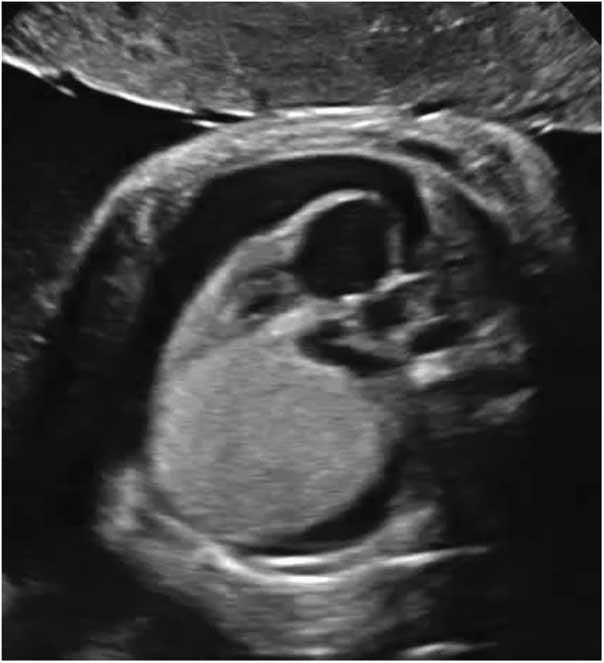
Fetal echocardiography revealed a giant left ventricular tumour of 43×42 mm, occupying almost all the left ventricular cavity. The tumour severely impaired diastolic and systolic left ventricular function. Evidence of retrograde flow across the aortic arch predicted a duct-dependent systemic circulation and the need for intravenous prostaglandins after birth. Moderate pericardial effusion was also present (Fig 1). During counselling to the parents, clinical features of tuberous sclerosis were found in the father who was unaware of having a systemic disease.
Giant left ventricular tumour on fetal echocardiography.

A 3040-g term female infant was born by caesarean section. The infant had Apgar scores of 6 and 8 at 1 and 5 min, respectively. She presented with signs of cardiac failure including respiratory distress, requiring orotracheal intubation and warranted transfer to neonatal ICU. Initial physical examination revealed rhythmic heart sounds without murmurs and symmetrical pulses in four extremities. Further evaluation reported preductal oxygen saturation of 88% and postductal oxygen saturation of 65%. Chest X-ray revealed severe cardiomegaly with clear lung fields. ECG demonstrated an incomplete left bundle branch block with a severe repolarisation disorder. Transthoracic echocardiogram confirmed the presence of a giant mass (47×40 mm) attached to the left ventricular wall, conditioning severe systolic and diastolic dysfunction. Two smaller tumours, sized 10×17 mm and 10×10 mm, located in the interventricular septum and the right ventricular free wall, respectively, were detected as well. Intermittent retrograde flow across the aortic arch was noted. A large patent ductus arteriosus of 7.3 mm with right to left shunt was present. Shortening fraction of the left ventricle was 15%. A moderate pericardial effusion with a maximum pool of 8 mm between pericardial leaves was also detected.
Prostaglandin E1 infusion was started at a dose of 0.05 mcg/kg/min on day 2 of life because of duct-dependent systemic circulation and decrease on patent ductus arteriosus diameter from 7.3 to 4.1 mm. Dobutamine was added on day 24 of life at a 10 mcg/kg/min dose and discontinued when digoxin was started on day 25 of life at a dose of 6 mcg/kg. Diuretics were used to prevent pulmonary oedema.
Abdominal ultrasonography was performed to discard associated anomalies of the urinary tract, showing bilateral renal cysts. Transfontanelle sonography revealed no alterations. Genetic evaluation confirmed the presumed diagnosis of tuberous sclerosis, with cardiac rhabdomyoma accounting for the major criteria and multiple renal cysts and confetti skin lesions accounting for two minor criteria. DNA extraction was performed for molecular testing, finding a pathogenic variant of tuberous sclerosis complex 2 gene on exon 34 that results in a premature stop codon and protein truncation. On day 36 of life, owing to unavailability, everolimus was started at a dose of 0.25 mg two times per day, only 2 days a week per nasogastric tube with no side effects encountered. Blood cell count, lipid profile, and hepatic and renal function tests were monitored weekly to avoid toxicity.
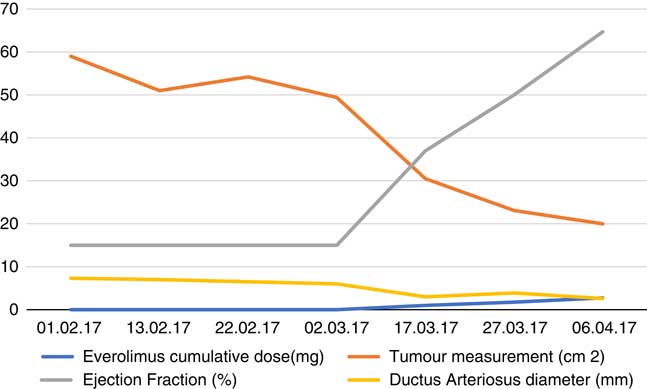
Tumour mass decreased significantly only after the start of everolimus, and ejection fraction also increased parallel to the tumour involution (Fig 2).
Clinical evolution showing tumour size decrease and improvement on ejection fraction with everolimus treatment.

Mechanical ventilation was weaned according to cardiac conditions considering the risk of pulmonary oedema. On day 54 of life with enhancement of ejection fraction to 50%, she was successfully extubated to nasal ventilation and weaned to nasal cannula. With improvement in ventricular function, prostaglandin infusion was stopped. The patient was transferred to intermediate care on day 63 of life. A new transfontanelle sonography revealed a subependimary echogenic image located at the anterior horns of the right lateral ventricle, presumed to be a subependymal nodule. No seizures were recorded during hospital stay.
Sildenafil was started at day 72 to decrease pulmonary pressure. Supplemental oxygen was discontinued on day 76, and on day 79 of life she was discharged and continued treatment with everolimus; no adverse effects were reported.
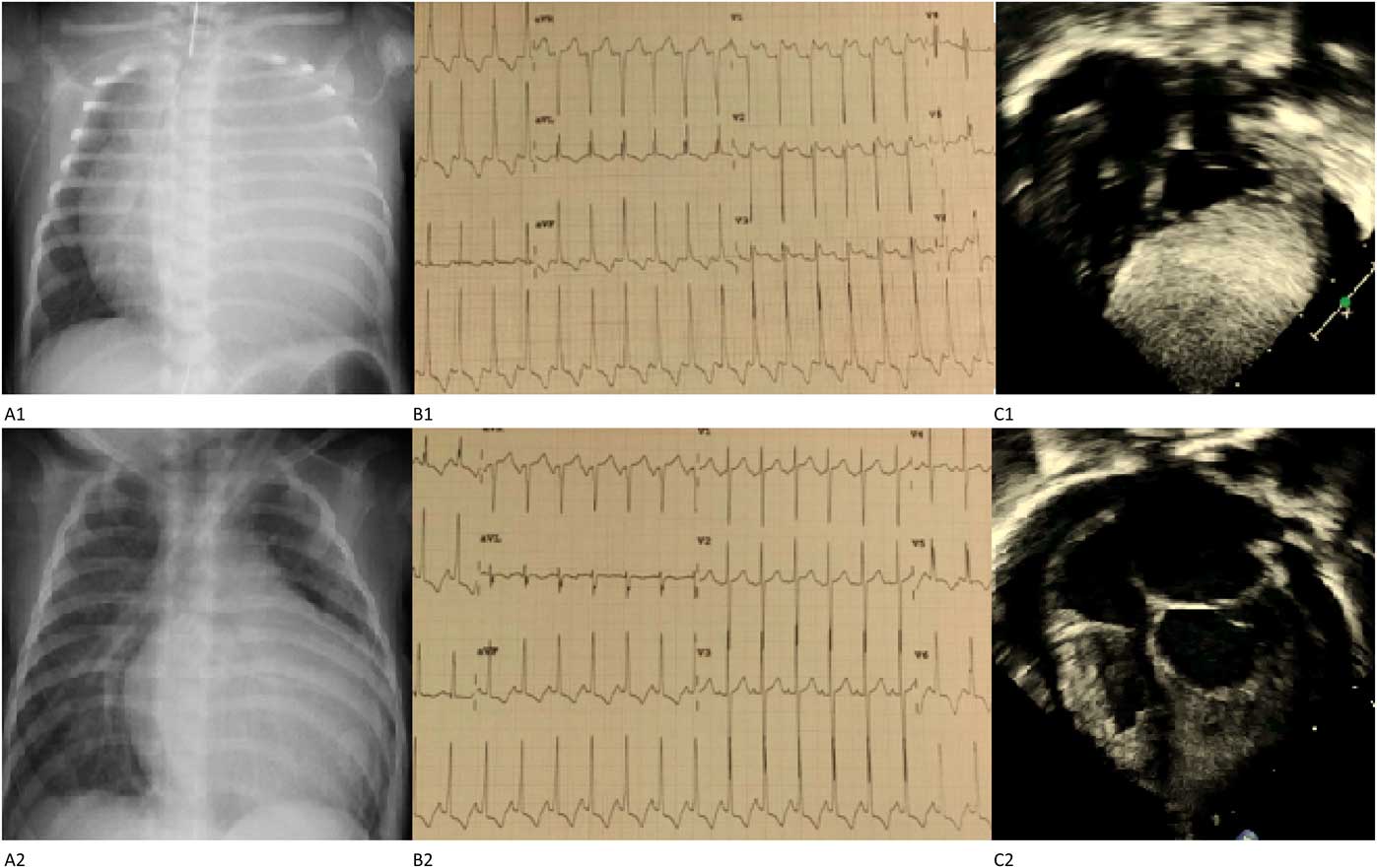
On day 120 of life, a follow-up echocardiography was performed revealing a left ventricle rhabdomyoma of 22×29 mm with a normal ejection fraction. The patient was asymptomatic and tumour size regression was adequate, being unnecessary to restart everolimus. Radiologic, electrocardiographic, and echocardiographic evolution is shown in Figure 3.
(A1) Chest X ray before treatment with everolimus showing severe cardiomegaly. (B1) ECG showing incomplete left bundle branch block with a severe repolarization disorder. (C1) Four chamber view echocardiogram demonstrating the presence of a giant rhabdomyoma (47 x 40 mm) attached to left ventricular wall. (A2) Chest X ray after treatment with everolimus showing improvement in cardiomegaly. (B2) ECG showing improvement in the repolarization pattern. (C2) Four chamber view echocardiogram after everolimus treatment revealing a significant decrease in rhabdomyoma dimensions.

Discussion
The main treatment of symptomatic cardiac tumours is surgical resection. However, this may be difficult when the tumours are multifocal and infiltrative.Reference Aw, Goyer, Raboisson, Boutin, Major and Dahdah 6 , Reference Goyer, Dahdah and Major 8 Furthermore, surgery for cardiac tumours carries an acceptable mortality risk (6.25% in Ying et al series).Reference Dogan, Yesil and Kayali 9 The use of everolimus has proven to be efficacious by enhancing rhabdomyoma size regression rate without significant adverse effects.Reference Aw, Goyer, Raboisson, Boutin, Major and Dahdah 6
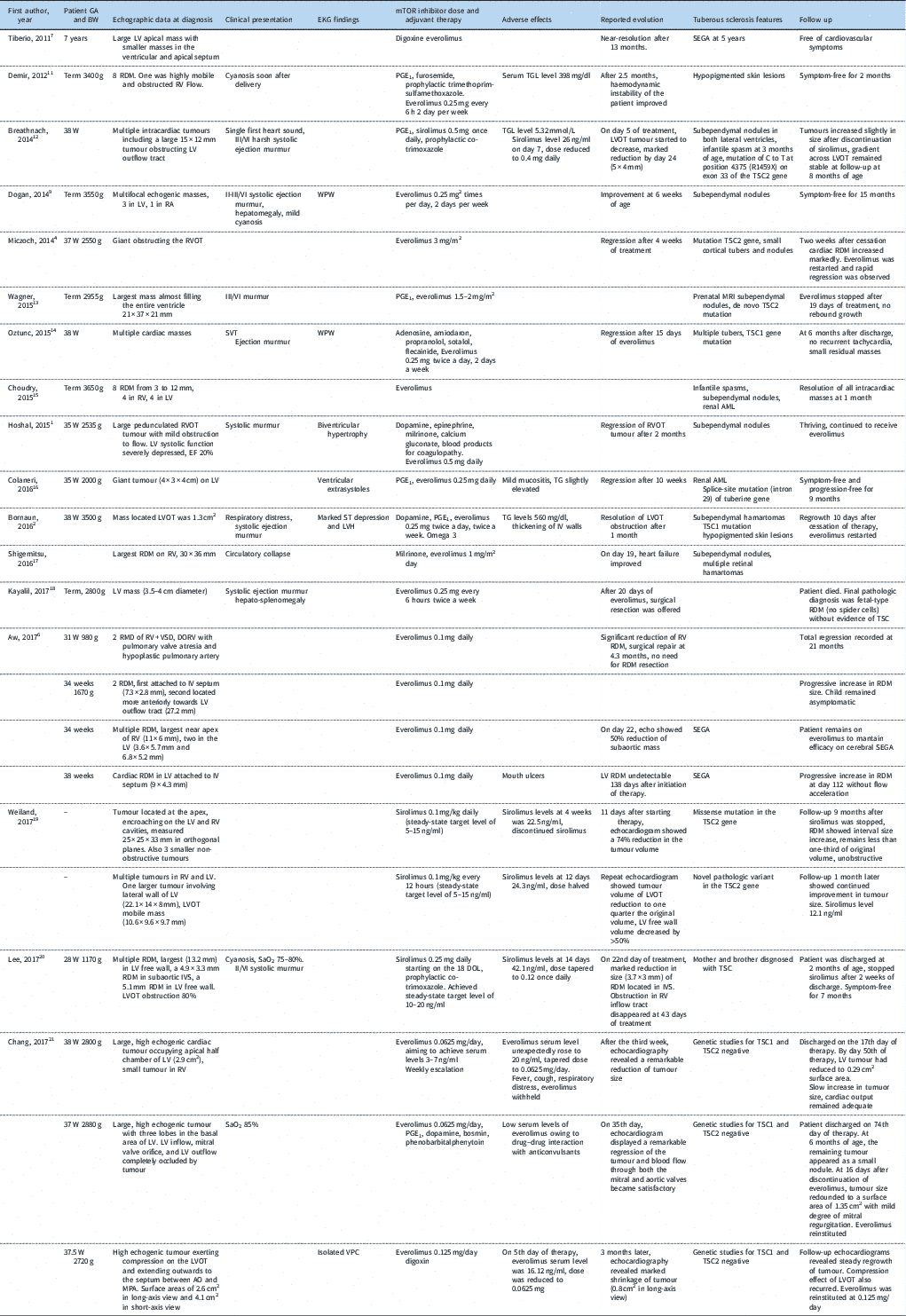
The study of Kotulska was the first to show mammalian target of rapamycin pathway dysregulation and an increased expression of proapoptotic Bax protein in cardiac rhabdomyoma associated with tuberous sclerosis complex.Reference Kotulska, Larysz-Brysz and Grajkowska 10 The authors also looked for the possible mechanism of cardiac rhabdomyoma regression and postulated that it depends on apoptosis regulation abnormalities associated with mammalian target of rapamycin pathway disruption.Reference Kotulska, Larysz-Brysz and Grajkowska 10 To date, several cases of cardiac rhabdomyomas treated successfully with everolimus have been described (Table 1).Reference Hoshal, Samuel, Schneider, Mammen and Vettukattil 1 , Reference Bornaun, Oztarhan and Erener-Ercan 2 , Reference Miczoch, Hanslik, Luckner, Kitzmuller, Prayer and Michel-Behnke 4 , Reference Aw, Goyer, Raboisson, Boutin, Major and Dahdah 6 , Reference Tiberio, Franz and Phillips 7 , Reference Dogan, Yesil and Kayali 9 , Reference Demir, Ekici, Yazal Erdem, Emir and Tunc 11 – Reference Chang, Chiou, Yao, Chou and Lin 21 However, the United States Food and Drug Administration has not approved the treatment of cardiac rhabdomyomas with mammalian target of rapamycin inhibitors.Reference Hoshal, Samuel, Schneider, Mammen and Vettukattil 1
Characterization of patients with cardiac rhabdomyomas treated with mTOR inhibitors.

AML=angiomyolipoma; AO=ascending aorta; BS=body surface; BW=birth weight; DOL=day of life; DORV=double-outlet right ventricle; EF=ejection fraction; GA=gestational age; IV=interventricular; LA=left atrium; LV=left ventricle; LVH=left ventricular hypertrophy; LVOT=left ventricular outflow tract; MPA=main pulmonary artery; mTOR=mammalian target of rapamycin; RA=right atrium; RDM=rhabdomyomas; RV=right ventricle; RVOT=right ventricular outflow tract; SEGA=subependymal giant-cell astrocytoma; SVT=supraventricular tachycardia; TG=triglyceride; TSC=tuberous sclerosis complex; VPC=ventricle premature contractions; VSD=ventricular septal defect; W=weeks; WPW=Wolf–Parkinson White
We report a case of a giant rhabdomyoma of the left ventricle, causing severe left ventricular dysfunction and leading to a duct-dependent systemic circulation. Before treatment, the size regression rate was 0.32 cm2/day, and increased to 0.80 cm2/day after everolimus. Aw et al reported an rhabdomyomas size regression rate 11.8 times faster with everolimus than historic controls, and a reduced dose of 4.5 mg/m2/week was sufficient to obtain recommended therapeutic level.Reference Aw, Goyer, Raboisson, Boutin, Major and Dahdah 6
Everolimus undergoes complete hepatic metabolism through CYP 450 3A4. This metabolic pathway is immature in preterm and full-term newborns in the neonatal period,Reference Goyer, Dahdah and Major 8 for which liver function should be monitored. The various rapamycin analogues differ in hepatic metabolism, in which everolimus is 2.7-fold lower than sirolimus. Nonetheless, sirolimus systemic clearance is half that of everolimus, giving everolimus faster steady-state levels after initiation and faster elimination after discontinuation.Reference MacKeigan and Krueger 22 CYP3A-dependent sirolimus metabolite formation changes in an age-dependent manner as described by Emoto et al,Reference Emoto, Fukuda and Mizuno 23 with rapid increase of sirolimus clearance over time in neonates and in infants, indicating a developmental change. In our review of literature, hypertriglyceridaemia and mild mucositis were the most commonly reported adverse effects of mammalian target of rapamycin inhibitors, which disappeared after discontinuation of the drug and were not dose dependent. Doses of everolimus ranged from 0.1 mg daily to 3 mg/m2 body surface, achieving regression of the cardiac rhabdomyoma. Mass regrowth was observed in some cases, for which everolimus was restarted. Rebound growth was not associated with dose or duration of treatment. Dosage regimens for sirolimus range from 0.1 mg/kg/day to 0.5 mg daily, reporting cardiac rhabdomyoma regression. It is noteworthy that dose had to be tapered owing to supratherapeutic serum levels – above 20 ng/ml – in all cases, without adverse effects reported.Reference Breathnach, Pears, Franklin, Webb and McMahon 12 , Reference Weiland, Bonello and Hill 19 , Reference Lee, Song, Cho, Choi, Ma and Cho 20 In the case reported by Lee et al, sirolimus reached a level of 42.1 ng/ml in a preterm infant with an initial dose of 0.25 mg daily. Steady-state serum level of sirolimus at 10–20 ng/ml was achieved under 0.12 mg once daily, which corresponded to 0.1 mg/kg/day, suggesting this to be a reasonable dose to start treatment with sirolimus.Reference Lee, Song, Cho, Choi, Ma and Cho 20
Target levels have been described for sirolimus and everolimus. Sirolimus and everolimus were initially developed to treat fungal infections and cancer and to prevent organ transplant rejection. As a result, robust knowledge around dosing and treatment-related side effects existed years before these drugs were first used to treat tuberous sclerosis complex.Reference MacKeigan and Krueger 22 Toxicity occurs in tuberous sclerosis complex patients with overall reduced frequency and severity compared with oncologic patients, possibly because these agents are monotherapies for tuberous sclerosis complex patients, whereas in other oncologic and transplant settings they are frequently combined with chemotherapy or immunosuppressant regimens. Furthermore, for cancer treatment, dosing is closer to the maximum tolerated dose, whereas in tuberous sclerosis complex dosing strategies seek to identify the minimum effective dose, thus avoiding side effects associated with higher doses.Reference MacKeigan and Krueger 22 In our case report, everolimus levels were not measured owing to unavailability. However, liver and renal function, lipid profile, and blood cell count were closely monitored. It is important to note that most commonly reported adverse effects have not been dose dependent.
In the first published case reporting regression of a cardiac rhabdomyoma in a patient receiving everolimus, Tiberio et alReference Tiberio, Franz and Phillips 7 described a therapeutic range of 5–15 ng/ml. The patient achieved everolimus serum levels of 2.3–7.1 ng/ml, showing near-resolution of ventricular rhabdomyoma.Reference Tiberio, Franz and Phillips 7 Target sirolimus levels in the initial period after transplant range from 10 to 15 ng/ml, decreasing to 5–10 ng/ml over the medium to long term.Reference Breathnach, Pears, Franklin, Webb and McMahon 12 Breathnach et al aimed for a level of 20 ng/ml in their report, which showed a significant effect on tumour regression. However, initial dosage of 0.5 mg once daily was reduced to 0.4 mg once daily owing to sirolimus level of 26 ng/ml on day 7 of treatment.Reference Breathnach, Pears, Franklin, Webb and McMahon 12
As described above, everolimus has a wider therapeutic range, and its use in tuberous sclerosis complex as monotherapy reduces the frequency and severity of toxicities.Reference Breathnach, Pears, Franklin, Webb and McMahon 12 , Reference MacKeigan and Krueger 22 Multiple dosing regimens have been described, and lower doses compared with the one described by Tiberio et al – for which no toxicity was reported – have been found to achieve regression of cardiac rhabdomyomas.
When compared, both agents similarly inhibit cell proliferation and T-cell immunologic activity, and both are efficacious in preventing organ rejection.Reference MacKeigan and Krueger 22 Comparative pharmacokinetics suggest that everolimus is more readily absorbed and exhibits greater oral bioavailability compared with sirolimus owing to selective intestinal cell efflux for which sirolimus alone is a substrate.Reference MacKeigan and Krueger 22 The more robust clinical trial experience with everolimus combined with regulatory approvals by the FDA and the European Medicines Agency provide the most compelling reason favouring everolimus over sirolimus to treat subependymal giant-cell astrocytoma and other tuberous sclerosis complex disease manifestations at this time.Reference MacKeigan and Krueger 22
As rhabdomyomatous tissue can generate myocardial electrical potential and act as an accessory pathway, arrhythmias may develop with an incidence of 14–16%.Reference Shi, Wu and Fang 3 , Reference Wagner, Riede and Seki 13 Resolution of arrhythmia was observed before tumour size regression in the majority of cases, with 2 weeks being the fastest rate.
Prenatal cardiac rhabdomyomas can be diagnosed from the 20th week of gestation, with a tumour growth spurt occurring between 22 and 32 weeks.Reference Yuan 24 In this period, arrhythmia and non-immune hydrops may cause fetal death.Reference Yuan 24 In fetuses with a tumour size greater than 20 mm, hydrops and dysrhythmia are significantly associated with neonatal morbidity.Reference Yuan 24
In older patients with tuberous sclerosis complex, the sequelae left by cardiac rhabdomyomas may lead to increased risk of sudden cardiac death.Reference Yuan 24 It is important to remember that mammalian target of rapamycin inhibitors have proven to be a systemic therapy, which is rather important in a multisystem disease such as tuberous sclerosis complex. Unfortunately, little is known about the long-term effects of mammalian target of rapamycin inhibitors in patients with tuberous sclerosis complex who started everolimus early in their childhood.Reference Yuan 24
A potential use of mammalian target of rapamycin inhibitor therapy could be in pregnant women, for in utero treatment of cardiac rhabdomyomas. Successful pregnancies in women undergoing everolimus treatment have been reported without teratogenic manifestations in the neonate.Reference Hoshal, Samuel, Schneider, Mammen and Vettukattil 1 However, hyperglycaemia and hyperlipidaemia could be fetal risk factors that should be considered.Reference Hoshal, Samuel, Schneider, Mammen and Vettukattil 1 This is the largest cardiac rhabdomyoma of the left ventricle reported, presenting with an accelerated response to everolimus and no significant adverse effects.
Conclusion
Mammalian target of rapamycin inhibitors have proven to be efficacious in the size reduction of cardiac rhabdomyomas in cases in which surgical resection is not possible owing to extensive intramural myocardial involvement or tumour size. The more robust clinical trial experience with everolimus provides the most compelling reason favouring everolimus over sirolimus to treat tuberous sclerosis complex disease manifestations. Although several dosage regimens have been used, doses as low as 0.1 mg daily and 0.1 mg/kg/day for everolimus and sirolimus, respectively, have been reported to be effective. Monitoring serum levels for dosage tapering are recommended, although adverse effects are presumably dose-independent. Treatment with mammalian target of rapamycin inhibitors has proven to be well tolerated; however, little is known about the long-term effects of this treatment started in the neonatal period.
Supplementary material
To view supplementary material for this article, please visit https://doi.org/10.1017/S1047951118000598