Introduction
There is no consensus in the literature about how to explain the behavior of smallholders in relation to household production choices. At one extreme are the theories premised on smallholders’ inclination toward profit maximization, whereas at the other extreme are propositions that they are irrational, unmotivated by profit and unresponsive to economic incentives. Some supporters of the latter view have gone so far as to cite smallholders’ conservatism as being responsible for their low agricultural productivity and poverty. The perceptions of the behavior of smallholders have implications in that development interventions and policy prescriptions are based on their predicted responses or lack thereof.
If it is assumed that smallholders act rationally, then it follows that growth in agricultural productivity can be achieved by increasing factor availability and providing new technologiesReference Wolgin1. On the other hand, if it is assumed that they are irrational, a different set of interventions is planned and implemented. The success of the interventions would therefore depend on the validity of the underlying assumptions about the behavior of their intended recipients, in this case, the smallholders. In my view, these diametrically opposed positions both suffer from the same shortcoming of theorizing without context. They are premised on assumptions that do not hold in many of the cases to which they are extended. I adapt Elli'sReference Ellis2 definition of peasants to define smallholders as households which derive their livelihoods mainly but not exclusively from agriculture, predominantly utilize family labor in farm production, are characterized by a partial engagement in input and output markets, and are both producers and consumers of agricultural goods and services. The term peasant is avoided due to the pejorative connotations usually associated with it in preference for the more neutral term, smallholder.
According to FAO3, conservation agriculture (CA) is an approach to managing agro-ecosystems for improved and sustained productivity, increased profits and food security while enhancing the resource base and the environment. It is conceptualized as a set of agronomic practices encapsulated in three principles namely: (i) minimal mechanical soil disturbance through zero or reduced tillage; (ii) maintenance of a permanent soil cover through the use of cover crops, intercrops, or mulching provided by crop residues or other organic materials; and (iii) diversification of crop species grown in sequences and/or associationsReference Kassam, Friedrich, Shaxson, Pretty, Toulmin and Williams4, 5. Owing in part to the wide diversity in the agro-ecological, economic and institutional landscapes of sub-Saharan Africa the actual practices of CA adopted across the sub-region vary tremendously. For instance, the operationalization of the principle of minimum mechanical soil disturbance can either be zero/no tillage or reduced tillage; performed manually, using animal draft power or tractors.
The variants of manual zero/no and reduced tillage systems commonly employed in southern and eastern Africa are use of the jab planter, dibble stick and the digging of planting basins.Reference Ngwira, Wall, Thierfelder and Lambert6 The jab planter and the dibble stick are used to plant seeds directly into the soil without any tillage while the digging of planting basins entails up to 30% of the soil is inverted. For those farmers with access to animal draft power, ripping, the making of furrows along which seeds are placed; or animal traction direct seeding systems are used. The tractorized variant also takes two forms, zero/no tillage or reduced tillage.
There are variations in the sizes of planting basins and accompanying cultural practices regionally. In West Africa , planting basins, termed ‘zai’, in Burkina Faso, ‘tassa ’ in Niger, are 20–30 cm in diameter and 10–15 cm deepReference Lahmar, Bationo, Dan Lamso, Guéro and Tittonell7; in Zimbabwe, the planting basins are 15 cm deep, 15 cm wide, and 15 cm broadReference Andersson, Giller, Sumberg and Thompson8 whereas in Zambia, they are 30×20×15 cm. A corollary of zero or reduced tillage under CA is increased weed pressure and use of herbicides. Under zero/no tillage systems, herbicides are exclusively used for weed management whereas both herbicides and mechanical weeding are employed in reduced tillage systems. Differences in the practice of CA are also through whether crops are rotated sequentially or intercropped; the legume crops grown; whether and what cover crops are used; if crop residues are used to provide the soil cover or organic materials are imported into the fields to act as mulch5.
Recently, there have been increasing calls for the integration of nitrogen-fixing trees with CA systems to have what is termed as conservation agriculture with trees (CAWT) or evergreen agriculture. CAWT reduces run-off and soil erosion, improves the physical, biological and chemical properties of the soil; combines the synergies of rapid improvements of livelihoods from CA with the longer term but sustained crop productivity and environmental resilience derived from nitrogen-fixing tress9. It builds on the indigenous knowledge of minimum-tillage farming techniques, traditionally practiced by many African communities in the past10. Underlying all of these CA principles and practices is the notion that agriculture should nourish and enhance the natural biological processes that support soil fertility, nutrient cycling and hydrological cycling. These ecosystem services, in turn, benefit farmers by boosting crop yield, reducing (but not excluding) the need for external inputs, increasing farm profitability and reversing land degradation5.
CA has been, and continues to be, promoted in Zambia on the assumption of the rationality of the smallholders. It is assumed that the current and persistent low productivity of smallholders in Zambia is caused by lack of access to appropriate technology and inputs, and a lack of knowledge of yield-improving sustainable agricultural practices like those packaged as CA. Reduced tillage practices promoted among CA farming households are the digging of planting basins and ripping. Planting basins are dug along carefully measured rows in a 0.9 m×0.7 m matrix using a specially designed hoe called a Chaka hoe11. Ripping is performed using a plow-like animal-drawn implement called a ripper to make 15–20 cm deep furrows in which seeds are planted12. The soils between the planting basins and ripped lines are left undisturbed. Zero tillage planters with configurations suited for oxen, horses and donkeys are being trialed in Zambia13.
Mechanized systems, although not yet common in Zambia, involve the use of tractors attached with disks and harrows, and direct drill planters. Hoes, cultivators and herbicides are used for weed removal before and after crops are planted. Herbicides such as glyphosate (N-(phosphonomethyl) glycine, 41% active ingredient), paraquat (1,1′-dimethyl-4,4′-bipyridinium dichloride), and atrazine (2-chloro-4-ethylamino-6- isopropylamino-1,3,5-triazine) are used. Manure and mineral fertilizers are prescribed at application rates of 4 t ha−1 and 325–550 kg ha−114 for the planting basin system and 4 t ha−1 and 200–500 kg ha−111 for the ripped systems, although the prescribed rates are rarely attained by smallholders. Crops are planted into the planting basins and ripped furrows after either manure or mineral fertilizer has been placed at the bottom. Other agronomic practices promoted as part of the CA package in Zambia are dry-season land preparation and early planting; planting of the legume tree Faidherbia albida within fields; and frequent weeding (4–6 times).
The objective of this study was to document smallholder CA farmers’ practices and household decision making, and assess these in light of the main household decision-making theories. There is an implicit assumption by CA experts and promoters that once the smallholders are shown the agronomic and economic benefits of CA, their profit maximizing calculus would automatically lead them to adopt it. No study has been conducted to assess whether such assumptions are valid with regards to CA smallholders in Zambia. I hypothesized that CA smallholders in the studied areas do not aim to maximize profits. Rather, they try to secure household consumption from own production first before any other considerations. This study shows that the non-adoption of CA by numerous smallholders who have clearly seen its agronomic and economic benefits suggests that factors or considerations other than, or in addition to, profit maximization may be at play. The phenomenon of partial adoption of CA, where smallholders adopt CA but only practice it on some of their fields is the norm. CA smallholders report higher yields and incomes from their CA fields even as they continue to farm substantial proportions of their land in the conventional way. Although they do respond to economic incentives, their responses are contingent upon ‘safety first’, minimizing risks associated with securing a minimum level of livelihood and investments by investing into local practices that serve as insurance. This may explain why they only partially adopt CA, which despite its productivity improving benefits, is still susceptible to the vagaries of climate and market failures. They also employ a range of livelihood diversification strategies aimed at dealing with the risks and seasonality that they have to endure over the course of a year.
The paper is informed by my field experiences and numerous discussions with CA and non-CA smallholder families, local leadership of rural communities in the southern, central and eastern provinces of Zambia, experts on CA and agricultural development in general, academicians and scientists working with smallholder families from all over the world and extensive literature review on the subject. I review a range of theories on household production choices and try to interpret the empirical evidence obtained from my own field work and from literature in the context of these theories. I use concepts from Ellis’sReference Ellis15–Reference Ellis17 Rural Livelihood Diversity in Developing Countries to think through the choices and activities of the smallholders under study.
Methodology
Overview of the study areas
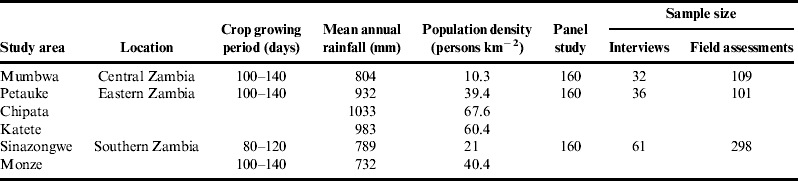
Fieldwork was conducted in Sinazongwe, Monze, Mumbwa, Petauke, Katete and Chipata Districts. These are semi-arid areas with average annual rainfall of between 600 and 1000 mm (Table 1). The seasonal rainfall is received between November and May, while the rest of the months are dry. The rainy season is characterized by inter- and intra-seasonal variations. The soils found in Sinazongwe are generally of low agricultural potential and are further limited by a seasonal lack of adequate water. The soils in the other districts are highly weathered, and of high agricultural potential18. Sinazongwe and Monze are located in the Southern Province of Zambia; Mumbwa is in the Central Province, whereas Petauke, Katete and Chipata are in the Eastern Province. Smallholder farming in the study areas is mainly rain fed and characterized by, inter alia, climate-related risks and uncertainties such as floods and droughts.
Selected agro-ecological descriptions and sample sizes of the study areas.
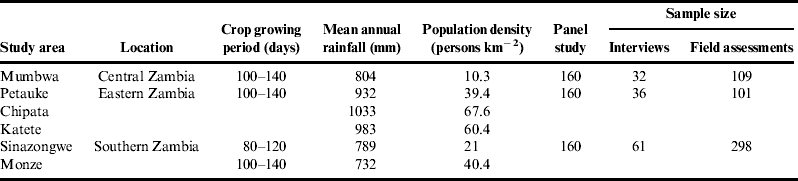
Except for Mumbwa, the population densities of the study areas were higher than the national average of 17.319. According to FAO20 these areas have a potential to support population densities of 201 persons per km2 under low-input and up to 500 persons per km2 under high-input agriculture. This suggests that the areas are currently underpopulated. Typically, a farming household had in excess of 20 ha of land under its direct control but only about 10–20% of this land is cropped in any one seasonReference Bwalya21. Similar to other areas where land is relatively abundant, the size of cultivated land is not determined so much by limited access to land as by limited household access to labor for cultivationReference Dorward22.
Mixed farming systems dominate, with most households engaged in both crop and livestock production. The most dominant crop grown is maize (Zea mays). The study areas are found in the southern half of Zambia referred to as the maize belt. This is a reflection of the ubiquitous production and consumption of maize in the region. Other crops traditionally grown include sorghum (Sorghum bicolor), groundnuts (Arachis hypogaea), cassava (Manihot esculenta), sweet potatoes (Ipomea batatas), soybeans (Glycine max), cowpeas (Vigna unguiculata), common beans (Phaseolus vulgaris), cotton (Gossypium hirsutum), tobacco (Nicotiana tabacum) and sunflower (Helianthus annuus).
Livestock mainly reared are cattle, goats, sheep and pigs. Poultry are also common, with local breeds of free-ranging chickens, guinea fowls and ducks being preferred. Mixed farming systems have led to the development of local norms pertaining to grazing for livestock. After harvest and on a date set by the traditional leadership (either chief or headman) fields become communal grazing grounds for livestock, which are then allowed to freely roam around the communities, whereas before they are either restricted to kraals or tethered near the owners’ homesteads. In this way, the livestock owners benefit through increased access to crop residues for their livestock while the owners of the fields benefit from the replenishment of soil nutrients through the dung that is dropped as the livestock graze. There is also an understanding that the oxen-owning households reciprocate by lending their oxen to the households without oxen at least once during land preparation (P.H. Nyanga, personal communication, 2012).
Data collection
Several field visits were made to the study areas beginning from February 2008 to January 2011. Primary data were collected through a 4-year panel survey that started with 640 respondents; 129 semi-structured interviews; field assessments; numerous informal interviews and talks; two focus group discussions; key informant interviews; observations; and attending field days. Field assessments included observing and recording of labor use during four farming operations, namely land preparation, planting, weeding and harvesting, over two complete farming seasons. Two focus group discussions were conducted with CA farmers representing all the four tillage methods under consideration. The discussions centered on household decision making pertaining to farming activities such as tillage system, crop choice, access and allocation of inputs.
Data analysis
The questionnaire survey and field assessments data were analyzed using independent sample t-test, Analyses of variance (ANOVA) and descriptive statistics were calculated using statistical software MINITAB 15 for personal computers23, R Studio24 and PASW/SPSS 1825. The statistical tests were conducted at a probability level of P⩽0.05.
Theory and Literature Review
Profit maximization theories
The profit maximization theories, epitomized by work from scholars such as SchultzReference Schultz26, LiptonReference Lipton27, StiglitzReference Stiglitz and Bardhan28 and others, argue for the smallholder mode of production as profit maximizing. The households are treated as farm businesses whose main aim of production is to allocate resources in order to maximize profit. They assume that the resource and production conditions confronting the smallholders are homogeneous, and that the markets for land, labor, capital and input/output products are fully competitiveReference Friis-Hansen29. In his seminal ‘efficient but poor’ hypothesis, SchultzReference Schultz26 posited that allocative efficiency was mostly high in smallholder agriculture in the context of the prevailing technical possibilities and of the factor and product–cost relationships. He elucidated that there were comparatively few significant inefficiencies in the allocation of the factors of production in traditional agriculture. His definition of traditional agriculture was that it was a ‘particular type of economic equilibrium at which agriculture gradually arrives over a long period, provided that: (1) the state-of-the-art remains constant, (2) the state of preference and motives for holding and acquiring sources of income remains constant, and (3) both of these states remain constant long enough for marginal preferences and motives for acquiring agricultural factors as sources of income to arrive at an equilibrium with the marginal productivity of these sources viewed as an investment in permanent income streams and with net savings approaching zero’Reference Schultz26 (pp. 29–30).
The defining characteristic of traditional agriculture is thus that the physical and economic environments, as well as preferences, have been stable for long enough that farmers have arrived at an equilibrium in which they optimize at the margins in their resource allocation and investment decisionsReference Ball and Pounder30. What follows is that disparities in economic behavior between farmers in poor and high-income countries arise not from any differences in economic motivation but rather from constraints faced by farmers, both resource constraints and constraints arising from existing institutionsReference Abler and Sukhatme31. Hence, to raise the productivity of traditional agriculture, farmers must have access to new information and high-payoff inputs. Schultz also assumed that smallholders in developing countries responded positively to price incentivesReference Sauer and Mendoza-Escalante32. He refuted the notion that farmers in developing countries were poor because of cultural characteristics such as a lack of work ethic, lack of understanding of the idea of saving, or general ignorance of how to make best use of their resourcesReference Ball and Pounder30. SchultzReference Schultz26 further argued that low income levels in developing country agriculture were a result of the low productivity of the available factors of production, not of inefficiencies in their allocation. The implication of this assertion was that outside experts could not help farmers improve productivity merely by suggesting a re-allocation of the available factors of production and it was therefore important to invest in education to facilitate the diffusion of new factors that could enhance productivityReference Ball and Pounder30.
By experimentation over time, Schultz argued, where the state-of-the-arts has not changed and where the environment is inherently risky, farmers learn how to allocate the resources at their disposal in a manner that is consistent with their own interests, that is, in an efficient mannerReference Abler and Sukhatme31. Sauer and Mendoza-EscalanteReference Sauer and Mendoza-Escalante32 contended that Schultz's hypothesis had important implications with respect to the long-term effectiveness of an individual development strategy applied to smallholder farming. If farmers are reasonably efficient, then an additional increase in efficiency requires the usage of more productive inputs and/or the application of a more productive technology to shift the production frontier upwards. If on the other hand, current inputs and/or technology could be used more productively, an improvement in the institutional setting that includes input markets, infrastructure endowment, available extension systems, management, and training services should be targeted to increase efficiency at the farm level.
Criticisms of Schultz's hypothesis have been leveled at his strict definition of a traditional agriculture and for failing to consider the implications of market failures for his hypotheses. LiptonReference Lipton27 observed that Schultz's hypothesis was only applicable for individual utility maximization under perfect competition. In the presence of market failures, even if farmers allocate their resources efficiently from each individual's point of view, there may still be collective inefficiencies. At the group or collective level, therefore, the efficient but poor hypothesis may failReference Ball and Pounder30. The proposition that smallholders are efficient in a purely neoclassical profit maximizing sense requires such strict assumptions about the competitiveness of the markets in which smallholders operate, that these are rarely likely to pertain in the smallholder populations from which the samples are drawnReference Ellis2. However, EllisReference Ellis2 argued that a great deal of evidence, especially on the responsiveness of smallholders to changes in relative market prices between crops, reveals a strong element of economic calculation on the part of smallholders everywhere.
Ellis proposed what he called conditional profit maximization instead. Smallholders maximize profits subject to (1) trade-offs with other goals, (2) resource constraints, and (3) the working of markets. Since the process of decision making of a smallholder family involves both production and consumption aspects, other economists have argued that profit maximizing theory tends to ignore a major side (i.e., consumption side) of the smallholder household decision processReference Chayanov33.
Another criticism of the profit maximization theory is that its assumptions are rarely likely to pertain to African smallholder societies. Many case studies have shown resource and production conditions in smallholder societies to be highly heterogeneous. Land in African smallholder societies is traditionally not subject to sale, and its allocation and use are guided by cultural, social and political relationsReference Ball and Pounder30. Labor is not freely available for sale in many smallholder societies, and work is primarily carried out by family labor. There are clear divisions of labor within the household which further limit the competitive allocation of labor. The availability of capital in smallholder societies is clearly limited and competitive capital markets are not developedReference Friis-Hansen29.
Utility maximization theories
These theories encompass the dual character of smallholder households as both families and enterprises and thereby take into account the consumption side of smallholder decision makingReference Mendola34. LiptonReference Lipton27 argued that utility maximization places emphasis on survival under conditions of uncertainty. Under conditions of imperfect knowledge (uncertainty) there is not a single marginal physical product for each factor, but a probability range within which the actual marginal physical product for any factor will be in a given year, and the range may be quite great. Under conditions of uncertainty, the smallholders, instead of profit maximizing, seek survival algorithms.
ChayanovReference Chayanov33 posited that the goal of any smallholder household was simple reproduction rather than profit maximization. He proposed that the interaction of consumption and production within the household caused a unique form of decision making, which sets smallholders apart from any other kind of production unit under capitalism. Chayanov argued that the smallholder economy could not be studied by applying profitability oriented capitalist economic principles. His utility maximization model involves a trade-off between the drudgery of farm work and the income required to meet the consumption needs of the household. According to Friis-HansenReference Friis-Hansen29, Chayanov argued that the smallholder household, using its own labor force, would apply it to agricultural production according to its internal equilibrium. This equilibrium is determined by equating the household demands and needs with the drudgery involved in meeting them.
Using a concept of consumer/producer ratio, ChayanovReference Chayanov33 analyzed the effect of changing household structure during the life cycle of a smallholder household on production and income. He then postulated that the intensity of farming or the use of family labor is a function of the ratio of consumers to workers in the family and that economic differentiation among smallholders in terms of farm size is more a measure of relative family size than differential economic success. Criticisms leveled at the utility maximization theories are that their sphere of analysis is limited to the household, and the theories can therefore not say anything about the development of society as a whole. They also treat the household unit as a single decision-making unit and do not take into account gender relations, division of labor and smallholders’ external relationsReference Friis-Hansen29.
Theories on risk-averse households
These focus on the trade-off between profit maximization and risk aversion. Smallholders are reported to exhibit risk aversion in their decision makingReference Binswanger and Sillers35, Reference Moscardi and de Janvry36 and to be risk-averse out of necessity because they have to secure their household needs from their current production or face starvation. There is no room for aiming at higher income levels by taking risky decisionsReference Lipton and Longhurst37. A risk-averse household prefers a smooth consumption stream to a fluctuating one, which in contexts of incomplete capital markets or underdeveloped institutional arrangements, entails a low-risk portfolio choice of productive activities. Innovative behavior, particularly in agriculture, involves risk and uncertainty.
Using a new technique, input or crop represents risk taking and uncertainty-bearing because by virtue of its newness there is no previous experience upon which to predict the outcomeReference Weeks38. Because those at the lower end of the income and wealth distribution apply not profit maximization, but a survival algorithm, they will not tend to innovate, and will not receive the gains from innovative behaviorReference Weeks38. Risk preferences are influenced by the resource constraint and capital market imperfections faced by decision makers. Thus, differences in preferences may be due to differences in access to institutional arrangements that enable households to pool risks across time. Risk, along with asset-poor initial conditions, may contribute to making small farm households inefficient and persistently poorReference Dercon39. Households first opt for safety and from the safe alternatives, they choose based on expected utility and possibly expected income.
According to PopkinReference Popkin40 many of the norms and procedures of smallholder societies are embedded in considerations of subsistence and survival; the village is not only a ritual and cultural unit, but is also an important part of smallholder economic life as a source of rights and resources. Smallholders are concerned with uncertainty when evaluating economic strategies. They prefer strategies with low but certain returns to strategies with high but uncertain returns.
Role of smallholder agriculture in economic development
The role of smallholder farming in agricultural development remains highly debated. CollierReference Collier41 argued that smallholder farmers in Africa were ill-suited to the challenges of contemporary agricultural development, lacking scale, knowhow and access to supply chains. He criticized the long-term preferences of donors and governments in Africa for small farms and their reluctance to support large-scale farming as a disservice to the continent. Favoring small farmers, he posited, was romantic but unhelpful. Collier and DerconReference Collier and Dercon42 contended that fast labor productivity growth is what is needed for large-scale productivity improvements but smallholders and the institutions to support and sustain them are weak agents for labor productivity growth in Africa. In response to this criticism, authors such as WigginsReference Wiggins43 have countered that records show the cases of smallholder success in Africa, both at district levels and for countries. Byerlee et al.Reference Byerlee, de Janvry and Sadoulet44 observed that small farmers can be efficient and innovative as seen in Asian green revolution but also in Africa as well when given the chance.
Others have argued that when smallholders increase production and productivity, the rural poor gain. Food security is as much about incomes and access as food supply; that is, agricultural development through smallholders can do much to raise the incomes of the poor and their access to foodReference Boyce45.
The Future Agricultures Consortium organized an e-debate on the topic and the contributors made the following arguments; small farms have advantages in managing labor as household labor is self-supervising in effort and diligence. This leads to more intensive use of labor and consequently higher output per hectare on smaller farms than larger ones. Small farmers may be better stewards of natural resources, conserving biodiversity and safeguarding the future sustainability of agricultural productionReference Boyce45. When countries are poor and agrarian, with people effectively trapped on the land, focusing on small farm development can reduce poverty, provide jobs, and constitute a safety net for those with few other assets than their access to land. For others, one of the roles of small farm development is to prevent premature migrationReference Hazell and Diao46. Displacing smallholders in developing countries would create a kind of social, political and economic chaos47. Similarly, Deininger and ByerleeReference Deininger and Byerlee48 recently argued that smallholders have an intimate knowledge of local soil and climate, often accumulated over generations, that gives them an advantage in tailoring management to local conditions and the flexibility to quickly adjust management decisions to site, seasonal and market conditions.
Although the large diversity among nations in their physical endowment, cultural heritage and historical context precludes any universally applicable definition of the role that agriculture should play in the process of economic growth, certain aspects of agriculture's role appear to have a high degree of generality because of special features that characterize the agricultural sector during the course of developmentReference Johnston and Mellor49. Agriculture, as the dominant sector of an underdeveloped economy can and should make a contribution to the capital required for overhead investment and expansion of secondary industry. The sheer size of the agricultural sector as the only major existing industry points to its importance as a source of capital for overall economic growth. Rising net cash incomes of the farm population may be important as a stimulus to industrial expansionReference Johnston and Mellor49. LewisReference Lewis50 and HirshmanReference Hirschman51 saw the role of agriculture in economic development to be as a supplier of labor for the expanding urban industries.
MellorReference Mellor52 extended Lewis’s arguments and espoused that agricultural growth creates demand for locally produced non-tradable items necessary for rural development. Mellor and JohnstonReference Mellor and Johnston53 pointed out that not only does agricultural growth provide food for the rural households it promotes employment in non-agricultural sectors by increased demand for non-agricultural consumer goods. For the case of Africa, VogelReference Vogel54 claimed that an agricultural demand-led industrialization strategy was a strong development option as agriculture was the primary source of factors that could be invested in the region's emerging industrial sector. Agriculture does not take place in isolation from the other sectors of the economy but is more or less closely intertwined with them in a matrix of interdependence.
Delgado et al.Reference Delgado, Hazell, Hopkins and Kelly55 among others have demonstrated that agricultural development has vital linkages with other sectors. MellorReference Mellor and Mellor56 postulated that promoting growth linkages in agriculture resulted in the highest multiplier effects. Davis et al.Reference Davis, Reardon, Stamoulis and Winters57 identified two types of farm/non-farm linkages. These are production and expenditure linkages. Agricultural production needs inputs while its products are used as inputs elsewhere. Households deriving income from one type of activity are likely to spend that income on products of other activities. Local entrepreneurs and wage earners use incomes from the sale of non-farm products to buy food and other agricultural outputs. They also provide inputs for the agricultural sector.
CA has been placed within this theoretical framework as an agricultural system that can contribute to economic development. By increasing labor productivity and gross margins, CA has the potential to increase smallholders’ incomes and improve household food security58. With time the poorest CA households are expected to graduate from being mere subsistence producers to selling a substantial part of their production through increased cash cropping and improve their cash income earnings. This links to the non-farm sector through their purchases of non-farm consumer goods, and purchase of agricultural inputs.
In the rest of this paper, I discuss the above theories in relation to my observations and analysis of smallholder farmers who were practicing CA in Zambia. I then comment on the extent to which the theories explain the results of my analysis of the practices and perceptions of the CA farming households studied.
Results and Discussion
Practicing of CA in Zambia: a deductive analysis
The practice of CA in the study areas did not seem to be based on profit maximization but rather several considerations were made. I make this assertion based on my own research on the CA smallholders in the study areas and also from critical review of the literature. I present the reasons for this assertion in the sub-sections below.
Partial adoption of CA systems
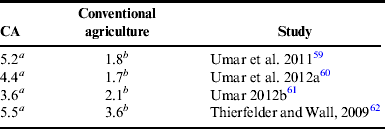
The superiority of yields from CA fields compared with conventionally farmed fields was reported by all the 129 households that participated in the semi-structured interviews and from the 2-year field assessments during this study; and other studies on CA in Zambia (Table 2)Reference Umar, Aune, Johnsen and Lungu59–Reference Thierfelder and Wall62. This view was also put forward in the focus group discussions, informal discussions and by most key informant interviewees. Yet all but one of the CA households continued to practice CA on only a portion of their total cultivated areas and allocated between 30 and 50% of their cultivated areas to CA. Allocating all their cultivated areas to CA would have increased their crop yields, total crop production and crop incomes. However, the CA households have several considerations when they select agricultural systems at the beginning of any particular farming season. One of these is choice of crop. There is a perception that some crops perform well in particular tillage systems. Therefore, once the decision has been made to engage in the production of a crop, the preferred tillage system for that crop will be used. For instance, sweet potatoes and cassava are characteristically grown on ridges and are perceived to be unsuitable for growing using CA tillage systems currently adopted in Zambia.
Average maize yields (t ha−1) from conservation and conventional agriculture fields.1
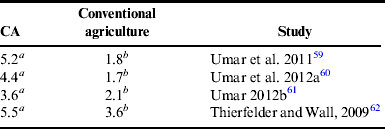
1 Means in the same row followed by different letters were significantly different at P⩽0.05.
Timing and drudgery
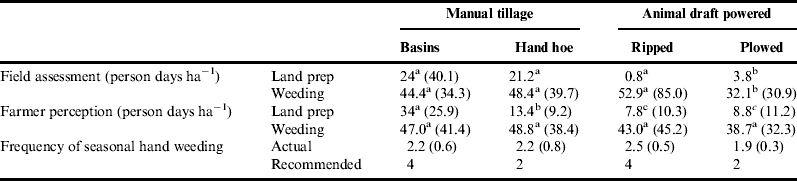
Another consideration made is the labor requirement and the timing of the land preparation for the farming system. The recommended ideal period for digging the basins is the post-harvest dry season. CA promoters contend that this enables labor-constrained households to spread their labor over a longer period. It also allows CA farmers to plant with the first effective rains in November, the beginning of the rainy season in Zambia. The combination of basins, precise input application and early planting results in higher yields. However, many CA households did not follow these prescriptions despite knowing their agronomic and subsequent economic benefits. They preferred to wait until the beginning of the rainy season before commencing to dig basins. They explained that basin digging was a very labor-demanding activity characterized by drudgery. This drudgery was exemplified in their perception of having done much more work than they actually did (Table 3).
Comparisons of actual labor use and perceptions in different tillage systems.1

Note: Values in parenthesis are standard deviations. Comparisons were made for the manual and animal draft powered systems separately.
1 Means in the same row followed by different letters were significantly different at P⩽0.05.
Households overestimated labor use on basin preparation by 42% but underestimated it in the hand hoe system by 37%. While the field assessments did not reveal any significant differences in labor use between basins and hand hoe systems, the farmers thought that the basin system required significantly more labor. Farmers also perceived their labor use to have been similar for ripping and plowing when, in fact, they had expended significantly less labor when ripping compared with plowing (Table 3). Field assessments and farmer perceptions converged in their conclusion that labor used for weeding was similar in the basin and hand hoe systems. This similarity seemed to suggest that households expended all the labor they could access at the time, and not a reflection of the labor requirements for the two systems, which are different.
Ideally, CA fields must be weeded four or five times per season, but this was not achieved (Table 3). There was divergence between actual labor use and farmers’ perception for the ripped and plowed systems with farmers reporting similarity when in fact ripping required more.
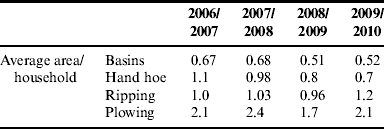
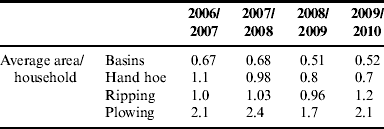
Basin digging was engaged in only for long enough to till an area of land sufficient to meet the families’ consumption needs and rarely more than that. Area under basins per household that had adopted this tillage system averaged 0.67 and 0.68 ha during the 2006/2007 and 2007/2008 farming seasons, respectively, but reduced to 0.51 and 0.52 ha during the 2008/2009 and 2009/2010 farming seasons, respectively (Table 4).
Area under different tillage systems over four farming seasons.
The households were either unwilling or unable to expand area under basins much beyond the area cultivated. I argue that basin digging was adopted as a safety first food security strategy and not for profit maximization. Moreover in line with Chayanov'sReference Chayanov33 assertions, I further argue that the CA households did not push the practice of basin digging beyond the point where the possible increase in output was outweighed by the drudgery of the extra work. ChayanovReference Chayanov33 had further observed that each family struck a rough balance between the degree of satisfaction of family needs and the degree of drudgery of labor.
Drudgery aversion also explains the CA household members’ behavior. Most of them waited for the rains to soften the soils before they engaged in any tillage operations despite the yield losses that resulted from late land preparation and planting. They also only worked for a few hours per day, usually from early in the morning to mid-morning or midday. They spent the rest of the day on non-farm activities such as chatting with friends, resting, drinking beer, and attending to household and community responsibilities; anything but farming. They preferred engaging in such activities to continued digging of basins despite the higher production that would result from having larger tracts of land under basins.
CA farming operations and livelihood strategies
The failure by most CA households to engage in dry-season basin digging seemed also to be related to their livelihood diversification strategies, which entailed their engagement in non-farm activities during the dry season. The CA farmers engaged themselves in economic and social activities during the post-harvest period such as trading, fishing, rethatching of huts, carpentry, masonry, craft making, preparations and attending of traditional harvest ceremonies, weddings and travel to urban areasReference Umar, Aune, Johnsen and Lungu59. Smallholder farming in Zambia is a precarious enterprise influenced by uncertainties that are biophysical, institutional and economic. The biophysical uncertainties are typified by the unimodal rainfall whose distribution is unknown at the beginning of the season.
The large variances in the rainfall amounts and distribution within and between seasons have spurred the development of risk aversion behavior among smallholders. Smallholder CA farmers minimize risk by having a combination of tillage and cropping systems. NyangaReference Nyanga63 also noted the diversification of tillage systems among CA farmers in Zambia and suggested that rather than seeing CA as an overall superior agricultural system, farmers perceived CA as an additional option, among many, for addressing their food security problems.
Area under CA after flood incidences
The average area under basins per household reduced during the 2008/2009 and 2009/2010 farming seasons, which were characterized by above normal rainfall that resulted in floods64. Basins became waterlogged and farmers responded by backfilling them and making ridges around the crops. The farmers reported that although this action greatly disturbed the soil, it was necessary for crop survival but complained that it increased their labor burden. This shows that farming households are responsive to unexpected changes in their environment and act to minimize crop losses, even if that means going against the recommendations of CA experts. The flooding episodes also exacerbated weed pressure. Field observations confirmed very high weed infestations in fields that had been flooded. This seemed to be a disincentive to the expansion of a tillage system whose success is premised on its attribute of conserving water during periods of moisture stress and therefore recommended for low rainfall areas. The CA households responded by re-allocating less land to basins and slightly more to ripping during the 2009/2010 farming season, as ripped fields had not been besieged by waterlogging to the same extent.
Profitability comparisons for CA and conventional systems
Ripping had higher gross margins than plowing (Table 5), basin digging was also much more profitable than its conventional agriculture equivalent, hand hoeing. It must be noted that family labor was given a shadow price and treated as a variable cost during the calculations of gross margins. Smallholders themselves do not cost family labor in this way. Their assessments of total variable costs was thus less than the actual for all tillage systems except plowing, as in their calculations they did not include the cost of labor that was not paid for.
Economic analyses for four tillage systems from field assessments and farmer perceptions.

Farmers persisted with the less profitable plowing as it was a deeply embedded practice, which has been tried and tested over many generations. In southern and central Zambia, plowing is also associated with the tribal identity of the dominant tribes of these areas. Plowing was, for instance, perceived as what Tongas do’. Being Tonga is conceptualized as including the use of oxen and mould board plow for tillage. Ripping does not yet have the same cultural connotations. Basins were profitable during periods of normal and below normal rainfall. However, during seasons of above normal rainfall, they became waterlogged and resulted in yield losses.
Plowing and hand hoeing result in yield losses during periods of below normal rains. CA households therefore prefer the lower but more stable yields that result from the diversification of tillage practices as opposed to complete conversion to CA tillage systems. This process of livelihood diversification is not unique to the study areas but is common to many poor communities whose lives are characterized by uncertainty. EllisReference Ellis16 contended that seasonality explained many of the patterns of diversity in rural household incomes, especially those involving on-farm diversity and off-farm agricultural wage earnings. He further argued that as both risk and market imperfections abound in the rural economy, income instability, and consumption smoothing are real problems confronted by households, and therefore an important motive for income diversification associated with seasonality is to reduce income instability.
CA households in Zambia and production choice theories
The observed behavior of the studied CA households agrees with the utility maximization theories in that households are more interested not in profit maximization but in maximizing their utility, be it through assurance of home consumption, avoidance of drudgery and engagement in non-farm activities. LiptonReference Lipton27 argued that under conditions of imperfect knowledge or uncertainty, smallholders seek what he termed as ‘survival algorithms’ and not profit maximization. ScottReference Scott65 in a similar vein posited that the smallholder cultivator seeks to avoid the failure that will ruin him rather than attempting a big but risky killing. This is exemplified in this case by smallholders not knowing the future price of their crops and the local rainfall distribution at the beginning of the farming season when decisions about which crops to grow are made. When it comes to maize, for instance, the central government through its agency called the Food Reserve Agency (FRA) sets the floor price of maize grain after harvest. Smallholder farmers therefore have no way of knowing whether it would be profitable to grow maize beforehand.
Smallholder farming in Zambia is quite unique for its dominance of maize, not only in terms of inputs allocated to maize growing but in the collective farmers’ and policy makers’ mindsets. Successful farming seasons are conceptualized as ‘bumper’ maize harvests. In south, central and eastern Zambia, farming is maize and maize is farming. Not only is maize the single most important staple crop, but it is also a culturally and politically important crop. The first considerations made when it comes to farming at the start of the farming season by all typical smallholders in southern Zambia is to produce maize, how much maize to produce, and what resources to allocate to maize production. The maize is grown first and foremost for household consumption. Depending on the resources the household is able to command, decisions on growing cash crops then follow while the production of locally adapted food crops, either as intercrops or in own fields, goes without saying.
The diversity and quantities of crops grown by a household is also a reflection of its command over the relevant resources. Those who can afford to, grow all kinds of crops for the many different household uses. In the south-eastern part of Zambia the saying ‘pa khomo apa mpamwana alirenji ’ whose literal translation is ‘this household has everything, what can a child cry for?’ is a reflection of the importance of growing for own consumption and the desire to be as self-sufficient as possible especially with food resources. All households grow the must-have crops such as maize, groundnuts, pumpkins, sorghum, cowpeas and so on; whereas the better endowed ones venture into cash crops, horticulture and a higher diversity of other crops. The better endowed households also use more purchased inputs such as mineral fertilizers, hybrid seed, pesticides, hired labor and labor-saving technologies. They are also able to respond to economic incentives and adopt new innovations as they can afford to take risks in a way that poorer households cannot.
Smallholder CA households and risk
DufloReference Duflo66 argued that poverty changes the set of options available to individuals. A poor person is more likely to be risk averse if he has limited access to resources/insurance since shocks are particularly painful if one has very little to buffer them. He may thus not be an efficient farmer because the efficient choice would be too risky. EllisReference Ellis17 argued along similar lines and posited that risk aversion results in farming practices designed to increase family food security rather than to maximize profits. A trade-off is made between livelihood security and economic efficiency. Smallholders’ risk aversion inhibits the diffusion and adoption of innovations, which could improve the output and incomes of smallholder farm families. In the areas studied, risk aversion was manifested by the focus on producing for own consumption; the piecemeal adoption of CA; and diversification of tillage systems and livelihood strategies.
Risk aversion also resulted in the delayed application of basal fertilizer. Instead of applying the basal fertilizer before planting as prescribed by agronomists, most households reportedly waited until after the shoots had emerged. Focus group discussants asserted that they did not want to risk their hard-earned fertilizer by putting it in the ground when they were not sure that it would rain in good time and the maize seed would germinate and the shoots would emerge. They also delayed their planting until they were sure that the rainy season had effectively started. These two risk-averse strategies resulted in sub-optimal crop yields. Hagblade and TemboReference Haggblade and Tembo67 and CFU14 estimated that Zambian smallholders lost 1–2% of their yield for every day they delayed their planting after the first planting opportunity. ScottReference Scott65 argued that living close to the subsistence margin and subject to the vagaries of weather and the claims of outsiders, a smallholder household has little scope for the profit maximization calculus of traditional neoclassical economics.
While most smallholders studied responded to economic incentives, their environment characterized by market and government failures limited or conditioned their responses . In Mumbwa District, they responded to the higher soybean prices by allocating larger areas to soybean production as they cut down on cotton production. Cotton companies offered ZMK1400 kg−1 (US$0.3 kg−1) while soybeans were sold at ZMK3500 kg−1 (US$0.7 kg−1). Most farmers complained of low cotton prices offered by the cotton companies in the area.
Focus group discussants and probing from individual farmers during the administering of the semi-structured interviews revealed that although velvet beans (Mucuna pruriens) was known to be a good cover crop and excellent at nitrogen fixation, only 14% grew it. The most common complaint leveled against its production was that there was no market for it. Government failures to provide public goods such as roads and other communication infrastructure increased the transaction costs on the part of the smallholders and reinforced market failures. The roads leading to the communities in the study areas were in a grave state of disrepair and most were impassable at the peak of the rainy season. In such an environment, farmers opt to focus on producing for own consumption instead of producing high-value crops that would generate the cash for buying food.
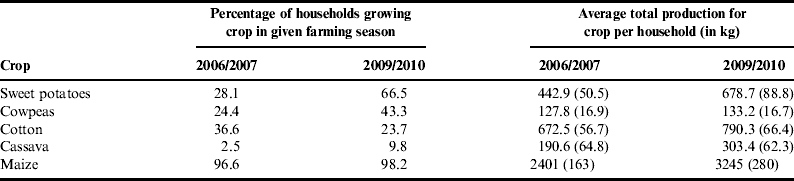
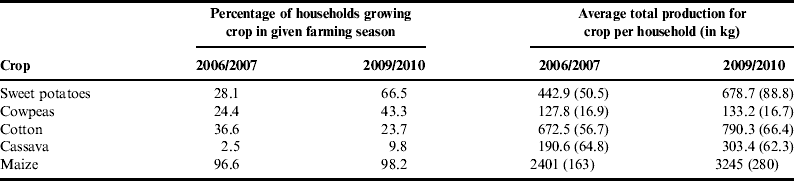
CA smallholders may not be efficient but poor, as espoused by ShultzReference Schultz26 but they definitely respond to economic incentives that they perceive as not placing their livelihood options under undue risk. In this regard, the CA farmers in the areas studied responded positively to price incentives by increasing the production of crops whenever the farm gate prices stabilized at levels perceived as high enough to spur the increased production. Other incentives such as provision of input and price subsidies, or even free inputs by technology promoters also elicited responses from the CA households (Table 6).
Average percentages of household crop production and total production for selected crops.
Note: Values in parentheses are standard errors.
In the study area, a CA promoter provided sweet potato vines, cassava cuttings, cowpea seeds to CA farmers and stationed extension agents in the study area to closely supervise them. The result was an increase in both the number of households producing these crops and the average quantities produced. There was a reduction in the number of households growing cotton (Table 6). The households that abandoned cotton cultivation complained of the low prices, while those that continued with it revealed that they increased the hectarage under cotton in efforts to maintain stable cotton incomes after the fall in cotton prices. This was reportedly challenging for them as cotton production was labor intensive and required up to five weedings per season. This is as was observed by EllisReference Ellis2 that a great deal of evidence, especially on the responsiveness of smallholders to changes in relative market prices between crops, reveals a strong element of economic calculation on the part of smallholders everywhere. This is contrary to the perception that poor smallholders do not respond to economic incentives because they are overly risk averse, due to their culture or are laggards.
CA smallholders were engaged in work-sharing arrangements in which labor was pooled for purposes of helping labor-constrained counterparts meet their labor needs during critical farming periods. For widows without adult males in their households, the help extended to such activities as rethatching of huts and granaries, plowing and ripping, weeding, pre-tillage felling of large trees and other activities on humanitarian or altruistic basis. Local mechanisms also include sharing food, receiving remittances, sending off household members to less affected kin. Patrons, that is, wealthy households that have patron–client relationships with the poorest households, are also expected to help out by providing food to affected clients. These are limited in that most members of the same community are poor. It is difficult for patrons to provide adequate help during calamities that affect a large number of people at the same time, e.g., food shortages resulting from droughts or floods.
Development of such norms is aimed at spreading risk and helping offset resource constraints. Such practices are part of what ScottReference Scott65 referred to as the moral economy of the peasant. He distinguished between technical and social arrangements. Under social arrangements he included patterns of reciprocity, forced generosity, communal land and work-sharing. Technical arrangements consisted of seed varieties, planting techniques and timing. These arrangements helped to even out the inevitable troughs in a family's resources which might otherwise have thrown them below subsistence. In a similar vein, PopkinReference Popkin40 observed that many of the norms and procedures of smallholder societies are embedded in considerations of subsistence and survival; the village is not only a ritual and cultural unit, but is also an important part of smallholder economic life as a source of rights and resources.
In the studied areas, it was common for smallholders to leave their farming at critical periods to go and attend funerals or visit sick kin and friends within or in neighboring villages. Such show of support for one's kin and friends was expected to be reciprocated in the future when misfortune struck one's household. For the very poor households, their mere presence was enough, while the rich patrons were expected to help the affected family meet its material needs. These norms would qualify in Scott'sReference Scott65 terminology as social arrangements. Technical arrangements in the studied areas included the selection and planting of local landraces, multi-cropping, mixed farming (crop and livestock production) and the like. Focus group discussants reported that the exchange of 10 kg bags of hybrid seed for 10 kg of local seed varieties was common. Abler and SukhatmeReference Abler and Sukhatme31 observed that aspects of agricultural households’ decisions and land tenancy arrangements in developing countries seemingly defy efficient behavior. However, LiptonReference Lipton27 elucidated that many superficially odd village practices make sense as disguised forms of insurance.
Placing CA in context—its linkages and role in economic development
During the period immediately after harvest, CA households have disposable income from their crop sales which they use to purchase consumer and investment goods. They use part of their incomes to purchase agricultural inputs. Local purchases spur the local economy but are limited by a lack of business entities in the locality. Travel to urban centers is usually necessary for the acquisition of most goods. This minimizes the local linkages between the farm and the non-farm sectors. The severe dearth of critical infrastructure such as all-weather roads, small-scale processing industries, electricity and mobile phone networks also increases the transaction costs. This has, on the one hand, benefited and encouraged the growth of private transporters. The small-scale processing sector is limited to a very small number of the better-off households that own mechanical processors for vegetable oils (groundnuts, sunflower) and milling (maize, groundnuts); and threshers. Blacksmiths forge the blades for traditional hand hoes and the Chaka hoes used for digging basins, while local carpenters make the wooden handles for the hoes. The agricultural implements are also stocked in shops in the urban centers.
The dependence on externally procured and expensive inputs and lack of availability of CA implements (rippers, subsoilers, planters) limits the backward linkages and the expansion of CA activities locally. The minimal development of local markets and high cost of transporting farming produce to larger urban and peri-urban markets has limited the horticultural production, which can potentially create more local linkages. About 30% of the CA households with irrigated fields near rivers were involved in the growing of tomatoes and green vegetables but they complained of unreliable markets, which occasionally led them to sell at extremely low prices locally to avoid the products going to waste. They also complained about the cost of going to the urban centers to purchase agro-chemicals. The potential for CA to contribute to the economic development is there but is currently hindered by the isolation of most of the smallholders and the high transaction costs.
Theorizing on smallholder CA households in Zambia
Smallholder CA households in Zambia live in environments characterized by uncertainty related to the biophysical environment, markets and public goods provision. They deal with the uncertainty both as consumers and producers. They do not aim at profit maximization but at contingent utility maximization. Their practice of farming prioritizes own consumption before other considerations such as deciding whether and what to grow for sale. The amount and type of foods to be produced for own consumption is mediated by the size of the households and the access to needed resources. In response to the pervasive risks and uncertainty, practices and norms aimed at minimizing risk and the adverse effects of calamitous events have been developed and are consciously maintained. These include strong local institutions for reciprocity, labor pooling and communal grazing for livestock during the post-harvest season, among others. Added to these are livelihood diversification strategies. Most smallholders have a diverse portfolio of activities that are engaged in by different household members at different times of the year.
Decisions on whether to adopt CA, and how many of the prescribed practices to adopt and over what area, are made in light of the impact on the whole range of other livelihood strategies engaged in by the household, and also in light of local norms and practices. Certain crops are locally important and always grown for home consumption and other household uses for such crops as pumpkins, millet and sorghum. No profit motives enter into the growing of such crops. Some farmers also grow crops that have been important historically and are integral parts of rituals during traditional ceremonies. For example, other than maize, pumpkins and sugar canes are used during the Ncwa'la ceremony of the Ngoni people of eastern Zambia; maize, sorghum and millet are important constituents of traditional beer, consumed at community gatherings in all regions. The extent to which CA contributes to the development of both the farm and the non-farm sector will depend to a large extent on the minimization of risks and uncertainty that characterize the practice of CA by smallholders, drudgery, and labor needs of manual CA, and the removal of factors that hinder the strengthening of farm and non-farm linkages.
Conclusion
This paper has argued that contrary to the profit maximizing theories, the CA smallholders in Zambia do not aim at profit maximization but at being able to secure their own consumption in a risky and uncertain environment. This is contrary to the premises of current dominant CA intervention efforts which assume a priori that conviction of CA's agronomic and income earning superiority over conventional agriculture systems would motivate smallholders to embrace CA. Given that smallholders face risks and uncertainty, which influence their responses to agricultural innovations, there is a need to take greater cognizance of the sources of risk and uncertainty, which include rainfall, germination, crop prices and other market-related factors. The challenges faced by smallholders when it comes to meeting their livelihood needs and expanding their income earning opportunities hinder productivity improvements, adoption as well as expansion of CA practice. Infrastructural developments would spur economic activity that could impact positively on both farming and non-farming sectors. Development of both backward and forward linkages to the agricultural sector is needed in order to secure whatever gains could come out of the consistent and increased practice of CA. This can be in the form of support to develop local artisanal jobs, processing and storage facilities, communication infrastructure, service delivery and livestock husbandry.
Access to urban markets would be pivotal as this would improve farmers’ incomes and prompt a shift to more of the high-value crops, adoption of productivity improving technologies, and more risk-taking behavior. Reductions in the risks and uncertainty faced by CA households would expand the area under CA and other agricultural productivity improving innovations. This would have positive effects on both the forward and backward linkages. Access to resources is important as it affects smallholders’ ability to undertake activities and withstand shocks. The CA smallholders have diversified their livelihood strategies as a risk reducing measure. Promoters of CA in Zambia need to adapt it so that it supports the diversification strategies engaged in by the smallholders rather than to counter them. The socio-cultural and institutional environment is important and should be factored into project design and implementation strategies. Local contexts affect both constraints and opportunities.