1. Introduction
Super-hydrophobic (SH) surfaces are patterned rough surfaces covered with a hydrophobic coating, for which the roughness is of micro-scale, the contact angle is large, typically greater than
 $150^{\circ }$
, and the contact angle hysteresis is small, typically less than
 $5^{\circ }$
(Rothstein Reference Rothstein2010). Upon contact of liquids with these surfaces, small bubbles form in between the surface roughness tips, producing a mattress of gas/liquid menisci, over which liquids can slip. This slippage generally leads to drag reduction (DR), but under certain conditions can also lead to drag increase (DI). The magnitude of DR or DI is dependent upon the meniscus shape, its protrusion angle, the SH surface micro-pattern, and the flow regime (Steinberger et al.
Reference Steinberger, Cottin-Bizonne, Kleimann and Charlaix2007; Davis & Lauga Reference Davis and Lauga2009; Rothstein Reference Rothstein2010; Karatay et al.
Reference Karatay, Haase, Visser, Sun, Lohse, Tsai and Lammertink2013). The surface slippage is generally characterized by an apparent slip velocity,
 $U_{s}$
, and a corresponding slip length,
 $L_{s}$
, defined as
 $L_{s}=U_{s}/\langle \partial U/\partial n\rangle _{wall}$
(Voronov & Papavassiliou Reference Voronov and Papavassiliou2008), where
 $n$
denotes the unit normal on the wall, and
 $\langle \,\rangle$
denotes averaging over the pattern of the SH surface micro-texture.
In laminar flow, a number of experiments have reported SH DR or DI with various patterns of SH surface micro-texture (Steinberger et al.
Reference Steinberger, Cottin-Bizonne, Kleimann and Charlaix2007; Rothstein Reference Rothstein2010). Advances have also been made in capturing the flow physics near the SH surface using high-resolution
 ${\it\mu}$
-PIV (Ou & Rothstein Reference Ou and Rothstein2005; Tsai et al.
Reference Tsai, Peters, Pirat, Wessling, Lammertink and Lohse2009). In turbulent flow, the performance of SH surfaces is not as well understood. Experiments in pipe flow with a random SH micro-texture on the walls have shown no noticeable DR in turbulent flow, while laminar flow in the same geometry has achieved
 $14\,\%$
DR (Watanabe, Ugadawa & Ugadawa Reference Watanabe, Ugadawa and Ugadawa1999). In micro-channels with arrays of SH longitudinal micro-grooves (MG) on one or both walls, DRs of
 $0\,\%$
(Peguero & Bruer Reference Peguero, Bruer and Eckhardt2009),
 $11\,\%$
(Woolford et al.
Reference Woolford, Prince, Maynes and Webb2009) and up to
 $50\,\%$
(Daniello, Waterhouse & Rothstein Reference Daniello, Waterhouse and Rothstein2009) have been experimentally observed with
 $g/w=1$
,
 $g^{+0}\approx 0.2$
;
 $g/w=4$
,
 $1.3\lesssim g^{+0}\lesssim 2.5$
; and
 $g/w=1$
,
 $0.7\lesssim g^{+0}\lesssim 4.8$
, respectively, where
 $g$
and
 $w$
denote the widths of the SH MG and the spacings in between them, respectively, and
 $+0$
denotes non-dimensionalization with respect to the wall-friction velocity,
 $u_{{\it\tau}_{0}}$
, and kinematic viscosity,
 ${\it\nu}$
, of a no-slip channel flow at the same bulk Reynolds number as the SH channel, where the bulk Reynolds number is defined as
 $Re_{b}\equiv U_{b}h/{\it\nu}$
, with
 $U_{b}$
denoting the bulk velocity in the channel, and
 $h$
denoting the channel half-height. More recently, DRs of up to 75 % have been reported in SH turbulent boundary layers with
 $1\leqslant g/w\leqslant 19$
,
 $0.6\lesssim g^{+0}\lesssim 2.2$
(Park, Sun & Kim Reference Park, Sun and Kim2014).
The earliest DNS studies of turbulent flow in channels with SH walls were performed by assuming uniform slip on both channel walls (Min & Kim Reference Min and Kim2004). More recent studies have considered channels with SH longitudinal MG, transverse MG, or micro-posts on the walls. The gas/liquid interfaces on these patterned surfaces have been modelled as ‘idealized’ flat, shear-free boundaries in all the DNS studies to date. DRs of up to
 $50\,\%$
were obtained with longitudinal MG and
 $g/w=1$
,
 $4.4\lesssim g^{+0}\lesssim 281.6$
(Martel, Perot & Rothstein Reference Martel, Perot and Rothstein2009; Martel, Rothstein & Perot Reference Martel, Rothstein and Perot2010; Jelly, Jung & Zaki Reference Jelly, Jung and Zaki2014; Türk et al.
Reference Türk, Daschiel, Stroh, Hasegawa and Frohnapfel2014), while increasing the
 $g/w$
ratio to
 $1<g/w\lesssim 16$
,
 $9\lesssim g^{+0}\lesssim 593$
resulted in DRs of up to 90 % (Park, Park & Kim Reference Park, Park and Kim2013).
These studies have greatly advanced our understanding of turbulent DR with SH surfaces. Nevertheless, neither the scaling of turbulent DR with SH surface micro-texture, nor the mechanism of turbulent DR with SH surfaces is currently well understood. Analytical solutions, developed for Stokes flow in channels with a variety of SH micro-patterns on the walls (Philip Reference Philip1972; Lauga & Stone Reference Lauga and Stone2003; Davis & Lauga Reference Davis and Lauga2010; Rothstein Reference Rothstein2010), suggest that DR in SH laminar flow scales with the shear-free fraction (SFF) and other geometric parameters of the SH surface. In turbulent flow, it has been suggested that the magnitude of DR scales with SFF and geometric parameters of the SH surface normalized in wall units (Martel et al. Reference Martel, Rothstein and Perot2010). Analytical expressions have also been proposed for the magnitude of DR in SH turbulent channel flow in terms of the slip length in wall units and the friction Reynolds number of the base flow (Fukagata, Kasagi & Koumoutsakos Reference Fukagata, Kasagi and Koumoutsakos2006). As to the mechanism of DR, it is generally agreed that DR in laminar flow is entirely due to the effective slip on the wall (Ou, Perot & Rothstein Reference Ou, Perot and Rothstein2004). A SH surface with a given pattern of longitudinal MG, however, has been observed to yield significantly more DR in turbulent flow compared to laminar flow. This observation has led a number of investigators (Daniello et al. Reference Daniello, Waterhouse and Rothstein2009; Martel et al. Reference Martel, Rothstein and Perot2010; Rothstein Reference Rothstein2010; Park et al. Reference Park, Park and Kim2013) to conclude that the bulk of SH DR in turbulent flow arises from mechanisms beyond surface slip, such as modifications to the turbulence dynamics.
In this study, we present an exact analytical expression for the magnitude of DR in channel flows with any periodic SH micro-texture on the walls. This expression, which remains valid in both laminar and turbulent channel flows, separates the DR arising from the effective slip on the walls, from the DR arising from other sources, such as modifications to the turbulence structure and dynamics within the flow. By comparing this expression with results from DNS, it is shown that the effective slip on the wall remains the ‘dominant’ mechanism of SH DR in turbulent channel flow. The effect of the SH surface on the normalized dynamics of turbulence is shown to be small and confined to additional production of turbulence kinetic energy (TKE) within a thin ‘surface layer’ of thickness of the order of the width of surface micro-indentations.
The paper is organized as follows. In § 2, an exact analytical expression for the magnitude of DR in SH channel flow is derived. Section 3 gives an overview of the present DNS studies. In § 4, the DNS results are reviewed and compared to the analytical expression derived in § 2 to clarify the roles of effective slip on the wall versus modifications to the turbulence dynamics within the flow in the mechanism of turbulent DR with SH surfaces. A summary and conclusions are given in § 5.
2. The magnitude of DR in SH channel flow
For steady, fully developed, turbulent flow in a homogeneous channel, with any periodic SH micro-texture on the walls, the streamwise Reynolds-averaged momentum equation is given by
 $$\begin{eqnarray}\displaystyle \frac{\partial }{\partial x}\left({\it\nu}\frac{\partial \bar{U}}{\partial x}-\overline{uu}-\bar{U}\bar{U}\right)\!+\frac{\partial }{\partial y}\left({\it\nu}\frac{\partial \bar{U}}{\partial y}-\overline{uv}-\bar{U}\bar{V}\right)\!+\frac{\partial }{\partial z}\left({\it\nu}\frac{\partial \bar{U}}{\partial z}-\overline{uw}-\bar{U}\bar{W}\right)=\frac{1}{{\it\rho}}\frac{\partial \bar{P}}{\partial x} & & \displaystyle \nonumber\\ \displaystyle & & \displaystyle\end{eqnarray}$$
where the overbar denotes Reynolds averaging,
 $\bar{U}$
,
 $\bar{V}$
,
 $\bar{W}$
and
 $u$
,
 $v$
,
 $w$
denote the streamwise (
 $x$
), spanwise (
 $y$
) and wall-normal (
 $z$
) components of the mean and fluctuating velocity fields, respectively,
 $\bar{P}$
denotes the mean pressure and
 ${\it\rho}$
is the fluid density. The presence of the SH micro-texture on the walls gives rise to non-zero gradients for all Reynolds-averaged quantities in the wall-parallel directions in the immediate vicinity of the wall. These wall-parallel gradients in the Reynolds stresses, in turn, give rise to secondary mean flows, in the form of pairs of streamwise and/or spanwise counter-rotating vortices, in the immediate vicinity of the wall, making
 $\bar{V}$
and
 $\bar{W}$
non-zero in these regions (Perkins Reference Perkins1970; Rastegari & Akhavan Reference Rastegari and Akhavan2013; Jelly et al.
Reference Jelly, Jung and Zaki2014; Türk et al.
Reference Türk, Daschiel, Stroh, Hasegawa and Frohnapfel2014). These secondary mean flows do not have a counterpart in laminar flow, because they are driven by the gradients in Reynolds stresses. Thus, (2.1) can also describe laminar flow in SH channels, but with
 $\bar{V}$
,
 $\bar{W}$
,
 $u$
,
 $v$
and
 $w$
all set to zero.
Averaging (2.1) over the periodic pattern of the SH surface micro-texture in the streamwise and spanwise directions, and integrating in the wall-normal direction gives
 $$\begin{eqnarray}{\it\nu}\left\langle \frac{\partial \bar{U}}{\partial z}\right\rangle -\langle \overline{uw}\rangle -\langle \bar{U}\bar{W}\rangle =\langle u_{{\it\tau}}^{2}\rangle \left(1-\frac{z}{h}\right),\end{eqnarray}$$
where
 $\langle \,\rangle$
denotes averaging in wall-parallel directions over the periodic pattern of the SH micro-texture, and
 $\langle u_{{\it\tau}}\rangle \equiv \sqrt{-\langle \partial \overline{P}/\partial x\rangle h/{\it\rho}}$
is the average wall-friction velocity in the SH channel.
Integration of (2.2) in the wall-normal direction, once from 0 to
 $z$
, and again from 0 to
 $h$
(Fukagata, Iwamoto & Kasagi Reference Fukagata, Iwamoto and Kasagi2002), and use of the boundary condition
 $\langle \bar{U}\rangle |_{wall}=U_{s}$
, gives
 $$\begin{eqnarray}C_{f}=\frac{6}{Re_{b}}\left(1-\frac{U_{s}}{U_{b}}\right)+3C_{f}\int _{0}^{1}[-\langle \overline{uw}\rangle ^{+}-\langle \bar{U}\bar{W}\rangle ^{+}](1-{\it\xi})\,\text{d}{\it\xi},\end{eqnarray}$$
where
 $C_{f}\equiv 2\langle u_{{\it\tau}}\rangle ^{2}/U_{b}^{2}$
is the friction coefficient,
 ${\it\xi}=z/h$
is the normalized wall-normal coordinate, and the
 $+$
superscript denotes non-dimensionalization with respect to the average wall-friction velocity,
 $\langle u_{{\it\tau}}\rangle$
, and kinematic viscosity,
 ${\it\nu}$
, in the SH channel. Equation (2.3) extends to SH channel flows the analytical formulation originally developed by Fukagata et al. (Reference Fukagata, Iwamoto and Kasagi2002) for the breakdown of skin-friction drag into its constituting elements on smooth no-slip walls, which was later generalized to geometrically complex no-slip surfaces by Peet & Sagaut (Reference Peet and Sagaut2009). Here, the analysis is taken further to derive an exact analytical expression for the magnitude of DR in SH channel flow. To this end, (2.3) is rearranged as
 $$\begin{eqnarray}C_{f}=\frac{6}{Re_{b}}\left(1-\frac{U_{s}}{U_{b}}\right)\left(\frac{1}{1-3I^{+}}\right),\end{eqnarray}$$
where
 $I^{+}=\int _{0}^{1}[-\langle \overline{uw}\rangle ^{+}-\langle \bar{U}\bar{W}\rangle ^{+}](1-{\it\xi})\,\text{d}{\it\xi}$
, and
 $I^{+}$
is bounded by
 $0<I^{+}<1/3$
per (2.2). In channel flows with no-slip walls, (2.4) reduces to
 $C_{f}^{0}=(6/Re_{b})/(1-3I^{+0})$
, where
 $I^{+0}=\int _{0}^{1}[-\langle \overline{uw}\rangle ^{+0}](1-{\it\xi})\,\text{d}{\it\xi}$
.
Defining the drag reduction as
 $DR\equiv (C_{f}^{0}-C_{f})/C_{f}^{0}$
, an expression for the magnitude of DR in SH channel flow can then be obtained as
 $$\begin{eqnarray}\displaystyle DR & = & \displaystyle \frac{U_{s}}{U_{b}}+\left(1-\frac{U_{s}}{U_{b}}\right)\left(\frac{3{\it\varepsilon}}{1-3I^{+}}\right)\nonumber\\ \displaystyle & = & \displaystyle \frac{U_{s}}{U_{b}}+O({\it\varepsilon}),\end{eqnarray}$$
where
 ${\it\varepsilon}=I^{+0}-I^{+}$
is the difference between the values of the integrals in the base channel flow with no-slip walls and the SH channel flow.
Equation (2.5) gives an exact analytical expression for the magnitude of DR in laminar or turbulent SH channel flow, while providing a breakdown of the DR into: (i) contributions arising from the effective slip at the wall, captured in the
 $U_{s}/U_{b}$
term, and (ii) contributions arising from modifications to the turbulence structure and dynamics and any additional secondary mean flows established in the SH channel, captured in the
 $O({\it\varepsilon})$
term. In laminar flow, where
 $I^{+0}=I^{+}={\it\varepsilon}=0$
, the magnitude of DR is given by
 $DR=U_{s}/U_{b}$
, and DR is entirely due to the effective slip at the wall. In turbulent flow, the magnitude of DR is given by
 $DR=U_{s}/U_{b}+O({\it\varepsilon})$
, where
 $U_{s}/U_{b}$
represents the contribution of the effective slip on the wall to DR, while
 ${\it\varepsilon}=I^{+0}-I^{+}$
is a measure of the differences between the structure of turbulence in the SH channel and any secondary mean flows established in the SH channel compared to a base channel flow with no-slip walls. The relative importance of each of these terms in turbulent flow can be assessed using results from DNS.
3. DNS studies
To quantify the roles of effective slip on the walls versus modifications to the turbulence dynamics within the flow in the mechanism of DR by SH surfaces, and clarify the scaling of DR with SH surface properties, a series of DNS studies were performed in laminar and turbulent SH channel flow with various patterns of longitudinal or transverse MG or micro-posts on both walls. The gas/liquid interfaces on the SH surfaces were modelled as ‘idealized’ flat, shear-free boundaries, similar to previous analytical (Philip Reference Philip1972) and computational (Martel et al. Reference Martel, Rothstein and Perot2010; Park et al. Reference Park, Park and Kim2013; Jelly et al. Reference Jelly, Jung and Zaki2014; Türk et al. Reference Türk, Daschiel, Stroh, Hasegawa and Frohnapfel2014) studies. Such ‘idealized’ SH surfaces have been shown to provide a reasonably good approximation of real SH surfaces in laminar flow (Lauga & Stone Reference Lauga and Stone2003; Ou et al. Reference Ou, Perot and Rothstein2004). The presence of interface curvature has been shown to introduce competing effects in laminar flow, depending on the meniscus shape, the aspect ratio of the micro-cavities, and the geometric parameters of the SH surface (Sbragaglia & Prosperetti Reference Sbragaglia and Prosperetti2007). These competing effects can result in either a small decrease (Tsai et al. Reference Tsai, Peters, Pirat, Wessling, Lammertink and Lohse2009) or a small increase (Ou & Rothstein Reference Ou and Rothstein2005), of no more than 5–10 %, in the magnitude of DR in laminar flow, compared to flat interfaces. Similar effects can also be expected in turbulent flow. Furthermore, the compliance of the deforming interface may lead to additional mechanisms of DR in turbulent flow (Bushnell & Hefner Reference Bushnell and Hefner1990), which would be absent with non-deforming interfaces.
Standard D3Q19 single relaxation time lattice Boltzmann (LB) methods (Succi Reference Succi2001) were used in the present study for all the simulations. The no-slip and free-slip boundary conditions on the SH walls were implemented using half-way bounce-back and specular reflection methods (Benzi et al. Reference Benzi, Biferale, Sbragaglia, Succi and Toschi2006), respectively. The accuracy of the numerical methods was verified by detailed comparisons of LB DNS results with experimental measurements and DNS results obtained using pseudo-spectral methods in wall-bounded and free-surface turbulent channel flows, as well as comparisons of LB DNS results with analytical solutions and experimental measurements in SH laminar channel flow. These verification studies are discussed in further detail in the supplementary data (see supplementary data available at http://dx.doi.org/10.1017/jfm.2015.266).
Schematic of the SH channels and the coordinate system: (a) longitudinal MG; (b) transverse MG; (c) micro-posts.

The simulations were performed in channels of size
 $5h\times 2.5h\times 2h$
, in the streamwise (
 $x$
), spanwise (
 $y$
) and wall-normal (
 $z$
) directions, respectively. A constant flow rate was maintained in the channel during the course of all simulations, corresponding to a bulk Reynolds number of
 $Re_{b}\equiv U_{b}h/{\it\nu}=3600$
. All the simulations in turbulent flow were performed with grid spacings of
 ${\it\Delta}^{+0}\approx 2$
in all three directions, and were initialized from a fully developed base turbulent channel flow with no-slip walls at
 $Re_{b}=3600$
, corresponding to
 $Re_{{\it\tau}_{0}}\equiv u_{{\it\tau}_{0}}h/{\it\nu}\approx 223$
.
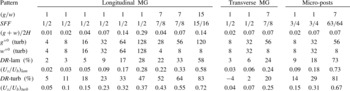
A total of fifteen cases, with SH surface micro-patterns consisting of longitudinal MG, transverse MG, or micro-posts,
 $g/w$
ratios of 1, 7, 15, and geometric parameters of
 $0.01\leqslant (g+w)/2H\leqslant 0.29$
, corresponding to
 $4\lesssim g^{+0}\lesssim 128$
, were studied, as shown in figure 1 and table 1. Here
 $H=2h$
denotes the full height of the channel, and the parameters
 $(g/w)$
and
 $(g+w)/2H$
arise from analytical solutions in laminar SH channel flow with longitudinal or transverse MG (Philip Reference Philip1972). For comparison, these fifteen cases were also studied by DNS in the laminar flow regime at
 $Re_{b}=50$
.
SH surface geometries, resulting slip velocities, and DRs in laminar and turbulent channel flow.

4. Results
4.1. The magnitude of DR in laminar and turbulent SH channel flow
Figure 2(a) shows the DRs obtained in the present study in laminar and turbulent SH channel flow with longitudinal MG, transverse MG and micro-posts, and
 $g/w=$
 $1$
,
 $7$
,
 $15$
, as a function of the geometric parameter
 $(g+w)/2H$
. Also shown are the DNS data of Park et al. (Reference Park, Park and Kim2013), obtained in turbulent channel flow at
 $Re_{{\it\tau}_{0}}\approx 180$
,
 $395$
,
 $590$
with longitudinal MG and
 $g/w\approx$
 $1$
,
 $3$
,
 $7$
,
 $16$
, and the DNS data of Türk et al. (Reference Türk, Daschiel, Stroh, Hasegawa and Frohnapfel2014) in turbulent channel flow at
 $Re_{{\it\tau}_{0}}\approx 180$
with longitudinal MG and
 $g/w=1$
. The DRs for the DNS of Türk et al. (Reference Türk, Daschiel, Stroh, Hasegawa and Frohnapfel2014) were estimated from the quantities reported in their paper using the procedures described in the supplementary data. For each category of SH surface micro-pattern, the DNS data show a trend for increase in DR with increasing
 $(g+w)/2H$
or
 $g/w$
, at a given
 $Re_{{\it\tau}_{0}}$
. The DNS data of Park et al. (Reference Park, Park and Kim2013) also show a trend for increase in DR with increasing
 $Re_{{\it\tau}_{0}}$
for longitudinal MG. For each category of SH surface micro-pattern, the DRs in laminar flow follow similar trends to those in turbulent flow. However, for a given SH surface micro-pattern, the magnitude of DR in turbulent flow is higher than that in laminar flow, by
 $143\,\%$
to
 $267\,\%$
with longitudinal MG, and by
 $10\,\%$
to
 $61\,\%$
with micro-posts, as shown in figure 2(a) and table 1. These trends are reversed with transverse MG, for which the DRs in turbulent flow are always lower than the corresponding cases in laminar flow, and in some cases even negative, indicating a drag increase (DI) in the presence of the SH surface. The significantly higher DRs observed in turbulent flow compared to laminar flow with longitudinal MG has led a number of investigators (Daniello et al.
Reference Daniello, Waterhouse and Rothstein2009; Martel et al.
Reference Martel, Rothstein and Perot2010; Rothstein Reference Rothstein2010; Park et al.
Reference Park, Park and Kim2013) to conclude that the enhanced DR observed in turbulent flow must be due to mechanisms beyond the effective slip on the wall, such as modifications to the turbulence dynamics.
Scaling of DR and
 $U_{s}/U_{b}$
in laminar and turbulent channel flow: (a) DR as a function of the geometric parameter
 $(g+w)/2H$
for different
 $g/w$
and
 $Re_{{\it\tau}_{0}}$
; (b) DR as a function of the average slip velocity
 $U_{s}/U_{b}$
; (c) average slip velocity on the slip surfaces,
 $(1+1/SFF)U_{s}/U_{b}$
, as a function of
 $g/h$
; (d) DR as a function of the slip length
 $L_{s}^{+0}$
. ●, ▪, ◆
 $\,$
, present study,
 $Re_{{\it\tau}_{0}}\approx 223$
, longitudinal MG,
 $g/w=1$
,
 $7$
,
 $15$
, respectively; ▶, ◀
 $\,$
, present study,
 $Re_{{\it\tau}_{0}}\approx 223$
, transverse MG,
 $g/w=1$
,
 $7$
, respectively; ▲, ▼, present study,
 $Re_{{\it\tau}_{0}}\approx 223$
, micro-posts,
 $g/w=1$
,
 $7$
, respectively; ◯, ▫, ♢, present study,
 $Re_{b}=50$
, longitudinal MG,
 $g/w=1$
,
 $7$
,
 $15$
, respectively; ▷, ◁
 $\,$
, present study,
 $Re_{b}=50$
, transverse MG,
 $g/w=1$
,
 $7$
, respectively; △, ▽, present study,
 $Re_{b}=50$
, micro-posts,
 $g/w=1$
,
 $7$
, respectively;


 $Re_{{\it\tau}_{0}}\approx 180$
,
 $g/w=1$
, 3, 7, respectively;


 $Re_{{\it\tau}_{0}}\approx 395$
,
 $g/w=1$
, 3, 7, 15, respectively;


 $Re_{{\it\tau}_{0}}\approx 590$
,
 $g/w=1$
, 3, 7, 15, respectively;

 $Re_{{\it\tau}_{0}}=180$
,
 $g/w=1$
;

 $2450\leqslant Re_{b}\leqslant 4000$
,
 $g=w=30~{\it\mu}\text{m}$
, MG on one wall; ——,
 $DR=U_{s}/U_{b}$
in (b), and
 $DR=L_{s}^{+0}/[1+(Re_{b}/Re_{{\it\tau}_{0}})]$
with
 $Re_{b}=3600$
,
 $Re_{{\it\tau}_{0}}\approx 223$
in (d);
 $\boldsymbol{-}\boldsymbol{\cdot }\boldsymbol{-}$
,
 $\boldsymbol{-}\boldsymbol{\cdot }\!\boldsymbol{\cdot }\,\boldsymbol{-}$
, analytical expressions of Fukagata et al. (Reference Fukagata, Kasagi and Koumoutsakos2006) for uniform streamwise slip and uniform combined slip, respectively, at
 $Re_{{\it\tau}_{0}}\approx 223$
.

However, when the same DR data is plotted as a function of
 $U_{s}/U_{b}$
, as shown in figure 2(b), the DRs from all DNS databases in laminar and turbulent flow, for all SH surface micro-patterns, nearly collapse and cluster around the line
 $DR=U_{s}/U_{b}$
. In laminar flow, the magnitude of DR exactly matches
 $U_{s}/U_{b}$
for all SH surface micro-patterns, as shown in table 1, confirming that DR in laminar flow is entirely due to the effective slip on the walls. In turbulent flow, the magnitude of DR either falls slightly above
 $U_{s}/U_{b}$
, as with longitudinal MG or micro-posts with high SFF, or slightly below
 $U_{s}/U_{b}$
, as with transverse MG or micro-posts with moderate SFF ratio. These reflect the effect of the
 $O({\it\varepsilon})$
term in (2.5), and indicate that changes to the structure and dynamics of turbulence within the flow can lead to either a further DR or a DI beyond the DRs resulting from the effective slip on the walls. For the former, the modifications to the turbulence dynamics lead to a normalized Reynolds shear stress,
 $-\langle \overline{uw}\rangle ^{+}$
, in the SH channel which is lower than that in the base flow, thus making
 ${\it\varepsilon}$
positive. For the latter, the modifications to the turbulence dynamics lead to a normalized Reynolds shear stress,
 $-\langle \overline{uw}\rangle ^{+}$
, in the SH channel which is slightly higher than that in the base flow, thus making
 ${\it\varepsilon}$
negative. The SH surface micro-pattern in the latter case acts similarly to surface roughness, enhancing the Reynolds shear stress. However, these additional DRs or DIs, resulting from modifications to the turbulence dynamics, are in all cases small and contribute no more than 10 % to 15 % additional DR with longitudinal MG and micro-posts of high SFF, and no more than 10 % DI with transverse MG or micro-posts of moderate SFF. In all cases, 80 % to 100 % of the total DR arises from the effective slip on the walls.
The higher DRs observed in turbulent flow compared to laminar flow arise primarily from the higher normalized average slip velocities on the slip surfaces,
 $(1+1/SFF)U_{s}/U_{b}$
, which can be achieved in turbulent flow compared to laminar flow with a given SH surface micro-pattern, as shown in figure 2(c), not from mechanisms beyond the effective slip on the wall. The only exceptions are transverse MG and micro-posts with high SFF, for which the normalized average slip velocities in laminar and turbulent flow become comparable, either because the orientation of the MG relative to flow direction makes the flow regime immaterial, as with transverse MG, or because the nature of the flow is predominantly inviscid, as with micro-posts of high SFF.
Using the relations
 $U_{s}^{+}=L_{s}^{+}$
and
 $U_{s}/U_{b}=$
 $L_{s}^{+0}(1-DR)Re_{{\it\tau}_{0}}/Re_{b}$
, (2.5) can be rearranged to give an expression for the magnitude of DR in terms of the slip length,
 $$\begin{eqnarray}DR=\displaystyle \frac{L_{s}^{+0}}{L_{s}^{+0}+\displaystyle \frac{Re_{b}}{Re_{{\it\tau}_{0}}}}+O({\it\varepsilon}).\end{eqnarray}$$
Similar to (2.5), the scaling given by (4.1) remains valid in both laminar and turbulent SH channel flow. However, unlike earlier similar expressions (Fukagata et al. Reference Fukagata, Kasagi and Koumoutsakos2006), no assumptions about the shape of the mean velocity profile or the SH surface micro-pattern is required in the derivation of (4.1). Good agreement is seen in figure 2(d) between (4.1) and all available DNS data. Reasonable agreement is also seen in figure 2(b,d) between (2.5) and (4.1) and experimental data (Daniello et al. Reference Daniello, Waterhouse and Rothstein2009) for which the slip velocities were reported.
Spanwise variation of the mean streamwise velocity, and vector plots of the secondary mean flow, in SH turbulent channel flow with longitudinal MG: (a,d)
 $g^{+0}=w^{+0}\approx 32$
; (b,e)
 $g^{+0}\approx 56,w^{+0}\approx 8$
; (c,f)
 $g^{+0}\approx 120,w^{+0}\approx 8$
;


4.2. Turbulence statistics and energy budget
The roles of the effective slip on the wall and modifications to the turbulence dynamics within the flow in the mechanism of turbulent DR with SH surfaces can be further clarified by examining the one-point turbulence statistics and TKE budget in the SH channel. In view of their superior DR performance in turbulent flow, the following discussion will focus on longitudinal MG. However, the general conclusions remain valid for other SH micro-patterns, as well.
The presence of SH longitudinal MG on the channel walls gives rise to spanwise variations in all Reynolds-averaged quantities in turbulent flow, within a ‘surface layer’ of thickness
 $z\approx g$
. Figure 3(a–c) show examples of these spanwise variations in the Reynolds-averaged streamwise velocity. Similar spanwise variations exist in all Reynolds-averaged turbulence statistics, including the Reynolds stresses. The latter gives rise to the development of a secondary mean flow, in the form of pairs of counter-rotating vortices (Perkins Reference Perkins1970; Rastegari & Akhavan Reference Rastegari and Akhavan2013; Jelly et al.
Reference Jelly, Jung and Zaki2014; Türk et al.
Reference Türk, Daschiel, Stroh, Hasegawa and Frohnapfel2014), within the ‘surface layer’
 $(z\lesssim g)$
, as shown in figure 3(d–f). Both this secondary mean flow and the spanwise variations in the Reynolds-averaged turbulence statistics need to be properly accounted for to obtain accurate turbulence statistics in the SH channel. To facilitate comparison of these statistics to those in turbulent channel flows with no-slip walls, all Reynolds-averaged statistics in the SH channel are reported here after performing an additional spanwise average,
 $\langle \,\rangle$
, over the pattern of slip and no-slip surfaces on the SH walls.
Figure 4(a–c) show the normalized profiles of the spanwise-averaged mean streamwise velocity,
 $\langle \bar{U}\rangle ^{+}$
, turbulence intensities,
 $\{\langle \bar{u_{i}^{2}}\rangle ^{+}\}^{1/2}$
, and shear stresses,
 $\langle {\it\tau}_{xz}\rangle ^{+}$
, in the SH channel, compared to a base flow with no-slip walls. With the average slip velocity subtracted, the mean streamwise velocity profiles,
 $\langle \bar{U}\rangle ^{+}-U_{s}^{+}$
, in the SH channel display a progressive thinning of the buffer layer, along with a downward shift of the logarithmic layer, with increasing DR. These features are in stark contrast to other examples of drag-reduced turbulent flow, for which DR is generally accompanied by a thickening of the buffer layer and an upward shift of the logarithmic layer (Bushnell & Hefner Reference Bushnell and Hefner1990). The difference lies in the mechanism of DR in the present flow, which is primarily the effective slip on the walls. The presence of this effective slip leads to weaker gradients of the mean streamwise velocity over the slip surfaces up to distances of
 $z\approx g$
, which when mixed and averaged with the mean streamwise velocities over the no-slip surfaces, leads to weaker gradients in
 $\langle \bar{U}\rangle ^{+}$
within the ‘surface layer’, and manifests as a progressive thinning of the buffer layer and a downward shift of the logarithmic layer in the profiles of
 $\langle \bar{U}\rangle ^{+}-U_{s}^{+}$
.
Within this ‘surface layer’ (
 $z\lesssim g$
), the normalized streamwise and spanwise turbulence intensities are enhanced compared to the base flow, as shown in figure 4(b). Outside of the ‘surface layer’, however, the normalized turbulence intensities collapse to those in the base flow, indicating that the normalized dynamics of turbulence has reverted to that of turbulent flows with no-slip walls.
Turbulence statistics and TKE budget in SH channel flow with longitudinal MG: (a) mean streamwise velocity with the average slip velocity subtracted; (b) turbulence intensities; (c) Reynolds shear stress
 $\langle {\it\tau}_{R,xz}\rangle ^{+}$
, viscous shear stress
 $\langle {\it\tau}_{v,xz}\rangle ^{+}$
, convective stress
 $\langle {\it\tau}_{c,xz}\rangle ^{+}$
, and their sum
 $\langle {\it\tau}_{t}\rangle ^{+}$
; (d) bulk production
 $\langle P\rangle$
and bulk dissipation
 $\langle {\it\varepsilon}\rangle$
; (e) breakdown of
 $\langle P\rangle$
into
 $-\langle \overline{uw}\partial \bar{U}/\partial z\rangle$
and
 $-\langle \overline{uv}\partial \bar{U}/\partial y\rangle$
; (f) total bulk transport
 $\langle t^{({\it\Sigma})}\rangle$
; (g) production
 $\langle P\rangle ^{+}$
and dissipation
 $\langle {\it\varepsilon}\rangle ^{+}$
; (h) breakdown of
 $\langle P\rangle ^{+}$
into
 $-\langle \overline{uw}\partial \bar{U}/\partial z\rangle ^{+}$
and
 $-\langle \overline{uv}\partial \bar{U}/\partial y\rangle ^{+}$
; (i) total transport
 $\langle t^{({\it\Sigma})}\rangle ^{+}$
.

 $g^{+0}=w^{+0}\approx 4$
;

 $g^{+0}=w^{+0}\approx 8$
;

 $g^{+0}=w^{+0}\approx 16$
;

 $g^{+0}=w^{+0}\approx 32$
;

 $g^{+0}=w^{+0}\approx 64$
;

 $g^{+0}=w^{+0}\approx 128$
;

 $g^{+0}\approx 28,w^{+0}\approx 4$
;

 $g^{+0}\approx 56,w^{+0}\approx 8$
;

 $g^{+0}\approx 120,w^{+0}\approx 8$
;
 $\boldsymbol{\cdot }\boldsymbol{\cdot }\boldsymbol{\cdot }\,\boldsymbol{\cdot }$
, no-slip channel flow at
 $Re_{b}=3600$
 $(Re_{{\it\tau}_{0}}\approx 223)$
; - - - -, no-slip channel flow at
 $Re_{{\it\tau}_{0}}\approx 100$
. Arrows indicate increasing DR.

Figure 4(c) shows the normalized profiles of the spanwise-averaged Reynolds shear stress,
 $\langle {\it\tau}_{R,xz}\rangle ^{+}\equiv -\langle \overline{uw}\rangle ^{+}$
, viscous shear stress,
 $\langle {\it\tau}_{v,xz}\rangle ^{+}\equiv \langle \partial \overline{U}/\partial y\rangle ^{+}$
, mean convective stress,
 $\langle {\it\tau}_{c,xz}\rangle ^{+}\equiv -\langle \bar{U}\bar{W}\rangle ^{+}$
, and total stress,
 $\langle {\it\tau}_{t}\rangle ^{+}\equiv \langle {\it\tau}_{R,xz}\rangle ^{+}+\langle {\it\tau}_{v,xz}\rangle ^{+}+\langle {\it\tau}_{c,xz}\rangle ^{+}$
, in the SH channel, compared to the base flow. The profiles of normalized Reynolds shear stress display a progressive drop in their peak magnitudes compared to the base flow, with increasing DR. However, the magnitudes of these drops are nowhere as large as those observed at comparable DR with other means of skin-friction DR. Indeed, the profiles of normalized Reynolds shear stress remain comparable to those which would be observed in a turbulent channel flow with no-slip walls at the
 $Re_{{\it\tau}}$
of the drag-reduced SH channel flow, as shown in figure 4(c). This keeps the differences between the Reynolds shear stress in the SH flow and that in the base flow small, thus keeping the
 $O({\it\varepsilon})$
term in (2.5) small. Similarly, for cases where the
 $O({\it\varepsilon})$
term leads to a DI (not shown), the magnitude of the Reynolds shear stress in the SH channel becomes slightly larger than that in the base flow. In computing the total balance of shear stresses, in addition to the Reynolds and viscous shear stresses, a small contribution is also observed from the mean convective stress,
 $-\langle \bar{U}\bar{W}\rangle ^{+}$
, arising from the secondary mean flow in the channel. With this contribution, the total stress shows good agreement with the theoretical line
 $\langle {\it\tau}_{t}\rangle ^{+}=(1-z/h)$
, as required by (2.2). These secondary flows are found to make a negligible contribution to the
 $O({\it\varepsilon})$
term in (2.5).
Figure 4(d–i) show the balance of the terms in the TKE budget in the SH channel, compared to the base flow, where
 $\langle P\rangle \equiv -\langle \overline{u_{i}u_{j}}\partial \bar{U}_{j}/\partial x_{i}\rangle$
is the rate of TKE production,
 $\langle {\it\varepsilon}\rangle \equiv 2{\it\nu}\langle \overline{\unicode[STIX]{x1D634}_{ij}\partial u_{j}/\partial x_{i}}\rangle$
is the rate of viscous dissipation,
 $\langle t^{({\it\Sigma})}\rangle \equiv -(1/2)\langle \partial \overline{u_{j}^{2}u_{i}}/\partial x_{i}\rangle -(1/{\it\rho})$
 $\langle \partial \overline{pu_{i}}/\partial x_{i}\rangle +2{\it\nu}\langle \partial \overline{u_{j}\unicode[STIX]{x1D634}_{ij}}/\partial x_{i}\rangle$
is the total TKE transport, and
 $\unicode[STIX]{x1D634}_{ij}=1/2(\partial u_{i}/\partial x_{j}+\partial u_{j}/\partial x_{i})$
is the fluctuating strain-rate tensor (Hinze Reference Hinze1975). When normalized with the bulk variables,
 $h$
and
 $U_{b}$
, the production, dissipation and transport of TKE in the SH channel display significant drops compared to the base flow, as shown in figure 4(d–f), consistent with the presence of DR and the lower
 $Re_{{\it\tau}}$
in the SH channel. When normalized in wall units, however, the profiles of TKE production,
 $\langle P\rangle ^{+}$
, and dissipation,
 $\langle {\it\varepsilon}\rangle ^{+}$
, collapse to those in the base flow outside of the ‘surface layer’, while within the ‘surface layer’ there is additional production and dissipation of TKE compared to the base flow, as shown in figure 4(g). A breakdown of TKE production into its non-zero components,
 $-\langle \overline{uv}\partial \bar{U}/\partial y\rangle ^{+}$
and
 $-\langle \overline{uw}\partial \bar{U}/\partial z\rangle ^{+}$
, reveals that TKE production through the
 $-\langle \overline{uw}\partial \bar{U}/\partial z\rangle ^{+}$
term in the SH channel remains virtually unchanged from that in the base flow, as shown in figure 4(h). The additional production of TKE within the ‘surface layer’ arises from the
 $-\langle \overline{uv}\partial \bar{U}/\partial y\rangle ^{+}$
term, resulting from the spanwise variations in the mean streamwise velocity within the ‘surface layer’. In the low-DR regime, this enhanced production of TKE is balanced locally by viscous dissipation within the ‘surface layer’, as shown in figure 4(g–i). In the high-DR regime, the additional production of TKE within the ‘surface layer’ cannot be fully dissipated locally, and is transported to the interior of the flow, where it is dissipated. This leads to a reversal in the sign of the transport terms within the ‘surface layer’, compared to the base flow, as shown in figure 4(i). The main effect of the SH surface on the dynamics of turbulence is thus additional production of TKE within a ‘surface layer’ of thickness of the order of the width of SH MG. This effect, however, is not drag reducing, but turbulence enhancing. Outside of this ‘surface layer’, the normalized dynamics of turbulence in the SH channel proceeds as in channel flows with no-slip walls at the
 $Re_{{\it\tau}}$
of the SH channel flow. Collectively, these results indicate that the effect of the SH surface on the internal dynamics of turbulence is small, and the dominant mechanism of turbulent DR with SH surfaces remains the effective slip on the wall.
5. Summary and conclusions
By analysis of the governing equations, we have shown that the magnitude of DR in laminar or turbulent SH channel flow, with any periodic pattern of SH surface micro-texture, can be expressed as
 $DR=U_{s}/U_{b}+O({\it\varepsilon})$
. This expression separates the contribution to DR arising from the effective slip on the wall, from that arising from modifications to the turbulence dynamics within the flow. By comparing this expression with results obtained from DNS of turbulent SH channel flow with longitudinal MG, transverse MG and micro-posts, it is shown that 80 % to 100 % of the total DR arises from the effective slip on the walls. Modifications to the turbulence dynamics contribute no more than 20 % of the total DR with longitudinal MG or micro-posts of high SFF, and a DI with transverse MG or micro-posts of moderate SFF. In the latter case, the SH surface micro-pattern acts similarly to surface roughness, and enhances the production of turbulence. The effect of the SH surface on the normalized dynamics of turbulence is found to be small, and confined to additional production of TKE within a thin ‘surface layer’ of thickness of the order of the width of SH surface micro-indentations. Outside of this ‘surface layer’, the normalized dynamics of turbulence proceeds as in turbulent channel flows with no-slip walls at the
 $Re_{{\it\tau}}$
of the SH channel flow. The present DNS studies assumed flat, shear-free boundaries for the gas/liquid interfaces on the SH surface. Deformable interfaces may result in additional modifications to the turbulence dynamics and the effective slip on the walls, which could modify these conclusions.
Acknowledgements
This work was supported by an unrestricted grant from the Martin R. Prince Foundation, and NSF XSEDE Allocation CTS-070070. This support is gratefully acknowledged.
Supplementary data
Supplementary data is available at http://dx.doi.org/10.1017/jfm.2015.266.