INTRODUCTION
Although advance directives are codified under federal (Patient Self-determination Act, 1992) and state law (Creation and Use of Proxies in Residential Health Care and Mental Hygiene Facilities, 1993) and palliative-care guidelines recommend that clinicians be able to discuss end-of-life goals of care, (National Consensus Project for Quality Palliative Care, 2004), there are no national or state mechanisms for tracking implementation of do-not-resuscitate directives (DNRs). Characterizing DNR utilization among advanced cancer patients has important implications for end-of-life decision making where the medical team is generally obliged to perform CPR in the absence of a DNR. Only a health-care proxy or physician declaration of “medical futility” may avert the obligation to perform CPR (Creation and Use of Proxies in Residential Health Care and Mental Hygiene Facilities, 1993).
Although systematic DNR implementation data are lacking, several cross-sectional studies have been reported, the largest of which retrospectively examined a stratified sample (n = 13,883) of all U.S. deaths in 1986 (excluding trauma and perinatal deaths) (Hanson & Rodgman, Reference Hanson and Rodgman1996). It reported DNRs in 9.8% of overall deaths and 16% of cancer deaths. Females, whites, higher education and socioeconomic status, poor functional status, and near-death experience were associated with greater DNR utilization and Medicaid with lower utilization. Those with DNRs had more acute hospital days and outpatient visits in their last year of life, were half as likely to receive CPR, and were greater users of hospice services.
A 1996 chart review of 200 consecutive deaths in a general hospital reported 77% with a DNR at time of death, but only 13% upon admission. Of patients who died after a length of stay of at least 3 weeks, 90% had a DNR directive. Thus, admission was a trigger for signing of DNRs. Overall, 25% of patients underwent CPR prior to death. Patients authorized the DNR status in 32% of cases, health-care proxies authorized 64%, and physicians 5% (Fins et al., Reference Fins, Miller and Acres1999).
The SUPPORT study reported on DNR utilization in metastatic colorectal patients (n = 520; Haidet et al., Reference Haidet, Hamel and Davis1998). Only 22% had a DNR order written during their index hospital stay. Median time from DNR order to death was 32 days (Haidet et al., Reference Haidet, Hamel and Davis1998).
Community studies have reported varying rates of DNR utilization: 60% of community-dwelling elderly in Ohio (average age 80, n = 231) had advance directives (associated with being white, unmarried, and younger age; Kahana et al., Reference Kahana, Dan and Kahana2004). A 2002 New Hampshire sample of consecutive deaths (n = 782) reported an 80% DNR prevalence (half of which were authorized by health-care proxies with 91% implementation in nursing home deaths, hospice 89%, and acute hospitals 73%; Solloway et al., Reference Solloway, LaFrance and Bakitas2005). A 2001 Hawaiian random telephone survey (n = 700) found that 29% of adults had a living will but this increased to 62% in the over 65 age group (Braun et al., Reference Braun, Onaka and Horiuchi2001). A 2006 Korean study reported DNRs in 86.7% of advanced cancer deaths, signed, on average, 8 days before death, but in 10% of cases, on the day of death (Oh et al., Reference Oh, Kim and Kim2006).
In summary, the above studies share cross-sectional designs; thus, there is no indication as to whether DNR utilization is increasing with time. Medical and functional morbidity and higher socioeconomic status were associated with increased DNR utilization. In two studies, half or more of DNRs were authorized by health-care proxies, but it is not clear how widespread this practice might be in oncology, where death may be more predictable. The temporal relationship between signing of various DNR types and death was generally not reported, but it is of interest, as it is one reflection of timely palliative-care planning.
Objective
The impetus for this study was the development of communication-training programs for doctors that focus on end-of-life issues. There were no a priori hypotheses because of the exploratory and descriptive nature of the study.
We wanted to understand the following more fully:
1. The percentage of deaths accompanied by a DNR order, considered an indicator of end-of-life communication frequency.
2. The relative utilization of different DNR types, for example, outpatient, inpatient, and proxy signed. This information is crucial for designing mock, end-of-life, communication-training scenarios.
3. Potential clinical markers of communication training such as the temporal characteristics of a DNR status in relation to death (e.g., how often a DNR was signed on the day of death and what percentage of DNR orders were signed more than a month in advance).
METHODS
Setting and Subjects
The study was conducted at Memorial Sloan-Kettering Cancer Center (MSKCC) in New York City. The cohort consisted of 206,437 patients, the entire main campus population from January 2000 to December 2005.
Study Design
Deidentified computerized databases were searched to determine the number of inpatients and outpatients who died with and without a DNR order. Although DNR data of 206,437 patients were surveyed, 473,313 unique patient encounters were extracted. This was because there were often multiple DNR records for individual patients (e.g., DNR renewed, inpatient DNR signed with subsequent outpatient DNR prior to discharge). Patients were only counted once.
Signed, bar-coded DNR forms were scanned into the FileNet system, an optical document storage and retrieval system. These data were maintained in an Oracle database. Structured Query Language was used to retrieve the data. Admission and visit data were obtained from the Institutional DataBase Warehouse.
Patients discharged from an inpatient service at least once during the encounter year were defined as “inpatients” and the remainder as “outpatients,” thus keeping them mutually exclusive. A patient was defined as “DNR” if the year of the patient's earliest DNR date was less than or equal to the encounter year. Otherwise, the patient was defined as “No DNR.”
The living or deceased status for each year was designated: (1) “Died with DNR as inpatient” if the patient died at MSKCC during an admission in that year, (2) “Died with DNR outside of hospital” if MSKCC was notified that the patient's death occurred outside of MSKCC (e.g., hospice, home, other institution), or (3) “alive.” The hospital's cancer registry tracks outside deaths in the following ways: (1) Next of kin informs the patient's physician, (2) the billing department is informed by insurance companies or next of kin, or (3) patients lacking contact with MSKCC for 12 months are entered onto a possible “lost to follow-up” list. “Lost to follow-up” status triggers a search of the social security death database or outreach to the patient, family, or physician via a personal letter or telephone call. Thus, the system captures deaths that occur outside of MSKCC with a high degree of confidence. Although we were able to track patients with previously signed DNR orders who died outside the MSKCC system, our methodology did not detect DNR orders signed elsewhere (e.g., hospices).
Six different types of DNR forms were tracked:
1. Adults with capacity
2. Adults without capacity with a surrogate
3. Therapeutic exception (adults who might be harmed by DNR discussion)
4. Adults without capacity who previously consented to a DNR (used when patient's DNR lacks a MSKCC scannable barcode or for DNR renewal after 7 days of an inpatient admission where patient now lacks capacity)
5. Minors
6. New York State Department of Health nonhospital DNR (mandated outpatient form).
Because the study involved deidentified data with no personal health information available to the researchers, the Institutional Privacy and Review Board granted the study “exempt status.”
Main Outcome Measures
We measured the frequency of DNR utilization over time, percentage of patients who died with and without DNRs, the proportion of DNRs signed by patients versus health-care agents, and their timing in relation to death.
Statistical Methods
Descriptive statistics were used to describe patterns of DNR utilization (e.g., numbers of different DNRs types). Binomial 95% confidence intervals were calculated when data are presented in percentage format. The multiple sample proportion test with continuity adjustment (Fleiss, Reference Fleiss1981) was used to compare proportions in several groups. Statistical analyses were carried out by the statistical language R (R-Development-Core-Team, 2004).
RESULTS
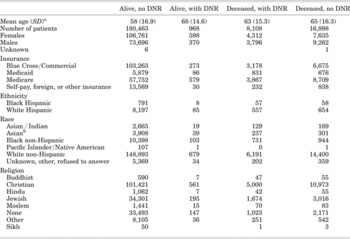
Demographic Data (Table 1)
Alive patients without a DNR order were younger than those alive with a DNR (mean age 58 [SD 16.9] years versus 68 (SD 14.6). Patients who died with a DNR had a mean age of 63 (SD 15.3) years; those who died without a DNR had a mean age of 65 (SD 16.3).
Demographics, All Patients 2000–2005

aFor alive patients, age was calculated on December 31 of that year and for deceased patients by date of death.
bIn March 2001 Pacific Islanders were removed from the Asian category and placed in a category of their own, together with Native Americans.
Regarding all deaths (2000–2005), females were more likely to die with a DNR than males; 36% of females (n = 4312) versus 29% of males (n = 3796) died with a DNR (χ2 = 140, p < .0000001).
Thirty-two percent of patients with commercial insurance, 55% with Medicaid, 31% with Medicare, and 22% of “self pay” died with a DNR (χ2 = 427, p < .0000001).
DNR utilization differed significantly across race and ethnic groups. DNRs were present in the deaths of 30% of White non-Hispanics, 44% of Black non-Hispanics, 46% of White Hispanics and 50% of Black Hispanics (χ2 = 265, p < .0000001).
The percentages also differed across religion: 46% of Buddhists (n = 102), 31% of Christians (n = 15,973), 43% of Hindus (n = 97), 25% of Sikhs (n = 4), 36% of Jews (n = 4,690), 46% of Moslems (n = 153), 32% of “none” (n = 3,194), and 32% of “other” (n = 793) died with a DNR directive (χ2 = 58, p < .00001).
Prevalence of DNR Orders
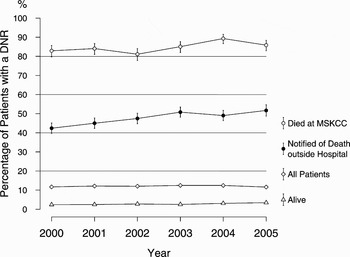
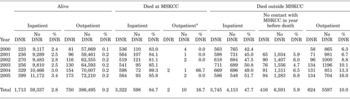
Table 2 summarizes the percentage of living and dead patients with a signed DNR. The percentages of inpatients who died with a DNR order each year between 2000 and 2005 were 83%, 84%, 81%, 85%, 89%, and 86%, respectively. An equality of proportions test (Fleiss, Reference Fleiss1981) showed that this year-to-year fluctuation was not random (p = .0013). Figure 1 contrasts the 6-year DNR utilization in four different patient groups:
1. Inpatient deaths (uppermost plot; discussed above).
2. Discharged from inpatient admission in the previous year, subsequently died in community (second plot). DNR utilization also increased here from 2000 to 2005: 42%, 45%, 48%, 51%, 49%, and 52%; p < 0.00001.
3. All patients, alive and dead (third plot).
4. Alive patients at censoring point (lowermost plot).
Percentages of patients who had signed a DNR between the years 2000 and 2005. For each year, patients were first categorized into those who were alive at the censuring point of data collection (triangles) and those who died in that year. Death occurred either within MSKCC (open circles) or outside MSKCC, for example, hospice, home, another institution (filled circles). The pooled percentages for all patients are indicated by rectangles. Patients in each of the survival categories were further categorized into two subgroups: those with a DNR order and those without. The percentages were calculated by dividing the number of patients who died with a DNR by the total number of patients in that category. For example, in 2000, 643 patients died at MSKCC and 533 died with a DNR. Thus in 2000, 533/643 = 83% of patients died with a DNR at MSKCC. There were 11,314 patients (deceased and alive combined) in 2000 and 1,322 signed a DNR order in that year. Thus the percentage was 1,322/11,314 = 11.7%. Error bars are the 95% binomial confidence intervals for the percentages. The error bars for “all patients” and “alive” are not shown because they are narrower than the size of the plotting symbols and therefore masked.

Number of Patients With or Without a DNR, Separated by Year, Site of Death, and the Presence or Absence of DNR Directives

aThe category of outpatient deaths that occurred at MSKCC includes those patients who died in the Urgent Care Center. These were not considered inpatients deaths because, technically, they had not been admitted to a ward.
The latter two plots provide a context for appreciating the relative utilization of DNRs in populations that are closer to community cohorts (e.g., cancer survivors are represented in the lowermost group). Patients with a DNR who died in the community but were never inpatients in the year prior to death (not graphed here) also showed significantly increased DNR utilization from 6% in 2000 to 16% in 2005 (p < .0001).
The absolute number of DNRs also increased 27% from 4/day to 5/day (2000–2005), paralleling a 23% increase in patient turnover (70,191 to 86,585 patients).
Inpatient Deaths and Utilization of Specific DNR Types
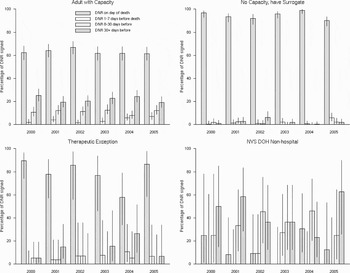
A striking aspect of these data is that, for the vast majority of patients, most DNRs were agreed to on the same day that the patient died (Fig. 2).
Percentage of DNR orders signed relative to time of death. Error bars represent 95% binomial confidence intervals of the percentages. Bars are color coded to represent four categories: DNR directives signed on the day of death, 1–7 days before death, 8–30 days before death and >30 days before death. Four commonly used DNR categories are portrayed here: adults with capacity, adults who lack capacity with a surrogate, therapeutic exception, and a New York State nonhospital (outpatient) DNR.

Of the six different types of DNRs (Table 3), the most common DNR type was for adults with capacity, constituting a mean of 53% (range 51%–60%) of DNR deaths. The median time between signing and death was 0 days, that is, on the date of death (median was used rather than mean, as data are not normally distributed). On average, 63% were signed on the day of death, 22% >30 days before death, 4% from 1 to 7 days before death, and 11% from 8 to 30 days before death (Fig. 2, upper left).
Percentage of Inpatient Deaths per DNR Type

aPatients were only counted once. If multiple DNR orders were present, the following hierarchical rules were applied: If a patient was in the “no capacity, previously consented to DNR” category, then the date of the first “adults with capacity” DNR was used. If a patient had an “adults with capacity” DNR, then the date of the first “adults with capacity” was used. If a patient had a “NYS DOH nonhospital” DNR, then the date of the first “NYS DOH nonhospital” was used. Otherwise, the date of the last “therapeutic exception”, “no capacity, have surrogate,” or “minor patients” DNR was used.
The second most common DNR type for inpatient deaths was signed by surrogates on behalf of patients lacking capacity, constituting 34% (range 29%–38%) of DNRs. The median time between signing and death was also 0 days. On average, 95% of these were signed by surrogates on the day of death, 2% between days 1 and 7, 1% between days 8 and 30, and 2% more than 30 days before death (Fig. 2, upper right).
“Therapeutic exception” DNRs constituted only 3% of cases. The median time between signing and death was 0 days. On average 79% of these were signed on the day of death, 6% between days 1 and 7, 4% between days 8 and 30, and 11% more than 30 days before death (Fig. 2, lower left).
The median time between signing and death was also 0 days for minors and for patients who had previously signed a DNR but now lacked capacity. These accounted for 2.5% and 2% of inpatient deaths, respectively (confidence intervals were too wide to be portrayed in Fig. 2).
The mandated, outpatient New York State Department of Health DNR that is used in clinics or upon discharge to a community setting (e.g., home, hospice) represented an average of 5.5% of deaths. The median time between signing and death was 30 days (range 14–48). On average, 4% were signed on the day of death (presumably discharge to the community was planned but the patient died before this could be realized), 6% were signed between days 1 and 7, 35% between days 8 and 30, and 44% more than 30 days before death. Note wider confidence intervals (Fig. 2, lower right graph).
Finally, DNR forms signed by the court or an appointed guardian (patient lacks capacity, no health-care proxy) were rare, accounting for nine deaths over 6 years.
Of the patients who died with a DNR directive, on average, 70% had only one DNR order on record, 24% had two, and 7% had three or more. Forty-nine patients had a DNR dated postmortum, but most of these had more than one DNR on record (there was no analytic impact, as our hierarchy, detailed in the footnote to Table 3, captured the first DNR documented).
DISCUSSION
To our knowledge, this is the first temporal analysis of DNR trends in a large cancer center, demonstrating that their use is both commonplace and has significantly increased over the 6-year study period, in both inpatient and outpatient settings.
This study was designed as part of a needs analysis for end-of-life communication-training—each DNR order represents one or more potential discussions between a clinician and patient/proxy. Considering that MSKCC reports, on average, 4,167 deaths/year, the scope for specific communication-training (Weiner & Cole, Reference Weiner and Cole2004a, Reference Weiner and Cole2004b) to improve palliative decision making can be appreciated. This justifies institutional investment in communication training, comparable, perhaps, to ensuring quality standards for a clinical procedure that is performed multiple times each day.
That 34% of DNRs were signed by health-care proxies is important because communication with the health-care proxy of a dying patient is a complicated scenario and quite different from communicating with a patient who has full capacity. Our data indicate that DNR communications with health-care proxies are common enough to justify tailoring communication training to this scenario.
The most startling finding was that the median time between signing DNR orders and death was 0 days (i.e., on the day of death) whether signed by health-care proxies or adults with capacity. The implementation of DNR directives so late in the death trajectory might reflect the physicians' desires to avoid imminently predictable CPR, but is this timing too late and does it represent suboptimal palliative care? The true purpose of DNR directives is to empower patient autonomy over their palliative care, culminating in a peaceful, natural death. Improved doctor–patient communication about end-of-life goals of care may lead to timelier decision making.
In this regard, prognostication is a crucial skill, which can empower decision making but may be anxiety provoking for both physicians and patients. Over-optimistic prognostication, often occurring, paradoxically, when physicians know their patients better (Christakis, Reference Christakis1999) may cause procrastination of preparation for dying. This is important, because motivation for many of the human tasks involved in preparation for dying is fostered by patient and family awareness of serious physical decline. Lunney et al. (Reference Lunney, Lynn and Foley2003) found that the sharp functional decline that defines the dying trajectory in cancer patients occurred in the 3 months before death. A gradual outpatient discussion of the rationale for a DNR order in the context of end-of-life goals of care should occur for a larger proportion of patients with advanced cancer to allow them appropriate preparation time.
When the family member is better prepared for the loss, he or she is less likely to suffer complicated grief during the bereavement process (Barry et al., Reference Barry, Kasl and Prigerson2002) The proxy's signing of a DNR directive is exceptionally stressful. Azoulay et al. (Reference Azoulay, Pochard and Kentish-Barnes2005) showed that where an ICU patient died after end-of-life decisions had been made, 60% of relatives developed significant posttraumatic symptoms. However, among those relatives who shared in end-of-life decisions, 81.8% developed these symptoms. Increasing the interval between the initiation of an advance care planning discussion and the patient's death might be one concrete way to diminish the surrogate's potential suffering from his or her decision-making responsibilities (Weiner & Roth, Reference Weiner and Roth2006).
The significance of the timing of DNR directives for the deaths of minors is less clear but seems to be comparable with other reports. Wolfe et al. (Reference Wolfe, Grier and Klar2000) reported DNRs in 66% (n = 103) of pediatric cancer deaths, signed, on average, 34 days before death in progressive cancer, but 1.5 days prior in cases with treatment-related complications. Bradshaw et al. (Reference Bradshaw, Hinds and Lensing2005) reported a 48% DNR prevalence (n = 145) signed a median of 11 days prior to death.
Regarding demographic variables, we found that females were significantly more likely than males to die with a DNR, perhaps hinting at a greater capacity for more open communication among females. Medicaid patients, Blacks, and Hispanics were also more likely to die with a DNR. By contrast, researchers a decade ago showed that Black race, low educational levels, Medicaid, and lower socioeconomic status were associated with a lower DNR rate (Hanson & Rodgman, Reference Hanson and Rodgman1996). As this study was not designed to gather socioeconomic or treatment-related data, we are reluctant to comment further on the significance of these demographic results.
This study contains several limitations. First, it may have oversimplified the true picture of the dying process. For example, in our research design, patients who undergo CPR only to be subsequently designated “DNR” by health-care proxies are counted as having died with a DNR. Thus, to use a figure such as 14% “death without a DNR” (in 2005) as a proxy for CPR utilization may underestimate the true rate of CPR. Considering CPR utilization data would be important in future studies. Second, data accuracy is partially influenced by the quality of data entry, over which we had no control. This is true for all large database studies. Third, because MSKCC is a tertiary medical center, selection bias may limit the generalizability of our findings. Finally, the computer database did not record information concerning DNR orders that were rescinded by the patient or proxy. Chart review would be necessary to extract this information.
Nevertheless, this study has several strengths: (1) we had a large cohort (206,437), the entire patient population for 2000–2005, which included 25,006 cancer-related deaths; (2) synthesis of complex data occurred via a sophisticated, integrated medical record and data-retrieval methodology; and (3) a 6-year study period enabled the analysis of temporal trends in DNR utilization, which has not previously been reported.
The data presented here suggest areas of focus where communication training and research might potentially aid end-of-life clinical decision making. These data suggest that DNR directives are frequently signed late in the death trajectory for inpatients with and without capacity at MSKCC and, over a 6-year period, this pattern showed no change. Helping doctors communicate in a timelier and more efficient manner may improve delivery of palliative care to dying cancer patients.
ACKNOWLEDGMENTS
Dr. Weiner's work was funded in part by a grant from the UJA Federation of New York. There was no direct funding support for this research. We thank Suzanne Kelson, MSKCC cancer registry, who assisted with death tracking procedures, Mary A. Weiser, Esq. MSKCC, for her legal insights, and Efrat Blum, M.D., for her editorial assistance.