The global incidence of significant CHD is 6 to 9/1000 live births.Reference Hoffman and Kaplan 1 , Reference Van der Linde, Konings and Slager 2 Presentation of CHD is variable and may range from patients being completely asymptomatic to having severe cyanosis or heart failure. Heart murmurs are the most common reason for referral of a neonate to the paediatric cardiologist.Reference Singh, Desai and Miller 3 The purpose of this study was to determine whether a heart murmur, the only sign detected on routine pre-discharge neonatal examination, warrants echocardiographic examination to check for CHDs.
Methods
All newborn infants born at Jordan University Hospital between August, 2007 and June, 2014 who underwent echocardiographic studies within 48 hours of birth were reviewed. All babies underwent complete physical examination by a house staff paediatric resident before discharge. Before 2014, routine neonatal screening by pulse oximetry was not carried out at our hospital. Echocardiographic evaluation was performed for various indications including heart murmurs, weak femoral pulses, and cyanosis. We included newborns with a heart murmur on pre-discharge routine physical examination who had undergone echocardiography for this sole indication. We excluded babies who had a prenatal suspicion of heart disease, babies with any symptom of heart disease, babies who had other physical examination signs suggestive of heart disease such as cyanosis and weak femoral pulses, babies who were admitted to the neonatal ICU for any reason before the echocardiographic examination, babies with suspected or proven chromosomal abnormalities, and babies born to diabetic mothers.
CHD was defined as any structural abnormality of the heart or great vessels, excluding the presence of patent ductus arteriosus and patent foramen ovale, which were considered as normal physiological findings early in life. Atrial septal defect was distinguished from patent foramen ovale based on the presence of an actual deficiency of the septum of ⩾3 mm in diameter in contrast to the classical flap-like defect of patent foramen ovale. Significant CHD was defined as any anomaly that would eventually prove to be symptomatic and/or eventually require intervention during infancy or childhood; this, for example, excluded a small ventricular septal defect and atrial septal defect.
This study was approved by the institutional review committee.
Results
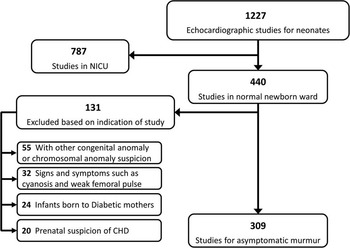
From August, 2007 to June, 2014, 22,215 babies were born at Jordan University Hospital, including 3920 babies admitted to the neonatal ICU. Of 1227 babies who underwent echocardiographic evaluation, 309 babies met the inclusion criteria. This included babies with a heart murmur as the only sign on routine physical examination within 48 hours of life. All murmurs were systolic; the babies had no other risk of CHD such as chromosomal anomalies, other congenital anomalies, or being an infant of diabetic mother. We also excluded babies admitted to the neonatal ICU (Fig 1).
Diagram illustrating the total number of echocardiographic studies carried out for neonates at Jordan University Hospital between 2007 and 2014, with numbers of included and excluded studies, as well as the exclusion criteria.

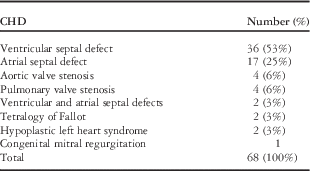
The study included 167 males and 142 females. Echocardiographic evaluation was carried out within the 1st day of life – within 24 hours of birth – in 246 babies (80%) and on the second day of life in 63 (20%) babies. CHD was found in 68 babies (22%), and 18 of them (6%) had significant heart disease. The most common diagnosis was ventricular septal defect occurring in 38 (56%) patients. These included muscular defects in 27, perimembranous defect in 10, and outlet septum defect in one; two of the patients with ventricular septal defect had atrial septal defect as well, and eight patients with ventricular septal defect were considered with significant heart disease based on the large size of the defect. Other significant heart diseases included aortic stenosis in four, hypoplastic left heart syndrome in two, tetralogy of Fallot in two, and severe pulmonary stenosis in two. The spectrum of heart disease is outlined in Table 1.
Spectrum of CHD in 309 asymptomatic newborns with heart murmur.

Patent ductus arteriosus was found in 104 babies (34%), and was considered to be a normal finding. As expected, the prevalence of patent ductus arteriosus within the first 24 hours of life, 90/246 (37%), was significantly higher than that within 24–48 hours of life, 14/63 (22%), p=0.036. Patent foramen ovale was found in 248 babies (80%), which was also considered normal. There was no difference between the prevalence of patent foramen ovale within the first 24 hours, 198/246 (80%), and the 24–48 hour period, 50/63 (79%), p=0.86.
Discussion
The purpose of our study was to answer the question whether a murmur heard in an asymptomatic newborn in the first 48 hours of life warrants echocardiographic assessment before dicharge. No newborn infant should be discharged from the hospital without a complete physical examination, 4 and cardiac examination is an essential part of neonatal physical examination. The incidence of murmurs in neonates is variable but generally <5%.Reference Ainsworth, Wyllie and Wren 5 , Reference Taksande 6 We used strict inclusion criteria of only asymptomatic babies with a heart murmur within the first 48 hours of life. The purpose of exclusion of newborns with other non-cardiac anomalies, other physical signs of heart disease, suspected chromosomal anomalies, infants of diabetic mothers, or infants admitted to the neonatal ICU before echocardiographic evaluation was to exclude newborns who would have been evaluated by a cardiologist even if a murmur was not detected, or infants who stayed in the hospital, and hence had a greater chance of being detected in case they indeed had heart disease.
The correlation of auscultated murmurs with structural heart abnormalities by echocardiography has been studied a few times with varying rates between 40 and 85%.Reference Hoffman and Kaplan 1 , Reference Singh, Desai and Miller 3 , Reference Ainsworth, Wyllie and Wren 5 – Reference Rein, Omokhodion and Nir 7 Variability is related to multiple factors including sample size, definition of structural heart disease, particularly with regard to inclusion of normal physiological findings such as patent ductus arteriosus, and age of the newborn children included, which was up to 5 days.Reference Rein, Omokhodion and Nir 7 Difference in the experience of the care provider in detection of heart murmurs is also an important variable.Reference Azhar and Habib 8 In our study, 22% of babies with asymptomatic heart murmurs had structural heart disease on echocardiography, a significantly lower figure than that previously reported; however, we did not include normal physiological findings such as patent ductus arteriosus and patent foramen ovale.
The question of whether to refer a newborn with a murmur for echocardiography remains an important one. Early detection of CHD is of utmost importance; some highly treatable conditions can lead to irreversible morbidity and mortality if not detected early. Deterioration may be sudden and the development of pulmonary hypertension may prevent the treatment of repairable abnormalities. For the previously outlined reasons, early referral to a paediatric cardiologist for echocardiographic evaluation has been strongly encouraged.Reference Singh, Desai and Miller 3 Although our study showed that most of the detected abnormalities on echocardiography were non-critical lesions, 26% of those detected had significant heart disease where an intervention is likely to be required early in life. These findings support previous recommendations of referral in cases where a murmur is heard.
Yet, we believe that it is important not to ignore the other part of the data; our study showed that 241 babies (78%) out of the 309 with murmurs heard in the first 48 hours of life had normal echocardiograms. This finding makes the recommendation to obtain an echocardiography before discharge controversial; one may consider other factors such as the characteristics of the auscultated murmur determined by an experienced personnel and the presence of family history of CHD, which were not evaluated in this study. In addition, we believe that social factors relating to the local community should be taken into consideration when making such a decision. It is recommended that any newborn child who is discharged from the hospital before 48 hours of life should be examined again by a healthcare professional within 48–72 hours of discharge. 4 If this cannot be guaranteed for any reason, we do recommend echocardiographic examination before discharge – for example, many newborns born at our hospital are discharged before their first 24 hours at the request of their parents and against medical advice, largely due to social and economic factors. This leads to paediatricians potentially missing murmurs that become more audible beyond the 1st day of life, secondary to the changes in cardiac physiology from prenatal to postnatal states. Compliance with the 3- to 5-day well-baby visit, as recommended by the American Academy of Pediatrics,Reference Hagan, Shaw and Duncan 9 is also very low at our hospital. This pushes attending paediatricians towards referring any neonate with a murmur to the paediatric cardiologist due to the fear of missing significant CHD.
Finally, the current recommendations for neonatal screening include performing pulse oximetry for all newborns at 24 hours of life.Reference Mahle, Newburger and Matherne 10 , Reference Ewer, Middleton and Furmston 11 The primary target of this screening method is to detect critical heart diseases such as hypoplastic left heart syndrome and cyanotic lesions, even in the absence of murmurs or other signs of heart disease. This screening method was not adopted in our hospital during the study period; four of our patients who had heart disease – two with hypoplastic left heart syndrome and two with tetralogy of Fallot – were likely to have abnormal oximetry screening, prompting echocardiographic evaluation, even if a murmur was not detected. On the other hand, most of the other patients were likely to have normal oximetry. We believe that oximetry screening adds to the sensitivity of neonatal evaluation and is not meant to substitute a thorough physical examination. This would result in more infants being appropriately referred for echocardiographic evaluation, and therefore less cardiac patients being missed.Reference Ailes, Gilboa and Honein 12
Conclusion
The presence of murmurs on pre-discharge physical examination is a useful, yet slightly insensitive tool for the early detection of CHD. We do recommend echocardiographic screening of newborns with heart murmurs before discharge from the hospital, particularly if compliance with early follow-up visits to healthcare providers is difficult to predict for any reason.
Acknowledgements
None.
Financial Support
This research received no specific grant from any funding agency, commercial, or not-for-profit sectors.
Conflicts of Interest
None.
Ethical Standards
The authors assert that all procedures contributing to this work comply with the ethical standards of national guidelines and has been approved by the institutional ethical committee.