Introduction
Family Aphelenchoididae Skarbilovich, 1947 contains several genera, including Aphelenchoides. Members of this family are primarily fungal feeders (Aliramaji et al. Reference Aliramaji, Pourjam, Álvarez-Ortega, Afshar and Pedram2018). However, foliar nematodes are plant feeders (Subbotin et al. Reference Subbotin, Oliveira, Alvarez-Ortega, Desaeger, Crow, Overstreet, Leany, Vau and Inserra2021), which could be economically significant due to the yield loss of crops (Shokoohi et al. Reference Shokoohi, Handoo, Elshishka, Salama, Khan and Quintanilla2022). Aphelenchoides was established by Fischer (Reference Fischer1894) and comprised 175 nominal species (Aliramaji et al. Reference Aliramaji, Pourjam, Álvarez-Ortega, Afshar and Pedram2018). This species-rich genus is the type genus of the family Aphelenchoididae. It is well known for the prevalence of species lacking conspicuous apomorphies, which is helpful for its species delimitation (Aliramaji et al. Reference Aliramaji, Pourjam, Álvarez-Ortega, Afshar and Pedram2018). So far, Aphelenchoides species have been discovered in various habitats, including soil, mosses, mushrooms, decaying organic materials, and plant tissues (Subbotin et al. Reference Subbotin, Oliveira, Alvarez-Ortega, Desaeger, Crow, Overstreet, Leany, Vau and Inserra2021). Morphologically, Aphelenchoides resembles genera, including Basilaphelenchus Pedram. Kanzaki, Giblin-Davis & Pourjam, Reference Kanzaki, Shokoohi, Fourie, Swart, Muller and Giblin-Davis2018; Robustodorus Andrássy, Reference Andrássy, Csuzdi and Mahunka2007; Schistonchus (Cobb Reference Cobb1927) Fuchs, Reference Fuchs1937; and Tylaphelenchs Rühm, Reference Rühm1956. However, it differs from the genera mentioned above in the stylet morphology. Aphelenchoides is distinguished from Basilaphelenchus, which bears stylet knobs elongated and posteriorly directed (Pedram et al. Reference Pedram, Kanzaki, Giblin-Davis and Pourjam2018a). Compared with Robustodorus, it differs in stylet knobs (small vs. robust and developed). It differs from Schistonchus in stylet (slender vs. robust). It also differs from Tylaphelenchus in stylet (slender with small knobs vs. robust with developed knobs (Kanzaki & Giblin-Davis Reference Kanzaki, Giblin-Davis, Manzanilla-Lopez and Mendoza2012). Historically, several authors studied Aphelenchoides, emphasizing the feature to diagnose the species (Hunt Reference Hunt1993, Reference Hunt2008; Shahina Reference Shahina1996; Andrássy Reference Andrássy, Csuzdi and Mahunka2007). Among the characters, lateral filed incisures were the matter of debate among the nematologists. Shahina (Reference Shahina1996) indicated that the lateral field with 4–6 incisures is rare. Similarly, Andrássy (Reference Andrássy, Csuzdi and Mahunka2007) showed that species with six incisures of the lateral field are rare. The character was found to be six incisures in the present species of Aphelenchoides from Iran.
Additionally, several species have been transferred to Aphelenchoides. Laimaphelenchus heidelbergi Zhao, Davis, Riley and Nobbs, Reference Zhao, Davies, Riley and Nobbs2007 was transferred to the genus Aphelenchoides (Carta et al. Reference Carta, Li, Skantar and Newcombe2016). Tylaphelenchus christinae Lieutier and Laumond, Reference Lieutier and Laumond1978 was transferred to the genus Aphelenchoides (Pedram et al. Reference Pedram, Kanzaki, Giblin-Davis and Pourjam2018a, Reference Pedram, Pourhashemi, Hosseinzadeh and Koolivand2018b). In contrast, Aphelenchoides subtenuis (Cobb Reference Cobb1926) Steiner and Buhrer, Reference Steiner and Buhrer1932 and A. arachidis Bos, Reference Bos1977 have also been transferred to the genus Robustodorus Andrássy, Reference Andrássy, Csuzdi and Mahunka2007 (Kanzaki et al. Reference Kanzaki, Shokoohi, Fourie, Swart, Muller and Giblin-Davis2018). Recently, A. helicus Heyns, Reference Heyns1964 was transferred to Robustodorus (Aliramaji et al. Reference Aliramaji, Pourjam, Álvarez-Ortega, Afshar and Pedram2018).
During a survey on nematodes in northern provinces of Iran, a population of a new species of Aphelenchoides was recovered from a wild persimmon in Guilan Province. Therefore, the study’s aims were 1) to describe the morphology and morphometrics of Aphelenchoides persicus sp. n. and 2) to study the phylogenetic position of the new species based on 28S rDNA.
Materials and methods
Nematode extraction and morphological observations
Several soil samples were collected randomly in Guilan Province, Iran (36°58’15.7"N; 50°16’48.8"E), during June and May 2021. The samples were collected using an auger and then transferred through the cooler box to the laboratory. The tray method (Whitehead & Hemming Reference Whitehead and Hemming1965) was used to extract nematodes. The nematodes were handpicked under an Olympus SZ16 stereomicroscope (Japan). The collected specimens were killed in a hot 4% formaldehyde solution, transferred to anhydrous glycerin according to De Grisse (Reference De Grisse1969), and mounted on permanent slides. Measurements and observations on morphology were made under an Olympus BH-2 Light microscope (Japan). Photographs were taken using a digital camera attached to an Olympus BX51 microscope (Japan). Drawings were made using a drawing tube attached to the microscope Olympus BX51.
DNA extraction, polymerase chain reaction (PCR), and sequencing
DNA was extracted from a single female. The nematode was squashed in TE buffer (10 mM Tris-Cl, 0.5 mM EDTA; pH 9.0, Qiagen) on a clean slide with a cover slip and the pressure of a plastic probe. The supernatant was extracted from the tube and stored at –20°C. Primers for LSU D2/D3 amplification were forward primer D2A (5’ACAAGTACCGTGAGGGAAAGT3’) and reverse primer D3B (5’TGCGAAGGAACCAGCTACTA3’) (Nunn Reference Nunn1992). The thermal cycling program for amplifying genomic fragment (LSU rDNA D2–D3) was as follows: denaturation as 94ºC for 4 min, followed by 35 cycles of denaturation at 94ºC for 30 sec, annealing at 53ºC for 40 sec, and extension at 72ºC for 90 sec. A final extension was performed at 72ºC for 10 min. Polymerase chain reaction was performed in a final volume of 30 ml PCR mixture and contained 15 ml 2X GoTaq DNA polymerase mix (Sina Clon), each of a 1.5 ml forward and reverse primers solution (5 pmol), 9 ml distilled water, and 3 ml of a 100 times-diluted crude DNA extract. PCR products were purified and sequenced directly for both strands using the same primers with an ABI 3730XL sequencer (Bioneer Corporation, South Korea).
Alignment and phylogenetic inference
The molecular sequences of D2/D3 expansion segments of 28S ribosomal RNA gene of the new species were compared with those of other nematode species available in GenBank using the BLAST homology search program. The sequences were aligned using the Q-INSi algorithm of the online version of MAFFT version 7 (http://mafft.cbrc.jp/alignment/server/) (Katoh and Standley Reference Katoh and Standley2013). The Gblocks program (version 0.91b) has all three less stringent parameters (http://phylogeny.lirmm.fr/phylo_cgi/one_task.cgi?task_type=gblocks) and was used for post-editing of both alignments (i.e., to eliminate poorly aligned regions or divergent positions). The model of base substitution was selected using MrModeltest 2 (Nylander Reference Nylander2004). The Akaike-supported model, a general time reversible model including among-site rate heterogeneity and estimates of invariant sites (GTR + G + I), was used in LSU analyses. Bayesian analyses were performed using MrBayes v3.1.2 (Ronquist and Huelsenbeck Reference Ronquist and Huelsenbeck2003), running the chains for 3 × 10⁶ generations for both datasets. After discarding burn-in samples, the remaining samples were retained for further analysis. The Markov chain Monte Carlo (MCMC) method within a Bayesian framework was used to estimate the posterior probabilities of the phylogenetic trees (Larget and Simon Reference Larget and Simon1999) using the 50% majority rule. Aphelenchid and classic rhabditid species, including Steinernema carpocapsae Weiser, 1955; Panagrellus reivivus (Linnaeus, Reference Linnaeus1767) Goodey, Reference Goodey1945; Acrobeles singulus Heyns, 1969; Paraphelenchus acontioides Taylor and Pillai, 1967; and Aphelenchus avenae Bastian, 1965 (accession numbers KJ950293, DQ145647, DQ145622, HQ218322, and KR527123, respectively) were used as outgroup taxa (according to previous studies (e.g., Mortazavi and Pedram Reference Mortazavi and Pedram2020; Aliramaji et al. Reference Aliramaji, Mirzaie Fouladvand, Pourjam, Mortazavi, Jahanshahi Afshar, Kanzaki, Giblin-Davis and Pedram2020a, Reference Aliramaji, Pourjam and Pedram2020b)). The phylogenetic program output files were visualised using Dendroscope V.3.2.8 (Huson and Scornavacca Reference Huson and Scornavacca2012) and re-drawn in CorelDRAW v. 2017. The original partial 28S rDNA sequence of A. persicus sp. n. was deposited in GenBank under the accession number OR146497.
Results
Aphelenchoides persicus sp. n.
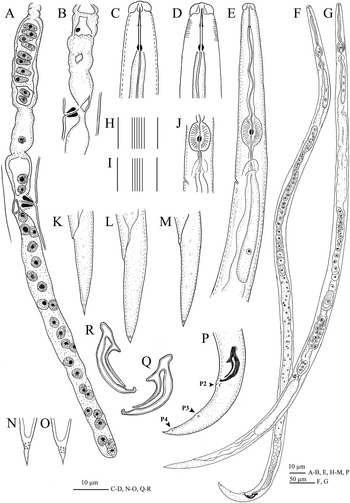
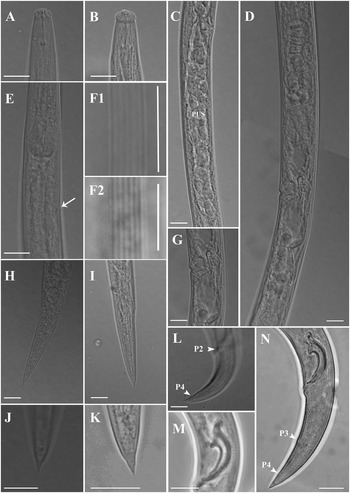
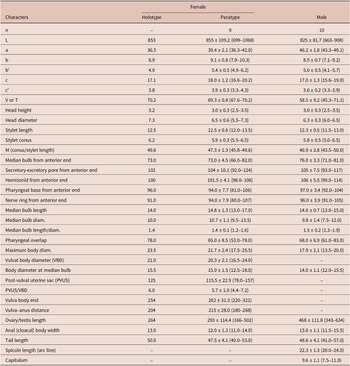
(Figures 1 and 2, measurements in Table 1)
Aphelenchoides persicus sp. n. A: female reproductive system with post uterine sac (PUS); B: vagina; C, D: anterior end; E: pharynx; F: entire male; G: entire female; H, I: lateral field; J: metacorpus and excretory pore; K–M: female posterior end; N, O: female tail tip; P: male posterior end; Q, R: spicules.

Aphelenchoides persicus sp. n. (LM). Female. A, B: anterior end; C: post uterine sac; D: female reproductive system; E: metacorpus and excretory pore (arrowhead showing excretory pore); F: lateral field (F1, F2); G: vagina; H–K: female posterior end. Male. L: genital papillae; M: lateral view of spicule region; N: lateral view of tail region. (P2 = subventral precloacal, P3, P4 = postcloacal pairs) Scale bar: all measurements = 10 μm.

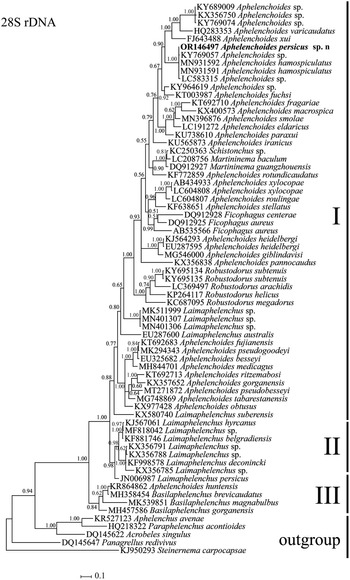
Bayesian 50% majority rule consensus tree of Aphelenchoides persicus sp. n. based on large subunit (LSU) rDNA (D2–D3 segment) sequences under GTR + I + G model. Bayesian posterior probability values of more than 0.50 are given for appropriate clades. The new sequence is indicated in bold.

Morphometrics of Aphelenchoides persicus sp. n. All measurements in μm and in the form: mean ± s.d. (range), except for ratio

Female (Figs 1A–R; 2A–N): Body slightly ventrally curved when heat-relaxed, very gently narrowing towards both ends. Body annuli about one μm wide at mid-body. Cuticle weak, less than one μm at mid-body. Lateral field with six incisures, occupying about 22–32% of corresponding body width, initiating with two at anterior end, extending to six at mid-body, in some areas, five incisures are also observed (Figures 1H, I; 2F), and reducing to two bands at posterior end. Lip region rounded, finely annulated, offset from body contour, 2.0–2.4 μm height and 5.5–7.3 μm width. Stylet not robust, conus thin, shorter than the shaft, the lumen well visible all over the stylet, having small swellings at base. Procorpus slender, median bulb rounded or oval, 1.4 ± 0.1 (1.2–1.6) times longer than the width, its valvular plates well sclerotized, slightly posterior to the central. Nerve ring at isthmus level. Excretory pore ca 1.5 metacorpal length posterior to base of the metacorpus. Pharyngo-intestinal junction just posterior to metacorpus, pharyngeal glands lobe overlapping intestine dorsally for 53–87 μm. Hemizonid 2–5 μm posterior to excretory pore. Intestine simple, rectum and anus functional. Reproductive system monodelphic-prodelphic, ovary outstretched, oocytes in one or two rows in germinal zone, oviduct distinct, spermatheca rectangular to elongate oval, possessing relatively large cells with clearly confirmed cell nuclei at anterior end. Crustaformeria and uterus boarder, well developed, vagina straight to slightly anteriorly directed. Vulva a simple transverse slit without any vulval flap. Post uterine sac (PUS) elongate, about 4–7 times than the vulval body diameter or 40–77% of the vulva-anus distance, bearing sperm in some specimens. Tail conical, ventrally almost flat, ending to a single mucro with a tiny projection close to the tail tip.
Male (Figures 1F, P–R; 2L–N): Abundant, equal to females in number. General morphology similar to that of female, except for reproductive system and the posterior end more ventrally bent after fixation. Genital system monorchic, testis outstretched with spermatocytes arranged in single to two and single row at germination and growth zone, respectively. Spicules arcuate, condylus well developed, rounded, slightly dorsally at the end, rostrum small, blunt conical, tip of dorsal limb hook-like. Male caudal papillae composed of three pairs (single P1 papilla lacking), arranged as follows: the first pair (P2) at cloacal level or slightly posterior, the second pair (P3) at about middle of the tail, and the third pair (P4) vestigial, close to the tail end. Tail similar to that of female, ending with a single mucro with tiny protuberance.
Diagnosis
Aphelenchoides persicus sp. n. is characterized by having a long body length (699–1068 μm in females and 663–908 μm in males), stylet 12.0–13.5 μm, with a distinct basal swelling, a long PUS, a little more than half the distance between vulva to anus, six incisures of lateral field, female tail with a simple mucro with tiny projection close to the tail tip, male with spicules 20–24 μm long with round condyles, conical rostrum and tip of dorsal limb hook-like and male tail with three pairs of caudal papillae (2 + 2 + 2).
Relationships
The most extensive work on Aphelenchoides was done by Shahina (Reference Shahina1996). Based on the key provided by Shahina (Reference Shahina1996), the new species belongs to Group 2, which is defined as having the female tail terminus with ‘one or sometimes two mucronate structure’. In having six lines in the lateral fields, the new species is most similar to five species from Group 2 including A. chinensis Husain and Khan, Reference Husain and Khan1967; A. meghalayensis Bina and Mohilal, Reference Bina and Mohilal2017; A. nechaleos Hooper and Ibrahim, Reference Hooper and Ibrahim1994; A. paranechaleos Hooper and Ibrahim, Reference Hooper and Ibrahim1994; and A. parasexlineatus Kulinich, Reference Kulinich1984. It is also similar to two species from Group 4, including A. allius Feng, Reference Feng2012 and A. sexlineatus Eroshenko, Reference Eroshenko1967.
Compared with A. allius, it differs in the tail end (a simple mucro (Figures 1N–O; 2J–K, 3D) vs. finger-like projection with midline (see Feng Reference Feng2012)), and stylet (with distinct basal swelling vs. lacking basal swelling) and longer PUS (5.7 vs. 3.8 times vulva body diameter). Compared with A. chinensis, it differs in longer female body length (699–1068 vs. 380–550 μm), stylet (with distinct basal swelling vs. lacking basal swelling), tail mucro (terminal vs. ventral), and longer PUS (six vs. three times vulva body diameter). Compared with A. meghalayensis, it differs in a longer female body (699–1068 vs. 493–681 μm), longer stylet (12.0–13.5 vs. 8.6–10.3 μm), a longer PUS (40–77% vs. 27–35% of the vulva-anus distance), and tail mucro (short vs. long). Compared with A. sexlineatus, it differs in the longer female body (699–1068 vs. 600–640 μm), longer stylet (12.0–13.5 vs. 9.0 μm), and tail end (a single and simple mucro vs. finger like mucro). Compared with A. parasexlineatus, it differs in the longer female body (699–1068 vs. 450–790 μm), longer PUS (5.7 vs. 1.5 times vulva body diameter), and female tail (conical with a single mucro vs. conical with a finger-like mucro). Compared with A. nechaleos, it differs in longer females (699–1068 vs. 600–930 μm), longer stylet (12.0–13.5 vs. 10.5–11.5 μm), and spicule length (20–24 vs. 15–20 μm). Compared with A. paranechaleos, it differs in longer females (699–1068 vs. 630–860 μm), longer stylet (12.0–13.5 vs. 9.5–10.5 μm), spicule length (20–24 vs. 15–18 μm), and female tail length (40–53 vs. 35–40 μm).
Additionally, the tail end appendage is a significant character to distinguish the Aphelenchoides species. Hence, the new species, compared with A. homospiculatus Mortazavi and Pedram, Reference Mortazavi and Pedram2020, differs in the longer female body (699–1068 vs. 467–666 μm), longer stylet (12.0–13.5 vs. 8–10 μm), and number of lateral field incisures (6 vs. 5). Compared with A. kheirii Golhasan, Heydari, Esmaeili, and Kanzaki, Reference Golhasan, Heydari, Esmaeili and Kanzaki2018, it differs in the longer female body (699–1068 vs. 448–520 μm), longer stylet (12.0–13.5 vs. 10–11 μm), number of lateral field incisures (6 vs. 4), and longer PUS (78–157 vs. 28–45 μm). Compared with A. xui Wang, Wang, Gu, Wang, and Li, Reference Wang, Wang, Gu, Wang and Li2013, it differs in number of lateral field incisures (6 vs. 5) and spicule (rostrum conical vs. rostrum rounded). Compared with A. paraxui Esmaeili, Heydari, Fang, and Li, Reference Esmaeili, Heydari, Fang and Li2017, it differs in the longer female body (699–1068 vs. 500–660 μm), longer stylet (12.0–13.5 vs. 8–9 μm), and number of lateral field incisures (6 vs. 4). Compared with A. smolae Wang, Wang, Gu, Wang, and Li, Reference Wang, Wang, Gu, Wang and Li2013, it differs in shorter stylet (12.0–13.5 vs. 13.0–14.9 μm) and number of lateral field incisures (6 vs. 4).
Molecular phylogenetical status
The phylogenetic tree based on the sequences of 28S rDNA formed three clades, including I) Aphelenchoides spp., Ficofagus spp., Laimaphelenchus spp., Martininema spp., Robustodorus spp., and Schistonchus spp., with 1.00 posterior probabilities support, II) Laimaphelenchus spp., including unidentified Laimaphelenchus; L. hyrcanus Miraeiz, Heydari, Tanha Maafi, and Bert Reference Miraeiz, Heydari, Tanha Maafi and Bert2015; L. belgeradiensis Oro, Reference Oro2015; and L. deconincki Elmiligy and Geraert, Reference Elmiligy and Geraert1972 with 0.98 posterior probabilities support, and III) A. huntensis Esmaeili, Fang, Li, and Heydari Reference Esmaeili, Fang, Li and Heydari2016; Basilaphelenchus brevicaudatus Mirzaie Fouladvand, Pourjam, Kanzaki, Giblin-Davis, and Pedram, Reference Mirzaie Fouladvand, Pourjam, Kanzaki, Giblin-Davis and Pedram2019; B. magnabulbus Aliramaji, Mirzaie Fouladvand, Pourjam, Mortazavi, Jahanshahi Afshar, Kanzaki, Giblin-Davis, and Pedram, Reference Aliramaji, Mirzaie Fouladvand, Pourjam, Mortazavi, Jahanshahi Afshar, Kanzaki, Giblin-Davis and Pedram2020; and B. gorganensis Mirzaie Fouladvand, Pourjam, Kanzaki, Giblin-Davis, and Pedram, Reference Mirzaie Fouladvand, Pourjam, Kanzaki, Giblin-Davis and Pedram2019 with 0.84 posterior probabilities support. Additionally, within clade I, the phylogenetic result of 28S rDNA placed Aphelenchoides persicus sp. n. close to A. hamospiculatus Mortazavi and Pedram, Reference Mortazavi and Pedram2020, and unidentified Aphelenchoides with a 1.00 posterior probabilities support. Besides, A. persicus sp. n. along with A. varicaudatus Ibrahim and Hooper, Reference Hooper and Ibrahim1994; A. xui, A. fragariae (Ritzema Bos, 1890) Christie, 1932; A. macrospica Golhasan, Heydari, Esmaeili, and Miraeiz, Reference Golhasan, Heydari, Esmaeili and Miraeiz2017; A. eldaricus Esmaeili, Heydari, Golhasan, and Kanzaki Reference Esmaeili, Heydari, Fang and Li2017; A. paraxui, and A. iranicus Golhasan, Heydari, Álvarez-Ortega, Esmaeili, Castillo, and Palomares-Rius, Reference Golhasan, Heydari, Álvarez-Ortega, Esmaeili, Castillo and Palomares-Rius2016; and several unidentified Aphelenchoides formed a clade with a 0.79 posterior probability support values.
Type host and locality
The nematodes were recovered from the soil around the rhizosphere of wild persimmon (Diospyros sp.) in Guilan Province, northern Iran. The first author collected the samples on 1 June 2021.
Type material
A female holotype (slide number: GU-1A), two female paratypes (slide numbers: GU-2A and GU-3A), and three male paratypes (slide numbers: GU-2A and GU-3A) were deposited in the nematode collection of the Plant Protection Department, College of Plant Production, Gorgan University, Iran. In addition, two paratypes of females and males (slide numbers: GU-4A and GU-5A) were deposited at the Nematology collection of the Aquaculture Research Unit of the University of Limpopo, South Africa. Two paratypes of females and males (slide numbers: GU-6A and GU-7A) were deposited in WANECO collection, Wageningen, The Netherlands (http://www.waneco.eu).
Etymology
The species’ name refers to the country of origin (Iran, old name: Persia) where the samples were collected.
Discussion
Aphelenchoides with detail and a key to species is provided by Shahina (Reference Shahina1996), and it is a highly diverse genus with more than 153 species (Hunt Reference Hunt2008). Although several species of Aphelenchides have been recently described worldwide, they should be added to the available species list. The genus has few morphologically diagnostic taxonomic characters, and it is challenging to compare new species with older ones, often with incomplete descriptions (Kanzaki Reference Kanzaki2006). This study described a new species using molecular characterization. Molecular sequences and phylogenetic analyses strongly supported the status of A. persicus n. sp. as a new species. Although the features have been revised by Shahina (Reference Shahina1996), the new species from Iran, A. persicus sp. n., belongs to a rare group of Aphelenchoides characterised by having six incisures in the lateral field.
The 28S phylogenetic result placed the new species, A. persicus sp. n., close to A. hamospiculatus, A. varicaudatus, A. xui, A. fragariae, A. macrospica, A. eldaricus, A. paraxui, and A. iranicus. The relationships between A. persicus sp. n., A. hamospiculatus, A. xui, and A. paraxui have been discussed already. The result obtained in the present study is in agreement with Aliramaji et al. (Reference Aliramaji, Pourjam, Álvarez-Ortega, Afshar and Pedram2018) and Golhasan et al. (Reference Golhasan, Heydari, Álvarez-Ortega, Esmaeili, Castillo and Palomares-Rius2016), whose results categorized Aphelenchoides with simple or two mucronate appendages at the tail tip in the same group.
However, compared with A. varicaudatus, it differs in body length (699–1068 vs. 580–710 μm) and number of lateral field incisures (6 vs. 4). Compared with A. fragariae, it differs in female body length (699–1068 vs. 450–800 μm) and number of lateral field incisures (6 vs. 2). Compared with A. macrospica, it differs in the female tail (40–53 vs. 52–63 μm), spicule length (20–24 vs. 27–32 μm), stylet length (12.0–13.5 vs. 15–16 μm), PUS (78–157 vs. 41–60 μm), mucro (a single and straightforward vs. a single with unequal bifurcate), and number of lateral field incisures (6 vs. 4). Compared with A. eldaricus, it differs in the female body (699–1068 vs. 507–700 μm), spicule length (20–24 vs. 24–29 μm), stylet length (12.0–13.5 vs. 9–10 μm), PUS (78–157 vs. 27–40 μm), and number of lateral field incisures (6 vs. 3). Compared with A. iranicus, it differs in the female body (699–1068 vs. 330–383 μm), spicule length (20–24 vs. 10–11 μm), stylet length (12.0–13.5 vs. 7–9 μm), PUS (78–157 vs. 21–34 μm), and number of lateral field incisures (6 vs. 3).
Overall, Aphelenchoides were placed in several groups within the 28S phylogenetic tree, revealing Aphelenchoides as paraphyletic. This is in agreement with the finding of several nematologists (Zhao et al. Reference Zhao, Davies, Riley and Nobbs2007; Rybarczyk-Mydƚowska et al. Reference Rybarczyk-Mydlowska, Mooyman, van Megen, van den Elsen, Vervoort, Veenhuizen, van Doorn, Dees, Karssen, Bakker and Helder2012; Wang et al. Reference Wang, Wang, Gu, Wang and Li2013; Fang et al. Reference Fang, Gu, Wang and Li2014; Miraeiz et al. Reference Miraeiz, Heydari, Tanha Maafi and Bert2015; Esmaeili et al. Reference Esmaeili, Fang, Li and Heydari2016, Golhasan et al. Reference Golhasan, Heydari, Álvarez-Ortega, Esmaeili, Castillo and Palomares-Rius2016; Aliramaji et al. Reference Aliramaji, Pourjam, Álvarez-Ortega, Afshar and Pedram2018).
However, Aphelenchoides, with the sequences included in the present study, stands close with Basilaphelenchus (Pedram et al. Reference Pedram, Kanzaki, Giblin-Davis and Pourjam2018a); Ficofagus Davies, Ye, Kanzaki, Bartholomaeus, Zeng, and Giblin-Davis, Reference Davies, Ye, Kanzaki, Bartholomaeus, Zeng and Giblin-Davis2015; Laimaphelenchus Fuchs, Reference Fuchs1937; Martininema Davies, Ye, Kanzaki, Bartholomaeus, Zeng, and Giblin-Davis, Reference Davies, Ye, Kanzaki, Bartholomaeus, Zeng and Giblin-Davis2015; Robustodorus; and Schistonchus. The mentioned above genera bear a high rate of morphological homoplasy, as indicated by Zeng et al. (Reference Zeng, Giblin-Davis and Ye2007), Kanzaki et al. (Reference Kanzaki, Shokoohi, Fourie, Swart, Muller and Giblin-Davis2018), and Pedram et al. (Reference Pedram, Pourhashemi, Hosseinzadeh and Koolivand2018b). Thus, they can be separated via stylet morphology and molecular characters of rDNA. Additionally, the new species, A. persicus sp. n., was isolated from the soil, and its ecological role is yet to be investigated. The 28S rDNA phylogenetic tree showed that members of the superfamily Aphelenchoidea, especially Aphelenchoides and Laimaphelenchus, placed in several groups. Therefore, more information on the mentioned taxa is critical for their study. In contrast, Basilaphelenchus, Schistonchus, Robustodorus, Ficofagus, and Maritinema are placed together, despite the few sequences available and studied. Hence, for the mentioned taxa, more sequences belonging to various species reveal the actual position of the species. The main feature that distinguishes the members of the Aphelenchoidea is stylet morphology. In addition, posterior morphology also becomes essential to describe the new species, pointing to the importance of SEM photographs. In conclusion, the new species was confirmed by the morphological and molecular characters. However, using other rDNA and mtDNA might reveal the actual position of the aphelenchid nematodes.
Acknowledgements
The authors are thankful to the Gorgan University of Agricultural Sciences and Natural Resources, Gorgan, Iran, for the financial support of this project.