

Introduction
Otitis media (OM) is among the most common illnesses of infancy and early childhood, with a peak age specific incidence between 6 and 24 months of age. 1 It is one of the most common infections for which children make office visits to physicians and for which antibacterial agents are prescribed in the United States. 2 – Reference Faden, Duffy and Boeve 4 The spectrum of OM includes acute OM (AOM), OM with effusion, chronic suppurative OM and OM-related complications.
AOM is defined by the presence of fluid in the middle ear, as seen by tympanic membrane bulging, accompanied by signs of acute illness and middle ear inflammation. 5 Effusion can persist in the middle ear for weeks to months and potentially impair hearing.Reference Fiellau-Nikolajsen and Lous 6 Recurrent middle ear infections may adversely impact long-term health with respect to the development of speech and cognitive abilities. 7
Well-established risk factors for childhood OM include young age, male sex, race and ethnicity, familial history and exposure to tobacco smoke.Reference Uhari, Mäntysaari and Niemelä 8 Other implicated risk factors include seasonal, social and economic conditions, underlying anomalies or diseases (such as immunodeficiency, craniofacial anomalies, upper respiratory tract infections, adenoid hypertrophy and laryngopharyngeal reflux). Prematurity was also found to increase the susceptibility to OM due to different anatomic and functional factors, as compared with term infants.Reference Kero and Piekkala 9 , Reference Bland 10 Furthermore, nasotracheal intubation and feedings tube may impair the physiological mobility of the tympanic membrane or the function of the Eustachian tube, thereby increasing the risk for childhood OM.Reference Berman, Balkany and Simmons 11 Breastfeeding, proven to protect against AOM, 12 is less common among preterm newborns. 13
Prematurity is independently associated with increased mortality, short- and long-term morbidity for the offspring. 14 Examples of prematurity-related morbidity classically include respiratory distress syndrome, retinopathy of prematurityReference Jacobson 15 and neurocognitive impairment. 16 Furthermore, preterm infants have increased susceptibility to infection because of immune system immaturity, leading to decreased phagocytic cellular defenses as well as decreased transmission of maternal antibodies and with the resultant decreased maternally acquired passive immunity.Reference Lott 17
Although the International Classification of Diseases (ICD) defines term pregnancy as delivery between 37 weeks 0 out of 7 and 41 weeks 6 out of 7, 18 fetal maturation appears to be a continuum and perinatal adverse outcome rates are not even across the 5-week gestational age range that constitutes ‘term.’ 19 Early-term delivery (37 weeks gestation 0 out of 7 through 38 weeks gestation 6 out of 7) is now a well-established risk factor for short- and long-term neonatal morbidity, in a pattern similar to late preterm deliveries (34 weeks gestation 0 out of 7–36 weeks gestation 6 out of 7). This includes neonatal mortality, 20 respiratory morbidity, 21 higher rates of neonatal intensive care unit admissions, 22 longer durations of hospital stay at birth, increased rates of re-hospitalization within the first year of life, higher emergency department use, 23 higher rates of pediatric obstructive sleep apnea 24 and endocrine and metabolic morbidity. 25 Given the variable immediate adverse perinatal outcome rates across the 5-week span of term, ‘term pregnancy’ was redefined by the Defining Term Pregnancy Workgroup in 2013.Reference Spong 26
As OM is a common and burdensome infection during childhood, sometimes attributable to premature immune system of the child, we sought to determine whether the different subgroups of preterm and term delivery impact differently on the long-term prevalence of childhood OM, with a specific focus on early-term born offspring.
Methods
A retrospective cohort study of all women was conducted who delivered at the Soroka University Medical Center (SUMC), Beer-Sheva, Israel, between the years 1991 and 2014. SUMC is the sole hospital in the Negev (southern Israel), which occupies 65.5% of the country’s land and 14.4% of Israel’s population – approximately 1,200,000 inhabitants. 27 During the 23-year study period, the annual number of deliveries managed at SUMC increased from roughly 10,000 to 15,000. Since the early 1990s, the Negev region is characterized by positive immigration. Thus, the study is based on nonselective population data.
The primary exposure was defined as gestational age at birth including early and late preterm as well as the 5-week span, which constitute ‘term delivery’ and later. Early-term delivery, full-term delivery, late-term delivery and postterm delivery were all defined as per the ‘Defining Term Pregnancy Workgroup.’Reference Spong 26 Gestational age upon delivery was subdivided into six groups: early (<34 weeks gestation 0 out of 7) and late (34 weeks gestation 0 out of 7–36 weeks gestation 6 out of 7) preterm, and early (37 weeks gestation 0 out of 7–38 weeks gestation 6 out of 7), full (39 weeks gestation 0 out of 7–40 weeks gestation 6 out of 7), late (41 weeks gestation 0 out of 7–41 weeks gestation 6 out of 7) and post (⩾42 weeks 0 out of 7) term deliveries. Gestational age was based on the best obstetric estimate determined by providers and used for clinical decision-making. The standard criteria used involved consideration of the clinical history and earliest ultrasound measurements. If the last menstrual period (LMP) was certain and consistent with the ultrasound, dating was based on LMP. If the ultrasound was not consistent with the LMP, or the LMP was unknown, ultrasound data were used for determination of gestational age. Owing to the well-established association of prematurity with multiple gestations and congenital malformations on one hand, and the association of several malformations with infections on the other hand, we excluded both multiple gestations and fetuses with congenital malformations from the cohort.
The primary objective of the study was to investigate the association between gestational age at delivery and the risk of childhood OM in the offspring (dependent variable) followed up to the age of 18 years. The incidences of childhood OM in the offspring were compared between the six gestational age groups.
The long-term outcomes assessed included all hospitalizations of the offspring up to the age of 18 years involving OM. A diagnosis of OM during hospitalization was predefined according to a set of ICD-9 related procedures and diagnoses codes detailed in the Supplementary Table.
The study period started on January 1, 1991 and ended on January 1, 2014. Follow-up ended if any of the following occurred: first OM hospitalization, child death (during hospitalization, other than OM related), the child reached 18 years of age (calculated for each child based on date of birth) or at the end of the study period, whichever came first. Follow-up time was defined as time to an event (OM-related hospitalization), or until censored. Only the first hospitalization for each child was included in the analyses.
Data were collected from two databases that were cross-linked and merged: the computerized hospitalization database of the SUMC (‘Demog-ICD-9’), and the computerized perinatal database of the obstetrics and gynecology department. The perinatal database consists of information recorded immediately following delivery by an obstetrician. Experienced medical secretaries routinely review the information before entering it into the database to ensure its maximal completeness and accuracy. Coding is performed after assessing medical prenatal care records, as well as routine hospital documentation. The Demog-ICD-9 database includes demographic information and ICD-9 codes for all medical diagnoses made during hospitalizations at the SUMC.
Statistical analysis
Statistical analysis was performed using STATA (version 12.0) and SPSS (version 23.0) software. Assumptions were two-sided with α=0.05 and β=0.2. Initial analysis compared background, pregnancy and perinatal characteristics between the different gestational age groups, using Fisher’s exact χ2-test for categorical variables and one-way analysis of variance for continuous variables. Background and perinatal characteristics included maternal age, maternal diabetes mellitus and hypertensive disorders, maternal smoking, parity, and ethnicity, mode of delivery, Apgar score, birthweight and offspring gender. Incidence rates and incidence density rates per 1000-person years were calculated and compared between study groups.
Kaplan–Meier survival curves were constructed, and the cumulative OM-related hospitalization incidence was compared between the six gestational age groups using the Cox–Mantel log-rank test. Only the first hospitalization for each child was included.
In order to adjust length of follow-up, the multivariable Weibull parametric analysis was performed, in which mothers in the cohort were entered as clusters and the dependence among the siblings was accounted for. This regression analysis is unique in that it controls not only length of follow-up (similar to the Cox regression model) but also familial aggregation, very relevant to the outcome variable. Variables statistically different between the study groups were tested for associations with the outcome variable. In case both terms were present, the variables were suspected as confounders and considered in the multivariable model. Variables with clinical importance were also included in the multivariable analysis. These included offspring gender, mode of delivery, induction of labor, birthweight [small for gestational age (SGA), defined as birthweight of less than the fifth percentile for gestational age and for gender], maternal smoking and ethnicity. Deliveries occurring at full term (i.e., 39 weeks 0 out of 7 through 40 weeks 6 out of 7) were considered as reference. The models compared the independent risk for OM-related morbidity. The final model was selected based on the best model fit and lowest-2 log likelihood.
The study protocol was approved by the SUMC institutional review board and informed consent was exempt.
Results
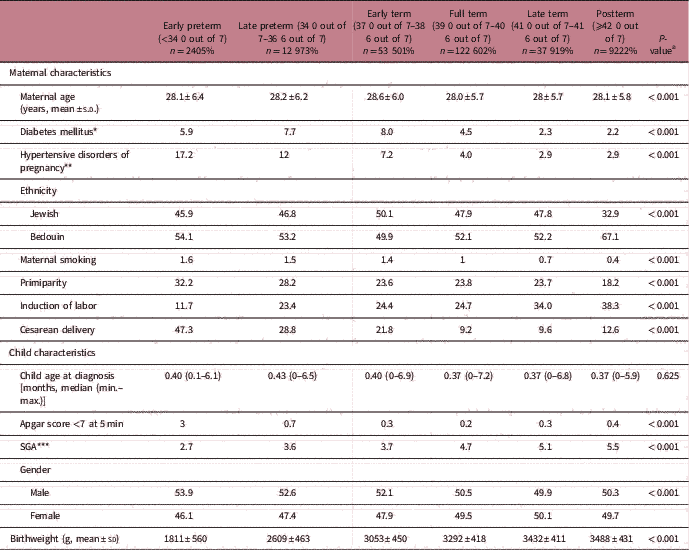
During the study period 238,622 deliveries met the inclusion criteria. Of them, 15,378 (6.4%) were preterm deliveries and 223,244 (93.6%) occurred at term. Of the preterm deliveries, 15.6% (n=2405) occurred at early preterm, whereas 84.4% (n=12,973) occurred at late preterm. Of the term deliveries, 24% (n=53,501) occurred at early term, 54.9% (n=122,602) at full term, 17% (n=37,919) at late term and 4.1% (n=9222) at postterm. Table 1 compares demographic characteristics, pregnancy course and immediate perinatal outcomes in the different gestational age groups. Pregnancies delivered at early term were more likely to be complicated by maternal diabetes (both gestational and pregestational) as compared with all other preterm and term delivery groups. Hypertensive disorders of pregnancy decreased in frequency across the gestational age groups with highest rates at early preterm pregnancies (Table 1). Mean birthweight increased gradually as gestational age increased across the gestational age groups. Bedouin ethnicity as well as smoking and primiparity were more common in the preterm groups. Rates of labor induction were significantly higher in the late and postterm groups and significantly lower in the early preterm group. Male gender and having a low (<7) Apgar score at 5 min were significantly more common in early preterm newborns. There was no significant difference in mean child age upon diagnosis between the different gestational age groups (P-value=0.625).
Maternal demographic characteristics, pregnancy course and perinatal outcomes in the different gestational age groups

Data are presented as %, or mean±sd (standard deviation), or median (minimum−maximum).
aCalculated for all using the χ2-test for trends.
* Including pregestational and gestational diabetes.
** Including chronic hypertension, gestational hypertension and preeclampsia with or without severe features.
*** SGA defined as <5th centile birthweight for gestational age and for gender.
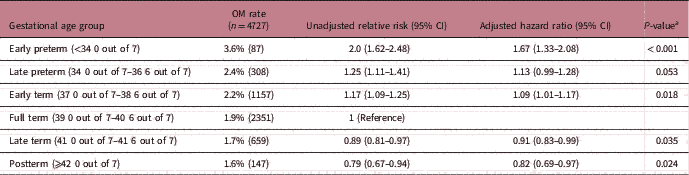
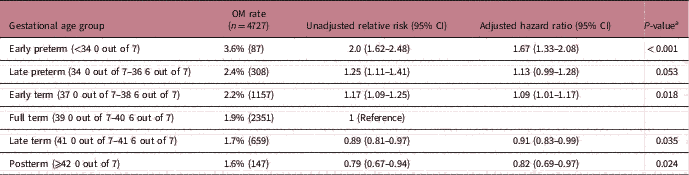
OM-related hospitalizations of the offspring up to 18 years of age were recorded, with a total of 4727 children (2% of the entire cohort) hospitalized at least once during the follow-up period. Notably, 92% of the OM cases in our cohort were coded under the diagnosis ‘Unspecified otitis media’ (ICD code 3829). OM-related hospitalizations gradually decreased as gestational age at birth advanced, ranging from 3.6% in the early preterm group to 2.2% in children born at early term, to as low as 1.6% in postterm born children (P<0.001; using the χ2-test for trends).
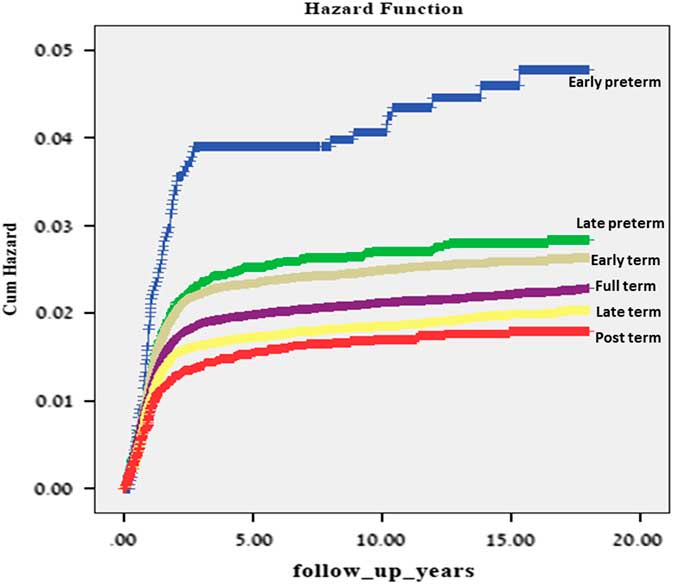
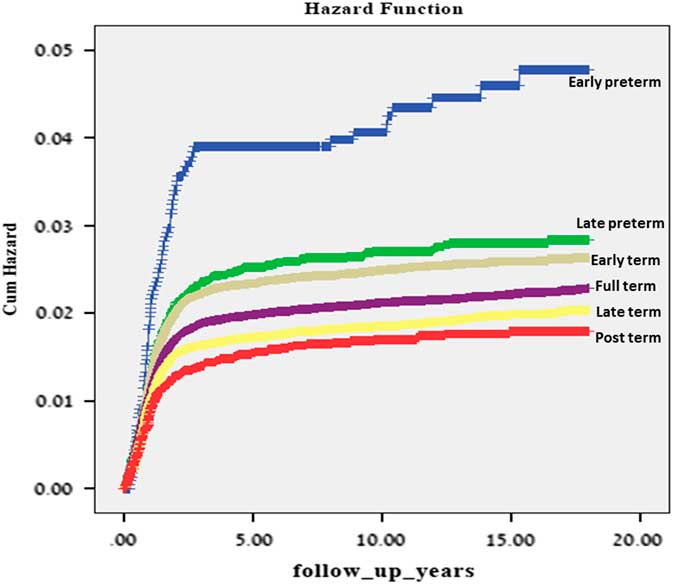
The Kaplan–Meier survival curve (Fig. 1) demonstrates the cumulative incidence of pediatric OM-related hospitalizations according to gestational age at delivery. Only the first hospitalization for each child was included in the survival curve. Cumulative OM incidence in the early-term group was significantly higher, as compared with other term subgroups, and significantly lower as compared with the early preterm delivery group (Fig. 1, log-rank test P<0.001). The early term and late preterm curves appear to be similar.
The cumulative incidence of pediatric otitis media related hospitalizations according to gestational age at delivery.
The Weibull parametric regression model (Table 2) was employed to establish an independent association between pediatric OM (up to the age of 18 years) and gestational age at birth, while controlling for potential confounders [including birthweight in percentiles (SGA, defined as less than the fifth centile birthweight for gestational age and gender), maternal smoking, offspring gender, ethnicity, mode of delivery and induction of labor]. Similar to the preterm group, and unlike other term subgroups, early-term delivery exhibited a significant and independent association with pediatric OM-related hospitalizations of the offspring with an adjusted hazard ratio (HR) of 1.09 [95% confidence interval (CI) 1.01–1.17] as compared with full-term deliveries (reference value), whereas both late and postterm deliveries were found to be significantly protective (adjusted HR: 0.91 and 0.81, respectively).
Weibull regression model for prediction of otitis media-related hospitalizations in children (up to the age of 18 years) according to gestational age
Controlled for: SGA (small for gestational age, defined as <5th centile birthweight for gestational age and gender), ethnicity, maternal smoking, mode of delivery, induction of labor and offspring gender.
aCalculated for all using the χ2-test for trends.
Several additional multivariable analyses were constructed in order to examine our results (Weibull regression analyses using an identical set of confounders as previously described), including separate analyses solely for vaginal deliveries, cesarean deliveries (while controlling for major indications – previous cesareans and fetal malpresentation) and for antibiotics usage during labor [penicillin G for known group B streptococcus (GBS) colonization, models not presented]. The regression model which included vaginal deliveries only (most of the original cohort) yield a significant association between early-term delivery and childhood OM (HR: 1.08, P-value=0.05). The regression model which included cesareans only (small part of the cohort) showed a similar trend, but this reached statistical significance only in the early preterm group. In the third regression model including known GBS carriage, the results remained similar to the original model (presented in Table 2), with a clear association between the different gestational ages upon delivery and the risk for childhood OM. Early-term delivery significantly elevated the risk for OM with an adjusted HR of 1.09 (95% CI 1.02–1.18, P-value=0.018).
Discussion
In our large cohort of offspring with a long follow-up period, we demonstrated an inverse relationship between gestational age at birth and childhood OM incidence (as evident by OM-related hospital admissions). The risk of OM-related hospitalization was significantly increased, not only in preterm born offspring but also with early-term deliveries, as compared to full-term born offspring, while controlling for labor induction, birthweight, mode of delivery and other clinically relevant confounders. Because the vast majority of the OM cases in our cohort were unspecified OM, we assume the main outcome to be AOM.
The early-term born population of infants has received growing attention in the last decade, with accumulating data now suggesting a pattern of morbidity similar to those of late preterm born children. Gouyon et al. 28 described higher morbidity rates in early-term born offspring, with a specific vulnerability of the respiratory system. Our group has also published several studies confirming the association between early-term delivery and later metabolic, respiratory and sleep abnormalities. 21 , 24 , 25 To address concerns regarding respiratory morbidity in early-term infants, the American Congress of Obstetricians and Gynecologists updated their 1996 recommendation that elective delivery before 39 weeks gestation be performed only after fetal lung maturity is established and the appropriate clinical circumstances are present. 29 As symptomatic upper respiratory infections among young children are often complicated by OM, 30 the significant association between early-term and pediatric OM is likely mediated by respiratory system vulnerability, potentially resulting from persistent bronchopulmonary dysplasia, as well as respiratory syncytial virus and other viral infections. Our results clearly suggest that within the wide spectrum of ‘term’ gestation and delivery, pediatric OM rates vary significantly. The risk gradually decreases as gestational age advances and the association of increased incidence with early term remained independent after controlling for variables which may be associated with both early-term delivery as well as childhood OM. These potential confounders include maternal smoking, ethnicity and offspring gender.
We were able to include 4727 OM-related hospitalizations up to 18 years of age – implicating 2% of the entire study population. This rate is well below the reported prevalence of OM in children. 1 , 31 The probable reason for this discrepancy is related to the fact that most childhood OM cases are managed in an ambulatory setting. Admissions for OM were probably related to oral treatment failure, complications (such as concomitant mastoiditis or sepsis) or other background medical conditions. The exclusion of offspring with anomalies, some of which are later associated with OM, may have also contributed to the low rates observed. 5 It is also likely that changes in modifying factors such as pneumococcal and influenza vaccines, decreased smoking and higher breastfeeding rates 32 , 33 contributed to reduced OM prevalence during childhood. In Israel, as in many other countries around the globe, a comprehensive, charge free, childhood vaccination protocol exists, and executed via neonatal departments in hospitals, baby clinics distributed around the country (‘Tipot Halav’) and in all public schools. Every newborn is discharged from the hospital with a vaccination booklet containing the recommended vaccination schedule (according to the Ministry of Health). The above noted vaccines are included in the Israeli health ministry protocol. 34 Notably, according to Organization for Economic Cooperation and Development data, vaccination rates in Israeli children are one of the highest worldwide, about 95%. 35 Nevertheless, all such factors are expected to impact all delivery age groups in a similar fashion and thus should not have introduced bias or misclassification.
In our cohort, we found early-term deliveries to be associated with higher rates of cesarean deliveries as compared with later gestational ages (early 21.8%, full 9.2%, late 9.6% and postterm 12.6%). These increased rates must be considered when interpreting the long-term outcome of the offspring, as mode of delivery may potentially mediate the relationship between gestational age and later offspring respiratory morbidity in general and specifically OM. Cesarean delivery has been reported to be a risk factor for respiratory complications (i.e., respiratory distress syndrome, transient tachypnea of the newborn, pulmonary hypertension or need for ventilator support), particularly if the cesarean was performed in a nonlaboring patient. 36 In the long run, an association between cesarean delivery and asthma/bronchiolitis was demonstrated. 37 As mode of delivery may be the mediator explaining the relationship between early-term delivery and childhood OM in the offspring, we have analyzed this relationship while accounting for delivery mode in the Weibull regression model.
Uniquely for our study population, SUMC is the only tertiary medical center treating the entire population of the Negev region, allowing thus true long-term follow-up of offspring health. The long-term follow-up allowed us to closely examine any hospitalizations during childhood. In addition, our data set combines maternal, neonatal and long-term childhood data, enabling the opportunity to examine the long-term outcomes of offspring with the ability to control for many parameters and potential confounders surrounding pregnancy and delivery. That said, the main limitation of our study lies with its retrospective design. As a population-level analysis, our study can support or refute only an association but not causation, or underlying pathogenesis. In addition, several factors known to influence OM risk were not available. These include breastfeeding, presence of allergies, family history, daycare use, exposure to potentially ototoxic antibiotics in utero or later on and socioeconomic status. In addition, we focused only on hospitalization at SUMC related to a diagnosis of OM. Thus, any medical encounter occurring at an ambulatory setting or at a different hospital, for any reason, was not accounted for. It is possible that some OM-related hospital encounters occurred outside of this large tertiary regional medical center due to immigration. We can see no reason, however, that immigration rates would be different across the gestational age groups and thus believe that its specific impact on our results is probably minor. Another potential limitation is the fact that, although we excluded from our cohort congenital anomalies, some congenital anomalies and background diseases known to be associated with OM (such as immunodeficiency, craniofacial anomaly, adenoid hypertrophy and laryngopharyngeal reflux) may only be diagnosed later in childhood and thus not excluded from our cohort. We believe that there is no reason for higher rates of such anomalies in early-term deliveries as compared with other gestational age subgroups. Although we speculate that hospitalizations for OM constitute an underestimation of OM incidence across all study groups, such underestimation introduces another limitation, which is the inability to estimate the disease burden and economical and healthcare implications of increased incidence in the early-term delivery subgroup.
We believe there is biological plausibility to our findings, as early term appears to be a ‘bridge period’ in many aspects (for both short- and long-term outcomes) between the late preterm period and the full-term period. Our results, taken together with earlier studies that pointed out respiratory tract vulnerability, especially in light of our cohort’s large size, long follow-up period and significant results add important information to the possible implications of delivery timing within the wide range of ‘term gestation.’ The increased propensity for respiratory infection in early-term offspring suggests both anatomical and functional factors are involved in its pathogenesis. To the best of authors’ knowledge, this study is the first to suggest an increased incidence of childhood OM related to the gestational age at birth within term gestation.
To conclude, gestational age at birth appears to be closely associated with long-term risk of pediatric hospitalizations on account of OM-related morbidity in the offspring. Early-term born offspring appear to exhibit a similar pattern of morbidity to those of preterm newborns, rather than to other term gestation subgroups. As gestational age advances, within term, the risk gradually decreases. The pathogenesis and health implications of this observation warrant further study.
Supplementary material
To view supplementary material for this article, please visit https://doi.org/10.1017/S2040174418000685
Acknowledgments
None.
Financial Support
This research received no specific grant from any funding agency or from commercial or not-for-profit sectors.
Conflicts of Interest
None.