

Despite passionate advocacy for pure blank minds at birth by tabula rasa proponents, astute parents often give testimony to the remarkable early emergence and stability of particular personality traits in their children. Theoretically, Shiner and Caspi (Reference Shiner and Caspi2003) explain the process of developmental elaboration to describe how an individual's personality develops from infancy to adulthood. Essentially it is seen to involve a complex set of interactions with the environment, where predispositions develop into adult personality profiles. Both internal and external processes interactively reinforce the repeated expression of early personality tendencies, shaping particular personality traits over time (Shiner & Caspi, Reference Shiner and Caspi2003). Thus, the early identification of personality traits in childhood may provide useful markers for predicting the course of an individual's psychological development.
While there continues to be debate over a global definition of personality more broadly, personality traits per se have been empirically and consistently identified across culturally disparate populations. Boag (Reference Boag and Boag2008) noted the rise of the variable-centred trait approach, particularly the work of Eysenck and Cattell in the post-war period, evidenced by the flourish of papers focusing on personality in adults and late adolescents. With the development of reliable trait scales, McCrae and Costa (Reference McCrae, Costa, Boyle, Matthews and Saklofske2008) reported hundreds of subsequent studies establishing trait correlates, with key psychological variables supporting construct validity.
There is now general consensus on a set of five principle domains commonly known as the Big Five (B-5): Neuroticism, Conscientiousness, Extraversion, Openness to Experience, and Agreeableness (Deary, Reference Deary, Corr and Matthews2009; McAdams & Pals, Reference McAdams, Pals, Robins, Fraley and Krueger2007). Emerging in the 1980s, McCrae (Reference McCrae2011) acknowledged the B-5 taxonomy as largely inclusive of the full range of adult personality traits, and subsequently used it as the basis for the Five Factor Model (FFM). The B-5 factors refer to higher-order personality domains, each comprised of numerous lower-order facets. The model has generated significant research in adults in areas including physical and mental health, occupational work, achievement, heritability, cross-cultural invariance and relationships, providing confirmation of predictive validity, and furthering the FFM's credentials (Caspi, Roberts, & Shiner, Reference Caspi, Roberts and Shiner2005; Costa & McCrae, Reference Costa and McCrae2011; Deal, Halverson, Martin, & Baker, Reference Deal, Halverson, Martin and Baker2007; John, Naumann, & Soto, Reference John, Naumann, Soto, John, Robins and Pervin2008; Ozer & Benet-Martinez, Reference Ozer and Benet-Martinez2006). The significance of adult trait work has encouraged FFM researchers to extend their investigations downwards to children (De Clercq, Rettew, Althoff, & De Bolle, Reference De Clercq, Rettew, Althoff and De Bolle2012). Childhood personality measures have been developed with serious potential for future research and practice in early intervention. Particularly promising is work that investigates the role of personality traits as a basis for redirecting maladaptive developmental trajectories (De Clercq et al., Reference De Clercq, Rettew, Althoff and De Bolle2012).
The past two decades have seen the development of two approaches to measuring child personality traits. The top-down approach applies an adult questionnaire to a child population, often with minor adaptations to wording. Using this top-down method, De Fruyt, De Bolle, McCrae, Terracciano, and Costa (Reference De Fruyt, De Bolle, McCrae, Terracciano and Costa2009) have demonstrated that the adult Neuroticism-Extraversion-Openness (NEO) trait model can be well identified in children as young as 12 years old. To this end, the most recent revision of the questionnaire, the Neuroticism-Extraversion-Openness-Personality Inventory-3 (NEO-PI-3) now provides separate adolescent norms for respondents aged 12–20 years (McCrae, Costa, & Martin, Reference McCrae, Costa and Martin2005). Currently, however, comparatively little research is available for children younger than 12 years. With Costa and McCrae's facet structure being derived from adults, there is concern that it may not be valid to simply transpose this model as the basis of establishing trait structure in younger children (Halverson et al., Reference Halverson, Havill, Deal, Baker, Victor, Pavlopoulos and Wen2003). This assumes that some adult traits may not be as relevant for understanding children's personalities. Researchers are encouraged to reconceptualise how traits are differentially expressed across the lifespan (Markey, Markey, & Tinsley, Reference Markey, Markey and Tinsley2004). Thus, bottom-up methods that uncover developmentally appropriate aspects of child personality are required.
Given the need for understanding and ascertaining traits developmentally, Kohnstamm, Halverson, Mervielde, and Havill (Reference Kohnstamm, Halverson, Mervielde and Havill1998) set out to identify the personality traits of young children aged 3–12 years. They adapted the lexical approach to utilise parental-free descriptions of children's personalities, finding that between 70–80% of the descriptors could be classified in accordance with the FFM. Subsequently, test development work based on these descriptors resulted in the construction of the 144-item Hierarchical Personality Inventory for Children (HiPIC; Mervielde & De Fruyt, Reference Mervielde, De Fruyt, De Raad and Perugini2002). The HiPIC reports 18 lower-order facets, grouped into five domains reflective of the B-5; Benevolence, Extraversion, Imagination, Emotional Stability and Conscientiousness (Mervielde & De Fruyt, Reference Mervielde, De Fruyt, Mervielde, Deary, De Fruyt and Ostendorf1999). While reflecting the adult FFM, it is noteworthy that the HiPIC factors are not identical (see De Fruyt, Mervielde, & Van Leeuwen, Reference De Fruyt, Mervielde and Van Leeuwen2002; or Mervielde & De Fruyt, Reference Mervielde, De Fruyt, De Raad and Perugini2002 for further details of these developmental differences).
The original version of the HiPIC was first developed and validated in Flemish (Mervielde & De Fruyt, Reference Mervielde, De Fruyt, Mervielde, Deary, De Fruyt and Ostendorf1999) and has since been satisfactorily validated for use in a number of other European languages, including French (Rossier, Quartier, Enescu, & Iselin, Reference Rossier, Quartier, Enescu and Iselin2007), German (Bleidorn & Ostendorf, Reference Bleidorn and Ostendorf2009), Italian (Di Blas, Serafino, & De Fruyt, Reference Di Blas, Serafino and De Fruyt2005) and Norwegian (Vollarth, Hampson, & Juliusson, Reference Vollarth, Hampson and Juliusson2012). The English version was translated by the authors of the questionnare (Mervielde and De Fruyt), who were also fluent in English. A native English-speaking colleague performed a cross-check on item grammar, clarity and content equivalence and the resulting items were finally back-translated by an independent, bilingual, Dutch-speaking researcher before a final review by the original authors (Tackett, Kushner, De Fruyt, & Mervielde, Reference Tackett, Kushner, De Fruyt and Mervielde2013). Although one recent validation of the English-translated HiPIC has been conducted in a bilingual English-speaking country, as yet there is no published work evaluating the translation and examining the generalisability of the HiPIC structure within an Australian population. Cross-cultural validation in an Australian population would further extend the availability of the HiPIC to an official monolingual English-speaking country.
Debate continues regarding the best way to validate personality measures across samples, countries, cultures and languages (Allik & McCrae, Reference Allik and McCrae2004; Hopwood & Donnellan, Reference Hopwood and Donnellan2013; Laher, Reference Laher2010; Vassend & Skrondal, Reference Vassend and Skrondal2011). Although Structural Equation Modelling (SEM) provides an often preferred approach for confirmation and cross-group comparisons, its appropriateness for personality traits has been questioned (Hopwood & Donnellan, Reference Hopwood and Donnellan2013; Lee & Ashton, Reference Lee, Ashton, Robins, Fraley and Krueger2007; McCrae, Zonderman, Costa, Bond, & Paunonen, Reference McCrae, Zonderman, Costa, Bond and Paunonen1996). As personality questionnaires can be considered as subjective opinion-type polls (Hofstee, Reference Hofstee, Braun, Jackson and Wiley2002), the varying semantic understandings of respondents inherently involves a certain fuzziness where overly stringent fit indices lead to an inflated chance of type II error (Hopwood & Donnellan, Reference Hopwood and Donnellan2013; McCrae et al., Reference McCrae, Zonderman, Costa, Bond and Paunonen1996).
Procrustes is now generally used and accepted as the preferred and most appropriate confirmatory method for the validation of hierarchical personality models (Laher, Reference Laher2010; McCrae et al., Reference McCrae, Zonderman, Costa, Bond and Paunonen1996; Paunonen, Reference Paunonen1997; Rossier et al., Reference Rossier, Quartier, Enescu and Iselin2007). It is also widely used in cross-cultural and other replication studies to evaluate the generalisability of a previously validated model to a new sample (Friedman et al., Reference Friedman, Rholes, Simpson, Bond, Diaz-Loving and Chan2010; Gruven, von Rueden, Massenkoff, Kaplan, & Lero Vie, Reference Gruven, von Rueden, Massenkoff, Kaplan and Lero Vie2013; Hopwood & Donnellan, Reference Hopwood and Donnellan2013; Jacobs & Costello, Reference Jacobs and Costello2013; Martinez, Garcia, Musitu, & Yubero, Reference Martinez, Garcia, Musitu and Yubero2012; Rammstedt, Kemper, & Borg, Reference Rammstedt, Kemper and Borg2013; Schwartz, Chapman, Duberstein, Weinstock-Guttman, & Benedict, Reference Schwartz, Chapman, Duberstein, Weinstock-Guttman and Benedict2011; Tackett et al., Reference Tackett, Slobodskaya, Mar, Deal, Halverson, Baker and Besevegis2012). Procrustes rotation carries out a targeted rotation of factor tables generated by one or other exploratory factor analysis (EFA) techniques, with the aim of maximally fitting a new sample table of loadings to a previously obtained ‘target’ set of loadings. This rotation allows factor loadings to be directly compared (Lee & Ashton, Reference Lee, Ashton, Robins, Fraley and Krueger2007). The process establishes and reports congruencies between the loadings, providing a measure of fit for each variable and factor as well as for the overall structure (Lorenzo-Seva & ten Berge, Reference Lorenzo-Seva and ten Berge2006).
By extracting the maximum variance from the data set with each component, principal components analysis (PCA) provides an empirical summary of the data and is recommended when the primary aim is to reduce many variables into a small number of components (Tabachnick & Fidell, Reference Tabachnick and Fidell2013). PCA with varimax rotation is most commonly used as the initial stage of structural analysis and was the chosen method of analysis in the development of FFM-based measures, including the HiPIC (Mervielde & De Fruyt, Reference Mervielde, De Fruyt, De Raad and Perugini2002) and the NEO-PI-3 (McCrae et al., Reference McCrae, Costa and Martin2005). For this reason, PCA with varimax is used with new samples to enable comparison of the data with these established models. Although there are some who argue over the technicalities of using orthogonal versus oblique rotations in personality research, it has been noted that both rotations generally result in essentially the same structure (McCrae et al., Reference McCrae, Zonderman, Costa, Bond and Paunonen1996). While an oblique rotation is theoretically suggested by the cross-loadings present between the factors, higher order factor independence is commonly carried out using an orthogonal rotation as this assumes optimal factorial uniqueness. This means that the facets are grouped into the most distinct simple structure possible, making for ease of interpretation (Laher, Reference Laher2010; Lee & Ashton, Reference Lee, Ashton, Robins, Fraley and Krueger2007). The most appropriate approach then for the purposes of trait model comparison is one based on Procrustes with orthogonal varimax-rotated PCA. However, this needs to be done with an understanding of the limitations: in reality, the actual complexity of human beings suggests that even minor cross-loadings in personality should be considered meaningful individual differences if we are to provide an adequately sophisticated evaluation of personality (Hopwood & Donnellan, Reference Hopwood and Donnellan2013; McCrae et al., Reference McCrae, Zonderman, Costa, Bond and Paunonen1996).
In order to determine the validity of the English-translated HiPIC (HiPIC-Eng) for use with an Australian population, the current study investigated the structure and replicability of the HiPIC model with parent/carer reports of an Australian sample of children. The study firstly involved considering the extent to which the Australian sample produced loadings in an exploratory analysis consistent with the original HiPIC model. Model replicability was then more specifically evaluated by comparing the Australian and original Flemish HiPIC factor structures (Mervielde & De Fruyt, Reference Mervielde, De Fruyt, De Raad and Perugini2002, pp. 140). Evaluation was based on the congruence coefficients after a Procrustes targeted rotation.
Method
Participants
The parents or carers of 202 children aged from 5 to 14 years (M = 8.67, SD = 2.91), drawn at random from across Australia, completed the online survey. A parent/carer rating was obtained for 118 boys and 81 girls with three missing responses. Of these, 88.6% of children were rated by their mother, 8.9% by their father and 2.5% by another care-giver (e.g., aunt, grandmother, stepmother).
HiPIC (Mervielde & De Fruyt, Reference Mervielde, De Fruyt, Mervielde, Deary, De Fruyt and Ostendorf1999)
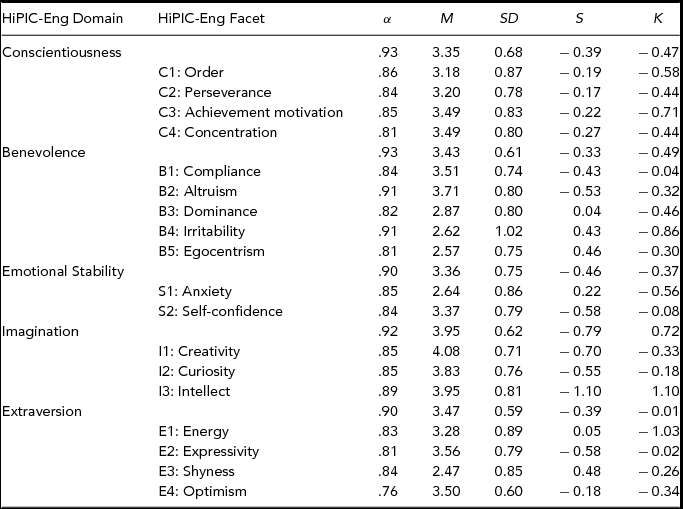
The English-translated HiPIC (HiPIC-Eng) contains 144 items measuring 18 facets (8 items per facet) hierarchically arranged under five domains as shown in Table 1. Responses are made on a 5-point Likert scale ranging from (1) barely characteristic to (5) highly characteristic of the child. Facet scores are calculated according to the HiPIC scoring guidelines (Mervielde & De Fruyt, Reference Mervielde, De Fruyt, Mervielde, Deary, De Fruyt and Ostendorf1999). Domain scores for Emotional Stability, Extraversion Imagination, Benevolence and Conscientiousness are calculated by combining their lower-order facet scores as indicated in the manual. The HiPIC-Eng domains and facets show adequate internal consistency with Cronbach's alpha, ranging from .72 (Energy) to .92 (Conscientiousness; Tackett et al., Reference Tackett, Kushner, De Fruyt and Mervielde2013). Various translations of the HiPIC also show similar psychometric properties to the original Flemish version (Bleidorn & Ostendorf, Reference Bleidorn and Ostendorf2009; Di Blas et al., Reference Di Blas, Serafino and De Fruyt2005; Mervielde & De Fruyt, Reference Mervielde, De Fruyt, De Raad and Perugini2002; Rossier et al., Reference Rossier, Quartier, Enescu and Iselin2007; Vollarth et al., Reference Vollarth, Hampson and Juliusson2012).
Domain and Facet Scale Alpha, Means, Standard Deviations, Kurtosis and Skewness Coefficients

Procedure
The HiPIC-Eng was included as part of a larger anonymous online survey using Qualtrics. Items were presented in a different randomised order to each participant. Participants were recruited via a national media release reported by local and national newspapers as well as via radio stations and television segments across Australia. Additional recruitment procedures included posters and newsletter advertisements within metropolitan Victoria and rural New South Wales.
Results
Given the a priori HiPIC structure, missing data points (0.26%) for HiPIC-Eng items were replaced using the Expectation-Maximisation procedure based on available scores for each facet. Item-level univariate and multivariate outliers were recoded to within one unit of the next highest or lowest case to conform to normality assumptions (Tabachnick & Fidell, Reference Tabachnick and Fidell2013).
Cronbach's alpha coefficients (Table 1) indicated adequate internal consistency. Alpha for facets ranged from .76 (Optimism) to .91 (Irritability) and for domains from .90 (Emotional Stability) to .93 (Benevolence). Kurtosis and Skewness for all domains and facets verified all distributions as sufficiently normal and symmetrical (Pallant, Reference Pallant2013).
Exploratory Factor Analysis
Consistent with the methodology used to validate the HiPIC previously (Rossier et al., Reference Rossier, Quartier, Enescu and Iselin2007), a PCA with varimax rotation was conducted on the 18 facets. Kaiser-Meyer-Olkin measure of sampling adequacy (.810) and Bartlett's Test of Sphericity (χ2 = 2269.44, df = 153, p < .001) indicated that the sample was appropriate for factor analysis. Given the a priori model, five factors were extracted, explaining 75.1% of the variance. The first six eigenvalues for the model were 5.38, 3.76, 2.10, 1.31, .96, and .72 respectively. A Monte Carlo parallel analysis provided support for a four-factor solution; however, visual inspection of the scree plot suggested five factors.
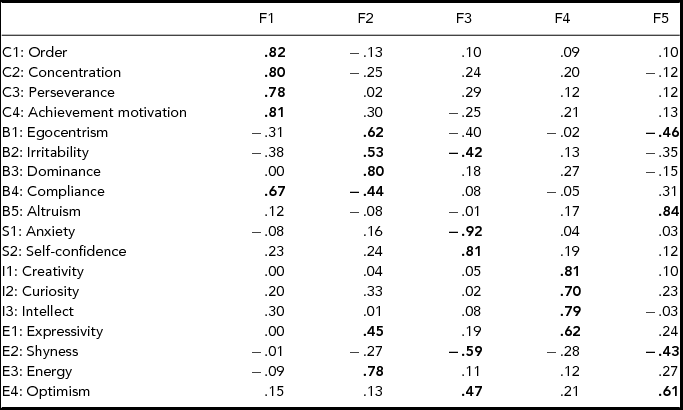
On inspection, the structure of four of the five factors (F1, F2, F3, F4) appears sufficiently similar to the original HiPIC model. Table 2 shows the Australian HiPIC-Eng factor structure, with facets presented as hypothesised by the original HiPIC model.
Principal Components Analysis of HiPIC-Eng Facets With Varimax Rotation — Presented in A Priori Structure
Note: Bold type = loading > .40
All Conscientiousness facets load well on F1 in the Australian sample. The Benevolence facets of Egocentrism, Irritability, Dominance and Compliance load together on F2, though Compliance has a primary loading on F1. Altruism does not load with the other facets of F2 as it does in the original HiPIC model; instead, it loads strongly on F5. As expected, the Emotional Stability facets load together on F3 while the Imagination facets all load on F4. Contrary to the original HiPIC model, however, the Extraversion facets do not coherently load together, with F5 showing the least structural consistency with the original HiPIC model. The facets of Expressivity, Shyness, and Energy show primary loadings on F4, F3 and F2 respectively, with no substantial cross-loading (>.4) on F5. Although Optimism loads primarily on F5, it also cross-loads on to F3.
Procrustes Confirmatory Analysis
To assess whether the apparent inconsistencies in EFA structure indicate significant cross-sample differences, a Procrustes procedure was carried out using the Flemish loadings as the target (Mervielde & De Fruyt, Reference Mervielde, De Fruyt, De Raad and Perugini2002, p. 140).
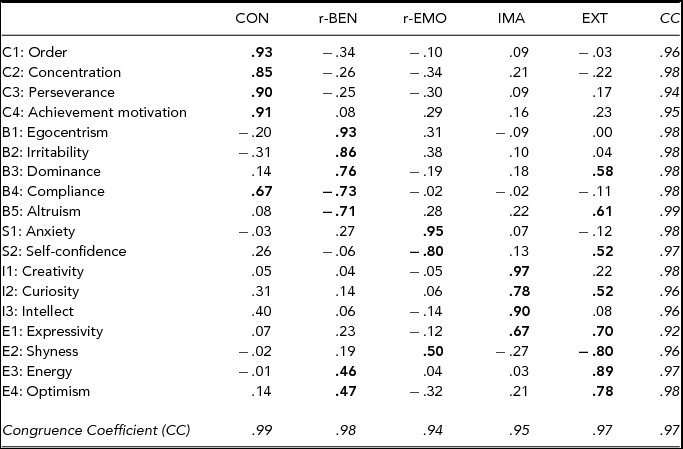
As shown in Table 3, the coefficients following the Procrustes rotation indicate adequate to strong congruence between the original HiPIC and HiPIC-Eng models. Comparatively, the Australian and Flemish instruments and populations are sufficiently similar to be considered replicated across all factors and facets (range .92–.99) with a global congruence of .97.
HiPIC-Eng Factor Loadings and Congruence Coefficients After Procrustes Rotation to Flemish Target
Note: CON = Conscientiousness (F1); r-BEN = Benevolence (reversed; F2); r-EMO = Emotional Stability (reversed; F3); IMA = Imagination (F4); EXT = Extraversion (F5; CC = Congruence Coefficient; Bold type = loading > .40
Discussion
The initial EFA, free to find its own rotation, suggested some inconsistencies between the HiPIC-Eng and the original HIPIC structure. Contrary to the original HiPIC model, only four domains were well represented by the varimax-rotated components. Specifically, all Conscientiousness, Emotional Stability, and Imagination facets loaded as expected within their respective factors. With the exception of Altruism, the Benevolence facets also loaded together, though Compliance showed an extreme version of the cross-loadings seen in both the original Flemish and other validation studies, resulting in a substantial cross-loading (.67) on the Conscientiousness factor. The Extraversion facets were less consistent, showing substantial loadings across four of the five factors (see Table 2).
The Procrustes rotation carried out to evaluate model congruences indicated that the HiPIC structure is clearly replicated overall in the Australian data, with each and every facet and factor showing high satisfactory congruence with the original Flemish structure. This illustrates how the structural differences seen in an EFA representing an unguided rotation can obfuscate true congruencies. The personality structure of Australian children compared with Flemish children is also consistent with the Procrustes results presented in the validation of the French-translated HiPIC (Rossier et al., Reference Rossier, Quartier, Enescu and Iselin2007), as well as the conclusions of other translated HiPIC validation studies (Bleidorn & Ostendorf, Reference Bleidorn and Ostendorf2009; Di Blas et al., Reference Di Blas, Serafino and De Fruyt2005; Tackett et al., Reference Tackett, Kushner, De Fruyt and Mervielde2013). Thus, when an appropriate confirmatory approach is used, the original HiPIC factor structure is evident in the Australian sample despite apparent inconsistencies in the free EFA structure. McCrae et al. (Reference McCrae, Zonderman, Costa, Bond and Paunonen1996) demonstrate the same pattern of results with adult NEO-PI-R samples from Japan and the United States before and after a Procrustes rotation. The current results provide a promising step in the validation work on the English-translated HiPIC questionnaire, as well as the first validation of a five-factor personality structure in young Australian children.
To further illustrate the benefit of using a confirmatory approach such as Procrustes over simple EFA, some observations from the current study will be detailed. First, consider Altruism's high loading on the fifth factor in the free EFA loadings (Table 2). This location suggests that it is not strongly related to the other Benevolence facets and may in fact be related to some aspects of Extraversion (e.g., Optimism). However, after the Procrustes rotation in comparison with the original Flemish sample, Altruism's highest loading is on the Benevolence factor (.71) and the congruence coefficient is almost perfect (.99). This dramatic shift in hierarchical structure by using a simple targeted rotation of the axes mirror the findings in the French HiPIC validation study, particularly in their sample of female children (Rossier et al., Reference Rossier, Quartier, Enescu and Iselin2007).
Second, the shifts in hierarchical organisation of some HiPIC-Eng Benevolence and Extraversion facets such as Energy and Altruism between the varimax and Procrustes rotated loadings echo similar observations described by McCrae et al. (Reference McCrae, Zonderman, Costa, Bond and Paunonen1996). Comparable to the Benevolence and Extraversion loadings seen in Table 2, the Japanese replication of the NEO structure showed two factors that contained a mix of both Extraversion and Agreeableness facets (McCrae et al., Reference McCrae, Zonderman, Costa, Bond and Paunonen1996, p. 561). The Japanese EFA factor containing ‘love’ facets such as Warmth, Positive Emotionality and Altruism is arguably similar to the Altruism/Optimism factor (F5) in the current study. The Japanese EFA factor comprising more ‘dominance’ facets such as Activity, Assertiveness, Compliance and Modesty appears conceptually similar to F2 extracted from the Australian varmiax-rotated EFA. Consistent with the confirmatory results in the current study, however, when subjected to a Procrustes rotation targeted to match standardised American loadings, the Japanese factor loadings clearly indicate the original Extraversion and Agreeableness factors (McCrae et al., Reference McCrae, Zonderman, Costa, Bond and Paunonen1996). These illustrations from both the current and previous studies highlight the advantage of utilising an appropriate targeted confirmatory analysis against a hypothesised model.
The authors note the frequency with which cross-sample comparisons are conducted by simply comparing exploratory factor structures, at times with no criteria other than searching for replicated simple structure. Without a targeted rotation, free EFA structure is sensitive to relatively minor differences in the correlations between items and facets, which may result from subtle differences in sampling or administration (Tabachnick & Fidell, Reference Tabachnick and Fidell2013; Vecchione, Alessandri, & Barbaranelli, Reference Vecchione, Alessandri and Barbaranelli2012). Procrustes provided a method of guiding the rotation to reduce the influence of such differences between the current and original HiPIC studies. In this regard, it is noteworthy that the national online survey administered in the current study automatically randomised HiPIC-Eng items to reduce test effects. This is in contrast to the pen and paper administration used in the original Flemish study. Nevertheless, any minor influences on the data (e.g., Vecchione et al., Reference Vecchione, Alessandri and Barbaranelli2012) are thought to be outweighed by the benefit of using this technology to provide more efficient and widespread methods of collecting and presenting data across a large country like Australia. Next, although the Flemish study averaged the mother and father HiPIC ratings prior to their analysis (Mervielde & De Fruyt, Reference Mervielde, De Fruyt, De Raad and Perugini2002), the current study was predominantly mother-only ratings. The successful replication of the original Flemish structure suggests, however, that these methodological differences did not heavily influence the results.
Future Directions
As encouraging as the current results are for developmental personality researchers in Australia, there is potential for refining and sharpening the instrument for Australian use. For example, consider that the English-translation of the HiPIC items was conducted by non-Australian English speakers. Cross-cultural researchers warn of the necessity to retain both semantic and cultural equivalence in item translation (DeVellis, 2012). To the authors and some of their Australian colleagues, some items were somewhat obscure. The Extraversion item ‘likes to let his/her hair down’, for example, is a colloquial phrase with the potential for multiple interpretations. Additionally, the item ‘arouses the sympathy of his/her classmates’, a positively scored Optimism item, may reflect a cultural difference. ‘Sympatico’ in European culture generally refers to one who is congenial whereas the lexigraphical neighbour ‘sympathy’ is likely to have a more negative connotation in an Australian population. Such ambiguity is an immediate threat to construct validity and researchers need to be confident that the intended and construed meaning of an item is parallel across translations. This is important in a scale such as the HiPIC, which relies on parent report of their children's observable behaviours. Therefore, future research should carefully investigate the validity of HiPIC-Eng items and lower-order facets, particularly those within the Extraversion and Benevolence domains due to their high cross loadings, even after the Procrustes rotation.
Conclusion
The first direct evaluation of a Five Factor Model measure of personality for young children in Australia has indicated good generalisability of the original HiPIC structure. While the initial EFA suggested some possible discrepancies in HiPIC-Eng structure compared to the original model, appropriate confirmatory analysis using Procrustes rotation indicated that these were in fact trivial, illustrating the shortcomings of using solely exploratory analysis to ascertain congruence. This initial validation of structure and generalisability provides Australian psychologists with confidence in the English-translated HiPIC as a useful instrument in capturing FFM personality differences in children for practice and research. Thus, for the time being, Flemish norms may be used with caution as a guide in research and psychological practice until such a time as a larger study provides adequate Australian norms. A final Australian version may also profit from a review of the semantic and cultural equivalence of a number of items.
Acknowledgments
The authors would like to offer thanks to Prof. Filip De Fruyt for granting the Personality, Abilities and Individual Differences research team at Monash University permission to conduct research utilising the English-translated HiPIC in Australia.
Financial Support
This research received no specific grant from any funding agency, commercial or not-for-profit sectors.
Conflict of Interest
None.
Ethical Standards
This research was approved by the Monash University Human Research Ethics Committee (project no. CF13/600-2013000240). The authors assert that all procedures contributing to this work comply with the ethical standards of the relevant national and institutional committees on human experimentation and with the Helsinki Declaration of 1975, as revised in 2008.