


Introduction
In recent years self-help approaches to mental health problems have been developed to the point where NICE guidelines for depression and anxiety recommend the provision of cognitive behaviour therapy (CBT) based guided self-help interventions (National Institute for Clinical Excellence, 2004a, b). These interventions are recommended to be provided in primary care for patients with mild to moderate anxiety and depression as part of a stepped care model. A stepped care approach advocates that the least intensive treatment likely to provide significant health gain is first offered and more intensive treatment offered only if required (Lovell and Richards, Reference Lovell and Richards2000).
Self-help interventions are also being advocated as a way to improve access to psychological therapies services. Guided self-help, along with computerized CBT (National Institute for Clinical Excellence, 2006) and case management approaches (Gensichen et al., Reference Gensichen, Beyer, Muth, Gerlach, Von Korff and Ormel2006) are considered to be low intensity interventions and it is argued these should be available to patients in primary care, before more intensive and traditional psychological therapies are offered. Parallel to the development of a wider range of psychological interventions are developments to broaden the range of professionals able to provide the interventions. It is therefore important to look at new roles, an effective and efficient skill mix and new ways of working. The most significant development in the primary care mental health workforce in the UK has been the introduction of graduate primary care mental health workers (Department of Health, 2003), many of who provide guided self-help and case management within primary care.
Meta-analyses of research into self-help interventions for anxiety and depression provide support for their effectiveness (Gould and Clum, Reference Gould and Clum1993; Marrs, Reference Marrs1995; Cuijpers, Reference Cuijpers1997; Scogin, Hanson and Welsh, Reference Scogin, Hanson and Welsh2003; Bower, Richards and Lovell, Reference Bower, Richards and Lovell2001) and a recent review of research into self-help approaches for mental health problems reports evidence for the effectiveness of CBT-based self-help materials for anxiety, depression, bulimia nervosa and binge eating disorder (Lewis et al., Reference Lewis, Anderson, Araya, Elgie, Harrison, Proudfoot, Schmidt, Sharp, Weightman and Williams2003).
Despite this evidence and recommendations in NICE guidance, there is still a need for research into self-help interventions to clarify the amount and type of guidance required, models of provision such as stepped care and cost effectiveness. Also, relatively few well designed, controlled studies of guided self-help have been carried out and where controlled studies have been carried out the results have sometimes failed to demonstrate clear benefits (Richards et al., Reference Richards, Barkham, Cahil, Richards, Williams and Heywood2003; Mead et al., Reference Mead, Macdonald, Bower, Lovell, Richards, Roberts and Bucknall2005).
There is also a need for more effectiveness research in routine services to complement randomized controlled trials (RCTs). RCTs in research settings often exclude patients with co-morbid problems and treatment effects of interventions in routine settings are often poorer than in efficacy studies in research settings (Westen and Morrison, Reference Westen and Morrison2001). In contrast, effectiveness research is more inclusive and representative of routine practice where patients are not excluded based on co-morbidity.
This study was a controlled clinical trial of a brief and low intensity self-help intervention provided in a routine psychological therapy service, in which patients were offered a self-help intervention while waiting for psychological therapy. It therefore combines elements of experimental control and “real world” effectiveness research in a routine service setting.
Method
Setting
The service where the trial was carried out was a multi-professional adult psychological therapies service receiving about 1100 referrals a year, serving a population of about 320,000 people across the Wakefield Metropolitan District. Therapists include clinical psychologists, a specialist psychotherapy team, counsellors, nurse therapists, cognitive behaviour therapists and an art therapist. A range of therapies was provided including cognitive behavioural therapy, psychodynamic and psychoanalytic psychotherapies, person-centred approaches and integrative psychotherapies such as cognitive analytical therapy. Initial assessments were carried out to determine suitability for psychological therapy and the most appropriate approach was recommended and provided, including individual, couple and group work.
Participants
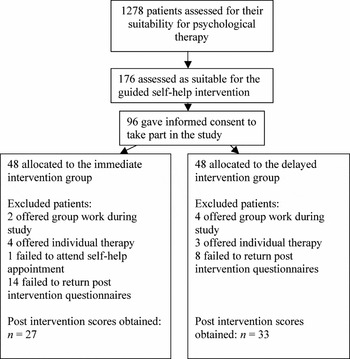
During the time of the study 1278 consecutive patients were assessed for their suitability for psychological therapy. Of these, 176 were identified as suitable, based on the inclusion criteria, and 96 of these gave their consent so were included in the study (see Figure 1 for flow of patients through the study). Sixty-two were female and 34 male, with average age of 40.4 (range 20 to 65). For the immediate group 33 were female and 15 male, with an average age of 42 (range 21 to 65) and for the delayed (control) group 29 were female and 19 male, with an average age of 39 (range 20 to 60).
Flow of participants through the study

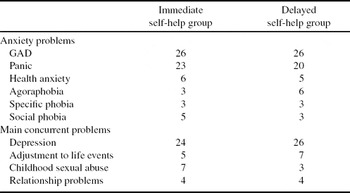
The inclusion criteria were that one of the following anxiety disorders was a main presenting problem in need of help: panic disorder, generalized anxiety disorder, agoraphobia, social phobia, health anxiety, and specific phobias. Patients with a main problem of post traumatic stress disorder or obsessive compulsive disorder were excluded because the self-help pack was not deemed suitable. Patients with psychosis and substance misuse as the main presenting problem were also excluded. Patients with other concurrent mental health problems such as depression were included as long as one of the appropriate anxiety problems was a major presenting problem for which the patient wanted help. Table 1 shows the frequency of the main anxiety and other problems for the two groups.
Anxiety and other problems of the immediate and delayed self-help groups

The intervention
The intervention had the following main elements:
• The self-help pack: “Working to overcome anxiety”, covering understanding anxiety, recognizing and dealing with anxious thinking, physical effects of anxiety, effects on mood and behaviour, dealing with setbacks (see more details in the next section).
• 40 minute initial session with psychology assistant to explain the pack.
The psychology assistant (RN) providing the guidance sessions had a first degree in psychology and had attended a university module of guided self-help for anxiety and depression that included assessment of client work skills. She had received no other therapy training but was supervised by a consultant clinical psychologist with a CBT qualification (ML). The cost of the intervention was calculated to be approximately £25.00 per patient (2008 costs). This was calculated from the psychology assistant time, including staff and on costs, and cost of the self-help pack. This does not include the cost of training and supervision.
The self-help packFootnote 1
The pack was called “Working to overcome anxiety”. It was developed from CBT based self-help material used to facilitate anxiety management groups provided by the local psychological therapies service and modified by experienced clinical psychologists and CBT therapists working in the service. The pack consisted of a 110-page book and contained six sections on the following: understanding anxiety; physical effects of anxiety; recognizing anxious thinking; dealing with anxious thinking; effects of anxiety on mood and behaviour; and dealing with setbacks. A professionally recorded relaxation exercise was included and available as a tape or CD. The pack also included sections on the aims of the pack and tips on how to use it. Although the pack was presented in a positive way, care was taken to point out that some aspects take a long time to work through and some people may feel daunted by the content and unable to benefit.
A theme throughout the pack was to enable an understanding of the nature of anxiety, using the 5-systems CBT model (Wright, Williams and Garland, Reference Wright, Williams and Garland2002). The pack contained information and worksheets, for example, identifying physical symptoms of anxiety, anxiety patterns and triggers diaries, monitoring and evaluating thoughts diaries, challenging unhelpful thinking, relaxation and stress reduction exercises, planning and recording graded exposure tasks and a relapse prevention plan. Each of the six sections contained illustrative diagrams, a key points page, a quiz relating to key learning points, worksheets consisting of various exercises and self-monitoring forms relevant to the section.
Measures
Clinical Outcomes in Routine Evaluation – Outcome Measure (CORE-OM) is widely used as a clinical outcome measure within psychological therapies services, particularly in the UK (Barkham et al., Reference Barkham, Margison, Leach, Lucock, Benson, Mellor-Clark, Evans, Connell, Audin and McGrath2001; Evans et al., Reference Evans, Connell, Barkham, Margison, McGrath, Mellor-Clark and Audin2002). It consists of 34 self-report items, scored 0–4. The items represent four domains: subjective well-being (4 items); specific problems (e.g. depression, anxiety; 12 items); daily functioning (including social and close relationships; 12 items); and risk to self and others (6 items). The overall clinical scores (Leach, Lucock, Barkham, Noble and Iveson, Reference Leach, Lucock, Barkham, Noble and Iveson2006) were used in this study, which is the average of all 34 item scores multiplied by 10. The clinical cut-off for general emotional problems is 10, while the cut-off for severe problems is 25.
Hospital Anxiety and Depression Scale (HADS; Zigmond and Snaith, Reference Zigmond and Snaith1983) consists of 14 items, 7 for anxiety and 7 for depression, scored on a 4-point scale from 0 (not present) to 3 (considerable). The item scores are added, giving scores on the anxiety and depression sub-scales from 0 to 21. In order to be valid in patients with somatic problems, the HADS items are based on the psychological aspects of anxiety and depression. Scores of 11 or more on either subscale are considered to be a significant “case” of psychological morbidity, while scores of 8–10 represent “borderline” and 0–7 “normal”.
Procedure
Inclusion in the study was considered at the routine initial assessment. Clinicians assessing patients within the service were given the study protocol, including inclusion criteria, and the study was discussed at clinical team meetings prior to and during the study to reinforce the requirements of the study and the intervention available. Patients with significant anxiety problems and fitting the inclusion criteria were given an information sheet and consent form to return by post if they wanted to take part in the study. It was made clear the self-help intervention was being provided in addition to the usual service and that the patients would still be offered an appointment for individual or group therapy if this was deemed appropriate. The waiting time for such therapy was at least 3 months for the vast majority of patients so the self-help intervention was provided within this timescale. Once consent forms had been received, patients were allocated to either an immediate self-help group or a delayed group. The immediate group received the self-help pack and a 40-minute session with the psychology assistant within one to two weeks. This session took the patient through the whole pack and provided advice on its use. For example, patients were advised they would find some aspects more relevant and useful than others and a discussion took place on which sections may be most useful, based on the patients’ main problems and goals. Patients were also offered the option of ringing to discuss the contents of the pack if they wished (although none took up this offer). The delayed self-help group received this same intervention after a delay of 8 weeks. Patients completed the CORE-OM and the Hospital Anxiety and Depression Scale at initial assessment and after 8 weeks (after the intervention for the immediate group and after the waiting time for the delayed group).
All patients were asked to return an evaluation questionnaire about 3 months after the intervention, with one chase-up if they were not returned within a month. This questionnaire asked patients about the extent of their use of the pack, which sections and aspects were most and least helpful, and the perceived impact on their lives and functioning.
Ethics
The study was given ethical approval by the local research ethics committee and all participants gave informed consent.
Results
Ninety-six patients consented to take part in the study and were allocated to either the immediate or delayed self-help groups; 6 were excluded because they were offered group work during the study (2 from the immediate group, 4 from the delayed group); 7 were offered individual therapy (4 from the immediate group, 3 from the delayed group); one from the immediate group failed to attend the appointment; 22 failed to return questionnaires (14 from the immediate group and 8 from the delayed group). Pre and post scores were therefore available for 60 (63%) patients (27 from the immediate group and 33 from the delayed group).
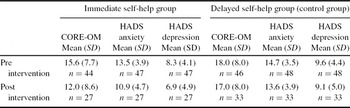
Table 2 shows the pre and post scores for the two groups over the initial 8 weeks after which the immediate group have received the intervention and the delayed group had been waiting. On a repeated measures ANOVA of CORE-OM scores there was a significant effect of time (F= 4.3; df = (1, 58); p = .04), non significant effect of group (F = 1.65; df = (1, 58); p = .2) and a significant group x time interaction (F = 4.3; df = (1, 58); p = .04). On an intention to treat analysis of this comparison (using last observation carried forward) effects of time (F = 3.7; df = (1, 90); p = .06), group (F = 4.5; df = (1, 90); p = .052) and the group x time interaction (F = 3.6; df = (1, 90); p = .06) were just outside the significance level. The effect size, comparing pre and post intervention scores on the CORE-OM, was 0.27 and 0.21 with the intention to treat analysis.
CORE-OM and HADS anxiety and depression scores for the immediate and delayed self-help groups
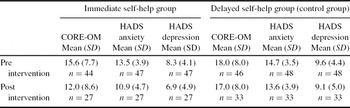
On a repeated measures ANOVA of HADS anxiety scores there were significant effects of time (F= 14.8; df = (1, 59); p < .000) and group (F = 4.4, df = (1, 59); p = 0.04) and a non significant group x time interaction (F = 2.4; df = (1, 59); p = 0.13). On an intention to treat analysis of this comparison (using last observation carried forward) there was a significant effect of time (F = 13; df = (1, 91); p < .000) and group (F = 6.1; df = (1, 91); p = .015) and a non-significant effect on the group x time interaction (F = 1.6; df = (1, 91); p = .21). On a repeated measures ANOVA of HADS depression scores there were no significant effects of time (F= 3.3; df = (1, 59); p = .08) and group (F = 2.8; df = (1, 59); p = .1) and a non-significant group x time interaction (F = 0.24; df = (1, 59); p = 0.63). On an intention to treat analysis of this comparison (using last observation carried forward) there was no significant effect of time (F = 3.1; df = (1, 91); p = .08) and group (F = 3.0; df = (1, 91); p = .09) and non-significant effect on the group × time interaction (F = 0.1; df = (1, 91); p = .74).
Clinically significant improvements were calculated on the CORE-OM, based on the cut-off of 10 for clinical caseness. Six patients from each of the immediate and delayed self-help groups showed a clinically significant improvement in clinical caseness and two of the immediate group and three of the delayed group deteriorated significantly.
Follow-up questionnaire
Evaluation questionnaires were sent to all participants about 3 months after the end of the intervention. This questionnaire asked for feedback on the most and least helpful aspects of the self-help pack, using 5-point Likert scales, and for feedback on the extent to which the pack overall had made a positive impact on the person's functioning.
Thirty-one evaluation forms were returned, a response rate of 31%. Of these, 27 (87% of those who returned the evaluation questionnaire) said they had been able to use some of what they learned from the pack in everyday life situations, 26 (84%) said they intended to continue using the pack, and 24 (77%) said that since using the pack they had been able to do things they could not do before. Participants were invited to describe in their own words things that they believed they could do as a direct result of help from the pack. Responses included going to shops, supermarkets, crowded places, public transport, trains, nightclubs, taking children to school, going into their garden in the summer, going back to work, and car journeys. Twenty-two made specific comments on how they had used the pack in their everyday life and this included breathing exercises, questioning negative thinking and graded exposure. Four commented that their memory and concentration problems had made it difficult for them to read and take in the materials in the pack.
Discussion
There was some support for the effectiveness of the self-help intervention, with a significant time × group interaction for CORE-OM scores, suggesting the group receiving the intervention immediately improved significantly more than the group waiting for the intervention. However, the effect size was small (Cohen, Reference Cohen1992). Furthermore, the significant interaction for CORE-OM scores was lost with the intention to treat analysis but this is not surprising given that the last observations carried forward in this analysis were the pre intervention scores. Although the effect size for the HADS anxiety scores was higher, the time × group interaction was not quite significant because the delayed group also improved during the waiting period. The results for the HADS depression scale did not approach significance but as the intervention was specific to anxiety this result was not unexpected. The modest and insignificant findings in this study may be a result of the study being underpowered, particularly with a relatively low intensity intervention and a small effect size. In considering these relatively modest findings for the CORE-OM scores, it is important to consider key elements of the intervention provided and the inclusion criteria. The intervention was low intensity, involving a small amount of direct guidance that reduced the likelihood of a significant clinical impact. It was also relatively inexpensive and Glass, McGaw and Smith (Reference Glass, McGaw and Smith1981) argue that the practical importance of a treatment effect depends on the relative costs and benefits. Therefore, the small effect size found in this study becomes more significant when the low cost of the intervention is considered. Also, patients with co-morbid problems and high HADS and CORE-OM scores were included and chronicity was not considered as an exclusion criterion. Therefore, patients were not excluded on the basis of complexity, severity or chronicity although it could be argued there should have been more selection of patients, based on CORE-OM and HADS scores and complexity (co-morbidity). This would have been more consistent with NICE guidance which recommends self-help approaches for patients with mild to moderate anxiety and depression. It was, however, decided that the main driver for deciding on the inclusion criteria was to offer the intervention to all patients with significant anxiety problems as described in the method section.
The feedback from the evaluation questionnaires was also encouraging, suggesting at least some patients believed the self-help pack helped them achieve significant goals. The low response rate almost certainly means the feedback was positively biased, assuming patients were more likely to complete the questionnaires if they had a positive experience of using the self-help pack, but nevertheless it was notable that so many attributed very significant behaviour change to help from such a low intensity and inexpensive intervention.
It is possible that the significant effect found in this study was due, not to the self-help pack itself, but to non-specific factors. For example, it is possible the patients who received the pack (and the offer of telephone support) felt supported and engaged in the service even though they were waiting for psychological therapy. In contrast, patients left waiting without the self-help intervention may have felt more vulnerable and disconnected from the service. This is only speculation but research into support and low intensity interventions for patients waiting for psychological therapy would seem an important priority given the problems of accessing psychological therapies and the inevitable long waiting times that follow. Such research should look at the need for further therapy as well as clinical outcome. It is important to note that, although there was evidence of positive effects of the intervention in terms of clinical outcome and goal attainment for some patients, there was no evidence that the intervention was sufficient for the vast majority of patients. In fact, of those who completed the evaluation questionnaire, only two patients indicated the self-help pack was sufficient and that they no longer required psychological therapy.
It is surprising that patients did not take up the offer of telephone support. There is evidence of the need for support to enable patients to make use of self-help materials and of the value of telephone support in particular (Gellatly et al., Reference Gellatly, Bower, Hennessy, Richards, Gilbody and Lovell2007) so perhaps the intervention would have been more effective if telephone support had been proactively provided as a part of the intervention.
This study provides some support for the option of providing relatively low intensity self-help interventions for patients in specialist psychological therapies services as well as primary care, where such approaches are recommended. The very low cost of the intervention, at £25.00 per patient, further justifies the intervention and, just as in primary care, support for self-help can be provided by staff without advanced training in formal psychological therapy, such as graduate primary care mental health workers and psychology assistants with appropriate training and supervision.
It is clear, however, that not all patients benefited from the intervention. Four patients commented that they had found it difficult to concentrate on the material and this is likely to be a bigger problem for those who are significantly depressed. Although there was no evidence of this, it is important to consider whether any patients may actually feel worse as a direct result of such an intervention. For example, it is possible some patients may feel a sense of failure if they cannot benefit from the self-help material. It is therefore important to make it clear to patients that not everyone will be able to benefit from the intervention and that some will require more support and guidance to make use of the materials. We also acknowledge that the readability of the self-help pack was not established and it is recognized that this is a barrier for a significant number of people (Martinez, Whitfield, Dafters and Williams, Reference Martinez, Whitfield, Dafters and Williams2007).
To conclude, this study lends some support for the provision of relatively low level self-help interventions for patients waiting for psychological therapy. However, the fact that the intervention was provided to a relatively small proportion of patients assessed in the service and the small effect size suggests such interventions should be considered as complementary rather than an alternative to more formal psychological therapy in secondary care psychological services. More adequately powered research is needed to identify the type of patients and problems that most benefit, possible adverse effects, the role of specific versus non-specific aspects of such interventions, and the effect on subsequent uptake of and engagement in therapy and number of therapy sessions required.



Comments
No Comments have been published for this article.