Introduction
In recent years of the business life, institutional scandals in American companies such as Enron, Worldcom, and Nortel revealed the discussions about the ethical leadership (Bedi, Alpaslan, & Green, Reference Bedi, Alpaslan and Green2016). On the other hand, ethical scandals have not been limited to only the USA, it has been experienced also in businesses such as Vivendi (France), Ahold (Netherlands), Parmalat (Italy), Yukos (Russia), and Credit-Suisse (Switzerland) (Fombrun & Foss, Reference Fombrun and Foss2004). As per Turkey, similar institutional scandals were seen in businesses such as Etibank, and Emlakbank (Bayraktar, Reference Bayraktar2007). Emission-cheating scandal in German Volkswagen Group (VW) (Griffin & Lont, Reference Griffin and Lont2018) and the fraud scandal occurred in the Turkish Imar Bank (Aktan, Masood, & Yilmaz, Reference Aktan, Masood and Yilmaz2009) are also some of the recent ethical scandals. These scandals have resulted from the fact that the managers of the organization use their position for their personal purposes. The basis of these ethical scandals is the abuse of power by senior executives; and hence the importance of ethical leadership is understood.
Ethical leadership is to display normatively decent attitudes in personal acts and interpersonal relations and demand the followers to act alike (Brown, Trevino, & Harrison, Reference Brown, Trevino and Harrison2005). Ethical leaders are the ones, who behave just, fair, and respectfully to his/her subordinates, creating an environment of trust and displaying attitudes suitable for the principles of professional ethics (Akatay, Yucekaya, & Kisat, Reference Akatay, Yucekaya and Kisat2016). Since the ethical leaders create an ethical climate (Akdogan & Demirtas, Reference Akdogan and Demirtas2014) and an ethical culture (Sagnak, Reference Sagnak2017) in their organization, the subordinates trust in these leaders and they embrace the leader as their role model (Mayer, Aquino, Greenbaum, & Kuenzi, Reference Mayer, Aquino, Greenbaum and Kuenzi2012). Therefore, the perception of justice (Gul & Ince, Reference Gul and Ince2014), organizational commitment level (Celik, Dedeoglu, & Inanir, Reference Celik, Dedeoglu and Inanir2015), identification with the organization level (Palalar Alkan & Arikboga, Reference Palalar Alkan and Arikboga2017), work commitment level (Engelbrecht, Heine, & Mahembe, Reference Engelbrecht, Heine and Mahembe2014), creativeness level (Javed, Rawwas, Khandai, Shahid, & Tayyeb, Reference Javed, Rawwas, Khandai, Shahid and Tayyeb2018), voice behavior level (Lam, Loi, Chan, & Liu, Reference Lam, Loi, Chan and Liu2016; Kwak & Shim, Reference Kwak and Shim2017), and performance level (Khokhar & Zia-ur-Rehman, Reference Khokhar and Zia-ur-Rehman2017) increase in the workers working with an ethical leader; while their burnout level (Lin & Liu, Reference Lin and Liu2017), cynicism level (Akatay, Yucekaya, & Kisat, Reference Akatay, Yucekaya and Kisat2016), counterproductive work behaviors (Khokhar & Zia-ur-Rehman, Reference Khokhar and Zia-ur-Rehman2017), work stress, and intention to leave the employment decrease (Elci, Sener, Aksoy, & Alpkan, Reference Elci, Sener, Aksoy and Alpkan2012).
In this study, which deals with the concept of ethical leadership, the questions of ‘Is ethical leadership perception of health sector employees the determinant of the extra-role behavior they exhibit?’ ‘If so; How does ethical leadership determine the extra-role service behavior?’ were tried to be answered. The article is thought to make contributions to the field at least in three aspects. First, ethical leadership, which has recently gained importance due to increased business scandals, was handled in this research study. Ethical leaders play an important role in the success of organizations in health sector as they do in other sectors. Because, in health sector there are unethical practices such as indoctrinating gain increasing transactions or treatments to the workers, overbilling the patients, applying medical treatments in order to make money for the hospital, avoiding health services that are not money-making, disregarding the treatment priority, preferential treatment in favor of the acquaintances of bureaucrat, superiors or health workers, writing prescriptions for pecuniary advantages, revealing the personal information of the patients, and causing the patients suffer due to trivial issues (Sayim, Reference Sayim2015). The workers will display ethical attitudes if the behaviors of role model ethical leaders (Brown, Trevino, & Harrison, Reference Brown, Trevino and Harrison2005) are based on moral principles, and if they are aware of the rights of patients and workers, and if they behave honestly to them.
Second, this research study embraced extra-role service behavior, which is important for the businesses functioning in the health sector. It was observed that there was not sufficient research in the literature about this concept, and in the few studies, it was only handled as the organizational citizenship, which is related with organizational resources. Although extra-role service behavior (or extra-role customer services) is expressed as service-oriented organizational citizenship behaviors (Penny Wan, Reference Penny Wan2010; Limpanitgul, Robson, Gould-Williams, & Lertthaitrakul, Reference Limpanitgul, Robson, Gould-Williams and Lertthaitrakul2013), it is more specific than organizational citizenship. Because it is essential in extra-role behavior that the worker moves beyond the role definition for meeting the demands and expectations of the customers (patients and their families) (Bettencourt & Brown, Reference Bettencourt and Brown1997; Menguc & Boichuk, Reference Menguc and Boichuk2012).
Third, in this research study, ethical leadership, person–organization fit, organizational trust, and extra-role service behavior variables were all handled together. When the literature was examined about the variables, some research studies were observed to be about the relation of ethical leadership with person–organization fit (DeConinck, Reference DeConinck2015; Schwepker, Reference Schwepker2015), organizational trust (Pucetaite, Reference Pucetaite2014; Yanik & Naktiyok, Reference Yanik and Naktiyok2017), and organizational citizenship behaviors (Wang & Sung, Reference Wang and Sung2016; Buyukyilmaz & Alper Ay, Reference Buyukyilmaz and Alper Ay2017); however, it was observed that there was no study embracing and evaluating all of these variables together. Therefore, it is considered that the findings of this study will contribute not only to the literature and further studies, but also to the organizations of service sector and particularly the health sector.
Theoretical Framework and Hypotheses
Ethical leadership
Ethical leadership is displaying normatively decent attitudes in personal acts and interpersonal relations and encouraging such kinds of attitudes by two-way communication, empowerment, and decision-making (Brown, Trevino, & Harrison, Reference Brown, Trevino and Harrison2005). This ethical leadership definition shows that the concept has two components as a moral person and a moral manager (Trevino, Hartman, & Brown, Reference Trevino, Hartman and Brown2000; Bedi, Alpaslan, & Green, Reference Bedi, Alpaslan and Green2016; Khokhar & Zia-ur-Rehman, Reference Khokhar and Zia-ur-Rehman2017). A moral person is characterized with honesty, righteousness, reliability, and fairness (Lee, Choi, Youn, & Chun, Reference Lee, Choi, Youn and Chun2017) and he/she prioritizes ethical standards both in professional and personal life (Brown & Trevino, Reference Brown and Trevino2006; Brown & Mitchell, Reference Brown and Mitchell2010). Therefore, ethical leaders are not only moral individuals, but also moral managers who take moral decisions (Tian, Liu, & Fan§, Reference Tian, Liu and Fan§2015; Lam et al., Reference Lam, Loi, Chan and Liu2016). A moral manager determines the attitudes that the workers of the organizations should display and persuade the workers to accept these attitudes. A moral manager is an individual, who draws the attentions of the subordinates to displaying ethical attitudes, who gives ethical messages to the subordinates by his/her opinions and behaviors (Sagnak, Reference Sagnak2017), who rewards the workers displaying ethical attitudes and disciplines the violators (Kwak & Shim, Reference Kwak and Shim2017; Lee et al., Reference Lee, Choi, Youn and Chun2017).
Ethical leaders are individuals, who take into consideration the personal demand and rights of the workers and who treat the workers fairly and impartially (Zhu, May, & Avolio, Reference Zhu, May and Avolio2004). Two approaches are used in understanding ethical leadership and inseminating these attitudes to the followers. These are social learning theory (Bandura, Reference Bandura1977, Reference Bandura1986) and social exchange theory (Blau, Reference Blau1964). According to the social learning theory, learning activity is acquired by observing the attitudes of others or experiencing (Bandura, Reference Bandura1986). According to Brown, Trevino, and Harrison (Reference Brown, Trevino and Harrison2005), the workers see their leaders as their role model in terms of social learning theory. Observing and thinking that their leaders are displaying decent and ethical attitudes, the workers are affected from these behaviors with social learning processes. Therefore, the workers attempt to simulate their leaders, embrace and reflect the ethical behaviors that their leaders display.
The social exchange theory is based on the reciprocity norm theory. Reciprocity norm is a theory, which assumes that the individuals tend to react to each other generally in the same terms (goodness in return for goodness, and evil vs. evil), in other words, which supposes that individuals help the others in return for the help of the others (Shelton, Reference Shelton2013). According to the reciprocity norm, the individuals, who think that they were treated decently and positively, will feel an obligation to react positively (Gouldner, Reference Gouldner1960; Eisenberger, Cummings, Armeli, & Lynch, Reference Eisenberger, Cummings, Armeli and Lynch1997). The social exchange theory, which is based on reciprocity norm theory, suggests that the individuals establish bilateral relations with others in order to increase their personal gains (Aselage & Eisenberger, Reference Aselage and Eisenberger2003), that the organization will provide some gains for the workers in return for their positive attitudes toward the organization and that reciprocal gain change will take place (Armeli, Eisenberger, Fasolo, & Lynch, Reference Armeli, Eisenberger, Fasolo and Lynch1998). From the point of ethical leadership, in the social exchange theory, when the followers perceive that their leader considers their welfare and goodness, they feel an obligation to react to the support of the leader (Bedi, Alpaslan, & Green, Reference Bedi, Alpaslan and Green2016, 2016). Since the ethical leaders inseminate the feeling of fairness and trust to the followers, an obligation appears in the followers for reacting via useful attitudes toward the organization (Brown, Trevino, & Harrison, Reference Brown, Trevino and Harrison2005).
The basis of the ethical leadership is comprised of ethical behaviors both in daily life and in the organizational settings. Ethical attitudes are transformative and interactionist (Bass, Reference Bass1985), and they are the main constituent of many leadership theories such as servant leadership (Greenleaf, Reference Greenleaf1977), authentic leadership (Avolio & Gardner, Reference Avolio and Gardner2005), and spiritual leadership (Fry, Reference Fry2003). Transformative leaders attempt to render the moral values and ideals attractive for the followers (Yukl, Reference Yukl1994), thus, they emphasize the ethical role model (Avolio, Bass, & Jung, Reference Avolio, Bass and Jung1999; Bedi, Alpaslan, & Green, Reference Bedi, Alpaslan and Green2016). According to Bass (Reference Bass1990), idealized effect dimension in transformative leadership theory is related with ethical leadership (Dedeoglu, Celik, Inanir, & Altay, Reference Dedeoglu, Celik, Inanir and Altay2016). It is suggested that ethical leadership bears transactional leadership such as determining open standards, and holding the workers accountable for fitting these standards via rewarding and disciplining (Brown & Trevino, Reference Brown and Trevino2006). According to Brown, Trevino, and Harrison (Reference Brown, Trevino and Harrison2005), ethical leaders influence the attitudes of the followers by using the features of transformative and transactional leadership together. Since the authentic leadership includes principled decision-making (Brown and Trevino, Reference Brown and Trevino2006), and since spiritual leadership emphasizes the leader treating others with integrity, honesty, humbleness, and ethics (Reave, Reference Reave2005; Brown & Trevino, Reference Brown and Trevino2006), they are both related with ethical leadership. Therefore, each leadership style has some similar features with ethical leadership and emphasizes ethical attitudes. Although these leadership styles emphasize the importance of education for effective leadership, none of them explains the effects of the ethical behaviors of the leaders on the ethical behaviors of the followers (Brown & Trevino, Reference Brown and Trevino2006; Bedi, Alpaslan, & Green, Reference Bedi, Alpaslan and Green2016, 2016).
The relation between ethical leadership and person–organization fit
Ethical leaders are individuals, who take into consideration the personal demands and rights of the workers and who treat the workers fairly and impartially (Zhu, May, & Avolio, Reference Zhu, May and Avolio2004). From the ‘reciprocity norm’ point of view of Gouldner (Reference Gouldner1960), in ethical leadership the leaders take into consideration the personal rights of the followers, and treat the workers fairly and unbiased, and in return, an obligation will be created in the workers for organizational benefit. In other words, the leaders treating the workers fairly and unbiased and prioritizing ethical standards both in personal and professional life will bring along an obligation for the workers to fit to these standards and display many positive attitudes and behaviors in favor of the organization. One of these mentioned attitudes and behaviors is the formation of person–organization fit perception.
According to Kristof (Reference Kristof1996), person–organization fit can occur (a) when at least one of the two sides, which is comprised of a person and an organization, meets the other's need, (b) when the person and the organization share similar features, or (c) in both cases. This definition has explained the person–organization fit both in terms of complementary-fit and supplementary-fit perspective. Complementary fit occurs when the person and the organization mutually meets the other-s needs, in other words, when the person has the skill that the organization needs, and the organization provides the rewards that this person demanded (Cable & Edwards, Reference Cable and Edwards2004). Supplementary fit is the case that the basic features of the organization and the basic features of the person are similar. In this research study, person–organization fit is explained from supplementary-fit perspective. In this perspective, person–organization fit expresses the fit and similarity between the person and the organization (Astakhova, Reference Astakhova2016) and involves the fit between the personality, values, objectives, and needs of the person, and values, objectives, culture, and climate of the organization (Kristof, Reference Kristof1996). Therefore, the compliance of individual with his/her organization can be conceptualized in different aspects such as value fit, objective fit, needs–supplies fit, and demands–abilities fit (Kristof, Reference Kristof1996; Chung, Reference Chung2017). Although the compliance of the individual is conceptualized in various ways, it is generally handled in terms of the values fit perspective in the literature (Deniz, Noyan, & Ertosun, Reference Deniz, Noyan and Ertosun2015; van Loon, Vandenabeele, & Leisink, Reference van Loon, Vandenabeele and Leisink2017). From the values fit perspective, person–organization fit is the similarity and overlapping of the values of the individuals and the values of the organization (Chung, Reference Chung2017). In this research study, rather than an objective measurement, this similarity and overlapping were subjectively evaluated as a perceptional situation, which is revealed as the individuals feel the values fit.
Ethical leaders are continuously in contact with their subordinates. They actively influence the behaviors of the workers by discussing the business ethics and values with them (Schwepker, Reference Schwepker2015). On the other hand, by means of transparent information share and high moral values, the leaders have an important effect on identification of the workers with the organization and their internalization of the values (Bouckenooghe, Zafar, & Raja, Reference Bouckenooghe, Zafar and Raja2015). Ethical leaders create an ethic culture in the organization since they embrace moral values both in their personal lives and in professional lives (Ruiz-Palomino & Martinez-Canas, Reference Ruiz-Palomino and Martinez-Canas2014). An ethical culture empowers the fit perception of the worker with the organization (Ruiz-Palomino, Martinez-Canas, & Fontrodona, Reference Ruiz-Palomino, Martinez-Canas and Fontrodona2013; Ruiz-Palomino & Martinez-Canas, Reference Ruiz-Palomino and Martinez-Canas2014). Therefore, as the workers perceive an ethical leadership in the organization, it is expected that their person–organization fit increases. In a research study conducted on sales people by DeConinck (Reference DeConinck2015), it was observed that ethical leadership had a positive influence on person–organization fit. On a study on sales people conducted by Schwepker (Reference Schwepker2015), it was suggested that ethical leadership empowered the person–organization fit.
In line with the abovementioned theoretical explanations and empirical findings, the following hypothesis is developed:
Hypothesis 1
Ethical leadership positively and significantly influences person–organization fit.
The relation between ethical leadership and organizational trust
From the reciprocity norm (Gouldner, Reference Gouldner1960) perspective, another positive situation that can appear by the leader displaying ethical behaviors to the workers is the empowerment of the trust. Trust is a concept that can appear both in individual and organizational levels, and it can be handled under two headings as trust in the person and trust in the organization (Iscan & Sayin, Reference Iscan and Sayin2010). Trust in the person is the belief of a person that the other person's behaviors will be in line with his/her estimations (Mayer, Davis, & Schoorman, Reference Mayer, Davis and Schoorman1995). Trust in the organization (or organizational trust) is the trust of the worker in his/her employer and in receiving support from the employer, and belief of the worker that the employer will be honest and keep his/her word (Gilbert & Tang, Reference Gilbert and Tang1998). A worker trusting in the organization believes in the policies and strategies of the organization (Karasakal & Yucebalkan, Reference Karasakal and Yucebalkan2016), and thinks that the organization will be consistent in its commitments and attitudes in every condition, and will provide support (Tokgoz & Aytemiz Seymen, Reference Tokgoz and Aytemiz Seymen2013). With the organizational trust, the worker trusts in his/her colleagues and managers (Guinot, Chiva, & Mallen, Reference Guinot, Chiva and Mallen2013), and thinks that the organization will treat fairly to himself/herself and other workers and protect them in difficult times.
As the role models, ethical leaders reward the workers displaying ethical behaviors, while disciplining the ones, who violate those behaviors (Lee et al., Reference Lee, Choi, Youn and Chun2017). Since they consider ethics in decision-making process, a fair and principled system (Trevino, Brown, & Hartman, Reference Trevino, Brown and Hartman2003) and an ethical organization culture are created in the organization (Ullah, Rehman, Hameed, & Kayani, Reference Ullah, Rehman, Hameed and Kayani2017). Creation of a powerful ethics culture in the organization helps the members of the organization feel the trust (Sagnak, Reference Sagnak2017). Therefore, it is possible that the organizational trust levels of the workers will increase, as they perceive ethical leadership. After all, previous empirical studies obtained findings supporting this statement. One of these studies was conducted on academic and administrative personnel of a university by Gucel, Tokmak, and Turgut (Reference Gucel, Tokmak and Turgut2012). The researchers concluded that ethical leadership influenced the organizational trust in a positive way. In another study conducted by Pucetaite (Reference Pucetaite2014) on public officials, it was determined that ethical leadership influenced organizational trust in a positive manner. Similarly, studies conducted by Xu, Loi, and Ngo on bank workers, and conducted by Yanik and Naktiyok (Reference Yanik and Naktiyok2017) on the workers of automotive sector, it was observed that ethical leadership increased the organizational trust.
Based on the abovementioned theoretical and empirical information, the following hypothesis is developed:
Hypothesis 2
Ethical leadership directly influences organizational trust positively and significantly.
The relation between ethical leadership and extra-role service behavior
According to the reciprocity norm (Gouldner, Reference Gouldner1960), based on the ethical behaviors of the leader, another change that will possibly appear is an increase in extra-role service behaviors. Service behaviors (customer service behaviors) can be handled as either role-prescribed or extra-role worker behaviors (Kang, Stewart, Kim, & Lim, Reference Kang, Stewart, Kim and Lim2012). Role-prescribed services (or customer services) express necessary behaviors in order to perform the service (Bove, Pervan, Beatty, & Shiu, Reference Bove, Pervan, Beatty and Shiu2009) and these behaviors include behaviors that the organization and the management accepted (Dalvi & Vahidi, Reference Dalvi and Vahidi2013). Extra-role services (or customer services) is to make an effort voluntarily beyond the normal job description (Kang et al., Reference Kang, Stewart, Kim and Lim2012). In other words, extra-role behaviors are the voluntarily behaviors (Bove et al., Reference Bove, Pervan, Beatty and Shiu2009), which are performed in order to help the service receivers (or customers). These behaviors are expressed as service-oriented organizational citizenship behaviors (Limpanitgul et al., Reference Limpanitgul, Robson, Gould-Williams and Lertthaitrakul2013) and include the worker's displaying helpfulness to the service receivers (or customers) beyond their service description (Yesiltas, Kanten, & Sormaz, Reference Yesiltas, Kanten and Sormaz2013), and meeting the demands and expectations of the service receivers (or customers) beyond the role requirements (Bettencourt & Brown, Reference Bettencourt and Brown1997; Menguc & Boichuk, Reference Menguc and Boichuk2012). Therefore, extra-role services include informal and voluntary behaviors beyond the ‘doing things by the book’ principle (Raub, Reference Raub2014). In this study, extra-role service behavior concept is handled as the behaviors displayed to the patients and patient relatives in order to help them beyond the service description.
Since the ethical leaders take into consideration the personal demands and rights of the workers, treat them fairly and impartially (Zhu, May, & Avolio, Reference Zhu, May and Avolio2004), and inseminate the feeling of fairness and trust (Brown, Trevino, & Harrison, Reference Brown, Trevino and Harrison2005), individuals working with an ethical leader go beyond their service description (Bolino & Turnley, Reference Bolino and Turnley2003). In other words, if the leaders are ethical in their interactions with the workers and if the workers perceive this ethical interaction, it helps the workers to react with organizational citizenship behaviors (DeConinck, Reference DeConinck2015). Therefore, in a study on retail industry workers conducted by Lindblom, Kajalo, and Mitronen (Reference Lindblom, Kajalo and Mitronen2015), it was suggested that ethical leadership influenced the customer-driven behaviors positively. In a study on hotel workers conducted by Garba, Babalola, and Guo (Reference Garba, Babalola and Guo2018), it was determined that ethical leadership influenced customer-driven citizenship behavior positively. The study of Bonner, Greenbaum, and Mayer (Reference Bonner, Greenbaum and Mayer2016), on workers in different sectors, and that of Lu (Reference Lu2014) on public officials, and the study of Palalar Alkan and Arikboga (Reference Palalar Alkan and Arikboga2017) on bank workers, it was concluded that organizational citizenship behaviors increased with increasing ethical leadership. Similar findings were also observed in studies on health workers conducted by Wang and Sung (Reference Wang and Sung2016) and Buyukyilmaz and Alper Ay (Reference Buyukyilmaz and Alper Ay2017).
Based on the abovementioned theoretical and empirical findings, the following hypothesis is developed:
Hypothesis 3
Ethical leadership directly influences extra-role service behaviors positively and significantly.
The relation between person–organization fit and organizational trust
When the worker perceives the fit between the personal values and the organizational values, it is expected that his/her trust in the organization increases in terms of consistency to the commitment and providing support for him/her. With the values fit, the belief of the worker that the organization is committed to acceptable principles and his/her perception of honesty strengthens, and ultimately the trust can increase (Mayer, Davis, and Schoorman, Reference Mayer, Davis and Schoorman1995). It can be mentioned that the findings of the literature are supportive for this expectation. As an example, in a study conducted by Alfes, Shantz, and Alahakone (Reference Alfes, Shantz and Alahakone2016) on a business functioning in service sector, it was determined that there was a positive relation between the person–organization fit and organizational trust. In a study conducted by Schuh, Quaquebeke, Keck, Göritz, De Cremer, and Xin (Reference Schuh, Quaquebeke, Keck, Göritz, De Cremer and Xin2016) on the workers of different sectors, the findings was obtained that there was a positive relation between the organizational trust and the compliance of the ideal values of the person and the organization. Edwards and Cable (Reference Edwards and Cable2009) concluded that the compliance between the personal and organizational values strengthens the trust.
Based on the abovementioned expectation and research findings, the following hypothesis is developed:
Hypothesis 4
Person–organization fit influences organizational trust positively and significantly.
The relation between organizational trust and extra-role service behavior
Provided that the workers trust in their organization in that the organization will be consistent in its commitments in every condition, and will treat himself/herself and other workers fairly, and will protect the workers in difficult times, the workers will voluntarily display extra-role service behaviors (Yoon, Jang, and Lee, Reference Yoon, Jang and Lee2016). In other words, when the workers perceive that their organization is trustable, they display extra-role service behaviors. Similarly, in a study conducted by Isci, Erdem Artan, and Sisman (Reference Isci, Erdem Artan and Sisman2011) on nurses of private hospitals, it was founded that the organizational trust influenced the organizational citizenship behavior positively. In research studies conducted by Liu, Huang, Huang, and Chen (Reference Liu, Huang, Huang and Chen2013) and Yoon, Jang, and Lee (Reference Yoon, Jang and Lee2016) on hotel workers, it was determined that the organizational citizenship behaviors increased with increasing organizational trust. It is possible to observe a similar finding in the study of Tokgoz and Aytemiz Seymen (Reference Tokgoz and Aytemiz Seymen2013) conducted on health sector workers. Alongside with these studies, in the studies conducted on the workers in different sectors (Kosar & Yalcinkaya, Reference Kosar and Yalcinkaya2013; Peikani & Shamshiri, Reference Peikani and Shamshiri2016; Singh & Srivastava, Reference Singh and Srivastava2016), it was determined that the workers displayed extra-role service behaviors with increasing organizational trust. Based on the abovementioned empirical research findings, the following hypothesis is developed:
Hypothesis 5
Organizational trust influences extra-role service behaviors positively and significantly.
The mediating role of person–organization fit and organizational trust
As mentioned above, the worker's value fit with the organization strengthens when he/she perceives the leader as ethical. Besides, with an ethically perceived leader, it is expected from the worker to trust in his/her organization much more. There are empirical studies suggesting that ethical leadership influences both organizational trust (Gucel, Tokmak, & Turgut, Reference Gucel, Tokmak and Turgut2012; Pucetaite, Reference Pucetaite2014; Xu, Loi, & Ngo, Reference Xu, Loi and Ngo2016) and person–organization fit positively (DeConinck, Reference DeConinck2015; Schwepker, Reference Schwepker2015). On the other hand, existence of a perception of value fit between the worker and the organization empowers the level of organizational trust (Alfes, Shantz, & Alahakone, Reference Alfes, Shantz and Alahakone2016; Schuh et al., Reference Schuh, Quaquebeke, Keck, Göritz, De Cremer and Xin2016). Based on the findings of this research study, it can be mentioned that person–organization fit has a mediating role in the effect of ethical leadership on organizational trust. When the literature is examined, it is observed that there is no research study suggesting that person–organization fit plays a mediating role on the effect of ethical leadership on organizational trust; however, there are studies suggesting that it has a mediating role on the relation among different variables (Ruiz-Palomino & Martinez-Canas, Reference Ruiz-Palomino and Martinez-Canas2014; DeConinck, Reference DeConinck2015).
Based on abovementioned explanations and findings of the literature, following hypothesis is developed:
Hypothesis 6
Person–organization fit plays a mediating role on the effect of ethical leadership on organizational trust.
When the workers think that their leaders in the organization display ethical behaviors both in daily life and in professional life, it not only strengthens their trust in the organization (Pucetaite, Reference Pucetaite2014; Xu, Loi, & Ngo, Reference Xu, Loi and Ngo2016; Yanik & Naktiyok, Reference Yanik and Naktiyok2017), but also increases organizational citizenship behavior, that is extra-role service behavior (Lu, Reference Lu2014; Bonner, Greenbaum, & Mayer, Reference Bonner, Greenbaum and Mayer2016; Garba, Babalola, & Guo, Reference Garba, Babalola and Guo2018). On the other hand, the workers with high level of organizational trust display extra-role service behavior as well (Tokgoz & Aytemiz Seymen, Reference Tokgoz and Aytemiz Seymen2013; Singh & Srivastava, Reference Singh and Srivastava2016; Yoon, Jang, & Lee, Reference Yoon, Jang and Lee2016). Therefore, with the increasing ethical leadership perception, the organizational trust can be strengthened and ultimately it can be simpler for the workers to display extra-role service behaviors. In other words, it is expected that organizational trust plays a mediating role on the effect of ethical leadership on extra-role service behavior. Although no study was encountered in the literature handling mentioned variables together, it is possible to see studies, manifesting that organizational trust has a mediation role among various variables (Guinot, Chiva, & Mallen, Reference Guinot, Chiva and Mallen2016; Yanik & Naktiyok, Reference Yanik and Naktiyok2017).
Based on the abovementioned explanations and empirical research findings, following hypothesis is developed:
Hypothesis 7
Organizational trust plays a mediating role on the effect of ethical leadership on extra-role service behavior.
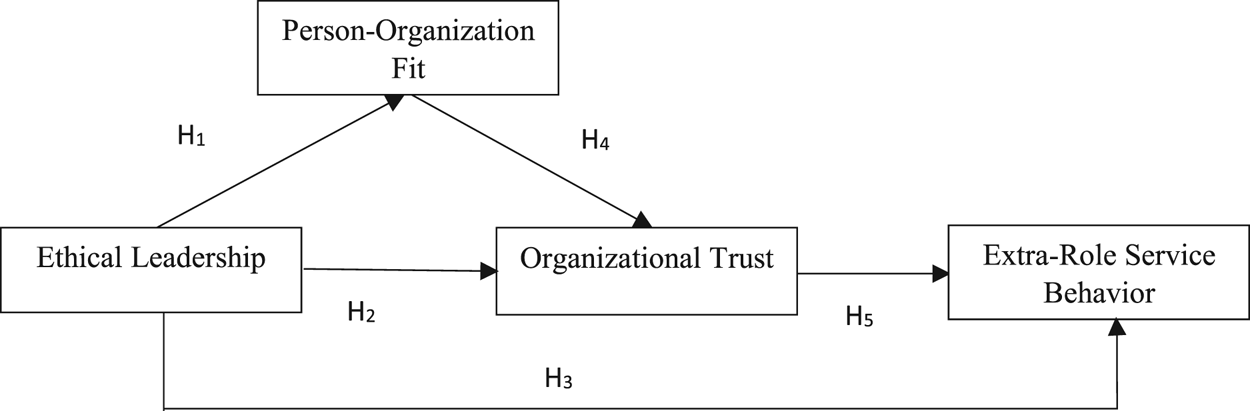
The research model is developed in line with the relations among the mentioned variables and developed hypotheses (Figure 1):
Research model.

Method
The objective and sample of the study
This research study focused on the health workers perceiving the ethical behaviors of their leaders, thinking that there is a value fit with their organization, trusting in their organization, and their levels of displaying extra-role service behavior. The objective of the study is to determine direct or indirect effects of ethical leadership perception on extra-role service behavior, and to detect the role of person–organization fit and organizational trust in this effect. In this purpose, the workers of two hospitals (a private hospital and a public hospital) functioning in a province of Turkey were determined as the universe of the study. The data were collected from the universe via convenience sampling method and questionnaire method. Worker voluntariness was a prerequisite for collection of the data. Two hundred and thirty questionnaire forms were returned out of 300 forms handed out to the workers; however, since there were data loss errors in some of them (25 questionnaire forms), only 205 of them were put into perspective.
Demographic data of the evaluated questionnaire forms are as follows: among the participants of the research study 48.3% were workers of public hospital, while 51.7% were private hospital workers; 63.4% of the participants were female, and 57.1% were married; majority of the workers (51.2%) were 30 years old and below; most of the workers were with bachelor's degree (37.6%) and associate (2-year) degree (37.1%); while 27.8% of the participant workers were nurse-midwife, 24.4% were medical clerks, and 42.4% were others (laboratory technician, anesthetist, radiology technician, etc.), 5.4% did not specify their profession. On the other hand, nonmanager worker participants were in majority (77.6%).
Scales used in the study
Ethical leadership scale
In defining the ethical leadership perceptions of the workers, a 10-question scale, which was developed by Brown, Trevino, and Harrison (Reference Brown, Trevino and Harrison2005), was used. One of the statements in the scale is ‘The managers in this hospital make fair and balanced decisions’.
Person–organization fit scale
In defining the person–organization fit, a four-question scale, which was developed by Netemeyer, Boles, McKee, and McMurrian (Reference Netemeyer, Boles, McKee and McMurrian1997), was used. One of the statements in the scale is ‘The values of this hospital regarding justice, is in parallel with those of mine’.
Organizational trust scale
In defining the organizational trust levels of the workers, a seven-question scale, four of which were developed by Nyhan and Marlowe (Reference Nyhan and Marlowe1997) and three of which were used by Tokgoz and Aytemiz Seymen (Reference Tokgoz and Aytemiz Seymen2013), was used. The statements in the scale are given in Appendix 1.
Extra-role service behavior scale
In defining the extra-role service behavior levels of the workers, a five-question scale, which was developed by Bettencourt and Brown (Reference Bettencourt and Brown1997), was used. One of the statements in the scale is ‘Voluntarily assists patients and their relatives even if it means going beyond job requirements.’ All the statements in the scales were answered according to the 5-point Likert scale (1=‘definitely agree’/5=‘definitely disagree’).
Findings
In the analysis of the data obtained from the study, SPSS and AMOS package programs were used. In this purpose, exploratory factor analysis, confirmatory factor analysis, correlation analysis, and structural equation modeling methods were used basically. Before applying these methods, normal distribution compliance test was made, which was critical for obtaining reliable results from the analyses. Normal distribution compliance test of the data was conducted via Kolmogorov–Smirnov and Shapiro–Wilk tests. As the result of the test, it was determined that the data did not have a normal distribution, since the test results were statistically significant (sig.<0.05). After this step, the analyses were conducted considering that the data did not have a normal distribution.
Reliability and validity analyses regarding the scales
Construct validity of the scales used in the research study was determined via exploratory and confirmatory factor analyses, respectively. That the item factor loads were not below 0.40 was taken as reference in the factor analyses. In the exploratory factor analysis, Barlett Sphericity Test value was desired to be significant (< 0.05), and the KMO (Kaiser–Mayer–Olkin) value was desired to be higher than 0.60 (Naktiyok, Reference Naktiyok2004). By taking these criteria into account, varimax exploratory factor analysis was performed on each scale in turn, and it was seen that each scale exhibited a one-factor structure and met the reference criteria. The factor structure, which was obtained from each scale via explanatory factor analysis, was tested with confirmatory factor analysis. In confirmatory factor analysis, the comparative fit index (CFI), root mean square error approximation (RMSEA), standardized root mean residual (SRMR) and χ2 statistic divided by the degrees of freedom (χ2/df) indices – which are suggested by Williams, Vandenberg, and Edwards (Reference Williams, Vandenberg and Edwards2009) – are used. Regarding model fit, the following conditions are taken as reference: CFI>0.95; RMSEA<0.08; SRMR<0.10 (Williams, Vandenberg, and Edwards, Reference Williams, Vandenberg and Edwards2009); and (χ2/df)≤3 (Iacobucci, Reference Iacobucci2010). In the analysis, modifications were made among the items of some scales in order to enhance the indices values regarding factor structure fit. It was determined that the fit good values of each scale met necessary criteria (see Table 1).
Postmodification fit indices values of the scales

In the reliabilities of the scales used in the research study, internal consistency was considered and Cronbach α coefficient was checked. It was considered that the Cronbach α coefficient is higher than 0.70 (Cortina, Reference Cortina1993). In the analyses, it was observed that the Cronbach α coefficients of the ‘ethical leadership, person–organization fit, organizational trust, and extra-role service behavior’ scales were respectively, 0.947, 0.924, 0.925, and 0.834, thus, it was determined that the scales were reliable. In the study, average variance extracted (AVE) values and composite reliability values (CR) were also investigated. The AVE value of the scales was higher than 0.50 and the CR value was higher than 0.70 (Hair, Anderson, Tatham, & Black, Reference Hair, Anderson, Tatham and Black1995). In the analysis conducted, the scales of ethical leadership (AVE = 0.678; CR = 0.955), person–organization fit (AVE = 0.816; CR = 0.947), organizational trust (AVE = 0.692; CR = 0.940), and extra-role service behavior (AVE = 0.605; CR = 0.884) were found in the reference criteria of mentioned scales and thus it is determined that the convergence and discriminant validity are provided.
Common method bias analysis was also conducted in the research. A common method bias is a systematic error variance resulting from the use of similar methods or resources. In order to determine the common method bias, the single-factor test proposal of Harman was taken into consideration in the study (Podsakoff, MacKenzie, Lee, & Podsakoff, Reference Podsakoff, MacKenzie, Lee and Podsakoff2003). In this respect, all items in the scales of ethical leadership, person–organization fit, organizational trust, and extra-role service behavior were subjected to noncyclic factor analysis. In the analysis, four (4) factors with eigenvalues higher than 1 were obtained. The first of the factors obtained was found to explain a significant level (49.097%) of the total variance, thus it was determined that there was no common method deviation (Podsakoff et al., Reference Podsakoff, MacKenzie, Lee and Podsakoff2003).
Tests of the hypotheses
Before using structural equation modeling for the testing of the hypotheses, the strength and direction of the relation among the ethical leadership, person–organization fit, organizational trust, and extra-role service behavior variables were determined via correlation analysis. Considering that the data did not manifest normal distribution, Spearman correlation analysis was used. The obtained findings are presented on Table 2.
Relations among the variables

According to the findings on Table 2; it is observed that the health workers think that their mid-level managers behave ethically (mean = 3.151) and that they trust in their organizations (mean = 3.035); however, they perceive lesser value fit with their organization (mean = 2.902). On the other hand, the extra-role service behaviors of the health workers toward the patients and their relatives are quite high (mean = 4.127). When the relations among the variables given on the table are examined; it is observed that there is a positive and significant relation between ethical leadership and person–organization fit (r = 0.639**) variables, and between organizational trust (r = 0.736**) and extra-role service behavior (r = 0.346**) variables. Based on the table, it is also observed that there is a positive and significant relation between person–organization fit and organizational trust (r = 0.606**), and between person–organization fit and extra-role service behavior (r = 0.277**). Based on the findings, it is observed that there is a positive and significant relation between organizational trust and extra-role service behavior (r = 0.390**), as well.
Structural equity modeling analysis was conducted via AMOS program for the testing of the hypotheses and the research model. Before conducting the analysis, as the prerequisite of structural equity modeling analysis, it was determined whether there was a multicollinearity problem among the variables. In this purpose, variance inflation factor (VIF) and tolerance indices were examined (see Table 3). It was observed that there was no multicollinearity problem, since the VIF value was below 10 and the tolerance indices were over 0.10 (Kerse & Karabey, Reference Kerse and Karabey2017); therefore, it was observed that structural equity modeling was available.
Multicollinearity results of the variables

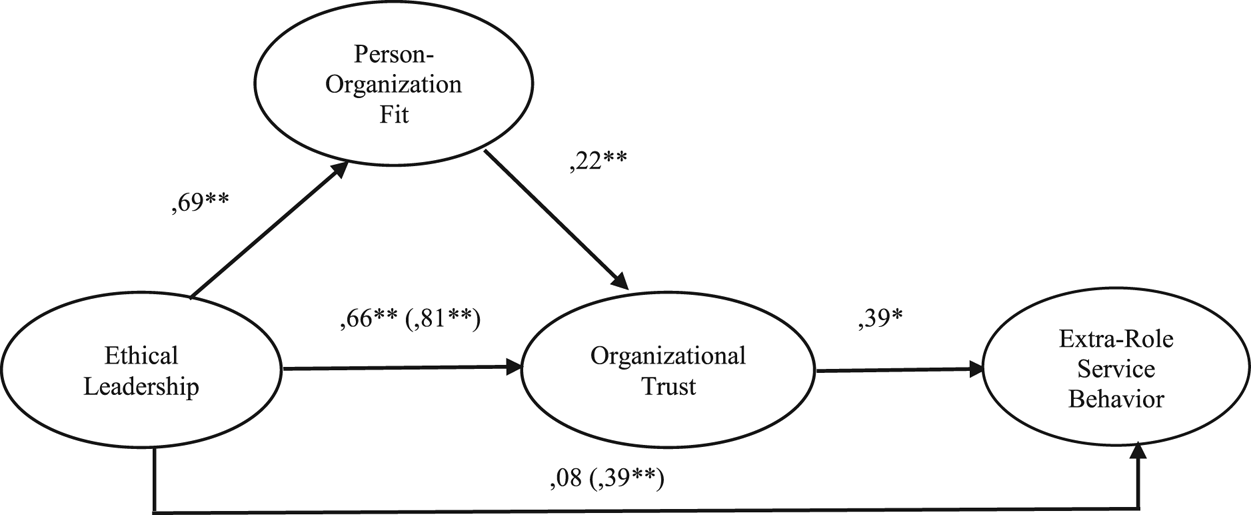
Structural equation analysis was conducted in order to test the hypotheses of the research and the developed model. Considering that the data did not manifest normal distribution, bootstrap method was used in the structural equation analysis (Bayram, Reference Bayram2013). On the other hand, it was observed that the goodness-of-fit values (χ2/df = 1.632; SRMR = .063; CFI = .958; and RMSEA = .056) of the model were in an acceptable level. Estimate results obtained from the analysis are presented in Figure 2:
Standardized estimate results of the model.

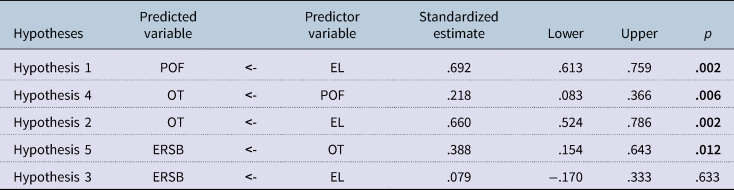
The estimate values of the model obtained from the analysis conducted for testing the hypotheses are given in Table 4.
Estimate values of the variables

EL = ethical leadership; POF = person–organization fit; OT = organizational trust; ERSB = extra-role service behavior.
When the findings shown in Figure 2 and Table 4 are examined; it is observed that ethical leadership influences person–organization fit (.692 and p = .002) and organizational trust (.660 and p = .002) significantly and in a positive manner; while it does not affect directly extra-role service behavior (.079 and p = .633) in a significant level. Besides, personorganization fit influenced organizational trust (.218 and p = .006) positively and in a significant level; while organizational trust influenced extra-role service behavior (.388 and p = .012) in the same way. Therefore, Hypothesis 1, Hypothesis 2, Hypothesis 4, and Hypothesis 5 are supported while Hypothesis 3 is not supported.
In order to determine whether person–organization fit played a mediating role on the effect of ethical leadership on organizational trust, person–organization mediating variable was removed from the model and the effect of ethical leadership on organizational trust was examined. In the last setting, where the mediating variable (person–organization fit) was removed, it was determined that the ethical leadership affected organizational trust (.809 and p = .003) significantly and in a positive manner. Since ethical leadership continued to influence organizational trust less but in a significant level (in the mediating model = .66**; in the nonmediating model = .81**) after the person–organization fit, which was the mediating variable, was included into the model, it was proved that it had a partial mediating role (Figure 2). Therefore, Hypothesis 6 is supported.
In order to determine whether organizational trust played a mediating role on the effect of ethical leadership on extra-role service behavior, organizational trust mediating variable was removed from the model. In the last setting, it was determined that the ethical leadership affected extra-role service behavior (.385 and p = .002) significantly and in a positive manner. Since the influence of ethical leadership on extra-role service behavior was completely disappeared (in the mediating model = .08; in the nonmediating model = .39**) after the organizational trust, which was the mediating variable, was included into the model, it was proved that organizational trust had a complete mediating role (Figure 2). Therefore, Hypothesis 7 is supported.
Discussion
The importance of ethical leadership on increasing voice behavior and citizenship behaviors, which are displayed voluntarily, is gaining recognition each passing day (Lam et al., Reference Lam, Loi, Chan and Liu2016; Wang & Sung, Reference Wang and Sung2016). However, when the relevant literature is examined, it is observed that the number of studies is limited, which used multilevel models and psychological mechanisms in explaining the relation between the ethical leadership and the abovementioned volunteer behaviors (Walumbwa, Mayer, Wang, Wang, Workman, & Christensen, Reference Walumbwa, Mayer, Wang, Wang, Workman and Christensen2011; Mo & Shi, Reference Mo and Shi2017). Therefore, in this study, the effect of ethical leadership on extra-role service behavior, which is on a voluntary basis, was attempted to be explained via a multilevel model. In this purpose, the effects of ethical leadership on person–organization fit, organizational trust, and extra-role service behaviors were examined. Besides, the study also considered whether person–organization fit played a mediating role on the effect of ethical leadership on organizational trust, and similarly whether organizational trust played a mediating role on the effect of ethical leadership on extra-role service behaviors. As the conclusions of the analyses based on the data obtained from the health sector workers, it was determined that ethical leadership influenced person–organization fit and organizational trust significantly and in a positive manner. These findings supported the ones in the literature, which suggest that ethical leadership influences person–organization fit (DeConinck, Reference DeConinck2015; Schwepker, Reference Schwepker2015) and organizational trust (Gucel, Tokmak, & Turgut, Reference Gucel, Tokmak and Turgut2012; Pucetaite, Reference Pucetaite2014; Xu, Loi, & Ngo, Reference Xu, Loi and Ngo2016; Yanik & Naktiyok, Reference Yanik and Naktiyok2017) significantly and in a positive manner. On the other hand, as was suggested in the previous research studies (Isci, Erdem Artan, & Sisman, Reference Isci, Erdem Artan and Sisman2011; Alfes, Shantz, & Alahakone, Reference Alfes, Shantz and Alahakone2016; Schuh et al., Reference Schuh, Quaquebeke, Keck, Göritz, De Cremer and Xin2016; Yoon, Jang, & Lee, Reference Yoon, Jang and Lee2016), the findings of this study showed that person–organization fit increased organizational trust, and organizational trust increased extra-role service behavior. Based on another finding obtained from the analysis results, it was observed that ethical leadership indirectly influenced extra-role service behavior. This finding partially coincided with the ones that of Garba et al. (Reference Garba, Babalola and Guo2018). All of these findings obtained from this study were handled within the framework of theoretical and practical implications and some suggestions were made for further studies.
Theoretical Implications
This study makes theoretical contributions to research studies in both national (Turkey) and international level, concerning extra-role service behaviors. Initially, our research study attempted to correspond to the suggestion of Brown and Mitchell (Reference Brown and Mitchell2010) by handling ‘fit’ variable, which is among the in-demand terms to be considered together with ethical leadership in organizational behavior literature.
Second, when the previous research studies of the literature were examined, it was observed that generally the interactions were examined between ethical leadership and organizational citizenship behaviors (Lu, Reference Lu2014; Bonner, Greenbaum, and Mayer, Reference Bonner, Greenbaum and Mayer2016; Palalar Alkan and Arikboga, Reference Palalar Alkan and Arikboga2017), and that only a limited number of studies (Garba, Babalola, & Guo, Reference Garba, Babalola and Guo2018) dealt with extra-role service (or extra-role customer service) behavior, which indicated directly customer-driven citizenship behaviors. Therefore, the study evaluated extra-role service behavior (Bettencourt & Brown, Reference Bettencourt and Brown1997), which is vital for service sector, with regards to ethical leadership.
Third, this study considered the calls for the need to develop a multilevel perspective in understanding the ethical leadership (Schaubroeck et al., Reference Schaubroeck, Hannah, Avolio, Kozlowski, Lord, Trevino, Dimotakis and Peng2012), and in this purpose, it revealed how and why ethical leadership influences extra-role service behavior. In this study, it was determined that ethical leadership increases organizational trust both directly and indirectly, by increasing person–organization fit. On the other hand, though not directly, ethical leadership indirectly strengthened extra-role service behavior over organizational-trust.
Fourth, in line with the views of Trevino, Hartman, and Brown (Reference Trevino, Hartman and Brown2000), who suggested that ethical leadership had two basic components, the study proved that the organizational trust levels of workers, who perceived their leaders as ‘a moral person’ and ‘a moral manager,’ increased. The worker, who trusts more in his/her organization, tends to display extra-role service behavior. From the social learning theory (Bandura, Reference Bandura1977, Reference Bandura1986) point of view, these results proved that the workers learned ethical behaviors from their leaders, who displayed ethical behaviors as ‘a moral person’ and ‘a moral manager,’ and that they displayed these behaviors although they are out of their job descriptions. On the other hand, the obtained results reflect the social learning theory perspective (Blau, Reference Blau1964) as well. It was determined that the workers, who thought that their managers treated them fair, honest, respectful, and prioritized their welfare and goodness, tended to display extra-role service behaviors in order to respond to their managers.
Lastly, this research study contributes to the ethical leadership research, concerning Turkey. Although ethical leadership concept drew attention of the researchers due to the recently increased scandals (such as Enron and Imar Bank), the studies on Turkey example are insufficient. Moreover, the studies on ethical leadership in Turkey focused on education sector (Cemaloglu & Kilinc, Reference Cemaloglu and Kilinc2012; Dogan & Ugurlu, Reference Dogan and Ugurlu2014; Tabancali & Cakiroglu, Reference Tabancali and Cakiroglu2017) and the number of studies on health sector was limited (Buyukyilmaz & Alper Ay, Reference Buyukyilmaz and Alper Ay2017). Therefore, it is evaluated that this research study will contribute to both national and international literature, and the mangers of the relevant sectors.
Practical (Administrative) Implications
Based on the findings of the study, some practical and administrative implications can be made. The findings validated the importance of ethical leadership on extra-role service behaviors. The compliance of the workers, who thought that their managers are moral both in daily life and in professional life, with their organization was strengthened, and their trust in their organization was increased. Increased trust in the organization encouraged the workers to display service behavior voluntarily, going beyond their job descriptions. Therefore, the study manifested the mechanism, which shows how an influence ethical leadership has on extra-role service behaviors.
Considering the findings of the study, the importance of the ethical leadership can be evaluated in two ways, in macro and micro levels. Since ethical leadership helps the workers display extra-role service behavior in micro level, it is beneficial for the organizations. As per the macro level, ethical leadership is vital for the development of economic development besides cultural development in the countries with high collectivist values (Lin & Huang, Reference Lin and Huang2014). Therefore, first, the organizations should strictly abide by the ethical codes, and employ managers with high moral values. On the other hand, moral standards should not be applied for the managers in employment, it should be applied to the other workers as well.
Second, the organizations should train the managers about the importance of the ethical standards and preservation of ethical behaviors. If the managers take reference ethical standards in their personal lives and decisions, it means that the workers will display such kinds of behaviors since they will see the managers as their role models. Moreover, the managers should not only focus on the question, ‘how can I reach to the organizational objectives?,’ he/she should rather answer the question ‘how can I reach to the organizational objectives wit ethical and moral standards?’ and lead the workers in this objective. In addition to training managers, the establishment of ethical follow-up centers in all organizations and daily follow-up of organizational activities may also contribute to the spread of ethical behaviors. In addition, the fact that the state control mechanisms for ethical scandals tighten their practices and increase their effectiveness may reduce the scandals. In addition, although there are laws regarding ethical violations in countries, it is unlikely that ethical violations will decrease and ethical behaviors will not be prolonged unless socio-economic order, lifestyle, education level, belief system, and culture are in compliance with the laws in question. For this reason, starting from basic education, giving lessons about ethical values, eliminating distorting ideas, and practices from the belief system in countries and encouraging enterprises that exhibit ethical activities (tax deductions and awards) can provide support in reducing ethical violations. Finally, conducting tests to reveal the behavior of candidates about ethical level in the process of recruitment – especially in recruitment for managerial positions – may also be useful in reducing such behaviors.
Evaluation of The Findings with National Culture
Evaluating the ethical leadership concept and the findings of the study in cultural context, as well, will better explain the importance of the study. Turkey is a country, where collectivist culture and high-power distance tendency are predominant (Hofstede, Reference Hofstede1980). As the Turkish society is the product of a culture in which collective action, namely collectivism, is held ahead (Sargut, Reference Sargut2001), there are collectivist-oriented subordinates in the enterprises. In a business, where there are subordinates with collectivist tendencies, ethical leadership will improve both the perception of justice and loyalty to the leader (Wang, Lu, & Liu, Reference Wang, Lu and Liu2017), and strengthens the value fit with the leader (Tang, Cai, Liu, Zhu, Yang, & Li, Reference Tang, Cai, Liu, Zhu, Yang and Li2015). Therefore, if the leaders display behaviors in their daily and professional lives in line with ethical standards, it will determine the attitudes of the workers toward him/her and the organization.
It is possible to mention similar things about the tendency of power distance. In high-power distance tendency, the workers try to look like their leaders, since they perceive their leaders as more attractive (charismatic). Therefore, since the workers organize their behaviors with social learning, ethical leadership much more influences the voluntary behaviors such as worker voice behaviors (Kwak & Shim, Reference Kwak and Shim2017). Considering that the extra-role service behavior is also a voluntary behavior (Kang et al., Reference Kang, Stewart, Kim and Lim2012), it can be mentioned that, in countries such as Turkey, where collectivist culture and high-power distance tendency is predominant, ethical leadership plays a determinant role in the worker attitude and behaviors such as value fit, organizational trust, and extra-role service behavior; therefore, it is important.
In addition to the above explanations, it should not be forgotten that in Turkey, it is assumed that the behaviors of the individuals in professional settings reflect their behaviors in daily lives. Besides, common proverbs used in Turkey such as ‘Work is the mirror of a person,’ ‘A man is better observed on working’ state that it is necessary to cast a look on a person's work, in order to recognize a man. Therefore, fair, honest, and moral behaviors displayed in professional life highly influence relations and interactions with other people in private life, as well. Thus, ethical leadership and ethical behaviors are more important in Turkey.
Limitations of The Research Study and Suggestions
Based on its findings, this research study is positive for both its theoretical contributions to ethical leadership and extra-role service behavior, and its practical suggestions to the business managers. However, there are some limitations for the study. One of these limitations is that only cross-sectional method is used as the design of the research. For further studies, it can be suggested that the data be obtained longitudinally and the relations between the variables be explained in this way.
Second, the data of the research are obtained from only one province in Turkey. Although the cultural context is controlled by obtaining the data from a single country and a single province, the findings cannot be generalized for the whole health sector. Therefore, it can be beneficial for further studies to be conducted including the health workers of other provinces.
Third, in order to generalize the findings for the relevant sector, both public and private workers were evaluated together. It can be suggested for further studies to evaluate mentioned variables comparing public and private businesses.
Fourth, there was state of emergency in Turkey during the data were collected, and the questionnaire forms were answered with this psychology. If the data are collected from the same sample and comparisons are made after the state of emergency is lifted, more healthy and generalizable results might appear. This is another limitation of the study. Therefore, it would be useful to handle the research model in the relevant sector after the state of emergency is lifted.
Lastly, a limited number of variables are used in the research. Although, the ethical leadership and its initial and secondary outputs are handled from a multilevel perspective, it would be useful to evaluate the model of the research considering the features of the followers. On the other hand, as seen in the findings of the research, person–organization fit plays a partial mediating role on the effect of ethical leadership on organizational trust. This means that some other variables apart from person–organization fit can play a mediating role on the effect of ethical leadership on organizational trust. Therefore, it can be suggested that the model of the research be enlarged by variables such as other fit types (person–job fit, person–manager fit, etc.), organizational justice, and organizational loyalty. In line with the findings of the research, agreeing with the opinions of Schaubroeck et al. (Reference Schaubroeck, Hannah, Avolio, Kozlowski, Lord, Trevino, Dimotakis and Peng2012), who suggest that a multilevel perspective should be embraced in understanding the ethical leadership, we make a similar call for further studies: ‘Ethical leadership is an important strategy in the businesses for motivating their workers for providing competitive advantage and sustaining their lives. Therefore, ethical leadership concept should be attached more importance and should be examined from a multilevel perspective in other sectors as well.’
Conclusion
Ethical scandals experienced in businesses such as Enron and Worldcom in the USA, Vivendi and Parmalat in Europe, and Imar Bank and Etibank in Turkey, increased the importance of business ethics and the ethical behaviors among the leaders. Therefore, ethical leadership was focused on this study, and the concept was evaluated from a multilevel perspective. The findings of this study showed that ethical leadership strengthened the organizational trust both indirectly over person–organization fit and directly, and also proved that with strengthening organizational trust, extra-role service behaviors were displayed in a higher level. In general terms, this research study contributed both to the leaders of the relevant sector and to further studies, manifesting how ethical leadership influenced extra-role service behavior.
Supplementary Material
The supplementary material for this article can be found at https://doi.org/10.1017/jmo.2019.4.
Author ORCIDs
Gökhan Kerse, 0000-0002-1565-9110.
Acknowledgements
This article is an original unpublished work elsewhere. The authors would like to thank editorials and referees for their comments and contributions.
APPENDIX 1. ORGANIZATIONAL TRUST SCALE
1. The level of trust among the managers and workers in this hospital is quite high.
2. In general, employees in this hospital have a high level of trust in each other.
3. The level of trust among people I work with in this hospital is very high.
4. I am very confident that this hospital will treat me fairly.
5. I trust to this hospital will be fair to all employees.
6. I trust that this hospital will be relevant and respectful to the employees.
7. I have confidence that that this hospital will be with me during my hard times.
Gökhan Kerse is an assistant professor at the Faculty of Economics and Administrative Sciences in Karamanoğlu Mehmetbey University. He completed his masters and doctoral educations at Ataturk University. His research interests include entrepreneurship, leadership, and organizational behavior.