The case for preventive public policy is ever present in large welfare states. Debates over health, crime, early years interventions and many other areas of social policy stress the advantages of prevention over coping, cure, compensation or confinement. This emphasis has been motivated by a combination of normative and economic reasons: it is better for human well-being to prevent harm than to deal with its consequences. The current era of austerity only strengthens the case for prevention, while at the same time constraining its funding.
Yet there is also agreement that prevention rarely succeeds. Despite the shift in discourse over the last two decades from social compensation to social investment, Western – and especially European welfare – states remain predominantly ‘downstream’ operations, addressing a variety of needs and harms that could in theory be prevented. This article explores why this is so and concludes that prevention initiatives are continually derailed by powerful ideological, interest-based and institutional forces.
To understand this combination of salience and impotence, I argue that the scope of prevention must be broadened to embrace not just social policy but environmental and economic policy too. This is a distinctive feature of a recent report by the New Economics Foundation,Footnote 1 which argues that these three spheres are inextricably and increasingly interdependent, and must be addressed together to plan for a sustainable future. In particular, social and environmental policy cannot be addressed independently of economic policy.
We shall see that each of these three domains of prevention poses quite different questions and deploys distinct conceptual frameworks. While the prevention framework is explicitly applied in social and environmental policy, it is much less prominent in thinking on economic policy. Yet it can be shown that effective prevention in both the social and environmental domains requires a major reorientation of the current economic paradigm. This necessitates a political economy approach that embraces all three domains. I contend that the obstacles to equitable and sustainable preventive policies are located in the economy, sustained by neoliberal ideology, and reinforced by the private interests and institutions that benefit from both of these.
This article begins with a theoretical framework for reflecting on the political economy of prevention in advanced capitalist economies. The next two sections survey prevention initiatives in social and climate change policy in turn, mainly focusing on the last three decades and based mainly on UK evidence. Then the relative absence of prevention in contemporary economic policy and management is considered: today's neoliberal economic and political order powerfully constrains preventive public policy. I conclude that it is not possible to develop robust social and environmental prevention in a political economy driven by short-term, non-generalizable interests. In the final section I outline an alternative social political economy that prioritizes preventive and precautionary policy making.
A CONCEPTUAL FRAMEWORK
The dictionary defines prevention as stopping something (usually unpleasant) from happening. This definition is rather crude – it is all or nothing; either threat/risk X is stopped or it is not. A more useful alternative definition of prevention is ‘to reduce the probability of a risk occurring’.Footnote 2 I shall take this to mean public policies designed to reduce the risks of significant harms befalling a population, following the centrality of the concept of harm in our earlier work on a theory of human need.Footnote 3
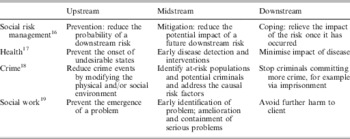
Coote,Footnote 4 drawing on health policy analysis, distinguishes three levels of public interventions:
-
1. Upstream interventions: to prevent harm before it occurs, usually focusing on whole populations and systems;
-
2. Midstream interventions: to mitigate the effects of harm that has already happened, usually targeted at groups or areas considered ‘at risk’; and
-
3. Downstream interventions: to cope with the consequences of harm that has not been – or cannot be – avoided.
In particular, upstream interventions do not address the immediate causes of harm but rather the ‘causes of the causes’.Footnote 5 They are concerned with ‘the adaptation of circumstances to individual need, rather than the adaptation of individuals to circumstances’; such interventions target prevailing economic and social structures, rather than adapting individuals to them.Footnote 6
Theories of Prevention
Though there are numerous theorizations of prevention in specific policy domains (some of which are surveyed below), theories of prevention per se are notable by their absence. In two articles Richard Freeman undertakes ‘a self-conscious attempt to theorize a domain of activity which is often left undertheorized’.Footnote 7 He argues that prevention is a product of modernity, which is bound up with the welfare state and the authority of professional and scientific expertise. Prevention policy is built on several basic foundations. I will concentrate on two: (1) scientific understandings of cause and effect and the possibility of prediction and (2) the capacity for controlled government intervention in social life.
Both of these foundations are contested. Contending theories about the social world have different notions of causality, conflicting value bases and different conceptions of the role of public policy. There is contention in numerous areas of social policy: between structural and individual approaches, between contextual and rational actor models, between medical and social explanations, etc. Alongside these differences, there is the sheer empirical challenge of identifying causality when modelling complex chains and changing social contexts. Perhaps Foucault's critique of the relationship between knowledge and power (and his allied notion of surveillance) constitutes the most powerful relativist rejection of the possibility of prevention.Footnote 8 To answer these critiques I consider each of Freeman's foundations in turn.
Scientific Understanding: Ontology and Epistemology
Here I draw on earlier work with Len Doyal on theorizing human needs.Footnote 9 This project encountered similar doubts that human needs can be coherently and consensually defined, emanating from diverse sources including liberalism, phenomenology and post-modernism. Our response to these doubts is that, cutting across cultural and value differences, there is an irreducible notion of ‘serious harm’, defined as ‘fundamental disablement in the pursuit of one's vision of the good’. The avoidance of harm constitutes the most basic human interest.Footnote 10 This enables us to define basic human needs as universal preconditions for avoiding serious harm, which we identify as physical health and autonomy. This approach shares some features with Sen's concept of ‘functionings’ and more with Nussbaum's ‘central human functional capabilities’.Footnote 11
This does not take us very far in rebutting relativist critiques of the justification for public (including preventive) policies. If we accept that there are certain universal harms and needs, we also know that the satisfiers of these needs are almost always variable and very often context specific. Both I and Nussbaum argue that a conceptual bridge can be built across this gap. In our case it is by identifying ‘universal satisfier characteristics’ – properties of goods, services, activities and relationships that enhance physical health and human autonomy in all cultures. In this way, ‘scientific understanding of cause and effect’ plays a role in developing public policies, including preventive policies.
However, such codified scientific knowledge is never enough. All effective policies to avoid harm and to develop appropriate need satisfiers must also draw on the experientially grounded knowledge of people in their everyday lives and contexts. Thus effective policy making requires a dual strategy that brings to bear both the codified knowledge of experts and the experiential knowledge of those whose basic needs and daily lives are under consideration. Fostering such a challenging process requires radically enhanced participation, empowerment and new forms of deliberative dialogue. Only by utilizing such a dual strategy can effective, upstream preventive programmes be devised and implemented.Footnote 12
Intervention Capacity: Political Economy
Turning to the second of Freeman's preconditions, what factors explain the prominence, role, nature and effectiveness of preventive strategies adopted by particular governments in particular policy areas at particular times? Is not government capacity for controlled intervention always limited? If anything, is it not weakening in the modern globalized world?
To answer these questions I build on historical and comparative welfare state scholarship over the past four decades. This literature has identified five factors or drivers of social policy development in the West over the last century: the ‘five I's’ of industrial capitalism, interests, institutions, ideas/ideologies and international influences.Footnote 13 Though developed to explain social policies, I believe this framework can also be applied to the contemporary emergence of environmental policies.Footnote 14 In this article I will focus on ideas, interests and institutions in order to understand the development and pattern of modern preventive public policies.
Ideas and ideologies
Ideas and ideologies – clusters of views on the nature of the world and normative beliefs about what governments can and should do – play a central role in shaping the goals, scope and nature of preventive strategies. The ongoing disputes between libertarian, liberal and social democratic perspectives on the harms of unconstrained markets and the role of the state are clearly relevant to views about the desirability and extent of prevention policy. Similarly, the form of prevention varies according to ideological persuasion. Youth crime can either be prevented by fortifying public buildings introducing metal detectors in schools and child curfews or by neighbourhood development programmes and other holistic programmes that promote child well-being.Footnote 15 Likewise, obesity can either be reduced by stomach stapling operations or by regulating sectors of the food industry or numerous interventions inbetween. Harm from prospective climate change can be reduced by cutting emissions or by adapting infrastructures or behaviours. Real-world preventive strategies are highly contested, and are shaped by dominant paradigms in society.
Institutions
Public policies, including preventive public policies, are shaped by institutions. These include the nature of political systems, their form of political representation, the administrative bureaucracies of modern states and how interest groups are integrated into the policy-making process. Three examples will be discussed. First, representative democracy favours short-term policy making following electoral cycles, militating against longer-term preventive strategies. Secondly, the welfare states of the Western world have built up powerful ministries that seek to protect their policy areas and block overarching preventive initiatives. Thirdly, these in turn bequeath policy legacies, commitments and path dependencies: welfare states pre-empt the application of resources to prevention due to the ‘double fiscal burden’ that such investment strategies impose.
Interests
Behind ideas often lurk different organized interests, including medical, pedagogical and accountancy-based professions created by and dominant in welfare states. A plethora of NGOs has also emerged to propound various forms of preventive policy that are notably oriented to targeted midstream interventions. The influence of trades unions has diminished in Western countries since the 1970s, but the structural power and ‘voice’ of corporate and financial interests has clearly grown. In social policy, two business lobbies are important: sectors that supply inputs to state services (from producing drugs to running care homes and prisons) and sectors whose products harm health or well-being that social policies try to ameliorate. Both wield considerable power (alongside the professions) to inhibit or shape prevention policy. In climate change policy, industrial and commercial interests play an important role in opposing or supporting mitigation programmes.
The above constitutes conceptual elements with which to confront and rebut current scepticism about the knowledge and capacities of modern states to undertake preventive measures, some of which are addressed in the final section. The need to establish a moral and technical foundation for preventive policy has gained new urgency from the environmental crisis – especially from the threat to the ability of our planet to sustain human life as a result of escalating climate change. This is the ultimate ‘serious harm’ that is calling forth new, unprecedented preventive efforts. So far all have proved inadequate, but this does not invalidate their overriding moral justification. This is the central reason why preventive policy must now take a broad perspective across the three spheres of society, environment and economy. The above framework provides a checklist to which I will refer when seeking to explain ‘government capacity for controlled intervention in social life’.
SOCIAL POLICY AND PREVENTION
Social policy is a major source of contemporary debates and policy innovations concerning prevention, and has fostered a wide range of studies and research. I shall here briefly survey health, crime and early years intervention, mainly drawing on examples and evidence from the UK over the past three decades. The distinction between upstream, midstream and downstream interventions, noted earlier, has its origins in medicine and health. It has since been adopted and adapted across other areas of social policy, as illustrated in Table 1. Despite numerous policy commitments and initiatives, the finding is that – with some notable exceptions – preventive interventions have been marginalized and, when pursued, focus almost exclusively on midstream or downstream measures.
Levels of Prevention

Health
The founding idea of the British National Health Service (NHS) was preventive, but in practice it has been utterly dominated by treatment. Pressure by the Health Education Council, chief medical officer and various reviews such as the Wanless reports of 2002 and 2004 have continually urged preventive initiatives alongside the NHS, for example restraining smoking and alcohol.Footnote 20 And as the cost of the treatment-oriented NHS has mounted, there has been growing interest in the cost-containment potential of effective health promotion.Footnote 21 The New Labour government developed a more coherent preventive health strategy, beginning with the pathbreaking 1998 Green Paper Our Healthier Nation, and put in place some initiatives to implement it. However, this approach was again soon sidelined when Prime Minister Blair announced his 2000 Health Plan to greatly expand expenditure on the treatment-oriented NHS. And many of the New Labour preventive initiatives have not survived the change of government.
Two linked debates have dominated the entire period: between different ideologies and between interventions targeted at individuals or social structures. First, the very idea of preventing ill health could be seen as a Fabian one, entailing proactive government and a degree of ‘social engineering’.Footnote 22 The New Right or neoliberal arguments concerning individual liberty and consumer sovereignty gained prominence in the late 1970s and have not relinquished that position. The ‘nanny state’ slogan has wormed its way into the national psyche.Footnote 23 Yet this counter-ideology has not removed prevention from the political agenda; rather, it has redefined it in terms of altering individual behaviour and ‘lifestyle choices’.
The second debate has been between interventions targeted either at individuals or social structures. Those arguing for more structural, upstream interventions have kept up a continual presence, from the 1978 World Health Organization Alma Ata declaration and the 1980 Black Report to the 1998 Acheson Report and the 2010 Marmot Review on health inequalities in England. The most radical focus is on the ‘pathogenic nature of modern social structures’ and the current ‘obesogenic environment’ of energy-dense food, motorized transport and sedentary lifestyles.Footnote 24 The Marmot Report proposes a preventive strategy that includes fair employment and good work, a healthy standard of living for all, and healthy and sustainable places and communities. But these proposals have gained little traction. Rather, the dominant strand of preventive intervention has been biomedical (for example, statins), targeted early years interventions (for example, immunization, nutrition during pregnancy, parenting classes) and health education and lifestyle change (for example, smoking cessation).
Can the framework presented earlier explain both the subaltern role of prevention in health policy and the dominance of individualist interventions? I briefly consider some of the arguments.
Ideological and epistemological
It is difficult to gather clear evidence of the effectiveness of primary preventive health measures, particularly those that accrue in the medium or long term. Both biomedical science and economics (the dominant epistemic community in the social sciences) favour targeting individual bodies and behaviours. The search is for individual pathogens rather than the social context of disease.Footnote 25 Since the 1970s, the role of medical sociology has been sidelined, and with it alternative, contextual methods to evaluate different policies.Footnote 26
Institutions
The institutional structures of health and the governance structures of modern capitalist societies weaken the scope for structurally oriented preventive health. Powerfully organized medical professions around the NHS reproduce a political constituency that advocates and favours curative therapies. In addition, all modern medical care systems indirectly, through their costs, weaken health promotion and prevention.Footnote 27 Managerial reforms in the NHS, coupled with progressive privatization of some functions, have generated new systems of payment by results that – by favouring outputs that are easily measurable and attributable in the short term – further weaken the capacity to deliver preventive health measures.Footnote 28
Interests
Two powerful business lobbies are outside government. The first, representing drugs and medical suppliers, campaigns for preventive measures that represent profitable niches in which to supply goods and services.Footnote 29 A second lobby, representing businesses that produce potentially health-harming products, campaigns assiduously to prevent prevention, as with the current arrangements for ‘self-regulation’ in the food and drinks industry. A final sector with a powerful impact on prevention is the media, which favour dramatic curative events and health ‘crises’ of various sorts, and give very low prominence to public health (no illness or crisis = no story).
Thus, notwithstanding the ethical and economic arguments for upstream prevention, the dominant discourses – backed by powerful interests and institutions – have blocked any significant switch in priorities. New Labour did increase the share of preventive health spending during its term in power, but it was dwarfed by the overall NHS budget and retains a low share of 3.6 per cent of total health expenditure.Footnote 30
Crime
Crime is another policy area in which preventive discourses figure greatly. It is also one with quite well-established links between ideologies, theories and policy recommendations (see Table 1). Much of the twentieth century was dominated by sociological theories of crime as a threat to social cohesion that merits ‘just deserts’ punishment. From the 1960s onwards, this approach was coupled with dispositional theories exploring why certain groups committed crimes and research on identifying at-risk groups and developing midstream forms of prevention. In the 1960s and 1970s, a critical criminology perspective emerged that briefly situated crime in the context of capitalist inequality and the state justice system and suggested more radical upstream approaches.
The 1980s saw a rather clear paradigm shift toward a neoclassical criminology and rational choice theory,Footnote 31 which focused on the ‘rationality’ of certain forms of crime, notably theft and burglary, for certain groups. The preventive policy derived from this was ‘situational crime prevention’ (for example, fortifying buildings and properties, CCTV surveillance, internal locking and metal detectors in schools, etc.). Such ‘upstream’ prevention was concerned with modifying the built environment and gave little attention to the social environment; at the same time, downstream prevention was boosted via a continually rising rate of imprisonment. The current Coalition government is also developing new ways of privatizing prevention, instituting a payment-by-results policy – here focused on outcomes rather than outputs – to incentivize ‘offender management’. This policy provides a range of providers with incentives to encourage the rehabilitation of offenders. It requires a large administrative apparatus, measurable and attributable outcome indicators, systems to track individuals through programmes, and monitoring of unforeseen consequences,Footnote 32 all of which can encourage ‘gaming’ by private contractors.
The model of ‘technical prevention’ endorses focused, short-term, cost-effective programmes, consistent with individualist rational choice theory. It can also be explained in terms of dominant interests and institutions. Criminal justice bodies and the police play a greater role compared with social work and probation professions: for example, the new ‘Secured by Design’ policy is administered by the Association of Chief Police Officers (ACPO). Furthermore, the model provides large new profitable opportunities to a burgeoning security industry and multinationals like G4S: an interconnected and self-perpetuating dynamic is emerging that involves ACPO, private security companies and a public standards culture.Footnote 33 Ideas, interests and institutions act together to reinforce a limited and flawed model of crime prevention.
Early Years
The idea of intervening in the rearing and education of pre-school children became dominant in the 1990s.Footnote 34 In particular, New Labour after 1997 developed a range of initiatives such as the Every Child Matters Green Paper, the Children's Act of 2004, Sure Start, the Children's Fund and On Track. These measures were linked to the preventive health strategies noted above. Their motivation was to prevent (or at least stem the worsening of) a series of social problems including truanting, youth crime, poor school achievement and employment prospects, and ‘welfare dependency’. The rationale was both value based, seeking to move away from the predominantly punitive strategies of the 1980s and early 1990s, and economic, seeking to forestall rising costs to welfare and penal services.
Risk Factor Analysis, imported from the United States, became an important tool to identify the targets for such secondary intervention. It led to the relative neglect of the sociological life course approach, the dangers of stigmatization, and the role of structural factors and transactions between individuals and contexts.Footnote 35 This ‘empiricist psychometric’ approachFootnote 36 applies a fortiori to the recent reliance on neurological findings on brain growth championed in the Coalition government's Early Intervention Report.Footnote 37 Critics are also concerned that too much emphasis is now being placed on policing families and ‘parenting’ – a neologism reflecting a new and explicit arena of policy intervention.
The report Backing the Future Footnote 38 advocates an alternative ‘universal and holistic’ preventive system for the early years. It draws on cross-national research demonstrating the effectiveness of Scandinavian social and family services in reducing a wide range of social problems, from young people who are not employed or in education to teenage births, and from crime to mental health. These combine extensive universal benefits with selective programmes targeted at families and individuals in need. While this is not a cheap option, the report shows that the costs of not preventing are higher. Indeed it advocates social bonds, redeemable over a ten-year period, to finance social and family services without tax costs.Footnote 39 However, the Scandinavian preventive approach stands in stark contrast to the dominant strategy in the UK, which remains targeted on individuals rather than structures. To reverse this would require a shift in welfare regime that conflicts with major interests and institutions that are currently pressing for a radical reduction in the scope of the British welfare state.Footnote 40
Summary
Discourses of prevention have proliferated across social policy – within health, crime and early years intervention – over the last three decades, a period coinciding with the maturation of welfare states and continual attempts to manage long-term cost pressures. This situation of ‘growth to limits’ is now overlaid by unprecedented short-term cuts to manage fiscal crises brought about by the 2008 crash. Though the economic environment strengthens the efficiency case for prevention, in practice policy initiatives have been derailed by powerful ideological, interest-based and institutional forces. For ideological reasons (and because it has been in the interest of dominant players and institutions), in all three fields of social policy, such preventive policy that has occurred has been downstream or midstream, and where ‘primary’ prevention strategies have been developed, they have adopted a technical rather than social form of intervention.
ENVIRONMENTAL POLICY: PREVENTING CLIMATE CHANGE
The domain of environmental policy is quite different. It is potentially enormous, covering the pollution of air, water and land; species extinction; threats to global resources, including oil, water and food supplies; and much more. I will concentrate only on the threat of climate change, which according to the Garnaut Report poses ‘a truly complex and diabolical policy problem’Footnote 41 for reasons that can be linked back to Freeman's twin foundations of preventive public policy.
The first, scientific understanding of cause and effects and the possibility of prediction, is very problematic given, inter alia (1) the complexity of the global climate system, (2) the inherent problems of predicting the effects of a unique, rapid, one-off shift in the parameters and (3) the complexity of the causal chain linking global warming to human welfare. The second, governmental capacity for controlled intervention, is also remarkably problematic. Climate change is a global phenomenon, yet no global agency has the necessary responsibilities and capacities to address the problem. It is also an intergenerational issue that poses threats into the very long term, far longer than the scope of any existing public policies. Climate change is also cumulative, so that short-term, high-cost measures are necessary to forestall vaguer, but potentially enormous, future costs. Thus one would expect that national governments would have little motivation or capacity to implement serious preventive strategies.
Yet despite these formidable obstacles, there are two areas of success. First, the global scientific consensus is growing stronger over time, martialled by the formidable reports of the UN Intergovernmental Panel on Climate Change.Footnote 42 This consensus is challenged by powerful ‘climate denial’ interests, yet, contrary to expectations, this sceptical current has made little headway in terms of public opinion in the West, with the exception of three outlier countries: the United States, Canada and Australia. Most surveys show public opinion in Western countries to be ambivalent – wishing to protect the earth's environment but unwilling to pay a significant price to do so. There has been some increase in climate change scepticism in the UK since 2005, and overall levels of concern about the issue have fallen, as have risk perceptions.Footnote 43 But the great majority of world citizens believes that climate change is happening and that it is caused by human activity.
Secondly, national and regional prevention policies have been developed.Footnote 44 The EU has put in place the world's most ambitious cap-and-trade programme, the Emissions Trading System. And the UK Climate Change Act of 2008 is remarkably radical: a commitment to cut greenhouse gas (GHG) emissions by 80 per cent by 2050, with tough legally binding intermediate five-year targets, and a statutory body (the Climate Change Committee) charged with monitoring progress. This amounts to an unprecedented preventive strategy. It even led, under New Labour, to the first national plan since the 1960s – the UK Low Carbon Transition Plan. Rather than planning for growth in outputs, it planned for cuts in carbon emissions and GHGs, but it contained all the features of state planning for prevention: goals, targets, costing of alternative scenarios, sectoral breakdowns, timelines, policy proposals and incentive systems. (The Coalition government has since abandoned this implementation framework).
However, in terms of global results the record is poor if not disastrous. The only binding global agreement, the 1992 Kyoto Protocol, is quite inadequate; since its creation, global emissions have ‘more than doubled’.Footnote 45 The issue of global governance is beyond the scope of this article. Instead, I consider why, at the national level, certain progress in mitigation/prevention has been achieved (thus far), despite the scientific and governance obstacles noted above.
Ideas and Ideology
The scientific consensus on climate change is solid and has increased over time. However, there is an empirical link between extreme neoliberal beliefs and denial of climate change. This has been stated most pithily by Martin Wolf:
To admit that a free economy generates a vast global external cost is to admit that the large-scale government regulation so often proposed by hated environmentalists is justified. For many libertarians or classical liberals, the very idea is unsupportable. It is far easier to deny the relevance of the science.Footnote 46
This has contributed in the United States (and Australia) to fierce ‘climate wars’: the ‘issue framing’ of climate change has generated strongly polarized positions – it has become a crucial ‘ideological marker’.Footnote 47 Thus the hegemony of neoliberal ideas poses an ever-present threat to climate mitigation.
Interests
Commercial interests in coal, oil and energy-intensive industries, especially in the United States, are funding vigorous public ‘information’ and lobbying campaigns to denigrate climate change science. Against this, a ‘green’ agenda is advanced, from above and below. On the one hand, there has been an ‘efflorescence of non-state activism’: protest groups, countercultural movements, the green party, environmental social movements, transition towns, etc.Footnote 48 On the other hand, elite interest in reform can shift. Sectors of business understand the opportunities in green products and processes. Political elites understand the social costs of unplanned growth. These reformist elites will conflict with representatives of ‘carboniferous capitalism’ and libertarian politicians, and outcomes will partly depend on this balance of power.
Institutions
As a relatively recent policy domain, climate change policy making has required the construction of new ministries, such as the UK Department of Energy and Climate Change in 2008. Several factors have facilitated this institutional emergence: unlike social policy, there was no prior fiscal burden to be financed, and the core programmes of climate change mitigation have required little public expenditure so far. Moreover, there is a substantial prospective role for the private sector in developing green industries.Footnote 49 There is cross-national evidence that institutional patterns of interest representation affect the adoption of climate mitigation policies. Corporatist (rather than pluralist) political systems enable leading EU countries, notably Germany, and the EU itself to advance an alternative strategy of green growth that is based on aggressive carbon constraints and green technology.Footnote 50 However, there is evidence that the post-2008 economic depression has lowered concern for climate change and strengthened pressures for short-term remedies that may undermine national mitigation action in the future.
To summarize, the threat of climate change calls for unprecedented preventive strategies to reduce GHG emissions in rich countries, but estimating causal effects and developing the capacity to intervene are daunting. Yet we find ambitious mitigation targets and programmes in place in certain countries, which are related to the configuration of their ideological, interest-based and institutional features. This returns us to the economy, current economic models and styles of economic management.
ECONOMIC POLICY AND MANAGEMENT
Preventive economic policy is rarely discussed as such. An online search of ‘prevention’ and ‘economic policy’ reveals a large number of studies related to the influence of economic policy and economic performance on the effectiveness of prevention in numerous other domains: famine, obesity and health, inequality, group conflicts, peace building, disaster prevention, etc. But there are relatively few studies on prevention as a goal within economic policy and management – the major exception being proposals to prevent a repeat of the 2008 financial crash and banking bailouts.
This inattention to preventive measures reflects the domination of economics by ideologies – in the sense of combined normative and explanatory views of the world. Economic policy and management are riven by the clash between the competing paradigms of neoclassicism and Keynesianism (or some form of ‘Keynes-plus’). Neoclassicism or neoliberalism displaced Keynesianism in the late 1970s and remains the dominant economic paradigm across the Organisation for Economic Co-operation and Development and much of the world. The extraordinary financial crisis has done little to dent its hegemony. Thus I begin by exploring the paradigm clash and ideological transition around 1980 in some detail, before briefly noting the underlying role played by interests and institutions in this shift.Footnote 51
Ideologies
Keynesianism dominated until the mid-1970s, and founded what could be regarded as a precautionary, preventive style of economic management. Fiscal and monetary policy was to be used to maintain aggregate demand and near-full employment, with resulting social and economic benefits. The automatic stabilizers of tax and welfare spending could be regarded as primary preventive economic mechanisms. However, anomalies within this system began to accumulate, notably the combination of stagnation and inflation, which posed great challenges to the Keynesian paradigm – first to its instruments and techniques, and ultimately to its goals. After a period of both ‘puzzling’ and ‘powering’ it was displaced, initially in the English-speaking world, with what I will call neoliberalism.Footnote 52
It is useful to distinguish between two ‘counter-revolutions’ here: Hayekism and neo-classical economics, both of which have profound implications for Freeman's twin bases of preventive economic management. Hayek'sFootnote 53 philosophical foundations – of markets as catallaxy and society as a spontaneous order – deny the rationale and capacity for any but the most minimal forms of preventive policy. They hold that society or its representatives cannot conceive of the causal connections between policies and outcomes in a scientific way. Furthermore, should the state try to intervene in markets to prevent harm, this would be coercive, since the constraints on market actors’ opportunities would be intentional.Footnote 54
The second, neo-classical counter-revolution abolished the distinction between uncertainty and risk, abandoned the idea of a distinct macroeconomic method and advanced the belief that markets are powerfully self-stabilizing. ‘Rarely in history’, writes Skidelsky, ‘can such powerful minds have devoted themselves to such strange ideas’.Footnote 55 With their triumph, government intervention in numerous areas of the economy was rolled back: ‘contracting out’ and quasi-markets spread in social policy, cap-and-trade and market incentives spread in climate mitigation and privatization and deregulation ruled in economic policy. Skidelsky and many others have demonstrated the role of this model in bringing about the 2008 crisis.
Where did this leave preventive economic policy – and, notably, primary prevention? In a series of influential writings, MajoneFootnote 56 argued that a new form of policy making, the ‘regulatory state’, emerged to complement the shift toward a privatized economy. Its goal was to rectify market failures, notably the abuse of monopoly power and excessive externalities. This might be thought to offer the prospect of a new form of preventive economic management. However, Majone himself argued that the sole normative justification for such intervention is, and should be, efficiency: to improve positive-sum outputs for the economy as a whole. This required regulation by expert agencies – the Ofgems, Ofwats and Ofcoms of today's world. Yet such a regulatory structure is not conducive to joined-up thinking in economic management. Nor can efficiency objectives be separated in practice from equity or sustainability goals. For example, the UK policy of obliging energy companies to reduce emissions and increase renewables hurts lower-income households the most, since raising energy charges to pay for them is highly regressive.
Following the 2008 crisis, the case for a reinvented Keynesianism – or rather of a new paradigm that embraces but moves beyond Keynes – is re-emerging. Recognizing the radical uncertainty of the future in all economic management provides the starting point. According to Keynes, capitalism, as the engine of accumulation, exacerbates this radical uncertainty. From this it follows that government should pursue precautionary policies. Such preventive economic policies would include taming finance via substantial restructuring of financial markets, active macroeconomic management and the socialization of considerable sectors of investment. For example, the investment aspect of social policy would be emphasized, and new ways of ‘valuing what matters’ established.Footnote 57 Adair Turner, past Chairman of the UK Financial Services Authority, argues that governments should seek to maximize stability rather than growth, and even proposes making explicit distinctions between good and harmful (or ‘socially useless’) economic activity.Footnote 58
However, the solid reality remains, in the words of Colin Crouch, ‘the strange non-death of neo-liberalism’.Footnote 59 To understand the persistence of such anti-precautionary economic policies, we must move beyond the domain of ideas and ideologies and recognize the role of interests, institutions and power that sustains them.
Interests
Neoliberalism serves the interests of powerful capitalist agents, and in turn strengthens their power. Crouch argues that it serves the interests of giant corporations, which are ‘more potent than states or markets’. This power is based on both structure (their ability to engage in ‘regime shopping’ in a globalizing world economy) and agency (their capacity and willingness to spend vast amounts on lobbying and political funding). The end result is no less than the ‘capture’ of governments by corporations, a process begun in the United States. For other scholarsFootnote 60 it is the financial sector that drives neoliberal policies and benefits most from them. As industry declines and is outsourced from the West, most notably in the UK, capitalism becomes financialized with numerous consequences. As a result, instability increased, culminating in the 2008 crisis. But this only strengthened financial capital, as its structural position became more critical to national economic survival.Footnote 61
Institutions
Thus governments, starting with the American and British, become more beholden to these private and sectional interests and ideas. Indeed, governments and capital become more entwined, and the ability of democracy to temper this is eroded as ‘winner-takes-all’ politics takes over.Footnote 62 StreeckFootnote 63 even argues that economic elites have become so rich that their interests become divorced from their interests in the survival of the system. There are no longer any collective constraints on personal greed, and all claims of social need are sidelined – beginning most notably in liberal market economies dominated by financial interests, such as the UK.
CONCLUSION THUS FAR
If this general argument is true, then the obstacles to equitable and sustainable social and environmental policies (including longer-term preventive policies) are profound. They are located in the economy, sustained by neoliberal ideology, and reinforced by the private interests and institutions that benefit from them.
In different areas of social policy, prevention discourse flourishes, mainly fostered by cost concerns of large welfare states that are now facing big cuts. However, most policy is directed at altering individual and family behaviours, rather than larger social structures. This is the result of dominant ideas that undermine the rational case for coherent longer-term social interventions – ideas that are in turn maintained by powerful interests and institutional biases.
In environmental policy, specifically climate change mitigation, at first we find a contrasting and paradoxical picture. Despite the manifold knowledge and capacity problems in mitigating future global warming at the global level, a reasonably coherent primary prevention strategy is emerging in the EU, including in the UK. However, the cross-national evidence suggests this is likely to be more effectively implemented (if at all) in economies with stronger traditions of state intervention.Footnote 64
In economic policy and management, the global dominance of neoliberal ideas, economic models and values blocks the emergence of an alternative strategy for an equitable and sustainable social economy. Preventive action in the economy, society and the environment can make little headway in an atmosphere that is hostile to bold public initiatives. This hegemonic climate is supported by, and reinforces the power of, dominant corporate and financial interests.
Thus the current economic model hinders the necessary public regulatory, fiscal and mobilizing initiatives that are essential for a co-ordinated social-environmental-economic preventive strategy of the sort advocated by the New Economics Foundation at the start of this article. Within social policy, for example, ‘contracting out’ spawns and subsidizes a growing network of private providers and a new form of private-interest government. Within climate change mitigation, it has seen off effective carbon taxes and new public investment in ecosystem maintenance.
Growing cross-national evidence supports this conclusion, but qualifies it in important ways. Goodin and colleagues have demonstrated in great detail that social democratic forms of capitalism, typified in their study by the Netherlands, have outperformed US capitalism across all major socio-economic outcomes – poverty, inequality and social integration; the German form of capitalism has achieved a respectable second place. Their more recent work shows that the same pattern holds when looking at a healthy work-life balance, which serves both social and environmental prevention goals.Footnote 65 Comparative research on environmental regulation and climate mitigation shows that the leaders in the developed world are the co-ordinated economies such as Germany and social democratic welfare states such as the Nordics.Footnote 66
The conclusion is that there are potential synergies between radical preventive social and environmental policy, which can be realized in more co-ordinated forms of capitalism. Integrated prevention is possible; and cross-national research offers evidence of its realization in certain capitalist contexts. This more hopeful conclusion is developed in the final section by returning to some of the theoretical issues raised at the start of the article.
TOWARD AN ALTERNATIVE SOCIAL ECONOMY AND INTEGRATED PREVENTION
An alternative, preventive social-economic model needs to address, inter alia, three issues: the shibboleth of ‘consumer choice’, how to reach consensus on just and sustainable forms of preventive intervention, and the preconditions for integrated policy making. This returns us to the normative, scientific and governance issues raised in the introduction.
Sustainable Needs versus Consumer Sovereignty
Hayek and neo-classical economics together helped cement the prime position of consumer sovereignty in economics and as a central, taken-for-granted, normative stance in policy making. We have seen how this has inhibited various strands of preventive public policy (with some hard-fought exceptions, such as smoking cessation). Yet all serious studies by scholars in political science, law and behavioural sciences demonstrate that consumer preferences are endogenous to socio-economic systems. Our wants are shaped by structures, interest groups, and private and public institutions. Thus to proclaim respect for consumer choice as the taken-for-granted foundation of preventive policy is to respect the current factors and forces shaping preferences as either optimal or unchangeable.
This notion is rejected by scholars from a wide range of positions: ‘(In the face of current levels of obesity) it is quite fantastic to suggest that everyone is choosing the optimum diet, or the diet that is preferable to what might be produced with third-party guidance’.Footnote 67 ‘Any welfare approach based on the presumption that individuals are always the best judges of their own interest falls at the first hurdle: many people neither understand nor accept the conclusions of the science of climate change’.Footnote 68
Thus it is essential to qualify the pursuit of want-regarding principles with ideal-regarding principles, to use Brian Barry's terms.Footnote 69 I have already argued that human need provides just such an alternative measure of value. Amartya Sen and Martha Nussbaum proclaim capabilities and functionings.Footnote 70 There are differences between these concepts, but these are less important than the opportunity all offer to operationalize ideal-regarding principles. In developing these alternative value measures, disciplines other than economics will play a powerful role, one that has been displaced in recent decades. Economics is by far the most dominant ‘epistemic community’ in the modern world, and economists such as Stiglitz, Turner and Skidelsky recognize the harm this is doing. To develop more structural, primary forms of preventive policy, the full range of social (and historical) sciences needs to play a greater public role.
Codified and Local Knowledge
In determining the evidence for making preventive interventions, I have argued that two sorts of knowledge must be tapped. First, there is the best available codified knowledge, including scientific/technical knowledge of causal relationships between harms/need satisfaction and other factors, and comparative anthropological knowledge about practices across cultures and sub-cultures, states and political systems in the contemporary world. Second is the experientially grounded knowledge of people. If upstream interventions are to be negotiated, all groups must have the ability to participate in devising need satisfiers and to contribute to policy making:
Preventing harm is arguably most effective when it involves change from the bottom up: people and organizations becoming more resilient: building up their own immune systems, both literally and metaphorically, so that they become less susceptible to harm; changing attitudes and capabilities so that they are better able to withstand harm by taking positive actions themselves.Footnote 71
Thus any rational and effective attempt to resolve disputes over ways to improve the satisfaction of human needs, including preventive action, must bring to bear both the codified knowledge of experts and the experiential knowledge of those whose basic needs and daily life are under consideration. It ‘requires a dual strategy of policy formation which values compromise, provided that it does not extend to the general character of basic human needs and rights’.Footnote 72 This dual strategy calls for new forms of participatory processes and deliberative dialogue, which are already much explored and piloted in numerous areas of life.
It is not inconsistent to extol the virtues of participation while being extremely critical of existing representative democracy, as the Nef report recognizes: ‘While the processes of preventing harm may well be more effective if they are participative … the politics of prevention offers a formidable challenge to democracy, perhaps especially where the environment is concerned’. Quite apart from the domination by powerful lobbies, the decline of value-based political parties results in a representative democracy built on aggregating preferences, as expressed in ‘median voter’ theories. Moreover, there is an inherent conflict between electoral cycles and the long time frame of environmental pressures, resource planning and investment.
A Political Economy for Preventive Policy Making
The Brundtland Report famously defined sustainable development as ‘development that meets the needs of the present without compromising the ability of future generations to meet their own needs’.Footnote 73 Achieving this requires certain procedural and material preconditions.Footnote 74 The procedural preconditions refer to the ability of a nation (which I shall take as the relevant economic unit at this stage) to define basic needs and appropriate need satisfiers in a rational way and to prioritize the need satisfactions of different groups, including future generations. These preconditions entail that the composition of output in an economy becomes as much an object of policy as its size and distribution. Following BaumolFootnote 75 and Turner, we should foster a principled debate on the distinctions between productive, unproductive and destructive outputs in the economy. This returns us to much earlier discussions of productive and unproductive labour, luxuries and necessities, and inputs essential for reproducing people, communities and ecologies.
Using this framework, I have tried to evaluate the ability of three forms of capitalism to achieve these preconditions: neoliberal capitalism, statist capitalism and corporatist capitalism.Footnote 76 Of these, corporatist capitalism has the potential to integrate market forces with two other methods of co-ordination – state intervention and public negotiation. It can, in theory, provide elementary forms of dialogic democracy to advance these material preconditions. By contrast, neoliberal capitalism fails to achieve the first precondition – to identify sustainable needs. Indeed, true neoliberals glory in the fact that there is (and should be) no central debate on, or prioritization of, the goals of the economy. By frequently denying the existence or knowability of individual and social needs, it cannot or will not challenge consumer demand except in isolated cases. Thus needs that are not backed up by relevant knowledge and/or purchasing power will go unmet. By deregulating markets to the maximum extent, the ability of consumer-citizens to define need satisfiers is also diminished. Democratic distortions are numerous and increasing, as financial and corporate power is unleashed and freed from democratic restraint.
Yet the ability of capitalism to meet material preconditions for human well-being should not be ignored. Markets can utilize the dispersed knowledge of millions of separate actors to achieve historic improvements in material standards of living. However, there is the well-established litany of market failures requiring state regulation and intervention; to regulate and redistribute incomes to prevent soaring inequality; to protect consumers against the power of commercial lobbies and advertisers; and to prevent the degradation of future natural resource stocks via regulation of property rights, preservation of stocks of natural capital and fostering of longer time horizons. Even in the most deregulated forms of capitalism, governments will pursue some of these forms of regulation; but the continual neoliberal pressure is to undermine them or roll them back altogether, as the disciples of Ayn Rand now demand in America.
To conclude, Freeman's presumptions for effective public prevention policy are not necessarily out of reach. They can be reconstituted within a more collective, precautionary political economy that prioritizes meeting needs and avoiding harm, which pursues a dual strategy and fosters dialogic democracy. In so doing, it can draw on the experiences of alternative forms of co-ordinated capitalism, as they still exist across Europe and as they emerge across the world.