State-sponsored persecution of gay people and popular hostility toward homosexuality in developing countries, especially African ones, have been capturing widespread attention from scholars, the media, and international organizations.Footnote 1 In 1995 President Robert Mugabe barred a display by the group Gays and Lesbians of Zimbabwe at an international book fair organized in Harare around the theme “human rights” (Stychin Reference Stychin2004). In the years since that event, multiple forms of official and societal persecution against gays have emerged across Africa.
The most infamous recent example comes from Uganda. In June 2008, several gay activists protesting the government’s refusal to fund HIV programs for men who have sex with men (MSM) were arrested and detained at the HIV Implementers Meeting in Kampala. In the months that followed, a number of gay men were charged with “having carnal knowledge against the order of nature” (Mukasa Reference Mukasa2009). Then, in October 2009, a bill was introduced into Parliament that would impose life imprisonment for the offense of homosexuality (which was already illegal) by nationals living in or outside Uganda, five to seven years in jail for anyone failing to report homosexual activity or supporting gay rights, and the death penalty for “aggravated” homosexuality—recidivism or homosexual activity while HIV positive, with a disabled person, or while under the influence of controlled substances.Footnote 2 Similar legislation in Nigeria, another country where gays have been experiencing harassment and maltreatment (Van der Westhuizen Reference Van der Westhuizen2009), was rebuffed in 2007; but it was reintroduced in 2011 and is still pending.
The list of antigay measures and incidents does not end there. The Ghanaian government banned a gay conference scheduled for September 2006 on the grounds that “unnatural carnal knowledge”—homosexuality and bestiality—“violently offends the culture, morality, and heritage of the entire people of Ghana” (Igwe Reference Igwe2007). Cameroon has attracted international attention for the frequency and intensity of antigay attacks in the country and the complicity of public officials. Religious leaders in Kenya disrupted the work of a government health center providing HIV/AIDS services to the community, MSM included, in the coastal town of Mtwapa (Kilifi District) in February 2010. The populace had already been riled by rumors of a supposed “gay wedding” that was to take place that month. Two gay men in Malawi caused a similar furor in 2009 when they were accused of “gross public indecency” after declaring themselves engaged (BBC News 2009). “Lack of security, arbitrary arrests and detentions, violence, and executions of LGBT people have become the order of the day in Africa,” according to the Ugandan gay rights activist Victor Juliet Mukasa (Reference Mukasa2009): “Today, the bodies of LGBT people in Senegal are exhumed from cemeteries [and desecrated], whilst in Tanzania the corpse of a transgender woman was put on public display as a postmortem exhibition.” In the latter country thirty-nine gay men and lesbians were arrested solely for attending a party in 2009. Many more examples from across Africa could be cited.
Although not a true phobia, “homophobia” has become the rubric under which this wave of hostility has been discussed by gay rights organizations and journalists (Ahmad & Bhugra Reference Ahmad and Bhugra2010:447–48). The term covers a range of negative attitudes toward homosexuality and those who are or are perceived to be homosexual. Homophobia can be sponsored by the state or by institutions like religious groups, the private sector, and the military. Social homophobia refers to sentiments of prejudice, antipathy, contempt, aversion, and/or fear found within the general population or even among gay people themselves (Lingiardi, Falanga, & D’Augelli Reference Lingiardi, Falanga and D’Augelli2005; see Weinberg 1972).
In much of the developed and developing world—although more quickly in some places than in others—all forms of homophobia are in decline and homosexuality has been gaining social acceptance and institutional inclusion. It has been undergoing decriminalization, and gays have gained more and more rights.Footnote 3 Sodomy laws have been repealed, and various types of same-sex partnerships, up to and including marriage, have appeared (Sable Reference Sable2010). Africa, however, seems to have moved mostly in the other direction, with new and reinforced sodomy laws (state homophobia) as the order of the day, in addition to more virulent antigay attitudes and actions throughout society (institutional and social homophobia).
This article attempts to assess explanations for Africa’s apparent homophobic exceptionalism. After considering why the topic is worth studying and why the focus should first be on state homophobia, the analysis presents the factors that have been put forward in the literature—inconsistently and often only implicitly—to explain why some African countries make same-sex activity illegal while others do not: religious beliefs, delayed political and economic development and resistance to globalization, political leadership strategies, and the legacy of colonialism. Simple logistic regression is then run to assess the explanatory power of those variables. This procedure, to be sure, may merit criticism for involving crude measures and/or being improperly operationalized. However, this macro-level approach provides useful analytical contextualization of the topic at hand, while micro- and meso-level ethnographic research, which has shed much welcome light on the undeniable complexity of African sexualities, does not usually aim to draw generalizations or construct comparisons. The broader picture offered here thus has lessons to teach about state homophobia across Africa, with implications for efforts to combat it. As this article will show, colonialism accounts more than other factors—albeit far from decisively—for the pattern of legal acceptance or rejection of homosexuality observed across the continent.
Why It Matters
Several African countries already face the possibility of losing foreign assistance because of homophobia and antigay policies. Under pressure from international donors like the Global Fund to Fight AIDS, Tuberculosis, and Malaria and the Joint United Nations Program on HIV and AIDS (UNAIDS), even countries with sodomy laws on their books have been agreeing to include MSM in their strategies to combat the spread of the virus.Footnote 4 Until dropped at the last minute, nondiscrimination on the grounds of sexual orientation was to be a condition of the renegotiated Cotonou Agreement on trade between the European Union and the African, Caribbean, and Pacific states (ACP) in 2010 (Roehr Reference Roehr2010). The International Gay and Lesbian Human Rights Commission (IGLHRC) has issued calls for donors and governments to make aid conditional on respect for gay rights. Sweden and the U.S., major donors to Uganda, have threatened to stop assisting the country if it does not at least tone down its harsh antigay bill. Britain has issued similar warnings to Nigeria (Purefoy & Karimi Reference Purefoy and Karimi2011). When Burundi decided to criminalize homosexuality in 2009, it received harsh rebukes from its two main donors, Belgium and the Netherlands (VOA 2009; Wang Reference Wang2009).
In regard to a continent where challenges are not lacking, why is the existence of homophobia such an important issue? Three main reasons present themselves. First, human beings are being discriminated against, hurt, and even killed because of who they are. “Same-sex relations and identities” have gained greater visibility in Africa in recent years, seeming to represent the “public transgression of sexual norms” and generating a harsh homophobic (or “transphobic”) backlash (Epprecht Reference Epprecht2005:253–54). Sexuality is a human rights issue; as the South African scholar Vasu Reddy (2001:83) put it, “where homophobia exists, freedom of expression, and the right to equality, dignity, and civility are also at stake.” Persecution in countries like Kenya, Malawi, Uganda, and Zimbabwe has caused gay people to flee abroad. Sometimes and in some places they are granted asylum, but they are just as likely to be sent back home to prison or worse (ILGA 2006).
Second, despite the odd dissenting view (see Raabe Reference Raabe2010), the general public health consensus is that homophobia increases the risk of HIV infection in both gay people and the general population (Roehr Reference Roehr2010; Moszynski Reference Moszynski2009; CMA 2007). Stigmatization of both AIDS and homosexuality, along with the criminalization of HIV transmission and exposure across Africa, causes many MSM to avoid getting tested and seeking treatment (Kazatchkine Reference Kazatchkine2010). Health care workers aggravate the problem, sometimes verbally and even physically harassing MSM and refusing to treat them (Mayer, Mimiaga, & Safren Reference Mayer, Mimiaga and Safren2010:206; see Lane et al. Reference Lane2008). Most national HIV-prevention programs in Africa, as well as those provided by foreign donors, have ignored and discriminated against gay people in their design and implementation (PlusNews 2009). That oversight puts not only sexual minorities at risk but also society at large. Homosexual transmission has been underestimated across Africa, where many MSM report having both female and male partners (Epprecht Reference Epprecht2010).
Third, it is important to study homophobia in Africa for scholarly reasons. The literature on social movements and civil society’s role in development and democratization has centered on North America and Europe. It has largely ignored sexual and gender minority movements in Africa (Adam, Duyvendak, & Krouwelet Reference Adam, Willem Duyvendak and Krouwel1999; Croucher Reference Croucher2002). Research on Africa therefore “questions the assumption that LGBT movement ideologies, identities, and organizational forms travel from a ‘more developed’ global North to an ‘underdeveloped’ global South” (Currier Reference Currier2007:1).
Starting with the Laws
All told, thirty-six African countries have made male homosexuality illegal, while seventeen have not. Same-sex activity between women is either legal or of uncertain legal status in eight countries that ban sex between men—perhaps by oversight, as a reflection of sexism, or perhaps because the male establishment has avoided legislating on lesbianism for fear of drawing women’s attention to its existence, as some historians have argued was the case in Victorian England (see Sweet Reference Sweet2001). Male homosexuality is the more contentious issue in Africa. Application of laws against it varies, and penalties range from fines and one-month jail terms to ten years of hard labor or life imprisonment. The penalty is death in Mauritania, parts of Nigeria, Somalia, Sudan, and, potentially, Uganda. In places such as Cameroon, the enforcement of existing sodomy laws has become markedly more aggressive over the past decade. Requirements that guilty parties be caught in flagrante delicto—which also holds true of Shari’a law, according to most schools of interpretation—are more commonly ignored than before (Kalamar Reference Kalamar2009:7). Meanwhile, countries like Djibouti, Rwanda (unsuccessfully), and the aforementioned Burundi (where President Pierre Nkurunziza ignored an overwhelming Senate vote in opposition) have moved to criminalize consensual homosexual conduct for the first time. Many other governments have toughened implementation of existing provisions in their penal codes (Queerboy 2009).
A couple of countries have gone in the other direction, opting for decriminalization. Cape Verde did so in 2004, and São Tomé and Príncipe officials have been promising for several years now to follow suit. Malawi’s new president, Joyce Banda, suspended the country’s antigay laws in late 2012, although the Parliament has yet to vote on whether to repeal them (Karimi Reference Karimi2011). More famously and definitively, in 1996 South Africa enacted a new Constitution that is the first in the world to explicitly prohibit discrimination on the basis of sexual orientation (Croucher Reference Croucher2002). The “rainbow nation” recognized same-sex relationships in 1996, same-sex adoption in 2002, and same-sex marriage in 2006, and it finally removed sodomy as a crime under common law in 2007 (Moosa Reference Moosa2010). There are other countries where gay rights are recognized, although not on the same comprehensive level as in South Africa. Mauritius and Mozambique have also prohibited some antigay discrimination—for example, in employment. In December 2008 a coordinating group that included Gabon presented a declaration to the U.N. General Assembly condemning violence, harassment, discrimination, exclusion, stigmatization, and prejudice based on sexual orientation and gender identity. The statement has also been signed by Cape Verde, the Central African Republic, Guinea-Bissau, Mauritius, and São Tomé and Principe (even though same-sex activity remains illegal there). South Africa did not originally back the declaration (Astra Network 2009) but eventually changed its position.Footnote 5 In June 2011 it the U.N. Human Rights Council (HRC) express grave concern at the violence and discrimination experienced by people because of their sexual orientation or gender identity and commission a global study to document the suffering (Associated Press 2011).
Laws that are on the books, however, are not always well-known to police or the general public. Nor does the absence of state homophobia necessarily signal the end of institutional and social homophobia. Changing laws is not the same as changing hearts and minds (see Astbury Reference Astbury1991). Even with the disappearance of state homophobia, South Africa experiences high levels of antigay hostility and violence. A Pew Research Center poll conducted in 2007 measured global opinion about contemporary social issues among forty-seven thousand people in forty-seven countries, including eleven in North and sub-Saharan Africa. In general, African and Asian countries displayed the least tolerance toward homosexuality. In nine of those eleven African publics, less than 5 percent felt that society should accept it. Only in South Africa (28 percent) and Côte d’Ivoire (11 percent) was that low barrier surpassed (Kohut et al. Reference Kohut, Wike and Horowitz2007:35).
Nevertheless, laws do matter, and they represent a logical place to start a macro-level comparative study like this one. Gay and other human rights activists are in general agreement that the focus of the fight against homophobia first needs to be on decriminalization and tackling other forms of state discrimination (Dogueli Reference Dougueli2010; Inter Press Service 2009). Sodomy laws legitimize antigay actions and sentiments in institutions and society and constrict the political space available for those who struggle to reduce them (see Ekine Reference Ekine2010; Gupta Reference Gupta2008). The legislation in South Africa, for example, now sets an important example for its society; the share of the population that believes that homosexuality is immoral remains high (as much as half), but that figure is still far below what it was ten years ago (see Bavoso Reference Bavoso2008; Ray Reference Ray2010). Perhaps more significantly, the executive director of UNAIDS, Michel Sidibe, has observed that the eighty-five countries that outlaw homosexuality worldwide have higher rates of HIV/AIDS (AASECT 2010). The remainder of this article will explore the various reasons that can be teased out of the literature to explain why some African countries have decided nevertheless to forbid same-sex activity.
Explaining the Laws
Religion
Not surprisingly, given the etymology of the term, sodomy laws are commonly justified through reference to religious texts. The Qur’an contains only one passage (4:15–16) that can be interpreted as laying down a legal position toward homosexuality, but Islam has been strongly associated with antigay views in Africa as elsewhere. Practicing Muslims differ only in degree and not in kind on the issue. And despite the ambiguity of the Bible on homosexuality—on which Jesus never spoke and for which the Old Testament’s Holiness Code (Leviticus 17–26) prescribes the same death penalty that it does for adultery, premarital sex, disobedient children, and blasphemy—many African Christian leaders have been in the forefront of campaigns to criminalize gay sexual behavior. State homophobia has accordingly been associated in some scholarship and journalistic reports with high levels of Christian and/or Muslim religiosity. High levels of acceptance of homosexuality, conversely, are seen to correlate with countries having “a strong secular system where self-expression is valued above a sense of group survival” (Seale Reference Seale2009:85).
Such assessments rarely entail making any distinctions among Christian denominations or branches of Islam. Even mainstream Protestant churches known for their moderation on this topic in the West have denounced homosexuality, egged on witch hunts and lynchings in some cases, and promoted legal prohibition. Clergy like the Anglican Archbishops Njongonkulu Ndungane of Cape Town and his predecessor, Desmond Tutu, and the Anglican Canon Gideon Byamugisha of Uganda, who preach tolerance of and respect for gay people, have been exceptions proving the rule (Croucher Reference Croucher2002). Furthermore, there has been rapid growth in fundamentalism in many parts of the continent.Footnote 6 As reported by journalists, conservative Western evangelicals have been implicated in moves to strengthen laws against homosexual activity in Uganda, Nigeria, and Malawi (Johnson Reference Johnson2010; Tande Reference Tande2009) and to outlaw it in Burundi and Rwanda (Thakkar Reference Thakkar2010). Shia Iran and the conservative Sunni countries of the Persian Gulf, all of them officially hostile to homosexuality, have been competing for political influence among Africa’s predominantly Muslim countries (Hassan Reference Hassan2008). Leo Igwe (Reference Igwe2007), the founder of the Nigerian Humanist Movement, argues that “what we are witnessing in Africa is essentially a religion-based homophobia.”
Development, Globalization, and Resistance to the West
Another factor that receives blame for Africa’s state homophobia relates to its rocky road to capitalist development. This view argues that industrialization and urbanization in the West created a middle class with “the resources to live autonomous lives” and gradually rendered homophobia, like racism and sexism, “economically inefficient” due to its tendency to “exclude groups of people from full participation in the society and the economy” (Sanders Reference Sanders2005:5–6). In Africa, by contrast, colonialism, Cold War proxy conflicts, and dependence on the developed world have all stymied growth and change, helping “to delay development of the material basis for Third World gay-lesbian communities” (Drucker Reference Drucker1996:77).
When globalization in general and neoliberalism in particular began to spark negative reactions in developing countries by the early 1990s, resistance to the West therefore took on a homophobic cast: open markets and homosexuality became inextricably linked. “Global resistance to neo-liberalism” tends to cast gay men especially as “the winners or even the agents of capital’s globalization, of the precarization of labor,” and the leading edge of “Western societies’ immoralism” (Woltersdorff Reference Woltersdorff2007) and attendant “corrosion of character” (Sennett Reference Sennett1998). In parts of Africa, it has been a short step from such judgments for homosexuality to become perceived as the province of corrupt, exploitative political elites in league with the alien and the modern (Gueboguo & Mimche Reference Gueboguo and Mimche2006), an “un-African” import or imposition (Epprecht Reference Epprecht2008). Disapproval extends to home-grown activists and to indigenous gays returning from school or work abroad who militate for official recognition (Reddy Reference Reddy2001:85–86; see Altman Reference Altman, Richardson and Seidman2001).
South Africa’s embrace of nondiscrimination toward gays has made it seem in some corners like a Western beachhead to homophobic neighbors and has confirmed their worst fears. Whereas a unique constellation of forces came together to effect the 180-degree turn from the apartheid regime’s repressive penal code (Jones Reference Jones2008), the role of the “gay and lesbian” lobby has received due attention (Oswin Reference Oswin2007:97). Dominated by affluent white males, that movement has sometimes been seen as effectively Western and capitalist, thus leading to charges that the South African experience is not truly African or instructive for the rest of the continent (see Cock Reference Cock2003). “South Africa is too white, too European,” some say, “that is why they have this gay marriage” (Roehr Reference Roehr2010). According to the Somali Islamic leader Sheikh Sharif Ahmed, “This is a foreign action imposed on Africa. This is not something that is indigenous to Africa; it is something that has come from abroad” (quoted in PinkUnlimited 2006).Footnote 7
Cited as evidence of the threat’s spread are gay groups that have turned up in East Africa in the absence of a public gay presence. A major study has found that “those who claimed to lead these potentially fraudulent LGBT organizations did so because it was lucrative. They knew Northern donors wanted to support democratic growth and human rights throughout the continent” (Currier Reference Currier2007:189). More broadly, the AIDS pandemic, which is blamed by some in Africa on a Western conspiracy, has caused a rethinking of sexualities. One outcome has been “the construction of a hypersexualized African masculinity which has worked to recuperate racist colonial versions” (Bhana et al. Reference Bhana2007:133). Mobilizing to combat AIDS seems to have had a positive effect by catalyzing gay identity movements (Roberts Reference Roberts1995), but they, in turn, have provoked negative reactions. Some African officials have decreed that only whites and those under their influence could possibly be gay,Footnote 8 and such attitudes have currency even in certain southern African feminist and academic circles (Arnfred Reference Arnfred and Arnfred2004:73; see also Aarmo Reference Aarmo, Blackwood and Wieringa1999; Hames Reference Hames2003).
In effect it is gay identity, and not gay behavior, that the West is accused of foisting onto Africa and that is being outlawed (Cock Reference Cock2003:41). Homosexual behavior exists universally, and presumably, if gays adhered to an implicit “don’t-ask-don’t tell” policy and kept their orientation and activities secret, all would be well (Duranti Reference Duranti2008). Gay organizations in Africa receive harsh criticism when they solicit and accept donations from abroad (Currier Reference Currier2007:165), partly because of the charge that global gay organizations needlessly harm local sensibilities. Groups such as the International Lesbian and Gay Association and the International Gay and Lesbian Human Rights Commission (IGLHRC) have been accused of launching an ethnocentric and patronizing campaign that, by stressing African gays’ victimhood and their collective gay identity (Binnie Reference Binnie2004:76; see Gaudio Reference Gaudio2009), has had mostly negative consequences. Gay rights, according to some observers, have now become part of a universalizing “assimilationist project” to impose an “Occidental” human rights discourse on the non-Western world, with dire consequences: “By inciting discourse about homosexuals where none existed before, the Gay International is in fact heterosexualizing a world that is being forced to be fixed by a Western binary” (Massad Reference Massad2002:383–84). Gay activists, in turn, have heatedly contested this “Orientalism of sexuality” (Pagano Reference Pagano2009; see also Wockner Reference Wockner and Likosky1992).
African Leaders
Another identified source of state homophobia in the literature is African leaders themselves, particularly desperate authoritarian rulers who see gays as useful scapegoats for drawing attention away from the poor performance and corruption of their regimes. Many of those governments are the product of national liberation movements that, once in power, have failed “to follow through on their promises to deliver equality” (Currier Reference Currier2010:111). A variety of regimes—authoritarian, populist, fascist and quasi-fascist, personal rule, and Maoist (Drucker Reference Drucker1996:91)—have engaged in antigay campaigns and have introduced, moved to reinforce, or begun to enforce sodomy laws. Creating enemies and silencing opponents are part of a process of generating an exclusionary nationalism that helps them maintain control (Melber Reference Melber2007; Ratele Reference Ratele2008). Not coincidentally, xenophobia has been on the rise simultaneously in Angola, Cameroon, Congo, Côte d’Ivoire, Gabon, Ghana, Kenya, Nigeria, Mozambique, South Africa, and other areas of the continent (see Ireland Reference Ireland and Denemark2010; Morris Reference Morris2008).
The catalogue of outrageous homophobic statements by African leaders is lengthy. At a celebration of Zimbabwe’s independence in 1995, President Robert Mugabe declared that homosexuality “degrades human dignity. It’s unnatural, and there is no question ever of allowing these people to behave worse than dogs and pigs. If dogs and pigs do not do it, why must human beings?” (quoted in Ray Reference Ray2010:75). In 1997, President Sam Nujoma and his ruling South West African People’s Organization called for homosexuality to be “uprooted” from Namibia and published a newspaper ad in which they announced that “we made sacrifices for the liberation of this country, and we are not going to allow individuals with alien practices such as homosexuality to destroy the social fabric of our society” (quoted in Reddy Reference Reddy2001:84). In May 2010, Zambia’s vice president, George Kunda, said that gays undermine the country’s Christian values, with sadism and Satanism as possible consequences (Economist 2010). Yahya Jammeh, president of The Gambia, vowed in 2008 to institute “stricter laws than Iran,” ordered all gays to leave the country, and threatened to “cut off the head” of any who remained (Tatchell Reference Tatchell2009). Similar official remarks have been heard since the early 1990s in Burundi, Egypt, Kenya, Nigeria, Senegal, Uganda, and elsewhere.
A Legacy of Colonialism
A final explanation for the pattern of sodomy laws found across Africa focuses on the countries’ experiences as colonies. According to this argument, homophobia as such did not exist in precolonial days: “If there was negativity towards homosexuals, [then] it was no more than a mild dislike” (Ntuli Reference Ntuli2009:12). Other observers acknowledge that “politicized homophobia” does have “some roots in traditional African culture” but claim that it was Western imperialism and missionary activity that really brought it to the fore and gave it legal force (Epprecht Reference Epprecht2005:262). Most of the provisions that exist against homosexuality in Africa are based on colonial law (Botha & Cameron Reference Botha, Cameron, West and Green1997), and as “sexual experimentation and the expression of same-sex desire” became criminal acts (Bhana et al. Reference Bhana2007:132), revulsion against these behaviors was eventually internalized by a population subject to Christian proselytizing. In Muslim areas, too, the colonizers’ actions reinforced the hostility toward gay sex—if not toward homosexuality per se—that is preached by that faith. In short, according to this argument, it was not homosexuality that was imported into Africa but homophobia (Blackwood & Wieringa Reference Blackwood and Wieringa1999).
Colonies that won their sovereignty from the British have in fact been more likely than others to forbid same-sex activity, as did the U.K. itself until the 1960s. At present, nineteen of the thirty-six African countries that criminalize homosexual behavior were once colonies of Britain.Footnote 9 The original draft of the Indian Penal Code served as a template for penal codes in many British colonies (Gupta Reference Gupta2008), and while India, Nepal, and South Africa have dropped their sodomy laws over the last few years, there has been little movement in that direction in the rest of Anglophone Africa (Wilets Reference Wilets2010:17).
“Unnatural fornication” between men and between people and animals was illegal in German colonies (Schmidt Reference Schmidt2008), too, and the Netherlands and Portugal likewise “enforced harsh laws couched in religious language against sodomy or ‘unnatural lust’” during the colonization of southern Africa (Epprecht Reference Epprecht2005:254). The Dutch lost the Cape Colony to the British in the nineteenth century, however, and ambiguity in penal codes strongly shaped by Portuguese rule can make it difficult to determine whether homosexuality is or is not unlawful today in Lusophone Africa. France decriminalized homosexuality in 1791, as did Belgium, then a French possession, in 1795. Neither country forbade same-sex relations in its African colonies. Although public decency laws could potentially be employed to achieve the same ends, customary antihomosexual laws had no application there, unlike in British possessions (Teunis Reference Teunis2001).
Testing the Explanations
A logical case can be made for each of the factors discussed above as possible explanations for prohibition against homosexual behavior in African countries. This article’s major intended contribution has involved highlighting the proposed causal factors that have been identified by activists, legal scholars, and ethnographers. Their research has produced much of our knowledge about this topic, and its richness has added a great deal to our understanding of sexualities north and south of the Sahara. At the same time, few of these analysts have attempted to weigh or prioritize the various causal factors, choosing rather to stress one or (more commonly) to list several causes without providing hard and fast evidence—while focusing on colorful (or horrifying) illustrations. For both our understanding and efforts to combat homophobia, however, it seems important at least to try to determine which factor or factors matter more than others.
This section represents a very simple, straightforward attempt to do so. For a first-cut analysis, it makes sense to treat the proposed causal factors as independent and to make a strong, clear-cut case for each by adopting an indicator amenable to it and in tune with its proponents. The dependent variable is the legal status of male same-sex behavior in each of Africa’s fifty-three countries—that is, whether it is prohibited or not. The study analyzes if that outcome correlates with the proposed independent variables: religion, development and globalization, the influence of African leaders, and the legacy of colonialism.
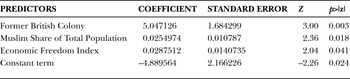
The effect of religion was assessed in straightforward fashion by considering the share of Christians and Muslims in a total national population, according to the CIA’s World Factbook (2011; see also Legrand et al. Reference Legrand2010), with higher shares hypothesized to result in the greater likelihood of sodomy laws. Development and globalization were operationalized, respectively, through each country’s rank on the U.N.’s Human Development Index (HDI 2010), which was inspired by the work of the Nobel laureate Amartya Sen (see also Xie Reference Xie2010), and the Heritage Foundation and Wall Street Journal’s “Index of Economic Freedom” (2011). Since lower rankings indicate higher levels of development and openness, the expectation was that higher rankings on each measure would correlate with a greater likelihood of having sodomy laws on the books. The same assumption was made about the effect of authoritarian political leadership, which was gauged according to a country’s ranking on Freedom House’s seven-item scale of political rights as listed in its 2010 “Freedom in the World” report. The colonial legacy, finally, was captured according to the dichotomous measure of whether or not a country had gained its independence from Britain, with a positive response presumed to be associated with sodomy laws. Using the STATA statistical software package (version 10.0), a correlation matrix was generated, and logistic regression (logit) was then run to try to predict whether or not a country outlaws same-sex behavior. The variables were all independent, and the N of 53 was judged sufficiently large to develop a model with six possible predictors. (No interaction effects were detected.) The model with the best fit, as shown in the table below, includes a British colonial legacy, share of Muslims in the total population, and the economic freedom score.
BEST FIT MODEL

Of the six independent variables, only the correlation coefficient for the British colonial legacy proves to be greater than zero (Pearson chi2(1) = 9.78; p < 0.01; r = 0.43 and p¬ < 0.01). The moderate association of .43 shows that there is indeed a relationship, if far from a perfect one, between a country’s having gained sovereignty from Britain and its having a sodomy law today. This variable alone explains almost a fifth of the variance in sodomy laws (Prob > chi2 = < 0.001, z = 2.56, p>|z| = 0.01, Pseudo R2 = 0.18). When it is combined with a country’s having a larger share of Muslims and relatively less economic freedom and openness, that share rises to just over a third (Prob > chi2 = <0.001, Pseudo R2 = 0.34). Such figures imply that the Commonwealth of Nations should perhaps become more involved than it has been in condemning antigay discrimination in is former colonies (see Tatchell Reference Tatchell2009) and that economic and political development might ameliorate legal conditions for African gays. The findings here are far from decisive, though, and cannot account for most of the disparity in antisodomy laws across Africa. While much of the relevant literature asserts, often on the basis of anecdotal evidence, or merely assumes that a single factor or collection of factors can explain state homophobia, this study suggests that the causes are more complex—or perhaps more random.
Of course, these results could also have been affected by the way in which the predictor variables were operationalized in this study. Perhaps in explaining sodomy laws it matters which Christian denominations and/or Islamic branches or sects predominate in a given country or whether a country is seriously divided along religious lines in the manner of Nigeria. Some African colonies were under the control of more than one European power, either over time (like Burundi and Rwanda) or simultaneously (like Cameroon). Colonies also differed as to whether they had legal dualism or significant numbers of European settlers. Measures like the Freedom House rankings and the Index of Economic Freedom are contested by some Africanists and, as national-level variables, gloss over differences subnationally and across subpopulations in the ways that sodomy laws are applied. There are, in sum, many areas in which future research could improve on the basic analysis undertaken in this study.
Conclusions
What does appear undeniable is that with respect to state homophobia, African states are more diverse than is commonly believed. If activists are correct that the absence or removal of sodomy laws is the first step toward reducing institutional and social homophobia in many areas of the continent, there is reason to believe that change is possible. Several developments point at least to the potential for greater tolerance on the African continent: these include the legal reforms in South Africa and Cape Verde; pending reforms in São Tomé and Principe; the suspension of antigay laws in Malawi; the rejection of criminalization in Rwanda and the Burundian Senate’s vote against it; the pleas for tolerance from prominent clergymen in former British colonies; the increasingly open debate over the contradiction between sodomy laws and both national constitutions and the African Charter on Human Rights in Ghana and Senegal; and the bravery of the growing numbers of local activists.Footnote 10 Marc Epprecht has argued that because “politicized” homophobia and diverse, ambiguous sexual and gender identities all have roots in traditional African culture, a more confident and intellectually autonomous continent might be able to rid itself of the negative effects of the colonial period; he asserts that “the possibility is actually fairly strong that this re-invention could embrace sexual rights and be more open to women’s empowerment and effective approaches to sexual health than is so evidently the case at present” (2005:262–63). There is enough evidence to suggest that under certain conditions legal restrictions against gays might be tempered or removed (see Bangoshe Reference Bangoshe2008).
That is an important observation, and one that runs counter to the notion that is both explicit and implicit in much of the relevant literature that homophobia is a sentiment that is particularly strong not only in Africa (see White Reference White1990) but also in outposts of the African diaspora. The black church and black nationalism have received blame for stoking homophobic sentiment among African Americans (Harris Reference Harris2009; Stokes et al. 2006; Ward Reference Ward2005), thereby contributing to political outcomes like overwhelming African American backing for California’s anti–gay marriage Proposition 8 in 2008. Black voters have repeatedly elected African American politicians who champion gay rights, however, and they have for the most part proven less likely than whites to vote for constitutional amendments banning same-sex marriage (Stewart-Winter Reference Stewart-Winter2008). In the Caribbean, islands like Jamaica—called the “most homophobic place on earth” by Time magazine (Padgett Reference Padgett2006)—Barbados, St. Lucia, and St. Kitts and Nevis are well known for their hostility toward gay rights (see Anderson et al. Reference Anderson2009; Stichting Hoezo/Expreszo 2009), but Curaçao, Haiti, and Puerto Rico are recognized for their more tolerant approach (Drucker Reference Drucker1996). African-origin populations in Central and South American countries have not displayed uniformly homophobic positions either. Except for residents of Belize and Guyana, both former British colonies, they all live in countries where homosexuality is legal (Ottosson Reference Ottosson2010).
The range of African policy responses to same-sex activity makes the case that scholars should continue to investigate the causes of state homophobia and develop more nuanced approaches toward doing so. African cultures have shown themselves to be dynamic, heterogeneous, and adaptable. If the barriers to legal acceptance of homosexuality can be identified and then targeted, there is hope that other forms of homophobia might be tackled successfully as well.