In the American judiciary, the deliberative nature of collegial courts is expected to identify and correct legal errors through appellate review and yield a higher-quality, reasoned judgment than the decision of a single (trial) judge. One federal appellate judge describes collegiality as “a process that helps to create the conditions for principled agreement, by allowing all points of view to be aired and considered” (Edwards Reference Edwards2003, 1645). During these deliberative processes, judges on a collegial court do not simply vote on an outcome; they must also agree on the holding of the court. If the processes are robust, one would expect to see some evidence of deliberations in the majority opinion. The legitimacy of the court’s decision may depend on whether the written justification convinces the public that the decision was reached by the reasoned application of neutral legal principles (Carter Reference Carter1979). As described by District of Columbia Circuit Judge Edwards (Reference Edwards2003, 1662), “Coming to a multi-judge agreement is not a straightforward matter of voting for one side or another. Rather, it is a complex interplay of reasoning that may be overlapping, continuous, related, or opposed, and which must, if we do our job well, ultimately distill to a clear holding that tells the parties and future litigants what the law is.”
Although Judge Edwards’s experience suggests active deliberations characterized his tenure on the circuit bench, the observations of other judges and scholars suggest variation in the degree to which members of an appellate panel communicate with one another over the course of deciding a case (Wasby Reference Wasby1977; Cohen Reference Cohen2002). What factors may be expected to shape the predisposition of a collegial court to deliberate on potential issues and arguments? Advocates for increasing racial and gender diversity on the bench have long argued that the quality of decision making will be strengthened by including judges who represent a variety of backgrounds and viewpoints. Likewise, legal scholars have warned against the risks of conformity and polarization that flow from “like-minded” groups (Cross and Tiller Reference Cross and Tiller1998; Sunstein Reference Sunstein2003). Here, we explore these premises by evaluating whether demographic diversity in the makeup of a US courts of appeals panel affects the output of their deliberations: the majority opinion. Using an innovative measure of an opinion’s legal content, we find mixed support for the contention that demographically diverse panels produce opinions reflective of more thorough group decision-making processes.
Diversity and Information Processing
Several Supreme Court opinions have addressed the notion that diversity, broadly defined, contributes to the “robust exchange of ideas” (Regents of California v. Bakke, 438 U.S. 265 [1978]). In particular, the Court’s decisions about diversity within law school settings stress the educational benefits that flow from having a variety of backgrounds and perspectives represented. Among these benefits were “livelier,” “more enlightening,” and “more spirited” classroom discussions and demonstrating to nonminority students that minority students themselves possess a variety of viewpoints (Grutter v. Bollinger, 539 U.S. 306, 330 [2003]). The understanding of diversity highlighted in these Supreme Court opinions emphasizes the information-processing benefits that flow from having a range of perspectives and skills represented in a mixed group (Schweiger, Sandberg, and Rechner Reference Schweiger, Sandberg and Rechner1989).
Empirical research in a variety of settings provides support for this perspective. For example, racially diverse groups in organizations have been found to produce higher-quality ideas during brainstorming than racially homogeneous groups (McLeod, Lobel, and Cox Reference McLeod1996). Groups composed of members with differing perspectives engage in more thorough decision making than groups without dissenters (Stasser and Birchmeier Reference Stasser2003). The presence of minority viewpoints also appears to contribute to divergent thinking by majority members who are exposed to cognitive processes that are different from their own (Nemeth Reference Nemeth1986). Meanwhile, homogeneous groups have been found to engage in convergent thinking because they may generate and consider fewer alternatives during problem solving (Janis Reference Janis1972). When a group is composed of like-minded individuals, members tend to focus on shared information and overlook issues, easily reaching consensus on a position that potentially fails to identify errors and reflects a more extreme position than suggested by members’ individual thinking (Sunstein Reference Sunstein2003).
Studies on jury decision making also offer support for this view, finding that racially diverse groups contribute to longer, more thorough deliberations relative to processes used by all-white groups (Sommers Reference Sommers2006). Moreover, the effect of heterogeneity in jury decision making is not linked to the viewpoints of minorities; instead, the effect was a result of different information processes used by white participants in racially mixed groups (Sommers, Warp, and Mahoney Reference Sommers2008). Along these lines, Ruhe and Eatman (Reference Ruhe1977) conclude that small, integrated work groups can enhance the performance of African American members, compared to their performance in segregated work groups, and that this improvement occurs without negatively affecting white group members’ performance.
Finally, research on integrative complexity sheds some light on the impact of diverse group compositions on small group outputs. Integrative complexity refers to the degree of simplicity or complexity in information processing, which is best thought of as a continuum (Suedfeld and Tetlock 1977, 172):
At the simple end of the continuum, decisions are characterized by anchoring around a few salient reference points; the perception of only one side of an argument or problem; the ignoring of subtle differences or similarities among other points of view; the perceiving of other participants, courses of action, and possible outcomes as being either totally good or totally bad; and a search for rapid and absolute solutions in order to achieve minimization of uncertainty and ambiguity. At the complex end, we find flexible and open information processing; the use of many dimensions in an integrated, combinatorial fashion; continued search for novelty and for further information; and the ability to consider multiple points of view simultaneously.
Applications of integrative complexity to the small group setting have found that racial diversity produces more integratively complex work outputs (Antonio et al. Reference Antonio, Chang, Kenny and Milem2004) and that, consistent with jury research, group integrative complexity can increase in ways not related to the individual capabilities of group members (Gruenfeld and Hollingshead Reference Gruenfeld and Hollingshead1993).
Taken as a whole, these studies suggest support for a “superadditivity” account of group performance (Page Reference Page2007), in which the overall dynamic of the group is something more than the contributions of particular members (Gruenfeld and Hollingshead Reference Gruenfeld and Hollingshead1993; Sommers et al. Reference Sommers2008). Having a variety of backgrounds and experiences represented can lead to a more thorough consideration of alternatives by the group as a whole (Jehn, Northcraft, and Neale Reference Jehn, Northcraft and Neale1999, 741–42). This perspective, however, does not directly address how much diversity is needed for an effect to be seen. In contrast, other research on diversity and group dynamics emphasizes inequality between group members and the importance of relative status (Correll and Ridgeway Reference Correll and Ridgeway2003). Given the dominance of white males in positions of power in political and legal institutions, this perspective suggests that the influence of a single female or minority may be limited because norms of interaction within the group are defined by the societal majority (Kanter Reference Kanter1977; Ridgeway and Smith-Lovin Reference Ridgeway1999). In a recent study of group deliberations, Karpowitz, Mendelberg, and Shaker (Reference Karpowitz2012) found that women were disadvantaged participants when they were the lone female member of their group.
Small Group Decision Making on the US Courts of Appeals
The important role of group dynamics on the US courts of appeals has been well documented in research (Howard Reference Howard1981; Hettinger, Lindquist, and Martinek Reference Hettinger2006; Collins and Martinek Reference Collins and Martinek2011). The focus on group-level influences is not surprising, given the manner in which these courts decide cases. Although there are a number of variations in how courts of appeals handle their caseloads, the process by which a case comes before a panel is relatively similar across circuits. The chief judge of the circuit, usually acting through the clerk, is responsible for random assignment of three judges to panels. Case assignment to panels is, by all accounts, an essentially randomized process, with exceptions made in some situations when cases are related to each other in terms of issues, litigants, or facts; adjustments may also be made to prevent imbalances across panels in terms of case difficulty (Cohen Reference Cohen2002). Under certain conditions, the output of these randomly assigned judges may be greater than the sum of the court’s individual parts; in other words, in the small group context of judging, the final product may be of a different quality than would have been expected given the judges’ individual abilities (Martinek Reference Martinek2010).
In the US courts of appeals, interchamber communication over a case typically does not begin before oral argument.Footnote 1 For cases that are orally argued, judges may pose questions to attorneys that also serve as an opportunity to convey their ideas about the legal issues (Wasby Reference Wasby1977). After oral argument, the judges meet in conference, which provides the only formal face-to-face oral discussion of the case. After conference, the presiding judge typically drafts a memo that outlines the positions of the members of the panel, with an indication of their collective judgment (Cohen Reference Cohen2002). The presiding judge assigns the opinion to a member of the panel, generally the same judge who provided the bench memorandum for that case. After a draft opinion is written, the judge will circulate the draft to members of the panel. At this stage, interactions between chambers are generally in writing, responding to the draft opinion (Cohen Reference Cohen2002). The process has been characterized as decision “by committee” as opposed to the more “autocratic” decision-making role of the district court judge (Howard Reference Howard1981, 135). Research comparing circuit outputs has documented both a general tendency toward consensus (as indicated by relatively low dissent rates) and also variation across circuits and across time in the strength of these norms (Lindquist Reference Lindquist2007).
Because of the closed nature of the judicial process, scholars have struggled to ascertain precisely how much (and what kind of) interaction goes on among circuit court judges during the opinion-writing stage. There are, however, a few notable exceptions.Footnote 2 Owens and Black (Reference Owens and Black2010) use an extensive archival data set (the papers of a retired District of Columbia Circuit judge) to test hypotheses about bargaining and negotiation among panel members. Their research offers many examples of instances in which the opinion author circulated a draft and responded to specific suggestions (or threats) from other members of the panel in subsequent revisions. However, the degree to which an opinion author was able to facilitate compromise successfully varied with the identity of the opinion author, as well as the characteristics of the panel and the case. Other work that examines the disposition time for cases (Christensen and Szmer Reference Christensen2012) points indirectly to variation in the effectiveness of different opinion authors in achieving consensus with their colleagues about the content of the opinion. Finally, appellate judges themselves emphasize the robust give-and-take that occurs in the process of trying to hash out a majority opinion (Edwards Reference Edwards2003, 1660–62).
Diversity on Three-Judge Panels
When a three-judge panel is composed of individuals with similar backgrounds, judges focus on shared information and are more likely to reach a consensus quickly (Sunstein Reference Sunstein2003). In contrast, when the panel reflects a variety of backgrounds, the give-and-take process of decision making is likely to be more robust, with more alternatives considered by the group. In the judicial politics literature, support for this view is suggested by empirical research that examines the policy consequences of ideologically “mixed” panels (Cross and Tiller Reference Cross and Tiller1998; Sunstein Reference Sunstein2003). On such panels, the presence of a “counter” judge leads the three judges to more moderate case outcomes (Sunstein Reference Sunstein2003; Kastellec Reference Kastellec2012). Other studies similarly find that the presence of a judge whose demographic identity runs counter to the majority influences the decision making of the majority (Farhang and Wawro Reference Farhang2004; Peresie Reference Peresie2005; Ostberg and Wetstein Reference Ostberg and Wetstein2007; Boyd, Epstein, and Martin Reference Boyd and Martin2010; Jilani, Songer, and Johnson Reference Jilani, Songer and Johnson2010; Kastellec Reference Kastellec2012).
One major limitation of existing studies of panel decision making on the US courts of appeals is that the focus on binary policy outcomes (i.e., liberal/conservative) does not permit an evaluation of a central claim, namely, that the composition of the groups affects deliberative processes and the doctrine that emerges from those processes. As one court of appeals scholar has observed, “panelists undoubtedly deliberate not only over which party should win, but for what reasons” (Kim Reference Kim2009, 1344).
Unable to measure directly panel deliberations that take place outside of public view, we model the outputs of those processes, specifically the court’s written justification in the majority opinion. Although we acknowledge that socializing processes and legal training contribute to a common frame of reference, diversity in the composition of an appellate panel should affect deliberative processes, including the final stage of those processes: opinion writing. With greater diversity in panel composition, we expect interchamber communications to be more extensive, as judges will bring different approaches and ideas to the table when crafting the disposition. More thorough deliberations should yield an opinion that addresses the relevant issues and does so with well-developed reasoning. In this respect, demographically mixed panels would be expected to incorporate more ideas and engage in processes that acquire more information than demographically homogeneous panels.
In addition, the increasing numbers of women and minorities to the federal bench allow us to examine a second aspect of panel diversity: Does the number of nontraditional judges on a panel matter? As noted earlier, scholars who emphasize status-based hierarchies in small groups argue that the presence of a token female or minority will have little effect. Consistent with this view, researchers found that women’s influence is rated lower when they are in a numerical minority (Johnson and Schulman Reference Johnson1989). In a study of group deliberations, Karpowitz et al. (Reference Karpowitz2012) found that women participate in discussion less than men in predominantly male groups; however, women participated at equal rates when they made up a large majority. We expect, then, that deliberation dynamics will be affected by the relative presence of nontraditional judges on the panel. When the dominant demographic group in the federal judiciary (Caucasian males) constitutes a numerical majority on the panel, the influence of a single nontraditional judge may be limited in contributions to group deliberations because group decisional norms are defined by the demographic majority (Kanter Reference Kanter1977). For similar reasons, we expect that when at least two of the three judges on an appellate panel are “nontraditional” (female or minority), attention to the identification and discussion of issues in the majority opinion will be greater than what one finds in cases heard by a panel with a Caucasian male majority.
In sum, we expect that panels that are homogeneous with respect to race and gender will yield opinions with the most narrow issue coverage.Footnote 3 In comparison to this reference category, attention to issue coverage should be greater on panels with female or minority judges. Moreover, we expect these effects to be stronger if nontraditional judges compose the demographic majority on the panel.
Data and Method
The cases used for our analysis were drawn from the Multi-User Database on the US courts of appeals, 1997–2002.Footnote 4 Only published opinions were included. Focused on measuring the points of law in an opinion as our dependent variable, we initially considered using the majority opinion length as a proxy for issue coverage. While this indicator includes the coverage of issues in the opinion, it also captures idiosyncratic differences in judicial writing style, as well as variation in the amount of text devoted to recounting the facts and procedural history. Given these limitations, we turned instead to a more direct measure of legal content: case headnotes. Initially developed by West Publishing Company in the 19th century, the “key number” system identifies the points of law addressed in each opinion. Organized along seven broad categories (persons, property, contracts, torts, crimes, remedies, and government), approximately 400 major topics (e.g., civil rights, pretrial procedure) represent general subject areas in law. Each topic is subdivided further resulting in a detailed, comprehensive outline of American law. When any appellate court issues an opinion for publication, trained attorney editors at West analyze the opinion and distill the points of law that are presented in the final published form as headnotes. Each note offers a brief explanation on a point of law that was highlighted in the court’s opinion; as part of that explanation, West assigns a key number to each headnote. (For more information, including an illustrative case, see the appendix.)
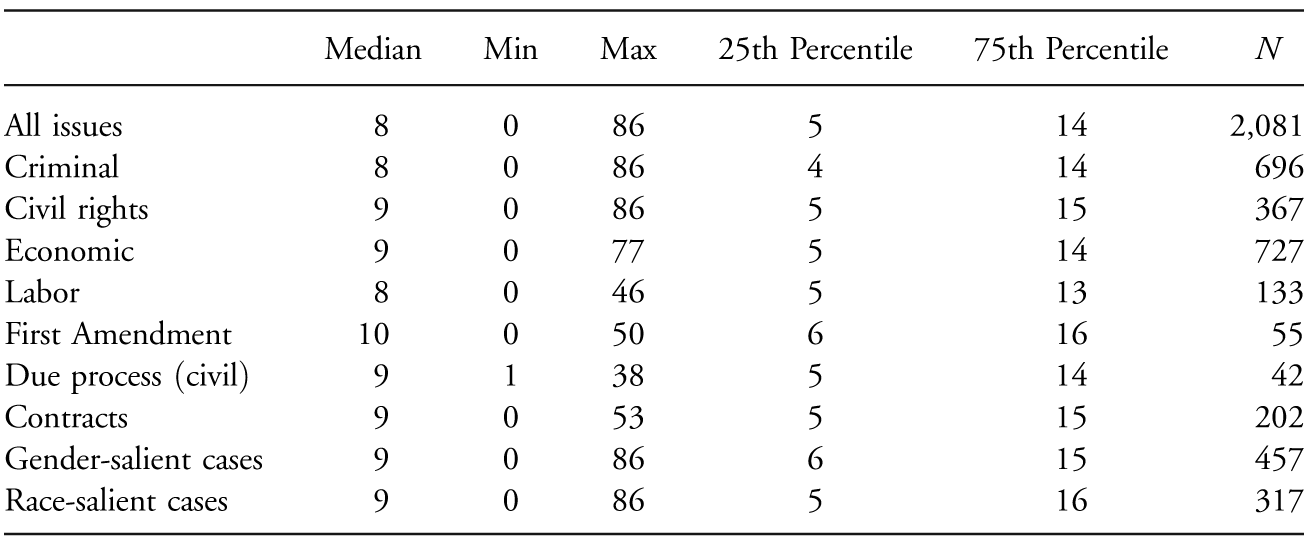
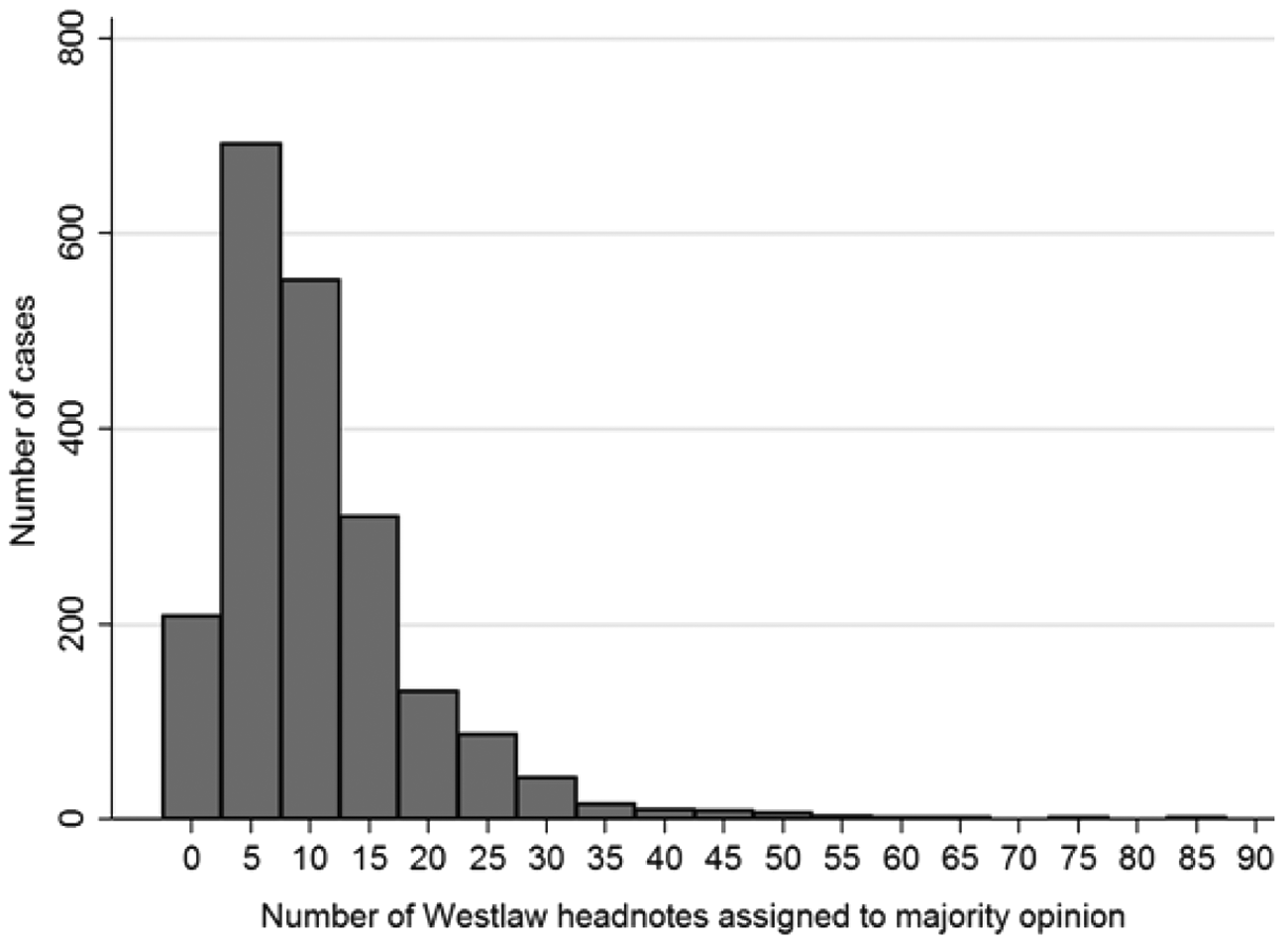
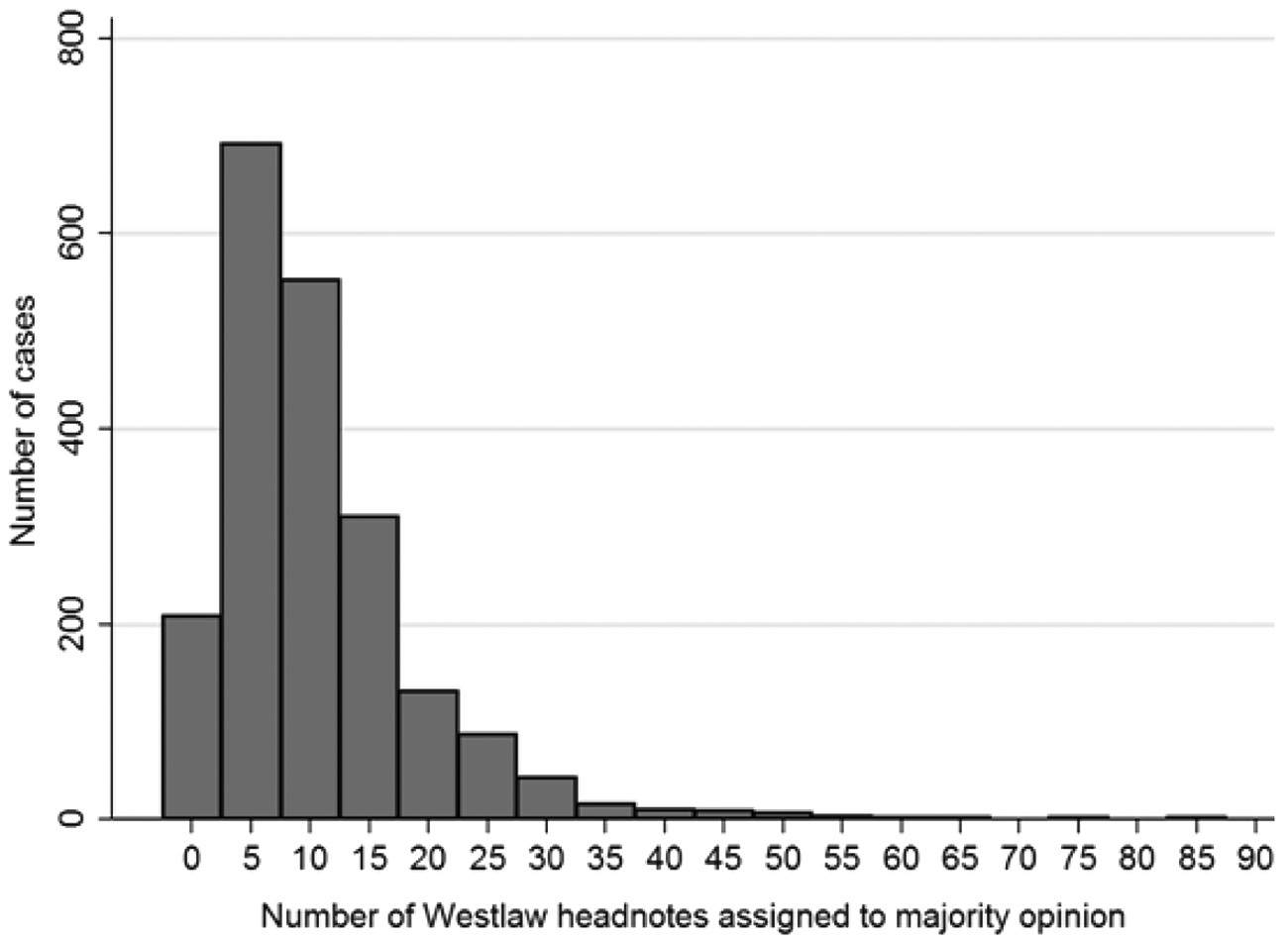
For every case in the database, the total number of headnotes was recorded. As such, it provides a rough indicator of the number of points of law addressed in the court’s opinion. This figure would be expected to be higher in cases that raise multiple issues (e.g., “sufficiency of evidence” along with awarding attorneys’ fees) and lower when the court’s opinion focused on a limited number of questions (e.g., whether an upward departure in sentencing was warranted). Importantly, the notes will increase in cases in which the court’s legal reasoning was sufficiently developed in addressing that question so as to constitute a “point of law.” Given the novelty of this dependent variable, we provide an assessment of the measure’s validity in the appendix. We emphasize that our purpose is not to assert a normative claim that opinions with more points of law are qualitatively “better” in terms of doctrine. Our primary interest is in evaluating whether more diverse panels contribute to enhanced deliberative processes, and we use one measure of judicial attention to issues, as an indicator of a deliberative output, leaving the normative debate for others.Footnote 5 As shown in table 1, the distribution does not vary substantially by issue area; over all issues, it is positively skewed and ranges from 0 to 86, with the median value falling at 8 (see also fig. 1).
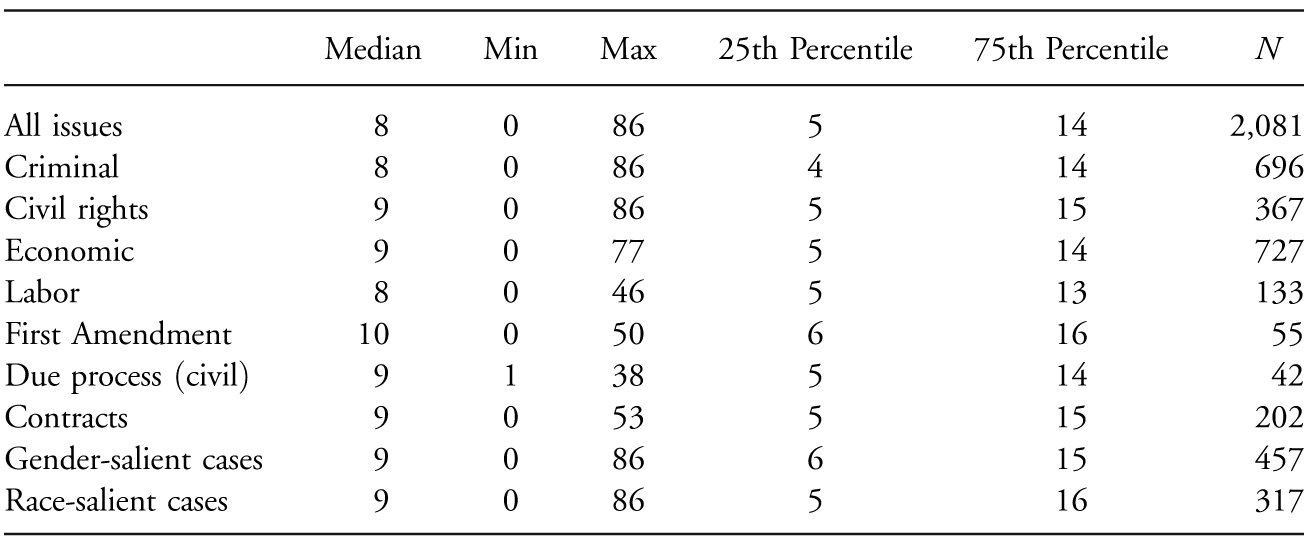
Note.—Descriptive statistics are not reported for issue areas with fewer than 40 observations. Gender-salient cases include those in which a woman was a party in the case (for cases that involved individual persons) or in which the issue area was coded as dealing with sex discrimination in employment, obscenity, abortion, mandatory sterilization, or Family and Medical Leave Act claims. Race-salient cases are those in which a racial minority was a party in the case or in which the case dealt with race issues in voting rights, desegregation, race discrimination in employment, affirmative action, alien petitions, American Indian rights, free expression claims protesting race, employment of aliens, or immigration.
Points of law in majority opinion
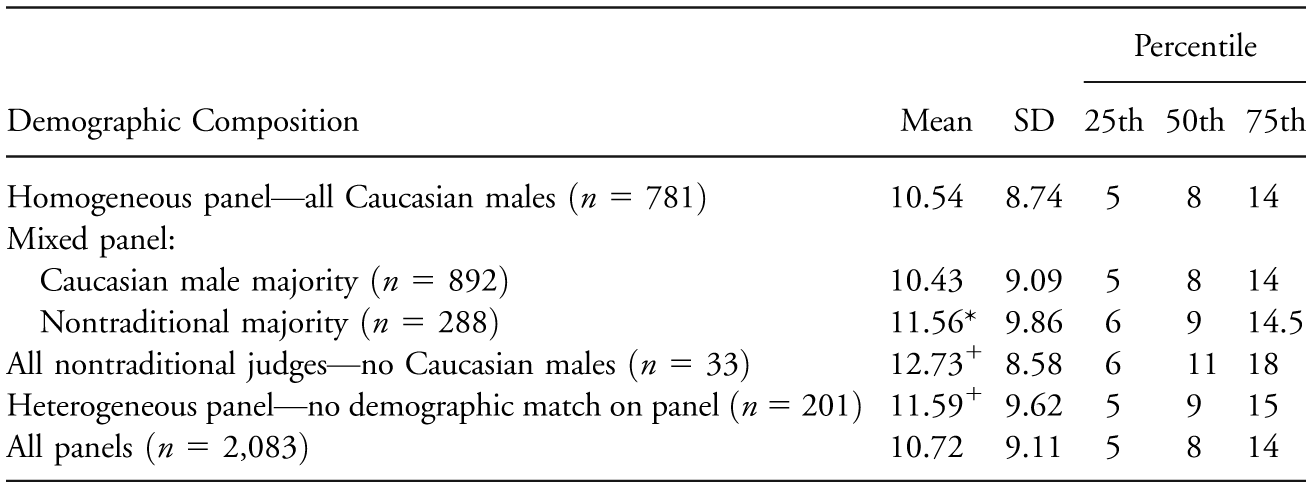
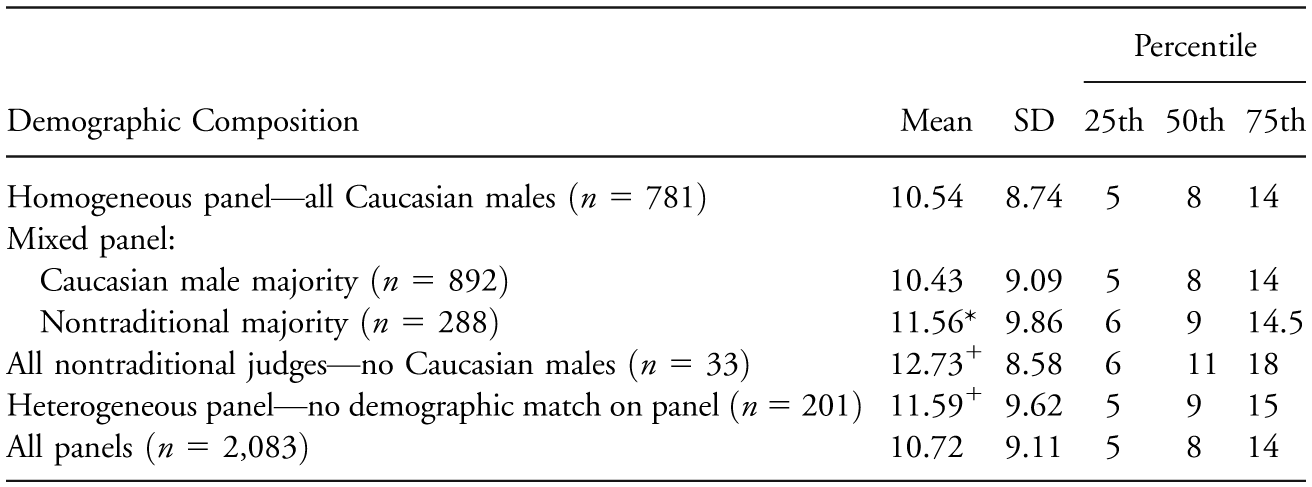
All indicators of judges’ race and gender are drawn from the Multi-User Database on the attributes of federal court judges, with data for recent appointees collected from the Federal Judicial Center.Footnote 6 As a preliminary investigation of our expectations, we calculated descriptive statistics on the points of law in each opinion, by panel composition. These findings are shown in table 2.
Note.—Significance is compared to all-Caucasian-male panel as baseline.
+ p < .10 (one-tailed test).
* p < .05 (one-tailed test).
The descriptive statistics offer only modest support for the view that the presence of women and minorities contributes to opinions with more attention to the identification and discussion of issues. When the panel was demographically homogeneous (made up of three Caucasian males), the mean number of points of law was 10.54.Footnote 7 When panels were composed of three judges who did not match in terms of both race and gender (e.g., a panel with a Caucasian male, a Caucasian female, and a minority male), the mean points of law rose to 11.59. Issue coverage did not increase if a female or minority judge was on the panel and Caucasian males continued to be in the majority; however, when the demographic majority shifted, issue coverage increased. When two women or minority judges were seated on the panel, the mean points of law increased slightly (11.56). When the panel was made up entirely of women and minority judges (but not demographically homogeneous), issue coverage was greater as indicated by the mean, 12.73.Footnote 8
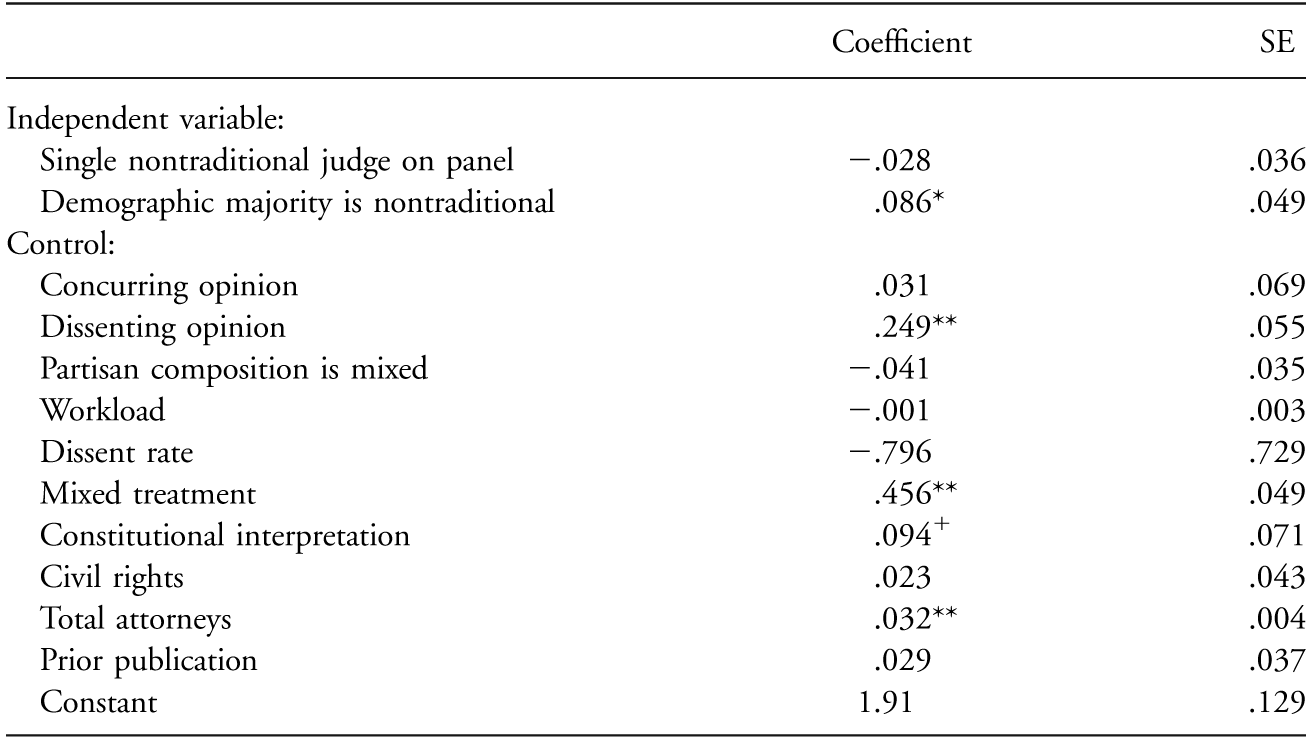
To evaluate further our expectations about the relationship between demographic diversity and issue coverage, we also estimated a multivariate model that takes into account other effects on opinion content. In this model, we use three dummy variables to measure panel diversity. One variable taps into the “token” concept and denotes panels in which one judge on the panel was a female or minority and the other two judges were Caucasian males. The other variable identifies cases heard by panels in which the demographic majority was diverse with respect to race or gender (i.e., the majority was not Caucasian male). The excluded reference category includes cases in which the panels were made up of three Caucasian male judges. (The model does not include the small number of observations in which the panel was made up of three Caucasian women, three African American men, or three African American women.)
Because there is likely to be some overlap between demographic diversity and diversity with respect to political party affiliation, it is important to account for this alternative explanation, in order to isolate the effects of gender and race. Prior research has documented more moderate outcomes when panels are staffed by judges from both parties, relative to what would be expected by looking at which party had a majority on the panel (Cross and Tiller Reference Cross and Tiller1998; Sunstein et al. Reference Sunstein2006; Kastellec Reference Kastellec2007). In addition, the lack of opposing viewpoints on politically homogeneous panels (all Democrats or all Republicans) may reduce the comprehensiveness of deliberations and lead to a majority opinion that does not fully consider competing perspectives (Gruenfeld Reference Gruenfeld1995). To account for the possibility that the coverage of issues in the opinion would be affected by the presence of a judge whose party affiliation is different from the other judges on the panel, we include an indicator for whether the majority coalition included judges who were appointed by presidents of a different political party.Footnote 9
Other factors related to the organizational context should be controlled for because they affect the panel’s ability and tendency to search for alternatives and information. In the US courts of appeals, existing research documents substantial circuit-level variation in institutional practices that may be expected to shape deliberations and opinion writing (Cohen Reference Cohen2002; Lindquist Reference Lindquist2007). Norms that contribute to or detract from circuit-level consensus are likely to shape decision making by panels. In circuits characterized by frayed collegiality, one would expect a tendency for opinion authors to be less attentive to information provided by their colleagues and less likely to incorporate different perspectives in the majority opinion.Footnote 10 Attention to issues in the opinion may also be undermined in circuits where judges are burdened by high workloads (Wold Reference Wold1978). To control for these organization-specific norms and workloads, we included the following variables: a measure of the circuit dissent rate (lagged 1 year), an indicator of workload measured as the ratio of published opinions divided by active judgeships for each circuit-year, and a series of dummy variables for each of the circuits (District of Columbia is the excluded category). The organizational context also includes factors that affect the “directions” provided by the appeals court to litigants and the court below. Therefore, we include a dummy variable that flags cases in which the panel affirmed in part and reversed in part because a “mixed” outcome may require greater elaboration and explanation in the majority opinion in order to provide guidance to the lower court and the parties involved (Lindquist, Martinek, and Hettinger Reference Lindquist, Martinek and Hettinger2007).Footnote 11
Although descriptive statistics do not indicate that opinions from different substantive areas of the law vary in the number of points of law, we include controls to identify cases that address constitutional questions or civil rights claim in the event that differences emerge in a multivariate model. More robust attention to issues may be expected in cases that require panels to address constitutional questions or civil rights claims because of the importance and difficulty of these areas of law (Hettinger, Lindquist, and Martinek Reference Hettinger and Lindquist2004). For this reason, two dummy variables were created to identify cases involving a question of constitutional interpretation or a civil rights claim.Footnote 12 Likewise, case inputs by litigants will affect the number of points of law addressed in the majority opinion. In particular, the number of attorneys associated with a case should be positively related to more discussion of issues and arguments. When briefs are submitted by multiple advocates (whether on the same brief or representing multiple litigants), one would expect that the court’s opinion will have more issues to address as well as relevant information to process in its decision.Footnote 13 Finally, cases decided with published opinion in the court below signal the need for greater attention to issues in the majority opinion.Footnote 14
The dependent variable for our multivariate analysis is a count of the points of law in the majority opinion. Because the dependent variable is a count (rather than a continuous variable), using ordinary least squares as our method of estimation is inappropriate. For this reason, we estimated a negative binomial regression model (NBRM) to account for unobserved heterogeneity among observations. NBRM is preferred to the Poisson regression model for data like ours, where the conditional variance is greater than the conditional mean, because Poisson underestimates the amount of dispersion in the outcome (Long and Freese 2003, 206). The results of our NBRM models are discussed in the following section.
Findings
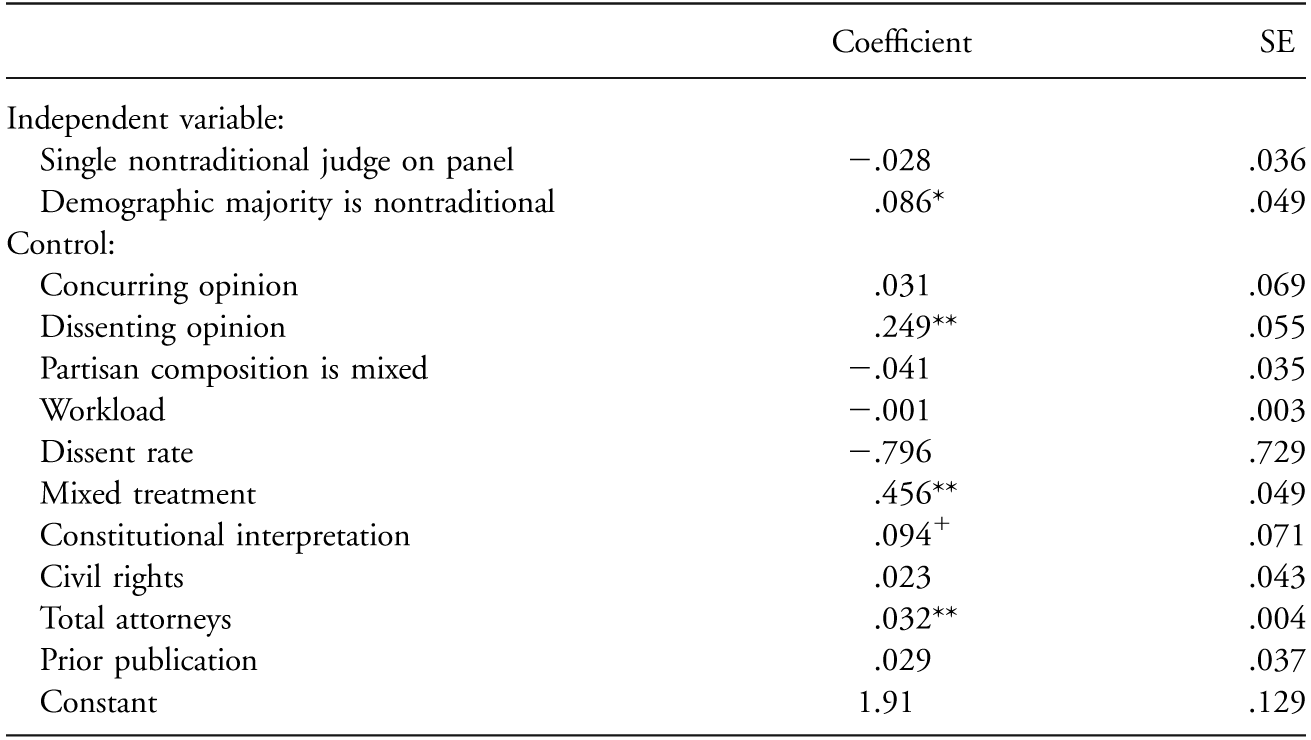
Table 3 displays the results of our NBRM estimating the effect of panel diversity on the points of law in the majority opinion. The model includes all cases, pooling those decided unanimously with those decided with dissent. For this reason, we also included controls for the presence of concurring and dissenting opinions, which previous research tells us should stimulate more robust deliberations by the majority.Footnote 15 The results generally track the descriptive portrait from table 2.Footnote 16 The presence of a single minority or female judge on a panel with a Caucasian male majority did not significantly affect the number of points of law. If the demographic majority shifted, however, the number of points of law increased, as expected. In panels in which women and minority judges were in the majority, issue coverage was greater than that in cases heard by all Caucasian males. Looking at the control variables, while no effect is found for concurring opinions, the presence of a dissenting opinion is associated with a large increase in the points of law in the majority opinion.Footnote 17 This finding suggests that it is the presence of strong disagreement (in the form of dissent) rather than minor disagreement (in the form of a concurrence) that affects deliberative outputs. Both attorney inputs and mixed outcomes also were significantly associated with opinions having more points of law.
Note.—Output for circuit dummies omitted. All models significant at p < .001. N = 2,050.
+ p < .10 (one-tailed test).
* p < .05 (one-tailed test).
** p < .01 (one-tailed test).
Overall, the results from the count model provide only partial support for the general expectation that the presence of minorities and women will enhance issue coverage in the panel’s opinion. To the extent that diversity on the panel shaped deliberative outputs, it appeared to do so only when the majority of judges are women or minorities.Footnote 18
To explore this finding further, we compare the deliberative outputs of panels made up of Caucasian men, Caucasian women, African American men, African American women, and Hispanic men and women. We do so in order to address some limitations of the model presented in table 3. First, conceptualizing diversity in terms of “nontraditional” and “traditional” judges may oversimplify by conflating the experiences of women and minorities. Moreover, this approach ignores the possibility of effects associated with the intersection of race and gender (Hancock 2007; Collins and Moyer 2008). Finally, this approach also fails to account for the possibility that the effects of panel diversity may vary with the opinion author’s race and gender. To the extent that the opinion author exerts policy leadership, we may find that his or her demographic identity is particularly important in understanding the relationship between panel diversity and issue coverage. In the next part of our analysis, we dig deeper to consider these factors.
Unpacking the Effects of Panel Diversity
The small group context surrounding decision making by three-judge panels on the US courts of appeals requires an approach that emphasizes the potential contributions of each individual while also recognizing how dynamics of the small group may be shaped by the predisposition of the numerical majority. The results thus far suggest that the presence of multiple women and minorities on panels contributes to greater coverage of issues in the opinions. In this part of our analysis, we consider the nature and extent of panel diversity, examining separately the effects of race and gender (including the joint effects of race and gender) as well as the identity of the opinion author.
Previous research suggests that norms (Reingold 1996) and decision rules (Karpowitz et al. 2012) may affect the extent to which systematic differences in outputs linked to race and gender become evident. In the context of the US courts of appeals, this means that it may be relevant not only which judges are on the panel but which judge is assigned to write the majority opinion, when thinking about the ways that panel diversity affects the opinion-writing process. Prior research (Owens and Black 2010) suggests that the identity of the opinion author is likely to be an especially important influence on panel deliberations because the opinion author must be able to satisfy her colleagues enough to maintain a majority. While nontraditional judges will obviously have more influence on the collective output of a panel when they are the opinion author than when they are not, white male opinion authors may also behave differently than they would otherwise when in the presence of diverse colleagues (Peresie 2005; Kastellec 2007; Boyd et al. 2010).
In thinking about interactions among members of the panel when the opinion author is a woman or minority, the literature on diversity and leadership styles provides some additional insights for our analysis. For instance, a number of studies have documented differences in leadership and interaction styles between men and women in political institutions as well as other organizations (Eagly and Johnson 1990; Kathlene 1994; Carey, Niemi, and Powell 1998; Rosenthal 1998; Whicker and Jewell 1998).Footnote 19 Translating these findings into the judicial context suggests that the leadership style of the opinion author is likely to affect the degree to which robust deliberations occur, with the contributions of each panel member being solicited and considered by the opinion author. Therefore, in the model below, we test whether the effects of demographic composition vary with the race and gender of the opinion author relative to the majority on the panel.
To test these expectations, we first generated a list of all observed combinations of judges’ race and gender on the panel in our sample. Given our interest in examining the interactions between the opinion author and the other members of the panel, we included only unanimously decided cases. We then sorted these combinations into groups relative to the characteristics of the opinion author: white male author, white female author, black male author, black female author, and Hispanic male author. Then, for each opinion-author group, we sorted the combinations into subgroups of frequently occurring classifications, ultimately generating 20 dummy variables. Where there were no recurring patterns that could allow us to distinguish among panels clearly on the basis of racial and gender heterogeneity (as was the case with Hispanic women opinion authors), those observations were excluded from the analysis. A joint hypothesis test indicates that we can reject the hypothesis that the effects of all these variables are simultaneously equal to zero (at
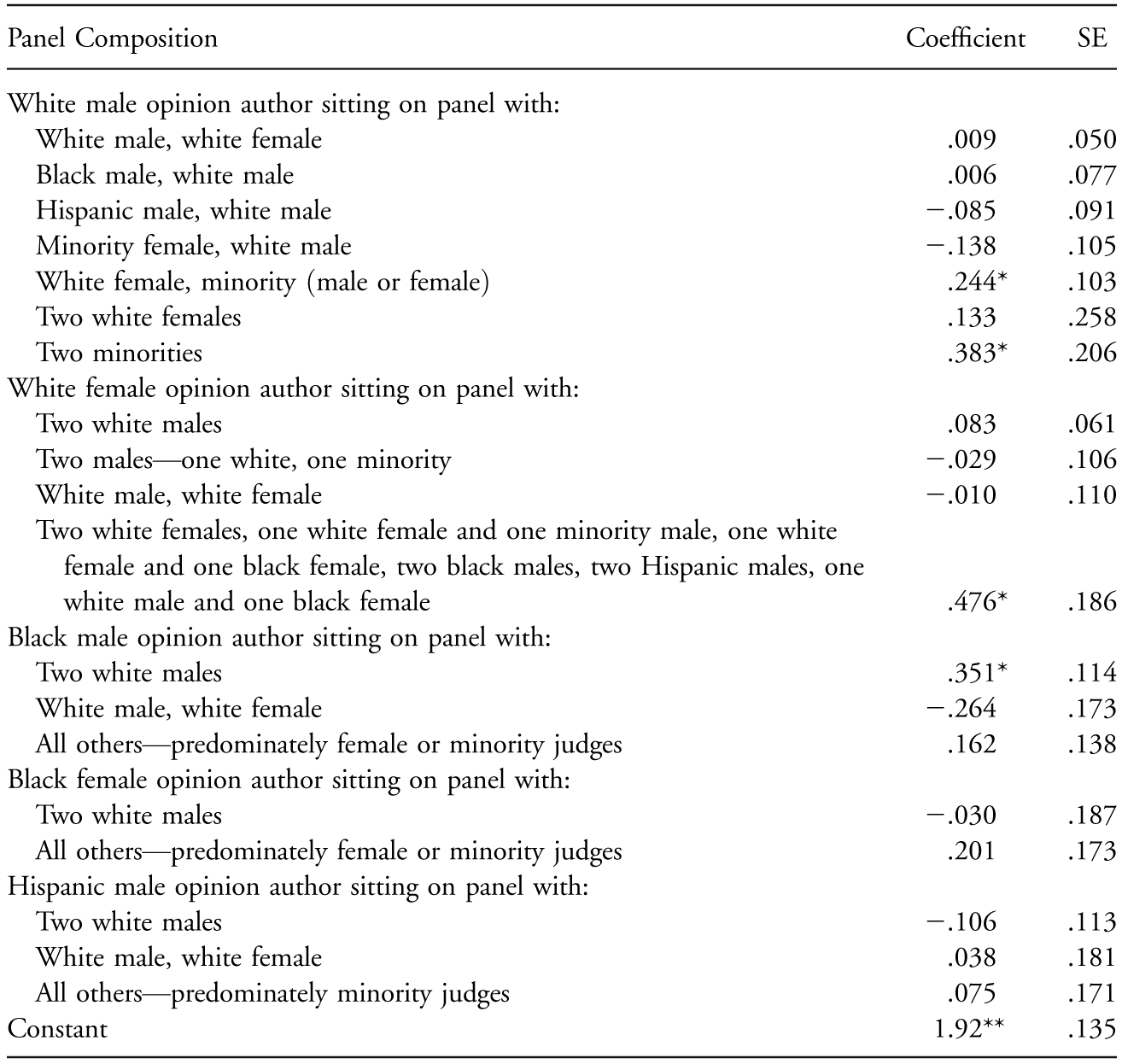
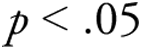 ). Using a homogeneous panel (a white male opinion author seated with two white male judges) as the excluded category, we report the results of this analysis of unanimous cases with signed opinions in table 4.

Note.—Model is statistically significant at p < .001. N = 1,608. Excluded category is an all-white-male panel. Estimates for other independent variables excluded for space reasons. The results for other independent variables are substantively and statistically similar, with two exceptions: the constitutional interpretation and dissent rate variables are now positive (as predicted) and statistically significant.
* p < .05 (one-tailed test).
** p < .05 (two-tailed test).
As before, the presence of heterogeneity in the racial and gender composition of the panel affected the number of points of law addressed in opinions, largely supporting our expectations. These findings are robust to model specification and hold up even when nonunanimous cases are included.Footnote 20 Consistent with the results of the first model, four different combinations of diverse panels were associated with greater issue coverage than cases decided by three white males. Panels in which Caucasian male opinion authors were seated with another Caucasian male and one nontraditional judge did not produce a statistically significant effect on the number of points of law. However, the effect of a single African American male on the panel resulted in greater issue coverage when he was assigned the majority opinion. We did not find similar results in panels in which white female opinion authors were seated with two white males. In addition, the estimates for variables capturing the influence of black female opinion authors and Hispanic male opinion authors failed to reach statistical significance.
The results affirm the findings reported above involving panels with a white male opinion author who was seated with a “nontraditional” majority. Two variables were positively signed and statistically significant, in support of this hypothesis: white male opinion authors seated with two minorities, and white male opinion authors seated with one white female and one minority. However, when white male opinion authors were seated with two white females, no significant effect was found on the number of points of law covered. When white female judges were seated with other women or minorities, their opinions were associated with greater issue coverage.Footnote 21 Finally, no other diverse panel combination was associated with a statistically significant impact on the number of points of law.
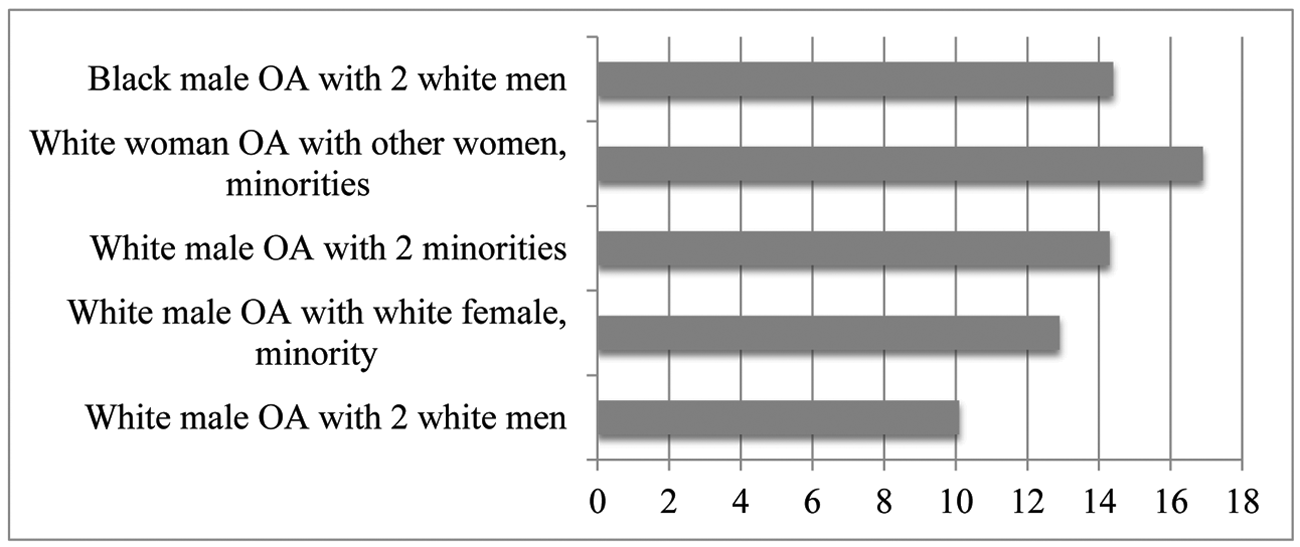
To illustrate further these differences (see fig. 2), we calculated expected values for the dependent variable for specific panel types of interest, holding the values of the other independent variables at their means (if continuous) or at the mode (if dichotomous). We selected the Fifth Circuit as the reference court since the median number of headnotes in this circuit placed this court in the middle of our distribution. The expected points of law for Fifth Circuit opinions authored by a white male who was seated with other white males is 10.1. In contrast, when the white male opinion author sat with a white female and a minority judge, the predicted count was 12.9; this expected value goes up to 14.9 when a white male opinion author was seated with two minority judges. An even larger effect is seen when white female opinion authors were seated with other women or on racially diverse panels: the expected number of points of law increased substantially to 16.3. Given the relatively smaller number of observations involving opinions authored by black females, it is perhaps not surprising that no statistically significant differences were found when comparing this group to those opinions from an all-white-male panel. However, the number of points of law increased in those opinions authored by black males seated on panels with two white male judges, with an expected count of 14.4.Footnote 22
Predicted points of law, by opinion author (OA) and panel composition. Predicted values shown only for statistically significant diversity variables.

Discussion
On the third day of Sonia Sotomayor’s confirmation hearings, Senator Cornyn (R-TX) asked the nominee about a speech published in a 2002 law review article: “So you stand by the comment that … inherent physiological differences will make a difference in judging?” Sotomayor clarified her position in this way: “If you read the entire part of that speech, what I was saying is, let’s ask the question. … But I certainly wasn’t intending to suggest that there would be a difference that affected the outcome. I talked about there being a possibility that it could affect the process of judging.”Footnote 23
While we find some evidence that supports Justice Sotomayor’s observation that diversity on the bench may yield qualitatively different decision-making processes, we cannot claim unqualified support for the “superadditivity” account. Our results indicate that deliberative outputs are sensitive to both the degree of diversification as well as the identity of the opinion author relative to the panel. Panels that were heterogeneous with respect to race and gender, but did not include Caucasian males, issued opinions that covered significantly more points of law. When nontraditional judges constituted a numerical majority on the panel, deliberative outputs were more comprehensive than those associated with all-Caucasian-male panels. Consistent with past research that demonstrates that white male judges’ voting behavior is influenced by the gender and race of their colleagues (Kastellec Reference Kastellec2007; Boyd et al. Reference Boyd and Martin2010), we find that a white male was more likely to author an opinion with greater attention to issues when he was in the demographic minority (i.e., the other two judges were female or African American). Yet white male opinion authors were not similarly influenced by the presence of a single “nontraditional” judge. Although not predicted by the superadditivity account, these results do line up with the insights of Kanter (Reference Kanter1977) and others (Johnson and Schulman Reference Johnson1989; Karpowitz et al. Reference Karpowitz2012) who suggest that women and minority “tokens” are generally not sufficient to change the culture of an organization or small group.
Interestingly, the effects of gender and racial diversity on deliberative outputs were not identical. The presence of minority judges, particularly African Americans, appears to play a more prominent role in the deliberative output of the panel. We leave this finding for future research, although a comparison of the racial and gender composition of the bench may yield some clues. During this time period, the proportion of women on the bench was much higher than the proportion of African American judges, reaching 31% in one circuit. As such, it is possible that panels with two women judges were more likely to be located in a circuit where the norms of deliberations were shaped by a cohort that includes a substantial proportion of women. In contrast, panels with an African American majority were rare; at no time during our analysis did the proportion of African American judges exceed 17% in a circuit. Taken together, these results underscore the sensitivity of panel dynamics to the identities and institutional roles of the participants.
This leads us to another important point. Demographic diversity in small groups does not automatically lead to different (or better) decision making; rather, diversity of race and gender is likely to benefit groups only insofar as it creates other diversity in the workgroup, such as diversity of information or perspective (Jehn et al. Reference Jehn, Northcraft and Neale1999, 741–42). Over time, if traits like race and gender become less reflective of differences in background or perspective for those individuals appointed to the federal bench, it is conceivable that demographically diverse panels would be effectively homogeneous from an information-processing perspective. And while the impact of ideological diversity is beyond the scope of this study, our results clearly show that demographic and ideological diversity on a panel do not have the same effects on opinion content. Future research should explore why this is the case.
We also find that the presence of a dissent has a large and positive effect on issue coverage in the majority opinion, consistent with the literature on the value of dissent in improving the deliberative process of small groups (Janis Reference Janis1972; Gruenfeld Reference Gruenfeld1995; Gruenfeld and Preston Reference Gruenfeld2000). This work suggests that a majority who must respond to a dissenter typically engages in a more thorough deliberative process that considers alternative arguments and trade-offs (Gruenfeld Reference Gruenfeld1995). Statements by appellate judges reinforce this point. For instance, one senior circuit judge observed that “a dissenting opinion is usually very strengthening to the opinion of the court because it makes clear that what the dissenter said was not overlooked. … If the dissenter says that a certain thing shouldn’t have controlled the case, then you know the other judges were aware of that contention and haven’t overlooked it” (Moyer Reference Moyer2008, 197). Future work should continue to investigate how the dynamics between the majority and the dissenting coalitions can shape the content of legal opinions.
Advocates for diversity on the bench argue that a superior bench will be one that “looks like” the general population and point to the potential corrosive effects on the public’s confidence in court decisions made by a homogeneous judiciary. Our analysis offers partial support for the empirical claim underlying this argument. In particular, our findings suggest that panels made up of women and minorities were more likely to yield opinions with more points of law than panels with a Caucasian male majority. We recognize that our analysis explored just one aspect of a court’s deliberative output and that diversity may be expected to have effects on other dimensions of decision-making processes and court doctrine. Additional research will be needed to examine how other forms of diversity in the judiciary, including career experiences, legal education, and socioeconomic status, may be expected to affect panel deliberations and the reasoning in court opinions.
This study also contributes to a growing body of research directed at understanding influences on the legal reasoning employed in court opinions—efforts frequently hindered by measurement issues and limitations on data collection. Our approach offers one possible avenue for future empirical research; however, we emphasize that any effort will require that scholars give careful attention to the conceptualization and operationalization stages of research design. The conceptualization of opinions as outputs from varying deliberative processes required a measure that roughly captured the breadth and depth of the court’s written justification. To the extent that a court’s external audience shapes the justification in the opinion (Baum Reference Baum2006), this measure offers an opportunity to evaluate these effects as well, an important effort given the role of opinions in legitimizing judicial power.
Appendix: Evaluating the Validity of the Dependent Variable
Here, we provide an assessment of the facial validity of our measure, followed by an analysis of its content validity and a summary of construct validity tests.
Facial Validity
We reprint below a majority opinion and the corresponding headnotes to illustrate the facial validity of using our dependent variable as an indicator of issue coverage. In this case, West Publishing identified five points of law (less than the median of 8 for all cases in our analysis). The first headnote focused on conditional pleas, and the second identified the standard of review to be employed. The remaining three dealt with due process issues. In the majority opinion, West Publishing highlights (using the corresponding number to the headnote) that portion of the opinion that corresponds to the headnote. For example, the second note on the standard of review sets off the paragraph under “Standard of Review” in the majority opinion. As this case illustrates, the headnotes are derived from the opinion’s reasoning (rather than a discussion of the “facts”). A brief mention of the appellant’s equal protection claim at the end of the majority opinion was not sufficient for West Publishing to include a headnote. (For more information on West’s topic and key number system, see http://lawschool.westlaw.com/knumbers.)
United States of America v. Cristino Sierra-Hernandez (192 F.3d 501)
Headnotes
[1] Criminal Law
Pleas
Plea of Guilty
In General
Requisites and Proceedings for Entry
In General.
A guilty plea may be conditioned on denial of motion to dismiss an indictment for the loss of testimonial evidence. Fed. Rules Cr. Proc. Rule 11(a)(2), 18 U.S.C.A.
[2] Criminal Law
Review
Scope of Review in General
Review De Novo
In General.
Constitutional challenges are questions of law that are reviewed de novo.
[3] Constitutional Law
Due Process
Criminal Law
Evidence and Witnesses
Interference with Witnesses. Most Cited Cases.
Criminal
Counsel
Duties and Obligations of Prosecuting Attorneys
Nonproduction of Witness or Rendering Witness Unavailable
In General.
Deportation of ten of the twelve illegal aliens found in van driven by defendant near border did not violate his due process rights, despite his assertion that they would have testified that he was not hired to take them across the border, in that such testimony would tend to prove at most that he did not know he was transporting illegal aliens, circumstances of his pick-up of aliens who came running from behind a bush rendered such defense weak, and his counsel conceded that government acted in good faith in deporting aliens. U.S.C.A. Const. Amend. 5.
[4] Constitutional Law
Due Process
Criminal Law
Evidence and Witnesses
Interference with Witnesses. Most Cited Cases.
To show that the deportation of potential witnesses violates his or her due process rights, a defendant must make a plausible showing that the testimony of the deported witnesses would have been material and favorable to his or her defense, in ways not merely cumulative to the testimony of available witnesses. U.S.C.A. Const. Amend. 5.
[5] Constitutional Law
Due Process
Criminal Law
Evidence and Witnesses
Interference with Witnesses. Most Cited cases.
Criminal Law
Counsel
Duties and Obligations of Prosecuting Attorneys
Nonproduction of Witness or Rendering Witness Unavailable
In General. Most Cited Cases.
The deportation of potential witnesses violates a defendant’s due process rights only if there is a reasonable likelihood that the testimony could have affected the trier of fact; it is recommended that this evaluation be done in the context of the entire record. U.S.C.A. Const. Amend. 5
The Court’s Opinion
| [1] Cristino Sierra-Hernandez appeals from a guilty plea conditioned on the district court’s denial of his motion to dismiss the indictment for loss of testimonial evidence. Because the district court properly found that the defendant failed to show that the testimony of the deported witnesses would have been material and favorable, this Court affirms his conviction and sentence. |
| FACTS |
| [Excerpt not reprinted here for space.] |
| STANDARD OF REVIEW |
| [2] Constitutional challenges are questions of law that are reviewed de novo. See United States v. Lampton, 158 F.3d 251, 255 (5th Cir.1998). |
| DISCUSSION |
| I. DUE PROCESS |
| [3] Sierra-Hernandez argues that the deportation of the ten illegal aliens violated his due process rights because the deported aliens plausibly could have testified that Sierra-Hernandez was not involved in bringing them into the United States or in transporting them within the United States. |
| [4][5] Valenzuela-Bernal established the test for determining whether or not deportation of potential witnesses violates the defendant’s due process rights. In that case, the Supreme Court stated that in order to show a due process violation the defendant must make “a plausible showing that the testimony of the deported witnesses would have been material and favorable to his defense, in ways not merely cumulative to the testimony of available witnesses.” United States v. Valenzuela-Bernal, 458 U.S. 858, 873, 102 S.Ct. 3440, 3449, 73 L.Ed.2d 1193 (1982). In addition, the Court stated that due process has been violated “only if there is a reasonable likelihood that the testimony could have affected the trier of fact” and recommended that that evaluation be done “in the context of the entire record.” Id. at 874 & 874 n. 10, 102 S.Ct. 3440. |
| Although the Fifth Circuit has never squarely addressed the meaning of this test, many other circuits have. Courts have uniformly rejected Valenzuela-Bernal-based claims of due process violations. See United States v. Pedraza, 27 F.3d 1515 (10th Cir.1994); United States v. Ramirez-Jiminez, 967 F.2d 1321 (9th Cir.1992); United States v. Dring, 930 F.2d 687 (9th Cir.1991); United States v. Nesbitt, 852 F.2d 1502 (7th Cir.1988); United States v. Guzman, 852 F.2d 1117 (9th Cir.1988); United States v. Morales-Quinones, 812 F.2d 604 (10th Cir.1987); United States v. Ginsberg, 758 F.2d 823 (2d Cir.1985); United States v. Saintil, 753 F.2d 984 (11th Cir.1985). Furthermore, courts have strictly evaluated Valenzuela-Bernal’s requirements. See, e.g., Nesbitt, 852 F.2d at 1519 (“the strict standard of materiality set forth in Valenzuela-Bernal”); Ginsberg, 758 F.2d at 831 (stating that positing the testimony most favorable to defendant that the deported witnesses could provide does not satisfy the Valenzuela-Bernal test). |
| In this case, appellant has not plausibly demonstrated that the deported aliens would have provided testimony that was both material and favorable and reasonably likely to influence the trier of fact or that the government did not act in good faith. First, the defendant’s assertion that the deported aliens would testify that he was not hired to take them across the border is immaterial to whether he transported illegal aliens. At most, defendant could argue that such testimony tends to prove that he did not know those he was transporting were illegal aliens. Second, the circumstances of the pick-up—the twelve aliens running out from behind a bush in South Texas—renders such a defense weak at best. Third, defendant’s appellate counsel conceded at oral argument that the government acted in good faith when it deported the aliens. The district court was therefore correct in denying the defendant’s motion to dismiss the indictment. |
| II. EQUAL PROTECTION |
| Appellant also asserts that the fact that the Houston Division of the Southern District of Texas holds all illegal aliens for seven days to allow the defense a chance to interview them, while the Brownsville Division does not, constitutes a denial of his right to equal protection. He asserts that this Court should apply strict scrutiny because the practices in question impinge on a fundamental right. Because appellant has provided no evidence that the two Divisions in fact have different procedures, this court declines to review his equal protection claim. |
| AFFIRMED. |
Content Validity
To assess the content validity of our measure, we read through a small set of opinions to determine whether a count of headnotes captures multiple dimensions of our concept of interest and empirically distinguishes cases in terms of the opinion’s attention to the issues. To select the cases for our assessment of the measure’s facial and content validity, we searched Westlaw (http://www.westlaw.com) for published opinions decided by a three-judge panel in the Second Circuit in November–December 2001, using the topic (sentencing) that defendants had been convicted under the US Code (e.g., bank fraud). This search yielded seven decisions. We start with the premise that opinions that fully address the legal issues would be characterized by a long discussion section, citations to more legal authorities, a discussion of previous precedents by name, and the use of persuasive precedents (nonbinding decisions from other jurisdictions). We also believed that more developed opinions would be cited more frequently in subsequent decisions and other legal authorities.
With this in mind, we read through each case, recorded the number of headnotes, and addressed the following questions:
-
Was the opinion signed?
-
How many pages were devoted to the “discussion” of issues?
-
How many precedents were cited?
-
How many precedents were discussed by name?
-
How many nonbinding precedents were cited?
-
How many other legal authorities were discussed (e.g., US Criminal Code, US Sentencing Guidelines, Federal Rules of Evidence, Federal Rules of Criminal Procedure, other provisions from the US Code)?
-
Using Shepard’s, how many times was the opinion cited in subsequent decisions and other legal publications?
As table A1 indicates, the two cases with the lowest counts of headnotes, Dennis and Feola, had short, unsigned opinions that used the fewest number of precedents (relative to the other cases in this set), with all of the citations to binding authority. In contrast, the Second Circuit opinion in Mulder was clearly the most well developed in this subset of cases. The majority opinion, citing 36 precedents, carefully discussed detailed fact patterns from 11 relevant precedents. In doing so, the opinion author made clear the connections (or not) between these 11 cases and the appeal before the court.

Construct Validity
When comparing the headnote counts against subsequent citations, generally there is a correspondence, with only one case appearing to be an exception to the pattern, Feola. To examine further whether the number of keynotes corresponded to a case’s precedential value, we took a small random sample (
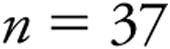 ) from our data set and collected information from Shepard’s on the number of decisions that later cited that case. These two measures were correlated to a statistically significant degree (
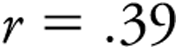 ).
We also examined whether this measure is correlated with opinion length (
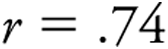 ). And we tested whether headnotes were correlated with a measure of the number of days from the briefs’ submission to when the court’s opinion was filed in a random sample of cases (
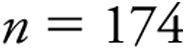 ).Footnote 24 In the aggregate, headnotes and disposition time were not correlated; however, when we examined the correlations by circuit (excluding the District of Columbia Circuit, for which data were not available), we found a very strong positive correlation in four circuits (greater than .45), a moderate relationship for three courts (.3 to .4), a weak relationship in three circuits (.13 to .27), and a negative correlation for one circuit.
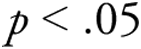
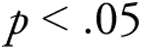
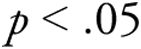 ). Panels with a female judge generate opinions with significantly more points of law, compared to panels without a female judge, in gender-salient cases, although the significance of this effect is weaker (
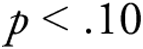 ).