1 Introduction
This paper analyses indigenous rights in the context of oil pipelines in Canada, specifically examining the 2017 Supreme Court of Canada case of Chippewas of the Thames First Nation v. Enbridge Pipelines Inc. et al.Footnote 1 (the ‘Chippewas’ case’). In this case, the Chippewas objected to an expansion of a pre-existing oil pipeline transporting oil between Sarnia, Ontario and Montreal, Quebec. Their objection was unsuccessful before the National Energy Board (NEB) as well as the Supreme Court of Canada (SCC). Using intersectional analysis, which considers how social structures of inequality and oppression shape lived experience, this paper examines the dichotomy between indigenous rights ‘on paper’ and the real architecture of indigenous rights experienced by the Chippewas in this case. Based on this case-study, juxtaposed against the companion SCC case of Clyde River released at the same time and Canadian pipeline developments since 2017, this paper concludes that indigenous rights are legally less effective when situated within an already compromised environment – that is, locations with a pre-existing oil and gas pipeline – as opposed to those without.
In Canada, indigenous rightsFootnote 2 obtained constitutional protection in 1982 with the Constitution Act 1982Footnote 3 and concurrent Charter of Rights and FreedomsFootnote 4; these protections were internationally confirmed in the 2007 United Nations Declaration on the Rights of Indigenous Peoples (UNDRIP). Implicit in the protection of many Canadian indigenous rights (including hunting, trapping and fishing rights) is environmental integrity sustaining these activities (Collins and Murtha, Reference Collins and Murtha2010). This paper exposes how far indigenous rights reach in practice for preserving the integral environment. The environment is defined as our biophysical environment, recognised to be both a real external phenomenon experienced by us and a cognised or constructed phenomenon (Hurlbert, Reference Hurlbert2018). One indigenous writer states that the Eurocentric word ‘environment’ does not have a direct translation into their indigenous language (Korteweg et al., Reference Korteweg, Gonzalez, Guillet, Cutter-Mackenzie, Payne and Reid2011):
‘Actually, the term “environment” does not exist in my Aboriginal worldview as it is not a place, but rather a concept of being. There is no word for environment in Ojibwe [Anishinaabe]. Environment is everything, so attempting to define a place it exists in, is not possible. We are creatures of the space and land we occupy, not caretakers of it, removed from the land. The land owns us, we do not own the land.’ (p. 87)
The language used by the Assembly of First Nations is ‘Honouring Earth’:
‘From the realms of the human world, the sky dwellers, the water beings, forest creatures and all other forms of life, the beautiful Mother Earth gives birth to, nurtures and sustains all life. Mother Earth provides us with our food and clean water sources. She bestows us with materials for our homes, clothes and tools. She provides all life with raw materials for our industry, ingenuity and progress.’ (AFN, n.d.)
This paper recognises the Eurocentric nature of the word ‘environment’ but argues that protecting the environment advances the indigenous practices referred to by the Assembly of First Nations of Canada of honouring Earth.Footnote 5
The Chippewas’ case is appropriate to examine indigenous rights and the environment for several reasons. Both the NEB and the SCC afford transparency surrounding their processes (Lambrecht, Reference Lambrecht2013). Indigenous rights is an area of legal change; Peter Hogg (2010, p. 195) argues that ‘[n]o area of law has been so transformed in such a short period of time as the law of Aboriginal [sic] rights’ and as such provides an important case-study. The NEB played a central part in development across Canada, with its role in environmental assessment described as a process to reconcile development desires with environmental protection and preservation.Footnote 6 The NEB regime has recently been updated with a new Impact Assessment Act potentially allowing new legal insights (such as those arising from this analysis of the Chippewas’ case) to inform future practice.Footnote 7
The concept of intersectionality is employed in this case analysis to examine the intersecting oppressions that indigenous people in Canada face and the challenges of addressing these oppressions through legal structures. An intersectional lens allows an examination of the implicit power structures inherent in law's operation, illustrates the real experience and identity markers of the Chippewas in the court case and, by exposing these power structures and experiences, allows the possibility of advancing these claims (Davis, Reference Davis2015).
First, the development of indigenous rights and the duty to consult is reviewed and the facts and determinations of the Chippewas’ case outlined. After an overview of intersectionality and an examination of the intersecting oppressions that indigenous people face, an analysis of the Chippewas’ case follows. This analysis exposes the naturalised, intersecting power structures and historic legal doctrines that oppress the Chippewas and diminish their legal rights. The Chippewas’ experience is then contextualised by comparison to the result of its companion case, Clyde River, and recent Canadian pipeline developments.
2 Indigenous rights
Indigenous rights in Canada, which include the right to hunt, fish and trap, arise from the prior occupation of land by indigenous peoples and the prior social organisation and distinctive cultures of indigenous peoples on that land.Footnote 8 These rights are also recognised in some areas of Canada pursuant to the treaty.Footnote 9 In 1982, section 35 of the Constitution Act 1982 granted constitutional protection to indigenous rights, thereby preventing their further extinguishment except by consent.Footnote 10 When an infringement is alleged in court, the court determines whether the limitation on the right is unreasonable or whether the regulation imposing a limitation represents an undue hardship.Footnote 11 Next, the court determines whether a right holder is denied their preferred means of exercising their right. Once an infringement is established, a two-part test has evolved whereby the Crown must show a valid legislative objective for infringing indigenous rights and, second, that the infringement is consistent with the honour of the Crown.Footnote 12 The criteria of justification in early case-law included the requirement that there is as little infringement as possible to effect the desired legislative result, whether fair compensation is paid (in a situation of expropriation) and whether the indigenous group has been consulted regarding the measures being implemented.Footnote 13
The development of indigenous rights has therefore resulted in an obligation imposed by law on the Crown to consult with indigenous peoples when there is potentially damaging resource-management activities initiated that might impact indigenous people and their rights, such as the building or expansion of a pipeline.Footnote 14 The purpose (Kleer, Reference Kleer2012) of such a consultation is to reach agreement between indigenous peoples and the Crown. Because of this, satisfying a duty to consult requires much more than just providing a space for the airing of concerns, as the Crown is ultimately making a decision that may infringe on indigenous peoples’ section 35 rights.
Having to determine whether a right exists, whether it has been infringed and whether such an infringement is justified essentially places the Crown in a conflicted position. The Crown's honour is at stake and the Crown must act in a way that does not compromise this honour; it must fully engage with indigenous people and fulfil promises made to indigenous people.Footnote 15 The duty to consult is a duty imposed on the Crown, and the duty arises with the mere assertion of a claim; the claim does not require proof.Footnote 16
In Delgamuukw v. British Columbia, a spectrum of consultation was outlined:
‘The nature and scope of the duty of consultation will vary with the circumstances. In occasional cases, when the breach is less serious or relatively minor, it will be no more than a duty to discuss important decisions that will be taken with respect to lands held pursuant to Aboriginal title. Of course, even in these rare cases when the minimum acceptable standard is consultation, this consultation must be in good faith and with the intention of substantially addressing the concerns of the Aboriginal peoples whose lands are at issue. In most cases it will be significantly deeper than mere consultation. Some cases may even require the full consent of an Aboriginal nation, particularly when provinces enact hunting and fishing regulations in relation to Aboriginal lands.’Footnote 17
A spectrum of consultation exists such that the Crown's duty to consult is proportionate to a preliminary assessment of the strength of the indigenous right or title as well as the seriousness of the adverse effect upon the right or title being claimed.Footnote 18 Some cases have recognised indigenous rights and/or title as well as their infringement, although a full survey of these cases is beyond the scope of this paper.Footnote 19 This paper will further explore what protection is afforded by indigenous rights and the duty to consult in relation to the Chippewas’ case and existing oil and gas pipelines.
3 The Chippewas’ case: objection to Line 9 expansion
3.1 Background to the case
The Chippewas of the Thames (‘the Chippewas’) objected to a 2013 Enbridge proposal to modify its Line 9 pipeline, which connects Sarnia, Ontario to Montreal, Quebec, in Canada. Line 9 was originally opened in 1976 to transport crude oil from western Canada to eastern refineries and was constructed without any consultation with the Chippewas. In 1999, Line 9 was reversed to carry oil westward. In 2013, Enbridge lodged an application for the re-reversal of the flow back to an eastward direction in a particular segment, as well as for an increase in the annual capacity from 240,000 to 300,000 barrels per day. The 2013 application also sought to change the designation of oil being carried in the pipeline to heavy crude. Virtually all of the construction required for these changes would take place on previously disturbed lands owned by Enbridge and on Enbridge's rights of way.Footnote 20
In February 2013, after Enbridge filed an application for approval, the NEB notified nineteen potentially affected indigenous groups, including the Chippewas, informing them of the project, their role and the upcoming hearing process.Footnote 21 Representatives of the Chippewas participated in the NEB hearings and raised several objections, the most substantive relating to the infringement of their indigenous hunting, trapping and fishing rights in the lands that might be impacted by the pipeline. They also raised concerns about the increased risk of pipeline ruptures and spills that could adversely impact their use of the surrounding land and the Thames River for traditional purposes.Footnote 22 In addition, the Chippewas wrote a letter to the prime minister and several Canadian federal government ministries describing their asserted indigenous and treaty rights and the project's potential impact on them. No response was heard back from these ministries until after the conclusion of the NEB hearing.
The Chippewas specifically raised concerns that the project assessment did not consider scenarios involving pipeline-rupture events and noted perceived regulatory gaps relating to pipeline monitoring and the enforcement of standards to prevent leakage and ensure safety. Enbridge dismissed these concerns and took the position before the NEB that ‘scenarios concerning pipeline rupture events [were] not within the scope of the Line 9 application’.Footnote 23 However, in response to an information request, Enbridge did acknowledge that a release of crude oil from Line 9 during the operational phase of the project may cause adverse environmental effects and correspondingly impair the ability to exercise indigenous and treaty rights.Footnote 24
In January 2014, the NEB concluded its hearing process and granted Enbridge's application. In its reasons, the NEB stated that it ‘considers all of the benefits and burdens associated with the project, balancing the interests and concerns of indigenous groups with other interests and factors’.Footnote 25 The Minister of Natural Resources then responded to the September 2013 letter that had been sent by the Chippewas by stating that the government relied on the NEB processes to address potential impacts to indigenous and treaty rights and had fulfilled the Crown's duty to consult indigenous peoples on the project.
3.2 The NEB decision
The Chippewas argued before the SCC that the federal government's duty to consult had not been fulfilled by the NEB process. They argued that there were numerous deficiencies including that no order was made to remedy the lack of information provided and nothing was done to address the perceived lack of pipeline regulatory oversight.Footnote 26 Responding to these submissions, the NEB relied on the fact that Enbridge's application assessment was not an assessment of the current operations of Line 9, but only an assessment of a modification of the existing pipeline, including an increase in the capacity, the transport of heavy crude and a reversal of flow. They stressed that no permanent land rights need be acquired and all work would take place on existing Enbridge facilities and rights of way. Given the limited scope of the application, the NEB was satisfied the Chippewas had received adequate information and had had an opportunity to share their views about the project through the hearing process and discussions with Enbridge.Footnote 27 The NEB concluded: ‘Any potential Project impacts on the rights and interests of Aboriginal groups are likely to be minimal and will be appropriately mitigated …. Enbridge will continue to safely operate Line 9, protect the environment, and maintain comprehensive emergency response plans.’Footnote 28
3.3 The SCC decision
The SCC dismissed the Chippewas’ appeal in Chippewas of the Thames First Nation v. Enbridge Pipelines Inc. et al.Footnote 29 and confirmed the decision of the NEB. The court found there were adequate accommodations to address the concerns of the Chippewas.Footnote 30
The SCC determined that the Crown's duty to consult the Chippewas was fulfilled through the NEB hearings. The SCC concluded that a separate proceeding therefore was not required, as the NEB had provided notice of the hearing, disclosed all parties’ information, heard the arguments of the Chippewas and rendered a written decision with reasons. The SCC acknowledged it might be impossible to understand a project's seriousness without considering the larger context and cumulative effects of an ongoing project. The court further noted that the historical context may inform both the duty to consult as well as consideration of ‘cumulative’ effects.Footnote 31 However, immediately after the court noted this, the court concluded, without any elaboration or discussion in the Chippewas’ case, that the consultation undertaken was manifestly adequate, thus only paying lip service to the ideas of historical context and ‘cumulative’ effects. The court determined that, in the Chippewas’ case, it was not ‘relevant’ that the Chippewas had never been consulted in regard to the original pipeline. Indigenous rights did not attain constitutional protection until 1982 and, as a consequence, prior infringements are not actionable. As a result, even though the Line 9 pipeline was historically constructed without consultation, the SCC confirmed that, first, the duty to consult is not triggered by historical impacts and, second, that the duty to consult is not the vehicle to address historical grievances.Footnote 32 In relation to arguments about ‘cumulative’ effects, the court held that the duty to consult only related to the specific proposal at issue and not to the adverse impacts of the whole project of which it is part.Footnote 33
The SCC thus found that the consultation undertaken in the case of the Chippewas by the NEB was manifestly adequate,Footnote 34 even though the NEB failed to discuss any possible accommodation of the Chippewas’ concerns surrounding pipeline leaks.Footnote 35 Moreover, the SCC did not consider any evidence about past or potential pipeline leaks, nor did it assess the probability of leaks in the future. Pipeline leakage was simply not considered by the court.
4 Intersectionality, Canadian indigenous people and indigenous rights
This paper uses intersectionality as an analytical framework to consider the Chippewas’ case. First, the concept will be defined and its application in the analysis of legal cases outlined.
4.1 Intersectionality
The roots of intersectionality trace back at least to the 1980s, originating from Black feminist critiques of Second Wave feminisms that had centralised the experiences of White, middle-class and heterosexual women (hooks, Reference hooks1989; Hull et al., Reference Hull, Bell-Scott and Smith1982/2015; Moraga and Anzaldúa, Reference Moraga and Anzaldúa1981/2015). Intersectionality has since evolved within anti-oppressive research to consider the interconnectedness of differing components of identity – including gender, ‘race’, culture, class, age, sexuality and geopolitical location, amongst others – and their connection to broader systems of power and privilege (Crenshaw, Reference Crenshaw1991). Intersectionality helps to address the problems of universalisation and essentialism that occur from viewing experience as only the product of singular and discrete identity categories (Harris, Reference Harris1990).
Intersectionality therefore highlights different experiences of inequality and oppression that occur through the interaction (i.e. at the intersection) of ‘race’, ethnicity, culture, gender, ability, sexuality, socio-economic status (SES), geographical location and other axes of inequality, and therefore cannot be understood through only a singular lens (such as indigeneity, ‘race’ or gender alone) (Davis, Reference Davis2015). An intersectional approach examines a person's lived experience through the interconnection of their numerous social dimensions of identity. This examination is not merely a summation (Bowleg, Reference Bowleg2008), but rather an interactive layering of these social dimensions of identity to produce context-specific and situationally constructed experiences. However, an intersectional approach should also recognise the relatively perseverant structural origins of oppression (Smooth, Reference Smooth and Wilson2013), such as colonisation, capitalism and/or patriarchy, for example. In other words, inequality at the intersection of indigeneity, location and SES is not ‘naturally occurring’, but is the product of interconnected historical and contemporary power structures that have caused inequality and that are, in turn, embedded in legal architectures. Analytic examination of key aspects of social location for the Chippewas as a nation, together with their lived experience of the law in this case (Comack, Reference Comack1990/2006), effectively illustrates the dichotomy of their experience advancing indigenous rights with indigenous rights on paper.
Our legal system often fails to recognise the lived experience and/or experience of a person's multiple identity markers in its jurisprudential application of the law (Conaghan, Reference Conaghan and Grabham2008). As Davis (Reference Davis2015, p. 209) states: ‘[m]ethodologically, intersectionality examines lapses in legal recognition of those people existing in the overlap of multiple identity markers.’ A figurative ‘negative space’ is created in which individuals or groups experience disadvantage due to intersectional oppression or inequality (Davis, Reference Davis2015, p. 209). Within this negative space, the experiences fall outside of legal precedents, without recognition or legal remedy (Davis, Reference Davis2015). When this negative space is identified and examined, an intersectionality analysis can compare protections of those with individual markers with the lack of protections available to people experiencing multiple markers of inequality (Davis, Reference Davis2015).
This method of analysing the impacts of law demonstrates how ‘law concretised and naturalised power relationships that were in fact contingent and constructed’ (Crenshaw, Reference Crenshaw1991, p. 228). Through the examination of the legal case, the contradictory ways in which law advances yet dismisses indigenous claims allows an unpacking of legal doctrine to illustrate underlying assumptions, institutional values, concrete particulars and subjectivities against which indigenous rights are determined unworthy, including the ideological processes delegitimising their claims (Crenshaw, Reference Crenshaw1991). The written jurisprudential law of indigenous rights of Section 2 contrasts with the lived experience of the Chippewas. Although indigenous rights and the duty to consult illustrate the advancement of indigenous claims, the deeper analysis contained in Section 5 reveals the contradictory ways in which the application of this law in the Chippewas’ case dismisses or de-legitimises these claims. Intersectionality allows the analysis of particular social structures and power systems that contribute to the Chippewas’ experience of legal inequality in this case (Pheonix, Reference Phoenix, Lutz, Vivar and Supik2011).
Intersectionality as a concept has considerable pliability and has expanded into considerations of environment; it has travelled across the globe; it has been sensitised to multiple manifestations including into studies of masculinities, heteronormativity, migration and transnational livelihoods of post-colonial migrants (Lutz et al., Reference Lutz, Vivar and Supik2011; Cho, Reference Cho2013). Feminist scholars have suggested the potential usefulness of intersectional analysis in the areas of environmental conflict (Fletcher, Reference Fletcher and Fröhlich2018) and climate change (Kaijser and Kronsell, Reference Kaijser and Krosnell2014; Moosa and Tuana, Reference Moosa and Tuana2014). Further intersectional analysis concerning climate change and human relations with the ‘non-human other’ has highlighted the uneven distribution of environmental burdens (Slicer, Reference Slicer2015).
4.2 Intersectionality in the Chippewas’ experience
This paper examines a particular legal–environmental conflict shaped by the intersection of SES, culture and geographic location. The low average SES within the Chippewas of the Thames First Nation is affected by structural inequalities stemming from Canada's history of colonisation. Traditional activities of hunting, trapping and fishing contribute to livelihood and reinforce a cultural connection to the land and environment that goes beyond human relations. Geographic location (on developed land in Ontario, in proximity to an already built pipeline), in combination with colonial history and legal systems, had profound implications for the Chippewas’ experience before the SCC.
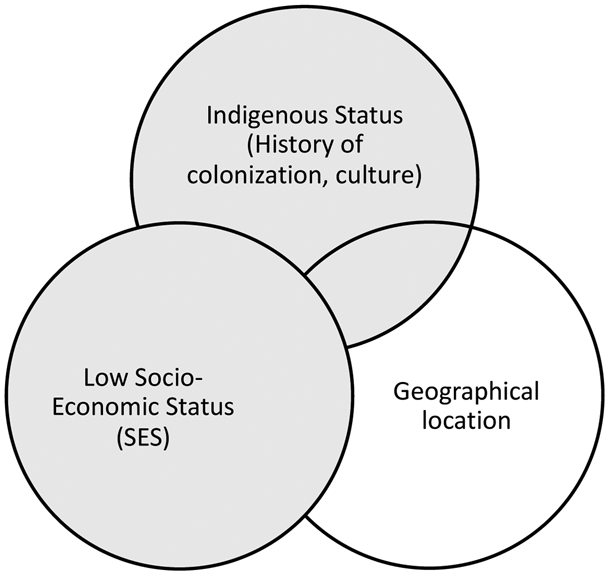
The Chippewas people experience intersectional oppression due to several overlapping and indiscrete factors: their indigenous status and the historical denigration of their culture in a colonial White-settler society; their SES, which is itself a product of the ongoing effects of colonisation; and their geographical location, which places them in a specific environmental and legal context that fails to recognise their culture, worldview and legal entitlements. This unique position at the intersection of these factors is illustrated in Figure 1. First, the Chippewas’ status as indigenous is reflected in their standing under the Indian Act, status as a treaty signatory and possession of reserve and traditional lands.Footnote 36 Based on a 2014 Census, 2,738 Chippewas people live on-reserve in south-west Ontario, Canada; the size of the reserve is 9,025.8 acres, or 39.11 km2.Footnote 37
Intersectional positionality of the Chippewas

Second, SES is a key determinant of social inequality for the Chippewas people. Demographic statistics not only illustrate the marginalisation of indigenous people in Canadian society, but also reveal additional intersectional inequalities, such as gender inequality and residence location, within the indigenous population itself. Median incomes for indigenous people in Canada are significantly lower than those of non-indigenous people.Footnote 38 Data from the 2016 Census clearly demonstrate an additional, significant income gap experienced by indigenous women relative to indigenous men, as well as relative to both non-indigenous men and women (Table 1). Furthermore, indigenous people living on-reserve earned over $9,000 less in terms of median after-tax income than those living off-reserve.Footnote 39 Relative to non-indigenous people, highly educated indigenous people still experience significant earnings gaps (Crane et al., Reference Crane, Mainville and Mason2008). Indigenous people are also overrepresented in the Canadian justice system, representing 3.1 per cent of the adult population in 2006, but 17 per cent of people admitted to remand (temporary incarceration after being charged with an offence), 18 per cent of people admitted to provincial prison and 19 per cent admitted to a conditional sentence.Footnote 40
Example of intersectional income inequality for indigenous people in Canada

Data source: Statistics Canada, Census 2016, Data Table/Catalogue # 98-400-x2016171.
For the Chippewas specifically, in 2011 (the most recent year for which Census data are available for the community), the median household income was $27,200,Footnote 41 which is well below the ‘low income’ cutoff for a family of four in Canada, which was $30,487 in 2011.Footnote 42 In the Chippewas’ Comprehensive Community Plan of 2012, a five-year strategy was developed to address specific concerns of the Chippewas’ SES, which included: 80 per cent of households struggling with the impacts of intergenerational trauma and healing issues; 75 per cent of children living in poverty and 80 per cent with drug or alcohol addictions; 25 per cent of houses having serious mould problems. Also, there has not been potable water in the community for months. Further, 70 per cent of households receive social-assistance payments, with only 30 per cent working at jobs or in a business. Most young people never go to university or college.Footnote 43 It is clear that, in Canada, indigenous people uniquely experience multiple forms of oppression.
Each of the three social dimensions of identity (including geographical location) will be considered further below. First, indigeneity as identity will be considered (in Section 5.1); second, SES and the Chippewas hunting, trapping and fishing livelihoods will be examined (in Section 5.2); lastly, the geographical location of the Chippewas will be outlined (in Section 5.3) and connected to its relevance in the legal case discussed here.
5 Intersectional legal analysis of the Chippewas’ case
The relevance of intersectionality in the Chippewas’ lived experience of the legal-justice realm is illustrated in the Chippewas’ case. This experience is the result of the combination and interplay of the three identity markers illustrated in Figure 1 including (1) culture, history of colonisation and indigenous status; (2) SES, which is also linked to colonisation and ongoing discrimination; and (3) geographical location.
5.1 Culture, history of colonisation and indigenous status
The failure of the Chippewas’ claims illustrates how the intersections of their SES (and traditional lifestyle, which is inherently connected to the land) and indigeneity determine two experiences before the SCC. It illustrates, first, as Davis (Reference Davis2015) posits, the lapses in legal recognition and, second, as identified by Crenshaw (Reference Crenshaw1991), the reality of the architecture of Canadian law, despite contestation of constitutionally paramount indigenous rights. Each will be discussed in turn.
5.1.1 Lapses in legal recognition
The NEB and SCC sidestepped the justifiable infringement analysis of indigenous socio-economic rights and focused on the adequacy of consultation. The Chippewas argued it was unjust that the NEB did not identify the strength of the asserted indigenous and treaty rights, nor identify the depth of consultation required in relation to each indigenous group.Footnote 44 The SCC decided in the Chippewas’ case that this was not required. For the Chippewas, the SCC concluded that there was no necessity for providing a formulaic analysis of the strength of their claims and the depth of the consultations, arguably because the pipeline had existed prior to the application to the NEB to expand and modify it.Footnote 45
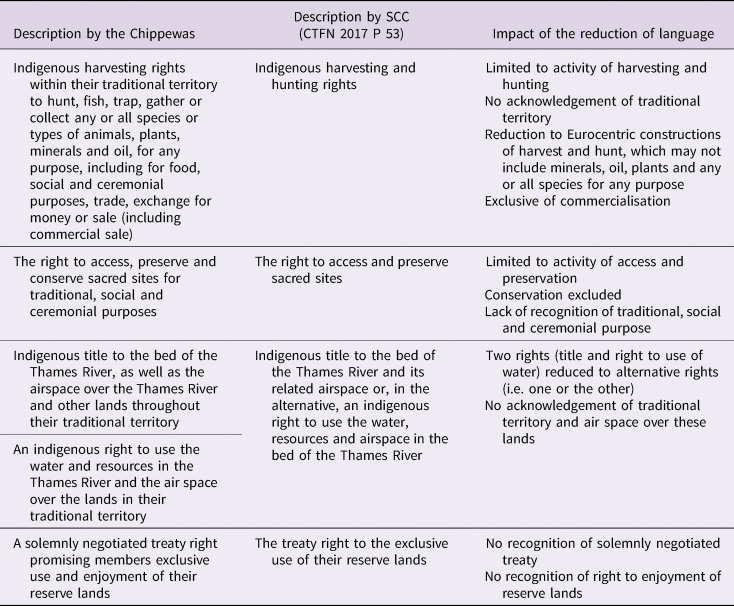
Although not forming part of the binding portion of the decision (the ratio decidendi), the description and summary of the Chippewas’ claim by the SCC were much narrower than how the Chippewas described their claim, and this is arguably illustrative of a reduction and dismissal of the Chippewas’ claim. Table 2 provides a breakdown of how the substance of the claim was described in the SCC judgment and in the Chippewas’ court documents.
Description of Chippewas’ claim and impact of reduction

The table shows how the SCC substantially reworded the claims of the Chippewas, essentially abbreviating, reducing and, ultimately in the Chippewas’ decision, rejecting their rights. By not recognising the traditional territory upon which the treaty rights were to be exercised, but only the indigenous title to the bed and airspace over the Thames River, the hunting, trapping and fishing rights are significantly reduced potentially to only that portion of the Thames River adjoining the reserve – a much smaller area than the Chippewas claim. Further, it is possible to have both a title to the bed of the river as well as an indigenous right to use of the water flowing through the river in relation to quantity and quality. The narrow language of the SCC reduces these rights to either the title to the bed or the use of the water, but does not allow both.
As there was no explanation for these reductions in the written reasons provided by the SCC, there is clear evidence of the negative legal space occupied by the Chippewas where their claims, connected to their culture and lifestyle of hunting, trapping and fishing and situated within the context of a fulsome worldview, are without recognition or remedy. Considering the already low SES of the Chippewas compared to the general Canadian population, access to traditional foods (including the provision for commercial sale) become particularly significant for food security and potential income. The SCC failed to recognise the Chippewas’ indigenous rights, thus illustrating ‘lapses in legal recognition of those existing in the overlap of multiple identity markers’ (Davis, Reference Davis2015, p. 209).
The failure of the Chippewas’ claim implies that pipelines built prior to 1982 can be expanded, reversed and repurposed with little perceived impact on indigenous rights. It also demonstrates the failure of the legal system to fully comprehend indigenous cultural values and worldview, thus resulting in a reductionist approach and a legal failure to consider intersections between cultural values and contemporary inequalities such as SES (itself a product of colonisation). Effectively, NEB processes in these instances were considered sufficient to address the Crown's obligation and duty to consult indigenous peoples. Further, plans to provide information and education suffice for the Crown to meet any ongoing obligations. The next section addresses why indigenous rights were reduced in this case.
5.1.2 The real architecture of Canadian law
The result in this case reveals the hidden architecture of Canadian indigenous-rights law. The law affirms that any infringements prior to the constitutional protection of indigenous rights in 1982 will not be considered. However, the legal reasoning of the courts (in the context of the substantive changes made to Line 9) reveal the contingent and constructed application of law that effectively naturalised and concretised the infrastructure of the existing pipelines or the built environment of oil distribution (Crenshaw, Reference Crenshaw1991, p. 228). The law protects the pipeline infrastructure and the socio-technical system it represents by reducing the claim of the Chippewas (perpetuating their marginalised status and ignoring intersecting dimensions of their experience) and effectively advancing historical legal rules that contradict the more recently developed indigenous-rights jurisprudence. These historical rules of law include real-property law, Crown property in wildlife, the inherent standing granted to the economy and the assimilation of inherent indigenous rights of self-government and nationhood. These arguments are expanded in this section.
Traditional Canadian law counteracts the promise of indigenous rights. The result of the Chippewas’ case accords with two fundamental principles of Canadian law, and two implicit principles. Although not directly espoused as legal reasons for this decision, the property-law context referenced in the case and the lack of standing of both wildlife and habitat provide important background. Each of the fundamental and implicit principles are legal constructs or principles that negate the recognition of the Chippewas’ claims effectively providing the reasons for dismissal of their claims. As identified by Crenshaw, these are architectures of oppression (Crenshaw, Reference Crenshaw1991).
5.1.2.1 Property law
The lands impacted by the Line 9 expansion, reversal and repurposing were limited to ‘six existing fenced-in Enbridge facilities, and one new densitometer site to be located on the Enbridge Right of Way within a cornfield’.Footnote 46 Otherwise, the entire application before the NEB related to property and rights of way that Enbridge currently and historically held and accessed in relation to the pre-existing Line 9. The NEB heavily relied on the fact that no permanent land rights would need to be acquired in relation to the application; all work was taking place on existing Enbridge facilities and rights of way. The limited nature of the change in ‘real-property’ interests that were required to be legally transferred allowed the NEB to narrow the scope of its inquiry and consideration of issues. When this is considered together with the way in which the Chippewas’ claim was reduced (as outlined in Table 1), the Chippewas’ claim is effectively both ‘landless’ and ‘groundless’. The ‘architecture’ of property law effectively dismissed the Chippewas’ claims.
5.1.2.2 Crown property: wildlife and fish
Indigenous hunting, trapping and fishing rights inherently contravene the rules that all wildlife is vested in the Crown. In common law, it was not considered possible to hold property rights in animals in their wild state. Blackstone (Reference Blackstone1979) described the law as follows:
‘There are some few things, which …. Must still unavoidably remain in common; being such within nothing but an usufructuary property is capable of being had; and therefore they still belong to the first occupant, during the time he [sic] holds possession of them, and no longer… [S]uch also are the generality of those animals which are said to be freai naturae, or of a wild and untameable disposition; which any man may seize upon and keep for his own use and pleasure. All these things, so long as they remain in possession, everyman has a right to enjoy without disturbance; but if once they escape from his custody or he voluntarily abandons the use of them they retain to the common stock, and any man else has an equal right to seize and enjoy them afterwords.’ (Blackstone, Reference Blackstone1979, p. 14)
In fact, prior to the constitutional protection of indigenous rights in 1982, four Ojibway representatives from Northern Ontario brought a suit against the federal government on the grounds the Crown had breached the Robinson Huron Treaty of 1850. They alleged that the federal government had, in the treaty, promised them full and free privilege to hunt over the territory ceded by them and to fish in its waters as they had historically done. In that case, the judge dismissed their claim and concluded:
‘The Crown, by entering into the Treaty, did not take upon itself a trust obligation. For such a trust to exist there must be property, which is the subject matter of the trust. A privilege to hunt and fish cannot be said to constitute such property.’Footnote 47
Provincial legislation has now been passed vesting the property in wildlife in the Crown and specifically providing that no compensation is payable for the loss of the ability to hunt, trap or fish.Footnote 48 Consistently, governments have arguably had certain immunity for any breach of indigenous rights up until their constitutional protection in 1982Footnote 49 and indigenous groups have been unsuccessful in economic claims for breach of indigenous rights.Footnote 50 The architecture of wildlife law also effectively dismissed the Chippewas’ claims, thus acting as an ‘architecture of oppression’.
5.2 SES and further marginalisation of the Chippewas
The further marginalisation of the Chippewas’ due to SES (the second marker of intersectionality in Figure 1) occurred in two ways. First, the NEB and SCC effectively gave higher metaphorical ‘standing’ and priority to the mainstream oil and gas economy and, second, as a result, dismissed the inherent indigenous sovereignty that would allow indigenous governance and place higher priority on the importance of hunting, fishing and trapping activities inherently linked to Chippewas culture. Viewed through the intersection of culture and SES, the decision effectively prioritised extractive economic structures associated with a colonial state over traditional indigenous livelihoods, thus exacerbating the already low SES of the Chippewas within the dominant Canadian economy and implicitly devaluing their culture.
5.2.1 The ‘standing’ of the economy
The result of the Chippewas’ case effectively gave ‘standing’, or recognition in law, to the economy as a public interest. Because of the considerations of the NEB and SCC in ‘balancing’ multiple interests, the interests of the ‘economy’ were reinforced as prevailing over the indigenous livelihood rights to hunting, trapping and fishing of the Chippewas. Economic rights have suffered historical failure in Canadian courts when advanced to protect the rights of the poor.Footnote 51 In the Chippewas’ case, economic rights in relation to jobs and the economy advanced as the ‘public interest’ effectively usurped the advancement of indigenous rights of the Chippewas, raising the further question of who is implicitly assumed in conceptualisations of ‘the public’ within the colonial legal architecture.
The Chippewas argued that the NEB ‘[f]ocused on balancing multiple interests’ and that it was not appropriate that ‘Aboriginal [sic] and treaty rights [were] weighed by the Board against a number of economic and public interest factors’.Footnote 52 Freedman and Hansen (Reference Freedman and Hansen2009) opine that there is an inherent conflict raised when a tribunal determines rights in accordance with the duty to consult in the context of a public-interest mandate. They state:
‘It is difficult to see how a public interest-based approach to determining section 35 rights can satisfy the important purposes behind granting those rights constitutional protection in the first place. How is the important objective of reconciliation to be achieved if projects can simply be approved because of the money they will bring in or the jobs they will create? How in such a framework will the aboriginal [sic] perspective of their rights and the need for the land, environment, and ecosystem to remain in a certain state be properly taken into account? In our view, the rights and interests of First Nations are ignored or downplayed in these public interest-based tribunals.’Footnote 53
The inherent value given to the public interest and to the promise of money and jobs over the indigenous interest in a hunting, trapping and fishing lifestyle is not questioned by either the NEB or the SCC. This devaluing of indigenous jobs and economy (of hunting, trapping and fishing) and of the indigenous rights protecting it, while favouring oil and gas jobs and economy, illustrates the subtle ways in which power structures create the intersecting oppressions that constitute the indigenous lived experience in law.
The evidence of this intersectional experience of oppression is arguably even more acute when further case-law is considered. In the SCC, the Chippewas’ indigenous rights were dismissed contrary to both the decision in Mikisew, where the court held that the Crown was required to solicit and listen carefully to indigenous concerns and attempt to minimise adverse impacts on their hunting, fishing and trapping rights,Footnote 54 and the Rio Tinto decision (2010),Footnote 55 where it was held that a duty to consult gives rise to a special public interest. Despite these precedents, the SCC held that it was appropriate to balance indigenous interests with other interests ‘at the accommodation stage’ and that the duty to consult does ‘not provide Aboriginal [sic] groups with a “veto” over final Crown Decisions’.Footnote 56 The court found there was a need to balance competing societal interests with indigenous and treaty rights. The SCC concluded that balance and compromise are inherent in the process and that the Chippewas were not entitled to a one-sided process, but rather a ‘cooperative’ one, that has a view towards reconciliation.Footnote 57 This language of ‘balance’ in the Chippewas’ court case allows the ‘recognition’ of a societal interest to be prioritised over the recognition of the Chippewas and their interests. Moreover, this reasoning calls for a compromise of the Chippewas’ interests, but not of the ‘public's’ economic interest.
5.2.2 Assimilating inherent indigenous rights
The Chippewas’ case aptly illustrates that inherent customary rights cannot be understood as granted by a higher power (here the Canadian state); if they are, a form of assimilation results (De Santis, Reference De Santis and Hurlbert2018). The Chiefs of Ontario eloquently argued that the NEB decision allows the historical pattern of unilateralism to continue to fail to ‘recognise’ the First Nations’ sovereignty, evading the duty to consult and the spirit and intent of the Treaty of Niagara. The Treaty of Niagara was grounded on principles of co-operation, consultation, mutual respect and reconciliation based on an underlying nation-to-nation relationship (Borrows, Reference Borrows1994).Footnote 58 However, having these duties implemented by an unstructured regulatory regime erodes the scope and content of this duty and leads to needless and costly litigation.Footnote 59 The SCC Beckman decision (2010)Footnote 60 previously held that administrative law might be flexible enough to give full weight to the constitutional interests of indigenous communities, if the substance of the appropriate level (breadth and depth) of consultation is provided.Footnote 61 However, in relation to the Chippewas’ case, the Chiefs argued that the courts have too often applied technical administrative-law doctrines to legal indigenous-rights problems and that, thus, the underlying indigenous rights that have been asserted are ignored.Footnote 62
Christie (Reference Christie2005) also argues that courts have almost exclusively focused on the adequacy of the consultation, overemphasising the process of dialogue and accommodation, and sidestepping away from a necessary focus on the infringement of indigenous rights and any remedies thereby warranted.Footnote 63 We argue that this overemphasis on procedure constitutes what Davis (Reference Davis2015, p. 209) identified as a ‘lapse’ in legal recognition, or a substantive injustice associated with the intersectional experience of indigenous peoples illustrated in relation to their SES and their geographical location. By relegating cases to the procedural purview of consultation, through their omission of consideration of the merits of indigenous-rights claims, the courts effectively or implicitly relegate indigenous rights out of the legal court sphere of consideration to a bureaucratic or administrative tribunal sphere.
This sidestepping is contrary to the duty to consult on paper. The duty to consult has been recognised as distinct from duties that the Crown owes other Canadians.Footnote 64 The Chippewas negotiated a treaty with the Crown and the Crown made a solemn promise to forever protect and uphold the Chippewas’ indigenous rights to the continued use of their lands, waters and natural resources.Footnote 65 The SCC has confirmed that the nature of the treaty agreement is sacred.Footnote 66 Further, the constitutional duty to consult and accommodate indigenous peoples’ rights is grounded in the principles of the honour of the Crown and thus reaching reconciliation, and is an obligation imposed on the Crown, not pipeline companies. This consultation and accommodation cannot be technical, but must be meaningful, substantive and inclusive.Footnote 67
The parties before the SCC disagreed on whether the NEB could satisfy the Crown obligation surrounding consultation. The SCC decided the NEB could, and it had. The Chiefs of Ontario argued that the failure to include the affected indigenous communities themselves in the design and development of the consultative processes was a more fundamental omission.Footnote 68 The Chiefs cited the call made in the Haida Nation SCC case to ‘set up regulatory schemes to address the procedural requirements appropriate to different problems at different stages, thereby strengthening the reconciliation process’.Footnote 69 These arguments were apparently ignored. In the Chippewas’ case, the Crown did not participate in the NEB application process; further, no provision in the NEB Act has delegated the Crown's duty to consult to the Board. The Chippewas repeatedly requested that the minister attend the NEB hearing to carry out consultation and accommodation,Footnote 70 but this did not occur.
Without formally considering the indigenous claim to sovereignty and nation-to-nation status, the SCC effectively rejected it – the fundamental identity upon which indigenous claims in Canada are based (Morse and Kozak, Reference Morse and Kozak2001).
5.3 Geographical location: the Chippewas’ lack of (legal) relation to pristine Earth
As opined by Davis (Reference Davis2015), a figurative ‘negative space’ is created where disadvantaged people experience multiple sites of inequality. Within the Canadian legal system, a categorical approach based on singular identity markers contributed to a reduction in the Chippewas’ claims. Complex intersecting factors like culture, SES and geographical location are not fully encompassed by this relatively technocratic application of the law. For the Chippewas, this negative space has connection with the natural world, and specifically the fact that the Line 9 pipeline already existed on their traditional lands. When situated in the context of other legal and political decisions surrounding the development of pipelines, the intersection and importance of geographical location in relation to proposals concerning pipelines can be discerned. The Line 9 project arguably proceeded because of the pre-existing pipeline and the fact that its retrofitting involved very little new land (only small parcels for equipment and no extensions of the pipeline in a new direction or over territory without previous pipeline infrastructure). Set against other pipeline decisions (as well as the Chippewas’ companion case, Clyde River), we argue that considering the context of geographical location primarily in relation to an extant pipeline infrastructure reduces the claims of indigenous people. Each will be discussed in turn.
First, at the same time as the SCC determined the Chippewas’ case, the Clyde River case was also determined.Footnote 71 In this case, the NEB's authorisation of offshore seismic testing for oil and gas in Nunavut was quashed due to in inadequate consultation, even though the NEB had concluded that testing was unlikely to cause significant adverse environmental effects. The Clyde River is described on its website as the ‘Gateway to the Fiords, located on a flood plain and surrounded by spectacular fiords all the way to the Barnes Icecap and replete with whales, seals, polar bears, wolves and caribou’.Footnote 72 Although there are several facts that distinguish this case from the Chippewas’ case,Footnote 73 it is noteworthy that this geographical location was found worthy of deep consultation by the court and that there are no existing oil and gas pipelines.
Second, the trend in recent pipeline cases suggests that old pipelines can be modified, although applications for significant new pipeline extensions into land previously untouched by a pipeline infrastructure will not be successful. In Canada, recent applications to build new, or new segments of, pipelines have met with limited success. Three prominent examples include the Northern Gateway Pipeline, Energy East and Prince Rupert pipeline, discussed in turn.
(1) One of the most renowned withdrawals of application from the NEB has been the Northern Gateway Pipeline, which would have linked the Alberta oil sands through a new pipeline built to the west coast, north of Vancouver. In 2016, Prime Minister Justin Trudeau cancelled the Northern Gateway Pipeline (Cheadle, Reference Cheadle2016). This cancellation occurred after the Federal Court of Appeal quashed the Order-in-Council that directed the NEB to issue a certificate of public convenience and necessity to Northern Gateway. The Federal Court of Appeal ruled that the federal government had not fulfilled its duty to consult with indigenous people.Footnote 74 The court concluded that Canada had offered a brief, hurried and inadequate opportunity to exchange and discuss information, which ignored entire subject areas of importance to affected First Nations and that many potential impacts were left undisclosed, undiscussed and unconsidered.Footnote 75 The timeline for the consultation had allowed only 45 days for discussions and First Nations were given only 45 days to provide their concerns in writing, with a maximum three-page limit.Footnote 76
(2) In 2017, TransCanada Corp. cancelled its $15.7 billion Energy East pipeline that was planned to cut across Quebec and New Brunswick (areas with no previous pipelines) in order to provide 1.1 million barrels a day of western Canadian crude oil to eastern refineries and export terminals (McCarthy et al., Reference McCarthy, Cryderman and Lewis2017). Although TransCanada refused to provide comment on the cancellation, the decision followed an announcement on 23 August 2017 by the NEB that the assessment of the project was to be expanded to include: (1) more visibility to the evaluation of scenarios, consequences, mitigation and response to potential accidents and malfunctions; (2) upstream and downstream greenhouse-gas (GHG) emissions to determine whether the projects are in the public interest including the market impacts of GHG-reduction targets embedded in laws and policies on the economic viability of the project; (3) indigenous participation in the projects throughout their life-cycles, landowner and municipal considerations, cumulative environmental effects, as well as socio-economic elements.Footnote 77 The decision reflects a desire to consider social costs, not just the potential for stranded assets (the usual ambit of consideration of the NEB).
(3) As a final example, in 2017, a TransCanada pipeline to Prince Rupert that would have been built through territory without previous pipelines was cancelled when Malaysian-state-owned Petrovas cancelled building a liquefied natural-gas plant. It is reported that a significant reason for this cancellation was that the project faced entrenched opposition from indigenous and environmental groups because of the proximity to a juvenile-salmon habitat at the mouth of the Skeena River in northern British Columbia (Morgan, Reference Morgan2017).
As many such proposals for new pipelines terminate or stall, proposed expansions of current pipelines to carry larger quantities of oil, as in the Chippewas’ case, meet with more success.Footnote 78 Three examples illustrate this argument. (1) After cancelling the Northern Gateway Pipeline, Prime Minister Trudeau approved the Kinder Morgan pipeline expansion (joining Alberta oil sands with the south-eastern US) and eventually purchased it. The Kinder Morgan project involves expanding the already existing TransMountain pipeline.Footnote 79
(2) In 2017, Enbridge's Line 3 Replacement Program proceeded between Alberta, through Saskatchewan and Manitoba. Most of this Line 3 replacement was constructed within the existing pipeline's current rights of way.Footnote 80 (3) Lastly, the Keystone Pipeline has already been completed in Canada. Although, under the Obama administration, the proposed Keystone XL expansion project was cancelled, it has been resurrected by President Trump (albeit currently experiencing difficulties with the selection of an alternate route). This expanded pipeline would ship oil through southern Alberta into Montana (Mufson and Eilperin, Reference Mufson and Eilperin2017).
The Chippewas’ geographical location in the presence of existing pipelines – a factor that, we have argued, contributed to their unsuccessful claim – is the product of colonial legal mechanisms (both historical and contemporary), which have prioritised profit by the energy industry over indigenous cultures and livelihoods. From an intersectional perspective, deeply rooted power relations associated with colonisation and capitalism have produced a particular experience of inequality at the intersection of culture, SES and geographical location. As evidenced by other successful cases made by indigenous groups in locations without an existing pipeline infrastructure, the complexity of the situation cannot be reduced to a single component, such as indigeneity or geographical location alone. Indeed, intersectional analysis does not just focus on differences between identity-based groups; it can provide for cross-movement mobilisation when attention is paid to intersecting identities, interconnected power structures and the potential for solidarity and cohesion (Roberts and Jesudason, Reference Roberts and Jesudason2013). Intersectionality is based on a rejection of single-category-identity politics, emphasising instead the emergent effects of multidimensional oppression. Such emergence is seen in the case of the Chippewas, whose argument against the Enbridge expansion was based on a complex set of intersecting factors – most prominently culture, SES and geographical location – that could not be adequately addressed under categorical Canadian law. As Kimberle Crenshaw argues:
‘intersectionality applies to everyone – no one exists outside of the matrix of power, but the implications of this matrix – when certain features are activated and relevant and when they are not – are contextual. Power marks these relationships among and between categories of experience that vary in their complexity. To map intersectionality from instance to instance both confirms the relevance of categories, and provides the impetus for disrupting dominant discourses that regard these categories as fixed and mutually exclusive.’ (Crenshaw, Reference Crenshaw1991, p. 230)
6 Conclusion
This paper has applied an intersectional framework to doctrinal analysis and critique of the Chippewas’ Line 9 pipeline expansion case in the context of recent Canadian pipeline cases, attending to intersecting power systems, identity markers and resulting oppression. Indigenous peoples’ lived experience demonstrates how indigeneity and culture, SES and geographical location, which are rooted in power structures related to colonialism and capitalism, are interconnected and worked together to exclude the Chippewas from being heard, or having influence, in connection with their opposition to Line 9. Their indigeneity, SES and associated livelihood of hunting, trapping and fishing interconnects with the geographical location – a location with an already existing pipeline (i.e. Line 9 in Ontario) – to create a particular situation of oppression. The interconnection then determines the Chippewas’ experience before the SCC asserting their indigenous rights to no avail.
Intersectional legal analysis of the Chippewas’ case demonstrates the reality of the architecture of Canadian law and its winners and losers, which reveals the preferences made in the law's application, regardless of the protection afforded to indigenous rights in the Constitution (Crenshaw, Reference Crenshaw, Lutz, Vivar and Supik2011). The case also reveals the limitations of legal categories that are ill-equipped to consider intersecting and emergent effects.
The Chippewas’ case illustrates the relevance of identity categories (e.g. indigenous status) in shaping people's experiences under the legal system, while also illustrating the deeper interconnection of multiple power systems like capitalism and colonialism. The Chippewas’ historical experience of colonisation contributes to current statistics of low SES in the Nation. Low SES (which is, paradoxically, defined by the indicators of the dominant economic system) could be offset by traditional cultural practices of hunting and fishing, which themselves contribute to a harmonious relationship with Earth. However, the dominant colonial-capitalist system reduces such complexities to a singular category – indigenous status – which is positioned as one of several voices that must be ‘balanced’ in the legal context of an economic system heavily based on extractive industry.
The Chippewas thus experience a ‘lapse’ in legal recognition identified by Davis (Reference Davis2015), in which they are relegated to the minimalist level of duty to consult without consideration of the merits of their indigenous rights. The analysis shows that negligible space existed for the Chippewas’ indigenous rights within the context of an existing pipeline, even though they opposed its expansion, conversion to ‘dirtier’ crude oil and reversal of flow. Pre-existing legal-power mechanisms of real property, Crown ownership of wildlife and fish, the economy and the assimilation of inherent indigenous rights outmanoeuvred the environmental and indigenous rights in the Line 9 rebuild context.
The domination of these pre-existing legal-power mechanisms resulted in the dismissal of concerns about the impact of oil spills on indigenous rights to hunt, trap and fish, and to access sacred sites, water and resources. The confluence of structure and identity highlights the invisible dimensions of Canadian law that subvert indigenous rights. Not only are undesirable impacts on the environment rendered invisible, but also indigenous rights are rendered non-existent in the prevailing framework and infrastructure of existing oil pipelines. In fact, the SCC dismissed the Chippewas’ claims to such an extent that it made the unusual order that the Chippewas should pay Enbridge's legal bill as well as their own $600,000 legal bill.Footnote 81
Through this intersectional analysis, law's architecture and these naturalised power mechanisms are exposed arguably so that they can be addressed. Acknowledging the intersections of culture, SES and geographical location contributes to a broader understanding and, potentially, a more just interpretation and application of law. An intersectional analysis illuminates the deep architecture of law inhibiting indigenous rights and could add depth to the principle of ‘universalism’ espoused by Former Chief Justice of Canada, Beverley McLachlin. McLachlin argues that the SCC has adopted an approach to the duty to consult embedded in universalism in which recognition is given to ‘the broad, general principles underlying the imposition of responsibility’.Footnote 82 This is contrasted with formalism whereby rules, precedent and categories that are clear and predictable are applied.Footnote 83
This intersectional analysis reveals the real architecture of Canada's indigenous-rights law and how it naturalises the power structures inherent within and contingent to it. Law both advances yet dismisses indigenous environmental claims. However, an intersectional analysis allows the critical examination of legal doctrine and structural processes that de-legitimise indigenous claims. Such identification and exposition of the ‘negative spaces’ in Canadian law can help advance not only the rights of indigenous people, but increased honour for Earth and the environment.
Acknowledgements
Funding was provided by the Canada Research Chairs, jointly funded by the CIHR, NSERC and SSHRC.
Conflicts of Interest
None