1. Introduction
The world's oldest macroscopic borings are known from Ediacaran time (Bengtson & Yue, Reference Bengtson and Yue1992). The earliest Trypanites Mägdefrau, Reference Mägdefrau1932 borings can be found in lower Cambrian deposits (Bromley, Reference Bromley1972; James, Kobluk & Pemberton, Reference James, Kobluk and Pemberton1977; Taylor & Wilson, Reference Taylor and Wilson2003). Microscopic scallop-shaped excavations and associated carbonate chips in archaeocyathan cavity walls in lower Cambrian deposits of southern Labrador were described by Kobluk (Reference Kobluk1981a ) who suggested they were produced by endolithic sponges. Trypanites has been described from several lower Cambrian hardgrounds, but it is rare in middle–late Cambrian hard substrates (James, Kobluk & Pemberton, Reference James, Kobluk and Pemberton1977; Kobluk, James & Pemberton, Reference Kobluk, James and Pemberton1978; Kobluk & James, Reference Kobluk and James1979; Kobluk, Reference Kobluk1981a , Reference Kobluk b ; Palmer, Reference Palmer1982; Brett, Liddell & Derstler, Reference Brett, Liddell and Derstler1983). A late Cambrian hardground from Newfoundland with Trypanites-like borings was described by Chow & James (Reference Chow and James1992). Conway Morris and Bengtson (Reference Conway Morris and Bengtson1994) studied various borings in Cambrian skeletons. Some of these borings, especially those made in brachiopods, were almost certainly excavated by predators (Conway Morris & Bengtson, Reference Conway Morris and Bengtson1994; Zonneveld & Murray, Reference Zonneveld and Murray2014).
Most of the ichnological record of borings is associated with carbonate or wood substrates (Taylor and Wilson Reference Taylor and Wilson2003); rarely have borings been described from the other substrates such as quartzite and magmatic rocks (Allouc, Le Campion-Alsumard & Leung Tack, Reference Allouc, Le Campion-Alsumard and Leung Tack1996; Mikuláš, Nemecková & Adamovic, Reference Mikuláš, Nemecková and Adamovic2002; Johnson, Wilson & Redden, Reference Johnson, Wilson and Redden2010; Santos et al. Reference Santos, Mayoral, Johnson, Gudveig Baarli, Cachao, Silva and Ledesma Vázquez2012; Baarli et al. Reference Baarli, Santos, Mayoral, Ledesma Vázquez, Johnson, Silva and Cachao2013).
Bioerosion of hard substrates in Ordovician deposits of Baltica has been studied by several authors (Ekdale & Bromley, Reference Ekdale and Bromley2001; Vinn & Wilson, Reference Vinn and Wilson2010; Vinn, Wilson & Mõtus, Reference Vinn, Wilson and Mõtus2014). However, macroscopic bioerosional ichnofossils from Cambrian deposits of Baltica have not been previously described (Raukas & Teedumäe, Reference Raukas and Teedumäe1997).
The aims of this paper are to report and describe for the first time borings and bioerosion in the Cambrian siltstone cobbles and pebbles of Baltica, and to compare the Cambrian bioerosion of Estonia with other Cambrian examples.
2. Geological background
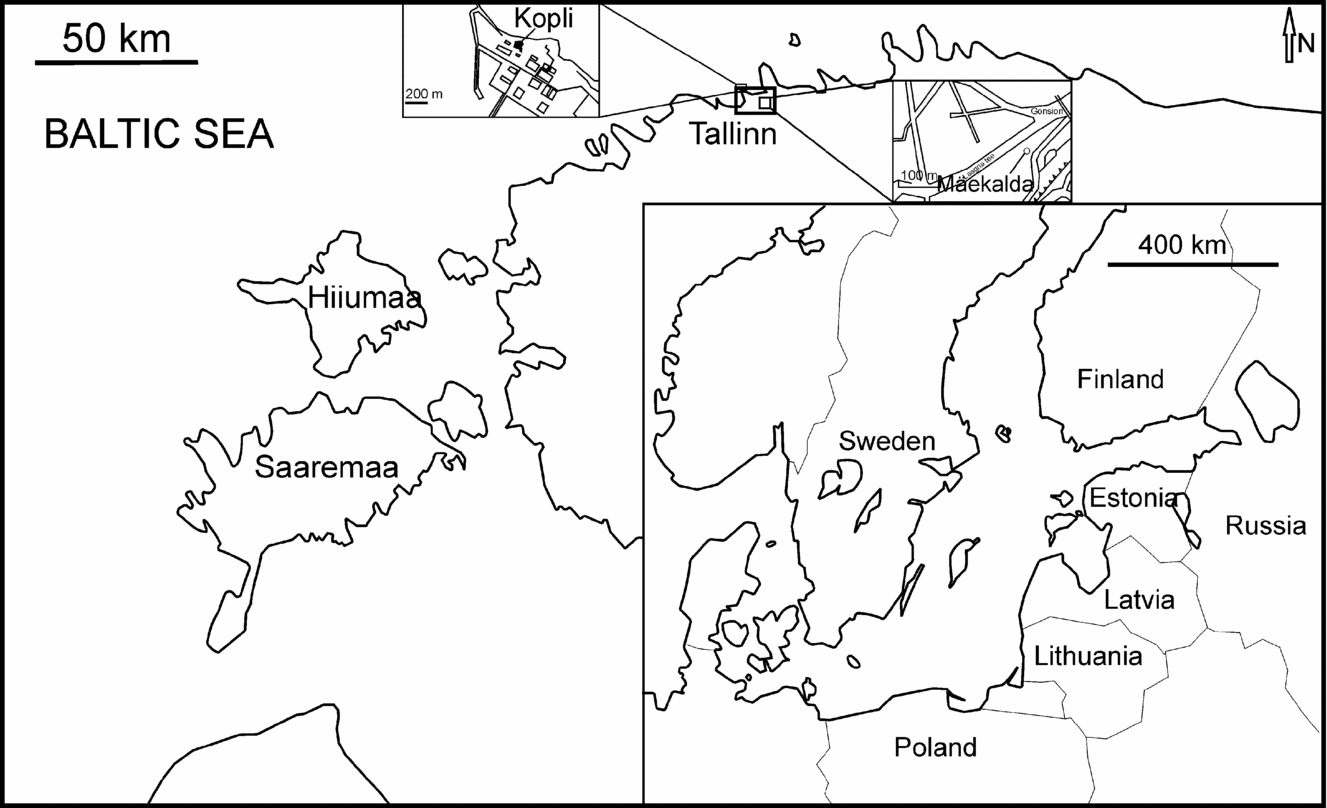
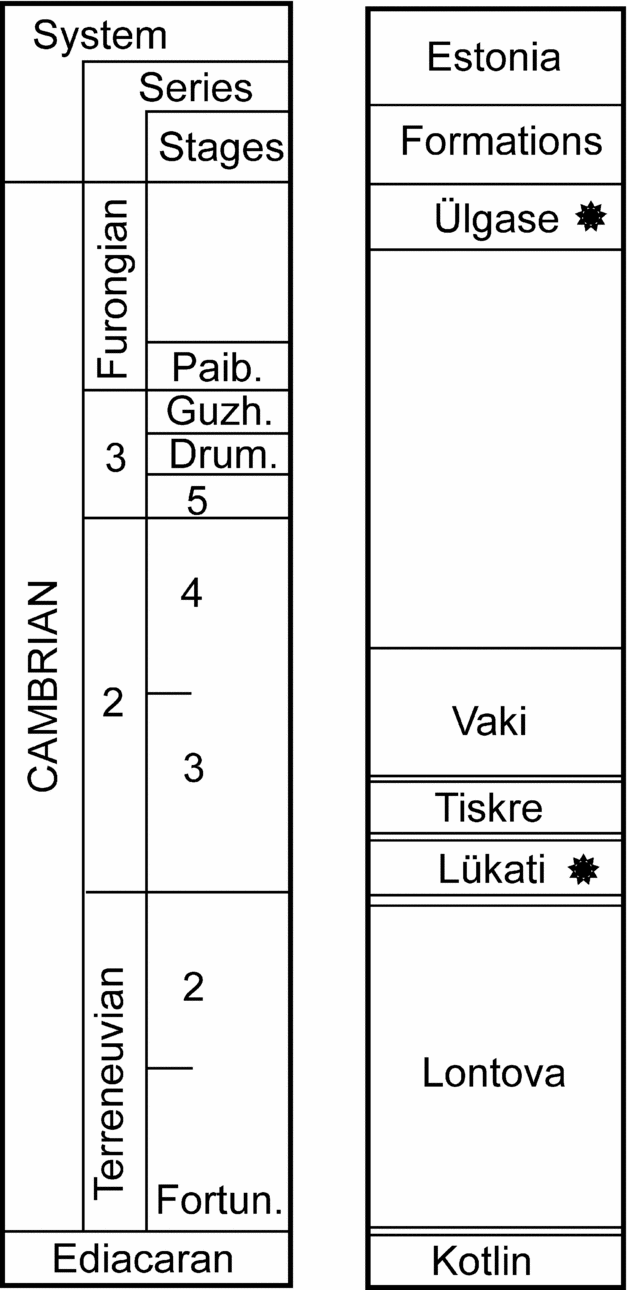
Baltica was located between 30°S and 60°S in the Southern Hemisphere during Cambrian time (Torsvik et al. Reference Torsvik, Smethurst, van der Voo, Trench, Abrahamsen and Halvorsen1992). Cambrian rocks are exposed only in northern Estonia (Fig. 1). The Cambrian rocks form the basal layers of the northern Estonian Cliff (the Baltic Klint), and are overlain by Ordovician rocks. Lower Cambrian rocks are more widespread and thicker than upper Cambrian rocks in Estonia. The Furongian Epoch is defined on the basis of palaeontological evidence, both shelly fossils and acritarchs. The Lükati Formation (lower Cambrian) lies transgressively on the Lontova Formation in eastern Estonia (Fig. 2). It is usually separated from the underlying units by conglomerate lenses containing pebbles of phosphatized siltstones (Raukas & Teedumäe, Reference Raukas and Teedumäe1997). The Ülgase Formation (Furongian) has a thickness of c. 10 m and is better represented in the vicinity of Tallinn and within some 50 km east and south of it. The Ülgase Formation consists of light-coloured fine-grained sandstones and coarse-grained siltstones with interbeds. There are lenses of greenish-grey clay in the lower part of the formation and brownish-grey thin films in its upper part. The lower boundary of the formation is often marked with phosphatized siltstone pebbles (Raukas & Teedumäe, Reference Raukas and Teedumäe1997).
Location of Kopli quarry and Mäekalda outcrop in northern Estonia (Tallinn).

Stratigraphy of Cambrian Estonia. Location of samples shown with asterisk.

3. Localities
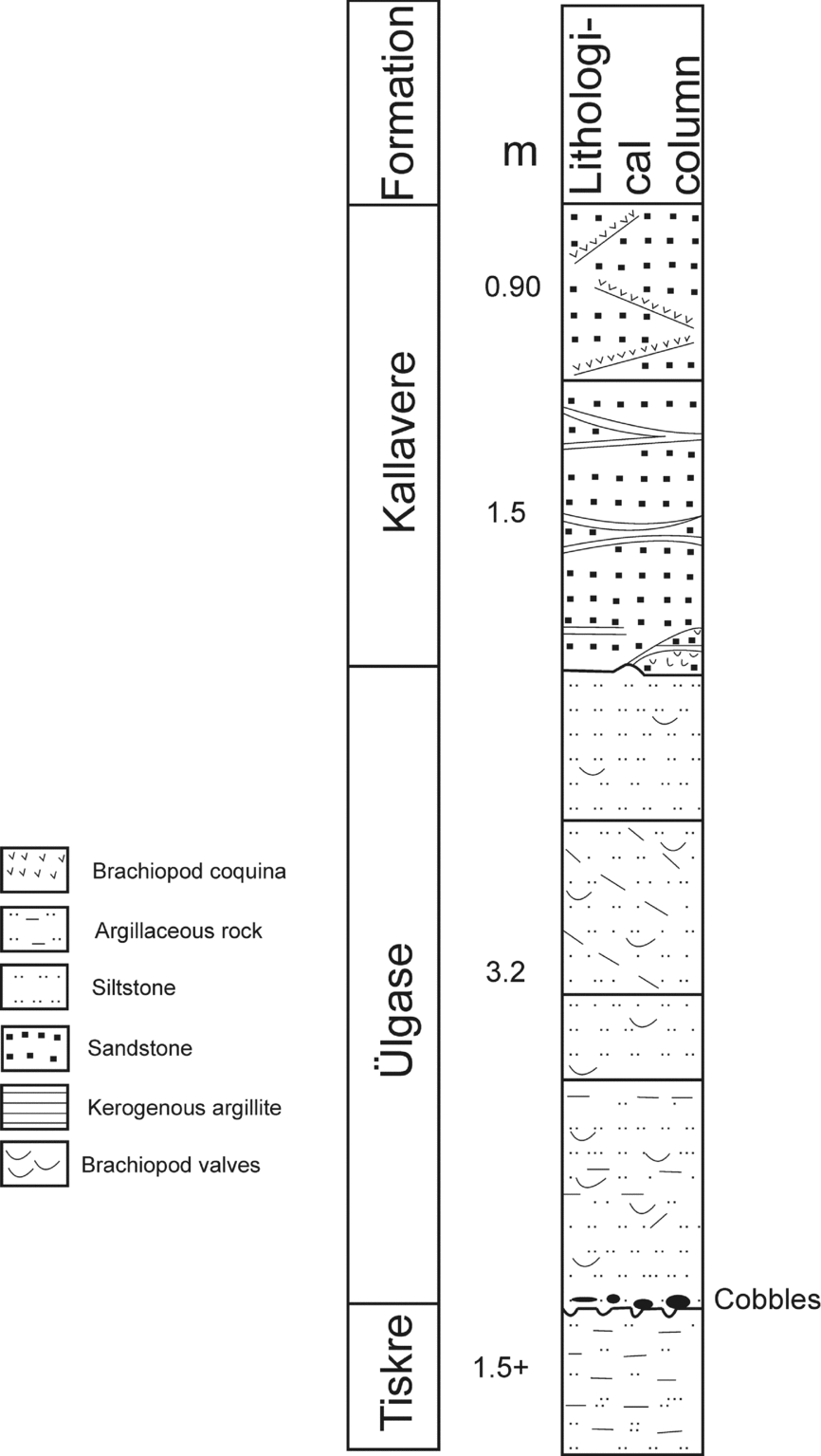
Mäekalda section is named for the street in the eastern margin of Kadriorg Park, Tallinn. It is exposed in a road-cut excavated during the building of a new motorway in 1986. Lower Palaeozoic rocks from the siltstones of the lower Cambrian Tiskre Formation to the Middle Ordovician limestones of Lasnamägi Regional Stage are exposed. The upper Cambrian Ülgase Formation has a thickness of 3.20 m and covers the underlying greenish-grey argillaceous siltsones of the lower Cambrian Tiskre Formation. The lower boundary of the Ülgase Formation is sharp and marked by phosphatized siltstone cobbles and pebbles. The fauna of the Ülgase Formation includes numerous phosphatic brachiopods and hyolithelmith Torellella (Mens et al. Reference Mens, Viira, Paalits and Puura1989; Fig. 3).
Section of Mäekalda outcrop. Modified after Mens et al. (Reference Mens, Viira, Paalits and Puura1989).

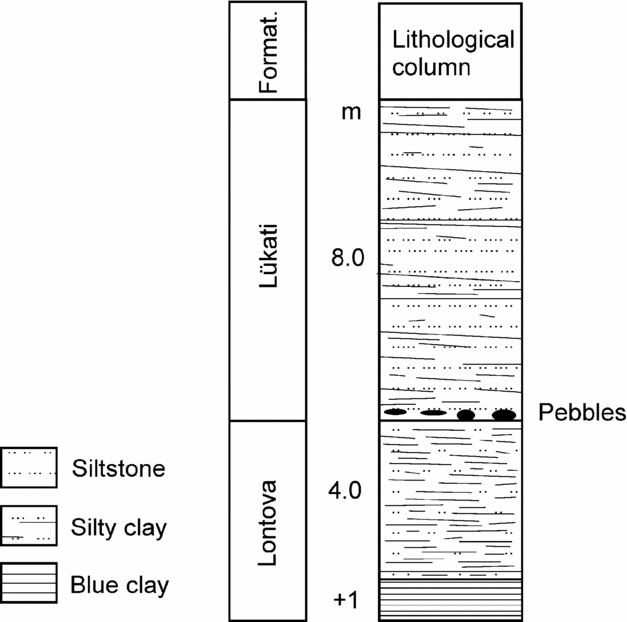
Kopli quarry is situated in northern Tallinn. In the deepest part of the quarry, violet-grey clays of the Kestla Member (Lontova Formation) are exposed. These clays are rich in pyritized worm traces. In the higher part, a 4–6-m-thick unit of grey silty clays belonging to the Tammeneeme Member (Lontova Formation) is exposed. These silty clays contain the forameniferan Platysolenites and acritarchs. The lower boundary of Lükati Formation is marked by a basal conglomerate composed of dark phosphatized siltstone pebbles. The Lükati Formation is composed of alternating siltstones and silty clays. The rocks of the Lükati Formation are rich in Volborthella (a problematic shell), the foraminiferan Luekatiella, inarticulate brachiopods and trilobites (Pirrus, Reference Pirrus1984; Fig. 4).
Section of Kopli quarry. Modified after Pirrus (Reference Pirrus1984).

4. Materials and methods
Cambrian siltstone pebbles in the collections of the Institute of Geology, Tallinn University of Technology were searched for signs of bioerosion. The studied cobbles derive from the basal layer of the Ülgase Formation (Furongian) (Figs 1, 2) and the pebbles from the basal layer of the Lükati Formation (lower Cambrian) (Figs 1, 2). Twenty cobbles from the Ülgase Formation and eleven pebbles from the Lükati Formation were studied. Cobbles and pebbles were randomly selected by the collectors. Pebbles from the Lükati Formation are not sorted; they are usually smaller than 1 cm, but can reach up to a length of 20 cm and a thickness of 7 cm (e.g. field notes of various collectors). Cobbles from the Ülgase Formation are also not sorted; they can reach lengths of 20 cm and are composed of lower Cambrian (Tiskre Formation) coarse-grained siltstones (0.05–0.1 mm) (e.g. field notes of various collectors). Borings were recorded on all surfaces of the cobbles and pebbles. Some cobbles and pebbles were sectioned with a stone saw in order to study the boring depth and morphology within the pebbles. The cobbles, pebbles and their sections were photographed with a digital scale bar. The maximal number of borings on the pebbles was counted in four quadrants using a grid drawn on a transparent film and calibrated photos. A grid was also used to measure the surface areas of the studied cobbles and pebbles on calibrated photos.
All studied pebbles have GIT collection numbers and are housed at the Institute of Geology, Tallinn University of Technology.
5. Results
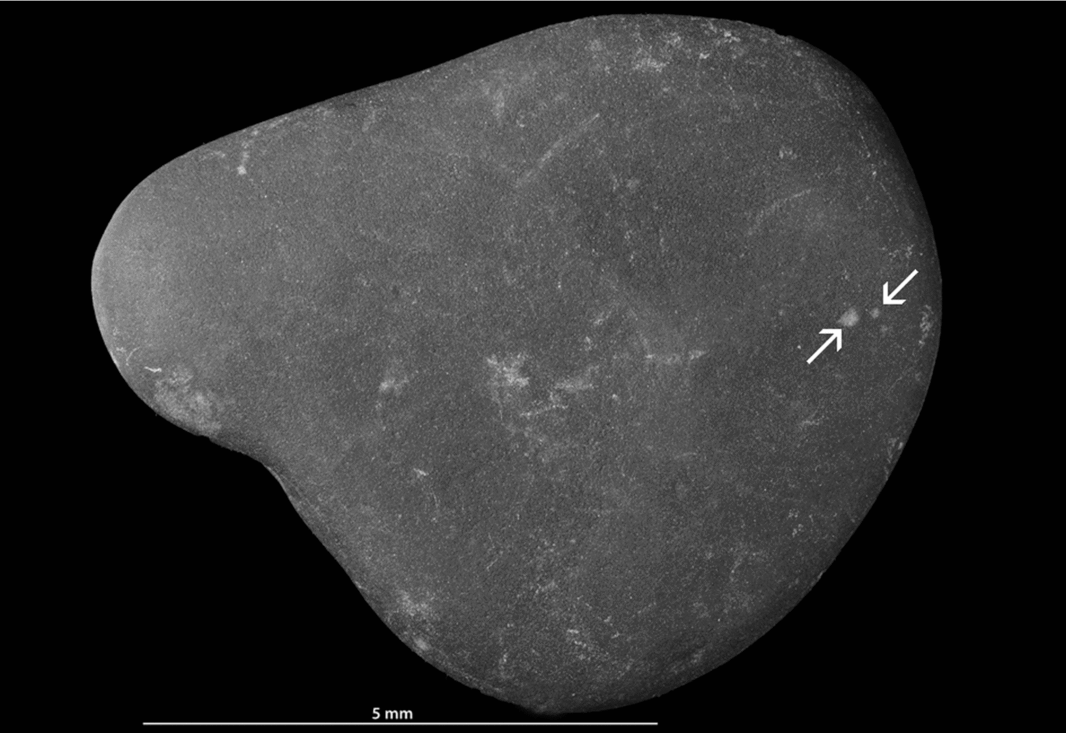
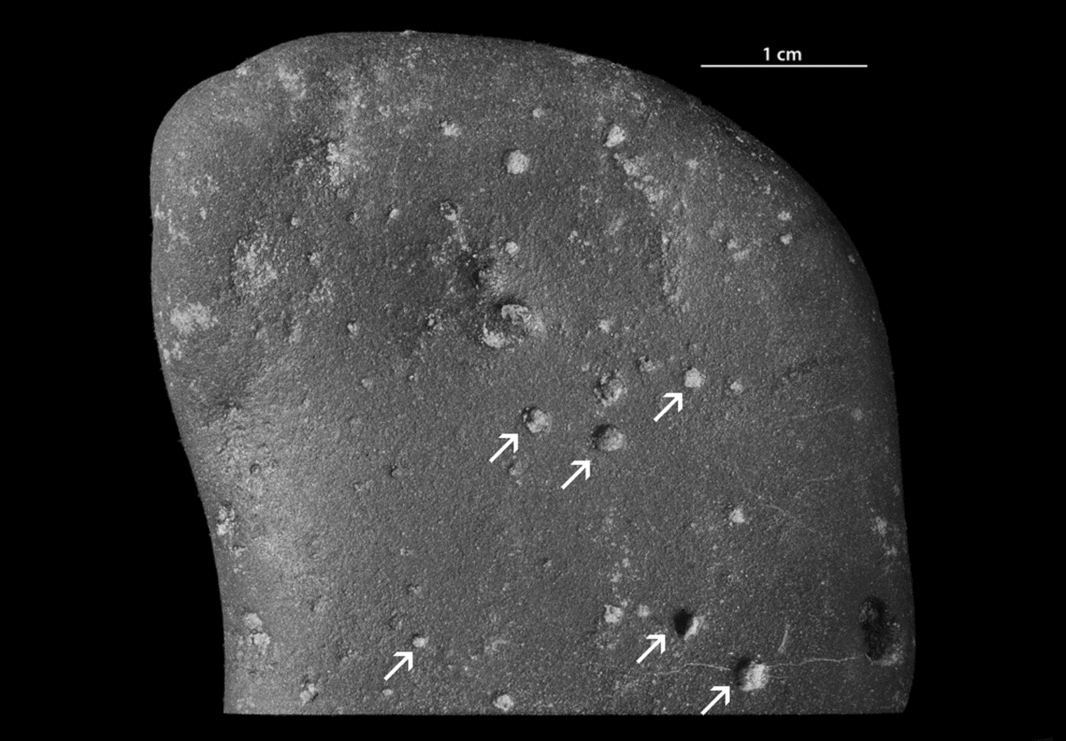
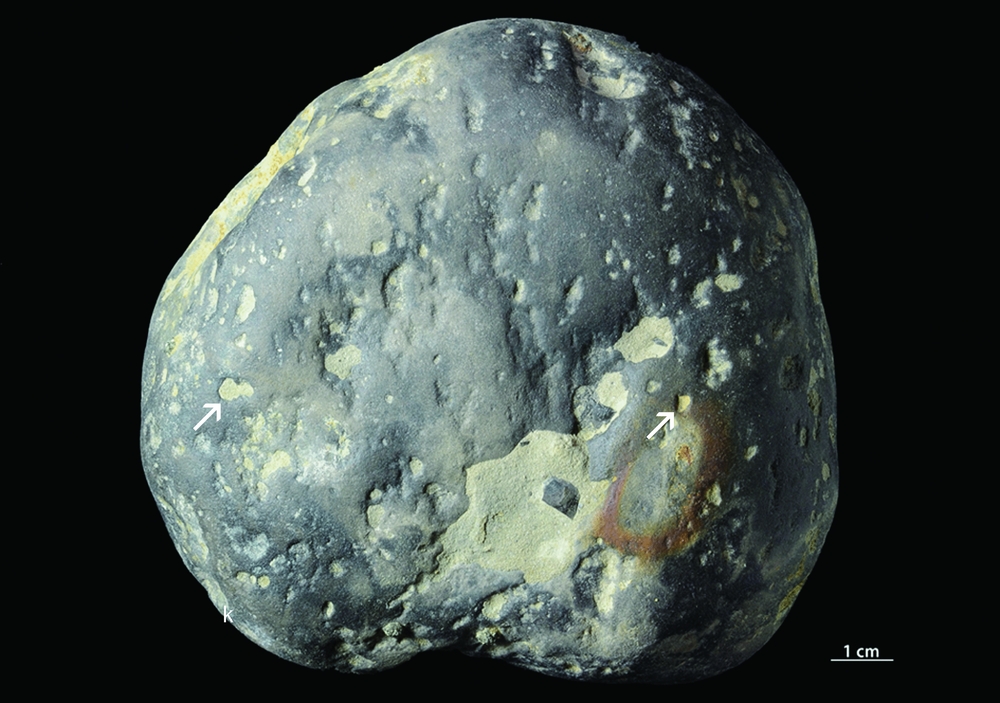
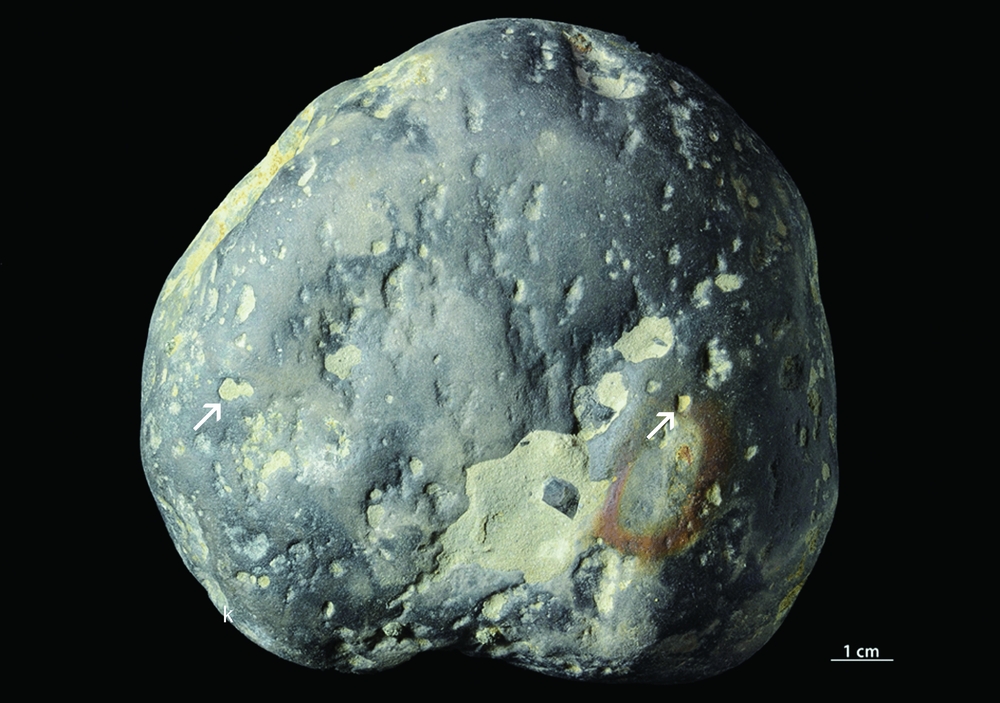
The studied pebbles from the Lükati Formation are rounded and have an oblate to tabular shape. They are 4.5–7.1 cm in diameter. They have a dark-coloured phosphatized exterior, but their interior is formed of light-coloured siltstone. Their cement does not react with acid and is possibly not carbonate. The grains are not notably sutured together. The size of grains in the siltstone corresponds to silt fractions and is not well sorted. The vast majority of the grains are quartz. The external surface of the pebbles is usually relatively smooth (Figs 5–7). Ten pebbles contain borings. The cobbles from the Ülgase Formation are rounded and have an oblate shape (Fig. 8); they are 10.3–17.5 cm in diameter. Three cobbles contain borings. They have a dark-coloured phosphatized exterior, but their interior is formed of light-coloured coarse-grained siltstone. Their cement does not react with acid and is possibly siliceous. The size of grains in the siltstone is relatively large, and they are not well sorted. The vast majority of the grains are quartz. The external surfaces of cobbles are relatively smooth to somewhat rough. The pebbles and cobbles do not show any preferential orientation. There are no encrusters on the studied pebbles and cobbles.
A bored siltstone pebble from the lower Cambrian Lükati Formation of Kopli Quarry, Tallinn. Arrows point to Trypanites borings. GIT 156-2184.

A bored siltstone pebble from the lower Cambrian Lükati Formation of Kopli Quarry, Tallinn. Arrows point to Trypanites borings. GIT 156-2185.

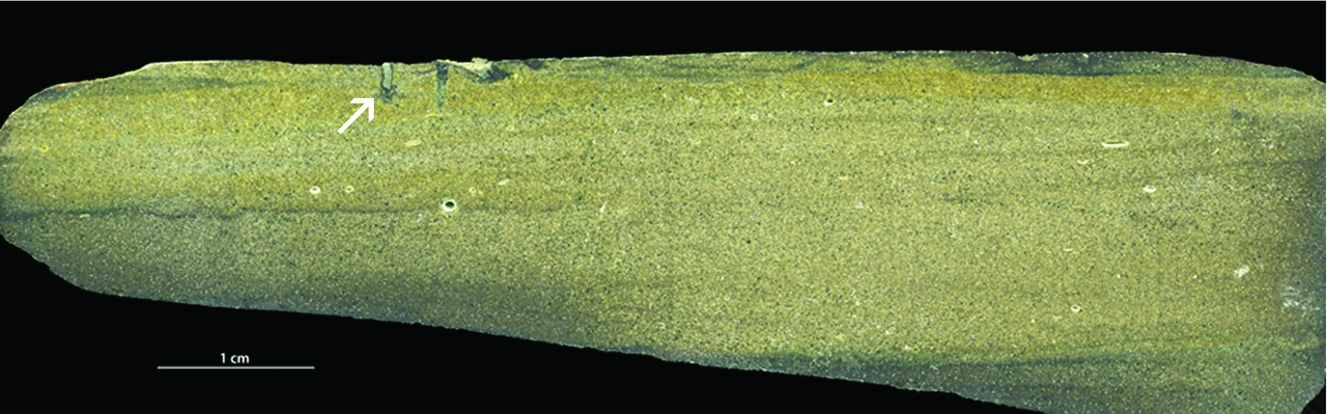
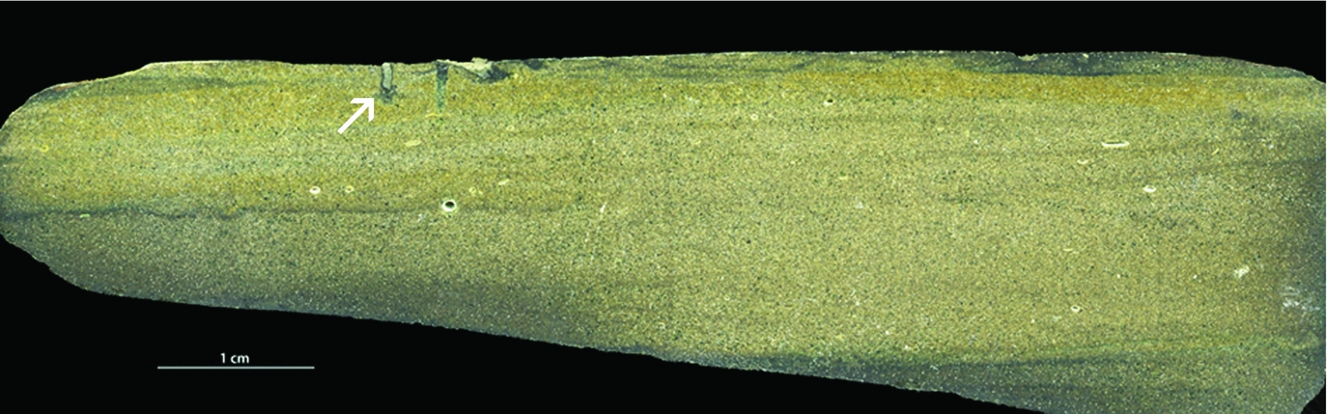
Section of the bored siltstone pebble from the lower Cambrian Lükati Formation of Kopli Quarry, Tallinn. Arrow points to Trypanites boring. GIT 156-2186.
A bored siltstone cobble from the Ülgase Formation (Furongian), Ülgase, northern Estonia. Arrows point to Trypanites borings. GIT 362-68.
Borings penetrate through the external heavily phosphatized layer into the interiors of the siltstone pebbles. However, the borings are also surrounded by a thin, diagenetic phosphatized layer. The siltstone infilling of borings is grey and finer grained than the yellowish matrix of the pebbles and is similar to the surrounding siltstone. The borings are up to 2.0 mm deep (Fig. 7). The diameters of borings vary over the range 0.1–0.3 mm in the lower Cambrian (Lükati Formation) (Figs 5–7) samples and 0.2–0.4 mm in the Furongian (Ülgase Formation) (Fig. 8) samples. The borings are simple cylindrical shafts, unbranched, with single openings. They are perpendicular to the surfaces of the pebbles and cobbles or slightly tilted (up to 20o). All borings lack a lining. The walls of the borings are relatively smooth without any regular perpendicular relief. The termini of the borings are tapered (i.e. holes come to a point) to rounded. The apertures of borings do not show signs of erosion. Borings tend to be clustered. Tabular pebbles do not contain borings on the sides.
There are at maximum eight borings per 4 cm2 of surface area in the Lükati Formation (lower Cambrian) pebbles, while in the Ülgase Formation there are at maximum seven borings per 4 cm2 of surface area. The distribution of borings is patchy on the studied cobbles and pebbles. All surfaces of all cobbles and pebbles are bored.
6. Discussion
6.a. Sedimentary environment
The sedimentary environment represented by the lower Cambrian Lükati Formation and upper Cambrian Ülgase Formation was a shallow onshore sea with normal salinity (Raukas & Teedumäe, Reference Raukas and Teedumäe1997). The water depth was within the zone of active wave influence, as indicated by overturned pebbles and cobbles. The overturning of pebbles and cobbles could also have made the substrate unfavourable for the only certain encruster, Torellella, known from Cambrian rocks of Estonia (Vinn, Reference Vinn2006). Sepkoski (Reference Sepkoski, Einsele and Seilacher1982) found that flat-pebble conglomerates, which are very common in Cambrian strata, are formed from thin limestone beds that have been ripped up and re-deposited, mostly during storms. The studied pebbles were also ripped up, but from a cemented siltstone bed and possibly also re-deposited during storms. The difference in size of pebbles and cobbles is presumably due to differential erosion before the bioerosion.
6.b. Palaeoecology
The described Trypanites borings were presumably made by endolithic suspension-feeding organisms. These organisms found shelter against predators inside the borings and had a slightly more stable substrate than the sand and silt grains on the seafloor. Maybe just as importantly, they were protected from physical abrasion within these borings. The occurrence of numerous borings in a single pebble possibly means that the studied pebbles were inhabited by many boring organisms of the same type. The ecology of Trypanites has been described for Silurian examples (Nield, Reference Nield1984). Trypanites organisms had a patchy distribution on hard substrates, they usually preferred higher grounds and they were less common on cryptic surfaces (Brett & Liddell, Reference Brett and Liddell1978; Nield, Reference Nield1984). Some of the studied pebbles show a somewhat patchy distribution of Trypanites that is similar to the stratigraphically later examples of Trypanites borings (Nield, Reference Nield1984; Tapanila, Copper & Edinger, Reference Tapanila, Copper and Edinger2004; Vinn & Wilson, Reference Vinn and Wilson2010). We did not find borings to be more numerous on certain sides of the pebbles, but this may be due to continuous overturning of the pebbles on the seafloor during the Trypanites colonization.
6.c. Boring intensities
The density of Trypanites borings in the Cambrian pebbles is not as high as in the Ordovician limestone cobbles and pebbles of Estonia, which may exceed 20 borings per 4 cm2 of substrate surface area (O. Vinn, personal obs.). The Ordovician Period experienced a great increase in bioerosion intensities and diversity; this phenomenon has been termed the Ordovician Bioerosion Revolution (Wilson & Palmer, Reference Wilson and Palmer2006). The lower boring intensities of the studied Cambrian pebbles as compared to their Ordovician analogues fits with the general idea of an evolution of bioerosion during early Palaeozoic time. Alternatively, or in addition, studied Trypanites are in phosphatized pebbles; these are generally significantly less bored than those of limestones. Lower boring intensities of Cambrian pebbles/cobbles may also be due to their different exposure time on the seafloor and availability for colonization, space competition (e.g. of the feeding apparatus, corona, etc.) and reproduction.
6.d. Encrusting organisms
Cambrian hard substrates can be encrusted (Kobluk & James, Reference Kobluk and James1979; Kobluk, Reference Kobluk1981a ). Possible encrusters known from Furongian rocks of Estonia include tubeworm-like Torellella (Cnidaria?), which cemented with its discoid holdfast to various hard substrates, such as phosphatic brachiopod shells (Vinn, Reference Vinn2006). Encrusters are not known from the lower Cambrian rocks of Estonia (Raukas & Teedumäe, Reference Raukas and Teedumäe1997). The lack of encrusters on studied siltstone pebbles is not surprising as Cambrian hard substrates were usually much less encrusted than the later Ordovician hard substrates (Palmer, Reference Palmer1982; Taylor & Wilson, Reference Taylor and Wilson2003). Wilson (Reference Wilson1987) found that increased disturbance (i.e. overturning of the cobble/pebble) is generally correlated with increased taxonomic diversity (unless the substrate is overturned so frequently that few colonizers are retained). Cambrian pebbles and cobbles of Estonia may therefore have been relatively unstable considering the occurrence of only Trypanites borings. However, the only certain encrusters known from Cambrian Estonia are Torellella (Vinn, Reference Vinn2006), and mobile substrates may have been unfavourable for them. Brett, Liddell & Derstler (Reference Brett, Liddell and Derstler1983) described a late Cambrian hardground association which included echinoderm holdfasts, algae and stromatolites. None of these encrusters are known from Cambrian Estonia.
6.e. Formation of borings
An entirely chemical means of production of these boring is unlikely, as the quartz siltsone (SiO2) is not easily soluble using the most common biologically produced solvents. However, the siltstone cobbles of Cambrian Estonia are not metamorphosed (Raukas & Teedumäe, Reference Raukas and Teedumäe1997); it is therefore possible that the cement of pebbles, which may have originally been carbonate, was dissolved or weakened chemically and the silt was mechanically removed from the boring.
Rodríguez-Tovar, Uchman & Puga-Bernabéu (Reference Rodríguez-Tovar, Uchman and Puga-Bernabéu2015) described bioerosion in gneiss. They found that Gastrochaenolites with a circular outline was created by mechanical action; mechanical boring seems to be more feasible than dissolution of gneiss. In the case of Cuenulites sorbasensis, mechanical bioerosion seems to be unimportant or even absent because its shape indicates that it was not able to rotate in the elliptical-in-outline boring (Rodríguez-Tovar, Uchman & Puga-Bernabéu, Reference Rodríguez-Tovar, Uchman and Puga-Bernabéu2015).
6.f. Comparison with other examples of Cambrian bioerosion
Intertidal biotas were relatively diverse during Cambrian time (Johnson & Baarli, Reference Johnson, Baarli and Talent2012). The described borings from Ülgase and Lükati formations were also made in a shallow sea. Lower Cambrian Trypanites borings from Estonia (Baltica) were formed in a relatively cold climate in high southern latitudes (Raukas & Teedumäe, Reference Raukas and Teedumäe1997). Laurentia was located in tropical latitudes during Cambrian time; the previously described records of early Cambrian bioerosion are related to North America (James, Kobluk & Pemberton, Reference James, Kobluk and Pemberton1977; Kobluk, Reference Kobluk1981a , Reference Kobluk b ; Johnson, Wilson & Redden, Reference Johnson, Wilson and Redden2010). The described phosphatized siltstone pebbles show that bioerosion of hard substrates was also common in relatively cold-climate Cambrian epicontinental seas, such as the Baltic Basin. Kobluk, James & Pemberton (Reference Kobluk, James and Pemberton1978) found up to two borings per 4 cm2 of surface area (i.e. 2950–5720 borings per 1 m2) in lower Cambrian carbonate hard substrates of North America. This is somewhat less than from lower Cambrian Estonia, but the difference could be explained by the different size of area used for the study. Johnson, Wilson & Redden (Reference Johnson, Wilson and Redden2010) described shallow, parabolic borings which occur in clusters with densities of 1–3.5 cm−2 in quartzite boulders from the basal conglomerate of the Cambrian–Ordovician Deadwood Formation in North America. Mechanical excavation of silicates such as quartizite would seem difficult, but it is more feasible than chemical dissolution. These boring were presumably created by the rotation of the hard parts of the boring organisms against the substrate. These boring densities are generally similar to those of the Lükati Formation, but slightly higher. Boring intensities of non-carbonate hard Cambrian substrates were relatively similar in Baltica and North America, indicating no latitudinal differences. In addition to Trypanites, borings of possible endolithic sponges are known from the lower Cambrian rocks of North America (Kobluk, Reference Kobluk1981a , Reference Kobluk b ). These borings are not known from Cambrian Baltica. It is possible that the Cambrian North American bioerosional ichnofauna may have been more diverse than its Baltic equivalent.
7. Conclusions
-
• The earliest borings in Baltica are Trypanites. These borings occur in siltstone pebbles and cobbles of early Cambrian age.
-
• Boring intensities in these Cambrian siltstone cobbles and pebbles are lower than in the Ordovician limestone pebbles of Baltica.
-
• Borings in siltstone pebbles and cobbles were likely made mechanically.
-
• Bored cobbles and pebbles lack encrustation; this is presumably due to the rarity of encrusting organisms during Cambrian time in Estonia.
Acknowledgements
Financial support to OV was provided by the Palaeontological Association Research Grant, Estonian Research Council projects ETF9064 and IUT20–34. This paper is a contribution to IGCP 591 ‘The Early to Middle Palaeozoic Revolution’. We are grateful to G. Baranov, Institute of Geology, Tallinn University of Technology for photographing the specimens and B. Pratt for useful comments on the manuscript. We are grateful to M.A. Wilson and C. Brett for the constructive reviews.