Introduction
Poultry industries face various decisions in the production cycle that include nutrient and mineral supply to birds, cost and type of feed and a range of bird health, welfare and environmental issues that affect the profitability of an operation. Prediction of growth and identifying the times of maximum growth rate and when the birds are ready for sale are important factors that contribute to the profitability of poultry operations. Traditionally, mathematical functions called ‘growth functions’ have been used to relate body weight (W) to age of the bird or cumulative dietary intake (McCance, Reference McCANCE1960; Lister et al., Reference LISTER, COWEN and McCANCE1966; Fitzhugh, Reference FITZHUGH1976). They can also be used to determine efficiency of nutrient utilization, which is the derivative of the relationship between W and cumulative dietary intake, and as response functions to predict daily energy and protein dietary requirements for maintenance and growth (France et al., Reference FRANCE, DHANOA, CAMMELL, GILL, BEEVER and THORNLEY1989). A useful growth function should describe data well and contain biologically and physically meaningful parameters (France et al., Reference FRANCE, DIJKSTRA and DHANOA1996a). Attributes quantified using growth functions include protein deposition (Strathe et al., Reference STRATHE, DANFÆR, CHWALIBOG, SØRENSEN and KEBREAB2010a), body weight (Porter et al., Reference PORTER, KEBREAB, H., LÓPEZ, STRATHE and FRANCE2010), and mineral deposition (Kebreab et al., Reference KEBREAB, STRATHE, YITBAREK, NYACHOTI, DIJKSTRA, LÓPEZ and FRANCE2010). López (Reference LÓPEZ2008) reviewed various nonlinear functions used in animal nutrition to represent time-dependent processes and events, and examined current and potential use of these functions to describe response to nutrients.
Growth functions can be broadly classified into three categories: those that describe diminishing returns behaviour (e.g. monomolecular), sigmoidal behaviour with a fixed point of inflexion (e.g. logistic, Gompertz, Schumacher), and sigmoidal behaviour with a flexible point of inflexion (e.g. von Bertalanffy, Richards, López (also referred to as Morgan), Weibull), as described in Chapter 5 of Thornley and France (Reference THORNLEY and FRANCE2007). The flexible functions are often generalized models that encompass simpler models for particular values of certain additional parameters. The objective of this paper is to review the applicability of growth functions for analyzing growth profiles in poultry.
Functional forms
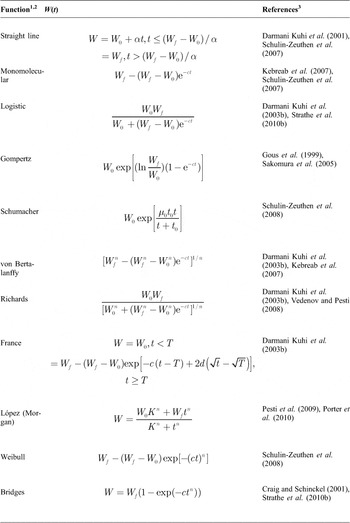
The functional forms of the equations commonly used for W (or length or height) versus age analysis are summarized in Table 1. The monomolecular equation is the simplest nonlinear equation used in most studies reviewed and contains three parameters to be estimated. The monomolecular equation describes the progress of a simple, irreversible first-order reaction and exhibits diminishing incremental behaviour. Among the growth functions with sigmoidal behaviour, the logistic equation can be derived by assuming that the quantity of growth machinery is proportional to W, the growth machinery works at a rate proportional to amount of nutrient (feed) and growth is irreversible. The inflexion point is fixed at exactly half of Wf, where Wf is theoretical final weight (mature size) of the bird (Table 1). The assumptions underlying the Gompertz equation are nutrient supply is non-limiting, the quantity of growth machinery is proportional to W, and effectiveness of the growth machinery decays exponentially with time according to a decay constant. Inflexion in this sigmoidal growth function is fixed and occurs at W = Wf /e. The Schumacher equation also exhibits sigmoidal behaviour with a fixed point of inflexion (W = W f/e2). Like the logistic and Gompertz, the Schumacher can also be derived as a two-state variable problem in which the specific growth rate decays according to a 3/2 power function rather than log-linearly as in the Gompertz (Thornley and France, Reference THORNLEY and FRANCE2007).
The functional forms used to describe the relationship between body weight, W(t), and age (time) or cumulative dietary intake, t.

1Thornley and France (Reference THORNLEY and FRANCE2007); 2W 0 is initial weight, Wf is final weight, the parameters µ 0, t 0, α, c, d and K are positive entities, n≥–1; 3Example of recent studies with poultry or pigs where the equation has been used as a growth or response function
In the von Bertalanffy equation, the assumptions are that nutrients are non-limiting, and the growth process is the difference between anabolism and catabolism. It has a flexible inflexion point that occurs at W = (1 − n)1/nWf. The Richards equation is a more empirical construct, and therefore does not have the underlying biological basis of the von Bertalanffy. However, it belongs to the same group of classic growth functions, and its flexibility, due to its shape parameter n (dimensionless), makes it a generalized alternative to other equations (e.g. monomolecular, Gompertz, logistic, von Bertalanffy) (Thornley and France, Reference THORNLEY and FRANCE2007). The France equation is capable of describing a range of diminishing returns and sigmoidal growth patterns. It has the advantages over the Richards of being able to describe a wider variety of possibilities, and of having a more mechanistic derivation. The López equation is a generalized Michaelis-Menten equation akin to the Hill equation for enzyme kinetics. Both the France and the Lopez equations are flexible growth functions that can be derived from state variable considerations (Thornley and France, Reference THORNLEY and FRANCE2007).
The differential form of the Weibull equation is non-autonomous (i.e. explicitly time-dependent), so the equation cannot be derived as a state variable problem and therefore has little credible mechanistic basis in terms of a simple model. Nonetheless, it is a well behaved and useful function. A special case of the Weibull (with W 0 = 0) is the Bridges equation. The initial condition W 0 = 0 might well limit its applicability in the study of growth curves in poultry.
Historical development
Graphical representation of animal growth was current prior to the 1920s when early fast growth rate, point of inflexion, and slow approach to final asymptotic weight were apparently based on visual appraisal of growth curves (e.g. Ritzman, Reference RITZMAN1917). However, mathematical descriptions of these curves were almost non-existent. The sigmoidal shape of the trajectory indicated that linear regression was not suitable to describe growth, unless small portions of the curve only are considered or data are transformed. Description and prediction of growth using equations emerged in agriculture from two different directions: equations were either borrowed from human population studies or developed specifically for animals and plants.
Mitscherlich-Königsberg (Reference MITSCHERLICH-KÖNIGSBERG1909) proposed an equation with no accelerating phase to describe the effect of chemical fertilisers on crop yields. The growth response obeyed the law of diminishing increments, meaning that growth rate decreased continually and that the curve had no point of inflexion. This equation is more commonly referred to as the ‘monomolecular’ because of its association with chemical reaction kinetics. Wood and Yule (Reference WOOD and YULE1914) referred to the law of diminishing increments in describing the relationship between body weight gain and swede (rutabaga) intake in oxen, but did not mention explicitly whether they used the monomolecular. Body weight as a function of feed intake was first described using the monomolecular in poultry science by Jull and Titus (Reference JULL and TITUS1928) and Hendricks (Reference HENDRICKS1931) in studies with chickens. The monomolecular is inadequate to describe the sigmoidal growth trajectory of young birds and mammals with respect to time. Therefore, Brody (Reference BRODY1945) brought the exponential and monomolecular equations together to generate a curve having a sigmoidal shape. The monomolecular (Mitscherlich) was first proposed by Blaxter and Boyne (Reference BLAXTER and BOYNE1978) for describing the relationship between energy retention and feed intake, based on a detailed analysis of over 80 calorimetric experiments with sheep and cattle. Previously, this non-linear relationship had been approximated with two straight lines intersecting at zero energy retention (i.e. maintenance) (Blaxter and Wainman, Reference BLAXTER and WAINMAN1961).
The logistic equation, developed by the mathematician Verhulst (Reference VERHULST1838), was first applied to animals by Robertson (Reference ROBERTSON1916, Reference ROBERTSON1923), and thereafter by Pearl (Reference PEARL1925), who described the growth of mammals, plants, and yeast cells. Robertson (Reference ROBERTSON1908) had originally applied the logistic to plants in studying autocatalysis. The Gompertz equation (Gompertz, Reference GOMPERTZ1825) was first used as a growth function in animal science by Wright (Wright, Reference WRIGHT1926; Winsor, Reference WINSOR1932), a geneticist, who stated that growth curves of individual organisms display an asymmetrical S-shape which is better described by a log-log equation than by the logistic. Wright (Reference WRIGHT1926) never referred to Gompertz in his paper, but the equation he brought forward was in reality a linearised form of the Gompertz (Wright, Reference WRIGHT1926; Winsor, Reference WINSOR1932). Two years later, Davidson (Reference DAVIDSON1928) described the growth of Jersey cows using the Gompertz. He was arguably one of the first to note that the point of inflexion of the Gompertz is fixed and corresponds to maximum asymptotic body weight divided by the base of natural logarithms. Winsor (Reference WINSOR1932) probably contributed to the popularisation of the Gompertz in biology through his paper read at the US National Academy of Sciences, and it has been used for purposes other than growth analysis, e.g. to estimate glucose oxidation in broiler chickens (Buyse et al., Reference BUYSE, GEYPENS, MALHEIROS, MORAES, SWENNEN and DECUYPERE2004). Schulin-Zeuthen et al. (Reference SCHULIN-ZEUTHEN, KEBREAB, DIJKSTRA, LÓPEZ, BANNINK, DARMANI KUHI, THORNLEY and FRANCE2008) introduced another sigmoidal function, the Schumacher equation, into animal science to describe growth in pigs. The Schumacher is analysed in detail by Thornley and France (Reference THORNLEY and FRANCE2007) and deviates considerably from its original empirical construct described in Schumacher (Reference SCHUMACHER1939) to represent timber yield.
The rise of systemics, a collection of organised and interrelated concepts to explain causality, in science between 1920 and 1950 probably fostered the mechanistic representation of growth (Dumas et al., Reference DUMAS, DIJKSTRA and FRANCE2008). Growth functions that attempt to include biologically meaningful parameters and circumvent concerns about a fixed point of inflexion as assumed in the logistic and Gompertz equations arose mostly during this time period. Pütter (Reference PÜTTER1920) conceptualized growth as anabolism prevailing over catabolism. The biologist von Bertalanffy, a pioneer of systemics (von Bertalanffy, Reference VON BERTALANFFY1950), borrowed the concept proposed by Pütter (Reference PÜTTER1920) and formalized it (von Bertalanffy, Reference VON BERTALANFFY1957; Ricker, Reference RICKER1979), incorporating various assumptions such as allometry and size dependence, to derive his growth function. The equation has an asymptote, Wf, and a flexible point of inflexion (Thornley and France, Reference THORNLEY and FRANCE2007). Prior to von Bertalanffy, Murray (Reference MURRAY1921) considered growth as a metabolic process and applied his equation to farm animals using a value of two-thirds for the allometric exponent. Murray (Reference MURRAY1921) did not refer to Pütter, nor differentiate between anabolism and catabolism in its mathematical expression, and therefore gave no biological interpretation of the equation parameters. However, it was assumed that metabolism adheres to the surface law and, for this reason, adopted the value two-thirds. Lotka (Reference LOTKA1925), another pioneer of systemics, proposed a similar equation, but overlooked the metabolic processes in play.
Richards (Reference RICHARDS1959), a botanist, starting with the von Bertalanffy equation, developed a more generic function. The Richards equation has four parameters and encompasses the von Bertalanffy, Gompertz, logistic and monomolecular equations. The inflexion point can occur at various fractions of the maximum asymptotic weight. The function is generally flexible and accommodates various growth patterns (Thornley and France, Reference THORNLEY and FRANCE2007). It is sometimes referred to as the four-parameter logistic (e.g. Gahl et al., Reference GAHL, FINKE, CRENSHAW and BENEVENGA1991). The France equation is capable of describing a range of diminishing returns and sigmoidal growth patterns (France et al., Reference FRANCE, DIJKSTRA, THORNLEY and DHANOA1996b). It has the advantages over the Richards of being able to describe a wider variety of possibilities, and of having a more mechanistic derivation. The López equation is a generalized Michaelis-Menten akin to the Hill equation for enzyme kinetics (Hill, Reference HILL1910; Michaelis and Menten, Reference MICHAELIS and MENTEN1913). It was derived as a growth function by López et al. (Reference LÓPEZ, FRANCE, GERRITS, DHANOA, HUMPHRIES and DIJKSTRA2000) and proposed earlier as a response function by Morgan et al. (Reference MORGAN, MERCER and FLODIN1975). It is sometimes referred to as the saturation kinetics model when used to analyse nutritional response data (e.g. Vedenov and Pesti, Reference VEDENOV and PESTI2008). The López encompasses the simple Michaelis-Menten, a diminishing returns equation which, although originally intended for enzyme kinetics, has been used to describe weight gain of animals, effect of substrate on bacterial growth rate, and biochemical flows in process-based simulation models of metabolism (Monod, Reference MONOD1942; Koehler et al., Reference KOEHLER, PAHLE, GRUHN, ZANDER, JEROCH and GEBHARDT1988; López et al., Reference LÓPEZ, FRANCE, GERRITS, DHANOA, HUMPHRIES and DIJKSTRA2000). Both the France and the Lopez equations are flexible growth functions that can be derived from state variable considerations, unlike the Weibull equation. The latter is the cumulative density function of the Weibull distribution, a continuous probability distribution. It is named after Waloddi Weibull who described it in detail (Weibull, Reference WEIBULL1951), although it was first identified by Frechet (1927) and first applied by Rosin and Rammler (Reference ROSIN and RAMMLER1933) to describe the size distribution of particles. The Bridges equation, a special case of the Weibull, was proposed by Bridges et al. (Reference BRIDGES, TURNER, STAHLY, USRY and LOEWER O.J.1992), measuring time from conception rather than from birth.
Most of these growth functions are now routinely applied in animal biology to predict growth. Furthermore these, along with chemical kinetic equations, have proven appropriate to describe complex dynamics and metabolic fluxes in mechanistic simulation models as they exhibit a wide array of dynamic behaviour.
An illustrative case study
Among nutritional factors determining rate of growth of animals, dietary energy and crude protein (CP) are without doubt the most important ones. The usefulness of growth functions, particularly the monomolecular equation, to predict daily energy and protein dietary requirements for maintenance and growth has recently been demonstrated in broilers and turkeys (Darmani-Kuhi et al., 2003a, 2004, 2009 and Kebreab et al., Reference KEBREAB, FRANCE, DARMANI KUHI and LOPEZ2008). This illustrative case study aims to apply the monomolecular to provide an estimate of cumulative metabolisable energy (ME) requirements, CP requirement for maintenance, and efficiency of CP utilisation for growth in growing turkeys.
materials and methods
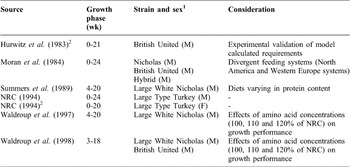
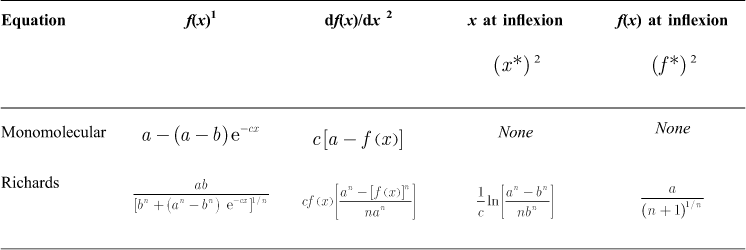
Data sets, shown in Table 2, and the function forms, f(x), listed in Table 3and 4, were used to investigate the relationships between body weight and cumulative ME intake, and between body weight gain and CP intake in two different analyses (Analysis I and II, respectively). Note that growth functions (Table 1) need to be re-parameterised before application to retention versus intake data (i.e. rate against rate) to permit negative values of the intercept on the y-axis (France et al., Reference FRANCE, DHANOA, CAMMELL, GILL, BEEVER and THORNLEY1989).
Data sources used in the case study.

1M = male, F = female
2These data were only used in Analysis II
The functional forms used in Analysis I to describe the relationship between body weight, f(x), and cumulative ME intake, x.
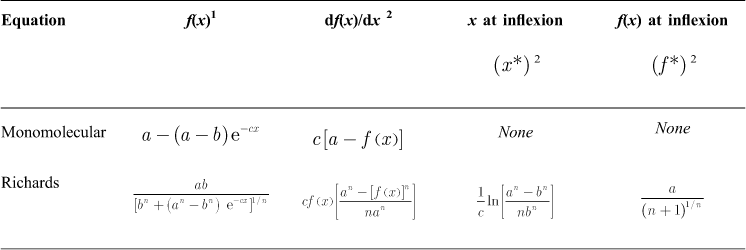
1The parameters a and b (both g) are the final and initial values corresponding to Wf and W 0, respectively, in Table 1; c (MJ-1) is positive and n (dimensionless) ≥ −1
2df(x)/dx is at its maximum at the inflexion point (x*, f*)
The monomolecular model used in Analysis II to describe the relationship between body weight gain, f(x), and CP intake, x.

1France et al. (Reference FRANCE, DHANOA, CAMMELL, GILL, BEEVER and THORNLEY1989); 2The parameters a, b and c are positive entities, with f max = a and f min = −b. The expressions for xm, where the subscript m denotes maintenance, were obtained as the x value when f(x) = 0
All statistical analyses were performed using the mixed non-linear procedure of SAS (SAS, Reference SAS2000). Mixed model analysis was chosen for analyses because the data were gathered from various published reports and therefore there is a need to consider the report (data source) factor as a random effect (because the studies represent a random sample of a larger population of studies). Performance of the models was evaluated using the significance level of the parameters estimated, variance of error estimate and its standard error. Comparison of models was based on Bayesian Information Criteria (BIC) (Leonard and Hsu, Reference LEONARD and HSU2001).
results
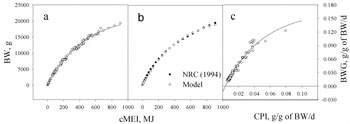
Fitting the Richards equation (Analysis I) to the pooled cumulative ME intake data set showed that parameter n was not significantly different from −1. Therefore, the sigmoidal trend was discarded and diminishing returns behaviour was assumed (Figure 1a). To evaluate the performance of the monomolecular, a comparison was made with data used for the calculation of cumulative ME requirements for male turkeys proposed by NRC (1994). Body weight profiles were simulated from our model using the relevant parameter estimates and compared with data from NRC (1994) (Figure 1b). There was close agreement between the values of body weight proposed by NRC (1994) and those obtained using our model. Figure 1c shows the fit of the monomolecular equation to body weight gain versus CP intake data in Analysis II.
Plots of a) body weight (BW, g) against cumulative metabolisable energy intake (cMEI, MJ) showing the fit of the monomolecular equation (Analysis I), b) comparison between BW proposed by NRC (1994) and BW values estimated from cMEI using the monomolecular equation (Analysis I), c) rate of BW gain (BWG, g/g BW/d) against crude protein intake (CPI, g/g BW/d) showing the fit of the monomolecular equation (Analysis II).

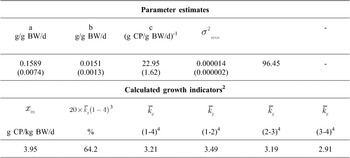
The fitted curve and general goodness of fit, based on variation accounted for and standard error (SE) estimated for the growth parameters, indicated that fit of the monomolecular to the data sets was acceptable (Table 5).
Parameter estimates obtained and growth indicators calculated using the monomolecular model (Analysis II), standard errors are given in parentheses1.

1Number of observations = 199
2Indicators calculated based on parameter estimates for a, b and c 3The average net protein utilisation for growth between 1-4 times maintenance calculated based on the assumption that the carcass of turkeys contains approximately 20% crude protein
4The average efficiency of CP utilization for growth (g gain/g CP) between 1-4, 1-2, 2-3 and 3-4 times maintenance
inference
Based on statistical performance and the biological interpretability of the parameter estimates, it was found that the data could be accurately described by the monomolecular equation (Table 5 and Figure 1). The CP requirement for maintenance (3.95 g/kg body weight/d) and average net protein utilisation for growth between 1-4 times maintenance (64%), calculated based on parameter estimates for the monomolecular (Table 5), agree well with previous studies (Kebreab et al., Reference KEBREAB, FRANCE, DARMANI KUHI and LOPEZ2008).
Comparing growth functions
Comparison of three and four parameter growth functions shows that in many cases a four parameter growth function is required to describe growth versus age adequately. Darmani Kuhi et al. (Reference DARMANI KUHI, KEBREAB, S. and FRANCE2003b) compared the Gompertz, logistic, López, Richards, von Bertalanffy and France equations for describing growth in meat and egg strains of chicken. In general the authors found the four parameter equations gave a better fit but all parameter estimates were not always significant. The Richards was found to be the best fitting model and the Gompertz fitted better than the logistic due to the lower inflexion point observed in the data. Therefore, consideration of flexible growth functions as an alternative to simpler equations (with a fixed point of inflexion) for describing the relationship between body weight and age are recommended in chickens (Darmani Kuhi et al., Reference DARMANI KUHI, KEBREAB, S. and FRANCE2003b). However, using the Richards equation can sometimes lead to optimisation problems and the process can fail to converge, primarily due to difficulty in estimating initial W (W 0) values. If W 0 is known and does not need to be estimated, fixing W 0 might solve the problem of non-convergence with the Richards. On the other hand, if W 0 has already been estimated using the equation, fixing it might worsen the fit (France et al., Reference FRANCE, DIJKSTRA and DHANOA1996a).
Porter et al. (Reference PORTER, KEBREAB, H., LÓPEZ, STRATHE and FRANCE2010) compared three flexible growth functions (von Bertalanffy, Richards, and López) and evaluated them with regard to their ability to describe the relationship between W and age in growing turkey hens from commercial flocks. They also compared the flexible functions with the Gompertz. The authors reported that the fixed inflexion point of the Gompertz was a limitation, and that the relationship between W and age in turkeys was best described using flexible growth functions. However, they ran into optimisation problems with the Richards and reported that the López was best in describing growth in turkeys.
Similar to poultry growth, Kebreab et al. (Reference KEBREAB, SCHULIN-ZEUTHEN, LÓPEZ, DIAS, DE LANGE and FRANCE2007) reported for pigs that using a more complex (four parameter) function resulted in lower BIC values (therefore, better) than using three parameter functions and the additional parameter was justified because it gave flexibility to a growth function. The authors argue that although the Gompertz has been used extensively, four parameter growth functions such as the Richards were superior in describing growth over time and are recommended for use in growth data analysis in monogastric animals. Among the four parameter growth functions, Schinckel et al. (Reference SCHINCKEL, PENCE, EINSTEIN, HINSON, PRECKEL, RADCLIFFE and RICHERT B.T.2006) showed that the López equation produced a marginally better fit for pig growth data than the Weibull and the Bridges equations. Strathe et al. (Reference STRATHE, DANFÆR, SØRENSEN and KEBREAB2010b) compared four growth functions to describe growth profiles from barrows, boars, and gilts and reported that based on Akaike Information Criteria (Burnham and Anderson, Reference BURNHAM and ANDERSON2002) the ranking was López > Bridges > Gompertz > Logistic. One of the reasons for the Logistic equation performing poorly when describing growth is the inflexion point occurs at a much earlier stage than half mature body size. The Gompertz has a lower inflexion point compared to the logistic and usually does better in describing growth. Schulin-Zeuthen et al. (Reference SCHULIN-ZEUTHEN, KEBREAB, DIJKSTRA, LÓPEZ, BANNINK, DARMANI KUHI, THORNLEY and FRANCE2008) reported that the Schumacher equation did better than the Gompertz based on BIC values. Part of the reason could be that, in the Schumacher, the inflexion point occurs at an earlier age compared to the Gompertz and the logistic. The authors also reported that the Weibull was better than the Gompertz based on residual mean squares but some of the parameters were not significant.
A diminishing returns rather than a sigmoidal function is in most cases all that is required to describe growth versus cumulative dietary intake or rate of retention versus daily nutrient intake adequately. A standard growth function needs to be re-parameterised before it can be applied retention versus intake data to allow negative values of the y-axis intercept (France et al., Reference FRANCE, DHANOA, CAMMELL, GILL, BEEVER and THORNLEY1989). Our case study has demonstrated the applicability of the monomolecular to these analyses in growing turkeys, a result confirmed previously for broilers (Darmani-Kuhi et al., 2003a, 2009 and Kebreab et al., Reference KEBREAB, FRANCE, DARMANI KUHI and LOPEZ2008) and turkeys (Darmani-Kuhi et al., 2004).
Conclusions
For describing growth versus age in poultry and pigs, a fixed point of inflexion can be a limitation with equations such as the Gompertz and logistic. In general, the point of inflexion occurs at weights less than half of final weight and varies depending on age, sex, breed and type of animal. Therefore, it has been reported in many cases that four parameter equations with a flexible inflexion point fit growth data better. In some cases optimisation problems can occur with equations such as the Richards but consideration is needed on a case by case basis. The López has frequently been shown to be an appropriate mathematical function for growth profile analysis in both poultry and pigs. For describing growth versus cumulative dietary intake and retention rate against daily intake, which generally do not exhibit an inflexion point, the monomolecular would appear the function of choice.