Introduction
The Russian Federation (hereafter Russia), the largest of all the successor states to the Soviet Union, is a constitutionally multi-ethnic state. Having inherited the institutional legacies of ethno-federalism from the Soviet Union, Russia not only has 21 republics, Footnote 1 one autonomous oblast’, and four autonomous okrug, but also continues to officially categorize its population in ethnic terms in censuses (for example, all-Russia population censuses in 2002 and 2010). The Soviet Union pioneered, compared to the rest of the world, the establishment of ethnic, territorially based, autonomous entities for certain ethnic minorities (Martin Reference Martin2001, 10) to reconcile distinct, entrenched ethnic identities with the multi-ethnic state’s territorial integrity. In such formally autonomous ethnic regions, the ethnic category for whom autonomy is designated is considered “titular” to the region, and elites of such titular categories are supposed to have guaranteed representation in the ethnoregional state apparatuses, at least proportionate to the demographic weight of the titular population in the total regional population.
Other institutions of the Soviet Union that manage its ethnically, linguistically, and culturally diverse population include generating ethnic categories (Hirsch Reference Hirsch2005); training and promoting ethnic non-Russian cadres (korenizatsiia, Martin Reference Martin2001, 10–12); and standardizing non-Russian ethnic languages, state-sponsored institutions for the production and reproduction of ethnically-specific knowledge, and affirmative actions (14). The Soviet Union’s designation of ethnic territorially based autonomy under an ethnofederal framework consisted of four tiers (Gorenburg Reference Gorenburg2003, 31) of ethnic regions. The first tier, union republics, laid the foundation for the very disintegration of the Soviet Union, whereas the second tier, Footnote 2 autonomous soviet socialist republics, became constituent units of the newly independent Russia as a result of the compromises between Moscow and elites based in such republics in the 1990s.Footnote 3 Since Vladimir Putin’s rise to power, Moscow has pursued centralization reforms, but the normative frame of ethnofederalism remains.
Ideally, ethnic, territorially based autonomy is meant to provide ethnic minorities with formal opportunities for participating in state affairs, especially in their eponymous regions. Intriguingly, although autonomy as a prescriptive institution applies to all of such ethnic regions in Russia, autonomy as an implemented outcome varies across them. Some of them have been more capable of actually exercising the formally promulgated autonomy than others. What can explain the variations across different ethnic regions in terms of implemented autonomy outcome? Using ethnic regions as units of analysis, this article proposes both a conceptual framework to represent such variations and an analytical framework, which is composed of both long-range (inter-ethnic boundary making) and short-term (titular elites’ bargaining capacity) variables to account for such variations. Both frameworks are applied to a synchronic comparative study of autonomy outcomes in three ethnic republics of Russia, Republic of Tatarstan (hereafter RT, used as a reference case), Republic of Bashkortostan (hereafter RB), and Republic of Sakha/Yakutia (hereafter RS) for the first six years of the 2010s. Based on data collected from fieldworkFootnote 4 and secondary sources, the article investigates whether differing patterns of Tatar-Russian, Bashkir-Russian, and Yakut-Russian inter-ethnic relations can contribute to varying degrees of bargaining capacity for the titular elites, which in turn can shape varying autonomy outcomes across the three republics.
Tatarstan, Bashkortostan, and Yakutia are similar with regard to the titular–Russian population ratio, Footnote 5 and around half of their respective ethnoregional population can still use the titular language.Footnote 6 They differ from both the cluster of ethnic regions where titular ethnic consciousness dwindles continuously (such as Karelia, Mari El, Mordovia) and the cluster of ethnic regions mired in either sporadic insurgencies, highly coercive governance, or economic underdevelopment (such as Chechnya, Ingushetia, Dagestan, Kalmykia, Tyva). Bashkortostan is the firstFootnote 7 ethnic republic established under the auspices of the Bolsheviks within the boundary of the present-day Russian Federation. It also has the distinctions of being the ethnic region in Russia with the largest population and of the relatively low percentageFootnote 8 of its titular ethnic population in the total population of the republic. Tatarstan is the secondFootnote 9 ethnic republic established under the auspices of the Bolsheviks within the boundary of present-day Russian Federation. It is also the ethnic region in Russia with the second largest population. Most notably, throughout the 1999s, 2000s, and 2010s, flourishing autonomy-building initiatives have enabled Tatarstan to attain the most privileged status of all the constituent entities of Russia. Yakutia is the ethnic region with the largest area in Russia. It also has the distinction of being the largest subnational-level entity of the world in terms of area.
Unlike conventional wisdom, which tends to assume inter-ethnic integration and inter-ethnic distinction as mutually conflictual or even exclusive processes (Gurr Reference Gurr2000; Horowitz Reference Horowitz1985; Maxwell Reference Maxwell2012; Sambanis and Milanovic Reference Sambanis and Milanovic2014), I argue that an “integration–distinction balance,” or rather, greater inter-ethnic integration combined with robust consciousness of inter-ethnic distinction, is conducive to building the capacity for titular elites to bargain with the central state, which in turn can lead to a greater autonomy outcome for the ethnic region. Simply put, the higher the level of social integration for the titular population, and the higher the level of titular elites’ representation in the regional state, then the higher the level of implemented autonomy outcome for the ethnic region.
Existing Literature
The existing literature tends to treat ethnic territorially based autonomy either as an independent variable impacting the likelihood of ethnic conflicts (Bunce and Watts Reference Bunce, Watts, Roeder and Rothchild2005; Siroky and Cuffe Reference Siroky and Cuffe2015) or as a prescriptive category to manage ethnic conflicts (Lake and Rothchild Reference Lake and Rothchild1996; Lapidoth Reference Lapidoth1997; Shaykhutdinov Reference Shaykhutdinov2010) rather than as an empirical and quantifiable fact. The question regarding “once launched, how autonomy actually works” has not been adequately addressed, which results in a lack of readily available analytical frameworks to explain autonomy as implemented outcome. [An exception is Sambanis and Milanovic’s (Reference Sambanis and Milanovic2014) political economy explanation of varying “policy autonomy” across regions.] In response, I build on Rahsaan Maxwell’s (Reference Maxwell2012) political sociology explanation (“integration trade-offs” theory), which posits that social segregation is conducive to political representation by appropriating one long-range factor, social integration, and one short-term factor, elite representation, to account for implemented autonomy outcomes. Nevertheless, I challenge an assumption underlying his explanation that inter-ethnic integration and inter-ethnic distinction are mutually conflictual by drawing upon Elise Giuliano’s (Reference Giuliano2000) insights on ethnic mobilization.
Sambanis and Milanovic’s study is pioneering in terms of measuring a subnational-level region’s degree of actually exercised autonomy by employing the “share of regional expenditures that can be financed out of regional revenues” (Reference Sambanis and Milanovic2014, 11) as a proxy for political autonomy. However, financial self-sufficiency can be treated as just one of many component aspects of an ethnic region’s implemented autonomy outcome. In addition, such aspects as overall productivity, efficiency in terms of labor use, and ability to procure financial transfers from the central state can also suggest a region’s level of political autonomy. For example, Tatarstan and Bashkortostan were largely comparable in terms of their regional financial self-sufficiency from 2010 through 2015. Does this mean Tatarstan and Bashkortostan were equally autonomous? Not quite if we take into consideration the region’s overall productivity (ability to contribute to the bursar of the central state) and developmental sustainability, since the GDP per capita of Tatarstan is much higher than that of Bashkortostan, and the size of the regional expenditure is larger as well (Russian Federation Federal Statistical Service 2017). Moreover, Yakutia’s GDP per capita was much higher than that of Tatarstan and Bashkortostan thanks to being a geographically immense, resource-rich, sparsely populated region, but its unemployment rate was much higher than that of Tatarstan and Bashkortostan (Russian Federation Federal Statistical Service 2017). In light of these issues, I use a conceptual framework that comprehensively assesses an ethnic region’s implemented autonomy outcome on three dimensions: political participation among the region’s titular population, economic development of the region, and cultural promotion among the region’s titular population.
Maxwell’s (Reference Maxwell2012, 4) “integration trade-offs” theory postulates that a higher level of social integration may undermine a minority’s ability to mobilize, which in turn may hinder its ability to bargain with the state for economic benefits and to be better politically represented in the state apparatus. He bases his argument on the assumption that social segregation can be conducive to the building of group consciousness of collective identity (Maxwell Reference Maxwell2012, 22), which in turn prepares the minority for group-based mobilization that can improve political or economic integrations. Nevertheless, the type of minorities studied by Maxwell are migrant minorities without autonomous regions designated for them, while this article focuses on titular minorities with autonomous regions designated for them. Furthermore, the institutional order of former colonial empires in Western Europe differs significantly from that of such colossal, multi-ethnic, and authoritarian regimes as Russia. In Britain or France, political representation of migrant minorities is usually realized through electoral processes, whereas in Russia, representation of elites of ethnic minority categories is usually realized through elite networks within an incumbent party, even if the incumbent party’s picked candidates may be legitimized through formal electoral processes as well. Last but not least, higher levels of acculturation and social integration do not necessarily translate into reduced group consciousness. On the contrary, inter-ethnic integration and inter-ethnic distinction can be achieved at once and combined to improve minority elites’ bargaining capacity.
Giuliano (Reference Giuliano2000), in her case study of ethnic mobilization in Tatarstan, challenges the assumption that individuals’ preferences automatically align with their ethnic affiliation. The conventional wisdom, that inter-ethnic integration and distinction are mutually exclusive, tends to have two underpinning assumptions: (1) integration erodes distinction and (2) shared identity automatically translates into intra-ethnic cohesion and shared preferences. Giuliano argues that intra-ethnic heterogeneous preferences may form despite shared consciousness of being ethnically distinct, since other types of cleavages may contribute to “varied interests within the group” (Giuliano Reference Giuliano2000, 303). She also notes that cross-ethnic, common preferences and cooperation may also exist (303). The empirical records of the three republics of Russia inform us that (1) integration does not necessarily erode distinction and (2) shared ethnic affiliation alone does not translate into improved bargaining capacity for titular elites. To the contrary, when robust consciousness of inter-ethnic distinction is treated as a given, inter-ethnic integration can be conducive to elite-level, cross-ethnic cooperation, especially through an incumbent party, as well as to building cohesion, not only within the titular population but also across ethnic populations.
Autonomy as Prescriptive Institution and as Implemented Outcome
I conceptualize ethnic, territorially based autonomy in two separate modes: “autonomy as prescriptive institution” and “autonomy as implemented outcome.” Autonomy as prescriptive institution is defined as territorially based power-sharing arrangements distinguishing an ethnoregional state from the central state, in which a specific territory is formally attached to a specific ethnic category, usually a minority category, and in which elites of that ethnic category are supposed to be adequately represented in the decision making of the ethnoregional state. Such prescriptive institution is usually embodied in the relevant, legally binding documents that legitimate and delimit the expected roles of both the central and ethnoregional states in terms of how to govern the ethnic region.
For ethnic regions in Russia, the governing documents encompass the 1993 Constitution of the Russian Federation and the respective constitutions of ethnic republics, such as the 1992 Constitution of the RT, Footnote 10 the 1993 Constitution of the RB, Footnote 11 and the 1992 Constitution of the RS.Footnote 12 In the case of Tatarstan, a third document, the 2007 Federal-Tatarstan Treaty, Footnote 13 also serves as a baseline.
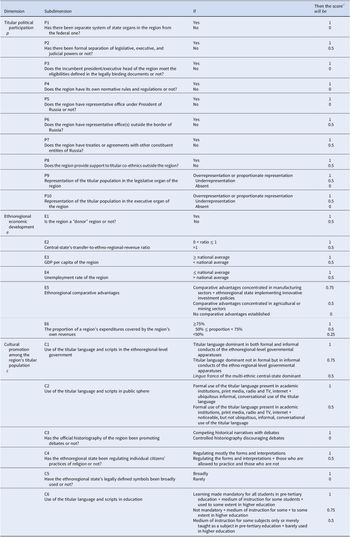
I define autonomy as implemented outcome in terms of how much of what is prescribed in the legally binding documents establishing the formal autonomy for the ethnic region has been empirically implemented in compliance. To measure a region’s degree of such compliance, I devise an instrument ( Table 1) that scores a region on three dimensions: political participation among the region’s titular population, economic development of the region, and cultural promotion among the region’s titular population. Each dimension is assigned a weight of one-third, generating an aggregate score up to 100%. Scoring is reliant upon a triangulation of state-generated data, respondents’ perspectives, and cross-verifications with the author’s observations.
Scoring schemes for an ethnic region’s implemented autonomy outcome in Russia.

a Subdimensions considered necessary attributes of implemented autonomy can take the value of 0 if empirical evidence points to the absence of such attributes. For attributes considered concomitant but not necessary attributes of implemented autonomy, indexes can be dichotomous or trichotomous but do not take the value of 0.
For an ethnic region in Russia, the formula with which to calculate the degree of its actually exercised autonomy, A, is proposed as
 $$ \mathrm{A}=( p/10\times 1/3+ e/6\times 1/3+ c/6\times 1/3)\times 100\% $$
Autonomy Outcome in Tatarstan, Bashkortostan, and Yakutia
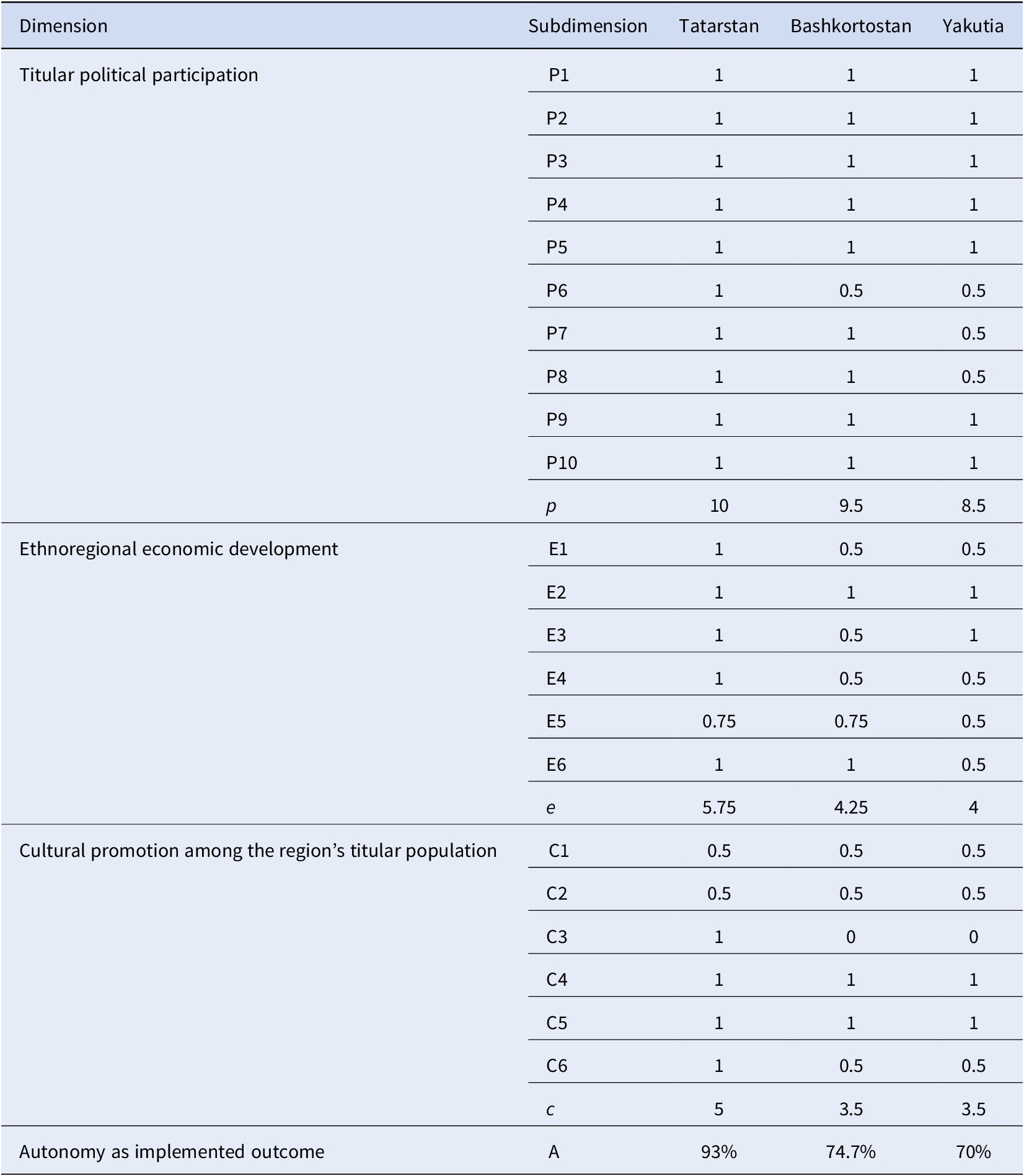
As summarized in Table 2, the level of implemented autonomy outcome was highest in Tatarstan, followed by Bashkortostan and Yakutia, for the first six years of the 2010s. With regard to titular political participation, the three republics are largely comparable with only minor discrepancies. Meanwhile, in terms of ethnoregional economic development and cultural promotion among the region’s titular population, the discrepancies across the republics tend to be more pronounced. In the rest of this section, I disaggregate implemented autonomy outcomes of the three republics according to different dimensions, using Tatarstan as a reference case and discussing Bashkortostan and Yakutia’s outcomes as far as how they differ from Tatarstan’s.
Tatarstan, Bashkortostan, and Yakutia compared in terms of autonomy as implemented outcome (2010–2015).

Tatarstan
As Table 2 outlines, Tatarstan scores 10 on a scale of 10 in terms of titular political participation for 2010–2015. Specifically, RT has been maintaining a system of state organs separate from the federal system. The incumbent President of RT, Röstəm Mingnekhanov, is both native to and a citizen of RT no younger than 30 while knowing competently both Tatar and Russian. Thus, he meets the eligibility requirements laid in both the Constitution of the RT and the 2007 Federal-Tatarstan Treaty. The legislature of the RT, State Soviet (Dəülət Sovyete), has enacted a series of normative rules and regulations applicable to Tatarstan. Meanwhile, RT has been maintaining a representative office under the President of Russia in Moscow. As of 2016, the RT state has opened representative offices in Kazakhstan, Turkey, Turkmenistan, France, Uzbekistan, UAE, Czech Republic, and Ukraine. RT reached a treaty with the Republic of Chuvashia, another ethnic republic of Russia, on May 13, 1994, which was renewed on March 15, 2011.Footnote 14 Meanwhile, RT has been engaged in outreach activities to ethnic Tatars living outside Tatarstan or outside Russia through an umbrella organization, World Congress of Tatars (Bötendönya Tatar Kongressi).
Given ethnic Tatars’ population share in the total population of the RT as of 2010, 53.2%, at the fourth Convocation of the State Soviet of the RT (2009–2014), ethnic Tatar deputies were overrepresented at a percentage of 60.7%.Footnote 15 At the fifth Convocation of the State Soviet (since 2014), ethnic Tatar deputies are again overrepresented, at a percentage of 64%.Footnote 16 Since 2009, the proportion of ethnic Tatar ministers in the total number of ministers in the RT Cabinet of Ministers has been stable around 88.2% (15 out of 17 ministers), Footnote 17 which suggests “extraordinary” overrepresentation of ethnic Tatar ministers.
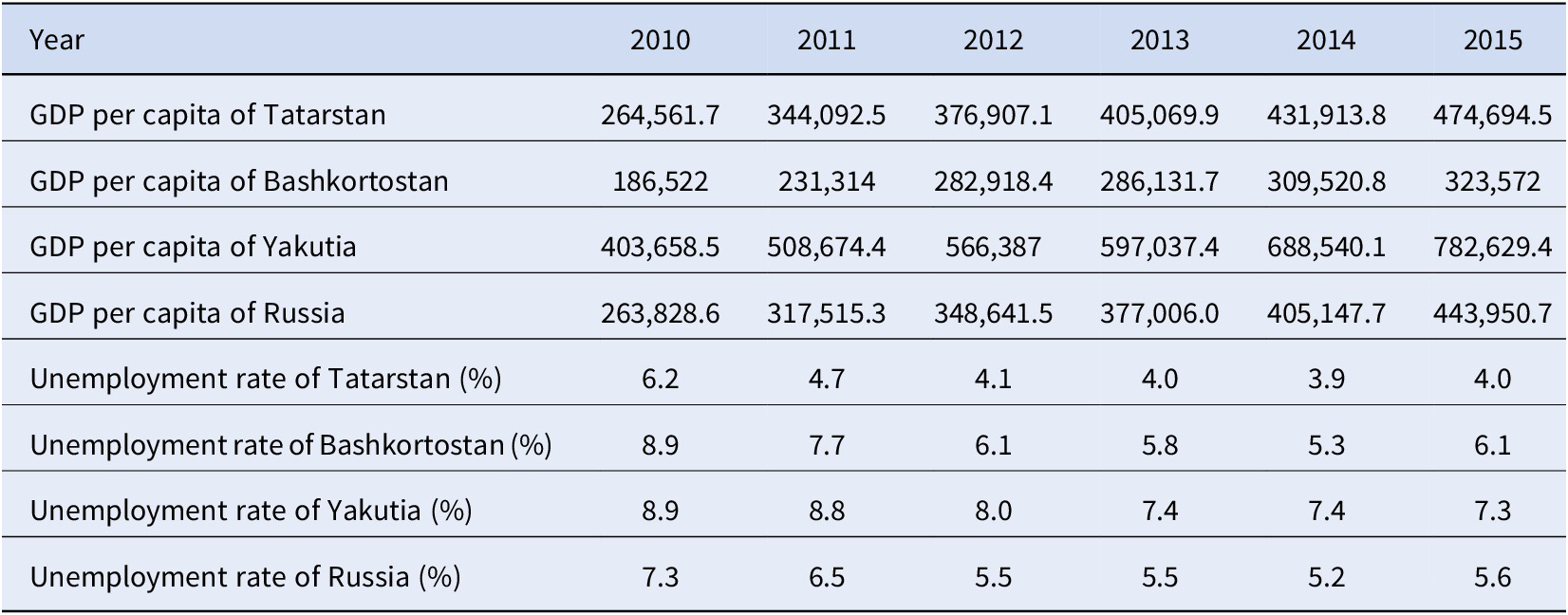
In terms of ethnoregional economic development, Tatarstan scores 5.75 on a scale of 6 for 2010–2015. Except for the hosting of the 2013 Kazan Universiade, RT has been contributing more to the federal government’s budget than it receives from the federal government in the form of fiscal transfers.Footnote 18 Thus, RT qualifies as a “donor”Footnote 19 region in Russia. In view of the structure of the 2010–2015 budgets, RT was more reliant upon revenues of its own ethnoregional sources than upon federal transfers (Russian Federation Federal Statistical Service 2017). The GDP per capita of RT has maintained the pattern of exceeding the Russia-wide GDP per capita for 2010–2015, while RT’s unemployment rate has been consistently lower than the national average of Russia from 2010 through 2015, as demonstrated in Table 3. Of all the ethnic republics in Russia, RT has consistently stood out as the economically most developed one. Tatarstan’s comparative advantages have mostly been concentrated in oil extraction and manufacturing (automotive, chemical, and machinery industries), whose infrastructural and technological foundations were laid during the post-WWII Soviet era. The KAMAZ truck plant, which is headquartered in the second largest city of Tatarstan, Yar Challı/Naberezhnye Chelny, has been prestigious internationally for its expertise in truck and engine manufacturing. Moreover, RT has been actively pursuing innovative investment policies. The first IT innovation and professional development center of Russia, Innopolis, has been established in Tatarstan, which has attracted companies that specialize in IT outsourcing, software-development, and electronic business solutions.Footnote 20
GDP per capita (in Russian rubles) and unemployment rate of Tatarstan, Bashkortostan, Yakutia, and of Russia as a whole compared (2010–2015).

Sources: Regions of Russia: Socio-Economic Indicators 2012; Regions of Russia: Socio-Economic Indicators 2017; Labor and Employment in Russia 2015; Basic Socio-Economic Indicators of the Republic of Tatarstan 2011–2015 (Kazan: RT Branch of the Federal Statistical Service 2017).
With regard to titular cultural promotion, Tatarstan scores 5 on a scale of 6 for 2010–2015. In meetings, sessions, or debates of the RT State Soviet, the principally used language is Russian. Even if most of the top political elites of Tatarstan are ethnically Tatar, and even if many of them are able to speak Tatar fluently, in formal political deliberations, Russian overwhelms Tatar. In the executive organs of the RT state, Russian dominates formal conversations. Court sessions are predominately conducted in Russian. In the realm of pre-tertiary education, the formal recognition of the Tatar language in Tatarstan has been promoted to such an extent that Tatar was made a mandatoryFootnote 21 subject in nearly all of the pre-tertiary education institutions. As of 2016, there are three types of pre-tertiary educational institutions according to languages of instruction in Tatarstan: Tatar-instructed schools, schools of mixed Tatar-Russian instruction, and Russian-instructed schools. In higher education institutions in Kazan, formal Tatar-language instruction is largely limited to those departments devoted either to the production of ethnically specific knowledge or to the training of experts with such knowledge. The Tatar language has been used to a limited extent in the publications of Tatarstan Academy of Sciences but is much more extensively used in print media, radio, TV, and internet. As of 2016, 17 magazines (of which three are for children) and 56 newspapers throughout Tatarstan were published in the Tatar language.Footnote 22 Moreover, 16 radio channels (both republic-level and county-level) and 21 TVFootnote 23 channels (both republic-level and county-level) produced programs either fully or partially in the Tatar language.Footnote 24 Overall, there has been noticeable, but not ubiquitous, informal, conversational use of the Tatar language in the public sphere in RT. Russian assumes the dominant role as the language of business transactions in the market, and Tatar is featured more often in formal, ethnocultural events.
On the “ethnogenesis” of Kazan Tatars, the debates between Tatarists, who hold that Tatars are heirs of the Golden Horde (Altın Urda), and Bulgarists, who hold that Tatars are descendants of Volga Bulgaria, date back to the early 19th century (Kondrashov Reference Kondrashov2000, 66). The official historiography of the Soviet era was biased against the Tatarist view, and the study of the history of the Golden Horde was even officially banned in 1944 (68). Following the disintegration of the USSR, the study of the Golden Horde was rekindled. As of 2016, the Institute of History of Tatarstan Academy of Sciences has become a hub for the study of the history of the Golden Horde and its successor Khanates. Tatarists’ view, that ethnic Tatars are heirs of the Golden Horde, has largely been accepted as the official historical narrative in Tatarstan, while Bulgarists’ claim has also been partially integrated into Tatarists’ historical narratives.Footnote 25
The RT state has been regulating the forms and interpretations of religious practices through such organizations as the RT Spiritual Board of Muslims (Diniyə Nəzarəte). Nevertheless, the RT state does not impose restrictions regarding who is allowed to practice and who is not. In reality, minors are visibly allowed to enter mosques or churches in Tatarstan, and certain governmental officials symbolically participate in religious events.
Tatarstan’s state flag and emblem have been broadly used throughout the republic, especially over state apparatuses’ buildings, on governmental websites, or on state-issued documents. In fact, the presidential residence, located in Kazan Kremlin, has been flying only the RT flag, rather than alongside the flag of the Russian Federation, on its top as of 2016. The RT state has also been actively pushing for historical and archaeological sites of Tatarstan to be listed as UNESCO’s World Heritage Sites. By 2016, Tatarstan’s Complex of the Kazan Kremlin, Bolgar Complex, and the town-island of Sviyazhsk have been recognized by UNESCO as world heritage sites, accounting for three out of a total of 17Footnote 26 sites thus far recognized in Russia.
Bashkortostan and Yakutia
From 2010 through 2015, Bashkortostan largely attained a comparable level of titular political participation to that of Tatarstan, except that no representative office of RB had been opened outside the border of Russia. In terms of ethnoregional economic development, for 2010–2015, Bashkortostan differs from Tatarstan on the following dimensions:
RB’s proportion of expenditures covered by its own revenues for 2010–2015 was on average around 78% (Russian Federation Federal Statistical Service 2017), which is even higher than that of Tatarstan and signifies a high level of financial self-sufficiency. Despite that, RB has been consistently a recipient rather than a donor region, and its GDP per capita was consistently lower than the national average, while its unemployment rate was consistently higher than the national average, as shown in Table 3. Nevertheless, Bashkortostan boasts of one of the mostFootnote 27 diverse economies of all ethnic republics in Russia. Aside from taking the lead in Russia in terms of the ability to refine crude oil, Bashkortostan has solid foundations in such sectors as manufacturing (petrochemical, machinery), mining, Footnote 28 and energy, while tourism in the Ural Mountains remains underdeveloped despite huge potential. Notably, Bashkortostan also has been trying to emulate Tatarstan in terms of innovative investment policies.
With regard to titular cultural promotion, Russian has been the dominant language used in the RB ethno-regional-level government. Formal use of Bashkir has been present in academic institutions, print media, radio/TV, and internet, while informal, conversational use of Bashkir has been noticeable but not ubiquitous in the public sphere. Bashkir has been used as medium of instruction for some subjects only or taught as a subject in pre-tertiary education but is barely used in higher education in RB. The official historiography in RB on the “ethnogenesis” of ethnic Bashkirs treats them as an “ancient, autonomous people” with a stable, primordial “core,”Footnote 29 thus more or less discouragingFootnote 30 debates about the history of the consciousness of “being Bashkir.”
From 2010 through 2015, Yakutia attained a lower level of titular political participation than either Tatarstan or Bashkortostan. RS was not maintaining any representative office outside the borders of Russia, nor did RS enter into any treaty or agreement with other constituent entities of Russia. In terms of ethnoregional economic development, for 2010–2015, Yakutia differs from Tatarstan on the following dimensions:
RS has consistently been a recipient rather than a donor region and has been heavily reliant upon budget transfers from the federal government. Although its GDP per capita was consistently much higher than the national average, its unemployment rate was also consistently higher than the national average, as demonstrated in Table 3. Moreover, RS’s proportion of expenditures covered by its own revenues was on average approximately 58% for 2010–2015 (Russian Federation Federal Statistical Service 2017), signifying an intermediate level of financial self-sufficiency. RS’s comparative advantages are mostly concentrated in the sectors of mining and energy.
With regard to titular cultural promotion, Yakutia is distinguished from Tatarstan on the following dimensions. The literary Yakut language has been used as a medium of instruction for some subjects only or taught as a subject in pre-tertiary education but is barely used in higher education in RS. That said, the 1990s marked the beginning of a series of initiatives aimed at reviving and improving knowledge of the Yakut language among ethnic Yakuts, which turned out to be more far-reaching Footnote 31 than in other ethnic regions in the Asian part of Russia (Chevalier Reference Chevalier2017, 614).
Inter-Ethnic Boundary-Making in Tatarstan, Bashkortostan, and Yakutia
I treat the long-range variable, an ethnic region’s inter-ethnic boundary making, as processes in which actors of both the ethnic region’s titular category and the central state’s majority category relate to existing boundaries by trying either to maintain them or to change them, either to reinforce them or to de-emphasize them in a historical context shaped by previous processes of boundary making. Such processes entail both tendencies toward integration and tendencies toward differentiation and are analyzed on three dimensions: acculturation, social integration, and psychological identification (Rumbaut Reference Rumbaut and Kivisto2005, 166–168; Wimmer Reference Wimmer2013, 104).
Acculturation connotes the processes of linguistic/cultural diffusions or changes that result in greater linguistic and cultural similarity (Rumbaut Reference Rumbaut and Kivisto2005, 167) between populations of the titular ethnic category of the ethnic region and the multi-ethnic state’s ethnic majority category. Social integration is associated with aggregating the processes of interpersonal, socioeconomic, and spatial interactions relevant to the economy, the polity, and the community among the populations of both an ethnic region’s titular ethnic category and the multi-ethnic state’s ethnic majority category. Interethnic social integration can be assessed according to such demographic indicators as levels of urbanization, educational attainments, and intermarriage rates with the ethnic majority, as well as residential patterns. Psychological identification is associated with the level of ethnic consciousness among individuals of the titular ethnic category. Notably, a robust level of ethnic consciousness among individuals of the titular ethnic category is indispensable for them to act socio-politically in ethnic terms. Weak ethnic consciousness can significantly obscure the boundary between the titular and majority populations, which can in turn render the formally designated autonomy increasingly dissociated with its intended “agents.”
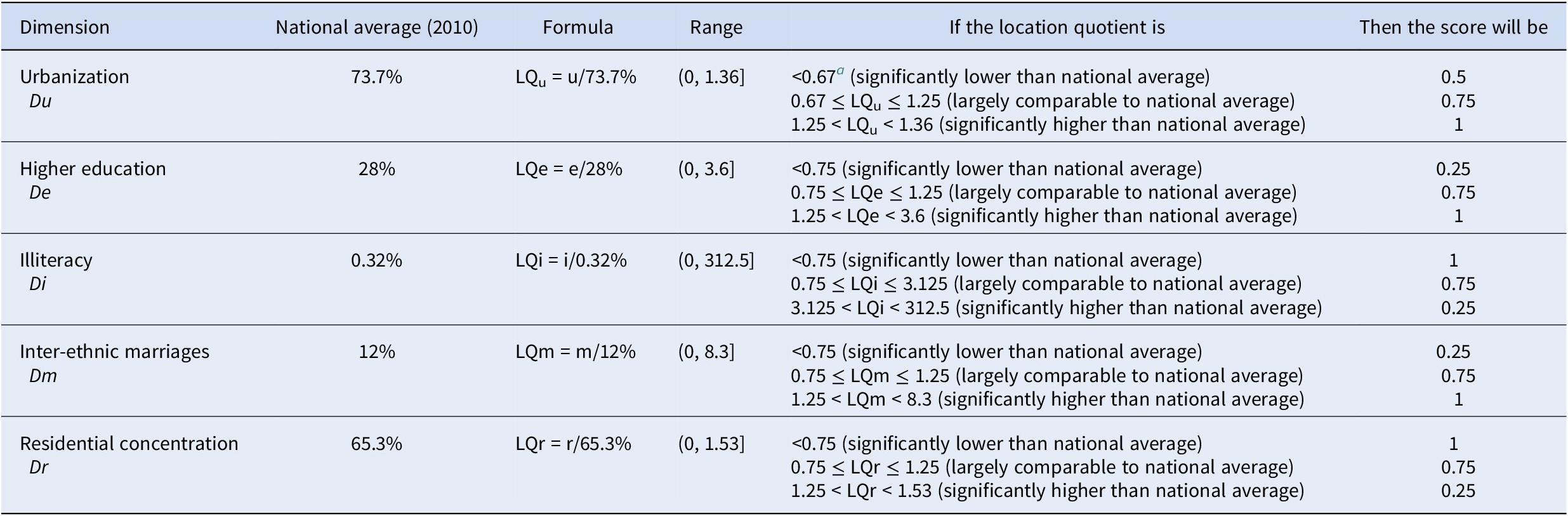
According to the 2010 census, in Russia, the overall level of urbanization reached 73.7%, Footnote 32 whereas the overall level of higher educationFootnote 33 reached 28%.Footnote 34 The overall level of illiteracy in Russia was 0.32%, Footnote 35 while the rate of inter-ethnic marriagesFootnote 36 reached 12%. Of the total population of those ethnic minority categories for whom ethnic, territorially based autonomy has been designated, 65.3% were residents in those autonomous entities, with the rest living outside their designated ethnic regions.
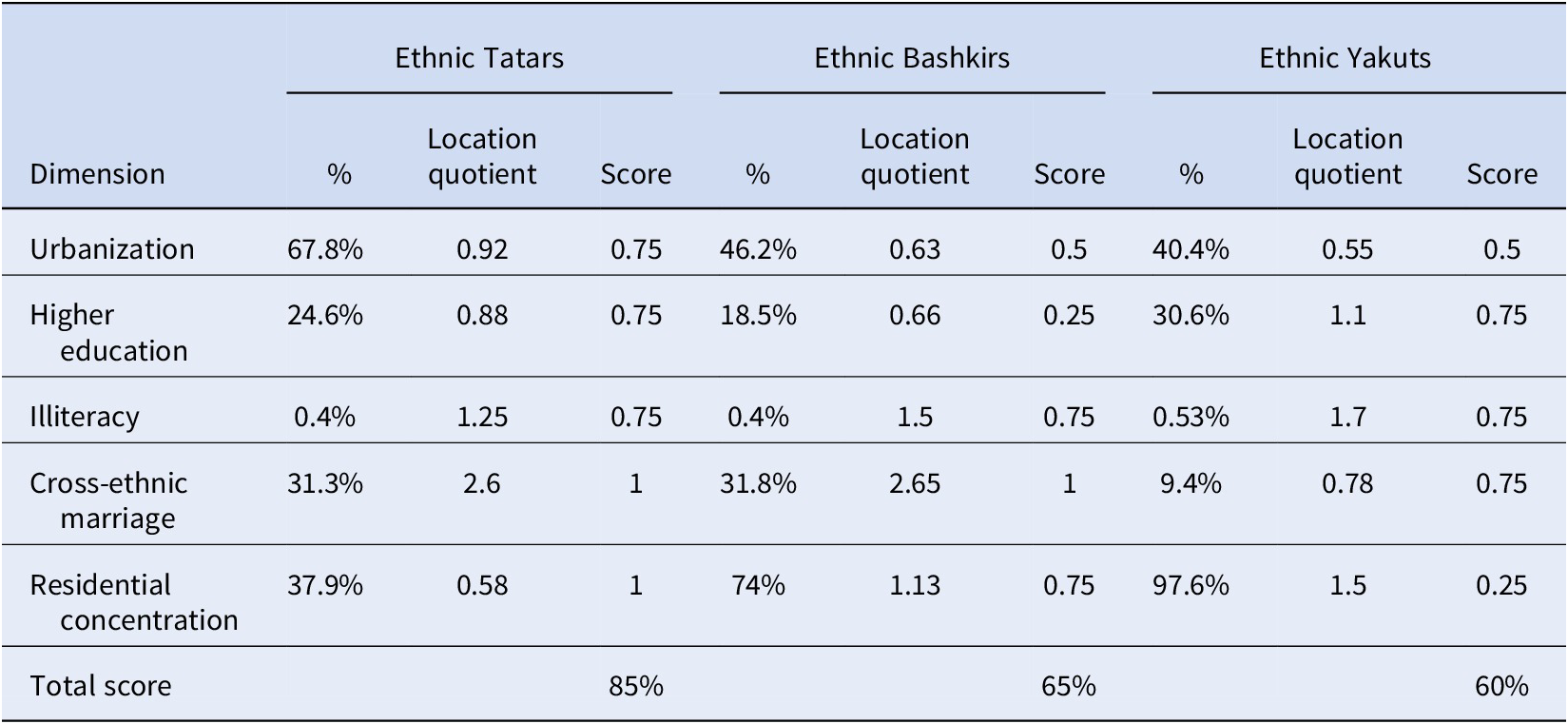
To evaluate and compare the Russia-wide level of social integration for the titular population of an ethnic region according to the 2010 census, I use an instrument ( Table 4) that scores, relative to the national average, a population’s level of integration on five dimensions: urbanization, higher education, illiteracy rate, inter-ethnic marriage rate, and residential concentration within designated ethnic regions. These dimensions were informed by Maxwell’s (Reference Maxwell2012, 13) study of immigrant minorities’ integration in Western European democracies, as well as by Rubén Rumbaut’s (Reference Rumbaut and Kivisto2005, 166–168) discussion of minority “assimilation” in the US. The score of each dimension is assigned a weight of one-fifth. Scoring is mostly based on census data, cross-verified with respondents’ perspectives and the author’s observations. For an ethnic region in Russia, the formula with which to calculate the country-wide level of social integration for its titular ethnic population, SI, is proposed as
 $$ \mathrm{SI}=\left( Du\times 1/5+ De\times 1/5+ Di\times 1/5+ Dm\times 1/5+ Dr\times 1/5\right)\times 100\% $$
Scoring schemes for the Russia-wide level of social integration for an ethnic region’s titular population.

a When the level of urbanization for a population is approximately 50%.
The five dimensions are assessed on an ordinal scale of three categories. Accordingly, a titular population’s score on these dimensions will take one of three mutually discrete values, as listed in Table 4.
While Tatarstan, Bashkortostan, and Yakutia are largely comparable in terms of linguistic acculturation (knowledge of Russian) and robust ethnic consciousness among the titular population, they vary more conspicuously with regard to the level of social integration of the titular population, as summarized in Table 5. An “integration–distinction balance” is most pronounced in Tatarstan, followed by Bashkortostan and Yakutia.
Ethnic Tatars’, ethnic Bashkirs’, and ethnic Yakuts’ Russia-wide level of social integration compared (2010).

Tatarstan
There are more ethnic Tatars in Russia who know Russian than those who know Tatar. According to the 2010 census, 97.8% of ethnic Tatars Russia-wide claimed to know Russian. By contrast, merely 69% of ethnic Tatars Russia-wide claimed to know Tatar. In Tatarstan alone, 95.8% of ethnic Tatars claimed to know Russian, while 92.7% of ethnic Tatars claimed to know Tatar. Of the total population of Tatarstan regardless of ethnicity, 97.6% claimed to know Russian, while only 52.1% claimed to know Tatar.
Meanwhile, consciousness of being ethnically Tatar remains robust in Tatarstan, as the percentage of ethnic Tatars in the total population of RT rose slightly from 53% as of 2002 to 53.2% as of 2010. A longitudinal study by Gulnara Gabdrakhmanova (Reference Gabdrakhmanova and Khakimov2013, 472) demonstrates that the percentage of urban-based, ethnic Tatar respondents who responded “yes” to the question “I never forget about my ethnicity” raised from 51.9% in 1999 to 77.6% in 2011.
As summarized in Table 5, the calculated Russia-wide level of social integration for the total population categorized as ethnic Tatars in Russia is 85% as of 2010. With only 37.9% of all ethnic Tatars in Russia who live in Tatarstan, ethnic Tatars have been maintaining highly dispersed residential patterns throughout Russia. Such a heightened level of social integration of ethnic Tatars was unanimously confirmed by most of my respondents.
As interactions between ethnic Tatars and ethnic Russians are more common in urban areas of Tatarstan than in rural areas, Tatar–Russian friendship tends to be more common in the urban areas of Tatarstan, depending upon types of workplace, especially in ethnically mixed, professional settings.Footnote 37 In rural areas, inter-ethnic relations can be more complicated, where communities can be more close-knit while overlapping with inter-ethnic boundaries.Footnote 38 Illiteracy among adult-age ethnic Tatars was largely an unheard-of phenomenon during my fieldwork in Tatarstan. Tatar–Russian inter-ethnic marriages tend to be sufficiently commonplace in urban centers of Tatarstan, Footnote 39 especially in Kazan.
Bashkortostan and Yakutia
What distinguishes Bashkortostan from other ethnic regions in Russia can be the blurred, ambiguous, inter-ethnic boundaries between ethnic Bashkirs, the titular ethnic population of RB, and ethnic Tatars, the third largest ethnic population of RB. Such fuzzy Bashkir–Tatar boundaries have been salient particularly in the northwestern counties of RB (Gorenburg Reference Gorenburg1999, 558–559). Considering that the literary and colloquial Tatar and Bashkir languages are mutually completely intelligible and almost identical, that both ethnic Bashkirs and ethnic Tatars are traditionally mostly Muslims, and that it can be really tricky to tell who is Bashkir or Tatar, I treat ethnic Bashkirs and ethnic Tatar combined as the “titular” population of RB. In other words, I view “Bashkir” and “Tatar” as two categories artificially imposed during the Soviet period upon a shared landscape of cultural continuum.Footnote 40
Similar to the linguistic demographics among ethnic Tatars, there are more ethnic Bashkirs in Russia who know Russian than those who know Bashkir. According to the 2010 census, 97.5% of ethnic Bashkirs Russia-wide claimed to know Russian. By contrast, merely 62% of ethnic Bashkirs Russia-wide claimed to know Bashkir, while, notably, 23.4% of ethnic Bashkirs Russia-wide claimed to know Tatar. In Bashkortostan alone, 96.9% of ethnic Bashkirs claimed to know Russian, while 67.8% of ethnic Bashkirs claimed to know Bashkir and 27.1% claimed to know Tatar. Of the total population of Bashkortostan, 98.7% claimed to know Russian, while only 23.5% claimed to know Bashkir and 26.7% claimed to know Tatar. Despite the high level of linguistic Russification among ethnic Bashkirs and Tatars alike in Bashkortostan, consciousness of being ethnically Bashkir or Tatar remains robust, as the percentage of ethnic Bashkirs and Tatars combined in the total population of RB rose from 53.9% as of 2002 to 55% as of 2010. Moreover, Bashkir–Tatar intermarriages are not uncommon: as of 2010, 4.9% of ethnic Tatars had ethnic Bashkir spouses, whereas 16.4% of ethnic Bashkirs had ethnic Tatar spouses.
Since the population ratio of those who identified as Bashkir to those who identified as Tatar in RB in the 2010 census is 1.16:1, to calculate a “combined” Russia-wide level of social integration for ethnic Bashkirs and Tatars together, I assign a weight of 1.16 out of 2.16 to ethnic Bashkirs’ Russia-wide score of social integration and a weight of 1 out of 2.16 to ethnic Tatars’ Russia-wide score of social integration. As summarized in Table 5, the Russia-wide level of social integration for the total population categorized as ethnic Bashkirs is 65% as of 2010, while the Russia-wide level of social integration for the total population categorized as ethnic Tatars is 85% as of 2010. Accordingly, the weighted Russia-wide level of social integration for ethnic Bashkirs and Tatars combined as of 2010 is 74%, which is lower than the Russia-wide level of social integration for ethnic Tatars, the titular ethnic population of Tatarstan.
Similar to ethnic Tatars, there are more ethnic Yakuts in Russia who know Russian than those who know the Yakut language. According to the 2010 census, 90.6% of ethnic Yakuts Russia-wide claimed to know Russian, while a lower proportion of them, at 85.9%, claimed to know Yakut. In Yakutia alone, 90.4% of ethnic Yakuts claimed to know Russian, while 87% of ethnic Yakuts claimed to know Yakut. Consciousness of being ethnically Yakut remains robust in Yakutia, as the percentage of ethnic Yakuts in the total population of RS rose from 45.5% as of 2002 to 49.9% as of 2010. As summarized in Table 5, the Russia-wide level of social integration for the total population categorized as ethnic Yakuts as of 2010 is 60%, which is significantly lower than both the Russia-wide level of social integration for ethnic Tatars and that for ethnic Bashkirs and Tatars combined.
Titular Elites’ Representation in the Ethno-Regional State of Tatarstan, Bashkortostan, and Yakutia
The short-term variable, titular elites’ capacity to bargain with the central state, activates the link from the pattern of inter-ethnic boundary making to autonomy outcome. The bargaining capacity of an ethnic region’s titular elites is their ability to employ both material and discursive resources to influence decision making at both central and regional states. Such an ability is constituted by four dimensions: elite-level inter-ethnic relations, the central state’s perception of the ethnic region, intra-ethnic cleavage structure, and titular elites’ representation in the ethno-regional state and its most powerful positions. Proportionate representation of titular elites in the ethnoregional state is a necessary, but not sufficient, condition for a higher level of implemented autonomy outcome.
To briefly sketch the mechanism regarding how an inter-ethnic “integration–distinction balance” can lead to greater autonomy outcome, I focus on Tatarstan while touching upon Bashkortostan and Yakutia tangentially. Given that the three republics feature comparably high level of linguistic Russification and robust ethnic consciousness among the titular population, the major difference consists in the extent to which an integration–distinction balance has been achieved, or rather, given similarly robust titular consciousness, how social integration shapes titular elites’ bargaining capacity. In this regard, robust titular consciousness is a necessary condition for titular elites to build their capacity to exercise formally prescribed autonomy, since they need to first and foremost be aware of their being “titular.”
In Tatarstan, a high level of linguistic Russification, combined with more solid social integration among ethnic Tatars, promotes titular elites’ capacity to build cross-ethnic political networks and more collusive, less hierarchical types of relationships with ethnic Russian elites, especially in terms of exchanging political and economic favors through the incumbent United Russia (hereafter UR) party.Footnote 41 Ethnic Tatars’ more solid social integration not only cultivates positive perceptions of Tatarstan by the central state as Russia’s “most important” ethnic republicFootnote 42 but also translates into less differentiated, less polarized intra-ethnic socio-economic and cultural contour. Ethnic Tatars’ more solid relationships with both the central state and their co-ethnics, coupled with a positive image of Tatarstan in the eyes of Moscow, have been jointly sufficient for heightened representation of Tatar elites in the state organs and their most powerful positions of Tatarstan. As compared to Tatarstan, Bashkortostan and Yakutia have been less capable of striking an inter-ethnic “integration–distinction balance.” Neither of them keeps the title “President” for their executive head as has Tatarstan, and their levels of titular representation in the state apparatuses tend to be lower than that of Tatarstan, as demonstrated below.
Although not tracing in detail the process of how differing patterns of inter-ethnic boundary making lead to differing patterns of titular elites’ bargaining capacity for the three republics, this section applies an instrument to measure and to compare titular elites’ levels of representation in the respective ethnoregional state and its most powerful positions of Tatarstan, Bashkortostan, and Yakutia. Titular elites’ level of representation is used as a proxy for titular elites’ bargaining capacity. Based on such a comparison, I test whether, across the three republics, the higher the level of social integration for the titular population, and the higher the level of titular elites’ representation in the ethno-regional state, then the higher the level of implemented autonomy outcome for the ethnic region.
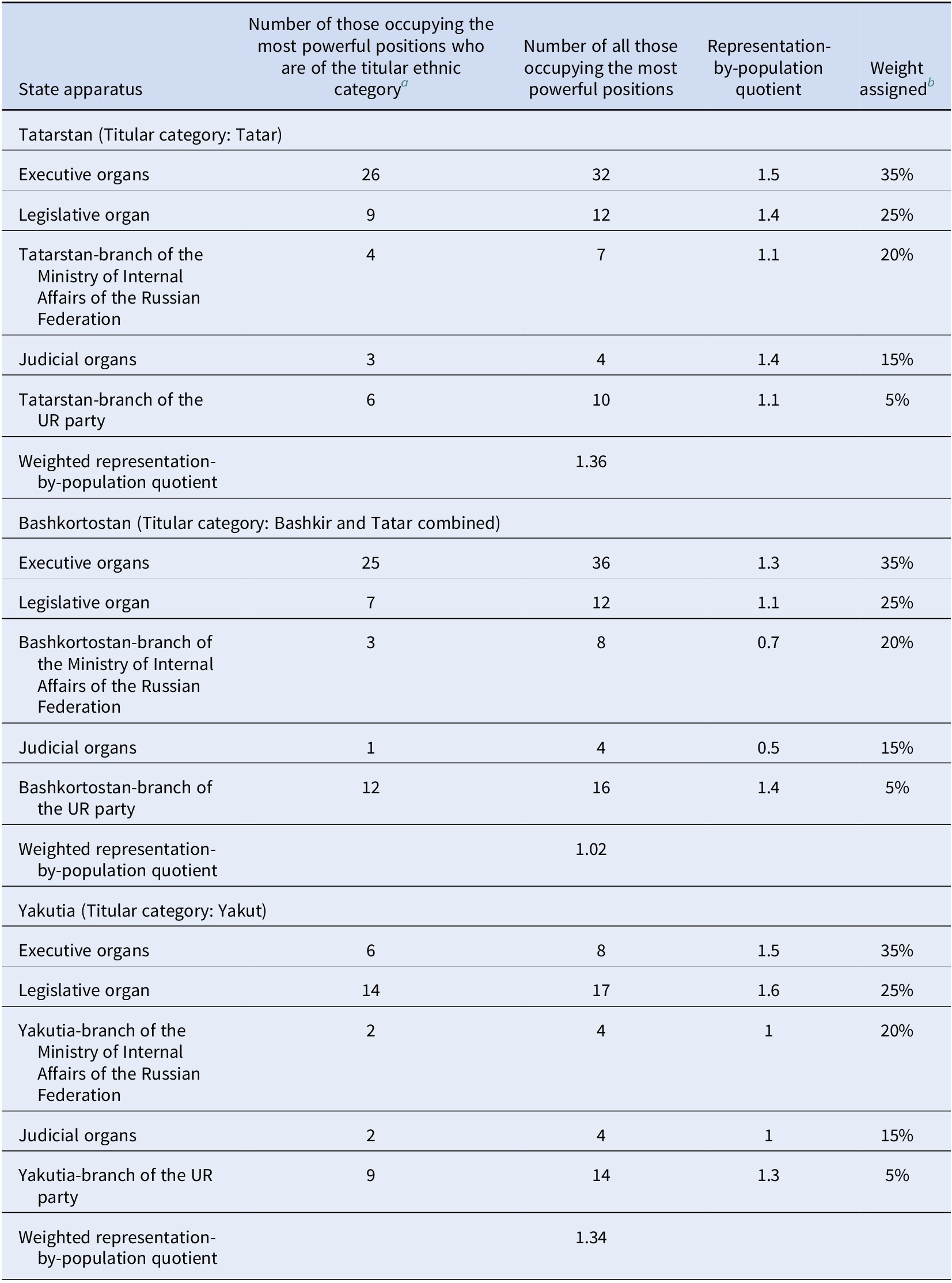
In terms of operationalization, I calculate the “representation-by-population quotient” of an ethnic region’s titular elites by weighting the quotients of the 2015 percentages of such elites in the key posts of various ethnoregional state apparatuses divided by the 2010 percentage of the population of the titular category in the total population of the ethnic region. The instrument takes into consideration the distribution of decision making and enforcement power across different state apparatuses. I base my understanding of how decision making power is distributed across state apparatuses on what is stipulated in the constitutions of the RT, RB, and RS, and on respondents’ perceptions.
The largest weight, 35%, is assigned to the key posts in the executive organs. For Tatarstan, such organs include the Presidency, the Prime Minister, and the Cabinet of Ministers. For Bashkortostan, such organs include the Head (Bashkortostan Respublikahı Bashlığı), the Prime Minister, and the Cabinet of Ministers of the RB. For Yakutia, such organs include the Head (İl Darkhan), the Chair of the Government, and the Cabinet of Ministers.
The second largest weight, 25%, is assigned to the key posts in the legislative organ. This amount of weight is assigned in light of the prescriptive authority wielded by the legislative organ despite its lack of enforcement power. For Tatarstan, such key posts include the leadership of the State Soviet and the chairs of its law making committees (komitet). For Bashkortostan, such key posts include the leadership of the State Assembly-Kurultay (Dəülət Yıyılıshı-Koroltay) and the chairs of its lawmaking committees. For Yakutia, such key posts include the leadership of the İl Tümən and the chairs of its lawmaking committees.
A 20% weight is assigned to the leadership of the ethnoregional branch of the Ministry of Internal Affairs of the Russian Federation, since it is the major state apparatus that wields the means of coercion in law enforcements of the ethnic region, even if its authority mostly rests in law enforcing rather than decision making. It is directly subordinate to the centralized command of the Ministry of Internal Affairs in Moscow, while maintaining a coordinative relationship with the region’s state apparatuses.Footnote 43 A 15% weight is assigned to the Public Prosecutor of the region and to the heads of three courts: the Constitutional Court, the Supreme Court, and the Arbitration Court of the ethnic republic. The ethnoregional Prosecutor’s Office serves as the highest supervisory organ conducting investigations and prosecutions in the realm of law enforcement. The Constitutional Court of an ethnic region is part of the ethnoregional state, whereas the Supreme Court and the Arbitration Court of an ethnic region are parts of the federal judicial system. The smallest weight, 5%, is assigned to the key posts at the ethnoregional branch of the United Russia party, the incumbent party of not only the Russian Federation but also Tatarstan, Bashkortostan, and Yakutia. Those occupying such positions can be influential in the region’s executive and legislative elections while bridging the federal and the ethnoregional states through partisan links, Footnote 44 even if they do not wield decision making power in these capacities.
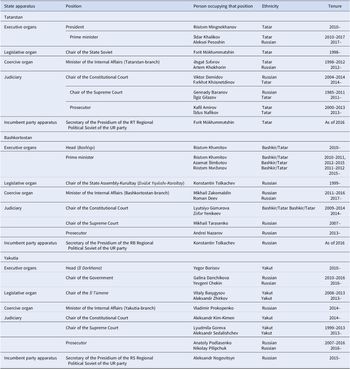
For Tatarstan, as summarized in Table 6, the weighted representation-by-population quotient for ethnic Tatar elites in Tatarstan as of 2015 is 1.36, which is higher than 1 and signifies overrepresentation of ethnic Tatar elites in the RT ethnoregional state and its most powerful positions. Overall, as summarized in Table 7, of the 13 individuals who occupied the most powerful positions of RT from 2010 to 2017, nine are ethnic Tatars, thus making up the majority and overrepresented in relation to the population share of ethnic Tatars in the total population of RT.
Titular elites’ representation in the ethnoregional state of Tatarstan, Bashkortostan, and Yakutia compared (2015).

a Individuals’ ethnicity is determined either from biographical information if ethnicity is explicitly indicated therein, or by referring to the titular-language websites of the relevant state apparatuses, or by looking at the individual’s given name and family name if information is available only in Russian, supplemented with cross-checking with other biographical information and respondents’ knowledge.
b Alternative distributions of weights were also tried, and the relative positions of the weighted quotients for the three cases did not change and remain robust.
Sources: President of the Republic of Tatarstan. http://president.tatarstan.ru (accessed July 31, 2018); The Cabinet of Ministers of RT. http://prav.tatarstan.ru/pravit.htm (accessed July 31, 2018); Committees of the State Soviet of the RT. http://tat.gossov.tatarstan.ru/komitet (accessed July 31, 2018); Deputies of the State Soviet of the RT. http://tat.gossov.tatarstan.ru/deputaty (accessed July 31, 2018); Tatarstan-Branch of the Ministry of Internal Affairs of the Russian Federation: Leadership of the Ministry. http://mvd.tatarstan.ru/rus/rukov.htm (accessed July 31, 2018); Current Composition of Judges for the Constitutional Court of RT. http://ks.tatarstan.ru/rus/structure/judge.htm (accessed July 31, 2018); Leadership of the Supreme Court of RT. http://vs.tat.sudrf.ru/modules.php?name=info_court&rid=7 (accessed July 31, 2018); Presidium of the RT Regional Political Soviet of the UR. http://tatarstan.er.ru/persons/presidium (accessed July 31, 2018); Head of the Republic of Bashkortostan. https://glavarb.ru/rus (accessed July 31, 2018); Government of the RB. https://www.pravitelstvorb.ru/ru (accessed July 31, 2018); State Assembly-Kurultay of the RB. http://gsrb.ru/ru (accessed July 31, 2018); Bashkortostan-Branch of the Ministry of Internal Affairs of the Russian Federation. http://02.мвд.рф (July 31, 2018); Constitutional Court of the RB. http://www.ks-rb.ru (accessed July 31, 2018); Supreme Court of the RB. http://vs.bkr.sudrf.ru (accessed July 31, 2018); Presidium of the RB Regional Political Soviet of UR Party. https://bashkortostan.er.ru/persons/presidium (accessed July 31, 2018); Head of the Republic of Sakha/Yakutia. https://glava.sakha.gov.ru (accessed July 31, 2018); Government of the RS. https://prav.sakha.gov.ru (accessed July 31, 2018); State Assembly-İl Tümən of the RS. http://iltumen.ru (accessed July 31, 2018); Yakutia-Branch of the Ministry of Internal Affairs of the Russian Federation. http://14.мвд.рф (accessed July 31, 2018); Constitutional Court of the RS. https://ks.sakha.gov.ru (accessed July 31, 2018); Supreme Court of the RS. http://vs.jak.sudrf.ru (accessed July 31, 2018); Presidium of the RS Regional Political Soviet of UR Party. https://yakut.er.ru/persons/presidium (accessed July 31, 2018).
Those occupying the most powerful positions at the ethnoregional state of Tatarstan, Bashkortostan, and Yakutia (2010–2017).

Sources: See Table 6.
For Bashkortostan, the weighted representation-by-population quotient for ethnic Bashkirs and Tatars combined in RB as of 2015 is 1.02 ( Table 6), which signifies proportionate representation of ethnic Bashkir and Tatar elites combined in the RB ethnoregional state and its most powerful positions. Overall, as summarized in Table 7, of the ten individuals who occupied the most powerful positions of RB from 2010 to 2017, five are ethnic Bashkirs or Tatars, largely proportionately representedFootnote 45 in relation to the population share of ethnic Bashkirs and Tatars in the total population of RB. Compared to Tatarstan, the level of titular representation in Bashkortostan as of 2015 is lower.
For Yakutia, the weighted representation-by-population quotient for ethnic Yakuts in RS as of 2015 is 1.34 ( Table 6), which signifies overrepresentation of titular elites in the RS ethnoregional state and its most powerful positions. Overall, as summarized in Table 7, of the 12 individuals who occupied the most powerful positions of RS from 2010 to 2017, six are ethnic Yakuts, neatly proportionately represented in relation to the population share of ethnic Yakuts in the total population of RS. Intriguingly, although the Russia-wide level of social integration for ethnic Yakuts as of 2010, at 60%, and the implemented autonomy outcome for RS for 2010–2015, at 70%, are significantly lower than the Russia-wide level of social integration for ethnic Tatars as of 2010Footnote 46 and the implemented autonomy outcome for RT, Footnote 47 respectively, the observed level of representation of titular elites for RS as of 2015 is not significantly lower than that for RT, at 1.36, and even higher than that for RB, at 1.02. Despite the relatively low level of social integration for ethnic Yakuts Russia-wide compared to ethnic Tatars and ethnic Bashkirs, the overrepresentation of ethnic Yakut elites in the RS ethnoregional state may require an in-depth case study of autonomy building in Yakutia. Nonetheless, despite titular elites’ overrepresentation, the degree of implemented autonomy outcome for RS is lower than that for RB, which substantiates the argument that sufficiently high titular representation is a necessary but not sufficient condition for a higher degree of autonomy outcome.
In this regard, incumbent elites’ agency in their actual governance matters. Such elite agency can be shaped by, inter alia, elite-level inter-ethnic relations, central state’s perception of the ethnic region, and intra-ethnic cleavage structure, in terms of ideological adaptability, mimicking skills at the regional level of Putin’s centralization reforms (Goode Reference Goode2011), lobbying skills (Sharafutdinova Reference Sharafutdinova2013, 516) for federal investment, winning contracts for federally sponsored mega-projects, attracting foreign investment, expanding state-owned enterprises, building regional comparative advantages, and framing skills of cultural interests of the titular population in ethnically inclusive terms (Giuliano Reference Giuliano2000, 303).
Conclusion
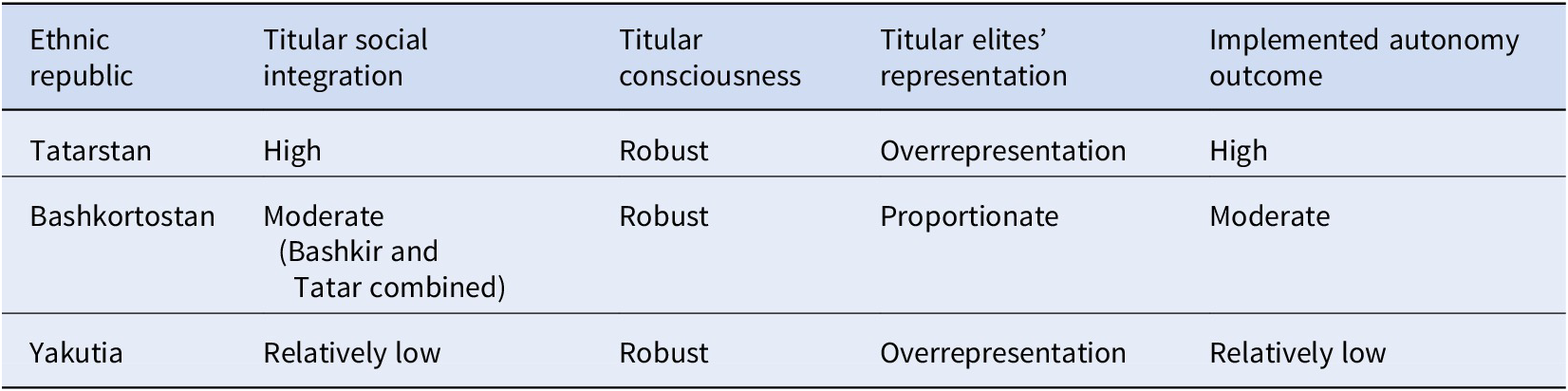
This article first introduces a conceptual framework to measure and compare autonomy as implemented outcome across different ethnic republics in Russia then proposes an analytical framework, composed of a long-range (inter-ethnic boundary making) and a short-term (titular elites’ representation) factor to account for cross-region variations in terms of implemented autonomy outcome. Both frameworks are applied to three ethnic republics, Tatarstan, Bashkortostan, and Yakutia, for the first six years of the 2010s. A comparison of Tatarstan, Bashkortostan, and Yakutia in terms of the empirical evidence on inter-ethnic boundary-making, titular elites’ bargaining capacity, and implemented autonomy outcome tends to substantiate my argument that an “integration–distinction balance,” or rather, higher inter-ethnic integration combined with robust consciousness of inter-ethnic distinction, can contribute to titular elites’ representation in the ethnoregional state, which is a necessary condition for greater autonomy outcome for the ethnic region. As summarized in Table 8, the level of Tatar–Russian integration was the highest, while that of Yakut–Russian integration was the lowest. Accordingly, Tatarstan attained the highest implemented autonomy outcome of the three republics and Yakutia the lowest.
Tatarstan, Bashkortostan, and Yakutia compared in terms of the key variables.

Future research can test the statistical significance of my argument to a larger sample of ethnic regions in Russia by collecting either synchronic observations or a mix of synchronic and diachronic, within-case observations. What can also be investigated is whether fiscal federalism in Russia can amplify or inhibit an ethnic region’s implemented autonomy outcome. Last but not least, additional data-collecting fieldwork may be needed to comparatively trace the process of how differing patterns of inter-ethnic boundary making lead to differing patterns of titular elites’ bargaining capacity, especially for Bashkortostan and Yakutia.
Disclosure.
Author has nothing to disclose.