Implications
Calcium (Ca) and phosphorus (P) interactions on nutrient digestibility in broilers fed diets differing in concentration of these minerals were investigated using a geometric experimental approach. Generally, high concentrations of dietary Ca and low nPP, and high nPP and low Ca concentrations had negative effects on mineral digestibility. Amino acid digestibility was less influenced by dietary Ca and nPP. The data shows that the absolute amount of these minerals was less important than their relative proportions. Data from this study will contribute to a better understanding of Ca and P nutrition in broilers and the formulation of poultry diets.
Introduction
Calcium (Ca) and phosphorous (P) requirements of poultry have been investigated extensively over the past 75 years (Driver et al., Reference Driver, Pesti, Bakalli and Edwards2005). Despite decades of research investigating dietary concentrations of Ca and nPP required for optimum broiler performance, there is still no general agreement on what the appropriate concentrations of these two minerals and/or their relative proportions should be. Though Ca and P are interrelated in many biological functions, the requirement of these minerals is interdependent (Mello et al., Reference Mello, Gomes, Rostagno, Albino, Da Rocha, De Almeida and Calderano2012). Commercially, broilers are rarely, if ever, fed Ca concentrations recommended by the NRC (1994) and actual Ca intake is most probably 20% below these recommendations (Driver et al., Reference Driver, Pesti, Bakalli and Edwards2005). The amount of Ca and nPP in poultry diets has both nutritional and economic implications. Excess dietary Ca impedes the availability of other minerals such as P, magnesium, manganese and zinc and may also reduce the energy value of the diet (Driver et al., Reference Driver, Pesti, Bakalli and Edwards2005; Selle et al., Reference Selle, Cowieson and Ravindran2009). Decreasing dietary Ca concentrations may improve bird performance, P and nutrient digestibility; however, this may also lead to increased leg health problems (Wilkinson et al., Reference Wilkinson, Selle, Bedford and Cowieson2011).
The majority of published poultry nutritional research is based on altering a single food property at a time or changing multiple factors at once. However, the post-ingestive interactions of Ca and P in the digestive tract of poultry are highly complex and often difficult to interpret based on tabulated data. To better understand complex interactions such as those of Ca and P in poultry nutrition, it is necessary to use models that can assess several factors at once. The geometric framework graphically models outcomes in a geometric space that is fashioned by two or more axes that represent either nutritional, environmental or other variables that contribute to the fitness of the animal (Simpson and Raubenheimer, Reference Simpson and Raubenheimer2011). By graphing data as contour plots, conclusions may be visually assessed and more easily interpreted when compared with tabulated results.
The objectives of the current study were to feed broilers diets varying in the concentrations and ratios of Ca and non-phytate phosphorus (nPP) to investigate their influence on nutrient digestibility. It was hypothesised that birds may increase digestibility of nutrients that are supplied insufficiently and decrease digestibility of nutrients supplied in excess.
Material and methods
All experimental procedures conducted in this study were in accordance with the University of Sydney Animal Ethics Committee and with the Australian code for the care and use of animals for scientific purposes (National Health and Medical Research Council, 2004).
Animals and housing
Birds in this study were housed according to the conditions outlined by Bradbury et al. (2014). Briefly, a total of 600-day-old male Ross 308 chicks were obtained from a commercial hatchery. Birds were housed in metabolism cages within an environmentally controlled room maintained at 31°C for the first 5 days that was reduced by 0.5°C per day until 24°C (day 21). Photoperiod during the study was 23 L : 1 D (h) for the first 5 days and 18 L: 6 D (h) thereafter. Birds were fed a commercial broiler starter crumble diet for the first 7 days which provided 11.8 MJ/kg AME, 228 g/kg CP, 8.8 g/kg Ca and 4.4 g/kg nPP (Vella Stock Feeds, Plumpton, NSW, Australia). On day 7, all birds were weighed, wing tagged and randomly allocated to one of 15 dietary treatments. Each treatment was replicated five times with eight birds per replicate cage.
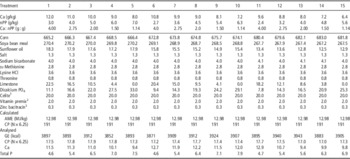
Treatment diets were fed as a mash based on corn and soybean meal and were formulated to be nutritionally adequate (NRC, 1994) with the exception of Ca and nPP (Table 1). Diets were clustered around three total Ca+nPP densities of 12.0, 13.5 and 15.0 g/kg with five varying ratios of total Ca : nPP (4 : 1, 2.75 : 1, 2 : 1 and 1.14 : 1) within each density. To calculate the apparent ileal digestibility (AID) coefficients for CP, amino acids, digestible energy (DE) and minerals, an indigestible marker (acid insoluble ash (AIA)) (Celite 281; Filchem Australia Pty Ltd, Castle Hill, NSW, Australia) was added to diets at a concentration of 20 g/kg. All birds were fed ad libitum and water was freely available. On day 28, birds were euthanised via an intravenous injection of sodium pentobarbitone (Lethabarb; Virbac Australia Pty Ltd, Milperra, NSW Australia). The contents of the lower ileum were collected according to the methods of Ravindran et al. (Reference Ravindran, Hew, Ravindran and Bryden2005), pooled for each cage and immediately frozen and stored at −20°C until further analysis.
Ingredient and nutrient specifications (as fed g/kg) of the experimental diets fed to Ross 308 broilers (day 7 to day 28)

Ca=calcium; nPP=non-phytate phosphorus; P=phosphorus.
1 Filchem Australia Pty Ltd, Castle Hill, NSW, Australia.
2 Supplied per kg of diet: retinol, 3600 μg; cholecalciferol, 125 μg; α-tocopherol, 50 mg; menadione, 3 mg; thiamine, 3 mg; riboflavin, 9 mg; pyridoxine, 5 mg; cobalamin 25 μg; niacin, 50 mg; pantothenic acid, 18 mg; folic acid, 2 mg; biotin, 200 μg; Cu, 20 mg; Fe, 40 mg; Mn, 110 mg; Co, 250 μg; I, 1 mg; Mo, 2 mg; Zn, 90 mg; Se, 300 μg; ethoxyquin, 125 mg.
3 Albac, G 150 (Philbro Animal Health Pty Ltd, Girraween, NSW, Australia)
Chemical analyses
The ileal digesta samples were lyophilised and all samples were ground (Retsch ZM 100; Retsch GmbH, Haan, Germany) to pass through a 0.5 mm screen before chemical analyses. The gross energy (GE) and nitrogen (N) contents of diets and ileal digesta were determined. The diets and digesta were also analysed for minerals (P, Ca, Cu, K, Mg, Mn, Na, Sr, Fe and Zn). The GE of diets and excreta were determined using a Parr 1281 adiabatic bomb calorimeter (Parr Instrument Company, Moline, IL, USA) that was standardised with benzoic acid. Nitrogen concentration of samples was determined by the Dumas method using a FP-428 nitrogen analyser (LECO® Corporation, St. Joseph, MI, USA) as described by Sweeney (Reference Sweeney1989). Samples were wet acid digested using nitric acid and hydrogen peroxide (Peters et al., 2003) before the determination of mineral concentration by Inductively Coupled Plasma-Optical Emission Spectroscopy using a Perkin Elmer OPTIMA 7300 (Perkin Elmer Inc., Waltham, MA, USA). Amino acid concentrations in the diet and dried ileal digesta samples were determined using a Waters AccQTag Ultra amino acid analysis system following acid hydrolysis in 6 M HCl at 110°C. The AIA component of dried diets and ileal digesta samples were determined according to the method of Siriwan et al. (Reference Siriwan, Bryden, Mollah and Annison1993). The AID coefficient of N, DE, amino acids and minerals were calculated as per Ravindran et al. (Reference Ravindran, Selle, Ravindran, Morel, Kies and Bryden2001).
Statistical analysis
All data were analysed using the linear mixed-effects model in R version 2.15 (R Development Core Team, 2011). Fixed effects were dietary Ca and nPP and block was included as a random effect. Treatments are represented as dots overlaid on the contour plots. Interrogation of the data was performed using a quadratic polynomial function and the terms Ca and P presented on the contour plots are composites of linear and quadratic terms. Differences were considered significant at P<0.05.
Results
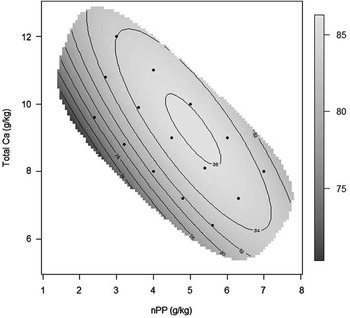
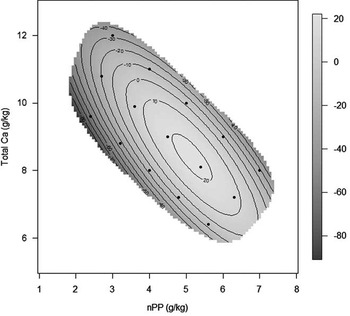
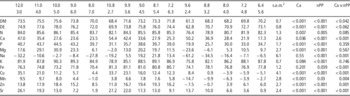
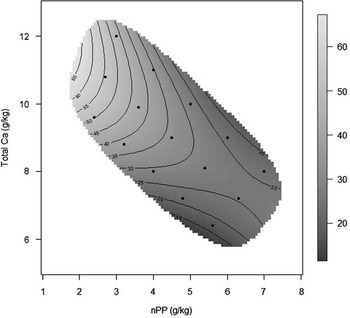
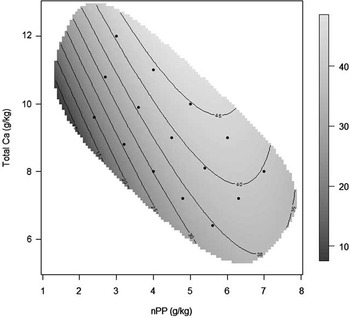
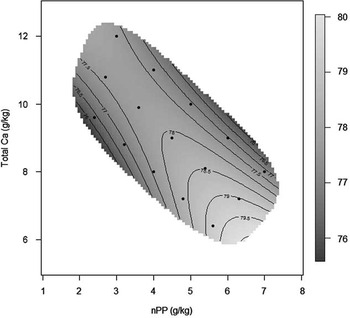
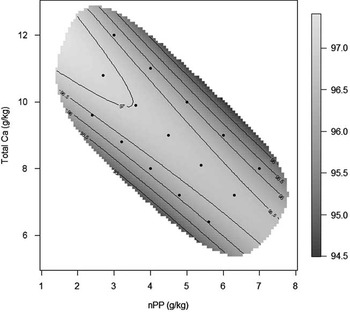
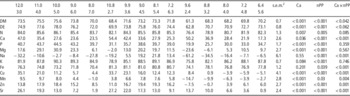
Bird performance, tibia ash and latency to lie results are presented in Bradbury et al. (Reference Bradbury, Wilkinson, Cronin, Thomson, Bedford and Cowieson2014). The analysed Ca and P concentrations (Table 1) were within acceptable ranges when mixing and assay errors were considered. The effect of dietary Ca and nPP on the AID of N, DM, DE and minerals are presented in Table 2. The AID of DM and DE were highest in birds fed diets containing 4 to 5 g/kg nPP and 10 to 11 g/kg Ca. Wide Ca : nPP or medium Ca : nPP ratios reduced the AID of DM and DE within each Ca : nPP cluster resulting in a significant interaction between dietary Ca and nPP. Both total Ca and nPP concentrations influenced the digestibility of N (P<0.01) and was greatest in birds fed diets containing ~8 to 10 g/kg Ca and 4.0 to 6.0 g/kg nPP. The AID of Na increased within each Ca : nPP cluster as the ratio of Ca : nPP narrowed and conversely as this ratio widened the AID of Na was decreased leading to a significant interaction between the two macro minerals (P<0.001). Maximal Na digestibility found in birds fed 8.1 g/kg Ca and 5.4 g/kg nPP. Diets containing high Ca (>8.0 g/kg) and low nPP (<3.0 g/kg) or low Ca (<8.0 g/kg) and high nPP (>4.5 g/kg) resulted in negative Na digestibility coefficients. Plotting the response surfaces for the AID of N and Na showed discrete optima for dietary Ca and nPP producing orbital-like surface patterns (Figures 1 and 2, respectively). Deviation from these optima either by increasing or decreasing the concentrations of dietary Ca and nPP considerably reduced the digestibility of these nutrients. An interaction between Ca and nPP was reported for the AID of Zn (P<0.01) and was maximised at similar Ca and nPP concentrations for N. The AID of Mn was greatest in birds fed 10.0 to 11.8 g/kg Ca and 3.5 to 4.5 g/kg nPP (Ca×nPP, P<0.01).
The effect of dietary Ca and nPP on the apparent ileal digestibility of N in broilers (day 28) (P-values; Ca, 0.007; nPP, 0.005; Ca×nPP, 0.085).

The effect of dietary Ca and nPP on the apparent ileal digestibility of Na in broilers (day 28) (P-values; Ca, 0.55; nPP, <0.001; Ca×nPP, <0.001).

Interaction of dietary Ca and nPP concentration (g/kg) on the apparent ileal digestibility (%) of dry matter (DM), digestible energy (DE), nitrogen (N) and minerals in d 28 broilersFootnote 1
1 Mean values from five treatment replicates.
2 Pooled s.e.m.
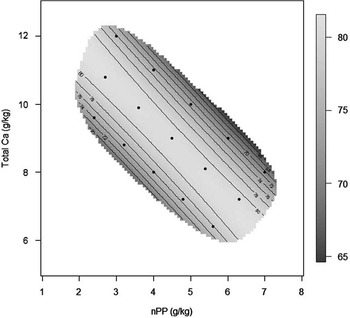
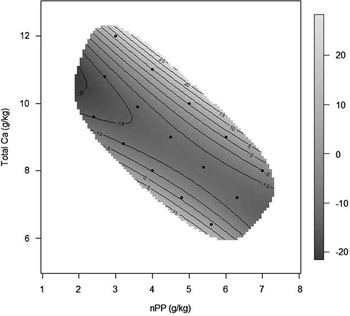
A significant interaction between Ca and nPP was found for the AID of Ca which was greatest at high dietary Ca (>9.0 g/kg) and low nPP (<3.5 g/kg) concentrations (see Figure 3). Calcium digestibility was maximised at the 4 : 1 Ca:nPP ratio (Table 2) for each density grouping (15, 13.5 or 12 g/kg Ca : nPP). Strontium and Cu digestibility were maximised in broilers fed >10 g/kg Ca and<3.5 g/kg nPP and had significant interactions between Ca and nPP (Table 2).
The effect of dietary Ca and nPP on the apparent ileal digestibility of Ca in broilers (day 28) (P-values; Ca, 0.036 nPP, <0.001; Ca×nPP, <0.001).

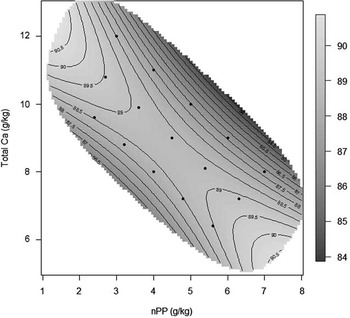
Generally, increased dietary Ca concentrations improved the ileal digestibility of P at lower dietary P concentrations and less so for higher dietary P concentrations (Figure 4). Phosphorus and Mg digestibility were greatest in birds fed 10.0 g/kg Ca and 5.0 g/kg nPP. The ileal digestibility of K in high Ca (>10g/kg) diets was substantially improved with increased nPP, however, this improvement abated above 5.0 g/kg nPP. Ileal digestibility of Fe did not resemble any of the surface plots of the other minerals (Figure 5). An interaction between dietary Ca and nPP was reported (P<0.001) with greatest Fe ileal digestibility around 7.2 to 10.8 g/kg Ca and 6.3 to 3.6 g/kg nPP.
The effect of dietary Ca and nPP on the apparent ileal digestibility of P in broilers (day 28) (P-values; Ca, <0.001; nPP, <0.001; Ca×nPP, 0.359).

The effect of dietary Ca and nPP on the apparent ileal digestibility of Fe in broilers (day 28) (P-values; Ca, 0.209; nPP, 0.038; Ca×nPP, <0.001).

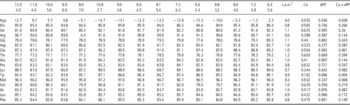
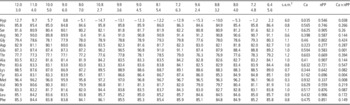
The effects of dietary Ca and nPP on the AID coefficients of amino acids are presented in Table 3. Broadly, dietary Ca and nPP did not significantly influence individual amino acid digestibility per se. The response surface for the amino acids may be categorised into one of four categories based on their response to dietary Ca and nPP concentrations. The digestibility of Ala, Arg, Asp, Gly, His, Ile, Leu, Lys, Phe, Pro Ser and Tyr were all maximised in birds fed diets with wide ratios of Ca : nPP (Figure 6). Increased ileal digestibility of Glu, Thr and Val were observed with increasing nPP concentration and a concomitant decrease in total Ca (Figure 7). The AID of Met was maximal at higher Ca concentrations and lower nPP (Figure 8) while hydroxyproline (Hyp) showed an inverse response and was highest at higher nPP concentrations and lower total Ca (Figure 9). However, decreased digestibility of Hyp was associated with lower nPP and moderate Ca concentrations and was increased with greater nPP and increased or decreased Ca leading to a Ca and nPP interaction (P<0.05). Ileal digestibility of Glu, Met and Tyr were optimised by feeding diets with 13.5 g/kg Ca+nPP (irrespective of absolute proportions) resulting in significant Ca and nPP interactions for each of these amino acids. There was a tendency (P<0.1) for an interaction between dietary Ca and nPP for the digestibility of Lys and Ile.
The effect of dietary Ca and nPP on the apparent ileal digestibility of lysine in broilers (day 28) (P-values; Ca, 0.344; nPP, 0.642; Ca×nPP, 0.082).

The effect of dietary Ca and nPP on the apparent ileal digestibility of threonine in broilers (day 28) (P-values; Ca, 0.603; nPP, 0.669; Ca×nPP, ns).

The effect of dietary Ca and nPP on the apparent ileal digestibility of methionine in broilers (day 28) (P-values; Ca, 0.932; nPP, 0.337; Ca×nPP, <0.01).

The effect of dietary Ca and nPP on the apparent ileal digestibility of hydroxyproline in broilers (day 28) (P-values; Ca, 0.035; nPP, 0.546; Ca×nPP, <0.05).

The effect of Ca and nPP (g/kg) on the apparent ileal digestibility (%) of amino acids in Ross 308 broilers (day 28)Footnote 1
1 Mean values from five treatment replicates.
2 Pooled s.e.m.
Discussion
Bird performance is reported in (Bradbury et al., Reference Bradbury, Wilkinson, Cronin, Thomson, Bedford and Cowieson2014) and will be briefly discussed. Feed intake was highest in birds fed diets with high nPP and intermediate concentrations of Ca and lowest in birds fed high Ca and low nPP diets. BW followed a similar pattern to feed intake. Birds were healthy throughout the study.
In this study, the AID coefficients for Mn, Na, Zn and N had discrete optima resulting in an orbital-like contour plot is instructive and may provide further information on some of the anecdotal effects of phytase. Phytic acid contains 12 dissociable protons with pKa values ranging from 1.5 to ~10. Phytic acid in its fully protonated form has a low pKa and when combined with the release of phosphate ions by phytase results in the secretion of Na bicarbonate into the intestinal lumen to act as a buffer (Liu et al., Reference Liu, Ru, Li and Cowieson2008). Cowieson et al. (Reference Cowieson, Acamovic and Bedford2004) found that the ingestion of phytate by broilers was associated with increased endogenous flow of Na from the intestinal tract. Phytate and phytase may influence the partitioning of Na via increased secretion of sodium bicarbonate (NaHCO3) in response to dietary phytate, which may be partially ameliorated with phytase (Cowieson et al., Reference Cowieson, Acamovic and Bedford2004). If this is true, it may be possible that the repartitioning of Na to NaHCO3 may in turn influence the Na-dependent transport of nutrients such as glucose and amino acids (Cowieson et al., Reference Cowieson, Bedford, Ravindran and Selle2011). Liu et al. (Reference Liu, Ru, Li and Cowieson2008) demonstrated in broilers that were fed phytate there was a significant decrease in the activity of Na+K+−ATPase in the duodenum and that phytase alleviated the negative effects of phytate. Ravindran et al. (Reference Ravindran, Cowieson and Selleo2008) showed that the efficacy of a microbial phytase was reduced with increasing dietary Na concentration, suggesting that Na may either reduce the antinutrient effects of phytic acid and/or impair the efficacy of phytase (Cowieson et al., Reference Cowieson, Bedford, Ravindran and Selle2011). From the available literature, this is the first study to show a relationship between dietary Ca and nPP per se on ileal Na digestibility. These data suggest that a moderate change in Ca and nPP concentrations would result in substantial changes to ileal Na digestibility and raises the possibility that the interaction between phytase and Na may be mediated through changes in digestible Ca and nPP concentrations. This association may also have implications for water intake of birds, excreta moisture and litter quality which are, among other things, related to the dietary electrolyte balance and have been anecdotally linked with phytase use (Ravindran et al., Reference Ravindran, Cowieson and Selleo2008). Whatever the mechanism, due to improved Na availability when using phytase in broiler diets, it may be appropriate to assign Na matrix values to phytase so as avoid compromising Na digestibility and/or Na-dependent transport systems and degradation of litter quality.
The ileal digestibility of Zn and Mn were also shown to have discrete optima related to dietary Ca and nPP concentration. Though their patterns were similar, the ranges for which optimal digestibility was observed differed and was bounded within the range of ~8 to 10 g/kg total Ca and 4 to 5.5 g/kg nPP (Zn) and 10 to 11 g/kg Ca and 3.5 to 4.5 g/kg nPP (Mn). Outside of these ranges led to a considerable reduction in their digestibility. Zinc and Mn are known to form insoluble complexes with phytate in the intestine of broilers leading to reduced availability (Li et al., Reference Li, Lu, Hao, Wang, Zhang, Liu, Liu, Li and Luo2011). The predominant antagonists include dietary Ca and phytate while phytase has been shown to restore their availability (Schlegel et al., Reference Schlegel, Nys and Jondreville2010). As such, the findings from this study support the notion that optimising dietary Ca and nPP concentrations with an emphasis on the destruction of phytate with phytase in the intestine may result in extra-phosphoric effects such as increased Zn and Mn availability.
The effects of dietary Ca and nPP on the on the ileal digestibility of N and amino acids of broilers in the current study and may partially reflect the extra-phosphoric effects associated with phytase use. Maximal ileal N digestibility was apparent in birds fed diets containing ~8 to 10.5 g/kg Ca and 4 to 6 g/kg nPP. Outside of the maximal ‘hub’, ileal N digestibility sharply decreased with reducing dietary Ca and nPP and moderately decreased with increased Ca and nPP in diets. Broadly speaking, these effects corresponded to maximal BW gain and the most efficient feed conversion during the experimental period (Bradbury et al., Reference Bradbury, Wilkinson, Cronin, Thomson, Bedford and Cowieson2014).
Notably the response surfaces for the AID of individual amino acids in birds were not similar in shape to that of N. It is possible that though the individual response surfaces of individual amino acids varied to that of N, a composite surface plot of these amino acids would be different. It is well understood that endogenous amino acid losses are influenced by dry matter intake as well as the composition of the diet (Cowieson et al., Reference Cowieson, Bedford, Selle and Ravindran2009). The negative hydroxyproline AID values are in agreement with previous work and may be related to increased turnover of the epithelium and or reduced gastrointestinal tract integrity (Wilkinson et al., Reference Wilkinson, Selle, Bedford and Cowieson2014). Work in rats has demonstrated that a high Ca diet is associated with reduced N retention (Goto and Sugai, Reference Goto and Sugai1975). Studies in broilers has shown that feed intake and the efficiency of N and amino acid digestion are negatively influenced with increasing dietary Ca concentration (Shafey and McDonald, Reference Shafey and Mcdonald1991a). An explanation for this remains to be defined. However, it has been shown that high Ca diets reduce digesta transit time as well as increase the intestinal microbial population and this is hypothesised to cause irritation to the intestinal mucosa and impair absorption (Shafey and McDonald, Reference Shafey and Mcdonald1991b). High Ca diets usually contain more limestone which has been associated with higher gizzard pH and this may restrict gastric digestion rates (Walk et al., Reference Walk, Addo-Chidie, Bedford and Adeola2012). It is also worth noting that diets 11 to 15 had reduced oil concentrations and this may also have influenced gastric digestion rates and N digestibility.
In the present study, Na and nitrogen digestibility were maximised in similar geographic regions on their response surfaces. However, this was not true for the amino acids. Generally, as Na digestibility decreased the AID of amino acids was improved. Protein–phytate interactions are not completely understood, however, the benefits to protein digestibility from phytase are speculated to be derived from numerous factors (Selle et al., Reference Selle, Ravindran, Caldwell and Bryden2000). This is likely to be a combination of the release of protein from endogenous plant protein–phytate complexes, prevention of the formation of binary and ternary protein–phytate complexes within the intestine as well as the alleviation of negative phytate impacts on digestive enzyme and endogenous amino acids losses (Selle et al., Reference Selle, Cowieson, Cowieson and Ravindran2012). Upon ingestion of phytate and passage into the duodenum there is increased secretion of mucin, increasing the presence of endogenous amino acids in the lumen (Cowieson et al., Reference Cowieson, Bedford, Selle and Ravindran2009). Dietary Na has been shown to play a role in the antinutrient effect of phytate and although the mechanism remains unclear, it has been demonstrated that cation/anion balance can disrupt phytate : protein complexes (Liu et al., Reference Liu, Ru, Li and Cowieson2008; Ravindran et al., Reference Ravindran, Cowieson and Selleo2008; Bye et al., Reference Bye, Cowieson, Cowieson, Selle and Falconer2013). This has been associated with dampening the antagonistic effect of phytate on endogenous amino acid flow (Cowieson et al., Reference Cowieson, Bedford, Ravindran and Selle2011). The reduced retention of Na in broilers, which simultaneously showed improved amino acid digestibility, may be evidence for the above mechanisms.
It is worth noting that in formulating the experimental diets in the present study it was necessary to vary the proportions of limestone and di-calcium phosphate (DCP) used between treatments. As such, this may have influenced some of the digestibility metrics. High dietary Ca concentration has been shown to decrease bird performance and P digestibility (Driver et al., Reference Driver, Pesti, Bakalli and Edwards2005). Limestone is used extensively in broiler diets as a cost-effective source of Ca. However, limestone has a high acid binding capacity that is capable of increasing intestinal pH and creating a favourable environment for the formation of phytate-nutrient complexes (Selle et al., Reference Selle, Cowieson and Ravindran2009). At each Ca to nPP ratio, there was a tendency for improved nutrient digestibility, increased BW gain, feed intake and tibia ash (Bradbury et al., Reference Bradbury, Wilkinson, Cronin, Thomson, Bedford and Cowieson2014) as the proportion of DCP increased in the diet and limestone reduced. However, direct comparisons are difficult since each Ca : nPP cluster also differed in Ca and nPP concentrations.
In this study, the response of P digestibility to dietary Ca and nPP concentrations was broadly in keeping with published data which shows maximal apparent digestibility in broilers (AID of 0.41 to 0.45) fed diets around 4.0 to 6.0 g/kg nPP. However, somewhat contrary to published results, data from this study also showed greatest P digestibility in broilers was achieved with diets containing more than 8.0 g/kg Ca. Changes to the rates of absorption of dietary Ca in the intestine and urinary excretion of Ca by the kidneys are two mechanisms for which Ca homeostasis may be controlled (Bronner and Pansu, Reference Bronner and Pansu2000). Phosphorus absorption is less regulated and is a linear function of intake (Wilkinson, Reference Wilkinson1976). Studies in rats have shown that excess P consumption is associated with decreased feed intake and that they are averse to over-consuming P when provided the choice to do so (Siu et al., Reference Siu, Hadley and Draper1981). However, data from the current study shows birds did not reduce their consumption of high nPP diets (Bradbury et al., 2014) but the P digestibility of these diets was reduced. The mechanism for this remains unclear.
Conclusions
Discrete optima for the ileal digestibility of N, Mn, Na and Zn were found but these did not correspond with maximal amino acid digestibility. These results show that the ratio of Ca : nPP is perhaps more influential to mineral digestibility than the absolute dietary concentration of each macro mineral and highlights the importance of formulating diets to provide sufficient nPP to poultry.
Acknowledgements
The authors would like to thank Rural Industries Research and Development Corporation (Chicken Meat) for providing financial support for this work. The Australian Poultry Cooperative Research Centre for scholarship funding for Ms Bradbury. Professor Steve Simpson (Faculty of Biological Science, University of Sydney) is thanked for his introduction to the geometric framework.