INTRODUCTION
Autonomous regional peacekeeping, i.e. formally independent peace operations launched by regional states to address a local conflict, has attracted global attention and considerable material support since the early 1990s. It remains highly relevant: United Nations (UN) Secretary-General Ban Ki-moon (Reference Ban2007) noted that in matters of international peace and security the UN's ‘partnerships with regional and sub-regional organisations are stronger and more active than ever … The United Nations is committed to helping build up the capacity of regional and sub-regional organisations to undertake conflict-prevention, peacemaking and peacekeeping tasks in their respective regions.’ In 2010, the UN General Assembly's Special Committee on Peacekeeping Operations ‘reaffirm[ed] the important contribution that regional arrangements and agencies can make to peacekeeping’ (UNGA 2010).
African regional peacekeeping has drawn particular attention, given the high incidence of armed conflicts on the continent, the perceived advantages of ‘African solutions to African problems’, and the continued reluctance of Western states to deploy to the region. Since the early 1990s, African states have developed multiple sub-regional and continental institutions for managing and responding to conflicts in the region (Berman & Sams Reference Berman and Sams2000: chs. 3–6). Among the most recent initiatives is the African Union's (AU's) creation of the continental African Standby Force (ASF), which was formally established in July 2002 and was due to become functional in 2010, though its operationalisation has been delayed. In parallel with these regional efforts, Western actors have launched a series of regional peacekeeping capacity-building programmes intended to address the severe limitations faced by most African militaries and/or develop regional institutional capacities to deploy and manage peace operations. Recent initiatives include European Union support for the ASF, the UN's on-going ten-year capacity-building programme for the AU (UNSG 2006, 2011) and the US Global Peace Operations Initiative (GPOI), which from 2004 onwards and with an emphasis on Africa has sought ‘to enhance the capacity of regional and sub-regional organisations to train for, plan, deploy, manage, and sustain peacekeeping operations’ (Pulliam Reference Pulliam2009). International interest in further developing African regional peacekeeping capacities remains strong. In March 2009, the UN Security Council reiterated the importance of assisting AU efforts to improve regional peacekeeping capacities (UNDPI 2009). In July 2009, US President Barack Obama (2009) stressed that ‘Africa's future is up to Africans’, called for ‘a strong regional security architecture’, and pledged continued US ‘support that strengthens African capacity’. The 2010 report of the UN's Special Committee on Peacekeeping dedicated a full section to the ‘Enhancement of African peacekeeping capacities’ (UNGA 2010: section K).
The benefits, disadvantages, and optimal ways of addressing conflicts through autonomous regional peacekeeping operations have been subject to considerable debate,Footnote 1 as have internationally sponsored regional peacekeeping capacity-building programmes (Abramovici & Stoker Reference Abramovici and Stoker2004; Berman Reference Berman2003; Mazrui & Ostergard Reference Mazrui, Ostergard and Laremont2002). Implicitly or explicitly, many contributions to these debates assume a dichotomy between regional and UN peacekeeping: regional peacekeeping is conceived of primarily in contrast and as an alternative to UN peacekeeping. Thus Herbert Howe's (Reference Howe1996/7) seminal analysis of regional peacekeeping in Liberia assesses – and largely disputes – the alleged advantages of regional over UN peacekeeping. Eric Berman (Reference Berman1998) investigates the extent to which relying on regional peacekeeping constitutes genuine collaboration between the UN and regional bodies rather than an abdication of responsibilities. The International Commission on Intervention and State Sovereignty (2001) advocates regional peacekeeping in cases where the UN Security Council fails to respond to humanitarian crises. The 2009 special edition of the journal African Security identified one of its principal objectives as highlighting ‘the advantages and disadvantages of African regional and sub-regional organisations vis-à-vis other security mechanisms, in particular UN peace operations’ (Hentz et al. Reference Hentz, Söderbaum and Tavares2009).
This article argues that in sub-Saharan Africa, the evolving practice of regional peacekeeping has undermined the usefulness of this conceptual dichotomy between regional and UN peacekeeping.Footnote 2 There are still important differences between autonomous regional peace operations and UN peacekeeping missions: regional peace operations may or may not enjoy the unquestioned legitimacy conveyed by a UN Security Council mandate,Footnote 3 they cannot automatically draw on the UN's Departments of Peacekeeping Operations and Field Support (DPKO and DFS) for mission support, and they are not necessarily funded through the UN peacekeeping budget.Footnote 4 Failing to recognise a distinction between UN and regional peacekeeping is thus problematic. Yet the dichotomy between regional and UN peacekeeping also obscures important features of contemporary peacekeeping.
This article highlights three key trends in the practice of regional peacekeeping in sub-Saharan Africa that make it essential to move beyond this dichotomy. First, sub-Saharan African states have largely distanced themselves from long-term autonomous regional peacekeeping, and currently favour explicitly interim missions that are a prelude rather than an alternative to UN peacekeeping. Second, the analytically clear line between regional peacekeeping and the separate sub-Saharan African tradition of solidarity deployments (i.e. military support of embattled governments) has in practice become blurred, and the regional vs universal peacekeeping dichotomy not only fails to acknowledge this trend but helps to obscure it. Finally, since the early 2000s sub-Saharan African states have increasingly addressed regional conflicts by participating in UN operations deployed in the region. In other words, UN peacekeeping has emerged as a preferred form of regional peacekeeping in sub-Saharan Africa. The remainder of this article explores each of these trends in turn.
AUTONOMOUS REGIONAL PEACEKEEPING IN SUB-SAHARAN AFRICA: AN EVOLVING PHENOMENON
The practice of autonomous regional peacekeeping in sub-Saharan Africa has evolved considerably over the past twenty years. The paradigmatic case in the 1990s was the 1990–7 Nigerian-led Economic Community of West African States (ECOWAS) intervention in Liberia, which contemporary UN Secretary-General Boutros Boutros-Ghali (1995) explicitly acknowledged as a test case of regional peace operations. ECOMOG, the ECOWAS Monitoring Group deployed to end Liberia's civil war, was hobbled by resource constraints and suffered from limited local and international legitimacy, but it responded to a crisis ignored by the UN, grew to include over 12,000 troops, and was sustained despite heavy human and financial costs (Howe Reference Howe1996/7: 160–73; Reference Howe2001: ch. 4; Coleman Reference Coleman2007: ch. 3). It thus set a precedent for conceiving of African regional peacekeeping as sub-regional, robust, and controversial. As one commentator put it (Hirsch Reference Hirsch2000: 8),
regionalism will not look as pretty as UN initiatives … A system of UN-sponsored regio-cops … will be far from ideal. It is a messy, often inconsistent muddle-through solution with many risks. But in an environment of astringent alternatives – a determinedly minimal US role and a grossly underfunded and undersupported UN – there may be no other practicable way for the international community to stop atrocities it no longer seems able to stomach.
Continuing this apparent pattern, ECOMOG deployed to Sierra Leone in 1997–9, again facing resource problems and allegations of partiality but responding to a vicious conflict that the rest of the international community was failing to address. Two further controversial interventions claimed the auspices of the Southern African Development Community (SADC): South Africa and Botswana's 1998 deployment in Lesotho, which raised fears of renewed South African regional interventionism; and Angola, Namibia and Zimbabwe's 1998–2002 intervention in the Democratic Republic of Congo (DRC), which South African president Mandela publicly criticised as worsening the situation (Coleman Reference Coleman2007: chs. 4, 5). MISAB, a French-supported force of 800 troops from Burkina Faso, Chad, Gabon, Mali, Senegal and Togo, deployed to the Central African Republic in 1997–8 (SIPRI 2010). The continental Organisation of African Unity (OAU) largely deferred to the sub-regions on regional peace and security issues, though it did field small observer missions in Rwanda (1991–3), Burundi (1993–6), the Comoros (1997–8) and the DRC (1999–2000).
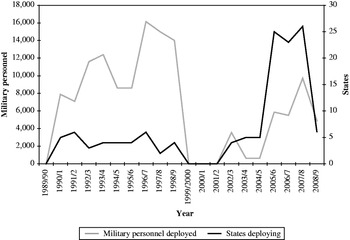
However, as Figure 1 suggests, the practice of autonomous regional peacekeeping in sub-Saharan Africa changed dramatically from the 1990s to the 2000s. There have been two crucial developments. First, continental peacekeeping has emerged as a significant form of regional peacekeeping. Created in 2000 to replace the largely discredited OAU, the AU deployed an observer mission to Ethiopia and Eritrea in 2000, and peacekeeping missions to Burundi in 2003, to Sudan in 2004 and to Somalia in 2007. It also deployed electoral support and security assistance missions to the Comoros in 2006 and 2007, the latter of which became an enforcement mission in 2008. These missions often depended heavily on large troop contributions from particular African states, notably South Africa (in Burundi and Comoros), Uganda (in Somalia), and Nigeria and Rwanda (in Sudan). Nevertheless they elicited more widespread participation than sub-regional operations, in the sense of attracting at least some troops/military observers from a wide variety of sub-Saharan African states. Strikingly, the AU operation in Sudan (AMIS) drew military personnel from twenty-five sub-Saharan African states in 2007 (SIPRI 2010). AU missions also enjoyed considerable international legitimacy and global support, replacing sub-regional organisations as the primary focus of international attention. UN Security Council resolution 1809 (2008) on Peace and Security in Africa, for example, acknowledged sub-regional organisations but centred heavily on the AU. However, AU operations have so far been much smaller than the earlier sub-regional ones: ECOWAS deployments in Liberia and Sierra Leone peaked at 12,450 and 14,000 troops, respectively, while AMIS reached a maximum strength of 6,500–7,000 troops and military observers in 2007 (IISS 1997–8, 1999–2000, 2008–9; New Times 2007). The AU mission in Somalia (AMISOM) received pledges of 9,000 troops in January 2007, but by January 2010 only 5,100 troops were actually deployed (Ban Reference Ban2010b: 7). Figure 1 captures the resulting trend towards more widespread state participation but fewer troops deployed in autonomous regional peacekeeping operations in sub-Saharan Africa.
Sub-Saharan African participation in autonomous regional peacekeeping, 1989/90 to 2008/9

The second crucial development is that both continental and sub-regional actors have distanced themselves from long-term, open-ended peacekeeping operations, in large part because of the enormous financial and military resources these operations require. In the ECOWAS case, this largely reflects Nigeria's increasing reluctance to assume the costs of sub-regional peacekeeping. Nigeria decided not to participate in ECOMOG's 1998 deployment in Guinea-Bissau, and in 1999 announced its intention to withdraw from the ECOWAS force in Sierra Leone, triggering its replacement by a UN mission. Nigeria also declined to contribute troops to the 2002–4 ECOWAS mission in Côte d'Ivoire (ECOMICI), which consequently proved slow to deploy and grow and which, at ECOWAS's request, was replaced by a UN peacekeeping force in February 2004. Only Liberia, where civil war reignited in 2003, saw a substantial deployment of over 1,600 Nigerian troops within the framework of a 3,566-strong ECOWAS force, ECOMIL (Aboagye & Bah Reference Aboagye, Bah, Aboagye and Bah2005: 20). ECOMIL was robust, enjoyed widespread support within ECOWAS, had a formal UN Security Council mandate, and benefited from substantial US military support (Ross Reference Ross2005). It was also an explicitly short-term deployment: the Security Council resolution that authorised ECOMIL committed the UN to deploying a ‘follow-on … stabilization force’ within two months (UNSC 2003: §2). Nigeria had no intention of leading another open-ended and costly sub-regional deployment. Thus ‘the ECOMOG-style operations of the '90s have made way for interventions authorized by the Security Council, that involve regional forces as firefighters … and which transition into full-blown UN multifunctional peacekeeping and peacebuilding missions’ (Malan Reference Malan2004).
There has been very little autonomous sub-regional peacekeeping beyond ECOWAS. South Africa deployed up to 750 troops to Burundi in 2001–3 in what was supposed to be a regional Special Protection Force, but the expected troop contributions by Ghana, Nigeria and Senegal failed to materialise (SIPRI 2010). Thus the only non-ECOWAS sub-regional peacekeeping operation since 2000 has been FOMUC, a French- and EU-supported Economic and Monetary Union of Central African States force established in 2002 to protect Central African Republic (CAR) president Patassé and secure the border between the CAR and Chad. FOMUC effectively became a peace operation after the 2003 coup in the CAR: its mandate expanded to include contributing to the CAR's overall security environment, assisting in the restructuring of the CAR's armed forces, and supporting the post-coup transition process (Meyer Reference Meyer2009). However, FOMUC's total strength never surpassed 380 troops and its impact on CAR peace and stability was limited. In 2008, authority over the force was transferred to the Economic Community of Central African States, renamed MICOPAX, and its strength reached 504 thanks to additional troops from Cameroon.
At the continental level, the AU has been severely hampered by the limited resources that its members were able and willing to contribute to its missions, and has emerged as unable to sustain effective long-term peacekeeping operations. As de Coning (Reference de Coning2010: 4) notes, ‘the AU has a proven capability to undertake high-risk stabilisation-type missions … [but it] is unable to sustain these operations, because it does not yet have predictable funding mechanisms, and it has not yet developed the in-house mission-support capacity to backstop these missions with the logistics, personnel and financial systems needed to manage them’. In Sudan, AMIS lacked basic equipment and relied on NATO, the European Union and the UN for funding, strategic airlift and troop training. A 2007 report on the mission highlighted several core weaknesses: weak strategic and operational management capacities; insufficient logistic support; insufficient communication and intelligence capacity; problems with force generation; and ‘a quasi-total dependence on external partners to finance the mission’ (Guicherd 2007: 3–4). Similarly, the AU mission in Somalia (AMISOM) relied first on the USA, the EU and NATO and subsequently on the UN for logistics support and funding.
Actors within the AU have thus increasingly envisioned a temporal division of labour with the UN, mirroring the trend in ECOWAS. The 2007 decision to replace AMIS with the African Union/United Nations Hybrid Operation in Darfur (UNAMID) was a compromise with the Sudanese government, which had long refused to accept a ‘pure’ UN mission, but also reflected growing African and international recognition ‘that peacekeeping in Darfur need[ed] to be enhanced and made effective’ (Ban & Konaré Reference Ban and Konaré2007: §40).Footnote 5 At AMISOM's creation in 2007, the AU explicitly requested a UN follow-on mission to be deployed within six months (AUPSC 2007: §14). The Security Council effectively refused this and subsequent requests: it announced its intent to establish a ‘follow-on’ operation to AMISOM in January 2009, but in practical terms has limited itself to commending AMISOM, periodically extending its UN mandate, authorising UN logistical support for the mission, and calling for more troop contributions and international financial support for it (UNSC 2009, 2010). Such Security Council reluctance notwithstanding, the AU currently conceives of its peace operations as interim measures: ‘Today it is accepted that the AU will deploy first, opening up the possibility for a UN follow-on multi-dimensional peace support operation’ (Cilliers Reference Cilliers2008: 7; see also de Coning Reference de Coning2010: 4–5).
The prospect of sustained continental peacekeeping has not been entirely abandoned. Notably, the ASF could technically be deployed for longer-term missions. The Force is projected to include substantial military capabilities, consisting of five sub-regional stand-by brigades comprising almost 4,300 troops each, with integrated command units and force enablers such as engineering, logistics and medical units, supported by sub-regional training and logistic systems (Cilliers Reference Cilliers2008: 3). The 2002 Protocol establishing the AU Peace and Security Council as the ASF's mandating body explicitly considers funding procedures for longer-term operations Reference Ban(AU 2002: 27). The ASF's 2003 Policy Framework recommends considering whether ‘AU and Regional operations should be designed with the view to eventually handing over mandates and responsibilities to the UN’, but does not restrict the ASF to transitional missions (AU 2003: 3, 30). Indeed, Bachmann (Reference Bachmann2011: 27, 41) highlights that the scenario for the ASF's 2010 command post exercise was a long-term mission, and argues that the AU may be turning away from temporary deployments ‘to scenarios where Africans themselves assume peace consolidation tasks in the long run’.
However, despite progress on establishing the ASF's structure, doctrine and training facilities, the obstacles to a substantial and sustainable continental peacekeeping capability remain formidable. Progress on the five sub-regional stand-by brigades has been uneven (Alghali & Mbaye Reference Alghali and Mbaye2008; Bachmann Reference Bachmann2011; Kinzel Reference Kinzel2008), and as of December 2010 there has been no ‘comprehensive [Memorandum of Understanding] on the use of the ASF for AU mandated missions’ (AU 2010: 50). Moreover, troop pledges are ‘not yet a guarantee of force effectiveness’ (Bachmann Reference Bachmann2011: 38). Key challenges remain in the areas of logistics, funding, clear demarcation of continental and sub-regional authorities and responsibilities, and AU administrative capacity (AU 2010: 49–50; Bachmann Reference Bachmann2011: 35; Cilliers Reference Cilliers2008: 6, 16–18; Kinzel Reference Kinzel2008: 23–5). The AU has not met its target of achieving a fully operational ASF by June 2010, and has announced a new deadline of December 2015 (Cameroon Today 15.6.2011). It is not yet clear how it plans to overcome the remaining obstacles for operationalising the ASF. It is also notable that a December 2010 AU briefing paper recommended ‘coordination of Mission support requirements with the UN … because deployment of the ASF is predicated on handing over to the UN’, suggesting that at least for some AU officials, transitional deployments remain a more likely scenario than long-term ones even for a fully operational ASF (AU 2010: 56).
In sum, the current potential for sustained autonomous regional peacekeeping in sub-Saharan Africa is very limited. There is little capacity or political will to replicate the costly open-ended deployments of the 1990s at either the continental or the sub-regional level. Sub-Saharan African actors currently see regional deployments not as alternatives to larger UN peacekeeping operations but as interim measures pending the creation of such operations. This suggests the obsolescence of the regional vs UN peacekeeping dichotomy, and raises new policy issues, including how to manage the many practical challenges of transitioning from a regional to a UN operation and the more fundamental questions of transition timing: how long the initial regional operation should operate, what conditions (if any) should be met before the UN replacement mission is deployed, and how early in the process the UN can or should commit to such a replacement mission. As a senior UN official put it, ‘the issue of transition is absolutely important’ (UN OMA int.; see also Cilliers Reference Cilliers2008: 7–8).
REGIONAL PEACE OPERATIONS AND SOLIDARITY DEPLOYMENTS
The conceptual dichotomy between regional and UN peacekeeping is also flawed because it masks the diversity of international military operations undertaken by sub-Saharan African states. This critique goes beyond the caution that ‘peacekeeping’ is often used as a loose and imprecise umbrella term. Scholars have long noted that peacekeeping – or more properly peace (support) operations – encompasses a range of activities including unarmed observer missions, ‘interpositional’ deployments along ceasefire lines, ‘multidimensional’ operations to help implement comprehensive peace agreements, and peace enforcement missions seeking to impose a settlement on a conflict (Bellamy et al. Reference Bellamy, Williams and Griffin2010; Durch Reference Durch2006: 5–9). This diversity is not unique to the UN. The AU (2003: 3) envisions six deployment scenarios for the ASF: military advice to a political mission; observer missions alongside UN missions; ‘stand alone’ observer missions; consent-based or preventive peacekeeping; ‘complex multidimensional’ peacekeeping with ‘low level spoilers’; and ‘intervention – e.g. genocide situations where international community does not act promptly’. However, the problem is not simply one of acknowledging the diversity of peace operations (potentially) undertaken by sub-Saharan African regional actors.
More fundamentally, the issue is that alongside its evolving tradition and practice of peace operations, sub-Saharan Africa has a separate tradition of solidarity deployments, i.e. international troop movements through which governments support embattled regimes in other states. When these deployments respond to an armed attack against the target state by an international actor they fall in the legal category of collective self-defence measures, whose lawfulness is reaffirmed under Article 51 of the UN Charter. Yet solidarity deployments may also occupy more ambiguous legal territory in supporting a government against an internal armed challenge (i.e. a challenge emanating entirely from within the national population), which may or may not be characterised as a civil war (Grey Reference Grey2008: 81–8). They can also respond to an internal challenge supported, sponsored or fomented by an outside power, or a hybrid armed challenge by both national and international actors.
As an ideal type, solidarity deployments differ dramatically from peace operations. Their primary objective is to support an existing government rather than to restore peaceful conditions in the recipient state, and they are by definition partial: they aim to aid to the host government, not to broker an even-handed agreement among conflict parties. Their ideological justification within sub-Saharan Africa traditionally lies in the discourse of solidarity, which derives from the pan-Africanist ideals asserted by early post-independence leaders, and continues to feature prominently in African diplomatic rhetoric. The AU's Constitutive Act, for example, begins by declaring itself ‘inspired by the noble ideals which guided the founding fathers of our Continental Organisation and generations of Pan-Africanists in their determination to promote unity, solidarity, cohesion and cooperation among the peoples of Africa and African States’ (AU 2000).
Solidarity deployments were relatively common in Cold War sub-Saharan Africa: Hughes and May (Reference Hughes, May and Baynham1986: 177–80) noted in 1986 that although they had ‘largely escaped academic notice’, ‘regime-supportive military interventions’ constituted the most common ‘use of African armies as an instrument of foreign policy between states’. The most prominent of these deployments supported governments of newly independent states threatened by aggression from countries that remained under minority rule. Nigeria deployed to Angola to assist the government against the US - and apartheid South Africa-supported UNITA movement (Abegunrin & Akomolafe Reference Abegunrin, Akomolafe, Abegunrin and Akomolafe2006: 114–15). Mozambique's government attracted military support from Tanzania, Malawi, and especially post-independence Zimbabwe, as well as from the USSR and Cuba, in its struggle against the Rhodesian-sponsored and apartheid South African-supported RENAMO group.Footnote 6 While not wholly motivated by pan-African solidarity, these deployments corresponded closely to its principles, arguably revealing both inter-regime and inter-population solidarity. They were thus proudly proclaimed and widely celebrated.
In addition, however, Cold War sub-Saharan African solidarity operations included pro-government deployments by Nigeria in Tanganyika (1964); by Angola in São Tomé e Príncipe (1977–91); by Guinea-Bissau in São Tomé e Príncipe (1977); by Guinea in Sierra Leone (1971, 1977), Benin (1977) and Liberia (1979); by Tanzania in the Comoros (1975–8), the Seychelles (1977, 1981–4) and Zambia (1980); by Zaire in Burundi (1972), the Central African Empire (1979) and Chad (1984); and by Senegal in the Gambia (1980, 1981) (Hughes & May Reference Hughes, May and Baynham1986: 180–4). While citing solidarity motivations, these deployments also often reflected common threat perceptions, personal friendships between state leaders, and/or a quest for personal or national aggrandisement by intervening regimes (ibid.: 193–4). Moreover, many strengthened autocratic governments against domestic challenges, thus demonstrating inter-regime solidarity but hardly broader solidarity with sub-Saharan African populations.
Solidarity deployments remain a feature of post-Cold War sub-Saharan Africa. Nigeria unilaterally supported Sierra Leone's Momoh and Strasser regimes against the RUF from 1991 until the 1997 ECOWAS intervention. It also dispatched ground attack aircraft to help quell Côte d'Ivoire's incipient rebellion in September 2002 (This Day 28.9.2002). Angola followed its 1997 support of Sassou-Nguesso's seizure of power in the Republic of Congo with a six-year deployment in support of the dictator. In 1998, Guinea and Senegal supported Guinea-Bissau's Vieira government against an army mutiny. Ethiopia deployed in support of Somalia's Transitional Federal Government in 2006–9; and in 2008 South Africa provided a small number of troops to support the Central African Republic's embattled government. Overall, ten of the twenty-nine instances of international military interventions resorting to combat in support of another government identified in the International Military Intervention, 1989–2005 (IMI) database were undertaken in sub-Saharan Africa by sub-Saharan African actors (Kisangani & Pickering Reference Kisangani and Pickering2007).
However, the end of the Cold War, the demise of apartheid and especially the formal democratisation of many African states have made solidarity deployments increasingly difficult to justify, particularly if they mostly reflect intergovernmental solidarity. Rhetorically at least, the AU (2003: §4h; 2007) has stressed its commitment to democratic principles, and its assertion of its right to intervene militarily against war crimes, genocide and crimes against humanity suggests a re-emphasis on inter-societal rather than intergovernmental solidarity. In practice, the organisation has not yet fully dissociated itself from the intergovernmental solidarity politics that earned its predecessor the moniker of a ‘dictator's club’. Its decision not to cooperate with the International Criminal Court's warrant against Sudan's president Omar al-Bashir, for example, demonstrates the continued salience of intergovernmental solidarity, as, at the sub-regional level, does SADC's reluctance to confront Zimbabwe's president Robert Mugabe Reference Fleshman(see Tieku Reference Tieku2009). Nevertheless, the increasingly prevalent discourse of popular sovereignty has eroded the justificatory basis of contemporary solidarity deployments: it suggests that only democratic governments are worthy of solidarity, and limits the ability of non-democratic states to launch legitimate solidarity deployments, since authoritarian regimes struggle to make credible claims of supporting democracy abroad.
Combined with the international community's (and especially Western states') readiness to support regional peace operations, these circumstances have created the conditions for a deliberate blurring of the line between solidarity deployments and regional peace operations in sub-Saharan Africa. Especially where the democratic credentials of the intervening and/or the recipient state are in doubt, sub-Saharan African states face considerable incentives to present their solidarity deployments as regional peacekeeping efforts, or to launch hybrid operations that merge peacekeeping and solidarity aims. Thus both operations that asserted SADC auspices in the 1990s were predominantly solidarity deployments, even though they claimed the title of peace operations and are commonly referred to as such (Bellamy & Williams Reference Bellamy and Williams2005: 163; Berman & Sams Reference Berman and Sams2000: ch. 5; Coleman Reference Coleman2007: chs. 4, 5; Schoeman & Muller Reference Schoeman and Muller2009). South Africa and Botswana's intervention in Lesotho emphasised the neutral peacekeeping objectives of preventing anarchy and restoring law and order, but was requested by Lesotho's Prime Minister and clearly favoured the government: its concept of operations bluntly called for the identification and containment of ‘destabilisers and destabiliser resources … where applicable with the necessary force to eliminate the threat’ (Malan Reference Malan1999: 52). The massive deployments of Angolan, Namibian and Zimbabwean troops to the DRC in 1998–2002 similarly responded to a government request, and explicitly supported President Kabila against internal and external military challenges. The intervening states tended to stress the peace and security goals of their deployments, but from a legal point of view the claim of assistance against invasion would have provided a stronger defence (Coleman Reference Coleman2007: 122–5). The IMI database identifies both interventions as ‘government supporting’ deployments (Kisangani & Pickering Reference Kisangani and Pickering2007).
ECOWAS missions have often been hybrid operations. ECOMOG's deployments in Liberia and Sierra Leone, for example, had clear peacekeeping dimensions, notably after the 1993 Cotonou Accords and the 1999 Lomé Accords, respectively. Yet both operations also had strong solidarity deployment characteristics. The Liberia intervention was launched to support Liberian dictator Samuel Doe against Charles Taylor's National Patriotic Front of Liberia (NPFL). The contemporary Nigerian ambassador to Liberia succinctly summarised his country's motivation for leading the intervention: ‘We went into Liberia to help Doe to crush the rebellion’ (Adjakayie int.). When Doe was killed in September 1990, ECOMOG supported his successor regimes and continued treating the NPFL largely as an enemy rather than a potential negotiating party (ibid.; Howe Reference Howe1996/7: 166). ECOMOG's Sierra Leone deployment incorporated and only partially contained the previous Nigerian solidarity deployment in the country. ECOWAS ministers stressed ‘the reinstatement of the legitimate government of President Ahmad Tejan Kabbah’ as a ‘central objective of the ECOWAS Peace Plan’ (ECOWAS 1997: §5). Critics charged that ‘the neutrality and impartiality expected of a peacekeeping force was all but missing, as ECOMOG became, in effect, a party to the conflict’ (Francis et al. Reference Francis, Faal, Kabia and Ramsbotham2005: 143). ECOMOG's Guinea-Bissau mission also followed unilateral solidarity deployments, in this case by Guinea and Senegal, ‘rais[ing] the concern that any country willing and able – not only Nigeria – could hijack ECOMOG for its own purposes’, although ultimately it fielded a relatively neutral (though not very effective) force (Berman & Sams Reference Berman and Sams2000: 128–9). During the ECOMICI deployment in Côte d'Ivoire, too, ECOWAS explicitly expressed its ‘solidarity with President Gbagbo’ (ECOWAS 2002).
At the continental level, the AU mission in Somalia (AMISOM) has also displayed solidarity characteristics, despite presenting itself as a peacekeeping mission. Uganda provides the vast majority of AMISOM's troops, with Burundi as the only other troop contributor. The operation is thus widely (and accurately) perceived as a Ugandan mission, which supports Somalia's Transitional Federal Government against predominantly Islamic opposition groups (Williams Reference Williams2009: 516–17). The July 2010 bombings in Uganda attributed to the Islamist Somali militia al-Shabaab testify to the degree to which local factions perceive AMISOM as an enemy rather than a mediator.
This de facto blurring of the line between solidarity deployments and peace operations is made possible by the fact that despite their clear analytical differences, peace operations and solidarity deployments can be difficult to distinguish in practice. Peace operations can bolster existing governments by resolving local conflicts, and solidarity deployments can enhance peace and security, especially if the regime is being challenged by a rebel force that deliberately targets civilians. Thus reliably distinguishing peace operations from solidarity deployments requires assessing the intervening state's primary motivation, a notoriously difficult task when states face incentives to dissimulate. Yet the tendency to view African operations through the prism of regional vs universal peacekeeping has also facilitated this blurring. The dichotomy made the label of regional peacekeeping readily available to sub-Saharan African states engaged in non-UN operations. It also discouraged consideration of alternative interpretations of these operations, notably by inviting continued neglect of the phenomenon of solidarity operations, which falls outside the scope of this neat dichotomy. Thus ‘regional peacekeeping’ became the default label for non-UN operations by regional actors in sub-Saharan Africa. Mark Malan's (Reference Malan1999) analysis of South Africa and Botswana's Lesotho intervention illustrates this dynamic. Malan notes the dissonance between the mission's official neutral peacekeeping objectives and its pro-government concept of operations, but concludes that the intervention was ‘some type of peace enforcement action’ marred by ‘considerable doctrinal confusion’ as to what this entailed, without considering the alternative explanation that this was a solidarity deployment that merely claimed the peacekeeping label. Other academics who note non-peacekeeping features within particular operations also ultimately maintain a ‘peace operation’ label (Bellamy & Williams Reference Bellamy and Williams2005; Coleman Reference Coleman2007).
By contrast, explicit recognition of solidarity deployments and regional peacekeeping as analytically distinct deployment types prompts analysts – and international policy makers – to empirically evaluate the balance of solidarity and peacekeeping characteristics in individual cases. It also enables a better understanding of the often-lamented biases in African peacekeeping, which frequently reflect not an insufficient understanding of peacekeeping principles, but a continued commitment to the principles of solidarity deployments. A similar response can be made to the charge that ‘many emerging regional security organisations seem to provide cover for “sovereignty-boosting” missions’ instead of improving human security (Hentz et al. Reference Hentz, Söderbaum and Tavares2009: 206). Consequently, these biases will not be amenable to correction by improved peacekeeping training. Finally, clearly distinguishing between the regional peacekeeping and solidarity deployment ideal types highlights a central dilemma for sub-Saharan African regional peacekeeping operations: both during and after the Cold War, the largest sub-Saharan African troop deployments have been for solidarity deployments or regional peacekeeping operations with substantial solidarity characteristics. This includes Zimbabwe's deployments of up to 12,000 troops to Mozambique in the 1980s and to the DRC in 1999/2000, and Nigeria's deployments of up to 10,000 troops in Liberia (1992–4) and 11,000 troops in Sierra Leone (1998/9) (IISS 1975/6–2008/9). Governments were willing to expend these resources because they saw their national (or regime) interests engaged: solidarity deployments are by definition based on perceptions of common interests uniting the deploying and host governments. More impartial regional peacekeeping operations are less likely to permit a pursuit of national interests beyond regional peace and security, and thus provide fewer incentives for large-scale participation.
UNITED NATIONS PEACEKEEPING AS REGIONAL PEACEKEEPING
The final reason to move beyond the regional vs UN peacekeeping dichotomy is that the historical circumstances that gave rise to it no longer obtain. Global interest in autonomous regional peacekeeping – particularly in sub-Saharan Africa – developed after the failures of UN operations in Somalia and Bosnia brought the dramatic expansion of UN peacekeeping during the early 1990s to an abrupt halt. Following these events, permanent UN Security Council members turned to other organisations (notably NATO) to address security issues they considered vital, and distanced themselves from conflicts in areas they perceived to be of little strategic interest, including sub-Saharan Africa. Total UN uniformed peacekeeping personnel, which had skyrocketed from 13,000 in 1988 to 78,800 in 1993, fell to 12,084 in June 1999 (GPF 2011c; UNDPKO 2011a). Peacekeeping in ‘non-strategic’ areas was increasingly ‘contracted out’ to regional organisations allegedly more able but sometimes simply more willing to undertake these missions. UN involvement was largely limited to small co-deployment missions charged with monitoring larger regional missions, though UN missions following this model in Liberia (UNOMIL) and Sierra Leone (UNOMSIL) were generally ineffective (Francis et al. Reference Francis, Faal, Kabia and Ramsbotham2005: 128–31, 143). The number of UN troops and military observers in sub-Saharan Africa plummeted from over 41,000 in 1992/3 to only 1,495 in July 1999 (GPF 2011b; IISS 1993–4). Regional peacekeeping was thus increasingly seen as both the only robust conflict management option in sub-Saharan Africa, and an explicit alternative to UN peacekeeping. As one African UN diplomat noted in 1999, ‘we have had to bear such a responsibility … not only because we feel a sense of ownership for confronting and managing conflict, but also because the response of the international community has recently been either muted or lukewarm’ (Fleshman Reference Fleshman1999: 4).
Yet regional peacekeeping need not take the form of autonomous peace operations. In principle, sub-Saharan African states can channel their military efforts to address regional conflicts either through regional organisations or through the UN – or indeed through both. This point is not merely semantic. In practice, the conditions that rendered the UN option unavailable to sub-Saharan African states in the 1990s have abated, and in the 2000s UN peacekeeping has emerged as a central focus of sub-Saharan African states' contributions to peacekeeping in their region. This trend becomes clear when current sub-Saharan African participation in UN peacekeeping is put in historical perspective.
Sub-Saharan African engagement with UN peacekeeping actually began with an attempt to help address a regional crisis through the global institution. The 1960–4 UN Operation in Congo (ONUC) was originally intended to facilitate colonial Belgium's withdrawal from the Congo, but its mandate subsequently expanded to include preserving the Congo's territorial integrity against a secession attempt, preventing civil war, and removing foreign mercenaries from the country (Boulden Reference Boulden2001: 31; O'Neill & Rees Reference O'Neill and Rees2005: ch. 3). Correspondingly, ONUC grew to a maximum strength of 19,828 troops and cost over US$400 million (UNDPI 1996: 709). Sub-Saharan African participation in the mission was substantial. At ONUC's creation, six of the region's then thirteen independent states joined the operation, and Nigeria and Sierra Leone added their contributions on attaining independence. Ethiopia, Ghana, Liberia and Nigeria maintained multi-year troop commitments, and Ethiopia and Nigeria each furnished an ONUC force commander. Yet while the Congo retained its territorial integrity, ONUC's political stance proved controversial, civil war was not averted, the mercenaries proved difficult to expel, and the UN suffered 251 fatalities, including Secretary-General Dag Hammerskjöld. By 1964 the mission was widely perceived as a failure.
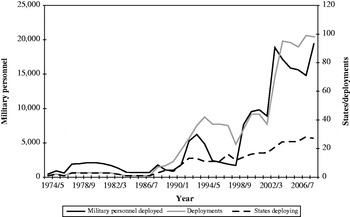
The subsequent history of sub-Saharan African participation in UN peacekeeping comprises three key phases, as illustrated in Figure 2, which tracks the number of sub-Saharan African states, military personnel and national deployments (i.e. national troop contingents in particular operations) in UN peacekeeping operations from 1974/5 to 2008/9. For the remainder of the Cold War, there were no further UN peacekeeping operations in sub-Saharan Africa: UN peacekeeping only resumed in 1989, when the first UN Angola Verification Mission (UNAVEM I) and the UN Transition Assistance Group (UNTAG) in Namibia were launched. For their part, sub-Saharan African states showed little interest in contributing to UN peacekeeping operations outside the region: only Ethiopia, Ghana, Nigeria and Senegal sent military contributions to such missions (UNDPI 1996: 691–710).
Sub-Saharan African participation in UN peacekeeping, 1974/5 to 2008/9

The second phase began with the ‘boom’ in UN peacekeeping in the early 1990s, for which sub-Saharan Africa was a key arena: half of the eighteen new UN peacekeeping missions created in 1989–93 were in the region, which by 1992/3 hosted 57% of the UN's troops and military observers (calculated from IISS 1993–4). Sub-Saharan African participation in UN missions also escalated, with the number of participating states growing from five in 1990 to thirteen in 1992/3, and the number of troops and military observers contributed increasing from 1,051 in 1990 to 5,254 in 1992/3 (IISS 1993–4). Moreover, sub-Saharan Africa was emerging as a global peacekeeper: just over half of its personnel (51·4%) were deployed outside the region, notably in Lebanon, the former Yugoslavia and Cambodia. The subsequent ‘bust’ of UN peacekeeping led the number of sub-Saharan African UN military personnel to decline to 1,703 in 1998/9 (IISS 1999–2000). Yet because participation in UN peacekeeping declined less in sub-Saharan Africa than elsewhere, the region's share of UN military personnel increased from 7·3% to 18·4% (IISS 1993–4, 1999–2000). The number of participating sub-Saharan African states also remained relatively stable, declining from thirteen in 1992/3 to twelve in 1998/9. However, the percentage of personnel contributed to missions outside sub-Saharan Africa declined to 41·6% in 1998/9, foreshadowing a core trend of the 2000s.
The current third phase of sub-Saharan African participation in UN peacekeeping is characterised by the emergence of UN peacekeeping as a preferred form of regional peacekeeping efforts for many sub-Saharan African states. It coincides with the dramatic revival of UN peacekeeping from 2000 onwards, especially in sub-Saharan Africa. The total number of UN troops and military observers climbed from fewer than 10,000 in mid 1999 to 86,751 in January 2010, and over the same period the UN peacekeeping budget expanded from US$995 million to $7.75 billion (GPF 2011a; UNDPKO 2011a, 2011b). Meanwhile the number of UN troops and military observers in sub-Saharan Africa increased from fewer than 1,500 in 1999 to 65,394 in January 2010, and the proportion of total UN military peacekeeping personnel deployed to the region grew from 15% to 75% (GPF 2011b; UNDPKO 2011b). By January 2010, six of the UN's fifteen on-going peacekeeping missions (including four of its five largest operations) were in sub-Saharan Africa, and almost 73% of the UN peacekeeping budget was allocated to operations in sub-Saharan Africa (UNDPKO 2011b).Footnote 7 This is often cited as evidence of the UN's renewed commitment to sub-Saharan African peace and security, in which the decision to escalate rather than withdraw the UN mission in Sierra Leone (UNAMSIL) after it was attacked in May 2000 was a major turning point. Thus UN Secretary-General Kofi Annan (Reference Annan2004: 8) commented:
Having experienced enormous disappointments in bringing peace to Angola, the Central African Republic, Liberia, Rwanda and Somalia in the 1990s, the will of the Security Council and the international community in general converged … to make the mission in Sierra Leone a success. This success has given confidence to the United Nations to again support complex peace operations in Africa and, today, the region receives the highest deployment of United Nations peacekeeping efforts in the world.
Neethling (Reference Neethling2004: 52; Reference Neethling2009: 7) has cogently argued that the narrative of the ‘UN's return to Africa’ is overstated: the overall figures reflect large personnel commitments from developing states and thus mask a continued reluctance by Western states to deploy to sub-Saharan Africa. Yet the fact remains that the Security Council has at least overcome its reluctance to authorise UN operations in sub-Saharan Africa. Autonomous peace operations are thus no longer the only option available to sub-Saharan African states wishing to engage in peacekeeping in their region. The result has been a dramatic change in sub-Saharan African participation in UN peacekeeping.
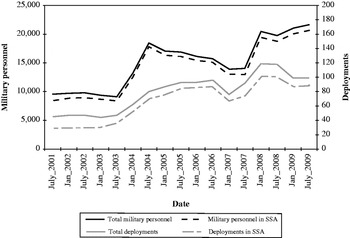
Figure 3 captures the evolution of sub-Saharan African participation in global as well as more specifically sub-Saharan African UN peacekeeping in the 2000s. It illustrates two related phenomena. First, overall sub-Saharan African participation in UN peacekeeping escalated dramatically. In July 2001, sub-Saharan Africa contributed 9,558 troops and military observers to UN missions, a five-fold increase of its commitment in 1998/9. By July 2009, 21,665 sub-Saharan African troops and military observers served in UN missions. On average, sub-Saharan Africa accounted for over 26% of UN military peacekeeping personnel in 2001–9, making it the second largest troop-contributing region after Central and South Asia. The number of separate national contingents deployed more than doubled from 45 in July 2001 to 99 in July 2009, after peaking at 119 in January 2008. The number of participating states also increased: in July 2001, seventeen sub-Saharan African states contributed military personnel to at least one UN mission, while eight years later twenty-seven did. In January 2008, no fewer than thirty-one sub-Saharan African states were contributing to at least one UN peacekeeping operation. Overall, from 2001 to 2009 more than two thirds of sub-Saharan Africa's forty-eight states made at least one military contribution to UN peacekeeping.
Location of sub-Saharan African participation in UN peacekeeping, 2001–9

Second, almost all of this increased activity occurred in UN operations within sub-Saharan Africa. Total UN peacekeeping commitments outside of the region increased from about 9,000 troops and military observers at the beginning of the 2000s to about 22,000 at the decade's end, but sub-Saharan Africa's total contribution to these missions remained relatively constant between 680 and 1,120 military personnel.Footnote 8 By contrast, sub-Saharan African contributions to UN deployments within the region rose from 8,441 military personnel in July 2001 to 20,677 in July 2009. Consequently, the share of sub-Saharan African UN personnel stationed outside the region fell from almost 12% in July 2001 to less than 5% in July 2009, a striking contrast to the corresponding figure of about 30% during the previous spike in UN peacekeeping in 1993 and 1994 (IISS 1993–4, 1994–5). Thus while sub-Saharan African commitment to UN peacekeeping soared in the 2000s, it also became more localised. For sub-Saharan African states, participation in UN peacekeeping became primarily – in fact almost exclusively – a form of regional peacekeeping. UN Secretary-General Ban Ki-moon (Reference Ban2009b) acknowledged this by using the key slogan associated with regional peacekeeping to describe African troops in UN operations: ‘They are helping find African solutions to African challenges.’
Institutionally, the convergence of regional and UN peacekeeping in sub-Saharan Africa is most clearly evident in the African Union/United Nations Hybrid Operation in Darfur (UNAMID), the first peacekeeping mission that is formally both a UN and a regional operation. The AU and the UN jointly appoint UNAMID's top officials and agree on its composition, and the UN provides the mission's ‘command and control structures and backstopping’ as well as its funding (Ban Reference Ban2010a). Sub-Saharan African states furnish the bulk of UNAMID troops (71% in May 2011), in part because of Sudan's insistence on a predominantly African force (UNDPKO 2011d). However, the convergence of regional and UN peacekeeping is also evident in the common practice of ‘re-hatting’ troops from autonomous regional peace operations to become UN personnel. Strikingly, the two spikes in sub-Saharan African contributions to UN peacekeeping operations illustrated in Figure 3 do not primarily represent new troop deployments, but reflect the ‘re-hatting’ of almost 3,500 previously ECOWAS troops into UNOMIL in Liberia (late 2003), 1,300 previously ECOWAS troops into UN Operation in Côte d'Ivoire (UNOCI) (early 2004), and some 7,000 previously AU troops into UNAMID in Sudan (early 2008).
Moreover, it appears that for many sub-Saharan African states, the UN has become the preferred vehicle for regional peacekeeping. In 2001–9, far more sub-Saharan African troops were deployed in UN operations in the region than in regional peacekeeping operations. On average, sub-Saharan African states deployed a total of just under 5,200 troops and military observers a year for autonomous continental or sub-regional peacekeeping operations in 2001–9 (calculated from SIPRI 2010). In the same period, their average total deployment in UN operations within sub-Saharan Africa was just over 14,200 troops and military observers.
The patterns of transition between regional and UN missions are also telling. There have been no cases of regional operations replacing UN missions. The three cases in which UN or hybrid UN/regional missions replaced regional ones show increased sub-Saharan African participation after the transition. In Liberia, all eight ECOMIL contributors allowed their soldiers to be ‘re-hatted’ as UN Mission in Liberia (UNMIL) troops in October 2003. Five had to reduce or terminate their commitments after January 2004 – in part because they did not meet UN standards (UNDPKO int.) – but the remaining three increased their troop contributions and seven sub-Saharan African states that had not participated in ECOMIL joined UNMIL. Ultimately, UNMIL averaged some 5,550 sub-Saharan African troops and military observers from 2001 to 2009, compared with only 3,480 troops in ECOMIL (Aboagye & Bah Reference Aboagye, Bah, Aboagye and Bah2005: 20; UNDPKO 2011e). In Côte d'Ivoire, all five ECOMICI troop contributors allowed their troops to be ‘re-hatted’ as UNOCI personnel and maintained or expanded their troop commitments from UNOCI's establishment in April 2004 through July 2009. Fourteen other sub-Saharan African states contributed small contingents for all or part of UNOCI's deployment, bringing the force to an average strength of just under 2,000 troops and military observers for 2004–9, compared with ECOMICI's 1,300 troops (SIPRI 2010; UNDPKO 2011e). In Sudan, twenty-three of AMIS's twenty-five troop contributors continued their deployments under UNAMID in 2008. By 2010, many of the smaller contributors had reduced or withdrawn their contingents, but AMIS's largest contributors (Rwanda and Nigeria, followed by South Africa and Senegal) steadily increased their UNAMID contingents. Together with the contributions of sub-Saharan African states that had not furnished troops to AMIS (notably Ethiopia), this meant that in March 2010 seventeen sub-Saharan African states furnished 12,840 UNAMID troops, compared with the 6,500–7,000 the region fielded in AMIS.
For sub-Saharan African states, UN deployments offer three sets of advantages over autonomous regional peacekeeping. The first is financial. Contributors to autonomous regional peacekeeping operations must normally cover their own deployment costs, but most UN operations are funded through the UN peacekeeping budget, of which all forty-eight sub-Saharan African states together pay less than 0·13% (Ban Reference Ban2009a). The per diems that the UN pays states for the soldiers they contribute to a UN mission typically exceed the salaries of sub-Saharan African military personnel, allowing the contributing state to reap a profit from its deployment. Moreover, UN reimbursement rates for the use of many types of basic Continent-Owned Equipment (COE) are generous enough to allow contributing states to amortise the acquisition of new military equipment over time (UNDPKO 2010 int.). Second, contributors to UN peacekeeping operations enjoy the international recognition and prestige of contributing to a global peace mission, while autonomous regional peacekeeping operations can be more controversial and may embroil participating states in regional rivalries and conflict dynamics (GfK Roper 2010: 4). Finally, the UN framework offers a very substantial ‘force multiplier’ for sub-Saharan African peacekeeping efforts. Regional states can expect assistance with training, troop transport, equipment and logistics either directly from the UN or from wealthier UN members (Berman & Sams Reference Berman and Sams2000: 251–5). Moreover, UN missions attract troop contributions from non-African states that would not be available for regional peace operations. In October 2008, for example, 33,455 of the UN's 55,776 military personnel in the region were non-African, including 26,543 troops from Central and South Asia (CIC 2009: 151).
Against these advantages stands one major disadvantage: sub-Saharan African states do not control the mandating process for UN peacekeeping operations, which is in the hands of the UN Security Council. Conversely, autonomous regional peacekeeping structures are attractive precisely because they offer an avenue for intervention in the face of Security Council inaction. This fact, coupled with a strong sense of pride in regional autonomy, helps explain the continued development of autonomous regional peacekeeping structures in parallel to sub-Saharan African states' increased engagement in UN peacekeeping. The slow progress on pivotal capacities like the ASF suggests, however, that sub-Saharan African states feel little urgency to move their peacekeeping efforts from the UN into an autonomous regional framework. As Cilliers (Reference Cilliers2008: 7) noted, ‘African troop contributors appear to choose between deployment on UN missions and a commitment to the ASF. Given the disparities in resources available to the two types of mission, the ASF does not generally receive the same level of support as that of UN missions.’
In sum, when the Security Council's increased willingness to authorise sub-Saharan African missions in the 2000s provided regional states the opportunity to act within the UN framework, they seized it. It is worth stressing that this does not mean that sub-Saharan African states prefer the UN to address their region's challenges instead of regional actors. The notion that African problems require African solutions remains strong. The point is rather that in the 2000s, sub-Saharan African states have done most of their regional peacekeeping within UN operations.
The critical policy implication is that one of the most effective ways to facilitate regional peacekeeping in sub-Saharan Africa is to further enhance the UN's ability and willingness to respond to crises in the region. UN peacekeeping itself can be improved: one challenge, for example, is achieving a balance between allowing widespread participation in UN missions and insisting on operationally effective troop contingents and highly competent staff officers and military observers. Moreover, the UN's capacity to act as a force multiplier for sub-Saharan African peacekeeping efforts can be enhanced by further developing the UN's logistics and personnel support capacities (UNDPKO & UNDFS 2009: 35–6), and ensuring adequate financing of UN operations through the peacekeeping budget. It also depends on non-African UN member states continuing or rekindling their willingness to make substantial personnel contributions to UN peacekeeping operations in sub-Saharan Africa. Finally, sustaining and enhancing sub-Saharan African regional peacekeeping within the UN framework requires maintaining the Security Council's willingness to authorise robust peacekeeping missions in sub-Saharan Africa, and increasing the involvement of sub-Saharan African actors in the Council's decision-making process. UN troop-contributing countries have long sought greater inclusion in the Security Council's deliberations on potential peacekeeping operations, and thus the ability to affect not only whether a peacekeeping operation is authorised but also what its mandate is (UNGA 2010: §154). This inclusion would enhance sub-Saharan African states' ability to undertake regional peacekeeping through the UN.

It has become commonplace for scholars to warn against uncritically applying concepts developed in the West to African politics. This article raises a somewhat different caution: given the highly dynamic nature of African politics, all conceptual constructs – Western or otherwise – should be reassessed over time to determine whether they continue to be useful.
The on-going debate about the desirability, limitations, and ways of improving autonomous regional peace operations remains important. In the absence of Security Council action, or in the interim period before a UN deployment, regional interventions in local conflicts can be crucial for saving lives and enhancing international peace and security. However, the conceptual dichotomy between regional and universal peacekeeping has ceased to be useful in the sub-Saharan African context. The practice of regional peacekeeping in sub-Saharan Africa has evolved in three critical ways over the past two decades. First, autonomous regional peacekeeping has evolved away from robust long-term operations towards relatively small and explicitly interim deployments. Autonomous regional peacekeeping is thus currently less an alternative to UN peace operations than a possible precursor to them. Second, the line between regional peace operations and solidarity deployments has been blurred, and hybrid operations with both peacekeeping and solidarity deployment characteristics have emerged. The diversity of operations undertaken by regional actors and claiming the regional peacekeeping label is not captured if regional peacekeeping is defined only in contrast to UN peacekeeping and not also in opposition to solidarity deployments. Third, since the early 2000s sub-Saharan African states are increasingly making their regional peacekeeping contributions through participation in UN peacekeeping operations deployed on the subcontinent. Rather than being mutually exclusive activities, for sub-Saharan African states UN peacekeeping has become a form of regional peacekeeping.