INTRODUCTION
Of more than 200 species of insect pests reported to attack sugarcane during different growth phases of the crop in India (David and Nandagopal, Reference David, Nandagopal, David, Easwaramoorthy and Jayanthi1986), lepidopteran borers are considered most detrimental in both tropical and sub-tropical sugarcane fields. Amongst the borers, Chilo sacchariphagus indicus (Kapur) (Lepidoptera: Crambidae), commonly known as internode borer, has remained a major pest in peninsular India. It generally attacks the crop from internode formation to harvest, causing estimated crop losses of 10–35% (Yalawar et al., Reference Yalawar, Pradeep, Ajith Kumar, Hosamani and Rampure2010). When the borer injury extends to three or more internodes per cane, or more than 10% of the total length of the cane, canes suffer significant deterioration in juice quality. Although known to bore the top four to five formative internodes, the borer destroys the apical meristem in young and weak shoots producing deadhearts (David, Reference David, David, Easwaramoorthy and Jayanthi1986), with axial bud sprouting and bunchy top formation leading to crop losses (Mukunthan and Rakkiyappan, Reference Mukunthan and Rakkiyappan1989). Larvae often enter from the top to either feed only on the spindle above the meristem or reach and injure the meristem, both of which produce deadhearts often coupled with axial bud germination and injury to the germinated buds (Srikanth and Kurup, Reference Srikanth and Kurup2011).
Insecticides are generally not effective against the borer due to its internal tissue feeding habits and plant canopy structure (Ananthanaryana and David, Reference David, David, Easwaramoorthy and Jayanthi1986). Biological control and sex pheromone traps are known to minimize infestation levels but suffer from specific limitations (Mukunthan, Reference Mukunthan2006; Srikanth et al., Reference Srikanth, Sivaraman, Kurup, Chandrasekhar, Sundara and Rakkiyappan2013). Host plant resistance provides an effective platform for breeding varieties resistant to important borer pests such as C. sacchariphagus indicus. Cultivars were screened against borers such as C. sacchariphagus indicus in India (Albert et al., Reference Albert, Thirumalai, Krishnamurthi, Ramya, Lourdusamy and Gopinathan2007), Diatraea saccharalis (Fabr.) (Lepidoptera: Crambidae) (Coburn and Hensley, Reference Coburn and Hensley1972) in Louisiana, Mexican rice borer Eoreuma loftini (Dyar) (Lepidoptera: Crambidae) in Texas (Reay-Jones et al., Reference Reay-Jones, Way, Sétamou, Legendre and Reagan2003; Wilson et al., Reference Wilson, VanWeelden, Beuzelin, Reagan, Way, White, Wilson and Showler2015) and other moth borers in Papua New Guinea (Korowi and Samson Reference Korowi and Samson2013; Korowi et al., Reference Korowi, Samson and Kuniata2011) to identify their resistance. The ICAR-Sugarcane Breeding Institute Research Center (ICAR-SBI RC), Kannur, Kerala State, India, currently maintains the world's largest collection of sugarcane germplasm. This vast germplasm with diverse genetic makeup includes assemblages of Saccharum spp. accessions. Interspecific crosses involving Saccharum officinarum, Saccharum barberi, Saccharum robustum and Saccharum spontaneum were carried out and the progenies evaluated for identifying superior hybrids. These hybrids were intercrossed, back crossed and crossed with the commercial varieties to develop genetic stocks and new varieties (Nair, Reference Nair2011). Besides, Saccharum spp. also serve as sources of resistance against pests and accessions resistant to some emerging pests have been identified amongst those maintained at the research centre (Mahesh et al., Reference Mahesh, Chandran, Srikanth, Nisha and Manjunatha2013, Reference Mahesh, Srikanth and Chandran2014, Reference Mahesh, Srikanth, Chandran and Nisha2015a, b).
In preliminary observations, the germplasm collection at the centre showed 1.2–23.5% incidence of C. sacchariphagus indicus in Saccharum spp. and exotic and Indian hybrids (Anonymous, 2008). In studies conducted elsewhere with clones of Saccharum spp., a few were identified as resistant to C. sacchariphagus indicus (Jayanthi, Reference Jayanthi1988). As Saccharum spp. serve as important parental material, identification of sources of resistance against C. sacchariphagus indicus would strengthen the breeding programme for resistance against the borer. However, no screening studies were conducted with the large collection of Saccharum spp. accessions maintained in the world sugarcane germplasm at the ICAR-SBI RC. Hence, the present study was taken up to screen accessions of four Saccharum spp. against C. sacchariphagus indicus.
MATERIALS AND METHODS
Study site and field layout
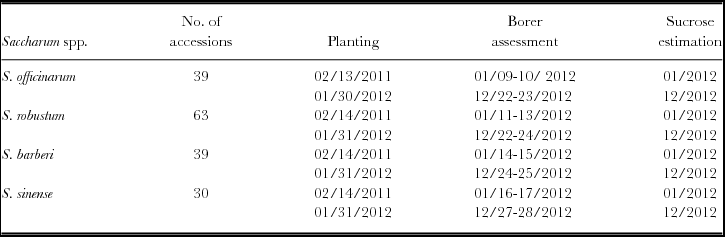
Sugarcane germplasm maintained at ICAR-SBI RC, Kannur, Kerala State, India (11°52′ N, 75°25′ E, 11 m MSL), constitutes a crop island as Kerala State in general and Kannur in particular lack large-scale or commercial sugarcane cultivation. The germplasm collection includes four species of Saccharum, viz. S. officinarum, S. robustum, S. barberi and Saccharum sinense. Each accession of the four species was planted in a 2 m row with 90 cm spacing between rows and 10 cm between plants (Table 1). Recommended agronomical practices were followed but no insecticides were applied for pest control.
Experimental details of screening Saccharum spp. against Chilo sacchariphagus indicus at ICAR-SBIRC, Kannur, Kerala State, India, in 2011 and 2012. As injury parameters, proportions (%) of bored internodes and deadheart were evaluated.

Infestation parameters
The attack of C. sacchariphagus indicus begins at fifth month age of the crop and extends almost until harvest. Larvae, after feeding on the leaf tissue for 7–8 days, typically bore into the top internodes egesting out wet frass from the bore holes, which indicates fresh attack. The presence of large bore holes, often blackened by the growth of saprophytes, in the lower internodes characterizes old attack (See supplementary Figure S1 available online at http://dx.doi.org/10.1017/S0014479716000697). Grown-up larvae emerge out of the tunnel and pupate in dry leaf sheaths. Occasionally, young canes that produce deadhearts remain stunted and fail to produce millable canes (David, Reference David, David, Easwaramoorthy and Jayanthi1986).
Three types of injury were considered to assess the borer incidence in terms of direct or derived parameters, as follows:
 $$\begin{equation}
{\textrm{Percent incidence}} = \frac{{{\textrm{Number of injured canes}}}}{{{\textrm{Total number of canes}}}}{\textrm{ }} \times {\textrm{ }}100,
\end{equation}$$
 $$\begin{equation}
{\textrm{Percent intensity}} = \frac{{{\textrm{Number of injured internodes}}}}{{{\textrm{Total number of internodes}}}} \times 100,
\end{equation}$$
 $$\begin{equation}
{\textrm{Infestation}}\,{\textrm{index}} = \frac{{{\textrm{Percent}}\,{\textrm{incidence }} \times {\textrm{ Percent}}\,{\textrm{intensity}}}}{{100}}.
\end{equation}$$
The usefulness of deadhearts as an independent infestation parameter was assessed by computing its occurrence separately as follows:
 $$\begin{equation}
{\textrm{Percent deadhearts}} = \frac{{{\textrm{Number of canes with deadhearts}}}}{{{\textrm{Total number of canes}}}}\;\times\;100.
\end{equation}$$
Progression of borer attack
Progression of C. sacchariphagus indicus was examined in 39 accessions of S. officinarum, which is highly prone to the borer attack, during 2012 crop season. Percent of borer incidence on the basis of fresh injury was assessed at monthly intervals beginning in July (120 days after planting) and ending in December. The total number of canes and number of canes with fresh injury were recorded and percent incidence was calculated for each observation.
Borer status in Saccharum spp.
Adequate number of trained personnel, familiar with symptoms of injury, was deployed to assess the incidence levels of the borer in 171 accessions of the four Saccharum spp. in 2011 and 2012. As the observations were done at harvest, all three types of injury symptoms and parameters were considered. For each accession, after counting the total number of canes, individual canes were cut at the base and examined for the presence of injury symptoms and the affected cane number recorded. In the infested canes, the total number of internodes and number of injured internodes were recorded and the three injury parameters were computed.
Categorization of accessions
Accessions of the four Saccharum spp. were grouped into three categories of resistance/susceptibility based on percent incidence (Mukunthan, Reference Mukunthan, Sreenivasan, Amalraj and William Jebadas2001). For each accession, the datasets from the two study years (2011–2012) were compared and the dataset with higher incidence was selected to account for the variation between the 2 years and avoid the possibility of escapes under low natural infestation.
Morphological characters vs. borer incidence
Selected morphological traits such leaf length, leaf width, sheath hair and nature of leaf sheath clasping were recorded in 9-month old plants as per the descriptor classes and descriptor states adopted for sugarcane germplasm (Artschwager and Brandes, Reference Artschwager and Brandes1958). Yield traits such as cane thickness, cane length and sucrose percentage in healthy canes were recorded in 12-month old plants.
Meteorological data
Daily weather data during the experimental period were recorded by the Meteorological Observatory of the Center, with monthly averages for air temperature and relative humidity, and monthly totals for rainfall being calculated.
Statistical analyses
Non-parametric analysis was applied to the data of infestation parameters. Friedman ANOVA by ranks and Kendall concordance coefficient test for multiple dependent samples were applied to the monthly data (July–December 2012), with sugarcane accessions as blocks and months as treatments. Post-hoc analysis was carried out using Wilcoxon matched pairs rank test with a Bonferroni correction that sets a significance level of P < 0.0033 for the 15 2-month comparisons. Simple correlation coefficients were calculated between mean monthly (July–December 2012) weather parameters and mean and rank values of C. sacchariphagus indicus incidence in S. officinarum. Wilcoxon matched pairs rank test for two dependent samples was used to compare the percent incidence data of the two study years (2011 and 2012) for individual Saccharum spp. Kruskal–Wallis ANOVA by ranks and multiple comparison tests were applied to the accession data selected on the highest value of percent infestation taking the four Saccharum spp. as treatments. Box plots were used for graphical depiction of means from the four Saccharum spp. For assessing the relationship between morphological characters and infestation parameters, simple correlation coefficients were computed for quantitative parameters and Mann–Whitney U test was applied for qualitative parameters with two categories. The analyses were performed using StatSoft Inc. (2004).
RESULTS
Progression of infestation
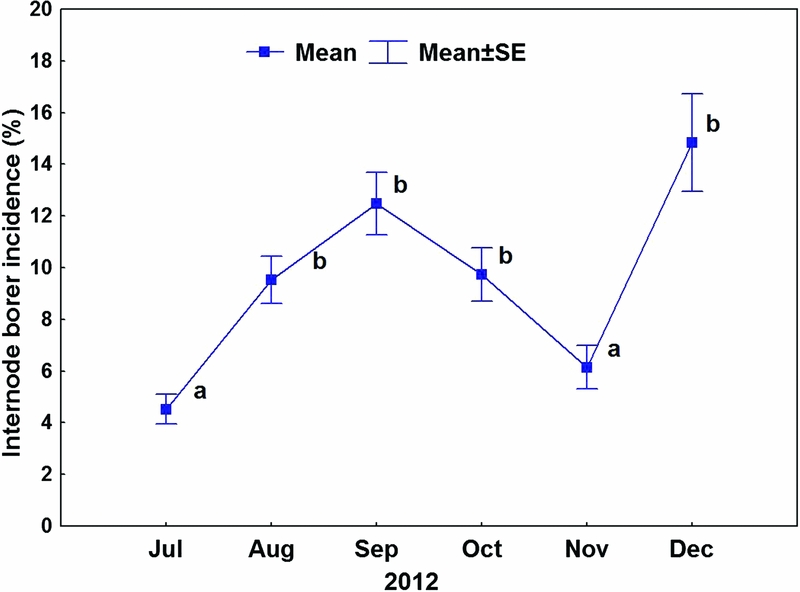
Progression of the borer in S. officinarum assessed from July to December on the basis of freshly attacked canes showed significant differences amongst months by Friedman ANOVA (χ 2 = 75.965, N = 135, df = 5, P < 0.00001; Kendall coefficient of concordance = 0.113). Borer attack began in the first fortnight of July with 4.5% mean incidence amongst the accessions, increased in the next 2 months and reached its peak in September with 12.5% infestation (Figure 1). Thereafter, the incidence decreased in the next 2 months but reached its overall peak (14.8%) in December, i.e. at harvest. Wilcoxon matched pairs rank test with a Bonferroni correction indicated significant differences amongst months. Simple correlation coefficients between mean monthly (July–December 2012) weather parameters and mean and rank values of borer incidence were not significant for any parameter (See supplementary Table S1 available online at http://dx.doi.org/10.1017/S0014479716000697).
Pattern of Chilo sacchariphagus indicus incidence during July–December 2012 in Saccharum officinarum. Means with the same letter are not significantly different by Friedman ANOVA and Wilcoxon matched pairs rank test with a Bonferroni correction.

Borer attack rates in Saccharum spp.
Comparison of C. sacchariphagus indicus attack rates by Wilcoxon matched pairs rank test indicated significant differences between the 2 years for percent of canes attacked in the four Saccharum spp. Percent incidence of the borer was significantly higher in 2012 than in 2011 for S. officinarum (Z = 5.39; P < 0.0001), S. barberi (Z = 5.34; P < 0.0001) and S. sinense (Z = 4.19; P < 0.0001). However, borer incidence did not differ significantly (Z = 0.64; P = 0.525) between the 2 years for S. robustum.
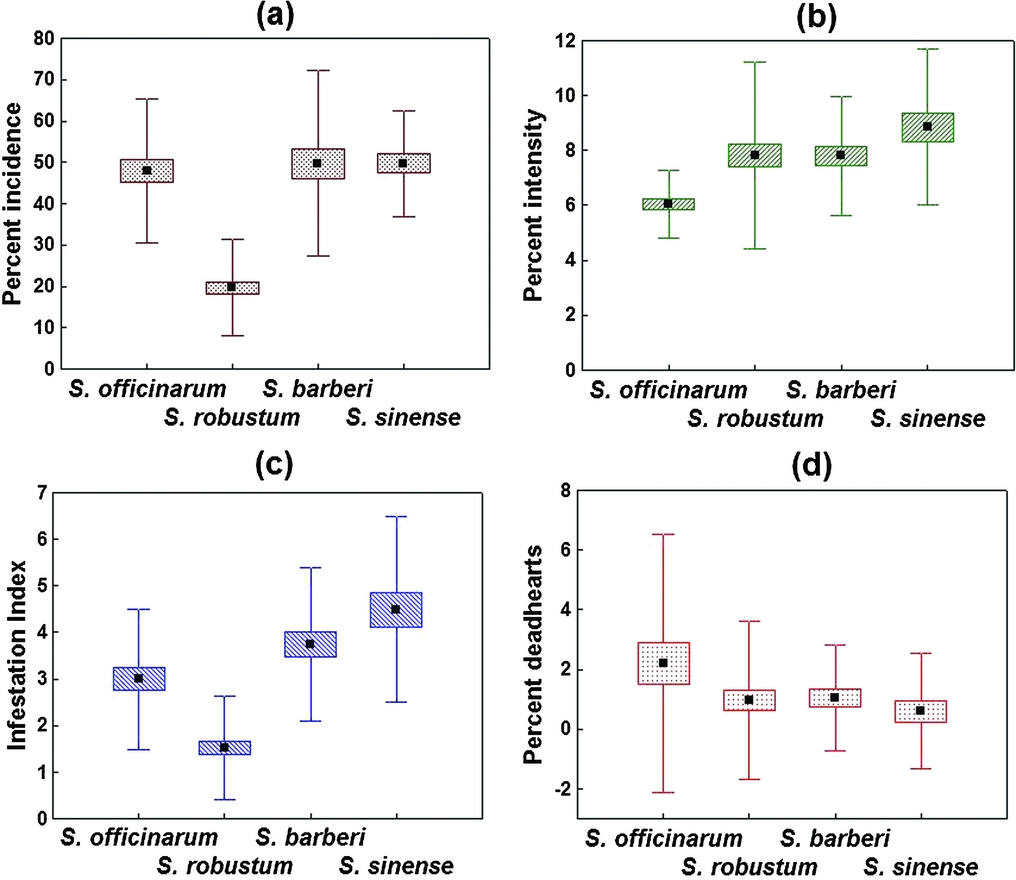
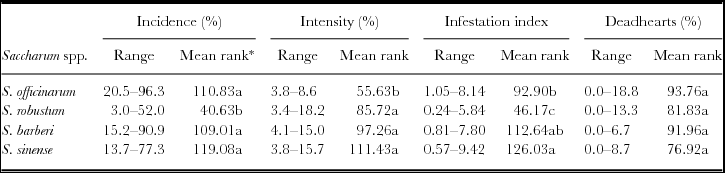
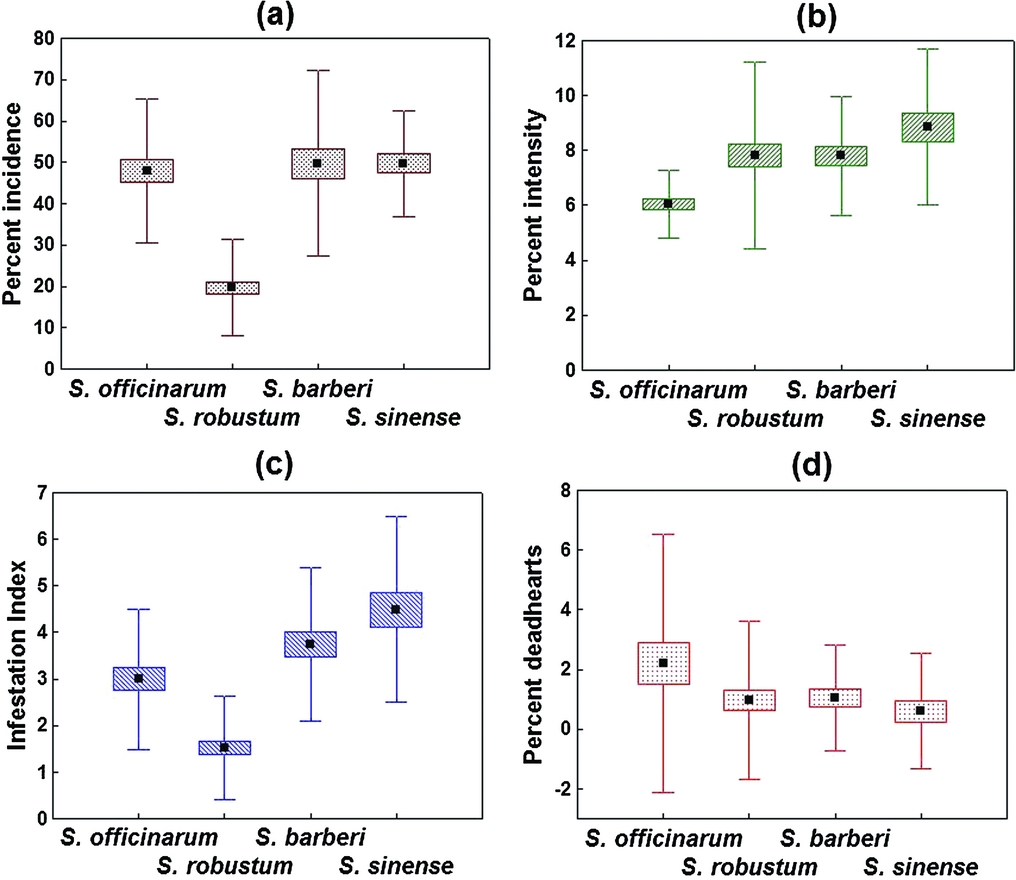
The accessions of S. robustum showed the lowest mean (Figure 2a) and range of C. sacchariphagus indicus incidence (Table 2). Amongst the four species, the lowest incidence (3.0%) was observed in the accession IM 76-255 (S. robustum) and the highest (96.3%) in UB 1 (S. officinarum). Mean percent intensity in affected canes was the lowest in S. officinarum (Figure 2b) whereas the range was the highest in S. robustum with the minimum (3.4%) being found in IJ 76-535 and the maximum (18.2%) in NG 77-108. The Infestation index was the lowest in S. robustum (Figure 2c) reflecting the trend observed in incidence.
Infestation parameters of Chilo sacchariphagus indicus amongst accessions of four Saccharum spp.: (a) incidence, (b) intensity, (c) infestation index and (d) deadhearts. Markers represent mean, boxes indicate mean ± SE and whiskers display mean ± SD.
Comparative Chilo sacchariphagus indicus attack rates in accessions of four Saccharum spp. sorted on highest percent incidence in two study years (2011 and 2012).

* Mean ranks followed by the same letter are not significantly different (P > 0.05) by Kruskal–Wallis ANOVA and multiple comparisons test.
Canes with deadhearts that were visibly shorter and thinner than healthy canes and dried deadhearts could be pulled out easily; the canes that produced deadhearts often featured axial bud germination (Figure S1). The mean and range of percent deadhearts was the highest in S. officinarum followed by S. robustum, S. sinense and S. barberi (Table 2; Figure 2d). The lowest overall mean deadheart (0.6%) was observed in S. sinense and the highest (2.2%) in S. officinarum. When all 171 accessions were considered together, 21.6% accessions showed deadheart symptoms.
Kruskal–Wallis ANOVA by ranks showed significant differences amongst the four Saccharum spp. for incidence (χ 2 = 84.56; df = 3; N = 171; P < 0.0001), intensity (χ 2 = 24.61; df=3; N = 171; P < 0.0001) and infestation index (χ 2 = 72.43; df=3; N = 171; P < 0.0001) but not for percent deadhearts (χ 2 = 5.86; df = 3; N = 171; P = 0.118). Multiple comparison z′ and P values established S. robustum as the species harbouring significantly lowest incidence amongst the four species; the other three showed no differences amongst them (Table 2). Intensity was, however, significantly lowest in S. officinarum whilst the other three species had similar intensity. Infestation index showed the same trend as percent canes attacked in that it was significantly lowest in S. robustum and highest in S. sinense; S. barberi showed overlapping differences with S. officinarum and S. sinense. Percent deadhearts did not differ amongst the four Saccharum spp.
Categorization of accessions
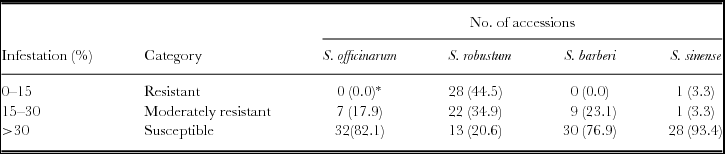
All accessions showed borer attack in at least one experimental year. The 171 accessions were grouped broadly into three different categories following the grading suggested by Mukunthan (Reference Mukunthan, Sreenivasan, Amalraj and William Jebadas2001) based on the higher incidence level between the two study years. Of the 171 accessions from the four Saccharum spp., 29 (17.0%) were placed in resistant category, 39 (22.8%) in moderately resistant category and 103 (60.2%) in susceptible category (Table 3).
Categorization of Saccharum spp. accessions on the basis of higher percent incidence of Chilo sacchariphagus indicus in 2 years (2011 and 2012).

* Numbers in parenthesis are percent values for each species.
Out of the 39 accessions of S. officinarum, none was placed in the resistant category (Table S2). Whilst 17.9% accessions were in the moderately resistant category, a large majority (82.1%) showed susceptible reaction. In S. robustum, whilst nearly half (44.5%) the accessions emerged as resistant to C. sacchariphagus indicus, a considerable number occupied the moderately resistant category. The reaction of S. barberi accessions was similar to that of S. officinarum in that none was resistant to the borer; considerable percentage (76.9%) of accessions remained susceptible to the borer. Saccharum sinense occupied the last position with 28 accessions (93.4%) emerging as susceptible. Only one accession each, namely KHADYA with 13.7% borer incidence and PANSAHI with 28.6% borer incidence represented resistant and moderately resistant categories, respectively.
Morphological characters vs. borer incidence
Amongst the morphological characters examined, leaf length showed non-significant correlations with incidence, intensity and infestation index in all four Saccharum spp. (Table S3). Leaf width showed non-significant correlations for all parameters and species except for a significant negative correlation with infestation index in S. sinense. For cane thickness, the only significant relationship was the positive correlation with incidence in S. officinarum. Cane height showed significant negative correlations with infestation index in S. officinarum, and incidence and infestation index in S. barberi. Sucrose content in cane showed significant negative correlation with intensity in S. officinarum; significant negative correlations with incidence and infestation index in S. robustum; significant negative correlation with incidence but significant positive correlation with intensity in S. barberi; significant positive correlations with incidence and infestation index in S. sinense.
Mann–Whitney U test carried out for sheath hair character indicated that in S. officinarum, incidence and infestation index ranked significantly higher in accessions with sheath hair than those without it. In S. barberi, incidence ranked significantly higher but intensity ranked significantly lower in accessions with sheath hair. Nature of leaf sheath clasping generally showed non-significant impact on borer infestation parameters. In S. barberi, however, tight leaf sheath showed significantly lower rank for incidence but significantly higher rank for intensity than loose leaf sheath.
DISCUSSION
Chilo sacchariphagus indicus, a major borer pest of sugarcane restricted to tropical Indian states, is known to be active from June to December in the sugarcane monoculture belts with peak activity during June and July, albeit with minor variations in different locations (David, Reference David, David, Easwaramoorthy and Jayanthi1986). Under mild or favourable climatic conditions that facilitate year-round plantations, the borer and its natural enemies remain active throughout the year (Srikanth et al., Reference Srikanth, Easwaramoorthy, Shanmugasundaram and Kumar1999). In the present study site, where the sugarcane germplasm is maintained as a crop island from January to December, the onset of C. sacchariphagus indicus activity in July could be due to two reasons: (i) suitability of 6-month old crop for first attack and (ii) harvest in June of the previous season crop, generally maintained for an additional 6 months to ensure emergency seed material in the event of germination failure, leading to dispersal of the borer to the current season crop. The increase in borer attack rates in the next 2 months appeared to be more due to suitability of the crop stage and general favourable conditions of moderate air temperature and humidity than the influence of any specific weather parameter as the non-significant correlations between monthly weather data and borer attack for the short 6-month period indicated. Although crop maturity may have led to the decrease in borer incidence rates during September–November, attack of side shoots in deadheart canes and water shoots may have contributed to the higher attack rate in December. Such higher incidence of the borer observed late in the season justified the assessment of the Saccharum spp. accessions on the basis of cumulative incidence of the borer at harvest.
Significant differences in attack rates in 2011 and 2012 observed for pink stem borer Sesamia inferens (Walker) (Lepidoptera: Noctuidae) and leaf miner Aphanisticus aeneus Kerremans (Coleoptera: Buprestidae) were suggested to be independent of climatic factors. Differential response of individual accessions or directional location of the germplasm collection in the Research Centre was suggested to be partly responsible for such variation (Mahesh et al., Reference Mahesh, Srikanth and Chandran2014, Reference Mahesh, Srikanth, Chandran and Nisha2015a). Higher C. sacchariphagus indicus incidence in 2012 than in 2011 observed for S. officinarum, S. barberi and S. sinense could also be due to the same reasons. However, assuming the possibility of higher borer activity in 2012, the absence of significant difference in attack rates for S. robustum suggested that this species responded similarly under differential intensity of the borer thus emerging as a source of resistance.
Amongst the three parameters used for assessing the borer injury, higher ranges of incidence than intensity values for all four Saccharum spp. indicated higher between-plant than within-plant dispersal of the borer. The infestation index, developed from the percent incidence and percent intensity, gave a trend similar to that of incidence parameter both in terms of range and mean ranks. Whilst assessing the resistance of commercial and experimental sugarcane cultivars to the Mexican rice borer E. loftini, Wilson et al. (Reference Wilson, VanWeelden, Beuzelin, Reagan, Way, White, Wilson and Showler2015) used a relative resistance ratio calculated from relative resistance rankings based on proportion of bored internodes and relative survival, the latter based on adult emergence holes developed by Bessin et al. (Reference Bessin, Reagan and Martin1990). Since larvae of C. sacchariphagus indicus often display cane-to-cane dispersal and pupate outside the cane, assessment of relative survival rate is infeasible. Instead, intensity was assessed from the number of bored internodes and total internodes in affected canes. However, due to the non-significant correlation coefficients between incidence and intensity obtained for the four species, only incidence was used as a rapid and low sampling-cost method to assess the resistance status of the four Saccharum spp. against C. sacchariphagus indicus.
Chilo sacchariphagus indicus is known to cause deadhearts (Mukunthan and Rakkiyappan, Reference Mukunthan and Rakkiyappan1989; Srikanth and Kurup, Reference Srikanth and Kurup2011) in commercial varieties, particularly in young and weak shoots (David, Reference David, David, Easwaramoorthy and Jayanthi1986). Apparently, this is due to the mismatch between larval development and plant growth rates leading to the larvae reaching the meristem in the course of vertical feeding. A similar mechanism would have operated in the four Saccharum spp. Although the range of percent deadhearts in the accessions showed some variation, the non-significant differences in the mean ranks indicated that the four species responded similarly or provided identical conditions required for the production of deadhearts. Also, since percent incidence included deadhearts whose intensity was far lower than that of internode injury, as was also observed earlier in commercial varieties in growers’ farms (Srikanth and Kurup, Reference Srikanth and Kurup2011), deadheart injury was ignored as a separate parameter.
Categorization of accessions on the basis of higher incidence between the 2 years not only accounted for the year-to-year variation but also avoided erroneous grouping due to the possibility of escape in the low infestation year. The categorization adopted in the present study (Mukunthan, Reference Mukunthan, Sreenivasan, Amalraj and William Jebadas2001) with lower ranges of infestation in each category was more stringent than other systems of classification (Radadia and Shinde, Reference Radadia and Shinde2013) in vogue. Despite such rigorous classification, about 40% of accessions of the four Saccharum spp. showed resistance to moderate resistance against internode borer. Amongst the four species, S. robustum emerged clearly as the source with the highest resistance whereas the other three species showed more or less similar categorization. The susceptible status of S. officinarum and resistance status of S. barberi accessions to the borer were indicated in an earlier study based on infestation index (Jayanthi, Reference Jayanthi1988). In another study on sugarcane early shoot borer Chilo infuscatellus (Snellen) (Lepidoptera: Crambidae), despite the far fewer number of Saccharum spp. accessions used, the highest resistance was observed in S. spontaneum and S. robustum whilst the other species showed susceptible entries (Kumar et al., Reference Kumar, Singh, Singh, Singh and Singh2002). In our earlier studies with the pink stem borer S. inferens in accessions of the four Saccharum spp., S. robustum emerged as the resistant species and S. officinarum as the susceptible species (Mahesh et al., Reference Mahesh, Srikanth and Chandran2014). All these studies indicated that S. robustum and S. officinarum showed similar resistance and susceptibility status, respectively to C. sacchariphagus indicus, C. infuscatellus and S. inferens which suggested common mechanisms of resistance to all these borers in the four Saccharum spp.
Amongst the morphological characters selectively examined for their relationship with C. sacchariphagus indicus infestation parameters, leaf length and width are expected to impart typical canopy architecture with a bearing on visual attraction for oviposition. On the other hand, greater thickness and lesser height can enhance the suitability of the cane for entry of young larvae. However, the general lack of significance in correlation analysis indicated the weak influence of these plant morphological characters on borer activity. Presence or absence of sheath hair can potentially interfere with movement and entry of young larvae into the tender top internodes. Varieties with close-fitting leaf-sheaths showed higher incidence than the loose-fitting and self-detrashing varieties apparently because the newly hatched borer larvae generally remain inside the leaf-sheaths in the initial stages before feeding their way slowly into the cane, and grown-up larvae usually pupate underneath the leaf-sheath (David, Reference David, David, Easwaramoorthy and Jayanthi1986). Coburn and Hensley (Reference Coburn and Hensley1972) reported that tightness of leaf-sheaths was partially responsible for the resistance to D. saccharalis. However, these two characters did not seem to affect C. sacchariphagus indicus activity as evidenced from the general lack of significance in Mann–Whitney U test of ranks for accessions in each of the four Saccharum spp.
Association studies of selected biochemical nutrients in different hosts and levels of E. loftini infestation showed that plant species with relatively high levels of fructose supported elevated levels of the borer consistently (Showler and Moran, Reference Showler and Moran2014). However, such possible impact of carbohydrates on borer levels was not evident in the present study as indicated by the variable relationship between sucrose content and C. sacchariphagus indicus. A similar absence of relationship between selected cane yield or quality parameters and infestation parameters of stalk borer Chilo auricilius Dudgeon (Lepidoptera: Crambidae), a borer with predominance in subtropical India and feeding habits similar to C. sacchariphagus indicus, was observed in sugarcane genotypes, including subtropical, exotic and interspecific and intergeneric hybrids (Pandey et al., Reference Pandey, Karuppaiyan, Singaravelu, Ravinder, Meena, Bakshi and Chhabra2014). These trends suggested the possible significant role of plant biochemical factors rather than morphological or nutritional characters for resistance against borers in sugarcane.
With no commercial cultivation of sugarcane either for sugar or jaggery for several kilometres around, the world collection of sugarcane germplasm established in the late 50s represents a crop island intended to serve as a fail-safe measure against pest incursion. However, over the decades, the germplasm had been colonized by a few pests, including C. sacchariphagus indicus, whose populations rose to considerable levels in the recent years. The high 96.3% infestation rate of the borer observed in an S. officinarum accession adequately justified the screening of Saccharum spp. at the present study site. Around 60% of accessions from all four Saccharum spp. rated as susceptible can be rejected straight away since they showed more than 30% incidence. The accessions classified as moderately resistant and resistant, particularly of S. robustum which contributed significantly to these two categories, need to be re-evaluated under more stringent conditions of natural infestation or artificial inoculation of the borer before selecting them as potential donors in resistance breeding programmes.
SUPPLEMENTARY MATERIAL
To view supplementary material for this article, please visit http://dx.doi.org/10.1017/S0014479716000697
Acknowledgements
The authors thank Dr Bakshi Ram, Director, Sugarcane Breeding Institute (SBI), Coimbatore, for logistic support and academic encouragement. The help rendered by Ms Sanju Balan, Technical Assistant, in recording the observations is gratefully acknowledged.