Introduction
Capacity refers to a judgement as to whether an individual has the requisite cognitive, decisional, affective, and practical skills to be found to have the ability to adequately complete a particular task (such as driving), or to make a particular decision (such as to refuse medical treatment) (Moye and Braun, Reference Moye, Braun and Lichtenberg2010). Decisional abilities are distinct from practical (also known as executional) abilities in so far as the person may not be able to accomplish their choice without assistance (Collopy, Reference Collopy, Gamroth, Semradek and Tornquits1995; Boyle, Reference Boyle2008). Although conclusions about capacity are ultimately determined by the law, in practice most views formed about a person's capacity are established by health professionals, lawyers, social care workers, friends and family (Kapp, Reference Kapp2002; Bennett and Hallen, Reference Bennett and Hallen2005).
When a view is formed that a person has impaired capacity, the vast majority of solutions are informal such as family or friends offering assistance. However, when informal solutions cannot be found or issues of conflict are raised, the law may have a role. Applications are made to guardianship (also known as conservatorship) courts and tribunals seeking legal orders to appoint a substitute decision-maker, also known as a guardian or conservator (Leatherman and Goethe, Reference Leatherman and Goethe2009). A critical piece of evidence in the legal proceedings is the clinical report of decision-making capacity written by a health professional (Moye et al., Reference Moye, Armesto and Karel2005).
Models of decision-making capacity that have developed over the last 30 years have been based on empirical research, expert consensus and case law (Appelbaum and Roth, Reference Appelbaum and Roth1981; Grisso and Appelbaum, Reference Grisso and Appelbaum1998; Moye and Marson, Reference Moye and Marson2007; Karlawish, Reference Karlawish2008). Key components include: (1) the presumption of capacity, (2) capacity as domain specific to the lifestyle area under review (e.g., finances or personal care), (3) decision specific within that domain (e.g., paying bills or selling real estate), and (4) temporally limited due to the transient and progressive nature of some disabilities (e.g., delirium or Alzheimer's disease) (Ganzini et al., Reference Ganzini, Volicer, Nelson and Derse2003; Moberg and Kniele, Reference Moberg and Kniele2006; Boyle, Reference Boyle2008; Newberry and Pachet, Reference Newberry and Pachet2008).
Research has helped to advance the understanding that decision-making capacity is not a global, “all or nothing” status but rather a situation-specific functional definition (Anderer, Reference Anderer1990; Sabatino and Basinger, Reference Sabatino and Basinger2000; Peisah et al., Reference Peisah, Forlenza and Chiu2009). Reviews of empirical research grouped by cognitive and psychiatric disorders have reliably found that medical diagnoses alone do not predict impaired decision-making capacity (Okai et al., Reference Okai, Owen, McGuire, Singh, Churchill and Hotopf2007; Moye et al., Reference Moye, Gurrera, Karel, Edelstein and O’Connell2006; van Staden, Reference van Staden2009). More specifically, no single neuropsychological test, cognitive domain or psychiatric presentation consistently predicts a lack of capacity (Okai et al., Reference Okai, Owen, McGuire, Singh, Churchill and Hotopf2007; Palmer and Savla, Reference Palmer and Savla2007; Moberg and Rick, Reference Moberg and Rick2008). Additionally, mental status screening has little utility beyond staging cognitive impairment (Pachet et al., Reference Pachet, Astner and Brown2010). The results show that decision-making capacity is more than group membership or scores achieved on standardized tests.
Surveys of health professionals have suggested decision-making capacity is often considered challenging to assess and report, commonly due to limited knowledge of the concept (Ganzini et al., Reference Ganzini, Volicer, Nelson and Derse2003; Hill et al., Reference Hill, Mather and James2006; Mullaly et al., Reference Mullaly2007). To aid health professionals in providing clinical reports of decision-making capacity for adult guardianship courts and tribunals, there has been an emergence of resources (e.g., Ontario Ministry of the Attorney General, 2005; Moye et al., Reference Moye, Butz, Marson and Wood2007a; American Bar Association Commission on Law and Aging and American Psychological Association, 2008; Australian Psychological Society and the Office of the Public Advocate, 2009; British Psychological Society, 2010; O’Neill and Peisah, Reference O’Neill and Peisah2011). To date, however, no systematic review has been undertaken of the literature that has examined the content of written reports of decision-making capacity tendered by health professionals for adult guardianship proceedings. The aims of this systematic review were (a) to critically appraise the design and methodological quality of the published literature on decision-making capacity reports written by health professionals for adult guardianship proceedings and (b) to describe the content of these reports.
Methods
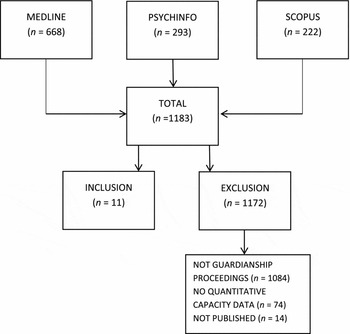
Searches were conducted using three electronic databases: Ovid MEDLINE (1948 to February, 2015), PsycINFO (1967 to February, 2015) and Scopus (1980 to February, 2015) from 1980 until February 1, 2015 (Figure 1).The search terms were developed based on specific key words to capture guardianship proceedings (guardianship/guardian/conservatorship/conservator) and capacity (capacity/competency/decision making/decision making capacity/incompetent/incompetence/incom-petency/mental capacity/mental incapacity) or disability (disability/dementia/brain injury/cognition/cognitive impairment) or proceedings (proceedings/determination/order/finding/evidence).
Flowchart of the search strategy.

The selection criteria for inclusion in the systematic review were as follows: (a) the article was written in English, (b) participants were aged 18 years or above, (c) capacity reports for guardianship proceedings were evaluated and (d) the article reported results using quantitative analyses. The exclusion criteria were as follows: (a) opinion articles and narrative reviews, (b) studies containing less than 10 subjects.
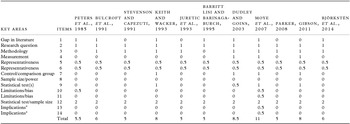
Articles meeting the selection criteria were rated for methodological quality in 11 key areas using a 14-item critical appraisal tool developed by Heacock et al. (Reference Heacock, Koehoorn and Tan1997; Table 1). Scores ranged from 0–12. Heacock and colleagues (Reference Heacock, Koehoorn and Tan1997) categorized scores as strong (9–12 points), moderately strong (more than 6 and up to 9 points) and weak (6 points and less). The critical appraisal tool was developed for non-experimental quantitative research. It was selected for use in the current study because a guide to scoring each item was provided, and the scale had undergone content validation and reliability testing (Crowe and Sheppard, Reference Crowe and Sheppard2011). Heacock and colleagues (Reference Heacock, Koehoorn and Tan1997) indicate good to excellent interrater reliability of the checklist items apart from the first item which was reported as poor.
Critical appraisal ratings of the selected articles

Notes: Gap in Literature: 1 = Does the study identify a gap in the existing literature; Research Question: 2 = Is the research question clearly stated; Methodology: 3 = After reading the methods section, could the reader repeat the study with confidence; Measurement Instruments/ Techniques: 4 = Do the authors state the measurement technique(s)/ instrument(s) are valid/ reliable or do they provide information so the reader can investigate the validity and reliability of the measurement technique(s)/ instrument(s); Representativeness: 5 = Is the study population representative of the end-user population; Representativeness: 6 = Is the study setting representative of the workplace to which the results will be applied; Control/ Comparison Group: 7 = Is there an appropriate control/comparison group; Sample Size: 8 = Is there a statement about sample size or power of the study; Statistical Test(s): 9 = Do the authors state the statistical test used and level of significance or confidence levels achieved; Limitations/Bias: 10 = Do the authors discuss the limitations or biases of the study design and/or methodology; Limitations/ Bias: 11 = Do the authors discuss the effects of the preceding limitations or biases on the results; Appropriateness of Statistical Test/ Sample Size: 12 = Do the authors achieve any one of the following; utilize a study sample with at least 30 subjects or; conduct non-parametric statistics tests for samples with less than 30 subjects or; conduct parametric tests for samples with less than 30 subjects but explain the sample is normally distributed or; conduct multivariate tests with ten times as many subjects as there are independent variables; Implications: 13 = Do the authors discuss recommendations of the findings; Implications:14 = Do the authors identify opportunities for further research based on the current study. Methodological ratings are from Heacock et al., (Reference Heacock, Koehoorn and Tan1997).
aOnly answer items 13 and 14 if you responded yes to item 11.
Each of the key areas was weighted equally in terms of importance for methodological quality and was assigned a value of one point in the checklist with one exception being area 9 (Appropriateness of Statistical Test/Sample Size) that was assigned a value of two because it was considered vital to the valid interpretation of research results (Heacock et al., Reference Heacock, Koehoorn and Tan1997). This weighting scheme attempts to address the problem whereby summary scores hide defects if studies score well in some areas considered not as methodologically important as others (Crowe and Sheppard, Reference Crowe and Sheppard2011).
Results of the database searches were downloaded and imported into Endnote files. Duplicate articles were excluded. The title and abstracts of all articles were reviewed by the first author to identify those meeting selection criteria. Where abstracts were not available or study methods were ambiguous, the full text of the article was sourced and examined. The full texts of all articles meeting selection criteria were retrieved. Reference lists of the articles meeting the selection criteria, opinion papers and narrative reviews were searched for additional relevant articles.
Results
The results of the searches produced 961 articles from Ovid MEDLINE and PsycINFO and 222 from Scopus. Ten articles met the inclusion criteria. Another article was sourced by examining the references from the selected articles, bringing the total to eleven. Figure 1 provides details of the identification process, including the reasons for exclusion.
Study quality
Research questions examining reports of capacity written for guardianship proceedings are restricted in so far as experimental designs cannot be applied due to the ethical and legal constraints imposed by the lawful process being examined. These constraints limit research designs to observational studies which are largely descriptive. Of the articles selected, ten used retrospective cross-sectional designs and one was a before and after design (Keith and Wacker, Reference Keith and Wacker1993).
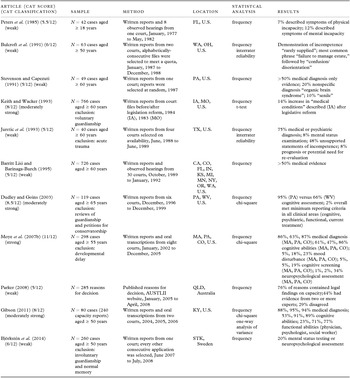
Capacity reports were generally sourced from guardianship files held by the courts. As shown in Table 2, nine studies sourced files from between one and 30 courts across various states in the U.S. and one other sourced files from a court in Sweden. Reports were variously selected by randomizing guardianship files (Stevenson and Capezuti, Reference Stevenson and Capezuti1991), choosing alphabetically-consecutive files to meet a quota (Bulcroft et al., Reference Bulcroft, Kielkopf and Tripp1991), convenience samples (Jurectic et al., Reference Juretic, Martin, Taffet, Wilson, Gregory and Luchi1993) and every other consecutive application (Björkstén et al., Reference Björkstén, Fälldin and Ulfvarson2014). The ten studies examined in total 2443 guardianship files from the U.S. and Sweden. The remaining study reported on 285 reasons for decision (also known as judgements) from guardianship hearings in Australia (see Table 2).
Data extraction from the selected articles

Notes: CAT = critical appraisal tool; CA = California; CO = Colorado; IA = Iowa; IN = Indiana; FL = Florida; KS = Kansas; KY = Kentucky; MA = Massachusetts; MI = Michigan; MN = Minnesota; MO = Missouri; NY = New York; OH = Ohio; OR = Oregon; QLD = Queensland; STK = Stockholm; TX = Texas; WA = Washington; WV = West Virginia.
The methodological rating scores for the eleven articles ranged from 5 to 11 according to the Heacock et al. (Reference Heacock, Koehoorn and Tan1997) criteria (see Table 1). Only four studies received scores above 6. These four studies used appropriate comparison groups and three utilized a reliable and valid instrument to code key elements in the health professional's capacity report. Accordingly, these studies received strong (Moye et al., Reference Moye2007b) and moderately strong (Keith and Wacker, Reference Keith and Wacker1993; Dudley and Goins, Reference Dudley and Goins2003; Gibson, Reference Gibson2011) classifications based on their methodological quality. A strength of Keith and Wacker's (Reference Keith and Wacker1993) study was the use of four comparison groups that were sourced from two time periods, before and after law reform, allowing testing of hypotheses that were based on change over time. In contrast, the seven articles that were classified as weak were each based on a single group design, lacked comparative statistical analysis, and did not address the effect of any design limitations on the findings (Peters et al., Reference Peters, Schmidt and Miller1985; Bulcroft et al., Reference Bulcroft, Kielkopf and Tripp1991; Stevenson and Capezuti, Reference Stevenson and Capezuti1991; Juretic et al., Reference Juretic, Martin, Taffet, Wilson, Gregory and Luchi1993; Barritt Lisi and Barinaga-Burch, Reference Barritt Lisi and Barinaga-Burch1995; Parker, Reference Parker2008; Björkstén et al., Reference Björkstén, Fälldin and Ulfvarson2014) (Table 2).
Data extraction methods
The same three studies that utilized a reliable and valid instrument, systematically coded key elements from capacity reports (Dudley and Goins, Reference Dudley and Goins2003; Moye et al., Reference Moye2007b; Gibson, Reference Gibson2011). Two studies developed survey instruments with high interrater reliability; Juretic and colleagues (Reference Juretic, Martin, Taffet, Wilson, Gregory and Luchi1993) used a 45 item measure based on expert consensus (99% agreement) and Bulcroft and colleagues (Reference Bulcroft, Kielkopf and Tripp1991) developed a semi-structured instrument of 40 items (Kappa values of reliability ranged from .85 to .98). Barritt Lisi and Barinaga-Burch (Reference Barritt Lisi and Barinaga-Burch1995) employed two survey instruments, one for use when observing the proceedings, the other for a file summary. Keith and Wacker (Reference Keith and Wacker1993) counted the frequency of clinical reports contained in guardianship files before and after legislative changes and Björkstén et al. (Reference Björkstén, Fälldin and Ulfvarson2014) counted the frequency of responses contained in physician statement forms issued for the guardianship court. Three articles did not describe their data extraction methods (Peters et al., Reference Peters, Schmidt and Miller1985; Stevenson and Capezuti, Reference Stevenson and Capezuti1991; Parker, Reference Parker2008).
Study findings
Subjects of guardianship applications
The majority of individuals were elderly, with the reported average age across studies ranging from 76 years to 82 years. Most were female and unmarried, including those who were widowed or divorced, and they often resided in hospitals, nursing homes or residential facilities at the time of the guardianship hearing. Three of the studies reported the majority of persons were diagnosed with a dementia, ranging from 59% to 71% across the samples, followed by a mental illness (20–24%) and other neurological events such as stroke (11–24%) (Peters et al., Reference Peters, Schmidt and Miller1985; Stevenson and Capezuti, Reference Stevenson and Capezuti1991; Moye et al., Reference Moye2007b). Five studies recorded that persons appeared at their own hearings between <1% to 57% of the time (Bulcroft et al., Reference Bulcroft, Kielkopf and Tripp1991; Stevenson and Capezuti, Reference Stevenson and Capezuti1991; Barritt Lisi and Barinaga-Burch, Reference Barritt Lisi and Barinaga-Burch1995; Dudley and Goins, Reference Dudley and Goins2003; Moye et al., Reference Moye2007b). Björkstén et al. (Reference Björkstén, Fälldin and Ulfvarson2014) found that 25% of physicians indicated the person should not be heard in court as it may cause them harm by attending the hearing. Nine studies recorded legal orders were made 84–100% of the time.
Health professionals
Physicians prepared the majority of expert reports for guardianship hearings. Two articles did not specify health disciplines (Keith and Wacker, Reference Keith and Wacker1993; Parker, Reference Parker2008), two had a small representation of psychologists (around 7% in each) (Dudley and Goins, Reference Dudley and Goins2003; Moye et al., Reference Moye2007b), and one study had an equal representation of physicians, psychologists and social workers (Gibson, Reference Gibson2011).
The content of capacity evaluations
Quantitative data on the content of capacity reports were limited for the seven methodologically weak articles. Three of these articles reported that at least 50–75% of physicians’ reports referred to a medical diagnosis as evidence of impaired capacity (Peters et al., Reference Peters, Schmidt and Miller1985; Stevenson and Capezuti, Reference Stevenson and Capezuti1991; Juretic et al., Reference Juretic, Martin, Taffet, Wilson, Gregory and Luchi1993). Few evaluations were reported to detail cognitive, psychiatric or functional abilities. Peters and colleagues (Reference Peters, Schmidt and Miller1985) reported that five of the 42 reports described symptoms of mental incapacities. Juretic et al. (Reference Juretic, Martin, Taffet, Wilson, Gregory and Luchi1993) noted a mental status examination was documented in three of the 40 reports reviewed. While Stevenson and Capezuti (Reference Stevenson and Capezuti1991) commented that the most frequently cited phrase was “disoriented × 3”, describing the subject's confusion about aspects of person, place and time (p. 13). Barritt Lisi and Barinaga-Burch (Reference Barritt Lisi and Barinaga-Burch1995) recorded medical evidence was present in the court files for the majority of the cases while Bulcroft et al. (Reference Bulcroft, Kielkopf and Tripp1991) found only 30% (n = 19) of guardianship applications were accompanied by a report from a physician. (Table 2).
Björkstén and colleagues (Reference Björkstén, Fälldin and Ulfvarson2014) described the content of reports that physicians use for submission to the guardianship court in Sweden. Reports for voluntary guardianship (known as a custodianship), where physicians had described the person as having a memory impairment were selected from one court. The authors found only 20% (52 of 260) of reports contained results from a mental status examination or from neuropsychological testing. Fifty-six percent of physicians had completed a ‘memory workup’, the results, however, were not described (Table 2).
Parker (Reference Parker2008) investigated agreement between health professionals for opinions of capacity in the context of guardianship proceedings. In this Australian series of guardianship ‘reasons for decisions’, also known as judgements, 76% (216 of 285) of the reasons for decision contained legal findings in relation to the question of the person's capacity. Of these 216 reasons for decision, 44% (n = 94) were found to have referred to evidence submitted from two or more health professionals, of which 29% (n = 27) were reported to have disagreed with each other's opinions of the person's capacity to decide matters for themselves (Parker, Reference Parker2008) (Table 2).
Three of the four methodologically strongest articles in the systematic review evaluated capacity reports in relation to definitions of impaired capacity contained within guardianship legislation, while one article evaluated reports in relation to interdisciplinary teams. The first moderately strong article by Keith and Wacker (Reference Keith and Wacker1993) compared four independent groups, two sourced before and two after dissimilar guardianship law reform was enacted in two U.S. states (Iowa and Missouri) in 1983 and 1984. This study did not record the range of data collection time points. It was reported that there was an increase in the number of medical reports (from 59% to 73%) tendered for guardianship proceedings in the state of Iowa where a broad definition of impaired capacity was adopted. The state of Missouri implemented a more detailed definition of impaired capacity for guardianship, but the number of medical reports provided before this change was already at near ceiling level (from 90% to 89%) leaving little scope for change (Table 2).
The second moderately strong article compared capacity evaluations across two U.S. states (West Virginia and Pennsylvania) that had comparable definitions of impaired capacity contained within their guardianship laws (Dudley and Goins, Reference Dudley and Goins2003). Four clinical areas (cognitive symptoms, psychiatric symptoms, functional abilities, and current treatments) taken from capacity reports were surveyed. There were few significant differences reported between the professionals’ evaluations from the two states in terms of the four clinical areas, apart from the number of cognitive symptoms described (Dudley and Goins, Reference Dudley and Goins2003). The authors noted these differences, although significant, suggested that in both states the professionals providing capacity evaluations were reporting few cognitive symptoms. Overall, 71% (n = 85) of professionals’ reports were found to have referred to three or fewer cognitive symptoms, 62% (n = 74) did not document psychiatric symptoms, 45% (n = 53) did not describe functional abilities and 30% (n = 36) did not record current medications or medical treatment. Ten of the capacity reports surveyed met the study threshold where reporting was required to meet a predefined number of symptoms in any one clinical area. Across both states, only two reports from 119 met the requirements for thoroughness in all four clinical areas (Dudley and Goins, Reference Dudley and Goins2003) (Table 2).
The remaining moderately strong article compared the content of capacity evaluations written by interdisciplinary teams (physicians, psychologists and social workers) from one U.S. state (Kentucky) (Gibson, Reference Gibson2011). Seventeen elements based on legislative requirements and best practice standards were surveyed. These included; health professional qualifications, current treatment and services, medical diagnosis, medical history, cognitive and functional abilities, and a need for guardianship. Medical diagnoses were well documented by physicians (88%; n = 70) psychologists (95%; n = 76) and social workers (94%; n = 75). Less well documented in written reports were cognitive (physicians: 53%, n = 42; psychologists: 91%, n = 73; social workers: 89%, n = 71) and functional abilities (physicians: 23%, n = 18; psychologists: 71%, n = 57; social workers: 77%, n = 61). Physicians documented, on average, eight of 17 elements compared to psychologists (12 elements), and social workers (11 elements). Across the health professional groups few reports of capacity contained information supporting the need for a substitute decision-maker to be appointed (physicians: 5%, n = 4; psychologists: 34%, n = 27; social workers: 21%, n = 17; Gibson, Reference Gibson2011) (Table 2).
The strongest article in the systematic review compared health professionals’ reports submitted for guardianship hearings across three U.S. states (Massachusetts, Pennsylvania, Colorado) with varying requirements for the evaluation of impaired capacity contained within their guardianship laws (Moye et al., Reference Moye2007b). Massachusetts legislation provided no specific requirements for evaluations of impaired capacity within their guardianship laws. In contrast, the legislation in Pennsylvania and Colorado required evidence on the nature and extent of impaired capacities, the person's mental and physical condition, adaptive behavior and social skills, treatments, services and prognosis. Six clinical indicators; medical diagnosis, cognitive and psychiatric symptoms, functional abilities, prognosis, values and preferences, and social supports were surveyed.
A medical diagnosis was commonly reported in samples drawn from Massachusetts, Pennsylvania and Colorado (86% versus 63% versus 87%), as was evidence of the person's cognitive abilities (61% versus 47% versus 86%) and functional status (25% versus 47% versus 64%). Test results from cognitive screening (5% versus 5% versus 19%), neuropsychological assessment (1% versus 2% versus 34%), and a review of mood (5% versus 18% versus 23%) were less well reported. A prognosis was provided in few reports (23% versus 23% versus 54%) and a person's values and preferences was rarely recorded (0% versus 2% versus 17%) (Moye et al., Reference Moye2007b). Across the three states, 29% of reports provided general conclusions about decision-making capacity without describing specific symptoms of mental impairment (Moye et al., Reference Moye2007b). Colorado, on average, documented four of the six clinical indicators compared to Pennsylvania (with three clinical indicators on average), and Massachusetts (two clinical indicators on average) (Moye et al., Reference Moye2007b) (Table 2).
Discussion
The aims were to systematically appraise the methodological quality of the published literature that reported the results of evaluating the content of decision-making capacity reports written by health professionals for adult guardianship proceedings and to describe the study findings. There was considerable variability in the methodological quality of the eleven articles that were published between 1985 and 2014 with only four studies rated as moderately strong to strong. The study findings however, were more consistent.
Only one study was rated as methodologically strong (Moye et al., Reference Moye2007b), three were moderately strong (Keith and Wacker, Reference Keith and Wacker1993; Dudley and Goins, Reference Dudley and Goins2003; Gibson, Reference Gibson2011), and seven were classified as weak (Peters et al., Reference Peters, Schmidt and Miller1985; Bulcroft et al., Reference Bulcroft, Kielkopf and Tripp1991; Stevenson and Capezuti, Reference Stevenson and Capezuti1991; Juretic et al., Reference Juretic, Martin, Taffet, Wilson, Gregory and Luchi1993; Barritt Lisi and Barinaga-Burch, Reference Barritt Lisi and Barinaga-Burch1995; Parker, Reference Parker2008; Björkstén et al., Reference Björkstén, Fälldin and Ulfvarson2014). The higher quality ratings were assigned to studies that compared capacity reports across groups of health professionals and over U.S. states with different guardianship laws, thereby allowing comparative statistical analyses to be performed (Keith and Wacker, Reference Keith and Wacker1993; Dudley and Goins, Reference Dudley and Goins2003; Moye et al., Reference Moye2007b; Gibson, Reference Gibson2011).
The reports written by health professionals for adult guardianship proceedings were often considered incomplete. A medical diagnosis was commonly provided but descriptions of cognitive abilities, functional abilities and psychiatric symptoms were infrequently documented (Peters et al., Reference Peters, Schmidt and Miller1985; Juretic et al., Reference Juretic, Martin, Taffet, Wilson, Gregory and Luchi1993; Dudley and Goins, Reference Dudley and Goins2003; Moye et al., Reference Moye2007b; Gibson, Reference Gibson2011; Björkstén et al., Reference Björkstén, Fälldin and Ulfvarson2014). Instead, the opinions of health professionals were often found to lack supporting evidence (Peter et al., Reference Peters, Schmidt and Miller1985; Juretic et al., Reference Juretic, Martin, Taffet, Wilson, Gregory and Luchi1993; Moye et al., Reference Moye2007b; Gibson, Reference Gibson2011). The person's values or preferences in relation to the issues under review were also rarely recorded (Moye et al., Reference Moye2007b). Moye and colleagues (Reference Moye2007b) considered information on the person's values or preferences as crucial to the court in weighing the fairness of any legal intervention, especially since persons rarely appeared at their own hearings (Bulcroft et al., Reference Bulcroft, Kielkopf and Tripp1991; Stevenson and Capezuti, Reference Stevenson and Capezuti1991; Barritt Lisi and Barinaga-Burch, Reference Barritt Lisi and Barinaga-Burch1995; Dudley and Goins, Reference Dudley and Goins2003). The importance of having regard for the person's preferences in relation to the law has been mandated by Article 12 of the United Nations Convention on the Rights of Persons with Disabilities (UNCORPD) (2012). Moreover, considerable variation in agreement between opinions of decision-making capacity was found when two or more experts assessed the same person (Parker, Reference Parker2008).
Guardianship law reform and health discipline may have had some impact on the content of reports written by health professionals. Keith and Wacker (Reference Keith and Wacker1993) reported a modest increase in the frequency of capacity reports submitted to courts after legislative reform to enhance procedural safeguards for persons being considered for guardianship orders. Moye and colleagues (Reference Moye2007b) found variation in report content across groups operating under different legal definitions of impaired capacity but they were unable to establish if the differences existed before the legislative changes. Gibson (Reference Gibson2011) found psychologists and social workers provided more clinical information to the courts compared to physicians.
Although the systematic review used a broad and rigorous search strategy, it is possible that studies were missed that used other phrases for decision-making capacity reports for guardianship proceedings. A further limitation was the exclusion of qualitative, narrative analyses of health professionals’ written reports for adult guardianship which may have yielded a higher standard of report content. Future research may evaluate, through methods both quantitative and qualitative, health professionals’ written capacity reports against gold standard criteria to identify high quality reports submitted to tribunals and courts. We may have also missed studies reported in languages other than English. In addition, the different tools used for extracting data from capacity reports impeded a direct comparison among studies.
The results of the systematic review showed health professionals’ written evidence of decision-making capacity for adult guardianship was often restricted to the person's physical or mental condition. These findings were consistent across the eleven studies spanning from 1985 to 2014. This ‘medicalized’ or status approach to capacity evaluation is not supported by the literature that has found a person's medical diagnosis or scores on standardized tests to be of limited predictive value in relation to decision-making capacity (Moye et al., Reference Moye, Gurrera, Karel, Edelstein and O’Connell2006; Okai et al., Reference Okai, Owen, McGuire, Singh, Churchill and Hotopf2007; Palmer and Savla, Reference Palmer and Savla2007; Moberg and Rick, Reference Moberg and Rick2008; van Staden, Reference van Staden2009; Pachet et al., Reference Pachet, Astner and Brown2010).
Ideally health professionals should provide medical information but just as importantly, they should provide written evidence of the person's capacity to make the particular decision under review (British Psychological Society, 2010). Decision-making capacity is generally conceptualized as the ability to understand the scope of the decision, appreciate that the decision relates to your circumstances, and the ability to reason through the possible choices and to communicate those choices (Moberg and Kniele, Reference Moberg and Kniele2006; Lai and Karlawish, Reference Lai and Karlawish2007). It is important to note that legal definitions of decision-making capacity contained in guardianship legislation across Common Law countries such as Australia and the UK, in addition to the U.S., are often unique to their jurisdictions (Bennett and Hallen, Reference Bennett and Hallen2005; Mayhew, Reference Mayhew2005; Boyle Reference Boyle2008; O’Neill and Peisah, Reference O’Neill and Peisah2011). Health professionals’ reports ought to reflect consideration of the particular legal definition of capacity for the jurisdiction that they are writing to (Moye et al., Reference Moye2007b).
As noted above, the influence of the person's values and preferences are considered important sources of evidence (Moye et al., Reference Moye2007b). Longstanding values and preferences are unique to the person and may be important considerations when the person is reasoning about decisions (Moye and Braun, Reference Moye, Braun and Lichtenberg2010). Accordingly, decisions consistent with values and preferences may indicate the person has capacity, although a change in values does not indicate a change in capacity (Moye and Braun, Reference Moye, Braun and Lichtenberg2010). The consistency between values and decisions may be of greater interest if the person's decision falls outside accepted normative standards (Moye and Braun, Reference Moye, Braun and Lichtenberg2010).
The range of articles sourced in the current systematic review emphasizes the limited international empirical study in this field, with all but two articles being from the U.S. (Parker, Reference Parker2008; Björkstén et al., Reference Björkstén, Fälldin and Ulfvarson2014). There is a need for further study of decision-making capacity reports written by health professionals for guardianship proceedings to determine if the results of the current review are replicated. Given the predominately U.S. research, there is a need to establish how capacity in relation to guardianship proceedings is conceptualized and reported upon outside the U.S. in order to compare international standards. Australia, Canada, Hong Kong and the United Kingdom, among others, have many similarities in relation to guardianship laws and the requirement to make legal findings on capacity (Carney and Tait, Reference Carney and Tait1997). Comparing standards of report content between U.S. states and Common Law countries would show the influence of the different legal systems and legal principles on the health professional's approach to capacity evaluations.
The results of the current review suggest the more detailed the legal definition of capacity contained in guardianship legislation, the higher the standard of written reports of capacity (Keith and Wacker, Reference Keith and Wacker1993; Moye et al, Reference Moye2007b). Recent research following the implementation of the UK Mental Capacity Act 2005 suggests the availability of legislative specific resources improves the documentation of capacity evaluations and consideration of the person's best interests (Dunlop and Sorinmade, Reference Dunlop and Sorinmade2014). The authors made available on a health service intranet a capacity assessment tool and a flow chart to guide clinicians in making best interest decisions for those clients who lacked capacity (Dunlop and Sorinmade, Reference Dunlop and Sorinmade2014).
The concept of decision-making capacity has evolved overtime, underpinned by a broad research base. The challenge for health professionals is to provide evidence that conforms to current models of decision-making capacity. Documenting the person's ability to understand, appreciate, reason and communicate the decisions under review, taking note of their values and preferences, has been found to be a more reliable method of assessing decision-making capacity than providing medical information alone. Empirical study and expert consensus have endorsed this as the gold standard when evaluating decision-making capacity (Appelbaum and Roth, Reference Appelbaum and Roth1981; Grisso and Appelbaum, Reference Grisso and Appelbaum1998; Moye and Marson, Reference Moye and Marson2007; Karlawish, Reference Karlawish2008). Notwithstanding particular variations in legislative definitions of capacity, describing the process by which a person makes a particular decision will provide assistance to the guardianship proceedings and be of benefit to the person subject to those proceedings rather than providing medical information alone.
Conflict of interest
None
Description of authors’ roles
All authors contributed to the study design. S. McSwiggan collected the data and wrote the initial draft of the paper. S. Meares and M. Porter supervised the project and critically reviewed the paper.
Acknowledgment
I gratefully acknowledge the support of Mr Malcolm Schyvens, Deputy President and Division Head, Guardianship Division, New South Wales Civil and Administrative Tribunal.