Introduction
In single-ventricle anatomies with dominant left ventricular morphology—particularly double-inlet left ventricle and tricuspid atresia—in the presence of ventriculoarterial discordance, the bulboventricular foramen represents a key component of the systemic ventricular outflow tract and is prone to progressive restriction. Reference Freedom, Benson, Smallhorn, Williams, Trusler and Rowe1,Reference Alsoufi2
Several studies have attempted to predict bulboventricular foramen restriction before primary palliation. Matitiau et al. reported that a bulboventricular foramen area index <2 cm2/m2 was a risk factor for bulboventricular foramen restriction. Reference Matitiau, Geva and Colan3 Several studies have suggested that the ratio of bulboventricular foramen diameter to aortic dimensions may be useful in predicting bulboventricular foramen restriction. Parameters such as the bulboventricular foramen-to-ascending aorta ratio Reference Franklin, Sullivan and Anderson4 and the bulboventricular foramen-to-aortic root ratio Reference Freedom, Benson, Smallhorn, Williams, Trusler and Rowe1 have been reported as predictors of bulboventricular foramen restriction. In addition, some authors have defined bulboventricular foramen restriction as a bulboventricular foramen-to-aortic annulus ratio <0.5. Reference Karl, Watterson, Sano and Mee5 whereas others have used a threshold of <1. Reference Hiramatsu, Imai and Kurosawa6 Pulmonary artery banding reduces ventricular volume load and alters ventricular geometry; combined with myocardial hypertrophy and increased ventricular wall thickness, this may contribute to progressive narrowing at the bulboventricular foramen. Reference Rychik, Jacobs and Norwood7,Reference Alsoufi, McCracken, Kanter, Shashidharan and Kogon8 Several studies have also reported that concomitant aortic arch reconstruction performed at the time of pulmonary artery banding is associated with an increased risk of bulboventricular foramen restriction. Reference Matitiau, Geva and Colan3,Reference Karl, Watterson, Sano and Mee5 In addition, bulboventricular foramen restriction may emerge after bidirectional cavopulmonary shunt or Fontan completion due to further reduction in ventricular preload. Reference Jensen, Williams, Laks, Drinkwater and Kaplan9
Bulboventricular foramen restriction has important clinical consequences, including the need for reinterventions and potential impairment of long-term Fontan outcomes. Therefore, identifying predictors of bulboventricular foramen restriction at different stages of palliation may guide surgical decision-making and improve long-term outcomes. In the present study, we aimed to identify clinical, surgical, and echocardiographic predictors of bulboventricular foramen restriction in patients with double-inlet left ventricle-ventriculoarterial discordance or tricuspid atresia-ventriculoarterial discordance.
Materials and methods
Study population
This study was conducted as a retrospective, single-centre study. Following institutional ethics committee approval (09.01.2026/2026-25), we retrospectively reviewed 17 patients with double-inlet left ventricle-ventriculoarterial discordance or tricuspid atresia-ventriculoarterial discordance who underwent staged palliation at our institution between August 2020 and December 2025.
Patients were included if they had dominant left ventricular morphology with ventriculoarterial discordance and bulboventricular foramen-dependent systemic outflow. Patients with single-ventricle physiology without bulboventricular foramen-dependent systemic circulation were excluded.
Definitions and echocardiographic measurements
Baseline demographics, operative variables, postoperative outcomes, and follow-up data were collected retrospectively. To calculate the bulboventricular foramen area, the bulboventricular foramen diameter was measured along two axes. The transverse diameter (A) was obtained from parasternal short-axis or subxiphoid short-axis views. The apex-to-base diameter (B) was measured from parasternal long-axis or apical views. The bulboventricular foramen area was calculated using the formula (A/2 × B/2 × 3.14). The bulboventricular foramen diameter was measured in the parasternal long-axis view and normalised to the aortic annulus diameter to calculate the bulboventricular foramen-to-aortic annulus ratio. Reference Matitiau, Geva and Colan3 Bulboventricular foramen restriction was defined as a peak gradient > 20 mmHg on echocardiography or > 10 mmHg on cardiac catheterisation. Reference Matitiau, Geva and Colan3–Reference Karl, Watterson, Sano and Mee5
Surgical decision-making algorithm
In the neonatal period, the choice of primary palliation in patients with a single left ventricle and ventriculoarterial discordance is determined based on the presence or absence of bulboventricular foramen restriction and aortic arch hypoplasia. In neonates without bulboventricular foramen restriction or aortic arch hypoplasia, pulmonary artery banding is performed. In neonates without bulboventricular foramen restriction but with aortic arch hypoplasia, pulmonary artery banding is combined with aortic arch reconstruction (PAB + AR). In neonates with both bulboventricular foramen restriction and aortic arch hypoplasia, the Norwood procedure is preferred. In neonates with bulboventricular foramen restriction but without aortic arch hypoplasia, the Damus–Kaye–Stansel procedure is preferred.
Surgical technique
Pulmonary artery banding was performed via median sternotomy. A 4-mm polytetrafluoroethylene band was placed on the main pulmonary artery, and band tightness was adjusted to achieve a pulmonary-to-systemic arterial pressure ratio of 0.3–0.5 and systemic oxygen saturation >75% in room air (FiO2 0.21). The band was secured with two 7-0 polypropylene sutures to prevent migration. If the target tightness could not be achieved due to desaturation, ventricular distension, or bradycardia, the sternum was left open, and band tightening was completed gradually over postoperative days 1–2.
In patients undergoing arch reconstruction, the reconstruction was performed on a beating heart under moderate hypothermia (28°C), using antegrade cerebral perfusion and coronary perfusion, followed by patch augmentation. Reference Pasquali, Shahian and O’Brien10
In the Norwood procedure, distal and transverse arch augmentation was performed on a beating heart under antegrade cerebral perfusion and coronary perfusion, similar to the arch reconstruction technique described above. Anastomosis and augmentation of the ascending aorta and pulmonary artery were performed under aortic cross-clamping. In this patient group, the descending aorta was additionally cannulated, and two oxygenators were used to allow separate control of flow through the descending aorta and innominate artery cannulas. Cooling at different temperatures was applied when needed. Delayed sternal closure was performed in cases of persistent hypotension during sternal closure, increased left atrial pressure, significant arrhythmias, or bleeding causing haemodynamic instability.
Follow-up protocol
All patients underwent echocardiographic evaluation at 1, 3, and 5 months after initial palliation. Before the bidirectional cavopulmonary shunt, echocardiography and cardiac catheterisation were routinely performed. After a bidirectional cavopulmonary shunt, echocardiography was performed during outpatient follow-up, and cardiac catheterisation was repeated before Fontan completion.
Statistical analysis
Continuous variables are presented as median (interquartile range, IQR 25–75%). The Mann–Whitney U test was used for continuous variables and Fisher’s exact test or chi-square test for categorical variables, as appropriate. Univariable analyses were performed to identify potential risk factors for bulboventricular foramen restriction. Because of the small sample size and sparse events, multivariable analysis was performed using Firth penalized logistic regression. Given the small sample size and limited number of events, the number of variables included in the multivariable model was restricted to avoid overfitting. Receiver operating characteristic analysis was used to determine discriminatory performance and identify an optimal cut-off value. A p-value < 0.05 was considered statistically significant.
Results
Patient characteristics
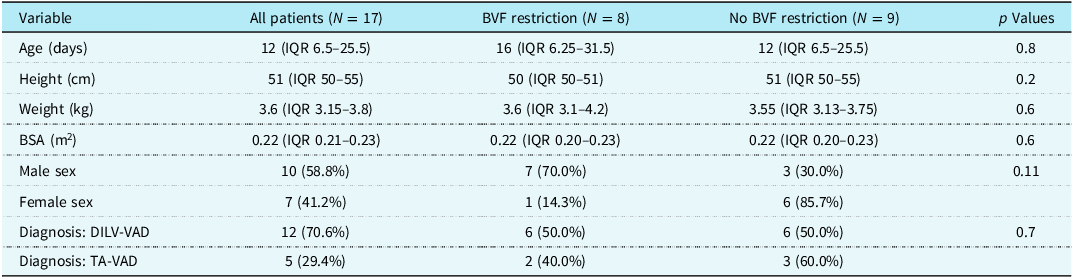
Seventeen patients were included. The median age at initial operation was 12 days (IQR 6.5–25.5), and the median body weight was 3.6 kg (IQR 3.15–3.8). Ten patients (58.8%) were male. Twelve patients (70.6%) had double-inlet left ventricle-ventriculoarterial discordance, and five (29.4%) had tricuspid atresia-ventriculoarterial discordance.
There were no significant differences between patients who developed bulboventricular foramen restriction and those who did not in terms of age, height, body weight, BSA, sex, or diagnosis (Table 1) (Figures 1 and 2).
Patient distribution. Flow diagram showing staged palliation and outcomes in the overall cohort (N = 17), stratified by development of BVF restriction (N = 8) versus no BVF restriction (N = 9).

Figure 1 Long description
The flowchart begins with 17 patients. It splits into two main branches: one for patients with BVF restriction (8 patients) and another for those without BVF restriction (9 patients). For the 8 patients with BVF restriction, the flowchart further divides into BCPS (6 patients) and BCPS waiting list (2 patients). The BCPS group then splits into Fontan (4 patients) and Fontan waiting list (2 patients). For the 9 patients without BVF restriction, the flowchart divides into BCPS (7 patients) and Ex (2 patients). The BCPS group further splits into Fontan (2 patients) and Fontan waiting list (5 patients).
Distribution according to primary palliation. Flow diagram of palliation strategy: isolated PAB (N = 5), Norwood (N = 3), and PAB+AR (N = 9), with subsequent progression to BCPS and Fontan stages.

Figure 2 Long description
The flowchart illustrates the distribution of 17 patients according to their primary palliation strategies. The diagram begins with all patients and branches into three main groups: isolated PAB with 5 patients, Norwood with 3 patients, and PAB+AR with 9 patients. Each group further divides into subsequent stages. For isolated PAB, 4 patients proceed to BCPS, with 2 moving to Fontan and 2 remaining on the Fontan waiting list. One patient from isolated PAB proceeds to EX. For Norwood, 2 patients proceed to BCPS, with 2 moving to the Fontan waiting list. One patient from Norwood proceeds to EX. For PAB+AR, 7 patients proceed to BCPS, with 4 moving to Fontan and 3 remaining on the Fontan waiting list. Additionally, one patient from PAB+AR is on the BCPS waiting list, and one is on the DKS+BCPS waiting list.
Demographic characteristics

Table 1 Long description
The table presents demographic characteristics of seventeen patients, divided into two groups: those with bulboventricular foramen restriction (eight patients) and those without (nine patients). The variables compared include age in days, height in centimeters, weight in kilograms, body surface area in square meters, sex distribution, and diagnosis types. The table shows median values and interquartile ranges for age, height, weight, and body surface area, along with percentages for sex and diagnosis. Notable trends include a higher percentage of male patients in the restriction group and a higher percentage of female patients in the no restriction group. The diagnoses are categorized into DILV-VAD and TA-VAD, with no significant differences between the groups.
DILV-VAD = double-inlet left ventricle with ventriculoarterial discordance; TA-VAD = tricuspid atresia with ventriculoarterial discordance; BSA = body surface area; BVF = bulboventricular foramen.
Initial echocardiography
At baseline echocardiography, median bulboventricular foramen diameter was 7.4 mm (IQR 5.25–9). The median bulboventricular foramen diameter was 6.8 (IQR 6–8) in patients who developed bulboventricular foramen restriction and 8 (IQR 4.75–10.5) in those without bulboventricular foramen restriction (p = 0.5). The median aortic annulus diameter was 8.3 mm (IQR 6.7–10.3). Median bulboventricular foramen/BSA ratio was 3.4 (IQR 2.3–4.1). The median bulboventricular foramen-to-aortic annulus ratio was 0.68 (IQR 0.66–1.80) in patients who developed bulboventricular foramen restriction and 1.09 (IQR 0.69–1.16) in those without bulboventricular foramen restriction (p = 0.3). No significant differences were observed between the groups (Table 2).
Baseline echocardiographic and operative data

Table 2 Long description
The table presents baseline echocardiographic and operative data for 17 patients, divided into two groups: those with bulboventricular foramen (BVF) restriction and those without. The table has four rows and five columns, including headers for variables, all patients, BVF restriction, no BVF restriction, and p values. The variables measured are baseline echo BVF diameter in millimeters, baseline echo aortic annulus in millimeters, baseline BVF/BSA ratio, and baseline BVF/aortic annulus ratio. For all patients, the median baseline echo BVF diameter is 7.4 millimeters with an interquartile range (IQR) of 5.25 to 9 millimeters. In the BVF restriction group, the median diameter is 6.8 millimeters (IQR 6 to 8 millimeters), while in the no BVF restriction group, it is 8 millimeters (IQR 4.75 to 10.5 millimeters), with a p value of 0.5. The median baseline echo aortic annulus diameter for all patients is 8.3 millimeters (IQR 6.7 to 10.3 millimeters). In the BVF restriction group, it is 8.6 millimeters (IQR 6.6 to 12 millimeters), and in the no BVF restriction group, it is 8 millimeters (IQR 6.8 to 10.1 millimeters), with a p value of 0.8. The median baseline BVF/BSA ratio for all patients is 3.4 (IQR 2.3 to 4.1). In the BVF restriction group, it is 3.4 (IQR 2.95 to 3.47), and in the no BVF restriction group, it is 3.4 (IQR 2.03 to 4.35), with a p value of 0.6. The median baseline BVF/aortic annulus ratio for all patients is 0.89 (IQR 0.66 to 1.1). In the BVF restriction group, it is 0.68 (IQR 0.66 to 1.8), and in the no BVF restriction group, it is 1.09 (IQR 0.69 to 1.16), with a p value of 0.3. No significant differences are observed between the groups.
BVF = bulboventricular foramen; BSA = body surface area.
Association with initial surgical strategy
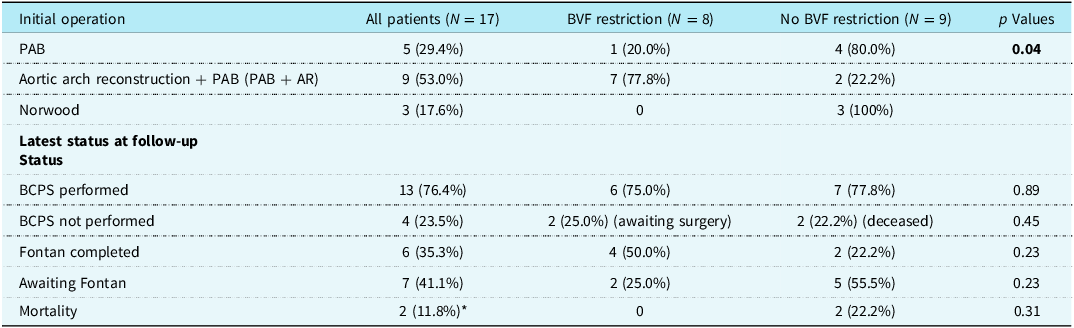
Bulboventricular foramen restriction developed in 8 patients (47.1%). Bulboventricular foramen restriction occurred significantly more often in patients who underwent pulmonary artery banding + arch reconstruction compared with those undergoing isolated pulmonary artery banding or Norwood palliation (p = 0.04) (Table 3).
Initial surgical strategy and current status

Table 3 Long description
The table presents data on initial surgical strategies and current status of 17 patients, divided into two groups: those with bulboventricular foramen restriction (8 patients) and those without (9 patients). The table has 12 rows and 5 columns, including headers for initial operations and follow-up status. Initial operations listed are pulmonary artery banding, aortic arch reconstruction plus pulmonary artery banding, and Norwood. Follow-up status includes whether the bidirectional cavopulmonary shunt was performed, Fontan completion status, and mortality rates. Notable trends include a higher percentage of aortic arch reconstruction plus pulmonary artery banding in the restriction group and a significant p-value of 0.04 for this operation. Mortality rates and Fontan completion status are also compared between the groups.
Bold values indicate statistically significant results (p < 0.05).
PAB = pulmonary artery banding; AR = aortic arch reconstruction; BCPS = bidirectional cavopulmonary shunt; BVF = bulboventricular foramen.
Pre-BCPS evaluation
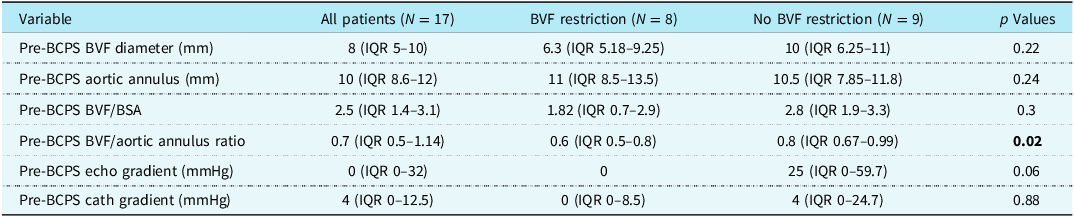
Before bidirectional cavopulmonary shunt, the bulboventricular foramen/aortic annulus ratio was significantly lower in patients who developed bulboventricular foramen restriction compared with those who did not (0.6 [IQR 0.5–0.8] versus 0.8 [IQR 0.67–0.99], p = 0.02) (Table 4).
Pre-BCPS echocardiography and catheterisation data

Table 4 Long description
The table presents pre bidirectional cavopulmonary shunt data for seventeen patients, divided into two groups: those with bulboventricular foramen restriction (eight patients) and those without (nine patients). The table includes six variables: bulboventricular foramen diameter, aortic annulus, bulboventricular foramen/body surface area, bulboventricular foramen/aortic annulus ratio, echo gradient, and catheterization gradient. Each variable is measured in millimeters or millimeters of mercury and includes interquartile ranges. Notably, the bulboventricular foramen/aortic annulus ratio is significantly lower in patients who developed bulboventricular foramen restriction compared to those who did not, with a p-value of 0.02. Other variables, such as bulboventricular foramen diameter and aortic annulus, show no significant differences between the two groups.
Bold values indicate statistically significant results (p < 0.05).
BSA = body surface area; BCPS = bidirectional cavopulmonary shunt; BVF = bulboventricular foramen.
Predictors of BVF restriction
In univariable analysis, both pulmonary artery banding + arch reconstruction (OR 21.0, 95% CI 1.6–279.4; p = 0.041) and lower pre-bidirectional cavopulmonary shunt bulboventricular foramen/aortic annulus ratio (OR 0.18, 95% CI 0.04–0.72; p = 0.016) were associated with bulboventricular foramen restriction. Multivariable penalized logistic regression analysis incorporating the initial surgical strategy and the receiver operating characteristic-derived cut-off value of the bulboventricular foramen/Aortic annulus ratio showed that both pulmonary artery banding + arch reconstruction and a bulboventricular foramen-to-aortic annulus ratio ≤0.65 were independently associated with the development of bulboventricular foramen stenosis (p = 0.04 and p = 0.047, respectively) (Table 5).
Multivariable analysis for BVF restriction

Table 5 Long description
The table presents a multivariable analysis for BVF restriction, focusing on two variables: initial operation and pre-BCPS BVF/aortic annulus ratio. It includes columns for adjusted odds ratio (OR), 95% confidence interval (CI), and p values. The first row shows an initial operation of pulmonary artery banding plus arch reconstruction with an adjusted OR of 21, a 95% CI of 1.6 to 279.4, and a p value of 0.041. The second row shows a pre-BCPS BVF/aortic annulus ratio of 0.65 or less with an adjusted OR of 8.9, a 95% CI of 1.1 to 102.3, and a p value of 0.047.
Bold values indicate statistically significant results (p < 0.05).
AR = arch repair; BCPS = bidirectional cavopulmonary shunt; BVF= bulboventricular foramen; PAB = pulmonary artery banding.
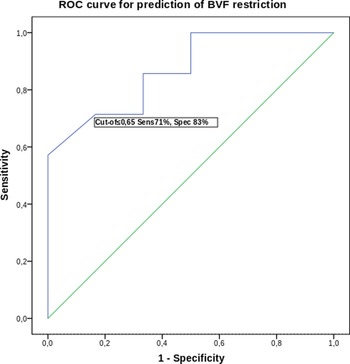
Receiver operating characteristic analysis demonstrated strong discriminatory performance for pre-bidirectional cavopulmonary shunt bulboventricular foramen/aortic annulus ratio (AUC 0.87). A cut-off ≤ 0.65 yielded sensitivity of 71% and specificity of 83%. In multivariable Firth penalized logistic regression analysis, both pulmonary artery banding + arch reconstruction and bulboventricular foramen/aortic annulus ratio ≤ 0.65 remained independently associated with bulboventricular foramen restriction (Table 5) (Figure 3).
ROC analysis. Receiver operating characteristic (ROC) analysis for prediction of BVF restriction using pre-BCPS BVF-to–aortic annulus ratio.

Figure 3 Long description
A line graph titled ROC curve for prediction of BVF restriction. The y axis represents sensitivity ranging from 0 to 1, and the x axis represents one minus specificity ranging from 0 to 1. The graph features a blue line that steps up and right, indicating the performance of a predictive model. A specific point on the curve is labeled with a cut-off value of 0.65, showing a sensitivity of 71 percent and a specificity of 83 percent. The green diagonal line represents a random guess. All values are approximated.
Timing and type of intervention
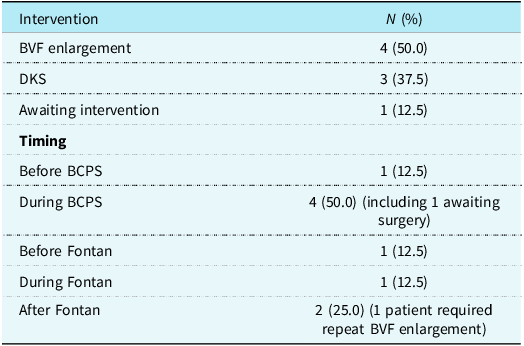
Among the 8 patients who developed bulboventricular foramen restriction, 4 underwent bulboventricular foramen enlargement, 3 underwent Damus–Kaye–Stansel, and 1 remains on the waiting list for intervention. Damus–Kaye–Stansel was performed before a bidirectional cavopulmonary shunt in one patient and at the time of a bidirectional cavopulmonary shunt in two patients. Bulboventricular foramen enlargement was performed during bidirectional cavopulmonary shunt in one patient, at Fontan in one patient, and after Fontan in two patients (Table 6).
Timing and type of intervention for BVF restriction

Table 6 Long description
The table presents data on the timing and type of intervention for bulboventricular foramen (BVF) restriction in 8 patients. It includes two main sections: Intervention and Timing. Under Intervention, 4 patients (50 percent) underwent BVF enlargement, 3 patients (37.5 percent) underwent Damus-Kaye-Stansel (DKS) procedure, and 1 patient (12.5 percent) is awaiting intervention. The Timing section details when these interventions occurred: 1 patient (12.5 percent) before bidirectional cavopulmonary shunt (BCPS), 4 patients (50 percent) during BCPS (including 1 awaiting surgery), 1 patient (12.5 percent) before Fontan, 1 patient (12.5 percent) during Fontan, and 2 patients (25 percent) after Fontan (1 patient required repeat BVF enlargement). The table is structured with 8 rows and 2 columns, providing a clear overview of the interventions and their timing.
BVF = bulboventricular foramen; DKS = Damus–Kaye–Stansel; BCPS = bidirectional cavopulmonary shunt.
Mortality
Two patients (11.8%) died during follow-up. One death occurred after isolated pulmonary artery banding due to prolonged ventilation and ventilator-associated pneumonia, and one occurred after the Norwood procedure following prolonged ECMO support. Mortality was not statistically associated with bulboventricular foramen restriction (p = 0.31).
Discussion
In this retrospective cohort of patients with double-inlet left ventricle-ventriculoarterial discordance or tricuspid atresia-ventriculoarterial discordance, we identified two key predictors of bulboventricular foramen restriction: Reference Freedom, Benson, Smallhorn, Williams, Trusler and Rowe1 an initial palliative strategy consisting of pulmonary artery banding combined with aortic arch reconstruction, and Reference Alsoufi2 a pre-bidirectional cavopulmonary shunt bulboventricular foramen-to-aortic annulus ratio ≤0.65.
An important question that arises from these findings is why patients are exposed to this risk. Specifically, why are Damus–Kaye–Stansel or Norwood procedures not uniformly applied as the initial palliation in all patients with a single left ventricle and ventriculoarterial discordance, instead of opting for pulmonary artery banding with or without aortic arch reconstruction?
Choice of primary palliation
The mechanism underlying progressive bulboventricular foramen restriction is multifactorial. Reduction in ventricular volume load after pulmonary artery banding, bidirectional cavopulmonary shunt, and Fontan completion may contribute to altered ventricular geometry and increased wall thickness, predisposing to progressive narrowing at the bulboventricular foramen Reference Rychik, Jacobs and Norwood7,Reference Alsoufi, McCracken, Kanter, Shashidharan and Kogon8,Reference Alsoufi, Slesnick and McCracken11,Reference Mosca, Hennein and Kulik12 . Our observation that bulboventricular foramen restriction occurred disproportionately in the pulmonary artery banding + arch reconstruction group is consistent with prior reports that systemic outflow tract obstruction is more likely in patients with concomitant arch hypoplasia or after arch reconstruction. However, this association may also reflect confounding by indication, as patients requiring arch reconstruction represent a more complex anatomical subset with a higher baseline risk. A key clinical challenge is the selection of the optimal palliative pathway. Although some institutions achieve excellent outcomes with primary Norwood reconstruction in non-HLHS single-ventricle anatomies Reference Alsoufi, McCracken, Kanter, Shashidharan and Kogon8,Reference Alsoufi, Slesnick and McCracken11,Reference Mosca, Hennein and Kulik12 , the Norwood operation remains a technically complex neonatal procedure associated with non-negligible mortality in many settings. Reference Karl, Watterson, Sano and Mee5,Reference Mosca, Hennein and Kulik12–Reference McElhinney, Reddy, Silverman and Hanley19 Consequently, in patients judged to be at lower risk of systemic outflow tract obstruction, strategies such as pulmonary artery banding with or without arch reconstruction remain attractive due to lower early operative risk.
Ruzmetov et al. compared pulmonary artery banding ± arch reconstruction with the Norwood procedure and reported no significant difference in mortality between the groups, while freedom from heart block was better in the Norwood group. Reference Ruzmetov, Geiss and Fortuna20 Tchervenkov et al. reported mortality rates of 43% in the pulmonary artery banding + coarctation repair group and 27% in the Norwood group, with a lower incidence of reintervention in the Norwood cohort. Reference Tchervenkov, Shum-Tim, Béland, Jutras and Platt21 In a study by Kalustian et al. comparing palliative arterial switch operation, pulmonary artery banding ± arch reconstruction, and Norwood–Damus–Kaye–Stansel strategies in 71 patients, no significant differences were observed among groups with respect to overall survival, Fontan completion rate, reintervention-free survival during the first interstage period, freedom from pulmonary artery reintervention, or ventricular dysfunction. Reference Kalustian, Spigel and Greenleaf22 In our series, the Norwood procedure was performed in three patients (17.6%), one of whom died.
An alternative technique is the palliative arterial switch operation; Reference Karl, Watterson, Sano and Mee5,Reference Lacour-Gayet, Serraf and Fermont23 however, this approach is less favoured due to difficulties in controlling pulmonary blood flow. Reference Lacour-Gayet24 The combination of pulmonary artery banding with coarctation repair and bulboventricular foramen enlargement has also been described, but it is rarely used today. Reference Serraf, Conte and Lacour-Gayet25
When bulboventricular foramen restriction develops after pulmonary artery banding + arch reconstruction, performing a Damus–Kaye–Stansel anastomosis as a second-stage procedure represents another option. In our cohort, three patients (17.6%) developed bulboventricular foramen restriction before bidirectional cavopulmonary shunt and underwent Damus–Kaye–Stansel at the second stage. When bulboventricular foramen restriction emerges late—particularly after division of the main pulmonary artery at the time of bidirectional cavopulmonary shunt—Damus–Kaye–Stansel may no longer be feasible, leaving bulboventricular foramen enlargement as the primary surgical option. Bulboventricular foramen enlargement is associated with restenosis risk, atrioventricular block, and ventricular dysfunction. Reference Alsoufi, McCracken, Kanter, Shashidharan and Kogon8,Reference Ruzmetov, Geiss and Fortuna20,Reference Rothman, Lang and Lock26 Rijnberg et al. reported heart block and ventricular dysfunction rates of 4% each, and a restenosis rate of 30% in a series of 23 patients undergoing bulboventricular foramen enlargement. Reference Rijnberg, Sojak, Blom and Hazekamp27 In our cohort, three patients developed bulboventricular foramen restriction after the main pulmonary artery division and underwent bulboventricular foramen enlargement; none developed heart block, although one patient (33.3%) required reintervention due to restenosis.
Another strategy is routine Damus–Kaye–Stansel anastomosis at the time of bidirectional cavopulmonary shunt, even in the absence of bulboventricular foramen restriction. Clarke et al. reported a primary palliation mortality of 4% and an overall mortality of 12% with this approach and suggested it as an alternative to the primary Norwood procedure. Reference Clarke, Kasahara and Andrews28 Although Damus–Kaye–Stansel can be performed with lower mortality at the bidirectional cavopulmonary shunt stage, it adds surgical complexity. Therefore, selectively performing Damus–Kaye–Stansel only in patients at high risk for bulboventricular foramen restriction may represent a balanced strategy. An important question is whether predictors of bulboventricular foramen restriction reported in the literature remain applicable before bidirectional cavopulmonary shunt.
Prediction of BVF restriction
Several studies have attempted to predict bulboventricular foramen restriction before primary palliation. Matitiau et al. reported that a bulboventricular foramen area index <2 cm2/m2 was a risk factor for bulboventricular foramen restriction. Reference Rychik, Jacobs and Norwood7 A bulboventricular foramen/Aortic annulus ratio<1 has also been identified as a predictor of bulboventricular foramen restriction. Reference Franklin, Sullivan and Anderson4,Reference Lacour-Gayet, Serraf and Fermont23 Park et al. reported that a low single-ventricle outflow tract area index and the presence of aortic arch hypoplasia were risk factors for outflow tract obstruction. Reference Park, Baek and Kwon29 Lan et al. suggested that patients with a bulboventricular foramen area index between 1 and 2 cm2/m2 could be managed with pulmonary artery banding or pulmonary artery banding + arch reconstruction. Reference Lan, Chang and Drant30 pulmonary artery banding reduces ventricular volume load and alters ventricular geometry, while myocardial hypertrophy leads to increased wall thickness, all of which may contribute to bulboventricular foramen stenosis. Reference Jensen, Williams, Laks, Drinkwater and Kaplan9,Reference Donofrio, Jacobs, Norwood and Rychik31,Reference Miura, Kishimoto, Kawata, Hata, Hoashi and Nakajima32 Several studies have also reported pulmonary artery banding + arch reconstruction as a risk factor for bulboventricular foramen restriction. Reference Matitiau, Geva and Colan3,Reference Karl, Watterson, Sano and Mee5 In our study, pre-palliation echocardiographic parameters, including bulboventricular foramen area index and bulboventricular foramen/aortic annulus ratio, did not differ significantly between patients who did and did not develop bulboventricular foramen stenosis, although values tended to be higher in patients without subsequent restriction.
In addition, the anatomical and hemodynamic mechanisms underlying the association between a lower bulboventricular foramen-to-aortic annulus ratio and subsequent restriction deserve further consideration. A relatively small bulboventricular foramen in relation to the aortic annulus may reflect a limited effective systemic outflow orifice at baseline. During staged palliation, progressive reductions in ventricular preload after pulmonary artery banding, bidirectional cavopulmonary shunt, and Fontan circulation, together with myocardial hypertrophy and geometric remodelling of the dominant ventricle, may further decrease the effective cross-sectional area of the bulboventricular foramen. In parallel, continued growth of the aortic annulus, in contrast to limited or absent growth of the bulboventricular foramen, may exacerbate this mismatch over time, leading to a relative and eventually functional restriction of the bulboventricular foramen. Data regarding the prediction of bulboventricular foramen restriction in the pre-bidirectional cavopulmonary shunt period are limited. Matitiau et al. suggested that the initial size of the bulboventricular foramen, rather than its growth rate, is the critical determinant of later restriction. Reference Matitiau, Geva and Colan3 In our study, we specifically evaluated echocardiographic and catheterisation data obtained before the bidirectional cavopulmonary shunt to identify risk factors at this stage. While the aortic annulus enlarges over time, bulboventricular foramen growth may be minimal, absent, or even negative, Reference Matitiau, Geva and Colan3 leading to a progressive decline in the bulboventricular foramen/Aortic annulus ratio. However, the literature does not provide clear evidence regarding when this decrease becomes a risk factor for bulboventricular foramen restriction. In our cohort, the median pre-bidirectional cavopulmonary shunt bulboventricular foramen/Aortic annulus ratio was 0.7, and values were <1 in both groups who developed bulboventricular foramen stenosis and those who did not (0.6 versus 0.8). Our receiver operating characteristic analysis demonstrates that a pre-bidirectional cavopulmonary shunt bulboventricular foramen/aortic annulus ratio ≤0.65 identifies patients at risk for subsequent bulboventricular foramen restriction with strong discriminatory performance (AUC 0.87). This finding is particularly clinically relevant because it provides a practical pre-bidirectional cavopulmonary shunt echocardiographic parameter that may support selective performance of Damus–Kaye–Stansel at the time of bidirectional cavopulmonary shunt, aiming to prevent late bulboventricular foramen enlargement and its associated complications.
Limitations
This study has several limitations. First, its retrospective single-centre design and small sample size limit statistical power and result in wide confidence intervals, particularly in multivariable analyses. Second, the distribution of patients across initial palliative strategies was unbalanced, and the association between pulmonary artery banding + arch reconstruction and bulboventricular foramen restriction may be influenced by confounding by indication, as patients requiring arch reconstruction may represent a more complex anatomical subgroup. Third, the receiver operating characteristic-derived cut-off value was obtained from the present cohort and was not validated externally; therefore, generalisability requires confirmation in larger multi-centre studies.
Conclusions
In patients with dominant single left ventricle morphology and ventriculoarterial discordance, pulmonary artery banding with aortic arch reconstruction and a pre-bidirectional cavopulmonary shunt bulboventricular foramen-to-aortic annulus ratio ≤0.65 are associated with subsequent bulboventricular foramen restriction. Selective performance of Damus–Kaye–Stansel at the time of bidirectional cavopulmonary shunt in high-risk patients may reduce the need for bulboventricular foramen enlargement and its related complications.
Author contributions
SE: Conception or design of the work, drafting the work, final approval of the version to be published, any part of the work is appropriately investigated and resolved.
BT: Drafting the work, final approval of the version to be published, any part of the work is appropriately investigated and resolved.
ER: Conception or design of the work, revising the work, final approval of the version to be published, any part of the work is appropriately investigated and resolved.
ŞÇ: Acquisition and analysis, final approval of the version to be published, any part of the work is appropriately investigated and resolved.
SS: Revising the work, final approval of the version to be published, any part of the work is appropriately investigated and resolved.
İŞI: Revising the work, final approval of the version to be published, any part of the work is appropriately investigated and resolved.
KK: Revising the work, final approval of the version to be published, any part of the work is appropriately investigated and resolved.
EÖ: Revising the work, final approval of the version to be published, any part of the work is appropriately investigated and resolved.
ACH: Revising the work, final approval of the version to be published, any part of the work is appropriately investigated and resolved.
Financial support
None declared.
Competing interests
The authors of this article have no conflicts of interest to disclose.