1. Introduction
Scientific anomalies are of significant theoretical interest in the philosophy of science, and they also play an important practical role in some biological controversies. In the philosophy of science, anomalies are important for at least two related reasons. First, most of the classic twentieth-century works on scientific theory change, including those of Karl Popper (Reference Popper1959), Thomas Kuhn (Reference Kuhn1970), Imre Lakatos (Reference Lakatos, Lakatos and Musgrave1970), and Larry Laudan (Reference Laudan1977), suggested that anomalies play a crucial “catalytic” role in the processes by which scientists develop new theories and alter previous ones. Second, many recent studies argue that the process of scientific discovery often involves a gradual modification and elaboration of existing theories or models in response to scientific problems, many of which involve anomalies (Wimsatt Reference Wimsatt, Nitecki and Hoffman1987; Darden Reference Darden1991; Schaffner Reference Schaffner1993; Nickles Reference Nickles1997; Elliott Reference Elliott2004a). Thus, both classic discussions of theory change and contemporary studies of scientific discovery affirm that anomalies are central to scientific progress.
Some of the literature on science policy suggests that anomalies also have the potential to play an important role in many scientific controversies, especially those with practical ramifications. For example, when a body of scientific evidence supports a particular policy that runs counter to a political actor's own agenda, he or she may search for and emphasize anomalous scientific data as a way of resisting the evidence for the policy (Herrick and Sarewitz Reference Herrick and Sarewitz2000; Sarewitz Reference Sarewitz and Frodeman2000). Furthermore, whereas anomalies in highly theoretical areas of science might “simmer” relatively unnoticed for an extended period of time, thus enabling researchers to develop increased understanding of them (Kuhn Reference Kuhn1970), the policy process is likely to bring anomalies to the political front burner immediately, when scientists still know very little about their characteristics (Collins and Evans Reference Collins and Evans2002).
Section 2 of this paper examines contemporary controversies concerning the low-dose biological effects of toxic chemicals and argues that anomalies do indeed play a central role in these disputes. On the basis of this case study, Section 3 suggests a novel philosophical account of scientific anomaly that emphasizes the potential for anomalies to display multiple “characterizations.” Section 4 of the paper argues that this account suggests at least two ways in which philosophers of science can help to resolve the biological controversy over low-dose chemical effects.
2. The Biological Controversy over Low-Dose Chemical Effects
The low-dose biological effects of toxic and carcinogenic chemicals are currently a matter of hot policy debate. On one hand, researchers such as Theo Colborn claim that extremely low doses of many chemicals may mimic hormones such as estrogen and be responsible for dramatic declines in animal populations. Some claim that these “endocrine-disrupting” chemicals may also be related to human reproductive cancers, immune disorders, and declining male sperm counts (Colborn, Dumanoski, and Myers Reference Colborn, Dumanoski and Myers1996). Nicholas Ashford adds that approximately 5% of the U.S. population may suffer from extreme sensitivity to toxic chemicals. This phenomenon, which is frequently called “multiple chemical sensitivity” (MCS), may be linked to “Gulf War syndrome,” “sick-building syndrome,” and other environmental sensitivities (Ashford and Miller Reference Ashford and Miller1998). On the other hand, the influential toxicologist Edward Calabrese suggests that low doses of many toxins may actually have beneficial effects. He claims that these beneficial effects, which he calls “chemical hormesis,” are widely generalizable across different species, biological endpoints, and toxins, and he notes that this phenomenon “is counter to the cancer risk assessment practices by U.S. regulatory agencies … which assume that cancer risk is linear in the low-dose area” (Calabrese and Baldwin Reference Calabrese and Baldwin1998, VIII-1; see also Calabrese and Baldwin Reference Calabrese and Baldwin2003).
Beneficial effects produced by low doses of toxic chemicals are plausibly an example of a scientific anomaly. In order to predict the effects of toxins and carcinogens, toxicologists currently use models that predict either harmful effects at all dose levels or thresholds below which chemicals have no biological effect (Calabrese and Baldwin Reference Calabrese and Baldwin2003). Although researchers and policy makers recognize that these models provide only rough approximations of actual chemical effects, the models are part of a toxicological framework in which toxic chemicals are expected to produce harmful effects (if they produce effects at all) at low doses. Thus, the occurrence of chemical hormesis is unexpected, or anomalous, relative to current toxicological science. Many of the phenomena associated with endocrine disruption and MCS are also anomalous (see Elliott Reference Elliott2004b). The rest of this paper focuses on hormesis as one particular example of anomaly in the controversy over low-dose chemical effects, but many features of the hormesis case also apply to the phenomena of MCS and endocrine disruption.
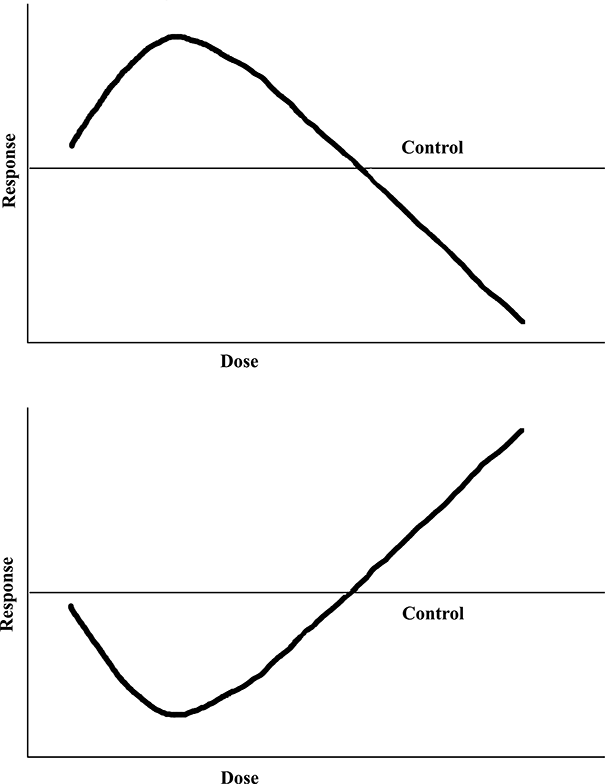
The effects of alcohol on human mortality provide a good illustration of the characteristics of the hormesis phenomenon (although not all researchers would consider the alcohol case as a genuine instance of hormesis). At high doses, alchohol increases human mortality, but at lower doses it can actually decrease the mortality rate below the level of controls (Gordon and Doyle Reference Gordon and Doyle1987). The result is a
 $\textsf{U}$-shaped dose-response curve that reflects the production of opposite effects at low doses versus at high doses (see Figure 1), which is characteristic of hormetic responses to toxic chemicals. These sorts of hormetic effects can allegedly occur on endpoints such as fertility, cancer incidence, growth, body weight, or enzyme activity, in addition to mortality.
Examples of the general form of hormetic dose-response relationships. The bottom curve could represent the relationship between alcohol intake and human mortality, whereas the top curve could represent a hormetic relationship between dose of a growth inhibitor and plant growth.

A particularly striking feature of the hormesis anomaly is that current researchers appear to be describing or “characterizing” it in multiple, different ways. Each of these characterizations involves an “empirical component” and a “theoretical component” that stand in a problematic relation to one another, but the components vary from one characterization to another. For example, when some researchers describe the hormesis anomaly, they focus on one or more sets of experimental data that are unexpected (e.g., Vichi and Tritton Reference Vichi and Tritton1989; Davis and Svendsgaard Reference Davis and Svendsgaard1990). If one were to make these researchers’ characterizations of the anomaly as explicit as possible, they would seem to involve an inconsistency relation between statements that describe a set of data from one or more experiments on one hand and statements that describe researchers’ expectations for those data on the other hand.
Other researchers appear to conceptualize the anomalous research data as evidence for the occurrence of one or more particular sorts of phenomena.Footnote 1 I have argued, however, that current researchers have been working with multiple different concepts for the hormesis phenomenon (Elliott Reference Elliott2000b). Two broadly “operational” concepts for the phenomenon include (1) “
 $\textsf{U}$-shaped-dose-response-curve hormesis” (henceforth “
 $\textsf{U}$-shaped hormesis”) and (2) “beneficial hormesis.”Footnote 2 According to the first concept (
 $\textsf{U}$-shaped hormesis), the phenomenon consists of “any non-spurious biological effect of a chemical that produces opposite effects at higher doses” (Elliott Reference Elliott2000b, 354). The name for this concept is based on the fact that a chemical that displays this sort of hormetic effect produces either an upright or upside-down
 $\textsf{U}$-shaped dose-response curve (see Figure 1). Using this concept, some researchers appear to characterize the hormesis anomaly as an inconsistency relation between descriptions of the occurrence of
 $\textsf{U}$-shaped hormesis on one hand and descriptions of dose-response models that do not incorporate
 $\textsf{U}$-shaped responses on the other hand (see Calabrese and Baldwin Reference Calabrese and Baldwin1998; Davis and Svendsgaard Reference Davis and Svendsgaard1990). It is notable, however, that even researchers who agree on employing
 $\textsf{U}$-shaped hormesis as the empirical component of their characterizations may still vary their theoretical components. For example, Calabrese and Baldwin (Reference Calabrese and Baldwin1998) frequently characterize the hormesis anomaly as a failure of physiological theories to explain the occurrence of
 $\textsf{U}$-shaped hormesis. Thus, the theoretical component of the anomaly could be not only a set of models but also one or more physiological theories.
As I argued previously, however, researchers use other concepts, in addition to
 $\textsf{U}$-shaped hormesis, for describing the hormesis phenomenon (Elliott Reference Elliott2000b). For example, many scientists employ the concept of beneficial hormesis, which I defined as a beneficial effect produced by a chemical that produces harmful effects at higher doses (see, e.g., Gerber, Williams, and Gray Reference Gerber, Williams and Gray1999).Footnote 3 Other researchers appear to define the hormesis phenomenon not merely in terms of particular operational effects but rather in terms of the mechanisms by which a chemical produces those effects. For example, Stebbing (Reference Stebbing1998) employs the concept of “overcompensation hormesis,” which consists of opposite effects produced by “a biological response in which processes are stimulated to above-normal levels in an attempt to restore organismal homeostasis after it is altered by a toxic chemical” (Elliott Reference Elliott2000b, 356).Footnote 4 Davis and Svendsgaard (Reference Davis and Svendsgaard1990) and other scientists have also hinted at the concept of “multiple-effects hormesis,” which I defined as “a low-dose effect, opposite to that which occurs at higher doses, that is caused by multiple biological effects of a chemical influencing the same endpoint in different ways at different dose levels” (Elliott Reference Elliott2000b, 360). Researchers who employ these different concepts for the hormesis anomaly appear to be characterizing it in subtly different ways.
There even appear to be some characterizations of hormesis according to which the theoretical component of the anomaly is not merely a model or theory but an overarching paradigm. Especially in the early twentieth century, some researchers suggested that hormesis might be the same sort of phenomenon as homeopathy, even though they were not sure precisely how to characterize homeopathy itself (Calabrese and Baldwin Reference Calabrese and Baldwin2000). Homeopathy is a debated medical practice in which people are treated for an illness by receiving extremely small quantities of substances that produce the same symptoms as the illness. Some homeopathic physicians make the surprising claim that their remedies are helpful even when they are diluted to the point that not even one molecule of the homeopathic substance is left in solution. Thus, at least some forms of homeopathic medicine run counter to paradigmatic assumptions of modern chemistry and physics, which hold that solutions do not retain the properties of substances that are no longer present in them. According to this characterization of the hormesis anomaly, it would consist of an inconsistency relation between descriptions of the phenomenon of hormesis (i.e., homeopathy) and descriptions of the current paradigms of chemistry, physics, and toxicology, which run counter to homeopathic phenomena.
3. A Novel Account of Anomaly
This section argues that the hormesis case study suggests a novel account that emphasizes the multiplicity of characterizations with which researchers may describe an anomaly. The case illustrates two particularly important ways in which the characterizations of an anomaly may differ from one another. First, the “general type” of the empirical or theoretical components may vary. This paper defines the general types of anomaly components as broad categories that describe the sorts of entities that can serve as empirical or theoretical components. Sets of data and phenomena are two general types of empirical anomaly components in the hormesis case, whereas researchers’ expectations, models, theories, mechanism schemata, and paradigms are general types of theoretical anomaly components.Footnote 5 The characterizations of an anomaly may also vary in a second way if their components differ in what this paper will call their “specific type.” The specific type is a particular instantiation of the general type; it can serve as the empirical or theoretical component in an actual characterization of an anomaly. For example, two characterizations of hormesis may both have the same general type of empirical component (namely, a phenomenon), but the specific type of empirical component may be the phenomenon of
 $\textsf{U}$-shaped hormesis in one characterization and the phenomenon of beneficial hormesis in the other.
Previous accounts of anomaly do not appear to have placed major emphasis on either of these ways in which the characterizations of an anomaly can vary. First, they each focused attention on one or two particular general types of empirical and theoretical components (e.g., phenomena, theories, paradigms, or research programs) that anomalies sometimes display (see Popper Reference Popper1959; Kuhn Reference Kuhn1970; Lakatos Reference Lakatos, Lakatos and Musgrave1970; Laudan Reference Laudan1977; Darden Reference Darden1991). Second, they did not emphasize the ways in which the specific type of an anomaly's components could vary from one characterization to another; instead, they tended to describe an anomaly in terms of a specific phenomenon that conflicted with a particular theory or paradigm. More than other thinkers, Kuhn (Reference Kuhn1970) did draw some attention to the potential for an anomaly to be conceptualized differently as researchers converted from one paradigm to another, but his discussion of this feature of anomaly was not systematic.Footnote 6
As a first step toward developing a novel account that emphasizes how anomalies may display multiple characterizations, this paper offers the following description of anomaly. It is called “account P” because it emphasizes the plurality of ways in which researchers may describe and conceptualize an anomaly.
Account P. A scientific anomaly is described by a “characterization,” which consists of an empirical component, a theoretical component, and a problematic relation between them. An anomaly may admit of multiple characterizations that differ in the general and specific types of their components and the relation between them:Footnote 7
(i) individual researchers may employ more than one characterization at roughly the same time,
(ii) different researchers may employ different characterizations at roughly the same time, and
(iii) researchers may change their characterizations over time.
In the hormesis case, for example, Calabrese and Baldwin's report on their initial literature study constitutes an example of how individual researchers can pursue more than one characterization at a time, because they employed some characterizations involving the phenomenon of
 $\textsf{U}$-shaped hormesis and others using that of overcompensation hormesis (Calabrese and Baldwin Reference Calabrese and Baldwin1998). Meanwhile, other researchers have emphasized different characterizations that do not conceptualize hormesis as a particular phenomenon but rather describe it in terms of experimental data that conflict with researchers’ expectations for their experiments (e.g., Jonas Reference Jonas2001). Finally, Calabrese and Baldwin continue to alter their characterizations. After their initial literature study, they began to focus on “mechanistic” characterizations of hormesis as an overcompensation phenomenon (Calabrese Reference Calabrese1999), but more recently they reverted to “operational” characterizations of the anomaly (Calabrese and Baldwin Reference Calabrese and Baldwin2002).
In addition to the support that account P receives from the hormesis case (and the cases of MCS and endocrine disruption, as described in Elliott [Reference Elliott2004b]), recent theoretical work in the philosophy of science also indicates the value of this description of anomaly. In particular, a number of thinkers have emphasized that experimental data often must be interpreted extensively before they can be brought to bear in the justification or testing of theories (see Hacking Reference Hacking1988; Mayo Reference Mayo1996). For example, Bogen and Woodward (Reference Bogen and Woodward1988) argue that low-level experimental results are not directly explained by scientific theories; rather, researchers use experimental data to infer the occurrence of more generalizable phenomena. In addition, David Gooding (Reference Gooding1990) has emphasized that, as scientists develop concepts for describing novel phenomena, they may start with intermediate descriptions of their perceptual experiences that he calls “construals.” He suggests that researchers conceptualize their results only after a period of what might be called “exploratory experimentation” (Steinle Reference Steinle1997). These claims support the notion in account P that the general or specific type of an anomaly's components may vary as researchers consider how to interpret their results.
4. How Account P Can Alleviate Controversy
By providing a more detailed analysis of the early stages in which scientists analyze anomalous findings, account P may suggest new insights concerning a variety of philosophical topics, including scientific discovery and the role of values in scientific practice (Elliott Reference Elliott2004b). This paper argues, in particular, that account P may help to alleviate biological controversies that involve anomalous findings. By highlighting the variety of characterizations that policy-relevant anomalies may display, this description of anomaly can contribute at least two sorts of insights. First, account P encourages philosophers of science to look for ways in which the characterizations of an anomaly play an important role in framing a controversy. Second, the account highlights the importance of identifying the methodological value judgments at stake in the choice of characterizations for anomalies that are implicated in biological controversies. By highlighting the framing effects and methodological value judgments associated with particular characterizations, philosophers of science can warn researchers and policy makers about anomaly conceptualizations that are particularly questionable or that have the potential to influence the ongoing controversy in significant ways.
4.1. Framing the Controversy
A number of different characterizations of hormesis have the potential to play an important role in framing the controversy concerning low-dose toxic chemical effects. First, characterizing the hormesis anomaly as a homeopathic phenomenon (that potentially conflicts with overarching paradigms of chemistry and physics) appears to decrease its legitimacy and to discourage research concerning it. For example, Calabrese suggests that the tendency for researchers to associate hormesis with homeopathy was a crucial factor contributing to the lack of attention that hormesis received from roughly the 1930s to the 1980s (see Calabrese and Baldwin Reference Calabrese and Baldwin2000). In contrast, the concepts of “overcompensation” or “multiple-effects” hormesis appear to increase its scientific legitimacy considerably. Each of these concepts characterizes hormesis in terms of specific, plausible mechanistic phenomena (either processes of overcompensation to toxins or multiple effects of a chemical on different biological endpoints). Thus, they make it appear more likely that hormesis is a legitimate phenomenon that deserves further research. Nevertheless, it is not clear that these concepts, by themselves, strongly support the significance of hormesis for public policy. For example, the concept of overcompensation hormesis suggests that toxic chemicals produce beneficial low-dose effects for only a short time (during which the overcompensation occurs), after which they could revert to neutral or harmful effects. The concept of multiple-effects hormesis indicates that hormetic effects may not be very generalizable from one chemical or endpoint to another, because those effects depend on the unique potential for particular chemicals to produce multiple effects on particular biological systems.
In contrast with other concepts of hormesis, that of beneficial hormesis does appear to draw attention to the potential policy significance of the phenomenon. It suggests that toxic chemicals may produce beneficial effects for organisms when administered at sufficiently low doses (which might seem to indicate that some regulations of toxic chemicals need to be relaxed). Nevertheless, this concept also has the potential to create confusion. It suggests that the new view about toxic chemicals is that they may be beneficial at low doses, in contrast to the old view (which is that they were harmful at low doses). But this dichotomy between old and new views may gloss over the fact that a toxic chemical can produce a beneficial effect on one endpoint over the short term while still having harmful effects on the organism as a whole over the long term. Thus, less normative concepts, such as
 $\textsf{U}$-shaped hormesis, might be preferable to the concept of beneficial hormesis, because they might decrease the potential for people to assume that hormetic effects are beneficial for entire organisms over extended periods of time.
This possibility for the concept of beneficial hormesis to frame debates about hormesis in a manner that misleads the public is made even more serious because of the potential for researchers to conflate different concepts of the anomaly. For example, I have argued previously that Calabrese and Baldwin (Reference Calabrese and Baldwin1998) initially defended the generalizability of hormesis by providing evidence for the occurrence of
 $\textsf{U}$-shaped hormesis (Elliott Reference Elliott2000a). In the same publication (as well as in many other publications by them and other authors), however, they shifted to the concept of beneficial hormesis and suggested that their results encouraged reevaluation of government risk-assessment policy based on the likely occurrence of beneficial effects produced by low doses of toxic chemicals. They did not provide independent evidence, though, that opposite effects on individual endpoints over the short term are genuinely beneficial for the organism as a whole over the long term. Thus, Calabrese and Baldwin's conflation of different concepts may increase the potential for policy makers and members of the public to be confused about the likelihood that toxic chemicals are producing genuinely beneficial effects at low doses.
4.2. Methodological Value Judgments
Account P can also contribute to alleviating contemporary biological controversies over low-dose chemical effects by highlighting the methodological value judgments that are involved in choosing some characterizations of an anomaly rather than others. In the case of hormesis, two value judgments appear to be particularly important. The first has already been introduced by the preceding discussion of the beneficial hormesis concept and its framing effects. Researchers have to decide whether the evidence that
 $\textsf{U}$-shaped hormesis occurs provides adequate reason to think that beneficial hormesis also occurs. Gerber et al. acknowledge that apparent beneficial effects on one endpoint “might have the effect of altering an optimum resource allocation among such functions as growth, maintenance, and reproduction. … A higher level of performance in any one of these [as a result of a hormetic effect] might be achieved at the expense of the other two [thus resulting in negative effects for the organism as a whole]” (Reference Gerber, Williams and Gray1999, 275). Nevertheless, they make the methodological value judgment that Calabrese and Baldwin have identified enough apparent instances of
 $\textsf{U}$-shaped hormesis on different endpoints to conclude that beneficial hormesis does occur (278). Other researchers, such as University of Missouri biologist Fred vom Saal, are very skeptical of the notion that
 $\textsf{U}$-shaped dose-response curves on particular endpoints are likely to result in benefical effects for an organism as a whole (see Kaiser Reference Kaiser2003).
A second methodological judgment involves determining whether the literature-study approach employed by Calabrese and Baldwin (Reference Calabrese and Baldwin1998) provides sufficient evidence to conclude that the hormesis anomaly constitutes a widely generalizable phenomenon rather than an occasional set of anomalous data. On one hand, a number of researchers appear to think that Calabrese and Baldwin have uncovered very convincing evidence for a general phenomenon (e.g., Gerber et al. Reference Gerber, Williams and Gray1999). On the other hand, Jonas (Reference Jonas2001) represents the views of another group of scientists when he claims that “Less than 1% of over 20,000 studies reviewed [by Calabrese and Baldwin] came close to true hypothesis testing of hormesis in experimental settings. … The criteria for rigorous ‘proof’ of hormesis will be different than those the authors [i.e., Calabrese and Baldwin] have used simply to ‘identify’ hormesis [sic] may exist. In the former one would want to assure proper dose verification, randomization of samples, blinding of outcome measures, proper statistical analysis, and full reporting of all data” (626–627; see also Mayo and Spanos Reference Mayo and Spanos2006).
5. Conclusion
This paper argued that attention to a novel account of scientific anomaly can contribute to the alleviation of biological controversies concerning the low-dose effects of toxic chemicals. It developed a new description of anomaly, called account P, that emphasizes how researchers may employ multiple characterizations for a single anomaly. These characterizations involve empirical and theoretical anomaly components that vary in their “general” and “specific” types. The paper then suggested how, in the case of the hormesis anomaly, attention to this account can alleviate biological controversy. Account P encourages philosophers of science to identify the framing effects of particular characterizations and the methodological value judgments involved in employing some characterizations over others. By doing so, they can highlight anomaly conceptualizations that are likely to exacerbate or mitigate controversy.