1. INTRODUCTION
The Taguchi (Reference Taguchi1991) method utilizes fractional factorial designs, or the so-called orthogonal arrays (OAs), to reduce the number of experiments under permissive reliability. The columns of the OA represent process/product parameters to be studied, whereas the rows denote the individual experiments and each row contains the combination of factor levels at which an experiment is conducted. The signal to noise (S/N) ratio is then used to identify optimal factor levels. Regardless of the response type, the optimal factor level is the factor level that maximizes the S/N ratio. The Taguchi method has been widely accepted for obtaining robust designs in many business applications. Nevertheless, most of the published research on the applications of the Taguchi method (Li et al., Reference Li, Al-Refaie and Yang2008) has been conducted to optimize a single quality response of a process or product. Recently, several optimization approaches have been proposed for the optimization of multiple responses (Al-Refaie, Li, & Tai, Reference Al-Refaie, Li and Tai2009; Al-Rafaie, Wu, & Li, Reference Al-Refaie and Li2009, Reference Al-Refaie, Wu and Li2010; Al-Refaie & Al-Tahat, Reference Al-Refaie and Al-Tahat2011; Al-Rafaie & Li, Reference Al-Refaie, Li and Tai2011).
Statistical regression is a comprehensive and powerful tool that can be used not only to find a crisp relationship between the dependent and independent variables but also to estimate the variance of measurement error. Although statistical regression has many applications (Hasan et al., Reference Hasan, Tuncay and Mustafa2006; Shu et al., Reference Shu, Ming, Jen and Chun2006; Gopalsamy et al., Reference Gopalsamy, Mondal and Ghosh2009), in many manufacturing processes the behavior of processes is usually vague and the observed data is irregular, and hence statistical regression models have an unnaturally wide possibility range. A fuzzy regression approach in modeling manufacturing processes, which has a high degree of fuzziness, possesses the distinct advantage of being able to generate models using only a small number of experimental data sets. The fuzzy regression analysis uses fuzzy numbers (Tanaka et al., Reference Tanaka, Uejima and Asai1982) expressed as intervals with membership values as the regression coefficients. Because the regression coefficients are fuzzy numbers, the estimated dependent variable will be a fuzzy number. Fuzzy linear regression approaches have been successfully applied in cost estimation of wastewater treatment (Wen & Lee, Reference Wen and Lee1999), financial forecasting (Oh et al., Reference Oh, Kim and Lee1990), earthquake prediction (Bardossy et al., Reference Bardossy, Hagaman, Ducketein, Bogardi, Kacaprzyk and Fedrizzi1992), sales volume estimation (Watada, Reference Watada, Kacaprzyk and Fedrizzi1992), and ergonomics (Chang et al., Reference Chang, Konz and Lee1996).
In reality, many manufacturing processes tend to be very complex in behavior and have inherent system fuzziness owing to the fluctuation of process pressure and temperature from environmental effects. Sometimes the observed values from the processes may not be regular. The fuzzy regression could be more effective than statistical regression when the degree of fuzziness of systems is high (Tanaka et al., Reference Tanaka, Uejima and Asai1982). This research aims at optimizing multiple responses in the manufacturing application on the Taguchi method using fuzzy regression analysis. The proposed approach provides valuable help to process engineering when seeking optimal process performance under external effects. The remaining of this paper is organized as follows. Section 2 outlines the proposed approach. Section 3 provides illustrative examples. Section 4 summarizes research conclusions.
2. THE PROPOSED OPTIMIZATION APPROACH
The proposed approach for optimizing multiple responses in the Taguchi method is outlined in the following steps:
Step 1. Typically, the quality response, y, is divided into three main types: the smaller-the-better (STB), the nominal-the-best (NTB), and the larger-the-better (LTB) response types. The Taguchi OA conducts n experiments to investigate f factors concurrently. Let q denotes the number of responses of main concern that are measured in each experiment. To include all fuzziness in the observations values for each response, calculate the S/N ratio, ηijr, at experiment i for each repetition of response j, using an appropriate equation from the following formulas:
 $$\eqalign{{\rm\eta} _{ijr}=\left\{\matrix{ - 10\log _{10} \lpar y_{ijr}^2 \rpar \hfill & \hbox{for STB}\comma \; \hfill \cr 10\log _{10} \lpar s_{ijr}^2 /\bar y_{ijr}^2\rpar \hfill & \hbox{for NTB}\comma\hfill & \forall i\comma\ \forall j\comma\ \forall r \hfill \cr - 10\log _{10} \lpar 1/y_{ijr}^2 \rpar \hfill & \hbox{for LTB}\comma \hfill} \right.\comma}$$
where  $\overline y _i $ and s i are the estimated average and standard deviation of y ir replicates at the ith experiment. Determine the optimal factor setting for rth repetition of response j using the S/N ratio. Let
 $\overline {\rm \eta} _{lfr} $ denotes the average of ηi values at level l of factor f for the rth repetition. Calculate the
 $\overline {\rm\eta} _{lfr} $values for all factor levels. Identify the combination of optimal factor levels for each repetition as the levels that maximize the
 $\overline {\rm\eta} _{lfr} $ for this factor.
Step 2. Let ηjr denotes the S/N ratio for the rth repetition of response j. Obtain the multiple linear regressions ηjr for all factor level combinations using the values of ηjr. That is,
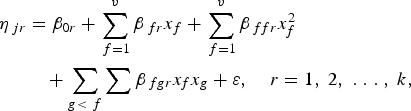 $$\eqalign{{\rm \eta} _{\,jr}&={\rm \beta} _{0r}+\sum\limits_{\,f=1}^v {{\rm \beta} _{\,fr} x_f }+\sum\limits_{\,f=1}^v {{\rm \beta} _{\,ffr} } x_f^2 \cr & \quad +\sum\limits_{g{\rm\lt }\, \, f} {\sum {{\rm \beta} _{\,fgr} } } x_f x_g +{\rm \varepsilon}\comma \; \, \, \, \, \, r=1\comma \; 2\comma \; .\;.\;.\;\comma \; k\comma \; }$$
where  $x_f \comma \; x_f^2 \comma \ {\rm and}\ x_f x_g $ are the independent factor variables; the coefficients, βf, βfg, βff are crisp values; and ɛ is random error observed in the response value. Then, determine the best-fit models for describing the functional relationship between the S/N ratio for response j and process factors. The fuzzy regression expressed as
 $$\eqalign{&\tilde{{\rm \eta} }_j = {{\tilde{{\rm \beta}}_0 }} + \sum\limits_{\,f = 1}^\nu {{{\tilde{{\rm \beta}}_f \, }}x_f \,+ } \sum\limits_{\,f = 1}^\nu {{{\tilde{{\rm \beta}}_{\,ff} \, }}x_f^2 \,+ } \sum\limits_{g \lt f} {\sum {{{\tilde{{\rm \beta}}_{\,fg} \, }}x_f x_g + \varepsilon\comma \; \, \, \, \, \, \, {\rm \forall }j\comma \; {\rm \forall }f}.}}$$
A trapezoidal fuzzy number  $\tilde{B}$ can be defined as (l, b, c, u) where l, b, c, and u, are trapezoidal limits. The
 ${\rm \mu} _{\tilde{B}} \lpar x\rpar $ is then defined as
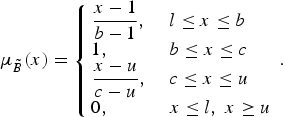 $${\rm \mu} _{\tilde{B}} \lpar x\rpar = \left\{{\matrix{ {\displaystyle{{x - 1} \over {b - 1}}\comma \; }\hfill & {l \le x \le b}\hfill \cr {1\comma \; }\hfill & {b \le x \le c}\hfill \cr {\displaystyle{{x - u} \over {c - u}}\comma \; } \hfill & {c \le x \le u}\hfill \cr {0\comma \; } \hfill & {x \le l\comma \; x \ge u}\hfill \cr }} \right..$$
Let  $\tilde{\rm \beta } = \lpar {\rm \beta} ^l \comma \;{\rm \beta} ^b \comma \; {\rm \beta}^c \comma \; {\rm \beta}^u \rpar $ are trapezoidal fuzzy coefficients. Obtain βl, βb, βc, and βu as follows:
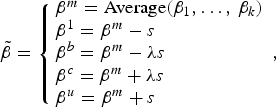 $$\tilde{\rm \beta } = \left\{\matrix{{\rm \beta} ^m = {\rm Average} \lpar {\rm \beta} _{1}\comma \ldots\comma \,{\rm \beta}_k \rpar \hfill \cr {\rm \beta}^{\rm 1} ={\rm \beta} ^m - s \hfill \cr {\rm \beta} ^b = {\rm \beta} ^m - {\rm \lambda} s \hfill \cr {\rm \beta} ^c ={\rm \beta} ^m + {\rm \lambda} s \hfill \cr {\rm \beta} ^u = {\rm \beta}^m + s \hfill} \right.\comma \;$$
where s is the standard deviation of (β1, . . . , βk), and λ is a positive constant 0 ≤ λ ≤ 1, chosen by an expert depending on experience about the repetitiveness of the proposed data. For instance, a large λ means that the expert has a poor opinion about their repetitiveness.
Step 3. Let  ${{\tilde{\rm \eta} _j }}\lpar {{\tilde{x}_q \rpar }}$ be the jth response value by substituting the optimal fuzzy factor levels of thr qth response. Calculate the
 ${{\tilde {\rm \eta} _j }}\lpar {{\tilde x_q \rpar }}$ for all
 ${{\tilde x_q }}$ values. Provide the “most desirable” response values for all response types using
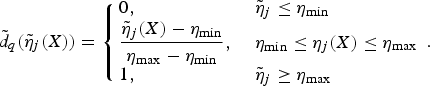 $${{\tilde{d}_q }}\lpar {{\tilde {\rm \eta} _j }}\lpar X\rpar \rpar = \left\{{\matrix{ {0\comma \; }\hfill & {{{\tilde {\rm \eta} _j }} \le {\rm \eta} _{\min }}\hfill \cr {\displaystyle{{{{\tilde {\rm \eta} _j }}\lpar X\rpar - {\rm \eta} _{\min }} \over {{\rm \eta}_{\max } - {\rm \eta} _{\min }}}\comma \; }\hfill & {{\rm \eta} _{\min } \le {\rm \eta} _j \lpar X\rpar \le {\rm \eta}_{\max }}\hfill \cr {1\comma \; }\hfill & {{{\tilde {\rm \eta} _j }} \ge {\rm \eta} _{\max }}\hfill \cr }} \right..$$
Let  ${{\tilde{U}_j }}$ and
 ${{\tilde{L}_j}}$ denote the upper and lower limits for the desirability functions, respectively. Calculate
 ${{\tilde{U}_j }}$ and
 ${{\tilde{L}_j }}$ as follows:
 $$\matrix{ {{{\tilde{U}_j }} = {{\tilde{d}_j }}\lpar {{\tilde {\rm \eta} _j }}\lpar {{\tilde X_j{*} }}\rpar \rpar }, & {\,j = 1\comma \; .\;.\;.\,\comma \; q} \cr }\comma \;$$
 $$\matrix{ {{{\tilde{L}_j }} = \min\lcub {{\tilde{d}_j }}\lpar {{\tilde {\rm \eta} _j }}\lpar {{\tilde X_j{*} }}\rpar \rpar \comma \; .\;.\;.\,\comma \; {{\tilde{d}_j }}\lpar {{\tilde {\rm \eta} _j }}\lpar {{\tilde X_j{*} }}\rpar \rpar \rcub \comma \; } & {j = 1\comma \; .\;.\;.\,\comma \; q} \cr }.$$
Step 4. Let D j(x) denotes the deviation function to be minimized then calculate theD j(x) using Eq. (9).
 $$\matrix{ {D_j \lpar x\rpar = \displaystyle{{{\rm\eta} _j^u \lpar x\rpar - {\rm\eta} _j^c \lpar x\rpar } \over {\lpar 1 - {\rm \lambda} {\rm \rpar }}}\comma \; } \hfill & {\,j = 1\comma \; .\;.\;.\,\comma \; q} \cr }.$$
Then, calculate the following:
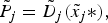 $$\tilde P_j = \tilde{D}_j \lpar \tilde x_j{*}\rpar \comma \;$$
 $$\tilde Q_j = {\rm Max}\lcub \tilde{D}_j \lpar \tilde x_1 \rpar \comma \ldots \comma \; \tilde{D}_j \lpar \tilde x_q \rpar \rcub \comma \; \, \, \, \, \, j = 1\comma \ldots \comma \; q.$$
Step 5. Formulate the final model as follows:
 $$\eqalign{& {\rm Max}\left\{{\tilde{d}_1 \lpar x\rpar \comma \; .\;.\;.\,\comma \; \tilde{d}_j \lpar x\rpar } \right\}\comma \; \, \, \, j=1\comma \; .\;.\;.\,\comma\; q\comma \; \cr & {\rm Min}\left\{{D_1 \lpar x\rpar \comma \; .\;.\;.\,\comma \; D_j \lpar x\rpar } \right\}\comma \; \, \, \, j=1\comma \; .\;.\;.\,\comma \; q.}$$
subject to x ∈ [factor levels].
Equation (12) is converted into a single objective by introducing two functions,  $\tilde S_j \lpar x\rpar $ and
 $\tilde{T}_j \lpar x\rpar $. Let
 $$\tilde{S}_j \lpar x\rpar = \lpar S_j^l \lpar x\rpar \comma \; S_j^b \lpar x\rpar \comma \; S_j^c \lpar x\rpar\comma\; S_j^u \lpar x\rpar \rpar$$
and
 $$\tilde{T}_j \lpar x\rpar = \lpar T_j^l \lpar x\rpar \comma \; T_j^b \lpar x\rpar \comma \; T_j^c \lpar x\rpar\comma \;T_j^u \lpar x\rpar \rpar \comma \;$$
where  $\tilde{S}_j \lpar x\rpar $ and
 $\tilde{T}_j \lpar x\rpar $ indicate the degrees of satisfaction from desirability and robustness, respectively. Then, estimate
 $\tilde{S}_j \lpar x\rpar $ and
 $\tilde{T}_j \lpar x\rpar $ as follows:
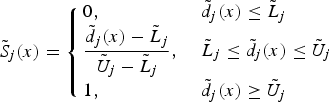 $$\tilde{S}_j \lpar x\rpar = \left\{\matrix{0\comma \; \hfill &\tilde{d}_j \lpar x\rpar \le \tilde{L}_j \hfill \cr \displaystyle{\tilde{d}_j \lpar x\rpar - \tilde{L}_j \over \tilde{U}_j - \tilde{L}_j}\comma \; \hfill &\tilde{L}_j \le \tilde{d}_j \lpar x\rpar \le \tilde{U}_j \hfill \cr 1\comma \; \hfill &\tilde{d}_j \lpar x\rpar \ge \tilde{U}_j \hfill} \right.$$
and
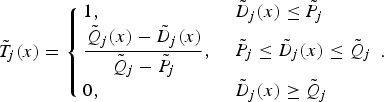 $$\tilde{T}_j \lpar x\rpar = \left\{\matrix{1\comma \; \hfill &\tilde{D}_j \lpar x\rpar \le \tilde{P}_j \hfill \cr \displaystyle{\tilde{Q}_j \lpar x\rpar - \tilde{D}_j \lpar x\rpar \over \tilde{Q}_j - \tilde{P}_j}\comma \; \hfill &\tilde{P}_j \le \tilde{D}_j \lpar x\rpar \le \tilde{Q}_j \hfill \cr 0\comma \; \hfill &\tilde{D}_j \lpar x\rpar \ge \tilde{Q}_j \hfill} \right..$$
Consequently, the objective is to maximize  $\tilde{S}_j \lpar x\rpar $ and
 $\tilde{T}_j \lpar x\rpar $. That is,
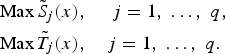 $$\eqalign{& \hbox{Max}\, \tilde{S}_j \lpar x\rpar \comma \; \quad j = 1\comma \; \ldots\comma \; q\comma \; \cr & \hbox{Max}\, \tilde{T}_j \lpar x\rpar \comma \quad j = 1\comma \; \ldots\comma \; q.}$$
subject to x ∈ [factor levels].
The Zimmerman Max–Min operator will be employed to convert the two-objective model to a single objective, which maximizes the minimum degree of satisfaction (Zimmermann, Reference Zimmermann1987). Let
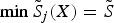 $$\min \tilde{S}_j \lpar X\rpar = \tilde{S}$$
and
 $$\min \tilde{T}_j \lpar X\rpar = \tilde{T}.$$
Then, the final model is expressed as
 $$\eqalign{&\max\, \tilde{S} \lpar X\rpar \comma \; \cr & \max\, \tilde{T} \lpar X\rpar \comma \hfill}$$
subject to
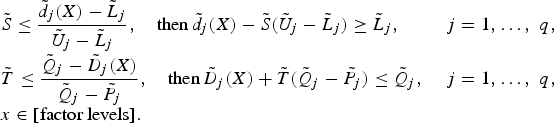 $$\matrix{\tilde{S} \le \displaystyle{\tilde{d}_j \lpar X\rpar - \tilde{L}_j \over \tilde{U}_j - \tilde{L}_j}\comma \quad \hbox{then}\, \tilde{d}_j \lpar X\rpar - \tilde{S} \lpar \tilde{U}_j - \tilde{L}_j\rpar \ge \tilde{L}_j\comma \; \hfill &j = 1\comma \ldots\comma \; q\comma \; \cr \tilde{T} \le \displaystyle{\tilde{Q}_j - \tilde{D}_j(X) \over \tilde{Q}_j - \tilde{P}_j}\comma \quad \hbox{then}\, \tilde{D}_j \lpar X\rpar + \tilde{T} \lpar \tilde{Q}_j - \tilde{P}_j\rpar \le \tilde{Q}_j\comma \; \hfill &j = 1\comma \ldots\comma \; q\comma \; \cr x \in \lsqb {\rm factor\, levels}\rsqb . \hfill &{}}$$
Finally, let w 1 and w 2 denote the important weights for desirability and robustness expressed by a decision maker based on cost, quality loss, and warranty. The final model with only one objective is transformed to
 $$\hbox{Max}\, w_1 \tilde{S} + w_2 \tilde{T}\comma$$
subject to
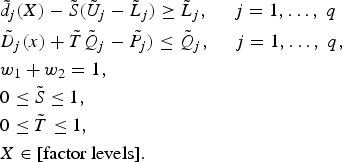 $$\eqalignno{&\tilde{d}_j \lpar X\rpar - \tilde{S} \lpar \tilde{U}_j - \tilde{L}_j\rpar \ge \tilde{L}_j\comma \; \quad j = 1\comma \ldots\comma \; q \cr & \tilde{D}_j \lpar x\rpar + \tilde{T} \tilde{Q}_j - \tilde{P}_j\rpar \le \tilde{Q}_j\comma \; \quad j = 1\comma \ldots\comma \; q\comma \; \cr& w_1 + w_2 = 1\comma \; \cr & 0 \le \tilde{S} \le 1\comma \; \cr & 0 \le \tilde{T} \le 1\comma \; \cr& X \in \lsqb \hbox{factor levels}\rsqb.}$$
Solve the models l, b, c, and m to determine the values of factor fuzzy levels.
3. ILLUSTRATIONS
Two real case studies, which were investigated in previous literature, are adopted for illustrating the proposed optimization approach as follows.
3.1. Optimizing the performance of sputtering process
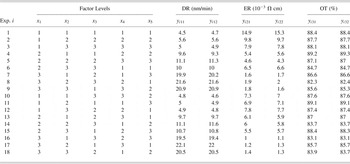
Chen et al. (Reference Chen, Tsao, Lin and Hsu2009) examined the sputtering process of GZO films using the Grey–Taguchi method. Five process factors were studied, including RF power, x 1; sputtering pressure, x 2; deposition time, x 3; substrate temperature, x 4; and postannealing temperature, x 5. The deposition rate (DR; nm/min, y 1, LTB), electrical resistivity (ER; 10−3 Ω cm, y 2, STB), and optical transmittance (OT; %, y 3, LTB) are the main responses. The L18 array was utilized in experimental work, and the results are shown in Table 1.
Experimental results for sputtering process

Note: DR, deposition rate; ER, electrical resistivity; OT, optical transmittance.
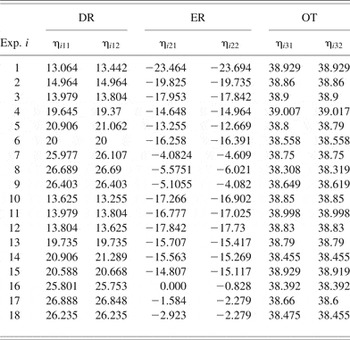
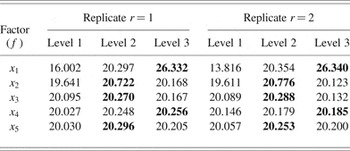
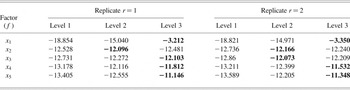
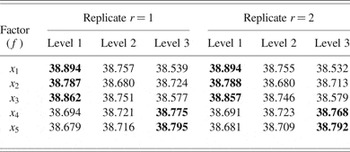
Step 1. Let ηi1r, ηi2r, and ηi3r denote the S/N ratio for the DR, ER, and OT responses at experiment i(i = 1, … , 18) with r (r = 1, 2) repetitions, respectively. The ηi1r, ηi2r and ηi3r are calculated for each repetition using the appropriate formula in Eq. (1). The obtained ηi1r, ηi2r and ηi3r are then summarized for both repetitions in Table 2. The  $\bar{{\rm\eta}}_{lfr}$ values in each response repetition are calculated for all factor levels then displayed in Tables 3 to 5 for the DR, ER, and OT responses, respectively.
The signal to noise ratios for the repetitions of the sputtering experiment

Note: DR, deposition rate; ER, electrical resistivity; OT, optical transmittance.
The optimal factor levels for the two repetitions of the deposition rate

The optimal factor levels for the first and second repetitions of the electrical resistivity

The optimal factor levels for the first and second repetitions of the optical transmittance

In Table 3, for DR the combination of optimal factor levels for the two repetitions are identified as  $x_{1_{\lpar 3\rpar }} x_{2_{\lpar 2\rpar }} x_{3_{\lpar 2\rpar }} x_{4_{\lpar 3\rpar }} x_{5_{\lpar 2\rpar }}$. In Table 4, the combination of optimal factor levels for the first and second repetitions of ER are respectively identified as
 $x_{1_{\lpar 3\rpar }} x_{2_{\lpar 2\rpar }} x_{3_{\lpar 3\rpar }}x_{4_{\lpar 3\rpar }} x_{5_{\lpar 3\rpar }}$ and
 $x_{1_{\lpar 3\rpar }}x_{2_{\lpar 2\rpar }} x_{3_{\lpar 2\rpar }} x_{4_{\lpar 3\rpar }} x_{5_{\lpar 3\rpar }}$, respectively. Finally, in Table 5 the combination of optimal factor levels is
 $x_{1_{\lpar 1\rpar }} x_{2_{\lpar 1\rpar }} x_{3_{\lpar 1\rpar }} x_{4_{\lpar 3\rpar }} x_{5_{\lpar 3\rpar }}$ for both OT repetitions. There is a conflict among the combinations that optimize the three responses concurrently. Moreover, there are two distinct combinations of optimal factor levels for ER repetitions. This shows the fuzziness effect on the ER response.
Step 2. The multiple linear regression equations for η11 and η12 are respectively written as
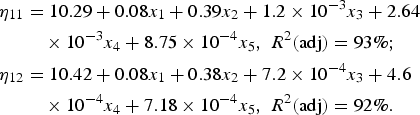 $$\eqalign{{\rm\eta}_{11} &= 10.29 + 0.08x_1 + 0.39x_2 + 1.2 \times 10^{-3} x_3 + 2.64 \cr &\quad \times 10^{-3} x_4 + 8.75 \times 10^{-4} x_5\comma \; R^2 \lpar \hbox{adj}\rpar = 93\percnt\semicolon \; \cr {\rm\eta}_{12} &= 10.42 + 0.08x_1 + 0.38x_2 + 7.2 \times 10^{-4} x_3 + 4.6 \cr &\quad \times 10^{-4} x_4 + 7.18 \times 10^{-4} x_5\comma \; R^2 \lpar \hbox{adj}\rpar = 92\percnt .}$$
whereas the multiple linear regression equations for η21 and η22 are respectively represented by
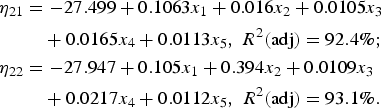 $$\eqalign{{\rm\eta}_{21} &= -27.499 + 0.1063x_1 + 0.016x_2 + 0.0105x_3 \cr &\quad + 0.0165x_4 + 0.0113x_5\comma \; R^2 \lpar \hbox{adj}\rpar = 92.4\percnt\semicolon \; \cr {\rm\eta}_{22} &= -27.947 + 0.105x_1 + 0.394x_2 + 0.0109x_3 \cr &\quad + 0.0217x_4+ 0.0112x_5\comma \; R^2 \lpar \hbox{adj}\rpar = 93.1\percnt .}$$
Finally, the multiple linear regression equations for η31 and η32 are respectively expressed as:
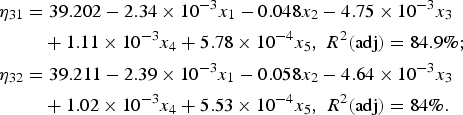 $$\eqalign{{\rm\eta}_{31} &= 39.202 - 2.34 \times 10^{-3} x_1 - 0.048x_2 - 4.75 \times 10^{-3} x_3 \cr &\quad + 1.11 \times 10^{-3} x_4 + 5.78 \times 10^{-4} x_5\comma \; R^{2} \lpar \hbox{adj}\rpar = 84.9\percnt \semicolon \; \cr {\rm\eta}_{32} &= 39.211 - 2.39 \times 10^{-3} x_1 - 0.058 x_2 - 4.64 \times 10^{-3} x_3 \cr &\quad + 1.02 \times 10^{-3} x_4 + 5.53 \times 10^{-4} x_5\comma \; R^{2} \lpar \hbox{adj}\rpar = 84\percnt .}$$
Using Eq. (5), the  $\tilde{\rm \beta} = \lpar {\rm\beta}^l\comma \; {\rm\beta}^b\comma \; {\rm\beta}^c\comma \; {\rm\beta}^u\rpar $ values are obtained. The trapezoidal fuzzy regression
 $\tilde{{\rm\eta}}_1\comma \; \tilde{{\rm\eta}}_2$, and
 $\tilde{{\rm\eta}}_3$ are then formulated for the three responses as follows:
 $$\eqalign{\tilde{{\rm\eta}}_1 &= \lpar 10.28\comma \; 10.31\comma \; 10.40\comma \; 10.44\rpar \cr &\quad + \lpar 0.08796\comma \; 0.0797\comma \; 0.0800\comma \; 0.08022\rpar \;x_1 \cr &\quad + \lpar 0.3709\comma \; 0.3772\comma \; 0.3897\comma \; 0.396\rpar \; x_2 \cr &\quad + \lpar 0.0006\comma \; 0.0008\comma \; 0.0011\comma \; 0.0013\rpar \; x_3 \cr &\quad + \lpar 0.00001\comma \; 0.0008\comma \; 0.0023\comma \; 0.0031\rpar \;x_4\cr &\quad + \lpar 0.0007\comma \; 0.00074\comma \; 0.00085\comma \; 0.0009\rpar \;x_5\comma \; \cr\tilde{{\rm\eta}}_2 &= \lpar\! -\!28.04\comma -\!27.88\comma -\!27.57\comma -\!27.41\rpar \cr &\quad + \lpar 0.1047\comma \; 0.1052\comma \; 0.1061\comma \; 0.1065\rpar \;x_1 \cr &\quad + \lpar\! -\!0.0622\comma \; 0.0713\comma \; 0.3383\comma \; 0.4718\rpar \; x_2 \cr &\quad + \lpar 0.0104\comma \; 0.0105\comma \; 0.0108\comma \; 0.0109\rpar \; x_3 \cr &\quad + \lpar 0.0154\comma \; 0.0172\comma \; 0.0209\comma \; 0.0227\rpar \; x_4 \cr &\quad + \lpar 0.0112\comma \; 0.01121\comma \; 0.0113\comma \; 0.01132\rpar \; x_5\comma \; }$$
and
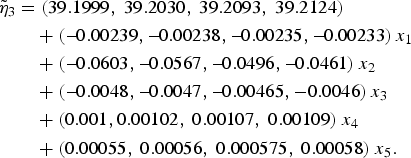 $$\eqalign{\tilde{{\rm\eta}}_3 &= \lpar 39.1999\comma \; 39.2030\comma \; 39.2093\comma \; 39.2124\rpar \cr &\quad + \lpar -\!0.00239\comma -\!0.00238\comma -\!0.00235\comma -\!0.00233\rpar \; x_{1} \cr &\quad + \lpar -\!0.0603\comma -\!0.0567\comma -\!0.0496\comma -\!0.0461\rpar \; x_{2} \cr &\quad + \lpar -\!0.0048\comma -\!0.0047\comma -\!0.00465\comma -0.0046\rpar \; x_{3} \cr &\quad + \lpar 0.001\comma 0.00102\comma \; 0.00107\comma \; 0.00109\rpar \; x_{4} \cr &\quad + \lpar 0.00055\comma \; 0.00056\comma \; 0.000575\comma \; 0.00058\rpar \; x_{5}.}$$
From Tables 3 to 5, the values of the combinations of optimal fuzzy factor levels for DR are given calculated as  $\tilde{x}_1 = \lpar 200\comma \; 200\comma \; 200\comma \; 200\rpar $,
 $\tilde{x}_2 = \lpar 0.67\comma \; 0.67\comma \; 0.67\comma \; 0.67\rpar $,
 $\tilde{x}_3 = \lpar 60\comma \; 60\comma \; 60\comma \; 60\rpar $,
 $\tilde{x}_4 = \lpar 100\comma \; 100\comma \; 100\comma \; 100\rpar $, and
 $\tilde{x}_5 = \lpar 100\comma \; 100\comma \; 100\comma \; 100\rpar $. The corresponding values of
 $\tilde{{\rm\eta}}_1$ are (26.5432, 26.7056, 27.0392, 27.2276). Similarly, for DR the values of the combinations of optimal fuzzy factor levels are
 $\tilde{x}_1 = \lpar 200\comma \; 200\comma \; 200\comma \; 200\rpar $,
 $\tilde{x}_2 = \lpar 0.67\comma 0.67\comma \; 0.67\comma \; 0.67\rpar $,
 $\tilde{x}_3 = \lpar 53.79\comma \; 64.39\comma \; 85.61\comma \; 96.21\rpar $,
 $\tilde{x}_4 = \lpar 100\comma \; 100\comma \; 100\comma \; 100\rpar $, and
 $\tilde{x}_5 = \lpar 200\comma \; 200\comma \; 200\comma \; 200\rpar $. The corresponding values of
 $\tilde{{\rm\eta}}_2$ are (−2.8021, −2.1555, −0.8434, −0.2114). Finally, the values of the combinations of optimal fuzzy factor levels for OT are
 $\tilde{x}_1^{\ast} = \lpar 50\comma \; 50\comma \; 50\comma \; 50\rpar $,
 $\tilde{x}_2 = \lpar 0.13\comma \; 0.13\comma \; 0.13\comma \; 0.13\rpar $,
 $\tilde{x}_3 = \lpar 30\comma \; 30\comma \; 30\comma \; 30\rpar $,
 $\tilde{x}_4 = \lpar 100\comma \; 100\comma \; 100\comma \; 100\rpar $,
 $\tilde{x}_5 =\lpar 200, 200\comma 200\comma \; 200\rpar $. The corresponding values of
 $\tilde{{\rm\eta}}_2^{\ast}$ are (39.1386, 39.1496, 39.1679, 39.1769).
Steps 3–4. Assume that the acceptable ranges of ηmin and ηmax for DR values are equal to (12, 12, 12) and (30, 30, 30), respectively. Similarly, the values of ηmin and ηmax for ER are (30, 30, 30) and (−24, −24, −24), respectively. Finally, the values of ηmin and ηmax for OT are determined as (38, 38, 38) and (40, 40, 40), respectively. The desirability function for each response is calculated using Eqs. (6) and (7), and the following values are determined:
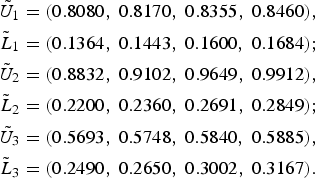 $$\eqalign{\tilde{U}_1 &= \lpar 0.8080\comma \; 0.8170\comma \; 0.8355\comma \; 0.8460\rpar \comma \; \cr \tilde{L}_1 &= \lpar 0.1364\comma \; 0.1443\comma \; 0.1600\comma \; 0.1684\rpar \semicolon \; \cr \tilde{U}_2 &= \lpar 0.8832\comma \; 0.9102\comma \; 0.9649\comma \; 0.9912\rpar \comma \; \cr \tilde{L}_2 &= \lpar 0.2200\comma \; 0.2360\comma \; 0.2691\comma \; 0.2849\rpar \semicolon \; \cr \tilde{U}_3 &= \lpar 0.5693\comma \; 0.5748\comma \; 0.5840\comma \; 0.5885\rpar \comma \; \cr \tilde{L}_3 &= \lpar 0.2490\comma \; 0.2650\comma \; 0.3002\comma \; 0.3167\rpar .}$$
Next, the fuzzy deviation functions for DR, ER, and OT are expressed respectively as
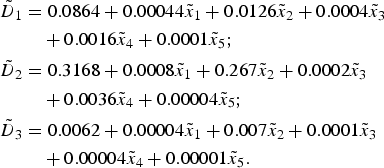 $$\eqalign{\tilde D_1 =\;& 0.0864 + 0.00044\tilde x_1 + 0.0126\tilde x_2 + 0.0004\tilde x_3 \cr \quad & \!\!+ 0.0016\tilde x_4 + 0.0001\tilde x_5\semicolon \; \cr \tilde D_2 =\;& 0.3168 + 0.0008\tilde x_1 + 0.267\tilde x_2 + 0.0002\tilde x_3 \cr \quad & \!\!+ 0.0036\tilde x_4 + 0.00004\tilde x_5\semicolon \; \cr \tilde D_3 = \;&0.0062 + 0.00004\tilde x_1 + 0.007\tilde x_2 + 0.0001\tilde x_3 \cr & \!\!+ 0.00004\tilde x_4 + 0.00001\tilde x_5.}$$
Using Eqs. (10) and (11), the  $\tilde P_j $ and
 $\tilde Q_j $ values are calculated and found, respectively, equal to
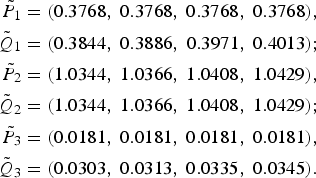 $$\eqalign{\tilde P_1 & = \lpar 0.3768\comma \; 0.3768\comma \; 0.3768\comma \; 0.3768\rpar \comma \; \cr \tilde Q_1 & = \lpar 0.3844\comma \; 0.3886\comma \; 0.3971\comma \; 0.4013\rpar \semicolon \; \cr \tilde P_2 & = \lpar 1.0344\comma \; 1.0366\comma \; 1.0408\comma \; 1.0429\rpar\comma \cr \tilde Q_2 & = \lpar 1.0344\comma \; 1.0366\comma \; 1.0408\comma \; 1.0429\rpar \semicolon \; \cr \tilde P_3 & = \lpar 0.0181\comma \; 0.0181\comma \; 0.0181\comma \; 0.0181\rpar \comma \; \cr \tilde Q_3 & = \lpar 0.0303\comma \; 0.0313\comma \; 0.0335\comma \; 0.0345\rpar .}$$
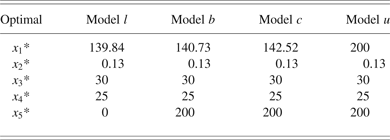
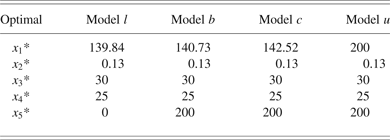
Step 5. By applying the Zimmerman Max–Min operator, the final model is categorized to four models: l, b, c, and u. Table 6 displays the obtained results. For illustration, models b and c are formulated as follows:
Model b
 $${\rm Max} \, \, \, 0.5 \times S^b + 0.5 \times T^b\comma$$
subject to
 $$\!\eqalign{&{-} 0.09384 + 0.00443x_1^b + 0.021x_2^b + 4.44 \times 10^{ - 5} x_3^b\cr & + 4.44 \times 10^{ - 5} x_4^b + 4.11 \times 10^{ - 5} x_5^b - 0.6727S^b \ge 0.1443\comma \; \cr &{-} 0.16173 + 0.00438x_1^b - 0.00297x_2^b - 4.375 \times 10^{ - 4} x_3^b\cr & + 7.7 \times 10^{ - 4} x_4^b + 4.67 \times 10^{ - 4} x_5^b - 0.6742S^b \ge 0.236\comma \; \cr & 0.6015 - 0.00119x_1^b - 0.0284x_2^b - 0.00235x_3^b \cr & + 0.00051x_4^b + 2.8 \times 10^{ - 4} x_5^b - 0.3098S^b \ge 0.2650\comma \; \cr & 0.0863 + 0.00044x_1^b + 0.126x_2^b + 0.0004x_3^b\cr & + 0.0016x_4^b + 0.0001x_5^b + 0.0118T^b \le 0.3886\comma \; \cr & 0.3168 + 0.0008x_1^b + 0.267x_2^b + 0.0002x_3^b \cr &+ 0.0036x_4^b + 0.00004x_5^b + 0T^b \le 1.0366\comma \; \cr & 0.0062 + 0.00004x_1^b + 0.007x_2^b + 0.0001x_3^b \cr &+ 0.00004x_4^b + 0.00001x_5^b + 0.0132T^b \le 0.0313\comma \; \cr & w_1 + w_2 = 1\comma \; \cr & 0 \le S^b\comma \; T^b \le 1\comma \; \cr & X = \lcub x_1^b \comma \; x_2^b \comma \; x_3^b \comma \; x_4^b \comma \; x_5^b \rcub \in \lsqb \hbox{factor levels}\rsqb .}\fleqno$$
Model c
 $${\rm Max}\, \, \, 0.5 \times S^c + 0.5 \times T^c\comma$$
subject to
 $$\eqalign{&-\! 0.0867 + 0.00045x_1^c + 0.022x_2^c + 7.22 \times 10^{ - 5} x_3^c + 1.72 \cr & \times 10^{ - 4} x_4^c + 5 \times 10^{ - 5} x_5^c - 0.6776S^c \ge 0.1684\comma \; \cr & -\! 0.1419 + 0.0044x_1^c + 0.0197x_2^c + 4.5 \times 10^{ - 4} x_3^c + 9.46 \cr & \times 10^{ - 4} x_4^c + 4.71 \times 10^{ - 4} x_5^c - 0.7063S^c \ge 0.2849\comma \; \cr & 0.6062 - 0.00117x_1^c - 0.0231x_2^c - 0.0023x_3^c + 5.45 \cr & \times 10^{ - 4} x_4^c + 2.9 \times 10^{ - 4} x_5^c - 0.2718S^c \ge 0.3167\comma \; \cr & 0.0864 + 0.00044x_1^c + 0.126x_2^c + 0.0004x_3^c + 0.00016x_4^c \cr & + 0.0001x_5^c + 0.0245T^c \le 0.4013\comma \; \cr & 0.3168 + 0.0008x_1^c + 0.267x_2^c + 0.0002x_3^c + 0.0036x_4^c \cr & + 0.00004x_5^c + 0T^c \le 1.0429\comma \; \cr & 0.0062 + 0.00004_1^c + 0.0071x_2^c + 0.0001x_3^c + 0.00004x_4^c \cr & + 0.00001x_5^c + 0.0164T^c \le 0.0345\comma \; \cr & w_1 + w_2 = 1\comma \; \cr & 0 \le S^c\comma \; T^c \le 1\comma \; \cr & X = \lcub x_1^c \comma \; x_2^c \comma \; x_3^c \comma \; x_4^c \comma \; x_5^c\rcub \in \lsqb \hbox{factor levels}\rsqb .}$$
The values of DR, ER, and OT (dB) at the optimal fuzzy factors levels given in Table 7 are calculated and found equal to (11.84, 12.26, 12.75, 21.94), (1.39, 2.91, 3.19, 4.32), and (86.48, 86.55, 87.67, 87.80), respectively. It is found that the trapezoidal membership function increases the flexibility of the fuzzy models by providing ranges of optimal solution. There are wide ranges between the lower and maximal DR and ER values, whereas a tight range is noted for OT. Excluding the fuzziness will result in misleading response values if the problem is solved by the traditional regression technique. Thus, by considering each response repetition separately, the inherent variability in the collected data is minimized.
The optimal factor levels for the sputtering process
Experimental data for wire electrical discharge machining process

Note: MMR, material removal rate; SR, surface roughness.
*The second replicate in this case is generated for illustration.
3.2. Optimization of Inconel on machining of the computer numerical control wire electrical discharge machining process
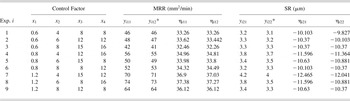
This case study (Ramakrishnan & Karunamoorthy, Reference Ramakrishnan and Karunamoorthy2008) aims at optimizing Inconel 718 on machining of the computer numerical control wire electrical discharge machining process. Four process factors were tested using the L9 array, including pulse in time, x 1; delay time, x 2; wire feed speed, x 3; and ignition current, x 4. Two responses are of main interest, involving material removal rate (MRR; mm2/min, y 1, LTB) and surface roughness (SR; μm, y 2, STB) of the wire electrical discharge machining process. Table 8 summarizes the experimental results.
The averages of signal to noise ratios for both repetitions of MRR and SR

Note: MMR, material removal rate; SR, surface roughness.
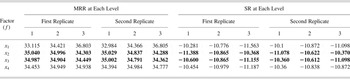
Steps 1–2. Let ηi1r and ηi2r denote the S/N ratio for MRR and SR, respectively, at experiment i; i = 1, … , 9, for the rth repetitions; r = 1, 2. The obtained and ηi1r and ηi2r for each repetition are also summarized in Table 7. Then, the  $\bar {\rm\eta}_{lfr}$ values are calculated for each response for both repetitions and the results are displayed in Table 9. In Table 9, for MRR the combination of optimal factor levels is identified as x 1(3)x 2(1)x 3(1)x 4(2) for both repetitions. Similarly, in Table 7 the combination of optimal factor levels for SR is identified as x 1(1)x 2(3)x 3(1)x 4(1) for both repetitions. It is noticed that there is a conflict among the combinations that optimize the two responses concurrently.
The optimal factor levels for wire electrical discharge machining process
Further, the multiple linear regression equations for η11 and η12 of MRR are respectively written as
 $$\eqalign{ {\rm\eta} _{11} &= 30.7153 + 6.12x_1 - 0.18435x_2 - 0.0738x_3 \cr & \quad + 0.06063x_4 \comma \; R^2 {\rm adj} = 96.1\percnt \semicolon }$$
 $$\eqalign{{\rm\eta} _{12} &= 30.8143 + 6.3296x_1 - 0.18523x_2 - 0.08945x_3 \cr & \quad + 0.04778x_4 \comma \; R^2 {\rm adj} = 96.3\percnt . }$$
while the multiple linear regression equations η21 and η22 of SR are respectively expressed by
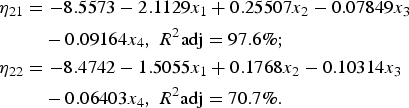 $$\eqalign{{\rm\eta} _{21} &= - 8.5573 - 2.1129x_1 + 0.25507x_2 - 0.07849x_3 \cr & \quad - 0.09164x_4 \comma \; R^2 {\rm adj} = 97.6\percnt \semicolon \cr {\rm\eta} _{22} &= - 8.4742 - 1.5055x_1 + 0.1768x_2 - 0.10314x_3 \cr & \quad - 0.06403x_4 \comma \; R^2 {\rm adj} = 70.7\percnt .}$$
Furthermore, the trapezoidal fuzzy regression and  $\tilde {\rm\eta} _1$ and
 $\tilde {\rm\eta} _2$ of MRR and SR are obtained for and expressed, respectively, as
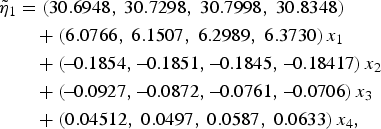 $$\eqalign{\tilde {\rm\eta} _1 &= \lpar 30.6948\comma \; 30.7298\comma \; 30.7998\comma \; 30.8348\rpar \cr & \quad + \lpar 6.0766\comma \; 6.1507\comma \; 6.2989\comma \; 6.3730\rpar \,x_1 \cr & \quad + \lpar \!-\! 0.1854\comma -\! 0.1851\comma -\! 0.1845\comma - \!0.18417\rpar\, x_2 \cr & \quad + \lpar \! -\! 0.0927\comma -\! 0.0872\comma - \!0.0761\comma -\! 0.0706\rpar\, x_3 \cr & \quad + \lpar 0.04512\comma \; 0.0497\comma \; 0.0587\comma \; 0.0633\rpar\, x_4 \comma }$$
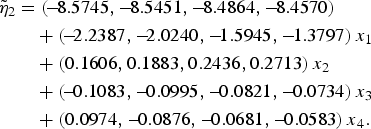 $$\eqalign{ \tilde {\rm\eta}_2 &= \lpar \!-\! 8.5745\comma - \!8.5451\comma -\! 8.4864\comma - \!8.4570\rpar \cr & \quad+ \lpar\! -\! 2.2387\comma -\! 2.0240\comma -\! 1.5945\comma -\! 1.3797\rpar \; x_1 \cr & \quad+ \lpar 0.1606\comma 0.1883\comma 0.2436\comma 0.2713\rpar \; x_2 \cr & \quad+ \lpar \!- \!0.1083\comma -\! 0.0995\comma - \!0.0821\comma -\! 0.0734\rpar \; x_3 \cr & \quad+ \lpar 0.0974\comma - \!0.0876\comma -\! 0.0681\comma - \!0.0583\rpar \; x_4 .}$$
Based on the combination of optimal factor levels, the optimal fuzzy factor levels for MMR response are  $\tilde x_1$ = (1.2, 1.2, 1.2, 1.2),
 $\tilde x_2$ = (4, 4, 4, 4),
 $\tilde x_3$ = (8, 8, 8, 8), and
 $\tilde x_4$ = (16, 16, 16, 16). While the optimal fuzzy factor levels for SR response are
 $\tilde x_1$ = (0.6, 0.6, 0.6, 0.6),
 $\tilde x_2$ = (8, 8, 8, 8),
 $\tilde x_3$ = (8, 8, 8, 8), and
 $\tilde x_4$ = (8, 8, 8, 8). The values of the trapezoidal fuzzy responses
 $\tilde {\rm\eta} _1$ and
 $\tilde {\rm\eta}_2$ at these levels are (37.2267, 37.4678, 37.9509, 38.1936) and (−10.2785, −9.7499, −8.6959, −8.1680), respectively.
Steps 3–4. Let ηmin = (30,30,30) and ηmax be the minimum and maximum acceptable ranges for the MRR response, whereas the acceptable ranges of ηmin and ηmax for SR response are (−13, −13, −13) and (−7, −7, −7), respectively. The  $\tilde U_j$ and
 $\tilde L_j$ for MRR are
 $\tilde U_j$ = (0.72, 0.75, 0.80, 0.82) and
 $\tilde L_7$ = (0.25, 0.26, 0.3, 0.31), whereas for SR the
 $\tilde U_2$ and
 $\tilde L_2$ are calculated as (0.46, 0.54, 0.72, 0.81) and (0.0, 0.10, 0.23, 0.41), respectively. Let λ = 0.5, then the fuzzy deviation functions for MRR and SR are respectively expressed as
 $$\tilde D_1 \lpar x\rpar = 0.07 + 0.1482\tilde x_1 + 0.0006\tilde x_2 + 0.011\tilde x_3 + 0.0092\tilde x_4$$
and
 $$\tilde D_2 \lpar x\rpar = 0.0588 + 0.4296\tilde x_1 + 0.0554\tilde x_2 + 0.0174\tilde x_3 + 0.0196\tilde x_4 .$$
Then, the  $\tilde P_j$ and
 $\tilde Q_j$ values for MRR are found equal to
 $$\eqalign{\tilde P_1 &= \lpar 0.4854\comma \; 0.4854\comma \; 0.4854\comma \; 0.4854\rpar \comma \; \cr \tilde Q_1 &= \lpar 0.4854\comma \; 0.4854\comma \; 0.4854\comma \; 0.4854\rpar}$$
whereas for SR the obtained  $\tilde P_j$ and
 $\tilde Q_j$ values are
 $$\eqalign{\tilde P_2 &= \lpar 1.0558\comma \; 1.0558\comma \; 1.0558\comma \; 1.0558\rpar \comma \; \cr \tilde Q_2 & = \lpar 1.2487\comma \; 1.2487\comma \; 1.2487\comma \; 1.2487\rpar .}$$
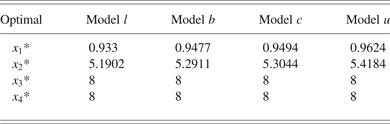
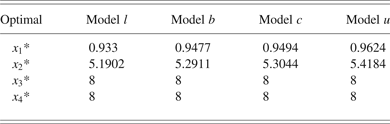
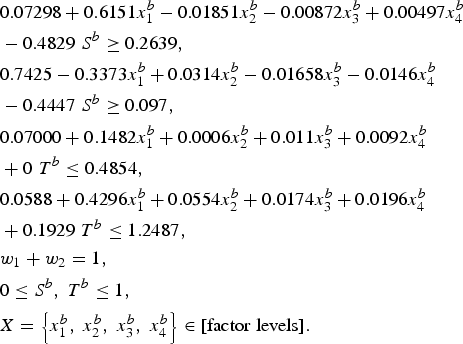
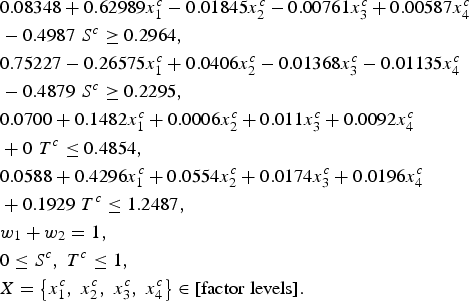
Step 5. The final model is constructed by applying the Zimmerman Max–Min operator. The final models l, b, c, and u are constructed then solved. Table 9 displays the values of the optimal factor levels for each response.
For example, models b and c are constructed as follows:
Model b
 $$\eqalign{&{\rm Max}\, \, \, \, \, \, 0.5 \times S^b+0.5 \times T^b \comma}$$
subject to
 $$\eqalign{& 0.07298+0.6151x_1^b - 0.01851x_2^b - 0.00872x_3^b+0.00497x_4^b \cr & - 0.4829\, \, S^b \geq 0.2639 \comma \cr & 0.7425 - 0.3373x_1^b+0.0314x_2^b - 0.01658x_3^b - 0.0146x_4^b \cr &- 0.4447\, \, S^b \geq 0.097\comma \cr & 0.07000+0.1482x_1^b+0.0006x_2^b+0.011x_3^b+0.0092x_4^b \cr & +0\, \, T^b\leq 0.4854 \comma \cr & 0.0588+0.4296x_1^b+0.0554x_2^b+0.0174x_3^b+0.0196x_4^b\cr & +0.1929\, \, T^b \leq 1.2487\comma \cr & w_1+w_2=1 \comma \cr & 0 \leq S^b\comma \; T^b \leq 1 \comma \cr & X=\left\{{x_1^b\comma \; x_2^b\comma \; x_3^b\comma \; x_4^b } \right\}\in \lsqb {\rm factor\ levels}\rsqb . }$$
Model c
 $$\eqalign{&{\rm Max}\, \, \, 0.5 \times S^c+0.5 \times T^c \comma }$$
subject to
 $$\eqalign{ & 0.08348+0.62989x_1^c - 0.01845x_2^c - 0.00761x_3^c+0.00587x_4^c \cr & -0.4987\, \, S^c \geq 0.2964 \comma \cr& 0.75227 - 0.26575x_1^c+0.0406x_2^c - 0.01368x_3^c - 0.01135x_4^c \cr & - 0.4879\, \, S^c \geq 0.2295\comma \cr & 0.0700+0.1482x_1^c+0.0006x_2^c+0.011x_3^c+0.0092x_4^c \cr &+0\, \, T^c \leq 0.4854\comma \cr & 0.0588+0.4296x_1^c+0.0554x_2^c+0.0174x_3^c+0.0196x_4^c \cr & +0.1929\, \, T^c \leq 1.2487 \comma \cr & w_1+w_2=1 \comma \cr & 0 \leq S^c\comma \; T^c \leq 1 \comma \cr & X=\left\{{x_1^c\comma \; x_2^c\comma \; x_3^c\comma \; x_4^c } \right\}\in \lsqb {\rm factor\ levels}\rsqb .}$$
Substituting the values of the optimal factor levels obtained for models l, b, c, and u, the results (dB) of optimal MRR and SR,  $\tilde {\rm\eta} _1^{\ast}$ and
 $\tilde {\rm \eta} _2^{\ast}$ are (35.0220, 35.2953, 35.6621, 35.9117) and (–11.4753, –10.9637, –9.9097, –9.3684), respectively. The optimal fuzzy responses
 $\tilde y_1^{\ast}$ and
 $\tilde y_2^{\ast}$ are calculated as (56.3767, 58.1788, 60.6884, 62.4576) and (2.9405, 3.1296, 3.533, 3.7477), respectively. The results show the efficiency of the proposed approach in dealing with fuzziness and inherent variability in the collected data. Notice that the optimal MRR value ranges between 56.3767 and 62.4576, whereas the optimal value of SR ranges between 2.9405 and 3.7477. Ignoring the variability in response values between repetitions will lead to incorrect optimal factor settings.
4. CONCLUSIONS
This research proposed an optimization approach using desirability function and fuzzy regression to deal with fuzzy multiple responses. Two case studies from previous literature are employed for illustration. Compared to traditional optimization techniques, such as grey relational analysis, the Taguchi method, data envelopment analysis, was found to successfully deal with inherent variability and fuzziness in multiple responses by providing ranges for optimal solution in contrast with traditional optimization techniques; to provide valuable information regarding the expected improvement amount in each response due to changing factor levels; to consider fuzzy process factor levels rather than crisp settings, thereby allows flexibility in changing factor levels that may be affected during operation by uncontrollable factors; and finally, to utilize fuzzy multiple regression and desirability functions to minimize deviation and obtain desirable response values. Therefore, it considers preferences in response values. In conclusion, this approach shall provide valuable help to process/product engineers to obtain optimal process performance under the existence of fuzziness and inherent variability.
Abbas Al-Refaie is an Associate Professor in the Department of Industrial Engineering at the University of Jordan. He has published numerous articles in international journals. Dr. Al-Refaie has also participated in several international conferences. His research interests include quality engineering, optimization, data envelopment analysis, and robust design.