INTRODUCTION
I am shocked by the events of the past few days. I am stunned that misconduct on such a scale was possible in the Volkswagen Group. As CEO, I accept responsibility for the irregularities. I am doing this in the interest of the company, even though I was not aware of any wrongdoing on my part.
–Former Volkswagen AG CEO Martin Winterkorn's resignation statement after emissions misconduct in March 2015
In recent years, many firms around the world have been involved in various cases of misconduct. For example, the American International Group in the US committed financial fraud in 2004; Sanlu in China was found to have allowed melamine in infant formula in 2008; Volkswagen in Germany admitted that it manipulated its emissions data in 2015; and JBS in Brazil was reported to have used rotten meat for food in 2017. Top executives at these firms were deeply stigmatized, even though some, such as Martin Winterkorn at Volkswagen, denied any wrongdoing. Being stigmatized by any face-value association with misconduct is referred to as courtesy stigma (Goffman, Reference Goffman1963; Semadeni, Cannella, Fraser, & Lee, Reference Semadeni, Cannella, Fraser and Lee2008). Courtesy stigma jeopardizes the career development of these executives, especially when they try to get hired at a new firm, because potential employers might show negative emotions toward executives related to a firm accused of misconduct or fear having that stigma transferred to them (Cowen & Marcel, Reference Cowen and Marcel2011; Wiesenfeld, Wurthmann, & Hambrick, Reference Wiesenfeld, Wurthmann and Hambrick2008).
Courtesy stigma can have critical consequences for organizations and individuals, such as discrimination, prejudice, and illegitimacy, so scholars in sociology and management have focused on the issue of stigma mitigation (Hudson & Okhuysen, Reference Hudson and Okhuysen2009; Kulik, Bainbridge, & Cregan, Reference Kulik, Bainbridge and Cregan2008; Pescosolido & Martin, Reference Pescosolido and Martin2015; Wiesenfeld et al., Reference Wiesenfeld, Wurthmann and Hambrick2008). A management research stream has started to investigate the mitigation mechanism for courtesy stigma from the perspective of social networks (Kulik et al., Reference Kulik, Bainbridge and Cregan2008; Schepker & Barker, Reference Schepker and Barker2018; Wiesenfeld et al., Reference Wiesenfeld, Wurthmann and Hambrick2008). This research stream has emphasized the bright side of social networks in mitigating courtesy stigma for executives. It has been argued that executives at firms accused of misconduct have close ties to members of the press, regulatory officials, and corporate leaders at other firms; therefore, they can gain trust from, and exchange favors with, others to mitigate the courtesy stigma effect because those with whom they share these social ties are reluctant to view the executives at firms charged with misconduct as inept, careless, or self-serving, thus helping to mitigate the effect of courtesy stigma.
Even though this research stream frames the mitigation mechanism for courtesy stigma from an interactive and relational perspective, knowledge about the role of a social network in courtesy stigma mitigation is still limited. In particular, a social network can serve as a particular information pipe between individuals as network nodes to shape the information that can be accessed (Burt, Reference Burt1992; Paruchuri, Reference Paruchuri2010; Podolny, Reference Podolny2001; Zaheer, Gözübüyük, & Milanov, Reference Zaheer, Gözübüyük and Milanov2010). This function is relevant to courtesy stigma because it is characterized by information exchange concerning the ongoing elements of misconduct, including rumors and gossip (Kulik et al., Reference Kulik, Bainbridge and Cregan2008; Sutton & Callahan, Reference Sutton and Callahan1987). Zhang, Wang, Toubiana, and Greenwood (Reference Zhang, Wang, Toubiana and Greenwood2021) have suggested that one key way for individuals to manage stigma is information management tactics and called for more efforts to study this issue. Although social networks and courtesy stigma are interrelated and interdependent in terms of information access, the question of how the social networks of executives at firms accused of misconduct shape information pipes to remedy or neutralize courtesy stigma is largely underexplored. Hence, we know little about whether such social networks with different structures consistently mitigate courtesy stigma from the information pipe perspective or about whether these functions have a dark side.
Information regarding any ongoing misconduct, such as how it occurred and who should take responsibility, affects external audiences’ judgment about the executives. Executives may withhold critical information about the misconduct from external audiences (Elsbach & Sutton, Reference Elsbach and Sutton1992; Sutton & Callahan, Reference Sutton and Callahan1987). The ability of an external audience to access information from different sources or different executives might shape its interpretation of an incident of misconduct when they judge the executives. From this perspective, we divide the social network of the executive with an external audience into two different types of social ties: open-loop ties and closed-loop ties. An open-loop tie is an executive's social tie with an external node if the node has no network path to connect with other executives at the same firm. The open-loop tie of an executive provides a single source of information about the incident of misconduct, thus giving the executive an informational advantage based on the ability to spin information about the misconduct. In contrast, a closed-loop tie is a social tie of an executive with an external node if the node has at least one network path to connect with other executives at the same firm, so the external node can have multiple sources of information from multiple executives. This external node tends to have access to diverse information, reducing the executive's informational advantage about the misconduct. Hence, the external nodes for the two types of social ties differ in their information access function; they lead to differences in the external perception and judgment about any executives at firms facing charges of misconduct.
Our goal is to explore whether and how open-loop and closed-loop ties shape access to information so as to either insulate or expose the negative effect of courtesy stigma on these executives to be hired by a new firm. In terms of social networks, we focus on interlock networks, which connect top corporate leaders at different firms, including top executives and board directors (Markóczy, Sun, Peng, Shi, & Ren, Reference Markóczy, Sun, Peng, Shi and Ren2013). Interlock ties are relevant to courtesy stigma mitigation because they consist of high-ranking corporate leaders at other firms, representing potential employers, who are responsible for dismissing or hiring executives from firms accused of misconduct (Cowen & Marcel, Reference Cowen and Marcel2011). Furthermore, interlock networks are critical channels for information flow regarding the misconduct because they are part of the same network and might focus on these events (Paxton & Moody, Reference Paxton and Moody2003). To gauge the effect of courtesy stigma on executives’ future careers, we focus on the individual-level likelihood that the executives will be hired or appointed at a new firm after a firm-level incident of misconduct. In other words, after a firm is charged with misconduct, the applications of its executives to join new firms may be rejected because the employers may show negative emotion toward them or fear a stigma transfer (Cowen & Marcel, Reference Cowen and Marcel2011; Wiesenfeld et al., Reference Wiesenfeld, Wurthmann and Hambrick2008).
We contribute to the current literature in two major areas. First, we contribute to the literature on stigma mitigation by raising doubt about the prevailing perspective that social networks tend to mitigate courtesy stigma by reducing the negative link between firm-level misconduct and individual-level career development (Kulik et al., Reference Kulik, Bainbridge and Cregan2008; Wiesenfeld et al., Reference Wiesenfeld, Wurthmann and Hambrick2008). The extant research stream has focused on the bright side of social networks, underestimating their dark side in the context of courtesy stigma mitigation. By adopting the information pipe perspective, we complement the extant research by theoretically and empirically revealing the complex, often conflicting effects of social networks, given their different types with different functions, on courtesy stigma mitigation.
Second, we contribute to the theory on structural holes. The theory on structural holes argues that an individual as a broker bridging two disconnected others has an informational advantage over the other two (Burt, Reference Burt1992; Zaheer & Bell, Reference Zaheer and Bell2005). In our research setting, we propose that structural holes may not be the only way to provide individuals with an informational advantage. Hence, we enrich the research stream on structural holes by identifying a new source of informational advantage in the context of courtesy stigma mitigation.
THEORETICAL BACKGROUND AND HYPOTHESES DEVELOPMENT
Executives’ Career after Firm-Level Misconduct: A Courtesy Stigma Process
Stigma, broadly defined, is anything that detrimentally segregates individuals (Devers, Dewett, Mishina, & Belsito, Reference Devers, Dewett, Mishina and Belsito2009; Goffman, Reference Goffman1963; Kurzban & Leary, Reference Kurzban and Leary2001; Link & Phelan, Reference Link and Phelan2001). Courtesy stigma is known as stigma by association or event stigma. Courtesy stigma is not triggered by the distinctive behaviors or qualities of individuals but by an association from an external audience between individuals and negative events, such as misconduct, bankruptcy, performance decline, and lawsuits (Hamori, Reference Hamori2007; McKinley, Ponemon, & Schick, Reference McKinley, Ponemon and Schick1996; Semadeni et al., Reference Semadeni, Cannella, Fraser and Lee2008). Hence, if a firm commits a certain type of misconduct, its executives might suffer from the negative effect of courtesy stigma, such as negative reactions (e.g., rejection) by potential employers.
Although executives at firms facing charges of misconduct might anticipate rejection and exclusion, these effects are actualized only when these executives experience specific rejection and exclusion in social interactions, especially when applying for new jobs (Pescosolido & Martin, Reference Pescosolido and Martin2015). In this situation, the severity of firm-level misconduct jeopardizes the opportunities of a firm's executives to be hired at a new firm because the new firm's corporate leaders, who represent the employer at the hiring firm, make the decision to hire or reject these executives largely based on their current firm's misconduct (Wiesenfeld et al., Reference Wiesenfeld, Wurthmann and Hambrick2008). Furthermore, moral and ethical standards may have been deeply entrenched in the minds of hiring employers. When they perceive that the executives might have transgressed or violated those standards by being associated with severe misconduct, they might treat the executives in a punitive and even vindictive manner, such as rejecting their job applications (Cowen & Marcel, Reference Cowen and Marcel2011; Tetlock, Reference Tetlock2002). Finally, corporate leaders at the hiring firm might have negative emotions toward executives at firms accused of severe misconduct, including outrage, anger, hatred, and a sense of inappropriateness (Cooper, Doucet, & Pratt, Reference Cooper, Doucet and Pratt2007). These emotions have a negative impact on the judgment of the hiring corporate leaders about the reputation, capability, and ethics of executives associated with firms facing charges of misconduct, thus harming the odds of an offer of employment to those executives.
Several empirical studies offer some support for these arguments (Arthaud-Day, Certo, Dalton, & Dalton, Reference Arthaud-Day, Certo, Dalton and Dalton2006; Fee & Hadlock, Reference Fee and Hadlock2004; Gilson, Reference Gilson1990; Hamori, Reference Hamori2007; Kaplan & Reishus, Reference Kaplan and Reishus1990). Hamori (Reference Hamori2007) found that because of courtesy stigma, negative events at a firm impair employees’ future careers when they move to other employers. Hence, we propose our baseline hypothesis as follows.
Hypothesis 1: The severity of a firm's misconduct is negatively related to the likelihood of its top executives being hired at a new firm.
Mitigating Courtesy Stigma by Providing Information
Goffman (Reference Goffman1963) originally noted that stigmatization can be enacted or mitigated only through social interaction with an external audience. After a firm commits misconduct, its top executives will try to mitigate or avoid courtesy stigma by providing positive information about themselves to external audiences, especially to corporate leaders at other firms who might be potential new employers (Elsbach & Sutton, Reference Elsbach and Sutton1992; Sutton & Callahan, Reference Sutton and Callahan1987). For example, after misconduct by their firm, executives can explain to a potential new employer that, even though that firm committed misconduct, it was facing unusual conditions, so the misconduct was accidental, rather than an inherent problem. They might also explain that external audiences have a general misunderstanding of the nature or cause of the misconduct. Moreover, an executive can offer information to an external audience by acknowledging the occurrence of the misconduct while denying direct responsibility for it. For example, after the emissions misconduct by Volkswagen, the CEO, Martin Winterkorn, claimed in his resignation statement that he was ‘not aware of any wrongdoing on my part’. Executives might not only deny responsibility for the misconduct but also find scapegoats or point a finger at their colleagues. Again, Winterkorn attributed the wrongdoing to ‘the terrible mistakes of a few people’, but not to himself.
Information exchange and social interaction between the executives at firms facing charges of misconduct and the corporate leaders of other firms that might be their new employers are essential for courtesy stigma mitigation (Goffman, Reference Goffman1963; Pescosolido & Martin, Reference Pescosolido and Martin2015). Zhang et al. (Reference Zhang, Wang, Toubiana and Greenwood2021) have suggested that one key way for individuals to manage stigma is information management tactics, referring to actors who manage the information they share or disclose about their stigmatized attribute. However, we know little about how social networks function as information pipes shape which nodes of information are available for external audiences to access, thus affecting their specific judgments about the executives (Podolny, Reference Podolny2001). For example, current studies focus exclusively on social networks’ positive side in terms of mitigating courtesy stigma (Kulik et al., Reference Kulik, Bainbridge and Cregan2008; Wiesenfeld et al., Reference Wiesenfeld, Wurthmann and Hambrick2008), often at the expense of the negative side. In this sense, we need to determine whether social networks with different structures consistently mitigate courtesy stigma and whether there is any negative side, taking the information pipe perspective.
Social Networks and Courtesy Stigma Mitigation: An Information Pipe Perspective
The information pipe perspective suggests that social networks are channels or conduits through which information flows, including information about exchange opportunities, goods, services, and resources (Podolny, Reference Podolny2001). Researchers have employed the information pipe perspective to study various management and strategy issues, ranging from firm opportunity recognition (Ma, Huang, & Shenkar, Reference Ma, Huang and Shenkar2011) and innovation (Owen-Smith & Powell, Reference Owen-Smith and Powell2004; Paruchuri, Reference Paruchuri2010) to executives’ career development (Seibert, Kraimer, & Liden, Reference Seibert, Kraimer and Liden2001). Seibert et al. (Reference Seibert, Kraimer and Liden2001) argued that executive’ social ties with top executives at other firms can be evoked to provide information, thus boosting their career prospects.
Information exchange within the interlock networks between executives at firms accused of misconduct and corporate leaders at other firms is relevant to courtesy stigma. When a firm commits misconduct, its executives may spread favorable information about themselves through interlock networks to protect their career opportunities (Sutton & Callahan, Reference Sutton and Callahan1987). Interlock networks consist of corporate leaders from diverse firms, who might be the executives’ potential new employers. The information affects the judgment of potential new employers about the executives in terms of questions such as the following: Should this executive take responsibility for the misconduct? Did this executive violate the rules on purpose? Answers to these questions trigger courtesy stigma concerning the executives at firms charged with misconduct. In addition, corporate leaders at other firms can decide whether they will engage in future economic exchange with the executives, such as rejecting job applications from them (Wiesenfeld et al., Reference Wiesenfeld, Wurthmann and Hambrick2008). Hence, how corporate leaders at other firms, as potential new employers, interpret the information from executives at firms accused of misconduct affects the perception and judgment of courtesy stigma.
Two Types of Information Pipes
Given the critical effect of information disclosed about executives’ roles in a case of ongoing misconduct, they have the discretion to disclose different information about the misconduct to potential new employers; some conceal the information, some deny responsibility, some point fingers at others, and some accept responsibility (Sutton & Callahan, Reference Sutton and Callahan1987). Whether these potential new employers can access information from multiple executives at firms charged with misconduct affects how they perceive and judge the misconduct, thus affecting their judgment of the executives applying for jobs. From this perspective, we divide executives’ interlock ties into two types: (1) open-loop ties and (2) closed-loop ties.
An open-loop tie is an executive's social tie with an external node if the node has no network path to connect with other executives at the same firm accused of misconduct. The open-loop tie of executives provides a single source of information about the misconduct, thus often giving the executives an informational advantage because these executives can put a positive spin on the information about the misconduct. In contrast, a closed-loop tie is the social tie of an executive with an external node if the node has at least one network path to connect with other executives at the same firm accused of misconduct, so the external node can have multiple sources of information from multiple executives. This node can access diverse information, reducing the executive's informational advantage about the misconduct. Hence, the external nodes for the two types of social ties differ in their information access functions, so they shape the differences in external perception and judgment about any concerned executives at firms charged with misconduct.
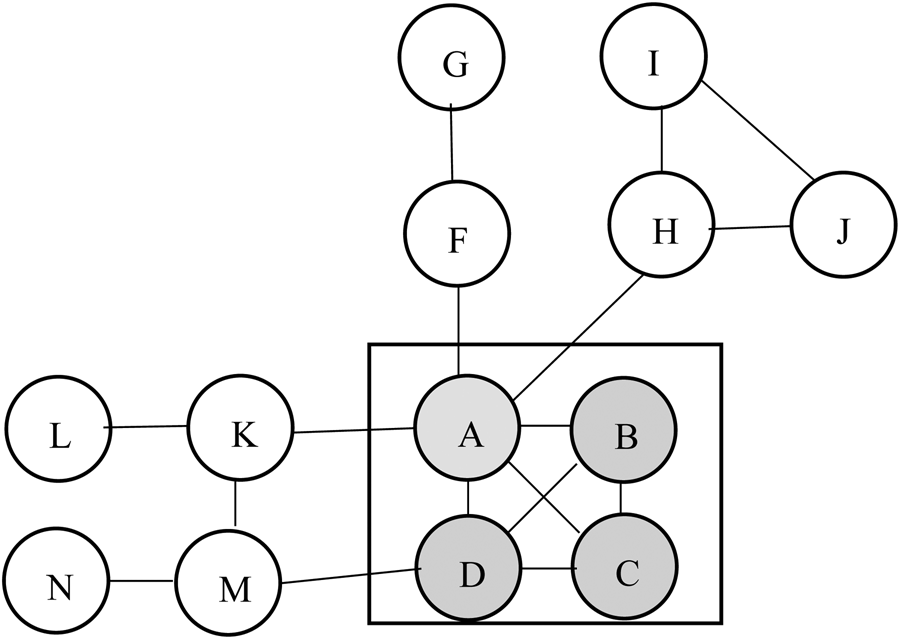
As Figure 1 shows, A, B, C, and D represent executives at a firm accused of misconduct, and all are connected to one another; the others represent corporate leaders at other firms or their potential new employers. We use A as an example to show an open-loop tie and a closed-loop tie. The focal executive A has three external direct ties with corporate leaders at other firms, A–F, A–H, and A–K. A–F and A–H are the only ties that connect F and H with A's firm, so F and H have only one information source. These two ties are A's open-loop ties. Furthermore, corporate leaders at other firms connected with A's open-loop ties, such as G, I, and J, have only one source of information about the misconduct. In contrast, K has more than one tie with A's firm, so K has more than one information source, thus being A's closed-loop tie. Corporate leaders at other firms connected with A's closed-loop tie, such as L, K, M, and N, have multiple (two in this example) information sources about the misconduct. In summary, in this case, A has two open-loop ties, but only one closed-loop tie.
Open-loop ties and closed-loop ties of executives in firms accused of misconduct Note: A has three external ties, A–F, A–H, and A–K. A–F and A–H are A's open-loop ties, and A–K is A's closed-loop tie.

A's potential new employers connected with A's open-loop ties (i.e., F, G, H, I, and L) have only one information source and thus only one side of the story from A, so A has an informational advantage over F, G, H, I, and L about the misconduct. A's potential new employers with open-loop ties can only judge A's role in the misconduct based upon A's version of events. In contrast, A's potential new employers with closed-loop ties (i.e., K, L, M, and N) can have two versions of events: one from A and the other from D, who also knows about the misconduct. Because D may offer information to M about the misconduct, A's potential new employers with closed-loop ties have a relatively equal informational advantage about the misconduct. Hence, potential new employers with A's closed-loop ties can judge A's role in the misconduct based upon multiple versions of events. In summary, open-loop ties generate an informational advantage for executives about the misconduct but closed-loop ties do not have such advantages.
Open-Loop Ties and Courtesy Stigma Mitigation: Insulation Mechanism
The primary negative effect of courtesy stigma is that executives at firms accused of misconduct can be perceived and judged as responsible for it by corporate leaders at other firms. Those corporate leaders at other firms are the executives’ potential new employers, so the careers of the executives at firms charged with misconduct can be negatively affected (Goffman, Reference Goffman1963; Semadeni et al., Reference Semadeni, Cannella, Fraser and Lee2008; Wiesenfeld et al., Reference Wiesenfeld, Wurthmann and Hambrick2008). Executive A's open-loop ties can mitigate the effect of courtesy stigma because A can insulate himself from the misconduct by only disclosing favorable information about himself to his potential new employers. First, because A's potential new employers (i.e., F, G, H, I, and J) linked with open-loop ties can obtain information about the misconduct only from A, the positive information from A about himself might insulate or shelter A from courtesy stigma because A has the informational advantage of open-loop ties (Sutton & Callahan, Reference Sutton and Callahan1987).
Second, A might deny any responsibility for the misconduct by pointing a finger at executives B, C, and D at the same firm (Sutton & Callahan, Reference Sutton and Callahan1987). For example, in responding to the emissions misconduct at Volkswagen, Winterkorn denied any wrongdoing on his part but attributed wrongdoing to ‘the terrible mistakes of a few people’ other than himself. A's explanation about the misconduct may weaken the potential new employers’ negative emotional reaction to the misconduct, such as outrage, anger, hatred, and assessments of inappropriateness, from those connected with A in open-loop ties (Cooper et al., Reference Cooper, Doucet and Pratt2007). Again, for lack of any further information, A's potential new employers with open-loop ties (i.e., F, G, H, J, and I) have no other information sources to confirm whether A is lying, so A can effectively protect himself from their negative judgment. In summary, because open-loop ties can provide focal executives with an informational advantage over potential employers about misconduct, the more open-loop ties they have to disclose only positive information about themselves and only negative information about other executives at the same firm, the more likely they are to insulate themselves from courtesy stigma.
Hypothesis 2: In the event of firm-level misconduct, the firm executives’ open-loop ties can mitigate the negative effect of courtesy stigma on their careers. In other words, executives’ open-loop ties will attenuate the negative link between the severity of firm misconduct and the likelihood of being hired by a new firm.
Closed-Loop Ties and Courtesy Stigma: Exposure Mechanism
A's closed-loop ties amplify the courtesy stigma effect for executives at firms accused of misconduct because A's potential new employers with closed-loop ties can more easily expose A to courtesy stigma. Because A's potential new employers with closed-loop ties have multiple information sources, his informational advantages over K, L, M, and N are neutralized. Figure 1 shows that A's potential new employers with closed-loop ties (i.e., K, L, M, and N) can access information pertaining to the misconduct from both A and D, so they may have more complete and accurate information about the misconduct, such as how the misconduct happened and who should take most of the responsibility for it, thus more likely exposing A to courtesy stigma.
First, A might argue to his potential employers (K, L, M, and N) that the misconduct was a one-time inadvertent event, not an inherent problem, whereas D might admit to A's potential employers (K, L, M, and N) that the firm committed the misconduct on purpose and that it would be difficult to address the problem (Sutton & Callahan, Reference Sutton and Callahan1987). A's potential employers might obtain inconsistent information about the misconduct from A and D. This information inconsistency might lead A's potential employers with closed-loop ties to conclude that A is lying about the misconduct or withholding negative information. This conclusion will impair trust and trigger negative emotions from potential employers with closed-loop ties that amplify the negative effect of courtesy stigma for A.
Second, to protect his reputation and career from being affected by the misconduct, A might also accuse D of being responsible for it or spread rumors about D to A's potential employers (K, L, M, and N). D might do the same, accusing A or spreading rumors about A to A's potential employers (K, L, M, and N). As a result, A's potential employers with closed-loop ties might obtain both positive and negative information about A. The asymmetry between positive and negative information suggests that negative information tends to have a larger impact on the perception and judgment of an external audience than does positive information simply because bad information has a greater effect than good information (Baumeister, Bratslavsky, Finkenauer, & Vohs, Reference Baumeister, Bratslavsky, Finkenauer and Vohs2001; Gable & Haidt, Reference Gable and Haidt2005; Peeters & Czapinski, Reference Peeters and Czapinski1990; Taylor, Reference Taylor1991). Baumeister et al. (Reference Baumeister, Bratslavsky, Finkenauer and Vohs2001) found that information about negative things is often processed more thoroughly than information about positive things. Skowronski and Carlston (Reference Skowronski and Carlston1992) found that the effect of morally positive behavior on the impression one conveys is easily overridden by new information about immoral behavior. Yzerbyt and Leyens (Reference Yzerbyt and Leyens1991) found that negative information leads to quick exclusionary judgment. Some researchers have studied the conditions of the positive-negative information asymmetry effect, including culture, gender, and nationality (Singapore and China), and their findings still mainly support this effect (Crisp & Hewstone, Reference Crisp and Hewstone2001). Hence, based upon the asymmetry effect, we argue that negative information about A from D will have a stronger effect on the judgment of A's potential employers with closed-loop ties than will positive information from A. In summary, the more closed-loop ties an executive has, the more likely A's potential employers are to associate the executive with the misconduct because of informational inconsistency, so the stronger the courtesy stigma effect will be.
Hypothesis 3: In the event of firm-level misconduct, the firm executives’ closed-loop ties can strengthen the negative effect of courtesy stigma on their careers. In other words, executives’ closed-loop ties amplify the negative link between the severity of misconduct and the likelihood of being hired at a new firm.
METHODS
To test our theory, we used Chinese listed firms that were subject to China Securities Regulatory Commission (CSRC) enforcement actions from 2008 to 2016. The CSRC, which is similar to the Securities and Exchange Commission (SEC) in the US, was established in 1998 to monitor and regulate the capital markets, including the Shanghai Stock Exchange and the Shenzhen Stock Exchange. The CSRC is responsible for developing regulations, regulating and overseeing financial activities, and levying sanctions to protect investor interests. Thus, the CSRC plays an oversight role in improving corporate governance by ensuring that accurate corporate information is conveyed to the market on a timely basis. The CSRC also actively promotes governance principles by monitoring listed firms.
CSRC punishment of financial misconduct by a listed firm generates stigmatization and serious negative consequences for firms and top executives as well. First, prior research has found that when firms have restatement events stemming from financial misconduct, such as accounting fraud, the reputation and image of the firms’ top executives are damaged and their careers are jeopardized (Arthaud-Day et al., Reference Arthaud-Day, Certo, Dalton and Dalton2006; Cowen & Marcel, Reference Cowen and Marcel2011). Second, punishment by the CSRC affects the price of stock for the misbehaving firm and sometimes even leads to dismissal of the CEO and CFO, enabling the CSRC to establish its credibility and show it's not a ‘toothless tiger’ (Yiu, Xu, & Wan, Reference Yiu, Xu and Wan2014). For instance, in 2001, the CSRC punished Yin Guang Xia for engaging in fraud, including inflating its profit and overstating its assets. Its CFO and CEO were dismissed, and their reputation and image were damaged and stigmatized.
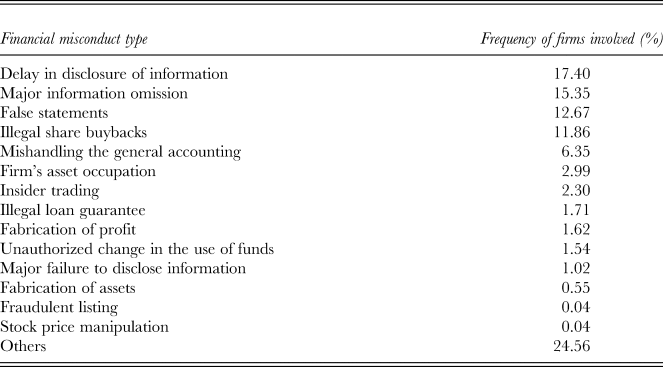
We collected data on Chinese firms that committed financial misconduct from the China Stock Market and Accounting Research (CSMAR) and financial performance data from WIND, which are widely used databases on publicly listed firms in China (Bao, Zhao, Tian, & Li, Reference Bao, Zhao, Tian and Li2019; Jiang, Cannella, Xia, & Semadeni, Reference Jiang, Cannella, Xia and Semadeni2017; Yiu et al., Reference Yiu, Xu and Wan2014).[Footnote 1] Table 1 provides detailed information about firm financial misconduct in our dataset. In some cases of firm financial misconduct, executives were singled out by the CSRC for punishment. The negative effect on those executives’ careers might be not due to courtesy stigma but, rather, personal penalties by the CSRC. Therefore, we excluded those executives. After eliminating missing values, we obtained a total dataset of 891 firms that committed financial misconduct (about 9% of all listed firms in China) and 5,090 executive-year observations. Those executives include CEOs, general managers, vice presidents, general secretaries, department managers (CFOs, COOs, and so on), and assistant department managers of these firms. The executives are responsible for firm decisions and are more likely to suffer courtesy stigma.
Firm financial misconduct description

Notes: One CSRC punishment could be put on more than one type of financial misconduct type. The category of ‘Others’ includes: no informing the authority before selling or buying major assets, tax evasion and tax fraud, illegally managing bad debt, false hiring, and others.
Measures
Executives hired at a new firm
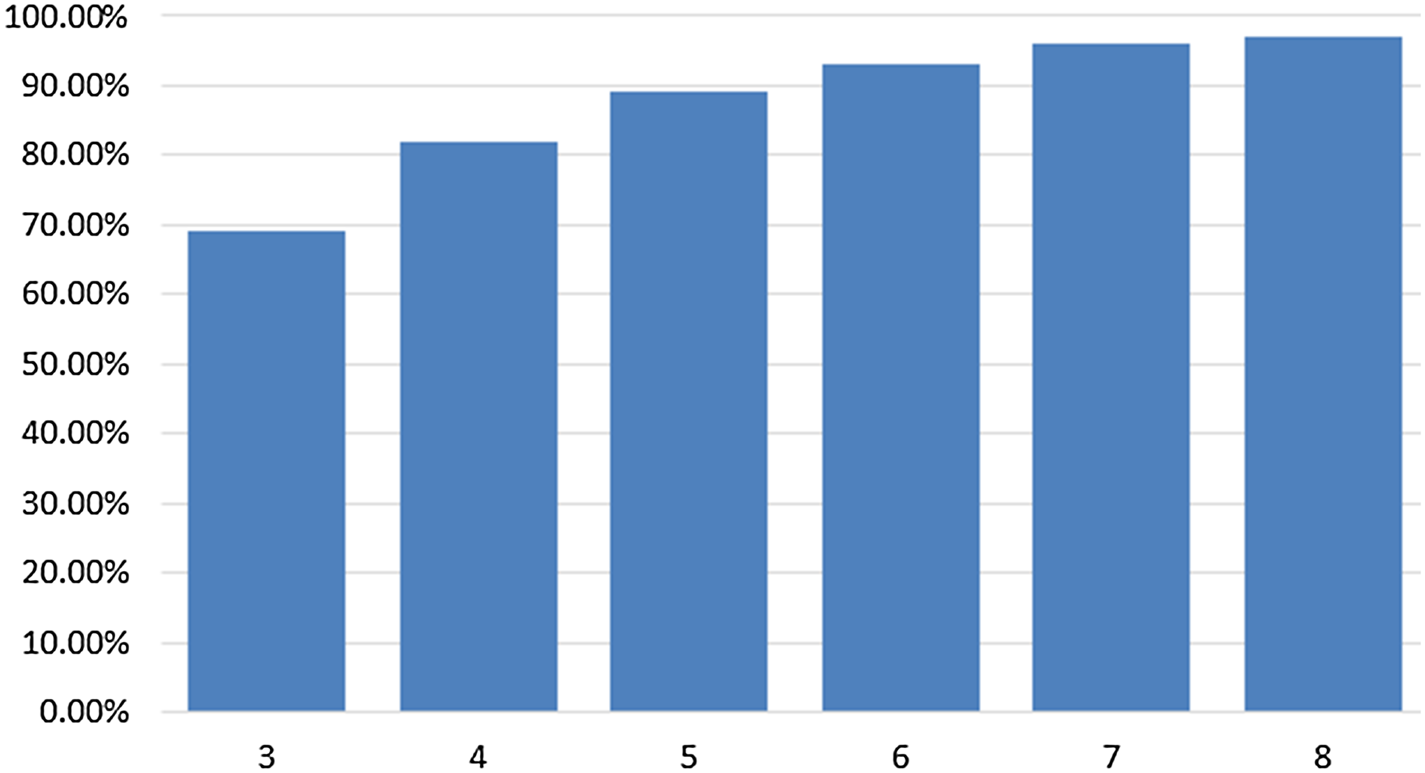
To capture the hiring of executives by a new firm after their firms were penalized by the CSRC for engaging in financial misconduct, we followed an approach inspired by prior research (Cowen & Marcel, Reference Cowen and Marcel2011; Jiang et al., Reference Jiang, Cannella, Xia and Semadeni2017). If a firm is penalized by the CSRC in year t, we tracked whether its executives were hired at a new firm at the end of years t+1, t+2, or t+3. If the executive is hired at a new firm, we assign a value of 1. To ensure that we have a three-year observation window for executive hiring at new firms, we ended the data on firm financial misconduct in 2014 and executive hiring at new firms in 2017. For example, firm A was punished by the CSRC in 2009, and one of its executives worked at the misbehaving firm in 2009. Afterward, the executive worked at firm A in 2010 and 2011 and at firm B in 2012. The executive hiring at the new firm equals 1 and the duration is 3. All time-variant predictor variables below are lagged by one year (Xiao & Tsui, Reference Xiao and Tsui2007). Figure 2 shows the cumulated distribution of executives being hired by a new firm after their firms being punished by the CSRC.
Cumulated distribution of executives being hired by a new firm after their firms being punished by the CSRC

Severity of financial misconduct
Wiesenfeld et al. (Reference Wiesenfeld, Wurthmann and Hambrick2008) suggested that the measurement of the magnitude of stigmatization should take authority settlements into account. To gauge the severity of financial misconduct, we used CSRC fines (Bao, Tian, & Li, Reference Bao, Tian and Li2018). Firms that commit financial misconduct, in some sense, are criminals that violated laws for the purpose of illegal economic benefit. The different levels of CSRC fines represent different levels of severity in financial misconduct. To correct the highly skewed nature of the CSRC fines on firms that had committed financial misconduct, we measured this variable using the logged value (Beckman, Haunschild, & Phillips, Reference Beckman, Haunschild and Phillips2004).
Network construction
To calculate the number of executives’ closed-loop ties and open-loop ties after firms were penalized by the CSRC for being involved in financial misconduct, we first constructed a global interlock network among all corporate leaders of Chinese listed firms for each year, including executives and board directors. If two top corporate leaders worked at the same firm, they had a connection or an interlock tie (Markóczy et al., Reference Markóczy, Sun, Peng, Shi and Ren2013; Shipilov, Greve, & Rowley, Reference Shipilov, Greve and Rowley2010; Tian, Caleb, Xiang, Li, & Pan, Reference Tian, Caleb, Xiang, Li and Pan2021a).
Based on the global network and open- and closed-loop tie definitions, we calculated the number of executives’ closed-loop ties and open-loop ties. Specifically, we employed a three-year window to calculate the executives’ social networks because when an incident of misconduct occurred, the information transfer between the executives and corporate leaders at other firms should be based on social ties that were established years ago.
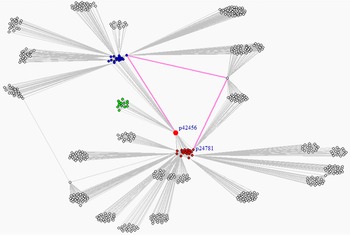
Figure 3 shows the open-loop ties and closed-loop ties of an executive coded as P42456 in a firm that committed financial misconduct. Each circle represents an executive. Red circles represent executives at the same firm as P42456. Green circles represent corporate leaders at other firms who have connections with executive P42456 but have a limited number of ties and thus cannot connect with the colleagues of P42456, meaning that they are P42456's open-loop ties. Blue circles represent corporate leaders who have connections with the colleagues of P42456, meaning that they are P42456's closed-loop ties. The red line represents the path of one of P42456's closed-loop ties.
Open-loop ties and closed-loop ties in our sample

Control Variables
Several control variables were included to account for factors other than the severity of firm financial misconduct and social networks that may influence the hiring of executives by new firms. First, the gender bias perspective suggests that gender bias arises from, and gives rise to, the distribution of men and women into social roles and that males and females are treated differently based on audience perception (Brands & Kilduff, Reference Brands and Kilduff2013; Cumming, Leung, & Rui, Reference Cumming, Leung and Rui2015; Eagly & Steffen, Reference Eagly and Steffen1984; Zhang & Qu, Reference Zhang and Qu2016). The new firm may treat job applications from male and female executives differently. Therefore, we controlled for executives’ gender (male = 0, female = 1). Second, to measure the market value of the executives, we used the executives’ salary from the firm accused of misconduct, using the logged value. Third, executives’ capability, knowledge, skill, and human capital affect the likelihood of being appointed at a new firm, and learning experience can help executives to acquire these resources (Cowen & Marcel, Reference Cowen and Marcel2011). Therefore, we controlled for three factors that can affect their career development: executives’ age, overseas experience (if executives worked in foreign countries, overseas experience = 1; otherwise, overseas experience = 0), and academic experience (if executives worked at academic institutions, such as universities and research centers, academic experience = 1; otherwise, academic experience = 0) (Maurer, Reference Maurer2001; Peltonen, Reference Peltonen1998; Sallop & Kirby, Reference Sallop and Kirby2007). Also, to control for executives’ social capital, social status, and informational advantage, we controlled for executives’ interlock network degree centrality, eigenvector centrality, and structural hole (Jiang et al., Reference Jiang, Cannella, Xia and Semadeni2017; Markóczy et al., Reference Markóczy, Sun, Peng, Shi and Ren2013; Xiao & Tsui, Reference Xiao and Tsui2007). Fourth, the firm charged with misconduct might attract attention from a new firm, and attention paid to firms accused of misconduct might affect the courtesy stigma process (McDonnell & King, Reference McDonnell and King2013). Therefore, we controlled for characteristics of the firm accused of misconduct that represent attention, including firm size, top management size, board size, institutional share rate, state share rate, board share rate, firm performance, media attention, and analyst attention (Seibert, Crant, & Kraimer, Reference Seibert, Crant and Kraimer1999; Semadeni et al., Reference Semadeni, Cannella, Fraser and Lee2008). Firm size is measured by the logged value of total assets (Beckman et al., Reference Beckman, Haunschild and Phillips2004; Thornhill & Amit, Reference Thornhill and Amit2003). Firm performance is measured by the return on assets (Harris & Bromiley, Reference Harris and Bromiley2007; Marquis & Bird, Reference Marquis and Bird2018). Media attention is measured by the logged number of news reports by newspapers, and analyst attention is measured by the logged number of analyst reports by the financial brokerage house that targets the firm (Chen, Cumming, Hou, & Lee, Reference Chen, Cumming, Hou and Lee2016). Finally, we also control for the external environment of the firm accused of financial misconduct. Industry membership can systematically affect executives’ appointments at a new firm. To address problems from unobserved heterogeneity, we generated industry dummy variables for each firm facing charges of misconduct and added them to our models. Similarly, we also generated and added a series of year dummies.
Analytical Method
One way to model whether executives will be hired at a new firm after their firms are punished by the CSRC for committing financial misconduct is ordinary least squares (OLS) or logistic regression. OLS and logistic regression cannot deal with right-censored cases (Staw & Hoang, Reference Staw and Hoang1995). Because the observation window is three years, no hire at a new firm may be observed during the observation window (or right-censored). Event history analysis (EHA) can address this problem by modeling the likelihood that an event is observed at time t because no event happened before time t (Staw & Hoang, Reference Staw and Hoang1995; Yu & Cannella, Reference Yu and Cannella2007).
Given the advantages of EHA, we used continuous-time EHA to model the likelihood of executives’ hire at a new firm after their firms were punished for committing financial misconduct. The Cox proportional hazard regression model can be shown in the following equation (Cox, Reference Cox1972; Katila & Shane, Reference Katila and Shane2005; Ozmel & Guler, Reference Ozmel and Guler2015):

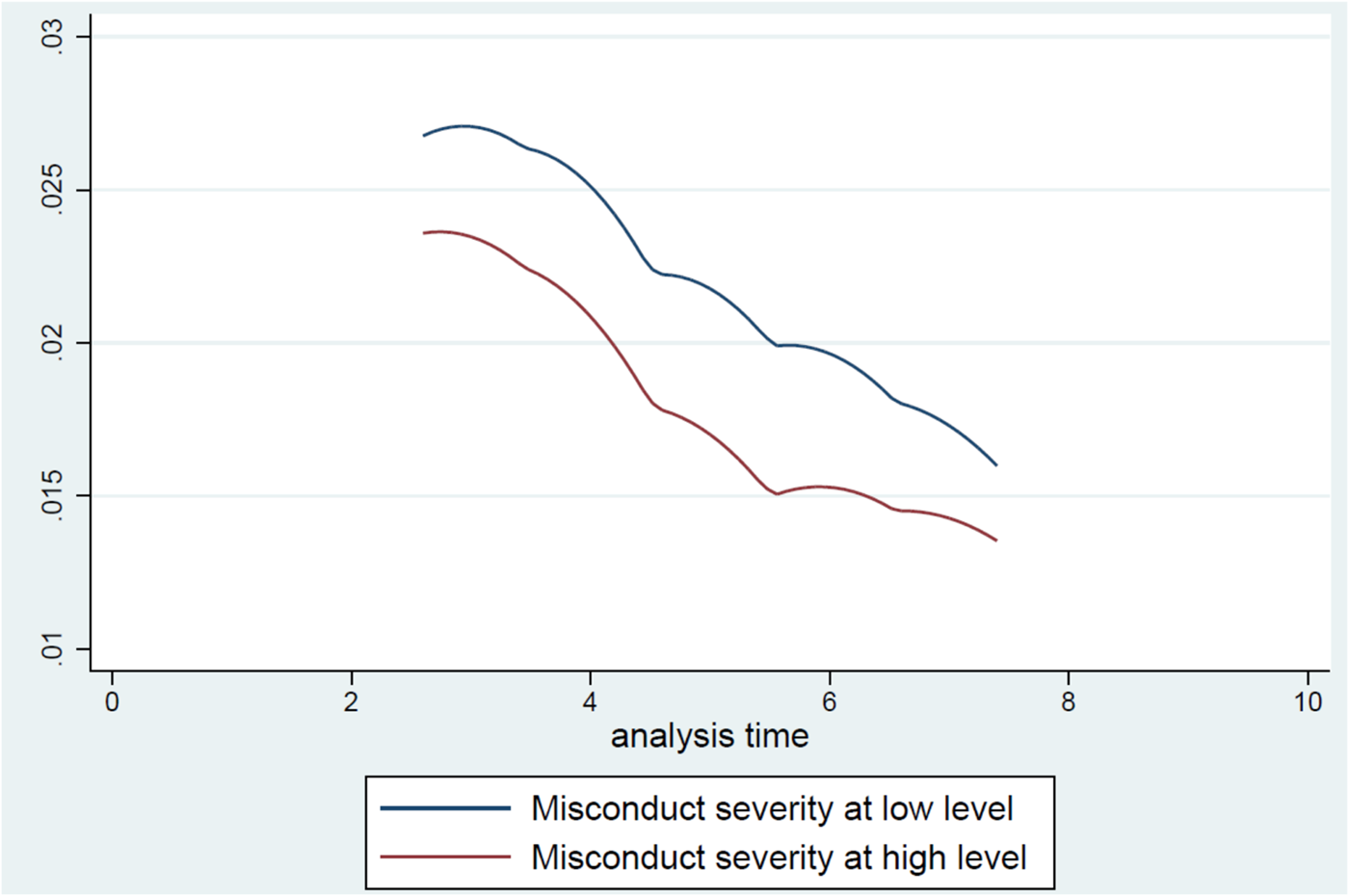
where h 0(t) is the baseline hazard function, and X ik(t) is the value of the kth covariate (independent variable) for executive i at time t, when the firm is penalized by the CSRC for engaging in financial misconduct. Figure 4 shows the hazard function for executives in firms with low and high misconduct severity based upon our data.
Hazard function for executives in firms committing financial misconducts

Addressing Reverse Causality and Autocorrelation
Endogeneity is a major concern in empirical research, especially reverse causality (Castellucci & Ertug, Reference Castellucci and Ertug2010; Chizema, Liu, Lu, & Gao, Reference Chizema, Liu, Lu and Gao2015; Luo, Wang, Raithel, & Zheng, Reference Luo, Wang, Raithel and Zheng2015; Xiao & Tsui, Reference Xiao and Tsui2007). Reverse causality bias occurs when the variance in X gives rise to the variance in Y; we can also raise arguments in which the direction is from Y to X (Paruchuri, Reference Paruchuri2010; Xiao & Tsui, Reference Xiao and Tsui2007). Reverse causality may not be a concern in our research. The executives’ hiring at a new firm is lagged three years from time the financial misconduct is committed, and the network is constructed three years before the financial misconduct occurs. This approach can mitigate the risk of reverse causality bias (Xiao & Tsui, Reference Xiao and Tsui2007).
We considered two types of model dependence in which observations are not independent: time and firm (Marquis & Qian, Reference Marquis and Qian2013). First, because we used data from 2005 to 2017, executives in the same year may have similar external environments, such as government policies, industry dynamics, and even global competition. Hence, executives in the same year may be dependent. Second, firm dependence emerges because executives are at the same firms, and one closed-loop tie may connect at least two executives. To control for these two types of autocorrelation, we ran EHA models with clustering of robust standard errors at the firm and year level and then compared their effects. The results show that the two approaches produce similar results. Thus, we have appropriately addressed autocorrelation in the model.
RESULTS
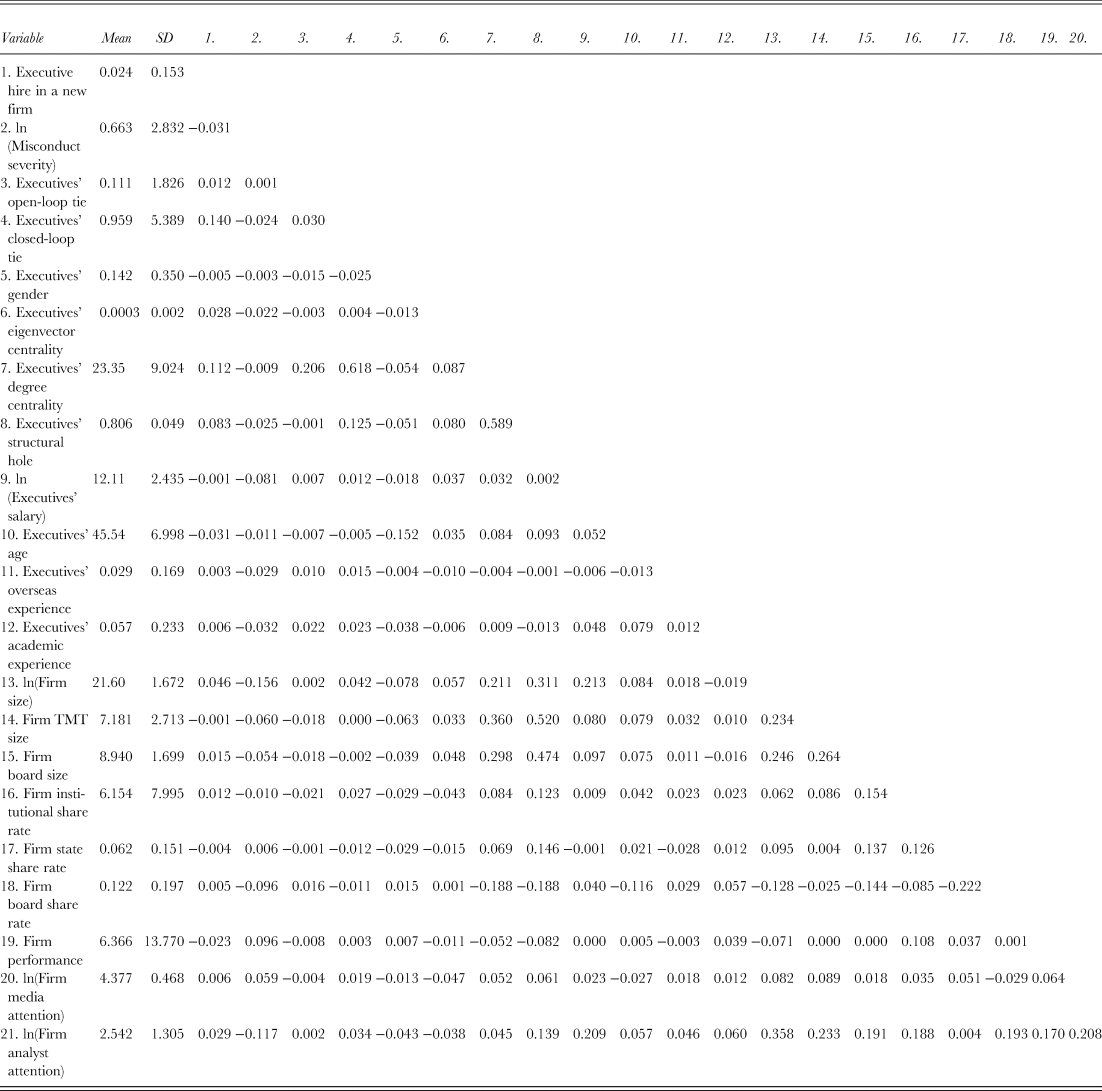
Table 2 lists the means, standard deviations, and pairwise correlations for all the variables. The number of executives’ open-loop ties and closed-loop ties are correlated at a low level (r = 0.030), meaning that the two concepts measure different dimensions of social networks. The highest correlation is between the number of executives’ closed-loop ties and degree centrality (r = 0.618). We tested the VIFs for all models; the mean VIF is 1.39, and the maximum VIF is 3.52, which are below the proposed threshold value of 10 (Marquis & Qian, Reference Marquis and Qian2013). This test shows that multicollinearity is not a concern in our study.
Descriptive statistics

Note: N = 5,090.
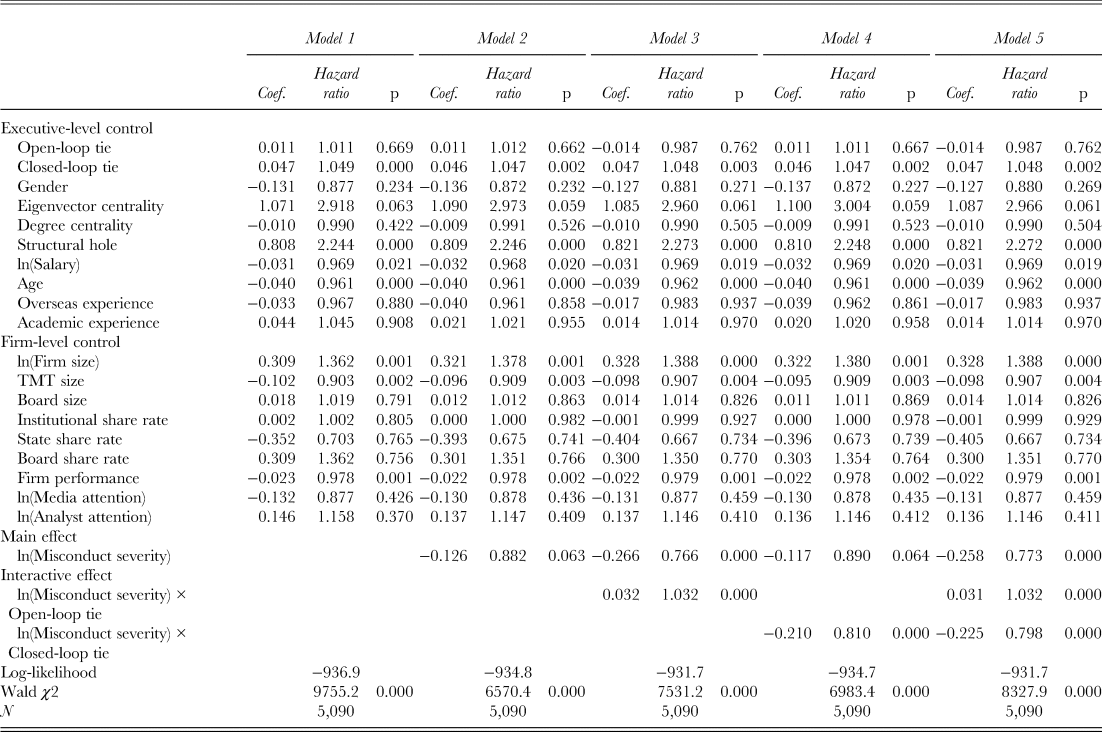
Table 3 presents the results of the Cox regressions. Hazard ratios are interpreted as the proportional change in the hazard rate with a one-unit increase in the independent variable. Values of 1 indicate no change, values smaller than 1 indicate that increases in the independent variable will decrease the likelihood of executives being hired at a new firm, and those larger than 1 suggest that increases in the independent variable will increase the likelihood of executive's hire at a new firm (Staw & Hoang, Reference Staw and Hoang1995; Yu & Cannella, Reference Yu and Cannella2007). For instance, a hazard ratio scoring 1.5 suggests that a one-unit increase in the independent variable will increase the hazard 0.5 times. We report coefficients, hazard ratios, and p-values in all models. Model 1 is the base model, including control variables only. Models 2, 3, 4, and 5 add the key independent variables and interaction variables.
Results of Cox regression on executives’ hire in a new firm

Notes: We report coefficients, hazard ratios, and p-values based upon robust standard errors. Hazard ratios are interpreted as the proportional change in the hazard rate from a one-unit increase in the independent variable. Hazard ratios can be calculated based upon estimated coefficients by the exponential function. Year dummies and industry dummies are included here, but not reported.
The results of Model 1 show the direct effect between closed-loop ties and the chance that top executives will be hired at a new firm is positive (coef. = 0.047, hazard ratio = 1.049, p = 0.000). Two reasons may account for this result: information and social capital (guanxi). First, closed-loop ties will bring diverse information about the top executives to the job market, which will give the top executives more opportunities to be noticed by potential employers. Also, in the hiring process, because of multiple sources of information, closed-loop ties can help employers to confirm the executives’ capability. Therefore, from the information perspective, closed-loop ties will reduce the search time and cost, thereby increasing top executives’ chance to be hired at a new firm. Second, guanxi, defined as particularistic social ties in the Chinese context (Li, Reference Li2007), is deeply rooted in the cultural context of our research setting (Li, Zhou, Zhou, & Yang, Reference Li, Zhou, Zhou and Yang2019; Xiao & Tsui, Reference Xiao and Tsui2007). Closed-loop ties will make it easier to prioritize exchanges between the top executives and their connected alters via a closed guanxi network, which will help such top executives enjoy goodwill from alters. This will also help these top executives make a positive impression on potential employers.
Hypothesis 1 states that the severity of a firm's misconduct is negatively related to the hazard of its executives’ being hired at a new firm. In Model 2, the coefficient of the CSRC fine on firms is negatively related to the chance of its top executives’ being hired at a new firm, and the hazard ratio of a CSRC fine on firms is less than 1 for its top executives’ being hired at a new firm (coef. = −0.126, hazard ratio = 0.882, p = 0.063). The hazard ratio results indicate that increasing the CSRC fine on firms by one unit will make its executives (exp(−0.126) − 1 = 0.118) 0.118 times less likely to be hired at a new firm. Therefore, Hypothesis 1 is supported.
Hypothesis 2 states that executives’ open-loop ties will attenuate the negative link between the severity of their firms’ misconduct and the hazard from these executives’ being hired at a new firm. In Model 3, the coefficient for the interaction term between the CSRC fine on a firm and executives’ open-loop ties is positively related with the opportunity for its executives to be hired at a new firm, and the hazard ratio for the interaction term is larger than 1 for its executives hired at a new firm (coef. = 0.032, hazard ratio = 1.032, p = 0.000). To interpret this result, when an executive without open-loop ties, the CSRC fine on firm will yield a hazard ratio of exp(−0.266) = 0.766 (0.234 times lower than the base hazard ratio of being hired in a new firm). In contrast, when an executive with one open-loop tie, the CSRC fine on firm yields a hazard ratio of exp(−0.266 + 0.032 * 1 −0.014 * 1) = 0.780 (0.220 times lower than the base hazard ratio of being hired in a new firm). Therefore, Hypothesis 2 is supported.
Hypothesis 3 states that executives’ closed-loop ties will strengthen the negative link between the severity of their firms’ misconduct and the hazard of these executives’ being hired at a new firm. In Model 4, the coefficient for the interaction term between the CSRC fine on firms and top executives’ closed-loop ties is negatively related to the chance of their executives’ being hired at a new firm, and the hazard ratio for the interaction term is less than 1 for their executives’ being hired at a new firm (coef. = −0.210, hazard ratio = 0.810, p = 0.000). To interpret this result, when an executive without closed-loop ties, the CSRC fine on firm will yield a hazard ratio of exp(−0.117) = 0.890 (0.110 times lower than the base hazard ratio of being hired in a new firm). In contrast, when an executive with one closed-loop tie, the CSRC fine on firm yields a hazard ratio of exp(−0.117 −0.210 * 1 + 0.046 * 1) = 0.755 (0.245 times lower than the base hazard ratio of being hired in a new firm). Therefore, Hypothesis 3 is supported. All results are consistent in Model 5.
Although our hypotheses were supported in Cox models, we are cautious about the whole model's explained and unexplained variance. Since the Cox model will not provide a statistic index for explained (or unexplained) variance, we used Logit to rerun our model and got the Pseudo R 2 to check the explained variance in the full model (Pseudo R 2 = 0.16). This result shows about 80% unexplained variance in our model, thus possible alternative explanations about executives being hired by a new firm. We will discuss this possibility in the section of limitations and future research directions.
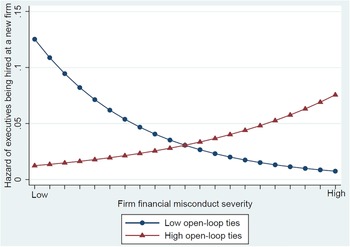
To illustrate the interactive effects of the severity of a firm's financial misconduct and its executives’ social networks on their hiring by a new firm, we plotted the results in Figure 5. Figure 5 shows that as the number of executives’ open-loop ties increases, the negative effect of the severity of financial misconduct on the hazard of being hired by a new firm is less negative. In contrast, Figure 6 shows that, as the number of executives’ closed-loop ties increases, the negative effect of the severity of the firm's financial misconduct on the hazard of being hired by a new firm is more negative.
Mitigating effect of open-loop ties on courtesy stigma

Amplifying effect of closed-loop ties on courtesy stigma

Robustness Test
Subsample test
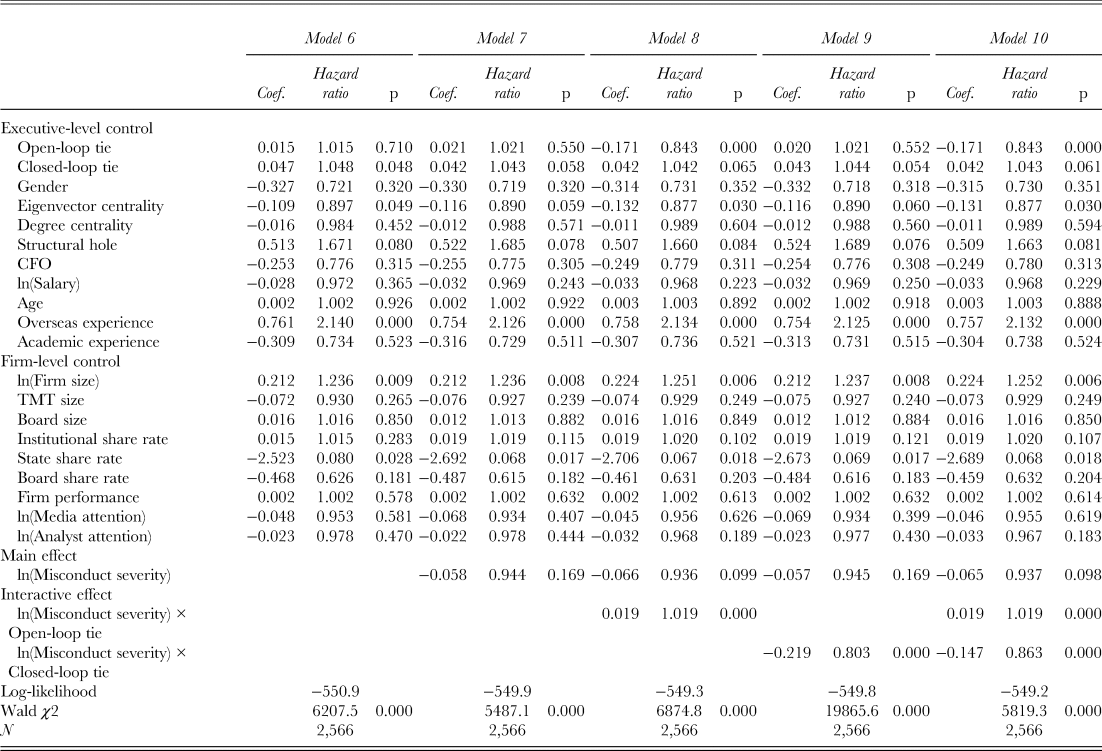
After firms are punished for financial misconduct by the CSRC, CEOs and CFOs are more likely to be singled out, thereby suffering more negative consequences from courtesy stigma (Wiesenfeld et al., Reference Wiesenfeld, Wurthmann and Hambrick2008). To retest our main findings, we selected CEOs and CFOs of firms that committed financial misconduct. The EHA models in Table 4 have similar findings: the coefficient of the CSRC fine on firms is negatively related to the chance that these two top executives will be hired by a new firm, and the hazard ratio of a CSRC fine on firms is less than 1 for these two top executives’ hiring by a new firm (coef. = −0.058, hazard ratio = 0.944, p = 0.169); the coefficient for the interaction term between the CSRC fine on a firm and these top executives’ open-loop ties is positively related to the opportunity of their hiring by a new firm, and the hazard ratio for the interaction term is larger than 1 (coef. = 0.019, hazard ratio = 1.019, p = 0.000); the coefficient for the interaction term between the CSRC fine on firms and these top executives’ closed-loop ties is negatively related to the chance of these two executives hiring by a new firm, and the hazard ratio for the interaction term is less than 1 (coef. = −0.219, hazard ratio = 0.803, p = 0.000). Therefore, our main findings are supported. All results are consistent in Model 10.
Results of Cox regression on executives’ hire in a new firm with subsample

Notes: We report coefficients, hazard ratios, and p-values based upon robust standard errors. Hazard ratios are interpreted as the proportional change in the hazard rate from a one-unit increase in the independent variable. Hazard ratios can be calculated based upon estimated coefficients by the exponential function. Year dummies and industry dummies are included here, but not reported.
Alternative measurements
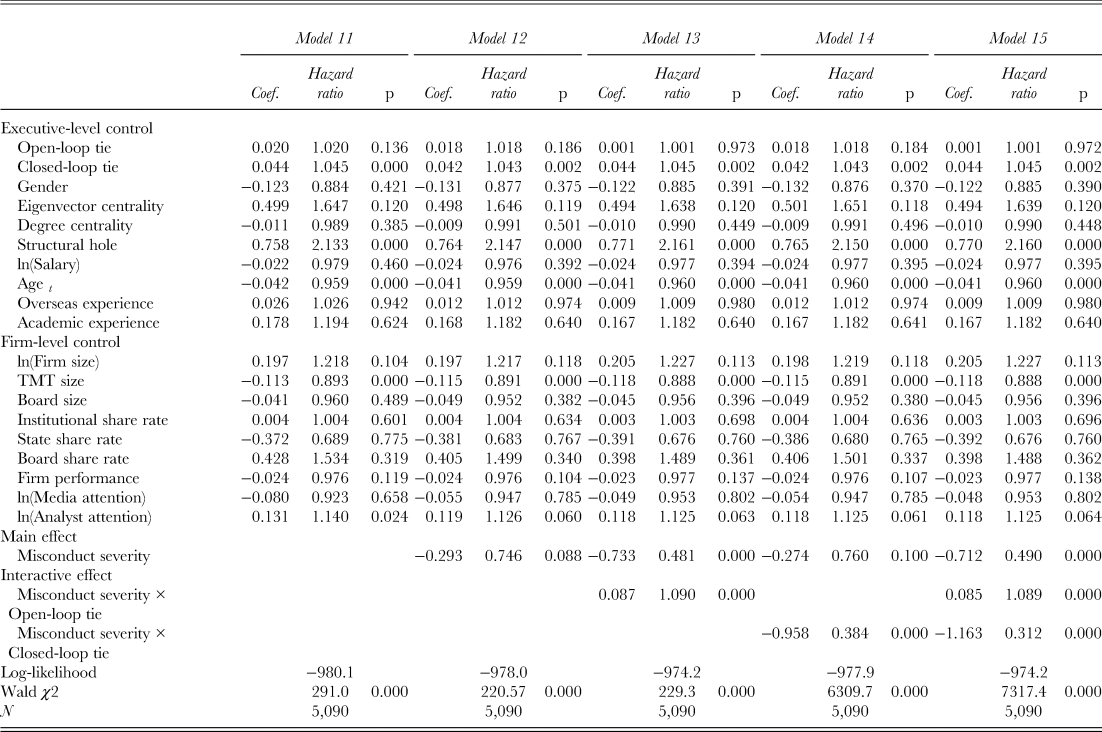
We also measured the severity of firm misconduct with the fine adjusted by a firm's total assets. The EHA models in Table 5 have similar findings: the coefficient of the CSRC fine on firms is negatively related to the chance of top executives hiring by a new firm, and the hazard ratio of a CSRC fine on firms is less than 1 for these two top executives’ being hired at a new firm (coef. = −0.293, hazard ratio = 0.746, p = 0.088); the coefficient for the interaction term between the CSRC fine on a firm and its executives’ open-loop ties is positively related to the opportunity of their hiring by a new firm, and the hazard ratio for the interaction term is larger than 1 (coef. = 0.087, hazard ratio = 1.090, p = 0.000); the coefficient for the interaction term between the CSRC fine on firms and top executives’ closed-loop ties is negatively related to the chance of top executives’ being hired by a new firm, and the hazard ratio for the interaction term is less than 1 (coef. = −0.958, hazard ratio = 0.384, p = 0.000). Therefore, our main findings are supported. All results are consistent in Model 15.
Results of Cox regression on executives’ hire in a new firm with alternative measurement for misconduct severity

Notes: We report coefficients, hazard ratios, and p-values based upon robust standard errors. Hazard ratios are interpreted as the proportional change in the hazard rate from a one-unit increase in the independent variable. Hazard ratios can be calculated based upon estimated coefficients by the exponential function. Year dummies and industry dummies are included here, but not reported.
Alternative empirical tools
Firm financial misconduct may not only jeopardize the hiring of executives by a new firm but also increase the potential for dismissal from interlocked firms. This result could lead to a reduction in the total number of jobs held by the executives after their firms commit financial misconduct. Therefore, to gauge the executives’ career development after the firms commit misconduct, we employed the number of jobs they held in other listed firms one year after the misconduct occurred.
In addition to the CSRC fine on firms, Chinese law specifies eight levels of punishment for financial misconduct: (1) public criticism; (2) a public accusation; (3) an administrative penalty; (4) entry of the misconduct into the legal record; (5) a warning to the firm; (6) a fine; (7) withdrawal of the stock market license and closing of the firm; and (8) all of the above. We use the level of government punishment to gauge the severity of each instance of financial misconduct.
The Poisson results show that the interaction term between the severity of a firm's financial misconduct and the number of its executives’ open-loop ties is positively related to the number of jobs held by the firm's executives at other listed firms (β = 0.012, p = 0.029). The interaction term between firm the severity of a firm's financial misconduct and the number of its executives’ closed-loop ties is negatively related to the number of their jobs at other listed firms (β = −0.007, p = 0.018). Thus, our hypotheses are robustly supported.
Alternative mechanism test
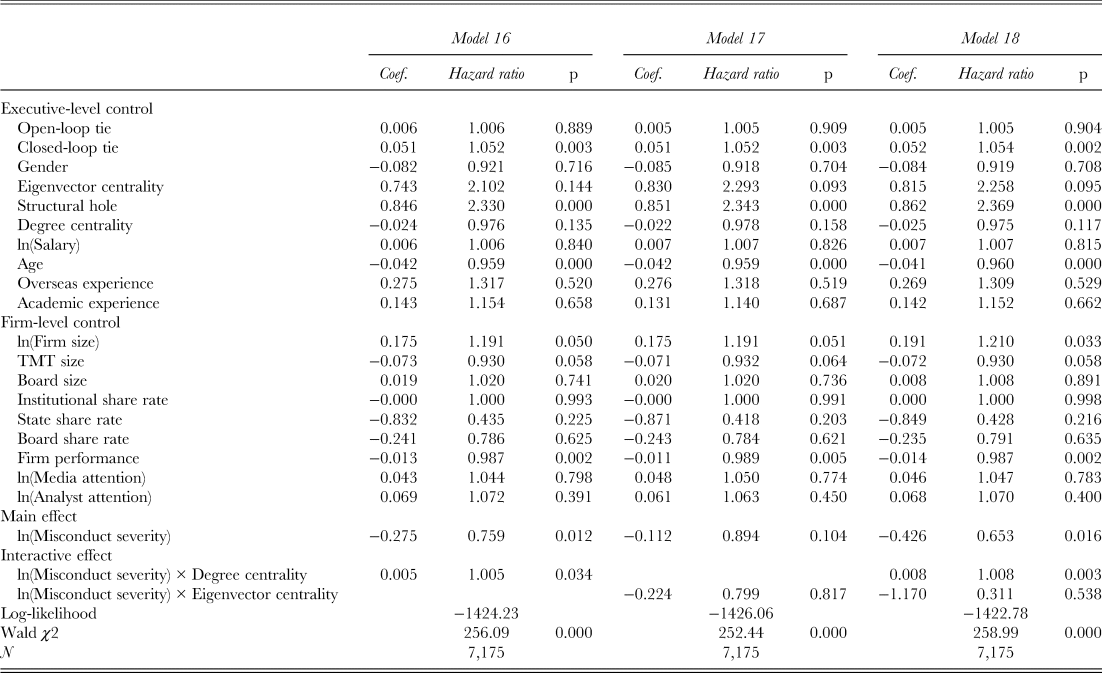
In addition to the information pipe perspective, prior research has proposed using social capital as another key mechanism, through which social networks (or guanxi in the Chinese setting) affect courtesy stigma (Kulik et al., Reference Kulik, Bainbridge and Cregan2008; Wiesenfeld et al., Reference Wiesenfeld, Wurthmann and Hambrick2008). Two key features of network centrality demonstrate the social capital of top executives: degree centrality and eigenvector centrality (Bao et al., Reference Bao, Zhao, Tian and Li2019; Jiang et al., Reference Jiang, Cannella, Xia and Semadeni2017; Markóczy et al., Reference Markóczy, Sun, Peng, Shi and Ren2013). Table 6 shows that the coefficient of the interaction term between the CSRC fine on a firm and these top executives’ degree centrality is positively related to their opportunity of being hired at a new firm, and the hazard ratio for the interaction term is larger than 1 (coef. = 0.005, hazard ratio = 1.005, p = 0.034). The interaction term between the severity of a firm's financial misconduct and its executives’ eigenvector centrality is not significantly related to the opportunity for hiring by a new firm (coef. = −0.224, hazard ratio = 0.799, p = 0.817). Therefore, our results partially support the social capital mechanism of social networks regarding courtesy stigma mitigation.
Alternative mechanism test

Notes: We report coefficients, hazard ratios, and p-values based upon robust standard errors. Hazard ratios are interpreted as the proportional change in the hazard rate from a one-unit increase in the independent variable. Hazard ratios can be calculated based upon estimated coefficients by the exponential function. Year dummies and industry dummies are included here, but not reported.
DISCUSSION
Theoretical Contributions
This article makes two major contributions to the literature. First, we contribute to the research stream exploring the function or role of social networks in mitigating courtesy stigma for executives and others in the workplace (Kulik et al., Reference Kulik, Bainbridge and Cregan2008; Pontikes, Negro, & Rao, Reference Pontikes, Negro and Rao2010; Schepker & Barker, Reference Schepker and Barker2018; Sutton & Callahan, Reference Sutton and Callahan1987; Wiesenfeld et al., Reference Wiesenfeld, Wurthmann and Hambrick2008). The stream emphasizes the positive side of social networks in courtesy stigma mitigation but largely neglected the negative side or hazards of social networks. In addition, this stream's findings about social networks and courtesy stigma mitigation are primarily based upon theoretical arguments and case studies, thus lacking generalizable empirical findings (Kulik et al., Reference Kulik, Bainbridge and Cregan2008; Sutton & Callahan, Reference Sutton and Callahan1987; Wiesenfeld et al., Reference Wiesenfeld, Wurthmann and Hambrick2008). Taking the information pipe perspective, we divided executives’ social networks into open-loop and closed-loop ties. Using longitudinal data from China, we found that after a firm commits financial misconduct, its executives’ open-loop ties could mitigate courtesy stigma because of the insulation mechanism. Surprisingly, executives’ closed-loop ties amplify courtesy stigma because of the exposure mechanism. Hence, from the information pipe perspective, we identified the dual effects of social networks in mitigating courtesy stigma. Our new findings complement prior research that focuses only on the positive side of social networks for courtesy stigma mitigation by providing stronger theoretical and empirical support for the complex roles or functions of social networks in mitigating courtesy stigma.
Second, we also contribute to the research stream on structural holes (Burt, Reference Burt1992; Ma et al., Reference Ma, Huang and Shenkar2011; Xiao & Tsui, Reference Xiao and Tsui2007; Zaheer & Bell, Reference Zaheer and Bell2005). The structural hole theory proposes that an individual as a broker interconnecting two disconnected individuals has an informational advantage over the other two individuals. However, when the informational advantage is based upon information access in the case of a complex event, a structural hole may not always offer brokers an informational advantage, and an informational advantage may not require a structural hole. In our research setting, the fundamental reason that a focal actor has an informational advantage over others is not whether two actors are connected but whether the two can access another information source regarding the event. For instance, according to the structural hole theory, network structure F–A–H will give A an informational advantage over F and H, and the closure of F and H will remove the informational advantage of A. However, in our case, even if F and H are connected, A still has an informational advantage over F and H because F and H have no other information sources. In terms of network structure K–A–D, A has an informational advantage over K based on the structural hole theory. However, in our case, because K has another source of information, A has no informational advantage over K. In this sense, we find that when an informational advantage derives from knowledge about certain complex events, those who have open-loop ties will enjoy an informational advantage, in contrast to brokers of structural holes. Our empirical findings support our argument by showing that executives with open-loop ties suffer less from firm-level misconduct because of an informational advantage over potential employers, and executives with closed-loop ties suffer more because of losing an informational advantage. Hence, we enrich our understanding of the structural hole theory by specifying its theoretical boundaries, and we reveal a new network structure for informational advantage.
Limitations and Future Research Directions
Our study has some limitations. First, we only studied open-loop and closed-loop ties between executives at one firm and corporate leaders at other firms after a firm engages in misconduct. However, we do not know whether open-loop and closed-loop ties should be expanded to include other external audiences, such as government officials and public media. Future research is needed to study executives’ open-loop and closed-loop ties with government officials and public media and investigate how they affect courtesy stigma. In addition, several characteristics of open-loop and closed-loop ties need further investigation, such as the distance between closed-loop and open-loop ties in a network. How the distance between these two types of social ties shapes the effect of courtesy stigma is still unclear.
Second, one possibility for only 20% explained variance of executives’ chance to be hired by a new firm is that there could be alternative explanations about the information mechanism of social networks. One of the alternative explanations relevant to our research setting is favor exchange related to social networks. Especially regarding the bright side of social networks in mitigating courtesy stigma, favor exchange may also work the same way as information exchange because social networks (or guanxi) in China can help executives to gain some biased attitudes, such as forgiveness, from stakeholders (Haveman, Jia, Shi, & Wang, Reference Haveman, Jia, Shi and Wang2017; Li, Reference Li2007; Li et al., Reference Li, Zhou, Zhou and Yang2019; Xiao & Tsui, Reference Xiao and Tsui2007). In this case, they may still have a good chance to be hired by a new firm. Our robust in the alternative mechanism test as well as prior research has partially supported this argument (e.g., Wiesenfeld et al., Reference Wiesenfeld, Wurthmann and Hambrick2008). One reason for us not to emphasize favor exchange theoretically and empirically is that prior research has discussed this issue, thus no longer novel (e.g., Wiesenfeld et al., Reference Wiesenfeld, Wurthmann and Hambrick2008). Another reason is that favor exchange via guanxi is sensitive and personal, thereby hard to obtain accurate data. Future research could use survey and interview methods to obtain first-hand data on the favor exchange of top executives in those firms involved in financial misconduct, which we believe is promising as well as challenging issue to tackle.
Third, we studied executives’ interlock networks after a firm committed misconduct but overlooked other types of networks, including education networks, informal social networks, and networks of prior firm employees. Future research is encouraged to pay more attention to these types of networks so as to test the generalizability of our findings to other settings.
Fourth, in this article, we did not consider the characteristics of new firms that hire those top executives. Future research could study several important characteristics of the new employers, including board social capital, human capital, and CEO features. This type of study would broaden our research from the top executive's perspective to the employer's perspective. Also, future research could examine whether or not the executives were hired by a directly connected new firm.
Finally, we studied only open-loop and closed-loop ties in the particular context of firm-level misconduct. More research is needed to study these two types of social networks in other contexts. For instance, the creativity literature argues that the exchange of knowledge between heterogeneous social networks can drive creativity. Do open-loop and closed-loop ties help boost employee creativity? We encourage researchers to study the role of open-loop and closed-loop ties in diverse contexts, such as creativity, innovation, entrepreneurship, strategy management, and cross-cultural alliance, and mergers and acquisitions.
CONCLUSION
Do executives’ social networks always mitigate courtesy stigma after firms have committed misconduct? Based upon the information pipe perspective, we specify the dual effects of social networks as a double-edged sword in courtesy stigma mitigation. We found that, after a firm commits financial misconduct, its executives’ open-loop ties mitigate courtesy stigma because of the insulation mechanism, whereas their closed-loop ties amplify courtesy stigma because of the exposure mechanism. These findings enrich our knowledge about a social network's complex role in courtesy stigma mitigation above and beyond the two prevailing assumptions: that a social network is always positive for courtesy stigma mitigation, and brokers for structural holes always enjoy an informational advantage. Further research is needed to enrich and extend this line of inquiry.
DATA AVAILABILITY STATEMENT
Replication code for this article has been published in Code Ocean, a computational reproducibility platform that enables users to run the code and can be viewed interactively at Tian, Li, Xie, and Li (Reference Tian, Li, Xie and Li2021b) at https://doi.org/10.24433/CO.2852789.v1