This article uses an ethnographic case study to examine how places become important in human society. A number of theoretical approaches suggest that places play nontrivial roles in structuring human behavior. Keith Basso (Reference Basso1996) famously observed that places are critical foci of cultural knowledge for individuals. Drawing theoretical insights largely developed in ecology, many scholars of hunter-gatherer cultures have emphasized the economic properties of places. The patch choice model offers a particularly elegant example (Bettinger et al. Reference Bettinger, Garvey and Tushingham2015; Bird and O'Connell Reference Bird and O'Connell2006; Kelly Reference Kelly2013). It posits that individuals tend to exploit the most calorically productive resource patches until return rates drop below that of the next most productive patch (accounting for travel between patches), at which time individuals move to a more productive patch. Similarly, the ideal free-distribution model posits that human populations occupy the richest ecological territories first and iteratively fill less desirable territories as populations grow (Winterhalder et al. Reference Winterhalder, Kennett, Grote and Bartruff2010).
More recently, ecological theory under the rubric of niche-construction theory has encouraged consideration of the constructed dimensions of places—how organisms create the environmental properties to which those very organisms adapt (Laland and O'Brien Reference Laland and O'Brien2010; Odling-Smee et al. Reference Odling-Smee, Laland and Feldman2003). Archaeologists specializing in hunter-gatherer research have implicitly explored niche-construction approaches to hunter-gatherer use of places. Drawing on ethnographic observations among the Nunamiut, Lewis Binford (Reference Binford1982) argued that hunter-gatherer use of landscapes created “cultural geographies.” Steven Kuhn (Reference Kuhn1995) reasoned that artifact caching and making plans to return to previously used locations were likely important parts of mobility lifeways among forward-thinking humans. The spatial patterns of Paleoindian period artifacts in western North America led Jason LaBelle (Reference LaBelle, Hurst and Hofman2010) and Brian Andrews and colleagues (Reference Andrews, LaBelle and Seebach2008) to conclude that reoccupation of places was important even among North America's earliest and most mobile hunter-gatherer populations. In an analysis of the statistical structure of hunter-gatherer site size variation and drawing theoretical insights from statistical physics and complexity theory (Bentley and Maschner Reference Bentley and Maschner2003; Lansing and Downey Reference Lansing, Downey and Hooker2011), Haas and colleagues (Reference Haas, Klink, Maggard and Aldenderfer2015) similarly suggested that variation in hunter-gatherer site sizes could be understood as the result of recursive use of places. The concept of material recycling—an intrinsically related concept to niche construction—has also been explored among archaeologists, including those who specialize in hunter-gatherer societies (Barkai et al. Reference Barkai, Lemorini and Vaquero2015). Such studies make clear that the constructed dimensions of human environments may be critical to understanding hunter-gatherer mobility patterns and regional structure in archaeological settlement patterns.
In a recent paper, Haas and Kuhn (Reference Haas and Kuhn2019) articulated an evolutionary model of forager mobility in constructed environments to generate and test expectations for the structure of archaeological settlement patterns. The model considers that basic human modifications to landscapes, including infrastructure construction and material deposition, encourage foragers to return to certain places, which in turn generates runaway accumulation of cultural materials at a few otherwise unexceptional places. The convergence of three basic human behaviors anticipates such recursive land-use practices: (1) obligate tool use, (2) mobility, and (3) energy-optimizing behavior. Given these three fundamental behaviors, residentially mobile individuals necessarily leave landscape modifications and materials at such locations. As long as some utility remains in those material artifacts or features, economically rational foragers can be expected to reoccupy those locations to realize cost savings in infrastructure construction and tool production. Such cost savings can be parlayed into more direct fitness pursuits and are therefore consistent with evolutionary theory.
Haas and Kuhn (Reference Haas and Kuhn2019) operationalize this conceptual model of forager mobility in constructed environments with an agent-based simulation in which a virtual forager moves through a landscape in such a way that mobility decisions are biased by previous occupations. Meanwhile, a virtual archaeological record forms in silico. The quantitative and temporal structure of the simulated archaeological record was compared to a Late Archaic period (7000–5000 cal. BP) settlement system in the Peruvian Andes where occupation intensity was measured as quantities of temporally diagnostic projectile points, site occupation spans, and site areas. The comparisons revealed remarkably close structural agreement when simulated bias to occupy previously occupied locations was very high, on the order of 90% or more—that is, the probability of occupying novel locations was 10% or less. The simple behavioral model successfully predicted extremely skewed distributions in site sizes (Haas et al. Reference Haas, Klink, Maggard and Aldenderfer2015) and extremely long occupation spans (Aldenderfer Reference Aldenderfer1998; Haas and Viviano Llave Reference Haas and Llave2015; Larson et al. Reference Larson, Kornfeld and Frison2009; Mitchell et al. Reference Mitchell, Plug and Bailey2008; Ortmann Reference Ortmann2010; Stiger Reference Stiger2008). Importantly, it did so without recourse to exogenous environmental factors. Simple internal dynamics were sufficient to generate considerable site size variation that is statistically consistent with variation observed archaeologically (Figure 1).
The working behavioral model considers that hunter-gatherer mobility entails preferential attachment to previously occupied places to realize cost savings in the acquisition and construction of cultural materials and features. An agent-based model shows that such recursive use of landscapes generates extreme, highly skewed variation in site occupation intensity, as seen in this example of simulation run (Haas and Kuhn, Reference Haas and Kuhn2019).

Previous tests of model expectations have relied on archaeological settlement patterns. A major limitation of those tests is they rely on material proxies of behavior rather than direct observations, raising the perennial concern of equifinality. Localized natural resource concentrations or ideological frameworks (Basso Reference Basso1996) that are empirically inaccessible could bias land use patterns in a way that generates similar archaeological structure. Or complex taphonomic processes (Dodds and Rothman Reference Dodds and Rothman2000) could structure the observed archaeological patterns. Ethnoarchaeology can partially address such analytical ambiguities by offering direct observations on camp selection among residentially mobile populations.
Therefore, we generated a series of predictions for ethnographic observations on mobility patterns among residentially mobile populations and will show that those predictions are consistent with mobility patterns observed during one month of ethnographic research among residentially mobile reindeer herders in the Mongolian Taiga. The observations underscore the point that while exogenous environmental factors are important in structuring human mobility and archaeologically observable settlement patterns, the constructed dimensions of places also exert considerable influence on how mobile individuals move through and alter landscapes.
Ethnoarchaeological Expectations
By observing mobile populations moving through landscapes, it should be possible to directly examine major factors influencing their use of specific locations. Following a working model of forager mobility in constructed environments, the question is the extent to which previous infrastructure and deposited cultural materials influence camp choice among residentially mobile populations. The working model suggests that the majority of camp occupations are heavily influenced by previous occupants’ material deposition and landscape modifications, whether the series of occupations involve the same individuals or members of the same family or entirely unrelated people. As long as there is some economic advantage to reoccupation, the model predicts that mobile individuals exhibit a strong bias to occupy previously occupied places. Occupations of novel locations occur, but in low frequency—10% of the time or less (Haas and Kuhn Reference Haas and Kuhn2019).
A number of models can account for the differential use of places without recourse to the materially constructed dimensions of landscapes. It is possible that spatially localized natural resources, other individuals, or perhaps even spiritual aspects of particular places could drive quantitative differences in the use of places. To be sure, these are not mutually exclusive behaviors. We expect that all combinations are possible in any given instance of camp selection. Indeed, the convergence of these and many other factors could generate substantial variation in the use of places. Nonetheless, it is possible, in an ethnographic context, to evaluate the extent to which any given factor contributes to camp selection.
The working model of mobility in constructed environments logically leads to five basic predictions for ethnographically observable mobility patterns. Prediction 1 suggests that most campsites are previously used camps. Selecting novel locations is rare but nonetheless present. Prediction 2 suggests that when camps are reoccupied, tools and infrastructure from previous occupations are recycled. Prediction 3 suggests that reoccupations include not only the same individuals and their family members but also mutually unknown nonkin. This prediction follows the premise that pragmatic reuse of materials does not preclude the use of materials left behind by nonkin. Prediction 4 suggests that hiatuses between occupations are variable, ranging from no occupational gaps to those lasting decades or longer. Again, as long as infrastructure and materials with remaining utility are present, economically rational individuals should take advantage of them even after considerable time has passed. Prediction 5 suggests that the distribution of person-time of occupation among camps is highly skewed such that most camps represent low occupation intensity while a few rare camps exhibit extremely high occupation intensity (Haas et al. Reference Haas, Klink, Maggard and Aldenderfer2015). This highly skewed distribution should appear as an L shape in a histogram and, given sufficient data, should be consistent with a power-law statistical distribution and inconsistent with Poisson or exponential distributions (see Figure 1). In the following section, we describe the materials and methods used to test the five predictions presented above.
A Month among a Dukha Family in the Mongolian Taiga
The authors spent 28 days in the Mongolian Taiga with a Dukha family. The Dukha are a small population of approximately 200 residentially mobile reindeer (Rangifer tarandus) herders and foragers who inhabit the Mongolian Taiga of the Khövsgöl Province near 99° east longitude, 51° north latitude, 2,000 masl (Inamura Reference Inamura, Ikeya and Fratkin2005; O'Brien and Surovell Reference O'Brien and Surovell2017; Surovell and O'Brien Reference Surovell and O'Brien2016; Walker Reference Walker2009; Wheeler Reference Wheeler2000). They are one of few modern human populations to move their dwellings throughout the year and regularly engage in overnight logistical forays. Spring through summer housing tends to be tipi forms locally known as ortzen ger. The long poles that comprise the framework of ortzen ger are made from small-diameter larch trees (Larix sibirica) and are called ortz. Small-diameter poles are important features of Dukha camps, also serving as tethers for reindeer, fences, cooking tripods, and various miscellaneous purposes. Winter houses include ortzen ger, the traditional Mongolian ger (i.e., yurt), and small log cabins. Both ortzen ger and ger have central stoves, beds, electronics, kitchen items, and shelving, among other household items (Haas et al. Reference Haas, Surovell and O'Brien2018).
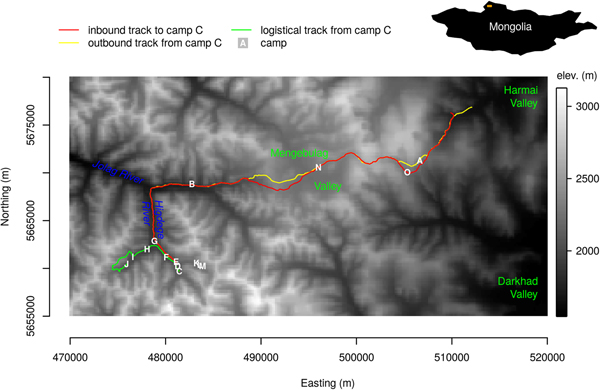
We worked with a Dukha family living in the Right Taiga (a.k.a. West Taiga), ca. 51° 11′ north latitude, 98° 56′ east longitude along the upper reaches of the Jolag River and its tributary of Higdege River (Figure 2). The second and third authors have been working periodically with this family since 2012. Sixteen Dukha individuals were observed during our 2017 study. Our main informants were Otgonbayar and Mönkh-Erdene, a married couple, 60 and 56 years old, respectively (Table 1). Along with Mönkh-Erdene's sister, Mönkhtsetseg, they are the primary managers of a herd of nearly 200 reindeer that were in Camp C during our observation period. With the exception of Bat-Erdene and Batbayar, who are nephews of Otgonbayar, all Dukha individuals observed in this study descend from Otgonbayar, Mönkh-Erdene, and Mönkhtsetseg. Note that the names used are pseudonyms.
The locations of camps (A–O), travel routes, and places discussed in text (map projection: UTM 47N, WGS 84).

Camp Occupants Observed during the Study Period.

* Pseudonyms used for Dukha participants.
** Expressed in years.
Ethnoarchaeological Observations on Dukha Camp Selection
Given the five predictions deduced from the working model of recursive land use outlined above, the goal of this study was to evaluate the extent to which Dukha camp selection entails reoccupation of places, recycling of materials, reoccupation of places by kin and nonkin, long occupation hiatuses, and a highly skewed distribution of person-time of occupation among camps. Here we present the results of opportunistic observations on Dukha camp selection during our four weeks of observation. Camps include those that our Dukha colleagues occupied during our stay and those observed as material remnants from previous occupations by our Dukha colleagues or other individuals. We present a brief summary of our relevant observations at 15 camps before synthesizing them in the following section. Relevant observations include camp occupants, their nights of stay, infrastructure and tools present, types of resources used, proximity to natural resources, material resources left behind, distances traveled between camps, general times of arrival and departure, and information communicated by the occupants.
Camp A
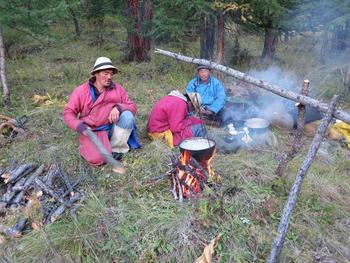
Late in the afternoon on August 24, after 10 km of travel by horseback from the Harmai Valley into the Taiga with Bat-Erdene, Batbayar, and Lkhagvasüren, we established a temporary camp just below the mountain pass we would traverse the next day. This camp location had no signs of prior use. It was located just off the main trail in a small opening in the larch forest. A seep was located about 15 m downslope and served as our water source for evening tea and dinner preparation. Horses were tied to trees on the edge of camp. Our guides collected a small-diameter larch pole and two shorter Y-shaped sticks to construct a wood cooking tripod, called a servunge, to suspend a large cooking pot over a fire (Figure 3). Dry brush and lower limbs from surrounding pine trees were collected for firewood. Our guides rigged a tarp among trees as a sleeping shelter. We vacated Camp A early the next morning.
Bat-Erdene stokes the fire at Camp A, a new camp created for a one-night stay en route to our destination. A wood tripod was created on the spot to suspend a cooking pot over a fire. Wood and stone cooking tripods are ubiquitous features in short-term Dukha camps. Photo by Randall Haas.

Camp B
Late in the afternoon of August 25, the same group established camp along the Jolag River after 29 km of travel from Camp A. Unlike the previous camp, this one had considerable evidence of prior use, including numerous hearth features, stone cooking tripods, ortz piles, trash, and tree stumps. Stone cooking tripods are an alternative to wood cooking tripods and consist of three boulders arranged in a triangle and about 20 cm apart.
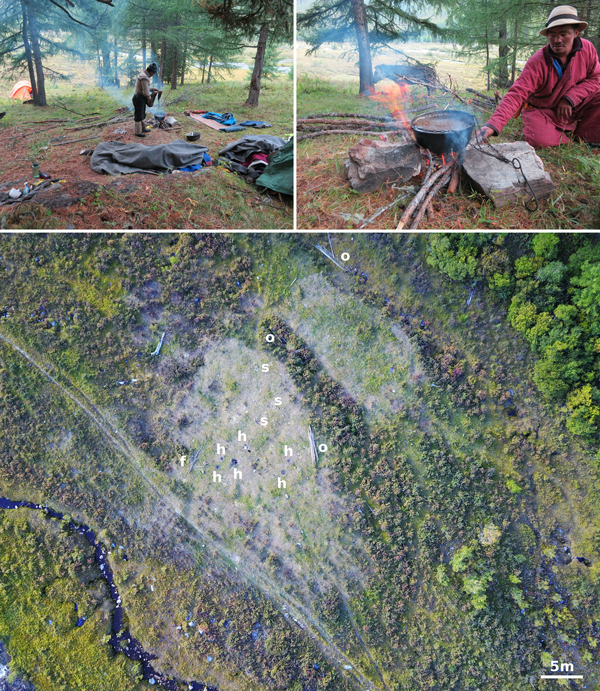
Camp B spanned the modern river terrace and adjacent pediment. The pediment portion of camp was located in a larch and pine forest and included a stone cooking tripod from a previous occupation (Figure 4, upper two images). This is where we camped. When asked why we were camping on the upper portion of the site, our informants explained that the trees made it easy to tether the horses and that there was a small grassy meadow where the horses could be picketed to graze overnight. If we had been traveling by reindeer, we would have set up on the lower portion where reindeer could be easily and effectively tethered to dwarf birch shrubs and loose poles.
Camp B with upper locus shown in the top two images and the lower locus in the bottom aerial image. Upper left: Batbayar makes tea while Bat-Erdene and Lkhagvasüren sleep under canvas. The researcher tent is in the background. Upper right: Three boulders for a cooking tripod were recycled from a previous cooking tripod at the camp. Bottom: Drone-based planimetric view of the lower terrace of Camp B showing at least six hearth features (h), three stone cooking tripods (s), three ortz piles (o), and a firewood pile (f). Photo by Randall Haas.

After tethering the horses, our guides moved the three previously used cooking tripod stones about 10 m to establish a new cooking tripod. Although the guides were willing to recycle tripod stones, they did not reuse the hearth because, according to them, Dukha tradition forbids the reuse of hearths.
We spent one night at this locus of Camp B. Just before our departure on the morning of August 26, Batbayar tied a leftover segment of cord to a tree, explaining that a future site occupant could use it.
We reoccupied Camp B several weeks later during our exit from the Taiga. On the evening of September 20, after 15 km of travel by reindeer from Camp C, we returned to Camp B. Because we were with reindeer, we occupied the lower portion of the camp where the deer were tethered to shrubs and poles. This locus consists of two cleared high spots on the alluvial terrace pocked with numerous hearth stains, stone cooking tripods, ortz piles, and debris, indicating intensive previous use (Figure 4, lower). Camp occupants included Otgonbayar, Mönkh-Erdene, Ganbaatar, Enkhjargal, and the authors. After unloading and tying the reindeer, our guides built a fire and made tea. The wooden cooking tripod they used was recycled from one that was already on site. As before, no existing hearth was reused. This observation further suggests that at least some of the hearths at this camp, including the stone cooking tripods, likely represent independent occupations instead of multiple simultaneously operating hearths.
Surprisingly, our party was not the only one camped at Camp B that day. A group of approximately six Darkhad individuals from the town of Ulaan-Uul camped for several days at the upper locus above us, the location of our stay on August 25. The Darkhad are a local ethnic group that speaks the Darkhad dialect of the Mongol language and live primarily in the Darkhad Valley. Their camp served as a staging and processing area for wild lingonberry (Vaccinium vitis-idaea) harvesting. The individuals were unknown to our Dukha colleagues. One of the men from the camp joined us for tea and friendly conversation. Our party departed the next morning while the Darkhad party remained.
Camp C
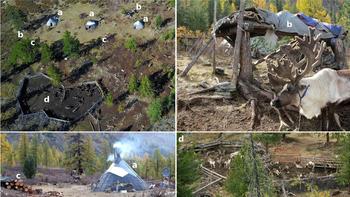
On the afternoon of August 26, after 16 km of travel on horseback from Camp B, we arrived at our target destination, Camp C, the most intensively occupied camp we visited during our observation period. It was a seasonal camp located near a fork in the Higdege River. When we arrived, 13 individuals constituting two families were already at the camp, making for a total occupancy of 16 individuals, including our guides and excluding the authors. Three ortzen ger were already in place. Two were for the current occupants and our guides, and the third was set up for the authors in advance of our arrival. The camp had been in use since mid-August and would remain occupied through November. Relatively permanent infrastructure included a large reindeer corral and two log cache platforms (Figure 5).
Camp C, a fall camp in use with three ortzen ger (a), two cache platforms (b), two wood piles (c), and a large reindeer corral (d). The rightmost ortzen ger in the upper left image was the authors’ lodging. Photo by Randall Haas.

The authors' host family first occupied Camp C in the 1990s followed by a long hiatus before reoccupying it in 2014, 2016, and 2017. It was not used in 2015 because of problems with wolf predation on reindeer in 2014. Assuming no other occupation between, these occupation dates give a minimal estimate for a maximum occupation hiatus of 14 years. Each occupation likely made use of some infrastructure established during previous years, at least between the more recent reoccupations. For example, the second author observed the construction of the reindeer corral in 2014, though its form has since been modified. House locations were in nearly the same locations between 2014 and 2017. The cache platforms were reused.
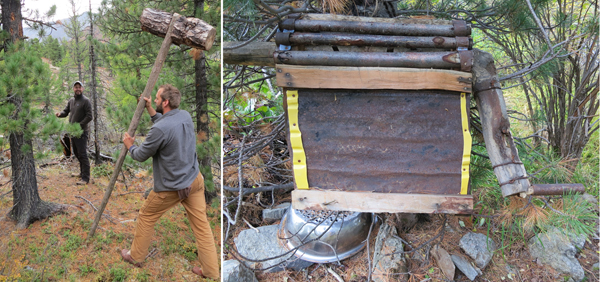
We also observed two relatively nonportable tools for pine nut harvesting that were left at Camp C from a previous year. One was an oversized log hammer used to dislodge pine cones from the high branches of trees by pounding the trunks. The other was a clever pine nut husking machine used to separate the nuts from the cones (Figure 6). These were used in a year when the pine nut harvest was good. They were not used the year we were there due to low pine nut productivity.
Pine nut harvesting tools at Camp C. Left: A giant mallet used to pound pine tree trunks to dislodge cones. Note the scars on the top of the tree trunk, which were created the previous year. Right: A pine nut husking device hanging upside down from a tree with a homemade colander below. The tools were cached here after their last use in 2016. Photo by Matthew O'Brien.

Camp membership was relatively stable though not constant during our 25-night stay. The day after our arrival on August 27, Bat-Erdene left camp on a foray, leaving 15 occupants in camp for the night. We do not know where he camped that night. On August 28, Bat-Erdene returned, bringing Camp C occupancy back to 16 individuals. On August 29, eight individuals (Bat-Erdene, Batbayar, Lkhagvasüren, Erdenechimeg, Oyuunchimeg, Gantulga, Ganzorig, and Nararangarov) left camp and did not return during the remaining period of observation. Eight individuals thus remained in camp. Otgonbayar, Mönkh-Erdene, Altantsetseg, and Enkhjargal were in one house, and Mönkhtsetseg, Narantsetseg, Ganbaatar, and Ganbold in the other. The only other occupancy change occurred on September 12 when Otgonbayar and Ganbaatar spent a night away from Camp C at Camp J (see below) during an extended reindeer-herding foray. In total, 221 person-nights were spent at Camp C during the period of observation.
Camp D
Camp D was a small camp that was not occupied during the observation period. It was relatively close to Camp C and consisted of two charcoal-filled stone cooking tripods about a meter apart. It was located on an alluvial terrace with easy access to Higdege River. The timing of occupation and the occupants of the camp were unknown. It was unlikely to have been used by the Dukha family during the occupation of Camp C, given its proximity. However, the occupation (or occupations) seems relatively recent, perhaps in the past five years or so, given the abundant and fresh charcoal. It is unclear whether the two features were used at the same time.
Camp E
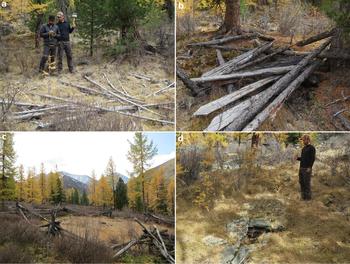
Camp E was not occupied during the observation period. It was known from a previous field season and was revisited by the authors during our stay. It was a relatively large site consisting of a corral, one or two fallen cache platforms, two ortz scatters, and a spring enhancement feature (Figure 7). The camp was located high above Higdege River where access to river water is difficult, which accounts for the construction of the spring enhancement feature. Otgonbayar, Mönkh-Erdene, and family occupied the camp in the Winter of 1998. Otgonbayar informed us that the family was considering reoccupying Camp E the following fall, abandoning Camp C because the corral was becoming muddy.
Camp E, a winter camp used by our informants in 1998, was reused subsequently as a temporary camp by unknown individuals on at least two occasions and is slated for potential reoccupation by our informants in the fall of 2018. The camp includes at least two ortz piles (a), one and possibly two collapsed cache platforms (b), a reindeer corral (c), and a log and stone spring enhancement (d). Photo by Randall Haas.

In addition, two independent, short-term occupations were evident within Camp E. One was inside the abandoned corral and consisted of three poles lashed at one end with the opposite end of one pole propped on the corral fence. This was probably used as a lean-to framework for an overnight stay sometime between 1998 and 2017.
A second short-term occupation was located on the edge of Camp E along the main trail. It consisted of a fallen wood cooking tripod, burned logs, a plank, and an instant yeast packet. The yeast packet's food safety certification and expiration stamp indicated camp use between 2004 and 2007. The advanced stages of degradation of the log poles at these two short-term occupations, coupled with the availability of discarded poles, seems to suggest that the associated poles were recycled from the 1998 occupation. Otgonbayar did not know who created the temporary camps, indicating multiple uses of the location by unknown individuals, likely nonkin. It is unknown to us whether the camp was used before 1998.
Given three occupations—one in 1998, a second sometime between 2004 and 2007, and a third post 1998—and assuming no other occupations, the minimal estimate for the maximum hiatus between occupations is three years. It is also worth noting that if the family does reoccupy that location next fall, two decades will have passed between their occupations.
Camp F
Camp F was not occupied during the observation period and consists of a wood cooking tripod, a stone cooking tripod, and a collapsed ortzen ger frame. The camp was located on a high terrace above Higdege River beyond the range of easy access to river water. The ortz suggested at least one overnight stay, and advanced decay of the wood suggested that its occupation was not recent. However, the occupants are unknown, as are specifics of occupation tempo.
Camp G
Camp G was not occupied during the observation period and was only observed in passing. A standing ortzen ger frame, a cluster of ortz propped against a tree, a partially collapsed cache platform, a possible corral, and a standing wood cooking tripod inside the possible corral were observed. There were likely more features. The presence of the tripod inside the corral was clear evidence of independent occupations. The time of occupation and the occupants are unknown, though it is likely that occupation was relatively recent, given the standing and semistanding infrastructure.
Camp H
Camp H was not occupied during the observation period. It was a small, short-term camp consisting of an ortz pile, a stone cooking tripod, and firewood. It was situated on the edge of the first terrace of the west branch of Higdege River with easy access to river water. The occupants are unknown, and the advanced stage of decay of the wood objects suggests the occupation was not recent. The ortz pile suggests overnight use. More specific information on the tempo of occupation is unavailable.
Camp I
Camp I was not occupied during the observation period. It was a small, short-term camp consisting of a hearth, wood cooking tripod, and two kindling piles. The site was situated on the first terrace of the west branch of Higdege River with easy access to river water. Minimal decay of wood indicated relatively recent use. The occupants and tempo of occupation are unknown.
Camp J
On August 11, Otgonbayar and Ganbaatar left Camp C on an overnight reindeer roundup. Though none of us accompanied them, we outfitted them with a GNSS unit, which later allowed us to determine that Camp J was at the end of a 13 km track (see Figure 2). On August 16, the first author visited the area to document the camp, which turned out to be the location of at least four separate occupations. Camp J is large, consisting of a wood cooking tripod, a stone cooking tripod, at least four ortz piles, a semi-standing lean-to frame, a pseudo-corral, scattered poles, scattered reindeer ties, and miscellaneous debris, including a camp stove gas cannister, a wood reindeer saddle, an ungulate mandible, and a discarded ax handle.
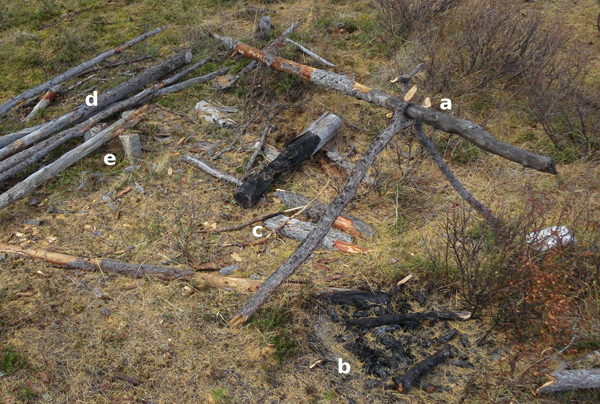
The wood cooking tripod, stone cooking tripod, one of the ortz piles, and hearth were at the locus occupied by Otgonbayar and Ganbaatar (occupation 4; Figure 8). The wood cooking tripod was still standing. It consisted of two freshly cut support arms and a main beam that appears to have been recycled from the ortz pile, which was left during a previous occupation. One ortz was burned on the end and inside Otgonbayar and Ganbaatar's hearth, indicating recycling of ortz for firewood. Also, there were two charred, bipointed sticks that Otgonbayar later informed us were skewers used for cooking meat. Two short logs, about 50 cm long by 20 cm in diameter, may have served as a pot stand. Although there was a stone cooking tripod at this locus, Otgonbayar and Ganbaatar did not use it; rather, it was from an earlier use (occupation 3).
Otgonbayar and Ganbaatar's overnight camp within Camp J several days after use on a reindeer herding foray. The site they chose was a seasonal camp that was occupied by an unknown family in the 1980s. Otgonbayar and Ganbaatar constructed a wooden cooking tripod, recycling an ortz previously used at the site (a). The hearth (b) was used to prepare tea and meat, which was cooked with two skewers that were left behind (c). Two short logs (c) may have served as a pot stand. Previous users of the site left five ortz piles (e.g., d) and a stone cooking tripod (e) among other things. Photo by Randall Haas.

On the other side of the site was an arrangement of ortz leaning against a tree in a fashion suggestive of a lean-to frame used for a distinct short-term occupation of the site (occupation 2). The most extensive occupation (occupation 1) is indicated by the pseudo-corral and high density of other objects, such as the ortz piles and various scattered objects. Otgonbayar informed us that the camp was used as a seasonal residence in the 1980s or 1990s by a family whose name he could not recall. This timing is consistent with the advanced decay on many of the wood objects and an unfinished carving in the top of a nearby fence post that read, “19’ ”. (The apostrophe indicates the start of the next digit that was never completed.)
While the exact tempo of occupation is unknown, it is clear that Camp J was occupied at least four times by at least two families with a minimal estimate of a maximum occupation hiatus of nine years.
Camp K
We discovered a series of previously occupied camps in a tributary of the Higdege River's east fork known to our Dukha colleagues as the Lost Branch. Camp K was the first we encountered. It was not occupied during the observation period. It consisted of four scattered poles, possibly part of a wood cooking tripod or lean-to. Two short logs, about 50 cm long by 20 cm in diameter and lying parallel, may have served as a pot stand. The minor decay in wood artifacts suggests recent use of the camp. The camp occupants are unknown, and nothing more is known about the tempo of its occupation.
Camp L
Camp L was not occupied during the observation period. It was a large camp with evidence of at least three distinct occupations. It was situated on a glacial moraine in the bottom of the Lost Branch valley overlooking a small lake dammed by the moraine. Lake water is easily accessed at about 50 m from the edge of camp. Occupation 1 was a large, multifamily occupation including eight households as indicated by as many ortzen ger pads. Ortzen ger pads were evident as a clear pattern of spatial association among stone stove pads, firewood piles, and ortz piles. The stove pads consisted of several flat rocks arranged in a rectangular pattern and would have served as the base for the central wood stove in the ortzen ger. Just a meter or two from each stove pad was a firewood pile with pieces sawed and split for short-term storage in the ortzen ger before feeding them into the stove. Ortz piles were also in association in most cases. Scattered in and around the ortzen ger were tens to hundreds of stakes and ortz as well as miscellaneous debris, such as an old clock and a plastic wash basin.
The advanced stage of decay in the wood objects suggested that occupation 1 was not recent, an observation later confirmed by Mönkhtsetseg. She informed us that she and her daughter Narantsetseg were among the eight households that lived there in the autumns of 1995, 1996, and 1997. Otgonbayar and Mönkh-Erdene never occupied Camp L. Given the presence of 8 ortzen ger, it is likely that the camp hosted at least 16 occupants at once and perhaps as many as 40.
More recent use of the camp was evident in two discrete short-term camps, both with wood cooking tripods and each located on separate ortzen ger pads separated by approximately 100 m. One appeared to be relatively recent as indicated by a tattered cotton shirt fragment with a palm-tree print. The main pole of the cooking tripod appeared to have been recycled from the ortz piles left by earlier occupants. Given occupations in 1995, 1996, 1997 as well as two occupations sometime between 1997 and 2017, the minimal estimate for a maximum occupation hiatus is six years. More detailed information about the tempo of Camp L occupation is unavailable.
Camp M
Camp M is located on the opposite side of the moraine lake from Camp L. It was unoccupied during the observation period. It consisted of a scatter of poles, a stone cooking tripod, and numerous reindeer stakes. There might have been remnants of an ortzen ger, but we were not certain. The camp was situated on the sloped edge of a terrace, and the nearby stream and lake could be easily accessed. The camp occupants and tempo of occupation are unknown.
Camp N
Our second day of travel out of the Taiga with Otgonbayar, Mönkh-Erdene, Ganbaatar, and Enkhjargal (see Camp B description for first day) began with a morning departure from Camp B on September 21. After riding for several hours and about 15 km on reindeer, we stopped in Mengebulag Valley to rest at Camp N. En route, Otgonbayar cut some willow poles. Then we stopped at an unoccupied summer camp of a relative, where he secured a few firewood logs and a larch pole. A few hundred meters away, we stopped to rest in a previously unoccupied location. Otgonbayar lit a fire, set up a wood cooking tripod with the willow poles and pole he collected, and prepared tea. We spent about an hour at this location. Although this was not an overnight stay, our activity there left a clear material signature, showing that not all camps with cooking tripods represent overnight camps.
Camp N also revealed that even in a rare instance where a “camp” was established in a novel location, the Dukha recycled materials from nearby camps. Why we didn't simply establish our rest area at the relative's camp where we confiscated materials is unclear. It would have been more energetically rational to do so rather than hauling the materials and making yet another stop. We suspect that it was related to the high winds we experienced that day. The chosen location was at the base of a low terrace that partially protected us.
Camp O
The final camp described in this study was the location of our second and final night during the pack trip out of the Taiga. After we completed the most difficult portion of the trip, covering 29 km and traversing a mountain pass, Otgonbayar took us off trail to find a suitable camp location. After about an hour of pushing through brush, he finally settled on the location of Camp O, a fall camp relatives had last used around 1985, according to Otgonbayar. The camp consisted of several wood structures that we unfortunately did not have time to document before sunset. According to Otgonbayar and Mönkh-Erdene, the camp offered easy access to water and forage for the deer.
Despite our reoccupying an old camp, we did not observe material recycling. Fresh poles were cut from live trees for our cooking tripod. Firewood was not recycled. However, the authors were tasked with firewood collection, and our cultural tenets as archaeologists virtually guaranteed we would not collect cultural materials for fuel. Even if our Dukha colleagues did not recycle any materials, a major benefit of reoccupying the camp was that it was relatively clear of brush. We could move through the open spaces and trails that the previous occupants had created to prepare camp and tend the deer. Such movement would have been more difficult in comparable but never occupied locations.
It is worth adding that camps are not given names. Instead, they are generally referenced by some combination of occupants, season of use, or associated physiography, depending on the context of discussion. For example, Camp C might simply be referred to as “Otgonbayar's fall camp” in some contexts or as “Higdege,” referring to the Higdege River Valley, in others. If there are multiple camps occupied in a given season and region, then Dukha individuals may refer to camps in terms of more local physiographic features, such as streams or mountains.
Summary and Conclusion
Here we summarize the camp observations in light of the five predictions. Table 2 further reduces the relevant observations for evaluating the five predictions under investigation.
Summary of Camp Occupancy Observations.

a The number of individuals who occupied the camp. Does not include investigators.
b Only includes the period of observation.
c Expressed in years.
Prediction 1 of the working model anticipated frequent reuse of camps after periods of abandonment. For the eight camps in which data were sufficient, occupation of previously occupied camps was observed six times. Dukha camp selection was therefore most often biased by previous camp selection. Moreover, only one of the two instances of selection of novel camp locations was a strong case. Camp A was used overnight, did not show any signs of previous occupation, and our Dukha colleagues did not recycle any previously discarded cultural materials. In contrast, Camp N was a daytime rest area, and materials from a nearby camp were recycled. Thus, Camp N is a relatively weak observation of occupation of a novel location. Regardless of those particular cases, the preference to select previously occupied camps is clear, supporting prediction 1.
Prediction 2 anticipated a preference for recycling previously discarded materials. Six of seven camp occupations revealed clear evidence of material recycling from previous occupations. The one case of a reoccupied camp that did not exhibit recycling behavior, Camp O, may represent observer interference. Regardless, the overall observations clearly indicated that recycling of previously deposited materials is a common practice among the Dukha.
Prediction 3 of the working model anticipated that not only would camps be reoccupied but also that pairs of reoccupations would involve a wide range of relatedness among individuals. While some pairs of reoccupations should simply involve the same individuals, others might involve close or distant kin, and others could involve nonkin. Indeed, five clear instances of camp reoccupation by pairs of nonprimary kin were observed. Most of the nonkin occupation pairs were separated by time in that the occupations were asynchronous. However, one instance, at Camp C, involved synchronous occupation by unrelated, mutually unknown Dukha and Darkhad families. This instance of coresidence among unrelated groups is rare. Dukha camps typically consist of close kin (O'Brien and Surovell Reference O'Brien and Surovell2017). This contrast highlights the pull of camp resources. Having observed Darkhad occupants on our arrival to Camp C, our Dukha colleagues could have decided to camp elsewhere. But it appears that the advantages of reoccupying the camp outweighed potential intergroup conflicts. We suspect that the single-night duration of our stay and orthogonal goals of the two groups—one foraging and the other in transit—effectively reduced the probability of conflict. Had our stay been multiday, the calculus would have inverted, and our colleagues likely would have sought an alternative location.
Prediction 4 anticipated that occupational hiatuses would be highly variable, ranging from no hiatus to long-term hiatuses of decades or longer. Hiatus lengths were difficult to accurately measure, but minimal estimates of maximum occupation hiatuses included 1, 3, 6, 9, 14, and 30 years. Although these estimates come with a high degree of uncertainty, they generally indicate that reoccupation of long-abandoned camps is not uncommon.
Prediction 5 anticipated highly skewed distribution in the intensity of camp occupation such that most camps would exhibit few person-nights of occupation while a few camps would exhibit extremely high person-nights of occupation. These values are derived from the records of camp occupation during the observation period. The number of person-nights of occupation among camps ranged from zero to 221. Though the sample of six camps is small, the broad, quantitative structure is qualitatively clear (Figure 9). Four of the six camps with occupation intensity data were occupied for five or fewer person-nights, and five of six for 13 or fewer person-nights. Camp C had, by far, the greatest occupation intensity at 221 person-nights—a 17-fold increase over the next most intensely occupied camp. This highly skewed statistical structure is qualitatively the same as that observed among archaeological hunter-gatherer site size distributions (Andrews et al. Reference Andrews, LaBelle and Seebach2008; Haas et al. Reference Haas and Llave2015).
Dukha camp occupation intensity during the period of observation. Person-nights of camp occupation were found by tracking occupancy. Six camps were directly observed. Most exhibit low occupation intensity whereas Camp C exhibits extremely high occupation intensity.

An unanticipated observation—one that was not systematically examined—was that camps are not given specific names but are referenced in some combination of individual occupants, season of use, or associated physiography. At some risk of post-hoc rationalization, we tentatively view this observation as counter to expectations from an ideology-based framework of place formation (sensu Basso Reference Basso1996), which would seem to anticipate less generic naming conventions.
In conclusion, our observations of 15 Dukha camps have produced data that support all five predictions that were explored. It is clear that Dukha camp selection entails (1) strong reoccupation bias, (2) recycling of materials across distinct occupations, (3) reoccupation by both kin and nonkin, (4) decadal scale hiatuses in some cases, and (5) highly skewed occupation intensity among camps. These observations are consistent with a mobility model in which the constructed dimensions of human habitat exert a strong influence on mobility patterns.
Discussion
As naturalistic experiments, both archaeological and ethnographic observations are, admittedly, imperfect for answering general questions about human behavior. Previous archaeological investigations of constructed dimensions of forager mobility are limited by the inability to make direct observations. Archaeological data are thus mere shadows of the behavior we wish to understand, and we must remain vigilant of the problem of equifinality when interpreting archaeological structure (Lyman Reference Lyman2004). Here, ethnographic observations complement archaeological investigation by providing direct observations of the behavior of interest. Indeed, this study of Dukha mobility patterns offered clear empirical evidence of theoretically anticipated behaviors.
Despite this advantage, the ethnographic observations are limited in a number of ways and require a degree of interpretive caution. First, the Dukha observations did not include foragers—the economic population of interest to the research at hand. Rather, the ethnographic observations were of people whose economy is appropriately termed herder-foragers. Reindeer herding is the primary economic pursuit, and foraging occupies a comparatively minor role. Nonetheless, the Dukha population, like the forager populations of interest, are residentially mobile, and this is the primary behavior of interest, so we consider them a reasonable proxy while staying alert to substantive confounds.
Second, while archaeological observations can provide a view of large geographic extents and time frames in a fairly short observation period, ethnographic observations are necessarily limited. For example, a month of archaeological survey can document dozens, if not hundreds, of sites and thousands of artifacts providing insight into thousands of years of land use. In contrast, our month of ethnographic observation was only able to document six active camps supplemented with observations on nine inactive camps representing at most three decades of use. We should be cautious about generalizing from so few observations.
Third, whereas prehistoric behavior is not biased by observers, ethnographic observations are. It is important to recognize that the specific dynamics of camp occupancy that we observed were not independent of the authors’ presence. The arrival of Bat-Erdene, Batbayar, and Lkhagvasüren at Camps A, B, and C was largely the result of guiding us into the Taiga. The departure of Erdenechimeg, Oyuunchimeg, Gantulga, Ganzorig, and Nergüi from Camp C was, in turn, influenced by the departure of Bat-Erdene, Batbayar, and Lkhagvasüren. The authors’ inexperience in the Taiga, especially in riding horses and reindeer, likely affected travel times and thus camp choice. Other residential and logistical moves may have been influenced by our presence in more subtle ways.
Such shortcomings should inspire additional research to further evaluate the leads generated here. Regarding the limited scope of ethnographic data that can reasonably be collected in a short time and biases created by our presence, we have conceived one potential ethnoarchaeological solution: we observed that small-diameter tree poles are a central feature of Dukha camp life for infrastructure, reindeer tethering, and fuel, and Dukha camps are thus easily recognized by tree stumps. An intensive program of pedestrian survey and tree-ring analysis could generate a high-resolution picture of occupation tempo for many camps over a relatively large area. Such an analysis would enable strong tests for predictions 1, 4, and 5. It would furthermore reveal insights into seasonality, annual rounds, and long-term responses to climatic and cultural changes. Combining such a systematic survey of Dukha camps with informant interviews would yield a robust picture of long-term settlement patterns of this residentially mobile population.
To the extent that the working model is valid, it should prove useful to archaeological research in several ways. At a theoretical level, it can serve as a competing model alongside exogenous environmental models in attempts to explain site size variations. For example, we might wish to know why a given location has achieved prominence in a settlement system, and we might consider a candidate set of models that includes niche construction alongside natural resource attractants, sedentism, aggregation, or exceptional preservation, or combinations thereof.
The model furthermore opens opportunities for exploring the extent to which natural versus cultural drivers influence human mobility in a given settlement system. During periods of resource abundance, natural resources may exert stronger influence on mobility than the constructed dimensions of environments, and vice versa during periods of resource scarcity. Whereas settlement size should weigh toward large sites in the former case, it should weigh toward smaller sites in the latter. Different types of economic pursuits, such as foraging versus herding, might similarly affect the relative pull of natural versus cultural resources. Such variations could be assessed quantitatively using measures of central tendency from appropriate statistical models (Haas et al. Reference Haas, Klink, Maggard and Aldenderfer2015).
The behavioral model further suggests that statistical model selection procedures could improve the reliability of archaeological predictive modeling. For example, if we wish to predict quantities of artifacts or features in some unknown region, we could identify an appropriate statistical model, estimate reasonable parameter values from prior knowledge, and randomly sample the models to estimate quantitative outcomes for the unknown region. Such an approach should be relatively immune to error compared to predictions based on theoretically uninformed statistical models—e.g., predicting from normal or uniform distributions despite a lack of theoretical support.
While previous anthropological research clearly demonstrates the importance of environmental structure in shaping human mobility decisions, considerable variation in camp occupancy exists within those contexts. Most camps in a settlement system in a given environmental context experience relatively light occupation while a few camps experience extremely heavy occupation. Recent archaeological findings, coupled with the ethnographic observations presented here, indicate that recursive mobility in constructed environments can account for such variation within otherwise homogeneous environments. We have argued that economic optimization among habitual tool users naturally leads to such mobility patterns and the resultant structural properties of human settlement systems. Additional archaeological and ethnographic research is required to achieve a more complete understanding of these dynamics, but it seems likely that previous camp selection strongly biases future camp selection among mobile populations. In other words, mobile individuals tend to occupy previously occupied places and very rarely occupy novel places. This is true among modern Western populations today (Song et al. Reference Song, Koren, Wang and Barabási2010), and our findings indicate that this mobility pattern and the settlement structure that results may have great antiquity among our hunter-gatherer ancestors.
Acknowledgements
First and foremost, we acknowledge the cooperation, generosity, and wisdom of our Dukha colleagues and hosts in the Taiga. They sheltered, fed, and educated us, and we are eternally grateful to them. This research has been supported by the National Science Foundation's Arctic Social Sciences Program (PLR 1442166), a Fulbright Scholar Flex Research Grant (#48140555) and the University of Wyoming's Department of Anthropology, George C. Frison Institute of Archaeology and Anthropology, and Research Office. Additional support was provided by Ace Hardware and the Mountain House Corporation. Liye Xie (University of Toronto) translated Chinese text on a wrapper to date an occupation at Camp E. Luis Flores Blanco (UC Davis) edited the Spanish abstract. Three anonymous reviewers provided helpful feedback.
Data Availability Statement
All original data supporting this analysis are presented in this manuscript.