




No CrossRef data available.
All acquisition begins with the projection of a bare verb phrase
Published online by Cambridge University Press: 11 March 2010
Extract
One of the main conclusions that we (Vainikka & Young-Scholten, 1994) make in regard to the second language (L2) German development of uninstructed Korean and Turkish adults was the resemblance of their morphosyntactic development to that of the German children under study at the time by Harald Clahsen and colleagues (see, e.g., Clahsen, Eisenbeiss, & Vainikka, 1994; Clahsen & Penke, 1992). Data from these L2 learners also indicated initial transfer of the headedness of their native language verb phrases (VPs), a claim then strengthened by research on L2 learners whose first language (L1) headedness differed from German, namely, Italian and Spanish (Vainikka & Young-Scholten, 1996). L2 learners' initial grammars were argued to consist of just a “bare” VP, based on comprehensive lack of inflectional morphology and complex syntax, and similar to children acquiring L1 German, these L2 learners' nonfinite verb forms were typically in final position, either early on (for head-final Korean and Turkish speakers) or a bit later, once headedness shifted to the German value from head-initial (for Italian and Spanish speakers). Similar to child L1 learners, the L2 morphosyntactic data pointed to subsequent projection of a head-initial underspecified functional projection and, with sufficient input, projection of higher functional projections. Apart from some details, the claim was that for children and adults learning German, acquisition is defined by the emergence of syntactic projections and the morphology associated with them.
Information
- Type
- Commentaries
- Information
- Copyright
- Copyright © Cambridge University Press 2010
Footnotes
1. This is not to say these are trivial details; from Haznedar and Schwartz (Reference Haznedar, Schwartz, Hughes, Hughes and Greenhill1997) and Lardiere (Reference Lardiere1998) to the present, much has been made of differences in the marking of inflectional morphology across the populations of L1 children, L2 children, and L2 adults (see also Vainikka & Young-Scholten, Reference Vainikka, Young-Scholten and Beck1998, Reference Vainikka, Young-Scholten and Faux2007b).
2. There are also approaches that involve the reduction of functional clause structure in learners’ early syntax, but not to VP, for example, the minimal default grammar in work on L1A in Hamann, Penner, and Lindner (Reference Hamann, Penner and Lindner1998) and Roeper (Reference Roeper and Clahsen1996). See Bhatt and Hancin-Bhatt (Reference Bhatt and Hancin-Bhatt2002) for an L2A version of this idea.
References
REFERENCES
Bhatt, R., & Hancin-Bhatt, B. (2002). Structural minimality, CP and the initial state in second language acquisition. Second Language Research, 18, 348–392.CrossRefGoogle Scholar
Clahsen, H., Eisenbeiss, S., & Vainikka, A. (1994). The seeds of structure: A syntactic analysis of the acquisition of case marking. In Hoekstra, T. & Schwartz, B. D. (Eds.), Language acquisition studies in generative grammar. Amsterdam: John Benjamins.Google Scholar
Clahsen, H., & Penke, M. (1992). The acquisition of agreement morphology and its syntactic consequences: New evidence on German child language from the Simone Corpus. In Meisel, J. (Ed.), The acquisition of verb placement: Functional categories and V2 phenomena in language acquisition (pp. 181–223). Dordrecht: Kluwer.CrossRefGoogle Scholar
Crystal, D., Fletcher, P., & Garman, M. (1976). The grammatical analysis of language disability: A procedure for assessment and remediation. London: Arnold.Google Scholar
Culicover, P., & Jackendoff, R. (2005). Simpler syntax. Oxford: Oxford University Press.CrossRefGoogle Scholar
Curtiss, S. (1982). Developmental dissociations of language and cognition. In Obler, L. & Menn, L. (Eds.), Exceptional language and linguistics (pp. 285–312). New York: Academic Press.Google Scholar
Curtiss, S., & de Bode, S. (2001). Language after hemispherectomy: If neither side nor age matters, what does? In Domingaez, L. & Johansen, A. (Eds.), BUCLD 25: Proceedings of the 25th Annual Boston University Conference on Language Development (pp. 202–213). Somerville, MA: Cascadilla Press.Google Scholar
Curtiss, S., & Schaeffer, J. (1997). Syntactic development in children with hemispherectomy: The INFL System. In Hughes, E., Hughes, M., & Greenhill, A. (Eds.), BUCLD 21: Proceedings of the 21st Annual Boston University Conference on Language Development (pp. 140–176). Somerville, MA: Cascadilla Press.Google Scholar
Fromkin, V., Krashen, S., Curtiss, S., Rigler, D., & Rigler, M. (1974). The development of language in Genie: A case of language acquisition beyond the “critical period.” Brain and Language, 1, 81–107.CrossRefGoogle Scholar
Hamann, C., Penner, Z., & Lindner, K. (1998). German impaired grammar: The clause structure revisited. Language Acquisition, 7, 193–245.CrossRefGoogle Scholar
Haznedar, B., & Schwartz, B. D. (1997). Are there optional infinitives in child L2 acquisition? In Hughes, E., Hughes, M., & Greenhill, A. (Eds.), BUCLD 21: Proceedings of the 21st Annual Boston University Conference on Language Development (pp. 257–268). Somerville, MA: Cascadilla Press.Google Scholar
Hyams, N. (1992). The genesis of clausal structure. In Meisel, J. (Ed.), The acquisition of verb placement: Functional categories and V2 phenomena in language acquisition (pp. 371–400). Dordrecht: Kluwer.CrossRefGoogle Scholar
Lardiere, D. (1998). Dissociating syntax from morphology in divergent end-state grammars. Second Language Research, 14, 359–375.CrossRefGoogle Scholar
Leonard, L. (1998). Children with specific language impairment. Cambridge, MA: MIT Press.Google ScholarPubMed
Leonard, L. (2000). Specific language impairment across languages. In Bishop, D. V. M. & Leonard, L. B. (Eds.), Speech and language impairments in children (pp. 155–129). Hove: Psychology Press.Google Scholar
Letts, C. (1993). Do explanatory theories of language acquisition have any practical value? In Clibbens, J. & Pendleton, B. (Eds.), Proceedings of the Child Language Seminar (pp. 93–107). Plymouth: University of Plymouth.Google Scholar
Linder, K. (2002). Finiteness and children with specific language impairment: An exploratory study. Linguistics, 40, 797–847.Google Scholar
McGuckian, M., & Henry, A. (2003). Grammatical morpheme omission in children with hearing impairment acquiring spoken English. In Beachley, B., Brown, A., & Conlin, F. (Eds.), BUCLD 27: Proceedings of the 27th Annual Boston University Conference on Language Development (pp. 519–530). Somerville, MA: Cascadilla Press.Google Scholar
Mobaraki, M. (2007). The acquisition of English by two Farsi-speaking children. Unpublished doctoral thesis, Durham University.Google Scholar
Radford, A. (1990). Syntactic theory and the acquisition of English syntax. Oxford: Blackwell.Google Scholar
Rice, M. (2004). Growth models of developmental language disorders. In Rice, M. L. & Warren, S. (Eds.), Developmental language disorders: From phenotypes to etiologies. Mahwah, NJ: Erlbaum.CrossRefGoogle Scholar
Rice, M., Wexler, K., & Cleave, P. (1995). Specific language impairment as a period of extended optional infinitive. Journal of Speech and Hearing Research, 38, 850–863.CrossRefGoogle ScholarPubMed
Rizzi, L. (1993/1994). Some notes on linguistic theory and language development: The case of root infinitives. Language Acquisition, 3, 371–393.CrossRefGoogle Scholar
Roeper, T. (1996). The role of merger theory and formal features in acquisition. In Clahsen, H. (Ed.), Generative perspectives on language acquisition. Amsterdam: Benjamins.Google Scholar
Schwartz, B. D., & Sprouse, R. (1996). L2 cognitive states and the full transfer/full access model. Second Language Research, 12, 40–72.CrossRefGoogle Scholar
Tarone, E., Bigelow, M., & Hansen, K. (2007). The impact of alphabetic print literacy level on oral second language acquisition. In Faux, N. (Ed.), Low-educated second language and literacy acquisition. Proceedings of the Second Annual LESLLA Conference (pp. 99–122). Richmond, VA: Virginia Commonwealth University, Literacy Institute.Google Scholar
Thordardottir, E. T., Chapman, R. S., & Wagner, L. (2002). Complex sentence production by adolescents with Down syndrome. Applied Psycholinguistics, 23, 163–183.CrossRefGoogle Scholar
Vainikka, A., & Young-Scholten, M. (1994). Direct access to X′-theory: Evidence from Korean and Turkish adults learning German. In Hoekstra, T. & Schwartz, B. D. (Eds.), Language acquisition studies in generative grammar. Amsterdam: Benjamins.Google Scholar
Vainikka, A., & Young-Scholten, M. (1996). The early stages in adult L2 syntax: Additional evidence from Romance speakers. Second Language Research, 12, 140–176.CrossRefGoogle Scholar
Vainikka, A., & Young-Scholten, M. (1998). Tree growth and morphosyntactic triggers in adult SLA. In Beck, M. L. (Ed.), The L2 acquisition of morphology. Amsterdam: Benjamins.Google Scholar
Vainikka, A., & Young-Scholten, M. (2007a). Minimalism vs. organic syntax. In Karimi, S., Samiian, V., & Wilkins, W. (Eds.), Clausal and phrasal architecture: Syntactic derivation and interpretation. Papers in honour of Joseph Emonds. Amsterdam: Benjamins.Google Scholar
Vainikka, A., & Young-Scholten, M. (2007b). The role of literacy in the development of L2 morpho-syntax from an organic grammar perspective. In Faux, N. (Ed.), Low educated second language and literacy acquisition. Proceedings of the Second Annual LESLLA Conference. Richmond, VA: Virginia Commonwealth University, Literacy Institute.Google Scholar
Vainikka, A., & Young-Scholten, M. (2010a). The universal bare VP and its theoretical ramifications. Manuscript submitted for publication.Google Scholar
Vainikka, A., & Young-Scholten, M. (2010b). Organic grammar and the acquisition of German. Manuscript submitted for publication.CrossRefGoogle Scholar
Wexler, K., Schütze, C. T., & Rice, M. (1998). Subject case in children with SLI and unaffected controls: Evidence for the Agr/Tns omission model. Langauge Acquisition, 7, 317–344.CrossRefGoogle Scholar
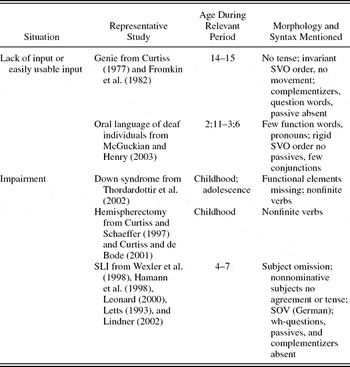
Table 1. First language acquisition in exceptional circumstances
 You have
Access
- 8
- Cited by
One of the main conclusions that we (Vainikka & Young-Scholten, Reference Vainikka, Young-Scholten, Hoekstra and Schwartz1994) make in regard to the second language (L2) German development of uninstructed Korean and Turkish adults was the resemblance of their morphosyntactic development to that of the German children under study at the time by Harald Clahsen and colleagues (see, e.g., Clahsen, Eisenbeiss, & Vainikka, Reference Clahsen, Eisenbeiss, Vainikka, Hoekstra and Schwartz1994; Clahsen & Penke, Reference Clahsen, Penke and Meisel1992). Data from these L2 learners also indicated initial transfer of the headedness of their native language verb phrases (VPs), a claim then strengthened by research on L2 learners whose first language (L1) headedness differed from German, namely, Italian and Spanish (Vainikka & Young-Scholten, Reference Vainikka and Young-Scholten1996). L2 learners’ initial grammars were argued to consist of just a “bare” VP, based on comprehensive lack of inflectional morphology and complex syntax, and similar to children acquiring L1 German, these L2 learners’ nonfinite verb forms were typically in final position, either early on (for head-final Korean and Turkish speakers) or a bit later, once headedness shifted to the German value from head-initial (for Italian and Spanish speakers). Similar to child L1 learners, the L2 morphosyntactic data pointed to subsequent projection of a head-initial underspecified functional projection and, with sufficient input, projection of higher functional projections. Apart from some details,Footnote 1 the claim was that for children and adults learning German, acquisition is defined by the emergence of syntactic projections and the morphology associated with them.
There has since been much discussion regarding the extent and nature of L1 influence on the L2 acquisition of morphosyntax by both adults and children, and although the majority currently favors an approach under which the L1 exerts influence from the initial state onward (Schwartz & Sprouse Reference Schwartz and Sprouse1996), a transfer-driven account has failed to truly address stages of acquisition. Yet for children with specific language impairment (SLI), a priority for parents, teachers, and therapists is tracking children's progress, which is an undertaking that would be difficult if one had no idea what step should come next (for early work along these lines on English, see Crystal, Fletcher, & Garman, Reference Crystal, Fletcher and Garman1976). Paradis' Keynote Article, which covers both SLI and L2 acquisition (by children), contains a number of important insights that strengthen the case for stages based on some sort of structure building in all types of acquisition.
REDUCED STRUCTURES AND OPTIONAL INFINITIVES
One of the main points covered in Paradis' Keynote involves comparing children of similar ages (or mean length of utterances) who are acquiring an L2 with children who are acquiring an L1 under SLI. Paradis shows that in many ways the two types of language acquisition are very similar, which can be seen in her figure 1a and 1b. In interpreting her data, rather than adopting Radford's (Reference Radford1990) early idea that functional projections mature altogether or Rizzi's (Reference Rizzi1993/1994) proposal that the optionality allowing projection of root infinitives ceases with maturation, Paradis follows Rice, Wexler, and Cleave's (Reference Rice, Wexler and Cleave1995) and Rice's (Reference Rice, Rice and Warren2004) model of an extended optional infinitive (EOI) stage, prompted by their work on SLI children.
Paradis has no choice but to follow Rice et al., because their account allows the possibility of not invoking maturation. We would like to suggest that she does not go far enough. This is perhaps because, for most acquisitionists, the operation of universal grammar entails a strong continuity approach (see, among others, Hyams, Reference Hyams and Meisel1992) under which languages share a single universal syntactic tree with all possible projections in any language. This tree also represents the L1 learner's initial state; however, explaining the reduced structures observed (e.g., root infinitives) has proven to be problematic, particularly when these reduced structures persist during development, as they do in SLI. Challenging strong continuity means relaxation of one of the three uniformity assumptions discussed in Culicover and Jackendoff (Reference Culicover and Jackendoff2005), derivational uniformity, allowing one to entertain various situations in which the projection of minimal syntax is natural, including during acquisition (see Vainikka & Young-Scholten, Reference Vainikka, Young-Scholten, Karimi, Samiian and Wilkins2007a).Footnote 2
In recent work, we take to its logical conclusion the idea that all acquisition commences with the learner's projection of a bare VP (Vainikka & Young-Scholten, Reference Vainikka and Young-Scholten2010a) by looking at a range of exceptional and unexceptional (L1A and child and adult L2A) language acquisition situations. If the learner projects only a VP in his/her earliest grammar, this explains the lack of tense or finiteness and the other aspects of the EOI phenomenon. Regardless of the details surrounding the exceptional circumstances presented in Table 1, researchers observations comprise a unified set regarding what is missing and what is nonadult-like in the grammars of the individuals affected.
First language acquisition in exceptional circumstances
Note: Age is in years;months; SVO, subject–verb–object; SLI, specific language impairment.
FURTHER SYNTACTIC STAGES AND ORGANIC GRAMMAR
Ten pages into her manuscript, Paradis wonders whether the parallels between child L2A and SLI extend beyond the initial stages, and she tentatively proposes that they do, at least in terms of the acquisition of finiteness and tense. This fits our proposal, which we now refer to as organic grammar, that functional projections develop one by one, both in (typical) L1 acquisition and in child and adult L2 acquisition (see Vainikka & Young-Scholten, Reference Vainikka and Young-Scholten2010b, on the L1 and L2 acquisition of German, including the stages involving the acquisition of finiteness, agreement, and subordinate clauses). Organic grammar is superior to the EOI proposal in that the latter is an analysis of just the earliest stage of acquisition, whereas organic grammar covers all subsequent stages of the development of phrase structure.
MATURATION VERSUS ORGANIC GRAMMAR
In addition to the overall similarity between child L2A and SLI/L1A, Paradis discusses specific differences between the two types of acquisition. As she implies, comparing these data types is critical for evaluating a maturational model of language acquisition, in particular Rice's (Reference Rice, Rice and Warren2004) maturational EOI model, to determine exactly where the differences lie. Rice's model predicts that there are differences between L2A and SLI, because typically developing children acquiring an L2 have already matured to a certain point (in particular, those children that have already acquired tense/finiteness in their L1). In contrast, SLI children are expected to be maturationally delayed and, for Paradis, this explains the differences between the two groups of children of the same age. Organic grammar points to a stronger conclusion than Paradis' concerning maturation, namely, that Rice's model actually cuts up the data in an unexpected fashion. It seems that Rice predicts that because delayed maturation is the cause of SLI, acquisition under SLI should look different from both L1A and L2A (where there are no maturational delays). L2A (child, according to Paradis, and adult, according to us) patterns one way, whereas SLI and L1A (whether simultaneuous bilingual or monolingual) pattern differently from L2A.
Paradis reviews two types of differences:
1. L2 children made more “commission” errors than SLI children (i.e., producing the wrong morpheme instead of omitting it).
2. Forms of the free morpheme BE are acquired earlier by children acquiring L2 English than other tense or finiteness morphemes, whereas in L1A/SLI forms of BE pattern with the other tense/finiteness morphemes.
As pointed out in Note 1, the production of functional morphology has been an ongoing topic of discussion among child and adult L2 acquisition researchers, and Paradis' analysis is an extremely useful addition to the debate. She concludes that the pattern of differences may be a challenge for a maturational model such as Rice's (Reference Rice, Rice and Warren2004), because the relative maturity of an L2 child does not in any obvious way explain the differences in Points 1 and 2 above. The picture that emerges here is the following: both children and adults (see Vainikka & Young-Scholten, Reference Vainikka, Young-Scholten and Beck1998) in L2A acquire free morphemes more readily than bound morphemes, and there may also be a difference in how inflectional morphology is used while it is being acquired. We believe that the overall similarities in the two types of acquisition that Paradis discusses are best captured by adopting a similar syntactic structure across acquisition situations (but varying, depending on how advanced a stage the learner occupies). In 1998 we assumed that the difference between L1A and L2A in terms of free versus bound morphemes was most likely connected with maturation; however, the very young L2 learners discussed by Paradis who display a similar pattern to the adult L2 acquirers prompt us to reconsider what we took to involve maturation in the phonological (prosodic) domain as the explanation. We are left with something along the lines of Paradis' discussion in terms of “creativity” or communicative pressure in the classroom. With respect to instructional settings, one might consider the nature of input the L2 children Paradis studied likely received in English as an L2 class. First, utterances in a language classroom might actually include the supposedly rare “one-word sentences separated by pauses” (from Paradis' quotation of Leonard, Reference Leonard1998). Second, unlike children acquiring their L1, school-age L2 children will be exposed to print, where free morphemes are relatively more salient than bound morphemes because of the spaces that surround words. That alphabetic literacy alters how one processes aural input is suggested by Tarone and colleagues’ (Tarone, Bigelow, & Hansen Reference Tarone, Bigelow, Hansen and Faux2007; see also Vainikka & Young-Scholten, Reference Vainikka, Young-Scholten and Faux2007b) work with adult immigrants who learn to read for the very first time during their acquisition of an L2. The situation with respect to print exposure is hardly clearcut. Differences in rate of acquisition of tense and agreement suffixes were found to relate to processing speed differences for two Farsi-speaking children learning L2 English in Mobaraki's (Reference Mobaraki2007) longitudinal study; the faster processer (a boy) read considerably more in both Farsi and English than did his sister. His faster rate of acquisition of these bound morphemes may have been the result of overall increased frequency of exposure, and the result of exposure in an additional (visual) mode. These factors have received very little attention from acquisitionists thus far.
ANOTHER CASE OF EXCEPTIONAL L1A
Where Paradis proposes that bilingualism may be therapeutic in SLI, data from a case not discussed elsewhere suggests this line of thinking may be on the right track. The case concerns a boy, Andrew, who is cognitively normal, performing at age level on the relevant academic tests for school readiness. Since birth he has suffered from a craniofacial syndrome, leading to multiple surgeries to correct, among other things, the misformation of his upper jaw and nasal area, and to a tracheostomy inserted at 0 years, 8 months (0;8) and removed at 4;11. Minor misformation of his fingers and toes has not required surgery but may have contributed to delays in development of motor skills. A hearing aid was fitted when he was 0;7. Most likely because of surgeries and early failure to thrive connected with feeding problems, at 4;10 he was 1.5 to 2 years behind socially and physically on gross-motor skills (from physical therapy assessment) and fine-motor skills (from occupational therapy assessment). His productive and receptive language was delayed, which was attributable to the above complications. To address anticipated problems, from 0;8 onward until the present (age 5;9) Andrew has received regular physical therapy and speech therapy, with the therapists involved being comparable in skill level. What is of interest here is that he is being raised in a trilingual environment where the maternal and paternal language each differ from the language of the wider community, which is also that of the speech and physical therapists (English). When Andrew was tested by a speech therapist at 4;3, prior to surgery at 4;5 to correct his upper jaw and midface area, this revealed a 6-month delay in English, which at the time was just becoming his strongest language, given its dominance in the wider environment. Andrew was at age level with his maternal language by this age (4;3), and he also exhibited some knowledge of his paternal language to which exposure was more limited. Understandably, given his physical problems up until 4;5, articulation of specific sounds (e.g., dentals) is at present (5;9) still delayed.
Although there are no comparison cases with children suffering from the same or a similar syndrome, it appears that Andrew's trilingual exposure has been therapeutic. His hearing and his articulators have been severely affected since birth; however, his language acquisition in the two languages to which he has received the most exposure has been and still is either typical, or delayed only in terms of the aforementioned problems with some consonants, relative to his gross and fine motor skills and social development, a situation that appears to be attributable to his trilingual environment. However, the languages to which Andrew is being exposed belong to three distinct language families and thus Paradis' proposal that the therapeutic effect is because of facilitation of morphosyntactic acquisition through transfer across languages would likely not apply in Andrew's case. Paradis raises an important issue that is worth pursuing in future research, which is to the eventual benefit of parents and teachers who, given folk beliefs about problems arising from bilingual exposure, would argue against the presumed overburdening of children in exceptional circumstances.