Introduction
Anxiety disorders are prevalent, disabling and costly (DuPont et al. Reference DuPont, Rice, Miller, Shiraki, Rowland and Harwood1996; Olfson et al. Reference Olfson, Fireman, Weissman, Leon, Sheehan, Kathol, Hoven and Farber1997; Mendlowicz & Stein, Reference Mendlowicz and Stein2000; Stein & Heimberg, Reference Stein and Heimberg2004; Kessler et al. Reference Kessler, Berglund, Demler, Jin, Merikangas and Walters2005). Although effective treatments are available, few patients receive them, especially in primary care settings, where the majority of anxious patients are seen (Stein et al. Reference Stein, Sherbourne, Craske, Means-Christensen, Bystritsky, Katon, Sullivan and Roy-Byrne2004). Coordinated Anxiety Learning and Management (CALM) is a flexible model for delivering evidence-based treatment for four anxiety disorders often encountered in primary care clinics: panic disorder (PD), generalized anxiety disorder (GAD), social anxiety disorder (SAD) and post-traumatic stress disorder (PTSD).
Compared to usual care (UC), CALM resulted in greater improvement in anxiety and depression symptoms, functional disability and quality of care from baseline to 18 months across all anxiety disorders and also in each principal anxiety disorder (Roy-Byrne et al. Reference Roy-Byrne, Craske, Sullivan, Rose, Edlund, Lang, Bystritsky, Welch, Chavira, Golinelli, Campbell-Sills, Sherbourne and Stein2010; Craske et al. Reference Craske, Stein, Sullivan, Sherbourne, Bystritsky, Rose, Lang, Welch, Campbell-Sills, Golinelli and Roy-Byrne2011). The flexibility of treatment, targeting of multiple anxiety disorders and clinical effectiveness across a range of patients and clinics suggest that the CALM model should be broadly applicable to primary care practices. However, even after clinical feasibility and effectiveness have been demonstrated, trade-offs between benefits and costs must be considered before disseminating a new treatment model. The current study reports estimates of benefits and costs for CALM versus UC.
When the cost-effectiveness of a new treatment is assessed, ideally, effects within and outside the health-care system are taken into account (Russell et al. Reference Russell, Gold, Siegel, Daniels and Weinstein1996). Outside the system, anxiety disorders can impact quality of life, employment, educational attainment, and more (Wittchen, Reference Wittchen2002; Van Ameringen et al. Reference Van Ameringen, Mancini and Farvolden2003; Waghorn & Chant, Reference Waghorn and Chant2005). However, because sufficient data on costs or effects outside the health-care system are not available for CALM study participants, the current paper focuses on costs within the health-care system.
Within the health-care system, a new treatment will generate more costs if it requires additional medications, or more, or more expensive, health-care visits. Most CALM treatment costs are incurred during a relatively short time, with the exception of minimal ongoing medication costs. By contrast, clinical effects from CALM continue to accumulate beyond the active treatment phase (Roy-Byrne et al. Reference Roy-Byrne, Craske, Sullivan, Rose, Edlund, Lang, Bystritsky, Welch, Chavira, Golinelli, Campbell-Sills, Sherbourne and Stein2010). CALM benefits versus costs should therefore be evaluated beyond the end of treatment. The CALM randomized controlled trial (RCT) followed participants for 18 months. For the majority of participants, the 18 months included 12 months of data beyond the end of treatment, as 87% of CALM participants had completed treatment by 6 months.
Method
The CALM study is a randomized, controlled effectiveness trial of the CALM treatment model versus UC. The study and its methods are described in detail elsewhere (Sullivan et al. Reference Sullivan, Craske, Sherbourne, Edlund, Rose, Golinelli, Chavira, Bystritsky, Stein and Roy-Byrne2007; Roy-Byrne et al. Reference Roy-Byrne, Craske, Sullivan, Rose, Edlund, Lang, Bystritsky, Welch, Chavira, Golinelli, Campbell-Sills, Sherbourne and Stein2010); they are summarized below. The study was approved by the institutional review boards of the Rand Corporation, University of Arkansas, University of California at San Diego, University of California at Los Angeles, and University of Washington.
Settings and subjects
Between June 2006 and April 2008, 1004 primary care patients were enrolled in 17 clinics in four US cities. The clinics were located in Little Rock, Arkansas, Los Angeles County and San Diego, California, and Seattle, Washington. All participants gave written, informed consent.
Participants were between 18 and 75 years old and English- or Spanish-speaking. All met DSM-IV criteria for one or more of PD, GAD, SAD and PTSD based on the Mini-International Neuropsychiatric Interview (MINI; Sheehan et al. Reference Sheehan, Lecrubier, Sheehan, Amorim, Janavs, Weiller, Hergueta, Baker and Dunbar1998). At baseline, they also scored at least 8 (moderate anxiety symptoms on a scale ranging from 0 to 20) on the Overall Anxiety Severity and Impairment Scale (OASIS; Campbell-Sills et al. Reference Campbell-Sills, Norman, Craske, Sullivan, Lang, Chavira, Bystritsky, Sherbourne, Roy-Byrne and Stein2009). Co-occurring major depression was permitted. After a baseline interview, participants were randomized to the CALM treatment model or UC.
CALM treatment model
The CALM treatment model offered patients the choice of cognitive behavioral therapy (CBT), anti-anxiety medication, or both. To enhance treatment decisions, the model included real-time, web-based clinical outcome monitoring (Unützer et al. Reference Unützer, Choi, Cook and Oishi2002a ) and a computer-assisted program to optimize CBT delivery by non-expert care managers (Craske et al. Reference Craske, Rose, Lang, Welch, Campbell-Sills, Sullivan, Sherbourne, Bystritsky, Stein and Roy-Byrne2009). Care managers also assisted primary care clinicians with promoting treatment adherence and optimizing medications. Psychiatrists provided consultation as needed (Sullivan et al. Reference Sullivan, Craske, Sherbourne, Edlund, Rose, Golinelli, Chavira, Bystritsky, Stein and Roy-Byrne2007).
The CALM group obtained treatment for 3 to 12 months. Initially, participants received their preferred treatment for 10 to 12 weeks. Participants who were symptomatic and thought to benefit from additional treatment could then receive more of the same or the alternative modality for up to three more steps of treatment at 3-month intervals over 1 year. After treatment completion, participants were entered into continued care and received monthly follow-up telephone calls to reinforce CBT skills, medication adherence, or both.
UC
The UC group continued to be treated by their physician in the usual manner. Usual treatment could include medication, counseling (seven of 17 clinics had limited in-clinic mental health resources), or referral to a mental health specialist. After the eligibility diagnostic interview, the only contact between UC participants and study personnel was for assessment by telephone.
Assessments
An assessment battery was administered at baseline and 6, 12 and 18 months post-baseline with centralized telephone surveys conducted by the RAND Survey Research Group. Interviewers were blinded to treatment assignment.
Clinical effectiveness measures
CALM's primary focus is anxiety. To capture changes in anxiety symptoms resulting from the CALM treatment model, we estimated the number of anxiety-free days (AFDs). To capture potential additional benefits, such as improved depression symptoms or functioning in response to the collaborative care model used by CALM, we also estimated quality-adjusted life years (QALYs).
We constructed AFDs with the 12-item Brief Symptom Inventory (BSI-12) subscales for anxiety and somatization (Derogatis, Reference Derogatis1993), the main CALM outcome measure. Following Lave et al. (Reference Lave, Frank, Schulberg and Kamlet1998), we first calculated for each BSI-12 score a value between 1 (‘anxiety free’) and 0 (‘fully symptomatic’). For BSI-12 scores ⩽8, the day was considered anxiety free; for scores ⩾18 it was considered fully symptomatic; and for scores between 8 and 18, the day was considered anxiety free proportionally (e.g. a score of 13 corresponds to ½ AFD), similar to criteria used for depression-free days (Simon et al. Reference Simon, Ludman and Rutter2009). Next, we used linear interpolation to estimate the number of AFDs between baseline and the month-6 assessment by averaging the baseline and month-6 AFD values and multiplying the average by the number of days between the two assessments (Lave et al. Reference Lave, Frank, Schulberg and Kamlet1998; Katon et al. Reference Katon, Roy-Byrne, Russo and Cowley2002; Vannoy et al. Reference Vannoy, Arean and Unützer2010). We repeated this approach for the remaining assessment intervals and summed the resulting AFDs per participant.
We estimated QALYs with scores from the Short-Form Health Survey-12 (SF-12; Ware et al. Reference Ware, Kosinski and Keller1996) and the EuroQol EQ-5D (Rabin & de Charro, Reference Rabin and de Charro2001). We followed Brazier & Roberts (Reference Brazier and Roberts2004) to generate the preference-based index of health, SF-6D. The utility-based algorithm for estimating the measure from a six-dimensional health state classification was modified to account for scoring of version 2 of the SF-12 (J. E. Brazier, written communication, April 2010). The algorithm for valuation of the EQ-5D used US population-based EQ-5D preference weights (Shaw et al. Reference Shaw, Johnson and Coons2005). We calculated the area under the curve to derive values over 18 months.
Health-care cost measures
Participants reported health-care use in response to survey questions developed for Partners in Care (Wells, Reference Wells1999). Participants were asked to enumerate, for the 6 months prior to each assessment, the number of visits to primary care providers; medical specialists; psychiatrists; non-psychiatrist mental health providers (e.g. psychologist, psychotherapist); the emergency room (ER); and hospitalizations. Participants were instructed to include CALM treatment visits in their counts. Participants were also asked about psychiatric medications used, including name, dosage, number of pills, and length of time taken.
The cost analysis focused on out-patient visits, ER visits, and psychiatric medication use. Hospitalization costs are presented as secondary information because hospitalizations are relatively rare and require a large sample to examine differences between intervention and UC (Sturm et al. Reference Sturm, Unützer and Katon1999). All costs are in 2009 US dollars. As recommended by the Medical Expenditure Panel Survey (MEPS), we adjusted cost to $2009 with the Personal Health-care Expenditure component of the National Health Expenditure Accounts (www.meps.ahrq.gov/mepsweb/about_meps/Price_Index.shtml).
To estimate cost in the absence of administrative data, we multiplied the number of visits reported by each participant at each assessment by average per-visit expenses from MEPS (Machlin & Carper, Reference Machlin and Carper2007b ). MEPS expenses reflect payments by private insurance, Medicare, Medicaid, Workers Compensation, and individuals. We used separate average expenses for primary care providers; specialists other than psychiatrists; and psychiatrists. Because MEPS does not differentiate payments to non-psychiatrist mental health providers, we used the average primary care visit expense for them. To estimate ER cost, we multiplied the number of ER visits by the average MEPS ER visit expense. For consistency with out-patient expense estimates, the first author estimated average ER expenses with MEPS data File HC-085E: 2004 Emergency Room Visits. Hospital stay costs are based on MEPS expense estimates for in-patient stays (Machlin & Carper, Reference Machlin and Carper2007a ). MEPS reports average per diem expenses by length of stay. Thus, we multiplied the number of nights for each stay by the corresponding per diem expense.
We based psychiatric medication cost on average wholesale prices in the 2009 Red Book edition. For each medication, we multiplied the number of pills participants reported having taken by its average Red Book price and then summed across all psychiatric medications by participant.
Cost-effectiveness measure
To compare CALM with UC, we estimated incremental costs and benefits and the incremental net benefit (INB). In recent years, the INB has become the preferred statistic for summarizing results of cost-effectiveness analyses (Nixon et al. Reference Nixon, Wonderling and Grieve2010). The INB combines incremental costs and incremental benefits into a single, monetary measure (Stinnett & Mullahy, Reference Stinnett and Mullahy1998) as follows:

where λ is the monetary value willing to pay per unit of benefit, μEffect CALM is the CALM sample mean effect, μEffect UC is the UC sample mean effect, μCost CALM is the CALM sample mean cost and μCost UC is the UC sample mean cost.
In contrast to the incremental cost-effectiveness ratio (ICER), the INB is a sum and, as such, avoids some of the ICER's inherent difficulties. For instance, two opposite cost–benefit results can have the same ICER value when a new intervention is either (a) clearly dominant because of its lower cost and higher benefit or (b) clearly inferior because of its higher cost and lower benefit compared to UC. ICER confidence intervals (CIs) can also include undefined values or can be completely undefined (Willan & Lin, Reference Willan and Lin2001). Because dollar values of an AFD or a QALY have not been established, we estimated the INB for a range of monetary values.
Statistical analysis
We prepared data with SAS version 9.2 (SAS Institute, USA) and analyzed them with StataSE 11 (StataCorp LP, USA). Study participants were the unit of analysis. We conducted separate analyses based on original assignment, regardless of treatment received for: (1) participants with complete cost and effectiveness data; (2) participants with complete data using non-response weights; and (3) participants with complete and incomplete data using missing data imputation. We constructed non-response weights and imputed AFDs, QALYs and health-care expenditures to address potential bias due to non-participation at follow-up, loss to follow-up and incomplete item-level data. Weights and imputations used baseline demographic characteristics, health-care use, medical and psychiatric conditions, level of functioning and disability, and anxiety and depression symptom scores. We performed multiple imputations with Stata's mi impute and mi estimate routines and 50 imputations. Twenty-two participants could not be included in the imputations because of missing baseline data.
The distribution of data can be of concern in cost-effectiveness analyses. Because true distributions are unknown, incorrect parametric assumptions about their form may lead to inappropriate inferences. To address this issue, we estimated mean INBs and their CIs non-parametrically with the central limit theorem approach in Nixon et al. (Reference Nixon, Wonderling and Grieve2010). However, a non-parametric approach is only appropriate if intervention and UC groups are similar at baseline. Although this was the case in CALM, we nevertheless adjusted for site to be consistent with Roy-Byrne et al. (Reference Roy-Byrne, Craske, Sullivan, Rose, Edlund, Lang, Bystritsky, Welch, Chavira, Golinelli, Campbell-Sills, Sherbourne and Stein2010) in assessing CALM clinical effects. To control for site, we estimated INBs with linear regression following Hoch et al. (Reference Hoch, Briggs and Willan2002). To examine the influence of outliers, we also estimated INBs with median regression adjusted for site. Median regression is less sensitive to outliers than ordinary linear regression and appropriate when data are skewed (Koenker & Hallock, Reference Koenker and Hallock2001). Median regression results represent the expected difference in INB medians between CALM and UC.
Results
Complete cost and effectiveness data were available for 692 of the 1004 participants (69%; 341 UC, 351 CALM). Five participants died during the study, 5.6% refused assessment after baseline, and the remaining participants lost to follow-up could not be contacted. Compared to participants with complete data, participants with missing information were younger, more likely to be Hispanic, have lower income, panic and multiple co-morbid anxieties, higher disability, anxiety and depression symptom scores, more ER visits, lower social support, and lower emotional functioning. We excluded two outliers.Footnote 1 Footnote †
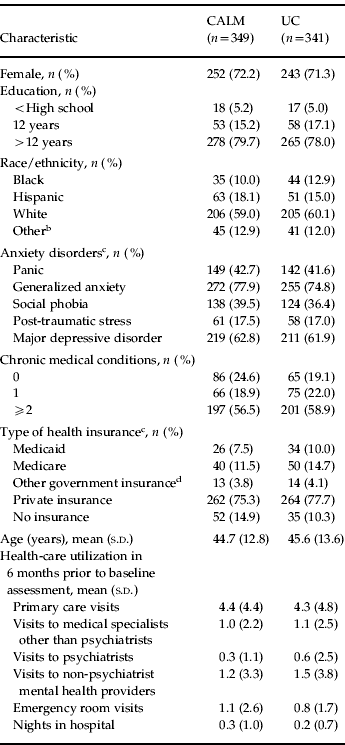
Table 1 provides baseline demographic and clinical characteristics and health-care use for the cost-effectiveness sample. At baseline, there were no statistically significant differences between the CALM and UC groups. The sample included more women, was ethnically diverse, and represented a broad age range. It was a fairly ill group; more than half had at least two anxiety disorders, two chronic medical conditions and co-morbid major depression.
Baseline characteristics of cost-effectiveness sampleFootnote a

CALM, Coordinated Anxiety Learning and Management; UC, usual care; s.d, standard deviation.
a There are no significant differences in any baseline characteristics between CALM and UC participants at p<0.05. Differences between CALM and UC participants were assessed with χ2 tests for categorical variables and t tests for continuous variables. Some numbers do not add up to the total number of participants because of missing data. Percentages may not add up to 100 because of rounding.
b This category includes race/ethnicity endorsements other than black, Hispanic or white.
c Numbers may total more than 690 because participants can have more than one disorder or health insurance.
d Other government insurance includes Veterans Administration benefits, TRICARE, county programs, or other government insurance, not otherwise specified.
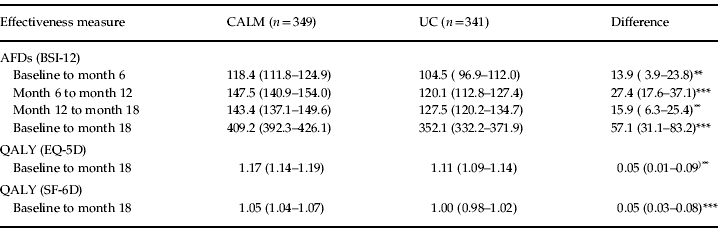
At each follow-up, mean BSI-12 scores were statistically significantly lower for CALM than UC. The mean number of AFDs from baseline to the 18-month follow-up was 57.1 days higher for the CALM treatment group (Table 2). Moreover, at each follow-up, mean EQ-5D and SF-6D scores were statistically significantly higher for CALM than UC by 0.04 to 0.05. Regardless of whether QALYs were measured with the EQ-5D or SF-6D, the CALM intervention added, on average, 0.05 QALYs between baseline and the 18-month follow-up (Table 2).
Effectiveness: baseline to month 6, 12 and 18 assessments

CALM, Coordinated Anxiety Learning and Management; UC, usual care; AFD, anxiety-free day; BSI-12, 12-item Brief Symptom Inventory; QALY, quality-adjusted life year.
Values given as mean (95% confidence interval). The results are weighted for non-response.
*** p<0.0001, ** p<0.01, * p<0.05.
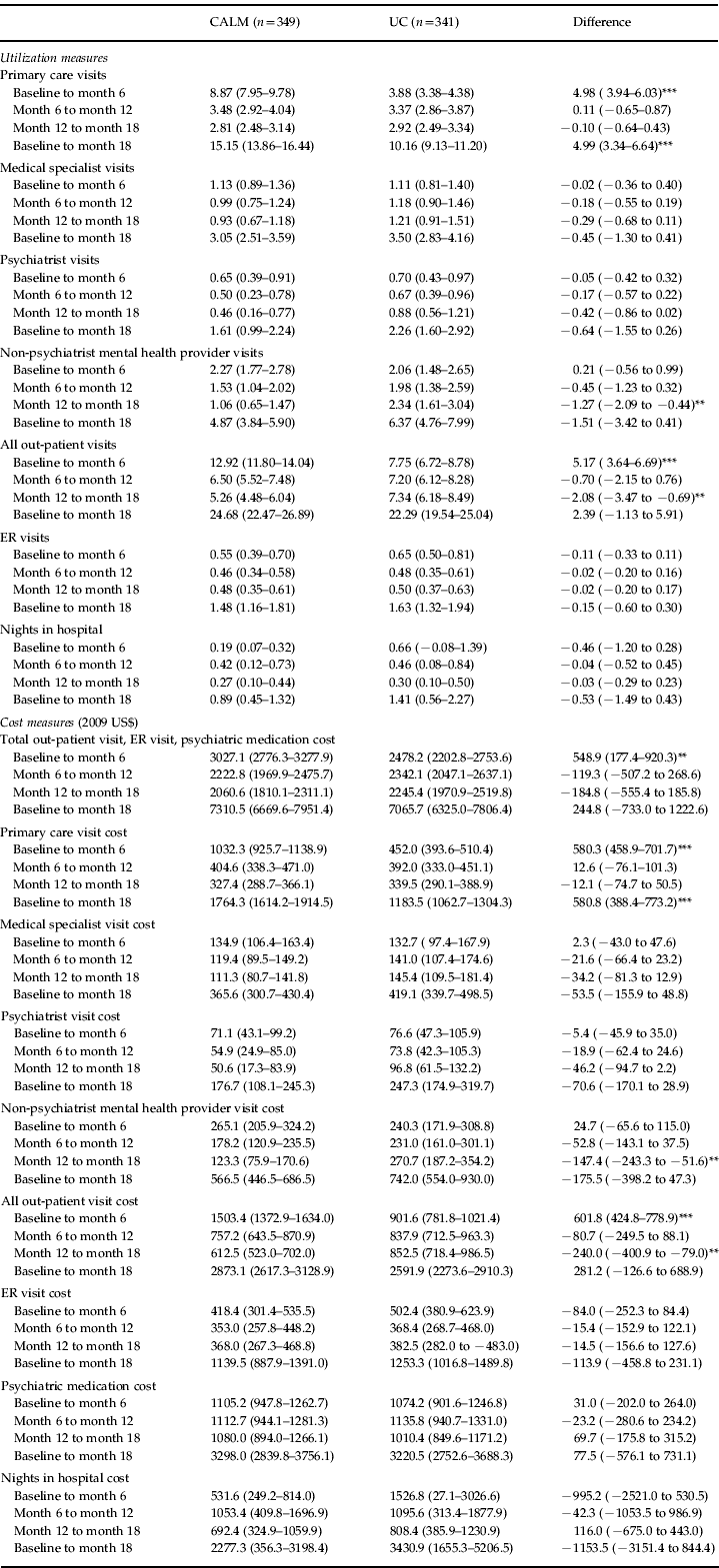
The per-participant cost of visits to primary care providers, medical specialists, psychiatrists, other mental health providers, the ER, and psychiatric medications was, on average, $245 higher for CALM than UC (Table 3). This difference is mainly the result of additional primary care visits among the CALM group. From baseline to the 18-month assessment, the average number of visits to medical specialists, psychiatrists, mental health providers other than psychiatrists, and the ER are all lower for CALM than UC, but the differences are not statistically significant at conventional levels. By contrast, the average number of visits to primary care providers is significantly higher for CALM (5.0, 95% CI 3.3–6.6). These additional primary care visits mostly took place within 6 months after randomization, when CALM treatment participants attended CBT sessions and/or medication management visits. Such visits are included in primary care visit counts.
Health-care utilization and costs: baseline to month 6, 12 and 18 assessments

CALM, Coordinated Anxiety Learning and Management; UC, usual care; ER, emergency room.
Values given as mean (95% confidence interval). The results are weighted for non-response.
*** p<0.0001, ** p<0.01, * p<0.05.
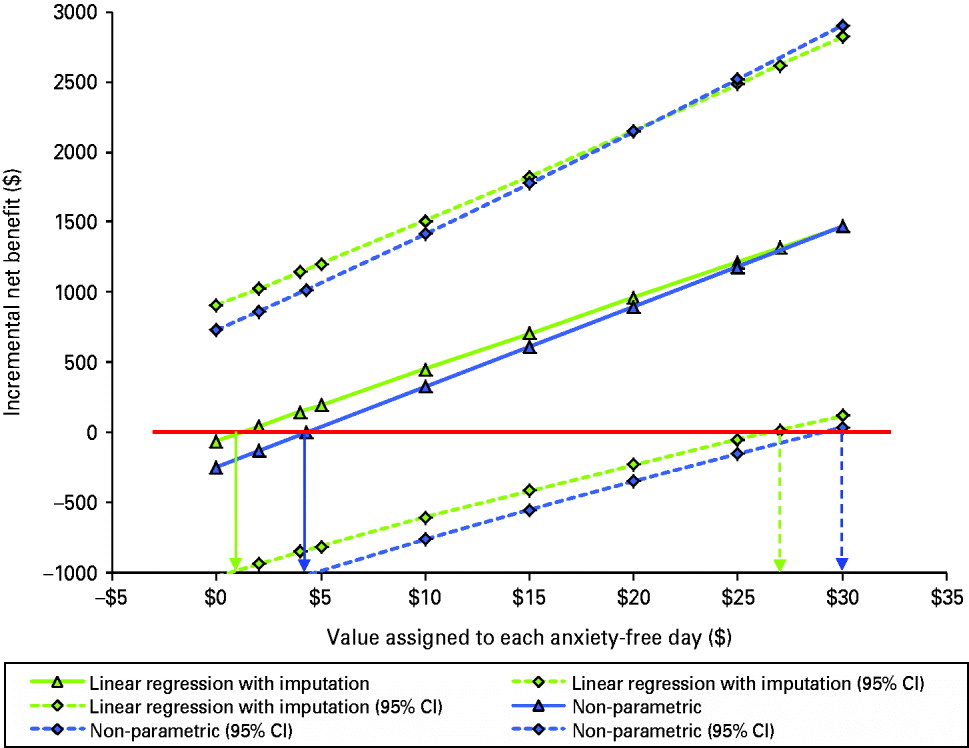
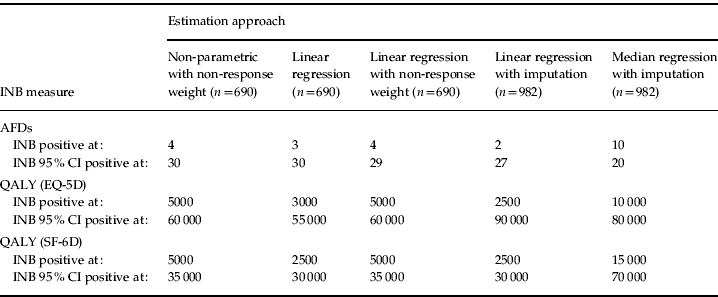
The INB for AFDs of CALM versus UC represents the monetary value of the additional mean AFDs experienced by CALM participants minus their additional mean costs for out-patient and ER visits and psychiatric medications. Figure 1 depicts how this INB varies depending on the value assigned to an AFD according to (a) non-parametric and (b) linear regression estimates with imputed data. When an AFD is valued at $0, the INB of CALM is negative in the amount of the CALM added cost of about $245 over 18 months. As an AFD is valued increasingly more highly, the INB becomes positive; that is, the value of added days free of anxiety exceeds the additional cost of CALM. According to the non-parametric results, an AFD has to be worth $4 to reach a positive INB, but at $4, the 95% CI includes negative INBs. This CI includes only positive values when an AFD is valued at $30. For the linear regression results with imputation, the INB becomes positive when an AFD is valued at ⩾$2 and the 95% CI includes only positive values at ⩾$27. The results obtained with the other estimation approaches are qualitatively similar to those in Fig. 1 (Table 4).
Incremental net benefit (INB) of Coordinated Anxiety Learning and Management (CALM) compared to usual care (UC) for anxiety-free days (AFDs). The INB varies with the $ value assigned to each additional AFD.

Incremental net benefit (INB) estimates by estimation approach

AFD, Anxiety-free day; INB, incremental net benefit; CI, confidence interval; QALY, quality-adjusted life year.
Values given as US$.
The INB estimates for QALYs are also similar across estimation approaches (Table 4). One exception is the somewhat wider EQ-5D QALY CI obtained with linear regression and imputation. For both QALY measures, a QALY has to be worth between $2500 and $5000 to reach a positive INB. To reach positive 95% CIs, a QALY has to be worth ⩾$90 000 for the EQ-5D and ⩾$35 000 for the SF-6D.
Discussion
For depression treatment in primary care, more than 40 studies have documented the effectiveness of collaborative care, that is care manager-assisted chronic disease management programs (e.g. Katon et al. Reference Katon, Von Korff, Lin, Walker, Simon, Bush, Robinson and Russo1995, Reference Katon, Robinson, Von Korff, Lin, Bush, Ludman, Simon and Walker1996, Reference Katon, Von Korff, Lin, Simon, Walker, Unützer, Bush, Russo and Ludman1999; Katzelnick et al. Reference Katzelnick, Simon, Pearson, Manning, Helstad, Henk, Cole, Lin, Taylor and Kobak2000; Simon et al. Reference Simon, Von Korff, Rutter and Wagner2000; Wells et al. Reference Wells, Sherbourne, Schoenbaum, Duan, Meredith, Unützer, Miranda, Carney and Rubenstein2000; Rost et al. Reference Rost, Nutting, Smith, Elliott and Dickinson2002; Unützer et al. Reference Unützer, Katon, Callahan, Williams, Hunkeler, Harpole, Hoffing, Della Penna, Noel, Lin, Arean, Hegel, Tang, Belin, Oishi and Langston2002b ). Although anxiety disorders are more prevalent than depression (Kessler et al. Reference Kessler, McGonagle, Zhao, Nelson, Hughes, Eshleman, Wittchen and Kendler1994) and equally as disabling and costly (Greenberg et al. Reference Greenberg, Sisitsky, Kessler, Finkelstein, Berndt, Davidson, Ballenger and Fyer1999; Kessler, Reference Kessler2000; Mendlowicz & Stein, Reference Mendlowicz and Stein2000; Stein & Kean, Reference Stein and Kean2000; Stein & Heimberg, Reference Stein and Heimberg2004), collaborative care for the treatment of anxiety disorders in primary care has been examined in only three prior studies (Roy-Byrne et al. Reference Roy-Byrne, Katon, Cowley and Russo2001, Reference Roy-Byrne, Craske, Stein, Sullivan, Bystritsky, Katon, Golinelli and Sherbourne2005; Rollman et al. Reference Rollman, Belnap, Mazumdar, Houck, Zhu, Gardner, Reynolds, Schulberg and Shear2005). These studies focused on PD or GAD. Thus, CALM is the first RCT to provide estimates of benefits and costs of a collaborative care treatment model in primary care settings for patients with multiple anxiety disorders.
As reported previously (Roy-Byrne et al. Reference Roy-Byrne, Craske, Sullivan, Rose, Edlund, Lang, Bystritsky, Welch, Chavira, Golinelli, Campbell-Sills, Sherbourne and Stein2010; Craske et al. Reference Craske, Stein, Sullivan, Sherbourne, Bystritsky, Rose, Lang, Welch, Campbell-Sills, Golinelli and Roy-Byrne2011), compared to UC, CALM showed clinical benefits for patients with PD, GAD, SAD and PTSD over the 18-month study. As described here, CALM also resulted in 57 additional AFDs over the 18 months. This average is below estimates reported earlier for primary care PD patients during a 1-year follow-up (Katon et al. Reference Katon, Roy-Byrne, Russo and Cowley2002, Reference Katon, Russo, Sherbourne, Stein, Craske, Fan and Roy-Byrne2006). The third study (Rollman et al. Reference Rollman, Belnap, Mazumdar, Houck, Zhu, Gardner, Reynolds, Schulberg and Shear2005) did not report AFD estimates. One reason for the discrepancy may be measurement based. In contrast to CALM, the PD studies derived AFDs from Anxiety Sensitivity Index (ASI) not BSI-12 scores. For PD, the ASI has been shown to have a larger effect size than other anxiety self-report measures (Hazen et al. Reference Hazen, Walker and Eldridge1996). Furthermore, CALM enrolled participants who used alcohol or marijuana. Such patients may be more treatment resistant, which may result in fewer AFDs.
The average difference in combined costs for out-patient visits, ER visits and psychiatric medications between CALM and UC was $245 during the 18 months. These additional costs of CALM are below the $473 incremental out-patient cost reported by Katon et al. (Reference Katon, Russo, Sherbourne, Stein, Craske, Fan and Roy-Byrne2006) for primary care patients with PD. The earlier study was able to include additional cost categories, collected health-care use data differently, but also used a narrower cost measure than the study reported here. The other extant PD study reported $325 lower out-patient costs for the intervention group (Katon et al. Reference Katon, Roy-Byrne, Russo and Cowley2002). In this latter study, diagnostic tests and non-mental health medications contributed considerably to the lower cost for the intervention group. The CALM study did not have cost data for either category.
The INB of CALM reflects the trade-off between its clinical benefits and additional health-care costs compared to UC. When an AFD is valued at ⩾$4, the additional cost of CALM is offset by the additional AFDs that CALM affords. This result compares favorably with the $8.40 reported by one PD study (Katon et al. Reference Katon, Russo, Sherbourne, Stein, Craske, Fan and Roy-Byrne2006), but is slightly higher than the −$4.00 reported by the other PD study (Katon et al. Reference Katon, Roy-Byrne, Russo and Cowley2002).
To our knowledge, there is no agreement on how to value a day free of anxiety. Primary care patients who have been treated for depression were willing to pay, on average, about $10 (in 2000 US dollars) per depression-free day (Unützer et al. Reference Unützer, Katon, Russo, Simon, von Korff, Lin, Walker, Ludman and Bush2003). If patients with anxiety disorders value a day free of anxiety similarly, the CALM treatment model provides a worthwhile benefit.
A figure of $50 000 per QALY gained is commonly referenced in the literature as a threshold for considering a new intervention (Grosse, Reference Grosse2008). Thus, at point estimates of between $2500 and $5000 per QALY gained, the CALM treatment model has potential to provide value to patients.
Limitations
Several study limitations need to be noted. First, costs and benefits are based on the first 18 months after randomization. Studies of collaborative care for depression in primary care indicate that clinical benefits and reductions in general medical costs may continue considerably beyond 18 months (Simon et al. Reference Simon, Ludman and Rutter2009). Hence, if the results from depression studies extend to collaborative care treatment for anxiety disorders in primary care, the incremental benefits and cost reported for CALM are conservative.
Second, our cost estimates were derived from self-reported health-care and medication use. If there is a systematic difference in reporting health-care visits and medication use between CALM and UC participants, the INB of CALM could be biased. A priori, we have no reason to expect differential reporting between the two groups.
Third, because of data limitations, the cost estimates do not cover medical procedures and non-psychiatric medications. Because CALM reduced somatic anxiety symptoms, CALM participants probably underwent fewer medical procedures during follow-up than UC participants. In this case, the incremental cost of CALM may be overestimated, resulting in conservative cost-effectiveness estimates.
Fourth, data limitations prevented us from distinguishing between primary care and Anxiety Clinical Specialist (ACS) visits. ACS visits, which are central to the CALM treatment model, are typically cheaper than primary care visits, as they are provided mostly by social workers and nurses. The reported cost estimates for CALM could therefore be higher than its actual cost, again producing conservative cost-effectiveness estimates.
Fifth, benefits realized outside the health-care system, such as improved productivity at work or at home, are not incorporated for lack of data. If such benefits were included, the INB may become positive at a lower monetary value per AFD than reported here.
Sixth, the results are based on data from 70% of participants in the baseline sample. It is unknown whether the benefit–cost trade-off is different for the remaining participants and whether a difference would change the results. Because our estimates remained qualitatively the same when we addressed missing data with weights or multiple imputations, we presume that the reported results are stable.
Conclusion
Persons with anxiety disorders are most often treated in primary care settings. Despite the high prevalence of anxiety disorders (Kessler et al. Reference Kessler, Berglund, Demler, Jin, Merikangas and Walters2005) and an increase in the proportion of individuals seeking help (Wang et al. Reference Wang, Lane, Olfson, Pincus, Wells and Kessler2005), patient care is not necessarily evidence based. Quality improvement interventions within those settings are therefore much needed. Patients with anxiety disorders whose care was provided with the CALM treatment model, on average, experienced greater improvement in anxiety and depression symptoms, functional disability and quality of care during 18 months of follow-up than patients in UC (Roy-Byrne et al. Reference Roy-Byrne, Craske, Sullivan, Rose, Edlund, Lang, Bystritsky, Welch, Chavira, Golinelli, Campbell-Sills, Sherbourne and Stein2010). Importantly, these benefits were achieved with modest increases in health-care expenditures. Thus, CALM holds promise for improving the lives of patients with anxiety disorders seen in primary care clinics.
It has been well documented that, under the current reimbursement system, financial barriers preclude the integration of mental health services into primary care (Butler et al. Reference Butler, Kane, McAlpine, Kathol, Fu, Hagedorn and Wilt2008). Organizational barriers pose further challenges to the successful integration of mental health services into primary care. Whether private insurers and other payers will use research findings to make decisions about covering evidence-based treatments and how much to pay for them remain open questions. Until these challenges are addressed, mental health care in the USA will continue to fail millions of patients in need of effective care.
Acknowledgements
This work was supported by grants U01 MH057858 and K24 MH065324 (P. Roy-Byrne), U01 MH058915 (M. G. Craske), U01 MH070022 (G. Sullivan), U01 MH070018 (C. D. Sherbourne), and U01 MH057835 and K24 MH64122 (M. B. Stein) from the National Institute of Mental Health (NIMH).
The CALM study's oversight was managed by the NIMH data and safety monitoring board, which has a rotating panel of members. The NIMH had no other involvement with the design and conduct of the study; in the collection, management, analysis, and interpretation of the data; or in the preparation, review or approval of the manuscript.
B. Benjamin (RAND Corporation, Santa Monica, California), D. Golinelli (RAND Corporation, Santa Monica, California) and I. I. West (University of Washington, Seattle, Washington) prepared some of the data used in the analysis.
In addition to the authors C. D. Sherbourne, G. Sullivan, M. B. Stein, M. G. Craske and P. Roy-Byrne, the following individuals conducted the CALM RCT (in alphabetical order): A. Bystritsky (University of California, Los Angeles, California), L. Campbell-Sills (University of California, San Diego, California), D. A. Chavira (University of California, San Diego, California), M. J. Edlund (University of Arkansas for Medical Sciences, Little Rock, Arkansas), D. Golinelli (RAND Corporation, Santa Monica, California), A. J. Lang (VA San Diego Healthcare System and University of California, San Diego, Californi), R. D. Rose (University of California, Los Angeles, California), and S. Shaw Welch (University of Washington, Seattle, Washington). K. Bumgardner (University of Washington, Seattle, Washington) was responsible for the central coordination of the CALM study.
[Clinical Trial Registration: clinicaltrials.gov. Identifier: NCT00347269.]
Declaration of Interest
P. Roy-Byrne reported receiving research grant support from the National Institutes of Health (NIH); having served as a paid member of advisory boards for Jazz Pharmaceuticals and Solvay Pharmaceuticals (one meeting for each); having received honoraria for CME-sponsored speaking from the American Psychiatric Association, Anxiety Disorders Association of America, CME LLC, CMP Media, Current Medical Directions, Imedex, Massachusetts General Hospital Academy, and PRIMEDIA Healthcare; and serving as editor in chief for Journal Watch Psychiatry (Massachusetts Medical Society), Depression and Anxiety (Wiley-Liss Inc.) and UpToDate in Psychiatry (UpToDate Inc.). P. Roy-Byrne reported also serving as an expert witness on multiple legal cases related to anxiety; none involving pharmaceutical companies or specific psychopharmacology issues.
M. G. Craske reported receiving research grant support from the NIH Health and having received honoraria for sponsored speaking from the Anxiety Disorders Association of America.
M. B. Stein reported receiving or having received research support from the US Department of Defense, Eli Lilly, GlaxoSmithKline, Hoffmann-La Roche, National Institutes of Health, and the US Veterans Affairs Research Program; and is currently or has been a paid consultant for AstraZeneca, Avera Pharmaceuticals, BrainCells Inc., Bristol-Myers Squibb, Comprehensive NeuroScience, Eli Lilly, Forest Laboratories, GlaxoSmithKline, Hoffmann-La Roche, Jazz Pharmaceuticals, Johnson & Johnson, Mindsite, Pfizer, Sepracor, and Transcept Pharmaceuticals. M. B. Stein is paid for editorial work on the journal Depression and Anxiety and UpToDate in Psychiatry (UpToDate Inc.).