Introduction
Vaccines have improved the control of human and animal diseases and thereby greatly reduced illness and death. However, vaccination is not an unchanging science. Vaccines are introduced, improved or withdrawn, and vaccination protocols may change as the prevalence of a disease waxes or wanes, or new evidence about vaccine side effects is discovered. In the 1990s, evidence that vaccination was, in rare instances, linked to aggressive feline sarcomas prompted a re-examination of feline vaccine protocols. Veterinarians questioned whether annual revaccination of cats was necessary and whether the risk of injection site sarcomas could be decreased if cats were vaccinated less often. Recently, concerns about annual vaccination have been extended to other companion animal species.
Although vaccination has an excellent safety record, no medical procedure is completely innocuous. Vaccine side effects are a particular concern in companion animals, which are vaccinated repeatedly over their lifetimes and are highly valued by their human companions. In addition to vaccine-associated fibrosarcomas, which seem to be limited to cats and possibly ferrets, vaccines have been associated with other rare side effects in companion animals (Hendrick, Reference Hendrick1998; Munday et al., Reference Munday, Stedman and Richey2003). Reported adverse effects include anaphylaxis, postvaccinal polyneuropathy, autoimmune disease, hypertrophic osteodystrophy, corneal edema, non-specific systemic side effects such as fever and lethargy, and localized reactions including pain, swelling, vaccine-associated alopecia, conjunctivitis and oculonasal ulcers (Kruth and Ellis, Reference Kruth and Ellis1998; Carmichael, Reference Carmichael1999; Dodds, Reference Dodds2001; Meyer, Reference Meyer2001; Richards and Rodan, Reference Richards and Rodan2001; Gaskell et al., Reference Gaskell, Gettinby, Graham and Skilton2002; Moore et al., Reference Moore, Guptill, Ward, Glickman, Faunt, Lewis and Glickman2005, Reference Moore, DeSantis-Kerr, Guptill, Glickman, Lewis and Glickman2007; Davis-Wurzler, Reference Davis-Wurzler2006). Microbial contamination of vaccines, although very rare, can also be a concern (Kruth and Ellis, Reference Kruth and Ellis1998; Dodds, Reference Dodds2001; Meyer, Reference Meyer2001). The risk of side effects may increase as more vaccines are given concurrently. Recently, Moore et al. reported that cats and small dogs given several vaccines at one time had an increased risk for anaphylaxis and other vaccine-related side effects (Moore et al., Reference Moore, Guptill, Ward, Glickman, Faunt, Lewis and Glickman2005, Reference Moore, DeSantis-Kerr, Guptill, Glickman, Lewis and Glickman2007). Vaccination might also cause transient immunosuppression. This has not been clearly established, and some authors suggest that the changes seen in immune parameters after vaccination may simply reflect changes in lymphocyte trafficking or transient shifts between humoral and cell-mediated immunity (CMI), rather than immunosuppression per se (Meyer, Reference Meyer2001; Strasser et al., Reference Strasser, May, Teltscher, Wistrela and Niedermuller2003). Nonetheless, even transient alterations in immune homeostasis suggest that vaccination places a stress on the immune system and reinforces the idea that unnecessary vaccination should be avoided (Strasser et al., Reference Strasser, May, Teltscher, Wistrela and Niedermuller2003).
Concerns have been voiced about the increasing number of vaccines being administered, sometimes simultaneously, to each animal. Twenty-five years ago, the most prevalent multivalent canine vaccines contained only distemper, hepatitis and Leptospira antigens. Currently, multivalent products containing eight or more agents can be given to dogs in the USA (Greene et al., Reference Greene, Schultz and Ford2001). The administration of such vaccines implies that dogs are at risk from each of the diseases and immunity to each component persists for approximately the same length of time. However, this does not seem to be the case. Although some vaccines seem to induce relatively strong, long-lasting immunity, others may provide protection for less than a year. Thus, there is interest in optimizing the vaccinations for each individual animal, based on its risk for each disease and the expected duration of immunity (DOI) from each vaccine. The benefits of vaccination for an individual vary with the vaccine's efficacy, the likelihood and intensity of exposure to the pathogen and the severity of the disease. The risks vary with the animal's genetic makeup and other host factors, as well as the frequency of side effects in the general population. This is emphasized by a recent study, which suggests that genetic background may be important in vaccine-induced fibrosarcomas in cats (Banerji et al., Reference Banerji, Kapur and Kanjilal2007). Several veterinary groups have endorsed the concept of vaccination as an individualized medical procedure (Richards and Rodan, Reference Richards and Rodan2001; Paul et al., Reference Paul, Carmichael, Childers, Cotter, Davidson, Ford, Hurley, Roth, Schultz, Thacker and Welborn2006; American Veterinary Medical Association [AVMA], 2007; Canadian Veterinary Medical Association [CVMA], 2007). This concept implies that only the vaccines necessary for an individual animal should be given. In addition, pets should be vaccinated before immunity falls below protective levels but infrequently enough to minimize the side effects from unnecessary boosters. The ideal length of this interval can be controversial.
Current recommendations for revaccination intervals
Although labels may suggest that revaccination be done at certain intervals, these recommendations are not always based on scientific studies. Until the 1990s, most vaccines in USA were licensed based solely on short-term challenge studies, typically performed a few weeks after vaccination (Nancy E. Clough, USDA APHIS, Ames, IA, USA; personal communication, July 2006). DOI studies were required to support labeling claims only for rabies vaccines. Since 1995, manufacturers have been required to conduct DOI studies for all vaccines that contain ‘new product fractions’, i.e. antigens not commercially available as of May 1995 (Meyer, Reference Meyer2001). Some new products may be licensed before such studies are completed, if efficacy is shown and DOI studies are in progress (Nancy E. Clough, personal communication). Studies to determine the maximum DOI are not required (Nancy E. Clough, personal communication). Many vaccines for common canine and feline diseases do not use novel antigens and are exempt from these requirements. The revaccination interval for these older vaccines has traditionally been 1 year. Although the reason for this practice is unclear, it may be related to the poor immunity provided by some early canine distemper vaccines (Baker et al., Reference Baker, Robson, Hildreth and Pakkala1962; Carmichael, Reference Carmichael1999; Coyne et al., Reference Coyne, Burr, Yule, Harding, Tresnan and McGavin2001b). It may also have been a precautionary measure, as repeated exposure to a pathogen was once thought to be necessary to maintain immunity, and exposure was expected to decrease as vaccination became widespread (Coyne et al., Reference Coyne, Burr, Yule, Harding, Tresnan and McGavin2001b). With the exception of rabies, veterinarians are not obligated to follow the labeling or product literature recommendations for vaccines, and are allowed to use their own discretion provided the vaccine protocol meets the current standard of care (Ford, Reference Ford2001; Schultz, Reference Schultz2006). Human vaccines are not labeled with revaccination recommendations; instead, these recommendations are developed by the medical profession and modified as necessary (Gumley, Reference Gumley2000).
Human vaccination guidelines are overseen by the American Academy of Pediatrics Committee on Infectious Diseases and the Advisory Committee on Immunization Practices. An equivalent body does not exist for veterinary medicine; however, several US veterinary advisory groups have issued new vaccination recommendations for dogs and cats. These groups distinguish between core vaccines, recommended for all members of the species, and non-core vaccines, which are given according to the animal's risk of infection. Core vaccines are defined based on factors such as the frequency and severity of disease, zoonotic potential, demonstrated efficacy of the vaccine and prevalence or ease of transmission (Ford, Reference Ford2001; Davis-Wurzler, Reference Davis-Wurzler2006). In 1998, the American Association of Feline Practitioners (AAFP) and Academy of Feline Medicine Feline Vaccine Panel first recommended extended vaccination intervals for the feline core vaccines: feline panleukopenia, feline herpesvirus-1 (FHV-1), feline calicivirus (FCV) and rabies (Elston et al., Reference Elston, Rodan, Flemming, Ford, Hustead, Richards, Rosen, Scherk-Nixon and Scott1998). Currently, the AAFP Feline Vaccine Advisory Panel recommends that primary vaccinations with the core vaccines be followed by a booster at 1 year (Richards et al., Reference Richards, Elston, Ford, Gaskell, Hartmann, Hurley, Lappin, Levy, Rodan, Scherk, Schultz and Sparkes2006). Thereafter, FHV-1 and FCV vaccines should be given every 3 years, and feline panleukopenia vaccines no more often than every 3 years (Richards et al., Reference Richards, Elston, Ford, Gaskell, Hartmann, Hurley, Lappin, Levy, Rodan, Scherk, Schultz and Sparkes2006). Rabies vaccines are given according to local, state or provincial guidelines (Richards et al., Reference Richards, Elston, Ford, Gaskell, Hartmann, Hurley, Lappin, Levy, Rodan, Scherk, Schultz and Sparkes2006). The recommended revaccination interval for non-core vaccines, which are administered to ‘at-risk’ cats only, is usually 1 year (Richards et al., Reference Richards, Elston, Ford, Gaskell, Hartmann, Hurley, Lappin, Levy, Rodan, Scherk, Schultz and Sparkes2006). Some vaccines are not recommended due to concerns about efficacy or other factors. Similarly, the AVMA Council on Biologic and Therapeutic Agents (COBTA) designated rabies, canine distemper, canine parvovirus 2 (CPV-2) and canine adenovirus 2 (CAV-2) as core vaccines for dogs (Klingborg et al., Reference Klingborg, Hustead, Curry-Galvin, Gumley, Henry, Bain, Paul, Boothe, Blood, Huxsoll, Reynolds, Riddell, Reid and Short2002). The 2006 AAHA Canine Vaccine Task Force guidelines recommend boosters for the core vaccines at 1 year of age (or 1 year after the initial vaccination for rabies), followed by triennial vaccination (Paul et al., Reference Paul, Carmichael, Childers, Cotter, Davidson, Ford, Hurley, Roth, Schultz, Thacker and Welborn2006). The committee emphasizes that rabies vaccines should be given according to local, state or provincial laws. With the exception of parenteral attenuated canine parainfluenza virus (CPIV) vaccines, which are administered similarly as the core vaccines, non-core vaccines are recommended for annual or more frequent revaccination, in ‘at-risk’ animals only.
There has been considerable debate in the USA and internationally, on the merits of triennial vaccination with the canine and feline core vaccines. In 1998, a Canadian expert panel found the new recommendations to be premature and recommended following the manufacturer's recommendations until they were proven to be unsatisfactory (McKelvey, Reference McKelvey1998). In Finland, in the 1990s, dogs were vaccinated for distemper every 2 years after an initial 1-year booster (El-Kommonen et al., Reference El-Kommonen, Sihvonen, Pekkanen, Rikula and Nuotio1997). In contrast, the UK's Veterinary Products Committee Working Group concluded in 2001 that there was insufficient evidence to recommend revaccination intervals longer than 1 year (Gaskell et al., Reference Gaskell, Gettinby, Graham and Skilton2002). Although this group noted that there was some evidence for a longer DOI and encouraged the development of risk/benefit assessments for individual animals, it felt that additional challenge studies would be necessary to support blanket changes in vaccine protocols (Gaskell et al., Reference Gaskell, Gettinby, Graham and Skilton2002, Reference Gaskell, Dawson and Radford2006). In the UK and EU, all claims of efficacy, including the duration of protection, must be supported by laboratory trials and usually by field trials (Gaskell et al., Reference Gaskell, Gettinby, Graham and Skilton2002, Reference Gaskell, Dawson and Radford2006).
Recently, some manufacturers have released vaccines with a 3-year DOI, established by challenge studies, in the USA and Europe. Some European advisory boards have also published vaccination protocols with extended revaccination guidelines. Since 2007, the European Advisory Board on Cat Diseases has recommended triennial or less frequent vaccination for feline panleukopenia unless there are special conditions, but continues to recommend annual revaccination for FHV-1 unless the cat is in a low-risk situation (e.g. a strictly indoor cat that has no contact with other felines), in which case triennial vaccination is recommended (Thiry et al., Reference Thiry, Addie, Belák, Boucraut-Baralon, Egberink, Frymus, Gruffydd-Jones, Hartmann, Hosie, Lloret, Lutz, Marsilio, Pennisi, Radford, Truyen and Horzinek2009; Truyen et al., Reference Truyen, Addie, Belák, Boucraut-Baralon, Egberink, Frymus, Gruffydd-Jones, Hartmann, Hosie, Lloret, Lutz, Marsilio, Pennisi, Radford, Thiry and Horzinek2009). This group also suggests that low-risk, indoor cats should be vaccinated every 3 years for FCV, high-risk cats (including those in catteries) should be revaccinated annually for this disease and others should be assessed on an individual basis (Radford et al., Reference Radford, Addie, Belák, Boucraut-Baralon, Egberink, Frymus, Gruffydd-Jones, Hartmann, Hosie, Lloret, Lutz, Marsilio, Pennisi, Thiry, Truyen and Horzinek2009). In 2007, the German Federal Association of Veterinary Practitioners recommended revaccination at 15 months of age followed by boosters every 2 years (Thiry and Horzinek, Reference Thiry and Horzinek2007). In the same year, the Vaccination Guidelines Group of the World Small Animal Veterinary Association (WSAVA) published guidelines resembling those in the USA, recommending triennial vaccination with core vaccines in adult cats and dogs, modified as necessary for the local situation (Day et al., Reference Day2007). Current position statements from both the AVMA and the CVMA emphasize that vaccination should be individualized for each animal and acknowledge that some vaccines may provide immunity beyond the label recommendations, but do not recommend specific revaccination intervals (AVMA, 2007; CVMA, 2007).
Unlike official information published by licensing authorities, vaccination guidelines are non-compulsory recommendations. Although some individual veterinarians have embraced various guidelines for extended revaccination intervals, others have voiced misgivings and continue to recommend annual revaccination. One concern for some veterinarians is the limited number of studies supporting extended revaccination protocols. This issue is complicated by the number of different vaccines available; results from one vaccine may not be applicable to others (Larson and Schultz, Reference Larson and Schultz1997; Carmichael, Reference Carmichael1999; Rikula et al., Reference Rikula, Nuotio and Sihvonen2000; Gaskell et al., Reference Gaskell, Dawson and Radford2006). There are also concerns about potential decreases in population immunity, particularly if extended revaccination intervals are applied universally to vaccines from all manufacturers. Outbreaks of canine distemper in Scandinavia, Alaska, Northern Quebec and Finland illustrate the dangers of decreasing vaccine efficacy or use to the point where protective immunity in the population wanes (El-Kommonen et al., Reference El-Kommonen, Sihvonen, Pekkanen, Rikula and Nuotio1997; Carmichael, Reference Carmichael1999). Some veterinarians may also be concerned about the uncertainties in determining the risks and benefits of each vaccine for an individual animal. In addition, individual veterinarians may have misgivings about liability, as well as concerns that annual examinations will decrease, with deleterious effects on animal health. In the 1990s, more than 50% of office visits to veterinarians were estimated to be associated with vaccination (Carmichael, Reference Carmichael1999). Whether owners will recognize the value of annual examinations if vaccination is not involved is uncertain. However, it is clear that owners of cats and dogs have become more concerned about the potential side effects of vaccination and may be aware of the new recommendations for less frequent vaccination. Practitioners are likely to face increased questions from their clients about vaccine protocols. More than ever, veterinarians must be knowledgeable about the state of research into extended duration protocols, as well as the factors that may affect the DOI in individual animals.
What factors affect vaccination efficacy and the DOI?
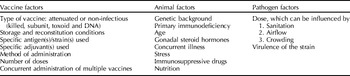
Vaccines cannot provide absolute protection from disease or protect all animals equally. The level and duration of protection varies with the vaccine and the animal, as well as the dose, virulence and prevalence of the pathogen (Table 1).
Factors that may influence the duration of immunity (DOI)

Vaccine factors
Veterinary vaccines from different manufacturers can vary in potency, efficacy and DOI. Whether a vaccine is attenuated or non-infectious often affects these parameters. Attenuated vaccines, which mimic natural infections, tend to induce stronger and longer-lasting immunity compared to vaccines that do not replicate in the host. Attenuated vaccines are also likely to induce the type of immunity, whether cell mediated or humoral, that is most effective against that pathogen. These vaccines contain strains of organisms that have usually arisen during passage in cell culture or unusual hosts. Most attenuated veterinary vaccines contain mixed populations of pathogens with multiple mutations; a few contain biologically cloned strains (Carmichael, Reference Carmichael1999). If precautions are not taken, the variable populations found in these vaccines could lead to the emergence of some non-immunizing mutants and vaccines with poor efficacy (Carmichael, Reference Carmichael1999). For this reason, the master seed concept limits the number of passages from which a manufacturer may make a vaccine. Vaccine efficacy can be reduced by storage or reconstitution conditions; only relatively small doses of live organisms are found in attenuated vaccines, and these organisms may be killed by poor handling. Due to the risks of using live vaccines in pregnant or immunosuppressed animals, as well as the risk of shedding vaccine virus, non-infectious vaccines may be preferred for some diseases or situations.
Non-infectious vaccines include inactivated (killed), toxoid and subunit vaccines, as well as such novel approaches as DNA vaccines. Killed, subunit and toxoid vaccines consist of organisms or purified proteins, typically combined with an adjuvant to boost the immune response. These vaccines tend to be safer and more stable than attenuated vaccines, but their efficacy may vary with the pathogen. Some killed viral vaccines, including canine and feline rabies vaccines, provide good immunity with an extended duration of protection. Protective immune responses in viral infections are usually generated against a few dominant proteins. In contrast, bacteria contain numerous proteins, protection is usually more complex and bacterins (killed bacterial vaccines) are often associated with a limited DOI. Both attenuated and non-infectious vaccines may be available for some diseases. Killed and attenuated feline respiratory virus vaccines are currently in use, and both are effective. Killed parvovirus vaccines were initially used in dogs, but were gradually replaced with more efficacious attenuated vaccines.
DNA vaccines, which are not yet commercially available for dogs and cats, are a novel vaccine type expected to provide particularly durable immunity. These vaccines consist of genes coding for viral or bacterial proteins, inserted into a bacterial plasmid. When the plasmid is inoculated into an animal's skin or muscles, it is transcribed and translated. The plasmid also contains a bacterial component that initiates the activation of antigen-presenting cells (APCs) (Ada, Reference Ada2003). APCs, which include dendritic cells and macrophages, interact with T cells to initiate immune responses. DNA vaccines have been associated with strong and durable antibody responses and CMI in a variety of species (Ada, Reference Ada2003). In mice, some antigens have resulted in lifelong persistence of the genes and humoral responses (Armengol et al., Reference Armengol, Ruiz and Orduz2004). DNA vaccines are being developed for some companion animal diseases (Ford, Reference Ford2001; Bahloul et al., Reference Bahloul, Taieb, Diouani, Ahmed, Chtourou, B'chir, Kharmachi and Dellagi2006).
A vaccine's specific components, especially the antigens and adjuvant (if any), can also affect protection. Individual veterinary vaccines often incorporate different strains of organisms or contain different antigens. Canine distemper vaccines are a good example: several strains of this virus may be found in effective vaccines. Nevertheless, licensed vaccines do not necessarily provide exactly the same level of protection. During a distemper outbreak in Finland, a disproportionate number of vaccinated dogs had been immunized with one popular vaccine, which was withdrawn from the market by the manufacturer once this was recognized (El-Kommonen et al., Reference El-Kommonen, Sihvonen, Pekkanen, Rikula and Nuotio1997). Significant differences were demonstrated between it and three other distemper vaccines used in Finland; 54% of the dogs vaccinated with the poorly efficacious vaccine had no detectable antibodies to this pathogen (Rikula et al., Reference Rikula, Nuotio and Sihvonen2000). Less dramatic differences between vaccines have also been recognized (Larson and Schultz, Reference Larson and Schultz1997; Carmichael, Reference Carmichael1999).
The method of administration may affect the efficacy, type or duration of immunity. Studies in dogs suggest that antibody titers remain elevated longer after intramuscular than subcutaneous administration of attenuated rabies vaccines (Sikes et al., Reference Sikes, Peacock, Acha, Arko and Dierks1971; Coyne et al., Reference Coyne, Burr, Yule, Harding, Tresnan and McGavin2001b). Intranasal FHV-1 and FCV vaccines may be preferred in high-risk environments such as shelters, because they are thought to induce more rapid immunity than parenteral vaccines (Richards et al., Reference Richards, Elston, Ford, Gaskell, Hartmann, Hurley, Lappin, Levy, Rodan, Scherk, Schultz and Sparkes2006). In contrast, intranasal feline panleukopenia vaccines may not be as effective as injectable vaccines when exposure occurs soon after vaccination (Richards et al., Reference Richards, Elston, Ford, Gaskell, Hartmann, Hurley, Lappin, Levy, Rodan, Scherk, Schultz and Sparkes2006). The number of doses can be a factor; both the efficacy of the vaccine and the species of animal may influence the strength of this effect. In one study, 99% of client-owned dogs in Finland were protected after two doses of efficacious canine distemper vaccines and additional boosters did not improve protection; however, when a less effective vaccine was used, the percentage of dogs with protective titers increased from 39% after one dose to 78% after four doses (Rikula et al., Reference Rikula, Nuotio and Sihvonen2000). In another study, multiple vaccinations increased antibody titers after rabies vaccination in client-owned dogs but not cats (Cliquet et al., Reference Cliquet, Verdier, Sagne, Aubert, Schereffer, Selve, Wasniewski and Servat2003).
Lastly, vaccine efficacy is limited by the effectiveness of the immune response to the virulent pathogen. When immunity after an infection is partial or short lived, the vaccine response is likely to have the same limitation. Feline upper respiratory infections with FHV-1 or FCV, for example, are followed by only partial immunity, and vaccines against these organisms behave similarly (Coyne et al., Reference Coyne, Burr, Yule, Harding, Tresnan and McGavin2001a; Gaskell et al., Reference Gaskell, Gettinby, Graham and Skilton2002). In addition, the DOI induced by vaccines for systemic diseases is expected to be greater than for mucosal diseases (Schultz, Reference Schultz2006).
Animal factors
Immune reactions, like other biological phenomena, have a normal distribution in the population; individual animals will respond more or less strongly to each vaccine (Tizard and Ni, Reference Tizard and Ni1998). Genetic factors can affect an animal's immune response (Kennedy et al., Reference Kennedy, Carter, Barnes, Bell, Bennett, Ollier and Thomson1999; Mansfield et al., Reference Mansfield, Burr, Snodgrass, Sayers and Fooks2004; Day, Reference Day2007). Breed-specific variations in multiple histocompatibility (MHC) genes, which can affect the level of immune responses by affecting antigen presentation to lymphocytes, have been described in dogs (Kennedy et al., Reference Kennedy, Carter, Barnes, Bell, Bennett, Ollier and Thomson1999; Day, Reference Day2007). One study reported breed-related and/or size-related differences among dogs in their responses to rabies vaccines (Kennedy et al., Reference Kennedy, Lunt, Barnes, McElhinney, Fooks, Baxter and Ollier2007). Size-related factors might be associated with differences in the deposition of subcutaneous fat, which sequesters antigens (Kennedy et al., Reference Kennedy, Lunt, Barnes, McElhinney, Fooks, Baxter and Ollier2007). Variability in MHC genes has also been described in cats, and would be expected to influence immune responses (Day, Reference Day2007). Some studies indicate that gonadal steroid hormones might influence the magnitude of responses positively or negatively (Rife et al., Reference Rife, Marquez, Escalante and Velich1990; Schuurs and Verheul, Reference Schuurs and Verheul1990; Verthelyi and Klinman, Reference Verthelyi and Klinman2000; Kennedy et al., Reference Kennedy, Lunt, Barnes, McElhinney, Fooks, Baxter and Ollier2007). In one study, intact cats, particularly males, had lower rabies titers than did neutered cats (Mansfield et al., Reference Mansfield, Burr, Snodgrass, Sayers and Fooks2004). Intact dogs have also been reported to have weaker responses to rabies vaccines (Kennedy et al., Reference Kennedy, Lunt, Barnes, McElhinney, Fooks, Baxter and Ollier2007). Age may affect vaccine responses. Differences were reported between puppies and adult dogs in blood lymphocyte subsets, and in the composition of immune cells in the mucosa (Day, Reference Day2007). Maternal immunity, even at levels too low to be protective, can interfere with immune responses in young animals. Old age appears to suppress vaccine responses in some studies but not in others. Mansfield et al. (Reference Mansfield, Burr, Snodgrass, Sayers and Fooks2004) reported that older animals had lower titers after rabies vaccination. Another study found that dogs under 1 year of age, as well as dogs older than 7 years, had lower titers and higher failure rates for rabies vaccination than dogs between the ages of 1 and 7 years (Kennedy et al., Reference Kennedy, Lunt, Barnes, McElhinney, Fooks, Baxter and Ollier2007). Interestingly, this effect occurred in old dogs vaccinated with two different commercial vaccines, but young dogs responded as well as adult (1- to 7-year-old) dogs to one vaccine. In contrast, HogenEsch et al. (Reference HogenEsch, Thompson, Dunham, Ceddia and Hayek2004) reported that elderly pet dogs had higher prevaccination rabies titers than young dogs. In this study, young and old dogs had similar postvaccination rabies, distemper and parvovirus titers despite decreased lymphocyte proliferative responses and other changes in immune parameters in older animals (HogenEsch et al., Reference HogenEsch, Thompson, Dunham, Ceddia and Hayek2004). Vaccine reactions can also be dampened by primary immunodeficiencies, concurrent illnesses, stress and immunosuppressive drugs. Poor nutrition can suppress immune responses by decreasing nutrient availability for cell division and protein (e.g. antibody and cytokine) synthesis. Factors such as immunosuppression, age and nutrition can affect the initial response to a vaccine as well as later resistance to disease. Perhaps as a consequence of one or more of these factors, some animals never mount good antibody responses to a vaccine. These animals may go unrecognized and remain healthy, either because they have CMI and mucosal immunity or because they are never exposed.
Pathogen factors
Ultimately, the development of illness depends on the interaction between a pathogen and the animal's level of immunity when it is exposed. Even when a good vaccine results in good immunity in an immunocompetent animal, a pathogen can sometimes overwhelm the immune response. Very high doses or unusually virulent strains of an agent can cause disease in animals that would be immune to smaller doses or less virulent organisms. The amount of pathogen in an animal's environment is affected by numerous factors, including the agent's inherent resistance to inactivation, factors that affect its distribution, and environmental parameters that affect its persistence (e.g. ambient temperatures and humidity). Some pathogens vary in their prevalence between geographic areas. Lifestyle factors also influence an animal's exposure. How frequently an animal is exposed to other susceptible animals, as well as the population density of those animals, will affect both the dose and types of pathogens that the animal will encounter. Indoor cats in single pet households usually have a low risk for exposure to infectious diseases compared to the much greater risk among indoor/outdoor cats in multiple cat households. Animals in shelters and kennels may be exposed to increased levels of pathogens and simultaneously to increased stress. Population immunity also affects exposure levels. Adequate immunity in sufficient number of animals can prevent an agent from being readily transmitted within the population, thus decreasing the level of exposure for individual animals. The threshold of population immunity has not been established for most canine or feline diseases (Coyne et al., Reference Coyne, Burr, Yule, Harding, Tresnan and McGavin2001a). However, it is known that rabies transmission effectively stops when more than 70% of dogs are immune (Coleman and Dye, Reference Coleman and Dye1996). Outbreaks can occur when population immunity wanes due to decreased vaccine efficacy or use. This can be illustrated by an outbreak of canine distemper in Finland that affected approximately 500 dogs (El-Kommonen et al., Reference El-Kommonen, Sihvonen, Pekkanen, Rikula and Nuotio1997). The outbreak was attributed to inadequate vaccine coverage, an increase in the population of young dogs and the poor efficacy of one popular vaccine (El-Kommonen et al., Reference El-Kommonen, Sihvonen, Pekkanen, Rikula and Nuotio1997).
If new field strains arise, a vaccine may be less effective against the new strain. Virulent FCV strains that cause a hemorrhagic syndrome with a high morbidity and mortality rate have recently appeared in feline populations (Hurley and Sykes, Reference Hurley and Sykes2003; Hurley et al., Reference Hurley, Pesavento, Pedersen, Poland, Wilson and Foley2004; Davis-Wurzler, Reference Davis-Wurzler2006). In many cases, vaccinated adult cats have been affected; the current FCV vaccines seem to provide no immunity (Hurley and Sykes, Reference Hurley and Sykes2003; Hurley et al., Reference Hurley, Pesavento, Pedersen, Poland, Wilson and Foley2004; Davis-Wurzler, Reference Davis-Wurzler2006). CPVs have also evolved; the initial CPV-2 strains found in 1978 were replaced or supplemented by CPV-2a and CPV-2b strains (Greene et al., Reference Greene, Schultz and Ford2001). CPV-2b is now the most prevalent strain in the USA (Abdelmagid et al., Reference Abdelmagid, Larson, Payne, Tubbs, Wasmoen and Schultz2004). CPV-2c strains have also been detected recently (Spibey et al., Reference Spibey, Greenwood, Sutton, Chalmers and Tarpey2008). However, unlike FCV strains that cause hemorrhagic syndrome, the currently available parvovirus vaccines are still protective against CPV-2a, CPV-2b and CPV-2c (Greene et al., Reference Greene, Schultz and Ford2001; Larson and Schultz, Reference Larson and Schultz2008; Spibey et al., Reference Spibey, Greenwood, Sutton, Chalmers and Tarpey2008). New strains of canine distemper virus have also been reported (Pardo et al., Reference Pardo, Johnson and Kleiboeker2005).
Sometimes, the pathogens in an animal's environment can have positive effects on immunity. When an agent is found at levels that do not cause disease in vaccinated animals, it can act as a natural booster, with periodic subclinical exposures helping to maintain the immune response. Conversely, as vaccination prevents infections and exposure to a pathogen decreases in the population, the absence of such natural boosting might allow levels of immunity to fall (Rouderfer et al., Reference Rouderfer, Becker and Hethcote1994). Maternal immunity may also decrease, with less protection for the young. In human populations, the mean titers to measles in cord blood declined following the measles vaccination campaign which began in the 1960s (Rouderfer et al., Reference Rouderfer, Becker and Hethcote1994).
How can the DOI be measured?
Challenge studies
Challenge studies with virulent organisms are the most unambiguous way to measure the DOI. A drawback in performing such studies is the cost and difficulty of keeping sufficient number of animals isolated for several years. Due to this limitation, most extended-duration studies are done on a small number of animals. The resistance of older animals to many diseases also complicates challenge experiments. Some models used to challenge young animals may not produce disease in older dogs and cats (Scott and Geissinger, Reference Scott and Geissinger1999; Coyne et al., Reference Coyne, Burr, Yule, Harding, Tresnan and McGavin2001a, Reference Coyne, Burr, Yule, Harding, Tresnan and McGavin2001b; Mouzin et al., Reference Mouzin, Lorenzen, Haworth and King2004a). For example, after infection with feline panleukopenia virus, adult cats may remain asymptomatic despite shedding virus (Scott and Geissinger, Reference Scott and Geissinger1999). For this reason, some challenge studies may use markers of infection rather than clinical signs. Markers used in challenge studies include changes in blood parameters, virus shedding and seroconversion.
Challenge studies may not completely mimic natural exposures in pet populations. Vaccines generally tend to perform better in experimental animals (Rikula et al., Reference Rikula, Nuotio and Sihvonen2000; Cliquet et al., Reference Cliquet, Verdier, Sagne, Aubert, Schereffer, Selve, Wasniewski and Servat2003). Research animals are typically in optimal health and on a high nutritional plane. Animals that do not respond to a vaccine can be recognized and accounted for in the analysis. They may also be given additional boosters until they mount a response. A natural population, in contrast, consists of animals with varying levels of immunity. Some pets never mount a good immune response to a vaccine, and these animals may never be recognized. In addition, the animals in most challenge studies are not exposed to the pathogen until the challenge, while natural populations may be more or less continuously exposed. Such frequent exposures can provide natural boosters to immunity. They may also provide opportunities for the pathogen to ‘break through’ an animal's immunity if a dose of virulent organisms coincides with a temporary susceptibility to disease. Challenge studies with most agents would be unethical in pet populations. In addition, such tests would be difficult to interpret due to the absence of control unvaccinated animals. One alternative is to measure immune parameters or changes in immune parameters.
Measurement of immune parameters
The DOI in an animal or a population can be measured by assessing parameters such as antibody levels. An advantage to these studies is that they can be done in pets as well as in research animals, and may be performed concurrently with challenge studies. A disadvantage is that the parameter must correlate well with immunity to the pathogen. Immunity to any agent is a complex process resulting from various combinations of humoral, cell-mediated and mucosal immunity. The relative importance of these mechanisms varies with the specific agent. For many canine and feline pathogens, the precise roles of CMI and humoral immunity have not been determined, although both are probably involved to some degree (Larson, Reference Larson1996; Lappin et al., Reference Lappin, Andrews, Simpson and Jensen2002). Nevertheless, some generalizations can be made. Humoral immunity is typically most effective for toxins or organisms that replicate outside cells, such as extracellular bacteria. Antibodies can also prevent intracellular organisms from binding to and entering cells; however, CMI is thought to be more important in controlling most viruses and intracellular bacteria. Mucosal immune mechanisms are involved in the early stages of entry for many pathogens and are particularly critical for agents that remain localized to mucosal surfaces. It should be remembered that the immune system is complex and such generalizations are not absolute. For example, immunity to leptospirosis was once thought to be mediated by antibodies alone, but newer research suggests that CMI may also be important (Naiman et al., Reference Naiman, Alt, Bolin, Zuerner and Baldwin2001).
Although immunity could be assessed most precisely by determining all three types of immune mechanisms, cell-mediated and mucosal immune mechanisms are complex and involve a variety of cells and proteins. These responses are generally difficult and impractical to measure, except in research settings. For this reason, only serum antibodies are commonly measured. Although this is necessarily imprecise, it may be effective if titers can be correlated with protection from challenge. A variety of antibody tests including serum neutralization (SN), hemagglutination inhibition (HI), complement fixation, ELISA and other assays are available. The SN test is used in many studies, as it is more directly correlated to protective immunity. One factor that complicates the interpretation of serologic data is that these tests are not standardized between facilities (Tizard and Ni, Reference Tizard and Ni1998). A single serum sample sent to several laboratories may return different titers from each (Ford, Reference Ford2001; Schultz, Reference Schultz2006). In addition, the minimum protective titer for a pathogen is often unknown, and the definition of a protective or non-protective titer can vary between researchers and laboratories. As an example, some researchers have defined the protective titer for neutralizing antibodies to canine distemper virus as low as 1:8, while others suggest values as high as 1:96 (Cooper et al., Reference Cooper, Chappius, Saint-Gerand and Duret1991; McCaw et al., Reference McCaw, Thompson, Tate, Bonderer and Chen1998).
Factors unrelated to the assay can also complicate the interpretation of serologic surveys. In animals that are not isolated, titers may not solely be due to vaccination; exposure to the pathogen can also boost immunity. Animals with low or no titers are sometimes protected even when titers are broadly correlated with immunity to a pathogen (Twark and Dodds, Reference Twark and Dodds2000; Ford, Reference Ford2001; Gaskell et al., Reference Gaskell, Gettinby, Graham and Skilton2002; Mansfield et al., Reference Mansfield, Burr, Snodgrass, Sayers and Fooks2004). For instance, titers correlate well with resistance to challenge with feline panleukopenia virus, but immunity has also been reported in cats without protective titers (Larson, Reference Larson1996; Tizard and Ni, Reference Tizard and Ni1998; Coyne et al., Reference Coyne, Burr, Yule, Harding, Tresnan and McGavin2001a; Gaskell et al., Reference Gaskell, Gettinby, Graham and Skilton2002; Lappin et al., Reference Lappin, Andrews, Simpson and Jensen2002). Similarly, dogs and cats seem to be protected from rabies challenge if they produce neutralizing antibodies of 0.5 IU/ml after vaccination, even when no serum antibodies are found on the day of challenge (Aubert, Reference Aubert1992). An animal without circulating antibodies to a pathogen may be protected from disease if CMI or mucosal immunity is critical for defense. It may also be protected if humoral immunity is important in protection and it has a sufficient number of memory B lymphocytes. When B cells, which produce antibodies, are stimulated by a pathogen, some of these cells differentiate into antibody-secreting plasma cells (effector B cells). Short-lived plasma cells, which die rapidly, account for the early rise in titers; long-lived plasma cells can survive for a year or more in specialized bone marrow niches and maintain long-term antibody titers. Once differentiated, neither type of plasma cell is responsive to antigens. Other B cells develop into long-lived memory B cells. On subsequent exposure to the antigen, memory B cells are capable of a rapid, enhanced response that produces new plasma cells (Benson et al., Reference Benson, Erickson, Gleeson and Noelle2007). The existing pool of long-lived plasma cells may be constantly regenerated by the slow turnover of memory B cells (Benson et al., Reference Benson, Erickson, Gleeson and Noelle2007); however, memory B cells can continue to exist after antibodies are no longer detected (Endsley et al., Reference Endsley, Roth, Ridpath and Neill2003, Reference Endsley, Ridpath, Neill, Sandbulte and Roth2004). Some serologic studies have attempted to include memory B cells in the assessment of vaccine responses by measuring the magnitude of response to revaccination. A rapid rise in titers is considered an indication that memory cells still exist. However, it can be difficult to correlate this type of assay with protection from disease.
Epidemiological studies
In human populations, vaccination frequency is typically adjusted by the surveillance of titers or monitoring of disease frequency. Using standardized commercial assays, protective titers have been established for some human diseases, such as tetanus or hepatitis B. The DOI for these diseases is monitored by following the decline in titers in vaccinated sentinel groups (Gaskell et al., Reference Gaskell, Gettinby, Graham and Skilton2002). Revaccination intervals are set for other diseases, such as pertussis or measles, by collecting data on disease incidence and using these data to adjust the vaccination frequency (Mouzin et al., Reference Mouzin, Lorenzen, Haworth and King2004a). In some cases, this is combined with mathematical modeling (Longini et al., Reference Longini, Halloran, Haber and Chen1993; Rouderfer et al., Reference Rouderfer, Becker and Hethcote1994; Gaskell et al., Reference Gaskell, Gettinby, Graham and Skilton2002). If vaccine failures result in disease outbreaks, vaccination campaigns are conducted (Gaskell et al., Reference Gaskell, Gettinby, Graham and Skilton2002). Human disease monitoring in the USA is conducted by the Centers for Disease Control and Prevention, and worldwide surveillance is facilitated by the World Health Organization. The interpretation of such surveillance can be complicated by the use of different vaccines and changes in vaccine composition, manufacturing processes or vaccination schedules (Wendelboe et al., Reference Wendelboe, Van Rie, Salmaso and Englund2005). It can also be affected by the use of a variety of case definitions, reporting systems and surveillance methods (Wendelboe et al., Reference Wendelboe, Van Rie, Salmaso and Englund2005).
In veterinary medicine, surveillance and monitoring are used to adjust vaccination frequencies in poultry and swine. Repeated serologic sampling of a herd or flock, in conjunction with sophisticated data management software, can be used to determine the degree of immunity in the flock or herd and the need for revaccination for diseases such as Newcastle disease or infectious bursal disease (Tizard and Ni, Reference Tizard and Ni1998). Several factors may hamper the application of epidemiological methods to companion animal populations. One is the absence of comprehensive disease monitoring in dogs and cats; in these species, data are routinely gathered only for rabies. In addition, veterinary vaccines from different manufacturers may vary in potency and efficacy (Larson and Schultz, Reference Larson and Schultz1997; Carmichael, Reference Carmichael1999; Rikula et al., Reference Rikula, Nuotio and Sihvonen2000). Finally, it must be recognized that systems which may be effective in production medicine, where the unit of importance is the herd, may not be acceptable when the individual animal is important and the consequences of infection may be serious or fatal.
Do human vaccines provide lifetime immunity?
One argument for extending the interval between boosters in adult dogs and cats is that humans are vaccinated infrequently in childhood, and this is often followed by lifelong immunity. Companion animals should not theoretically have significantly weaker immune systems than humans and, thus, should also be protected for extended periods or perhaps even a lifetime. Given this reasoning, it may be valuable to briefly review some current information about human vaccines.
At one time, infection with many human ‘childhood diseases’, including measles, mumps, rubella and pertussis, was thought to provide lifelong protection from reinfection. Vaccines for these diseases were also believed to provide long-lasting or lifelong immunity. Recently, these assumptions have been reexamined, as vaccination has replaced infection in many populations. The DOI may be shorter after vaccination than infection; some studies suggest that both antibody responses and CMI may decline more rapidly (Rouderfer et al., Reference Rouderfer, Becker and Hethcote1994; Davidkin et al., Reference Davidkin, Peltola, Leinikki and Valle2000; Wendelboe et al., Reference Wendelboe, Van Rie, Salmaso and Englund2005). There are also concerns about decreased natural boosting as childhood diseases become rare. A number of studies have examined the persistence of immunity in vaccinated human populations. Measles immunity may be particularly relevant to veterinary vaccines, as the measles virus and the canine distemper virus are related. In 1993, a measles epidemic occurred in the island of Palau, where this disease had been absent for 27 years. The frequency of disease in vaccinated and unvaccinated residents suggested that waning immunity was not a problem even in the absence of natural boosting (Guris et al., Reference Guris, McCready, Watson, Atkinson, Heath, Bellini and Polloi1996). Rubella vaccines are also thought to induce long-lived serologic responses that last up to 21 years (Davidkin et al., Reference Davidkin, Peltola, Leinikki and Valle2000). However, estimates of persistence of immunity to pertussis have been significantly reduced; immunity after an infection is now thought to persist for 7–20 years, and vaccine-induced immunity for 5–12 years (Wendelboe et al., Reference Wendelboe, Van Rie, Salmaso and Englund2005). New studies have also revealed that mild, previously unrecognized, pertussis infections can occur in adults and children who have recovered from natural infections (Wendelboe et al., Reference Wendelboe, Van Rie, Salmaso and Englund2005). The duration of smallpox vaccine responses is particularly interesting, because the smallpox virus was eradicated in the early 1970s and immunity has not been boosted by natural exposure to the virus since then. While some sources suggest that immunity to this virus persists for only 3–5 years, some epidemiological studies have suggested that vaccine-induced immunity may be long term or lifelong (Hammarlund et al., Reference Hammarlund, Lewis, Hansen, Strelow, Nelson, Sexton, Hanifin and Slifka2003). In one study, antibody responses to the vaccinia virus remained stable for up to 75 years after vaccination, while antiviral T cell responses declined slowly with a half-life of 8–15 years (Hammarlund et al., Reference Hammarlund, Lewis, Hansen, Strelow, Nelson, Sexton, Hanifin and Slifka2003). Overall, it can be concluded that studies no longer support the premise that lifelong immunity exists for all childhood diseases, but good vaccines seem to provide immunity in human populations for at least several years and, in some cases, for well over a decade.
Care should be taken, however, in extrapolating these findings to animals. In many countries, the vast majority of human population is vaccinated, resulting in increased population immunity and decreased disease transmission. In contrast, vaccination is not universal in canine and feline populations, and some diseases are still prevalent in unvaccinated animals (Gaskell et al., Reference Gaskell, Gettinby, Graham and Skilton2002). Two consequences are that greater natural boosting probably occurs in animal populations than in human populations, and vaccinated animals may be faced with higher challenge doses from environmental exposure (Gaskell et al., Reference Gaskell, Gettinby, Graham and Skilton2002). In addition, most of the pathogens found in humans and animals differ. Thus, while we can learn from human studies, the limitations of such comparisons must be recognized, and studies of specific vaccines in companion animals are needed.
DOI after vaccination in dogs and cats
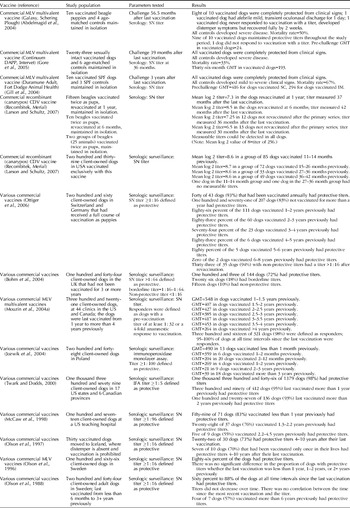
Although the data are still incomplete, a number of challenge studies and serologic surveys have examined the persistence of immunity to canine and feline core vaccines. Studies reported in the peer-reviewed literature from 1970 to the present day are summarized in Tables 2 through 7. Where information was provided by the authors, the test vaccine is identified. Vaccine information is often unavailable for client-owned animals in serologic surveys, as several vaccines may be used, particularly when more than one veterinary practice is involved. Direct comparisons between studies can be difficult, as there are many differences in the study design, tests used to measure protection, definitions of protective titers, and study populations. However, taken as a whole, they provide useful insights into the DOI to the selected vaccines in dogs and cats. It should be noted that some canine and feline vaccines with labels claiming a DOI of at least 3 years have been licensed in USA and EU markets (Gaskell et al., Reference Gaskell, Dawson and Radford2006). Label claims must be supported by challenge studies in laboratory animals, submitted to regulatory agencies. Some of these studies have also been published and are included in the tables.
Challenge and serologic evaluation performed more than 1 year after vaccination with canine distemper vaccines

DAPP=vaccine against distemper, adenovirus, parainfluenza and parvovirus, GMT=geometric mean titer. IFA=indirect fluorescent antibody, IM=intramuscularly, MLV=modified live virus, SC=subcutaneously, SN=serum neutralization, SPF=specific pathogen-free, UK=United Kingdom, US=United States.
Rabies vaccines
DOI claims for rabies vaccines must be supported by studies from the manufacturer at licensing. In addition, revaccination intervals for rabies are set by state or local authorities and must be followed, even if a vaccine label claims a longer DOI. For these reasons, the DOI to rabies vaccines is not reviewed. However, it should be noted that independent studies suggest that dogs are resistant to challenge with various attenuated vaccines for at least 38–41 months and to killed vaccines for at least 22–39 months, substantiating manufacturers’ claims (Coyne et al., Reference Coyne, Burr, Yule, Harding, Tresnan and McGavin2001b; Lakshmanan et al., Reference Lakshmanan, Gore, Duncan, Coyne, Lum and Sterner2006).
Canine distemper
After recovery from canine distemper, immunity is thought to be long lasting; dogs kept in isolation were resistant to intracranial challenge for at least 7 years (Coyne et al., Reference Coyne, Burr, Yule, Harding, Tresnan and McGavin2001b; Gaskell et al., Reference Gaskell, Gettinby, Graham and Skilton2002). Nearly all canine distemper vaccines are attenuated. Most are produced from the Onderstepoort, Rockborn, or Snyder Hill strains, or from a ferret origin strain grown in avian cell cultures (Carmichael, Reference Carmichael1999). Some derivatives of these strains have been given new names by manufacturers. Highly effective vaccines have been made from all strains; however, differences in efficacy have also been reported (Larson and Schultz, Reference Larson and Schultz1997; Carmichael, Reference Carmichael1999; Rikula et al., Reference Rikula, Nuotio and Sihvonen2000). A few published challenge studies support recommendations for extended vaccination intervals (Table 2). Two studies reported complete protection from challenge for approximately 3 years after vaccination with attenuated distemper vaccines (Gill et al., Reference Gill, Srinivas, Morozov, Smith, Anderson, Glover, Champ and Chu2004; Gore et al., Reference Gore, Lakshmanan, Duncan, Coyne, Lum and Sterner2005). In another study, eight of ten vaccinated dogs were completely protected for up to 56 months, and one dog developed a mild, transient afebrile oculonasal discharge for a single day after challenge (Abdelmagid et al., Reference Abdelmagid, Larson, Payne, Tubbs, Wasmoen and Schultz2004). One dog in this study never responded to vaccination with a titer and became ill at challenge, although it recovered fully within 2 weeks. In addition, challenge studies that have not been published in detail suggest that the estimated minimum DOI is at least 7 years for the Rockborn/Snyder Hill strains, at least 5 years for the Onderstepoort strain and at least 3 years for vaccines containing recombinant vectored virus (Schultz, Reference Schultz2006).
Several serologic studies have also been published (Table 2). Titers to the canine distemper virus are correlated with protection, but the protective threshold has not been standardized among laboratories or in the literature (Larson, Reference Larson1996; Coyne et al., Reference Coyne, Burr, Yule, Harding, Tresnan and McGavin2001b; Gaskell et al., Reference Gaskell, Gettinby, Graham and Skilton2002; Mouzin et al., Reference Mouzin, Lorenzen, Haworth and King2004a; Schultz, Reference Schultz2006). The minimum protective SN titer was set as low as 1:10 or as high as 1:96 in serologic studies (Larson, Reference Larson1996; McCaw et al., Reference McCaw, Thompson, Tate, Bonderer and Chen1998; Tizard and Ni, Reference Tizard and Ni1998; Coyne et al., Reference Coyne, Burr, Yule, Harding, Tresnan and McGavin2001b; Gaskell et al., Reference Gaskell, Gettinby, Graham and Skilton2002). Several studies found that 70–100% of client-owned or isolated research animals maintained protective titers for at least 3 years (Piercy, Reference Piercy1961; Prydie, Reference Prydie1966; Robson, Reference Robson1966; Olson et al., Reference Olson, Klingeborn and Hedhammar1988, Reference Olson, Finnsdottir, Klingeborn and Hedhammar1997; Twark and Dodds, Reference Twark and Dodds2000; Abdelmagid et al., Reference Abdelmagid, Larson, Payne, Tubbs, Wasmoen and Schultz2004; Bohm et al., Reference Bohm, Thompson, Weir, Hasted, Maxwell and Herrtage2004; Gill et al., Reference Gill, Srinivas, Morozov, Smith, Anderson, Glover, Champ and Chu2004; Gore et al., Reference Gore, Lakshmanan, Duncan, Coyne, Lum and Sterner2005; Ottiger et al., Reference Ottiger, Neimeier-Förster, Stärk, Duchow and Bruckner2006). Others suggest that many animals may not be protected after 2 years (McCaw et al., Reference McCaw, Thompson, Tate, Bonderer and Chen1998; Jozwik et al., Reference Jozwik, Frymus, Mizak and Rzezutka2004). Schultz states that the estimated minimum DOI in isolated dogs, using serologic testing, is at least 15 years for the Rockborn/Snyder Hill strains, at least 9 years for the Onderstepoort strain and at least 3 years for vaccines containing recombinant vectored virus (Schultz, Reference Schultz2006). This group recently reported that the mean titer was similar in client-owned animals whether they were tested 11–14 months, 15–26 months, 27–36 months or 36–48 months after their last vaccination with a recombinant canine distemper vaccine (Larson and Schultz, Reference Larson and Schultz2007). An unpublished study of nine isolated beagles vaccinated with the Rockborn strain also found that high titers of neutralizing antibodies were maintained for at least 6 years (Carmichael, Reference Carmichael1999). Direct comparisons between these studies are difficult, due to the variety of study populations, definitions of protective titers and methods. Titers in pet populations may not entirely be due to vaccination; some dogs might have been exposed to the virus in the environment, resulting in natural boosting. Low titers may reflect non-responders to vaccination, dogs with waning immunity that are susceptible to infection, or dogs that are protected against challenge by CMI, mucosal immunity or residual memory B cells. One study defined responders as dogs that had either a prevaccination SN titer of 1:32 or a postvaccination fourfold increase in titer (Mouzin et al., Reference Mouzin, Lorenzen, Haworth and King2004a). In this study, 98% of healthy dogs brought to veterinary clinics for routine care were defined as responders, and the percentage of responders did not vary significantly with time since the last vaccination. Titers also remained elevated for several years. This study suggests that immunity persists for several years and that dogs with non-protective titers may have memory B cells. However, it is not proven that dogs with fourfold increases in titers are necessarily protected from challenge.
CAVs
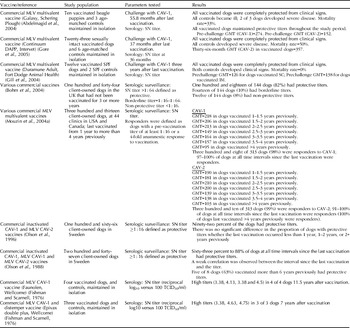
Two CAVs are important in dogs: CAV-1, which primarily causes infectious canine hepatitis, and CAV-2, which causes canine respiratory disease. Immunity to CAV-1 is thought to be long lasting after an infection, but the length of immunity after CAV-2 infection is unknown (Carmichael, Reference Carmichael1999; Coyne et al., Reference Coyne, Burr, Yule, Harding, Tresnan and McGavin2001b). Immunity to either virus is cross-protective and adenovirus vaccines protect dogs from both diseases (Carmichael, Reference Carmichael1999; Coyne et al., Reference Coyne, Burr, Yule, Harding, Tresnan and McGavin2001b; Greene et al., Reference Greene, Schultz and Ford2001; Gaskell et al., Reference Gaskell, Gettinby, Graham and Skilton2002; Bohm et al., Reference Bohm, Thompson, Weir, Hasted, Maxwell and Herrtage2004). At one time, CAV vaccines contained CAV-1, but due to the risk of anterior uveitis and corneal edema, they were replaced by CAV-2 vaccines. The shift from CAV-1 to CAV-2 vaccines may account for some differences between published studies. Three recent challenge studies (Table 3) suggest that complete protection from challenge with CAV-1 persists for at least 3 to 4.5 years after vaccination with commercial CAV-2 vaccines (Abdelmagid et al., Reference Abdelmagid, Larson, Payne, Tubbs, Wasmoen and Schultz2004; Gill et al., Reference Gill, Srinivas, Morozov, Smith, Anderson, Glover, Champ and Chu2004; Gore et al., Reference Gore, Lakshmanan, Duncan, Coyne, Lum and Sterner2005). Challenge studies that have not been published in detail suggest that immunity persists for at least 7 years (Schultz, Reference Schultz2006).
Challenge and serologic evaluation performed more than 1 year after vaccination with CAV (CAV-1 and CAV-2) vaccines

CAV=canine adenovirus, DAPP=vaccine against distemper, adenovirus, parainfluenza, and parvovirus, GMT=geometric mean titer, IM=intramuscularly, MLV=modified live virus, SC=subcutaneously, SN=serum neutralization, SPF=specific pathogen-free, TCID50=50% tissue culture infective dose, UK=United Kingdom, US=United States.
Serum antibody titers are correlated with protection against CAVs (Coyne et al., Reference Coyne, Burr, Yule, Harding, Tresnan and McGavin2001b; Mouzin et al., Reference Mouzin, Lorenzen, Haworth and King2004a; Schultz, Reference Schultz2006). Published serologic studies have defined protective SN titers from 1:16 to 1:64 (Olson et al., Reference Olson, Klingeborn and Hedhammar1988, Reference Olson, Hedhammar and Klingeborn1996; Coyne et al., Reference Coyne, Burr, Yule, Harding, Tresnan and McGavin2001b; Bohm et al., Reference Bohm, Thompson, Weir, Hasted, Maxwell and Herrtage2004; Mouzin et al., Reference Mouzin, Lorenzen, Haworth and King2004a). Studies that tested dogs 3–11 years after vaccination (Table 3) found that 63–100% of client-owned or isolated research animals had protective titers (Fishman and Scarnell, Reference Fishman and Scarnell1976; Olson et al., Reference Olson, Klingeborn and Hedhammar1988; Abdelmagid et al., Reference Abdelmagid, Larson, Payne, Tubbs, Wasmoen and Schultz2004; Bohm et al., Reference Bohm, Thompson, Weir, Hasted, Maxwell and Herrtage2004). High mean titers also persisted for 3 to 4.5 years in challenge studies where individual titers were not reported (Gill et al., Reference Gill, Srinivas, Morozov, Smith, Anderson, Glover, Champ and Chu2004; Gore et al., Reference Gore, Lakshmanan, Duncan, Coyne, Lum and Sterner2005). Schultz states that protective titers persist for at least 9 years in isolated dogs (Schultz, Reference Schultz2006). A recent study suggests that memory B cells that respond to either CAV-1 or CAV-2 persist at some level for at least 4 years (Mouzin et al., Reference Mouzin, Lorenzen, Haworth and King2004a). The interpretation of these serologic studies is complicated by the same factors that complicate studies of canine distemper.
CPV2
Immunity is thought to be long lasting in dogs that survive parvovirus infections, but the protection afforded by CPV vaccines has varied greatly over the years (Coyne et al., Reference Coyne, Burr, Yule, Harding, Tresnan and McGavin2001b). Early vaccines, which contained killed feline parvovirus (panleukopenia) antigens, had relatively poor efficacy (Wallace and McMillen, Reference Wallace and McMillen1985). These and other poorly efficacious vaccines were sometimes sold at the same time as more effective vaccines. Unpublished studies found that the DOI induced by vaccines available between 1987 and 1990 varied significantly (Carmichael, Reference Carmichael1999). Improved vaccines were used in the 1990s, but there were still marked differences in their effectiveness, particularly in puppies with maternal immunity (Larson and Schultz, Reference Larson and Schultz1997). This variability makes direct comparisons between studies conducted at different periods difficult, and probably accounts for some differences in the published DOI. In general, the few published challenge studies (Table 4) suggest that attenuated vaccines provide long-lasting immunity, but inactivated vaccines do not. Although some studies show that dogs vaccinated with inactivated CPV-2 vaccines were protected from clinical signs for at least 12 to 16 months, virus shedding was not always prevented (Povey et al., Reference Povey, Carmen and Evert1983; Wallace and McMillen, Reference Wallace and McMillen1985). In contrast, protection from both clinical signs and virus shedding was demonstrated for 2, 3, or 4.5 years in challenged dogs vaccinated with attenuated vaccines (Carmichael et al., Reference Carmichael, Joubert and Pollock1983; Abdelmagid et al., Reference Abdelmagid, Larson, Payne, Tubbs, Wasmoen and Schultz2004; Gill et al., Reference Gill, Srinivas, Morozov, Smith, Anderson, Glover, Champ and Chu2004; Gore et al., Reference Gore, Lakshmanan, Duncan, Coyne, Lum and Sterner2005). Challenge studies not published in detail suggest that immunity persists for at least 7 years after vaccination with attenuated vaccines (Schultz, Reference Schultz2006). Killed parvovirus vaccines are no longer available from the major US pharmaceutical companies (Schultz, Reference Schultz2006).
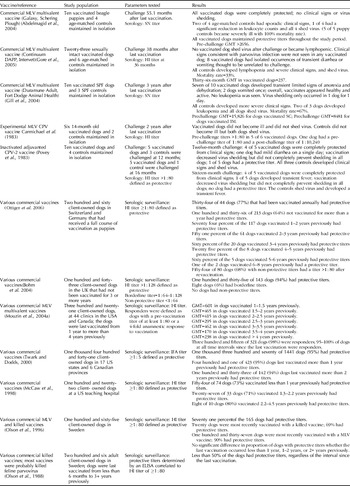
Challenge and serologic evaluation performed more than 1 year after vaccination with CPV vaccines

CPV=canine parvovirus, DAPP=vaccine against distemper, adenovirus, parainfluenza and parvovirus, ELISA=enzyme-linked immunosorbent assay, GMT=geometric mean titer, HI=hemagglutination inhibition; IFA=indirect fluorescent antibody, IM=intramuscularly, MLV=modified live virus, SC=subcutaneously, SN=serum neutralization, SPF=specific pathogen-free, UK=United Kingdom, US=United States.
Serum antibody titers are correlated with protection against CPVs (Larson, Reference Larson1996; Coyne et al., Reference Coyne, Burr, Yule, Harding, Tresnan and McGavin2001b; Gaskell et al., Reference Gaskell, Gettinby, Graham and Skilton2002; Mouzin et al., Reference Mouzin, Lorenzen, Haworth and King2004a). HI titers of 1:80 or greater are generally thought to be protective (Olson et al., Reference Olson, Klingeborn and Hedhammar1988, Reference Olson, Hedhammar and Klingeborn1996; McCaw et al., Reference McCaw, Thompson, Tate, Bonderer and Chen1998; Tizard and Ni, Reference Tizard and Ni1998; Carmichael, Reference Carmichael1999; Coyne et al., Reference Coyne, Burr, Yule, Harding, Tresnan and McGavin2001b; Gaskell et al., Reference Gaskell, Gettinby, Graham and Skilton2002; Mouzin et al., Reference Mouzin, Lorenzen, Haworth and King2004a; Ottiger et al., Reference Ottiger, Neimeier-Förster, Stärk, Duchow and Bruckner2006); although some authors set the threshold for protection at 1:100 or above (Bohm et al., Reference Bohm, Thompson, Weir, Hasted, Maxwell and Herrtage2004; Larson, Reference Larson1996). Protective titers were established primarily by measuring maternal antibodies in puppies, and it is possible that lower titers may be effective in dogs with acquired immunity (Gaskell et al., Reference Gaskell, Gettinby, Graham and Skilton2002). A number of serologic surveys have been published (Table 4). In older studies, which examined dogs vaccinated with inactivated vaccines or a mixture of inactivated and attenuated vaccines, a significant number of dogs were unprotected within a year or two after vaccination (Povey et al., Reference Povey, Carmen and Evert1983; Olson et al., Reference Olson, Klingeborn and Hedhammar1988, Reference Olson, Hedhammar and Klingeborn1996). One US study reported protective titers in 73% of dogs vaccinated less than a year previously, 71% of dogs vaccinated 1.3–2.2 years previously and 80% of dogs vaccinated 2.2–4.5 years previously (McCaw et al., Reference McCaw, Thompson, Tate, Bonderer and Chen1998). Two recent studies in North American or UK pet populations suggest that protective titers persist for a minimum of 2 or 3 years in 94% of dogs (Twark and Dodds, Reference Twark and Dodds2000; Bohm et al., Reference Bohm, Thompson, Weir, Hasted, Maxwell and Herrtage2004). In contrast, a recent European study found that 64% of dogs that were not vaccinated regularly, as well as 77% of dogs revaccinated annually, had adequate antibody titers (Ottiger et al., Reference Ottiger, Neimeier-Förster, Stärk, Duchow and Bruckner2006). Some of the dogs that were not immunized regularly may have been vaccinated with older inactivated vaccines. In this study, the proportion of dogs with protective titers did not decrease for 2 years after the last vaccination. Schultz suggests that protective titers may persist for at least 9 years in isolated research dogs (Schultz, Reference Schultz2006). In some published challenge studies, high SN or HI titers also persisted throughout the observation period (Abdelmagid et al., Reference Abdelmagid, Larson, Payne, Tubbs, Wasmoen and Schultz2004; Gill et al., Reference Gill, Srinivas, Morozov, Smith, Anderson, Glover, Champ and Chu2004; Gore et al., Reference Gore, Lakshmanan, Duncan, Coyne, Lum and Sterner2005). Whether immunity persists once titers have diminished or disappeared is unknown; CMI may play a role in protection (Carmichael, Reference Carmichael1999). Some memory B cells seem to persist in most dogs for at least 4 years (Mouzin et al., Reference Mouzin, Lorenzen, Haworth and King2004a).
Non-core canine vaccines
Most non-core canine vaccines have not been studied for more than a year. Protection from challenge was shown for up to 1 year for some of these diseases, such as Lyme disease and leptospirosis, but long-term studies have not been published (Bey and Johnson, Reference Bey and Johnson1982; Hartman et al., Reference Hartman, van Houten, Frik and van der Donk1984; Milward, Reference Milward1997; Coyne et al., Reference Coyne, Burr, Yule, Harding, Tresnan and McGavin2001b; Greene et al., Reference Greene, Schultz and Ford2001; Klaasen et al., Reference Klaasen, Molkenboer, Vrijenhoek and Kaashoek2003; Minke et al., Reference Minke, Bey, Tronel, Latour, Colombet, Yvorel, Cariou, Guiot, Cozette and Guigal2009; LaFleur et al, Reference LaFleur, Callister, Dant, Jobe, Lovrich, Warner, Wasmoen and Schell2010). The 2006 AAHA Canine Vaccine Task Force generally recommends that non-core vaccines be given annually or more frequently (Paul et al., Reference Paul, Carmichael, Childers, Cotter, Davidson, Ford, Hurley, Roth, Schultz, Thacker and Welborn2006). Infectious tracheobronchitis (kennel cough) often involves concurrent infections between CPIV and other agents. In addition to Bordetella bronchiseptica, pathogens that may be involved include CAV-2, canine distemper virus, herpesvirus, reovirus and Mycoplasma (Tizard and Ni, Reference Tizard and Ni1998; Coyne et al., Reference Coyne, Burr, Yule, Harding, Tresnan and McGavin2001b; Greene et al., Reference Greene, Schultz and Ford2001; Mouzin et al., Reference Mouzin, Lorenzen, Haworth and King2004a; Jacobs et al., Reference Jacobs, Theelen, Jaspers, Horspool, Sutton, Bergman and Paul2005). Vaccines are available for CPIV and B. bronchiseptica, but not for some of the other agents. The Task Force recommends that B. bronchiseptica or combined B. bronchiseptica and CPIV vaccines be given annually or more often to high-risk animals, while parenteral attenuated CPIV vaccines should be administered triennially after a 1-year booster (Paul et al., Reference Paul, Carmichael, Childers, Cotter, Davidson, Ford, Hurley, Roth, Schultz, Thacker and Welborn2006). Although short-term studies show reductions in clinical signs and shedding of B. bronchiseptica for up to 13 months after vaccination, long-term studies have not been published (Greene et al., Reference Greene, Schultz and Ford2001; Jacobs et al., Reference Jacobs, Theelen, Jaspers, Horspool, Sutton, Bergman and Paul2005; Lehar et al., Reference Lehar, Jayappa, Erskine, Brown, Sweeney and Wassmoen2008). However, immunity after natural B. bronchiseptica infections is thought to be relatively short lived and vaccines are unlikely to provide long-term protection (Coyne et al., Reference Coyne, Burr, Yule, Harding, Tresnan and McGavin2001b; Gaskell et al., Reference Gaskell, Gettinby, Graham and Skilton2002).
Feline panleukopenia
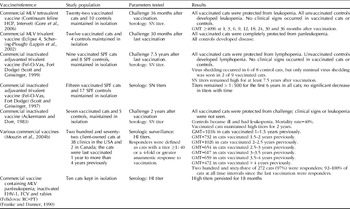
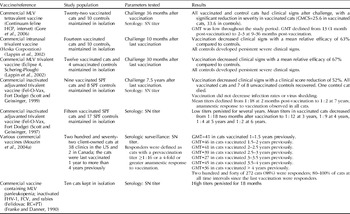
Cats that survive panleukopenia are thought to have long-lasting immunity to reinfection (Coyne et al., Reference Coyne, Burr, Yule, Harding, Tresnan and McGavin2001a; Gaskell et al., Reference Gaskell, Gettinby, Graham and Skilton2002). The feline panleukopenia vaccines also provide excellent protection; their estimated efficacy is greater than 99% (Schultz, Reference Schultz2006). Most vaccinated cats are completely protected from disease (Richards and Rodan, Reference Richards and Rodan2001). Three challenge studies (Table 5) demonstrated complete protection for at least 3 years in cats vaccinated with one attenuated vaccine, for at least 30 months in cats vaccinated with a different attenuated vaccine and for at least 7.5 years in cats vaccinated with an inactivated vaccine (Scott and Geissinger, Reference Scott and Geissinger1999; Lappin et al., Reference Lappin, Andrews, Simpson and Jensen2002; Gore et al., Reference Gore, Lakshmanan, Williams, Jirjis, Chester, Duncan, Coyne, Lum and Sterner2006). Another study reported complete protection for at least 2 years after vaccination with an inactivated vaccine (Ackermann and Dorr, Reference Ackermann and Dorr1983).
Challenge and serologic evaluation performed more than 1 year after vaccination with feline panleukopenia vaccines

FCV=feline calicivirus, FHV=feline herpesvirus, GMT=geometric mean titer, HI=hemagglutination inhibition, MLV=modified live virus, SPF=specific pathogen-free, SN=serum neutralization, US=United States.
Titers correlate well with protection from this disease (Larson, Reference Larson1996; Tizard and Ni, Reference Tizard and Ni1998; Coyne et al., Reference Coyne, Burr, Yule, Harding, Tresnan and McGavin2001a; Gaskell et al., Reference Gaskell, Gettinby, Graham and Skilton2002; Lappin et al., Reference Lappin, Andrews, Simpson and Jensen2002). SN titers stated to be protective vary from 1:8 to 1:40 (Tizard and Ni, Reference Tizard and Ni1998; Gaskell et al., Reference Gaskell, Gettinby, Graham and Skilton2002; Mouzin et al., Reference Mouzin, Lorenzen, Haworth and King2004b). Persistently high titers have been reported in vaccinated, isolated cats for periods as long as 3–7 years (Table 5) (Franke and Danner, Reference Franke and Danner1990; Scott and Geissinger, Reference Scott and Geissinger1997, Reference Scott and Geissinger1999; Lappin et al., Reference Lappin, Andrews, Simpson and Jensen2002; Gore et al., Reference Gore, Lakshmanan, Williams, Jirjis, Chester, Duncan, Coyne, Lum and Sterner2006). In one study, SN titers greater than 1:500 were observed in all vaccinated cats for 6 years, and no significant decline was noted over that time (Scott and Geissinger, Reference Scott and Geissinger1997). Only one long-term serologic study in pet populations has been published. This study found that 97% of cats had HI titers of at least 1:40 or a fourfold anamnestic response to vaccination, suggesting the persistence of memory B cells (Mouzin et al., Reference Mouzin, Lorenzen, Haworth and King2004b). Although this study demonstrated high mean titers in all groups of cats, including those that had been vaccinated more than 4 years previously, some individual cats, including some that had been vaccinated within the past 12–18 months, did not have protective titers or an anamnestic response. Resistance to challenge has been reported in some cats without protective titers (Lappin et al., Reference Lappin, Andrews, Simpson and Jensen2002).
Initial studies suggest that the feline panleukopenia vaccines provide good immunity to CPV variants such as CPV 2a, CPV 2b and CPV 2c, which can infect cats and, in some cases, cause a feline disease resembling panleukopenia (Greene et al., Reference Greene, Schultz and Ford2001; Richards and Rodan, Reference Richards and Rodan2001; Richards et al., Reference Richards, Elston, Ford, Gaskell, Hartmann, Hurley, Lappin, Levy, Rodan, Scherk, Schultz and Sparkes2006). The DOI to this virus has not been established.
FCV
A variety of combined FCV/FHV-1 vaccines are available, including parenteral attenuated or inactivated vaccines, and attenuated vaccines for mucosal administration. There are numerous strains of FCV, and varying degrees of cross-protection exist between strains (Gaskell et al., Reference Gaskell, Gettinby, Graham and Skilton2002). The current FCV vaccines do not seem to protect cats from some of the new, highly pathogenic strains that have been reported sporadically at veterinary hospitals (Hurley and Sykes, Reference Hurley and Sykes2003; Hurley et al., Reference Hurley, Pesavento, Pedersen, Poland, Wilson and Foley2004; Davis-Wurzler, Reference Davis-Wurzler2006; Radford et al., Reference Radford, Coyne, Dawson, Porter and Gaskell2007).
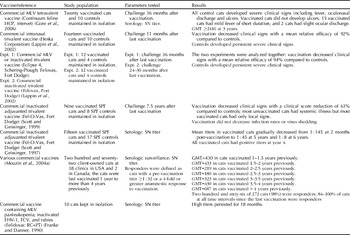
Immunity is thought to be brief after FCV infections (Coyne et al., Reference Coyne, Burr, Yule, Harding, Tresnan and McGavin2001a; Gaskell et al., Reference Gaskell, Gettinby, Graham and Skilton2002). Some infected cats become persistently infected and shed virus for prolonged periods (Coyne et al., Reference Coyne, Burr, Yule, Harding, Tresnan and McGavin2001a; Richards and Rodan, Reference Richards and Rodan2001; Hurley and Sykes, Reference Hurley and Sykes2003; Radford et al., Reference Radford, Coyne, Dawson, Porter and Gaskell2007). FCV vaccines can significantly decrease local symptoms and protect cats against serious systemic disease, but do not completely prevent infection or virus shedding (Scott and Geissinger, Reference Scott and Geissinger1997, Reference Scott and Geissinger1999; Richards and Rodan, Reference Richards and Rodan2001; Radford et al., Reference Radford, Coyne, Dawson, Porter and Gaskell2007). Protection is typically reported as a percentage reduction in clinical signs. Challenge studies in kittens demonstrate partial protection after vaccination (Hurley and Sykes, Reference Hurley and Sykes2003). Two studies reported relative efficacies of 64% or 84%, based on reductions in clinical signs in kittens challenged several weeks after vaccination (Scott, Reference Scott1977; Povey et al., Reference Povey, Koonse and Hays1980). In a recent study (Table 6), an attenuated multivalent vaccine significantly reduced the severity and duration of clinical signs in cats challenged 3 years after vaccination (Gore et al., Reference Gore, Lakshmanan, Williams, Jirjis, Chester, Duncan, Coyne, Lum and Sterner2006). None of the vaccinated cats developed ulcers. Fever, which occurred in 15 of 20 cats, was mild and short lived, and only two cats had a slight ocular discharge. In contrast, all of the control cats developed severe clinical signs including ulcers, fever and oculonasal discharge. In another study, the relative efficacy of inactivated or attenuated vaccines was 92% when cats were challenged at 11 months and 94% when cats were challenged 24–36 months after vaccination (Lappin et al., Reference Lappin, Andrews, Simpson and Jensen2002). In cats challenged with a homologous strain at 7 years, the relative efficacy of an inactivated vaccine was 63% (Scott and Geissinger, Reference Scott and Geissinger1999). It should be noted that FCV strains are highly diverse, and challenge with heterologous field strains will probably result in a shorter DOI than challenge with homologous strains (Radford et al., Reference Radford, Coyne, Dawson, Porter and Gaskell2007). Overall, these three studies suggest that, although the immunity from FCV vaccines is incomplete, protection appears to persist for several years.
Challenge and serologic evaluation performed more than 1 year after vaccination with FCV vaccines and companion short-term studies

FCV=feline calicivirus, FHV=feline herpesvirus, GMT=geometric mean titer, MLV=modified live virus, SPF=specific pathogen-free, SN=serum neutralization, US=United States.
Antibody titers are correlated with immunity to FCV infections (Lappin et al., Reference Lappin, Andrews, Simpson and Jensen2002; Larson, Reference Larson1996). SN titers stated to be protective range from 1:16 to 1:32 (Coyne et al., Reference Coyne, Burr, Yule, Harding, Tresnan and McGavin2001a; Mouzin et al., Reference Mouzin, Lorenzen, Haworth and King2004b). Few serologic studies have been conducted (Table 6), but limited surveillance suggests that high percentages of client-owned cats may have protective titers or memory B cells (Mouzin et al., Reference Mouzin, Lorenzen, Haworth and King2004b). Protective titers seem to persist for longer than a year and possibly for several years in isolated cats (Franke and Danner, Reference Franke and Danner1990; Scott and Geissinger, Reference Scott and Geissinger1997). In one recent study, the mean titer remained consistently high for at least 3 years in isolated cats vaccinated with an attenuated vaccine (Gore et al., Reference Gore, Lakshmanan, Williams, Jirjis, Chester, Duncan, Coyne, Lum and Sterner2006). At 3 years, when these cats were still protected from severe clinical disease at challenge, the geometric mean titer for the group was 1:2416 or higher. Although antibodies are thought to be important in protection to FCV, some cats without measurable titers are protected, suggesting that CMI and mucosal immunity may also be significant (Radford et al., Reference Radford, Coyne, Dawson, Porter and Gaskell2007).
Feline rhinotracheitis
Immunity to FHV-1 is also thought to be short-lived and incomplete (Coyne et al., Reference Coyne, Burr, Yule, Harding, Tresnan and McGavin2001a; Gaskell et al., Reference Gaskell, Gettinby, Graham and Skilton2002). Infected cats develop lifelong latent infections, and reactivation can occur if the animal is immunosuppressed by stress or other factors (Richards and Rodan, Reference Richards and Rodan2001; Gaskell et al., Reference Gaskell, Gettinby, Graham and Skilton2002). FHV-1 vaccines can significantly decrease local symptoms and protect cats from serious systemic disease, but do not completely prevent infection or virus shedding (Scott and Geissinger, Reference Scott and Geissinger1997, Reference Scott and Geissinger1999; Richards and Rodan, Reference Richards and Rodan2001; Gore et al., Reference Gore, Lakshmanan, Williams, Jirjis, Chester, Duncan, Coyne, Lum and Sterner2006). Protection is typically reported as a percentage reduction in clinical signs. Challenge studies in kittens demonstrate partial protection. In two studies, the relative efficacy, based on reductions in clinical signs, was 95% or 83% in kittens challenged several weeks after vaccination (Scott, Reference Scott1977; Povey et al., Reference Povey, Koonse and Hays1980). In a recent study (Table 7), vaccination with an attenuated vaccine significantly reduced the severity and duration of clinical signs after challenge at 3 years; the cumulative mean clinical score was 23.5 in vaccinated cats and 33.6 in controls (Gore et al., Reference Gore, Lakshmanan, Williams, Jirjis, Chester, Duncan, Coyne, Lum and Sterner2006). In other studies, the relative efficacy of an attenuated vaccine was 63% when cats were challenged at 10 months and 67% when cats were challenged at 30 months after vaccination (Lappin et al., Reference Lappin, Andrews, Simpson and Jensen2002). In cats challenged at 7 years, the relative efficacy of an inactivated vaccine was 52% (Scott and Geissinger, Reference Scott and Geissinger1999). These few studies suggest that, although the immunity from FHV-1 vaccines is incomplete, some protection may last for years.
Challenge and serologic evaluation performed more than 1 year after vaccination with feline rhinotracheitis (FHV-1) vaccines, and companion short-term studies

CMCS=cumulative mean clinical score, FCV=feline calicivirus, FHV=feline herpesvirus, GMT=geometric mean titer, MLV=modified live virus, SPF=specific pathogen-free, SN=serum neutralization, US=United States.
Some serologic surveillance has also been performed (Table 7). Although some authors suggest that the presence of FHV-1 titers corresponds to protection (Scott and Geissinger, Reference Scott and Geissinger1999; Lappin et al., Reference Lappin, Andrews, Simpson and Jensen2002), others state that the correlation between titers and immunity is poor (Johnson and Povey, Reference Johnson and Povey1985; Larson, Reference Larson1996; Coyne et al., Reference Coyne, Burr, Yule, Harding, Tresnan and McGavin2001a; Gaskell et al., Reference Gaskell, Gettinby, Graham and Skilton2002). Relatively high titers can develop in FHV-1 carriers, while non-carriers are seronegative or have decreasing titers (Tizard and Ni, Reference Tizard and Ni1998). Titers in many infected cats may be low (Gaskell et al., Reference Gaskell, Gettinby, Graham and Skilton2002). Given the complexity of the relationship between titers and protection, serologic surveys are difficult to interpret.
Non-core feline vaccines
A few DOI studies have been conducted for non-core feline vaccines. The AAFP Feline Vaccine Advisory Panel and/or the manufacturer recommends yearly vaccination in cats that are given FeLV, feline immunodeficiency virus, chlamydia, Bordetella bronchiseptica, Giardia or feline infectious peritonitis (FIP) virus vaccines (Richards et al., Reference Richards, Elston, Ford, Gaskell, Hartmann, Hurley, Lappin, Levy, Rodan, Scherk, Schultz and Sparkes2006). The AAFP Feline Vaccine Advisory Panel recommends FeLV vaccines for cats not restricted to a closed, indoor, low-risk FeLV-negative environment, as well as for all kittens, because they may be exposed to higher-risk environments later in life (Richards et al., Reference Richards, Elston, Ford, Gaskell, Hartmann, Hurley, Lappin, Levy, Rodan, Scherk, Schultz and Sparkes2006). Studies have shown that FeLV vaccines can protect cats from persistent viremia for at least 1 year (Scarlett and Pollock, Reference Scarlett and Pollock1991; Hoover et al., Reference Hoover, Mullins, Chu and Wasmoen1995; Harbour et al., Reference Harbour, Gunn-Moore, Gruffydd-Jones, Caney, Bradshaw, Jarrett and Wiseman2002). Long-term challenge studies can be difficult to conduct with this organism, as cats become more resistant to infection with increasing age (Richards and Rodan, Reference Richards and Rodan2001; Gaskell et al., Reference Gaskell, Gettinby, Graham and Skilton2002). A significant reduction in clinical signs has also been demonstrated in cats vaccinated with the chlamydiosis vaccine at 1 year (Kolar and Rude, Reference Kolar and Rude1981; Wasmoen et al., Reference Wasmoen, Chu, Chavez and Acree1992). The AAFP Feline Vaccine Advisory Panel does not recommend that FIV, chlamydiosis or B. bronchiseptica vaccines be given routinely to all cats, but these vaccines may be considered in high-risk situations (Richards et al., Reference Richards, Elston, Ford, Gaskell, Hartmann, Hurley, Lappin, Levy, Rodan, Scherk, Schultz and Sparkes2006). The minimum DOI for the feline giardiasis vaccine reported by the manufacturer is 1 year; however, an independent study did not find that the vaccine reduced the shedding of organisms (Stein et al., Reference Stein, Radecki and Lappin2003; Richards et al., Reference Richards, Elston, Ford, Gaskell, Hartmann, Hurley, Lappin, Levy, Rodan, Scherk, Schultz and Sparkes2006). The AAFP Feline Vaccine Advisory Panel does not generally recommend the feline giardiasis or FIP vaccines due to concerns about their efficacy (Richards et al., Reference Richards, Elston, Ford, Gaskell, Hartmann, Hurley, Lappin, Levy, Rodan, Scherk, Schultz and Sparkes2006). Long-term studies have not been published for any of these vaccines.
Conclusions
A vaccine's efficacy and DOI are determined by factors associated with the vaccine, animal and environment. Whether an animal will become ill or not depends on a balance between the level of immunity at challenge, and the dose and virulence of pathogens to which the animal is exposed. Many of the companion animal viral vaccines have been shown to produce at least 3 years of effective immunity when used in healthy animals under experimental conditions. Veterinarians need to assess the risks and benefits of vaccination for each disease in each animal when making vaccine decisions.
Acknowledgments
This modified and updated article is reprinted with permission from “Infectious Diseases” proceedings of a symposium held at the 2007 North American Veterinary Conference and the 2007 Western Veterinary Conference sponsored by Pfizer Animal Health. ©2007, Pfizer, Inc. Published by The Gloyd Group, Inc., Wilmington, DE.