During influenza season, especially during an influenza pandemic, monitoring influenza activity is needed at the community level across the United States. The ability of the Centers for Disease Control and Prevention (CDC) to issue appropriate guidance to public health officials and communities depends on having a full picture of disease activity, including comprehensive measures and impact measures that go beyond the direct burden of morbidity and mortality. Because most influenza surveillance depends on data from clinical encounters or the laboratory tests they generate, typically few options have been available for monitoring disease activity among people who do not seek care.1 Many ill people may not seek medical care, especially during a pandemic when hospitals and doctors’ offices are perceived to be or are overwhelmed. People also avoid medical facilities due to fear of contracting influenza or transmitting it to others. Therefore, methods for monitoring illness outside of health care settings are potentially important adjuncts to traditional disease reporting. One example is tracking absenteeism trends in schools and workplaces.Reference Patterson, Caddis and Durrheim2-Reference Buehler, Sonricker and Paladini9
Because detectable increases in absenteeism may precede signals from clinical or laboratory-based surveillance, monitoring absenteeism trends may provide an early indication of disease in the community. Absenteeism surveillance can also provide an important supplementary measure of the pandemic's impact because morbidity and mortality statistics may not fully reflect the disruption caused to the social and economic life of the community. This factor is especially true when disease makes people too sick to work but not sick enough to seek medical care. Furthermore, from the outset of the influenza A (H1N1) pandemic in the spring of 2009, one of CDC's primary control measures was to advise all sick people stay home from school and work.10 Subsequently, an ad hoc work group was formed early in the course of the pandemic to evaluate methods to assess how the pandemic was affecting health-related absenteeism in the workplace.
After examining existing sources of data on workplace absenteeism, CDC began monitoring health-related workplace absenteeism using nationally representative, population-based data from the Current Population Survey (CPS) issued by the Bureau of Labor Statistics (BLS).11 Preliminary analyses of historical data from the CPS and from CDC's US Outpatient Influenza-like Illness Surveillance Network (ILINet) indicated that workplace absenteeism correlates well with the seasonal occurrence of ILI. It also noted that absenteeism trends would be sensitive to outbreaks of influenza by responding in a predictable, detectable way.11, 12 Unfortunately, CPS absenteeism data are not timely enough to inform response efforts rapidly during a pandemic; therefore, a supplementary approach was needed.
In anticipation of a fall 2009 pandemic, concern and uncertainty about its impact on businesses’ continuity of operations, CDC initiated a pilot project to access the feasibility of an enhanced absenteeism surveillance system in sentinel worksites across the United States. CDC partnered with the American College of Occupational and Environmental Medicine (ACOEM), which has access to a large network of affiliated medical directors and corporate health units that routinely compile absenteeism data.
CDC's objectives for this project were (1) to establish a system to track trends in workplace absenteeism in selected workplace settings; (2) to assess the impact of 2009 H1N1 on absenteeism in the workplace to plan assumptions for preparedness and continuity of operations; and (3) to contribute to CDC's awareness of the health situation during the emergency response to the pandemic. Our discussion of workplace absenteeism surveillance during the 2009 H1N1 pandemic includes lessons learned and recommendations regarding its ongoing use as an adjunct to traditional disease reporting for national influenza surveillance.
Methods
Population-Based Surveillance
We monitored the prevalence of health-related absenteeism among full-time workers in the United States using population-based, nationally representative data from the CPS. The CPS is a monthly national survey of approximately 57 000 households conducted by the Bureau of the Census for the BLS. Data on all sample household members are collected from a single respondent using a standardized questionnaire. Questionnaire items refer to the week preceding the one in which the interview is conducted. The CPS obtains information on employment, demographics, and other characteristics of the civilian, noninstitutionalized population aged 16 years or older.13 For this analysis, we defined full-time workers as employed persons who reported they usually worked at least 35 hours per week. We defined health-related absenteeism as working fewer than 35 hours during the reference week due to the worker's own illness or injury.
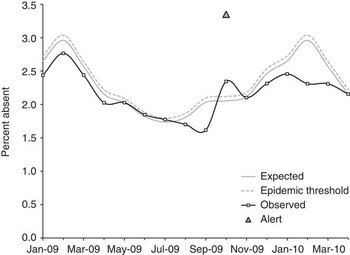
For each month from January 2009 to April 2010 the 1-week prevalence of health-related absenteeism among full-time workers was estimated and compared with an epidemic threshold defined as the 95% upper confidence limit for each month's expected value based on combined 2004-2008 data. Because the CPS questions refer to 1 week of each month—typically the week containing the 12th day—absenteeism during the other weeks of the month was not measured. These 1-week measures were intended to be representative of all weeks of the month in which they occur.
Observed values greater than the epidemic threshold generated surveillance alerts. Because the observed values were themselves estimates with their own margins of error, we confirmed the statistical significance of all alerts using the design-adjusted Wald χ2 test for equivalence between observed and expected values. All analyses were weighted, and estimates of all standard errors were adjusted to account for the complex design of the CPS sample.Reference Davern, Jones and Lepkowski14, Reference Davern, Jones and Lepkowski15
Sentinel Worksite Surveillance
From September 28, 2009, through March 31, 2010, we conducted enhanced passive surveillance of health-related absenteeism from a convenience sample of 79 sentinel worksites representing 16 different employers. Each week, aggregated absenteeism data were solicited by ACOEM from the medical directors of the sample companies using an e-mailed, standardized data collection form. The companies were responsible for entering data in the form and returning it by e-mail to ACOEM. ACOEM would replace company names with coded unique identifiers, and send the data to CDC for analysis. Data were reported each Monday for the preceding 7 days.
Measures used for this project included total absenteeism, defined as the percentage of employees with an unscheduled absence of any duration during the reference week, and ILI absenteeism, defined as the percentage of employees with an unscheduled absence during the reference week who reported having an ILI. ILI was defined as a fever 37.8 °C and a cough or sore throat, in the absence of any known cause other than influenza.16 Absenteeism was calculated each week for the total sample and by industry sector and geographic region. Industry sectors were defined by North American Industry Classification System codes. Geographic regions were based on US Department of Health and Human Services (HHS) administrative regions.
Results
Population-Based Surveillance
During the study period, health-related absenteeism among full-time US workers ranged from 1.6% to 2.8% and remained below the epidemic threshold each month except October, when there was a significant (P < .01) increase above baseline. This signal corresponded with the pandemic peak in the national occurrence of ILI, based on data from ILINet17 (Figure 1).
One-Week Prevalence of Health-Related Absenteeism Among Full-Time Workers by Month Compared with Expected Values. Expected values are based on combined 2004-2008 data aggregated by month, from the Current Population Survey, January 2009–April 2010.13

Sentinel Worksite Surveillance
The 79 sentinel worksites were located in all 50 US states, Puerto Rico, and the District of Columbia. Nine different industries were represented, contributing from less than 1% of the total sample (apparel manufacturers) to 38% to 39% (insurance agencies and brokerages and pharmaceutical preparation manufacturers). The maximum total employee population under surveillance was 30 549. However, because reporting by sample companies during the study period was inconsistent, actual sample size varied substantially by week. Toward the end of the study period, some companies discontinued reporting because concerns over 2009 H1N1 had lessened.
Total absenteeism values for the full sample ranged between 1% and 3% during the study period, with considerable weekly variability. However, the unstable denominator and variable regional and industry mix in the sample due to inconsistent reporting severely limited the comparability of any given week's data with the next. This limitation made the time series for the full sample impossible to interpret meaningfully, and those data are not presented here. Region- and industry-specific time series were also developed, but small sample sizes made them unstable and the results too erratic to be interpreted meaningfully. Those data also are not shown.
The results presented are based on data from a single large employer from the sample (company A). This company reported consistently and reliably throughout the study period, providing a stable denominator and eliminating variability due to potential company-specific differences in data collection and reporting practices. Company A, a large insurance agency with 11 959 employees, has 8 different worksites in 7 states, representing 6 of the 10 HHS regions, preserving some of the geographic diversity of the full sample.
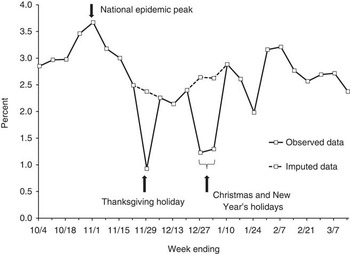
Figure 2 shows a time series of weekly total absenteeism during the study period for company A. It also indicates the national peak of 2009 H1N1 activity, based on the number of laboratory tests positive for influenza and the proportion of outpatient visits due to ILI,17 and the dates of certain events that may have affected absenteeism. The Thanksgiving, Christmas, and New Year's holidays appear to have resulted in artificially low absenteeism.
Weekly Absenteeism Prevalence Among Employees of Sample Company A With Multiple Worksites (October 2009–March 2010). Company A has 8 worksites in 7 states. National epidemic peak was based on results of laboratory tests positive for influenza and the proportion of outpatient visits due to influenza-like illness.

Total absenteeism in company A peaked during the week ending November 1, 2009, at 3.7%, which corresponded well—within one week—with the national epidemic peak. But the data still appeared erratic, with much of the variability apparently due to artifact from the holidays. We replaced the observed data points from those weeks with data imputed based on the mean of the surrounding observations and achieved a more stable time series; total absenteeism ranged roughly between 2.0% and 4.0%.
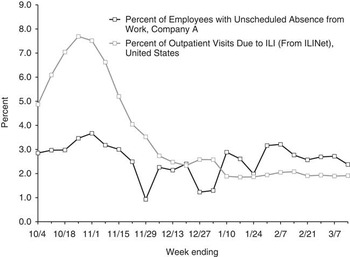
Figure 3 shows weekly total absenteeism in company A along with the estimated national percentage of outpatient visits attributable to ILI, based on ILINet data.18 While peak total absenteeism corresponded roughly with the maximum percent of outpatient visits due to ILI, their magnitudes were considerably different. The dramatic increase in the occurrence of ILI fall data was not mirrored in the total absenteeism data from company A.
Weekly Absenteeism Prevalence Among Employees of Sample Company A With Multiple Worksites and US Outpatient Visits for Influenza-like Illness (ILI; October 2009–March 2010). From the Centers for Disease Control and Prevention's US Outpatient Influenza-like Illness Surveillance Network (ILINet).

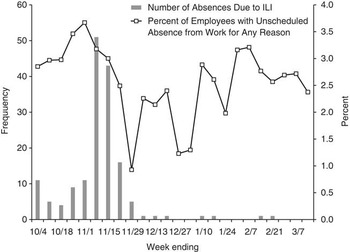
In addition to total absenteeism, company A provided data on ILI-specific absenteeism. Figure 4 shows weekly total absenteeism prevalence and weekly number of absences due to ILI in the company. Compared with total absenteeism, the peak occurrence of absenteeism due to ILI was later in the season, and the increase in magnitude was more pronounced.
Weekly Prevalence of Absenteeism and Number of Absences Due to Influenza-like Illness (ILI) Among Employees of Sample Company A With Multiple Worksites (October 2009–March 2010).

Discussion
Our experience with workplace absenteeism surveillance during the 2009 H1N1 pandemic, included both monthly population-based surveillance using the CPS and weekly sentinel worksite surveillance. Data on school and workplace absenteeism have been used as a nonspecific or syndromic indicator of the occurrence of ILI or other illness in the community at other times and in other settings.Reference Caddis and Paterson3-Reference Buehler, Sonricker and Paladini9 As cited,Reference Patterson, Caddis and Durrheim2 data on workplace absenteeism from a large public employer in London, UK, were used to monitor the occurrence of illness in that city during the 2009 H1N1 pandemic, and similar data have been used for influenza surveillance in Australia for years.
During the 1957-1958 influenza pandemic, CDC monitored workplace absenteeism among some 60 000 AT&T employees in 37 major cities using data provided in weekly reports by that company's medical director.Reference Trotter, Dunn and Drachman19 Surveillance results from that earlier pandemic indicated that workplace absenteeism peaked during the week ending October 19, 1957, coincident with the peak in influenza activity indicated by other measures.Reference Trotter, Dunn and Drachman19 During that week, excess absenteeism was only 2.7%.Reference Trotter, Dunn and Drachman19 Peak workplace absenteeism within individual cities ranged from 3% to 8%.Reference Trotter, Dunn and Drachman19 Those findings were all remarkably similar to our own findings. To our knowledge, ours has been the only effort to use workplace absenteeism data for public health surveillance at the national level in the United States since that time.
Total absenteeism and absenteeism due to ILI during the 2009 H1N1 pandemic does not appear to have been severe, particularly in comparison to assumptions commonly used in previous pandemic preparedness planning for continuity of operations, which anticipated absenteeism rates of 30% to 40%.20, 21 Consequently, the impact of 2009 H1N1 on companies’ ability to continue operating during the pandemic appears to have been modest to negligible, at least at the national level. Individual, local exceptions may exist. Some workplaces such as schools were affected not by high employee absenteeism, but because of government-recommended closures to prevent transmission of the virus, particularly in the early stages of the outbreak.22
In October and November, total absenteeism in company A was higher in general than in the full-time working population, based on nationally representative survey data. This finding may have been due, in part, to a higher occurrence of illness in our sample during those months; it also may have occurred because the sample data reflected unscheduled absenteeism due to all causes (eg, the illness of a child or spouse), while the CPS data specifically reflected absenteeism due to the workers’ own illness or injury.
Reasons for the modest impact of 2009 H1N1 on absenteeism may include the relative mildness of the disease in the working-age population and the fact that the age distribution of the most affected population, which tended to be young, did not overlap substantially with that of the working population.Reference Shiley, Nadolski and Mickus23
It has long been observed that, in the early stages of influenza epidemics, the predominance of cases tend to occur among school-aged children.Reference Glezen, Couch and MacLean24 Thus, increases in workplace absenteeism may lag other indicators (eg, school absenteeism, virologic surveillance) in signaling the existence of an epidemic. However, secondary influenza infections from children to other family members have been demonstrated to affect worker absenteeism.Reference Li and Leader25, Reference Palmer, Rousculp, Johnston, Mahadevia and Nichol26 In principle, therefore, sharp increases in workplace absenteeism could indicate community disease experience and, depending on the circumstances of the outbreak, could precede signals from medically-based surveillance systems. Ultimately, the value of workplace absenteeism surveillance may not be as a system for the early detection of influenza epidemics. Rather, it may be a gauge of an epidemic's impact on the workforce and of the community's burden of illness and disruption that might not be reflected in morbidity and mortality statistics based on data from health care settings.
Analysis of nationally representative data indicated that health-related workplace absenteeism correlated well with the occurrence of ILI and identified a significant increase in absenteeism that coincided with the peak of the fall pandemic wave. Also, similar to CDC's efforts 55 years ago, our feasibility project showed that sentinel surveillance data on workplace absenteeism could be collected and analyzed in a timely manner during a pandemic using a network of corporate occupational health professionals who routinely monitor absenteeism, provided the employers participate fully. Our experience with workplace absenteeism surveillance highlights the relative strengths and weaknesses of the approaches we used.
Strengths and Weaknesses of Population-Based Surveillance
The use of nationally-representative, population-based survey data for absenteeism surveillance has many advantages. The CPS uses a scientifically designed probability sample that is representative of the civilian, noninstitutionalized US population at the national, regional, and state levels.13 It has a consistent sample size and a very high response rate and can be used to produce valid and reliable estimates for subgroups, including demographic (eg, age groups) and major industry sectors (eg, service sector) and occupational groups (eg, health care personnel).13 Also, statistical tests can be applied to these data to determine the significance of differences between observed and expected values or between sample subgroups.
As operationalized, the absenteeism measure used with the CPS data may be superior to that used with the sentinel worksite data. While CPS data are self-reported, they are specific to absenteeism from work due to the worker's own ill health and not due, for example, to care for a sick child. The data also are less subject to the types of bias that may be involved when a worker reports the reasons for an absence to an employer, as when absenteeism is measured using data from administrative human resources records, especially when absences do not require medical certification.Reference McEwan27, Reference Kivimaki, Head and Ferrie28
However, we found the population-based survey approach to absenteeism surveillance had significant limitations as well. First, the nature of the CPS data only allowed us to surveil absenteeism among full-time workers. More importantly, the many advantages this approach had in terms of validity and reliability were achieved at the expense of timeliness. While the CPS is a monthly survey, unmatched in its frequency and timeliness by any national health survey, it is not timely enough to provide actionable information during a pandemic. The BLS releases key results from the CPS (ie, the national unemployment rate) on the first Friday of the month following the month in which the data are collected. The raw data, however, are not publicly available for analysis until the middle of the next month, resulting in a 2-month lag for absenteeism surveillance.
Strengths and Weaknesses of Sentinel Worksite Surveillance
The fundamental advantage of the sentinel worksite approach was timeliness. Data were routinely compiled and thus could be collected and analyzed in near real time, making this approach useful, in principle, for providing current situational awareness and actionable intelligence that could be used to inform, prioritize, and evaluate intervention efforts during the pandemic.
Conversely, such ad hoc or “drop-in” enhanced surveillance systems are typically hard to sustain, especially for long periods of time.29, Reference Das, Weiss and Mostashari30 As we found, reporting may be inconsistent and intermittent. Failure of some companies to report their data on certain weeks led not only to an unstable denominator during the study period, but, more importantly, to a variable regional and industry mix in the sample, which limited the comparability of weekly data values.
In addition, recruiting participants can be extremely difficult. Our project originally envisioned a population under surveillance of 250 000 workers. At most, we achieved 12% of the desired sample size. We understand that a major reason for fewer companies participating than had originally expressed willingness was due to unresolved ethical and legal concerns about collecting and sharing these kinds of data. Companies were concerned about the legal liability of asking employees the reason for their absence, particularly about specific medical reasons for the absence. Also, many companies may have been unable to participate due to “administrative incompatibility,” which relates to the increasing use of “paid time off” policies in lieu of more traditional sick leave policies.31 In the latter, employers cannot distinguish between health-related absenteeism and absenteeism due to other reasons, and could not provide the data required by the system.
The sentinel worksite results also had other limitations, the most important of which was the lack of representativeness of our sample. Because it was a convenience and not a probability sample, representation by both geographic region and industry was disproportionate. Another factor affecting the representativeness of the sample was that only companies served by ACOEM occupational health professionals were eligible for inclusion. Therefore, the use of statistical tests and the construction of meaningful confidence intervals based on these data were precluded. Moreover, these data cannot produce estimates that can be validly generalized to other populations.
Another limitation of this approach was its reliance on absenteeism due to all causes rather than ILI or illness in general, as its main measure. The misclassification bias in the use of total absenteeism as a proxy measure for illness can lead to overestimation of the occurrence of disease. While an ILI-specific absenteeism measure was used, collection of these data, which required a case definition to be explained by telephone to a person self-reporting an absence, was not considered reliable for our study and could lead to an underestimation of the occurrence of ILI absenteeism. Finally, absenteeism in the sentinel worksites could not be compared with a prepandemic baseline because previous years’ data were unavailable. This lack limited our ability to understand the degree to which the pandemic affected absenteeism in these worksites and highlighted the need to include absenteeism surveillance considerations in pre-event preparedness planning.
Conclusions
During the 2009 H1N1 pandemic, 2 approaches were used as supplementary systems for surveillance of health-related work absenteeism, with the idea that the disadvantages of the one could be offset by the strengths of the other. The ability of this combined approach to provide fully comprehensive and useful surveillance data, however, was limited. Ideally, the advantages of each approach would be incorporated into a single system for absenteeism surveillance. For example, rather than an ad hoc sample of sentinel providers, a permanent or semipermanent network of employers, selected using a formal sampling protocol, might be recruited during the interpandemic period to provide more representative and reliable data on an ongoing basis. Automated reporting systems might also be used to improve participation.
Based on the findings and conclusions of this study, we make the following recommendations. First, systems for monitoring workplace absenteeism should be included in pandemic preparedness planning, with consideration given to the lessons learned in this feasibility study. Second, networks comprising corporate health units and individual occupational health professionals could provide an infrastructure for the rapid collection of workplace absenteeism data. Finally, the use of permanent, ongoing systems to monitor workplace absenteeism should be considered one way to detect early community outbreak and conduct occupational health surveillance.
Acknowledgments
The American College of Occupational and Environmental Medicine and its member practitioners participated in this effort, and the management and employees of the companies involved provided data for this project.