INTRODUCTION
Measuring the adoption and diffusion of agricultural innovations remains a challenging endeavour (CIMMYT, 1993; Erenstein, Reference Erenstein2010; Rogers, Reference Rogers2003). Formal adoption and impact assessment surveys have the potential to provide robust indicators. A major drawback though is that they typically are resource demanding to implement and often imply a substantial lag between data collection and publication of results. Their utility also hinges on the underlying sampling framework, the indicators collected and the ability to control for confounding factors (e.g. Erenstein, Reference Erenstein2009a). There is thus considerable interest in reliable yet cheap and timely technology uptake indicators to guide agricultural research and development (R&D).
Village surveys provide a promising tool to monitor technology dynamics. They have already been variously used to characterize agricultural systems (Erenstein et al., Reference Erenstein, Thorpe, Singh and Varma2007b; Erenstein and Thorpe, Reference Erenstein and Thorpe2009) and complement formal surveys (Singh et al., Reference Singh, Erenstein, Gathala, Alam, Regmi, Singh, Rehman, Tripathi, Ladha, Yadvinder-Singh and Erenstein2009; Teufel et al., Reference Teufel, Erenstein and Samaddar2007). The concept as such is not new: village studies were already being promoted as an empirically-based alternative to other economic analyses of rural situations more than three decades ago (Dasgupta, Reference Dasgupta1978; Lipton and Moore, Reference Lipton and Moore1972; Scoones, Reference Scoones2009). However, there have been two main criticisms. First, generalizations from village studies were perceived to have limited applicability as the often limited sample of villages was deemed unrepresentative. Second, synthesis and interpretation across village studies proved problematic (Dasgupta, Reference Dasgupta1978). In subsequent years village surveys have seen various incarnations such as rapid and participatory appraisals, focus group discussions and key informant surveys, but all typically were still problematic to synthesize, interpret and generalize. To enhance the utility of village surveys as monitoring tool they need a common research design, including survey and sampling methodology, substantial village numbers and the inclusion of comparable quantifiable indicators.
This paper explores the use of village surveys to assess tillage dynamics in the Indo-Gangetic Plains (IGP) in India. There have been considerable investments in the adaptation and promotion of new tillage practices in the IGP, particularly zero tillage (ZT) – the seeding of a crop into unploughed fields, also known as no till, direct seeding/drilling or conservation tillage – in the rice-wheat systems (Erenstein et al., Reference Erenstein, Farooq, Malik and Sharif2008; Erenstein and Laxmi, Reference Erenstein and Laxmi2008; Hobbs et al., Reference Hobbs, Sayre and Gupta2008). Zero tillage was thereby seen as a promising technology that could save resources, reduce production costs and improve production while sustaining environmental quality and serve as a stepping stone towards conservation agriculture. The diffusion of ZT planting of wheat after rice has been most pronounced in northwest India and to a lesser extent the Indus plains in Pakistan (Erenstein et al., Reference Erenstein, Farooq, Malik and Sharif2007c; Erenstein and Laxmi, Reference Erenstein and Laxmi2008). However, the extent of diffusion has been problematic to assess reliably (Erenstein, Reference Erenstein2010). Furthermore, there were indications of discontinuation of ZT by farmers and the emergence of new tillage practices such as combining the ZT drill with reduced tillage and the use of rotavators that called for follow-up field research.
The objective of the paper is to illustrate the contribution of village surveys to technology uptake monitoring. Village surveys as used here can be defined as rapid quasi-quantitative community studies, i.e. a hybrid between quantitative and qualitative social science approaches to study a defined group of people or aspect thereof. They combine quantitative elements of sample surveys, such as a rigorous sampling design to ensure representativeness and the inclusion of substantial village numbers and comparable quantifiable indicators to facilitate quantitative analysis and contrasts, with a community level focus (i.e. for the entire village or target group) using key informants and group discussions. The paper illustrates the use of such village surveys through two empirical case studies, into tillage dynamics in the Trans-Gangetic Plains (TGP) – India's Green Revolution heartland comprising the two contiguous northwestern states of Punjab and Haryana. The first case is a revisit of communities surveyed earlier in Haryana State and the second a new study in Haryana and Punjab State.
MATERIALS AND METHODS
Case study 1: Follow-up village surveys in Haryana, India
Village surveys were implemented as follow-up to an intensive formal adoption survey (household level) that assessed ZT uptake in the rice-wheat zone of Haryana state, India (Erenstein et al., Reference Erenstein, Malik and Singh2007a). The original survey in 2003/04 used a stratified sampling frame. Within the state, the 10 districts where rice-wheat systems predominate were purposively chosen, including six districts where ZT had been widely promoted and four districts where ZT promotion had been less extensive. Within each district one or two blocks (the sub-sub-district administrative level, below the tehsil or sub-district) where rice-wheat systems predominate were chosen purposively. Within these five villages were randomly chosen per district with eight randomly chosen farm households per village. This gave a total of 50 villages and 400 farm households. A brief characterization of the study area and the findings from the original surveys have been variously reported (Erenstein and Farooq, Reference Erenstein and Farooq2009; Erenstein et al., Reference Erenstein, Malik and Singh2007a; Reference Erenstein, Farooq, Malik and Sharif2007c; Reference Erenstein, Farooq, Malik and Sharif2008).
During the 2007/08 wheat season the same 50 rice-wheat villages in Haryana surveyed earlier were revisited during a village survey. The second visit aimed to assess the evolution of tillage and residue management practices since the original survey, and to gain a better understanding of farmer's perceptions of tillage systems and any eventual problems they are facing. Within each survey village key informants and a self-selected group of villagers were interviewed using a semi-structured survey instrument. The survey process typically included a briefing of the village leaders and key informants leading to a larger group meeting with farmers (with an average of 10.5 participants). The group meetings endeavoured to include a representative group of village farm households that covered the diverse socio-economic spectrum. Overall, 64% of the group participants had relatively small farms (i.e. less than state average of 2.3 ha).
The survey instrument compiled a number of village level indicators to characterize and assess land and technology use within the community with a special focus on wheat tillage and residue management. Indicators included aggregate numbers of village assets, prevailing prices, occurrence of practices (reported hereafter as share of villages reporting) and the intensity of their use (reported as share of village or farm households). The village surveys also listed the main advantages/benefits and disadvantages/problems of each tillage system as practised in the village. Many village indicators provide estimates, which compared reasonably with available secondary data.
Case study 2: New village surveys in Haryana and Punjab, India
Case study 1 is limited to Haryana State and was relatively focused on rice-wheat systems and areas where ZT had been promoted. Case study 2 was initiated to provide a complementary study with a wider more representative random sample of wheat cultivating villages in the northwest (NW) IGP, and included non-rice-wheat systems and Punjab State.
During the same 2007/08 winter season an additional wheat tillage monitoring survey was conducted across 120 randomly selected villages in Haryana and Punjab (i.e. 2 states × 10 districts/state × 6 villages/district). The survey used a stratified sampling frame. Within each state, 10 districts were purposively chosen, ensuring coverage of the main agro-ecological zones and excluding districts that fell outside the IGP or bordered the capital. Within these districts, three tehsils (sub-districts) were randomly chosen per district with two randomly chosen villages per tehsil using the village directory from the Indian population census. As in case study 1, within each survey village key informants and a self-selected group of villagers were interviewed using a similar semi-structured survey instrument with an average of 12.6 participants, of which 59% had relatively small farms.
RESULTS
Village characteristics
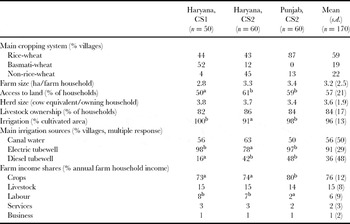
Wheat grown during the cool winter (rabi) season has traditionally been, and continues to be, the mainstay of food security in the TGP and the village surveys again confirm the prevalence of wheat-based cropping systems (Table 1). Monsoon rice only expanded rapidly in recent decades and gave rise to rice-wheat systems, thereby putting increasing pressure on the ability to plant wheat in timely fashion without incurring yield losses. The original case study 1 purposively selected rice-wheat areas and within these showed a relative bias towards basmati rice areas. The distinction between scented basmati rice and normal rice (non-basmati) is important in view of the marked divergences in crop and residue management and basmati's longer crop duration (Erenstein et al., Reference Erenstein, Malik and Singh2007a). Case study 2 aimed for a more regionally representative sample – with surveyed villages more or less split between rice-wheat and non-rice-wheat systems in Haryana whereas rice-wheat systems prevail in Punjab (Table 1). Irrigation constraints help explain Haryana's more varied cropping systems (Table 1). Other indicators are relatively similar for the surveyed communities, including 50–60% of village households engaged in arable farming and a prevalence of mixed crop-livestock systems (Table 1).
Selected village characteristics by case study.

Data followed by different letters differ significantly – Duncan multiple range test (significance level = 0.1), within row comparison. Source: Village surveys Case studies (CS) 1 and 2.
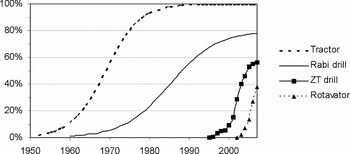
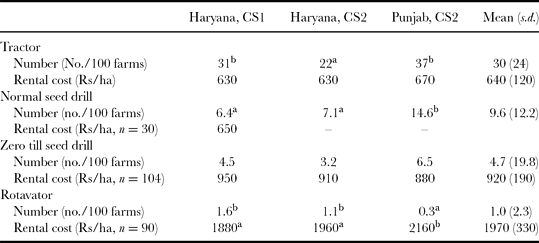
A distinctive feature of the TGP is its widespread tractorization (Figure 1) with mechanized land preparation now near universal. This was followed at a lag by a somewhat slower spread of conventional (rabi) seed drills primarily substituting the traditional broadcasting of wheat (Figure 1), particularly in Punjab (Table 2). In the last decade there has been a rapid spread of ZT drills and even more recently of rotavators (Figure 1), the rotavators being more common in Haryana (Table 2). In India there is a tradition of subsidizing agricultural machinery. State Governments provide 25% subsidy on the purchase cost of a new ZT drill or rotavator – and even up to 50% in districts covered by the National Food Security Mission. Tractor densities are particularly high in rice-wheat areas (Table 2). It is common practice for non-tractor owners to rent in mechanized tillage and crop establishment services with relatively similar rental rates throughout the TGP (Table 2). Rotavators have the highest rental rates, reflecting their high initial investment (double the cost of a ZT drill) and operating cost.
Mechanization diffusion in surveyed villages (retrospective data, first year of ownership within village). Source: Village surveys case studies 1 and 2. Tractor and rabi drill reflect estimated logistic curves (CIMMYT, 1993); ZT drill and rotavator cumulative responses.

Mechanization and price indicators by case study.
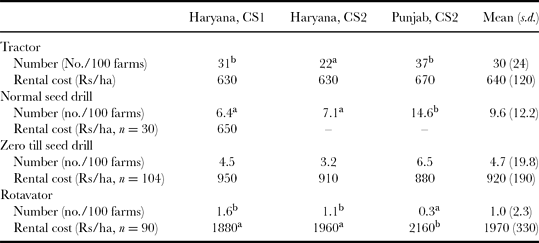
Note: n = 170 unless otherwise indicated. Duncan multiple range test (significance level = 0.1), within row comparison. Source: Village surveys Case studies (CS) 1 and 2.
Tillage systems: Characteristics and use
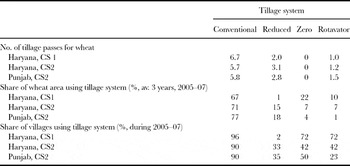
Land preparation and crop establishment for wheat in the TGP can be categorized into four main tillage systems – all tractor based (Table 3). The conventional system is tillage intensive and implies an average of 6–7 tillage passes with a tractor-drawn disc harrow and/or tined cultivator – followed by either mechanized seeding (60% of farmers) or broadcasting of wheat. Zero tillage is the planting of wheat with a tractor-drawn ZT seed drill directly into unploughed fields with a single pass of the tractor. Reduced tillage is an intermediate tillage system – reducing tractor tillage passes to 2–3 (with harrow and/or cultivator) and using either mechanized seeding or broadcasting. Rotavators are tractor drawn and typically imply a single pass of shallow intensive tillage which incorporates crop residues and pulverizes the soil. It thereby reduces the number of passes compared to conventional tillage, but its tillage intensity goes against the conservation agriculture tenets (Erenstein, Reference Erenstein2009b). Seeding in rotavator plots is typically either using a rotavator mounted spreader or by broadcasting.
Characteristics tillage systems by case study.

Source: Village surveys Case studies (CS) 1 and 2. n = 50 for CS1 and n = 60 each for Haryana and Punjab, CS2.
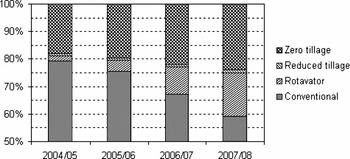
The earlier 2003/04 households surveys for case study 1 showed the diffusion of zero tillage wheat to have picked up since 2000, with 34.5% of wheat farmers using ZT on an aggregate 26% of the wheat area in the survey year (Erenstein, Reference Erenstein2010; Erenstein et al., Reference Erenstein, Malik and Singh2007a). The subsequent revisit confirmed similar indicators, albeit slightly lower, with the estimated ZT wheat area averaging 22% over the subsequent three year period (2005–08). The village surveys relied on retrospective data, and according to these the ZT wheat area continued to increase, albeit at a slow pace, from an average share of village wheat area of 18% in 2004/05 to 24% in 2007/08 (Figure 2). The village surveys also reconfirmed the earlier finding that the reduced tillage area in these villages was marginal, with farmers using either ZT or conventional tillage (Erenstein et al., Reference Erenstein, Malik and Singh2007a). However, the revisit highlighted the recent and rapid spread of rotavator tillage (Figure 2, Table 3).
Evolution of wheat tillage in rice-wheat systems in Haryana, India, 2004–08. Source: Erenstein, Reference Erenstein2009b, based on retrospective data from village surveys case study 1, n = 50.

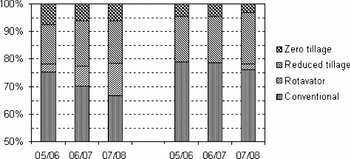
Case study 2 shows both some marked divergences and similarities (Figure 3) compared to case study 1. First, the average ZT area share (5%) is significantly lower – both in Haryana and Punjab – and showed a small decline over the period 2005/06 to 2007/08. This is the net results of an ambivalent adoption trend, with about a third of using villages reporting a downward trend and the remainder primarily upward. Zero tillage also stood out as the only new tillage systems in case study 2 that showed a higher adoption among larger farmers, in line with earlier findings (Erenstein and Farooq, Reference Erenstein and Farooq2009). Second, the average reduced tillage area (17%) in case study 2 was a multiple of the ZT area and showed a small increase in both states. As in case study 1, there was a marked increase in rotavator tillage particularly in Haryana. Both case studies concur that conventional tillage still is the prevailing tillage system, albeit on a consistent downward trend. Conventional tillage systems in the two case studies also differed somewhat, with its intensity only having declined in case study 2 (with an average of 0.5 tillage passes over the previous 5–10 years) and being more commonly associated with mechanized seeding in case study 2 (68% v. 38% in case study 1). The conventional tillage practices in case study 1 were, however, once more consistent with the earlier farm survey, which also found no reduction in tillage and 32% using mechanized seeding.
Evolution of wheat tillage systems in Haryana (left 3 columns) and Punjab (right), India, 2005–08. Source: Erenstein, Reference Erenstein2009b, based on retrospective data from village surveys case study 2, n = 120.

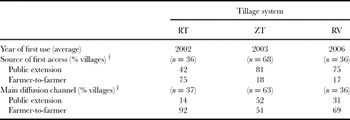
The introduction of the new tillage systems is relatively recent (Table 4). Across tillage systems, public extension is generally perceived to have had a significant role in introducing the new tillage system, and a much lesser role in subsequently diffusing the technology, which typically is more farmer-to-farmer. There are, however, some interesting contrasts between the new tillage systems (Table 4). Reduced tillage has had the least involvement of public extension, being primarily perceived as a farmer-led innovation. In contrast, the source of both ZT and rotavators is perceived to be similarly public extension led. However, whereas public extension continues to play a prominent role in ZT diffusion, the rapid recent advent of rotavators has become markedly farmer led. Still, it remains somewhat puzzling that public extension services are simultaneously promoting and subsidizing machinery that limits the intensity of soil tillage (ZT drills) and machinery that intensify the tillage intensity (rotavators).
Perceived year of introduction, sources and diffusion channels of wheat tillage systems, Haryana and Punjab.

Note: RT: reduced tillage; ZT: zero tillage; RV: rotavator.
†Multiple responses possible. Source: Village surveys case study 2.
Tillage systems: Contrasts and implications
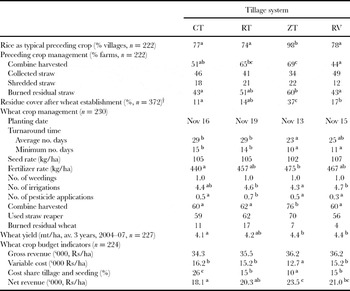
The tillage systems are variously associated with other crop management practices and performance indicators (Table 5). Zero tillage wheat is primarily used in former rice fields. The preceding crop in ZT fields thereby is also more commonly combine harvested and residual crop residues burned as a land preparation measure. Still, the elimination of tillage in ZT fields implies that typically some residue cover remains as mulch after wheat establishment, whereas these levels are marginal for the other tillage systems.
Crop management and performance indicators by wheat tillage systems, Haryana & Punjab.

Note: CT: conventional; RT: reduced tillage; ZT: zero tillage; RV: rotavator.
† Residue cover estimated in two representative plots using knotted rope. Duncan multiple range test (significance level = 0.1), within row comparison. Source: Village surveys case study 2.
Average wheat seeding dates did not vary significantly over tillage systems, despite farmers reporting ZT as having the lowest turnaround time (Table 5). In part this reflects that in practical terms actual turnaround times are often double the perceived minimum – and even more than double for ZT and rotavator. Actual seeding time particularly for ZT is dependent on residual soil moisture, and failing that, irrigation availability. Some farmers reported a turn-around time of 3–5 days if soil moisture was available, but 20–25 days otherwise. Some farmers thereby apply irrigation to the standing previous monsoon crop prior to harvest to ensure adequate soil moisture for the winter crop establishment. In addition, there is a preference to use ZT in basmati rice fields, which are harvested later but also tend to have more residual moisture. The similarity in wheat establishment dates across tillage systems is again consistent with the earlier 2003/04 survey. The dates fall around the optimal wheat sowing dates of mid-November, after which wheat yields tend to decline due to heat stress at the end of the wheat season.
Zero tillage did have the lowest number of average irrigations (Table 5) and reduced the length of the first irrigation, in line with its reported water saving nature (Erenstein and Laxmi, Reference Erenstein and Laxmi2008). Compared to the other tillage systems, combine harvesting of wheat is more common in ZT fields, associated with ZT's increased use in rice-wheat systems. Overall though, wheat management practices were relatively similar over tillage systems. Case study 1 compiled similar indicators, but differences between tillage systems were typically not significant, in part associated with the smaller sample size. An exception was a significant seed saving for ZT.
Both ZT and rotavator wheat out-yielded conventional tillage across sites, but ZT's lower costs implied the more favourable net revenue (Table 5). At first glance our yield findings seem in line with a recent review of ZT in India which found a 5–7% yield increase for wheat being reported across studies (Erenstein and Laxmi, Reference Erenstein and Laxmi2008). There was however some ambivalence about the tillage-induced yield effects in the present study, particularly if we limit ourselves to those communities that reported on more than one tillage system being used within their community (92% and 60% in case studies 1 and 2 respectively). In these communities a direct comparison could be made between tillage systems: no tillage-induced yield difference was reported in 78% of the communities in case study 1 and in 49% in case study 2. Average yields in these communities indeed did not differ significantly by tillage system. The aggregate tillage-induced yield effects (Table 5) thus seem in part to reflect specification effects and the inability to control for all underlying sources of variation (Erenstein, Reference Erenstein2009a). Many farmers in the surveyed communities reportedly were not able to realize a positive yield effect, whereas some even report negative yield effects. This clearly undermines the acceptability and diffusion of reductions in tillage, as farmers often are unwilling to compromise yield. This suggests the need for development agents to ensure correct use and demonstration of ZT and, more emphatically, stress the need for timeliness of wheat establishment – often the key to realize ZT's potential yield enhancement.
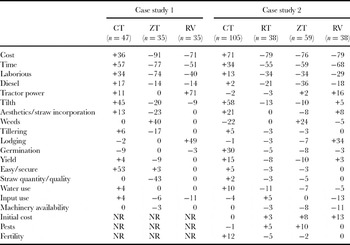
The reported implications of tillage systems for crop management practices and performance indicators can be contrasted with perceived system attributes (Table 6).
Main farmer reported advantages and disadvantages of wheat tillage systems by case study (% of villages).

Note: CT: conventional; RT: reduced tillage; ZT: zero tillage; RV: rotavator. Share of villages reporting indicator to open question of main advantages/benefits and disadvantages/problems of each tillage system as practiced in the village. Positive score implies reported net increase in attribute over villages, negative a net decrease. NR: Not reported. Source: Village surveys case studies 1 and 2.
Both case studies concur that the new tillage systems provide savings in cost, time and diesel, and are less laborious, with ZT scoring relatively high on these attributes in case study 1. A drawback of the rotavator was the need for more tractor power to operate them. Conventional tillage is generally appreciated for its soil tilth, its weed control and its clean fields with no visible crop residues. Conversely, ZT scores low on these attributes, with weeds in particular being problematic, and having somewhat less tillering. Zero tillage's current weed issue primarily relates to a change in the weed spectrum, in line with a recent review and its ability to reduce the incidence of the problematic Phalaris minor (Erenstein and Laxmi, Reference Erenstein and Laxmi2008). The rotavator compares favourably to ZT on these attributes, although farmers complain about its shallow tillage and the increased incidence of lodging. The diverging perception of germination under conventional tillage in the two case studies is primarily linked to the prevailing use of mechanized seeding (case study 2) or broadcasting (case study 1). Tillage intensity was generally favourably associated with yields and linked to the still widely held perception amongst farmers that the more you till, the more you harvest. Conventional tillage as an established practice was also perceived as easy and secure in case study 1. Case study 1 also flagged farmers' concerns about straw quantity and quality under ZT, the latter associated with reportedly more impurities in the reaped straw. Machine availability and its acquisition cost were only occasionally spontaneously flagged as a constraint for the new tillage systems. When asked directly though, case study 2 communities generally reported a shortage of ZT drills whereas in case study 1 availability was generally adequate.
Within 34 communities (primarily from case study 2), some farmers had stopped using ZT and were probed as to the underlying reasons (open ended, multiple reasons possible). Most commonly, the discontinuation was associated with weed problems, unsatisfactory performance and/or lower yields (24% each). Other reasons included soil problems (21%), aesthetics (i.e. visible stubble remaining in the field after seeding, 15%) and seeding problems (9%), whereas only 6% reported drill availability problems.
All farmers were queried about potential spill-over effects of the new tillage systems, but these were generally limited. The subsequent monsoon crop tillage and establishment was most frequently reported (22%), typically linked to the perceived need to increase tillage. A few communities (3%) reported a negative yield effect for the subsequent monsoon crop, primarily associated with the perception that soils had become harder. Only a few communities (4%) reported a negative effect on others (primarily labourers) due to the reduced labour needs.
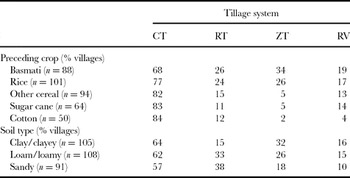
Farmers were also queried about the perceived appropriateness of tillage systems by preceding crop and soil type (Table 7). These views reiterate that conventional tillage is still widely favoured. ZT's perceived niche is primarily for wheat establishment after rice, particularly basmati, and heavier soils. The stubbles of non-rice crops constrain the use of ZT elsewhere, linked to the prevailingly tined ZT drills being used. Reduced tillage and rotavator use are perceived to be less specific to the preceding crop. Reduced tillage is perceived to be more apt for the lighter soils, where farmers perceive less need for intensive tillage. In turn, the use of the new tillage systems is still primarily limited to the wheat crop, with only 10% of the villages reporting some use of the new tillage systems for other crops. The subsequent rice crop is still intensively tilled and puddled to facilitate transplanting, and again this is in line with the earlier surveys.
Perceived appropriateness of wheat tillage systems by preceding crop and soil type, Haryana and Punjab.

Note: CT: conventional; RT: reduced tillage; ZT: zero tillage; RV: rotavator. Multiple responses possible. Source: Village surveys case study 2.
In the end, the introduction of ZT seems to have facilitated the introduction of other unintended tillage adaptations. Seeing it was possible to grow wheat with a single tractor pass, some farmers were thereby willing to start chipping away at the bastion of intensive conventional tillage. The R&D community perceives ZT as a stepping stone towards conservation agriculture. Reduced tillage, therefore, still is perceived as a step in the right direction, albeit less revolutionary and therefore perhaps more acceptable and amenable to farmers and farmer-to-farmer diffusion. More problematic is the rapid advent of the rotavator with its shallow but intensive tillage. This again seems to have been facilitated by the introduction of ZT, albeit that the rotavator directly addresses some of the perceived ZT shortcomings, particularly in terms of weed control, incorporation of crop residues and a better tilth. Further facilitating the advent of rotavators are the mixed R&D signals to farmers in relation to ZT, including ambivalence within the R&D community, inconsistent machinery promotion and subsidies, and the recommendation by some extension agents to resort to tillage every so many years when using ZT.
DISCUSSION
Village survey findings tend to compare reasonably with available secondary data (Erenstein and Thorpe, Reference Erenstein and Thorpe2009). Unfortunately, reliable and recent technology uptake indicators are often in short supply (Erenstein, Reference Erenstein2010), thus making it more problematic to assess the robustness of village surveys in terms of technology uptake. However, case study 1 builds on earlier research in the same communities. It was therefore encouraging that the village survey findings for technology use were largely in line with the earlier estimates from the large household survey. Village surveys thus provide a valuable additional tool to assess technology uptake.
There is a dearth of empirically based adoption estimates for new tillage systems in the IGP. The village surveys that underpin the case studies were primarily intended to help document and understand tillage dynamics. The study provides a first systematic attempt to reliably estimate the extent of ZT diffusion through a wide random representative sample across the TGP. The combined zero + reduced tillage (ZT + RT) wheat area amounted to 22% of the wheat area in the surveyed communities, which extrapolated to the two states would imply 1.26 million ha in 2007/08, with 0.5 million ha in Haryana and 0.76 million ha in Indian Punjab. The study thereby empirically confirms earlier reports of significant ZT diffusion in the NW IGP, both in the original Haryana study area (Erenstein et al., Reference Erenstein, Malik and Singh2007a) and as reported elsewhere, for instance:
• In 2005, a small but random village survey found 13% of farm households to use ZT + RT in the NW rice-wheat belt (12 villages), with still negligible adoption rates elsewhere in the Indian IGP (Erenstein et al., Reference Erenstein, Thorpe, Singh and Varma2007b).
• In 2006, a village survey of primarily project villages in India reported ZT + RT adoption rates of 18% of farm households in the NW plains (18 villages) and 5% in the eastern plains (Teufel et al., Reference Teufel, Erenstein and Samaddar2007).
• In 2008, a regional village survey reported ZT use in 14% of wheat area in project villages in the NW plains (Pakistan and India), 12% in the central plains (India and Nepal) and none in lower Gangetic plains of Bangladesh (Singh et al., Reference Singh, Erenstein, Gathala, Alam, Regmi, Singh, Rehman, Tripathi, Ladha, Yadvinder-Singh and Erenstein2009).
However, the present study also suggests that after the initial rapid spread of ZT in the NW IGP, the ZT + RT wheat area seems to have stabilized there between a fifth and a fourth of the wheat area – reiterating earlier indications that ZT diffusion may be plateauing in the NW IGP.
The current set of village surveys thus provided a useful monitoring tool to assess the on-the-ground reality and its recent evolution in a timely and relatively cost-effective manner. These surveys can thereby generate quantitative indicators that provide useful quantitative indicators. Indeed, group responses have their limitations and typically are more valuable in relative rather than absolute terms (Erenstein and Thorpe, Reference Erenstein and Thorpe2009). Village surveys thus do not necessarily provide the comprehensive and final assessment. Instead, they provide a useful reality check and an additional data source for better triangulation of diffusion estimates (Erenstein, Reference Erenstein2010).
The present paper illustrates the potential of village surveys as meso-level monitoring tool that facilitates the linkage of micro-level realities across a wide region. All too often resource and/or methodological constraints lead to studies becoming locale- or even study-specific so that they are not easily linked to the wider context, thereby inherently limiting the interpretation and contribution of their findings. To ensure the utility of village surveys as monitoring tool they need a common research design, including survey and sampling methodology, substantial village numbers and the inclusion of comparable quantifiable indicators.
As in any survey, sample selection has major implications for the interpretation and scaling-out of village survey findings. The observed differences in case studies 1 and 2 are a case in point. Case study 1 builds on an earlier survey that targeted Haryana's rice-wheat systems for which ZT was originally developed. As illustrated here, that study area primarily has basmati rice-wheat systems and therefore is not necessarily representative for other wheat-based systems which include non-basmati rice and non-rice monsoon crops. Case study 2 cast the net wider and therefore is more representative for the larger TGP region and the prevailing cropping systems.
The actual sample size in terms of number of villages depends inter alia on the underlying variability and the purpose of the study. A substantial village sample allows capturing of diversity in a relative short time span and enhances the interpretation and quantification of even relatively qualitative indicators (e.g. dichotomous yes/no indicators). In this respect, Erenstein and Thorpe (Reference Erenstein and Thorpe2009) were able to capture agro-ecological gradients with a sample of 72 villages spread over the Indian IGP, including 18 from the TGP. Case study 2 used 120 villages from the TGP alone in order to ensure representativeness and to be able to detect some of the technological variations within these relatively intensive systems. Indeed, the 50 villages of case study 1 appeared to constrain the ability to identify significant management and performance variations between its tillage systems.
The interpretation and use of village survey findings is enhanced by including comparable and quantifiable relevant indicators. Clearly indicators vary in their suitability for inclusion in village surveys. The group meetings can compile localized expert estimates, but these increasingly become guesstimates if participants are forced to move into uncharted territory. Indicators must remain realistic and take into account local understanding, ground reality and group dynamics. Generally, the group meetings were useful to provide a broad brush situation analysis and provided useful indicators on clearly identifiable and unambiguous practices, including the extent of their use and associated trends. Some attributes of technologies are also reasonably robust and quantifiable, e.g. ZT's diesel and cost savings (Erenstein and Laxmi, Reference Erenstein and Laxmi2008). Other attributes are more variable and/or fuzzy. Particularly problematic to capture are practices that inherently vary over space and time or are variously interpreted or variously associated with other practices. Village surveys leave open the potential to use open ended questions, as was done here in the case of the advantages and disadvantages of each tillage system and reasons for discontinuation. These can subsequently be regrouped into a more reduced set of categories to facilitate interpretation. This may imply some loss of information, but is more open ended and facilitates capturing the unexpected. Village surveys can thereby help fine tune and identify useful indicators and issues for subsequent research.
One R&D issue that merits follow-up is monitoring and better understanding of the implications of the rapid advent of the rotavator. The present study also sheds some light on the relative merits and demerits of tillage systems, but some findings remain mixed and fuzzy. A case in point are the mixed experiences that contribute to the stagnating ZT diffusion – the net result of some increasing and others decreasing ZT use – and the ambiguous tillage yield effects in farmer fields. The present study, however, also reiterates the need for longer-term monitoring of tillage systems to address and understand underlying dynamics and sustainability issues, including some of the recurring farmer concerns over weeds and soil quality. And finally, the study reminds us of the need to complement R&D efforts by more regular monitoring of farmer practices and systematic interaction with farmers on the ground, with village surveys offering a useful tool to do so.
CONCLUSION
Village surveys have the potential to provide timely and cost effective feedback to agricultural R&D. To ensure their utility for technology uptake monitoring there is a need for a common robust research design that allows for quantification and extrapolation.
The case studies empirically confirm the initial rapid spread of zero tillage wheat in intensive systems rice-wheat systems, but also show the diffusion to be levelling off and a more recent rapid advent of rotavators. The R&D community thereby needs to reinvigorate its efforts if its calls for conservation agriculture in the Indo-Gangetic Plains are to succeed.
Acknowledgements
The underlying field work benefited from the inputs of a dedicated survey team: Sube Singh, Dalip Kumar Bishnoi and Gajender Singh for case study 1 and Joginder Singh, Jaswant Singh, Piara Singh Gill, K. K. Shukla, Sube Singh, Arindam Samaddar and Ram Singh for case study 2, and the support from the national agricultural research and extension system active in the surveyed districts. The study benefited from USAID funding and reviewer comments. The views expressed in this paper are the author's and do not necessarily reflect the views of the donor or the author's institution.