Gardner, Ryan, and Snoeyink (Reference Gardner, Ryan and Snoeyink2018) provide illuminating analyses regarding the role of gender in career advancement within industrial and organizational (I-O) psychology. One of their suggestions for further advancing this area of research is to examine homophily, defined as the tendency for individuals to have social ties with those who are similar to themselves, in the social networks of men and women in the field. Such research is warranted because social networks—in particular, the networks of research collaboration relationships (e.g., publications, grants) scientists develop throughout their careers—are critical to success in academia (e.g., Bozeman & Corley, Reference Bozeman and Corley2004).
Organizational research has long suggested that gender homophily is a key driver of social networks in the workplace. For instance, in a sample of employees in a newspaper publishing organization, Brass (Reference Brass1985) showed that women's informal networks were female dominated whereas men's networks were male dominated. Further, this study, as well as other research (e.g., Ibarra, Reference Ibarra1992), suggested that the patterns of network connections related to career success differ for men and women. Whereas women's connections to highly central men were positively related to career success outcomes for women, the opposite was not true for men (i.e., connections to central women were not related to career success for men).
Applying these findings to academic I-O psychologists could shed some light on why there seems to be a “leaky pipeline” issue and fewer women publishing in top outlets (see Gardner et al., Reference Gardner, Ryan and Snoeyink2018). That is, if men are primarily publishing with other men, this may be putting female academics at a disadvantage in that the most prestigious academic accomplishments in the field (editorial board membership, leadership roles, publications in top journal) are dominated by men (per Gardner et al.’s findings). Further, homophilic tendencies could be creating a vicious cycle wherein women do not have the same access to opportunities granted by mentors (who are often coauthors) or other coauthors as men do, and therefore, men continue to advance at higher rates than women. On the other hand, gender dynamics in the workplace have changed considerably in the past few decades. More women are entering and remaining in academia as compared to 20–30 years ago. Potentially, today's junior scholars may gain similar benefits through connections to “female star performers” as they would connecting to men who are central in the field.
With these issues in mind, in this commentary we aim to generate a discussion surrounding gender homophily in academic I-O psychology. For the purposes of this commentary, we focused on a subset of influential I-O psychologists: SIOP members who obtained Fellow status in the last 5 years. We selected these inclusionary criteria for three reasons. First, we wanted to select a group of SIOP members who have reached a high metric of success; all had to meet the stringent criteria for Fellow. Second, focusing our analyses on recent Fellows allowed us to keep career stage relatively constant. Third, by focusing on Fellows who have largely entered in the field since the 1990s (mean year of first publication = 1995, SD = 5.88), we aimed to examine a group of scholars with similar access to male and female colleagues. After collecting information related to the publication history and gender of coauthors for each of the recent SIOP Fellows, we empirically evaluated two initial research questions: (1) How frequently do recent SIOP Fellows collaborate with women? and (2) What is the relationship between the productivity of recent SIOP Fellows and their percentage of female coauthors?
Method
We used the SIOP website to identify SIOP members who were selected as Fellows between 2013–2017 (n = 83 people) and coded for their gender based on photographs in the Fellow announcements. Then, we used Google Scholar combined with a web scraper application developed for this study to identify the publication coauthors of each recent Fellow. Nine men and six women were removed from the initial pool because they did not have a public Google Scholar profile; two men were removed because they are deceased; and one woman was removed because her Google Scholar profile contained a very large number of publications from other people with the same name. This resulted in a final sample of 65 recent SIOP Fellows (28 women and 37 men).
Identification of Coauthorship Networks for Recent SIOP Fellows
The application identified each of the unique coauthors for each Fellow as well as information about the number of times a Fellow published with each coauthor. After collecting this initial information, we manually screened the data for inaccurate publications (e.g., Google Scholar including names on an editorial board listing as a publication) and adjusted accordingly. We did not include publications with more than 10 authors, as these publications are likely to reflect a qualitatively different type of collaboration as compared to smaller teams (i.e., it is likely that the Fellow did not interact heavily with all coauthors in large teams).
Gender Proportions Within the Coauthorship Networks of Recent SIOP Fellows
We manually coded for the gender of each coauthor within the coauthorship networks of recent SIOP Fellows. For names with clear gender norms, we coded based on the assumed gender. For names that were more ambiguous, we first used an online search to locate an image of the specific individual, then, if this was unsuccessful, we used an online tool (namespedia.com) to identify the frequency with which the first name is female or male. When it was impossible to determine a coauthor's gender with relative certainty, we excluded information about that coauthor from analyses (mean number of missing coauthors per Fellow = 1.84, SD = 2.32). We calculated percentage of unique female coauthors by dividing the number of female coauthors by the total number of coauthors for each Fellow. We also calculated the number of collaboration-weighted percentage of women by summing the total number of times a Fellow had published with each female coauthor and dividing that by the total number of coauthors across all of their publications. For example, if a Fellow published three papers and on the first Bob was a coauthor, on the second Bob and Joe were coauthors, and on the third Suzy was a coauthor, then the percentage unique female coauthors would be 1/3 = 33%. The collaboration-weighted percentage of women would be 1/4 = 25%. Raw data including Fellow gender, coauthor gender, and productivity metrics are available upon request.
Identification of Productivity Metrics for Recent SIOP Fellows
To characterize the productivity of each recent SIOP Fellow, we used the “Publish or Perish” software program, which pulls raw data from Google Scholar and automatically calculates multiple productivity metrics (Tarma Software Research, 1990–2016). After manually removing inaccurate publications from the reports generated for each Fellow, we collected three metrics for each person: h-factor, g-factor, and AWCR. The h-factor is calculated by counting the number of publications with a citation count equal to, or higher than, the number of those publications (Hirsch, Reference Hirsch2005). The g-factor is calculated in a similar manner as the h-factor but computes the g value at which all publications above g have received at least g2 citations combined (this puts greater weight on publications that have received many citations; Egghe, Reference Egghe2006). The AWRC is computed as the square root of the sum of all age-weighted citation counts for a person's entire body of publications (Jin, Reference Jin2007).
Findings
Research Question 1: How Frequently Do Recent SIOP Fellows Collaborate With Women?
First, we explored the basic question of whether the coauthorship networks of male and female recent SIOP Fellows exhibit gender homophily. Specifically, we asked: To what degree do male and female recent SIOP Fellows publish with female coauthors? Our findings suggest that male SIOP Fellows had a significantly lower percentage of unique female coauthors than did female Fellows (M = 42%, SD = 8% versus M = 50%, SD = 14%; t(63) = 3.17, p < .05) and a significantly lower percentage of collaboration-weighted female coauthors (M = 37%, SD = 11% versus M = 50%, SD = 14%; t(63) = 4.24, p < .05). Thus, our findings suggest a trend whereby recent male SIOP Fellows appear to work more frequently with other men than they work with women. On the other hand, female SIOP Fellows appear to work with male and female coauthors at similar rates. Additionally, the difference in percentages for male Fellows between unique female coauthors (42%) and collaborations-weighted female coauthors (37%) seems to suggest that men are more likely to work with the same male coauthors repeatedly compared with female coauthors.
Research Question 2: What Is the Relationship Between the Productivity of Recent SIOP Fellows and Their Percentage of Female Coauthors?
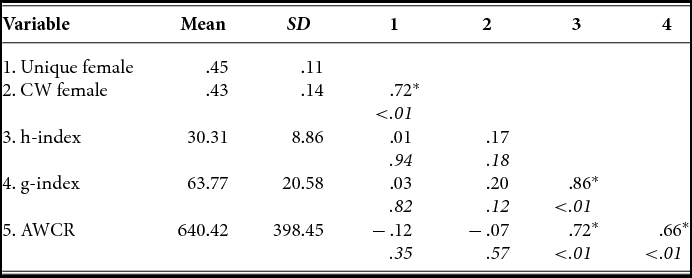
Second, we sought to examine the relationship between the percentage of female coauthors within individual SIOP Fellows’ coauthorship networks and their publication productivity. We began by evaluating this research question for the entire sample of male and female recent SIOP Fellows. As indicated in Table 1, there was no significant correlation between percentage of unique female coauthors or percentage of collaboration-weighted female coauthors and any of the productivity metrics for the full sample. Additionally, there were no significant differences between male and female Fellows in any of the productivity metrics, indicating that male and female Fellows share similar levels of publication success independent of coauthor network composition.
Table 1.Descriptive Statistics and Correlations for Study Variables
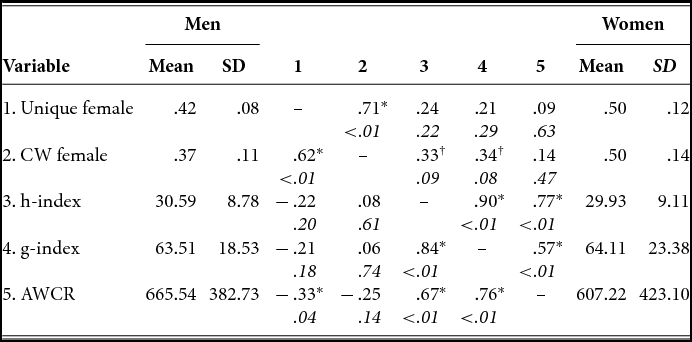
Next, we addressed RQ2 separately for men and women. Demographic diversity, such as gender diversity, may relate to weaker social ties within a group, weakened coordination of efforts, and lower productivity (Reagans & Zuckerman, Reference Reagans and Zuckerman2001). Indeed, meta-analytic evidence suggests that gender diversity within teams has a small negative association with performance (Bell, Villado, Lukasik, Belau, & Briggs, Reference Bell, Villado, Lukasik, Belau and Briggs2011). Applying this to I-O psychologists, we might then expect that, for men, working with a greater proportion of women relates to lower productivity, whereas for women the opposite effect is observed. Correlations between percentage female coauthors and productivity by Fellow gender are presented in Table 2. Note that the sample size is small, resulting in low power, but one might argue that because our focus is on this particular group of Fellows as the entire population, we should place less emphasis on p-values and instead examine effect sizes.
Table 2.Descriptive Statistics and Correlations by Fellow Gender
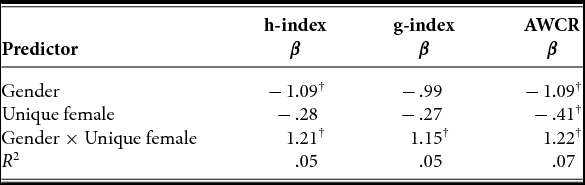
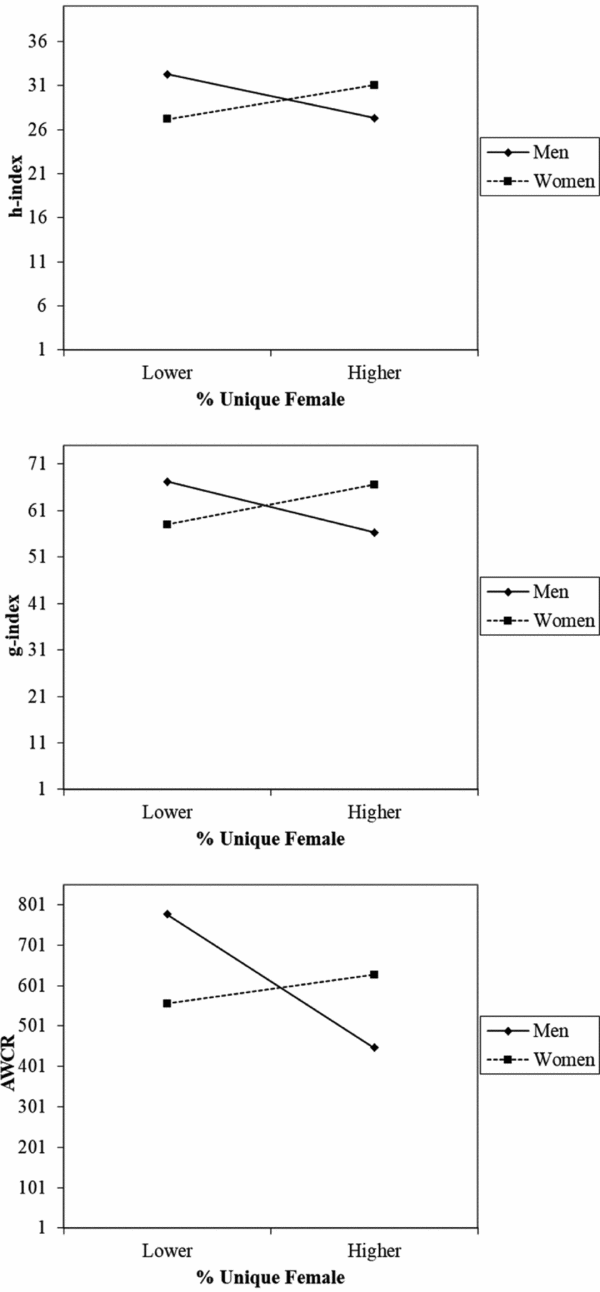
Although the results are not fully consistent across the two metrics for percentage of female coauthors nor across the three productivity metrics, the trend is that there is a positive association between the percentage of female coauthors and productivity for women, whereas this relationship is negative for men. We further tested this idea through moderation analyses (see Table 3 and Figure 1). Results are only presented for percentage unique female, as the collaboration-weighted percentage of female coauthors produced no significant results. Our findings suggest that working with a greater percentage of unique female coauthors is helpful for female Fellows but harmful for male Fellows in terms of productivity. Importantly, the present study framed the coauthor percentages in terms of female coauthors, but it is equally valid to re-frame it in terms of male coauthors. Doing so leads to the converse of our present conclusions, such that working with more unique male coauthors is harmful for female Fellows but helpful for male Fellows.
Table 3.Regression Analyses for Gender as a Moderator of the Relationships Between Percentage of Unique Female Coauthors and Productivity
Figure 1.Interaction between percentage unique female coauthors and gender on productivity metrics. “Lower” and “Higher” refer to one standard deviation above and below the mean, respectively.
Discussion
Brass's (Reference Brass1985) work suggested that it was essential for successful women to be connected to men, but men did not have the same requisites. Over 30 years later, our analyses for RQ1 suggest a trend in I-O psychology that mimics Brass's findings to some extent. Recent female Fellows (a marker of success in the field) tend have equal proportions of male and female coauthors, but male Fellows do not have similar rates of cross-gender coauthors. The finding that I-O psychologists, like others (McPherson, Smith-Lovin, & Cook, Reference McPherson, Smith-Lovin and Cook2001), exhibit a homophily tendency in their research collaborations might also help explain the differences in achievements between men and women in the field broadly.
Moreover, our findings related to RQ2 suggest some individual benefits of maintaining a social network that is homophilic with regard to gender. Speculatively, greater productivity for those who work more with members of their own gender may be due to greater team cohesion and less friction, generating a higher number of high-quality manuscripts that are submitted for publication. Interestingly, we found that more productive female SIOP Fellows collaborated more frequently with other female coauthors. This is somewhat counter to the assumption that women need to be primarily connected with men in order to be successful.
It is important to highlight that this study is largely descriptive in nature; further research is needed to elucidate the mechanisms underlying our findings. We evaluated only a small portion of the I-O psychology academic network. Before firm conclusions can be drawn, further exploration of network data is necessary. Specifically, a comparison of successful men and women to less successful men and women in I-O psychology would shed additional light on differences in networks; it may be that less successful men have similar coauthor patterns as male Fellows, which would call into question whether these patterns are actually meaningful or integral for success. Further, a more comprehensive approach would include information about the collaboration patterns among all coauthors within a person's network and would include a broader sample of I-O psychologists in order to enhance the generalizability.
To reiterate, the present study does not allow for causal conclusions, and there may be additional variables that account for observed relationships. Rather than take the results of RQ2 at face value and “shun” collaborations with members of the opposite gender, we urge readers to carefully consider the processes and decisions involved in building their personal publication networks. In fact, research on scientific collaboration has also suggested that some of the most innovative work is accomplished by teams with intellectual diversity (Uzzi, Mukherjee, Stringer, & Jones, Reference Uzzi, Mukherjee, Stringer and Jones2013). Based on this, to the degree that men and women bring unique perspectives, we may expect that gender diversity has positive implications for both male and female authors in terms of creating particularly innovative and impactful (i.e., highly cited) publications. To this end, it would be interesting to examine authorship gender composition of the most innovative publications in the field as a future research question.
In conclusion, in this commentary we sought to address the question of homophily in recent SIOP Fellow's coauthor networks. We view this as an important extension of Gardner et al.’s (Reference Gardner, Ryan and Snoeyink2018) work. Whereas they examined gender composition of individual publications in top journals in the field (i.e., Journal of Applied Psychology and Personnel Psychology), we examined recently successful I-O academics and surveyed their publication history to ascertain the overall gender composition of their coauthors. Our findings shed some light on how professional networks are potentially contributing to some of the persistent gender gaps in I-O psychology. Men are more likely to work with other men, which, given their general higher status in the field (based on editorships, editorial boards, and rank), may be perpetuating gender inequality and limiting the creativity of our field. That is, homophily may, to a degree, maintain existing power dynamics and, based on the extant literature demonstrating the value of diversity for creativity, reduce true innovation in publications. We hope this commentary provides a springboard for academics to consider their natural proclivities in choosing collaborators.




 You have
Access
Gardner, Ryan, and Snoeyink (Reference Gardner, Ryan and Snoeyink2018) provide illuminating analyses regarding the role of gender in career advancement within industrial and organizational (I-O) psychology. One of their suggestions for further advancing this area of research is to examine homophily, defined as the tendency for individuals to have social ties with those who are similar to themselves, in the social networks of men and women in the field. Such research is warranted because social networks—in particular, the networks of research collaboration relationships (e.g., publications, grants) scientists develop throughout their careers—are critical to success in academia (e.g., Bozeman & Corley, Reference Bozeman and Corley2004).
Organizational research has long suggested that gender homophily is a key driver of social networks in the workplace. For instance, in a sample of employees in a newspaper publishing organization, Brass (Reference Brass1985) showed that women's informal networks were female dominated whereas men's networks were male dominated. Further, this study, as well as other research (e.g., Ibarra, Reference Ibarra1992), suggested that the patterns of network connections related to career success differ for men and women. Whereas women's connections to highly central men were positively related to career success outcomes for women, the opposite was not true for men (i.e., connections to central women were not related to career success for men).
Applying these findings to academic I-O psychologists could shed some light on why there seems to be a “leaky pipeline” issue and fewer women publishing in top outlets (see Gardner et al., Reference Gardner, Ryan and Snoeyink2018). That is, if men are primarily publishing with other men, this may be putting female academics at a disadvantage in that the most prestigious academic accomplishments in the field (editorial board membership, leadership roles, publications in top journal) are dominated by men (per Gardner et al.’s findings). Further, homophilic tendencies could be creating a vicious cycle wherein women do not have the same access to opportunities granted by mentors (who are often coauthors) or other coauthors as men do, and therefore, men continue to advance at higher rates than women. On the other hand, gender dynamics in the workplace have changed considerably in the past few decades. More women are entering and remaining in academia as compared to 20–30 years ago. Potentially, today's junior scholars may gain similar benefits through connections to “female star performers” as they would connecting to men who are central in the field.
With these issues in mind, in this commentary we aim to generate a discussion surrounding gender homophily in academic I-O psychology. For the purposes of this commentary, we focused on a subset of influential I-O psychologists: SIOP members who obtained Fellow status in the last 5 years. We selected these inclusionary criteria for three reasons. First, we wanted to select a group of SIOP members who have reached a high metric of success; all had to meet the stringent criteria for Fellow. Second, focusing our analyses on recent Fellows allowed us to keep career stage relatively constant. Third, by focusing on Fellows who have largely entered in the field since the 1990s (mean year of first publication = 1995, SD = 5.88), we aimed to examine a group of scholars with similar access to male and female colleagues. After collecting information related to the publication history and gender of coauthors for each of the recent SIOP Fellows, we empirically evaluated two initial research questions: (1) How frequently do recent SIOP Fellows collaborate with women? and (2) What is the relationship between the productivity of recent SIOP Fellows and their percentage of female coauthors?
Method
We used the SIOP website to identify SIOP members who were selected as Fellows between 2013–2017 (n = 83 people) and coded for their gender based on photographs in the Fellow announcements. Then, we used Google Scholar combined with a web scraper application developed for this study to identify the publication coauthors of each recent Fellow. Nine men and six women were removed from the initial pool because they did not have a public Google Scholar profile; two men were removed because they are deceased; and one woman was removed because her Google Scholar profile contained a very large number of publications from other people with the same name. This resulted in a final sample of 65 recent SIOP Fellows (28 women and 37 men).
Identification of Coauthorship Networks for Recent SIOP Fellows
The application identified each of the unique coauthors for each Fellow as well as information about the number of times a Fellow published with each coauthor. After collecting this initial information, we manually screened the data for inaccurate publications (e.g., Google Scholar including names on an editorial board listing as a publication) and adjusted accordingly. We did not include publications with more than 10 authors, as these publications are likely to reflect a qualitatively different type of collaboration as compared to smaller teams (i.e., it is likely that the Fellow did not interact heavily with all coauthors in large teams).
Gender Proportions Within the Coauthorship Networks of Recent SIOP Fellows
We manually coded for the gender of each coauthor within the coauthorship networks of recent SIOP Fellows. For names with clear gender norms, we coded based on the assumed gender. For names that were more ambiguous, we first used an online search to locate an image of the specific individual, then, if this was unsuccessful, we used an online tool (namespedia.com) to identify the frequency with which the first name is female or male. When it was impossible to determine a coauthor's gender with relative certainty, we excluded information about that coauthor from analyses (mean number of missing coauthors per Fellow = 1.84, SD = 2.32). We calculated percentage of unique female coauthors by dividing the number of female coauthors by the total number of coauthors for each Fellow. We also calculated the number of collaboration-weighted percentage of women by summing the total number of times a Fellow had published with each female coauthor and dividing that by the total number of coauthors across all of their publications. For example, if a Fellow published three papers and on the first Bob was a coauthor, on the second Bob and Joe were coauthors, and on the third Suzy was a coauthor, then the percentage unique female coauthors would be 1/3 = 33%. The collaboration-weighted percentage of women would be 1/4 = 25%. Raw data including Fellow gender, coauthor gender, and productivity metrics are available upon request.
Identification of Productivity Metrics for Recent SIOP Fellows
To characterize the productivity of each recent SIOP Fellow, we used the “Publish or Perish” software program, which pulls raw data from Google Scholar and automatically calculates multiple productivity metrics (Tarma Software Research, 1990–2016). After manually removing inaccurate publications from the reports generated for each Fellow, we collected three metrics for each person: h-factor, g-factor, and AWCR. The h-factor is calculated by counting the number of publications with a citation count equal to, or higher than, the number of those publications (Hirsch, Reference Hirsch2005). The g-factor is calculated in a similar manner as the h-factor but computes the g value at which all publications above g have received at least g2 citations combined (this puts greater weight on publications that have received many citations; Egghe, Reference Egghe2006). The AWRC is computed as the square root of the sum of all age-weighted citation counts for a person's entire body of publications (Jin, Reference Jin2007).
Findings
Research Question 1: How Frequently Do Recent SIOP Fellows Collaborate With Women?
First, we explored the basic question of whether the coauthorship networks of male and female recent SIOP Fellows exhibit gender homophily. Specifically, we asked: To what degree do male and female recent SIOP Fellows publish with female coauthors? Our findings suggest that male SIOP Fellows had a significantly lower percentage of unique female coauthors than did female Fellows (M = 42%, SD = 8% versus M = 50%, SD = 14%; t(63) = 3.17, p < .05) and a significantly lower percentage of collaboration-weighted female coauthors (M = 37%, SD = 11% versus M = 50%, SD = 14%; t(63) = 4.24, p < .05). Thus, our findings suggest a trend whereby recent male SIOP Fellows appear to work more frequently with other men than they work with women. On the other hand, female SIOP Fellows appear to work with male and female coauthors at similar rates. Additionally, the difference in percentages for male Fellows between unique female coauthors (42%) and collaborations-weighted female coauthors (37%) seems to suggest that men are more likely to work with the same male coauthors repeatedly compared with female coauthors.
Research Question 2: What Is the Relationship Between the Productivity of Recent SIOP Fellows and Their Percentage of Female Coauthors?
Second, we sought to examine the relationship between the percentage of female coauthors within individual SIOP Fellows’ coauthorship networks and their publication productivity. We began by evaluating this research question for the entire sample of male and female recent SIOP Fellows. As indicated in Table 1, there was no significant correlation between percentage of unique female coauthors or percentage of collaboration-weighted female coauthors and any of the productivity metrics for the full sample. Additionally, there were no significant differences between male and female Fellows in any of the productivity metrics, indicating that male and female Fellows share similar levels of publication success independent of coauthor network composition.
Descriptive Statistics and Correlations for Study Variables
Note. N = 65. p-values are in italics underneath correlation coefficients. Unique female = percentage of unique coauthors who are female. CW female = percentage of collaboration-weighted coauthors who are female.
* p < .05.
Next, we addressed RQ2 separately for men and women. Demographic diversity, such as gender diversity, may relate to weaker social ties within a group, weakened coordination of efforts, and lower productivity (Reagans & Zuckerman, Reference Reagans and Zuckerman2001). Indeed, meta-analytic evidence suggests that gender diversity within teams has a small negative association with performance (Bell, Villado, Lukasik, Belau, & Briggs, Reference Bell, Villado, Lukasik, Belau and Briggs2011). Applying this to I-O psychologists, we might then expect that, for men, working with a greater proportion of women relates to lower productivity, whereas for women the opposite effect is observed. Correlations between percentage female coauthors and productivity by Fellow gender are presented in Table 2. Note that the sample size is small, resulting in low power, but one might argue that because our focus is on this particular group of Fellows as the entire population, we should place less emphasis on p-values and instead examine effect sizes.
Descriptive Statistics and Correlations by Fellow Gender
Note. Correlations above the diagonal are for women (N = 28) and those below the diagonal are for men (N = 37). p-values are in italics underneath correlation coefficients. Unique Female = percentage of unique coauthors who are female. CW female = percentage of collaboration-weighted coauthors who are female.
† p < .10. * p < .05.
Although the results are not fully consistent across the two metrics for percentage of female coauthors nor across the three productivity metrics, the trend is that there is a positive association between the percentage of female coauthors and productivity for women, whereas this relationship is negative for men. We further tested this idea through moderation analyses (see Table 3 and Figure 1). Results are only presented for percentage unique female, as the collaboration-weighted percentage of female coauthors produced no significant results. Our findings suggest that working with a greater percentage of unique female coauthors is helpful for female Fellows but harmful for male Fellows in terms of productivity. Importantly, the present study framed the coauthor percentages in terms of female coauthors, but it is equally valid to re-frame it in terms of male coauthors. Doing so leads to the converse of our present conclusions, such that working with more unique male coauthors is harmful for female Fellows but helpful for male Fellows.
Regression Analyses for Gender as a Moderator of the Relationships Between Percentage of Unique Female Coauthors and Productivity
Note. Gender coded 0 = male, 1 = female.
† p < .10.
Interaction between percentage unique female coauthors and gender on productivity metrics. “Lower” and “Higher” refer to one standard deviation above and below the mean, respectively.
Discussion
Brass's (Reference Brass1985) work suggested that it was essential for successful women to be connected to men, but men did not have the same requisites. Over 30 years later, our analyses for RQ1 suggest a trend in I-O psychology that mimics Brass's findings to some extent. Recent female Fellows (a marker of success in the field) tend have equal proportions of male and female coauthors, but male Fellows do not have similar rates of cross-gender coauthors. The finding that I-O psychologists, like others (McPherson, Smith-Lovin, & Cook, Reference McPherson, Smith-Lovin and Cook2001), exhibit a homophily tendency in their research collaborations might also help explain the differences in achievements between men and women in the field broadly.
Moreover, our findings related to RQ2 suggest some individual benefits of maintaining a social network that is homophilic with regard to gender. Speculatively, greater productivity for those who work more with members of their own gender may be due to greater team cohesion and less friction, generating a higher number of high-quality manuscripts that are submitted for publication. Interestingly, we found that more productive female SIOP Fellows collaborated more frequently with other female coauthors. This is somewhat counter to the assumption that women need to be primarily connected with men in order to be successful.
It is important to highlight that this study is largely descriptive in nature; further research is needed to elucidate the mechanisms underlying our findings. We evaluated only a small portion of the I-O psychology academic network. Before firm conclusions can be drawn, further exploration of network data is necessary. Specifically, a comparison of successful men and women to less successful men and women in I-O psychology would shed additional light on differences in networks; it may be that less successful men have similar coauthor patterns as male Fellows, which would call into question whether these patterns are actually meaningful or integral for success. Further, a more comprehensive approach would include information about the collaboration patterns among all coauthors within a person's network and would include a broader sample of I-O psychologists in order to enhance the generalizability.
To reiterate, the present study does not allow for causal conclusions, and there may be additional variables that account for observed relationships. Rather than take the results of RQ2 at face value and “shun” collaborations with members of the opposite gender, we urge readers to carefully consider the processes and decisions involved in building their personal publication networks. In fact, research on scientific collaboration has also suggested that some of the most innovative work is accomplished by teams with intellectual diversity (Uzzi, Mukherjee, Stringer, & Jones, Reference Uzzi, Mukherjee, Stringer and Jones2013). Based on this, to the degree that men and women bring unique perspectives, we may expect that gender diversity has positive implications for both male and female authors in terms of creating particularly innovative and impactful (i.e., highly cited) publications. To this end, it would be interesting to examine authorship gender composition of the most innovative publications in the field as a future research question.
In conclusion, in this commentary we sought to address the question of homophily in recent SIOP Fellow's coauthor networks. We view this as an important extension of Gardner et al.’s (Reference Gardner, Ryan and Snoeyink2018) work. Whereas they examined gender composition of individual publications in top journals in the field (i.e., Journal of Applied Psychology and Personnel Psychology), we examined recently successful I-O academics and surveyed their publication history to ascertain the overall gender composition of their coauthors. Our findings shed some light on how professional networks are potentially contributing to some of the persistent gender gaps in I-O psychology. Men are more likely to work with other men, which, given their general higher status in the field (based on editorships, editorial boards, and rank), may be perpetuating gender inequality and limiting the creativity of our field. That is, homophily may, to a degree, maintain existing power dynamics and, based on the extant literature demonstrating the value of diversity for creativity, reduce true innovation in publications. We hope this commentary provides a springboard for academics to consider their natural proclivities in choosing collaborators.