Introduction
Vertigo is a frequent complication following cochlear implantation (CI). The trauma of electrode insertion causes morphological and functional changes in the inner ear. Histological studies of petrous bone specimens have shown that other neighbouring vestibular organs are also affected, as well as the cochlea.Reference Fayad and Linthicum1 Structural changes have been demonstrated in the sacculus, utriculus and semicircular canals,Reference Handzel, Burgess and Nadol2, Reference Tien and Linthicum3 and lead to functional impairment of peripheral vestibular receptors.Reference Todt, Basta and Ernst4–Reference Vibert, Häusler, Kompis and Vischer7
Despite microscopically visible and functionally measurable damage to the peripheral vestibular organs, not all CI patients suffer from post-operative vertigo. The prevalence varies greatly in published reports, from 0.33 to 75 per cent.Reference Buchman, Joy, Hodges, Telischi and Balkany8 Furthermore, there seems to be no direct correlation between a measurable decrease in peripheral vestibular function and the occurrence of subjective vertigo symptoms.Reference Enticott, Tari, Koh, Dowell and O'Leary5, Reference Steenerson, Cronin and Gary6, Reference Buchman, Joy, Hodges, Telischi and Balkany8 Similarly, no significant difference has been found between patients with vertigo and symptom-free patients regarding cause of hearing loss, amount of surgical drilling, implant device used, scala of placement and depth of electrode array insertion.Reference Steenerson, Cronin and Gary6 Therefore, the trauma of electrode insertion cannot be solely responsible for post-operative vertigo.
We know from other causes of acute peripheral vestibulopathy (e.g. vestibular neuritis and temporal bone fracture) that balance problems can be overcome by central compensatory mechanisms. In this context, the interaction between vestibular and visual systems plays an important role. Visual stimuli are able to suppress vestibular afferences by deactivation of the parieto-insular vestibular cortex,Reference Brandt, Bartenstein, Janek and Dieterich9 and therefore to stabilise equilibrium performance.Reference Jahn, Strupp, Krafczyk, Schüler, Glasauer and Brandt10 These mechanisms could possibly also compensate for vestibular malfunction after CI.
It can be assumed that impairment of the peripheral vestibular receptors leads to symptomatic balance problems only in the presence of insufficient central compensatory mechanisms. This hypothesis was tested in the present study by comparing subjects' ability to suppress visual fixation after caloric stimulation of the horizontal semicircular canal, comparing patients suffering from post-operative vertigo with those who were symptom-free.
Materials and methods
Patients
This prospective clinical study included 59 adult patients who underwent cochlear implantation (CI) at our institution between April 2003 and March 2008. Informed consent was obtained from all patients included.
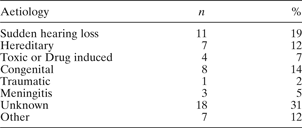
The indication for CI in these patients was bilateral, severe-to-profound, sensorineural hearing loss with no benefit from hearing aids. Only patients receiving their first cochlear implant were included. Patients' ages ranged from 15 to 83 years (mean, 54 years). Forty-one patients (69 per cent) were female and eighteen (31 per cent) were male. The causes of the patients' deafness were diverse and are summarised in Table I. In all patients, a pre-operative, high resolution, petrous bone computed tomography (CT) scan was performed. This showed cochlear sclerosis in five patients (9 per cent). All other CT scans were unremarkable.

The CI operation was performed on the right side in 32 patients (54 per cent) and on the left side in 27 patients (46 per cent), by three different surgeons (distribution = 30:20:9). The same surgical technique was used for all patients: a retroauricular, transmastoidal approach with a cochleostomy anterior to the round window niche. Forty-seven implants were Cochlear Nucleus 24 devices (Cochlear Pty, Sydney, New South Wales, Australia) and 12 were Med-El devices (Med-El, Innsbruck, Austria). The study protocol was approved by the relevant institutional review board.
Questionnaire
Using a questionnaire that has been developed at our institution specifically to evaluate CI-related vertigo,Reference Krause, Louza, Hempel, Wechtenbruch, Rader and Gürkov11 patients were asked about vertigo and imbalance symptoms pre- and post-operatively (see Appendix 1). This evaluation was repeated one week, one month, two months, four months and seven months after the CI operation.
Vestibular function testing
Patients' peripheral vestibular function was assessed before and after CI by means of computer-assisted video-oculography (Sensomotoric Instruments, Berlin, Germany). Post-operative testing was performed four to six weeks after surgery, i.e. after completed wound healing. The cochlear implant was activated only after the post-operative vestibular testing. Spontaneous nystagmus was recorded (with the patient sitting, eyes open, in darkness). The function of the horizontal semicircular canal (SCC) was further tested, according to the method of Hallpike,Reference Hallpike12 by caloric stimulation for 30 seconds with 100 ml of 30 and 44°C warm water. For this purpose, the patient was positioned supine with the head elevated by 30° (to create vertical positioning of the horizontal SCC). Nystagmus was recorded for 80 seconds by an infrared camera set into the goggles headset worn by the patient. The mean maximal slow phase velocity was automatically determined from a 20 second sample of the recorded nystagmus, and the caloric response was quantified for each ear based on summation of the warm and the cold irrigation responses. A response of less than 5°/second was considered to indicate complete loss of horizontal SCC function. A maximal slow phase velocity of less than 10°/second after warm and cold irrigation, was considered to indicate partial loss of horizontal SCC function. All other results were considered normal.
Visual fixation suppression was assessed in the following manner. Sixty seconds after termination of the caloric stimulus, a green light-emitting diode inside the goggles was switched on and was visually fixated upon by the patient for 10 seconds. During this interval, the nystagmus was continuously recorded. A ratio was calculated comparing maximal slow phase velocity under fixation and maximal slow phase velocity without fixation. A value of <0.34 in all four measurements (after warm and cold stimulus to each ear) was defined as normal. If one or more values was above 0.34, this was defined as abnormal, i.e. visual fixation suppression was insufficient.
Analysis
The group of patients with post-operative vertigo was compared with the group without post-operative vertigo, regarding results for horizontal SCC function and visual fixation suppression after caloric irrigation. The following parameters were also evaluated as risk factors for post-operative balance problems: age, sex, implanted electrode type, implant side, surgeon, cause of deafness, petrous bone CT findings and incidence of pre-operative vertigo (t-test or chi-square test, p < 0.05).
Results and analysis
Vertigo symptoms
Twenty-nine (49 per cent) of the 59 CI patients reported post-operative vertigo symptoms. In 27 patients, vertigo commenced within a week of CI. Vertigo commenced four weeks post-operatively in one patient and three months post-operatively in another. Seventeen patients suffered from short-term vertigo (i.e. less than four weeks), while 12 patients had longer lasting vertigo (i.e. four or more weeks).
Peripheral vestibular function
Pre-operative video-oculography could be performed in 56 of the 59 patients. In two cases, the examination was not possible due to congenital pendular nystagmus; in the third, the patient could not tolerate caloric irrigation. Bithermal caloric irrigation showed a complete loss of caloric response on the implant side in eight patients (14 per cent). Thirteen patients (23 per cent) had a decreased caloric response and 35 (63 per cent) had a normal caloric response.
Post-operative video-oculography could be performed in 53 of the 59 patients. Twenty-two patients (39 per cent) had impaired post-operative horizontal SCC function in the implant ear (i.e. a change from ‘normal’ to ‘decreased’ or ‘loss’, or from ‘decreased’ to ‘loss’). The number of patients with complete loss of caloric response post-operatively increased to 18 (34 per cent). The average bithermal caloric response on the implant side was significantly reduced from 25.0°/second pre-operatively (standard deviation (SD) = 22.1°/second) to 14.2°/second post-operatively (SD = 11.4°/second) (p < 0.001; t-test). On the non-implanted side, however, the caloric horizontal SCC response hardly changed. The pre-operative average bithermal caloric response was 23.9°/second (SD = 21.3°/second), while the post-operative average was 20.8°/second (SD = 16.8°/second). This difference was not significant (p = 0.161; t-test).
In summary, a marked impairment of peripheral vestibular function was observed in the implanted ears.
Correlation between vertigo symptoms and vestibular function
The baseline bithermal caloric response in the patients with post-operative vertigo (26.6°/second (SD = 25.8°/second)) was not significantly different (p = 0.141; t-test) from that in the patients without post-operative vertigo (23.4°/second (SD = 20.1°/second)). At post-operative assessment, there was a decrease to 15.4°/second (SD = 13.2°/second) in the patients with vertigo and to 13.5°/second (SD = 9.7°/second) in the symptom-free patients. This difference was not statistically significant (p = 0.278; t-test). The decrease in horizontal SCC function was 11.2°/second in patients with vertigo versus 9.9°/second in symptom-free patients, and was therefore very similar in both groups.
Visual fixation suppression
In 48 patients, visual fixation suppression could be measured by video-oculography pre-operatively. In eight patients, this was not possible due to a pre-existing loss of caloric response. In 27 (56 per cent) of the 48 patients, the visual fixation suppression was normal; in the remaining 21 (44 per cent), it was insufficient.
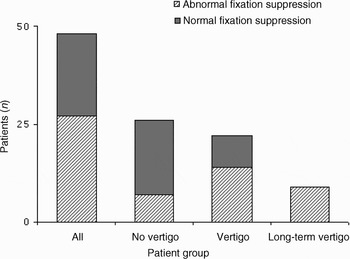
Patients with post-operative vertigo showed abnormal visual fixation suppression significantly more often than symptom-free patients (p = 0.019; chi-square test). Moreover, all patients with long-term post-operative vertigo (i.e. four weeks or more) had insufficient visual fixation suppression, if measurable. In three patients with post-operative vertigo, visual fixation suppression could not be determined. In one case, this was due to pre-existing loss of caloric horizontal SCC response, in another to pendular nystagmus. A third patient could not tolerate caloric irrigation (reacting with persistent closure of eyes). These results are shown in detail in Figure 1.
Visual fixation suppression findings in the 48 cochlear implant patients in whom it could be measured by pre-operative video-oculography.

The aetiology of deafness in those patients with impaired fixation suppression was as follows: sudden hearing loss in six patients; hereditary deafness in four patients; toxic damage in one patient; meningitis in two patients; and unknown aetiology in eight patients. There were no apparent differences in deafness aetiology between these patients and those with normal fixation suppression.
When the visual fixation suppression test was used as an indicator for all post-CI vertigo symptoms, its sensitivity was 64 per cent and its specificity 73 per cent. As an indicator for long-term post-CI vertigo, its sensitivity was 100 per cent and its specificity 43 per cent.
Other risk factors
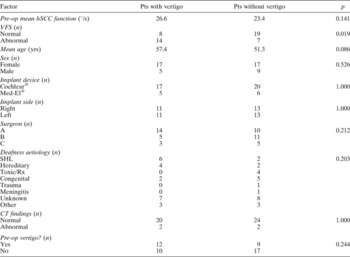
Other possible risk factors for post-CI vertigo were analysed, in addition to visual fixation suppression. Patients with vertigo and symptom-free patients were compared regarding age, sex, implanted electrode type, implant side, surgeon, cause of deafness, petrous bone CT findings and incidence of pre-operative vertigo. This analysis used data from only the 48 patients in whom determination of visual fixation suppression was possible. Patients with pre-existing loss of horizontal SCC function or without a valid video-oculography recording were excluded. No statistically significant differences were found between the two patient groups for any of the above-mentioned criteria (Table II).
study patients'* potential risk factors for vertigo after cochlear implantation

* n = 48. Pts = patients; pre-op = pre-operative; hSCC = horizontal semicircular canal; s = second; VFS = visual fixation suppression; yrs = years; SHL = sudden hearing loss; Rx = pharmacological; CT = computed tomography
Discussion
Numerous previous studies on the occurrence of vertigo symptoms after cochlear implantation (CI) have been reported. These have often shown a decrease in peripheral vestibular function following electrode implantation.Reference Enticott, Tari, Koh, Dowell and O'Leary5, Reference Buchman, Joy, Hodges, Telischi and Balkany8, Reference Brey, Facer, Trine, Lynn, Peterson and Suman13–Reference Kubo, Yamamoto, Iwaki, Doi and Tamura17 However, this finding has been reported with variable frequency, ranging from 16 to 100 per cent. Our results confirm a decrease in horizontal SCC function after CI. In 39 per cent of our patients, bithermal caloric response was impaired post-operatively. This is in concordance with the meta-analysis conducted by Buchman et al.,Reference Buchman, Joy, Hodges, Telischi and Balkany8 who found a corresponding decrease in function in 38 per cent of 186 patients. In our patients, the mean maximal slow phase velocity of the caloric response fell significantly in the implanted ear, while remaining stable in the contralateral ear.
Fewer studies have examined otolith function as well as horizontal SCC function, before and after CI. These studies have shown functional impairment of the otolith receptors in the implanted ear.Reference Todt, Basta and Ernst4, Reference Jin, Nakamura, Shinjo and Kaga18 Furthermore, damage to the peripheral vestibular receptors has been demonstrated following CI, using rotatory chair testingReference Brey, Facer, Trine, Lynn, Peterson and Suman13, Reference Mangham19 and posturography.Reference Brey, Facer, Trine, Lynn, Peterson and Suman13, Reference Fina, Skinner, Goebel, Piccirillo, Neely and Black20 This suggests that direct trauma as a result of electrode insertion into the labyrinth is of fundamental importance in the aetiology of post-operative vertigo symptoms. Other aetiologies have also been described in the literature, such as post-operative benign paroxysmal positional vertigo,Reference Di Girolamo, Fetoni, Di Nardo and Paludetti21 endolymphatic hydropsReference Fina, Skinner, Goebel, Piccirillo, Neely and Black20, Reference Graham and Dickins22 and direct electrical stimulation of vestibular receptors by the implant.Reference Bance, O'Driscoll, Giles and Ramsden23 However, these occur much less frequently and typically lead to vertigo symptoms appearing more than four weeks post-operatively (i.e. delayed vertigo).
It has remained an unresolved question why the measurable decrease in peripheral vestibular function does not correlate with the vertigo symptoms actually reported by CI patients.Reference Enticott, Tari, Koh, Dowell and O'Leary5–Reference Buchman, Joy, Hodges, Telischi and Balkany8, Reference Brey, Facer, Trine, Lynn, Peterson and Suman13–Reference Klenzner, Neumann, Aschendorff and Laszig16, Reference Mangham19, Reference Fina, Skinner, Goebel, Piccirillo, Neely and Black20 Likewise, our results showed a comparable decrease in horizontal SCC function in patients both with and without vertigo. Moreover, neither baseline nor post-operative values differed significantly between the two groups. Therefore, these peripheral vestibular function tests are not suitable for identifying patients prone to post-operative vertigo. Other factors with a possible influence on vestibular function (i.e. age, sex, implanted electrode type, implant side, surgeon, cause of deafness, petrous bone CT findings and incidence of pre-operative vertigo) were also analysed in the present study. It was not possible to deduce a risk profile for post-operative vertigo from these analyses. Other authors have come to the same conclusion.Reference Enticott, Tari, Koh, Dowell and O'Leary5, Reference Steenerson, Cronin and Gary6, Reference Buchman, Joy, Hodges, Telischi and Balkany8
Some reports have found a higher incidence of vertigo in older patients.Reference Brey, Facer, Trine, Lynn, Peterson and Suman13, Reference Fina, Skinner, Goebel, Piccirillo, Neely and Black20 The underlying reason for this association has remained speculative thus far, possibly because previous studies have tended to focus on peripheral damage to the inner-ear function. We know from other types of peripheral vestibular dysfunction that deficits can be compensated by other sensory systems (e.g. visual and proprioceptive) and by central compensatory mechanisms, leading to suppression of vertigo symptoms.Reference Brandt, Bartenstein, Janek and Dieterich9, Reference Jahn, Strupp, Krafczyk, Schüler, Glasauer and Brandt10, Reference Baloh, Honrubia, Yee and Hess24–Reference Straka and Dieringer26 An especially intricate relation exists between the vestibular and visual systems. This visual–vestibular interaction remains active even during decreased or complete loss of peripheral vestibular function.Reference Bense, Deutschländer, Stephan, Bartenstein, Schwaiger and Brandt27 In the present study, we were able to demonstrate that visual compensatory mechanisms play an important role when CI has caused vestibular damage. We used visual fixation suppression as an indicator of the visual–vestibular interaction.Reference Kato, Kimura, Aoyagi, Mizukoshi and Kawasaki28 Patients with post-operative vertigo symptoms had abnormal visual fixation suppression significantly more often than did patients free of vertigo. There was an insufficient ability to visually suppress the caloric nystagmus, especially in patients with longer lasting vertigo, indicating an impaired connection between the visual and vestibular systems. It seems therefore that peripheral damage to vestibular functions due to CI only leads to vertigo symptoms if compensatory mechanisms (such as the visual–vestibular interaction) are impaired. This could explain why some reports have identified greater age as a risk factor for post-operative vertigo. Older patients are slower and less efficient in compensating vestibular disturbances.
In cases of acute, unilateral, peripheral vestibulopathy caused by temporal bone fracture or vestibular neuritis, previously healthy individuals almost invariably suffer initially from vertigo, which is then compensated over time. In contrast, CI candidates already have impaired inner-ear function, often with reduced vestibular function. Many of these patients report vertigo symptoms, and have adapted to mild balance problems without noticing them consciously.Reference Krause, Louza, Hempel, Wechtenbruch, Rader and Gürkov11 In addition, CI often leads to a partial decrease in vestibular function, but only rarely causes a complete vestibular loss. If short-term or mild balance disorders occur immediately post-operatively, these may be masked by centrally sedating drugs used during general anaesthesia. Taking into account all these considerations, it is conceivable that a measurable impairment of vestibular function causes no or only short-term vertigo symptoms, if the patient's compensatory abilities are intact.
• Vertigo is a common post-operative complication following cochlear implantation
• Previous studies have shown a decrease in peripheral vestibular function due to electrode implantation
• In cases of vestibular damage due to cochlear implantation, visual compensatory mechanisms play an important role
• In this study, patients with post-operative vertigo symptoms had abnormal visual fixation suppression significantly more often than patients free of vertigo
By determining the visual fixation suppression of the thermally induced horizontal SCC vestibulo-ocular reflex, patients at high risk of CI-induced vertigo may be identified pre-operatively and counselled appropriately. These patients should be prime candidates for post-operative vestibular rehabilitation, since they seem to be especially prone to developing post-operative vertigo. With the aid of pre-operative visual fixation suppression testing and counselling for patients at risk of post-operative vertigo, such patients can be scheduled for vestibular rehabilitation training even before surgery.Reference Hillier and Hollohan29
This test method does have some limitations and should not be over-estimated. Several studies on visual fixation suppression in healthy control subjects have shown a high inter- and intra-individual variability of measurement results.Reference Schuchman and Uri30 In our patients, the specificity of this test as an indicator for post-operative vertigo was only moderate. Therefore, visual fixation suppression testing should not at present have a major influence on individual decisions regarding CI in suitable patients.
Acknowledgement
RG was supported by the Programm zur Förderung von Forschung und Lehre of the University of Munich.
Appendix 1. Questionnaire
(1a) Have you had vertigo or balance disorders since the CI operation? Yes/No
(1b) If you already had vertigo or balance problems before the CI operation, have they changed? Vertigo is increased/unchanged/decreased/changed in quality, namely …[open answer]
(2) When did the vertigo or balance disorder start after the operation? Directly afterwards/on the first day post-op/on the second day post-op/later, namely … [open answer]
(3) How would you describe the vertigo or balance disorder? Rotatory vertigo/to-and-fro vertigo/elevator sensation/light-headedness
(4) How many times does the vertigo or balance disorder occur? Continuously (go to question 8)/daily/weekly/monthly/several times a year/very irregularly
(5) How long does the vertigo or balance disorder last? Seconds/minutes/hours/days/weeks
(6a) Is there a triggering factor for the vertigo or balance disorder? Yes/no (go to question 7)
(6b) What is the triggering factor? [open answer]
(7a) Are there prodromal signs of the vertigo or balance disorder? Yes/no (go to question 8)
(7b) What are the prodromal signs? [open answer]
(8) Which accompanying symptoms appear with the vertigo or balance disorder? None/hearing loss/ringing in the ears or tinnitus/nausea or vomiting/headache/anxiety/sweating/others, namely … [open answer]
(9) How strong is the disturbance caused by the vertigo or balance disorder? Make a mark on the scale. [10 cm visual analogy scale; 0 = minimum = none, 10 = maximum (i.e. extreme, unbearable)]