Introduction
China produced 212.8 million tonnes of rice in 2022, accounting for 30% of global rice production (National Bureau of Statistics, 2023). Chemical fertilizers, particularly nitrogen (N) fertilizers, have been widely used in China over the last few decades, resulting in high rice yield (Wang and Lu, Reference Wang and Lu2020). The N fertilizer application rate in rice production in China ranges from 150 to 250 kg/ha and sometimes even exceeds 300 kg/ha, significantly higher than the global average (Zhang et al., Reference Zhang, Wang, Pan, Luo, Liu, Gu, Liu, Zhai, Lindsey, Zhang, Lei, Wu, Smith and Liu2018). Nitrogen is an essential component for rice growth. However, excessive N fertilizer application increases agricultural production costs and pollutes the environment (Wang and Lu, Reference Wang and Lu2020; Zheng et al., Reference Zheng, Chen, Yang, Wang, Farhan, Li, Li, Shen, Wang and Hu2023). Therefore, China's Ministry of Agriculture and Rural Affairs has formulated an ‘Action Plan for Chemical Fertilizer Reduction by 2025’. The goal is to promote further reductions in chemical fertilizers, optimize fertilization structure and processes and ensure the rice industry's green and high-quality development.
Based on model predictions, achieving the national rice production target in 2030 while reducing nationwide N consumption by 27% is possible (Cai et al., Reference Cai, Zhao, Pittelkow, Fan, Zhang and Yan2023). In addition, the amount of N fertilizer needed in the early and late seasons in the double-cropping rice area can be lowered by 17.7 and 26.7%, respectively (Cai et al., Reference Cai, Zhao, Pittelkow, Fan, Zhang and Yan2023). Research by Zhang et al. (Reference Zhang, Wang, Pan, Luo, Liu, Gu, Liu, Zhai, Lindsey, Zhang, Lei, Wu, Smith and Liu2018) further demonstrates that the N fertilizer application rate for the highest rice yield can be reduced by 20–39% while still guaranteeing 95–99% of the highest grain yield. According to a meta-analysis study, rice yield with lower N fertilizer application rates (100–200 kg/ha) decreased, albeit not significantly, compared to traditional N fertilizer application rates (200–300 kg/ha) (Cheng et al., Reference Cheng, Jiang and Cao2021). In double rice cropping systems (CSs), a moderate reduction in N fertilizer application did not significantly impact indica rice grain yield in the early and late seasons (Chen et al., Reference Chen, Chen, He, Wang, Lu, Yang, Deng, Chen, Tao, Li, Li and Ren2021a; Fu et al., Reference Fu, Zhong, Zeng, Liang, Pan, Xin, Liu, Hu, Peng, Chen, Hu and Huang2021). However, N reduction treatments decrease japonica rice grain yield in a rice-wheat CS (Ju et al., Reference Ju, Zhu, Liu and Sun2021). Therefore, effectively reducing the N fertilizer application rate during rice production is feasible but challenging (Zhang et al., Reference Zhang, Wang, Pan, Luo, Liu, Gu, Liu, Zhai, Lindsey, Zhang, Lei, Wu, Smith and Liu2018; Huang et al., Reference Huang, Fan and Zou2019).
A key objective of sustainable rice cultivation is the development of high-quality rice in addition to improved yield. Milling, appearance, cooking and eating and nutritional qualities are all aspects of rice quality that directly determine market pricing and consumer satisfaction. Rice qualities are primarily determined by genetics, although they are also affected by cultivation practices such as N fertilizer. Adequate N input is essential for rice growth and development and directly affects rice quality (Ding et al., Reference Ding, He, Zhang, Liu, Xu, Ullah, Cui and Zhou2020). Lower N fertilizer application generally increase chalky grain rates and chalkiness while decreasing head rice rates (Rogers et al., Reference Rogers, Norman, Siebenmorgen, Grigg, Hardke, Brye and Gbur2016; Zhang et al., Reference Zhang, Zhang, Song, Chen, Sun, Peng, Huang and Zhao2021; Guo et al., Reference Guo, Yuan, Yan, Xiang, Wu, Zhang, Wang, He, Fan, Yang, Chen, Sun and Ma2022; Fei et al., Reference Fei, Yang, Ma, Lunzhu, Wang, Wang and Guo2023). However, prior research has demonstrated that an increase in the rate of N fertilizer application also increases chalky grain rate, chalkiness, milled rice rate and head rice rate (Zhu et al., Reference Zhu, Zhang, Guo, Xu, Dai, Wei, Gao, Hu, Cui and Huo2017). Within a given range, the amount of N fertilizer applied causes an increase in rice protein content while decreasing amylose content. In other words, protein and amylose contents respond inconsistently to N fertilizer application rates (Zhu et al., Reference Zhu, Zhang, Guo, Xu, Dai, Wei, Gao, Hu, Cui and Huo2017; Chen et al., Reference Chen, Zhu, Xie, Deng, Tu, Guan, Yang, Huang, Chen, Qiu, Qian, Shao, Xu and Peng2021b). Several investigations have examined the impact of N fertilizer on the eating quality of rice, yielding inconsistent and inconclusive results. Many studies suggest that increasing N fertilizer application frequently results in a decrease in cooking and eating qualities (Gu et al., Reference Gu, Chen, Chen, Wang, Zhang and Yang2015; Huang et al., Reference Huang, Zhao, Zhu, Zhou, Zheng and Wang2020; Zhang et al., Reference Zhang, Fu, Tu, Zhao, Kuang and Zhang2020; Li et al., Reference Li, Shi, Cheng, Zhao, Pan, Cao and Jiang2023). Therefore, rice production necessitates a scientifically formulated N fertilizer reduction plan based on traditional N fertilizer application rates, soil fertility, cultivar characteristics, weather environment and other variables to balance its impact on rice yield and quality (Zhang et al., Reference Zhang, Fu, Tu, Zhao, Kuang and Zhang2020; Du et al., Reference Du, Lei, Lu, Wang, Xu, Luo and Zhang2022; Qiu et al., Reference Qiu, Yang, Jiang, Xu and Jiao2022).
The double rice CS in South China is an important rice production area in China. This area is rich in rice seed resources. It has a long history of producing high-quality rice, which is critical to developing a high-quality rice industry and ensuring China's food security. Currently, early- and late-season dual-use rice (ELDR) cultivars, suitable for planting during both the early and late growing seasons, make up most of the rice cultivars cultivated in South China's large rice fields. Under high-yield cultivation conditions, the N fertilizer application rates for double-cropping rice in South China are approximately 150–180 kg/ha in the early season and 150–210 kg/ha in the late season (Liang et al., Reference Liang, Zhong, Pan, Huang, Liu, Peng, Fu and Hu2019; Yang et al., Reference Yang, Yang, Zeng, Wang, Xiong, Wu and Zhang2022; Zhang et al., Reference Zhang, Wang, Wang, Ashraf, Mo, Tian, Duan, Li, Tang and Pan2022). The Department of Agriculture and Rural Affairs of Guangdong Province has formulated the ‘Fertilizer Reduction Work Plan in 2023’ while ensuring the efficient supply of vital agricultural products. Thus, we conducted a 2-year N fertilizer reduction experiment with two ELDR cultivars in South China's double-cropping rice area to promote and implement the ‘Plans’ and establish sustainable N fertilizer management measures for high-quality rice production. The objective is to comprehensively evaluate the effects of reducing the N fertilizer application rate on the grain yield and rice quality of ELDR in early and late seasons and to reveal the changing mechanisms of grain yield and rice quality under N fertilizer reduction settings.
Materials and methods
Experimental site
The experiment was conducted at the Dafeng experimental base of Guangdong Academy of Agricultural Sciences (23°09′N, 113°22′E, and 23 m above sea level) in 2022 and 2023. The area experiences a south-subtropical monsoon climate. Figure S1 depicts the weather conditions during the rice-growing seasons of 2022 and 2023. The soil had an initial pH of 5.8 at 0–15 cm depth, with organic matter, total N and available N contents of 25.3, 1.1 and 67.3 mg/kg, respectively.
Field experiment
Yuehesimiao (YHSM), a high-yielding rice cultivar, and Meixiangzhan 2 (MXZ), a low-yielding rice cultivar, were among the ELDR cultivars examined. All of them are inbred indica rice cultivars. The experiment adopted a split-plot design with N fertilizer rates as the main plots and cultivars as the subplots. The treatments included a 20% reduction in the N fertilizer application rate (RN2), a 10% reduction in the N fertilizer application rate (RN1) and a conventional N fertilizer application rate (CN). Each treatment consisted of three replicates. During the early season, the N fertilizer application rates were 108.0 kg/ha for RN2, 121.5 kg/ha for RN1 and 135.0 kg/ha for CN treatment. Late-season N fertilizer application rates were 120.0 kg/ha for RN2, 135.0 kg/ha for RN1 and 150 kg/ha for CN treatment. We used urea, which has a 46% N concentration, as the N fertilizer. Basal, tillering and panicle fertilizers were applied in a 5:3:2 ratio. The phosphate fertilizer is superphosphate, with an application rate of 48 kg/ha, and is used as a basal fertilizer. The potassium fertilizer used was potassium chloride, applied at a rate of 180 kg/ha, with a 6:4 ratio of basal to panicle fertilizer. We applied basal fertilizers 1 day before transplanting, tillering fertilizers 7 days after transplanting and panicle fertilizers during early panicle differentiation. Seedlings were raised using wet-bed seedling cultivation techniques. We manually transplanted early and late rice seedlings at 25 and 15 days old. Three seedlings per hill were transplanted in the early season and two seedlings per hill in the late season, with a spacing of 16.5 cm × 19.8 cm. Table S1 displays the ELDR calendar for 2022 and 2023. Water management involved maintaining a thin water layer during the tillering stage, followed by draining and drying the fields to control ineffective tillering. A thin water layer was maintained during the heading stage, with irrigation alternating between dry and wet conditions. Chemicals were sprayed to control pests and diseases during the tillering stage, 7 days before heading and during the grain filling stage. Chemical weeding was conducted before transplanting and during the tillering stage.
Dry matter accumulation, yield and yield components
Thirty hills were surveyed in each sub-plot at the tillering, heading and maturity stages to determine the average number of tillers or panicles. Five hills of rice plants were sampled from each sub-plot based on these averages. After removing the roots, the plants were washed and then dried at 75°C until they reached a constant weight. At maturity, five more hills of rice plants were sampled. During manual threshing, an air separator was used to separate filled grains and empty grains. We calculated the spikelets per panicle, the filled grain percentage and the grain weight. Fifty hills of rice plants were harvested from each sub-plot to ascertain the actual grain yield, which was subsequently adjusted for 13.5% moisture content.
Milling and appearance qualities
The rice grains underwent processing using a dehusker and a rice mill to determine the brown rice rate and milled rice rate per the National Standard of the People's Republic of China guidelines for ‘High Quality Paddy’. The head rice rate, chalky grain rate and chalkiness were then measured using a flatbed scanner (ScanMaker i800 Plus, Microtek, Shanghai, China) and rice quality analyser software (SC-E, Wanshen Testing Technology Co., Ltd., Hangzhou, China).
Amylose and protein contents
Approximately 20 g of head rice were ground and sieved through a 60-mesh sieve. The amylose content in rice flour was determined using the National Standard of the People's Republic of China guidelines for ‘High Quality Paddy’. In addition, the N content of the rice flour was determined using a Kjeldahl N analyser (Kjeltec 8400, FOSS Analytical Instruments, Hillerød, Denmark). The protein content was calculated by multiplying the N content by the conversion factor of 5.95.
Cooked rice texture and taste value
We weighed 20 g of head rice, placed it in an aluminium can and washed it twice with ultrapure water. Then, we added water, following a mass ratio of head rice to water of 1:1.3. After sealing the can with filter paper, the contents were steam-cooked for 30 min and then cooled for 30 min. The texture analyser (TVT 6700, Perten, Stockholm, Sweden) was used to determine the hardness and stickiness of cooked rice, while the rice taste analyser (STA1B, Satake, Hiroshima, Japan) measured its taste value. The specific methods for measuring the cooked rice texture and taste value were based on previous studies (Zhang et al., Reference Zhang, Fu, Tu, Zhao, Kuang and Zhang2020; Yang et al., Reference Yang, Chen, Xiong, Zeng, Jiang, Zhang, Zhang and Yang2024). All rice samples were cooked in two portions and measured six times for texture and two times for taste value.
Statistical analysis
A three-way analysis of variance (ANOVA) was used to investigate the impacts of year, cultivar, N treatment, as well as their interactions on grain yield, yield components, dry matter accumulation, milling and appearance qualities. Determining amylose content, protein content, cooked rice texture and taste value in 2023 led to a two-way ANOVA to assess the impacts of cultivar, N treatment and their interactions. All data were analysed using SPSS 25.0 statistical software (SPSS, USA).
Results
Grain yield and yield components of ELDR
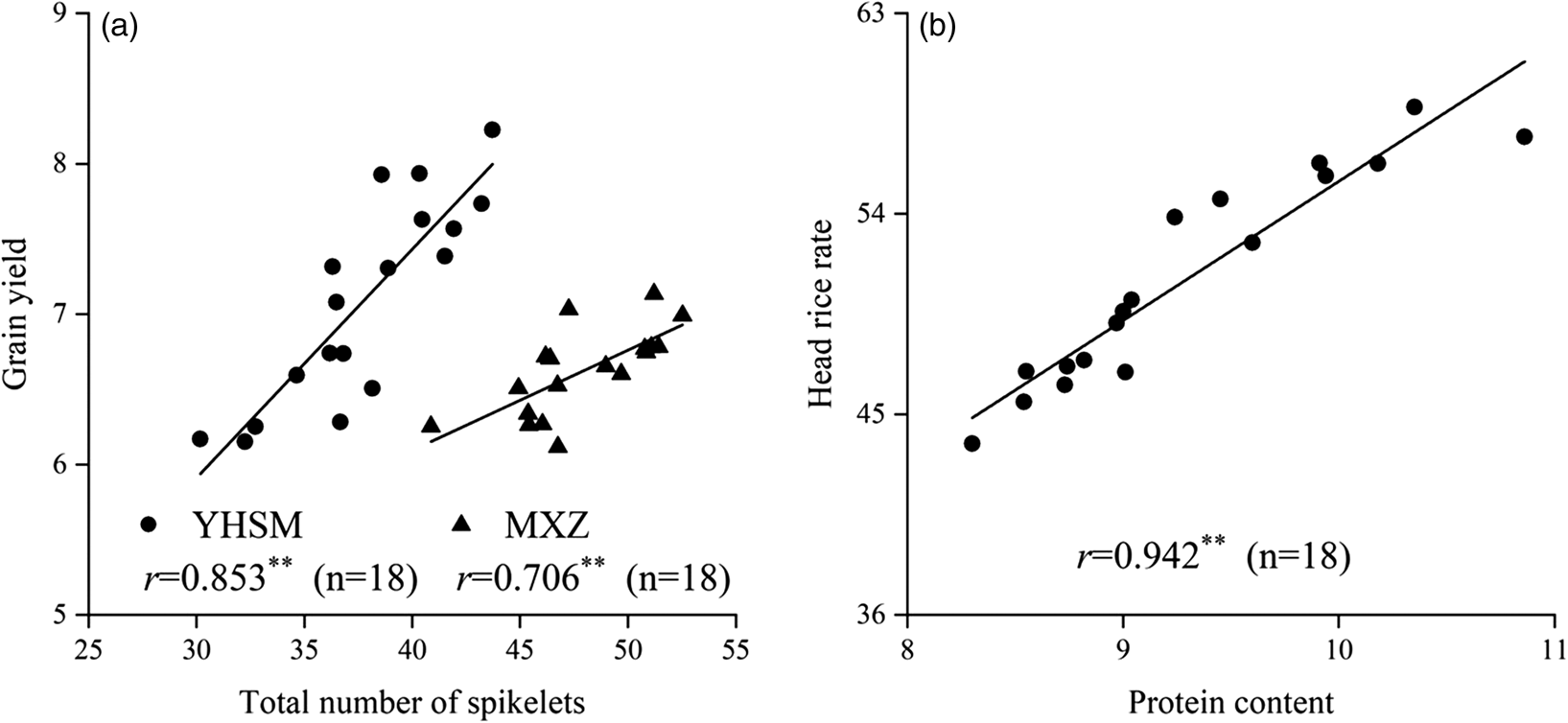
The cultivar, the N treatment and the interaction between the two significantly affected the early-season grain yield of ELDR (Table 1). Compared to CN treatment, RN2 significantly reduced the early-season grain yield of YHSM and MXZ by an average of 16.1 and 6.6%, respectively. Conversely, RN1 significantly decreased YHSM grain yield by 11.2% on average while not affecting MXZ grain yield (Fig. 1(a)). In early season, N treatment significantly affected spikelets per panicle and total number of spikelets but did not impact panicle number, filled grain percentage or grain weight (Table 1). Compared to the CN treatment, RN2 and RN1 significantly reduced the total number of spikelets of YHSM by 12.3 and 7.8%, respectively. Although RN1 did not affect the total number of spikelets of MXZ, RN2 significantly reduced it by an average of 8.4% (Fig. 1(g)). Correlation analysis showed that YHSM and MXZ grain yield in the early season were significantly positively related to the total number of spikelets (Fig. 2(a)).
Three-way ANOVA (F value) for grain yield and yield components of ELDR

* and ** indicate significant differences at the 0.05 and 0.01 levels.
Effects of a short-term reduction in N fertilizer application on grain yield and yield components of ELDR. (a, c, e, g, i and k) for early season; (b, d, f, h, j and l) for late season. YHSM, Yuehesimiao; MXZ, Meixiangzhan 2. RN2, 20% reduction in the N fertilizer application rate treatment; RN1, 10% reduction in the N fertilizer application rate treatment; CN, conventional N fertilizer application rate treatment. Data are means ± sd after averaging across two years. Different letters indicate significant differences among nitrogen treatments at P < 0.05 level using the LSD test.

Pearson correlations between grain yield and total number of spikelets, head rice rate and protein content in early season. YHSM, Yuehesimiao; MXZ, Meixiangzhan 2. ** indicates significant at the 0.01 level.

In contrast, the late-season grain yield of YHSM and MXZ differed significantly only among cultivars, not between years or N treatments (Table 1). While N treatment did not considerably affect yield components, significant differences in yield components existed between years and cultivars.
Dry matter accumulation of ELDR
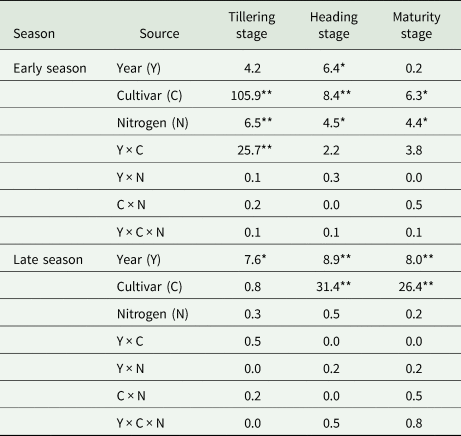
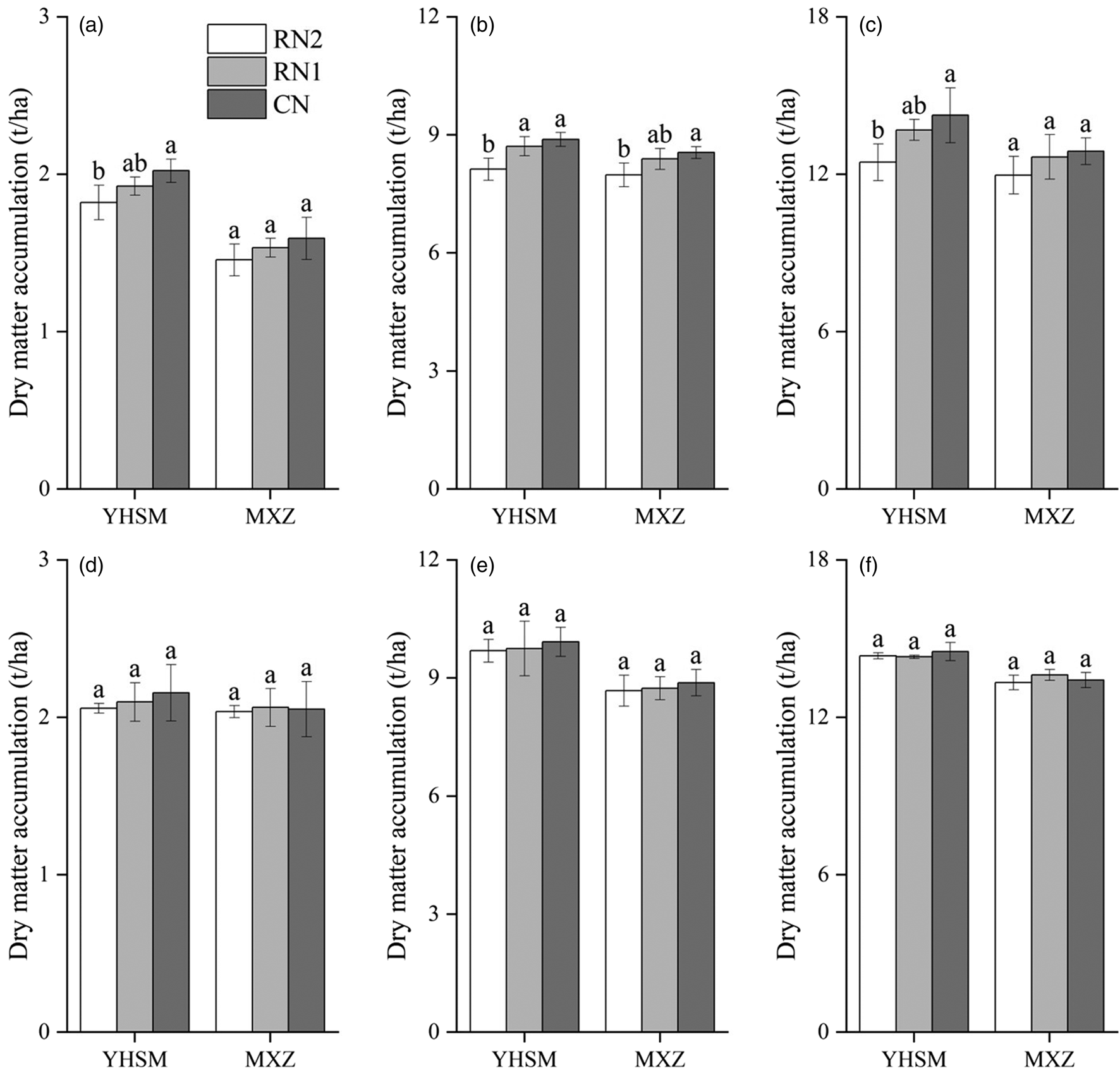
In the early season, N treatment significantly affected dry matter accumulation (Table 2). RN2 significantly decreased YHSM dry matter accumulation in the early season by 10.0 and 12.6% on average across years at the tillering and maturity stages, respectively, but had no effect on the heading stage (Figs 3(a–c)). In the early season, RN1 did not significantly impact YHSM dry matter accumulation at the three stages. Similarly, RN2 and RN1 did not significantly impact MXZ dry matter accumulation at three stages in the early season. In late season, RN2 and RN1 did not affect YHSM and MXZ dry matter accumulation at tillering, heading and maturity stages (Figs 3(d–f)).
Three-way ANOVA (F value) for dry matter accumulation of ELDR

* and ** indicate significant differences at the 0.05 and 0.01 levels.
Effects of a short-term reduction in N fertilizer application on dry matter accumulation of ELDR. (a) Tillering stage, (b) heading stage and (c) (maturity stage) for early season; (d) tillering stage, (e) (heading stage) and (f) (maturity stage) for late season. YHSM, Yuehesimiao; MXZ, Meixiangzhan 2. RN2, 20% reduction in the N fertilizer application rate treatment; RN1, 10% reduction in the N fertilizer application rate treatment; CN, conventional N fertilizer application rate treatment. Data are means ± sd after averaging across two years. Different letters indicate significant differences among nitrogen treatments at P < 0.05 level using the LSD test.

Milling and appearance qualities of ELDR
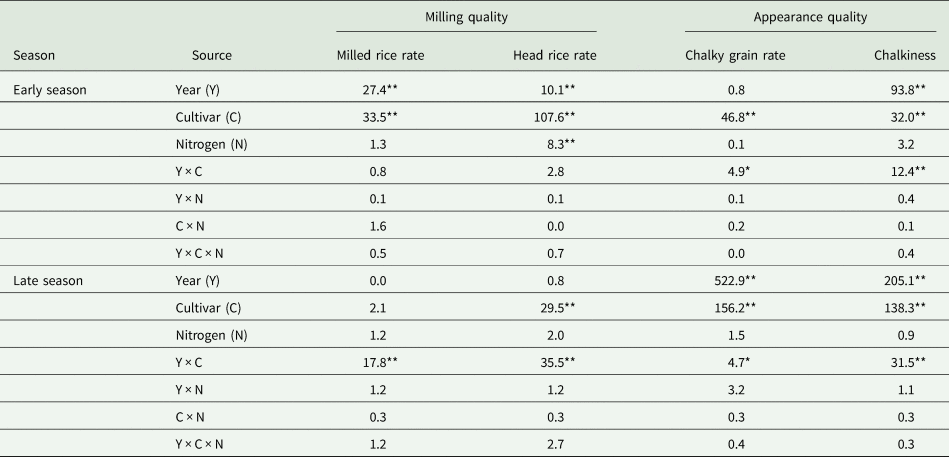
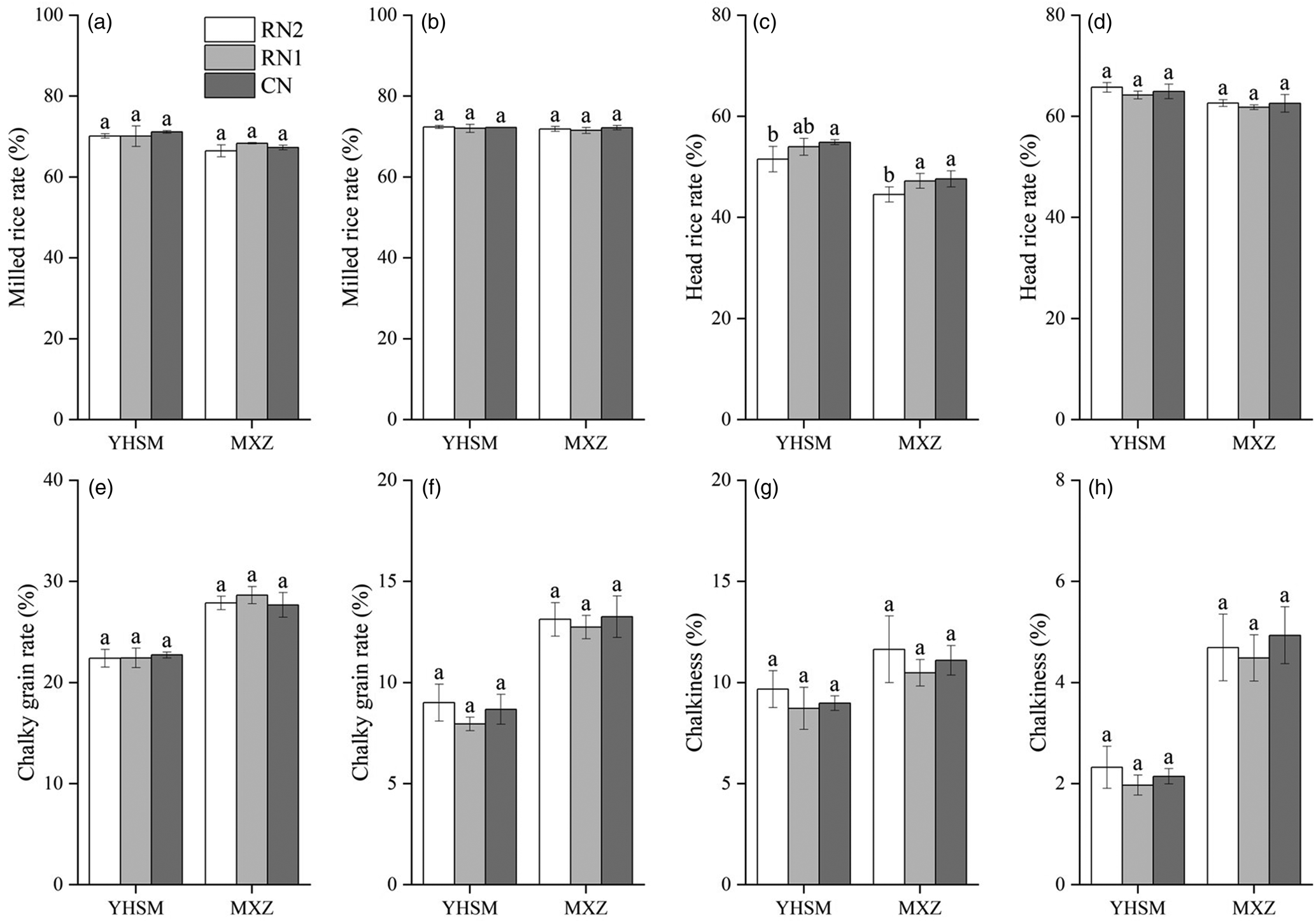
In the early season, N treatment significantly affected the head rice rate but had no significant impact on the milled rice rate or appearance quality (Table 3). Compared with CN treatment, RN2 significantly reduced the head rice rates of YHSM and MXZ in the early season by an average of 6.1 and 6.5%, respectively (Fig. 4(c)). However, RN1 had no significant effect on the head rice rates of YHSM and MXZ in the early season. In the late season, RN2 and RN1 had no significant impact on the milling and appearance qualities of YHSM and MXZ. However, there were substantial variations in appearance quality between years and cultivars and head rice rate between cultivars (Table 3). In addition, correlation analysis revealed that the head rice rate in the early season was significantly positively correlated with its protein content (Fig. 2(b)).
Three-way ANOVA (F value) for milling and appearance qualities of ELDR

* and ** indicate significant differences at the 0.05 and 0.01 levels.
Effects of a short-term reduction in N fertilizer application on milling and appearance quality of ELDR. (a, c, e and g) for early season; (b, d, f and h) for late season. YHSM, Yuehesimiao; MXZ, Meixiangzhan 2. RN2, 20% reduction in the N fertilizer application rate treatment; RN1, 10% reduction in the N fertilizer application rate treatment; CN, conventional N fertilizer application rate treatment. Data are means ± sd after averaging across two years. Different letters indicate significant differences among nitrogen treatments at P < 0.05 level using the LSD test.

Amylose and protein contents and eating quality of ELDR
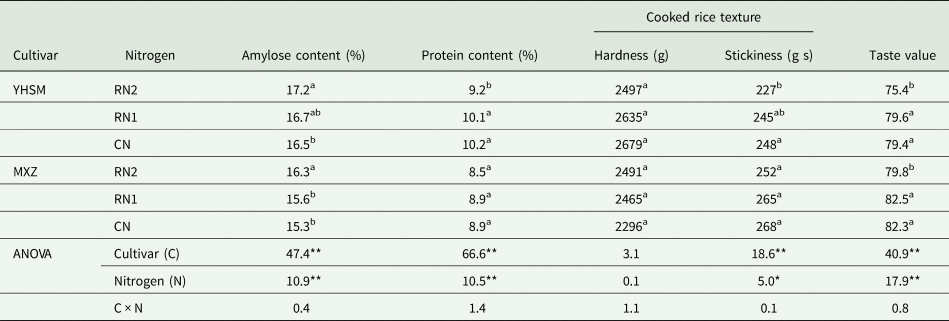
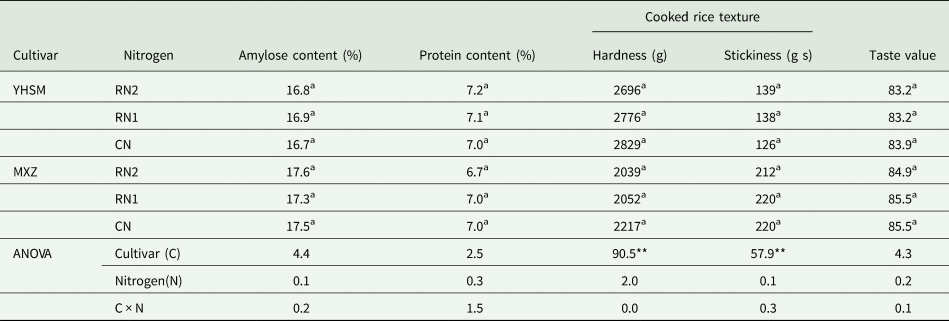
Table 4 shows that N treatment significantly affected amylose and protein content in the early season, with significant differences between cultivars. In contrast, there were no significant variations in amylose and protein contents between cultivars and N treatments in the late season (Table 5). Compared to the CN treatment, the amylose contents of YHSM and MXZ in the early season significantly increased by 0.68 and 0.98 percentage points under RN2 conditions, respectively. At the same time, RN1 did not affect the amylose contents of YHSM and MXZ (Table 4). In addition, N treatment only significantly affected the YHSM protein content in the early season, with a 0.91 percentage points decrease of RN2 treatment (Table 4).
Effects of a short-term reduction in N fertilizer application on amylose and protein contents, cooked rice texture and taste value in early season (2023)

YHSM, Yuehesimiao; MXZ, Meixiangzhan 2. RN2, 20% reduction in the N fertilizer application rate treatment; RN1, 10% reduction in the N fertilizer application rate treatment; CN, conventional N fertilizer application rate treatment.
Data are means ± sd. Different letters indicate significant differences among nitrogen treatments at P < 0.05 level using the least significant difference (LSD) test.
* and ** indicate significant differences at the 0.05 and 0.01 levels.
Effects of a short-term reduction in N fertilizer application on amylose and protein contents, cooked rice texture and pasting property in late season (2023)

YHSM, Yuehesimiao; MXZ, Meixiangzhan 2. RN2, 20% reduction in the N fertilizer application rate treatment; RN1, 10% reduction in the N fertilizer application rate treatment; CN, conventional N fertilizer application rate treatment.
Data are means ± sd. Different letters indicate significant differences among nitrogen treatments at P < 0.05 level using the LSD test.
* and ** indicate significant differences at the 0.05 and 0.01 levels.
In the early season, N treatment had no significant effect on the hardness of cooked rice but significantly affected its stickiness and taste value (Table 4). RN2 reduced stickiness and taste value of YHSM by 8.1 and 5.0%, respectively, whereas taste value of MXZ lowered by 3.1%. RN1 did not significantly affect YHSM and MXZ stickiness or taste value in the early season. In the late season, N treatment had no significant effect on cooked rice hardness, stickiness or taste value. However, there were significant differences in hardness and stickiness among cultivars (Table 5). Correlation analysis showed that cooked rice stickiness and taste value in the early season were significantly negatively associated with its amylose content (Figs 5(a) and (b)).
Pearson correlations among stickiness, taste value, amylose and protein contents in early season (2023). ** indicates significant at the 0.01 level.

Discussion
Effects of a short-term reduction in N fertilizer application on the grain yield of ELDR
In this study, we observed that RN2 significantly reduced the grain yield of YHSM and MXZ in the early season, whereas RN1 lowered the grain yield of YHSM but had no effect on MXZ (Fig. 1(a)). In the late season, RN2 and RN1 had no significant impact on the grain yield of the two cultivars (Fig. 1(b)). Most studies have shown that decreasing the amount of N fertilizer application reduces grain yield (Ju et al., Reference Ju, Zhu, Liu and Sun2021; Li et al., Reference Li, Shi, Cheng, Zhao, Pan, Cao and Jiang2023; Zhou et al., Reference Zhou, Yuan, Zhang, Gu, Liu, Zhang, Wang and Yang2023). However, Chen et al. (Reference Chen, Chen, He, Wang, Lu, Yang, Deng, Chen, Tao, Li, Li and Ren2021a) found that reducing N fertilizer application rates by 20% did not affect grain yield in early and late seasons in a double-rice CS. Thus, the effects of reduced N application on rice yield are variable and may be related to conventional N fertilizer application rates, cultivar characteristics and the regional environment (Zhang et al., Reference Zhang, Wang, Pan, Luo, Liu, Gu, Liu, Zhai, Lindsey, Zhang, Lei, Wu, Smith and Liu2018; Huang et al., Reference Huang, Fan and Zou2019).
Previous studies also indicated that decreased grain yield under reduced N application conditions were caused by a drop in panicle number, spikelets per panicle and total number of spikelets, but not filled grain percentage or grain weight (Ju et al., Reference Ju, Zhu, Liu and Sun2021; Zhou et al., Reference Zhou, Yuan, Zhang, Gu, Liu, Zhang, Wang and Yang2023). In this study, RN2 and RN1 decreased the total number of spikelets in the early season (Fig. 1(g)), and a significant positive correlation was observed between total number of spikelets and grain yield in both cultivars (Fig. 2(a)). Consequently, the primary factor contributing to the reduced grain yield in the early season under reduced N application conditions was the reduction in total number of spikelets. In contrast, the yield components in the late season, including panicle number, spikelets per panicle, filled grain percentage and grain weight, remained consistent under reduced N application conditions, indicating that grain yield were not significantly affected (Fig. 1).
Rice yield formation is based on aboveground dry matter production capacity. Previous studies have shown that variations in dry matter accumulation in rice plants under reduced N application conditions directly affect rice yield (Chen et al., Reference Chen, Chen, He, Wang, Lu, Yang, Deng, Chen, Tao, Li, Li and Ren2021a; Ju et al., Reference Ju, Zhu, Liu and Sun2021; Zhou et al., Reference Zhou, Yuan, Zhang, Gu, Liu, Zhang, Wang and Yang2023). Our study found that dry matter accumulation in YHSM and MXZ under RN2 and YHSM under RN1 conditions decreased in the early season, which may negatively impact their yield (Fig. 3). Nitrogen is a crucial nutrient for the growth and development of rice, directly impacting rice growth status (Ju et al., Reference Ju, Zhu, Liu and Sun2021; Zhou et al., Reference Zhou, Yuan, Zhang, Gu, Liu, Zhang, Wang and Yang2023). Before heading in the early season, low temperatures and frequent rainfall were observed (Fig. S1). Reducing N application proved unfavourable for the absorption of N by rice plants and the formation and growth of tillers, especially in the panicle differentiation stage. This might affect panicle differentiation, cause spikelets degradation and ultimately affect grain yield (Zhou et al., Reference Zhou, Li, Cao, Li, Huang and Peng2018). In addition, the early season also experienced relatively higher rates of precipitation (Fig. S1), leading to an increased risk of N loss. Therefore, rice plants in the early season might struggle to acquire enough N from the soil, negatively impacting rice growth and dry matter accumulation under reduced N application conditions. In addition, grain yield in response to RN1 varied between cultivars, only decreasing YHSM grain yield in the early season. This distinct response could be attributed to the specific characteristics of the YHSM cultivar, known for its high yield potential, and suggests that it may have a higher N requirement to support optimal growth (Xiong et al., Reference Xiong, Ding, Wei, Ding and Wang2013; Jia et al., Reference Jia, Wang, Qu, Zou, Sha, Liu, Sun, Zheng, Wang, Yang and Zhao2019).
Unlike the early season, the dry matter accumulation and yield components in the late season showed no significant changes under reduced N application conditions (Figs 1 and 3). High temperatures before heading and extended sunshine hours post-heading in the late season provided sufficient light and temperature resources for the growth and development of late rice under reduced N application conditions (Fig. S1). Furthermore, the CN was 150 kg/ha in the late season, which may surpass the N requirements of rice plants. Therefore, RN2 and RN1 had no impact on the growth and yield of the two ELDR cultivars in the early season. Consequently, a 10% reduction in N fertilizer will not affect the growth and yield of low-yielding rice cultivar (MXZ) in the early season but is not advisable for high-yielding rice cultivar (YHSM). In the late season, reducing N fertilizer application rates by 20 and 10% is feasible, without affecting the growth and yield of either YHSM or MXZ at the current N fertilizer application rate.
Effects of a short-term reduction in N fertilizer application on the milling and appearance qualities of ELDR
The milling quality, especially the head rice rate, directly determines the profits of rice producers. In our study, RN2 significantly affected head rice rates in the early season (Fig. 4(c)). Previous research indicates that reduced N fertilizer application decreased head rice rates (Rogers et al., Reference Rogers, Norman, Siebenmorgen, Grigg, Hardke, Brye and Gbur2016; Zhang et al., Reference Zhang, Zhang, Song, Chen, Sun, Peng, Huang and Zhao2021). Rice grains with high chalkiness are easily broken during milling, which affects their head rice rate (Usui et al., Reference Usui, Sakai, Tokida, Nakamura, Nakagawa and Hasegawa2014; Sreenivasulu et al., Reference Sreenivasulu, Butardo, Misra, Cuevas, Anacleto and Kishor2015). However, there was no significant change in chalky grain rates or chalkiness in the early and late seasons under RN2 conditions (Figs 4(e) and (g)). Therefore, we hypothesized that the drop in head rice rate in the early season under RN2 conditions could be due to other factors.
Starch and protein are the primary rice components, and their content variations may affect rice milling quality (Siaw et al., Reference Siaw, Wang, McClung and Mauromoustakos2021; Long et al., Reference Long, Guan, Wang, Jia, Fu, Lin, Huang and Liu2023). The head rice rate positively correlates with the relative abundance of storage protein in rice endosperm (Leesawatwong et al., Reference Leesawatwong, Jamjod, Kuo, Dell and Rerkasem2005). The high density of storage protein in rice endosperm provides resilience and improves the hardness of the grain (Leesawatwong et al., Reference Leesawatwong, Jamjod, Kuo, Dell and Rerkasem2005; Siaw et al., Reference Siaw, Wang, McClung and Mauromoustakos2021). Our findings revealed that the protein contents of the two cultivars in the early season decreased significantly under RN2 (Table 4), and were significantly positively correlated with head rice rates (Fig. 2(b)). Therefore, the decrease in head rice rates caused by RN2 in the early season could be related to a reduction in protein content, but it requires further validation.
We observed that RN2 and RN1 did not affect chalky grain rates or chalkiness in the early and late seasons (Fig. 4). Lower N fertilizer application rates may result in higher chalky grain rates and chalkiness (Zhang et al., Reference Zhang, Zhang, Song, Chen, Sun, Peng, Huang and Zhao2021; Guo et al., Reference Guo, Yuan, Yan, Xiang, Wu, Zhang, Wang, He, Fan, Yang, Chen, Sun and Ma2022; Fei et al., Reference Fei, Yang, Ma, Lunzhu, Wang, Wang and Guo2023). The grain-filling process primarily determines the chalkiness of rice. The decreased accumulation of carbohydrates in functional leaves and rice endosperms is detrimental to grain filling (Guo et al., Reference Guo, Yuan, Yan, Xiang, Wu, Zhang, Wang, He, Fan, Yang, Chen, Sun and Ma2022). It is also a primary cause of the excessive chalkiness of rice grown at low rates of N fertilizer application. Previous research indicates that low N fertilizer application enhance the mean grain-filling rate, while shortening the effective grain-filling period, resulting in increased chalkiness (Zhang et al., Reference Zhang, Zhang, Song, Chen, Sun, Peng, Huang and Zhao2021; Fei et al., Reference Fei, Yang, Ma, Lunzhu, Wang, Wang and Guo2023). In the current study, RN2 and RN1 did not affect grain-filling characteristics in the early and late seasons (Table S2). Even though RN2 reduced the mean grain-filling rate for YHSM in the early season, it prolonged the active grain-filling period.
A coordinated source–sink relationship benefits grain filling and the accumulation and distribution of assimilates in rice grains, which is the foundation for high-quality rice production (Tu et al., Reference Tu, Jiang, Salah, Cai, Peng, Zhang, Li and Cao2022). In the early season, RN2 and RN1 simultaneously reduced the dry matter accumulation and total number of spikelets (Figs 1(g) and 3(a–c)). In the late season, RN2 and RN1 had no significant impact on the dry matter accumulation or total number of spikelets (Figs 1(h) and 3(d–f)). We hypothesize that the ELDR cultivars in the early and late seasons maintained a balanced source–sink relationship and had little impact on grain filling and chalkiness under RN2 and RN1 conditions.
Effects of a short-term reduction in N fertilizer application on the eating quality of ELDR
The effect of N fertilizer application rate on amylose and protein contents in rice is consistent. Rice's protein content decreases while its amylose content either increases or remains unchanged under low N fertilizer application (Huang et al., Reference Huang, Zhao, Zhu, Zhou, Zheng and Wang2020; Zhang et al., Reference Zhang, Fu, Tu, Zhao, Kuang and Zhang2020; Guo et al., Reference Guo, Yuan, Yan, Xiang, Wu, Zhang, Wang, He, Fan, Yang, Chen, Sun and Ma2022; Li et al., Reference Li, Shi, Cheng, Zhao, Pan, Cao and Jiang2023). We observed that RN2 increased the amylose content and reduced the protein content in the early season but did not affect them in the late season (Tables 4 and 5). The amylose and protein contents of rice negatively correlate with its eating quality (Singh et al., Reference Singh, Pal, Mahajan, Singh and Shevkani2011; Zhang et al., Reference Zhang, Fu, Tu, Zhao, Kuang and Zhang2020). Therefore, based on the variations in rice components, RN2 and RN1 did not affect the eating quality in the late season. However, it was challenging to determine how RN2 affected eating quality in the early season. Nitrogen fertilizer is vital in regulating carbon and N metabolism in crop grains (Huang et al., Reference Huang, Zhao, Zhu, Zhou, Zheng and Wang2020; Guo et al., Reference Guo, Yuan, Yan, Xiang, Wu, Zhang, Wang, He, Fan, Yang, Chen, Sun and Ma2022). According to the current study, RN2 may alter the early-season processes of starch and protein synthesis in rice endosperm. However, more research is needed to determine the differential mechanisms across various seasons and cultivars.
Rice is consumed as a whole grain. The hardness and stickiness of cooked rice determine its eating quality (Zhu et al., Reference Zhu, Zhang, Wu, Qi, Wang and Qian2021). In our study, only RN2 significantly reduced the stickiness and taste values in the early season (Table 4). Research has indicated that lower N fertilizer application is accompanied by enhanced stickiness and taste value and decreased hardness of cooked rice (Zhang et al., Reference Zhang, Fu, Tu, Zhao, Kuang and Zhang2020; Li et al., Reference Li, Shi, Cheng, Zhao, Pan, Cao and Jiang2023). High-quality rice typically has a high stickiness and taste value and a low hardness when cooked (Chen et al., Reference Chen, Zhu, Xie, Deng, Tu, Guan, Yang, Huang, Chen, Qiu, Qian, Shao, Xu and Peng2021b; Li et al., Reference Li, Ji and Li2022). In summary, RN2 increased the amylose content while reducing the stickiness and taste value in the early season. RN1 in the early season and RN2 and RN1 in the late season did not affect the amylose and protein contents, textural properties or taste value. Thus, reducing N fertilizer application rates by 10% in the early season and 20% in the late season will not affect the eating quality of ELDR.
Amylose content generally has an inverse correlation with the stickiness and a positive relationship with the hardness of cooked rice (Li et al., Reference Li, Ji and Li2022). We found that the stickiness of cooked rice was significantly negatively correlated with its amylose content in the early season (Fig. 5(a)). Therefore, the decreased stickiness of cooked rice in early seasons under RN2 conditions can be attributed to its high amylose content. Rice protein is a source of high-quality plant protein for humans and affects its taste quality. Protein inhibits starch swelling by limiting its ability to absorb water during cooking (Zhu et al., Reference Zhu, Wu, Cheng, Zhang, Wang, Qian and Qi2020). Thus, the high protein content in rice correlates with the increased hardness of cooked rice, which diminishes its eating quality (Amagliani et al., Reference Amagliani, O'Regan, Kelly and O'Mahony2017). A low N fertilizer application rate improves the eating quality of rice, owing to its decreased protein content (Singh et al., Reference Singh, Pal, Mahajan, Singh and Shevkani2011; Gu et al., Reference Gu, Chen, Chen, Wang, Zhang and Yang2015). According to this study, although RN2 reduced the protein content in the early season, the increase in amylose content may have offset the effect of reduced protein content on hardness, resulting in no change in hardness of cooked rice (Table 4). Therefore, the taste quality would remain unchanged even if RN2 reduced the protein content in the early season. Finally, one potential limitation of our study is that we only conducted the reduced N fertilizer application experiment for two consecutive years. Further investigation is necessary to explore the differences in grain yield and rice quality between the early and late seasons under long-term reduced N fertilizer application conditions.
Conclusions
Short-term field experiments with two ELDR cultivars showed that RN2 reduced the grain yield, milling quality and eating quality of the two cultivars in the early season. RN1 lowered YHSM grain yield but had no effect on MXZ yield in the early season. In addition, RN1 did not alter the two cultivars' milling, appearance or eating qualities. In the late season, RN2 and RN1 did not affect the two cultivars' grain yield, milling quality, appearance quality or eating quality. Therefore, short-term reductions of 10 and 20% in N fertilizer application rates could sustain grain yield and rice quality of either high-yielding rice cultivar (YHSM) or low-yielding rice cultivar (MXZ) at current N fertilizer application rates in the late season. However, the early-season results only recommended a 10% reduction in the N fertilizer application rate for low-yielding cultivar (MXZ) to maintain both grain yield and rice quality. The results of this study offer a theoretical framework for the high-quality cultivation and N fertilizer management of ELDR cultivars in South China.
Supplementary material
The supplementary material for this article can be found at https://doi.org/10.1017/S002185962500005X
Author contributions
Jinsong Liu and Taotao Yang conceived and designed the study. Jinsong Liu, Jixiang Zou, Longmei Wu, Xiaozhe Bao and Bin Zhang conducted data gathering and performed statistical analyses. Jinsong Liu and Taotao Yang wrote the article.
Funding statement
This work was supported by the Guangzhou Science and Technology Plan Project (2023A04J0807) and the Elite Rice Plan of GDRRI (2021YG08).
Competing interests
None.