

In 1972, Edmund Morgan delivered the presidential address to the Organization of American Historians on the relationship between slavery and freedom in American political development. He argued that “the rise of liberty and equality in this country was accompanied by the rise of slavery,” and “that two such contradictory developments were taking place at once . . . is the central paradox of American history.”Footnote 1 Morgan’s narrative is often cited because it is philosophically counterintuitive, yet compelling. He claimed that slavery reduced the demand for white indentured servants and alleviated the attendant problem of a discontented, landless class of single men.Footnote 2 Moreover, the expansive growth of the evil institution united whites and minimized class differences.Footnote 3 The great irony is that these conditions made possible the development of ideas regarding freedom and equality that flowed from men like Thomas Jefferson and James Madison—Virginia statesmen, American Founders, and slave masters.Footnote 4
The revelation that “the rights of Englishmen were preserved by destroying the rights of Africans” also applies to state constitutional development.Footnote 5 Alexander Keyssar, Laura Scalia, Rogers Smith, Alan Tarr, and others have catalogued how, during the first half of the nineteenth century, greater access to the vote for white men came with limitations and outright restrictions on access to the vote for black men.Footnote 6 This unfortunate phenomenon took place in new and old states, North and South. There was, however, another similarly disturbing development in state constitutions. In slave states, the expansion of rights for white men, including universal male suffrage, was dependent on the continued dominance of black men, so democratization came at a cost: the constitutional protection of slavery. The cost was borne exclusively by African Americans. Few southern whites were abolitionists, so the exchange of additional slaveholder security for new political power seemed to be a bargain without a downside.
The end of the eighteenth and beginning of the nineteenth century marks a dynamic period in the politics of race and slavery. In Virginia, some planters used the prospect of freedom to motivate slaves, and many actually followed through on promises of manumission.Footnote 7 Debates over emancipation, deportation, and African colonization arose in Virginia, Maryland, and Tennessee. These efforts failed, and southern constitution makers then moved to protect and perpetuate the existing order. Securing slavery required several steps. First, those in bondage had to remain in bondage, so constitutional guarantees against legislative emancipation and protections for immigrant slaveholders were essential. Second, free blacks, regardless of wealth, education, or profession, would be relegated to a lower social and political status than all whites, hence the attack on African American voting rights. And finally, southern elites created the illusion of a herrenvolk democracy by expanding the rights of white men. In reality, elevating racial differences and minimizing economic differences perpetuated existing power structures and ensured continued, if not intensified, subjugation of African Americans. Furthermore, the constitutionalization of slavery lodged the institution into the fundamental law, which both legitimized it and set it on a path of expansion, rather than extinction.
Delegates to southern state constitutional conventions were often members of the slaveholding aristocracy seeking to protect their own interests, but as will become clear, the fight over democratization did not simply amount to planters vs. yeoman farmers. Elites feared a loss of political power as much or more than emancipation. In fact, threats to slavery might have been more imagined than real. Many poor whites aspired to own slaves as part of their quest for success and prosperity.Footnote 8 Additionally, people in all manner of industries—merchants, shippers, manufacturers, bankers, lawyers—depended on the fruits of slave labor to make their living.Footnote 9 Every exchange of money and goods in parts of the South was directly connected to the plantation system, and the tainted wealth flowed into the North and across the Atlantic.
Some scholars of southern state constitutional development have treated slavery provisions as ancillary add-ons included to accommodate the peculiar system of labor. Fletcher Green argues in his 1930 study of Maryland, Virginia, North Carolina, South Carolina, and Georgia that antebellum state constitutional development in the South was a “a never ending progressive evolution.”Footnote 10 As evidence, he cites national democratic trends—expansion of suffrage, elimination of property qualifications, limits on the legislature, increased executive powers, equalization of representation, more elective offices, and the defining and easing of the amendment process.Footnote 11 He does not, however, offer any substantive treatment of slavery or its effects on the evolution he identifies. In a more recent account, Don Fehrenbacher recognizes the contradiction that southern constitutional development followed the nation, even with a fundamentally different social, racial, and economic order.Footnote 12 Nevertheless, he argues that the underlying similarity among regions demonstrated a “substratum of consensus in the nation,” and that “in state constitutional development the South has been well within the American mainstream.”Footnote 13 Both studies are dated, and new scholarship is needed on the subject.
There is a dynamic and growing literature on state constitutions in political science; scholars like John Dinan recognize the strong influence slaveholders had on several features of development.Footnote 14 And as will become clear in the following pages, many historians have chronicled the connection between democracy and slavery in individual states. But few have traced the profound direct impact slavery had on rights, institutions, and governing arrangements across the South. One historian has uncovered strong evidence that the presence of chattel slavery had a transformative effect on American state constitutional development. In her superb study of taxation, Robin Einhorn reveals that southern planters constructed entirely different political systems than their contemporaries in New England.Footnote 15 She argues that “from the beginning of the colonial era, American governments were more democratic, stronger, and more competent where slavery was a marginal institution.”Footnote 16 Einhorn even finds that state constitution makers traded tax protection of slavery for expanded suffrage and representation.Footnote 17 Here I offer additional evidence that democratization of the fundamental law in the South required concessions to slaveholders.
Framers used a variety of techniques to defend slavery. Direct language forbidding legislative emancipation and protecting the rights of immigrant slaveholders certainly provided security, but so too did the basic design of governmental rules, structures, and institutions. Apportionment schemes, property qualifications, taxation, amendment procedures, and the relative power of state governments all perpetuated the plantation system. Constitution makers put walls around slave property to prevent the newly enfranchised from interfering. “King Numbers” was perhaps a frightening tyrant from the perspective of the elite, but there were other forces that added to their fears, including a growing abolition movement in the North, high-profile slave rebellions, and the drive to secure white supremacy.
The law that governed slavery was a vast and complex web of British common law, state statutes, local ordinances, and custom. This article does not address the full scope of the relationship between slavery and American law; instead it focuses on the narrower question of slavery in state constitutions.Footnote 18 Constitutions protect individual rights, distribute modes of participation, determine citizenship, design authoritative institutions, and shape social equality and justice. The fundamental law of each state is fundamental precisely because it determines who governs, what is governed, and the procedure for formulating, legitimating, and implementing public policy.Footnote 19 The inclusion of slavery in state constitutions both affected and was affected by these central features of the fundamental law.
One of the primary objects of government is the regulation and preservation of property.Footnote 20 This basic tenet of American political thought drove much of the effort to embed slavery in state constitutions, where it would be safe against fleeting demands for change. After all, slaves were among the most valuable personal assets. Slaveholders generally held more than two-thirds of their wealth in human property, so, according to Gavin Wright, “in the antebellum South, wealth and wealth accumulation meant slaves, and land was distinctly secondary.”Footnote 21 Most delegates to constitutional conventions in American history have been concerned with preserving property, often their own.Footnote 22 But in the slave states, these men derived their wealth and power from a rather precarious species of property that required special protection.
Two questions drive this investigation: (1) why did some states constitutionalize slavery; and (2) how did this choice affect other rights, provisions, and governing arrangements in the fundamental law?Footnote 23 I begin by considering how slavery appeared in the constitutions of the American Revolution, including the U.S. Constitution, then proceed chronologically through the first half of the nineteenth century, tracing the path of freedom and bondage in the constitutions of the slave states. The analysis first addresses direct textual protections of the institution before moving to the structural arrangements that ensured control of state governments by the planter class and its allies. It will quickly become obvious that the South was not monolithic—different states had different impulses based on geography, agriculture, frontier status, and the racial composition of the population.Footnote 24 However, a clear pattern does emerge whereby the constitutional protection of slavery was a condition precedent for the spread of democracy, confirming yet another manifestation of Morgan’s American paradox.
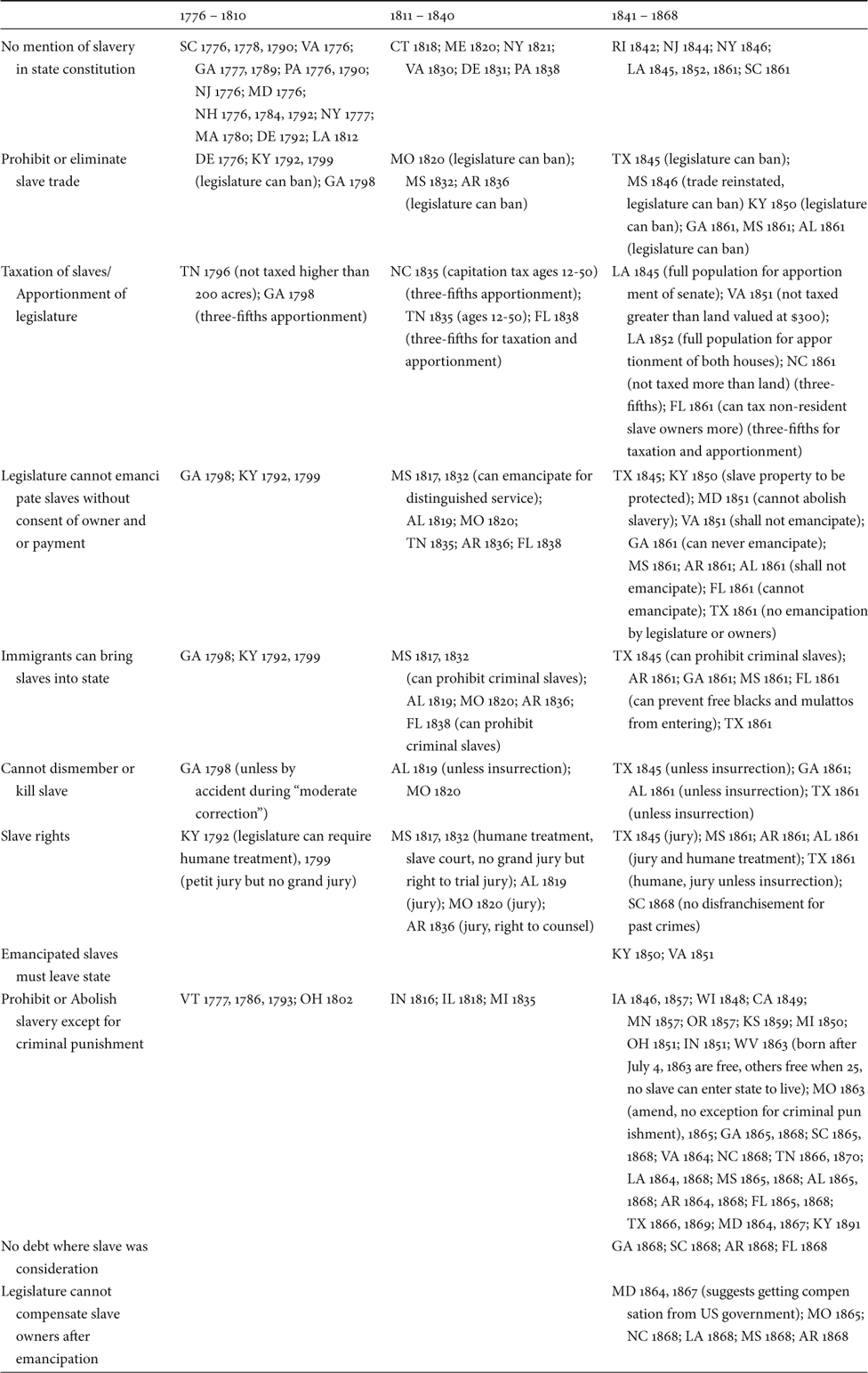
Slavery in All State Constitutions, 1776–1869
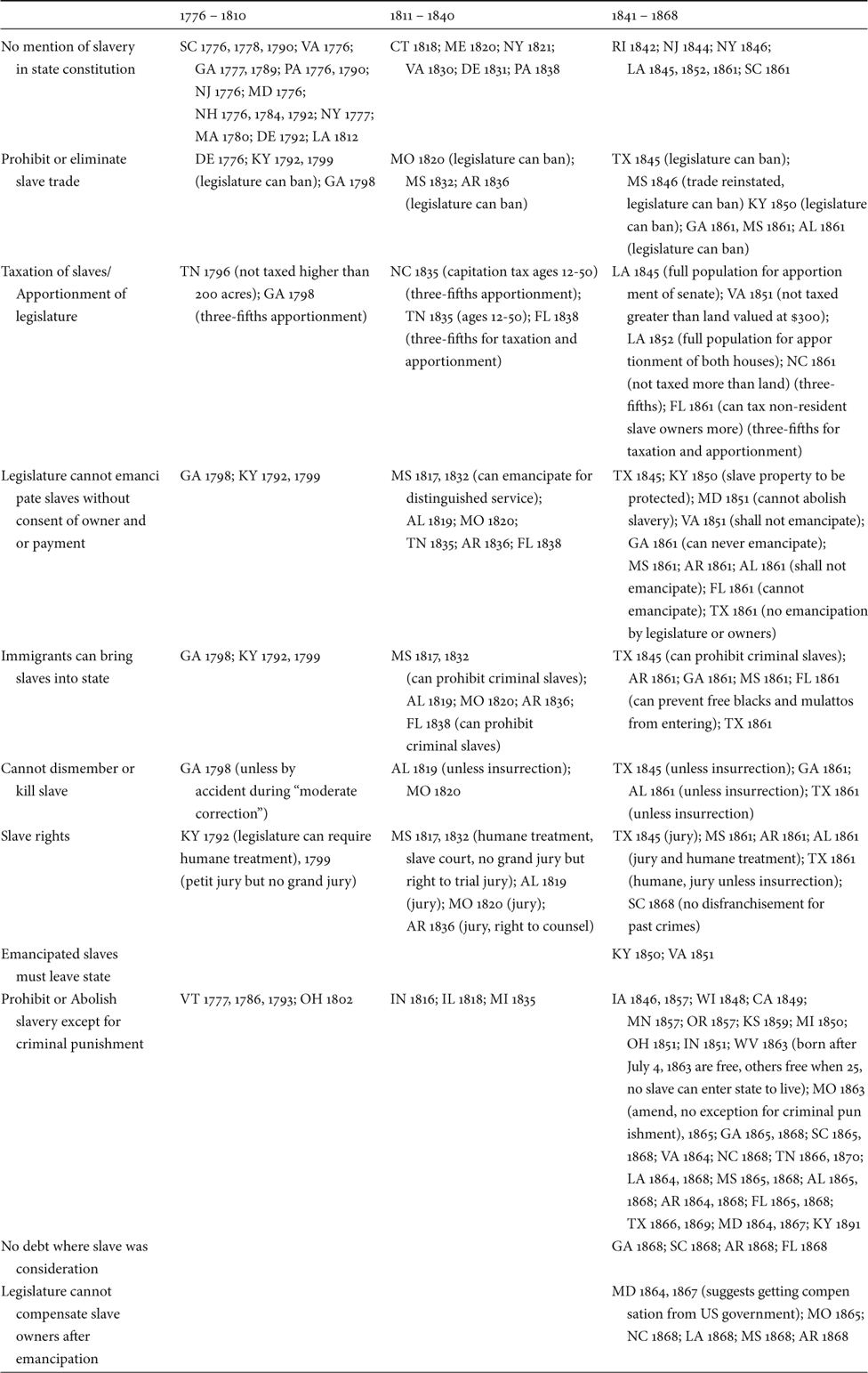
Note: This table does not include all taxation connected to slavery, like uniformity clauses. For an excellent analysis of the subject, see Einhorn, American Taxation, American Slavery, esp. Table 7, “Local Government School Taxes, 1850” (p. 222); Table 8, “State Constitutions, 1776–1860” (p. 234); Figure 2, “State Property Taxes per Capita, 1810–1850” (p. 220), and Map 1, “Adoption of Uniformity Clauses, 1776-1860” (p. 203).
Slavery and the Founding
In 1776, slavery existed in all of the colonies, but the numbers in the South dwarfed those in every other region. The fact that early framers of state constitutions did not incorporate protections or accommodations for slavery suggests they saw little risk of abolition. South Carolina used “slavery” in its first preamble, but not in reference to the institution upon which its entire economy was based. Rather, the South Carolina constitution ironically suggested that the Acts of the British Parliament would “reduce them from the rank of freemen to a state of the most abject slavery.”Footnote 25 North Carolina similarly accused King George III of waging war “for the purpose of reducing the inhabitants of the said Colonies to a state of abject slavery.”Footnote 26 Only two states constitutionally addressed African slavery in 1776 or 1777. Vermont outlawed it for women over eighteen and men over twenty-one, and Delaware banned the slave trade.Footnote 27 Virginia, Georgia, New York, New Jersey, New Hampshire, Connecticut, Massachusetts, and Rhode Island omitted mention of the institution or the term entirely.Footnote 28
When the Founding Fathers gathered in Philadelphia, slavery lurked in the background of every debate. Southerners were wary of new arrangements that might endanger one-third of all privately held wealth in the region.Footnote 29 Delegates from New England and the Mid-Atlantic therefore had to assure the planter class that their property would be safe in the new nation. The resulting document omitted the unsettling language of bondage; in fact, the word slave did not appear in the U.S. Constitution until ratification of the Thirteenth Amendment. But there is no doubt that slaveholders gained special treatment. Paul Finkelman argues that multiple features of the Constitution helped protect the evil institution: the three-fifths clause gave additional power to slave states in the House of Representatives and the Electoral College and limited taxation on the South; the slave-trade clause prohibited Congress from interfering for almost three decades, and amendment of the clause was forbidden during the same time period; the fugitive slave clause curbed the authority of free states; Congress’s power to suppress insurrection included slave revolts; proscriptions on import and export taxes favored slave states; and the onerous amendment procedure gave slave states a veto.Footnote 30 Additionally, delegates from all regions believed the American population was moving southwest, so they accepted the idea that all of these advantages would increase with the admission of new states.Footnote 31 William Lloyd Garrison was right to characterize the Constitution as “a covenant with death” and “an agreement with Hell.”Footnote 32
Early southern state constitutions also favored the interests of the plantation elite, whether or not they included the word “slave.” The first documents were based on state charters, so colonial experience was a major influence on development, and regional differences were apparent from the beginning.Footnote 33 The South tended to rely on the county system, while New England used townships. Robin Einhorn shows that the county as a governing unit led to less efficient and more abusive governance.Footnote 34 Southern county officials were generally appointed, while New Englanders elected those who served in townships.Footnote 35 Appointees could be counted on to protect the interests of slaveholders, who controlled state governments. And according to Einhorn, the constitutionalization of state and local taxation arose as part of an “effort to limit the power of the newly democratized majorities.”Footnote 36 In particular, uniformity clauses prevented legislatures from making decisions about how to tax—one of their primary functions.Footnote 37 Einhorn demonstrates that democratization was tied to constraints on slave taxation and that early structural choices often favored the wealthy. This investigation finds that slaveholders also demanded direct textual protections against legislative interference, and those states without such provisions remained the most undemocratic in the nation until after the Civil War.
Democratization of State Constitutions
All of the first state constitutions contained property qualifications for voting and office holding, except Pennsylvania.Footnote 38 Property requirements ensured rule by the aristocracy, or at least those most educated and wealthy, and they tended to increase from the lower house up to the governor.Footnote 39 Voting rights, apportionment, and the relative power of slaveholders were not yet political issues with enough salience to drive the design of state documents. The powerful crafted early constitutions without the coming challenge of new settlers, and because established landed interests and poor farmers were united against Great Britain, internal domestic political divisions and regional characteristics did not seem to greatly affect the content.
After the Revolutionary era, there was a shift in focus from national security to the internal politics of the states, and citizens began to fight for political access and insist on more active and accountable government. During this period, the debates over issues such as property qualifications and elective offices took place in the South, Mid-Atlantic, New England, and the expanding West. Even in new states, these efforts were part of an evolution of ideas about rights and institutions, often based on experience elsewhere.Footnote 40 Constitution makers began lowering property qualifications on white men for voting and office holding at the end of the eighteenth century and eliminating these restrictions after 1820.Footnote 41 There was also an accompanying shift from appointed to elected offices—every state that joined the nation after 1800 allowed for popular election of the governor.Footnote 42 It is true that New England did not democratize state constitutions during this period because the older documents were more resistant to change.Footnote 43 There was also less demand in those states where the township model offered more elective offices, closer seats of government, and greater opportunities for political participation.Footnote 44 In the rest of the nation, citizens clamored for new rights and additional control over their political destiny through constitutional revision.
Reformers did not just fight for individual political rights. They understood well that structural changes were also essential to wrest control from entrenched geographic interests. In Virginia and North Carolina, for instance, legislative county lines gave citizens in the East representation well out of proportion to their population.Footnote 45 This injustice grew over time as the population swelled in the West. A more flexible amendment process was another hallmark of early nineteenth-century state constitutional development.Footnote 46 Power could concentrate in a particular region or group if citizens did not have the ability to call new conventions or revise the fundamental law when needed. Eliminating property qualifications would be an ineffective way of spreading democracy without accompanying modifications to the underlying institutional arrangements that shaped political authority.
The literature chronicling democratization of state constitutions provides compelling evidence that the process was driven by national trends elevating the rights and virtue of the common man, combined with expanding populations and intrastate political conflict.Footnote 47 On this point Fletcher Green is correct about the “progressive evolution” in southern states.Footnote 48 Citizens of slave states, in fact, were even more susceptible to the allures of “Jacksonian Democracy,” which is often credited for expanding the political power of the common man. It is a mistake, however, to assume this meant progress for the nation as a whole.Footnote 49 During the era, advances in the liberties of white men were accompanied by retrenchment of the liberties of African Americans, Native Americans, women, and others. And the evidence chronicled here is yet another reason to resist celebrating the egalitarian legacy of Old Hickory.
In many slave states, established landholders dominated politics and resisted empowering new settlers, so there had to be a bargain between reformers and political elites that would benefit everyone. The planter class would not simply relinquish control to the masses.Footnote 50 Concessions were necessary so that elites would not fear the expanded electorate with expanded influence. To slaveholders, democracy was a potential menace to their wealth and political power, and any new constitutional arrangements had to include protections for their property and way of life. The irony was that poor whites gave up nothing; their freedom came only for promises of someone else’s enslavement. Although the demand for new rights was not a southern phenomenon, giving the wealthy new constitutional guarantees was, and this bargain often thwarted progress and preserved existing political, social, and economic authority, all while creating a more secure racial hierarchy.
Textual Protections for Slavery
Explicit constitutional protections for slavery arrived with democratization. Kentucky was the first western state to join the Union after the drafting of the U.S. Constitution and the first to safeguard slavery in its organic law. George Nicholas, the most influential framer, wanted to create a constitution tailored to the needs of Kentucky, but he was also concerned about maintaining existing institutions. Slavery was one of the most salient issues in the convention, and the slaveholders, led by Nicholas, restricted interference with their property for the first time in American constitutional development.Footnote 51 Nicholas and his allies saw explicit protection of slavery as necessary to draw immigrants who might otherwise go south to Tennessee.Footnote 52 The resulting document contained strict limits on legislative emancipation and guarantees that immigrants could bring human chattel into the state.Footnote 53 Of course, concerns about slavery and immigration would later become a dominant issue in American politics.
The first Kentucky constitution was retrograde in shielding the practice of owning other humans, but the same document was remarkably democratic for white men. In fact, it contained the “broadest suffrage in the United States.”Footnote 54 There were no property qualifications for the lower house, sheriff, or coroner, and the people elected all three.Footnote 55 An electoral college selected the senate and the governor, but members were not required to possess land or money.Footnote 56 Nicholas got the idea from the Philadelphia Convention, and he implemented it to bypass the gentry.Footnote 57 The governor still appointed some offices, and the constitution was not radical for its time, but the white male citizens of Kentucky enjoyed relatively generous political rights because they could not interfere with the enslavement of African Americans.
Georgia altered its constitution several times during the late eighteenth century, but it was the final revision in 1798 that included new direct prohibitions on emancipation and the federal ratio of three-fifths for counting slaves in legislative apportionment, which gave even more power to “black belt” counties dominated by the planter class.Footnote 58 The framers also drafted some new provisions designed to protect the rights of the enslaved.Footnote 59 The humanitarianism of these protections, however, was mitigated by clear concern for the interests of the slaveholder. Georgia provided the first constitutional prohibition against dismembering or killing slaves. Unfortunately this restriction was accompanied by the caveat that slaveholders would not be punished for murder during an insurrection or if “such death should happen by accident in giving such slave moderate correction.”Footnote 60
Pretend rights for slaves appeared in all of the new states that constitutionalized slavery after Georgia, except Florida.Footnote 61 Some required “humane treatment” and provided minor procedural and substantive rights, but there was always an exception whereby enslaved men and women forfeited legal privileges if they attempted to change their status as property through insurrection or escape. Constitutional provisions that “protected” slaves were likely part of the process by which southerners rationalized the institution as beneficial to all—paternalism.Footnote 62 This language also served to secure and legitimize slavery in the fundamental law. How could one question the righteousness of owning other humans when the practice was contained in the basic charter of society, which also mandated proper treatment of those who were owned?
Georgia already had almost universal white male suffrage by 1798, but delegates retained property qualifications for officeholders and several other undemocratic features.Footnote 63 Amendments in 1819 and 1824 made judges then the governor popularly elected.Footnote 64 And in 1835, the state dropped property requirements for senators and representatives.Footnote 65 The three-fifths clause continued to guarantee a strong structural power advantage to slaveholders, but by midcentury the constitution contained no property qualifications, and its provisions were largely democratic for the time. In Georgia, the advancement of white rights and the restriction of black rights did not take place all at once. Instead, the choice to safeguard slavery in 1798 allowed democracy to steadily advance over subsequent decades.
In 1817, Mississippi was the last state to join the Union without universal white male suffrage, though the restrictions on the electorate were minimal. The first constitutional convention drew membership from fourteen counties, just half of which were in the planter-dominated Delta, but the region provided thirty-two of the forty-eight delegates.Footnote 66 Slaveholders organized the state, and they explicitly protected slavery in the new constitution.Footnote 67 Apportionment concerns dominated debates in the convention.Footnote 68 The planters wanted representation based on whites and slave property, while their opponents wanted guarantees of at least one representative, even in sparsely populated counties.Footnote 69 The final compromise provided for apportionment based on free white inhabitants for the House—with each county guaranteed one representative—and “free white taxable inhabitants” for the Senate.Footnote 70 Delta delegates included “taxable” to gain some advantage after losing on the question of counting slaves.Footnote 71
Sectional conflict existed between the slaveholding class in the Delta and poor white farmers in the upcountry, but there was no ideological conflict regarding the propriety of chattel slavery. In fact, most white men who made their way to Mississippi to participate in the cotton boom hoped to acquire slaves, and those who already had slaves hoped to acquire more.Footnote 72 The state did not contain an established landed aristocracy like Virginia, so the social hierarchy was more fluid, and everyone had a chance to get rich. Ultimately, “slave labor made everything about the flush times possible.”Footnote 73 Mississippi democratized in 1832 by dropping “taxable” from the apportionment scheme, eliminating all property qualifications, and making most offices elected by the people, including judges.Footnote 74 Delegates also prohibited the interstate slave trade, which met with immediate resistance and delays on implementation.Footnote 75 Mississippians were still guaranteed the right to buy slaves elsewhere and bring them into the state, so a short trip across the river to Louisiana solved the problem.Footnote 76 Most simply ignored the prohibition, and the legislature repealed it by amendment in 1846.Footnote 77
Alabama gained statehood just two years after Mississippi. Forty-four delegates met in Huntsville on July 5, 1819.Footnote 78 A Committee of Fifteen drafted the constitution—nine members were from counties with a slave population of 40 percent or greater.Footnote 79 The document they created was democratic in suffrage requirements, apportionment, and elective offices, thanks to the “plain men” from “white counties” outside the black belt, who also blocked an effort to count slaves for representation.Footnote 80 The state’s frontier status tended to flatten differences among white men, but there was already a planter element present, so the constitution also contained conservative features like an appointed judiciary.Footnote 81 The Committee of Fifteen followed the examples of Mississippi, Georgia, and Kentucky in crafting provisions to protect slave property.Footnote 82 J. Mills Thornton III notes that Alabama resisted aristocracy in creating a constitution that “was the most liberal of any state’s at the time.”Footnote 83 Additionally he claims, “Alabamians were preaching the substance of the Jacksonian faith long before Jackson had become its symbol.”Footnote 84 Nevertheless, the property of rich slaveholders was constitutionally secured against democratic impulses.
Missouri drafted its first constitution in 1820 under a cloud of national debate over slavery. The controversy exposed the fact that the South had gotten the better bargain in the Philadelphia Convention and thus generated resentment in free states.Footnote 85 The compromise that temporarily settled matters ensured that slavery would be legal in Missouri, and it is unsurprising that the first constitution included textual protections similar to those in Kentucky, Georgia, Mississippi, and Alabama.Footnote 86 The document also contained universal white male suffrage and other democratic features typical of the era. In the case of Missouri, slavery provisions were surely seen as necessary to resist the rising outside threats of abolition as much or more than any internal threats by citizens or the legislators they elected.
Tennessee did not democratize until the 1830s. Prior to statehood, the Southwest Ordinance of 1790 protected slavery in the territory against action by the U.S. Congress.Footnote 87 The first Tennessee constitution, drafted in 1796, was democratic for the time but still contained property requirements for voters and officeholders.Footnote 88 And the founding convention did not explicitly prevent the state legislature from interfering with slavery. Tennesseans pressed for democratic reforms in the early nineteenth century and eventually elected delegates to revise the constitution in 1834. State constitutional historian Walter Mitchell McClure notes, “Increased democracy—but democracy limited to the white race—was the keynote of the convention’s work.”Footnote 89 The new constitution made more offices elective and dropped all remaining property qualifications.Footnote 90 It also contained a new system of apportionment based on electors rather than “taxable inhabitants,” which had included free men and all slaves between the ages of twenty-one and fifty.Footnote 91 Lewis Laska notes that the change “reversed the old bias in favor of slave-holding counties.”Footnote 92 Although Robin Einhorn finds that the planters still managed to win “a favorable tax deal.”Footnote 93
The 1834 Tennessee convention gathered in the period after several notorious slave rebellions, including Nat Turner’s in neighboring Virginia.Footnote 94 Citizens in the mountainous East, who had little need for slavery, seized on the opportunity and offered multiple memorials calling for emancipation. Abolition societies already appeared in the region, but there was no strong movement against slavery in Tennessee.Footnote 95 Even so, a committee was appointed to consider whether the institution should be limited in its future expansion.Footnote 96 The report concluded that proponents of eventual emancipation had good intentions, but the idea was impractical and unfair to the slaves, who would be shunned from society and unable to support themselves.Footnote 97 Moreover, there was a danger that those freed would plot with others still in bondage “to exterminate the white man and take possession of the country.”Footnote 98 Delegates ultimately included a new explicit prohibition on legislative emancipation.Footnote 99 Those from white counties were much more likely to oppose the provision and support legislative discretion on the matter.Footnote 100 The convention also restricted suffrage to white men, which helped ensure that differences among the races would be elevated over differences among the classes.Footnote 101 Tennessee provides a clear case of Jacksonian Democracy at work and the direct exchange of white liberty for black bondage.
The first constitutions of Arkansas (1836) and Florida (1839) also followed the national trend of expanding the vote for white men and the southern trend of guaranteeing the property rights of slaveholders.Footnote 102 Like Mississippi, Arkansas had a geographic divide between planters in the Delta and poorer farmers in the hills, but the divisions were overcome by a broadly shared desire for statehood.Footnote 103 In Florida the question of statehood was more contentious, and delegates debated whether the territory should be split in two. They also focused on broader contemporary political issues, including populism and the regulation of banking, which generated significant debate.Footnote 104 Delegates used constitutions from other southern frontier states, particularly Alabama, as models during deliberations.Footnote 105 They ultimately incorporated greater protections for slavery than most of the region. Stephanie Moussalli argues that anti-bankers opted to side with the commercial cotton growers on this question “partly as compensation for the banking losses.”Footnote 106 And she notes the “crowning victory for Florida’s slaveholders” came with the adoption of the federal ratio for apportioning the state legislature.Footnote 107
The Texas convention of 1845 offers a view into the deliberations not available in many earlier cases.Footnote 108 The framers understood that increased democracy posed a new threat to slavery, so to accommodate demands for the ballot and more elective offices, they first had to secure the interests of the plantation elite. And, like the rest of the region, it was often the planters themselves who served as delegates. One such individual warned the Texas convention: “I tell you, if you do not throw some protection around this species of property, if you do not guard it by some checks and balances in your Constitution, that fifteen years will not elapse before slavery will be abolished here in Texas, at the ballot box.”Footnote 109 The state joined the Union at a time when universal white male suffrage and elective offices were the norm, so the “protection around this species of property” could no longer be solely structural; it had to be unequivocally guaranteed.
As outlined above with Georgia and Florida, some states that explicitly protected slavery also relied on structural defenses, such as apportionment schemes favoring plantation counties. Representation was a primary concern in nineteenth-century constitution making. Early drafters used county lines to apportion the legislature, and citizens began to recognize the need to redraw districts to ensure equal representation.Footnote 110 Across the nation, the lower house was usually based on “inhabitants” or “white inhabitants” and the senate on districts composed of a county or counties.Footnote 111 Some Texas delegates argued that the South required a different approach. Mr. Hemphill claimed:
The truth that men are born free and equal, is perhaps undeniable in the Northern States, but at the South it is not only untrue, but preposterous and absurd. The maxim that representation should be based upon population, is not so entirety untrue, but it is altogether unsuitable to our circumstances. It is a maxim in the North that slavery is an evil and a curse; and it is equally a political axiom in the South that slavery is not an evil, moral or political, but a benefit.Footnote 112
The slave-based political economy accounted for the “circumstances” that rendered equal representation “unsuitable” in the South.
Unequal representation and the unwillingness of state legislatures to reapportion also resulted in a demand to ease the amendment process in state constitutions.Footnote 113 Growing populations would no longer tolerate control by entrenched geographic interests. Those entrenched interests feared domination by the majority, so they resisted calls to alter the amendment process, just as they resisted other democratic trends. Slaveholders in particular feared that increased democracy and a more flexible amendment process would endanger their property rights.Footnote 114 In Texas, Robert E. B. Baylor advocated a rigid amendment provision “to give greater stability to the government” and claimed, “it will be found in practice better calculated to secure a certain interest concerning which almost every gentleman in this House has manifested such an extreme sensibility; I mean the great slave interest.”Footnote 115
Amendment procedures varied in states with direct textual protections for slavery. In Texas, Mr. Baylor and his allies instituted a rather onerous set of requirements that mirrored those in the Alabama constitution: two-thirds vote of legislature, three months published in newspapers, vote by the people, two-thirds vote of new legislature.Footnote 116 Arkansas, Missouri, and Florida had the same process, save the vote by the people (Florida also allowed the state legislature to call a convention with a two-thirds vote); in Tennessee a majority of the legislature could propose an amendment, followed by a two-thirds vote of the new legislature and a popular vote; Mississippi required a two-thirds vote by the legislature, six-month publication in newspapers, and then a popular vote; Delaware required a two-thirds vote by the legislature, publication for three months, then a three-fourths vote by the next legislature (a convention was also very difficult to call, needing a majority of all eligible voters); and in Kentucky a majority of the General Assembly could send the question of a convention to the people.Footnote 117 In every case but Kentucky, delegates saw fit to include the hurdle that at least two-thirds of the state assembly had to approve of constitutional change, often multiple times. Some older states, like Georgia, Maryland, and Virginia, simply assumed the calling of a convention for amendments. While it is undeniable that slaveholders preferred a more rigid amendment process, a clear pattern does not emerge with this constitutional feature.
Maryland did not complete democratic reforms until 1851. The state removed property qualifications for white male voters and officeholders in 1810, and then in 1836 provided for the direct popular election of the governor and senators.Footnote 118 During the first half of the nineteenth century, Maryland reduced its slave population, and in 1832, after Nat Turner’s Rebellion, citizens demanded that the legislature consider emancipation, but a committee dominated by planters from the Southeast quashed debate.Footnote 119 Elites predictably resisted calls for a new convention after this controversy because they feared a threat to slavery.Footnote 120 In 1850, resistance became futile, and an election of delegates took place to reform the constitution.
Legal historian Roman Hoyos examines the debate in the Maryland convention of 1850 over how the constitution would regulate the “peaceful revolution doctrine,” or the right of the people to destroy and replace their government through a state convention.Footnote 121 Early in the proceedings, disagreement erupted over the introduction of a proposed Bill of Rights. One contingent of delegates objected to language providing “an inalienable right to alter, reform, or abolish their form of government in such manner as they may think expedient.”Footnote 122 They argued such an “inalienable right” posed serious danger to the minority. The final compromise softened the language and limited future alteration to “the mode prescribed in this constitution.”Footnote 123 Hoyos finds slavery was “the main dividing line” between the two sides of the issue, and it was slaveholders who feared peaceful revolution by the people.Footnote 124
Reapportionment of the legislature, which would give greater representation to urban areas, was also a subject of protracted controversy in the Maryland convention of 1850. A delegate from Baltimore proposed new protections for slavery because “he believed that there was no desire on the part of his constituents to interfere with the relation of master and slave as it now existed,” and “it was important that, in the early stages of the proceedings of the Convention on the subject of representation, gentlemen should understand that, whatever its basis might hereafter be, the rights of property as regarded the relation of master and slave would be secure.”Footnote 125 This demonstrates a clear understanding by reformers that democratization would not be possible without first placating slaveholders.
Maryland conservatives eventually agreed to extensive changes, including popular election of judges and a new apportionment scheme based more on population than property, but the new constitution also had to contain textual protection of slavery. Some delegates like J. W. Crisfield, a slaveholder from Somerset County, opposed the agreement and lamented the shift in the political power structure. He suggested that fellow easterners
reflect on the magnitude of the dangers to which they are exposing their constituents, and themselves, by submitting to the demands of the West, and the city, and giving absolute control over this subject to those who have no interest in common with us, who do not know, and cannot be made to feel, how deeply slavery is interwoven with our security and happiness, and what a convulsion its abolition would occasion.Footnote 126
One of his allies, Mr. Dent, also complained that the provisions guarding slavery were “but a ‘rope of sand’—a mere cobweb for all enduring purposes.”Footnote 127 He worried that the majority could not be trusted to restrain itself, and because the people had a right to “alter, abolish, or amend” the government, “they can make and unmake governments as often as it may suit their will or caprice . . . they can build up thrones and tear them down . . . they can break up an orderly, peaceable and prosperous government and substitute anarchy and confusion. . . . The poor, law-abiding, order-loving, helpless and defenseless [slaveholding] minority must submit or be annihilated.”Footnote 128 Democracy advanced in Maryland in 1851, but only with a new provision prohibiting the legislature from passing any law “abolishing the relation of master and slave” and a diluted right to alter or abolish the constitution itself, an arrangement that was still unacceptable to some slaveholders.Footnote 129
In Virginia, democratization also took a long time, but it moved at an even slower pace than in Maryland. Geographic and socioeconomic divides generated demands for constitutional reform beginning in the late eighteenth century, but change did not come until 1851. When change did finally arrive, it was unsurprisingly accompanied by strong constitutional guarantees for slave property. Planters in the East controlled the government from statehood, while yeoman farmers in the mountainous West agitated for additional power and democratization. The 1776 constitution gave more representatives to the East, and all attempts to challenge and adjust this arrangement failed for over half a century.Footnote 130
A Virginia constitutional convention finally met in 1829–30, and it was one of the most august bodies in American history, containing two ex-presidents (James Madison and James Monroe), the Chief Justice of the U.S. Supreme Court (John Marshall), and an assortment of dignitaries from Congress and the state legislature.Footnote 131 Western delegates demanded additional representation and expanded suffrage.Footnote 132 While there were minor concessions on apportionment, eastern planters refused to ease property requirements for voters or officeholders.Footnote 133 Robin Einhorn shows how delegates understood well the link between democratization for whites and enslavement of blacks in her analysis of the failed effort to include a uniformity clause.Footnote 134 Judge Abel P. Upshur, a slaveholder from the Tidewater region, argued, that “property is entitled to protection, and that our property [slaves] imperiously demands that kind of protection which flows from the possession of power.”Footnote 135 Reformers were unsuccessful because opposition “boiled down to a defense of states’ rights and slavery.”Footnote 136 Democracy would wait, so explicit constitutional protections for slave property were not yet necessary.
Unsatisfied with the amendments of 1830, citizens of western Virginia soon pressed for another constitutional convention, and the General Assembly relented in 1850.Footnote 137 Planters again held a majority because representation was based on population and taxation, giving eastern Virginia seventy-six delegates and western Virginia fifty-nine—the numbers would have been sixty-one and seventy-four if it were based on white population.Footnote 138 Easterners could no longer resist democratization, but they feared a growing abolitionist movement in the West.Footnote 139 Delegate James Barbour said, “I tremble when I anticipate the day when the unrestricted powers of this government shall pass into the hands not interested in the preservation of that [slave] property.”Footnote 140 And objectives of Henry Wise, who dominated the 1850–51 convention, “involved the strengthening of democracy only when it served the interests of slaveholders.”Footnote 141 The result was increased political participation for white men combined with new explicit protections for slavery, guaranteed eastern control of the senate, and lower taxes on slave property.
The process of democratization in Virginia has been well documented, and scholars of the subject recognize the conflict between eastern planters and the growing West. Alison Goodyear Freehling chronicles how people with divergent backgrounds and cultures divided the state.Footnote 142 Unlike many yeoman farmers of the Deep South, the Germans and Scots-Irish who settled west of the Alleghenies owned few slaves and did not aspire to create a plantation economy.Footnote 143 Nevertheless, according to Eva Sheppard Wolf, these westerners were not concerned about the peculiar property rights of their neighbors until the late 1820s when “discrete pro- and anti-slavery blocs crystalized,” and the fusion of “the issue of white Virginians’ rights and power with the problem of slavery” created a “real threat to the interests of the planter class.”Footnote 144 Wolf also notes that the failures of reformers at the 1829–30 convention, combined with fears generated the following year by Nat Turner’s Rebellion forced a debate on emancipation in the legislature. And “it was easterners’ refusal to share power more equitably that drove westerners to oppose the basis of slaveholders’ power—slavery—by 1832.”Footnote 145
According to historian Robert Sutton, in the convention of 1850–51, “slavery was the vital, indispensible issue in the eastern argument against democratic change.”Footnote 146 And John Dinan notes that easterners feared that “the West had shown some support through the years for emancipation and could not necessarily be counted on to be sufficiently forceful in defense of slavery.”Footnote 147 William Shade, on the other hand, argues that while slavery played a “central role” in the debate over representation, there is no evidence of a “proslavery east against an antislavery west.”Footnote 148 He cites the fact that reformers voted with the planters for lower taxes and protections for slave property.Footnote 149 But compromise on these issues was essential for democratization. It seems that westerners were most concerned about securing their own rights, regardless of whether it meant perpetuating the evil institution. Old Dominion offers clear and direct evidence that slaveholders would yield to democratic forces only when provided with unequivocal safeguards for their property. These safeguards were likely unnecessary against the newly empowered citizens of western Virginia, but a national threat was also growing.
The blatant and obvious transactions in Tennessee, Maryland, and Virginia—white political rights for black subjugation—buttress the larger claim that a similar mechanism operated on other conventions across the South. Moreover, those states that joined the Union with democratic constitutions that restricted interference with slavery also demonstrate that the two features were tied to and dependent upon each other. The records of state constitutional conventions are limited during the antebellum era, but those that are available offer a window into the motivations of both slaveholders and nonslaveholders. There is a wonderful and disturbing honesty from nineteenth-century delegates on issues of race and politics. These men leave little doubt as to their interests and beliefs. Put simply, planters wanted special protection for their property in exchange for democratization, and yeoman farmers were willing to deal.
Structural Assurances of Slaveholder Political Power
Slaveholders also found indirect methods to protect their property in state constitutions. If democracy threatened the institution, then limiting democracy would limit the threat. As noted above, some states used textual guarantees backed up by structural assurances, such as a more rigid amendment process or an apportionment scheme favorable to the wealthy. Other states, however, designed their governments to ensure that slaveholders would dominate and control the law-making process. In these cases, it was unnecessary to author provisions forbidding legislative emancipation or guaranteeing the rights of immigrant slaveholders because the planter class and the political class were one and the same.
The Carolinas and Louisiana safeguarded existing institutions and interests by blocking democratization. The North Carolina constitution never explicitly protected slavery, but it contained a variety of mechanisms to protect slaveholders. South Carolina, the state with the largest slave population at the Founding and throughout much of the nineteenth century, never included a single reference to plantation slavery in the state constitution, and it had the most conservative, undemocratic government until after the Civil War. And in Louisiana, planters gave themselves disproportionate representation in the legislature to maintain control. These three states demonstrate how critical protection of slavery was to the spread of democracy in the South. Without guarantees in the constitutional text, slaveholders held onto aristocratic arrangements that structurally assured their political dominance.
North Carolina drafted its first constitution during the American Revolution. It was a conservative document that limited political power to the wealthy slaveholders of the East.Footnote 150 As the population moved westward, new citizens with limited resources and few or no slaves organized for amendment.Footnote 151 In 1835, the legislature called a convention to update the constitution. The year is important because again delegates met while fears of revolt were fresh. Only Virginia was more affected by Nat Turner’s Rebellion.Footnote 152 The convention lifted property qualifications on voters for the House of Commons and made the governor elected by the people, giving additional power to yeoman farmers in the West.Footnote 153 This concession addressed the concern that apportionment of the General Assembly had for years favored the East. A major goal was also the disfranchisement of a relatively large free black population.Footnote 154 Slavery did not come under attack at all; to the contrary, it was indirectly secured through the constitutionalization of white supremacy.Footnote 155
North Carolina in 1835 did not democratize like many of its neighbors. The planter class dominated and controlled the state government and the state convention. Property qualifications for voters and members of the lower house may have been removed, but representation was based on the three-fifths ratio, giving advantage back to the East and to slaveholders across the state.Footnote 156 Delegates also adopted an amendment procedure for the first time in the state’s history.Footnote 157 The requirements were three-fifths of the planter-dominated state legislature, six months publication, two-thirds of the new legislature, and a popular vote.Footnote 158 Future constitutional change would come slowly, helping ensure the safety of conservative institutions and governing arrangements.
The North Carolina senate was the ultimate defense for antidemocratic forces. Delegates in 1835 retained property qualifications for senators and those who voted for them, an arrangement that persisted until the eve of the Civil War.Footnote 159 As an additional bulwark, senatorial districts were drawn based on taxes paid, not population or geography, and this system remained in place until 1868.Footnote 160 In the 1835 convention, Mr. Speight of Greene County rose to defend the interests of his eastern slaveholding constituents: “What is the security which the East is to have that their rights are not to be invaded? The friends of this compromise will tell us, Representation upon the principles of taxation in the Senate.”Footnote 161 And William Gaston of Craven County, perhaps the most influential member of the body, told his fellow delegates that the senate “represents the interests which spring from the possession of property, and the rule for its apportionment, as laid down in the Convention Act, that is, the ratio of taxation, seems to be peculiarly suited to the constitution of such a body.”Footnote 162 A senate devoted to protecting slave property eliminated the need for constitutional prohibitions on emancipation.
South Carolina, in many ways the most southern of the southern states, traveled a unique path in American constitutional development. The state long held on to aristocratic traditions and resisted democratic trends that flourished elsewhere, even in the rest of the South. It is impossible to read any comprehensive treatment of state constitutions without encountering phrases such as “except South Carolina” or “only South Carolina.”Footnote 163 Often it was the lone holdout on antiquated constitutional provisions that had been long abandoned by the rest of the nation. South Carolina is the best example for how a constitution could protect and defend slavery without ever mentioning the institution.
The Palmetto State was distinctive in its political economy, population, and traditions, and South Carolinians usually chose the most conservative option when designing institutions of government, indicating a general mistrust of democracy. All of the first state constitutions contained provisions for election of the lower house except for South Carolina. The state gave the vote to all white men in 1810 but maintained the highest property qualifications for officeholders through Reconstruction.Footnote 164 As of 1860, South Carolina was the only state in which the legislature selected the governor.Footnote 165 No other southern state ever placed religious qualifications for voting into their constitution.Footnote 166 South Carolina was also the last state to allow for popular election of presidential electors and the first state to have racial qualifications for voting.Footnote 167 In 1861, it still based representation in the lower house on the number of whites and “the amount of all taxes raised by the legislature,” which, together with property qualifications and appointed offices, acted as a structural barricade against emancipation.Footnote 168 Additionally, South Carolina only submitted one constitution in its history to the people for ratification—and that was the Reconstruction Constitution of 1868.Footnote 169 There was no reason to prevent government from interfering with slavery because the slaveholding aristocracy that controlled all political offices would never injure the source of their own wealth and power.
South Carolina planters also managed to convince yeoman farmers that slavery benefited society as a whole. The rights of freemen were “vigilantly guarded at law,” and, according to Stephanie McCurry, they enjoyed “virtually unlimited authority over the property within [their] own enclosure.”Footnote 170 So poor whites became advocates of a political system in which they had little voice. Even with supposed equality as white property holders, the herrenvolk democracy was but a “political fiction.”Footnote 171 Slavery did not in fact benefit all. To the contrary, yeoman farmers controlled little wealth, had diminished social status, and could exercise almost zero influence on a state government designed by and for rich slaveholders. Only their whiteness bestowed the illusion of equal participation and influence.
To the southwest, Louisiana had a decidedly different background and culture than the Carolinas, though it too long relied on undemocratic constitutional devices to ensure control by the planter aristocracy. The state joined the nation in 1812, and its founding constitution containing high property requirements and legislative selection of the governor—there were no direct protections for slavery in the document.Footnote 172 The first convention to amend the 1812 constitution came in 1845, when Louisiana slaveholders negotiated the exchange of democracy for power. Like Georgia, Tennessee, Maryland, and Virginia, yeoman farmers and poor whites only gained new constitutional rights with assurances that the new electorate would not topple the existing political, social, and racial orders. In Louisiana this meant handing over disproportionate control of the state senate to slaveholders in 1845 and then the entire state legislature just seven years later.
In the 1845 convention, delegates fulfilled the promise of reform by eliminating property qualifications for officeholders and expanding suffrage.Footnote 173 But slaveholders feared the influence of New Orleans, where there was a smaller slave population and a growing abolitionist sentiment.Footnote 174 John C. Beatty of Lafourche Parish warned that if “we adopt the free white male population as a basis, taking into consideration that the slave population of New Orleans is fast diminishing, it is not beyond the range of possibility that New Orleans may in a few years, without detriment to her own interest, propose and carry the abolition of slavery.”Footnote 175 He advocated counting the slave population for the purposes of representation to preserve liberty and counteract the influence of the Crescent City. Delegates compromised and approved a plan that would count slaves fully for apportioning the state senate, while representation in the lower house would be based on the number of electors.Footnote 176 This gave enormous advantage to the planters in the upper house.
The danger articulated by Mr. Beatty was much more limited than he would likely admit. New Orleans had been a hub of the slave trade in the South for decades. Early in the nineteenth century, slaves outnumbered whites by large numbers, prompting fears of revolt like had happened in nearby Haiti.Footnote 177 The cotton boom in Alabama and Mississippi also took place in Louisiana, generating an even greater influx of enslaved people from the Upper South. Moreover, New Orleans did not just make profits buying and selling African Americans; an enormous portion of the local economy came from the cotton and sugar trade, both of which required plantation agriculture and slaves.Footnote 178 Bankers, merchants, lawyers, shippers, all recognized that slavery provided the lifeblood of the city. In fact, half of the South’s antebellum cotton crop “routinely passed through the hands of New Orleans merchants on its way to textile manufacturers in the North and Europe.”Footnote 179 Protests by planters likely grew out of fear they were losing control of the state when there was a real and growing national threat to their cherished institution. There was also surely anxiety about the racial composition of New Orleans, where a large population of free people of color imperiled existing arrangements.
Continued public agitation over rights and governing arrangements led to another state constitutional convention just seven years later. In 1852, delegates expanded the number of elective offices (including all judges), created a board of public works, limited state debt, and funded a university.Footnote 180 Reformers also sought to adjust the method of apportionment so that representation in both houses would be based on qualified electors.Footnote 181 The planter class, however, thwarted and then reversed this proposal by apportioning representation based on total population (including a full count of slaves), not just for the senate but also for the lower house. A. J. Moss supported the change because “the electoral basis [counting qualified voters] would give undue influence of the commercial over the agricultural interest of the state.”Footnote 182 Five opponents of the new plan issued a statement claiming that “adoption of the total population” would result in “the destruction of the principles of Republican Government, and all political equality,” and it would transfer power to “the hands of the large slaveholders, thereby stamping upon this Government the odious principles and character of an aristocratic Government.”Footnote 183 Louisiana retained this arrangement until Presidential Reconstruction.
When analyzing antebellum southern state constitutions, North Carolina, South Carolina, and Louisiana stand out. Their fundamental laws contain little or no mention of slavery, despite the fact that, in all three cases, much of the state’s wealth and prosperity flowed from the plantation system. Of course they all had a complex set of statutory laws governing slave labor, but it is curious that they did not follow the rest of the South and directly prohibit emancipation. A closer look at how these three constitutions distributed power, however, reveals why explicit textual prohibitions were unnecessary. Slaveholders held all the political power needed to defend their interests.
One state remains unaccounted for in the analysis. Delaware’s long-running slave economy is sometimes forgotten in the public mind. Perhaps this is because the institution only ever proliferated in the southernmost counties.Footnote 184 Moreover, by the mid-nineteenth century, slavery was weakening and the percentage of free blacks was the largest in the nation.Footnote 185 But like Louisiana and the Carolinas, slaveholders maintained power through structural advantages. Delaware drafted its first constitution in 1776, and then made adjustments in 1792. Both of the eighteenth-century documents favored elites. Reformers first managed to call a convention in 1831, where Jacksonian Democrats faced off against conservatives. Delegates agreed to changes in the judiciary and the elimination of some property qualifications.Footnote 186 Conservatives, however, forced the retention of a tax-paying requirement for voters, property qualifications for the state senate, and the addition of a new onerous amendment procedure.Footnote 187 Over the next two decades, the population grew rapidly in New Castle County (Wilmington), and the legislature became severely malapportioned in favor of the southern slaveholding counties of Kent and Sussex.Footnote 188 In 1851, the legislature called for a special referendum on the question of calling a constitutional convention, which failed to reach the high threshold of a majority of eligible voters.Footnote 189 The following year, Democrats ignored the results and provided for the election of delegates.
At the beginning of 1853, the convention met under protest by Whigs, who claimed the whole effort was illegitimate.Footnote 190 Regardless, these conservatives had managed to elect a majority of delegates to resist reform. Slaveholders in the southern counties were concerned that reapportionment and democratization would threaten their power and property. Mr. Bayard, a Democrat from Wilmington, who owned no slaves, proposed language preventing legislative emancipation without consent and protecting the rights of immigrant slaveholders. He understood that those from the southern part of the state feared “a spirit of fanaticism” that “might hazard the possession of their property in slaves, if they permitted an increase in the representation in the Legislature” for the citizens of Wilmington.Footnote 191 Those from slaveholding counties preferred to retain structural protections for their property and saw new explicit guarantees as unnecessary and potentially inflammatory to the national and local slavery debate.Footnote 192 The convention did adopt some populist reforms, including the elimination of property requirements, but representation in the legislature remained skewed in favor of Kent and Sussex.Footnote 193 As a result, both sides were unhappy. Democrats and Whigs alike campaigned against ratification and voters obliged by roundly rejecting the document.Footnote 194 It seems that even in Delaware, where slavery had but a small presence, slaveholders managed to resist democratic reforms.
Conclusion
In many ways the findings above provide an ideal representative narrative of Jacksonian Democracy. As white men gained rights and additional political power, enslaved black men became less and less likely to ever see freedom. Securing slavery helped create an alliance between whites that transcended class to generate a southern societal hierarchy based almost exclusively on race.Footnote 195 Surely it was not lost on yeoman farmers that their independence grew out of the subjugation of African Americans. Even without such a realization, few of these men were in favor of abolition. In booming frontier cotton states, owning slaves meant wealth and success, and across the region people made money directly and indirectly from the plantation system. So it is doubtful that textual guarantees were necessary to prevent popular demand for or legislative action on abolition. Robin Einhorn is right that planters “refused to budge” on issues of suffrage and reapportionment “without new guarantees of ‘security.’”Footnote 196 The security in taxation she identifies came at a financial cost, but assurances against emancipation appeared free to all except those already in chains. In truth, the constitutional protection of the slave system worked to perpetuate the power of elites, despite new rights for the common white man.
There was enormous variation in southern political development. The states of the Middle South (Arkansas, Tennessee, Virginia, and North Carolina) and the Border South (Kentucky, Missouri, Maryland, and Delaware) all relied on slave labor, but they also contained many areas in which slaves were a small percentage of the population.Footnote 197 In the Lower South (Texas, Louisiana, Mississippi, Alabama, Georgia, Florida, and South Carolina), however, slaves made up a large majority in the extensive black belts, and in some cases outnumbered whites in the state.Footnote 198 This led to the existence of “fault lines” across the region, where different people had different interests in agriculture and slavery.Footnote 199 The abolition movement had limited influence, but it is also wrong to characterize all white antebellum southerners as pro-slavery. Ultimately, the variation across southern states makes the pattern of democratization and protection of slavery that emerged in state constitutions even more apparent and compelling.
The inclusion of slavery in state constitutions matters because it severely undermined the possibility that enslaved people would ever know freedom and ensured the institution would become a more permanent feature of southern society. Constitutions outline the fundamental principles that should be protected against the shifting winds of politics. The addition of chattel slavery to those fundamental principles legitimized it and helped drive the conflict between slave states and free states that eventually led to war. A final set of southern state constitutional amendments shows a clear reaction to the national and existential threat. In 1861, during secession, Georgia, Mississippi, Arkansas, Alabama, and Florida constitutionally forbade the legislature from emancipating slaves. Texas went further and extended the restriction to owners.
Slavery and freedom were intertwined and interdependent in American social, political, economic, and legal history. In every case outlined above, democratization and constitutional protection of slavery were intimately connected. Perhaps the most persuasive evidence that new rights were tied to protection of slavery appears in the “reform” conventions that gathered during the first half of the nineteenth century. Tennessee, Maryland, Virginia, North Carolina, Delaware, and Louisiana all revised existing documents in this era to expand the rights of white men, but delegates had to ensure that the new democracy would not injure old institutions. In every case, reform depended on the security of slavery, through direct prohibitions on emancipation, the retention of undemocratic structural features, or both. Edmund Morgan’s American paradox was a defining characteristic of antebellum southern state constitutional development. In the region below the Potomac River, democratization was only possible in conjunction with guarantees that the expanded electorate could not use its newfound rights and political power to attack slavery.