The prevalence of obesity among children and adolescents in developed and developing countries is increasing.1, 2 Overweight children are at increased risk of developing various chronic diseases.3 In addition obese children tend to become obese adults,4 and often have concomitant comorbidities such as metabolic syndrome, fatty liver, polycystic ovary syndrome, obstructive sleep apnoea syndrome, orthopaedic, and/or psychosocial disorders.5 The need for preventive and therapeutic measures, therefore, is of undoubted importance, but the best way to deliver interventions to children is not known.6, 7 Excess weight is caused by an interaction of genetic and environmental factors, which include metabolic and behavioural components. In obese children, family-based treatment has been associated with short- and long-term effects on the control of weight.8 The StEP TWO programme has been developed as a school- and family-based intervention consisting of extra lessons, healthy nutrition, and physical education.9 It is based on the modification of dietary intake, physical exercise, and behavioural therapy.
Our primary goal was to evaluate the effect on the anthropometric data, waist circumference, and blood pressure in children undergoing intervention compared with children who were invited and therefore screened, but did not take part in the intervention, the so-called non-participants, and controls from 4 other primary schools.
Materials and methods
Setting
In September 2003, 7 comparable primary schools were randomly selected from the schools in the region of Cologne, Germany. The distribution of pupils reflected the distribution of Germans in grades 1 through 4, representing children with average ages between 6 and 11 years. The total sample included 1678 children.
Three schools were chosen to participate in the prospective intervention study named StEP TWO for prevention of cardiovascular risk and obesity. We chose four schools to serve as controls. The examinations started at the beginning of the children’s school year, specifically in September and October of 2003, and were repeated at the end of the year, in other words June or July of 2004. The children were examined by the same trained group of examiners.
The study was approved by the institutional review board of the German Sport University. Informed consent was obtained from the parents or guardians of all the children chosen for intervention and their controls.
Response
In total, 95.3% of children in the targeted schools participated in the first examination, 0.9% was not allowed by their parents to participate, and 3.8% were not at school on the day of examination. Subsequently, 88.2% participated in both examinations, 3.9% changed to another school or moved house, 5.6% were ill at either the initial or the final examination, 1.7% were not allowed to participate, and 0.6% were lost to follow-up for unknown reasons.
Sample groups
We invited 121 overweight and obese children at the 3 schools involved in the programme of intervention to take part. Of these, 40 children completed the programme from November 2003 to July 2004, albeit that 6 dropped out, 1 because of a change of school, and 5 for personal reasons. We recruited 2 children in February, but they were not taken into account. The other 74 overweight and obese children were informed about their weight and the necessity for intervention, but did not take part. Their parents were requested to respond to a questionnaire concerning the reasons for non-participation. Of these parents, 20 (27.0%) responded to the questionnaire. Their main reasons were lack of time or interest.
We enrolled 155 overweight and obese children from the 4 other schools to serve as controls. Of these, 145 (93.5%) took part in both examinations.
Anthropometric data
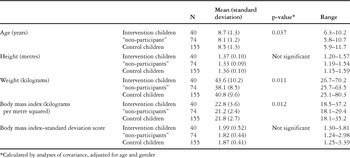
Height and weight were measured by the same person using the same free-standing seca-stadiometer. We deducted 500 grams for the clothes that the children wore. The weight was recorded as body mass index in weight related to height in metres squared. The body mass index was classified according to the German percentile graphs of Kromeyer-Hauschild et al.10, 11 Overweight was defined as body mass index greater than the 90th percentile, but less than the 97th percentile, using population specific data. Obesity was defined as body mass index greater than the 97th percentile.10 In addition, the body mass index– standard deviation score was calculated using the LMS method:10, 11 the M and S curves correspond to the median and coefficient of variation of body mass index for German children at each age and gender, whereas the L curve allows for the substantial age dependent skewness in the distribution of body mass index. The assumption underlying the LMS method is that, after Box-Cox power transformation, the data at each age is normally distributed.10, 11 Waist circumference was measured at the midpoint between iliac crest and lowest rib with an accuracy of 0.1 centimetres. The anthropometric data are shown in Table 1.
Table 1. Differences in the anthropometric data of the three subgroups at T1.

Heart rate and blood pressure
With the child sitting, heart rate, systolic and diastolic blood pressure in the left arm were measured by trained observers with an Omron sphygmomanometer after five minutes of sitting. The cuff size was adjusted to arm circumference, as recommended by Rascher et al.12
Intervention
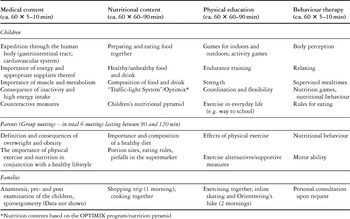
Intervention is part of a trial project called the Children’s Health Interventional-Trial project. The out-patient programme, entitled StEP TWO is designed for overweight and obese children and aims to reduce body mass index by weight maintenance, increased physical activity, and improving motor abilities. The school-based part started directly after school at each of the 3 participating primary schools. In addition, nutritionists, gymnasts and medical doctors taught the children in each of their respective fields (see Table 2). The nutritionists cooked and ate with the children twice a week. After the meal, the children received a physical activity programme lasting between 60 and 90 minutes. Parents were involved in 6 information evenings and 2 family events.
Table 2. Programme content with reference to the manual of the Konsensusgruppe Adipositasschulung (author’s translation: consensus group obesity education and training.13,14

Children chosen as controls did not receive any intervention, and only had their regular school programme, without any additional programme.
Statistical analysis
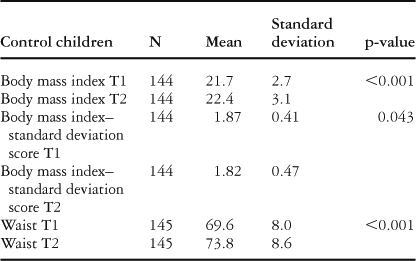
The descriptive statistics of the anthropometric data and differences in selected parameters between the entrance and the final examination are provided in the Tables 1 and 3 through 6. Differences between means in the groups concerning the anthropometric data, blood pressure and heart rate were tested for significance using a student’s unpaired t-test, and differences between the two time intervals of testing (T1 versus T2) using a paired t-test.
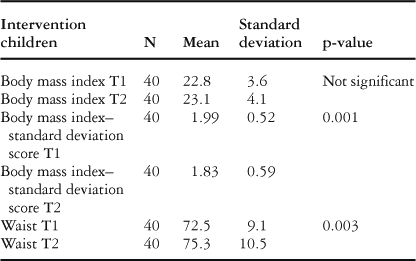
Table 3. Data at T1 and T2 in the group of the intervention children, calculated with the paired t-test.

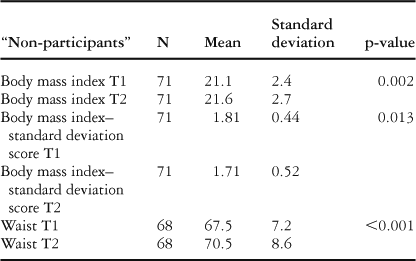
Table 4. Data at T1 and T2 in the group of the “non-participants”, calculated with the paired t-test.

Table 5. Data at T1 and T2 in the group of the control children, calculated with the paired t-test.

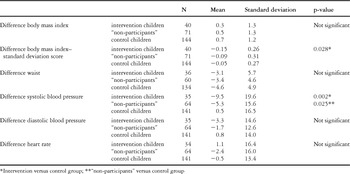
An analysis of covariance served for comparing the differences in individual characteristics, such as the difference in blood pressure between those undergoing intervention, their controls, and non-participants – see Table 6, adjusted for age and gender. The effect between categories, such as body mass index classification and groups, was analysed by means of the chi-square-test. P-values of less than 0.05 were considered statistically significant. All analyses were performed using SPSS version 11.0.
Table 6. Difference in selected parameters between the final and the entrance examination; calculated by ANCOVA adjusted by age and gender.

Results
Anthropometric data before and after the intervention
The anthropometric data for all children have been listed previously.9 Of the children, 7.3% were obese, 10.4% overweight, 75.7% normal weight, and 6.6% underweight. At both testing intervals, there were no differences in the prevalence of overweight or obese children between the schools involved with intervention and those chosen as controls (p more than 0.05). The anthropometric data of the three subgroups are shown in Table 1. Height and weight increased significantly due to growth (each p less than 0.001) during the period of follow-up (data not shown). Body weight increased less in the children involved in intervention, but there were no differences between the non-participants and the controls (data not shown). Of the children undergoing intervention, 37.5% reduced their body mass index, compared with 33.8% of the non-participants, and 28.5% of controls. These differences were not significant (p more than 0.05).
The anthropometric data of children who were available for examination both at the beginning and the end of the study protocol are shown in Tables 3 through 5.
Body mass index increased significantly in the non-participants and the control group compared with baseline measurements, but not in those selected for intervention. There were, however, no significant differences between the 3 subgroups in the increase in body mass index values throughout the study period. Body mass index–standard deviation score decreased in all groups, but most markedly in those chosen for intervention. There was a significant difference between those chosen for intervention and their controls (p equal to 0.028), but neither of these groups differed from the non-participants. The change in body mass index–standard deviation score was analysed separately in overweight and obese children (see Fig. 1). Normal development of body mass index–standard deviation score was demonstrated in the controls. Obese children involved in intervention reduced their body mass index-standard deviation score more markedly than overweight children. Among the non-participants, overweight children reduced their body mass index–standard deviation score more than the obese children. All these differences were not statistically significant due to the large standard deviation, although a consistent trend was demonstrable.

Figure 1. Body mass index–standard deviation score reduction from T1 to T2 in the “non-participants”, intervention and control group, differentiated after overweight and obesity at T1.
Heart rate and blood pressure
The differences between these parameters in the 3 groups are demonstrated in Table 6. Systolic blood pressure decreased significantly both in those selected for intervention group and non-participants, but not in the controls. The most marked decrease was seen in those selected for intervention. The difference between those chosen for intervention and their controls was significant, while there was no significant difference between the children undergoing intervention and non-participants (intervention versus control group, p equal to 0.002; non-participants versus control group, p equal to 0.025; each adjusted for age and gender). Diastolic blood pressure values and heart rate did not differ, between the groups.
Discussion
As in numerous countries worldwide,2, 15 the prevalence of overweight and obese individuals is rising in Germany.14 Effective interventions are warranted, but an ideal strategy has not yet been developed.6, 7 Solely school-based interventions do not seem intensive enough, and parents are often not included. Parents, however, are responsible for nutrition and the dietary and activity lifestyle of the family,16 and are necessary participants in the successful transfer of any recommended changes in lifestyle. Until the present time, no study has clarified the best settings or possible predictors for a successful participation in programmes of prevention or treatment. The purpose of our study was to document the effects of a school- and family-based intervention on children who completed the recommended intervention, and provide comparisons between them and children who were invited but did not participate, and age-matched controls.
At the beginning of the study the highest body mass index was found in those undergoing intervention. We speculate that parents of children who were more overweight than their peers presumably felt the need to participate in the intervention. The increase of body mass index was lowest, and the decrease of body mass index–standard deviation score was highest in those undergoing intervention. This was the case for both overweight and obese children. The higher reduction in the body mass index–standard deviation score in the non-participants compared with the controls reveals that there is a positive effect of a screening programme which brings to the attention of the parents that their child is overweight or obese. While not significant, there was a consistent trend that this benefit was observed in overweight, but not obese children. Perhaps changes in lifestyle are easier to implement in overweight children and their families as opposed to obese children. To achieve an effect against obesity, an intensive interdisciplinary therapy is most likely necessary.8, 14
There was a significant reduction of systolic blood pressure after intervention, and a lesser reduction of diastolic pressure. This could be attributed to the increase in regular exercise, which is known to reduce blood pressure,17 because body weight and body mass index were not reduced. On the other hand, non-participants also showed a slight reduction in systolic blood pressure, which may be the effect of the reduction of the body mass index–standard deviation score.
The major limitations of this study are that there is only limited information about the leisure activities and social background of the non-participants. We did use questionnaires, but we received responses from only one-quarter of those not participating. The majority cited lack of time and interest as the reason for non-participation. Another limitation of this study is that single measurements of blood pressure as performed here are less reliable, but 24-hour ambulatory measurements were not available for our study. Disturbances through anxiety can be excluded, because heart rate at rest did not differ in the 3 groups at any examination.
Despite these limitations, our data confirms the efficacy of interdisciplinary school- and family-based intervention for overweight and obese children with regard to body mass index–standard deviation score and systolic blood pressure compared with a control group. In addition an effect of screening examinations could be shown, which seemed to be of benefit predominantly for overweight children. To answer the initial question “who benefits?” will require long term observation to clarify for how long the effect of the intervention and the effect of the screening examination will last, for both overweight and obese children.