Introduction
Gamma-hydroxybutyrate (GHB) is a GABA-B agonist. It produces unconsciousness, bradycardia and seizures. Gamma-hydroxybutyrate is licensed for the management of cataplexy associated with narcolepsy, alcohol and opioid withdrawal states, and as an anaesthetic adjuvant in a number of countries. 1
The recreational abuse of GHB has been reported in America, Australia and extensively through Europe (Belgium, Denmark, Finland, France, Italy, Spain, Sweden, Switzerland, The Netherlands, Ukraine and the United Kingdom). 1 Within the Australian context, recreational abuse of GHB and its various pro-drugs was first reported in the 1990's,Reference Harraway and Stephenson 2 and its recreational use is increasing in a number of states’ jurisdictions.Reference Dietze, Cvetkovski, Barratt and Clemens 3
The majority of recreational GHB intoxications for which an ambulance is requested to attend go on to be managed in resuscitation cubicles within public emergency departments. Very few patients are definitively managed “on-scene” by paramedics,Reference Dietze, Cvetkovski, Barratt and Clemens 3 and the majority of presentations to emergency departments are classified as Australasian Triage Category 1 patients (defined as “Immediately Life Threatening”).Reference Munir, Hutton and Harney 4
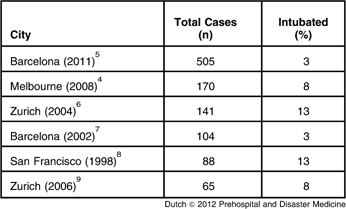
Experience both within Australia and internationally suggests that despite many patients being profoundly unconscious (GCS <9), the majority of GHB intoxications require only close observation, supportive care, simple airway management and time to recover.Reference Munir, Hutton and Harney 4 , Reference Galicia, Nogue and Miro 5 Importantly, the need for intubation and mechanical ventilation is rare (Table 1),Reference Munir, Hutton and Harney 4 - Reference Liechti, Kunz and Greminger 9 and while multiple deaths from GHB intoxication have been reported in Australia, none have occurred following the arrival of trained medical assistance.Reference Caldicott, Chow and Burns 10
Incidence of Intubation in GHB-Intoxicated PatientsFootnote a

a Adapted from Munir et alReference Munir, Hutton and Harney 4
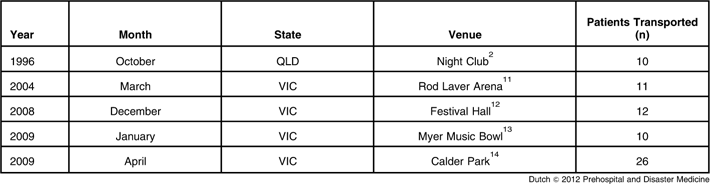
While GHB abuse does occur within the community, overdoses tend to be clustered at night clubs and at large commercial dance events (Table 2).Reference Harraway and Stephenson 2 , 11 - 14 Clusters of GHB intoxications have the potential to rapidly overwhelm ambulance resources, local emergency department resuscitation cubicles, and inpatient higher dependency and intensive care beds.
Recent Mass GHB Overdoses in Australia

Abbreviations: QLD, Queensland; Vic, Victoria
St. John Ambulance Australia has deployed both First Aiders and medical assistance teams (MATs) to high-risk dance events and music festivals in the state of Victoria for the last five years. First Aiders were based at posts as well as in mobile response teams. They met the Australian Resuscitation Council's definition of First Responder, being trained in advanced first aid, oxygen delivery and automated external defibrillation. First Aiders referred patients to the medical assistance teams when they were unable to definitively manage patrons onsite.
Medical assistance teams consisted of at least one registered medical practitioner, and two registered nurses and/or paramedics. Teams were deployed at the scene of mass gatherings as fixed, non-mobile, resources within pre-existing buildings or large, temporary tents. Teams aimed to maximize the number of patrons who could be definitively managed onsite, and to spread (both spatially and temporally) the distribution of patients throughout the entire health care system.
This paper aimed to examine the impact of medical assistance teams in reducing the burden of GHB intoxication on the greater health care system.
Methods
A retrospective chart review was undertaken for all patient presentations managed by medical assistance teams at music events attended by St. John Ambulance in the Australian state of Victoria from January 2010 through May 2011. Ethics approval for the study was granted by the St. John Research Ethics Committee.
Medical charts were semi-structured, and consisted of free text sections, as well as categorical data. Data was extracted by one of the authors (MJD) using a preformatted template, which included demographic information, symptoms, signs, interventions and patient disposition. GHB intoxication was defined as either having had a recent history of GHB ingestion, or GHB paraphernalia was found on the patient, or the GHB toxidrome was specifically mentioned in the medical record. Charts that did not meet the criteria for GHB intoxication were excluded from analysis.
The primary outcome measure of “transport to hospital” was defined as the use of the statutory emergency ambulance service to transfer a patient to hospital. This definition did not include patients who presented to hospital via private means. The decision to transport any patient to hospital was based on the need for endotracheal intubation (mandatory indication), resourcing decisions regarding bed occupancy, the failure to achieve a safe level of consciousness prior to the event ending, and the closure of the onsite medical facility.
Disposition was recorded by the treating team as a categorical variable in the medical chart at the time of disposition. An onsite active quality assurance process ensured 100% compliance with documentation of disposition.
Categorical variables were compared using the chi-square test, calculating a 2-tailed P value. Length of stay and age were reported as medians (interquartile range [IQR]).
Results
During the 18-month study period, medical assistance teams treated a total of 61 presentations of GHB intoxication at 14 of the 24 music festival events attended.
Patients or accompanying friends confirmed the diagnosis of GHB ingestion in 77% of presentations and GHB paraphernalia was found on eight percent of patrons; only 15% were diagnosed on clinical suspicion alone.
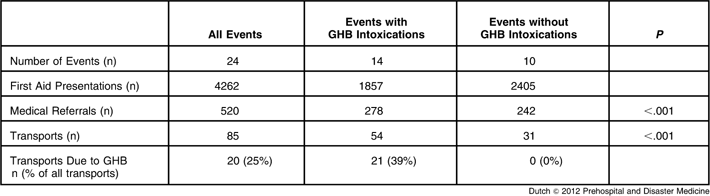
The presence of GHB intoxication at music festival events was associated with a 49% increase in the referral rate from First Responders to the medical teams, and a doubling of the transport to hospital rate per first aid presentation (Table 3). These events averaged 130 patron presentations to First Aiders. Approximately 15% of presentations were referred on to the medical team and 2.9% required transport to hospital (Table 3).
Level of Care and Disposition Profiles of Events With and Without GHB Intoxication Presentations

Demographics
The GHB-intoxicated patients were more commonly male (64%), and had a median age of 22 (IQR = 20-25 years). While there were a variety of reported co-ingestants, the use of MDMA “Ecstasy” (21%), alcohol (13%), and methamphetamine “Speed” (11%) was commonly reported.
Clinical Presentation
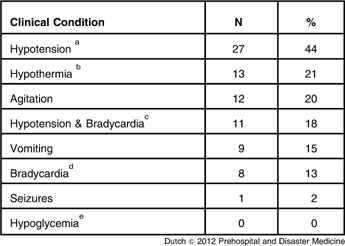
The GHB-intoxicated patients presented in an altered conscious state in 89% of cases, and were profoundly unconscious (GCS <9) in 44%. Bradycardia and hypotension were common, and GHB's sine qua non of reduced conscious state peppered with episodes of agitated delirium occurred in 20% of presentations (Table 4).
Clinical Presentation of GHB-Intoxicated Patients

aSystolic blood pressure <100 mmHg.
bTympanic thermometer temperature <35.0°C.
cCombination of systolic blood pressure <100 mmHg and heart rate <60 beats per minute.
dHeart rate <50 beats per minute.
ePoint of care glucose level <3.5 mmol/l.
Clinical Interventions
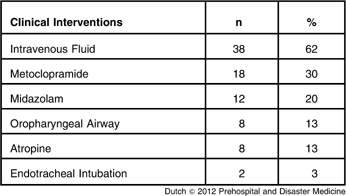
Unconscious patients were monitored with continuous electrocardiogram (ECG), pulse oximetry, non-invasive capnography, frequent non-invasive blood pressure measurement and one-on-one nursing care. Intravenous access was routinely established, and the majority received intravenous fluids, and often prophylactic antiemetics. Chemical restraint with midazolam was required in 20% of patients. Endotracheal intubation (3%) was reserved for those patients who were apnoeic or vomiting with an unprotected airway (Table 5).
Clinical Interventions for Patients with GHB Intoxication

Disposition
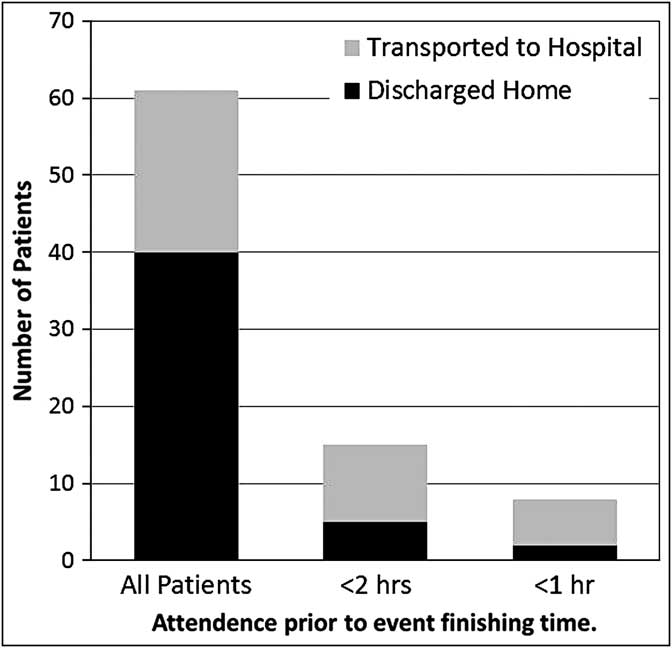
The median length of stay within the medical tent was 90 minutes (IQR = 36-130 minutes). Transport to hospital via ambulance was avoided in 65% of GHB-intoxicated patients. The majority of patients were discharged home or returned to the event. Presentations that occurred within two hours of the event end were associated with a 1.94 relative risk of requiring ambulance transport to hospital (CI = 1.18-3.19) (Figure 1).
Patients with GHB Intoxication Requiring Transport to Hospital

Discussion
This study is the first to describe the prehospital onsite management of GHB intoxication by dedicated medical teams. Medical teams were able to avoid hospital transfer in over 65% of patients. The incidences of an altered conscious state, GCS <9, and vomiting and agitation were not significantly different from the rates reported in a large case series of GHB intoxications presenting to an inner-city emergency department in Victoria (P > .05).Reference Munir, Hutton and Harney 4
There was a higher incidence of hypotension in this case series (44% vs. 4%, P > .01), and a trend towards more bradycardia (13% vs. 6%, P = .09). Anecdotally, the authors believe that both hypotension and bradycardia equate clinically with the degree of intoxication.
Discharge planning within the medical tent commenced early. The median length of stay was half that of the non-intubated emergency department cohort (90 minutes vs. 192 minutes). While total numbers are small, the endotracheal intubation rate in this study was not statistically different from that in the case series in Victoria (MAT 3% vs. Hospital 8%, P = .23).
Approximately 23% of presentations in this study occurred during the final two hours of the events. These patients had a higher incidence of transport to hospital than those presenting earlier. Multiple factors likely contributed to the higher transport rate, including simply not having enough time to “sober up” before event end, as well as a potential surge in patron use of GHB towards the end of the event. Future strategies to maximize the number of patients definitively managed onsite could include extending the medical tent's hours of operation.
The provision of medical assistance teams at music festival events is now recommended by several best practice guidelines. 15 This benefits both patrons and event promoters by definitively managing more patients onsite, and reducing the adverse media generated by large number of patrons being transported to hospital. However, the provision of these teams can also be viewed in the context of a broader philosophy of minimizing the impact of mass gatherings on the “core business” of existing health service delivery.
The realities of a public health care system running near capacity, increasing ambulance demand,Reference Fisher 16 and pressures to expedite transfer of high-acuity patients to a finite ICU bedstockReference Mountain 17 only provide more impetus to explore new ways of limiting the impact of mass gatherings. Increased basal demand has already driven many new models of health care, including the Emergency Short Stay Units, the Hospital in the Home program, and General Practice Super Clinics. The medical tent at mass gatherings, which aims to reduce the surge in presentations seen with these events, is perhaps the ultimate hybrid of these models. With a well-resourced medical team onsite, patients who would otherwise have been transported to hospital by ambulance can have interim management with referral to their general practitioners for after-care, or even definitive management and return to event. For patients who need hospital care, non-ambulance transport options can be explored, or ambulance priority can be down-graded based on onsite medical triage and level of care provided on-scene.
From a health economics perspective, onsite medical care adopts a user pays approach for patrons who attend high-risk events, and where hospital attendance is substituted for follow-up with a general practitioner, within the Australian context, cost shifts from the state to the federal coffers.
Given the similarity of this study's cohort with the Victorian inner-city emergency department series, during this study period, medical assistance teams have avoided an estimated 40 ambulance transfers to hospital, of which 21 would have been triaged as Category 1 patients (immediately life threatening) and 10 as category 2 patients (imminently life threatening).
Limitations
This study was limited to reviewing GHB intoxication managed by medical assistance teams at music festival events. It may underestimate the total impact these events have on surrounding health care infrastructure, particularly by those patients of lower acuity. Patrons who collapse outside the event precinct would likely be transported directly to hospital, rather than to the medical assistance tent, and this study does not include patrons who present via private means to hospital.
Conclusion
Gamma-hydroxybutyrate intoxication at mass gatherings is a clinical presentation where on-scene definitive management by dedicated medical teams can reduce the burden of these patients on the wider health care system. Further research into the impact of medical teams at mass gatherings is needed.
Abbreviations
- GHB:
-
gamma-hydroxybutyrate
- MAT:
-
medical assistance team