INTRODUCTION
In recent decades the number of women, minorities, and women Footnote 2 of color elected to public office has noticeably increased, more than tripling in the past thirty years. Footnote 3 As such, we are increasingly faced with questions about the unique representational styles of these public figures. While a wealth of research exists concerning the impact of race or gender on representation, previous scholarship largely neglects the critical intersection of race and gender, leaving questions about minority women’s representational styles largely unanswered. In this paper, we seek to add to the collective knowledge concerning these women, identifying the unique ways in which minority congresswomen present themselves to constituents.
House members vary a great deal in their representational styles, no more so than in the ways they present themselves and their activities to voters. Seeking reelection every two years, U.S. Representatives must constantly communicate with constituents, building support for their agendas and enhancing their reelection chances. Richard Fenno (Reference Fenno1978) argues that representatives present themselves in a variety of ways to build trust among constituents, noting that “[o]f the many contextual expressions given off in the effort to win and hold constituent trust, three are ubiquitous. They are qualifications, identification and empathy” (p. 57). Critical among these components of self-presentation is a representative’s ability to identify with constituents, reminding them that he or she is “one of [them]” (Fenno Reference Fenno1978, p. 73).
To enhance trust (and reelection prospects), representatives present themselves to the public in a number of different ways. Among women and minority representatives, the choice to play up or de-emphasize one’s gender, racial, and/or ethnic background may vary a great deal, with some members focusing on these identities and related issues, and others virtually ignoring them. Previous research demonstrates that the racial, ethnic, and gender identities of both representatives and their constituents likely influence the issues, activities, and accomplishments these members of Congress choose to emphasize in their appeals (Canon Reference Canon1999; Carroll 2001; Fridkin and Woodall, Reference Fridkin, Woodall, Thomas and Wilcox2005; Kahn Reference Kahn1996; Zilber and Niven, Reference Zilber and Niven2000). However, little (if any) of this scholarship examines the presentational styles of minority women, which may be substantively different than those of either Anglo congresswomen or minority congressmen.
The intersectional experience cannot be understood as simply the additive effect of race and gender (Bratton et al., Reference Bratton, Haynie and Reingold2006; Brown Reference Brown2014; Carbardo et al., 2013; Hancock Reference Hancock2013). Rather, the combination of these identities likely exerts a unique impact on representational style. Intersectionality theory purports those relevant categories of difference are mutually constituted both analytically and experientially (Crenshaw Reference Crenshaw1989, Reference Crenshaw, Bartlett and Kennedy1991). For the purpose of this essay, intersectionality is defined as the interwoven and overlapping social categories and identities (such as race, gender, ethnicity, and class) that inform the lives of the congresswomen under study. We find that minority women present themselves as different representatives than White women and minority men. Specifically, minority congresswomen highlight their gender and racial identities simultaneously and with no hierarchy. Thus, in seeking to identify the ways minority women present themselves to their constituents, findings regarding gender or race alone are instructive, but not sufficient.
Due to the limitations of prior scholarship in this field, significant research is required to fully understand the unique way minority women present their experiences and identities to constituents. In this manner, we employ intersectionality theory as a “work in progress” (Carbado et al., Reference Carbado, Williams Crenshaw, Mays and Tomlinson2013, p. 305) by allowing us to examine intersectionality in unexamined places. In this exploratory study, we attempt to answer several questions. First, how do these women balance their gender, racial, and ethnic identities in their appeals to constituents? Do they play up their race and ethnicity, their gender, or none of the above? To answer these questions, we rely on a content analysis of 187 congressional websites. By combining both quantitative and qualitative analysis, we are able to offer a detailed description of the messages communicated by minority congresswomen, while at the same time clearly identifying general differences between these women and their Anglo and male peers in this regard. As such, this exploratory essay addresses an important gap in the existing literature by providing tangible evidence that mutually constructing identities (namely racial/ethnic and gendered concerns) inform how minority congresswomen present themselves to constituents. This is not a definitive study; however, we raise questions and present findings that acknowledge differences and commonalities among minority Congresswomen. Thus, an intersectional lens reveals the ways in which differing structures of racial/ethnic and gendered marginalization and privilege produce varying presentational styles for member of Congress.
RACE, GENDER, ETHNICITY, AND PRESENTATION OF SELF: PREVIOUS RESEARCH & EXPECTATIONS
By virtue of their identities, minority women may feel compelled to emphasize particular experiences and issue positions in their efforts to build support among their constituents, presenting themselves in substantively different ways than their Anglo and male peers. Unfortunately, little research concerning this topic exists. To formulate our expectations, we rely on research from several fields. Research regarding gender and political communication has tended to focus on the extent to which candidates and elected officials discuss the stereotypical “male” and “female” characteristics and issue competencies voters often expect them to possess. Several scholars have found that female representatives tend to pay greater attention to gender and “female” issues (such as education and healthcare) in their messages, while men tend to emphasize “male” issues (e.g., the economy and defense), mirroring their stereotypical strengths (Carroll 2001; Dodson et al., Reference Dodson, Carroll, Mandel, Kleeman, Schreiber and Liebowitz1995; Dodson Reference Dodson and Carroll2001; Dolan and Kropf, Reference Dolan and Kropf2004; Fridkin and Woodall, Reference Fridkin, Woodall, Thomas and Wilcox2005; Kahn Reference Kahn1996; Swers Reference Swers1998; Thomas Reference Thomas1994; Thomas and Welch, Reference Thomas, Welch and Carroll2001). With regard to gendered trait discussion, some research has found that male and female candidates often vary in their discussion of so called “male” traits (e.g., toughness, leadership abilities) and “female” traits (e.g., compassion, empathy) (Kahn Reference Kahn1996; Sapiro and Walsh, Reference Sapiro and Walsh2002). In contrast to this work, several scholars have found gender differences in candidates’ trait discussions to be minimal (Bystrom Reference Bystrom, Carroll and Fox2006; Bystrom and Kaid, Reference Bystrom, Kaid and Rosenthal2002; Dolan Reference Dolan2005).
The literature concerning political communication of minority representatives is fairly limited, with the vast majority of these studies focusing primarily on African American representatives. Generally, the literature has found that minorities tend to emphasize their own race, their constituents’ race, and race-related issues more frequently than their counterparts. For example, several scholars (Canon Reference Canon1999; Zilber and Niven, Reference Zilber and Niven2000) have found that African Americans discuss issues related to race, such as civil rights, more frequently than their Anglo counterparts. In contrast, other research (Gulati Reference Gulati2004; McIlwain and Caliendo, Reference McIlwain and Caliendo2002) has found little discernible difference in the presentation styles of African Americans and Anglos running for elective office, indicating that political and contextual variables may exert a stronger influence over the messages candidates emphasize.
Absent from the literature concerning gender, race, and representatives’ presentation styles is research concerning minority women. Rather than expecting these women to mirror White women or minority men, we anticipate that minority congresswomen, attempting to balance their multiple identities, will present themselves to constituents in a distinctly unique way. For example, literature in communications has shown that African American women write and speak differently about themselves and when they write their biographies (Marshall and Mayhead, Reference Marshall and Mayhead2008). Previous research regarding the representational styles of minority women in policy making indicates that minority women may be “doubly disadvantaged” in some ways (Darcy and Hadley, Reference Darcy and Hadley1988; Moncrief et al., Reference Moncrief, Thompson and Schulmann1991), facing additional pressures to represent both women and minority interests, while attempting to appeal to a wider audience. Recent scholarship convincingly disputes the double jeopardy (Beale Reference Beale and Cade1979) or multiple jeopardy (King 1979) theories that purport that women of color are politically disadvantaged because of their identities as minority women (Bejarano Reference Bejarano2013). More recent literature has shown that a woman’s gender has a unique appeal to voters, meaning that gender may be a strategic asset for female candidates (Bejarano Reference Bejarano2013; Dolan et al., Reference Dolan, Deckman and Swers2011; Lee Reference Lee2011). Furthermore, some scholarship concerning race and gender finds distinct differences in these women’s approaches to politics (Brown Reference Brown2014; Hardy-Fanta Reference Hardy-Fanta1993; Pardo Reference Pardo1998; Schulze 2013; Taskash-Cruz 1993). For example, Paule Taskash-Cruz (1993) found that Latina officials are often more concerned with issues that affect Latinos generally, frequently emphasizing these issue more than women’s issues. Carol Hardy-Fanta (Reference Hardy-Fanta1993) argues that Latinas differ from their male counterparts in their approach to politics, noting that “Latinas emphasize connectedness, collectivity, community, and consciousness that promote a participatory model of politics” (p. 153). Nadia Brown (Reference Brown2014) contends that minority women draw from their distinct race-gender identities to inform their legislative behavior in a way that often leads them to make political calculations that are distinctly different from minority men and White women. This is not to say that minority women have nothing in common with Anglo women or minority men. Edith Barrett (Reference Barrett1995) finds that Black women are similar to non-Black women in their support for women’s issues and are like Black men in their support of racial issues. Similarly, Kathleen Bratton and colleagues (2006) as well as Brown and Kira Banks (2013) found that Black female legislators represent both female and Black interests in the bills that they introduce, indicating a connection between descriptive and other forms of representation.
When deciding how best to present themselves to constituents, minority women (much like their Anglo female and minority male peers) may be significantly influenced by the gender and race-based stereotypes that many voters hold regarding elected officials. Research has shown that voters often expect men to be more competent in so called “male” issue areas, while women are presumed experts in gender-related and “female” issue areas (Huddy and Terkildsen, Reference Huddy and Terkildsen1993; Williams and Best, Reference Williams and Best1990). Similarly, research suggests that voters stereotype candidates and elected officials based on race, expecting minority candidates to be better equipped to deal with issues of race, poverty, and discrimination, while believing Whites to possess expertise in issue areas such as foreign policy and the economy (McDermott Reference McDermott1998; Sigelman et al., Reference Sigelman, Sigelman, Walkosz and Nitz1995). Collectively, these stereotypes may constrain the manner in which women and minorities present themselves, forcing them to choose between playing to voters’ gendered and racialized expectations in their messages, or trying to dispel stereotypes by emphasizing different traits and issues.
While they may be subject to similar stereotypes as Anglo women and minority men in some regard, the combination of these stereotypes may lead to distinctly different messages. For example, scholars have suggested that women in office must carefully shape their messages and activities around gendered expectations, walking a “fine line” between the often-preferred masculine traits and traditional feminine characteristics (Carroll Reference Carroll1994, Reference Carroll2008; Jamison Reference Jamison1995). However, minority women (Black women in particular) are often stereotyped as tough and non-feminine (Harris-Perry Reference Harris-Perry2011; King Reference King1977; Yarbrough and Bennett, Reference Yarbrough and Bennett2000), and may therefore find it difficult to achieve this critical balance. As a result, minority women (particularly Black women) may increasingly play up their feminine traits, gender identity, and gender-related issues in an effort to counteract these negative stereotypes. Constituent characteristics may also shape minority women’s messages. As many African American and Latino women represent large minority constituencies, they may (like many minority men) play up their racial and ethnic backgrounds and related subjects in an effort to identify with the communities they represent. Strategic intersectionality suggests that minority women legislators who have marked identities such as gender as well as race/ethnicity may under certain circumstances experience a multiple identity advantage (Bejarano Reference Bejarano2013; Fraga et al., Reference Fraga, Martinez-Ebers, Lopez and Ramirez2006). Minority women may play up both their race/ethnicity and gender identities because it signals to constituents that minority women candidates are better suited to represent the policy preferences of the most marginalized communities.
METHODS AND DATA
The Sample
To examine the ways in which minority congresswomen and their peers present themselves to constituents, we rely on a content analysis of 187 U.S. House members’ official websites’ biographies (see Appendix I for a detailed discussion of coding procedures). Websites are ideal in many ways for examinations of presentation of self. While all representatives maintain official sites, the content of these sites—much like other forms of communication emanating from House members—vary widely, depending on their priorities and style of representation. For example, some representatives’ biography pages include lengthy narratives regarding their family history, personal experiences, and professional activities, while others include relatively short descriptions of their professional service (e.g., years in office, committee assignments). Due in large part to the essentially unlimited space available on websites, House members are free to explain their representational styles, issue priorities, and accomplishments in as much (or as little) detail as they like. As such, websites offer excellent measures of U.S. House members’ “home style” of representation. While these sites are unique in some ways, they may also offer insight into House members’ representational styles in other arenas. In fact, websites have been found to be similar to representatives’ messages in other forms of communication (Niven and Zilber, Reference Niven and Zilber2001) and therefore offer insight into members’ presentation styles in other settings (Gulati Reference Gulati2004).
In an effort to examine representatives’ presentation of self in different political contexts, we rely on two separate data sets. Footnote 4 The first is a sample of representatives’ websites which was collected during a campaign period—October 2006. This group includes the official website biographies of seventy-two female, Latino, and African American House members. In selecting this sample, the House was stratified by representatives’ race, ethnicity, and gender, and random samples of representatives were selected from each stratum. The resulting sample—representing the majority of Anglo and minority women in the House—consists of twenty-two Latinos (including every Latina in the House in 2006), twenty-eight African Americans (including ten African American women) and twenty-two Anglo congresswomen. Very few members of Congress of color are Republicans in our sample; therefore, we do not pay specific attention to partisanship but instead focus on the racial/ethnic and gender identity of legislators. The second data set was collected during a non-campaign period (May of 2011). The 2011 set includes all non-delegate Anglo female, African American, and Latino representatives in the House during this period. Specifically, there are forty-seven Anglo congresswomen, twenty-seven Latinos (including seven women) and forty-two African Americans (including thirteen women). Footnote 5
The political contexts during which the data sets were collected differ in several ways. First, as representatives’ messages may change when an election is imminent, our study includes biographies collected during both campaign (October 2006) and non-campaign periods (May 2011). Furthermore, the political environment during these periods varied a great deal. For example, the 2006 data were collected during a campaign period in which Democrats were poised to retake the House and expected to usher in the first female speaker. In contrast, the 2011 sample was collected following a fairly successful election for the Republican Party in 2010. Furthermore, the 2011 sample is unique in that many of the newly-elected Republican representatives had ties to the Tea Party in what some might attribute to the election of Barack Obama, the nation’s first Black president. Largely as a result of the newly-elected Republican representatives, the 2011 set includes more variance in the partisan and ideological backgrounds of the women and minorities examined (compared with the 2006 sample). Thus, these two data sets allow for a comprehensive analysis of a diverse set of representatives’ biographical pages in very different political contexts.
Quantitative Analysis
In this paper, we examine the ways minority congresswomen communicate their identities and issue positions to constituents relying on both qualitative and quantitative analyses. The two methods complement each other: the quantitative data provides a meta-analysis of the types of issues that the legislators in our study champion as well as a broad view of how they present themselves; the qualitative data provides a more detailed and nuanced depiction of the quantitative findings.
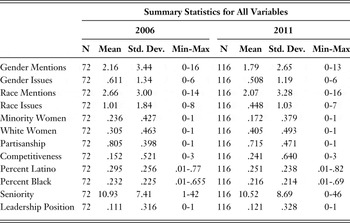
First, multivariate analyses were used to identify average differences in content across the groups examined (minority and Anglo congresswomen). In these models, our dependent variables are the frequency of identity and issue mentions in representatives’ biographical pages. In our first analyses, we measure the number of times members’ mention race, ethnicity and gender identities (their own and that of their constituents). Our second set of dependent variables examined issue discussion related to gender, race and ethnicity. Footnote 6 To examine the determinants of variance in members’ choice to emphasize race, gender, and ethnicity in their website biographies, we rely on a number of independent variables.
Our primary interest in these analyses is to examine the role of representatives’ race, ethnicity, and gender in shaping identity and issue discussion in members’ biographical webpages. As scholars have noted, empirical examinations of intersectionality can be problematic. Footnote 7 Recognizing these problems, we approach our analysis in a few ways. In our quantitative analysis, we employ binary variables for different representatives rather than interactive terms. To identify general similarities and differences among minority and Anglo representatives, Latino and African American representatives are grouped into categories in the quantitative analysis. Specifically, we include variables for minority women (Latina and African American congresswomen = 1, others = 0) and White women (White congresswomen = 1, others = 0), leaving minority men (Latino and African American congressmen) as the excluded category. We do not mean to imply that these groups are identical. However, the small numbers of these women limit our ability to examine statistical differences among these groups individually. As the grouping of these women and men into categories for analysis may mask important differences in their self-presentation, the qualitative analysis presents a more detailed examination of the unique messages of these different Latino, Latina, African American female, African American male, and Anglo female representatives.
Beyond representatives’ race, ethnicity, and gender, we control for several political and district level variables (which may shape representatives’ presentation of self) in our analyses. First, we control for partisanship. Just as voters use race and gender to form expectations of candidates, they may also evaluate politicians’ qualifications based on their party attachment. As Danny Hayes (Reference Hayes2005) puts it, “Democrats are the party of the worker, the elderly, and the less fortunate. . . . Republicans, on the other hand, have a coalition made up not of working classes and minorities but of business interests, the upper and middle classes, and social conservatives” (pp. 910-911). Due to these perceived strengths, Republicans and Democrats may emphasize different identities and issues to varying degrees in their biography pages. In particular, Democrats, often associated with female and minority interests, may more frequently make mention of these groups and issues related to them, compared with Republicans. We control for representatives’ partisanship with a binary variable (Democrat = 1, Republican = 0). In addition to partisanship, we controlled for two other representative characteristics that have been found to shape elected officials’ presentation of self: seniority and leadership position (Gershon Reference Gershon2008). Senior and more powerful members of Congress, secure in their positions, may feel freer to discuss race, ethnicity, and gender on their websites, compared with less prominent, more junior members seeking to appeal to voters. Seniority is measured as the number of years each member had spent in office at the time of the analysis. Leadership Position is a binary variable (representative holds a leadership position in Congress = 1, representative does not hold a leadership position = 0). Footnote 8
We also controlled for several district-level variables, including district racial and ethnic composition and competitiveness. While ethnic and racial identity of the representatives may shape their presentations of self to voters, it is likely that the identities of their constituents will influence this discussion as well. Previous research demonstrates that House members are responsive to the proportion of racial and ethnic minorities in their districts (Combs et al., Reference Combs, Hibbing and Welch1984; Lublin Reference Lublin1997; Welch and Hibbing, Reference Welch and Hibbing1984). Therefore, we expect that greater numbers of racial and ethnic minorities may lead representatives to increase their discussion of race, ethnicity, and related issues. As such, control variables measuring the proportion of each district that is Latino (Percent Latino) and African American (Percent Black) were used. Finally, we controlled for district-level competitiveness. Elected officials representing more competitive districts may vary from those in safer seats in their decisions to play up race, gender, ethnicity, and related issues in their website biographies in an effort to court voters. Competitiveness is measured with a scale based on Cook’s Political Report rankings (0 being the least competitive and 3 being the most competitive). Footnote 9
Qualitative Analysis
While the quantitative analysis described above demonstrates several group differences in the ways that these congresswomen present themselves to their constituents, to identify more nuanced differences in House members’ communication, a qualitative content analysis was performed using the quantitative index to explore legislators’ personal discussions of issues that matter most to them. For the qualitative analysis, analytical categories were developed to code the data. We used constant comparison, a method of analyzing qualitative data where the information gathered is coded into emergent themes. All the data relevant to each category were identified, examined, and sorted into broad theoretical categories such as: presentation of self (race, gender, both race and gender); women’s issues; race-related issues; and minority women’s issues. Presentation of self also included performative dynamics, or characteristics, that distinctly imply one’s identity such as noting one’s motherhood status and/or belonging to a racial/ethnic sorority (Carbado and Gulati, Reference Carbado and Gulati2013). The use of these qualitative techniques is particularly important when examining the intersection of race and gender as quantitative studies of this subject, which often attempt to isolate the effects of gender by controlling for race/ethnicity or vice versa (Spellman 1988), are at odds with any effort to trace the complex interactions of race-gender (Hawkesworth Reference Hawkesworth2003). Only through the combination of these methodologies are we able to give a detailed yet generalizable account of the messages emphasized on these websites.
RESULTS
Identity: Quantitative Analysis
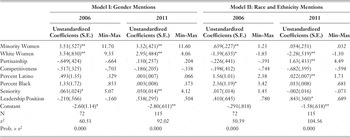
Descriptively, minority women discuss gender and racial identities significantly more frequently than their counterparts in both the 2006 and 2011 data sets. Footnote 10 However, there are likely several factors which explain representatives’ presentation of self. To examine the frequency of gender, race and ethnic identity, and issue mentions while controlling for other variables which may shape member’s biographies, negative binomial regression was employed throughout all the models in this paper due to over-dispersion of the data (Long and Freese, Reference Long and Freese2006). Footnote 11 The frequency of representatives’ discussion of gender (Model I), race and ethnic identities (Model II) are examined in Table 1.
Negative Binomial Regression: Gender, Race & Ethnic Identities Discussion

Notes: *p<.05, **p<.01. N (2006: 17 Minority Congresswomen, 22 Anglo Congresswomen, 33 Minority Congressmen; 2011: 20 Minority Congresswomen, 47 Anglo Congresswomen, 48 Minority Congressmen).
As the data in Table 1 demonstrate, Anglo and minority congresswomen are distinct from each other and their minority male peers in their identity discussion. Controlling for rival explanations, being either a minority or Anglo congresswomen significantly increased mentions of gender identity on biography pages in 2006 and 2011, compared with the effect of being a minority congressman (the excluded category). While the minority women in our sample discussed gender identities more frequently than their Anglo peers, these results indicate that once political and district characteristics are controlled for, being a woman (regardless of race or ethnicity) increases members’ discussion of gender in their presentations of self.
The results with regard to discussion of race and ethnic identities conform to our expectations to some extent. First, the impact of being a minority woman is positive in both models and significant in 2006, indicating that minority women discussed racial and ethnic identity at a higher rate than minority men (the baseline category). Furthermore, the coefficients for White congresswomen are negative and significant across both analyses, demonstrating that they mention these identities significantly less than minority men in their website biographies.
These data illustrate a few broad trends regarding discussion of race and gender identities. As might be expected, women discuss gender more frequently than men and minorities mention race and ethnicity more frequently than Anglos. Consistent with scholarship that uses an intersectional framework to explore minority women’s identities and interests, it appears that the minority women examined here cannot separate or rank their racial/ethnic and gender identities. Instead, minority congresswomen spend significant portions of their biography pages discussing gender, racial, and ethnic identities (rather than focusing on one over the other). While these data tells us something about the choices members make to emphasize their identities and that of their constituents, it is limited in its ability to identify the ways minority congresswomen distinguish themselves from their peers in their identity discussion. Our qualitative content analysis reveals that there is also significant variance in how these representatives highlight race, gender, and ethnicity. These differences will now be explored in detail.
Identity: Qualitative Analysis
Next we examine minority women’s discussion of gender, race, and ethnic identities. In attention to increased mentions of gender and racial identities, minority representatives (both men and women) are distinct in their biography page discussion, focusing their identity discussion primarily on breaking barriers. Thus, mentions of these representatives’ racial, gender, or ethnic identities often occurred while highlighting their accomplishments as minority women. All the Latinas in our sample are trailblazers who entered into spaces where no other Latina had previously served, and many emphasized these unique experiences in their biography page presentations. For example, Representative Linda Sanchez’s (D-CA) webpage notes that she was the first Latina on the Judiciary Committee. She and her sister, Representative Loretta Sanchez (D-CA), are the first “women of any relation and first sisters to ever serve in Congress” (Sanchez 2006, 2011). Representative Ileana Ros-Lehtinen (R-FL) noted that she was the first Latina to chair a congressional subcommittee. Similarly, Representative Nydia Velazquez (D-NY) noted that she was the first Puerto Rican elected to the House of Representatives. Representative Hilda Solis (D-CA) emphasized her unique position as the first Latina to serve on the House Committee on Energy and Commerce and the first Latina elected to the California State Senate.
African American Congresswomen also hold numerous distinctions as being the first Black women to serve in certain political positions. Representative Juanita Millender-McDonald (D-CA) noted in her biography that she was the first “African American woman to serve on the Carson City Council . . . [and] the first African American woman to give the national Democratic response to President Bush’s weekly radio address” (Millender-McDonald 2006). Likewise, Representative Eddie Bernice Johnson’s (D-TX) webpage notes, “Congresswoman Johnson was the first African-American woman to ever win elected public office in Dallas” (Johnson 2006). Representative Carolyn Cheeks Kilpatrick (D-MI) highlighted her role as the first Black woman to serve on the Michigan House Appropriations Committee, and Representative Stephanie Tubbs Jones (D-OH) noted her experiences as the first Black and first female representative from Cuyahoga County, Ohio.
Both the Latinas and Black Congresswomen in the sample made explicit reference to their socioeconomic status as well as their identity as women and minorities in detailing their backgrounds. Choosing to highlight both their race/ethnicity and gender is unique to the minority congresswomen in our sample. For example, Representative Gwendolynne Moore’s (D-WI) identity as a low-income woman is included on her biography webpage. “Moore started college at Milwaukee’s Marquette University as an expectant mother on welfare who could only afford her education with the help of TRIO, a program that provides educational opportunity for low-income Americans” (Moore 2006, 2011). Indeed, Moore’s inclusion of her fiscal struggles is gendered as she was afforded financial assistance (welfare) because she was an expectant mother. Representative Maxine Waters (D-CA) similarly portrayed her upbringing as gendered, raced, and class based. Like Moore, Waters was born into a large low-income family. This large family—led by a single mother—can be connected to the feminization of poverty. Representative Waters worked in segregated restaurants at the age of thirteen. She later worked in a factory. Pink collar jobs, stereotypical women’s work in the service industry, were both raced and gendered for Waters as employment in St. Louis, Missouri was segregated in the 1950s.
Latina Congresswoman Nydia Velazquez (D-NY) also included her meager beginnings on her biography webpage. “Given her achievements, her roots are humble. She was born in Yabucoa, Puerto Rico—a small town of sugar-cane fields—in 1953, and was one of nine children. Velázquez started school early, skipped several grades, and became the first person in her family to receive a college diploma” (Velazquez 2006; 2011) Also born into a large family, Representative Linda Sanchez (D-CA) presented her background on her biography webpage as “the sixth of seven children . . . born in the City of Orange to immigrant parents from Mexico . . . who worked to put herself through school” (Sanchez 2006; 2011). By discussing their humble backgrounds, Representatives like Moore, Sanchez, Velazquez, and Waters highlighted their identification with groups sharing these experiences and identities, communicating their empathy for minorities, women, and the economically marginalized. In fact, many of these women connect their experiences directly to their work in Congress, emphasizing legislation and other activities directed at helping these historically disadvantaged communities.
While an overwhelming majority of members of Congress list their families on their biographical webpages, Representative Grace Flores Napolitano (D-CA) is the only legislator who connected her ethnicity to motherhood. She included her upbringing in the border community of Brownsville, Texas, and her early marriage (after high school) to paint a picture of an immigrant community. In her biography page, she noted that her early life, devoid of politics, was centered on her family and career. “Always a working mother, Napolitano made her way up through the ranks of Ford Motor Company” (Napolitano 2006; 2011). Similar to Sonia Garcia and colleagues’ (2008) findings for Latina politicians, Representative Napolitano did not focus full time on her civic pursuits until after retirement. In line with other Mexican American women political leaders (Garcia et al., Reference García, Martinez-Ebers, Coronado, Navarro and Jaramillo2008), Representative Napolitano’s webpage details that she successfully balanced family, work responsibilities, and politics.
Within the category of minority women, there are significant differences in biography page mentions of identity. While there are similarities in how minority congresswomen’s identities shape their biography page discussion, African American congresswomen are more likely than Latinas to explicitly call attention to their identity in their legislative accomplishments. The minority women legislators frame issues in a gendered and/or racialized discussion by playing up their own racial and gendered identity. As such, there is a clear link between Black congresswomen’s identities, the issues they champion, and how they frame these issues in a gendered and/or racialized discussion. Latina women differ from Black women significantly in this regard, tending not to mention their own racial (or gender) identity when claiming credit for legislative work. The minority congresswomen all make references to their racial/ethnic, class, and gender background to position themselves to constituents as “one of them” (Fenno 2001).
Latino and Black Congressmen detail their historic firsts as racial in the webpage biographies that only highlight their racial/ethnic identity. For example, in his biography page, Representative Elijah Cummings (D-MD) included that he was “the first African American in Maryland history to be named Speaker Pro Tem, the second highest position in the House of [Representatives]” (Cummings 2006; 2011). Representative Emanuel Cleaver (D-MO) notes that “his experience on the City Council paved the way to a two-term stint as mayor of Kansas City, where he made history as the first African American elected to that office” (Cleaver 2006). Likewise, Alcee Hastings (D-FL) details that he was the “first African American federal judge in the state of Florida, and served in that position for ten years. . . He is the first African American [elected to Congress] from Florida since the Civil War period” (Hastings 2006, 2011). Nearly all the Latino congressmen in our sample boast on their biography pages that they are the first Hispanic to hold their current political positions. For example, Lincoln Diaz-Balart (D-FL) notes that he was the first Hispanic “in U.S. history to be named to the powerful Rules Committee” (Diaz-Balart 2006), and Representative Xavier Becerra (D-CA) highlighted his presence as the first Latino to serve on the House Ways and Means committee.
Similar to the minority legislators of both genders, White women also detail their historic firsts, but in ways that only highlight their gender. For example, Rep. Nancy Pelosi (D-CA) detailed on her biography webpage that “from 2007-2010, Pelosi served as Speaker of the House, having been elected as the first woman in American history to serve as Speaker. She first made history in November 2002 when House Democrats elected her the first woman to lead a major political party” (2011). Additionally, Representative Jackie Speier (D-CA) noted that she was “the first California state legislator to give birth while in office” (2011).
Representatives’ communication of race, gender, and the intersection of race and gender remained largely the same in the two samples; however, several freshman representatives that deviated from the patterns in the 2006 sample were elected in 2010. Specifically, the 2011 sample contains more White and Latina women who do not mention gender at all, and some Black men who do not include any discussion of race on their biography webpages. Further, the biography webpages of some Republican women—many newly elected members of the 2011 Congress—indicated a significant increase of Tea Party ideological positions. For example, several Anglo women—Jamie Herrera Beutler (R-WA), Marsha Blackburn (R-TN), Sandy Adams (R-FL), Jo Ann Emerson (R-MO), Virginia Fox (R-NC), Lynn Jenkins (R-KS), Cynthia Lummis (R-WY), and Martha Roby (R-AL)—are either Tea Party Caucus members or associated with the Tea Party movement. These women do not make explicit mention of their gender at all in their biography webpages.
The two Black congressmen who were elected in 2010 rode the anti-government sentiment into the legislature. Like the Tea Party-affiliated Anglo women who do not make reference to their gender, these Black congressmen do not allude to race in their biography pages. Representative Tim Scott (R-SC) makes no mention of race in his webpage. For Allen West (R-FL), on the other hand, the only notion of race in his biography is tied to patriotism. “Born and raised in the inner city of Atlanta, the same neighborhood where Dr. Martin Luther King, Jr. once preached, patriotism is in Congressman West’s blood” (West 2011). The divergence in discussion of race and gender among these freshman representatives may be explained in part by their party attachment. While the majority of female and minority representatives in both samples are Democrats, this group of new representatives has significantly higher numbers of Republicans, many with ties to the Tea Party movement. Anglo Republican women who have Tea Party affiliations are least likely to advocate for women’s issues and Black Republican men are least likely to advocate for race-related issues, providing insight into how race and gender politics can be mediated by partisanship.
In sum, there are several reoccurring themes which we uncovered in this analysis of biography page identity discussion. Among the most common is representatives’ discussion of being the “first” person of their race, gender, or race/gender to accomplish certain noteworthy tasks. But we also find significant differences in how the legislators discuss their identity. Minority women legislators are most likely to list their race and gender in tandem in their biography page and draw from their racialized and ethnic backgrounds (for Black women, their experiences with race-based obstacles and Latinas mention their immigrant status and/or country of origin) as an impetus to becoming a public servant. These women frame public service as an extension of caring for the less fortunate, building community, and seeking to improve government. Latinos are less likely to mention their ethnicity explicitly than Latinas, whereas, Black men draw from their experiences with civil rights struggles to indicate that race is an integral part of their identity. The Anglo women also list gender-related characteristics on their biography pages but just less frequently than minority congresswomen.
Issue Priorities: Quantitative Analysis
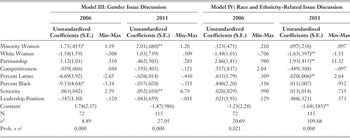
Next, we examined the frequency of representatives’ gender, race, and ethnicity-related issue mentions. The results presented in Table 2 indicate that minority women are distinct from their Anglo and minority peers in their choice to emphasize particular issues. First, controlling for political and district-centered variables, being a minority congresswoman results in significantly greater attention paid to gender-related issues compared with the impact of being a minority male (the excluded category). In contrast, being an Anglo woman did not result in significantly different amounts of gender-related issue discussion compared with minority congressmen. With regard to discussion of race and ethnicity-related issue discussion, we see less variance. Specifically, minority women are not distinct from their male counterparts in the attention they pay to race and ethnicity-related issues, once other variables are controlled for. As expected, the negative coefficients for Anglo congresswomen indicate that these women discuss issues connected with race and ethnicity at a lower level than minority men (and this relationship is statistically significant in the 2011 model).
Negative Binomial Regression: Gender, Race & Ethnicity-Related Issue Discussion

Notes: *p<.05, **p<.01. N (2006: 17 Minority Congresswomen, 22 Anglo Congresswomen, 33 Minority Congressmen; 2011: 20 Minority Congresswomen, 47 Anglo Congresswomen, 48 Minority Congressmen).
These results, while not identical, share some common themes with the previous analysis. The identities results presented earlier indicate that minority women and White women both exceed minority men in the attention they pay to gender identities. However, this analysis indicates that only minority women are significantly different from the excluded category with regard to gender-related issue discussion, exceeding both their male and Anglo female peers in this regard. Furthermore, although minority women discuss race/ethnic identities significantly more than their male peers, they exceed only White women in this area and are not distinct from minority men in their race-related issue discussion. Taken together, the 2006 and 2011 quantitative results indicate that minority women are consistently paying attention to both their female and minority constituencies in their biography page issue and identity discussion, rather than choosing to focus on one over the other.
Our focus is on two areas of legislative activity, gender-related, and race-related issued discussion, and the differences between women, minority men, and minority women legislators’ claims on their webpages. Because the legislators spend a good deal of their webpage biography discussing their legislative records and priorities, the qualitative issues discussion section is substantially longer and more detailed than the identities section. Unlike the above identity qualitative section which presented how legislators discussed race, gender, and the intersection of race and gender, we break the lengthier issues discussion into gender-related and race-related issues. These sections reflect the presentation styles of the data, which we turn to next.
Gender- and Race-Related Issue Discussion: Qualitative Analysis
Finally, we conclude our examination by discussing the qualitative differences in representatives’ issue discussion. First, we examine how legislators discuss gender-related issues. While the quantitative results indicate that minority women pay greater attention to gendered issues, they also differ from other representatives in the content of this discussion. The minority women legislators frame issues in a gendered and/or racialized discussion by playing up their own racial and gendered identity. They also call attention to their identity in their legislative accomplishments. As such, there is a clear link between their racial/gender identity and the issues they champion. Minority women position themselves as legislative leaders on issues that affect women of color. For example, Representative Grace Napolitano’s (D-CA) biography page boasts of her work on the Labor-Health and Human Services (HHS)- Education appropriations bill, which secured $1.6 million to help prevent suicide among Latina teens, saying, “Napolitano has also taken a leading role in suicide prevention among Latina adolescents noting that nearly one-out-of-three has seriously considered suicide—the highest rate for any ethnic or racial group in the country” (Napolitano 2006; 2011). Other minority congresswomen detailed their involvement in community programs that target minority women. For example, Representative Sheila Jackson Lee (D-TX) showcased her work with the Dr. Mae C. Jemison Grant Program “to work with institutions serving minorities to bring more women of color in the field of space and aeronautics” (Jackson Lee 2006; 2011). Representative Maxine Waters (D-CA) noted that she is a co-founder of Black Women’s Forum, a nonprofit organization for African American women in the Los Angeles area. Similarly, Representatives Stephanie Tubbs Jones (D-OH) and Marcia Fudge (D-OH) both touted their work as active members of the African American sorority Delta Sigma Theta Sorority Incorporated, which they use (through the sorority’s NGO status) to monitor the status of women and children in the world. As with Representatives Napolitano, Fudge, Waters, and Tubbs Jones, many minority congresswomen choose to discuss issues that impact minority women both in and outside their district boundaries, indicating that they may feel they represent their larger descriptive communities. For example, the 2011 data reveal that Democrat Black and Latina congresswomen were more likely than their White peers to discuss in their biography pages their confrontation of the Republican-controlled Congress’ attack on issues of concern to minorities, women, children, and poor people. Congresswoman Barbara Lee (D-CA) notes her fight against restrictive policies within the President’s Emergency Plan for AIDS Relief (PEPRAR/Emergency Plan); instead, she highlighted her vision for comprehensive HIV/AIDS prevention, education, and treatment programs. Next, Congresswoman Gwen Moore’s (D-WI) advocacy for Federal TRIO programs, which are programs designed to help students from disadvantaged backgrounds enroll and matriculate through college, is framed as both women’s and civil rights. Lastly, Congresswomen Grace Flores Napolitano’s (D-CA) tireless activism on comprehensive immigration reform is discussed on her biography webpage as a direct challenge to what she terms as a “major priority.”
Female representatives (regardless of race or ethnicity) differ from their male counterparts primarily in the way they frame their issue discussion. Specifically, women tend to frame their discussion by highlighting their advocacy for marginalized or disadvantaged groups. In addition to the racialized framing, minority and Anglo congresswomen differ in the way they claim credit for working on behalf of women around the world. For example, a significant number of White, Latina, and Black women representatives (e.g., Juanita Millender-McDonald (D-CA), Sheila Jackson-Lee (D-TX), Frederica Wilson (D-FL), Janice Schakowsky (D-IL), Judy Biggert (R-IL), Kay Granger (R-TX), Ileana Ros-Lehtinen (R-FL)) all championed global women’s issues, most often discussing the plight of women in nations such as Sudan, Iraq, Haiti, and Afghanistan. However, minority women tend to discuss their global women’s work while claiming credit as humanitarians. For example, Representative Juanita Millender-McDonald (D-CA) noted her work on behalf of human and women’s rights in her biography, saying “she has spoken out against genocide in Cambodia, Darfur and other regions of the world where human rights are in danger or ignored, and has worked with former Secretary of State Madeline Albright and Ambassador John Miller on human trafficking and women’s rights issues globally” (Millender-McDonald 2006). Representative Eddie Bernice Johnson (D-TX) boasts of her national and international work on behalf of women as well as her “acclaimed initiative ‘A World of Women for World Peace’” (Johnson 2006; 2011). Representative Gwendolynne Moore (D-WI) documented her advocacy on issues such as “women’s health, domestic violence and maternal and infant mortality—problems that affect women both at home and abroad” (Moore 2006; 2011). Similarly, Representative Frederica Wilson (D-FL) highlighted her advocacy work on behalf of Haitian refugees. Her efforts led to the release of all the women in a local detention center.
By contrast, White congresswomen most often position international women’s issues under homeland security and or defense issues on their biography webpages. For example, in claiming credit for her assistance to Iraqi women, Representative Kay Granger’s (R-TX) biography reported “Congresswoman Granger stepped into a national leadership role in the war on terrorism with her work with Iraqi women” (Granger 2006, 2011). Also connecting women’s issues to U.S. international policy, Representative Jean Schmidt (R-OH) noted that she is “a sponsor of [the] International Violence Against Women Act, which would make the safety of women and girls around the world a long overdue U.S. foreign policy priority” (2011). The difference in issue placement on the legislators’ webpages offers insight into the way congresswomen view these issues. While these global issues are all women’s issues, the data here suggest that minority congresswomen may view them as an extension of their public service to descriptive constituencies, while many White congresswomen (Republicans in particular) view them as a byproduct of the United States war on terrorism.
The content analysis of House members’ official websites from 2006 and 2011 indicates that minority and Anglo women were more likely than minority congressmen to include advocacy on behalf of women in their discussion. Anglo women (e.g., Representatives Judy Biggert (R-IL), Ann Marie Buerkle (R-NY), Janice Schakowsky (D-IL), and Dorothy Louise Slaughter (D-NY)) are more likely to list women’s interests—ranging from domestic violence to abortion rights (pro-choice: Representatives Diana DeGette (D-CO), Chellie Pingree (D-ME), and Dorothy Louise Slaughter (D-NY); pro-life: Jo Ann Emerson (R-MO))—compared with their minority female peers. White congresswomen advocate on behalf of children’s interests; however, when minority women discuss children’s issues, they focus particularly on issues that distinctly affect minority children. For example, Representatives Grace Flores Napolitano (D-CA), Lucille Roybal-Allard (D-CA), Linda Sanchez (D-CA), Karen Bass (D-CA), Barbara Lee (D-CA), Gwendolynne Moore (D-WI), and Maxine Waters (D-CA) discuss issues ranging from reducing Hispanic dropout rates to introducing African American history curriculum into schools. As indicated in the quantitative analysis, White congresswomen do not tend to include race or ethnicity in their gendered issue discussions. The few Anglo congresswomen who connected their advocacy for women’s health and minority health initiatives are Representatives Nancy Pelosi (D-CA) and Dorothy Louise Slaughter (D-NY).
To illustrate a similarity between how Anglo and minority women present gender issues on their biography webpages, we now turn to domestic violence legislation. Both minority women and White women express a legislative commitment to anti-domestic violence initiatives. Minority women legislators discuss their role as advocates for domestic violence victims. For example, Representative Gwendolynne Moore’s (D-WI) provisions from her legislation were included in the SHIELD Act signed into law during the reauthorization of the Violence Against Women Act (VAWA). Similarly, Representative Ileana Ros-Lehtinen (R-FL) was a co-sponsor of H.R. 2876, which reauthorized the Violence Against Women Act. She claims credit for this bill on her webpage stating that, “Ileana sent a strong message to the community that violence against women is unacceptable, and ensured that programs to address this problem continued to be funded into the future” (Ros-Lehtinen 2006). While domestic violence occurs in all racial/ethnic groups of varying class standings, anti-domestic violence organizations find that there may be compounding factors for women from minority communities. Anglo congresswomen—namely Representatives Judy Biggert (R-IL), Jan Schakowsky (D-IL), and Deborah Pryce (R-OH)—include advocacy descriptions of their work around anti-domestic violence legislation. As such, minority congresswomen and Anglo women are united in their efforts to protect women from domestic violence.
Yet, even as advocates for domestic violence legislation as a woman’s issue, minority and White congresswomen view government’s role in reducing domestic violence differently. Both Black and Latina congresswomen are more likely than White congresswomen to discuss their confrontation of the Republican-controlled Congress’ attack on issues of concern to people of color, women, children, and the poor. As such, the minority congresswomen frame their issue discussion in both gendered and/or racialized terms that can be tied to their ideological positions. Perhaps this is because the vast majority of Latinas and all the African American congresswomen are Democrats whereas some of the Anglo congresswomen are Republicans. This partisan difference could be attributed to the difference in how minority and White congresswomen discuss gender-based legislation.
Five African American congressmen and two of the Latino congressmen address gender issues in their biographies. Representative John Conyers (D-MI) was the only male member of Congress in our sample to mention anti-domestic violence initiatives in his webpage biography. Both Representatives Andre’ Carson (D-IN) and Keith Ellison (D-MI) are concerned with women’s economic opportunities and fair practices. Representative Bobby Rush (D-IL) advocated for treatment of postpartum depression in a women’s healthcare bill that was not passed during the 111th Congress. Lastly, Representatives Alcee Hastings (D-FL), Xavier Becerra (D-CA), and Henry Cuellar (D-TX) noted that they are champions of rights for women, children, and elderly, which are all traditional women’s interests.
Similar to recent scholarship by Michael Minta and Valeria Chapman (Reference Minta and Sinclair-Chapman2013), we find that some minority congressmen advocate for women’s interests. Minority men and women of all races/ethnicities are more likely to be political allies because they share similar policy preferences on civil rights and social welfare policies and similar experiences of unequal treatment in the United States. The Latino and Black congressmen who are Democrats combine traditional minority and women’s interests, such as championing access to healthcare and education and providing for low-income families.
The qualitative data reported here underscore significant differences in how minority women and Anglo women legislators frame gender-related issues that would otherwise be missed if only viewed through quantitative analysis. We find that women draw from their own identity to inform their positions on gender-related issue legislation, while minority men are least likely to discuss gender-related issues, particularly Latinos. All the legislators examined implicitly connected their identity to an advocacy issue, but minority congresswomen are most likely to include more than one marginalized identity (such as their race, class, and/or gender) to illustrate their concern for a disadvantaged subpopulation.
Next, we turn to our qualitative analysis of ethnicity- and race-related issue discussion. Unlike gender-related issue priorities, we find less discussion of race-based policy initiatives on Congress members’ biography webpages. While minority congresswomen and men were statistically indistinguishable in the attention they paid to race-related issues such as affirmative action, civil rights, and race-related legislation, the manner in which they highlight these issues is qualitatively very different. In our sample, thirteen Black men and ten Latino men made references to race/ethnicity-related legislation and issues. In contrast, Black and Latina congresswomen are more likely to discuss issues that pertain to minority women than solely race or gender issues. All Latina and Black congresswomen detail how identity politics influences their political agenda, either as policy concerns to women, ethnic/racial groups, and/or minority women. These women take positions on issues that impact both their racialized and gendered constituents in addition to race/ethnicity-only or women-only related legislation.
Compared with all other representatives, Black congressmen articulated racialized issues and policy priorities in their biographies in a distinct manner. The African American congressmen were most likely to discuss race-related issues while emphasizing their role and/or the significance of the Civil Rights Movement, or their own role in advancing Black civil rights in their home district (i.e., Bennie Thompson (D-MS), Emanuel Cleaver (D-MO), Al Green (D-TX)). In contrast, a vast majority of the minority congresswomen in this sample are members of the Civil Rights generation yet they do not detail the movement’s significance in their political development and its effect on their current legislative agenda. Women’s exclusion from leadership positions in the Civil Rights Movement (Robnett Reference Robnett2000) based on intersections of race, class, and gender within the social movement led to powerful hierarchies that pushed women into other roles. Therefore, minority women may not play up their Civil Rights credentials as influencing their race-based policy stances because they were not afforded the opportunities to gain their political skills through the Civil Rights Movement. In contrast to their male counterparts, when Black women talk about race-related issues, they often frame it in discussion of their work in the Congressional Black Caucus. Thus, how minority men and women talk about the same communities and their ties to that community differ. Latinas (like their male counterparts) tend to devote significantly less discussion to race issues (in comparison with Black women). Race matters in the self-perception of minority lawmakers and in the kinds of policies that racial and ethnic Congressmen support. Unlike minority women, however, minority men do not explicitly mention their gender in their biography webpages. This omission continues to illustrate the unmarked norm of maleness for political elites.
CONCLUSION
Using intersectionality as an analytical tool, our data indicate that minority congresswomen are more likely than their White female and minority male peers to emphasize characteristics and issues connected with their racial, ethnic, and gender identities, drawing a connection between themselves and their descriptive constituencies in their biographies. Unlike White women and minority congressmen, Black and Latina congresswomen detail how their politics is informed by their intersecting identities of race/ethnicity, gender, and class. They do not prioritize one identity over the other. We find that minority congresswomen repeatedly reference their own experiences and identities—for example, as single mothers on welfare and as workers in the low-wage, feminized, and overwhelmingly Brown and Black service sector of the economy. Furthermore, Black women and Latina members of Congress also detail their humble beginnings and their political firsts in ways that differ from racial/ethnic men and White women. Because minority congresswomen have chosen to present themselves as raced, gendered, and classed to a broad audience on their congressional website, they are emphasizing the totality of their identity. The results further underscore the significance of political context and partisanship, as illustrated by differences in discussion among representatives by party and year of analysis. These exploratory findings suggest that political scientists must embrace an intersectional analysis to better understand how other identities are co-constitutive for elected officials.
Our study of minority women representatives is beneficial to our understanding of gender differences but also to our understanding of descriptive representation and electoral appeals. Instead of asking whether or not race trumps gender (Mansbridge and Tate, Reference Mansbridge and Tate1992) in the policy preferences and self-representation of minority congresswomen, we have shown that the women in our sample use an intersectional approach to addressing the needs of their constituents and in their portrayal of themselves. While scholars have demonstrated variations in political representation based on gender as well as race and ethnicity, there has been little scholarly attention paid to the particular participatory acts of women of color. The differences between minority and Anglo congresswomen in 2006 and 2011 illustrate that scholars cannot privilege only one aspect of identity at the exclusion of another by focusing on either race or gender. Instead, this approach begins with the assumption that minority women exist within racial and ethnic and gender categories concurrently (Hancock Reference Hancock2007, Reference Hancock2013). While women of color share similar experiences with their racial/ethnic male counterparts and White women, they have experiences that uniquely position them in lower social, political, and economic strata due to the confluence of race/ethnicity and gender. Furthermore, the political histories of women and minority groups within the United States are not equal. Thus, each group has their own unique relationship to the state, face different political challenges, and have distinctive policy preferences.
Our findings are particularly salient given the changing gender demographics of minority elected officials. Since 1992, African American women and Latinas have outpaced African American and Latino men in achieving elected office (Fraga et al., Reference Fraga, Martinez-Ebers, Lopez and Ramirez2006; Garcia Bedolla et al., Reference Garcia Bedolla, Tate, Wong, Thomas and Wilcox2005; Smooth Reference Smooth2006; Tate Reference Tate2003). As a result, female legislators have become more racially and ethnically diverse. Gender diversity is higher among Blacks and Latinos than it is among White congressional and state legislators (Brown Reference Brown2014; Bratton et al., Reference Bratton, Haynie and Reingold2006; Fraga et al., Reference Fraga, Martinez-Ebers, Lopez and Ramirez2006; Garcia Bedolla et al., Reference Garcia Bedolla, Tate, Wong, Thomas and Wilcox2005; Smooth Reference Smooth2006; Tate Reference Tate2003). Once in office, scholars argue that women of color are positioned to be aware of and respond to the demands of diverse interests of racial/ethnic and gender representation. By examining how these women present their gender and racial identity in their biographies and through their issue positions, our study illustrates that women legislators of color are more likely to view race/ethnicity and gender as intersectional forms of representation.
This study has contributed to the scholarly understanding of minority women’s political representation in two important ways. First, in describing the differences in self-presentation styles and policy priorities among White women and minority men, this study reveals that legislative representation styles are gendered and racialized. Second, the data reveal some consistency in how legislators present themselves. The nature of political context and phenomena do not significantly alter these gendered and racialized frames of self-presentation and policy priorities. Our analysis finds that minority women are more likely than their peers to engage in a style of legislative representation that equally reflects their racial and gendered identities. Their policy preferences are concerned with issues that disproportionately affect women, minorities, and the poor.
Why do these women differ from other representatives in their presentation of self and what does this mean for their political fortunes? We suspect that, compared with other representatives, many minority congresswomen feel more compelled to represent their multiple descriptive constituencies (both in and outside their districts) in their appeals, linking their attitudes, experiences, and identities with those of other women and minorities. These appeals may have both positive and negative implications for minority women seeking elective office. On the one hand, these women are clearly able to identify with their descriptive constituencies, empathize with them, and communicate the ways in which they work on their behalf. These messages may therefore enhance trust and support for these representatives among voters sharing their descriptive characteristics. On the other hand, the significant proportion of discussion devoted to race, gender, and ethnicity in these appeals may limit their appeal to Whites and men. As such, it may be difficult for minority women to run successfully in majority White areas, thus limiting the presence of minority women in elective office, particularly at the national level. Future research on minority women’s representational style is required to clearly understand the causes and consequences of the variation we identify in this examination. While this work on communication styles is exploratory in nature, future studies may want to consider policy and electoral considerations.
ACKNOWLEDGMENT
The authors wish to thank Kira Sanbonmatsu, Diane Bystrom, and the anonymous reviewers at Du Bois Review for their insightful comments on this manuscript. Sarah Allen Gershon thanks her team of dedicated research assistants: Elizabeth O’Callaghan, Bobby Ochoa, and Wendy Zupac.