Significant outcomes
The most obvious beneficial effect of (−)-OSU6162 was on the patients’ activity level; moreover, the tolerability of (−)-OSU6162 was good. These results suggest that (−)-OSU6162 treatment has potential to substantially increase the quality of life for this patient group.
Limitations
This study did not include a washout period between treatments, which makes it difficult to rule out the possibility of carry-over effects.
Introduction
Mental fatigue is a common and disabling sequela following stroke and traumatic brain injury (TBI); it is also a common symptom in many other brain disorders (Glader et al., Reference Glader, Stegmayr and Asplund2002; Chaudhuri and Behan, Reference Chaudhuri and Behan2004; Deluca, Reference Deluca2005; Cantor et al., Reference Cantor, Gordon and Gumber2013). Mental fatigue is in ICD-10 (version 2015) defined within the diagnoses mild cognitive impairment (F06.7), neurasthenia (F48.0), and/or postconcussional syndrome (F07.2). Afflicted persons can exert mental effort only for short periods, and they need longer time than normal to regain energy. It is also difficult for persons with mental fatigue to handle large quantities of information at the same time. Accompanying symptoms are irritability, emotional instability, and headache. Mental fatigue and the accompanying symptoms have considerable influence on work and social activities. Impaired attention and information processing, as well as an increased propensity to become distracted, are also common sequelae after TBI (Brennan and Arnsten, Reference Brennan and Arnsten2008; Johansson et al., Reference Johansson, Berglund and Ronnback2009). Mental activities are reported as highly energy-consuming (see Deluca, Reference Deluca2005).
For people suffering from mental fatigue and other neurobehavioral problems after TBI or stroke, it is very important to individualise the treatment and attempt to include multiple therapy options for each patient; however, there is as yet no established pharmacological treatment for this condition. An open study with the central stimulant methylphenidate reported improvement of mental fatigue in TBI patients. Methylphenidate (5 mg × 3 or 20 mg × 3) was generally well tolerated although in some patients there were adverse effects such as increased blood pressure, increased heart rate, and restlessness (Johansson et al., Reference Johansson, Wentzel, Andrell, Odenstedt, Mannheimer and Ronnback2014). An open study with the wakefulness-promoting drug modafinil (50, 100 or 200 mg/day) in patients with stroke or multiple sclerosis reported decreased fatigue in the multiple sclerosis patients and in the patients with brainstem or diencephalic stroke but not in patients with cortical stroke. The dropout rate was 25% due to side effects such as headache, excitability, and hypertension (Brioschi et al., Reference Brioschi, Gramigna, Werth, Staub, Ruffieux, Bassetti, Schluep and Annoni2009). Modafinil has also been tested in studies with the intention to reduce fatigue after a TBI. In a placebo-controlled cross-over trial, no persistent clinically significant effect on fatigue (Fatigue Severity Scale, FSS) compared to placebo was detected, although improved excessive daytime sleepiness was noted (Jha et al., Reference Jha, Weintraub, Allshouse, Morey, Cusick, Kittelson, Harrison-Felix, Whiteneck and Gerber2008). Another double-blind, randomised, placebo-controlled pilot study in 20 patients with TBI with modafinil and placebo for 6 weeks showed similar effect, with no effect on fatigue (FSS) and a positive effect on daytime sleepiness (Kaiser et al., Reference Kaiser, Valko, Werth, Thomann, Meier, Stocker, Bassetti and Baumann2010).
(−)-OSU6162 is a compound that affects dopaminergic transmission via an entirely different, presumably more physiological mechanism compared to the central stimulants: (−)-OSU6162 appears to act as a pure antagonist on a binding site of the D2 receptors, which is identical to the ordinary (orthosteric) binding site for dopamine itself, although with preference for presynaptic autoreceptors and low affinity to postsynaptic receptors. In addition, (−)-OSU6162 has been proposed to act on an additional (allosteric) binding site on the dopamine D2 receptor, which leads to a stimulation of the receptor. (−)-OSU6162 has a behaviourally stabilising effect in rodents, stimulating behaviour in low-active animals and, conversely, inhibiting behaviour in animals with a high motor activity level (Lahti et al., Reference Lahti, Tamminga and Carlsson2007; Rung et al., Reference Rung, Rung, Helgeson, Johansson, Svensson, Carlsson and Carlsson2008). The ability of (−)-OSU6162 to interact with brain dopamine D2 receptors has been confirmed in humans using positron emission tomography (Tolboom et al., Reference Tolboom, Berendse, Leysen, Yaqub, van Berckel, Schuit, Ponsen, Bakker, Hoetjes, Windhorst, Carlsson, Lammertsma and Carlsson2015). Apart from stabilising dopaminergic transmission, (−)-OSU6162 exerts stabilising effects on serotonergic transmission via, for example, a partial agonist action on 5-HT2A receptors (Burstein et al., Reference Burstein, Carlsson, Owens, Ma, Schiffer, Carlsson and Hacksell2011; Carlsson et al., Reference Carlsson, Burstein, Kloberg, Hansson, Schedwin, Nilsson, Rung and Carlsson2011).
(−)-OSU6162 has shown promising results in various clinical trials with a remarkably mild side-effect profile. In a recent study in Huntington’s disease, we found that (−)-OSU6162 enhanced vitality and decreased depressive symptoms (Kloberg et al., Reference Kloberg, Constantinescu, Nilsson, Carlsson, Carlsson, Wahlstrom and Haghighi2014). Also in small clinical trials of schizophrenia, beneficial effects have been observed (Gefvert et al., Reference Gefvert, Lindström, Dahlbäck, Sonesson, Waters, Carlsson and Tedroff2000; Lundberg et al., Reference Lundberg, Tedroff, Waters, Sonesson and Carlsson2002). In our previous cross-over study in patients afflicted with mental fatigue following stroke or TBI (Johansson et al., Reference Johansson, Carlsson, Carlsson, Karlsson, Nilsson, Nordquist-Brandt and Ronnback2012), we observed improvements in mental stamina as evaluated by the mental fatigue self-assessment scale, and there was a clear overall symptom reduction in 7 out of 12 patients. In that study, the (−)-OSU6162 dose was gradually increased from 15 to 45 mg b.i.d. during a period of 4 weeks but a large proportion of the participants seemed to respond to (−)-OSU6162 already within a few days’ treatment; since there seemed to be no further improvement with dose increase, the present follow-up study was conducted with the same double-blind cross-over design but using lower dosage.
Aims of the study
The aims of the present study were to evaluate the efficacy and safety/tolerability of (−)-OSU6162 in doses up to 30 mg b.i.d. in patients suffering from mental fatigue following stroke or TBI.
Material and methods
Participants
Participants were recruited from the Sahlgrenska University Hospital in Gothenburg. The study was conducted in collaboration with Gothia Forum for clinical research at the Clinical Trial Center (CTC) at the Sahlgrenska University Hospital. Participants had to be between 20 and 65 years of age and suffer from sequelae of a stroke/TBI occurring more than 12 months earlier. Participants also had to meet ‘moderate disability’ (~5) or better recovery on the Glasgow Outcome (extended) Scale and score above 15 on the mental fatigue self-evaluation questionnaire (Johansson et al., Reference Johansson, Starmark, Berglund, Rodholm and Ronnback2010). Main exclusion criteria were psychiatric or neurological diseases, alcohol or drug abuse, clinically significant heart conditions, use of medications with potential risk of interaction with hepatic enzyme metabolism, pregnancy, and women of childbearing age not on contraceptives.
Study design and procedure
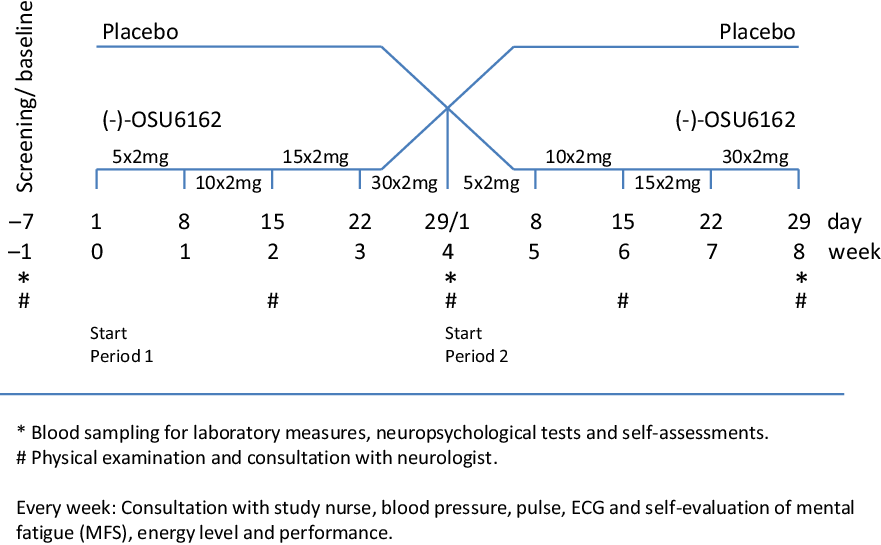
This was a double-blind randomised cross-over study comparing active substance to placebo. All participants received active drug, that is, (−)-OSU6162, and matching placebo, according to the predefined study scheme shown in Fig. 1. Total period of active substance treatment for each participant was 4 weeks. Patients were randomly assigned to start on either active substance or placebo. A start dose of 5 mg twice daily (in the morning and at noon) was given during the first week, with a dose increase to 10 mg × 2 during the following week, 15 mg × 2 during week 3, and 30 mg × 2 during the last week. Tablets of 5 and 15 mg, respectively, and matching placebo were used.
Illustration of study design.

The choice of doses was based on experiences from previous clinical trials; the present low doses were expected to be well tolerated with no significant side effects. The reason that we used lower doses in the present study compared to the previous mental fatigue study (Johansson et al., Reference Johansson, Carlsson, Carlsson, Karlsson, Nilsson, Nordquist-Brandt and Ronnback2012) was that we aimed to identify a threshold dose for therapeutic activity.
The dosage was individually flexible, meaning that if a person experienced alleviation of mental fatigue on a specific dose, and a dose increase resulted in decreased therapeutic effect and/or adverse events (AEs), the previous, lower dose was resumed and could be the final dose for that patient. This strategy was used to avoid missing a probable therapeutic window.
Randomisation and blinding
The randomisation was performed externally in agreement with CONSORT (Consolidated Standards of Reporting Trials) guidelines. Separate randomisation lists were used for TBI and stroke subjects.
Tablet packaging, as well as package and blister labelling and coding, were carried out by Galenica AB, Lund, Sweden. All packages and tablets were identical in appearance to ensure participants’ and involved investigators’ blindness to the treatment.
Efficacy outcomes
Primary end point was to investigate the therapeutic effects of (−)-OSU6162 as measured by the self-assessment questionnaires, with focus on the mental fatigue. Secondary end points were the results from the neuropsychological tests, with focus on information processing speed.
Self-assessment questionnaires: The Mental Fatigue Scale (MFS) (Johansson et al., Reference Johansson, Starmark, Berglund, Rodholm and Ronnback2010), Comprehensive Psychopathological Rating Scale (CPRS) for assessment of depression and anxiety (Asberg et al., Reference Asberg, Montgomery, Perris, Schalling and Sedvall1978; Svanborg and Asberg, Reference Svanborg and Asberg1994), and the Frenchay Activity Index (FAI) (Holbrook and Skilbeck, Reference Holbrook and Skilbeck1983). The FAI scale was divided into three domains: (1) Domestic domain (preparing main meals, washing up, washing clothes, light housework, and heavy housework), (2) Leisure/work domain (local shopping, walking outside more than 15 min, driving a car, and reading books), and (3) Outdoors domain (social outings, actively pursuing hobby, using public transports, and travel outings). Our own principal component analysis (PCA) modelling verified the relevance of this subgrouping within the FAI scale and it is to some extent similar to what was used in a previous study (Schuling et al., Reference Schuling, de Haan, Limburg and Groenier1993).
Neuropsychological tests: Digit symbol coding (information processing speed, subtest of WAIS-III (Wechsler, Reference Wechsler2003), Digit span (auditory working memory, subtest of WAIS-III), Letter verbal fluency, subtest of D-KEFS (Ellis et al., Reference Ellis, Kaplane and Kramer2001), Reading speed (Madisons, Reference Madisons2003), Trail making test (TMT A-B: visual scanning, divided attention and motor speed (Reitan and Wolfson, Reference Reitan and Wolfson1985); TMT C-D: higher demand dual tasks involving a greater extent of working memory and mental flexibility (Johansson et al., Reference Johansson, Berglund and Ronnback2009), Computer-based test with simultaneous demand on speed and working memory (Johansson and Ronnback, Reference Johansson and Ronnback2015).
The self-reports on MFS were performed every week throughout the study, and the other self-assessments were performed at the end of each treatment period as shown in Fig. 1. In addition, daily self-reports on mental energy and performance were made.
Safety outcomes
Safety monitoring comprised physical examinations and vital sign measurements, clinical laboratory measures, and reporting of AEs. Data from all included patients, whether they completed the study or not, were used for assessment of safety. Frequency and time points of efficacy and safety measurements are shown in Fig. 1.
Physical examinations, vital sign measurements (pulse and blood pressure) and electrocardiography (ECG) registration were performed in the morning 2–4 h after (−)-OSU6162 tablet intake. Echocardiography (UCG) was performed at screening and at the end of treatment period 2. Laboratory measures consisted of blood sampling – the samples were analysed for content of haemoglobin (Hb), erythrocyte volume fraction (EVF), serum-sodium (S-Na), serum-potassium (S-K), serum aspartate aminotransferase (S-ASAT), serum-alanine aminotransferase (S-ALAT), serum-alkaline phosphatase (S-ALP), leukocyte particle concentration (LPC), thrombocyte particle concentration (TPC), creatine, bilirubin, prolactin, and glycated haemoglobin (HbA1c).
Information on AEs was obtained from spontaneous reporting by the patients and by active questioning. The subjects could at any time report their AEs by phone to the responsible investigators. Registration of AEs and serious adverse events (SAEs) started on day 1 in treatment period one and lasted throughout the study and also included the follow-up visit 2–6 months after the study was completed.
Definition of AE: Any untoward medical occurrence in the patient or clinical trial subject administered a medicinal product and which does not necessarily have a causal relationship with this treatment.
A treatment-emergent adverse event (TEAE) is defined as any event not present prior to the initiation of the treatments or any event already present that worsened in either intensity or frequency following exposure to the treatments. TEAEs were identified using the medical history established at the screening visit and reports of AEs.
Drug concentration measurement
Blood samples were taken 1–2 h after last tablet intake the last day of respective treatment period (i.e. at the end of week 4 and 8), for determination of (−)-OSU6162 plasma concentrations. Plasma concentrations of (−)-OSU6162 were quantitatively determined by high-performance liquid chromatography/tandem mass spectrometry (see Tolboom et al., Reference Tolboom, Berendse, Leysen, Yaqub, van Berckel, Schuit, Ponsen, Bakker, Hoetjes, Windhorst, Carlsson, Lammertsma and Carlsson2015 for details).
Statistical analyses
Outcome measures were subjected to cross-over analyses (Altman, Reference Altman1991). The analysis was performed with nonparametric Wilcoxon two-sample test (Mann–Whitney U-test) by comparing the individual differences between assessments performed at week 4 and 8 for the two treatment sequences (‘OSU-plac’ and ‘plac-OSU’). The Hodges–Lehmann nonparametric method was used to calculate the magnitude of treatment effect and for construction of exact 95% confidence intervals for the treatment effect. The Hodges–Lehmann method is associated with the result of Wilcoxon linear rank statistic (see Hodges and Lehmann, Reference Hodges, Lehmann, Kotz, Johnson and Read1983; Hollander and Wolfe, Reference Hollander and Wolfe1999). The NPAR1WAY procedure in SAS 9.3 was used for calculations. Seventeen outcome measures were examined with cross-over analysis. Up to one statistically significant test (p < 0.05) would be expected on the basis of chance alone.
To compare the treatment effect between subgroups, the asymptotic interval midpoint and its standard error obtained from the Hodges–Lehmann estimation performed in each subgroup was used for construction of 95% confidence intervals for the difference.
McNemar’s test for paired proportions was used to evaluate if there were any differences in occurrence of AEs during the (−)-OSU6162 period compared to the placebo period.
Correlations were done with Spearman Rank correlation. Spearman’s Rho (Rs) is presented.
PCA was performed on differences between placebo and (−)-OSU6162 treatment for each individual. Differences were calculated for all total and subscale scores as well as for the single items from the rating scales and the neuropsychological tests, which resulted in a total of 57 variables for each patient. Pre-processing of data consisted of univariate scaling without mean centring. The significance of components was evaluated by means of cross-validation. To facilitate interpretation of plots, the signs on the responses of some variables were inverted so that decreased values always were associated with a positive treatment effect. Thus, the signs on the responses of FAI and neuropsychological tests (except for the TMT and computer test) were changed.
PCA is a multivariate projection method that extracts and highlights the systematic variation in a data matrix. The original set of variables is reduced into a smaller set, commonly referred to as latent variables or principal components, where the first principal component is coincident with the maximum variance direction in the data. The analysis gives an overview of trends and patterns and uncovers relationships among observations and variables. The result of the PCA analysis is presented as a two-dimensional projection score plot and a corresponding loading plot. The score plot gives an overview of relationships among the observations and the loading plot adds information about which variables are responsible for the pattern seen.
Results
Participant characteristics, dosing, and disposition
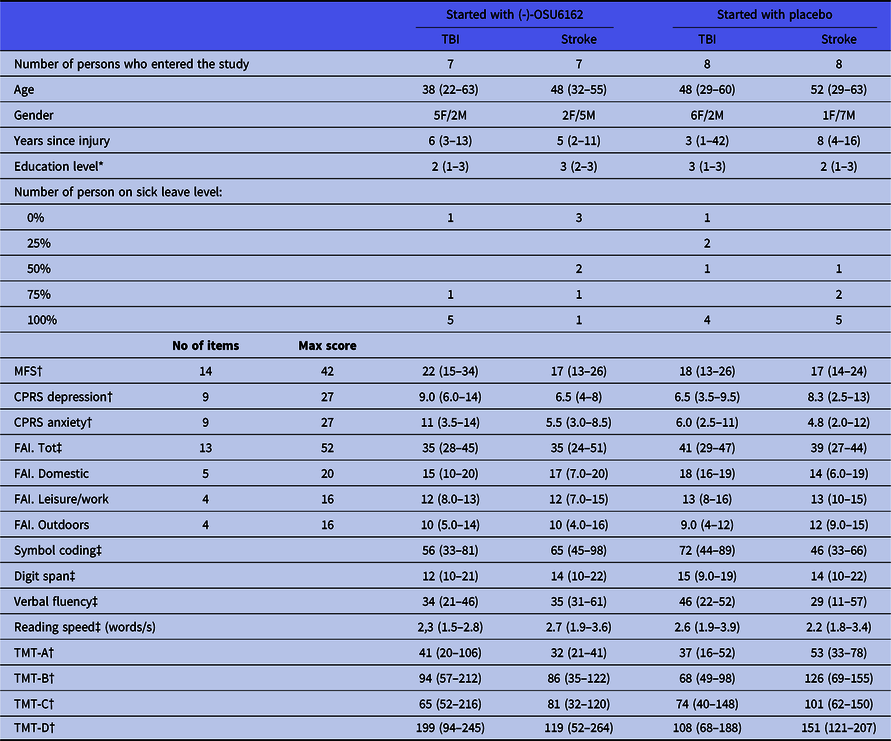
Our total sample comprised 14 women and 16 men, ranging in age from 22 to 63 years. Fifteen participants had suffered a stroke and 15 a TBI; median number of years elapsed since injury was 7 years (range 1–42). Of the total sample, 47% had a university degree or higher, and another 40% had upper secondary school degree. A majority (73%) of participants had a partner. Half of the participants (50%) were employed and 83% were on varying degrees of sick leave. Demographic and baseline characteristics are shown in Table 1. There were no differences in demographics or baseline data between the two treatment sequences or between stroke and TBI patients.
Demographic and baseline characteristics. Shown are quantity or median (range)

MFS cut-off score 10.5 (Johansson, B and Rönnbäck).
CPRS depression: Mild depression between 6.6 and 9.5, moderate between 10 and 17, and severe ≥17.5 (Snaith, R.).
No cut-off for CPRS anxiety exists.
* 1 – Primary school, 2 – Upper secondary school, 3 – University.
† Low value is desirable.
‡ High value is desirable.
Of the 30 participants included in the study, 16 were allocated to start with placebo and 14 with (−)-OSU616. Twenty-six out of the 30 participants followed the predefined study scheme of escalating doses and ended up with the final dose of 30 mg × 2 per day (or corresponding placebo dose). Two participants discontinued during period 2 at their own request; one participant discontinued after week 4 while on placebo treatment and the other discontinued after week 5 while on (−)-OSU6162 treatment. For another two participants, the dose was reduced (in agreement with the flexible dosing regime, see above), in one case during (−)-OSU6162 treatment (final dose 15 mg × 2) and in the other case during placebo treatment.
Efficacy evaluation
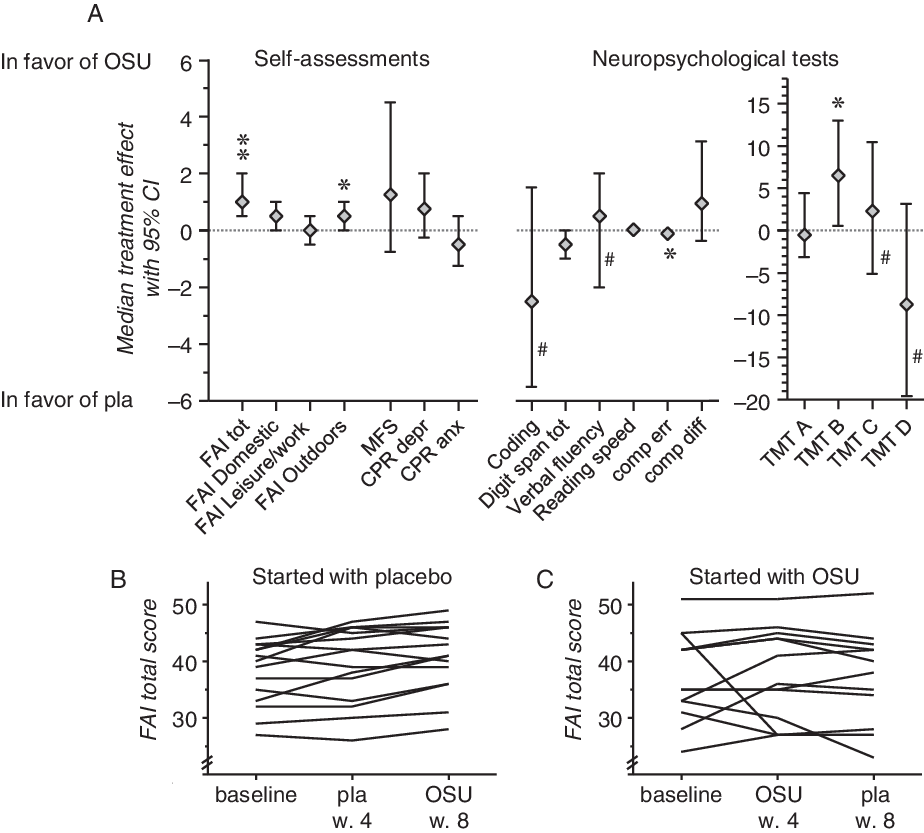
Among the self-assessment questionnaires, FAI showed significant differences in total scores and outdoor scores in favour of (−)-OSU6162 treatment (Fig. 2A). The patients’ median FAI total scores after 4 weeks on OSU6162 treatment were one unit higher than after 4 weeks on placebo (95% CI 0.5 to 2; p = 0.0097); the subscale FAI outdoors differed with 0.5 units (95% CI 0 to1; p = 0.0243). Individual FAI total scores plotted at each test occasion are shown in Fig. 2B and C.
Median effects on self-assessments and neuropsychological tests and individual FAI total scores. (A) Median and exact 95% confidence intervals for the treatment effect for all self-assessment scales and neuropsychological tests. (−)-OSU6162 treatment caused significant improvements on total Frenchay Activity Index (FAI) score, FAI outdoors sub-score, Trail making test (TMT-B), and an increased error rate on the computer test; *p < 0.05 and **p < 0.01. #p < 0.01 for significant period effect (Mann–Whitney U-test). (B and C) Individual Frenchay Activity Index (FAI) total scores at baseline, end of period 1, and end of period 2. High values on FAI are desirable.

Among the neuropsychological tests, there was a statistically significant treatment effect with respect to TMT-B; the median TMT-B performance was 6.5 seconds faster during (−)-OSU6162 treatment than during placebo treatment (95% CI 0.55 to 13; p = 0.0325). In the computer test, a negligible number of more errors was observed during (−)-OSU6162 treatment (0.13 errors with 95% CI 0 to 0.25; p = 0.0376). Fig. 2A shows median treatment effects with exact 95% confidence intervals for all efficacy outcomes.
No significant carry-over effect could be demonstrated for any scale/test (p-values between 0.18 and 0.9), but a period effect was found for coding, TMT-C, TMT-D, and reading speed (p = 0.003, p = 0.005, p = 0.008, and p = 0.002, respectively); in other words, on these tests, a majority of patients showed improved test results on the second test occasion, independent of treatment order, indicating a learning effect.
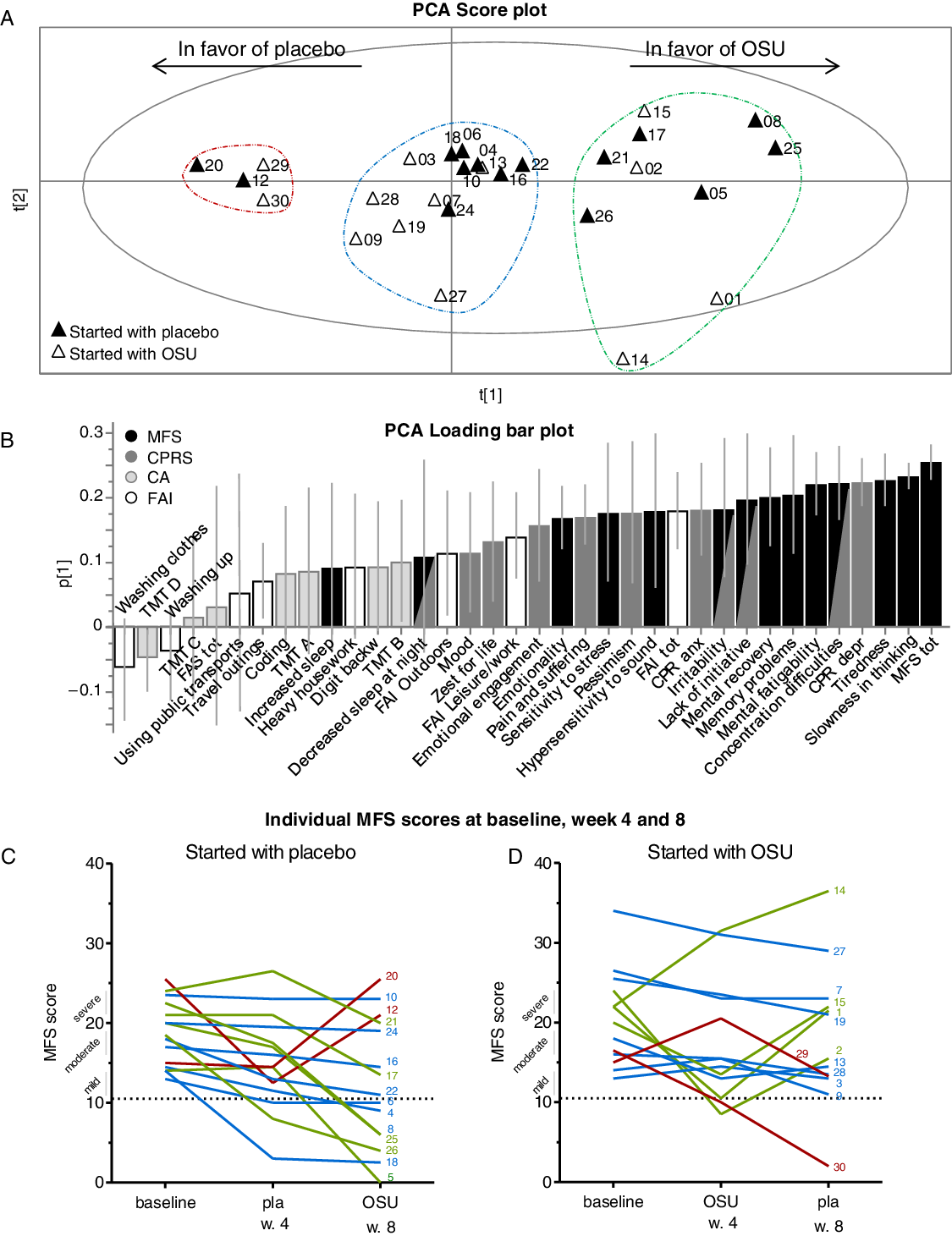
To get an overall picture of the treatment response, taking into account all efficacy variables at the same time, a PCA was conducted. The model included data from all participants who completed the study and comprised changes in total and subscale scores as well as changes in the single items from the rating scales and the neuropsychological tests. The PCA score plot (Fig. 3A) shows that the patients seem to cluster into three groups; 10 patients, located at the far right, had a clearly better overall symptom reduction during (−)-OSU6162 treatment than during placebo treatment. Four participants had clearly better symptom reduction during placebo, and the remaining group, located around origin, showed modest effects in either direction. The loading bar plot shown in Fig. 3B shows which variables are most responsible for the pattern seen in the PCA score plot; variables are sorted by importance. It can be seen that those who responded best to (−)-OSU6162 treatment were found to be most improved on the MFS total score, the single items ‘Slowness in thinking’ and ‘Tiredness’, the CPRS depressive total score, the single items ‘Concentration difficulties’, ‘Mental fatigability’, ‘Memory problems’, ‘Mental recovery’, ‘Lack of initiative’, and ‘Irritability’ (in decreasing order); these listed items are included in the MFS. ‘Concentration difficulties’, ‘Lack of initiative’, and ‘Irritability’ are included in both MFS and CPRS but are subjected to the different statistical analyses one time only. Thus, the PCA analysis indicates that the subgroupings are most likely primarily due to the patients’ different responses on the MFS scale. Fig. 3C and D shows the individual responses to treatment on MFS total score (ratings at baseline, at end of period 1 (week 4) and period 2 (week 8)). Lines are coloured in accordance with the colouring of marked subgroups in the PCA score plot. The 10 clear (−)-OSU6162 responders (in green; the outlier #14 included) were found to have 4–14.5 points lower MFS total scores during (−)-OSU6162 treatment than during placebo treatment; median difference between treatment periods for these participants was 8 points.
PCA score plot and individual responses to treatment. (A) Principal component analysis (PCA) score plot based on the differences in outcomes between placebo and (−)-OSU6162 treatment period. Each number represents an individual. Dashed circles indicate the distinct subgroups; green: clear (−)-OSU6162 responders, blue: individuals with modest effect, red: clear placebo-responders. (B) Corresponding PCA loading bar plot illustrating the influence of the single variables included in the PCA analysis. Variables are sorted by importance. (C and D) Individual total scores on the Mental Fatigue Scale (MFS) at baseline and at end of period 1 and period 2. Line colours are in accordance with the colouring of marked subgroups in (A). MFS cut-off score of 10.5 points is marked with a black dotted line.

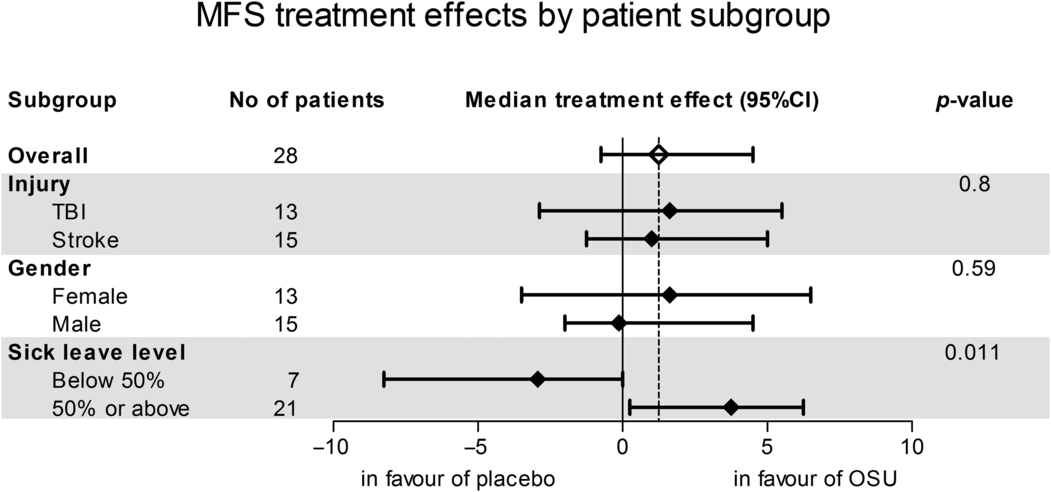
In contrast to our former mental fatigue study with (−)-OSU6162 where the dosage was higher (Johansson et al., Reference Johansson, Carlsson, Carlsson, Karlsson, Nilsson, Nordquist-Brandt and Ronnback2012), the present follow-up study did not show a significant treatment effect with respect to MFS outcome [median and 95% CI for the difference: 1.25(−0.75 to 4.5); p = 0.29)]. Nevertheless, the PCA revealed a differential response on MFS with a subgroup of patients responding well to treatment. Exploratory subgroup analyses showed a significant difference in treatment response depending on the patients’ sick leave level (p = 0.011 for the difference in treatment responses between subgroups; the difference was 7.38 points, 95% CI: 1.38 to 13.4). Patients on sick leave level between 50% and 100% showed a median treatment effect on MFS of 3.75 units, (95% CI 0.25 to 6.25) in favour of OSU6162 treatment, compared to −2.94 units, 95% CI (−8.25 to 0.0) in patients on sick leave level below 50%. The subgroup analyses did not show any differences in response on MFS between stroke and TBI patents or between males and females. The three subgroup analyses performed are illustrated in Fig. 4. A baseline subgroup difference in MFS total score related to sick leave level could not be demonstrated, but correlational analyses revealed a weak positive relationship between baseline MFS total score and sick leave level (R s = 0.377; p = 0.048). A similar positive correlation between sick leave level and (−)-OSU6162-induced MFS total score decrease was found (R s = 0.411; p = 0.030). No correlation was found between age/education level/years since injury/(−)-OSU6162 plasma concentration and treatment-related MFS total score change.
Mental Fatigue Scale (MFS) treatment effects by patient subgroups. There was a significant difference in treatment response depending on the patients’ sick leave level (p = 0.011).

Average (−)-OSU6162 plasma concentration for the active treatment period measured in blood samples taken 1–2 h after last tablet intake the last day of respective treatment period was 0.832 µmol/l (sd 0.309; range 0.262–1.430); average plasma concentration for those who completed the study was 0.729 µmol/l (sd 0.314; range 0.262–1.430).
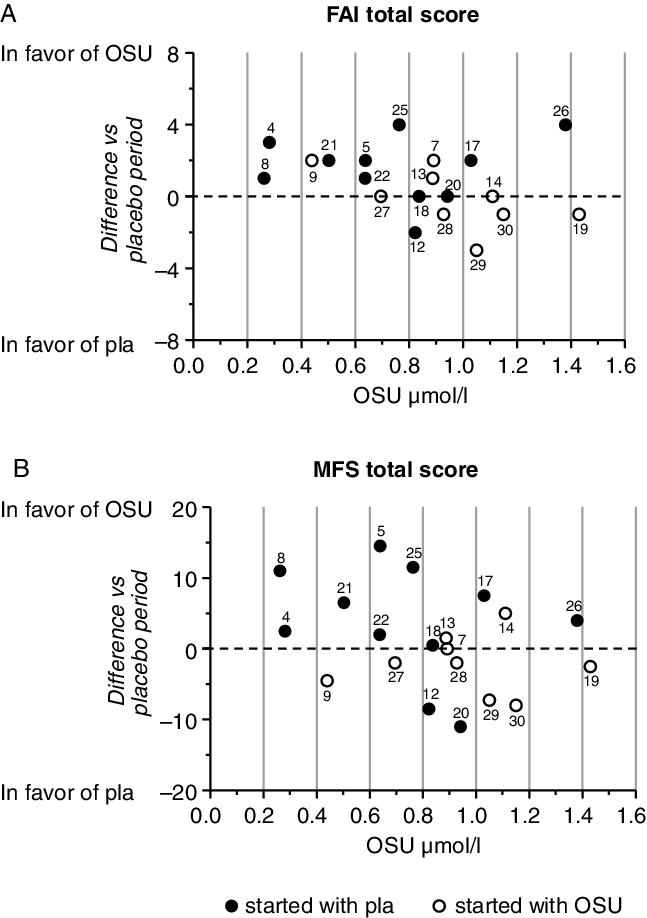
Scatter plots of differences between placebo and (−)-OSU6162 periods in FAI and MFS total scores plotted against (−)-OSU6162 plasma concentrations (data missing for 8 patients) are shown in Fig. 5. The plots indicate responses in favour of (−)-OSU6162 treatment primarily at blood concentrations up to 0.7–0.8 μmol/l. Higher concentrations seem to result in increased variability in the response with a higher proportion of individuals showing better symptom reduction during placebo than during (−)-OSU6162 treatment. It can also be seen in Fig. 5A and B that there appeared to be a differential response depending on whether the patients started with placebo or with (−)-OSU6162. Those patients who started with placebo and had plasma concentrations below 0.8 µM showed a more clear-cut therapeutic response to (−)-OSU6162 in relation to placebo than those patients who started with (−)-OSU6162 and had plasma concentrations above 0.8 µM; among those patients with (−)-OSU6162 concentrations below 0.8 μmol who started on placebo, all (six out of six) were improved on both FAI and MFS.
Scatter plots on differences in scores between placebo period and (−)-OSU6162 period plotted against plasma (−)-OSU6162 concentration for (A) FAI total score (B) MFS total score.

Safety evaluation
Vital signs, ECG, and results from physical examinations were normal and showed no changes during the course of the study; likewise, UCG was normal before as well as after completion of the study.
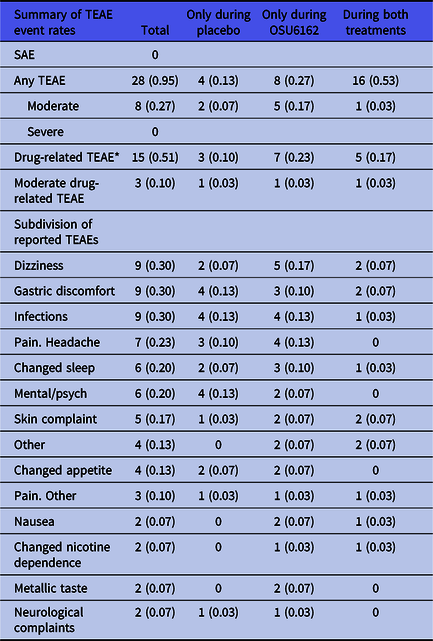
Table 2 summarises TEAEs and SAEs. There were no SAEs reported during the study. All reported TEAEs were mild or moderate in severity. Eight individuals experienced TEAEs exclusively during active substance and four individuals experienced TEAEs exclusively during placebo. Eight participants reported a moderate level of TEAEs, two exclusively during placebo (gastric discomfort and mental complaints, respectively), and five exclusively during active substance (skin complaint, infection, mental complaint, nausea, and headache). Of these TEAEs at moderate level, one was assumed to be related to (−)-OSU6162 treatment. The most common AEs reported during the study were dizziness, gastric discomfort, and infections. During active substance treatment, dizziness was most common and reported by 17% of participants, followed by infections and headache (13%, respectively). The corresponding distribution during placebo treatment was 7% for dizziness, 13% for infections, and 10% for headache. There were no significant associations found between occurrence of AEs and treatment.
Treatment-emergent adverse events. Shown are number of participants reporting one or more events during given treatment periods. Total n = 30. Proportion of afflicted participants is given in brackets

* Relation: possible or definitely.
For laboratory assessments, there were differences between placebo and (−)-OSU6162 treatment for EVF and Hb, and prolactin (p = 0.012, p = 0.004 and 0.006, respectively). 95% confidence intervals for each variable at any treatment period were within normal range.
Discussion
In the present study in patients suffering from mental fatigue following stroke or TBI, the most obvious beneficial effects of (−)-OSU6162 were on the patients’ activity level, illustrated by the improvement on the FAI scale and the FAI outdoors subscale. The improvements indicate that patients during (−)-OSU6162 treatment gained more energy, enabling engagement in activities such as social outings and hobbies and other activities of daily living. These are important improvements as they substantially increase the quality of life for this patient group.
Moreover, a subgroup of patients showed improvements on the MFS during the period of (−)-OSU6162 treatment; the largest effects were seen on the items ‘slowness in thinking’ and ‘tiredness’. The differential effect on the MFS was related to the patients’ sick leave level in that patients with the highest level of sick leave benefitted most from the treatment. A possible explanation for this finding could be that those on a higher level of sick-leave, not working or working part-time, could to a greater extent adjust their daily activity level by their own choice, thereby enabling them to more effectively take advantage of the energising effects of (−)-OSU6162. Those working full time or 75% of full time were undoubtedly exposed to a higher mental demand during the study (we know from clinical experience that being at work is generally extremely energy demanding for persons suffering from mental fatigue).
More than 30% of the participants responded well to (−)-OSU6162 treatment, as reflected by, for example, an improvement on the MFS. This is in line with expectations and comparable to what was seen in a study with methylphenidate to alleviate mental fatigue after a TBI (Johansson and Ronnback, Reference Johansson and Ronnback2014).
In agreement with previous experience, the tolerability to (−)-OSU6162 was good. An expected AE, based on observations in previous studies (Rodriguez et al., Reference Rodriguez, Azie, Adams, Donaldson, Francom, Staton and Bombardt2004; Nilsson et al., Reference Nilsson, Zachrisson, Gottfries, Matousek, Peilot, Forsmark, Schuit, Carlsson, Kloberg and Carlsson2018), was a moderate increase in serum prolactin concentrations during the (−)-OSU6162 period, in all likelihood reflecting blockade of pituitary dopamine D2 receptors. On the whole, AEs did not differ between the (−)-OSU6162 and the placebo period.
There was no correlation between (−)-OSU6162 plasma concentration and MFS total score change. However, a closer inspection of the data revealed that (−)-OSU6162 plasma concentrations still appeared to play a role for the therapeutic response inasmuch as patients with plasma concentrations below 0.8 µM that seemed to respond better to (−)-OSU6162 treatment than patients with plasma concentrations above 0.8 µM. This is a pattern we have observed previously in a clinical trial in patients with myalgic encephalomyelitis (Nilsson et al., Reference Nilsson, Zachrisson, Gottfries, Matousek, Peilot, Forsmark, Schuit, Carlsson, Kloberg and Carlsson2018) and it could be explained by the dual actions of (−)-OSU6162: Due to its preference for presynaptic autoreceptors and low affinity for postsynaptic receptors, low plasma concentrations lead to preferential dopamine autoreceptor blockade and thereby enhanced dopamine release and behavioural activation, whereas higher plasma concentrations also block heteroreceptors – in all likelihood mainly extrasynaptic rather than synaptic heteroreceptors – leading to behavioural inhibition (Carlsson et al., Reference Carlsson, Carlsson and Nilsson2004; Tolboom et al., Reference Tolboom, Berendse, Leysen, Yaqub, van Berckel, Schuit, Ponsen, Bakker, Hoetjes, Windhorst, Carlsson, Lammertsma and Carlsson2015).
Another observation we made in the present study is related to the order in which patients received (−)-OSU6162 versus placebo: The group starting with placebo seemed to respond better to (−)-OSU6162 treatment than the group starting with (−)-OSU6162. This raises the question whether we are, in spite of a statistical test failing to show so, dealing with carry-over effects. This is probably true for at least four of the patients (no 19, 27, 28, and 30) who responded to treatment during the first period while on (−)-OSU6162 and continued to respond during the subsequent placebo period. Supporting the notion of carry-over effects is that also in previous cross-over studies (Johansson et al., Reference Johansson, Carlsson, Carlsson, Karlsson, Nilsson, Nordquist-Brandt and Ronnback2012; Kloberg et al., Reference Kloberg, Constantinescu, Nilsson, Carlsson, Carlsson, Wahlstrom and Haghighi2014), we have made the observation that patients starting with placebo displayed a more clear-cut response to (−)-OSU6162 treatment compared to those starting with (−)-OSU6162. If present, a pharmacological carry-over would lead to an underestimation of the therapeutic effects. It should be pointed out in this context that tests for carry-over are known to have low power.
In our previous mental fatigue study, the most pronounced improvement was on the MFS scale. In Johansson et al. (Reference Johansson, Carlsson, Carlsson, Karlsson, Nilsson, Nordquist-Brandt and Ronnback2012), we did not report any statistics on FAI since there were no statistical significances, but calculations performed in the same way as in the present study show tendencies to improvements on FAI in the previous study [FAI tot; median and 95% CI for the difference: 1.5 (0 to 4.5) p = 0.095, FAI Leisure/work: 0.5 (0 to 1) p = 0.053]. This difference in emphasis between the two studies with respect to effects on MFS versus FAI may be due to the different dosing regimen, the present study using somewhat lower doses. We also saw a greater placebo response on MFS during the first period in this study compared to the former which might have reduced the estimated treatment response.
In future studies, it would be valuable to investigate the effect of (−)-OSU6162 using a parallel group design to eliminate concern about possible carry-over effects. A longer study duration would also be preferable as this might reduce the influence of a potential placebo response, even if this is not always the case; moreover, we have preliminary data from an open study in post stroke patients showing that the therapeutic response increases with time (at least up to week 12; unpublished observations).
In summary, the improvement observed in the present study in the patients’ activity level, as measured by the FAI scale, as well as the improvement on the MFS in a subgroup of patients, suggest that (−)-OSU6162 may offer a possible treatment strategy for certain symptoms in patients suffering from mental fatigue following stroke and TBI. A major advantage in this context is the favourable safety and tolerability profile of (−)-OSU6162. The results from this and our former study suggest that an optimal dose might be between 60 and 90 mg/day. However, for longer-term treatment/studies, a lower dose might suffice as the therapeutic response seems to increase with time up to a certain time point; moreover, it is important that the dosage is individualised and flexible.
Authors’ contributions
Authors’ Contribution: MC, BJ, and LR took part in the study design. BJ and LR performed the clinical evaluation. RS carried out the high performance liquid chromatography analysis. MN performed the statistical evaluation. All authors contributed to the interpretation of data. MN, MC, BJ, and LR wrote the manuscript draft, which was critically revised and finally approved by all authors.
Financial support
This work was supported by the Arvid Carlsson Foundation, the Foundation for Neuropharmacological Research and Education and Västra Götalandsregionen.
Conflict of interest statement
None.
Ethical standards
The study was performed in accordance with the version of the Helsinki Declaration of 1975, revised in 2008, and the International Conference on Harmonisation (ICH) guidelines on Good Clinical Practice (GCP). The study protocol and the patient information sheets were reviewed and approved by the regional ethics committee in Gothenburg before the study began.