Introduction
The age of global migration raises difficult challenges for traditional conceptions of social citizenship and the role of the welfare state in processes of migrant integration. At one level, political battles are being waged concerning the legitimate community of welfare receivers, the justification of inclusionary and exclusionary measures, and the set of rights and duties attached to social citizenship for non-nationals in national contexts. At the supranational level, social and political entities like the EU stimulate migration flows and foster integrative processes that broaden the scope for social rights claims (Soysal, Reference Soysal1994), yet the effective realisation of those rights claims remains essentially grounded in national institutions and structures (Faist, Reference Faist2001). Within individual states, the political debate on migration has often been coloured by underlying assumptions concerning migrant intentions and behaviours in the face of generous Western welfare state incentive structures. Often, this has amounted to charges of welfare tourism or welfare ‘dependency’, and simplistic moral hazard assumptions when it comes to welfare recipiency. The new economic constraints facing nation states in light of the global financial crisis ensure that migrant ‘welfare dependency’ will remain a divisive, if not explosive, political issue well into the future, with scope for both social unrest – witness the ‘British Jobs for British Workers’ marches or the racist attacks on the Roma community in Northern Ireland in mid-2009 – and the rise of far-Right political parties.
How states engage these political debates and what states assume about migrant intentions and motivations undoubtedly have a bearing on migrant experiences in the host country. Morissens and Sainsbury (Reference Morissens and Sainsbury2005) find evidence that legally resident migrants’ experiences of social citizenship in five European countries, in terms of poverty outcomes and access to welfare, fall far short of what citizens in those same countries can expect. Systematic disadvantage in terms of social citizenship is likely to entail highly undesirable consequences for migrant integration more broadly, with socio-economic disadvantage potentially fostering ‘oppositional cultures’ (Portes, Reference Portes1997), ‘segmented assimilation’ (Portes and Zhou, Reference Portes and Zhou1993) or other differential integration outcomes which may lead to social stratification or division.
The matter of apposite migrant social policy – which fosters integrative as opposed to disintegrative processes and is appropriately informed by empirical evidence concerning migrant utilisation of the state welfare system – thus presents itself as an issue of pressing concern for both policy-makers and society at large. Yet systematic comparative research on migrant interactions with the welfare state raises difficult challenges for the researcher, and previous studies have been limited by these difficulties and by other conceptual shortcomings.
This article aims to address some of these difficulties by utilising a rare confluence of factors highly favourable to comparative research in order to assess how similar migrant cohorts react to the incentives offered by relatively more and less generous welfare states in terms of welfare utilisation and labour market attachment. The focus will be on two EU countries with large recent inflows of EU migrants: Ireland and Britain.Footnote 1 Another key aim of the article is to add depth and nuance to this discussion by demonstrating the utility of disaggregating the concept of ‘welfare dependency’, a conventional but unexamined categorisation in the literature, into component parts capturing the conceptual and empirical differences between ‘usage’ of state-provided welfare to varying degrees, mere ‘participation’ in the welfare system, and absolute ‘dependency’ on state-provided welfare.
The findings have implications for migrant social rights in so far as they bear directly on how policy-makers conceive of migrant intentions in the face of welfare state incentives, and thus on how migrants are subsumed into both welfare state structures and into broader societal debates around social citizenship. Do relatively more generous welfare states engender outcomes in line with moral hazard arguments, such as higher levels of welfare usage and dependency? Or is the situation a more complex and nuanced work−welfare trade off than such reductionist accounts would admit? The findings indicate not only that the situation is more complex than has been previously argued, with moral hazard accounts finding little support here, but that migrants themselves play an active role in the definition of their place within the labour market/welfare system nexus in a manner which raises questions about conventional nation state conceptions of what migrant social citizenship should be. The next section discusses the justification for the comparison undertaken and the research design.
Comparing Ireland and Britain
A major challenge for comparative work on migration generally is the difficulty of holding constant in the experimental design some of the many sources of extraneous variance. Heterogeneity of migrant cohorts, variations in types of incorporation regime, and variations in welfare eligibility rules for different migrant sub-groups (for example, EU versus non-EU), all increase the difficulty of undertaking valid comparisons and drawing robust inferences. So, any comparative account of Ireland and Britain profits from the fact that these two countries share so many similarities pertinent to any discussion of inward migration: both are English-speaking, thus providing the same incentives to migrants who may be interested in language acquisition as a human-capital good in itself; both are members of the EU and thus observe the same rules regarding free movement of labour for citizens of other member-states; both shared a high demand and capacity for labour at the time of EU expansion (FÁS, 2006; Pollard et al., Reference Pollard, Latorre and Sriskandarajah2008), producing comparable pull factors across both jurisdictions, and both labour markets share similarly high levels of flexibility (Kogan, Reference Kogan2006); both share broad cultural similarities and very similar modes of politico-legal organisation. Most importantly, both differ on the institutional aspect of central relevance here: the incentive structures in terms of welfare generosity that pattern migrant intentions towards welfare utilisation. The logic of comparison at work is one of ‘most similar systems’, which seeks to hold confounding variables constant while maximising experimental variance on the variable of interest (Dogan and Pélassy, Reference Dogan and Pelassy1990; Peters, Reference Peters1998).
Ireland and Britain were two of only three countries (along with Sweden) which placed no limitations on labour market access for citizens of the Accession states following EU enlargement in 2004. Both received large influxes of migrants from these countries in the following two years, with Ireland increasing its total population share of non-nationals from 7 per cent to 10 per cent from 2002 to 2006 (Barrett and McCarthy, Reference Barrett and McCarthy2007) while Britain's net population of Accession-country migrants increased by over half a million from 2004 to 2008 (Pollard et al., Reference Pollard, Latorre and Sriskandarajah2008). In Ireland, nationals from the EU25 accounted for more than 88 per cent of the employment growth of non-Irish workers after enlargement (up to mid-2006), and migrants from the Accession states accounted for almost half of the total foreign workforce in Ireland in 2008 (OECD, 2008: 250), while more than three-quarters of all migrants of working age hail from the EU25 (CSO, 2006). With the economic downturn the proportion of migrants unemployed in Ireland grew substantially, from 12.9 per cent of total unemployed in July 2007 to 18.5 per cent in July 2009; this latter figure is disproportionate to overall migrant representation in the labour force of 15.6 per cent in 2009 (CSO, 2009). Unfavourable employment conditions may lead to return migration such as has been observed in Britain, with 200,000 migrants predicted to have returned in 2008 (Finch et al., Reference Finch, Pollard, Latorre and Rutter2009), although it appears that migrants in Ireland initially chose to remain while they suffered job losses (ESRI, 2009).
Rules around welfare receipt for EU migrants are similar in both countries, with some benefits conditional on employment – for example, child benefit – and other benefits accruing after a set period of time in employment has elapsed (the ‘habitual residence condition’): two years in Ireland and one year in Britain (DSFA, 2009a; HMRC, 2009a, 2009b). Both national governments imposed this condition in 2004 with the explicit aim of protecting the state welfare system from abuse or ‘benefit tourism’ by EU-Accession migrants (Doyle et al., Reference Doyle, Hughes and Wadensjö2006; Larkin, Reference Larkin2005). At the same time that the Irish electorate voted overwhelmingly in favour of a referendum proposal removing the right to jus soli citizenship for children born of immigrant parents, certain welfare entitlements were, for the first time, linked directly to citizenship (Fanning and Mutwarasibo, Reference Fanning and Mutwarasibo2007). Eurobarometer attitude surveys have shown that majorities of those polled in both countries believed that migrants abused the social benefits system (Crepaz, Reference Crepaz2007: 71), something which was unlikely to be helped by rare but high-profile news stories such as the case in Ireland where a group of Polish nationals were allegedly flying in on a monthly basis to claim welfare benefits before returning to Poland (O'Brien, Reference O'Brien2007). Thus, moral hazard assumptions have been very much in evidence both at the level of governmental policy-makers and in public and political discourse more broadly.
Motivating the relative generosity aspect of this comparative study, recent research has demonstrated that Ireland's welfare system is both more generous than Britain's, offering higher replacement rates for unemployment and sickness benefits, and also more encompassing, covering 100 per cent of the labour force for these two benefits, in 2002, compared to Britain's lower 86 per cent coverage (Scruggs, Reference Scruggs2006: 359; Scruggs and Allan, Reference Scruggs and Allan2006). Ireland's universally mandated child benefit payment has also in recent years been significantly more generous than Britain's (DSFA, 2009a; HMRC, 2009a). These differences obtain despite the usual (though not uncontested) inclusion of Ireland in the ‘Liberal’ welfare regime alongside Britain (Esping-Andersen, Reference Esping-Andersen1990; Cousins, Reference Cousins1997; Abrahamson, Reference Abrahamson1999).
This study focuses on cash benefits only, as does the research on welfare generosity by Scruggs and Allan (Reference Scruggs and Allan2006), for both theoretical and practical reasons. While other elements of the welfare system, such as differences in public service provision, arguably constitute an important part of the welfare incentive structure, the similarities between Ireland and Britain in the provision of these services (for example, Ireland has a universal public healthcare system with some private elements, broadly comparable to Britain's NHS) mean that any potential effect of services on migrant behaviours has been ‘held constant’ in the comparison. The data used in this study contain no information on migrant utilisation of public services, but, where appropriate data become available, future research could focus on the role services might play in the determination of migrant interactions with welfare systems.
As all non-EU migrants face more stringent eligibility criteria for welfare than EU citizens, this article attempts to limit its analysis to migrants of primarily EU origin, although there are some data limitations in this regard which are discussed below. Some migrants, depending on country of origin, face insuperable legal obstacles to welfare system entry, with non-EU migrants to Britain, for example, disbarred from claiming benefits at all and thus entirely reliant on the labour market (HMRC, 2008b). Limiting the analysis to migrants of primarily EU origin ensures a workable similarity and comparability of migrant cohorts, which should allow robust inferences to be drawn from reported empirical outcomes, allowing us to ascribe likely cause to institutional, welfare system, factors (cf. Kogan, Reference Kogan2003; Bloemraad et al., Reference Bloemraad, Korteweg and Yurdakul2008).
Previous research
Borjas has explored many facets of migrant interactions with the welfare system in the American context. He advances a theory of ‘negative self-selection’ which holds that migrants will have below-average earnings in both source country and host country, if the correlation between the return to skills in the two countries is high and if the dispersion in the earnings distribution is higher in the source than in the host country (Borjas, Reference Borjas1994: 1689). Social transfers in Western welfare states will tend to result in less dispersed earnings distributions than in many potential source countries (Nannestad, Reference Nannestad2007: 515). Hence Borjas expects immigration into Western welfare states, which usually involves less-developed source countries, to consist predominantly of negatively self-selected individuals: that is, those with below-average skill-levels relative to mean skill-levels in both source and host countries. An application of this stylised micro-economic model of migrant behaviour is the ‘magnet effect’, which holds that migrant relocation decisions are influenced by the relative generosity of welfare states, a theory for which Borjas (Reference Borjas1999) finds some empirical support in terms of migrant settlement and clustering in high-benefit areas of the US, although the results were on the margin of significance.
Implicit in this ‘welfare magnet’ theory are certain assumptions concerning migrant behaviour in the face of differential incentives due to welfare system generosity. Indeed, it is clear that, following relocation, migrants find themselves embedded in a network of incentives and constraints determined by the social, political and institutional configuration of the host country. These incentives are similar to those faced by all inhabitants of modern welfare states, where some degree of moral hazard is unavoidable (Okun, Reference Okun1975; Sinn, Reference Sinn1995), but incentives towards moral hazard are possibly greater for migrants given migrant-specific integration costs, which may lead some to opt, rationally, to maximise their income by means of social transfers and not through the labour market (Nannestad, Reference Nannestad2007). If such processes obtain, then we might anticipate certain observable post-migration outcomes: similar migrant groups will be expected to react differently to dissimilar institutional contexts, with migrants in a high-generosity welfare context expected to exhibit higher levels of welfare dependency than comparable migrants in a low-generosity context.
Such a gap in welfare dependency of migrants and natives was detected in the US by Borjas and Hilton (Reference Borjas and Hilton1996), who state that the difference in probabilities of receiving cash transfers was small but positive for migrants over natives; however, this gap widened to 7 per cent when other forms of social assistance were included. Similarly, Borjas and Trejo (Reference Borjas and Trejo1991) found that migrants retained an average level of welfare usage higher than that of natives. In Europe, Brücker et al. (Reference Brücker, Epstein, McCormick, Saint-Paul, Venturini, Zimmermann, Boeri, Hanson and McCormick2002) found a marginally significant correlation between welfare generosity and the gap in migrant-native dependency on welfare (unemployment) benefits after controlling for characteristics. Castronova et al. (Reference Castronova, Kayser, Frick and Wagner2001) found, for Germany, that despite migrants’ higher eligibility for welfare benefits given their income levels and household size, they were no more likely than natives to enter into receipt of welfare. These studies compare migrants only with natives in the host country. A rare example in the literature of an explicit migrant−migrant comparison is Kogan's (Reference Kogan2003) study, which assessed outcomes for similar groups of migrants, ex-Yugoslavs, in two different countries, finding that welfare availability depressed labour force participation in Sweden compared with Austria.
Looking specifically to the countries considered here, recent research finds a lower probability of migrants in Ireland being in receipt of any form of cash benefit, relative to natives, and concludes that migrants do not appear to be a ‘burden’ on the Irish welfare state (Barrett and McCarthy, Reference Barrett and McCarthy2007, Reference Barrett and McCarthy2008: 555). The same authors also found a higher probability of welfare receipt for migrants in the UK relative to natives, controlling for characteristics (Barrett and McCarthy, Reference Barrett and McCarthy2008), although the high degree of heterogeneity in the migrant sample in Britain severely limits the possibilities of generalising from this finding. The latter finding stands in contrast to Brücker et al. (Reference Brücker, Epstein, McCormick, Saint-Paul, Venturini, Zimmermann, Boeri, Hanson and McCormick2002), who found no significant migrant−native welfare gap (for unemployment benefits) in the UK.
This article questions some of the unexamined assumptions that have underpinned many of these previous studies, especially concerning questions of welfare usage and welfare ‘dependency’. It is maintained here that questions of whether or not migrants are in receipt of social transfer payments are ultimately of less interest than questions concerning how migrants use those transfers, in possible combination with income earned in the labour market so as to maximise individual welfare, in the broader sense of that term.
Modern welfare states, certainly those of Ireland and Britain, often mandate universal forms of payment so individuals may receive welfare assistance in addition to their earnings. Also, both Ireland and Britain allow part-time workers to claim welfare benefits, and both systems provide employment supports such as Ireland's Family Income Supplement, a weekly tax-free payment to families at work on low pay (DSFA, 2009b). Hence, labelling welfare use as welfare ‘dependency’ can be misleading, and to use the condition of receiving any form of payment as the dependent variable, as in many of the above studies, is to conceal a wealth of interesting and instructive variation. Welfare utilisation is disaggregated here into three dependent variables:
• Usage of welfare, denoting the proportion of an individual's income package comprised of cash social transfers;
• Participation in welfare, denoting receipt of any form of social transfer payment, the standard dependent variable used in studies on this topic;
• Dependency on welfare, precisely identifying those whose income is comprised entirely of state-provided social transfers.
Hypotheses
A key concept in studies of the welfare state is that of decommodification, or the extent to which individuals can maintain a livelihood without reliance on the market (Esping-Andersen Reference Esping-Andersen1990). Highly decommodifying states offer generous social assistance to their citizens such that the necessity to sell one's labour in the jobs market is removed or attenuated, and opting out of the labour market may be both economically rational and desirable for given individuals. The standard economic view of migration sees migrants as rational utility maximisers, usually moving from poor to wealthy countries and thus more likely to have lower reservation wages (Andersson and Wadensjö, Reference Andersson and Wadensjö2004) and, by extension, lower subjectively optimal total income levels. This view has implications for decommodification, both as facilitated by welfare states and as experienced by individuals. Lower optimal income levels among migrants implies a lower threshold at which migrants may elect to become decommodified and opt out of the labour market, or opt for only a partial attachment, using the welfare system to supplement their earnings so as to arrive at income optimality.
This may be the observed outcome even in those welfare systems not explicitly designed to be highly decommodifying, and may occur due to disparities in cost–benefit evaluations between migrants and natives. In comparative cross-national perspective, we would expect to see this outcome vary from high-generosity (HG) welfare systems to low-generosity (LG) systems for qualitatively similar cohorts of migrants. If a cohort of migrants manifests intra-cohort homogeneity, and sub-groups of that cohort relocate to jurisdictions which facilitate decommodification to varying degrees, we would expect to see variation in decommodification outcomes at similar levels of earned income across cohorts. In a HG system, it will be both rational and possible for some migrants to become decommodified at a given level of income in a manner which would not be rational or possible in an LG system. Several hypotheses derive from the foregoing discussion when applied to the disaggregated concept of welfare utilisation employed here:
H1: migrants to HG systems will manifest greater usage of social transfers relative to comparable migrants in LG systems, but decommodification incentives in HG systems should result in different observed outcomes at identical levels of earnings for migrants across countries.
H2: migrants to HG systems will be more likely to participate in the welfare system than migrants to LG systems, given the effects of differential incentive structures.
H3: migrants to HG systems will be more likely to exhibit complete dependency on social transfers than migrants to LG systems, if moral hazard accounts are correct.
However, this account may be too simplistic and there is a good case for taking account of migrant agency in this respect (Bloemraad et al., Reference Bloemraad, Korteweg and Yurdakul2008); migrants should not merely be seen as automatons reacting mindlessly to economic and financial incentives. Nor should we assume uniformity of preference with regard to subjective maximal utility, given the diversity of culture, experience and expectation inherent in any migrant cohort. Variations in expectations also logically imply that some migrants will be content to become decommodified at lower levels of income and thus opt for marginal labour market attachments over full labour market integration, where welfare system generosity facilitates this. In light of these considerations, a final hypothesis will assess whether some migrants can be said to subjectively engage with social citizenship frameworks so as to differentially define their own conceptions of inclusion in the work−welfare nexus by opting to form only partial labour market attachments.
H4: partial labour market attachments will be observed for some migrants in HG systems, but not in LG systems, and the likelihood of forming such an attachment will be responsive to changes in the level of welfare usage.
Data and methodology
The data used in the analysis are collected according to the EU-SILC (Survey on Income and Living Conditions) standard, as mandated by EU law. Data from Ireland were collected specifically for SILC purposes, while data from Britain were collected in the GHS (General Household Survey), with both cross-sectional datasets containing detailed information on welfare usage in cash terms as well as relevant socio-demographic information. Both surveys aim to collect nationally representative random samples at the household level and provide variables allowing identification of migrants, although only the GHS allows identification of migrants specifically by country of origin. The Irish SILC data allow identification only of Irish and non-Irish respondents. For Britain, the analysis included only those migrants originating from within the EU25 while, for Ireland, all non-Irish respondents were included. We can be confident that most (certainly more than three-quarters) of the non-Irish respondents will have come from within the EU, given census returns and the recent data on migratory movements and working patterns noted above (CSO, 2006; OECD, 2008).
However, coefficients should be interpreted cautiously, bearing in mind that some migrants to Ireland in the sample may have come from outside the EU, although the voluntary nature of these surveys means that illegal or irregular – that is, non-EU – migrants are probably under-sampled and thus less likely to bias the results (Kogan, Reference Kogan2006). As these data are collected from private households only, refugees or asylum seekers, who cannot claim welfare benefits in Ireland, will not have been included in the sample. Only respondents of working age (16–64) were analysed, and those who were permanently ill/disabled or otherwise unable to work were excluded. Three years of data were pooled, 2004–2006, to boost sample numbers of migrants covering the recent period of migratory influx following EU enlargement.Footnote 2 This resulted in a total sample of 53,510, of which 2,090 were migrants.
The concept of welfare usage was operationalised as a measure of proportional welfare usage (PWU), computed for each respondent by dividing total welfare receipts by total individual income: that is, earned income plus social transfers, generating a percentage measure of the amount of income derived from social transfers. As the focus is on migrants of working age only, pension benefits were excluded in the computation of this measure. Categorical dependent variables were computed from the measure, with welfare ‘participation’ coded 1 if PWU>0 and welfare ‘dependency’ coded 1 if PWU = 100 per cent. Models of propensities towards marginal labour market attachment used a dummy variable denoting those who work part time as the dependent variable.
The four dependent variables assessed for migrants in cross-national comparison, and also for country natives in cross-national comparison for reference purposes, are:
• PWU:
 .
• Participation: ‘participating in welfare system’ = 1 if PWU > 0.
• Dependency: ‘wholly dependent on social transfers’ = 1 if PWU = 100 per cent.
• Partial labour market attachment: categorical dependent variable coded 1 if respondent works part-time.
 .
Independent variables capture human-capital differences and socio-demographic factors:
Sex: female = 1; Marital status: single = 1, evaluated relative to all respondents currently or previously married; Children: continuous variable denoting number of child dependents (16 years or under) in household; Education: dummy variables on education capture human-capital differentials and denote ‘university-completion’, ‘post-secondary education (non-university)’ and ‘secondary education to some degree (not necessarily completion)’, evaluated relative to those with ‘no formal education/NA’; Earnings: earned income was converted to 2005 PPP Euros and log-transformed after the addition of a one thousand Euro ‘start’ to allow the transformation to include reported values of zero for earnings, and thus to accurately preserve the nature of the relationship between observations (Fox, Reference Fox1997: 62). The variable was centred at its grand mean; Age: variables were available, for Ireland, only in 2006 and so are not included in most models. Where used, they denote age-groups 16–24 and 25–49, evaluated relative to those aged 50–54; Migrant status: migrants = 1; Country: Ireland = 1; Year: dummies denoting the year of data collection were included in the models to capture time-variant economic conditions such as unemployment rates.
The effect of migrant status, and the set of independent variables, on PWU were estimated using OLS regression (Table 3), while the effects of the independent variables on the odds of a positive outcome for the set of categorical dependent variables were estimated using logistic regression models. All standard errors were cluster-corrected for intra-household correlation (Williams, Reference Williams2000).
Descriptive results
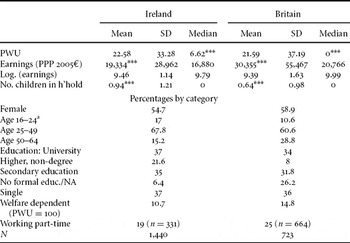
Table 1 shows relevant descriptive statistics for migrants by country. Of note are significant differences in median PWU, with migrants in Ireland showing a higher median PWU than those in Britain. Despite large mean differences in migrant earnings across countries, the more appropriate test for equality of medians reveals no significant difference, highlighting again the similarity of the migrant cohorts across countries, an important feature of the research design. Migrants to Ireland also appear to have more children than migrants to Britain.
Descriptive statistics for migrants by country

Notes: (a) Age variables for Ireland only available in 2006. Mann–Whitney test used to assess equality of medians. For some variables N differs from total reported N due to missing values. Migrant–migrant differences of means and medians: ***p<0.001, **p<0.01, *p<0.05.
Source: UK-GHS & SILC (Ireland) 2004–06, own calculations.
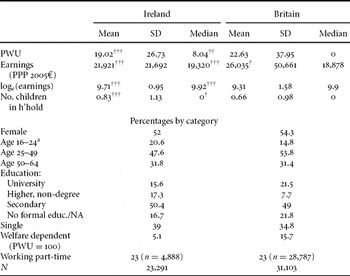
Looking to comparisons of migrants and natives within each country, see Table 2, we find significant differences in Ireland in terms of median earnings, with natives earning more than migrants, and we also find significant differences in median PWU, with natives using a higher proportion of welfare than migrants. Interestingly, there is also a highly significant difference in terms of mean PWU, suggesting the existence of a high-usage sub-group within the migrant sample for Ireland. Turning to Britain, there are no significant differences in PWU between migrants and natives, although there is a difference in mean earnings, significant at the 5 per cent level. In the next section, hypotheses pertaining to migrant welfare utilisation and the effect of welfare utilisation on labour market attachments are tested in the context of controlling for the range of human-capital and socio-demographic indicators.
Descriptive statistics for natives by country

Notes: (a) Age variables for Ireland only available in 2006. Mann–Whitney test used to assess equality of medians. For some variables N differs from total reported N due to missing values. Within-country comparisons of migrants with natives (see Table 1 for migrant scores), differences of means and medians: †††p<0.001, ††p<0.01, †p<0.05.
Source: UK-GHS & SILC (Ireland) 2004–06, own calculations.
Regression analyses
Usage
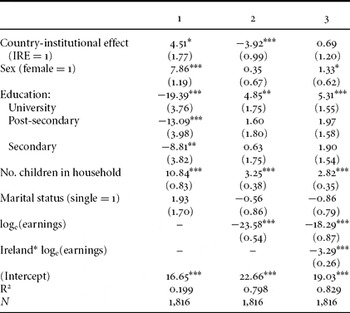
Table 3 shows results for regressions of the proportional welfare usage measure (PWU) on the set of socio-demographic indicators and other controls for the pooled sample of migrants. Model 1 shows the effect of national institutional factors on PWU controlling for the other variables in the model. Migrants in Ireland, denoted by the Ireland country dummy, are predicted under this model to use PWU at a level 4.5 per cent higher than migrants in Britain (p = 0.011), controlling for the other variables. The control variables are all significant, except for the variable denoting ‘single’ respondents, and the effects are much as we might expect: progressively higher levels of education predict lower levels of PWU, while ‘female status’ predicts higher usage and number of children predicts much higher PWU, in the region of 10 per cent extra welfare usage per child, controlling for the other variables in the model.
Effects (unstandardised coeff's and robust standard errors) of country institutional context and interactions on migrant PWU

Notes: ***p<0.001, **p<0.01, *p<0.05. Year controls included in all models but not reported. Ref. category for Ireland is ‘Britain’; for Education is ‘no formal education/NA’; for Single is ‘currently/previously married’. PWU is a percentage variable, from 0–100. Robust standard errors in parentheses.
Source: UK-GHS & SILC (Ireland) 2004–06, own calculations.
Other studies (for example, Castronova et al., Reference Castronova, Kayser, Frick and Wagner2001) have found that migrant-native differentials in welfare usage have disappeared entirely when the effects of earnings are known, suggesting that migrants’ higher use of welfare resulted from their relatively poorer wages. This possibility is tested, though in a migrant−migrant comparative context, in Model 2, and the results present a notably different picture. Controlling for logged earnings, the ‘Ireland effect’ actually reverses its direction, such that migrants in Ireland are predicted under this model to have welfare usage that is 3.9 per cent less than migrants in Britain, and this result is significant at the most demanding level. The effect of logged earnings on PWU is, of course, highly significant. The large coefficient (–23.58 per cent) should be read as indicating that for every one-unit increase in logged earnings – that is, when earnings increase by a factor of 2.72 (as logged earnings are taken to base e, where e = 2.72) – proportional welfare usage is predicted to decrease by 23.58 per cent, controlling for the other variables in the model. Obviously, the earned income variable is correlated with the dependent variable here, as one is derived from the other, accounting for the very high R-squared in the model. But this is to be expected, and the key concern here is not to explain away all of the variance in the dependent variable but to probe more deeply the juncture at which earned income ceases to have explanatory power and where individual actions and intentions towards welfare system incentive structures begin to matter. The fact that this country-institutional effect remains significant even when controlling for earnings is worthy of mention in itself, as it confirms that earned income alone is not sufficient to account for variation in welfare usage and that there is sufficient conceptual and empirical space for the role of intentions towards the labour market/welfare system nexus to come into play.
Model 3 examines how country-level institutional effects interact with earnings to determine migrant welfare usage. The highly significant multiplicative term indicates that there is indeed an interaction between these two variables and that the effect of earnings on PWU varies by country. Variation in the effect of identical changes in earnings on welfare usage can be thought of as a stylised model of the ‘elasticity’ of welfare usage to labour market earnings. An identical increase in earnings across countries reduces PWU for everyone, but the reduction is greater for migrants in Ireland, by –3.29 per cent, relative to migrants in Britain. The model's prediction mathematically holds true in reverse, and welfare usage will be similarly elastic to declining earnings in a manner predicting higher welfare usage for migrants in Ireland than in Britain. This accords closely with the theoretical expectations of Hypothesis 1 and the ‘elasticity’ finding seems to confirm the expectation that ‘decommodification incentives in HG systems should result in different observed outcomes at similar levels of earnings for migrants across countries’. But the expectation that migrants to HG systems will manifest greater PWU than those in LG systems has not been so straightforwardly confirmed, suggesting that simple moral hazard accounts of how migrants use the welfare system are inaccurate. The fact that the higher PWU ‘Ireland effect’ disappears when controlling for earnings indicates that Ireland's greater welfare generosity is not in itself a determinant of higher welfare usage among migrants, but indicates that migrants in Ireland may be experiencing some earnings disadvantages, as the descriptive findings in Table 1 also suggest.
Participation
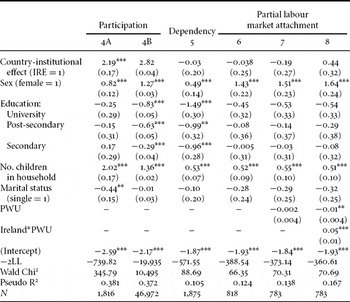
Model 4A, Table 4, examines the factors which determine the likelihood of simple participation in the welfare system for migrants. In line with many of the previous studies cited earlier, and in line with Hypothesis 2, the results show that the country-institutional context of the HG system predicts a higher likelihood of welfare participation: that is, the coefficient on the logit scale is positive. Exponentiating base e using this coefficient (e 2.19) gives the odds ratio for the relationship which shows, in this instance, that the country dummy significantly predicts odds of welfare participation for migrants to Ireland that are 7.5 times greater than the odds of welfare participation for migrants to Britain. It is illuminating to compare this to the country-institutional effect on the odds of welfare participation solely for the native populations of both countries.Footnote 3 This contextualises the results somewhat when we see that, for the native populations, Irish survey respondents were predicted to have odds of welfare participation almost seventeen times greater than the same odds for British respondents (Model 4B), again calculating odds ratios as above (e 2.83). This indicates that migrant propensities for greater welfare participation in Ireland are fully in line with general participation rates under the prevailing national institutional contexts, but suggests that the likelihood of migrant participation is in fact relatively less than might be expected.
Effects (unstand'ised coeff's and robust standard errors) of country institutional context and interactions on welfare utilisation and labour market attachments

Notes: ***p<0.001, **p<0.01, *p<0.05. Year controls included in all models but not reported, Age controls included in Models 6–8 but not reported. Ref. categories as per Table 3. All models report coefficients on the logit scale. All models use only migrant respondents, except Model 4B. Robust standard errors in parentheses.
Source: UK-GHS & SILC (Ireland) 2004–06, own calculations.
Dependency
The divisive issue of migrant welfare dependency, in the true sense of that word denoting complete reliance on social transfers, is addressed in Model 5. Running contrary to expectations the results clearly show a wholly insignificant effect for the country-institutional dummy, controlling for the other variables in the model. Complete dependency on welfare cannot, on these results, be ascribed to differences in migrant intentions and behaviour arising from the incentive structures presented by relatively more or less generous welfare systems. The strongest predictors of dependency on welfare are, perhaps unsurprisingly, sex, number of dependent children, and level of education. Women and those with dependent children are predicted in this model to have a greater likelihood of dependency, while those with higher levels of education, relative to those with no formal education, are predicted to have a lower likelihood of dependency. The key predictors of welfare dependency are shared by migrant cohorts across both countries, suggesting that the problems of welfare dependency are problems for social policy more so than migration policy. This result also raises the more serious concern that migrant incorporation regimes, which restrict migrant access to welfare benefits for fear that a freer access to the welfare system, and a broader conception of what migrant social citizenship should be or can be, may be acting on a misplaced presumption of moral hazard on the part of migrants (H3). We will return to this point later.
Partial labour market attachments
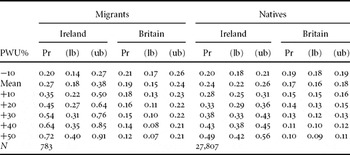
Finally, we address the issue of forming partial labour market attachments in response to welfare state incentives. If this hypothesis is correct then we expect to find that migrant proportional welfare usage, in interaction with the country-effect variable, affects the likelihood of forming a partial labour market attachment; increasing levels of PWU should be correlated with a higher probability of working part time for migrants in a HG system, but not an LG system. Before the results are presented, a word of caution. The datasets for Ireland contain the relevant variable for part-time work only for 2006, and not for any of the other years pooled in the sample here. Unfortunately, but unavoidably, this leaves us with relatively few migrant cases with a positive response recorded for the ‘working part time’ category: n = 63 for Ireland, n = 166 for Britain. In the regression model (total n = 783), there is a possibility that the results are being driven by this small number of cases. However, this small sub-group is nonetheless in line with our theoretical expectations discussed earlier (see H4), and we expect only some, not all, migrants to form partial labour market attachments in line with welfare system and subjective utility incentives.
Model 6 shows the results before controlling for the effects of PWU on the likelihood of forming a partial attachment. Country-institutional effects are not seen to be significant at all here, and the only significant predictors are seen to be sex and number of dependents. Controlling for the effects of PWU alone does not change this result (Model 7). However, when controlling for PWU in interaction with country-institutional effects we see a clear interaction in line with our theoretical expectations (H4), with the interaction term itself significant at the most demanding level (Model 8). But it should be remarked that it is not immediately intuitive – either from the predicted effects as captured by the coefficients on the logit scale or from the odds ratios that we might calculate from these coefficients – what the nature and direction of the effect might be. Table 5 calculates predicted probabilities of partial labour market attachment from Model 8 for migrants by host country, interacting the country-effect variable with increasing levels of PWU, from 10 per cent below mean PWU to 50 per cent above the mean. The results are striking and clearly in line with the hypothesised effect. At proportional welfare usage 50 per cent above the mean, migrants in Ireland have a predicted probability of 0.72 for forming a partial labour market attachment, compared to a probability of 0.12 for migrants in Britain at the same usage level. Again, we must be cautious in our interpretation of this result, given the confidence interval of the estimate for the migrants in Ireland, which can most likely be ascribed to the data limitations discussed above. However, even at the lower bound of the estimate, the effect is still notable.
Predicted probabilities of marginal labour market attachment by migrant status, country and level of PWU

Notes: Coefficients are predicted probabilities with 95% CIs, upper and lower bounds, of being employed part time by country, calculated separately for migrants and for natives holding other variables in each model at their means.
Source: Migrant comparison derived from Model 8 above, Native comparison derived from a native-only model (not shown), from analysis of UK-GHS & SILC (Ireland) data 2004–06, own calculations.
Comparing predicted probabilities for natives across countries (Table 5) reflects a similar, though less pronounced, situation. As we expect, given the much larger number of cases involved, the confidence interval is also smaller than that returned in the analysis of migrants, indicating the importance of high-quality representative samples for any future analysis of the process for which this exploratory analysis has generated some intriguing preliminary results.
Concluding remarks
In contrast to much of the literature on this issue, the findings presented here offer very little support for simplistic accounts of migrant intentions towards welfare state incentives. The results also illustrate the utility of disaggregating the concept of welfare utilisation into component parts, capturing different facets of engagement with state welfare systems. In response to the questions posed at the outset, as to whether simple moral hazard explanations could account for migrant interactions with state welfare systems, the results clearly point towards the need for a more nuanced approach to this often highly politicised issue. While likelihood of merely participating in the welfare system was seen to be greater for migrants in a relatively more generous system, as might be expected, this welfare generosity did not translate into a greater dependency on social transfers in the more generous system, nor even into greater usage of welfare (as a proportion of total income) once earnings were controlled for. However, in the more generous welfare system, some preliminary results intriguingly suggest a process whereby migrants may be utilising higher levels of welfare in tandem with income earned in the labour market to facilitate partial labour market attachments (that is, part-time work). This effect remains highly significant even controlling for other likely determinants of forming such partial attachments.
Is it the case, then, that migrants to relatively more generous Ireland are opting out of full-time work, availing themselves of the decommodification opportunities the Irish welfare system facilitates, and acting on their subjective interpretations of individual welfare so as to actively redefine their relationship with the labour market and welfare system? And what does this complex picture of migrant intentionality towards social citizenship mean for policy-makers?
In answer to the first question, the results presented here suggest that this is a distinct possibility, although definitive pronouncements must attend on larger sample sizes, which can make stronger claims to representativeness.Footnote 4 Collecting such data for further quantitative analysis and probing the micro-level determinants of the process hinted at here, by means of detailed qualitative analysis of migrant intentions towards the labour market/welfare state nexus, will be the task of future research. A recent small-scale qualitative study of migrant care workers in Ireland produced some findings congruent with the results of this analysis, in so far as some of the migrants surveyed were found to have ‘highly sophisticated’ attitudes to the welfare state and, while some were disapproving and sceptical of ‘welfare dependency’ among migrants, others were desirous of claiming more welfare benefits or learning more about what they might be able to claim (Timonen and Doyle, Reference Timonen and Doyle2008: 171). More research in this vein could look comparatively at how the processes suggested here apply, or do not apply, to other categories of migrant excluded from this analysis by research design considerations, such as non-EU migrants, refugees, illegal-entry migrants and so on.
On the second question, it is certainly clear that these results have direct implications for how policy-makers conceive of migrant social citizenship. If migrants cannot be seen as straightforward abusers of the welfare system but merely as intelligent users who respond in not unfavourable ways to a clear set of incentives, then this must surely challenge the rationale behind the restricted, and restricting, visions of migrant social citizenship that some policy-makers obviously hold, if unequal social citizenship outcomes are any indicator (Morissens and Sainsbury, Reference Morissens and Sainsbury2005). The imperative to challenge these restricted visions gains even more urgency when we consider the potentially highly negative consequences for broader societal integration of migrant populations if socio-economic inequality is entrenched and seen as justified (cf. Portes, Reference Portes1997).
But there are clear means of redressing such concerns, given that policy-makers have a direct and immediate influence over migrant social citizenship in a manner not paralleled at the level of the nation-state citizen, due to the unique role the ‘incorporation regime’, in interaction with the welfare state, will play in determining migrant social rights (Morissens and Sainsbury, Reference Morissens and Sainsbury2005; Sainsbury, Reference Sainsbury2006). Cogent arguments concerning the politics of the welfare state have shown how welfare state institutions are often characterised by path dependency and institutional ‘stickiness’ (Pierson, Reference Pierson2001), making broad changes to national social policy difficult, slow and incremental. But national incorporation regimes, addressing issues of formal citizenship, informal membership, and migrant inclusion and exclusion from the political, cultural and social life of society (Freeman, Reference Freeman2004; Sainsbury, Reference Sainsbury2006; Soysal, Reference Soysal1994), are more tractable to change as the affected migrant populations constitute small, and hence less resistant, constituencies of interest (Morissens and Sainsbury, Reference Morissens and Sainsbury2005: 654; Pierson, Reference Pierson2001).
These findings, in so far as they indicate the potential integrative benefits (and concurrent lack of economic disbenefits) of expanding the boundaries of migrant social citizenship, provide a fresh impetus to arguments for supranational, specifically EU-wide, forms of social citizenship. Despite an avowed commitment to the advancement of social cohesion and social inclusion across the Union, the realisation of a ‘Social Europe’ remains elusive (Schierup et al., Reference Schierup, Hansen and Castles2006). EU social policy currently operates in a manner which omits what, at the national level, are the ‘core domains’ of social policy: that is, social protection, income redistribution, income adequacy (Daly, Reference Daly2008: 1), focusing instead on ‘market-making’ (as opposed to ‘market-correcting’) forms of policy (Scharpf, Reference Scharpf2002). Member states themselves have resisted ceding control of these policy areas to the EU level for reasons concerning the diversity of national welfare state configurations as well as the divergent normative aspirations individual states may hold (Scharpf, Reference Scharpf2002). Where member states also accept received assumptions about migrant moral hazard this may work to engender disparities in migrant experiences of social citizenship of the kind reported by Morrisens and Sainsbury (Reference Morissens and Sainsbury2005).
The results presented here, however, indicate that moral hazard is not the pressing concern that some would claim, suggesting a justification for greater EU involvement in the core domains of social policy so as to facilitate social inclusion of intra-EU migrants across the Union. EU policies with this aim could appeal to a standard defined relative to the native populations of each member state, instead of employing uniform ‘low minimal standards’ as at present (Scharpf, Reference Scharpf2002: 666), thus allowing individual states to retain control of social protection while simultaneously expanding the scope for the effective realisation of migrant social citizenship. However, much further research is needed on precisely how such an expansion might be effected and also on the extent to which these findings apply to other intra-EU migrants in alternative national institutional contexts.
Acknowledgements
My sincere thanks go to Tony McCashin at Trinity College Dublin for his helpful comments on various versions of this article. I would also like to thank Kenneth Macdonald at Nuffield College, Oxford for his comments on an early version. I am grateful to Jos Elkink, Nicolas Motz, Joseph O'Gorman, the editors and two anonymous reviewers for their valuable input. Finally, I am grateful to Trinity College Dublin for its financial support.