Introduction
Cognitive behavioural therapy (CBT) is recommended in clinical practice guidelines as a first-line treatment for anxiety disorders (Katzman et al., Reference Katzman, Bleau, Blier, Chokka, Kjernisted and Van Ameringen2014; National Institute for Health and Care Excellence, 2011). Although increased access to psychotherapy and CBT has been found to be cost-effective in many publicly managed systems throughout the globe (Gratzer & Goldbloom, Reference Gratzer and Goldbloom2016; Vasiliadis & Dezetter, Reference Vasiliadis and Dezetter2017), access to evidence-based psychotherapy is still affected by limited human and financial resources. System-level factors related to underfunding and a lack of trained professionals impede equitable access (Bartram, Reference Bartram2017; Coalition of Ontario Psychiatrists, 2018; Fleury & Grenier, Reference Fleury and Grenier2012; Mental Health Commission of Canada, 2012, 2017). Individuals who, because of low income and/or lack of supplementary health insurance, cannot afford consultation in the private sector (Gulliver, Griffiths, & Christensen, Reference Gulliver, Griffiths and Christensen2010; Harvey & Gumport, Reference Harvey and Gumport2015; Mojtabai, Reference Mojtabai2005; Perreault et al., Reference Perreault, Lafortune, Laverdure, Chartier-Otis, Bélanger, Marchand and Milton2013; Walker, Cummings, Hockenberry, & Druss, Reference Walker, Cummings, Hockenberry and Druss2015) face long wait times for access to psychotherapy in the public sector (van Nieuwenhuyse & Dumas, Reference van Nieuwenhuyse and Dumas2012), leading to unmet need for care and increased first appointment nonattendance (Davis, Smith, Talbot, Eldridge, & Betts, Reference Davis, Smith, Talbot, Eldridge and Betts2020; Rens, Dom, Remmen, Michielsen, & Van Den Broeck, Reference Rens, Dom, Remmen, Michielsen and Van Den Broeck2020; Sweeney et al., Reference Sweeney, Clement, Gribble, Jackson, Carr, Catty and Gillard2019). Economic evaluation of psychotherapy and CBT is needed to support decision making around the allocation of resources to overcome barriers to care for patients with anxiety disorders, which are among the most common (Kessler et al., Reference Kessler, Berglund, Demler, Jin, Merikangas and Walters2005) and economically impactful (Chisholm et al., Reference Chisholm, Sweeny, Sheehan, Rasmussen, Filip, Cuijpers and Saxena2016) mental disorders globally.
Transdiagnostic CBT (tCBT) for anxiety disorders is of particular interest as it addresses cognitive and behavioural processes underlying a variety of anxiety disorders and integrates common elements of more targeted CBT protocols (Norton & Roberge, Reference Norton and Roberge2017). tCBT differs from traditional CBT for specific diagnoses (e.g. panic disorder) in that it addresses the range of anxiety and related disorders simultaneously rather than the unique features of each diagnosis (Barlow, Allen, & Choate, Reference Barlow, Allen and Choate2016; Norton & Roberge, Reference Norton and Roberge2017). Some have highlighted the efficacy and practicality of moving from diagnostic-specific CBT to a transdiagnostic protocol, as it would facilitate group formation in settings where there is an heterogeneous clientele (Clark, Reference Clark2009) as well as the training and supervision of professionals (Barlow et al., Reference Barlow, Allen and Choate2016). They also underline its relevance for individuals with multiple anxiety disorders (Barlow et al., Reference Barlow, Allen and Choate2016; Clark, Reference Clark2009), who are more the rule than the exception (Bandelow & Michaelis, Reference Bandelow and Michaelis2015). Meta-analyses support the efficacy of tCBT compared to passive and active control group as well as to diagnostic-specific CBT (Andersen, Toner, Bland, & McMillan, Reference Andersen, Toner, Bland and McMillan2016; García-Escalera, Chorot, Valiente, Reales, & Sandín, Reference García-Escalera, Chorot, Valiente, Reales and Sandín2016; Newby, Twomey, Yuan Li, & Andrews, Reference Newby, Twomey, Yuan Li and Andrews2016; Pearl & Norton, Reference Pearl and Norton2017; Reinholt & Krogh, Reference Reinholt and Krogh2014), suggesting tCBT could improve efficiency in the context of limited human and financial resources.
For research evidence to become integrated into clinical practice, stakeholders must be aware and supportive of the intervention. In reimbursement decisions of insurance companies and resource-allocation decisions of publicly-funded health systems, economic evaluations help weigh the outcomes of an intervention against costs involved in producing those outcomes (Frick et al., Reference Frick, Neissen, Bridges, Walker, Wilson and Bass2012). Although tCBT appears viable for adults with anxiety disorders in contexts where resources are limited, it has not yet been economically evaluated. Roberge et al. (Reference Roberge, Provencher, Gaboury, Vasiliadis, Benoit, Carrier and Norton2022) compared the effectiveness of group tCBT plus treatment as usual (TAU) against TAU alone in a pragmatic randomized controlled trial (RCT) and reported a significant reduction in anxiety symptoms (Roberge et al., Reference Roberge, Provencher, Gaboury, Vasiliadis, Benoit, Carrier and Norton2022). Building on this trial, the aim of this economic evaluation was (1) to determine the incremental cost-utility (ICUR) and cost-effectiveness ratios (ICER) of tCBT + TAU when compared to TAU alone and (2) to determine the probability of tCBT + TAU being cost-effective at different values of willingness-to-pay (WTP) threshold.
Methods
Trial design
This piggyback economic evaluation is based on an 8-month follow-up pragmatic RCT, which used a two-arm parallel (1:1) single blinded design comparing tCBT + TAU (n = 117) to TAU alone (n = 114) in community-based care settings in three health administrative regions of Quebec, Canada. Participants allocated to TAU were not subject to any intervention by the research team. They were allowed to stop their treatment, continue or seek new ones, which included, notably, pharmacotherapy, psychotherapy (inclusive of CBT) or other psychosocial approaches. Some of them did not receive any treatment for anxiety disorders. This methodological decision in the pragmatic RCT aimed at assessing the added value of tCBT in real-world conditions to maximize generalizability to routine care (Roberge et al., Reference Roberge, Provencher, Gosselin, Vasiliadis, Gaboury and Benoît2018). Randomization was stratified by study site with blocking. The study protocol and primary results are published elsewhere (Roberge et al., Reference Roberge, Provencher, Gaboury, Vasiliadis, Benoit, Carrier and Norton2022, Reference Roberge, Provencher, Gosselin, Vasiliadis, Gaboury and Benoît2018).
Participants
Participants were recruited through advertisements in regional newspapers, Facebook, Google AdWords and bulletin boards. Eligibility criteria included: (1) age 18–65; (2) fluent in spoken and written French; (3) meeting Diagnostic and Statistical Manual of Mental Disorders (DSM-5) (American Psychiatric Association, 2013) criteria for a principal diagnosis of panic disorder, agoraphobia, social anxiety disorder or generalized anxiety disorder, with a clinical severity rating (CSR) ⩾ 4 on the Anxiety and Related Disorders Interview Schedule for DSM-5 (ADIS-5) (Brown & Barlow, Reference Brown and Barlow2014). Exclusion criteria were: active suicidal intent, psychosis, bipolar disorder, substance-related and addictive disorders, cognitive impairment, and consultation with a psychiatrist in the past 12 months. In this pragmatic trial, participants could stop and start new treatments during the study period. Participants provided written informed consent.
Treatment intervention
The tCBT protocol (Norton, Reference Norton2012) comprised 12 weekly 2-h group sessions focusing on: (1) education and self-monitoring, (2) specific cognitive restructuring, (3) graduated exposure and response prevention, and (4) generalized cognitive restructuring (i.e. focus on more general anxious style). An initial individual 40-min session was completed with each participant two weeks prior to tCBT initiation, to introduce treatment and build a preliminary fear hierarchy to guide therapeutic exposures. Group tCBT sessions were co-led by two therapists certified by the Quebec Order of Psychologists and included, on average, 10 participants. Therapists followed up with participants who missed sessions to enhance compliance.
Economic evaluation
The data in this economic evaluation were collected over an 8-month period: at randomization (T 0, baseline), post-treatment (T 1, 4 months post-randomization) and 4-month follow-up (T 2, 8 months post-randomization). As the time horizon was less than one year, no discount rates were applied. Data from T 0 and T 1 were collected during face-to-face interviews and for T 2, by telephone interview. In Quebec, a public healthcare system is in place and covers medical consultations under the provincial health insurance plan. Residents are also required by law to hold private or public prescription drug insurance. The reference case for this evaluation followed Canadian economic evaluation guidelines (Canadian Agency for Drugs and Technologies in Health, 2017), which are also congruent with other countries (Sharma, Aggarwal, Downey, & Prinja, Reference Sharma, Aggarwal, Downey and Prinja2021). QALY was used as an effectiveness outcome, and for costs, the health system perspective was considered. Alternative cases explored the limited societal perspective (Kim et al., Reference Kim, Silver, Kunst, Cohen, Ollendorf and Neumann2020) for costs and anxiety-free days (AFDs) for effectiveness. Data from the educational and criminal justice sectors were not available.
Health-related quality of life
The quality-adjusted life year (QALY) is a standard outcome in economic evaluation that enhances comparability between studies. It incorporates notions of quality of life and longevity (Neumann & Cohen, Reference Neumann and Cohen2018). Utility index values were obtained using the EQ-5D-5L with an algorithm based on time trade-off values from Canada (EuroQol Research Foundation, 2019; Xie et al., Reference Xie, Pullenayegum, Gaebel, Bansback, Bryan, Ohinmaa and Johnson2016). The minimum utility index value for the Xie et al. (Reference Xie, Pullenayegum, Gaebel, Bansback, Bryan, Ohinmaa and Johnson2016)'s algorithm is −0.148 for the worst state, and the maximum 0.949 for the best state. The resulting QALYs were computed for each participant by linear interpolation according to the period between assessments (T 0–T 1, T 1–T 2). According to the range of utility index values established by Xie et al. (Reference Xie, Pullenayegum, Gaebel, Bansback, Bryan, Ohinmaa and Johnson2016), during the 4-month period between assessments, the lowest possible QALY was −0.049 and the highest 0.316. To cover the 8-month time horizon, the QALYs from each assessment period were summed for a total minimum utility of −0.098 and a maximum of 0.632.
Effectiveness outcome
Effectiveness was evaluated using AFDs. This is based on the concept of Depression-Free Days (Lave, Frank, Schulberg, & Kamlet, Reference Lave, Frank, Schulberg and Kamlet1998), which is a valid and easily interpreted measure (Vannoy, Arean, & Unützer, Reference Vannoy, Arean and Unützer2010). Based on cut-offs of the Beck Anxiety Inventory (BAI) (Beck & Steer, Reference Beck and Steer1993), scores of 7 or lower (minimal anxiety) were considered ‘non-symptomatic’ (equal to 1 AFD) while scores of 26 or more (severe anxiety) were considered ‘fully symptomatic’ (equal to 0 AFD). For scores between 8 and 25, AFD values were weighted proportionately. Using linear interpolation, the total number of AFDs in a given time period was obtained by multiplying the mean AFD value by the number of days between assessments (T 0–T 1, T 1–T 2). AFDs in each time period were summed to cover the 8-month time horizon. The possible range of AFDs between baseline and T 1 was 0 to 122, and between baseline and T 2 was 0 to 244.
Cost analysis
All costs were valued in 2020 Canadian dollars ($CAN) according to the Canadian consumer price index for January 2020 in Quebec (Statistics Canada, 2020). To facilitate international comparison, relative to the United States dollar (national currency/U.S. dollar), in 2020, the purchasing power parity of Canada, the European Union (€) and the United Kingdom (£) were respectively 1.206, 0.668 and 0.700 (Organisation for Economic Co-operation & Development, 2021).
Mental health service use data in the 4-month periods between assessments were collected with a structured interview guide previously used in Quebec (Roberge, Marchand, Reinharz, & Savard, Reference Roberge, Marchand, Reinharz and Savard2008). Self-reported data were collected and valued using administrative or governmental data sources on services used within the public healthcare system: outpatient health and social services used (reason, frequency, professional consulted) (Ministère de la Santé et des Services sociaux, 2017a, 2017b; Régie de l'assurance maladie du Québec, 2016a, 2016b), emergency department visits (reason, frequency), inpatient stays (reason, frequency) (Ministère de la Santé et des Services sociaux, 2017a, 2017b) and outpatient delivered medications (name, dosage, start-date) (Régie de l'assurance maladie du Québec, 2018). The interview also inquired about visits with health professionals from the private sector, transportation to and from medical appointments (mode), informal care (day-to-day assistance for mental health reason: need, hours) and use of alternative and complementary medicine (self-reported cost per month). We also estimated time spent with professionals for mental health reasons using the number of self-reported medical visits; absenteeism from self-reported leaves of absence due to mental health reasons [using the friction cost approach with an elasticity factor of 0.8 (Koopmanschap, Rutten, van Ineveld, & van Roijen, Reference Koopmanschap, Rutten, van Ineveld and van Roijen1995)]; and presenteeism in the past 28 days from a self-reported evaluation using the Health and Work Performance Questionnaire (HPQ) scale (1–10) (Kessler et al., Reference Kessler, Barber, Beck, Berglund, Cleary, McKenas and Wang2003). Work productivity was valued using the average wage in Quebec stratified by sex and age (Institut de la statistique du Québec, 2017). The opportunity cost of leisure time was valued at $11.25/h, which represented the minimum wage at the time of the study (Commission des normes de l’équité de la santé et de la sécurité du travail, 2017) (See online Supplementary Methods Appendix for details on costing).
tCBT intervention: The cost of tCBT was calculated based on sessions being led by one therapist from the public sector and one from the private sector, with an attendance of 10 participants per intervention group. The costs associated with a group tCBT treatment with two therapists were not dependant on treatment attendance. For this analysis, the following costs related to providing the intervention were considered independent of the actual participants' attendance: therapist salaries for the time in sessions; preparation time for sessions; individual pre-therapy appointments; phone follow-ups to enhance compliance; supporting document; as well as general overheads (Gouvernement du Québec, Reference Gouvernement du Québec2016; Ministère de la Santé et des Services sociaux, 2017a). From the limited societal perspective, participants' costs, namely transportation and time spent in therapy, were considered according to session attendance (See online Supplementary Methods Appendix for additional details). Costs for the training of health professionals were included in a sensitivity analysis.
Imputation and statistical analyses
Missing data and imputations
Twenty datasets were imputed with Amelia II R package which uses a bootstrapped-based expectation–maximization algorithm (Honaker, King, & Blackwell, Reference Honaker, King and Blackwell2019) on the assumption of a ‘Missing at Random’ mechanism. The imputation model included baseline variables associated with the probability of missing data as well as sex and age (See Supplementary Methods Appendix for more details on imputation).
Analyses
The analyses were based on intention-to-treat. For descriptive analyses on non-imputed data, χ2 or Fisher's Exact test were used to compare proportions between interventions for categorical data. Continuous data were compared with t tests or the Mann–Whitney U test depending on the normality of data.
Cost data were presented using mean and 95% confidence interval (Husereau et al., Reference Husereau, Drummond, Petrou, Carswell, Moher and Greenberg2013). The difference in costs and utility index between groups associated with treatment were assessed using a Generalized Linear Models (GLM) when considering the eight months time horizon or Generalized Estimating Equation (GEE) for repeated measures with gamma distribution and log link for longitudinal analysis (Paton et al., Reference Paton, Stöhr, Oddershede, Arenas-Pinto, Walker, Sculpher and Dunn2016). For BAI, models with normal distribution and identity link were used. The models were adjusted for age, sex, marital status, level of education, occupation and baseline costs for costs, baseline utility for QALYs and baseline BAI score for AFDs.
Cost-effectiveness
Point estimates of the ICUR (QALY) and ICER (AFD) were obtained with the following:

The ICUR and ICER formulas reflect the incremental difference in mean cost divided by the incremental difference in the mean number of QALYs or AFDs over the 8-month time horizon. Point estimates were derived from the multiply imputed datasets and for confidence interval, 10 000 bootstrapping were done in each dataset (See Supplementary Methods Appendix for more detail on confidence intervals).
The Net Benefit (NB) regression framework was used to create a cost-effectiveness acceptability curve (CEAC) at different WTP thresholds (Hoch, Briggs, & Willan, Reference Hoch, Briggs and Willan2002; van Hout, Al, Gordon, & Rutten, Reference van Hout, Al, Gordon and Rutten1994). The individual NB can be used in linear regression as a dependent variable where the β coefficient associated with the treatment variable is representative of the incremental NB (INB) of the intervention at a given WTP. If positive, it indicates that, compared to TAU, the effectiveness of tCBT + TAU outweighs its costs. It is therefore deemed cost-effective. The one-sided p value is used to determine the probability that the INB is positive (Hoch, Rockx, & Krahn, Reference Hoch, Rockx and Krahn2006). A range of WTP from $0/QALY to $ 100 000/QALY was evaluated, along with a range for AFD of $0/AFD to $100/AFD. A threshold of $ 50 000/QALY was used to evaluate the probability of cost-effectiveness from the health system perspective (Balijepalli et al., Reference Balijepalli, Gullapalli, Druyts, Yan, Desai, Barakat and Locklin2020). According to studies using the net-benefit regression framework in the context of an economic evaluation of psychotherapy in adults with common mental health disorders (Egger et al., Reference Egger, Konnopka, Beutel, Herpertz, Hiller, Hoyer and König2015, Reference Egger, Konnopka, Beutel, Herpertz, Hiller, Hoyer and König2016; Grochtdreis et al., Reference Grochtdreis, Brettschneider, Bjerregaard, Bleich, Boczor, Härter and König2019; Simons et al., Reference Simons, Drukker, Evers, van Mastrigt, Höhn, Kramer and Wichers2017), the linear regression models were adjusted for past-year mental health costs, clinical factors (utility index or BAI score according to the model), age (continuous), sex (dichotomic: male/female), study region, time of inclusion in the study, comorbid anxiety disorders based on those included in the study (categorical: 0,1,2,3), comorbid mental health disorders as per the ADIS-5 (dichotomic: yes/no) and occupation (categorical: working full-time, working part-time, non-remunerated, sick leave) at baseline.
A probability threshold of 95% was considered sound to determine if tCBT + TAU would be cost-effective compared to TAU alone. This threshold can be lower according to the risk aversion level of decision-makers. For all other analyses, α of 0.05 was used to establish statistical significance in hypothesis testing. IBM SPSS 24 and RStudio 3.6.1. were used to carry out the analyses.
Sensitivity analyses
First, one-way and two-way deterministic sensitivity analyses (DSA) with extreme values were carried out where all participants either: (1) consulted social services or mental health professionals in the private or (2) in the public sector. Non-imputed data were used. Additional details can be found in the Supplementary Methods Appendix.
Second, an additional DSA was carried out where two therapists from the public sector rather than one from the public and one from the private sector would co-lead the tCBT intervention. The objective was to consider potential provision of tCBT in primary care practice, where it is most needed.
Third, the impact of including therapist training costs on the probability that tCBT + TAU would be cost-effective compared to TAU from both perspectives was evaluated. The costs considered, from the health system perspective, for a three-hour training course, included: the supervisor's fee, therapist hourly salary (2), five supervision sessions, general overhead costs as well as supporting documents. The costs amounted to $170/participant, assuming ten participants per treatment group. From the limited societal perspective, it also included transportation fees as well as preparation time for therapists in relation to the training. The training costs from this last perspective totalled $225/participant. IBM SPSS 24 and RStudio v1.1.463 was used to carry out the analysis.
Finally, we explored the long-term cost-effectiveness of tCBT + TAU compared to TAU from the health system perspective with the subgroup of participants with a complete dataset over the 12-month time horizon (T 3; i.e. 8-month follow-up).
Results
Baseline participants characteristics
A total of 117 participants were randomized to the tCBT + TAU group and 114 to the TAU group. Women constituted most of the sample (85.7%) and the average age was 37 years old. Two participants in five had a university degree, more than half were working full time (60.6%), and most had at least a satisfactory economic situation (76.6%). The majority of the sample (98.3%) included Canadian citizens, 97.0% of which were since birth. The most frequent diagnosis was generalized anxiety disorder (52.8%) and three in four participants had at least one comorbid anxiety disorder. There were no significant differences between intervention groups according to the EQ-5D-5L utility index, BAI score, or mental health costs at baseline. However, in participants randomized to tCBT + TAU, the proportion with generalized anxiety disorder was higher and social anxiety disorder lower.
Adherence and attrition
Loss of data was defined as missing data on cost and/or effectiveness (BAI or EQ-5D-5L) (see online Supplementary Fig. S1 and Table S1 in the Supplementary Results Appendix for flowchart and logistic regression model results). Compared to baseline, in the tCBT + TAU and TAU groups, total data loss in the study sample reached 23.9% (n = 28) and 21.1% (n = 24) at T 1, and, 36.8% (n = 43) and 28.1% (n = 32) at T 2. Age at baseline (p = 0.030) and better self-perceived physical health (p = 0.014) were significantly and positively associated with a lower risk of cost data loss at T 2 while baseline societal cost was negatively associated (p = 0.033). As for clinical outcomes, according to baseline characteristics, higher BAI score (p = 0.011) as well as not taking psychotropic medication (p = 0.030) were associated with a higher risk of clinical outcomes data loss at T 2. As previously reported by Roberge et al. (Reference Roberge, Provencher, Gaboury, Vasiliadis, Benoit, Carrier and Norton2022), participants in the tCBT intervention group attended a median of 9 sessions [IQR 4–11].
Service utilization
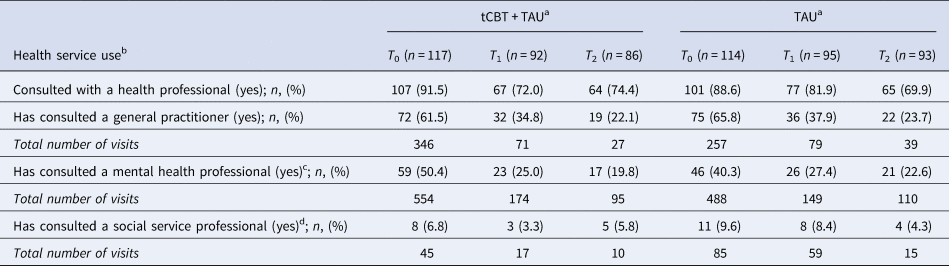
Table 1 presents self-reported use of healthcare resources for mental health concerns in each 4-month period. General practitioners (GP) and mental health professionals were the resources mentioned most. Use of emergency departments and hospitalizations were rare, with two individuals being hospitalized and four individuals visiting an emergency department for a mental health reason during the 8-month time horizon.
Self-reported health service utilization for mental health reasons and number of visits

a T 0 data were retrospective of the past twelve months; T 1, T 2, the past four months.
b Only professionals consulted by > 10% are shown.
c Includes: psychologists, psychotherapists, neuropsychologists.
d Includes: social workers and psychoeducators.
Costs
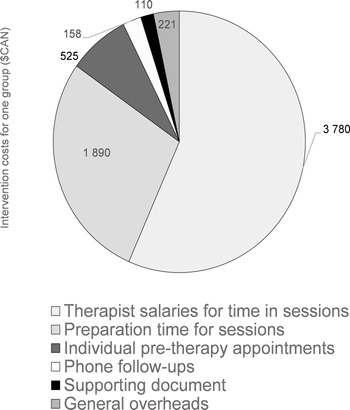
The costs associated with a tCBT intervention group are presented in Fig. 1. The most important costs were psychotherapist fees ($3780), which included the group sessions and preparation time.
Cost breakdown for a tCBT intervention group.
Note. Costs are presented for a group of 10 participants led by two therapists (private-public).

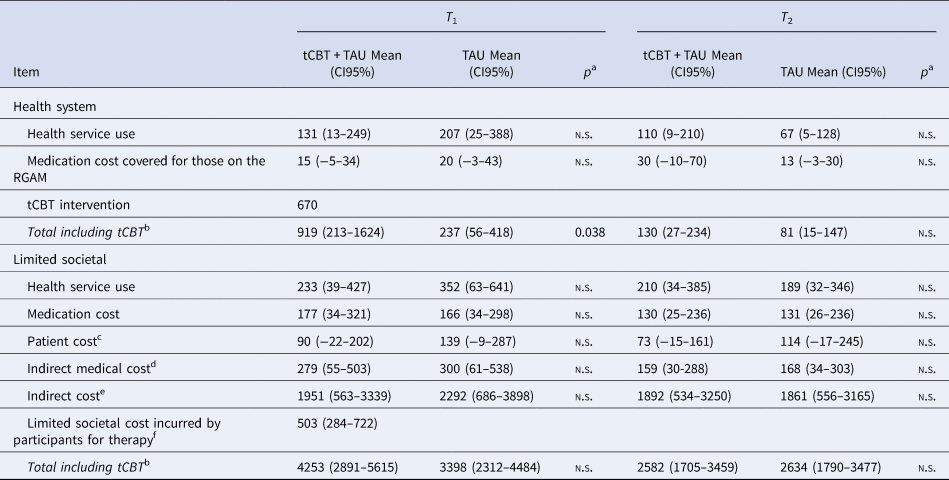
Table 2 presents a breakdown of costs incurred for mental health reasons by category, assessed from a health system perspective and a limited societal perspective (see also online Supplementary Fig. S2 in the Supplementary Results Appendix). As expected, the most important cost driver in the limited societal perspective was related to loss of productivity, namely presenteeism and absenteeism due to leaves of absence for mental health reasons. At T 1 and T 2, these costs represented more than half of the limited societal perspective costs. Presenteeism itself reached $2782 (CI95% $507–$5058) in the tCBT + TAU group and $2988 (CI95% $439–$5537) in the TAU group on the 8-month time horizon (obtained by GEE, data not shown). Health system costs represented less than 10% of the limited societal mental health cost.
Mean adjusted costs incurred for mental health reasons at post-treatment (T 1) and additional costs from post-treatment to 4-month follow-up (T 2)

n.s., not significant.
a Obtained by GEE.
b Total was obtained by GEE and does not reflect the summation of its individual component.
c Including natural products and day-to-day assistance.
d Including transportation and time spent for medical appointments.
e Including leaves of absence to mental health reasons and presenteeism.
f Obtained by GLM; Including transportation and time spent for therapy sessions.
Note. Adjusted for age, sex, marital status, level of education, occupation and baseline societal or health system cost.
The adjusted mean total cost over the eight months time horizon from the health system perspective was $908 (CI95% 216–1601) in the tCBT + TAU condition and $282 (CI95% 56–508) in the TAU condition. This difference was statistically significant (p = 0.002). The adjusted mean costs incurred from the limited societal perspective reached $6415 (CI95% 4753–8076) and $5724 (CI95% 4274–7175) in the tCBT + TAU and TAU condition, respectively. When considering time spent in therapy and transportation, the adjusted mean cost of the tCBT intervention was $1188 (CI95% $1122–$1254) per participant.
Utility and effectiveness
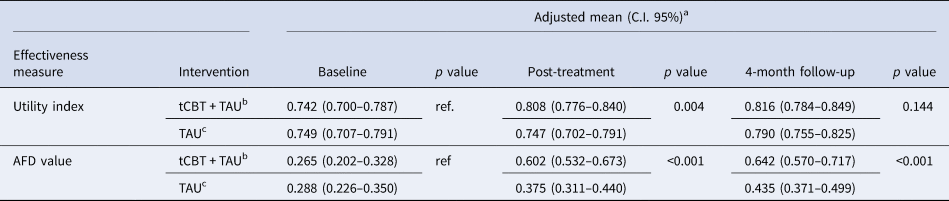
During the study period, tCBT + TAU had, on average, a higher mean adjusted number of QALYs [Mean (CI95%) 0.530 (0.510–0.549)] than the TAU condition [Mean (CI95%) 0.506 (0.483–0.529)] with a mean difference of 0.023 (CI95% 0.004–0.043) (p = 0.015). As shown in Table 3, the highest gains in QALYs were between baseline and T 1 and were maintained to T 2.
Mean adjusted clinical outcomes at post-treatment (T 1) and 4-month follow-up (T 2)

Note. Adjusted for age, sex, marital status, level of education, occupation and baseline utility/BAI score.
a Obtained by GEE.
b n = 117.
c n = 114.
The mean adjusted number of AFDs was significantly higher in the tCBT + TAU condition [Mean (CI95%) 129 (114–145)] than in the TAU condition [Mean (CI95%) 91 (76–105) (p < 0.001)]. As with QALYs, as shown in Table 3, the greatest AFD gain in the tCBT + TAU condition was between baseline and T 1 and this was maintained to T 2 (see online Supplementary Fig. S3 for visuals in the Supplementary Results Appendix).
Cost-utility and cost-effectiveness
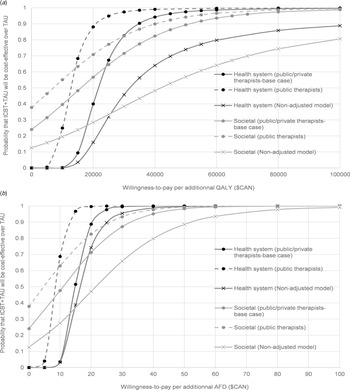
The unadjusted point estimates of the ICUR of tCBT + TAU compared to TAU was $ 30 290.60/QALY (CI95% $−12 181.70 to $72 762.89) and $ 40 309.81/QALY (CI95% $−56 850.00 to $137 496.60) from the health system and limited societal perspectives, respectively. The probability of cost-effectiveness of tCBT + TAU compared to TAU at a WTP threshold of $ 50 000 was 97% from the health system context and 89% from the limited societal perspective, on an 8-month time horizon (Fig. 2a).
Cost-effectiveness acceptability curve of tCBT + TAU compared to TAU from the health system and the restricted societal perspectives on the 8-month time horizon.
Note. (a) QALY and (b) AFD as outcome. Adjusted for baseline: costs, clinical variable (utility index or BAI score according to the model), age, sex, study region, time of inclusion in the study, comorbid anxiety disorders based on those included in the study, comorbid mental health disorders as per the ADIS-5 and occupation. Dashed lines represent sensitivity analysis where costs of the tCBT intervention considered two therapists from the public sector. Data were obtained by linear regression.

The unadjusted point estimates of the ICER for tCBT + TAU compared to TAU were $15.88/AFD (CI95% $3.95–$27.82) and $21.64/AFD (CI95% $−16.41 to $59.70) from the health system and limited societal perspectives, respectively. In both cases, tCBT + TAU was more effective, but more costly, over the 8-month time horizon. Figure 2b shows the adjusted CEAC curve for WTP ranging from $0 to $100/AFD from both perspectives. The CEAC indicated that at a WTP threshold of $25/AFD (health system) and $40/AFD (limited societal), there was ⩾95% probability that tCBT + TAU will be more cost-effective than TAU on an 8-month time horizon.
Sensitivity analyses
From the health system perspective, there was a decrease of less than 10% in the ICUR in all scenarios tested, attesting of the robustness of the results when considering the prevalence of the use of social health service or mental health professionals in either the private or the public sector. From the limited societal perspective, the change in ICUR was more important with a decrease of up to 31% if visits, of psychological, social or both natures, took place in the public sector. However, an increase in the ICUR of around 11% could be expected if all visits took place in the private sector.
Figure 2 shows the CEAC for the base case and the sensitivity analyses where both tCBT therapists are from the public sector. Using QALY as an outcome, at a WTP threshold of $ 50 000, there is less than a 10% difference in scenarios from the health system and limited societal perspectives. Using AFDs as an outcome, to reach a 95% probability of cost-effectiveness, corresponding WTP thresholds were lower, now being $15/AFD and $30/AFD from the health system and the societal perspectives respectively.
When considering training costs, the probability that tCBT + TAU is cost-effective compared to TAU decreased by less than 10% from both perspectives when considering a threshold of $ 50 000/QALY. When using AFDs as an outcome, the CEAC indicated that at a WTP threshold of $30 and $50 from the health system and limited societal perspectives, there was a ⩾95% probability that tCBT + TAU is more cost-effective than TAU (see online Supplementary Fig. S4 in the Supplementary Results Appendix).
Sensitivity analysis from the health system perspective using data from participants with a complete dataset over the 12-month time horizon (T 3; i.e. 8-month follow-up) (QALY: tCBT + TAU = 49; TAU = 59; AFD: tCBT + TAU = 51; TAU = 60) showed that at a threshold of $ 50 000/QALY, there was 97% that tCBT + TAU would be cost-effective when compared to TAU. When using AFD as an outcome, there was a 95% probability that tCBT + TAU would be cost-effective at a WTP threshold of $14/AFD (see online Supplementary Fig. S5 in the Supplementary Results Appendix).
Discussion
This piggyback economic evaluation assessed the cost-utility and cost-effectiveness of group tCBT + TAU compared to TAU alone in a sample of adults with anxiety disorders over an 8-month period: from baseline to 4 months after the end of treatment. It was based on data from Roberge et al. Reference Roberge, Provencher, Gaboury, Vasiliadis, Benoit, Carrier and Norton2022, who examined the effectiveness of tCBT + TAU compared to TAU in a pragmatic RCT in community-based care settings. The increment in QALYs associated with tCBT + TAU as compared to TAU alone was significant. Roberge et al. Reference Roberge, Provencher, Gaboury, Vasiliadis, Benoit, Carrier and Norton2022 found tCBT + TAU to be effective, leading to a higher decrease in BAI over time compared to TAU. In the present study, this translated into a higher number of AFDs. As for costs, results varied according to the economic perspective considered. Presenteeism was the most important cost driver from the societal perspective. After adjustment for study variables, the probability of tCBT + TAU being cost-effective, at a WTP threshold of $ 50 000/QALY, was 97 and 89% respectively from the health system and limited societal perspectives. The tCBT intervention was deemed cost-effective if stakeholders were willing to pay an additional $25/AFD from the health system perspective and $40/AFD from the limited societal perspective. Including therapist training costs led to a decrease in the observed cost-effectiveness, notably when using AFD as an outcome. The training costs considered were conservative, as they assumed that two therapists would only treat ten participants. Therapist training courses in community-based practices for wide-scale dissemination may vary compared to the format used for this clinical study. Notably, training formats such as online workshops may incur lower costs while allowing training of many therapists simultaneously, therefore having less impact on the cost-effectiveness. The participation of public sector therapists could reduce the costs. The sensitivity analysis including assessments over the 8-month follow-up period showed that at a threshold of $ 50 000/QALY, there was a 97% probability that tCBT + TAU would be cost-effective compared to TAU. Alternatively, using AFD as an outcome, a WTP threshold of $14 was needed to obtain a 95% probability of cost-effectiveness.
While, to our knowledge, there is no study on the minimal important difference (MID) for anxiety disorders using the EQ-5D-5L, a study based on a general simulation in Canada provided an estimate MID of 0.056 (s.d. 0.011) on the utility index (McClure, Sayah, Xie, Luo, & Johnson, Reference McClure, Sayah, Xie, Luo and Johnson2017). Although the difference between the intervention groups was statistically significant at post-treatment [adjusted mean (s.e.): 0.054 (0.028); p = 0.039], the difference did not persist at the 4-month post-treatment assessment [adjusted mean (s.e.): 0.012 (0.025); p = 0.230]. From these results, it is unclear if the tCBT intervention added to TAU was associated with a meaningful clinical impact on health-related quality of life (HRQOL). A meta-analysis by Hofmann, Wu, & Boettcher (Reference Hofmann, Wu and Boettcher2014) showed that face-to-face CBT could have a moderate impact on the quality of life of individuals with anxiety disorders (Hofmann et al. Reference Hofmann, Wu and Boettcher2014). Research studying utility and QALYs associated with CBT as compared to TAU in individuals with anxiety disorders are scarce. Hakkaart-van Roijen, van Straten, Al, Rutten, & Donker (Reference Hakkaart-van Roijen, van Straten, Al, Rutten and Donker2006) study on the cost-effectiveness of CBT compared to care as usual found a difference in the utility index of 0.04 at 18 months which was not statistically significant (Hakkaart-van Roijen et al. Reference Hakkaart-van Roijen, van Straten, Al, Rutten and Donker2006). Brettschneider et al. (Reference Brettschneider, Gensichen, Hiller, Breitbart, Schumacher, Lukaschek and König2020) compared the PARADISE programme, which is self-managed, CBT-oriented exposure training for individuals with panic disorder, to usual care. After 12 months, the mean QALY difference was 0.034 (CI95% 0.005–0.062), which was statistically significant (Brettschneider et al., Reference Brettschneider, Gensichen, Hiller, Breitbart, Schumacher, Lukaschek and König2020). Direct comparisons are difficult as CBT was provided in an individual format in these studies and their time frames were longer.
While there is no standard guideline on the value of a QALY in Canada, a WTP threshold frequently used by the Canadian Agency for Drugs & Technologies in Health is $CAD 50 000 (Griffiths & Vadlamudi, Reference Griffiths and Vadlamudi2016). In the current study, the addition of tCBT to TAU was considered cost-effective although there was a high uncertainty when looking at unadjusted ICUR, as shown by the large confidence intervals. The uncertainty surrounding the ICUR was further characterized in the CEAC adjusted for baseline variables. Health Quality Ontario modelled the cost-utility of CBT according to the format (group or individual) and provider (physician or non-physician) on a 5-year time frame. Compared to usual care, group CBT provided by a non-physician had a 99.5% probability of being cost-effective at a WTP threshold of $ 50 000/QALY for major depressive disorder and generalized anxiety disorder (Health Quality Ontario, 2017). Only direct costs were included. Similarly, at the same threshold, our study showed a 97% probability of cost-effectiveness. Other studies evaluated the probability of cost-effectiveness using QALY as an outcome, but with CBT in an individual format. In the study by Brettschneider et al. (Reference Brettschneider, Gensichen, Hiller, Breitbart, Schumacher, Lukaschek and König2020), at an equivalent threshold, the probability that the PARADISE programme was cost-effective against usual care was at least 95%. With a lesser probability of cost-effectiveness, a trial-based study for social anxiety disorder comparing participants who received individual CBT to participants on a waiting list found that the probability of CBT being cost-effective from the societal perspective was less than 25% at a WTP threshold of € 150 000/QALY on a 6-month time horizon (Egger et al., Reference Egger, Konnopka, Beutel, Herpertz, Hiller, Hoyer and König2015). Although the evidence on the probability of face-to-face CBT to be cost-effective using QALY as an outcome are encouraging, they are scarce.
To our knowledge, no study has evaluated the responsiveness to change of the EQ-5D-5L specifically in individuals with a primary diagnosis of anxiety disorders, and results are scarce for the EQ-5D-3L (Brazier et al., Reference Brazier, Connell, Papaioannou, Mukuria, Mulhern, Peasgood and Parry2014b; Payakachat, Ali, & Tilford, Reference Payakachat, Ali and Tilford2015). A synthesis of qualitative research by Connell, Brazier, O'Cathain, Lloyd-Jones, & Paisley (Reference Connell, Brazier, O'Cathain, Lloyd-Jones and Paisley2012) sought to identify the most important quality of life domains for individuals with mental health problems. They identified six themes: well-being and ill-being; control, autonomy and choice; self-perception; belonging; activity; and hope and hopelessness (Connell et al., Reference Connell, Brazier, O'Cathain, Lloyd-Jones and Paisley2012). Although domains such as well-being are partially addressed in the Anxiety/Depression domain of the EQ-5D, it does not fully cover themes that significantly impact the lives of people living with mental health disorders (Brazier, Connell, & O'Cathain, Reference Brazier, Connell and O'Cathain2014a). Brazier, Rowen, Lloyd, and Karimi (Reference Brazier, Rowen, Lloyd and Karimi2019) suggest that inclusion of the concept of ‘capacity’ and ‘well-being’ could be more relevant in decision-making for interventions where non-health impacts are expected, such as in mental health. In cost-utility studies, this could have major implications influencing treatment reimbursement or the adoption of mental health programmes (Brazier et al., Reference Brazier, Rowen, Lloyd and Karimi2019). Brazier's review reports on other measures of utility that may be more appropriate for assessing changes in HRQOL associated with mental health interventions (Brazier, Ara, Rowen, & Chevrou-Severac, Reference Brazier, Ara, Rowen and Chevrou-Severac2017). One is the Assessment of Quality of Life – 8 dimensions (AQoL-8D) (Richardson, Iezzi, Khan, & Maxwell, Reference Richardson, Iezzi, Khan and Maxwell2014a) which includes eight dimensions, some of which address psychosocial concepts: mental health, self-worth, happiness, coping, and relationships. To increase the content validity, the questionnaire items were developed with participants with mental disorders and mental health professionals such as psychologists and psychiatrists (Richardson, Sinha, Iezzi, & Khan, Reference Richardson, Sinha, Iezzi and Khan2014b). More recently, the Recovering Quality of Life (ReQoL) (Keetharuth et al., Reference Keetharuth, Brazier, Connell, Bjorner, Carlton, Buck and Barkham2018) and related preference-based utility index (Keetharuth, Rowen, Bjorner, & Brazier, Reference Keetharuth, Rowen, Bjorner and Brazier2021) were developed for individuals 16 years of age and older with common mental health problems or severe psychotic disorders. It included items in the following domains: activity (meaningful and/or structured), hope, belonging and relationships, self-perception, well-being, autonomy, and physical health. Some have argued for further research to evaluate the impact on cost-utility estimates associated with the use of these different HRQOL measures for mental health (Franklin, Enrique, Palacios, & Richards, Reference Franklin, Enrique, Palacios and Richards2021).
In the current study, while using AFD as an outcome, tCBT + TAU was cost-effective compared to TAU at WTP thresholds higher than $25/AFD and $40/AFD from the health system and the limited societal perspective respectively. Although there is no guideline on the value of an AFD, the intervention was both costlier and more effective, and within the range reported in other studies on CBT that used AFDs as an effectiveness outcome. Comparing our findings with other relevant economic evaluations is difficult as the methodologies and parameters used (e.g. perspectives, comparators, time horizon, CBT format, and effectiveness measurements) differed. To our knowledge, no study has compared tCBT or group CBT to TAU using AFDs as their economic evaluation outcome. Egger et al. (Reference Egger, Konnopka, Beutel, Herpertz, Hiller, Hoyer and König2016) used AFDs as their economic evaluation outcome in the follow-up of their study comparing face-to-face individual CBT to psychodynamic therapy for social anxiety disorder. Over a 30-month time horizon, unadjusted estimates of the ICER favoured CBT. With a WTP of more than ⩾ €30/AFD, there was a probability of more than 95% that CBT would be cost-effective. The authors included direct as well as indirect costs, namely absenteeism and presenteeism (Egger et al., Reference Egger, Konnopka, Beutel, Herpertz, Hiller, Hoyer and König2016). In the CALM study for anxiety disorders, Joesch et al. (Reference Joesch, Sherbourne, Sullivan, Stein, Craske and Roy-Byrne2012), including only direct costs on an 18-month time horizon, determined that, at a WTP threshold of US$27/AFD, there was a 95% probability that their programme – which included CBT (up to 5 preparatory sessions and up to 25 individual 50-min session) – would be more cost-effective than TAU. It is important to consider that the collaborative CALM treatment model is a complex organizational and clinical intervention and that it also included pharmacotherapy or a combination of therapies depending on the participant's preference (Joesch et al., Reference Joesch, Sherbourne, Sullivan, Stein, Craske and Roy-Byrne2012). Finally, Katon et al. (Reference Katon, Russo, Sherbourne, Stein, Craske, Fan and Roy-Byrne2006) evaluated the cost-effectiveness of a collaborative care intervention for panic disorder compared to TAU over 12-months. They considered costs of direct medical services and treatments and calculated an ICER of US$8.4 (CI95% 2.8–14.0) per AFD, when including only outpatient costs. As in the CALM study, CBT (6 individual and 6 booster sessions) was part of a programme including pharmacotherapy (Katon et al., Reference Katon, Russo, Sherbourne, Stein, Craske, Fan and Roy-Byrne2006).
Limitations and generalizability
While the present study provides useful insight for stakeholders on the cost-effectiveness of tCBT + TAU, there are some limitations. First, at the end of the 8-month study period, a quarter of participants had missing cost and/or effectiveness data, which may have introduced bias. Although self-reported information on health service utilization also allowed for a detailed account of private sector care, informal care and work-related costs, missing information due to losses to follow-up may be overcome with register-based datasets. Data loss did not differ with respect to utility index, cost from the health system perspective, or most sociodemographic factors at baseline (see online Supplementary Results Appendix for all variables assessed), which limits the risk of an attrition bias. The analyses included multiple imputations to handle missing data to reduce the impact of a potential bias further. The model was adjusted for variables that were significantly associated with missingness and baseline variables. Second, as in most piggyback economic evaluations, the statistical power requirements addressed in the study design were determined for the primary clinical outcome of the RCT, and not to detect a statistically significant difference between the interventions in cost or NB. Real differences of economically significant magnitude may have failed to emerge. That being said, this is not to be interpreted as evidence that tCBT + TAU does not impact costs (Altman & Bland, Reference Altman and Bland1995). Also, due to the high rate of hypothesis testing, p-values must be interpreted with caution because of the increased risk of false discovery. It has been suggested that when studies are underpowered, parameter estimates would be more reliable than p values (Briggs, Reference Briggs2000). Consequently, tCBT may be cost-effective at a lower threshold than what we found in this study with the net-benefit analyses. Nevertheless, to our knowledge this is the first cost-effectiveness study on tCBT, and findings provide a valuable assessment. Third, loss of leisure time and work-related absenteeism were not dissociated and were both estimated within the same weighted variable with the number of hours spent on medical consultations for mental health reasons. The HPQ estimated absenteeism during the previous 28 days, which could have led to inaccuracies through extrapolation and did not indicate if absenteeism was mental health related. It was deemed more appropriate to use a weighted cost based on the usual number of hours worked in a week and include only visits for mental health reasons. Fourth, in this study, absenteeism, as well as presenteeism, were both considered, as they represent some significant costs for those with anxiety disorders (Konnopka & König, Reference Konnopka and König2020). While there is no gold standard for evaluating presenteeism (Tang, Reference Tang2015; Yuasa, Yonemoto, LoPresti, & Ikeda, Reference Yuasa, Yonemoto, LoPresti and Ikeda2020), we relied on the HPQ as a measure of productivity considering satisfactory/acceptable psychometric properties, notably in terms of construct and criterion validity (AlHeresh, LaValley, Coster, & Keysor, Reference AlHeresh, LaValley, Coster and Keysor2017; Jain et al., Reference Jain, Roy, Harikrishnan, Yu, Dabbous and Lawrence2013; Kessler et al., Reference Kessler, Ames, Hymel, Loeppke, McKenas, Richling and Ustun2004, Reference Kessler, Barber, Beck, Berglund, Cleary, McKenas and Wang2003; Scuffham, Vecchio, & Whiteford, Reference Scuffham, Vecchio and Whiteford2014). Finally, due to the chronic course of anxiety disorders, future studies will be needed to evaluate the long-term cost-effectiveness of tCBT. The sensitivity analysis including a 12-month time horizon showed encouraging results but must be interpreted with caution as the results were based on a subgroup analysis excluding losses to follow-up.
The generalizability of study results to other health system contexts may be limited by the specificities related to a public health system that could impact the use of health care services and related costs. First, the study took place in the province of Quebec (Canada) where a publicly funded health system is in place and covers most medical care and treatments. Prescription drugs are also covered for those who do not have private supplementary insurance. Because primary care and prescription drugs are more accessible financially, users may be more inclined to use them (Ridic, Gleason, & Ridic, Reference Ridic, Gleason and Ridic2012). Second, because the study was designed to be representative of a community-based care setting, the results may not be generalizable to specialized mental health care settings. Third, generalized anxiety disorder was the most prevalent principal diagnosis, representing half of the sample, and differences in service utilization patterns between anxiety disorders may exist. However, anxiety comorbidities, which affect around 75% of study participants, could act as a balance. Fourth, most of the sample was constituted by Canadian citizens since birth, but race and ethnicity were not assessed directly. Finally, only mental health-related costs were included in this study; it was not possible to capture changes in cost related to the management of the somatic symptoms of anxiety, which are highly prevalent (Bekhuis, Boschloo, Rosmalen, & Schoevers, Reference Bekhuis, Boschloo, Rosmalen and Schoevers2015).
Clinical implication
This study demonstrates that tCBT added to TAU is both more effective as well as costlier than TAU alone and that its cost-effectiveness will be guided by the willingness to pay of decision makers. These results complement the practicality of a transdiagnostic protocol for group therapy; more specifically, training and treatment of individuals with multiple comorbid anxiety disorders. Thereby, this piggyback economic evaluation study provides evidence to support decision making. For successful programme evaluation, additional research is needed focusing on: formative programme evaluation to assess the readiness of the setting to implement the intervention; implementation economic studies to evaluate whether the cost incurred by different implementation strategies can be justified in light of its effect on desired outcomes as compared to current practice; and particularly relevant to tCBT, budget impact analysis could be relevant, demonstrating if the health system could afford to implement it.
There is a need to consider diversified and cost-effective CBT formats of both low and high intensity to organize services in accordance with user needs, preferences, and socioeconomic status. This study is the first to provide evidence of cost-effectiveness related to tCBT and could be a stepping stone to other studies in this area. Considering widespread dissemination of tCBT will require building a high-quality body of knowledge on its cost, effectiveness, utility, feasibility, and acceptability from a wide range of perspectives, settings, participants, and longer time horizons.
Supplementary material
The supplementary material for this article can be found at https://doi.org/10.1017/S0033291722003920
Acknowledgements
The authors would like to thank Djamal Berbiche for his assistance with the analyses.
Author contributions
Alexandra Chapdelaine: Methodology, Data curation, Software, Formal analysis, Writing-Original draft, Visualization, Writing-Review & Editing. Helen-Maria Vasiliadis: Conceptualization, Methodology, Formal analysis, Writing-Review & Editing, Supervision, Funding acquisition. Martin D. Provencher: Conceptualization, Methodology, Writing-Review & Editing, Supervision, Project administration, Investigation. Funding acquisition. Peter J. Norton: Conceptualization, Methodology, Writing-Review & Editing, Funding acquisition. Pasquale Roberge: Conceptualization, Methodology, Writing-Review & Editing, Supervision, Project administration, Investigation, Funding acquisition.
Financial support
The Canadian Institutes of Health Research funded this study (CIHR grants #334091 and 340410). Alexandra Chapdelaine received a doctoral training scholarship from the Fonds de Recherche en Santé du Québec for this project (application 254786).
Conflict of interest
Peter J. Norton is the developer of the tCBT protocol used for this study and receives royalties from Guilford Press for sales of ‘Group Cognitive Therapy of Anxiety: A Transdiagnostic Treatment Manual’ (Norton, Reference Norton2012). The authors declare that they have no other conflicting interests.
Ethical standards
The research protocol was approved by the principal ethics review boards of the Integrated Health and Social Services Centers in Estrie (#MP-22-2016-570), Québec City (#2017-166), and Laval (#2016-2017-C54). All participants provided written informed consent.