Introduction
The crustacean-made fossil burrow Ophiomorpha Lundgren, Reference Lundgren1891 is one of the best-known marine invertebrate ichnotaxa (Frey et al., Reference Frey, Howard and Pryor1978). Despite exceptions from deep-sea deposits (Tchoumatchenco and Uchman, Reference Tchoumatchenco and Uchman2001), this ichnogenus is usually found in situ in post-Permian foreshore and shoreface deposits (Chamberlain and Baer, Reference Chamberlain and Baer1973) and is characterized by: cylindrical morphology with homogenous diameter (ranging 10−60 mm), the presence of simultaneous Y- and/or T-shaped branches (which give a maze or box-work appearance to the whole burrow system), passive infilling, and the presence of typical agglutinated pellets of sediment partially aligned throughout the walls of the tunnels and shafts (Kennedy and Sellwood, Reference Kennedy and Sellwood1969; Bromley and Frey, Reference Bromley and Frey1974; Frey et al., Reference Frey, Howard and Pryor1978).
Ophiomorpha differs from other ichnogenera of similar architectural design, e.g., Spongeliomorpha de Saporta, Reference de Saporta1887 or Thalassinoides Ehrenberg, Reference Ehrenberg1944, by the presence of a pelleted (knobby) wall lining, with the organization and shape of the pellets being important ichnotaxobases at the ichnospecific level (Frey et al., Reference Frey, Howard and Pryor1978). Actually, Spongeliomorpha, Ophiomorpha, and Thalassinoides (the ‘SOT’ group; following Rindsberg, Reference Rindsberg2018) might represent different expressions of callianassid crustacean burrow systems made in substrata of different consistencies, related to distinct grain sizes and percolation (Goldring et al., Reference Goldring, Cadée, Pollard and Miller2007). The SOT ichnotaxa are partly substratum-controlled and transitions among these three ichnogenera could occur within the same burrow system depending on substratum consistency and lithology (Goldring et al., Reference Goldring, Cadée, Pollard and Miller2007; Uchman et al., Reference Uchman, Pervesler, Hohenegger and Dominici2011). Since the Late Jurassic, the SOT ichnotaxa are confidentially attributed to infaunal ghost shrimps (Crustacea, Decapoda, Callianassidae; Weimer and Hoyt, Reference Weimer and Hoyt1964; Frey et al., Reference Frey, Howard and Pryor1978, Reference Frey, Curran and Pemberton1984).
In this context, Ophiomorpha occurs in upper to lower shoreface settings, in addition to estuarine and deltaic environments, where unconsolidated siliciclastic and calcarenitic softgrounds and high wave or current energy are frequent, as represented by the Skolithos ichnofacies or the proximal Cruziana ichnofacies (MacEachern et al., Reference MacEachern, Pemberton, Gingras, Bann and Miller2007, Reference MacEachern, Bann, Gingras, Zonneveld, Dashtgard, Pemberton, Knaust and Bromley2012). One of the most accepted hypotheses for the pellet-lining function is to structure and reinforce the burrow, avoiding its collapse (Kennedy and Sellwood, Reference Kennedy and Sellwood1969; Frey et al., Reference Frey, Howard and Pryor1978). According to Gibert et al. (Reference Gibert, de Netto, Tognoli and Grangeiro2006), Ophiomorpha pellet composition consists of siliciclastic grains of fine to medium sand, but bioclasts (e.g., molluscan shell fragments) and other types of debris can also be included. Organization and shape of the pellets vary widely and are important ichnotaxobases of Ophiomorpha ichnospecies (Frey et al., Reference Frey, Howard and Pryor1978; Miller and Curran, Reference Miller and Curran2001).
As presented above, the SOT group is an excellent indicator of environmental and ecological conditions for the strata in which they occur. More particularly, Ophiomorpha can serve as a proxy for paleoshorelines (Hyžný et al., Reference Hyžný, Duane, Reinink-Smith, Eastoe and Hudáčková2018) and, consequently, of sea-level changes. In situ Ophiomorpha have been reported in distinct geological units of Brazil (Rossetti et al., Reference Rossetti, Góes, Truckenbrodt and Anaisse2000; Gingras et al., Reference Gingras, Rasanen and Ranzi2002; Netto and Rossetti, Reference Netto and Rossetti2003; Tognoli and Netto, Reference Tognoli and Netto2003; Rossetti and Góes, Reference Rossetti and Góes2009; Martins et al., Reference Martins, Cancelli, Lopes, Hadler, Testa and Barboza2018). In the particular case of the Rio Grande do Sul Coastal Plain (RSCP), Ophiomorpha nodosa Lundgren, Reference Lundgren1891 and Ophiomorpha puerilis Gibert et al., Reference Gibert, de Netto, Tognoli and Grangeiro2006 occur in situ in the emerged deposits of the Upper Pleistocene Chuí Formation (Villwock and Tomazelli, Reference Villwock and Tomazelli1995; Gibert et al., Reference Gibert, de Netto, Tognoli and Grangeiro2006; Netto et al., Reference Netto, Tognoli, Gandini, Lima, Gibert, Netto, Carmona and Tognoli2012, 2017; Lopes, Reference Lopes2013).
Fragments of SOT burrows (Ophiomorpha nodosa, O. puerilis, and other indeterminate specimens), exhumed from still indeterminate immersed deposits, are often found deposited on the current beach line of the southern littoral of Rio Grande do Sul, characterizing an uncommon case of ex situ trace-fossil assemblage. The main goal of this paper is to describe in detail the occurrence of ex situ callianassid burrows collected along the southernmost Brazilian shoreline, comparing them with the in situ record of the Pleistocene Chuí Formation and with burrows made by the modern callianassid Sergio mirim (Rodrigues, Reference Rodrigues1971). The ichnotaxonomy of these materials is also discussed and a taphonomic model to explain this peculiar assemblage is proposed.
Geologic setting
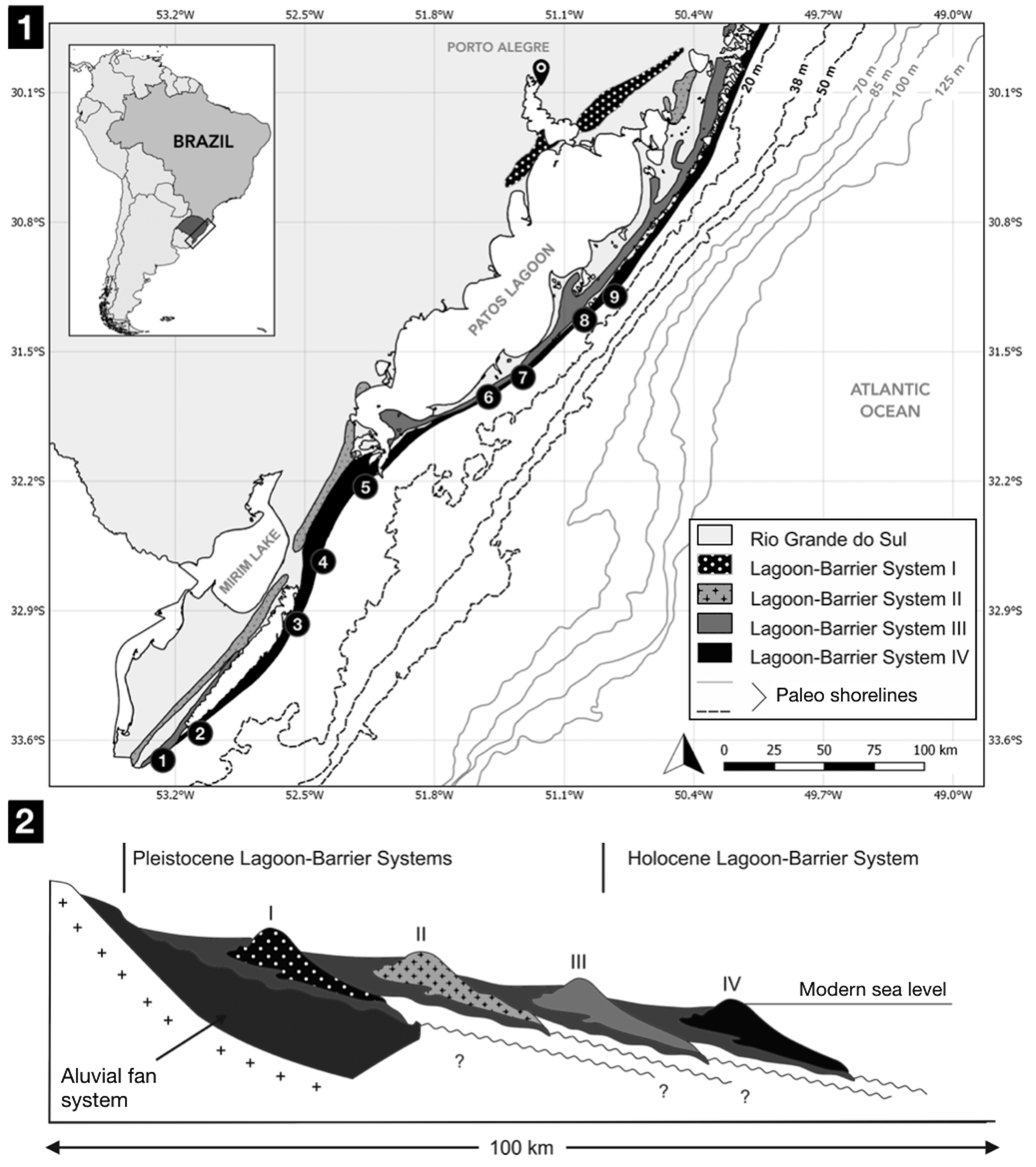
The study area encompasses the region of the RSCP, which is a long, physiographic province located in the Rio Grande do Sul state of Brazil (Fig. 1.1). The RSCP extends for 620 km, is ~150 km wide, and represents the upper sedimentary package of the Pelotas Basin (Tomazelli and Dillenburg, Reference Tomazelli and Dillenburg2007).
The Rio Grande do Sul Coastal Plain, southern Brazil: (1) main locations for ex situ ichnofossil collections; (2) Lagoon-Barrier depositional systems I–IV. 1 = Hermenegildo Beach; 2 = Concheiros do Albardão; 3 = Verga Lighthouse; 4 = Sarita Lighthouse; 5 = Cassino Beach; 6 = Conceição Lighthouse; 7 = Bujuru; 8 = Balneário Lagamarzinho; 9 = Lagoa do Peixe. Datum (WGS 84) (adapted from Corrêa, Reference Corrêa1996 and Tomazelli and Villwock, Reference Tomazelli, Villwock, Holz and De Ros2000).

During the Quaternary, fluctuations of mean sea level (MSL) related to glacioeustatic cycles acted on the deposition of a sequence of Lagoon-Barrier systems (Fig. 1.2; Villwock, Reference Villwock1984; Villwock and Tomazelli, Reference Villwock and Tomazelli1995; Corrêa, Reference Corrêa1996; Tomazelli and Villwock, Reference Tomazelli, Villwock, Holz and De Ros2000; Dillenburg et al., Reference Dillenburg, Tomazelli and Barboza2004; Lowe and Walker, Reference Lowe, Walker, Lowe and Walker2015). Specifically, four glacioeustatic events of MSL fluctuations occurred in the last 400 ka (Pleistocene–Holocene), giving rise to four respective lagoon-barrier depositional systems, named Lagoon-Barrier Systems I–IV (Villwock and Tomazelli, Reference Villwock and Tomazelli1995) (Fig. 1). According to Dillenburg et al. (Reference Dillenburg, Barboza, Tomazelli, Hesp, Clerot, Ayup-Zouain, Dillenburg and Hesp2009), the three oldest Lagoon-Barrier systems (I–III) are Pleistocene in age, whereas Lagoon-Barrier System IV began its formation ~7 ka (Holocene) and remains active at the eastern end of the coast of Rio Grande do Sul.
The Quaternary MSL fluctuations at Rio Grande do Sul are associated with climatic changes, i.e., glacial and interglacial periods, derived from Milankovitch cycles (Imbrie et al., Reference Imbrie, Hays, Martinson, McIntyre, Mix, Morley, Pisias, Prell, Shackleton and Berger1984), as indicated by oxygen isotopic curves and consequently Marine Isotope Stages (MIS) (Villwock and Tomazelli, Reference Villwock and Tomazelli1995). Each Lagoon-Barrier System of the RSCP has a representative MIS: MIS11 (Lagoon-Barrier System I; ± 400 ka), MIS9 (Lagoon-Barrier System II; ± 325 ka), MIS5 (Lagoon-Barrier System III; ± 120 ka), and MIS1 (Lagoon-Barrier System IV; ± 5–7 ka) (Imbrie et al., Reference Imbrie, Hays, Martinson, McIntyre, Mix, Morley, Pisias, Prell, Shackleton and Berger1984; Villwock and Tomazelli, Reference Villwock and Tomazelli1995).
During the development of these depositional systems, several fossiliferous deposits were formed. Among them, the Chuí Formation, as part of Lagoon-Barrier System III, has two distinct sedimentary deposits: a lower marine unit and an upper continental (eolian) unit (Gibert et al., Reference Gibert, de Netto, Tognoli and Grangeiro2006; Netto et al., Reference Netto, Tognoli, Gandini, Lima, Gibert, Netto, Carmona and Tognoli2012). The ichnofossils Cylindrichnus helix Gibert et al., Reference Gibert, de Netto, Tognoli and Grangeiro2006, Macaronichnus Clifton and Thompson, Reference Clifton and Thompson1978, Diplocraterion parallelum Torell, Reference Torrel1870, Rosselia socialis Dahmer, Reference Dahmer1937, Ophiomorpha nodosa, and O. puerilis can be found in situ in the marine deposits of the Chuí Formation, indicating that this unit was deposited in very shallow seas (Gibert et al., Reference Gibert, de Netto, Tognoli and Grangeiro2006; Netto et al., Reference Netto, Tognoli, Gandini, Lima, Gibert, Netto, Carmona and Tognoli2012, Reference Netto, Curran, Belaústegui and Tognoli2017).
Besides the emerged fossiliferous deposits, submerged deposits are accountable for the ex situ specimens encountered on the modern beach face, in which each submerged paleoshoreline has an estimated date of formation (28 m ≅ 8 ka; 38 m ≅ 9 ka; 50 m ≅ 9.5 ka; 70 m ≅ 11 ka; 85 m ≅ 14 ka; 100 m ≅ 16 ka; and 125 m ≅ 17.5 ka; Corrêa, Reference Corrêa1996) and represents immersed fossiliferous deposits (Fig. 1.1).
Material and methods
The burrow fragments studied during this project (N = 253) were collected along a stretch of the modern beach face of the RSCP, southernmost coast of Brazil. These specimens are housed at the Laboratório de Geologia e Paleontologia, Universidade Federal do Rio Grande (LGP-FURG; N = 204) and Museu de Ciências Naturais, Fundação Zoobotânica do Rio Grande do Sul (MCN-FZBRS; N = 49). A list of the acronyms and collection localities of each studied specimen is provided in Supplementary Table 1 (Suppl. File 1).
To describe and characterize these ex situ materials, a set of measurements was performed, which included external and internal diameters, thickness of the wall (in cross section), and pellet diameter (when they occur); some of the 253 burrow fragments analyzed were not complete enough to allow all measurements. The measurements were taken using an electronic caliper and ImageJ software (National Institutes of Health). Basic statistics were performed using the software PAST (Oyvind Hammer). Qualitative information, e.g., pellet organization and shape (following Frey et al., Reference Frey, Howard and Pryor1978; Goldring et al., Reference Goldring, Cadée, Pollard and Miller2007; Uchman, Reference Uchman2009), the presence of bifurcation (in Y- or T-shapes), the occurrence of turn-around points, and the burrow filling, was also recorded.
Samples of ex situ specimens were also analyzed by Scanning Electron Microscopy (SEM), X-Ray Diffractometry (DRX), and Energy Dispersive X-ray Spectroscopy (EDS), to verify their mineralogical and chemical compositions. The SEM and EDS analyses of the specimens LGP H0516, H0011, H0529, H0549, and H0515 were performed at Centro de Microscopia Eletrônica da Zona Sul of the Universidade Federal do Rio Grande (CEME-Sul, FURG). The DRX analyses of LGP H0050 and H0218 were carried out by the Laboratório de Difratometria de Raios-X of the Universidade Federal do Rio Grande do Sul (LRX, UFRGS). Two additional specimens (LGP H0007 and H0008) were sectioned for petrographic analysis; thin sections were made by the Núcleo de Estudos em Paleontologia e Estratigrafia of the Universidade Federal de Pelotas (NEPALE, UFPel), following standard techniques.
Ichnotaxonomic identifications of the ex situ specimens were based on the literature (e.g., Kennedy and MacDougall, Reference Kennedy and MacDougall1969; Frey et al., Reference Frey, Howard and Pryor1978; Griffis and Suchanek, Reference Griffis and Suchanek1991; Nickell and Atkinson, Reference Nickell and Atkinson1995; Bromley and Edkale, Reference Bromley and Ekdale1998; Bertling et al., Reference Bertling, Braddy, Bromley, Demathieu, Genise, Mikuláš, Nielsen, Nielsen, Rindsberg, Schlirf and Uchman2006; Gibert et al., Reference Gibert, de Netto, Tognoli and Grangeiro2006; Uchman, Reference Uchman2009; Netto et al., Reference Netto, Tognoli, Gandini, Lima, Gibert, Netto, Carmona and Tognoli2012, Reference Netto, Curran, Belaústegui and Tognoli2017; Angulo and Souza, Reference Angulo and Souza2014; Martins et al., Reference Martins, Cancelli, Lopes, Hadler, Testa and Barboza2018; Rindsberg, Reference Rindsberg2018), as well as direct comparison with the materials found in situ in the Chuí Formation cropping out at Osório, Santa Vitória do Palmar, and Chuí municipalities (Rio Grande do Sul, Brazil). Ophiomorpha nodosa specimens from the Chuí Formation housed at the Laboratório de História da Vida e da Terra, Universidade do Vale do Rio dos Sinos (LAVIGEA-UNISINOS; N = 8), and Laboratório de Geologia e Paleontologia, Universidade Federal do Rio Grande (LGP-FURG; N = 3) were also analyzed.
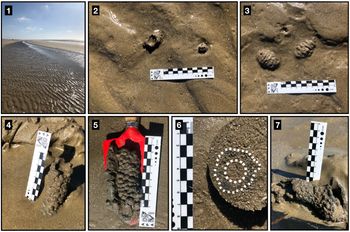
Additionally, a neoichnological analysis was carried out at Cassino Beach (Rio Grande municipality; Fig. 1.1) to access the morphology and size of modern Ophiomorpha-like burrows and to compare them to the fossil record (Fig. 2). For that, Sergio mirim burrows were excavated, measured, and photographed (Fig. 2). The cross-sectional area of the burrows was used to estimate the mass of their producers, following the allometric equation proposed by White (Reference White2005). For comparison purposes, we replicate this methodology using the Ophiomorpha isp. found ex situ. All of the data regarding this approach can be found in Supplementary File 3.
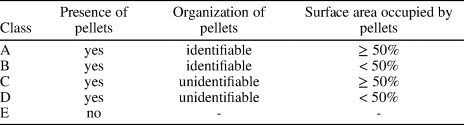
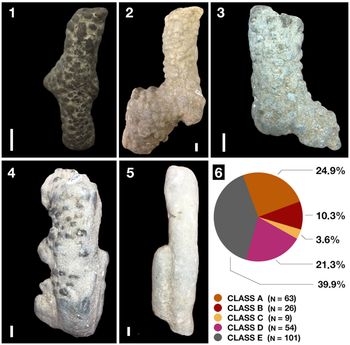
To understand the taphonomic processes and modifications that occurred between the exhumation of the trace fossils from the submerged paleoshorelines and their collection on the modern beach face, we classified the materials according to the degree of three taphonomic signatures: abrasion, bioerosion, and bioincrustation (occurrence of sclerobionts along the internal and external surfaces). Five classes (A–E) were distinguished using the presence, organization, and preservation of pellets in the surface as criteria (Table 1). Despite the unclear organization in classes C and D, pellet shape was preserved and pellet measurements were still viable in all four classes. Class E comprises specimens in which no pellets could be visualized or identified. For bioerosion and bioincrustation, presence or absence was recorded and, when possible, the bioerosion ichnotaxon and the encrusting species were identified. Bioeroders and incrusters were identified to generic or specific levels.
Criteria for classification of the ex situ burrow fragments found in the Rio Grande do Sul Coastal Plain shoreline.

Repositories and institutional abbreviations
Laboratório de Geologia e Paleontologia (LGP), Instituto de Oceanografia (IO), Universidade Federal de Rio Grande (FURG), Rio Grande, Brazil; Museu de Ciências Naturais, Fundação Zoobotânica do Rio Grande do Sul (MCN-FZBRS) (PI), Porto Alegre, Brazil; Laboratório de História da Vida e da Terra (LAVIGEA), Universidade do Vale do Rio dos Sinos (UNISINOS), São Leopoldo, Brazil.
Results
External morphology and ichnotaxonomy
Burrow external diameter ranged 6.82−75.72 mm (mean 29.33 ± 10.73 mm, N = 193) and internal diameter ranged 4.48−46.34 mm (mean 16.9 ± 8.36 mm, N = 167). Burrow wall thickness ranged 2.18−16.41 mm (mean 7.52 ± 2.75 mm, N = 216).
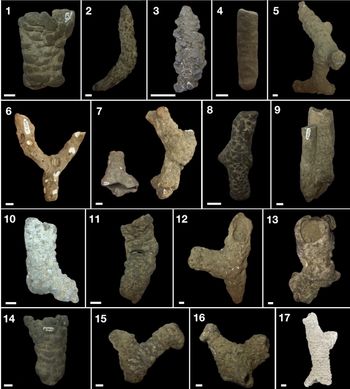
Y- or T-shaped bifurcations were present in 59 specimens (Fig. 3.5–3.7, 3.12, 3.15–3.17) and other 11 presented turn-around points (Fig. 3.7). Most of the analyzed burrows (N = 147) were filled by sand with bioclasts (mainly fragments of molluscan shells), but some were filled only by sand (N = 52), whereas others (N = 54) were unfilled.
(1) Cassino Beach (Rio Grande municipality), where Sergio mirim burrows (2–7) were sampled; (2) main opening of a S. mirim burrow gallery; (3) S. mirim burrow pelleted wall exposed at the beachface; (4, 5, 7) fragments of S. mirim galleries; (6) cross-sectional view of a S. mirim burrow in which the burrow wall and the burrow filling can be distinguished (white squares). Scale bars in centimeters.

Ex situ burrow fragments from the modern beach face of Rio Grande do Sul, Brazil: (1) LGP H0011, with pellets organized in a brick-like pattern; (2) LGP H0513, with pellets organized individually; (3) LGP H0073, with pellets organized in pairs; (4) LGP H0514, indeterminate burrow with no pellets on the outer surface; (5) LGP H0512, with branches and bifurcations; (6) LGP H0232, with a Y-shaped bifurcation; (7) LGP H0049 and H0051, with turn-around points; (8) LGP H0586, with pellets organized in a brick-like pattern; (9) LGP H0056, specimen composed of two associated burrows; (10) LGP H0038, with pellets organized individually; (11) LGP H0522, with pellets organized individually; (12) LGP H0078, with a T-shaped bifurcation; (13) LGP H0016, showing wall width; (14) LGP H0011, with pellets organized in a brick-like pattern; (15) LGP H0078, with a Y-shaped bifurcation; (16) LGP H0089, with multiple tunnel connectors; (17) PI 1670, with pellets organized in a brick-like pattern. All materials assigned to Ophiomorpha nodosa except (4). Scale bars = 1 cm.

For the burrows in which the pelleted outer surface was present (classes A–D), the pellet diameter ranged 2.3−13.77 mm (mean 7.82 ± 2.11 mm, N = 152). Pellet organization could be determined in 152 specimens (~60%), with 97 of them organized individually, 44 organized in a brick-like pattern, and 11 organized in pairs (Fig. 3.1–3.3). Pellet shape varied from cylindrical to ovoid, irregular, or rounded and well distributed along the outer wall. SEM analysis (Suppl. Figs. 5–9) showed that the shape of pellets varied as spherical, rounded, or trapezoidal. Pellets were not evident in 101 specimens (class E), representing ~40% of the total sample (Fig. 3.4). Microorganismal remains (e.g., skeletal elements of foraminiferans, diatoms, palynomorphs, etc.) were not found within the pellets. Thereby, pelleted ex situ trace fossils (N = 152) were identified as Ophiomorpha nodosa due the presence of an outer surface consisting of densely distributed pellets of discoid, ovoid, or polygonal (but not bilobate) morphology, excluding Ophiomorpha irregulaire Frey, Howard, and Pryor, Reference Frey, Howard and Pryor1978 and Ophiomorpha borneensis Keij, Reference Keij1965 (Frey et al., Reference Frey, Howard and Pryor1978).
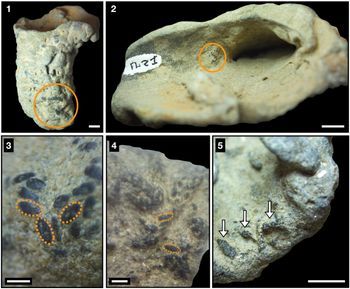
Ophiomorpha puerilis on the external surface of two O. nodosa (LGP H0270 and LGP H0230) specimens: (1, 2) distal images; (3, 4) images that emphasize the rod-shaped to ovoid pellets present on the O. nodosa burrow wall; (5) detail of cemented O. puerilis (arrows) of undetermined pellet shape. Scale bars = 1 cm (1, 2, 5); 1 mm (3, 4).

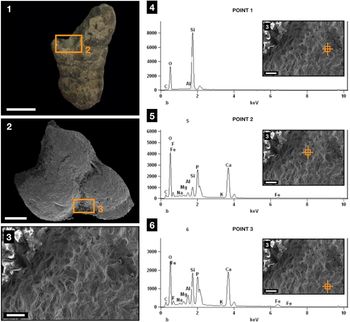
SEM imagery and EDS graphics of outer surface pellets of an ex situ Ophiomorpha nodosa, LGP H0516: (1) overview; (2) SEM image of spherical, rounded pellets; (3) magnified SEM image of one of the pellets; (4–6) EDS graphics showing specific elementary compositions at different points. Scale bars = 1 cm (1); 2 mm (2); 200 μm (3).

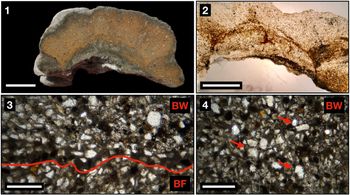
Thin section of Ophiomorpha nodosa, LGP H0007: (1) burrow in cross-sectional view; (2) thin section under stereomicroscope; (3, 4) thin section under petrographic microscope. Red line in (3) indicates the border that divides the sediment of the burrow wall (BW) and the burrow filling (BF); notice the differences in arrangement, compaction, and grain size. The red arrows in (4) indicate larger quartz grains of the BW that differ from the other minerals or heavy minerals. Scale bars = 1 cm (1, 2); 1 mm (3, 4).

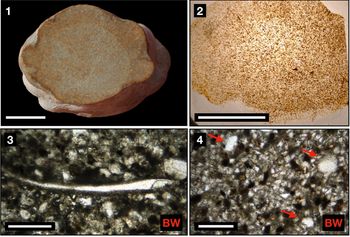
Thin section of Ophiomorpha nodosa, LGP H0008: (1) burrow in cross-sectional view; (2) thin section under stereomicroscope; (3) shell fragment incorporated in the burrow wall (BW) of the trace fossil; (4) larger bright quartz grains (red arrows) in the sediment composition of the BW. Scale bars = 1 cm (1, 2); 1 mm (3, 4).

Classification of the burrows found ex situ according the presence and organization of pellets. (1) LGP H0586 representing Class A. (2) LGP H0025 representing Class B. (3) LGP H0038 representing Class C. (4) LGP H0032 representing Class D. (5) LGP H0037 representing Class E. Scale bar represents 1 cm. (6) Percentage representation of each Class (A–E).

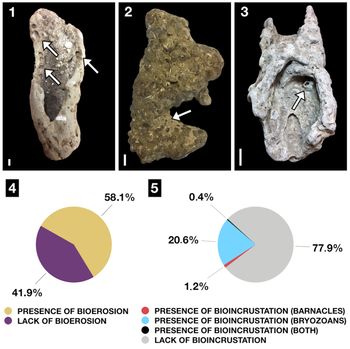
Bioerosion and bioincrustation in ex situ Ophiomorpha nodosa: (1) LGP H0482, with Gastrochaenolites isp. (arrows); (2) PI 1732, with a bryozoan colony (Biflustra aff. holocenica; arrow); (3) LGP H0068, with barnacles (Amphibalanus sp.; arrow); (4) percentage of presence and absence of bioerosion on ex situ O. nodosa; (5) percentage of presence and absence of bioincrustation on ex situ O. nodosa. Scale bars = 1 cm (1–3).

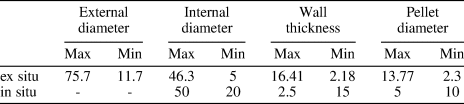
External diameter of ex situ Ophiomorpha nodosa presented a variation of 64 mm. Values of external diameter were not compared with specimens of in situ O. nodosa from the Chuí Formation (Gibert et al., Reference Gibert, de Netto, Tognoli and Grangeiro2006). However, in situ O. nodosa from Pleistocene deposits at the Pinheira coastal plain (Santa Catarina State, Brazil) presented an external diameter ranging 22.86−32.82 mm (mean 27.84 mm; Martins et al., Reference Martins, Cancelli, Lopes, Hadler, Testa and Barboza2018), which are values occurring within the ex situ O. nodosa range but are not as wide. Also, specimens of in situ O. nodosa from England presented a 60 mm maximum diameter (Kennedy and Sellwood, Reference Kennedy and Sellwood1969), which is 15.7 mm less than ex situ O. nodosa.
Internal diameter of ex situ Ophiomorpha nodosa presented a variation of 41.3 mm, whereas in situ O. nodosa from the Chuí Formation ranged 20–50 mm (mean 32 mm; Gibert et al., Reference Gibert, de Netto, Tognoli and Grangeiro2006). For ex situ O. nodosa, minimum internal diameter was 15 mm less than that given by Gibert et al. (Reference Gibert, de Netto, Tognoli and Grangeiro2006) and 3.7 mm less than the maximum value (Table 2). Internal diameter has a direct relation to organism size, as reflected by burrow cross-sectional area (White, Reference White2005; Wu et al., Reference Wu, Alton, Clemente, Kearney and White2015).
Maximum and minimum dimensions (mm) for ex situ and in situ (Chuí Formation) Ophiomorpha nodosa. In situ data from Gibert et al. (Reference Gibert, de Netto, Tognoli and Grangeiro2006), Goldring et al. (Reference Goldring, Cadée, Pollard and Miller2007), and Netto et al. (Reference Netto, Curran, Belaústegui and Tognoli2017). - = not available.

Wall thickness of ex situ Ophiomorpha nodosa presented a variation of 14.32 mm, whereas in situ O. nodosa from the Chuí Formation ranged 2.5–15 mm (mean 9 mm; Gibert et al., Reference Gibert, de Netto, Tognoli and Grangeiro2006). For ex situ O. nodosa, maximum wall thickness exceeded the maximum presented by Gibert et al. (Reference Gibert, de Netto, Tognoli and Grangeiro2006) by 1.41 mm, whereas the minimum value was approximately the same (Table 2).
The pellet diameter of ex situ Ophiomorpha nodosa had a variation of 11.47 mm, whereas in situ O. nodosa from Chuí Formation ranged 5–10 mm (Netto et al., Reference Netto, Curran, Belaústegui and Tognoli2017), which is within the ex situ pellet-diameter range, but the maximum and minimum values were both less (Table 2).
Two specimens of Ophiomorpha puerilis (Fig. 4) were found in the walls of two individual specimens of O. nodosa (LGP H0270, H0230). Due their size and poor preservation, external and internal diameters could not be measured. However, pellet diameter ranged 0.28−0.48 mm (mean 0.39 mm, N = 2). The pellets presented a rod-shaped morphology, which is one of the main diagnostic characters of O. puerilis (Gibert et al., Reference Gibert, de Netto, Tognoli and Grangeiro2006; Netto et al., Reference Netto, Curran, Belaústegui and Tognoli2017). The identification was also made by comparison with in situ O. puerilis from the Chuí Formation (Suppl. Fig. 11 in Suppl. File 2) and literature data. The burrow morphology measurements from in situ O. puerilis from the Chuí Formation ranged 1.36–12.9 mm (mean 4.47 mm; Netto et al., Reference Netto, Curran, Belaústegui and Tognoli2017) for external diameter and 0.63–10.58 mm (mean 2.03 mm; Netto et al., Reference Netto, Curran, Belaústegui and Tognoli2017) for internal diameter, whereas pellet diameter ranged 0.2–2.71 mm (mean 1.04 mm; Netto et al., Reference Netto, Curran, Belaústegui and Tognoli2017). Ex situ O. puerilis had a maximum pellet diameter much smaller when compared to that of the in situ specimens.
Mineralogical and chemical composition
X-ray Diffractometry (DRX) indicated that the pellets of the analyzed specimens were composed mostly of quartz, representing 64−70.8% of the mineralogical composition of the samples (Table 3). Subordinate minerals included feldspars (microcline) and carbonates (calcite and dolomite).
Mineral composition of two ex situ Ophiomorpha (LGP H0050 and H0218) obtained by X-ray Diffractometry (XRD). Values in weight (%). Cal = calcite; Dol = dolomite; Mc = microcline; Qtz = quartz.

Energy Dispersive X-ray Spectroscopy (EDS) results (Fig. 5) indicated substantial amounts of silicon, oxygen, and calcium on the wall of the sampled materials, with minor amounts of aluminum, carbon, fluorine, sodium, magnesium, phosphorus, potassium, iron, nitrogen, sulfur, chlorine, titanium, copper, and manganese (Suppl. Table 2 in Suppl. File 2). The presence of silicon, oxygen, carbon, and calcium corroborated the DRX results, and indicated that the samples were composed mainly of quartz and calcium carbonates. Other elements can be potentially indicative of the presence of clay (iron, aluminum, and magnesium), silt (iron, titanium, and zirconium), and heavy minerals (e.g., kyanite, sillimanite, magnetite, augite, and pyroxene) in the substratum used by the crustacean during wall construction. All of the above-mentioned minerals are common within the RSCP sediments (Corrêa et al., Reference Corrêa, Ayup-Zouain, Weschenfelder and Tomazelli2008).
Thin sections indicated that the specimens are composed of well-sorted, fine to very fine sand-sized grains of quartz and indeterminate opaque minerals cemented by calcium carbonate (Figs. 6, 7). In both burrow walls (pellets) and burrow fillings, the grains are closely packed, but in the latter, the grains can be coarser. Because the burrow walls and fillings are closely packed, they are almost indistinguishable. Differentiation between them is only possible because of a change in color (Fig. 6.3). Macroscopic bioclastic fragments (molluscan shell remains) could be recognized within the pellets (Fig. 7.3) and the burrow fillings.
Neoichnological analysis
Neoichnological observations of the Sergio mirim burrows at Cassino Beach reflects the locally available beach sediments in their composition, as in burrows constituted by fine quartz sand and shell fragments in the pelleted outer surface as in the smoothed inner surface, and a thin layer of mud in its interior (Fig. 2). The pellets presented an elongated, spherical, oval-shaped morphology organized individually. The interior of the burrows was also filled with quartzose fine sand and shell fragments.
External diameter ranged 20.7−49.8 mm (mean 31.77 ± 6.1 mm, N = 18) whereas internal diameter ranged 12.3–31.2 mm (mean 19.4 ± 4.1 mm, N = 18). Therefore, comparison between modern burrows and ex situ trace fossils showed that fossil Ophiomorpha nodosa present a wider range of measurements, with higher maxima and lower minima compared to the Sergio mirim burrows (Table 4). On the other hand, the mean values for both external and internal diameter are similar.
Maximum, minimum, and mean dimensions (mm) for ex situ Ophiomorpha nodosa (N = 111) and Sergio mirim burrows (N = 18).

The estimated maximum mass inferred for the constructors of ex situ Ophiomorpha nodosa is 34.5 g greater than that for Sergio mirim (Table 5). The mean mass inferred for both sample groups have a difference of only 1.4 g. Also, the minimum estimated mass value differs by only 0.8 g, with the ex situ specimens having the smallest value reported (Table 5).
Maximum, minimum, and mean estimated mass (g) for the producers of ex situ Ophiomorpha nodosa (N = 111) and extant Sergio mirim (N = 18). Extended data provided in Suppl. Table 2 of Suppl. File 2.

Taphonomic analysis
Regarding the ex situ trace fossils, 152 specimens (60.7%) presented a pelleted outer wall, being classified within classes A–D (Fig. 8). Class E (no pellets visualized or identified at the outer wall; Fig. 8.5) represented 39.3% (N = 101) of the total number of burrows found ex situ.
Sclerobionts and their trace fossils occurred in some ex situ trace fossils. Only one bioerosion trace fossil was identified on the burrow wall: Gastrochaenolites Leymerie, Reference Leymerie1842, which is a result of bivalve boring activity (Fig. 9.1). Gastrochaenolites occurred in > 55% (N = 147) of the analyzed specimens and were randomly distributed along the burrow walls (Fig. 9.4).
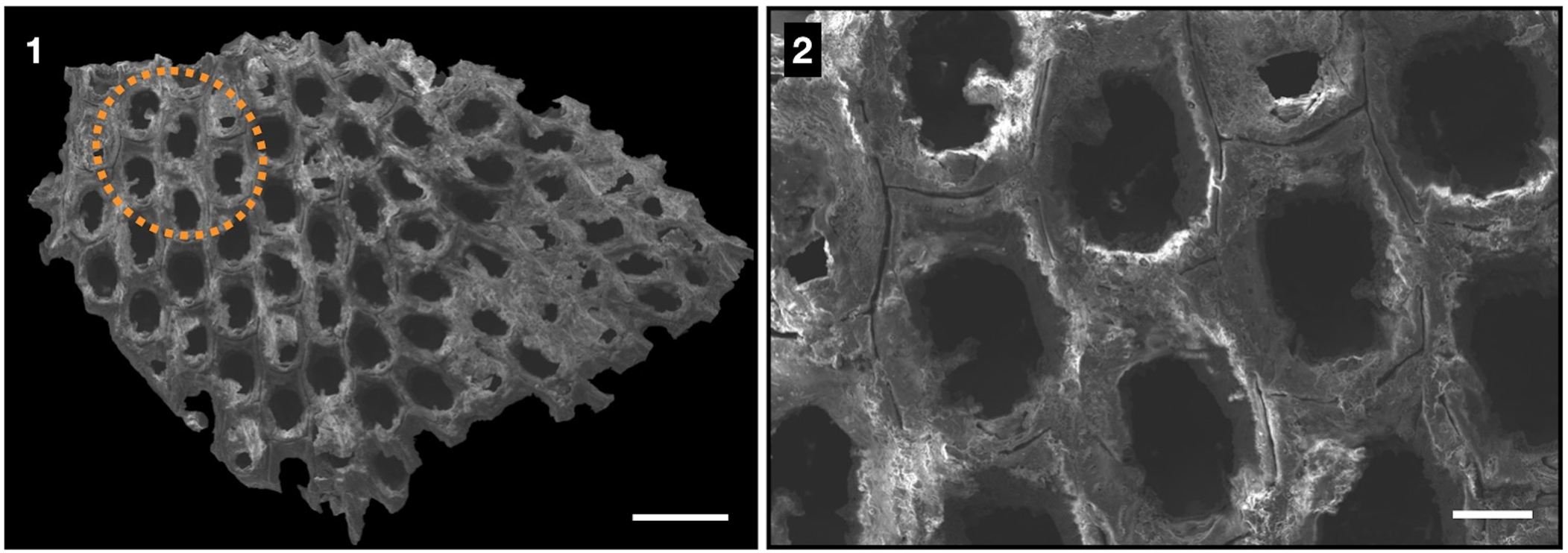
In addition, 22% (N = 56) of all ex situ burrows presented incrusting organisms colonizing the external and internal surfaces of the burrow walls (Fig. 9.5). Bryozoans (N = 52), barnacles (N = 3), and both (N = 1) occurred randomly placed along the analyzed burrows (Fig. 9.2, 9.3). The cheilostome bryozoan Biflustra aff. holocenica Vieira, Spotorno-Oliveira, and Tâmega, (Tâmega et al., Reference Tâmega, Spotorno-Oliveira, Dentzien-Dias, Buchmann, Vieira, Macario, Nash, Guimarães, Francischini and Bassi2019; Figs. 9.2, 10) and the barnacle Amphibalanus sp. were identified (Fig. 9.3).
Discussion
Taphonomic processes and remarks on the nonpelleted specimens
Transportation, weathering, disarticulation, fragmentation, abrasion, dissolution, erosion (including bioerosion), and encrustation are among the main taphonomic processes that can act on body fossils during the biostratinomic phase. The influence of these processes is directly related to the completeness, fidelity, and quality of the fossil record. Some of these taphonomic process also acted on trace fossils, since their production until their final burial (a period called ichnostratinomy, sensu Savrda, Reference Savrda and Miller2007), analogously influencing the quality of the trace fossil record.
One of the most striking differences concerning the way in which taphonomic processes act on body and trace fossils is transportation and reworking. It is widely accepted that bioturbation trace fossils are unlikely to be exhumed from their original matrix and then transported (Buatois and Mángano, Reference Buatois, Mángano, Buatois and Mángano2011), representing obligatory in situ records of organism activities. Here, we describe a peculiar case in which bioturbation trace fossils (crustacean burrows) are exhumed and transported from their original context. Similar occurrences have already been described in literature (Baird, Reference Baird1978; Balson, Reference Balson1980; Brett and Baird, Reference Brett, Baird, Tyson and Pearson1991; Savrda et al., Reference Savrda, Blanton-Hooks, Collier, Drake, Graves, Hall, Nelson, Slone, Williams and Wood2000).
Ex situ Ophiomorpha nodosa (classes A–D) have distinct taphonomic evidences, e.g., the presence of encrusting organisms (Biflustra aff. holocenica and Amphibalanus sp.) and bioerosion trace fossils (Gastrochaenolites), which indicate that the burrows remained under water after exhumation. Also, partial erosion of the pelleted outer wall presented in burrows of classes B and D is more evidence that they were subjected to erosional processes that directly affected their gross morphology. On the other hand, the trace fossils belonging to class E completely lack the characteristic pelleted lining of Ophiomorpha.
Two nonexclusive working hypotheses are proposed to explain the absence of pellets in the class E specimens: (1) the nonpelleted burrows found ex situ represent Spongeliomorpha and/or Thalassinoides (i.e., nonpelleted SOT) burrows, and/or (2) they represent Ophiomorpha specimens whose taphonomical processes acted to erode pellets. Below, we present arguments concerning both hypotheses.
The main difference among the SOT ichnogenera is related to the outer surface of the burrows. Different from the pellet-lined Ophiomorpha, Spongeliomorpha and Thalassinoides lack pelleted linings on their outer surfaces (Goldring et al., Reference Goldring, Cadée, Pollard and Miller2007). The main difference between Thalassinoides and Spongeliomorpha is the smoothness of the wall, which is scratched in the latter and completely smooth in the former (Goldring et al., Reference Goldring, Cadée, Pollard and Miller2007). Goldring et al. (Reference Goldring, Cadée, Pollard and Miller2007) considered that the SOT ichnotaxa could be a part of the same maze system in which the substratum cohesion and percolation combined with increasingly vertical depth induce the production of pellets by the crustacean, reflecting the sediment conditions at the burrow walls.
Furthermore, if the class E specimens confidently represent nonpelleted SOT burrows, the trace fossils could have been exhumed from more consistent deposits of the Skolithos ichnofacies or even from deposits representing different marine environments, e.g., the Glossifungites or Cruziana ichnofacies (MacEachern et al., Reference MacEachern, Pemberton, Gingras, Bann and Miller2007, Reference MacEachern, Bann, Gingras, Zonneveld, Dashtgard, Pemberton, Knaust and Bromley2012).
Some ex situ Ophiomorpha nodosa in classes A–D show clear evidence of pellet erosion. This loss is solid evidence that their fragments were morphologically affected by underwater abrasion. This observation suggests that the class E burrows could also have been abraded prior to complete destruction of their pellets.
Even though both hypotheses have support in different arguments, it is not possible to test them with the currently known data. The exact location of the deposit(s) in which these burrows are being exhumed and the effect of ocean dynamics in their taphonomic history remain completely unknown.
Neoichnological observations
According to White (Reference White2005) and Wu et al. (Reference Wu, Alton, Clemente, Kearney and White2015), there is a direct relation between animal size and burrow cross-sectional area. In addition, Twitchett and Barras (Reference Twitchett, Barras and McIlroy2004) stated that for ichnology, standard burrow diameter is a proxy for body size and, consequently for the organismal response to surrounding environmental conditions.
The ex situ Ophiomorpha nodosa sample group presented a wider range of calculated mass (0.05–49.2 g) when compared with Sergio mirim burrows (0.85–14.7 g; Table 3), assuming that O. nodosa from the Chuí Formation have a high probability of derivation from the fossilization of Sergio mirim burrows (Netto et al., Reference Netto, Curran, Belaústegui and Tognoli2017). The wide range of variation between the minimum and maximum estimated mass for the ex situ constructors could be explained by four distinct hypotheses: (1) a monospecific contemporary crustacean population is represented by the ex situ O. nodosa assemblage, and these crustaceans had a wider size range when compared with the modern S. mirim population; (2) the ex situ assemblage represents multiple, but contemporaneous, crustacean populations of different species (with different size ranges); (3) the ex situ assemblage represents different noncontemporaneous monospecific crustacean populations and the size of these animals varied during the Quaternary; and (4) different species of crustaceans of different mean sizes existed during the Quaternary and the ex situ burrow assemblage represents these variations.
Hypotheses (1) and (2) represent a time-specific group sample, unlike hypotheses (3) and (4) that support a time-averaged ex situ sample. During the Quaternary, the MSL fluctuated due to glacioeustatic changes (Villwock, Reference Villwock1984; Villwock and Tomazelli, Reference Villwock and Tomazelli1995; Corrêa, Reference Corrêa1996; Tomazelli and Villwock, Reference Tomazelli, Villwock, Holz and De Ros2000; Dillenburg et al., Reference Dillenburg, Tomazelli and Barboza2004; Lowe and Walker, Reference Lowe, Walker, Lowe and Walker2015). The distinct submerged paleoshorelines (Corrêa, Reference Corrêa1996) are currently being reworked, resulting in ichnofossil exhumation and deposition of the burrow fragments on the modern beach face. However, the age of these fragments is still unknown. Tâmega et al. (Reference Tâmega, Spotorno-Oliveira, Dentzien-Dias, Buchmann, Vieira, Macario, Nash, Guimarães, Francischini and Bassi2019) found shoreface Holocene bryoliths (free-living nodules coated by the bryozoan Biflustra holocenica) scattered in the foredunes of the RSCP. The bryolith radiocarbon datings (7.9 –7.6 ka), as well as compositional and morphological features (Tâmega et al., Reference Tâmega, Spotorno-Oliveira, Dentzien-Dias, Buchmann, Vieira, Macario, Nash, Guimarães, Francischini and Bassi2019), were used to assess the paleoenvironmental dynamics in the region.
Paleoenvironmental dynamics and a taphonomic model for ex situ trace fossil occurrences
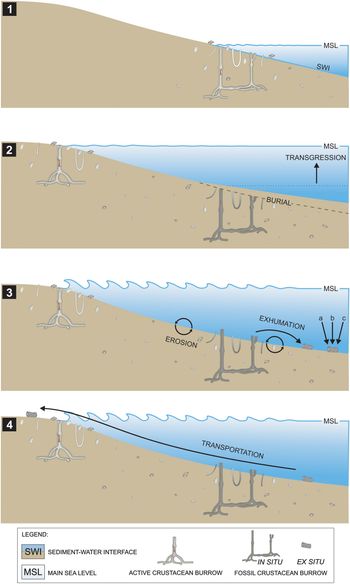
The ex situ trace fossils were exhumed from their original strata, reworked, and transported to the modern beach face of the RSCP (Fig. 11). According to the model proposed (Fig. 12), complex maze burrows were produced in the upper shoreface of a sandy beach at a stable coastline (Fig. 12.1). Coastal and shallow marine sediments have been deposited at the South American Atlantic margin since the late Mesozoic, where Ophiomorpha is often found in situ (e.g., Buatois et al., Reference Buatois, Bromley, Mángano, Bellosi and Carmona2003; Verde and Martínez, Reference Verde and Martínez2004; Bueno et al., Reference Bueno, Zacharias, Oreiro, Cupertino, Falkenhein and Martins Neto2007; Barboza et al., Reference Barboza, Rosa and Ayup-Zouain2008). Contrasting with deposits from Argentina and Uruguay (e.g., Buatois et al., Reference Buatois, Bromley, Mángano, Bellosi and Carmona2003; Verde and Martínez, Reference Verde and Martínez2004), trace fossils are still unknown from the Pelotas Basin prior to the Quaternary Lagoon-Barrier System of Rio Grande do Sul, preventing us from speculating about the source of the ex situ burrow fragments. During the Quaternary, the RSCP passed through transgressive and regressive (T-R) cycles that resulted in differing coastal deposition. Nowadays, these deposits and their respective trace fossils occur either emerged (i.e., the Chuí Formation) or submerged by the modern sea.
SEM images of zooidal skeleton of the bryozoan Biflustra aff. holocenica incrusting the outer wall of ex situ Ophiomorpha nodosa, PI 1732: (1) frontal surface of the colony; (2) detail of the autozooids. Scale bars = 100 μm (2); 500 μm (1).

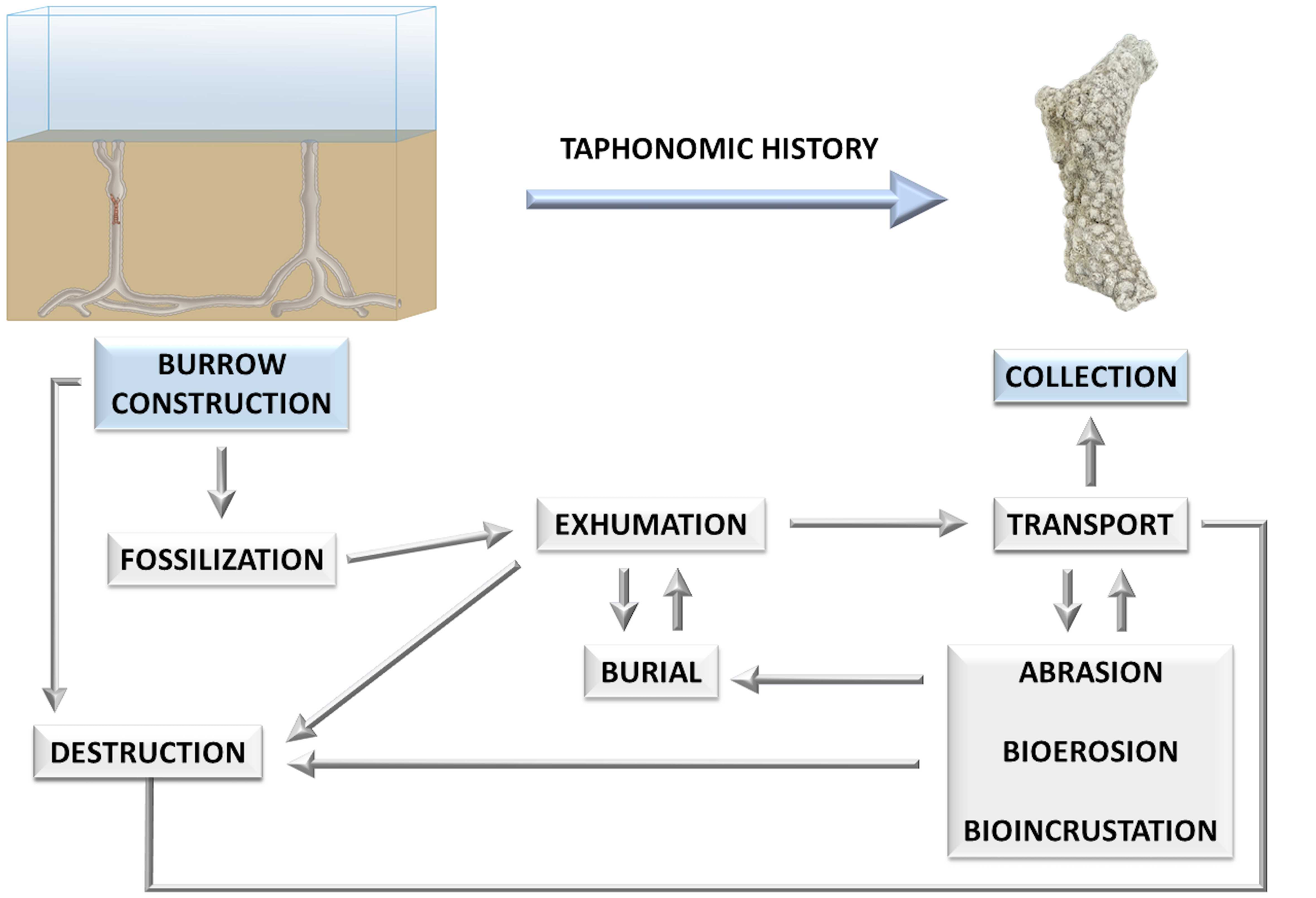
Taphonomic processes to which ex situ Ophiomorpha trace fossils collected along the Rio Grande do Sul coastal plain could have been exposed from the moment of construction to collection on the modern beach face.

Due to MSL transgressions (Villwock and Tomazelli, Reference Villwock and Tomazelli1995; Tomazelli and Villwock, Reference Tomazelli, Villwock, Holz and De Ros2000; Dillenburg et al., Reference Dillenburg, Tomazelli and Barboza2004), the ancient coastlines that were inhabited by crustaceans become submerged (Fig. 12.2) and the burrow systems become buried and perhaps filled with the surrounding sediment (Frey et al., Reference Frey, Howard and Pryor1978; Gibert et al., Reference Gibert, de Netto, Tognoli and Grangeiro2006). During a fast burial event, the burrow becomes inhospitable and the tracemaker either abandons the burrow or is rapidly buried and fossilized (Hyžný and Klompmaker, Reference Hyžný and Klompmaker2015; Hyžný et al., Reference Hyžný, Duane, Reinink-Smith, Eastoe and Hudáčková2018). Following the burial process, the burrows pass through fossilization and become lithified. Because of ocean dynamics (high energy wave incidence, i.e., storm surges), the now-lithified burrow gallery is exhumed at the surface of the ocean floor and fragments of the gallery are exposed (Fig. 12.3). After exhumation, the burrow fragments can either be buried again, transported, or even destroyed. If the fragment is not destroyed, transportation and reworking processes can proceed. Abrasion, bioerosion, and bioincrustation processes only occur after stabilization of the fragment (Fig. 12.3). The residence time of a fossilized burrow fragment at the ocean floor after exhumation is still unknown due to the lack of dated specimens that could range thousands of years, which also corroborates with a time-averaged sample. Uninterrupted, long-termed exposure of some of the burrow fragments at the ocean floor is suggested by the presence of the deep-tier ichnogenus Gastrochaenolites following the tiering model proposed by Bromley and Asgaard (Reference Bromley and Asgaard1993). However, more data are needed to precisely estimate the residence time of such fragments and the range of the time averaging.) Finally, when a meteorological high-energy event occurs, fragments of the burrows are transported both offshore and inshore, and it is possible to find them along the foredunes or foreshore (Fig. 12.4).
Reconstruction of paleoenvironmental dynamics since construction of a crustacean burrow in a paleoshoreline until deposition of the reworked fragmented Ophiomorpha on the modern beach face of the Rio Grande do Sul coastal plain: (1) a decapod crustacean engineered its burrow in soft substrate in the Quaternary upper shoreface; (2) mean sea level (MSL) rise (transgression phase) submerged the shoreface (paleoshoreline) and the crustacean burrow goes through fossilization (Ophiomorpha); (3) the trace fossil is exhumed by erosion from its original bedrock at the paleoshoreline, and burrow fragments are exposed to taphonomic processes, i.e., (a) abrasion, (b) bioerosion, and (c) bioincrustation; (4) trace fossil deposition on the modern beach face. Not to scale.

Conclusions
Ex situ crustacean burrows found along modern beaches of Rio Grande do Sul (southern Brazil) included pellet-walled tubes assigned mostly to Ophiomorpha nodosa and very rarely to O. puerilis. Other nonpelleted specimens could represent Ophiomorpha with eroded pellets, Spongeliomorpha, and/or Thalassinoides. Abrasion and bioerosion trace fossils plus bioincrustation demonstrate that these ex situ burrows passed through exhumation and redeposition.
The size range of the ex situ burrows is larger than that of the modern burrows of Sergio mirim. This suggests that the size and mass of crustacean producers varied during the Quaternary. For now, we do not have conclusive evidence that suggests whether the burrows were produced by different species of callianassids or if the modern S. mirim reached larger sizes in the past. Ex situ trace fossils, like those described here, are rare and generally lack most of the information related to the original depositional context in which they were preserved, making them difficult to identify and to interpret. Future contributions, as well as new approaches for information acquisition should shed light on this issue.
Acknowledgments
We thank the LGP team for their support during the field work, especially D. Diniz who helped in the beginning of this project and S. Medeiros for the artwork presented in Figures 11 and 12. CEME-Sul (FURG), NEPALE (UFPel), and LRX (UFRGS) performed the analyses. We also thank A.M. Ribeiro (MCN-FZBRS) and R.G. Netto (LAVIGEA-UNISINOS) for access to the specimens under their care. Reviewers A. Uchman and R. Netto, and the editor J. Jin provided constructive comments. This work was funded by the Coordenação de Aperfeiçoamento de Pessoal de Nível Superior – Brasil (CAPES) – Finance Code 001, with grants to GPF (Process Number: 88887.209627/2018-00), HF (Process Number: 88882.316166/2019/01), FTST (Process Number: 88882.314604/2019-01), and PSO (Process Number: 88887.320380/2019-00). This paper resulted from the project Paleo e Neoicnologia da Planície Costeira do Rio Grande do Sul, funded by the Conselho Nacional de Desenvolvimento Científico e Tecnológico (CNPq; 409750/2016-6).
Accessibility of supplemental data
Data available from the Dryad Digital Repository: https://doi.org/10.5061/dryad.pzgmsbcgs.
Supplemental files include: (Supplemental file 1) summary of all acronyms and localities for each analyzed specimen; (Supplemental File 2) additional tables and figures with information regarding basic statistics, EDS, SEM, XRD, and comparative morphological analyses; and (Supplemental File 3) inferred mass (g) of Ophiomorpha nodosa producers and Sergio mirim based on internal burrow diameters (mm).