1. Introduction
It is an honor and a pleasure to comment on the work of four such distinguished philosophers of biology as these. Although these works stand on their own, it will be worthwhile to remind the reader of the main themes. Each essay focuses on a different area where chance plays a role in evolution.
John Beatty's “Chance Variation: Darwin on Orchids” (Beatty Reference Beatty2006, in this issue) elucidates Darwin's concept of chance variation in orchids, the resulting divergent evolution of otherwise similar populations, and the role that chance variation plays in Darwin's case for evolution by natural selection. Robert Richardson's “Chance and the Patterns of Drift: A Natural Experiment” (Richardson Reference Richardson2006, in this issue) analyzes the studies of human blood types by Luigi Cavalli-Sforza et al. and argues that they are evidence that chance, in the form of genetic drift, is explanatorily autonomous and independent of debates over (in)determinism. Robert Skipper's “Stochastic Evolutionary Dynamics: Drift versus Draft” (Skipper Reference Skipper2006, in this issue) explicates the concept of genetic draft, distinguishes it from genetic drift, and discusses John Gillespie's argument that genetic draft is a more important evolutionary cause than genetic drift because it reduces heterozygosity at a faster rate. Finally, Michael Dietrich's “Three Perspectives on Neutrality and Drift in Molecular Evolution” (Dietrich Reference Dietrich2006, in this issue) explores neutral molecular evolution as (1) a simple and useful mathematical model in its early formulations, (2) a testable theory within population genetics, and (3) an explanation of the “molecular clock” in biochemistry.
In considering these case studies of chance in evolution, it seems to me that four issues or themes of particular philosophical interest arise. (In some cases, these are themes that the authors themselves emphasized; in other cases, these are themes that I have extrapolated from the authors’ discussions.) First, can the conceptions of chance illuminated by the case studies be given one unified conception, or must we recognize that the meaning of chance is different in different areas of evolutionary theory? Second, as one reads through the case studies, it becomes apparent that it is often necessary to distinguish a particular concept of chance from a “nonchancy” concept or from another “chancy” concept. Third, and relatedly, biologists often seek to empirically distinguish the occurrence of a given chance process from nonchance processes or other chance processes. And fourth, the case studies show that chance plays many different kinds of roles in evolutionary theory. I cannot hope to provide definitive analyses of each of these issues here; thus, my goal is the much more modest one of illuminating these common themes and raising questions concerning each.
2. Interlude: A Lens of Process versus Outcome
Before beginning my analysis, it will be helpful to be clear on the distinction between “process” and “outcome,” particularly as it occurs in evolutionary situations.Footnote 1 By “process” I mean a series of physical states occurring over time, whereas by “outcome” I mean the effect, or ending state at a particular point in time, of that process. To see why this distinction is important, suppose that there were a population of conspecific organisms in which there is a genetic locus where two alleles (A and a) are of equal numbers. In other words, suppose that the frequency of A, represented by the variable p, is 0.5, and that the frequency of a, represented by the variable q, is
 $1-p$
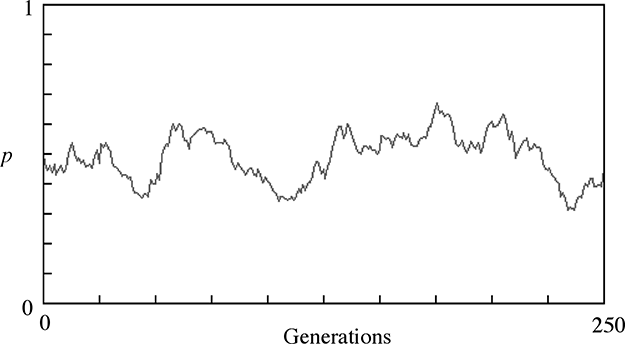
. Let us further suppose that the three genotypes formed by the two alleles (AA, Aa, and aa) are equal in fitness, and that the population is small and that environmental conditions keep the population small over time. In each generation, the following process (an indiscriminate sampling process) occurs: a large number of gametes are produced, from which only a random subset (the “sample”) are successfully united to form zygotes. (The subset is “random” in the sense that A gametes have an equal chance of being united to form gametes as a gametes do.) Because the random sample is small (by the assumption of a small population), the proportions of A and a alleles in the sample may not be representative of the proportions in the parental generation. In other words, the outcome—the frequency of A and a alleles—may show an increase from the previous generation. Or, it might show a decrease, or it might stay the same. As this sampling process is repeated in each generation, a series of outcomes is produced, and because these outcomes can represent increases or decreases from the previous generation, we would expect the gene frequencies of the population to fluctuate over time. Figure 1 gives an example of gene frequency changes for A over the course of generations (a plot of the successive outcomes) that would be consistent with this sampling process.
The changes in frequency, p, of an allele A in a population of conspecific organisms over time. These successive outcomes can be produced by an indiscriminate sampling process or by a discriminate sampling process in a changing environment.

The problem is that the pattern shown in Figure 1—the same fluctuation of gene frequencies over time—can be produced by a very different process, namely, a discriminate sampling process. Consider a population where the genotypes differ in fitness, but where the environment is fluctuating over time. To see how such a population could produce the same pattern, suppose that at the outset, the aa genotype is fitter than AA and Aa genotypes.Footnote 2 Thus, we would expect that there would be a decrease in the frequency of the A allele, which is what the figure shows. However, after a few generations the environment changes so that now aa is less fit than the other genotypes. We would then expect an increase in the A allele, which, again, is what the figure shows. Each increase or decrease in the frequency of A shown by the figure could similarly be explained by a change in the environment that produces a change in the relative fitnesses of the genotypes.
In other words, the same outcomes (the same pattern of gene frequency changes over generations) can be produced by two different processes, namely, (1) an indiscriminate sampling process (Beatty Reference Beatty1984) where physical differences between organisms are causally irrelevant to differences in reproductive success, or (2) a discriminate sampling process (Beatty Reference Beatty1984) where physical differences between organisms are causally relevant to differences in reproductive success. Thus, if we want to understand the biological situation, we cannot just consider outcomes; we must also take into account the processes that produce those outcomes. Elsewhere, I argue that we should call the first process “random drift” and the second “natural selection,” and that the terms “random drift” and “natural selection” ought to reflect process rather than outcome (Millstein Reference Millstein2002, Reference Millstein2005). Here I want to make a lesser point: it is often useful in trying to understand concepts and empirical debates in evolutionary biology if one is careful to distinguish between process and outcome, as the following discussion will show.
3. One Unified Conception of Chance in Evolution or Many?
Each of the case studies invokes a putatively different conception of chance that can be described in terms of a chance process and a probable outcome. (For each of these chance processes, other outcomes are possible.) In Beatty's analysis of Darwin's concept of “chance variation,” or perhaps more accurately, “chance differences in variation,” the chance process is that different variations arise at different times in similar populations in similar environments, which can produce an outcome where you have different adaptive strategies among initially similar populations, yielding an immense number of variations on a “theme.” (Philosophers of biology are familiar with “chance variation” in the sense that new variations are not an adaptive response to the environment; based on Beatty's discussion, it would seem that this sense does not fully capture the meaning of “chance variation” for Darwin. It should be noted, however, that Beatty's focus is more on the evolutionary implications of “chance variation” than it is on the meaning of “chance variation.”) The chance process discussed by Richardson is what biologists call “random genetic drift” or often just “drift.” Richardson characterizes this chance process as the “error” in the transmission of types from generation to generation arising from finite population size,Footnote 3 a process that can lead to a pattern of greater differentiation among small populations than among large populations. Skipper explores the chance process of “genetic draft,” which is a process of linked selection where it is a matter of chance which of two neutral alleles (in a two-locus model) happens to be linked to a site that undergoes an advantageous mutation, and where the timing of these mutations, followed by a rapid selective “sweep” to fixation, is random. As Skipper discusses, one of the interesting properties of genetic draft is that it can produce an outcome similar to that which one would expect from genetic drift in small populations, namely, a reduction in genetic variation (thus the similar name). Dietrich's focus is on “neutral evolution,” which, after selection quickly eliminates the many deleterious mutants and fixes the few advantageous mutants, invokes the chance process of drift—but at the molecular level. The expected outcome of the neutral model of molecular evolution is that most molecular variation is neutral or “nearly neutral.”
Prima facie, these are different conceptions of chance—they apply to different aspects of the evolutionary process (e.g., production of new variation versus perpetuation of existing variation) or to different levels of organization (phenotypic versus molecular) or different time scales (microevolutionary versus macroevolutionary). So then the question arises as to whether there is a common conception of chance underlying all of them. This is a difficult question, and I will not be able to address it fully in the space allotted here, but I will try to shed a little light on it.
The complexity of the question becomes obvious when one realizes that “chance” itself has more than one meaning. Elsewhere, drawing on Eble (Reference Eble1999), I argue that there are six conceptions of chance that are potentially relevant to evolutionary theory: (1) chance as “uncaused” or “fundamentally random,” implying a denial of Laplacean determinism, and, perhaps a vindication of the realist interpretation of quantum mechanics; (2) chance as “not by design”; (3) chance as ignorance of the real underlying causes; (4) chance as “indiscriminate sampling” (where any physical differences between items that are sampled are causally irrelevant to which items are picked); (5) chance as “coincidence” (an idea associated with Aristotle, implying the confluence of independent causal chains); and (6) a distinctly evolutionary conception of chance, or chance as “independent of the generally adaptive direction of natural selection” (Millstein Reference Millstein2000a). I think it is fair to say that each case study involves chance in at least one, and probably more than one, of these senses. However, a complete analysis would require exploring each of the four case studies in light of each of the six notions of chance, a probably tedious and certainly lengthy prospect. Thus, I will limit myself to discussing the first conception because it is the most easily ruled out.
With regard to the first conception, Richardson suggests that the nature of chance that drift embodies is independent of philosophical debates over indeterminism and determinism (see, e.g., the debate between Brandon and Carson Reference Brandon and Carson1996 and Graves, Horan, and Rosenberg Reference Graves, Horan and Rosenberg1999; but see Millstein Reference Millstein2000b for a critique of both). The relevant conception of indeterminism here is the ontological (and not the epistemological) one; that is, determinism is the view that given the complete state of the world at a particular point in time, for any given future point in time, only one state is possible, whereas indeterminism is the view that given the complete state of the world at a particular point in time, more than one future state is possible. And Richardson's claim that this is not what is at stake for drift seems right. (This also means that Dietrich's case study, to the extent that it also incorporates drift, similarly does not turn on the determinism question.) There are differences in blood group frequencies among the villages; these differences in frequency may be due entirely to deterministic factors that lead one person to marry another, or they may be partially the result of fundamentally indeterministic factors. That is, it may be the case that given the identical set of circumstances (identical villages, people, etc.), the same results would have occurred, or it may be the case that different results would have occurred. Either of these possibilities is consistent with the phenomenon of drift and its mathematical models. Drift, as Richardson points out, is operating at a higher level of description than factors such as marriage choices, which means that questions concerning those underlying causes become irrelevant. Deterministic drift and indeterministic drift would both be drift. Thus, whatever conception of chance drift invokes, it is not the first conception described above.Footnote 4
Similar arguments can be made for Skipper's case study and Beatty's case study. Actually, the two case studies, dealing with conceptions of chance developed in different centuries, share an interesting commonality; both examine phenomena where the timing of new variations is said to be the result of chance, and in both cases this can lead to different trajectories for different populations. Now, there is good reason to believe that point mutations, at least, are fundamentally indeterministic (Stamos Reference Stamos2001), so one might be tempted think that Skipper's and Beatty's case studies involve indeterministic chance. However, one should resist that temptation. One could imagine a universe in which it is the case that it is a completely deterministic process as to when and where a given mutation occurs. That is, one can imagine that it was always the case that given the identical circumstances, the same mutations would have occurred in the same place and time—and yet the concepts of chance would remain the same. As with the drift case, I think that consideration of the level of description is important; the chance phenomena under discussion are independent of the lower-level causes that produce mutation.
So, with regard to the first conception of chance that I outlined, my conclusion is negative; my claim is that none of the four case studies relies on chance in that sense. However, I leave open the possibility that one or more of the other five conceptions apply; further analysis is needed.
4. Conceptually Distinguishing Chance from Nonchance and Chance from Chance in Evolutionary Theory
Another theme that arises from these case studies is the extent to which it becomes necessary to distinguish these concepts of chance from other biological concepts—usually to distinguish chance from nonchance, but sometimes to distinguish one kind of chance from another kind of chance.
Recent work in this area has focused on distinguishing the concepts of selection from drift (e.g., Beatty Reference Beatty1984; Shanahan Reference Shanahan and Griffiths1992; Brandon Reference Brandon2005; Millstein Reference Millstein2002, Reference Millstein2005)Footnote 5 and on distinguishing “deterministic” from stochastic models of macroevolution (Millstein Reference Millstein2000a). The case studies highlight the fact that these analyses have just begun to scratch the surface; there are more conceptual distinctions to be clarified within evolutionary biology with respect to chance. For example, Beatty shows how Darwin's concept of chance variation contrasts with “teleological” and “unity of plan” approaches (both of which assume a Creator). Skipper's paper, on the other hand, distinguishes drift from draft (chance from chance!) and shows that the conceptual distinction cannot be found in the mathematical models of their outcomes (which are identical), but in the processes themselves.
These issues deserve further exploration. Furthermore, their existence implies that there may be other conceptual debates over chance that ought to be explored philosophically.
5. Empirically Distinguishing Chance from Nonchance and Chance from Chance in Evolutionary Processes
Evolutionary biologists spend quite a bit of time attempting to determine whether, for a given population or in general, chance processes are operating or nonchance processes are operating. More precisely, as Beatty (Reference Beatty1997) has argued, evolutionary biologists engage in “relative significance” debates. That is, they argue over the extent to which the changes in a given population or populations are due to chance processes.
The case studies illuminate a number of these relative significance debates. In some cases, biologists seek to empirically distinguish chance from nonchance. Richardson's paper discusses how to distinguish selection from drift in an ensemble of populations by looking to see whether the actual patterns match the expected patterns. Dietrich explores the difficulties in determining the relative significance of neutralist and selectionist assumptions, even as both sides acknowledge the phenomena of neutrality, drift, and selection. In other cases, biologists are trying to empirically distinguish chance from chance. Skipper's paper discusses Gillespie's argument that draft is less sensitive to population size than drift, which leads Gillespie to claim that draft is a more significant cause of evolution than drift. Skipper also points to other relative significance debates over chance in evolution: drift and draft as compared to mutation, boundary and origination processes, and selection in a random environment. Beatty points to recent work on the relative significance of chance variation and drift.
As with the previous section, these issues deserve further exploration. And again, they point to the possibility that there may be other empirical debates over chance that ought to be explored philosophically.
6. Roles for Chance in Evolution
Taken as a whole, the papers in this session suggest four possible roles for chance in evolution: an explanatory role, an instrumental role, a representational (“realist”) role, and a justificatory role. I will discuss each of these in turn.
First, there is an explanatory role for chance. That is, we frequently seek concepts of chance that can explain phenomena in nature. Richardson argues that drift can explain certain general patterns of changes—in the case he discussed, a pattern of greater differentiation among small populations than among large populations. Dietrich identifies explaining the “molecular clock” as one goal of the neutralist camp. Furthermore, I infer from Beatty that Darwin sought to explain different adaptations among orchids, and I infer from Skipper that Gillespie seeks to explain why molecular variation is largely insensitive to population size.
Second, there is an instrumental role for chance. That is, sometimes we seek concepts of chance that are useful to us in some way, without necessarily believing that they reflect reality. This is seen most clearly in Dietrich's paper, which describes the early use of neutral models as starting points for investigations of drift, selection, and migration, even though investigators believed the models to be unrealistic.
Third, there is a representational, or “realist” role for chance. Often, we are seeking concepts of chance that represent phenomena in nature. Each of the proponents of the chance concepts discussed in the four case studies sought to describe phenomena in nature (with the exception of the early use of neutral models noted previously).
Fourth, there is a justificatory role. Sometimes we seek concepts of chance that aid in the justification of other, less chancy phenomena. Beatty argues that Darwin's concept of chance variation helped bolster Darwin's case for evolution by natural selection. Dietrich mentions that Kimura and Ohta claimed that the neutral theory provided evolutionary theory with a testable model.
Thus, there is no one role for chance in evolution, but many. Moreover, there may be additional roles for chance that need to be explored.
7. Summary/Conclusion
The four case studies evoke the following conclusions. There is no one concept of chance, but many—and yet there may be an underlying unity. These concepts of chance will need to be distinguished from one another, not just from nonchance, both conceptually and empirically. The process/outcome distinction can help here. There is no one role for chance, but many. Furthermore, there are more concepts and debates for philosophers and historians of biology to seek out. In sum, there's more to the study of chance in evolution than what has been discussed previously—determinism versus indeterminism and drift versus selection—although I would not say that these debates are entirely resolved either.