Introduction
The family Ophioparmaceae was erected by Rogers & Hafellner (Reference Rogers and Hafellner1988) to accommodate the single genus Ophioparma Norman. Currently, the family includes three genera: Boreoplaca Timdal, Hypocenomyce M. Choisy, and Ophioparma (Wedin et al. Reference Wedin, Wiklund, Crewe, Döring, Ekman, Nyberg, Schmitt and Lumbsch2005; Miadlikowska et al. Reference Miadlikowska, Kauff, Hofstetter, Fraker, Grube, Hafellner, Reeb, Hodkinson, Kukwa and Lücking2006; Bendiksby & Timdal Reference Bendiksby and Timdal2013; Lücking et al. Reference Lücking, Hodkinson and Leavitt2017). Boreoplaca includes only the species B. ultrafrigida Timdal, which is characterized by a rosulate thallus, black and lecideine apothecia, and the presence of lecanoric acid (Zhou & Wei Reference Zhou and Wei2006). Hypocenomyce contains the three species H. australis Timdal, H. scalaris (Ach.) M. Choisy and H. tinderryensis Elix, according to the current revision of this genus (Bendiksby & Timdal Reference Bendiksby and Timdal2013). Seven species of Ophioparma are accepted, including two saxicolous species (O. lapponica (Räsänen) Hafellner & R. W. Rogers and O. ventosa (L.) Norman) and five corticolous species (O. araucariae (Follmann) Kalb & Staiger, O. handelii (Zahlbr.) Printzen & Rambold, O. juniperiicola Martínez & Aragón, O. pseudohandelii (Asahina) Printzen & Rambold and O. rubricosa (Müll. Arg.) S. Ekman) (Kalb & Staiger Reference Kalb and Staiger1995; Zedda & Sipman Reference Zedda and Sipman2001; Martínez & Aragón Reference Martínez and Aragón2003).
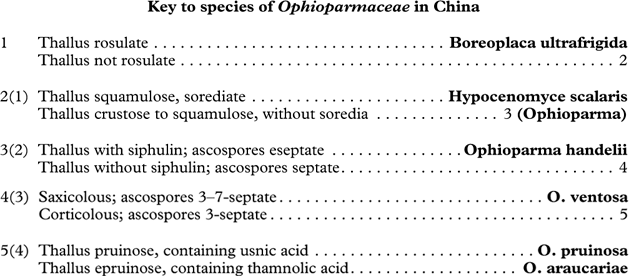
Two genera of Ophioparmaceae have been reported in China: Boreoplaca, including the species B. ultrafrigida (Zhou & Wei Reference Zhou and Wei2006; Davydov & Wei Reference Davydov and Wei2009), and Ophioparma, including the three species O. handelii, O. lapponica and O. ventosa (Zahlbruckner Reference Zahlbruckner1930; Satô Reference Satô1940; Wu Reference Wu1981; Printzen & Rambold Reference Printzen and Rambold1996). In the present study, the genus Hypocenomyce is reported as new to China due to the presence of the species H. scalaris.
In China, the family Ophioparmaceae is distributed in high latitude and high altitude areas: the genus Boreoplaca is found only in Jilin Province in north China (high latitude), and the two genera Hypocenomyce and Ophioparma are distributed in alpine localities (high altitude) of Shaanxi Province and south-western China. In the alpine zone, Gymnospermae is the main substratum for the corticolous species of Ophioparma and other corticolous lichens, and many endemic species can be found in this zone, such as Bryoria hengduanensis Li S. Wang & H. Harada, Hypogymnia laccata J. C. Wei & Y. M. Jiang and Lethariella zahlbruckneri (Du Rietz) Krog (McCune et al. Reference McCune, Martin and Wang2003; Wang et al. Reference Wang, Harada, Narui, Culberson and Culberson2003; Niu et al. Reference Niu, Wang, Zhang and Yang2007), providing great diversity and richness in the lichen biota of this region. The saxicolous species of Ophioparma ventosa grows on exposed alpine screes. Owing to a lack of study in this particular zone, a large number of species remain unknown, such as in Lasallia Mérat, Pleopsidium Körb, Rhizocarpon Ramond ex DC., Rhizoplaca Zopf, Umbilicaria Hoffm. and Xanthoria (Fr.) Th. Fr.
Materials and Methods
Morphological and chemical studies
Sixty-eight specimens of Ophioparmaceae were examined from the lichen herbaria of the Kunming Institute of Botany (KUN-L), the Botanische Staatssammlung München (M) and Harvard University (FH), including the holotype of Ophioparma araucariae. Apothecia and thalli were sectioned with a razor blade under a Nikon SMZ745T dissecting microscope and microscopic traits were observed and measured using a Nikon Eclipse Ci-S microscope. Secondary compounds were investigated using thin-layer chromatography (TLC), solvent system C (Orange et al. Reference Orange, James and White2001).
DNA extraction
Total genomic DNA was extracted from 16 specimens, including all species of Ophioparmaceae known from China, using the AxyPrep Multisource Genomic DNA Miniprep Kit 50-prep (Qiagen) according to the manufacturer’s instructions. The fungal internal transcribed spacer region (ITS) of the rDNA repeat was amplified via polymerase chain reaction (PCR) using the primers ITS1F (Gardes & Bruns Reference Gardes and Bruns1993) and ITS4 (White et al. Reference White, Bruns, Lee and Taylor1990). PCR amplification was performed in 25 μl reactions containing 12·5 μl of 2× MasterMix (0·1 units/μl−1 TaqDNA polymerase, 4mM MgCl2, and 0·4 nM dNTPs; Aidlab Biotechnologies Co. Ltd), 0·5 μl of each primer, 10·5 μl of ddH2O, and 1 μl of DNA. The following cycling conditions were used for PCR amplification: initial denaturation at 95°C for 3 min; 35 cycles each composed of 95°C for 1 min, 52°C for 1 min, and 73°C for 1 min; a final extension at 73°C for 7 min. PCR products were sequenced by TsingKe Biological Technology (Kunming, China) using the amplification primers.
Sequence analysis
Sequence fragments were assembled with SeqMan 7.0 (DNAStar). DNA sequences were aligned with MAFFT version 7 using the L-INS-I alignment algorithm (Katoh et al. Reference Katoh, Kuma, Toh and Miyata2005) and the MAFFT web service (http://mafft.cbrc.jp/alignment/server/index.html) with all parameters set to default values.
The ITS matrix was analyzed using a maximum likelihood (ML) optimality criterion and a Bayesian (BI) Markov chain Monte Carlo approach (B/MCMC), with Elixia flexella (Ach.) Lumbsch and Umbilicaria mammulata (Ach.) Tuck. as outgroups based on the results of Miadlikowska et al. (Reference Miadlikowska, Kauff, Högnabba, Oliver, Molnár, Fraker, Gaya, Hafellner, Hofstetter and Gueidan2014).
ML analyses were performed using RAxML7.0.4 (Stamatakis Reference Stamatakis2006) with default settings. Support values were inferred from the 70% majority-rule tree of all saved trees obtained from 1000 non-parametric bootstrap replicates.
BI analyses were performed using MrBayes v3.1.2 (Huelsenbeck & Ronquist Reference Huelsenbeck and Ronquist2001) with 2 000 000 generations and four incrementally heated chains. MrModeltest 2.3 (Nylander Reference Nylander2005) was used in conjunction with PAUP* (Swofford Reference Swofford2003) to estimate the best-fitting substitution model (i.e. GTR+G) based on the AIC by jModelTest 3.7 (Posada Reference Posada2008). MCMC was initiated from a random tree and was sampled every 1000 generations, with the first 10% of trees discarded as burn-in. The remaining trees were used to generate a majority-rule consensus tree with a posterior probability (PP) of ≥0·95, inferred from consensus values, considered as strongly supported. We used the program Tracer v1. 6 (Rambaut & Drummond Reference Rambaut and Drummond2003) to ensure that stationarity was achieved by verifying that log-likelihood values of sample points reached a stable equilibrium. Phylogenetic trees were visualized using the program FigTree 1.4.0 (Rambaut Reference Rambaut2012).
Results
Molecular phylogeny
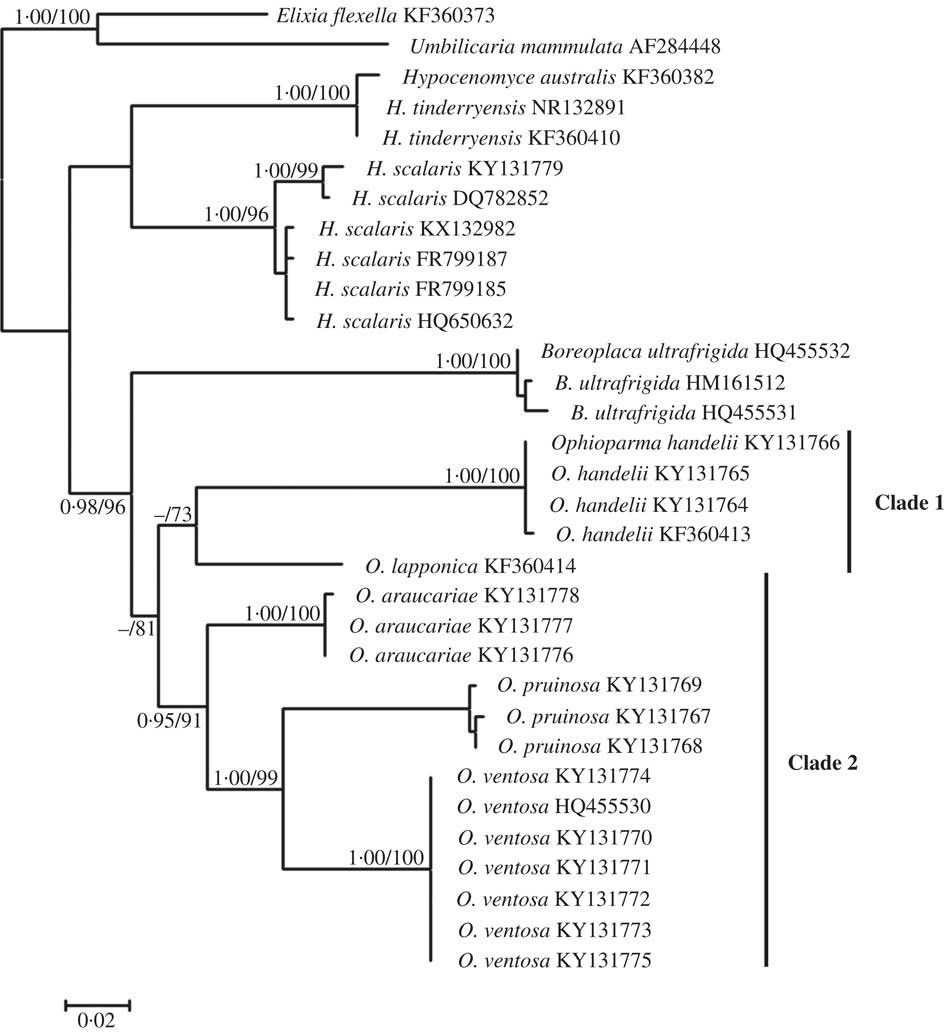
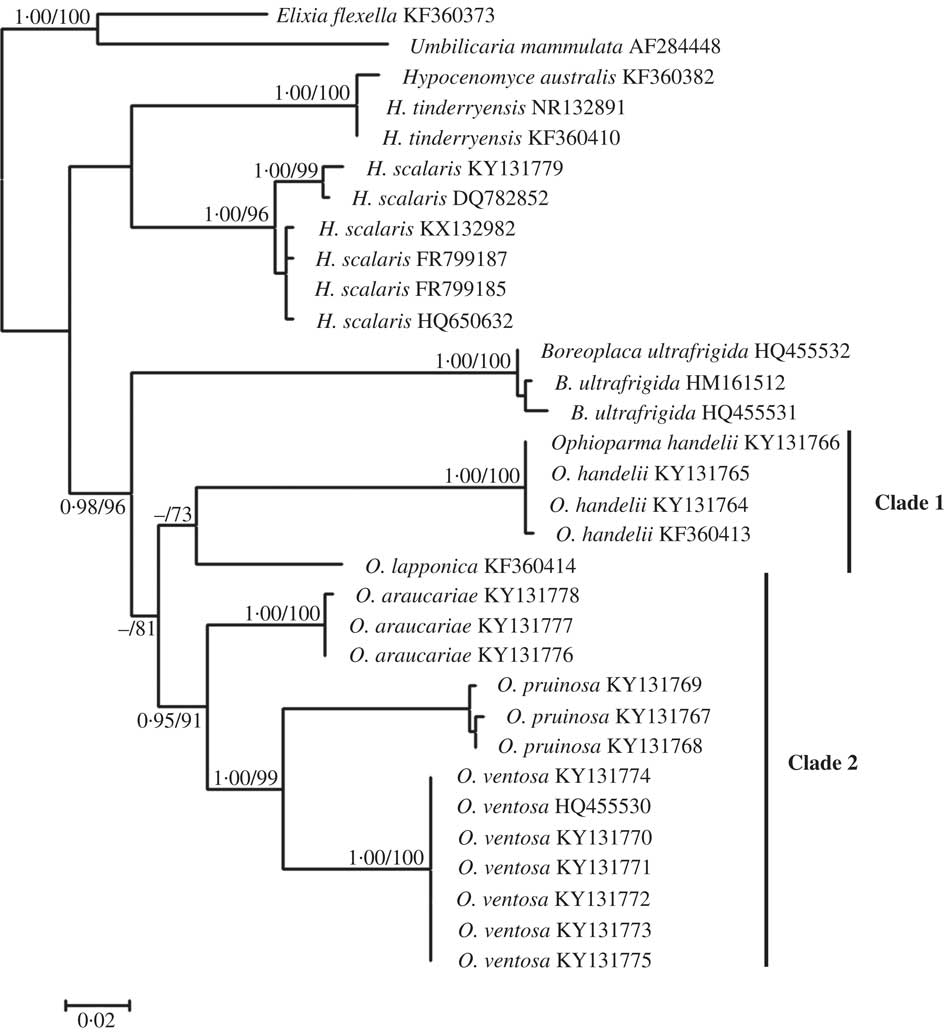
Topologies were established based on 32 ITS sequences including all available species within Ophioparmaceae and two outgroup species (Table 1). The new record of Hypocenomyce clustered in the topology with North American and European samples with high bootstrap support (Fig. 1). Ophioparma fell into two clades, corresponding with the septation of ascospores. The new species, O. pruinosa, forms a sister group to O. ventosa with high bootstrap support, indicating a close phylogenetic relationship between both species. However, O. pruinosa and O. ventosa are well separated by their different morphological characteristics, secondary metabolites and habitat preferences. The saxicolous species O. ventosa and O. lapponica share a relatively distant phylogenetic relationship as they are split by O. pruinosa and O. araucariae.
Majority-rule consensus tree showing the phylogenetic relationships of Ophioparmaceae inferred from ITS sequences. Species of Ophioparma in clade 1 have 0–1-septate spores; clade 2, 3–7-septate spores. Posterior probabilities≥0·95 from the Bayesian analysis (before the slash) and ML bootstrap values≥70% (after the slash) are given adjacent to nodes. Elix flexella and Umbilicaria mammulata were used as outgroups. GenBank Accession numbers given after species name.
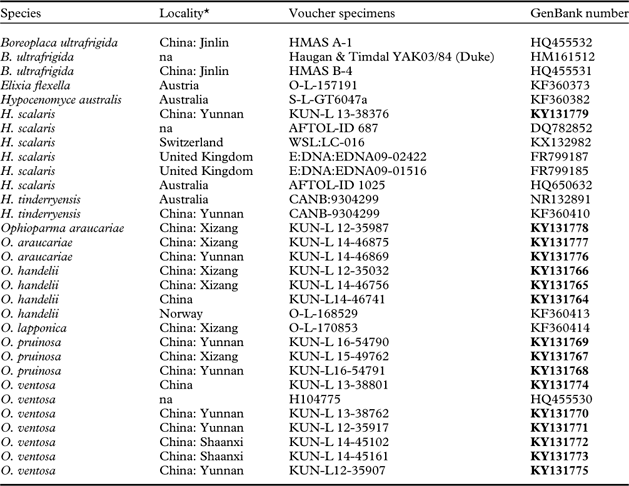
Specimens used in the phylogenetic analysis of Ophioparmaceae in China together with collection information and GenBank Accession numbers for ITS sequences. Newly obtained sequences are in bold

* na=not available.
Taxonomy
Hypocenomyce scalaris (Ach.) M. Choisy
Bull. Mens. Soc. Linn. Soc. Bot. Lyon 20: 133 (1951); type: not seen.
Thallus squamulose, corticolous, ochre to tan, imbricate elongation, up to 16 cm diam. Squamules convex, matt, margin entire and upturned, up to 1·5 mm diam. Epinecral layer colourless, c. 7 μm thick. Cortex light orange, 43–62 μm thick; algal layer 75–112 μm high. Photobiont trebouxioid. Medulla colourless, 50–100 μm high. Soredia white, common on the margin and lower surface of the squamules.
Apothecia and pycnidia not seen.
Chemistry. Spot tests: cortex K−, C+ red; medulla K−, C+ red. TLC: lecanoric acid.
Ecology and distribution. Growing on tree stumps, for example Abies sp., and rotten wood at elevations of 2600–3900 m. World distribution: North America, Europe, Russia, Japan, Australia and New Zealand (Dirig Reference Dirig1990), and new to the lichen biota of China.
Comments. Hypocenomyce scalaris is characterized by the presence of marginal and ventral soredia, convex, marginally upturned squamules, and a C+ red reaction of the thallus (Timdal Reference Timdal1984; Dirig Reference Dirig1990). The squamule diameter of Hypocenomyce scalaris from China exhibits a wide range (0·1–1·5 mm), even within individual specimens. Hypocenomyce scalaris is widely distributed in North America and Europe, and it has been recorded in Japan and Russia. This is the first report of the species and genus for China. The ITS sequence of the Chinese sample matches 97–99% with those from North American and European samples.
Specimens examined (all in KUN-L). China: Sichuan Prov.: Miyi Co., Mt. Beipo, alt. 2600 m, 1983, Wang Lisong 83−1051; Xichang Co., Mt. Luoji, 27°34'N, 102°22'E, alt. 3800 m, on Abies sp., 2010, Wang Lisong & Wang Jue 10−31405. Yunnan Prov.: Zhongdian Co., Mt. Xiaoxueshan, 28°19'N, 99°45'E, alt. 3900 m, on rotten wood, 2013, Wang Lisong & Xin Y. Wang 13−38376.—Finland: Uusimaa: Helsinki, Sibelius Park, 60°11'N, 24°54'E, alt. 2 m, on Betula bark, 2016, Wang Lisong & Xin Y. Wang 16−50295, 16−50308.
Ophioparma pruinosa Li S. Wang & Y. Y. Zhang sp. nov.
MycoBank No.: MB 819206
Resembles O. araucariae but differs by the pruinose upper surface, the presence of usnic acid, and also by the bullate to squamulose thallus.
Type: China, Yunnan Prov., Shangri-La Co., Mt. Daxueshan, 28°34'N, 99°49'E, alt. 4100 m, on Juniperus sp., 3 November 2015, Wang Lisong, Zhang Yanyun & Yang Meixia 15−49762 (KUN-L52793—holotype; M—isotype).
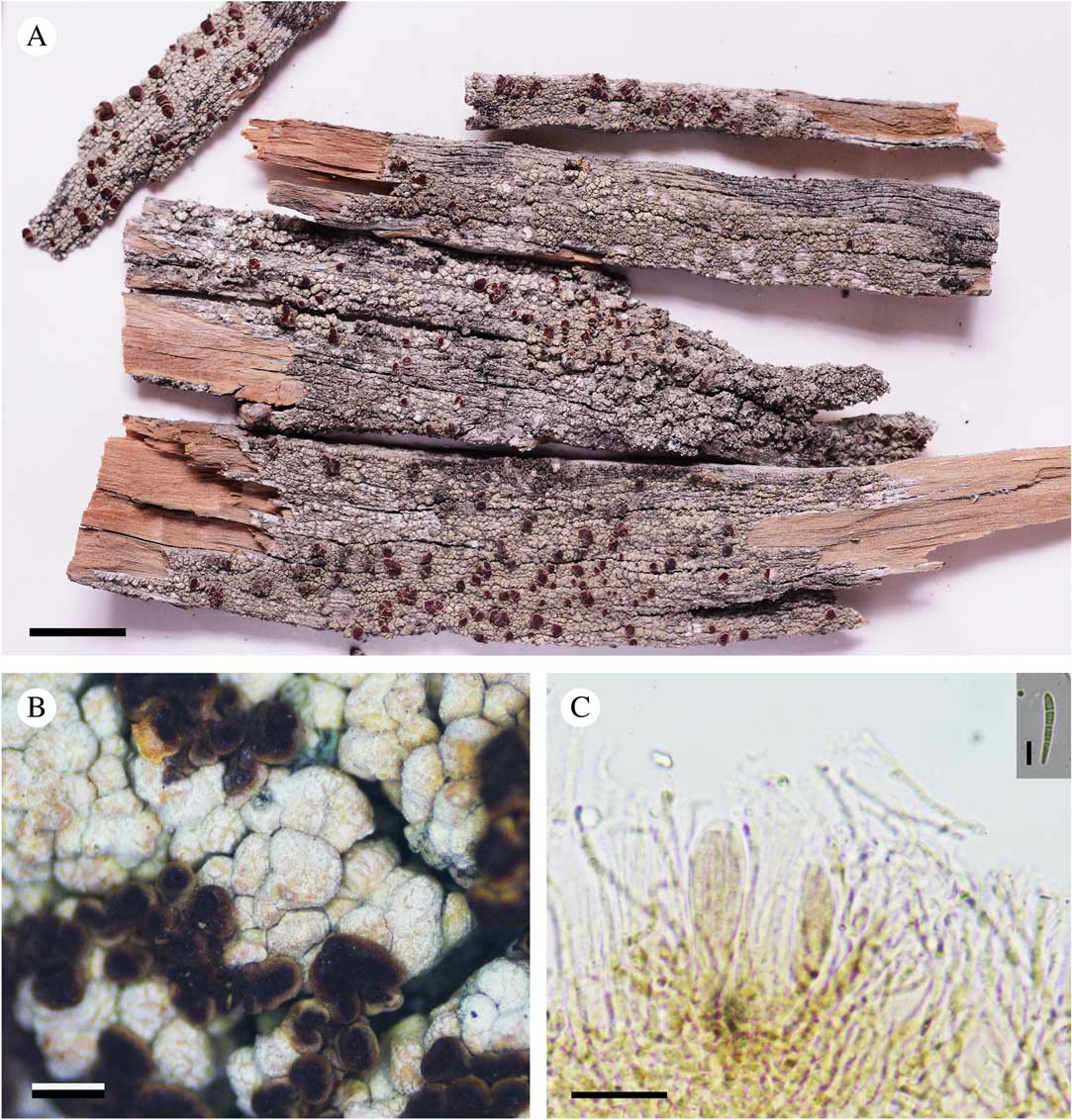
(Fig. 2)
Ophioparma pruinosa. A, holotype; B, pruina on the upper surface; C, ascus with ascospores. Scales: A=1 cm; B=0·5 mm; C=25 μm & 10 μm. In colour online.
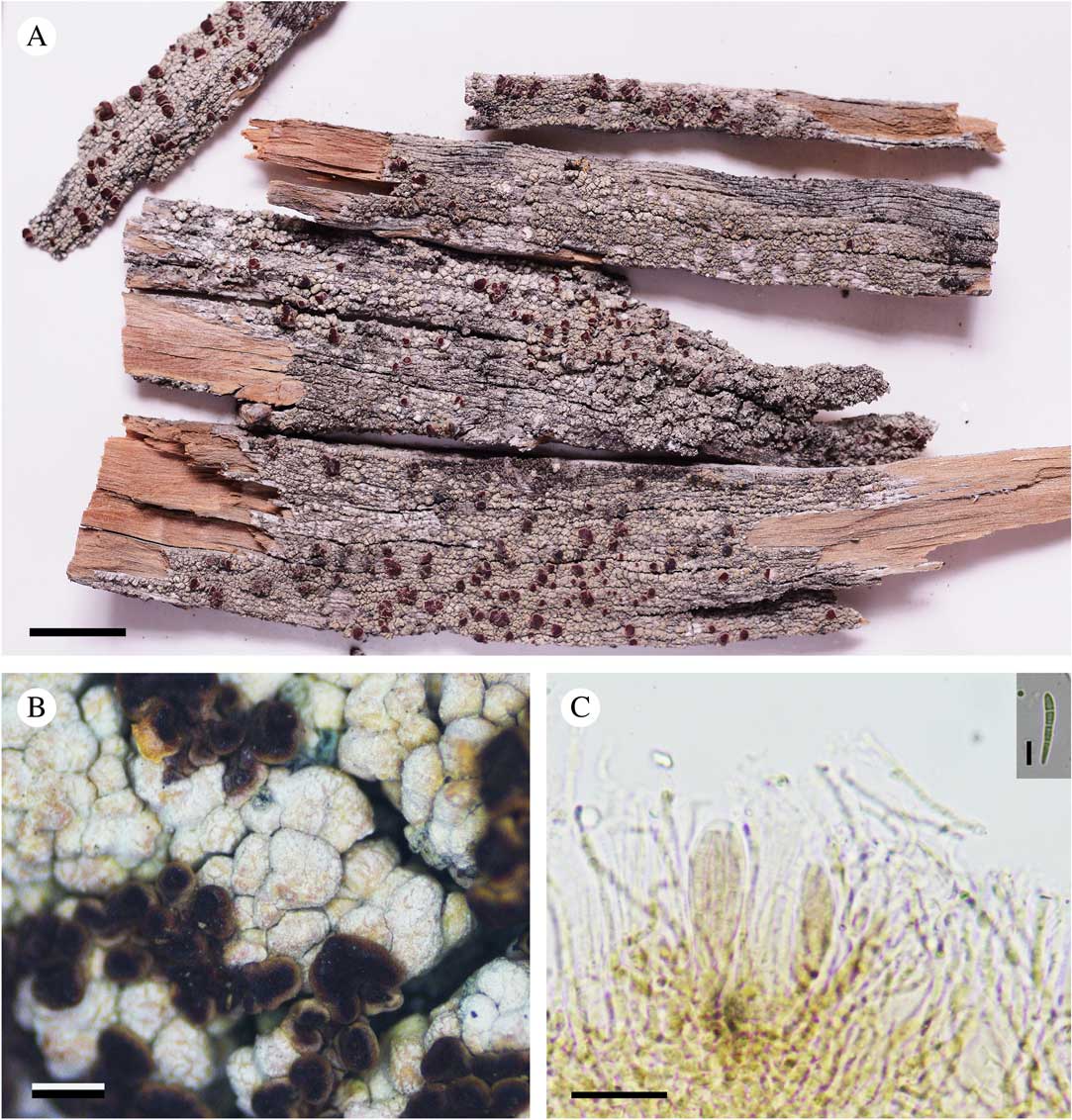
Thallus bullate to subsquamulose, corticolous, ochre, grey-green to white, up to 12 cm diam., c. 1 mm thick, some convex heaps consisting of several areoles overgrowing each other, up to 3·5 mm thick. Areoles contiguous or not, convex, rounded or mostly irregularly flexuose, 0·2–1·5 mm diam. Upper surface matt, always covered with white pruina. Epinecral layer colourless, 12–25 μm thick. Cortex 30–50 μm thick; algal layer well delimited, 62–87 μm high. Photobiont trebouxioid. Medulla colourless, c. 375 μm high.
Apothecia common, sessile, single to densely grouped, rounded to irregularly flexuose, up to 2·5 mm diam.; discs plane to slightly convex, deep red-brown; thalline margin thin, disappearing with age. Hymenium base colourless, apical with orange part, 47–57 μm thick; epihymenium orange, K+ blue turning violet, and finally fading, 7–12 μm thick; paraphyses colourless, simple to slightly branched, rarely anastomosing, evenly septate, with slightly thickened apex; hypothecium colourless, up to 300 μm high. Asci Ophioparma-type, without axial body and ocular chamber, 8-spored. Ascospores colourless, acicular-fusiform, arranged parallel to the long axis of the ascus, slightly curved or sometimes straight, 3-septate, 30–45×2·5–5·0 μm.
Pycnidia black, raised above the thallus, single to grouped, up to 1 mm diam., the pycnidial wall pigmented black-green; conidia colourless, bacilliform, straight to slightly curved, 5–7×c. 1·3 μm.
Chemistry. Spot tests: cortex K+ yellow, C−; medulla K−, C−. TLC: usnic acid, one unknown substance (Rf=28, UV before heating=blue; spot colour after acid and heating=pale yellow brown; UV after heating=green) and haemoventosin present in apothecia.
Etymology. ‘Pruinosa’ refers to the pruinose thallus.
Ecology and distribution. Growing on bark of Juniperus sp. and Picea sp. at elevations of 4000–4500 m in the alpine zone of China, usually growing together with Lethariella cladonioides (Nly.) Krog; so far known only from south-western China (Sichuan, Xizang and Yunnan provinces).
Comments. Ophioparma pruinosa belongs to Ophioparma due to the distinctive character of haemoventosin present in the apothecia (K+ deep blue, then violet, and finally dissolving) and its Ophioparma-type asci (Printzen & Rambold Reference Printzen and Rambold1996). Ophioparma pruinosa is characterized by the occurrence of white pruina, 3-septate and acicular-fusiform ascospores, and the presence of usnic acid.
There are four species with 3-septate ascospores in the genus: O. araucariae, O. junipericola, O. rubricosa and O. pruinosa. This new species differs from the other three by its pruinose upper surface, the presence of usnic acid and the lack of divaricatic acid.
Additional specimens examined. China (all in KUN-L): Sichuan Prov.: Daocheng Co., Yading, 28°26'N, 100°20'E, alt. 4500 m, on Juniperus sp., 2002, Wang Lisong 02−21573; Daofu Co., Songlinshankou beside S303 national road, 30°47'N, 101°18'E, alt. 3840 m, on Picea sp., 2016, Wang Lisong et al. 16−54791. Xizang Prov.: Mangkang Co., beside G318 national road, Mt. Hongla, 29°16'N, 98°40'E, alt. 4215 m, on Abies sp., 2016, Wang Lisong et al. 16−54790. Yunnan Prov.: Zhongdian Co., Mt. Daxueshan, 28°34'N, 99°50'E, alt. 4000 m, on Juniperus sp., 2000, Wang Lisong 00−19986.
Ophioparma araucariae (Follmann) Kalb & Staiger.
Biblioth. Lichenol. 58: 193 (1995); type: Chile, Malleco Prov., Woodpecker Mountains near Mallecon, on trunks of Araucaria araucana, 1961, G. Follmann 12379−K (M—holotypus!)
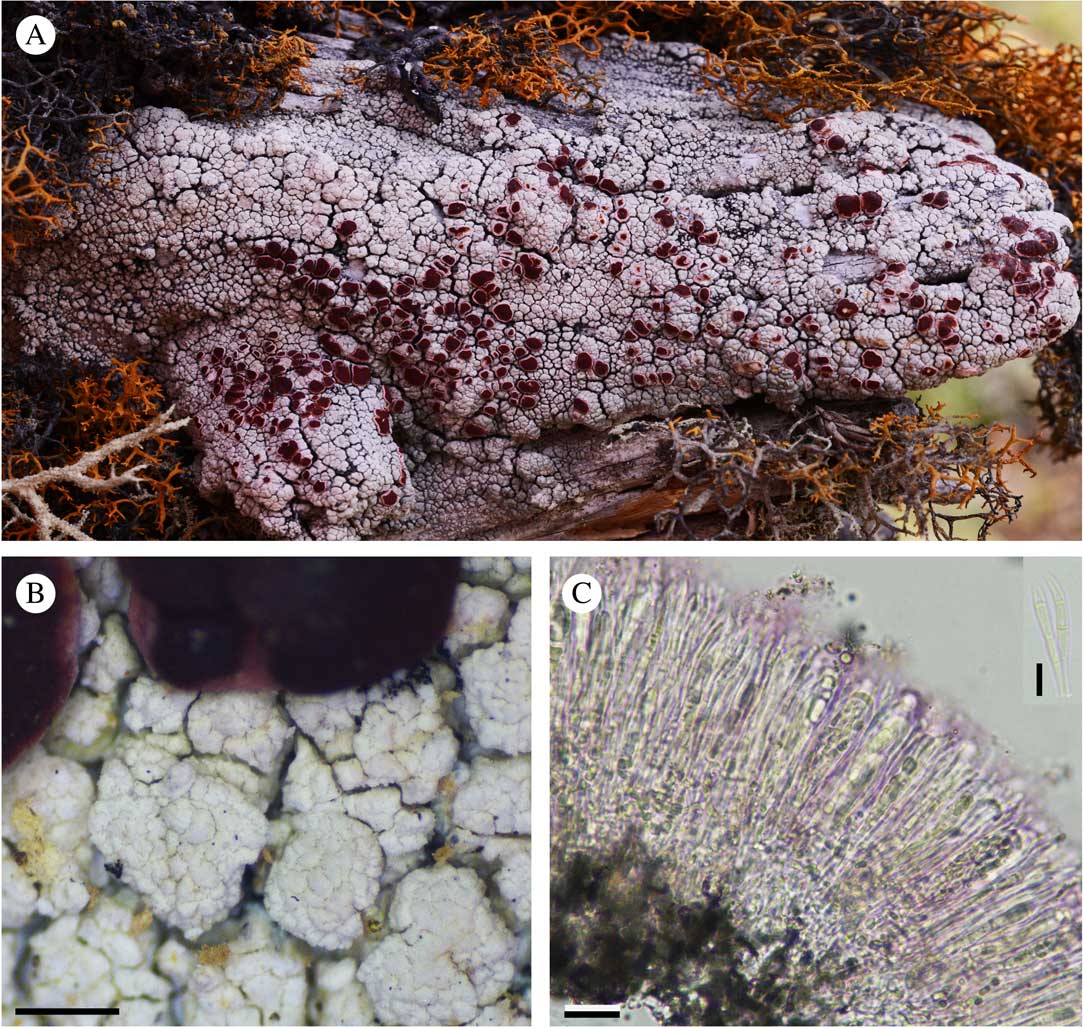
(Fig. 3)
Ophioparma araucariae. A, habit; B, upper surface of thallus; C, ascus with ascospores. Scales: B=0·5 mm; C=20 μm & 10 μm. In colour online.
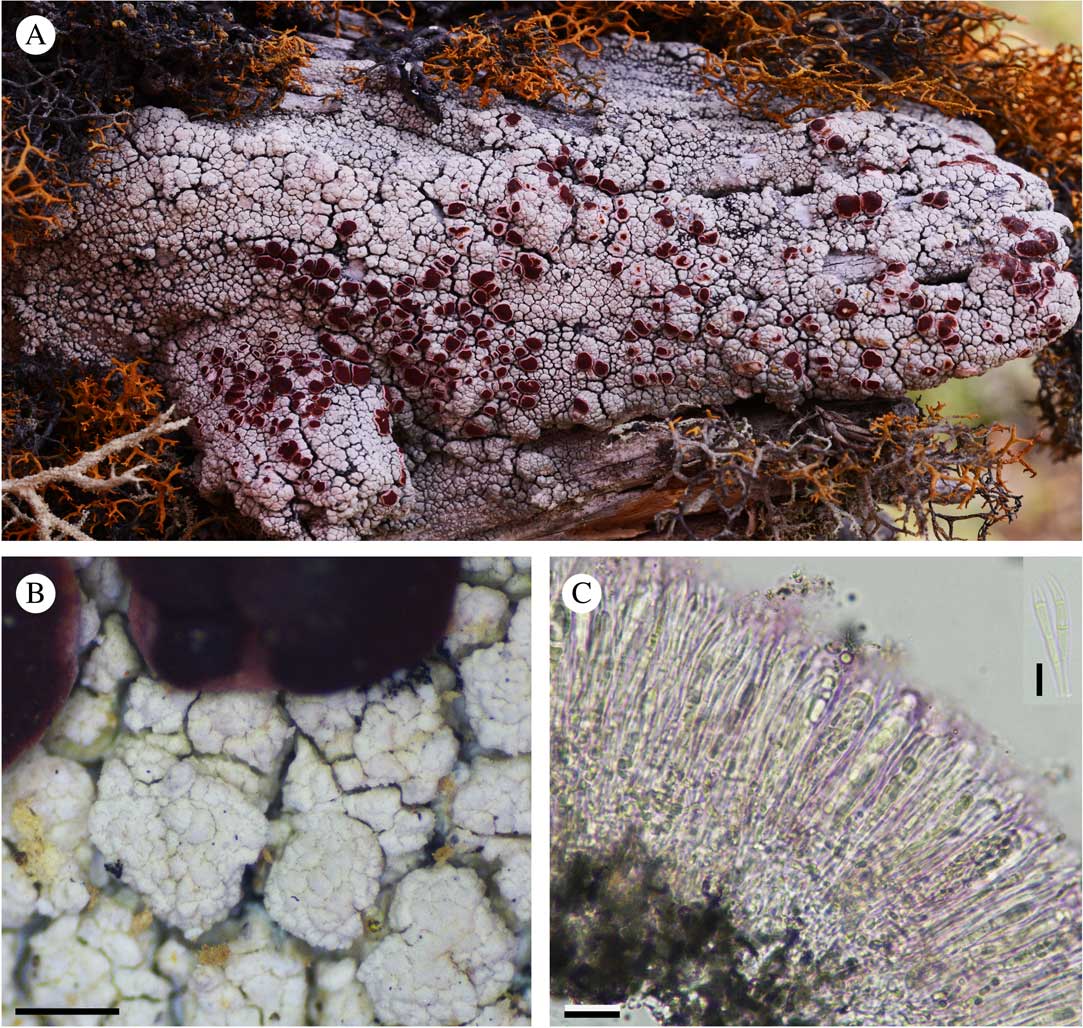
Thallus verrucose, corticolous, white to ochre, up to 14 cm diam. Thallus rimose-areolate, with papillate granules on the areoles resembling short isidia lacking photobionts, c. 1 mm thick, some convex heaps consist of several areoles overgrowing each other, up to 3 mm thick. Epinecral layer colourless, 5–12 μm high. Cortex with numerous crystal substances, 35–87 μm high; algal layer yellow to orange, 55–87 μm high. Medulla colourless, c. 625 μm thick.
Apothecia common, sessile, round to flexuose, usually single, not grouped and evenly distributed on the upper surface of the thallus, 0·5–4·0 mm diam.; discs plane to slightly convex, claret-coloured; thalline margin ochre, thin, disappearing with age. Hymenium base colourless, apically with orange pigment, 37–60 μm high; epihymenium orange, K+ blue turning violet, finally fading away, 5–12 μm thick; paraphyses colourless, simple, evenly septate, with slightly thickened apex; hypothecium colourless, up to 350 μm thick. Asci of Ophioparma-type, without axial body and ocular chamber, 8-spored. Ascospores colourless, acicular-fusiform, arranged slightly helically or parallel to the long axis of the ascus, straight to slightly curved, 3-septate, 27–50×2·5–3·5 μm.
Pycnidia not seen.
Chemistry. Spot tests: cortex K+ yellow, C−; medulla K+ yellow, C−. TLC: thamnolic acid and haemoventosin present in apothecia.
Ecology and distribution. Growing on bark of Juniperus sp. at elevations of 3600–4550 m in alpine zone, usually growing together with Lethariella cladonioides. World distribution: Chile, Argentina (Kalb & Staiger Reference Kalb and Staiger1995), new to the lichen biota of China.
Comments. The holotype consists of nine small fragments on the bark of Araucaria araucana glued to cardboard, with several apothecia at different stages of maturity on each piece.
Ophioparma araucariae is characterized by a verrucose thallus, 3-septate ascospores and the presence of thamnolic acid. Chinese specimens are considered to be conspecific due to a lack of morphological and chemical differences from the holotype material. So far, O. araucariae has been reported only from several localities in Chile and Argentina (Kalb & Staiger Reference Kalb and Staiger1995). ITS sequence data are not available from GenBank. Given the geographical divergence, our collections from China may represent another new species of Ophioparma. However, molecular data from South American samples are required to verify this.
Ophioparma araucariae is similar to O. rubricosa based on the similar size and septation of the ascospores; however, the latter contains divaricatic and usnic acids.
Specimens examined. Chile: Malleco Prov.: on Araucaria, 1971, Mahu M. 377499 & 377498 (FH).—China (all in KUN-L): Xizang Prov.: Chayu Co., along the road from Chayu to Chawalong, 28°46'N, 97°37'E, alt. 3941 m, on Juniperus sp., 2014, Wang Lisong et al. 14−46869, 14−46870, 14−46875; Linzhi Co., 29°35'N, 94°35'E, alt. 4090 m, on Juniperus sp., Wang Lisong et al. 07−28623; Mt. Shula, alt. 3600 m, on bark, 1982, Zang Mu 8037, 8191. Yunnan Prov.: Deqin Co., Meilishi Village, 28°38'N, 98°36'E, alt. 4550 m, on Juniperus sp., 2000, Wang Lisong 00−19762; alt. 3600 m, on bark, 1982, Zang Mu 82-8792; Suolayakou, 28°38'N, 98°37'E, alt. 4400 m, on branch, 2012, Wang Lisong et al. 12−35987.
Ophioparma ventosa (L.) Norman
Nyt Mag. Natur. 7: 231 (1853); type: not seen.
Thallus crustose, saxicolous, up to 18 cm diam., grey-yellow to grey-olive, rarely light yellow, rimose-areolate; areoles sometimes grouping to convex heaps up to 1 cm thick but more typically 3 mm thick.
Apothecia deep red, sessile, round to irregular, 0·5–3·0 mm diam., single or in groups irregularly distributed on the thallus; discs plane to slightly convex, claret-coloured; thalline exciple not well developed. Hymenium base colourless, apical with orange part, 50–75 μm thick; epihymenium orange, K+ blue turning violet, finally fading away, 25–37 μm thick; hypothecium colourless, up to 400 μm thick. Asci of Ophioparma-type, without any axial body or ocular chamber, 8-spored. Ascospores colourless, 3–7-septate, curved with one end blunt and the other end subulate to acicular, 37–60×3·5–6·5 μm, often helically arranged in the ascus, rarely arranged subparallel to the long axis of the ascus.
Pycnidia common, with distinct black ostioles, usually resembling black apothecia with a thalline margin; conidia colourless, bacilliform, 5–9×c. 1 μm.
Chemistry. Spot tests: cortex K+ yellow, C+ yellow; medulla K+ violet or K− (28: 7), C−. TLC: usnic, divaricatic, ±hypothamnolic acids, apothecia additionally with haemoventosin.
Ecology and distribution. Growing on rock in the alpine zone of China, at altitudes of 3570–5070 m. World distribution: arctic (Greenland), North Europe (Iceland, Finland, Norway, Sweden, Denmark and British Isles), North America (Alaska, Canada, USA and Mexico) and Asia (Russia, Mongolia, China, Japan, Nepal, India and Bhutan) (Satô Reference Satô1940; Awasthi Reference Awasthi1963; Hawksworth Reference Hawksworth1970; May Reference May1997, Reference May1998; Skult Reference Skult1997; Aptroot & Feijen Reference Aptroot and Feijen2002; Khare et al. Reference Khare, Rai, Upreti, Dubey and Gupta2010). In China, the species is known from the provinces of Shaanxi, Xizang and Yunnan. Here, we report this species from Sichuan Province.
Comments. Ophioparma ventosa exhibits three chemotypes: I, containing thamnolic, divaricatic and usnic acids; II, containing hypothamnolic, divaricatic and usnic acids and III, containing divaricatic and usnic acids (Skult Reference Skult1997). Ophioparma lapponica exhibits the same compounds as chemotype III but has non-septate or 1-septate ascospores while O. ventosa has 3–7-septate ascospores (May Reference May1997). Ophioparma ventosa has two chemotypes (II and III) in the proportion of 28: 7 among 36 specimens collected in China.
Both O. lapponica and O. ventosa have been reported in China (Zahlbruckner Reference Zahlbruckner1930; Satô Reference Satô1940; Wu Reference Wu1981). However, all specimens collected on rock in China studied here were O. ventosa with 3–7-septate ascospores. Ophioparma lapponica was reported by Satô (Reference Satô1940) in Yunnan Province and by Wu (Reference Wu1981) in Shaanxi Province. However, the record of O. lapponica by Wu (Reference Wu1981) includes no specimens examined and of the specimens we collected in Shaanxi, all of them were O. ventosa. In Satô (Reference Satô1940), O. lapponica and O. ventosa were differentiated only by secondary metabolites, which is not considered a good basis for distinguishing both species of this genus as O. ventosa has three chemotypes. Furthermore, the morphological description of O. lapponica by Satô is identical to that of O. ventosa (ascospores 5–8-septate, 40–60×3–5 μm). Therefore, we confirm that previous records of O. lapponica in China were misidentifications of O. ventosa and thus have to be excluded from the lichen biota of China.
Specimens examined (all in KUN-L). Ophioparma lapponica: USA: Alaska: Matanuska-susitna Co., 63°26'N, 147°85'E, alt. 912 m, on rock, 2010, McCune 30748.
Ophioparma ventosa: China: Shaanxi Prov.: Baoji City, Mt. Taibaishan, 33°57'N, 107°45'E, alt. 3570 m, on rock, 2014, Wang Xinyu & Ye Xin 14−45102, 14−45161. Sichuan Prov.: Kangding Co., Mt. Zheduoshan, 29°59'N, 101°55'E, alt. 3600 m, on rock, 2010, Wang Lisong 10−31712; Muli Co., Mabangyakou, alt. 4400 m, on rock, 1983, Wang Lisong 83−2130; Xiangcheng Co., Mt. Daxueshan, 28°34'N, 99°49'E, alt. 4650 m, on rock, 2002, Wang Lisong 02−21460, 02−22322, 02−22345, 02−22355. Xizang Prov.: Linzhi Co., Mt. Dongdalashan, 29°43'N, 97°59'E, alt. 4930 m, on rock, 2007, Wang Lisong et al. 07−30221; Motuo Co., alt. 4550 m, on rocks, 1982, Su Yongge 1639; Naidong Co., 28°37'N, 92°13'E, alt. 5070 m, on rock, 2007, Wang Lisong et al. 07−28565; Ridong Co., Qimala, alt. 4600 m, on rock, 1982, Zang Mu 82−6376; Xiangcheng Co., alt. 4100 m, 1981, Wang Lisong 81−2311c, 81−32850; Yadong Co., Mt. Dinggong, alt. 4700 m, on rock, 1975, Zang Mu 41. Yunnan Prov.: Dali Co., alt. 3900 m, on rock, 1981, Gaby 8; Deqin Co., Suolayakou, 28°38'N, 98°36'E, alt. 4800 m, on rock, 2012, Wang Lisong et al. 12−35894, 12−35907, 12−35917; Jianchuan Co., Mt. Laojunshan, 26°37'N, 99°44'E, alt. 4050 m, on rock, 2012, Wang Lisong et al. 13−38758, 13−38762, 13−38801; Zhongdian Co., Gezan Village, 28°08'N, 99°54'E, alt. 4490 m, on rock, 2009, Wang Lisong & Wang Jue 09−31004; alt. 4250 m, on rock, 2003, Wang Lisong 03−22884.
Discussion
The results of our molecular phylogenetic analyses largely supported the current taxonomic delineations of species and genera within the Ophioparmaceae that have been based on morphological and chemical characters (Rogers & Hafellner Reference Rogers and Hafellner1988; Printzen & Rambold Reference Printzen and Rambold1996; May Reference May1998; Davydov & Wei Reference Davydov and Wei2009; Bendiksby & Timdal Reference Bendiksby and Timdal2013).
The family Ophioparmaceae is monophyletic, which has been demonstrated in several studies (Wedin et al. Reference Wedin, Wiklund, Crewe, Döring, Ekman, Nyberg, Schmitt and Lumbsch2005; Miadlikowska et al. Reference Miadlikowska, Kauff, Hofstetter, Fraker, Grube, Hafellner, Reeb, Hodkinson, Kukwa and Lücking2006; Bendiksby & Timdal Reference Bendiksby and Timdal2013) and has also been confirmed in this study. The genus Hypocenomyce is a basal clade in this family and Boreoplaca forms a sister group with Ophioparma.
The genus Ophioparma falls into two clades corresponding with septation of the ascospores: species in clade 1 have 0–1-septate spores, while clade 2 represents species with 3–7-septate spores (Fig. 1). The presence of septation in ascospores suggests the evolutionary history of this genus, and this character offers good resolution for the taxonomy within the genus. Type of substratum was treated as a key character to separate the species; however, in our study, the corticolous species, Ophioparma pruinosa and O. araucariae, clustered with the saxicolous species O. ventosa in clade 2, while the corticolous O. handelii and saxicolous O. lapponica formed clade 1, showing that hierarchical relationships between saxicolous and corticolous groups are not supported by the molecular data.
Hypocenomyce scalaris and O. araucariae have been reported for the first time for China, extending their range and revealing the diversity of lichen biota in the alpine zone of China. Four species of Ophioparma are found in China but represent different distribution patterns. The new species O. pruinosa has a limited distribution in the alpine zone of south-western China and O. handelii was found only in China and Japan (Printzen & Rambold Reference Printzen and Rambold1996). Ophioparma araucariae was reported in South America and China (Kalb & Staiger Reference Kalb and Staiger1995). Ophioparma ventosa has a typical Arctic-alpine intermittent distribution (Satô Reference Satô1940; Awasthi Reference Awasthi1963; Hawksworth Reference Hawksworth1970; May Reference May1997, Reference May1998; Skult Reference Skult1997; Aptroot & Feijen Reference Aptroot and Feijen2002; Khare et al. Reference Khare, Rai, Upreti, Dubey and Gupta2010). These distribution patterns imply that these species might have experienced different geological events.
We thank Dr Andreas Beck from the Botanische Staatssammlung München and Dr Michaela Schmull from the Harvard University Herbarium for the loan of specimens. This study was supported by grants from the National Natural Science Foundation of China (Nos 31370069, 31400022 and 31670028), the Foundation of Key Laboratory for Plant Diversity and Biogeography, Kunming Institute of Botany, CAS (201306), and the Flora Lichenum Sinicorum (KSCX2-EW-Z-9).