FOCUS POINTS
• The pharmacokinetic profile of a given drug is different in the two sexes at the levels of absorption, distribution, metabolism, and elimination.
• The different pharmacokinetic characteristics in men and women may influence plasma levels of psychotropic drugs and, perhaps, their effectiveness.
• Sex-related peculiarities may also account for a different sensitivity of men and women to the side-effects of psychotropic drugs.
• Men and women seem to respond differently to some antipsychotics and antidepressants.
Introduction
In spite of the empirical evidence showing that, generally, psychotropic drugs are more commonly used (and abused) by women, who are thus more exposed to adverse events,Reference Fankhauser1 data regarding the specific effects of sex on drug tolerability, safety, and efficacy are still poor. Converging, albeit scattered, findings would suggest that sex plays an important role in determining the pharmacokinetic profile of psychotropic drugs, while data on pharmacodynamics are few in number. It is, however, interesting to underline that prior to 1993, women were rarely included in bioequivalence trials, as it was believed that the inclusion of women would have caused a significantly higher interindividual variability, resulting in the need for larger sample sizes.
The aim of this work is to review the available literature regarding the possible impacts of gender differences on the pharmacokinetics and the pharmacodynamics of psychotropic drugs. For this purpose, we carried out MEDLINE and PubMed searches of the years 1990–2012 with the following keywords: psychotropic drugs, sex, benzodiazepines (BDZs), typical and atypical antipsychotics, antidepressants, tricyclics (TCAs), and selective serotonin reuptake inhibitors (SSRIs).
Absorption
The absorption of a given drug depends on multiple factors—some related to the characteristics of the drug, such as physiochemical properties, formulation, and route of administration, and some to the gastrointestinal (GI) environment, if given orally. Absorption is affected by differences in luminal pH along the GI tract, surface area per luminal volume, blood perfusion, presence of bile and mucus, and nature of epithelial membranes.
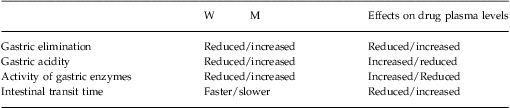
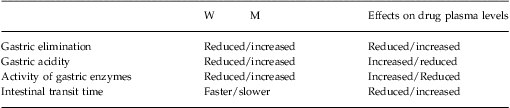
Women, as compared with men, show a reduced capacity of gastric eliminationReference Frezza, di Padova and Pozzato2, Reference Hamilton and Yonkers3 and a shorter time of intestinal transit,Reference Rao, Read and Brown4 which may lead to decreased drug plasma levels (Table 1). Women show also lower levels of gastric acidity compared to men,Reference Hamilton and Yonkers3, Reference Grossman, Kirsner and Gillespie5 and, therefore, compounds that tend to have a basic pH, such as BDZs or TCAs, are absorbed more rapidly and reach higher concentrations.Reference Hamilton and Yonkers3, Reference Pollock6 In addition, some gastric enzymes are less active in women, and this characteristic also would contribute to increased plasma concentrations.
Effect of different parameters on drug absorption in women (W) and men (M)
Sex differences have been also reported for bile acid composition, which is another factor that may influence the solubility of different drugs. Men tend to present higher concentrations of cholic acid, while women present higher concentrations of chenodeoxycholic acid.Reference Nicolas, Espie and Molimard7
A review of 26 studies submitted over a 20-year period to the Food and Drug Administration (FDA), the major U.S. drug regulation agency, revealed some sex differences in bioequivalence, with women showing significantly greater drug absorption (Cmax) and area under the concentration time curve than men. However, these findings should be interpreted with caution, as the sample size of these studies was quite small (no more than 10 men and 10 women), and the statistical significance of the difference decreased after correcting for weight.Reference Chen, Lee and Ng8
Distribution
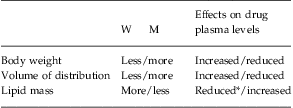
The volume of distribution of a drug is determined by different factors, including body weight, percentage of fatty mass, the degree of local blood flow, and binding to proteins. Women are characterized by lower body weight, but drug dosing in adults is not currently adjusted for body weight. Further, women show reduced blood volume and a larger amount of body fat mass than men.Reference Mayersohn9 The first two characteristics would provoke higher drug concentrations in women, while the greater percentage of fat mass would cause a larger distribution volume and thus, at least initially, lower plasma concentrations of a lipid-soluble compoundReference Hamilton and Yonkers3 (Table 2). Several psychotropic drugs, such as BDZs, are characterized by a high lipophilicity; they tend to accumulate easily in the adipose tissue, and this may lead to a significant increase in their half-life.Reference Yonkers, Kando and Cole10 Given that the fat mass increases with age, these drugs tend to accumulate more in elderly women who are at greater risk for this effect.Reference Greenblatt, Sellers and Shader11, Reference Sweet, Pollock and Wright12 Nevertheless, despite the fact that elderly women are among those who most often take psychotropic drugs, results of systematic and reliable studies to assess the potential role of sex and age interaction on drug plasma levels are not yet available.Reference Brown, Salive and Guralnik13, Reference Simoni Wastila14
Effect of different parameters on drug distribution in women (W) and men (M)
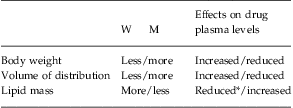
*Vouly initially, as over time, accumulation may occur imeressing half-life of a drug.
Once in the blood stream, drugs bind to plasma proteins, mainly to albumin and to alpha-1 glycoprotein acid. The total concentration of the drugs depends, thus, on the amount bound to proteins compared to the free quantity (unbound), but generally only the free quantity is active, and can pass through the blood–brain barrier and reach the central nervous system (CNS). While albumin does not seem to be influenced by gonadal steroids,Reference Gleiter and Gundert-Remy15 acid glycoprotein (AAG) may be lower in womenReference Hashimoto, Miwa, Akasofu and Nishida16–Reference Kishino, Nomura and Itoh18 and is decreased by estradiol,Reference Hashimoto, Miwa, Akasofu and Nishida16, Reference Tuck, Holleran and Berglund19 an effect that should increase the proportion of free drug; however, some disagreement exists.Reference Gleiter and Gundert-Remy15, Reference Blain, Mucklow and Rawlins17 Drugs bound by alpha-1 glycoprotein acid include triazolam, amitriptyline, desipramine, imipramine, doxepine, nortriptyline, reboxetine, chlorpromazine, thioridazine, and olanzapine.Reference Israili and Dayton20
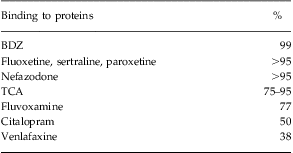
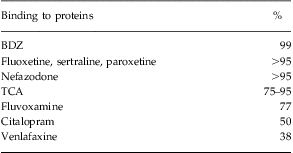
Generally speaking, the binding capacity of the plasma proteins seems to be lower in women than in men. This difference has a certain importance for several psychotropic compounds that generally show a high protein binding. Benzodiazepines circulate bound to plasma proteins in a percentage of 99%. Some serotonin reuptake inhibitor (SSRI) antidepressants, such as fluoxetine and paroxetine, are bound in percentages higher than 95%.Reference Preskorn21 By contrast, TCAs and fluvoxamine are only moderately bound (75% and 77%, respectively),Reference Palmer and Benfield22, Reference Yonkers and Hamilton23 and citalopram and venlafaxine are bound even less (50% and 38%, respectively)Reference Fredericson24 (Table 3).
Antidepressants and BDZ binding to plasma proteins
Simultaneous administration of two drugs with elevated protein binding may cause one of the two to be displaced, thus increasing its free amount, which may become toxic and cause severe side effects. As already mentioned, BDZs and TCAs are bound to plasmatic proteins in a moderate to strong way,Reference Kristensen25, Reference Wilson26 and, therefore, even a relative increase in the concentrations of TCAs may be clinically relevant in women, where these drugs have a relatively low therapeutic index. Therefore, the differences in protein binding may contribute to a greater risk for side effects and toxicity of TCAs in women than in men. Most SSRIs, with the exception of fluvoxamine and citalopram, are characterized by a high percentage of protein binding, although the type of binding is weak and involves mainly alpha1-glycoprotein acid.Reference Wilson26 Therefore the simultaneous administration of high protein-binding drugs, such as the anticonvulsants or warfarin, may lead to a dissociation of the SSRIs from the protein binding. Nevertheless, SSRIs have a wide safety interval, and even high plasma levels may not be toxic.
Elimination
Two processes, metabolism and elimination, are responsible separately or together for drug inactivation. Drugs are eliminated from the body mainly by hepatic, renal, or pulmonary routes and also, to a lower extent, by sweat, tears, and breast milk.
Hepatic clearance of drugs is a function of liver blood flow and hepatic enzyme activity. Hepatic blood flow is lower in women than in men, but also sex differences in hepatic enzymes are important. It has been reported that the expression of P-glycoprotein, which regulates the biliary excretion of certain drugs, is 2-fold lower in women than in men, maybe due to hormonal effects.Reference Nicolas, Espie and Molimard7
Metabolism
The metabolism of most psychotropic drugs occurs in the liver due to the action of different enzymatic systems. Both hydroxylation and glucuronidation are slower in women than in men, with consequent higher drug plasma concentrations in women.Reference Wilson26, Reference Preskorn27 Moreover, in comparison with men, women show lower renal clearance rates, which are probably associated with a reduced capacity for glomerular filtration.Reference Hamilton and Yonkers3 Since many psychotropic substances are excreted through the kidneys, both the metabolic processes and the filtration of psychotropic drugs are slower in women, and this provokes a generally slower elimination of the different compounds.
The enzymatic system of the cytochrome P450 (CYP)
A substantial amount of the hepatic metabolism of psychotropic drugs is regulated by the action of the enzymatic system of the cytochrome P450 (CYP), which is composed of more than 30 types of different isozymes.Reference Preskorn21, Reference Wilson26 These are a large family of related enzymes located in the smooth endoplasmic reticulum of the cell. While the CYP enzymes are all coded for by autosomal chromosomes, it is possible that sex-related differences in pharmacokinetics arise from variations in the regulation of the expression and activity of CYP enzymes through endogenous hormonal influences.Reference Nicolas, Espie and Molimard7, Reference Kalra28, Reference Zhou, Chan and Goh29
The isozymes CYP2D6, CYP3A4, CYP1A1/2, and CYP2C19 are responsible for the metabolic processes of most psychotropic drugs, and also of many other commonly prescribed drugs, such as beta-blockers, opiate analgesics, anticonvulsants, corticosteroid compounds, and some antibiotics.
CYP2D6
The isozyme CYP2D6 is responsible for the metabolism of most antidepressants, haloperidol, and pain killers. Its inhibition, therefore, provokes increased plasma concentrations of a given compound, and this may lead to a toxic reaction when a SSRI is co-administered with a TCA or an anti-arrhythmic compound.Reference Preskorn21 Although the enzyme CYP2D6 has become remarkably famous for its role in the interaction between one drug and another, no sex differences have been described in its activity.Reference Pollock6, Reference Pollock, Altieri and Kirshner30
Because CYP2D6 activity is increased during pregnancy,Reference Wadelius, Darj, Frenne and Rane31 it would be expected that female sex steroids influence CYP2D6 activity. However, some findings do not support this notion.Reference Kashuba, Nafziger and Kearns32–Reference McCune, Lindley and Decker34
CYP2C19
Sex differences have been reported for the isozyme CYP2C19. Women, in fact, seem to show a greater enzymatic activity compared to men.Reference Pollock6, Reference Pollock, Altieri and Kirshner30 This is relevant for several antidepressants (clomipramine, imipramine, and citalopram) and BDZs (diazepam) that are metabolized by this system, so that women have a faster metabolism and a lower plasma concentration of the same drugs.Reference Preskorn27, Reference Brosen35, Reference Ketter, Flockhart and Post36 There is some evidence of sex-related differences in the activity of CYP2C19 that are ethnically dependent, although a recent study suggested that the population data may be confounded by oral contraceptive use. While using S-mephenytoin as a probe, CYP2C19 activity was higher in Chinese women than men. By contrast, a lower activity was demonstrated in African AmericansReference Edeki, Goldstein and de Morais37 and Jewish IsraeliReference Sviri, Shpizen, Leitersdorf, Levy and Caraco38 women than in men. There was no sex difference in activity in Saudi Arabians and Filipinos.Reference Price Evans, Krahn and Narayanan39 In one large population study of Dutch Caucasians, CYP2C19 activity was 40% greater in men than women.Reference Tamminga, Wemer and Oosterhuis40 In a population study in Sweden using S-mephenytoin as a probe, CYP2C19 activity was found to be 61% lower in women receiving oral contraceptives compared with women not taking these drugs.Reference Hagg, Spigset and Dahlqvist41 However, aside from this last study, all the population studies just mentioned failed to report oral contraceptive use, so that it is not clear if CYP2C19 activity is sex- or ethnicity-dependent, or if the differences are due only to oral contraceptive use.
CYP2C9
CYP2C9 accounts for about 20% of hepatic CYP enzyme activity and contributes to the metabolism of medications such as diazepam, imipramine, amitriptyline, and phenytoin.Reference Anderson42 While ethnicity plays a significant role in explaining observed interindividual variation in CYP2C9 metabolism, sex does not seem to produce any effect.Reference Anderson42, Reference Scripture and Pieper43
CYP1A2
Evidence indicates that the activity of the CYP1A2 is slower in women than in men.Reference Ford, Truman and Wilcock44, Reference Hartter, Wetzel and Hammes45 Tricyclics, fluvoxamine, and clozapine are all metabolized by the CYP1A2.Reference Preskorn27, Reference Brosen35, Reference Ketter, Flockhart and Post36 Moreover, the isozyme CYP1A2 is important for the metabolism of other drugs, such as propanolol, theophylline, and warfarin.Reference Preskorn27, Reference Brosen35, Reference Ketter, Flockhart and Post36 Therefore, the possibility of adverse events at the same doses of these drugs is higher in women than in men.
Further, it is noteworthy to underline that CYP1A2 is the major smoking-inducible CYP isozyme, which may account for the wide variability in the activity of the enzyme.Reference Wrighton and Stevens46 Moreover, the genetic polymorphisms of CYP1A2 predominantly affect its inducibility by smoking rather than the baseline activity.Reference Jennings, Nafziger and Davidson47 When evaluating the probe substrate, caffeine,Reference Bock, Schrenk and Forster48, Reference Relling, Lin, Ayers and Evans49 or drugs metabolized by CYP1A2 (clozapineReference Lane, Chang and Chang50 and olanzapineReference Callaghan, Bergstrom, Ptak and Beasley51), some consistent findings demonstrated higher activity of CYP1A2 in men compared with women in both Caucasians and Chinese populations.
CYP3A4
The most important gender difference, however, involves the isozyme CYP3A4,Reference Pollock6 which represents more than 60% of the cytochrome P450.Reference Nemeroff, De Vane and Pollock52 This isozyme is responsible for the metabolism of several BDZs, painkillers, calcium channel blockers, and steroids.Reference Pollock6, Reference Preskorn21, Reference Ketter, Flockhart and Post36 The activity of this isozyme appears to be influenced both by gender and age: young women show higher levels of activity compared to both men and women of postmenopausal age.Reference Pollock6 Therefore, it is expected that plasma levels of BDZs will be lower in young women than in men or older women. A lower therapeutic activity of these drugs could derive from this effect in young women; moreover, the greater activity of the isozyme CYUP3A4 would determine a greater risk for abstinence after BDZs withdrawal or development of dependence (Table 4).
Gender and age differences in cytochrome P450 activity

The hyperactivity of the CYP3A4 isozyme in women of fertile age may determine lower concentrations and, therefore, less efficacy of different drugs, such as anticonvulsants (carbamazepine) and chemotherapeutics (tamoxifene).Reference Preskorn27
The declining activity of CYP3A4 with age is observed more often in men than in women.Reference Schwartz53 This effect, combined with the increased fat proportion in elderly women and decreased oxidation in elderly men, suggests that older women should have lower BDZ levels than older men at comparable doses.Reference Karim, Slater and Bradford54
When examining the possible influence of sex on CYP3A4 activity, it is important to mention the possible confounding role of ethnicity, as CYP3A4 activity is higher in Caucasians than in African Americans, and in Caucasian women than in Asian women.Reference Lin, Anderson, Kantor, Ojemann and Wilensky55
Elimination
The kidney is the major organ of drug excretion of both the parent drug compounds and metabolites. Drugs can be excreted into the urine through glomerular filtration, passive diffusion, and active secretion. Increased renal blood flow and glomerular filtration increase the elimination rate of drugs cleared by the kidneys. Sex differences have been described for glomerular filtration, tubular secretion, and tubular reabsorption, which are all faster in men.Reference Gaudry, Sitar, Smyth, McKenzie and Aoki56–Reference Silvaggio and Mattison59
Pharmacodynamics
Pharmacodynamics is the study of drug mechanism of action, including the physiological and biochemical effects on the body, and the relationship between drug concentration and the rate and extent of pharmacologic response. Therefore, at any given blood concentration, a drug may show variations in response, including differences in effectiveness or safety. Pharmacodynamic data on psychotropic drugs are few in number, so available findings will be reported for each major class of compounds, together with specific pharmacokinetic characteristics, in the next several paragraphs.
Benzodiazepines
The studies exploring sex-related pharmacokinetic differences of BZDs showed that the clearance of BDZs metabolized by conjugation (lorazepam and oxazepam) are generally slower in women than in men, while that of BDZs metabolized by oxidation is identical in the two sexes.Reference Kim and Nafziger60 Just a few data reported that the maximum concentrations of alprazolam are higher in women than in men; however this finding seems to be more related to weight differences than to sex.Reference Fromm61 As oral contraceptives inhibit the oxidative metabolism and facilitate the conjugation metabolism, the co-administration of BZDs with hormonal oral contraceptives needs to be considered carefully, and would suggest the need of a dose readjustment.Reference Yonkers, Kando and Cole62
To our knowledge, no information on pharmacodynamic differences between the two sexes for BDZs is available in the literature.
Antipsychotics
Gender-related differences in pharmacokinetics for atypical antipsychotics are demonstrated for clozapine, olanzapine, and sertindole. CYP1A2 is a major isozyme responsible for clozapine elimination, and slight differences between men and women have been shown.Reference Jerling, Merle, Mentre and Mallet63 Some findings suggest that women show higher plasma levels than men of both clozapine and its major metabolite, norclozapine,Reference Lane, Chang and Chang64 but only at the beginning of the treatment.Reference Fabrazzo, Esposito, Fusco and Maj65 The same difference has been reported also for olanzapine.Reference Rostami-Hodjegan, Amin and Spencer66–Reference Kelly, Conley and Tamminga68
Since blood volume is less in women, but lipid mass is greater than in men, the volume of distribution of lipophilic drugs, such as antipsychotics, is greater in women than in men. This may prolong the half-life of antipsychotics in the body with accumulation over time—a phenomenon that becomes relevant when administering depot preparations.
It is noteworthy that women are more likely than men to be taking antidepressants, mood stabilizers, pain killers, and contraceptives or hormone replacements, and these agents can interact with antipsychotics, especially those processed mainly by the CYP2D6 enzyme subsystem.
Although influenced by different factors, it is generally believed that the response to antipsychotics is more pronounced in women than in men.Reference Seeman69
Recently, some studies have evaluated different incidences of the major side effects of antipsychotics, such as extrapyramidal, cardiac, sexual, and weight gain in the two sexes, but the ensuing findings are controversial. Acute dystonia, believed to be more prevalent among men, was shown to happen more often in women than men in one study only.Reference Chen, Lee and Ng8 Tardive dyskinesia, generally thought to be typical of elderly women, was shown to be a risk factor, although less severe, for elderly men.Reference Morgenstern and Glazer70–Reference Browne, Roc, Lane, Gavin, Morris, Kinsella, Larkin and O'Calloghan72
Women show increased risk of torsades de pointes with drugs that can prolong the QT intervalReference Wolbrette73; therefore the use of high doses of haloperidol, which prolongs this interval, in emergency situations may be especially dangerous in women.Reference Hatta, Takahashi and Nakamura74 For this reason, it is mandatory to perform an ECG before an injection of haloperidol.
Hyperprolactinemia is more robust in women than in men taking both typical and atypical antipsychotics.Reference Kuruvilla, Peedicayil, Srikrishna, Kuruvilla and Kanagasabapathy75–Reference Melkersson, Hulting and Hall77 The same is true for weight gain and related complications.Reference Allison, Mentore and Heo78–Reference Sernyak, Leslie, Alarcon, Losonczy and Rosenheck81
Antidepressants
Most antidepressants are weak bases, and therefore they are more effectively absorbed under basic conditions. As already mentioned, women secrete less gastric acid, resulting in a more basic environment, which could potentially lead to enhanced absorption of antidepressants in the stomach.Reference Grossman, Kirsner and Cillespie82 In addition, women have a slower rate of gastric emptying than men do, thus increasing antidepressant absorption time.Reference Hutson, Roehrkasse and Wald83 This increase persists even after menopause, and it is enhanced by exogenous estrogens and progesterone.Reference Hutson, Roehrkasse and Wald83, Reference Wald, Van Thiel and Hoechstetter84 As women possess a higher percentage of adipose tissue than men do, lipophilic antidepressants, in particular trazodoneReference Greenblatt, Friedman and Burstein85 and bupropion,Reference Stewart, Berkel and Parish86 show a prolonged half-life and lower plasma concentrations in women.Reference Greenblatt, Divoll, Harmatz and Shader87, Reference Greenblatt, Divoll, Abernethy and Shader88 In contrast, a study of paroxetine in elderly patients reported the opposite findings.Reference Findling, Nucci and Piergies89
The peculiarities of protein binding in women make them particularly susceptible to the development of severe toxic effects by TCAs, especially when these are co-administered with other drugs that displace them from protein binding.Reference Wilson26
Antidepressants are metabolized by, inhibit, and/or induce a wide range of cytochrome P450 (CYP) enzymes, as reported in the previous section.Reference Bies, Bigos and Pollock90
A few studies have reported sex differences in the pharmacokinetics of both TCAs and SSRIs. In women compared with men, some studies have found higher concentrations of clomipramineReference Hildebrandt, Steyerberg and Stage91 and desmethylclomipramine,Reference Mundo, Pirola and Bellodi92 but not in adolescent patients.Reference Cohen, Biederman and Wilens93
As far as SSRIs are concerned, higher citalopram and desmethylcitalopram concentrations have been described in women than in men,94 but only in young patients.Reference De Mendonca Lima, Baumann and Braward-Amey95 On the contrary, no differences have been detected for escitalopram,Reference Reis, Chermß, Carlsson and Bengtsson96 sertraline,Reference Ronfeld, Tremaine and Wilner97 and fluoxetine.Reference Ferguson and Hill98 Higher concentrations were reported in women than in men for paroxetine in one study only,Reference Gex-Fabry, Eap and Oneda99 and the same was true for fluvoxamine.100 Women, compared to men, also show higher concentrations of mirtazapine and demethylmirtazapine and a longer half-life.100
Although there appears to be no difference in depression symptom severity, generally women respond better to SSRIsReference Parker, Parker and Austin101 than men, who, conversely, respond better to TCAs.Reference Kornstein, Schatzberg and Thase102–Reference Thase, Entsuah and Cantillon106 This may due to the fact that women produce more tryptophan and less cortisol when exposed to SSRIs.Reference Bano, Akhter and Afridi107
Interestingly, in two studies carried out by our research group, we noted better response of compulsive symptoms to either fluvoxamine or clomipramine in men than in women who suffer from obsessive-compulsive disorder.Reference Marazziti, Baroni and Giannaccini108, Reference Marazziti, Baroni and Faravelli109
Conclusions
Both pharmacokinetic and pharmacodynamic differences between the sexes have been described that may influence psychotropic drug effects. Generally, women are characterized by lower levels of gastric acidity and lesser activity of some gastric enzymes, all of which are factors that increase drug plasma concentrations. Further, women have a reduced capacity for gastric elimination, lower body weight, lesser blood volume, and a greater percentage of fat mass compared to men. These factors are important in determining the absorption and distribution of drugs, and consequently their efficacy and tolerability. In particular, BDZs are highly lipophilic and are accumulated in the adipose tissue with a significant increase of their half-life in women, especially when elderly. Even the protein-binding capacity in plasma shows important sex-related differences, in the sense that women are characterized by a lower concentration of proteins compared to men, which leads, especially in the case of drugs that bind strongly to the proteins, such as TCAs and BDZs, to a greater risk for more severe side effects and toxicity. Women are characterized by both slower hepatic metabolic processes and reduced capacity for glomerular filtration compared to men. The diminished capacity of elimination of different compounds, compared to men, may expose women to a greater possibility of severe toxic effects. As far as the enzymatic system of the cytochrome P450 is concerned, the most important sex difference involves the CYP3A4 isozyme, which is responsible for the metabolism of several psychotropic drugs. This isozyme shows a greater level of activity in young women than in men or postmenopausal women.
Sex-related peculiarities may also account for a different sensitivity of men and women to side effects of some psychotropic drugs and may perhaps influence the drug response, but specific data on these topics are very limited.
The clinical significance of reported differences warrants some considerations. The difference in size between men and women means that translating these results to clinical dosage rates should include an adjustment for body size, which currently is not done. Reports of sex differences that persist after considering weight may warrant further dosage adjustments. It should be also underlined that investigations are often performed in healthy fasting individuals, but generally medications are prescribed to patients with confounding influences of disease, co-medications, diet, and social habits. The relative role of sex on pharmacokinetics and pharmacodynamics as compared to genetics, age, disease, social habits, and their potential interactions in the clinical setting is not yet fully known, but should be routinely considered. Therefore, although data are scattered and controversial, clinicians must be aware of a substantial impact that sex might have on efficacy and development of side effects. In our opinion, this is an exciting field of research in psychopharmacology that needs to be widely promoted in upcoming years.