INTRODUCTION
Cognitive behavior therapy (CBT) is currently considered best-placed for the treatment of depression and anxiety post-TBI (Fann et al., Reference Fann, Hart and Schomer2009; Soo & Tate, Reference Soo and Tate2007). Studies have adapted CBT to accommodate TBI-specific cognitive needs, and its efficacy in reducing depression and/or anxiety symptoms has not consistently shown a treatment effect (Ashman et al., Reference Ashman, Cantor, Tsaousides, Spielman and Gordon2014; Fann et al., Reference Fann, Bombardier, Vannoy, Dyer, Ludman, Dikmen, Marshall, Barber and Temkin2015; Hsieh, Ponsford, Wong, Schönberger, et al., Reference Hsieh, Ponsford, Wong, Schönberger, Taffe and McKay2012; Ponsford et al., Reference Ponsford, Lee, Wong, McKay, Haines, Alway, Downing, Furtado and O’Donnell2016). More research is needed to determine how CBT can be optimized in the TBI population.
Studies examining predictors of treatment response in TBI-adapted CBT are limited and have focused on client factors (Anson & Ponsford, Reference Anson and Ponsford2006; Hsieh, Ponsford, Wong, & McKay, Reference Hsieh, Ponsford, Wong and McKay2012; Ponsford et al., Reference Ponsford, Lee, Wong, McKay, Haines, Alway, Downing, Furtado and O’Donnell2016). The only preinjury variable examined across these studies was premorbid IQ. The demographic variables of age at study entry, gender, or education were not investigated. Anson and Ponsford (Reference Anson and Ponsford2006) found higher premorbid IQ to be associated with greater improvement in depression symptoms in a CBT-based Coping Skills Group. Hsieh et al. (Reference Hsieh, Ponsford, Wong and McKay2012) found no significant correlation between change in anxiety symptoms and premorbid IQ in a CBT-based anxiety treatment. The same studies have also examined a variety of brain injury-related variables (e.g., time since injury, injury severity, and cognitive functioning). Anson and Ponsford (Reference Anson and Ponsford2006) found that greater post-traumatic amnesia (PTA) duration and better memory functioning were associated with less improvement in depression symptoms. Time since injury was not associated with symptom change. Hsieh et al. (Reference Hsieh, Ponsford, Wong and McKay2012) found no significant correlation between greater anxiety reduction and executive functioning. However, association with memory functioning and PTA duration approached statistical significance (p = .11 and p = .08, respectively).
The influence of pretreatment symptom severity has also been investigated. Anson and Ponsford (Reference Anson and Ponsford2006) found that less improvement in depression symptoms was associated with greater preintervention depression, whereas improvement in depression symptoms was associated with higher anxiety prior to intervention. Hsieh et al. (Reference Hsieh, Ponsford, Wong and McKay2012) found no significant correlation between anxiety symptom change and baseline anxiety levels. Ponsford et al. (Reference Ponsford, Lee, Wong, McKay, Haines, Alway, Downing, Furtado and O’Donnell2016) found higher anxiety and depression levels at baseline to be significantly associated with a better treatment response.
Effective CBT is dependent upon numerous in-session processes, the most researched of which in non-brain-injured cohorts are the working alliance, homework compliance, and therapist competence. Consistent with previous meta-analyses, a recent meta-analytic synthesis by Flückiger, Del Re, Wampold, and Horvath (Reference Flückiger, Del Re, Wampold and Horvath2018) demonstrated a moderate and robust relationship between alliance and CBT outcome, accounting for approximately 8% of treatment response (Fluckiger et al., Reference Fluckiger, Del Re, Wampold, Symonds and Horvath2012; Horvath et al., Reference Horvath, Del Re, Fluckiger and Symonds2011; Martin et al., Reference Martin, Garske and Davis2000).
A robust relationship between homework compliance and CBT outcome has been established across a series of meta-analyses (Kazantzis, Luong, et al., Reference Kazantzis, Luong, Usatoff, Impala, Yew and Hofmann2018; Mausbach et al., Reference Mausbach, Moore, Roesch, Cardenas and Patterson2010), and there is evidence for significant contributions of both homework quantity and quality (i.e., skill acquisition) to symptom reduction at post-CBT and follow-up (Kazantzis et al., Reference Kazantzis, Whittington, Zelencich, Kyrios, Norton and Hofmann2016). Theoretically, various beliefs can potentially drive a client’s level of homework quantity and quality (Kazantzis & L’Abate, Reference Kazantzis, L’Abate, Kazantzis, Deane, Ronan and L’Abate2005). Therefore, an exclusive focus on homework compliance (i.e., quantity) provides a narrow representation of this complicated therapy process (Holdsworth et al., Reference Holdsworth, Bowen, Brown and Howat2014). Arguably, the study of CBT homework requires consideration of quantity, quality, and client homework beliefs (e.g., perceptions of the difficulty and obstacles in completing the task) (Kazantzis et al., Reference Kazantzis, Deane and Ronan2004). This combination of factors will be referred to as homework engagement, henceforth, to be distinguished from homework compliance.
The relationship between CBT treatment outcome and therapist competence is relatively less clear. Although several studies have demonstrated significant relationships (Kuyken & Tsivrikos, Reference Kuyken and Tsivrikos2008; Strunk et al., Reference Strunk, Brotman, DeRubeis and Hollon2010), a meta-analytic review by Webb et al. (Reference Webb, DeRubeis and Barber2010) showed that therapist competence (measured as a broad construct by trained observer raters) was not related to patient psychotherapy outcome. Despite the evident homework–outcome relations in CBT, comparatively fewer studies have examined the specific relationship between therapist competence in using homework and symptom change (Willner-Reid et al., Reference Willner-Reid, Whitaker, Epstein, Phillips, Pulaski, Preston and Willner2016). A study by Detweiler-Bedell and Whisman (Reference Detweiler-Bedell and Whisman2005) found that greater client involvement in the assignment of homework was associated with lower depression levels at mid-therapy. Therapists’ use of concrete goal setting for homework and provision of written reminders was also associated with lower depression levels and better functioning at posttreatment and follow-up.
The only studies examining working alliance and therapy compliance (e.g., in-session participation, following therapist’s advice) in brain-injured participants have been in the context of neuropsychological rehabilitation (Schönberger et al., Reference Schönberger, Humle and Teasdale2006a, Reference Schönberger, Humle, Zeeman and Teasdale2006; Sherer et al., Reference Sherer, Evans, Leverenz, Stouter, Irby, Eun Lee and Yablon2007). CBT process research utilizing the observer perspective has not been undertaken in a TBI sample. Therefore, there is a gap in the evidence base to inform clinicians’ effective delivery of TBI-adapted CBT.
The present study aimed to identify the association of: 1) demographic/preinjury (i.e., gender, age at study entry, education level, and premorbid IQ); 2) injury-related (i.e., years since injury, PTA duration, memory/executive functioning); and 3) CBT processes (i.e., working alliance, homework engagement, and therapist competence in using homework) with depression and anxiety symptom change in patients undertaking TBI-adapted CBT (CBT-ABI; Ponsford et al., Reference Ponsford, Lee, Wong, McKay, Haines, Alway, Downing, Furtado and O’Donnell2016; Wong et al., Reference Wong, McKay, Hsieh, Haines, O’Donnell and Ponsford2019). It was hypothesized that greater symptom improvement would be associated with 1) higher premorbid IQ; 2) more years since injury, shorter PTA duration, and better performance on cognitive functioning tests; and 3) stronger working alliance and higher levels of homework engagement. The examination of gender, age at study entry, education, and therapist competence in using homework was exploratory.
METHOD
Parent Study
A randomized controlled trial (RCT) by Ponsford et al. (Reference Ponsford, Lee, Wong, McKay, Haines, Alway, Downing, Furtado and O’Donnell2016) (i.e., parent RCT) examined motivational interviewing as a preintervention to CBT-ABI for people with TBI. The CBT-ABI treatment was manualized (Wong et al., Reference Wong, McKay, Hsieh, Haines, O’Donnell and Ponsford2019) and delivered by psychologists over nine sessions. Seventy-five participants with TBI experiencing clinically significant depressive and/or anxiety symptoms, as indicated by the Structured Clinical Interview for DSM-IV (First et al., Reference First, Spitzer, Gibbon and Williams2007), were recruited in total. Participants who received CBT-ABI showed significantly greater reductions in Hospital Anxiety and Depression Scale (HADS)-anxiety scores (g = 0.84) and Depression Anxiety Stress Scales (DASS)-depression scores (g = 0.82) by 30 weeks post-baseline compared to wait-list control.
A total of 177 CBT-ABI audio recordings, representing 31 client–therapist dyads from the parent RCT, were available for the current study. This was due to a subset being lost to technological failures. The current study primarily included participants who had enrolled during the final 3 years of the parent RCT. Six out of eight therapists were represented in the final analyses, three of which delivered treatment to majority of participants in the parent RCT.
Therapists had no involvement in session selection for the current study. Corresponding participant demographic/preinjury and injury-related information collected in the parent RCT was also utilized in the current study. CBT-ABI sessions were distributed over each therapy stage as follows: sessions 1–3, n = 65; sessions 4–6, n = 59 and; sessions 7–9, n = 53. The majority of participants (65%) each had at least five CBT-ABI sessions available, dispersed across every therapy stage.
Measures
Outcome – anxiety and depression symptom change
In the parent RCT, anxiety levels were measured using the HADS – Anxiety subscale (Zigmond & Snaith, Reference Zigmond and Snaith1983). Depression levels were measured using the DASS – Depression subscale (Lovibond & Lovibond, Reference Lovibond and Lovibond1995). These subscales were chosen because they have demonstrated the greatest sensitivity to anxiety and depression symptoms, respectively, in individuals with TBI (Dahm et al., Reference Dahm, Wong and Ponsford2013; Schönberger & Ponsford, Reference Schönberger and Ponsford2010; Wong et al., Reference Wong, Dahm and Ponsford2013). Anxiety and depression symptoms were assessed at pre- and post-CBT-ABI.
The HADS-anxiety subscale is a seven-item self-assessment scale (Zigmond & Snaith, Reference Zigmond and Snaith1983) scaled from 0 (not at all/very little/definitely) to 3 (most of the time/very often/not at all). The patient endorses items based on how they have been feeling in the past week. Higher scores indicate worse anxiety levels. The DASS-depression subscale (Lovibond & Lovibond, Reference Lovibond and Lovibond1995) is a 14-item self-assessment scale, scaled from 0 (did not apply to me at all) to 3 (applied to me very much or most of the time). The patient rates the extent to which they have experienced each symptom over the past week. Higher scores indicate worse depression levels.
For HADS-anxiety, a score >7 indicates clinically significant anxiety, with scores 8–11 indicating mild, 12–15 moderate, and >15 severe anxiety. For DASS-depression, a score >9 indicates clinically significant depression, with scores 10–13 indicating mild, 14–20 moderate, 20–27 severe, and >27 very severe depressive symptoms.
Predictors – demographic/preinjury and injury-related
Demographic/preinjury (i.e., gender, age at study entry, years of education, and premorbid IQ) and injury-related (i.e., years since injury, days in PTA, and performance on memory/executive functioning tests) variables were collected in the parent RCT at pre-CBT-ABI. Premorbid IQ was measured using the National Adult Reading Test (NART; Nelson & Willison, Reference Nelson and Willison1991). Memory functioning was measured using total words recalled from trials 1 to 5 of the Brain Injury Rehabilitation Trust Memory & Information Processing Battery (BIRT) (Coughlan et al., Reference Coughlan, Oddy and Crawford2007). Executive functioning was measured using response latency in seconds from section two of the Hayling Sentence Completion test (Burgess & Shallice, Reference Burgess and Shallice1997; Cervera-Crespo & González-Alvarez, Reference Cervera-Crespo and González-Alvarez2017; Laakso et al., Reference Laakso, Hietanen, Melkas, Sibolt, Curtze, Virta and Jokinen2018). PTA duration was measured prospectively using the Westmead PTA Scale (Shores et al., Reference Shores, Marosszeky, Sandanam and Batchelor1986).
Predictors – CBT processes
Working alliance strength was measured using the Working Alliance Inventory-Short-Form Revised-Observer version (WAI-SR-O; Kazantzis, Cronin et al., Reference Kazantzis, Cronin, Farchione and Dobson2018). The WAI-SR-O has 12 items scaled from 1 (always) to 5 (seldom), which comprise 3 subscales: Goal (e.g., “The client and therapist collaborated in setting goals for the session”), Task (e.g., “There is agreement about the usefulness of the current activity in therapy”), and Bond (e.g., “The client and therapist respect each other”). Observer ratings were based on consideration of both the frequency and impact of missing relational elements over the entire CBT-ABI session. The total scale score was utilized in the current study (12 = strongest alliance, 60 = weakest alliance). Preliminary psychometric evaluation (Kazantzis, Cronin, et al., Reference Kazantzis, Cronin, Farchione and Dobson2018) shows the scale has excellent internal consistency and reliability.
Client homework engagement was measured using the Homework Rating Scale-Revised (HRS-II; Kazantzis et al., Reference Kazantzis, Deane, Ronan and L’Abate2005). This scale measures client’s homework quantity, quality, and beliefs (e.g., “The client understood the reason for doing the activity”, “The client enjoyed the activity”, “The client gained a sense of control over their problems”). The HRS-II is a 12-item measure scaled from 0 (not at all) to 4 (extensively/extremely/completely). HRS-II total score was utilized in the current study (0 = no homework engagement, 48 = complete homework engagement). The HRS-II observer version has achieved excellent internal consistency (α = .86) and inter-rater reliability (ICC = .83) in preliminary psychometric evaluation (Kazantzis, Zelencich, et al., Reference Kazantzis, Zelencich, Petrik, Bjornholdt, Munro, Jones and James2018), as have the client and therapist versions (Hara et al., Reference Hara, Westra, Aviram, Button, Constantino and Antony2015; Kelly & Carter, Reference Kelly and Carter2015; Sachsenweger et al., Reference Sachsenweger, Fletcher and Clarke2015).
Therapist competence in using homework was assessed with the Homework Adherence and Competence Scale (HAACS; Kazantzis et al., Reference Kazantzis, Dobson, Munro and Wedge2006). The HAACS is a 19-item measure, scaled from 0 (non-adherent/extremely poor) to 6 (excellent), and comprised of three subscales that focus on therapist behaviors in the review (e.g., “How well did the therapist attempt to problem solve practical obstacles to homework?”), design (e.g., “How well did the therapist present a rationale for homework?”), and assignment (e.g., “How well did the therapist collaborate with the client to specify how the homework would be practically integrated into the client’s life?”) of homework. An overall competence score (i.e., 0–6) for each subscale was utilized in our study. Psychometric evaluation (Cummins, Reference Cummins2013; Kazantzis et al., Reference Kazantzis, Dobson, Munro and Wedge2006; Sachsenweger et al., Reference Sachsenweger, Fletcher and Clarke2015) has shown excellent inter-rater reliability (ICC = .91) and internal consistency (α = .76–.91).
Observer Rater Training
Specialized training (approx. 41 hr) in all CBT process scales was delivered to the primary researcher (L.Z.), including didactic instruction and practice ratings. Inter-rater reliability was calculated for each practice session and rating guidance was provided throughout training. The Finn’s r (Reference Finn1970) statistic was utilized for reliability assessment (Tinsley & Weiss, Reference Tinsley, Weiss, Tinsley and Brown2000; Whitehurst, Reference Whitehurst1984). A cut-off of Finn’s r >.80 was considered adequate (Fleiss et al., Reference Fleiss, Levin and Paik2013; Streiner et al., Reference Streiner, Norman and Cairney2015).
The primary researcher assessed a selection of CBT-ABI sessions with the scales, which served as practice sessions for the purpose of co-rater training. The primary researcher delivered the same training to a co-rater (advanced psychology graduate). Raters were only permitted to proceed with main data collection when adequate inter-rater reliability (Finn’s r > .80) was obtained for all scales.
Main Data Collection
In the current study, data were collected through observer coding of the audio-recorded CBT-ABI sessions. The primary researcher assessed all CBT-ABI sessions with the working alliance scale, and sessions involving homework with one or both of the homework scales. A randomly selected subset of sessions were co-rated and re-rated for inter-rater and within-rater reliability calculation. Re-ratings for this subset occurred at least 3 months after the original ratings.
Compliance with Ethical Standards
All procedures performed were in accordance with the ethical standards of the institutional and/or national research committee and with the 1964 Helsinki declaration and its later amendments or comparable ethical standards. Informed consent was obtained from all individual participants included in the study. Ethics approved by Monash University Human Research Ethics Committee – project no. 9670.
Data Analyses
An average score for all CBT process variables was utilized in analyses (i.e., HRS-II total score, WAI-SR-O total score and HAACS total score of each subscale). To check for the possibility of multicollinearity, correlational analyses between pairs of predictors within each variable group were undertaken. Linear regressions with a robust Huber–White sandwich estimator (Huber, Reference Huber1967; White, Reference White1984) were then utilized. All statistical analyses were conducted in Stata 15.1 (StataCorp, 2017).
Interactions were investigated to ascertain whether predictor variables were differentially associated with time point (i.e., pre- and post-CBT-ABI). Due to the comparatively small sample size, only predictor variables with a statistically significant (p ≤ .05) time interaction that was also accompanied by comparatively lower Akaike Information Criterion (AIC) and Bayesian Information Criterion (BIC) values (Harrell, Reference Harrell and Harrell2015) were investigated further (i.e., by conducting separate regressions for pre- and post-CBT-ABI symptom scores). Based on locally weighted scatterplot smoothing (Cleveland, Reference Cleveland1979, Reference Cleveland1993), appropriate terms were added to the regression models for those variables with a curvilinear trend (e.g., quadratic). AIC and BIC values of both linear and quadratic trends were then compared, with and without time point interaction, to ascertain which model provided the best fit.
In the case of no time point interaction, regressions with robust Huber–White sandwich estimator allowed modeling of the symptom change scores, whilst also taking the actual pre- and post-CBT-ABI symptom scores into account (Tabachnick & Fidell, Reference Tabachnick and Fidell2013). When choosing predictors based upon individual regressions, a slightly more liberal p value such as .20 or .25 (Hosmer et al., Reference Hosmer, Lemeshow and Sturdivant2013) is often chosen to allow for variables that are not individually very highly correlated with the outcome, but are more highly correlated in combination with other predictors. Once again due to the small sample size, potential predictors were chosen using a more conservative p ≤ .10. The latter p value was chosen to limit final model variable numbers. Variables meeting that criterion were then entered together into a final model, in which statistical significance was redefined as p ≤ .05.
RESULTS
Session and Participant Characteristics
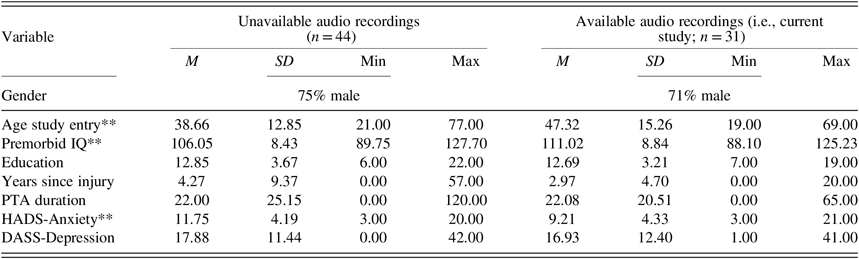
The current sample was older, with slightly higher premorbid IQ and lower anxiety symptoms, compared to those participants with unavailable audio recordings (see Table 1).
Comparison of participant characteristics at pre-CBT-ABI, for both unavailable and available audio-recorded CBT-ABI sessions

Note. DASS = Depression, Anxiety & Stress Scales; HADS = Hospital Anxiety & Depression Scale; PTA = Post-Traumatic Amnesia.
** p ≤ .05.
Participants (n = 31) in the current study had an average premorbid IQ of 111.03 (SD = 8.84). An average Hayling section 2 response time (Burgess & Shallice, Reference Burgess and Shallice1997) of 76.55 seconds (SD = 61.95) placed participants in the ‘low’ to ‘moderate average’ executive functioning range. An average total words recalled of 40.79 (SD = 15.21) on trials 1–5 of the BIRT (Coughlan et al., Reference Coughlan, Oddy and Crawford2007) placed participant memory functioning in the 10th to 25th percentile, relative to the normative sample.
Anxiety symptoms at pre-CBT-ABI ranged from normal to severe (M = 9.61, SD = 3.85; Min = 3 to Max = 17), and by post-CBT-ABI were in the normal to moderate range (M = 8.24, SD = 3.63; Min = 1 to Max = 14). Depression symptoms ranged between normal and very severe at both pre-CBT-ABI (M = 17.23, SD = 9.89; Min = 2 to Max = 38) and post-CBT-ABI (M = 14.24, SD = 10.43; Min = 0 to Max = 38).
CBT Process Scale Reliability
All 177 audio-recorded CBT-ABI sessions were assessed with the WAI-SR-O. Overall, over half (99; 55.9%) of the CBT-ABI sessions involved review of homework and were assessed with the HRS-II. A total of 143 (80.8%) of the recordings involved review and/or assignment of homework and were assessed with the HAACS. The co-rater assessed 15.3% of sessions with the WAI-SR-O, 7.1% with the HRS-II, and 15.4% with the HAACS. The primary researcher re-rated 25.4% of sessions with the WAI-SR-O, 23.2% with the HRS-II, and 26.6% with the HAACS. Adequate within-rater and inter-rater reliability was achieved (Finn’s r > 0.80) for all CBT process scales.
Preliminary Analyses
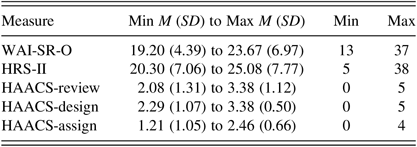
CBT process scale score descriptive statistics are presented in Table 2.
CBT process measure session mean range across nine CBT-ABI sessions

Note. WAI-SR-O = Working Alliance Inventory-Short-Form Revised-Observer version (12 = strongest alliance, 60 = weakest alliance); HRS-II = Homework Rating Scale-Revised (0 = no engagement, 48 = complete engagement); HAACS = Homework Adherence and Competence Scale (0 = extremely poor, 6 = excellent).
Correlational analyses found that gender and age at study entry were significantly associated (t 29 = -2.47, p < .05). Females (M = 57.11, SD = 13.82) were on average 13.79 years older than males (M = 43.32, SD = 14.22) at study entry. Years since injury and BIRT score were found to be significantly and positively correlated (r = 0.37, p ≤ .05), suggesting that a greater number of years since injury was associated with better memory functioning. WAI-SR-O and HRS-II scores were significantly negatively correlated (r = -0.51, p ≤ .05), suggesting that a higher level of homework engagement was associated with a stronger working alliance (i.e., lower alliance score).
Anxiety Symptom Change
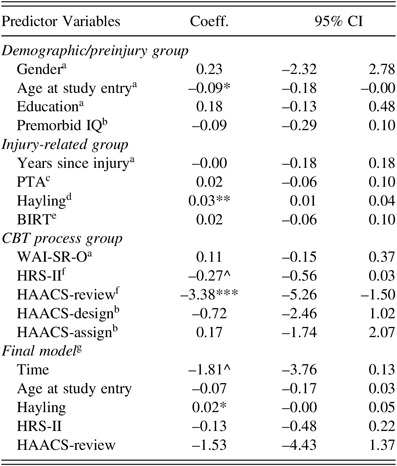
All anxiety symptom change analyses utilized linear regression with Huber–White robust estimation, without time interaction (see Table 3).
HADS-anxiety regressions for demographic/preinjury, injury-related, and CBT process variables

Note. Coeff.=unstandardized regression coefficient.
a n = 30; b n = 26; c n = 25; d n = 28; e n = 27; f n = 23; g n = 22.
*p ≤ .05, **p ≤ .01, ***p ≤ .001; ^p ≤ 0.10
Demographic/preinjury variables
Only age at study entry was significantly associated with change in HADS-anxiety score, F(2, 29) = 3.42, p ≤ .05, and accounted for 12.8% of its variance. Specifically, older age was associated with greater improvement in anxiety symptoms by post-CBT-ABI.
Injury-related variables
Only executive functioning (i.e., Hayling response time) was significantly associated with change in HADS-anxiety score, F(2, 27) = 8.50, p ≤ .005, and accounted for 20.28% of variance. Specifically, poorer executive functioning was associated with less improvement in anxiety by post-CBT-ABI.
CBT process variables
Homework engagement (i.e., HRS-II score) was significantly associated with change in HADS-anxiety, F(2, 22) = 3.86, p ≤ .05, accounting for 15.10% of variance. Specifically, a higher level of homework engagement was associated with greater improvement in anxiety symptoms by post-CBT-ABI.
Therapist competence in reviewing homework (i.e., HAACS-review score) was also significantly associated with change in HADS-anxiety score, F(2, 22) = 11.56, p ≤ .005, accounting for 28.27% of variance. Specifically, higher level of therapist competence in reviewing homework was associated with greater improvement in anxiety symptoms by post-CBT-ABI.
Final model
Linear regression was repeated and included age at study entry, Hayling response time, HRS-II, and HAACS-review. This final model explained 44.09% of variance in change in HADS-anxiety score, F(5, 21) = 4.43, p ≤ .05. When entered into the final model together, only Hayling (p ≤ .05) remained statistically significant. Mean HADS anxiety at pre-CBT-ABI, adjusted for the final model, was 9.90, 95% CI = 7.86–11.95. Mean HADS anxiety at post-CBT-ABI, adjusted for the final model, was 8.09, 95% CI = 6.98–9.20.
Depression Symptom Change
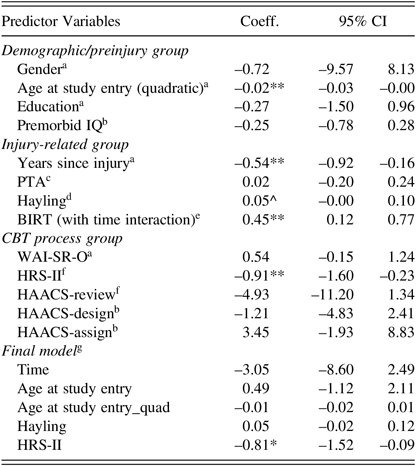
All analyses of depression symptom change were conducted using linear regression, without time interaction (see Table 4), with the exception of age at study entry and BIRT score.
DASS-depression regressions for demographic/preinjury, injury-related, and CBT process variables

Coeff. = unstandardized regression coefficient.
a n = 30; b n = 26; c n = 25; d n = 28; e n = 27; f n = 23; g n = 22.
*p ≤ .05, **p ≤ .01, ***p ≤ .001; ^p ≤ .10.
Demographic/preinjury variables
Quadratic regression, without time interaction, indicated that only age at study entry was significantly associated with change in DASS-depression score F(3, 29) = 4.81, p ≤ .05, accounting for 18.63% variance. Specifically, older age was associated with greater improvement in depression symptoms by post-CBT-ABI.
Injury-related variables
Years since injury was significantly associated with change in DASS-depression score, F(2, 29) = 5.04, p ≤ .05, accounting for 7.91% of variance. Specifically, longer duration since injury was associated with greater improvement in depression symptoms post-CBT-ABI.
Executive functioning (i.e., Hayling response time) was also significantly associated with change in DASS-depression score, F(2, 27) = 2.42, p ≤ .10, accounting for 10.12% of variance. Specifically, poorer executive functioning was associated with less improvement in depression symptoms by post-CBT-ABI.
The relationship between BIRT trials 1–5 score (i.e., memory functioning) and DASS-depression score showed a statistically significant time point interaction: F(3, 26) = 3.08, p ≤ .05, accounting for 14.94% variance. Since this relationship was likely dependent upon time point, separate regressions for pre-CBT-ABI and post-CBT-ABI were conducted. BIRT was found to be significantly associated with pre-CBT DASS-depression score, F(1, 24) = 5.59, p ≤ .05, accounting for 18.09% variance. Specifically, better performance on the BIRT at pre-CBT-ABI was associated with lower levels of depression at pre-CBT-ABI. However, BIRT score was not significantly associated with post-CBT-ABI DASS-depression score (p ≥ .10).
CBT process variables
Only homework engagement (i.e., HRS-II score) was significantly associated with change in DASS-depression score, F(2, 22) = 7.24, p ≤ .005, accounting for 20.69% of variance. Specifically, a higher level of homework engagement was associated with greater improvement in depression symptoms by post-CBT-ABI.
Final model
Linear regression was repeated and included age at study entry, Hayling response time, and HRS-II. This final model explained 35.73% of variance, F(5, 21) = 4.11, p ≤ .05. When entered into the model together, only HRS-II remained statistically significant (p ≤ .05). Mean DASS depression at pre-CBT-ABI, adjusted for the final model, was 17.17, 95% CI = 11.74–22.60. Mean DASS depression at post-CBT-ABI, adjusted for the final model, was 14.12, 95% CI = 10.69–17.54.
Summary
In summary, variables individually associated (p < .10) with greater improvement in both anxiety and depression symptoms in CBT-ABI were older age, better executive functioning and higher levels of homework engagement. Higher level of therapist competence in homework review was associated with greater improvement in anxiety symptoms only. Longer post-TBI recovery period was associated with greater improvement in depression symptoms only. Once entered into a final model, only Hayling response time and homework engagement remained significantly associated (p < .05) with anxiety and depression symptom change, respectively. Premorbid IQ, PTA duration, memory functioning, and working alliance were not associated with symptom change.
DISCUSSION
The findings of the current study highlight the importance of therapists comprehensively attending to accommodation of executive deficits, and facilitation of client homework engagement, in order to maximize treatment effectiveness.
Association of Demographic/Preinjury Variables with Symptom Change
Gender was not found to be associated, which suggests that both males and females can benefit from CBT-ABI. Older age was associated with greater improvement in both anxiety and depression symptoms. Previous studies of clients with cognitive impairment (Sherer et al., Reference Sherer, Evans, Leverenz, Stouter, Irby, Eun Lee and Yablon2007; Thomas et al., Reference Thomas, Rossell, Farhall, Shawyer and Castle2011) found no association of age with outcome. Therefore, the current result may reflect a relationship unique to CBT-ABI in the treatment of depression and anxiety post-TBI. The finding suggests that older participants have capacity to apply a greater wealth of life experience to CBT-ABI engagement, for example, more evidence (i.e., life experience) to draw upon in order to challenge unhelpful thoughts and formulate effective alternate thoughts.
Education was not associated with symptom change, which is in keeping with findings from Sherer et al. (Reference Sherer, Evans, Leverenz, Stouter, Irby, Eun Lee and Yablon2007). Contrary to our prediction, premorbid IQ was also not associated with symptom change. A lack of association with anxiety symptoms is consistent with previous research (Anson & Ponsford, Reference Anson and Ponsford2006; Hsieh et al., Reference Hsieh, Ponsford, Wong, Schönberger, Taffe and McKay2012); however, Anson and Ponsford (Reference Anson and Ponsford2006) found higher premorbid IQ to be associated with improvement in depression symptoms in group CBT. This inconsistency may be related to Anson and Ponsford (Reference Anson and Ponsford2006) having relatively more variability in participant premorbid IQ scores. The current findings suggest that the level of education and premorbid IQ do not necessarily pose an obstacle to symptom improvement in CBT-ABI.
Association of Injury-Related Variables with Symptom Change
A greater number of years post-injury were associated with greater improvement in depression symptoms by post-CBT-ABI. This finding partially supported our hypothesis, as anxiety symptom change was not associated with time post-injury. More time post-injury possibly means greater potential for depression symptom reduction, due to the necessary role of time in the development of hopelessness. Indeed, Schönberger et al. (Reference Schönberger, Humle and Teasdale2006b) found that improved awareness lead to increased depression during neuro-rehabilitation treatment for people with brain injury.
On the other hand, more time post-injury possibly means less potential for anxiety symptom reduction. This may be due to anxiety-driven avoidance eventually manifesting as depression symptomatology over a longer time frame (i.e., social isolation and withdrawal from usual activities). In other words, the severity of depression symptomatology may surpass that of anxiety symptomatology with more time post-injury. This consequently increases the potential for greater improvement in depression symptoms.
Contrary to our prediction, PTA duration was not associated with either anxiety or depression symptom change. A lack of association with anxiety symptoms is consistent with previous research (Anson & Ponsford, Reference Anson and Ponsford2006; Hsieh et al., Reference Hsieh, Ponsford, Wong, Schönberger, Taffe and McKay2012). The current finding is important as it suggests that greater injury severity does not necessarily pose an obstacle to anxiety and depression symptom improvement in CBT-ABI.
Unlike the current study, Anson and Ponsford (Reference Anson and Ponsford2006) did not find an association of years post-injury and depression symptom change, but did find lower injury severity to be related to greater improvement in depression symptoms. Both inconsistencies with current findings may be related to the Anson and Ponsford (Reference Anson and Ponsford2006) study having relatively less variability in participant years post-injury and more variability in PTA duration.
Poorer executive functioning was associated with less improvement in both anxiety and depression symptoms by post-CBT-ABI, thereby supporting our hypothesis. Furthermore, executive functioning remained statistically significant when entered into a final model for anxiety symptom reduction. In studies of CBT for older adults with Generalized Anxiety Disorder (Mohlman, Reference Mohlman2013; Mohlman & Gorman, Reference Mohlman and Gorman2005), better executive functioning has been found to be associated with greater decrease in anxiety and overall psychological distress. On the other hand Hsieh et al. (Reference Hsieh, Ponsford, Wong, Schönberger, Taffe and McKay2012) did not find such a relationship utilizing Hayling error score, a skewed variable with limited variability. In using Hayling response time as the executive function measure, the current study had significantly more variability in scores, which likely increased sensitivity to detect a significant association. The current finding suggests that greater therapist efforts may be needed to circumvent or address executive impairments in therapy, such as incorporating more concrete instances of abstract concepts, and increasing session structure and overt rehearsal of homework.
The current study showed better memory functioning (i.e., BIRT score) was only associated with pre-CBT-ABI depression levels, not post-CBT-ABI depression. This limits interpretation of the main effects between memory functioning and depression symptom change. This relationship requires further examination in future research.
Association of CBT Processes with Symptom Change
Contrary to our hypothesis, working alliance was not associated with anxiety or depression symptom change. This result is surprising, considering the consistency in alliance–outcome relations in prior psychotherapy research (Flückiger et al., Reference Flückiger, Del Re, Wampold and Horvath2018). Furthermore, in the neuro-rehabilitation context, Schönberger et al. (Reference Schönberger, Humle and Teasdale2006b) found that clients’ experience of a good emotional bond mid-therapy was related to greater depression symptom reduction by posttreatment. However, Weck et al. (Reference Weck, Richtberg, Esch, Hofling and Stangier2013) found no association between alliance and homework compliance in maintenance cognitive therapy for depression, and identified lack of alliance score variance as a possible explanation. On average, alliance was strong and stable across CBT-ABI sessions in the current study; therefore, it is possible that there was not enough variance to predict symptom change.
A higher level of homework engagement was associated with greater improvement in both anxiety and depression symptoms by post-CBT-ABI, thereby supporting our hypothesis. Furthermore, homework engagement remained statistically significant when entered into a final model for depression symptom reduction. This is in keeping with meta-analyses examining homework–outcome relations in non-brain-injured participants (Kazantzis, Luong, et al., Reference Kazantzis, Luong, Usatoff, Impala, Yew and Hofmann2018; Kazantzis et al., Reference Kazantzis, Deane and Ronan2000, Reference Kazantzis, Whittington and Dattilio2010, Reference Kazantzis, Whittington, Zelencich, Kyrios, Norton and Hofmann2016; Mausbach et al., Reference Mausbach, Moore, Roesch, Cardenas and Patterson2010). Without homework, new skills cannot be generalized to the client’s life (Beck, Reference Beck2011). Therefore, for a therapist delivering CBT-ABI, facilitation of homework engagement is a treatment priority.
Therapist competence in designing or assigning homework was not associated with anxiety or depression symptom change. This is inconsistent with Detweiler-Bedell and Whisman (Reference Detweiler-Bedell and Whisman2005) who found several homework design and assign strategies to be associated with lower depression levels at posttreatment and follow-up. In the current study, higher therapist competence in reviewing homework was associated with greater improvement in anxiety symptoms by post-CBT-ABI, but not in depression symptoms. Detweiler-Bedell and Whisman (Reference Detweiler-Bedell and Whisman2005) also found a trend, albeit nonsignificant, for more client involvement in homework review to be associated with better life functioning at follow-up (i.e., 2 years). However, anxiety was not examined in their study.
There is an overall lack of research specifically examining the therapist homework competence–symptom change relationship, particularly in the treatment of anxiety. Even examination of the general competence–symptom change relationship involves less focus on anxiety, relative to depression (Webb et al., Reference Webb, DeRubeis and Barber2010). An exception is a study by Huppert et al. (Reference Huppert, Barlow, Gorman, Shear and Woods2006) who found therapist CBT protocol adherence and client motivation interacted significantly to predict change in panic symptoms.
Therefore, it is difficult to speculate as to why therapist competence in review of homework was associated with anxiety, but not depression, in the current study. According to the HAACS-review items, a competent therapist provides more positive reinforcement for the client’s homework efforts, forms a greater understanding of homework-related beliefs, and comprehensively problem-solves barriers to homework engagement. These behaviors likely reduce fears related to coping with tasks, and anxiety symptoms are possibly more responsive to this reassurance and empowerment.
Limitations and Directions for Future Research
Although 177 CBT-ABI sessions were utilized in the current study, results are considered preliminary as this represented a relatively small client sample (n = 31). Nonsignificant findings may be due to low statistical power or could indicate that certain variables do not impact symptom change in CBT-ABI. Replication with larger sample sizes is required.
All CBT process scales were relatively new and originally developed with non-brain-injured clients. While they appear to have performed reliably in the current study, continued research is needed to verify the suitability of such scales in a brain-injured population. Furthermore, working alliance and homework engagement scale total scores were utilized in analyses. Future studies may consider further factor analytic evaluation of the scales and examination of association of subscale scores with symptom change. Indeed Schönberger et al’s. (Reference Schönberger, Humle and Teasdale2006b) significant alliance–outcome finding was based on the emotional bond subscale of the WAI.
The significant association between more years post-TBI and greater depression symptom improvement could reflect the impact of increasing self-awareness over time post-injury. Anson and Ponsford (Reference Anson and Ponsford2006) found that self-awareness of brain injury-related deficits contributed the greatest unique proportion of variance to change in depression following treatment, speculating that increased self-awareness drove client motivation for treatment. The current study did not assess participant self-awareness. Future research could further explore its association with symptom change in CBT adapted for cognitive deficits.
This study highlights the demographic and brain injury-specific characteristics that are important to consider in determining suitability of CBT-ABI treatment timing. Specifically older age, a greater recovery period post-injury, and better executive functioning were all associated with greater symptom improvement. Importantly, neither greater injury severity nor lower education or IQ impeded benefit from CBT-ABI. Finally, the current study reinforces the homework–outcome relationship, and demonstrates that this extends to CBT adapted for TBI.
ACKNOWLEDGMENTS
The parent RCT was supported by the NHMRC under Grant number 606432. The authors would like to thank Lilas Carstairs for assistance with data collection, and acknowledge Alex Petrik and Timothy Cronin for provision of CBT process scale training.
CONFLICTS OF INTEREST
The authors have nothing to disclose.