Introduction
Identity threat, as a kind of environmental challenge to the adequacy of individuals' identity, is defined as ‘experiences appraised as indicating potential harm to the value, meanings, or enactment of an identity’ (Petriglieri, Reference Petriglieri2011: 644) or ‘any overt action by another party that challenges, calls into question, or diminishes a person's sense of competence, dignity, or self-worth’ (Aquino & Douglas, Reference Aquino and Douglas2003: 196). It includes destructive behavior, verbal harassment, harsh criticism of one's competency, and public humiliation from environments (Aquino & Douglas, Reference Aquino and Douglas2003; Bies, Reference Bies, Greenberg and Cropanzano2001).
Identity threat is a common occurrence in the workplace (Baron & Neuman, Reference Baron and Neuman1996) that may arouse individuals' essential motives to defend themselves. Prior studies find that threats to individuals' social identity or personal identity can increase some kinds of unethical behavior. For example, scholars find that identity threat can lead to aggressive workplace behaviors, such as stealing, cheating, and lying (Belmi, Barragan, Neale, & Cohen, Reference Belmi, Barragan, Neale and Cohen2015), as social interactionist theories indicate that employees will use retaliatory responses against the perceived source of threat by the threat-recipient (Tedeschi & Felson, Reference Tedeschi and Felson1994). Others observe that individuals' displaced aggression is a robust and valid phenomenon in organizations (Marcus-Newhall, Pedersen, Carlson, & Miller, Reference Marcus-Newhall, Pedersen, Carlson and Miller2000) and that individuals' defensive behaviors, such as unethical behavior, can serve as value-expressive tools to vent negative emotions towards any available targets (Petriglieri, Reference Petriglieri2011). Additionally, threat-recipients in organizations can direct such aggressive behaviors against both perpetrators and nonperpetrators (Aquino & Douglas, Reference Aquino and Douglas2003).
Prior studies have noted the critical role of identity in morality literature (Aquino & Reed, Reference Aquino and Reed2002; Treviño, Weaver, & Reynolds, Reference Treviño, Weaver and Reynolds2006). Individuals are always present behind different kinds of roles (Ashforth & Mael, Reference Ashforth and Mael1989; Frone, Russell, & Cooper, Reference Frone, Russell and Cooper1995; Leavitt, Reynolds, Barnes, Schilpzand, & Hannah, Reference Leavitt, Reynolds, Barnes, Schilpzand and Hannah2012; Rozuel, Reference Rozuel2011; Song, Yu, Zhang, & Jiang, Reference Song, Yu, Zhang and Jiang2015). Given that activating different personal identities simultaneously activates different self-concepts, motives, and behavior scripts (Brewer & Gardner, Reference Brewer and Gardner1996; Markus, Reference Markus1977; Markus & Kunda, Reference Markus and Kunda1986), disparate types of identity threats may also lead to individuals' various kinds of defensive intentions (Leavitt et al., Reference Leavitt, Reynolds, Barnes, Schilpzand and Hannah2012; Mayer, Greenbaum, Kuenzi, & Shteynberg, Reference Mayer, Greenbaum, Kuenzi and Shteynberg2009). In the current study, we focus on one specific kind of unethical behavior that can be aroused to protect individuals' identity, such as cheating to maintain the status of one's identity (Schoderbek & Deshpande, Reference Schoderbek and Deshpande1996). Moreover, we try to test the dichotomous impacts of public or private aspects of individuals' identity on their unethical behaviors.
Our study is based on theories about individuals' different responses to identity threats (Aquino & Douglas, Reference Aquino and Douglas2003; Petriglieri, Reference Petriglieri2011). We propose that the effect of identity threat on individuals' unethical behavior may depend on the publicness of such threat. Specifically, the publicness of identity threat, which taps into a more generally sensitive self towards others' responses, is one of the key factors determining whether individuals can use unethical behavior as a defensive response to defend their identities (Hollenbeck, Williams, & Klein, Reference Hollenbeck, Williams and Klein1989; Petriglieri, Reference Petriglieri2011; Salancik, Reference Salancik, Staw and Salancik1977). Generally, individuals have a basic need to construct their desired identity image (Leary & Baumeister, Reference Leary and Baumeister2000; Sherman & Cohen, Reference Sherman and Cohen2006). Unethical behavior serves as an identity-protection response that can be used to conceal individuals' actual identity status in public spheres due to individuals' basic need to meet public standards (i.e., construct a desirable identity image; Leary & Baumeister, Reference Leary and Baumeister2000) or bifurcate the effects of identity threat when believing it cannot be perceived by others (i.e., privateness).
Self-affirmation, as an effective psychological intervention that can reduce the influences of identity threat (Cohen & Sherman, Reference Cohen and Sherman2014; Sherman & Cohen, Reference Sherman and Cohen2006; Steele, Reference Steele1988), is used in our study as the control group. Self-affirmation theory (Steele, Reference Steele1988; Steele & Liu, Reference Steele and Liu1983) and related empirical studies support the idea that affirming individuals' global self-worth can reduce the amount of their identity-defensive behaviors (Cohen & Sherman, Reference Cohen and Sherman2014). In the current study, we suggest that self-affirmation can also serve as an identity-defensive response (Petriglieri, Reference Petriglieri2011). Affirming identities other than the currently threatened ones provide suitable control groups for us to investigate the effects of identity threat (Fast, Burris, & Bartel, Reference Fast, Burris and Bartel2014). Ultimately, in this study, we use self-affirmation as our control group in which identity threat does not exist.
In exploring the above issues, we seek to make at least three important contributions. First, we seek to contribute to the identity threat theory by investigating the potential influences of the public or private aspect of identity threat. Second, by examining the relationship between identity threat and unethical behaviors in public and private situations, we seek to enrich unethical behavior literature by incorporating identity threat as one possible predictor and differentiating the effects of private or public identity threat simultaneously. Third, we provide more empirical evidence of the ‘dark side’ of self-affirmation, which is often considered as a positive accelerator of mitigatory attitudes and behaviors (Cohen & Sherman, Reference Cohen and Sherman2014). One online experiment and one laboratory experiment are conducted to test these effects in this study.
Theoretical Development and Hypotheses
The resistance to challenge the idea that threats to currently salient identity forces individuals to behave defensively (Aquino & Douglas, Reference Aquino and Douglas2003; Petriglieri, Reference Petriglieri2011; Steele, Reference Steele1988). Based on this premise, Petriglieri (Reference Petriglieri2011) observes two basic coping responses individuals may use to deal with identity threats: the identity-protection response, which targets the source of identity threat, and the identity-restructuring response, which targets the importance of the threatened identity. The identity-protection strategy encompasses concealing the current identity status, and the identity-restructuring strategy encompasses the importance-changing response towards the threatened identity. In Petriglieri's view, individuals will evaluate these two responses to identity threat and choose one based on the inherent characteristics of the identity threat. For example, unethical behavior can be used to express fake impressions to deal with potential harm to one's identity image (Treviño, den Nieuwenboer, & Kish-Gephart, Reference Treviño, den Nieuwenboer and Kish-Gephart2014). However, as previous studies suggest, not all kinds of identity threats can be concealed by unethical behaviors (Baumeister, Reference Baumeister2010; Mar, De Young, Higgins, & Peterson, Reference Mar, De Young, Higgins and Peterson2006; Trivers, Reference Trivers2000). If the self-importance of identity threat is increasing, individuals will hardly use any concealment strategy (Petriglieri, Reference Petriglieri2011).
According to James (Reference James1950), individuals' personal identity consists of moral sensibility; conscience; and desire for achievement, mastery, and competence (cf. Mayer et al., Reference Mayer, Greenbaum, Kuenzi and Shteynberg2009). In this study, we posit that the effect of individuals' identity threat on unethical behavior may be influenced by the publicness of such threat. People hold generally positive self-concepts of themselves as rational, intelligent, responsible, and healthy (Crocker, Niiya, & Mischkowski, Reference Crocker, Niiya and Mischkowski2008; Steele, Reference Steele1988) and have a basic need to maintain positive identity image in both their own and others' eyes (Baumeister & Leary, Reference Baumeister and Leary1995; Sherman & Cohen, Reference Sherman and Cohen2006). Therefore, we shed light on one important categorized characteristic: the publicness of a specific identity threat that affects an individual's decisions under the threat. In fact, some scholars have already attempted to differentiate the public aspects of the self from the private aspects (Baumeister, Reference Baumeister1986; Tetlock & Manstead, Reference Tetlock and Manstead1985). For instance, individuals have a basic need to maintain desirable identity images by publicly claiming attributes consistent with those identities (Gollwitzer, Reference Gollwitzer1986). Baumeister and Leary (Reference Baumeister and Leary1995) claim that individuals want to maintain the identity status in both their own and others' eyes. In this study, we posit that when identity threat comes from the public sphere, unethical behavior can serve as an effective defensive method in a specific domain because of individuals' inherent need to satisfy publicly acceptable requirements. In contrast, when identity threat is from the private sphere, it increases the self-importance of such identity. The need for accuracy requires them to have an accurate self-evaluation. Individuals will be less likely to use a concealment response (i.e., unethical behavior) as their identity defensive strategy (Petriglieri, Reference Petriglieri2011).
In addition, self-affirmation theory articulates that most individuals' basic motive is to maintain global integrity of the self, ‘which can be defined as the sense that, on the whole, one is a good and appropriate person’ rather than perceived worth in specific domains or particular situations (Sherman & Cohen, Reference Sherman and Cohen2006; Steele, Reference Steele1988). Self-affirmation provides individuals with useful psychological interventions to deal with identity threat. That is, individuals can draw on alternative positive traits, abilities, or values irrelevant to the activated threat to maintain their global perceived integrity (Cohen & Sherman, Reference Cohen and Sherman2014). Their flexible self-systems enable them to define success in a way that highlights their idiosyncratic strengths. Thus, self-affirmation may eliminate drastic attitudes or behaviors and promote adaptations to an array of challenges faced over one's lifespan. In summary, affirming alternative identities unrelated to current identity threat will decrease the salience and self-importance of identity threat at stake (Cohen, Aronson, & Steele, Reference Cohen, Aronson and Steele2000; Correll, Spencer, & Zanna, Reference Correll, Spencer and Zanna2004; Fein & Spencer, Reference Fein and Spencer1997; Reed & Aspinwall, Reference Reed and Aspinwall1998; Sherman, Nelson, & Steele, Reference Sherman, Nelson and Steele2000). In the current study, to investigate the influences of different kinds of identity threats on individuals' unethical behaviors, the self-affirmation method is also adopted as the control group.
Identity threat from the public sphere
The needs to appear consistent with others and to project a positive identity image in others' eyes stem from humans' basic need for social adaptation and evolutionary advantage (Colvin, Block, & Funder, Reference Colvin, Block and Funder1995; Salancik, Reference Salancik, Staw and Salancik1977; Taylor & Brown, Reference Taylor and Brown1988; Trivers, Reference Trivers2000) while other-concern and self-concern are two basic motives for individuals' behaviors (Meglino & Korsgaard, Reference Meglino and Korsgaard2004). Therefore, impression management-based identity-defensive responses must be considered when we investigate identity threat (Schoderbek & Deshpande, Reference Schoderbek and Deshpande1996). Impression management refers to the process through which individuals try to maintain their images in others' eyes (Bolino, Reference Bolino1999). Individuals tend to resist changing an established course of action that may make their competency look inconsistent with public standards (Hollenbeck, Williams, & Klein, Reference Hollenbeck, Williams and Klein1989; Salancik, Reference Salancik, Staw and Salancik1977). For example, Dweck and Gilliard (Reference Dweck and Gilliard1975) find that children persist longer at an insoluble puzzle when they have made public statements regarding their expected success. Moreover, according to impression management studies (Jones & Pittman, Reference Jones, Pittman and Suls1982; Leary & Kowalski, Reference Leary and Kowalski1990), when individuals confront threats of potential harm to their valued identity image in other individuals' eyes, they will use any strategy to maintain the original conditions. Prior studies also find that individuals may set even higher performance goals to show their own identities can still be protected or even enhanced (Taylor & Brown, Reference Taylor and Brown1988). In fact, individuals' behavior can result from the motive to verify an important facet of the self through appraisals of others (Winterich, Aquino, Mittal, & Swartz, Reference Winterich, Aquino, Mittal and Swartz2013). According to moral disengagement theory, this strong extrinsic incentive to protect their public identity from threat may also motivate individuals to dehumanize and objectify the unethical instruments they use to pursue these defensive goals (Bandura, Reference Bandura1999).
Moreover, in individuals' goal system, scholars find that the extrinsic goals of image, popularity, and financial success are inherently incompatible with intrinsic goals such as community feeling or affiliation (Grouzet et al., Reference Grouzet, Kasser, Ahuvia, Dols, Kim, Lau and Sheldon2005). These extrinsic goals increase the likelihood of setting higher performance goals and draw individuals' attention to attaining such goals (Van Yperen, Hamstra, & Van der Klauw, Reference Van Yperen, Hamstra and Van der Klauw2011). Also from the social value system (Schwartz & Boehnke, Reference Schwartz and Boehnke2004), image and achievement values, which reflect self-enhancement, are diametrically opposed to the benevolence value, which reflects self-transcendence (Aquino, Freeman, Reed, Lim, & Felps, Reference Aquino, Freeman, Reed, Lim and Felps2009). Based on the above studies, we propose that when identity threat is from the public sphere, individuals' main motive underlying their threatened identity is to protect their identity images. Using unethical behavior to conceal their actual identity status can be one such type of strategy (Petriglieri, Reference Petriglieri2011).
However, when individuals are self-affirmed, they have little need to protect their public identity image in a given domain. This intervention makes the defensive process milder and appears in the form of more rumination (Koole, Smeets, Van Knippenberg, & Dijksterhuis, Reference Koole, Smeets, Van Knippenberg and Dijksterhuis1999) and use of various paradigms (Blanton, Pelham, DeHart, & Carvallo, Reference Blanton, Pelham, DeHart and Carvallo2001). Thus, self-affirmation lessens the stress in encountering ethical dilemmas and concerns about making a good impression under identity threat. In the current study, we use self-affirmation as the comparative condition opposite to identity threat. Therefore, we posit the following hypothesis:
Hypothesis 1 Individuals will engage in more unethical behavior when identity threat is from the public sphere than those without such threat (i.e., after self-affirmation).
Identity threat from the private sphere
The story differs with regard to the private sphere. Identity threat from the private sphere can establish a sense of high personal salience or self-importance of such identity threat. As Bandura's moral disengagement model suggests individuals need motivations for unethical behavior to disengage from their self-condemnation system (Bandura, Reference Bandura1999; Detert, Treviño, & Sweitzer, Reference Detert, Treviño and Sweitzer2008; Mazar, Amir, & Ariely, Reference Mazar, Amir and Ariely2008). We suggest that when individuals' private identity is threatened, the self-importance of such identity is actually strengthened. Additionally, individuals tend to use their own sense of the importance of the threatened identity as a reference when evaluating others' perceived importance of such identity. This may bring them higher psychological costs of cheating others and decrease their self-imposed unethical thresholds for seeing themselves as moral (Bandura, Reference Bandura1999). Furthermore, the more important an identity threat is, the more central it is to individuals' goals, values, or sense of self and the more individuals will be motivated to display rather than hide it (Branscombe & Ellemers, Reference Branscombe and Ellemers1998; Griffith & Hebl, Reference Griffith and Hebl2002; Petriglieri, Reference Petriglieri2011).
Moreover, as long as identity threat cannot be perceived by significant others, the beneficiaries of the defensive identity will always be the individuals themselves (Leary & Kowalski, Reference Leary and Kowalski1990). As a traditional Chinese allegory suggests, ‘people cannot just plug their own ears while stealing a bell.’ It is individuals' own need to accurately evaluate their certain identity status that makes threats to the target identity impossible to defend by unethical behavior (Cialdini & Goldstein, Reference Cialdini and Goldstein2004). Therefore, unethical behavior, such as cheating or lying, may become unacceptable in the threatened domain when an individual's identity is threatened privately.
However, self-affirmation reverses this effect. As self-affirmation theory demonstrates, self-affirmation broadens individuals' perspectives (Critcher & Dunning, Reference Critcher and Dunning2015) and perceived sources of self-integrity (Sherman & Cohen, Reference Sherman and Cohen2006). Individuals who are affirmed by alternative positive traits, abilities, or values other than the currently threatened identity are less likely to be influenced by such threats. Consequently, the restraining effect of private identity threat on unethical behavior will also be decreased in individuals' global self-worth systems after self-affirmation (Simon, Greenberg, & Brehm, Reference Simon, Greenberg and Brehm1995). Individuals in such circumstances may become more intent on engaging in unethical behavior when encountering unethical temptation (e.g., cheating for money). In conclusion, self-affirmation will show its ‘dark side’: impairing self-importance in the threatened identity and increasing the likelihood of engaging in unethical behavior at this time. Thus, we also use self-affirmation as the comparative condition opposite to identity threat from the private sphere. Following this logic, we posit the following hypothesis:
Hypothesis 2 Individuals will engage in less unethical behavior when identity threat is from the private sphere than those without such threat (i.e., after self-affirmation).
Hypothesis 3 Publicness of identity threat and self-affirmation will interactively predict unethical behavior.
Overview of Experiments
Two laboratory experiments were conducted to test these hypotheses. Study 1 examined whether individuals' intention to engage in unethical behavior decreased or increased when public or private competent identities were threatened. Study 2 replicated this result by conducting the experiment in an actual situation and tested whether participants would cheat more to gain money when their competent identities from the private sphere or from the public sphere were threatened. Study 2 also demonstrated that individuals with higher risk preference would be more easily affirmed. In other words, self-affirmation was more effective when individuals held higher risk preference.
Study 1: Online Experiment
Participants and design
Participating in our first online experiment were 197 individuals with at least one year of work experience (Male = 95, Female = 102; Mean age = 31.86 years; Mean work exp. = 8.65 years) recruited by an online survey system from almost 20 different regions in China. Approximately 80 percent of the participants had a college-level education. The experiment was conducted using a 2 by 2 mixed design. We manipulated publicness of identity threat with a within-subject design and the self-affirmation and non-affirmation condition with a between-subject design. We used mixed design in this study because in scenario experiments, participants need clear references to help them make appropriate judgments, and a mixed-design experiment could help participants acquire more information to make decisions (Aguinis & Bradley, Reference Aguinis and Bradley2014; Atzmüller & Steiner, Reference Atzmüller and Steiner2010). All the participants were told to participate in a managerial decision-making program in exchange for a monetary reward (6 RMB, almost $.92 per person), and they were randomly assigned to the self-affirmation condition or non-affirmation condition. Then, all the participants read the scenario of identity threat.
Procedures
After agreeing to participate, all the participants first completed the self-affirmation or non-affirmation tasks. The method to manipulate self-affirmation was adapted from previous studies (Cohen, Aronson, & Steele, Reference Cohen, Aronson and Steele2000; Cohen, Garcia, Apfel, & Master, Reference Cohen, Garcia, Apfel and Master2006; Sherman, Bunyan, Creswell, & Jaremka, Reference Sherman, Bunyan, Creswell and Jaremka2009; Sherman, Nelson, & Steele, Reference Sherman, Nelson and Steele2000; Vohs, Park, & Schmeichel, Reference Vohs, Park and Schmeichel2013; see McQueen & Klein, Reference McQueen and Klein2006 for a review). Half of the participants who were assigned to the self-affirmation condition were informed on the computer screen by a cover letter that they would first complete a personal experience exercise. This task required them to rank a list of 11 values and characteristics developed by Harber (Reference Harber1995) (as cited in Cohen, Aronson, & Steele, 2000) in order of personal importance. The new instruction below asked them to ‘recall three or four personal experiences in which the highest ranked value is most important for you and makes you feel good about yourself’ (Cohen, Aronson, & Steele, Reference Cohen, Aronson and Steele2000). These participants were also asked to pick one experience about which to write a story reflecting their selected value and describing their feelings at that time. Following Steele (Reference Steele1988), reflecting on an important value or characteristic was an effective means to induce self-affirmation. Therefore, in our study, no intellectual or moral-related values or characteristics were provided on the list. In the non-affirmation condition, we asked the other half of the participants to indicate the least important value and write a story describing why this value may be important for other individuals (Cohen et al., Reference Cohen, Garcia, Apfel and Master2006).
After affirmation manipulation, one scenario was used to measure the participants' unethical intentions. The scenario stated that all the participants were participating in a ‘business case design competition with large rewards but low possibility of winning’. In the course of the scenario, we set an impossible goal to manipulate identity threat as in previous studies (Koole et al., Reference Koole, Smeets, Van Knippenberg and Dijksterhuis1999): ‘According to previous experience, you are highly unlikely to win the competition’. Supposing they were the subjects of public or private identity threat, we asked the participants to indicate their probability of engaging in unethical behavior when different identities were threatened. All the participants were asked to indicate to what extent they wanted to engage in unethical behavior (such as cheating or lying) to win the tournament if they were participating in the tournament to (1) evaluate their own self-competency (private identity threat) or (2) demonstrate their high competency to all the individuals in their companies (public identity threat). We randomized the sequence of two different identity threats to counterbalance any influences of the sequence. Thus, half of the participants read the private identity condition first, while the other half read the public identity condition first.
To assess the participants' likelihood of engaging in the unethical behavior, we had them respond to one item for each condition: ‘How likely would you be to use unethical behavior (such as cheating, lying) to win the game?’ A seven-point Likert scale was provided with ‘1 = totally impossible’ and ‘7 = completely possible’.
Results
Manipulation check
We asked the participants to indicate the reason that they wanted to win the tournament to check the manipulation of publicness. All the participants indicated that their reason for seeking to win the tournament was to evaluate their own competency or show their competency to other individuals.
Prior studies suggest that the reason self-affirmation reduces individuals' defensive attitudes or behaviors is because it may improve their other-oriented positive affects (Crocker, Niiya, & Mischkowski, Reference Crocker, Niiya and Mischkowski2008). Thus, it was appropriate for us to test the difference in positive affects between the self-affirmation and non-affirmation conditions to check the affirmation manipulation (Koole et al., Reference Koole, Smeets, Van Knippenberg and Dijksterhuis1999). All the participants were required to write a story reflecting their selected value and describing their feelings containing approximately five sentences and 100 words (Mean = 100.23). A text-analysis program named Linguistic Inquiry and Word Count (LIWC; Tausczik & Pennebaker, Reference Tausczik and Pennebaker2010) helped us calculate the words connoting positive affect. This program could scan the stories and calculate the percentage of words relative to the total word counts that could represent some categories of human speech patterns, such as standard linguistic dimensions (e.g., articles, auxiliary verbs) as well as psychological constructs (e.g., cognitive processes, achievement). A separate list or dictionary that was made up of relevant words was built to measure each dimension. For example, works that revealed interests in power, status, and dominance would be categorized as the Power dimension. Thus, someone who was concerned with power would be more likely to use words such as boss, strong, and president. Each LIWC dimension of words was part of an extensive dictionary (Pennebaker, Chung, Ireland, Gonzales, & Booth, Reference Pennebaker, Chung, Ireland, Gonzales and Booth2007). For example, we chose to use its simplified Chinese version to scan participants' stories supporting their choicesFootnote 1. Following previous processes, we used the number of positive affect-related words in their stories. One typical sentence of self-affirmation was ‘I usually hang out with my girlfriend and feel so happy’, and one of non-affirmation was ‘I work very hard to have better scores’. The percentage of the number of positive affect-relevant words such as ‘Happy’ and ‘Excited’ of the total words was calculated. As expected, the half of the participants in the self-affirmation condition tended to have more positive affects (M = 4.22, SD = 4.73) than those in the non-affirmation condition (M = 2.50, SD = 3.01), (t (195) = − 3.07, p < .01). Half of the participants who were in the self-affirmation condition reported approximately 4.23 positive affect-relevant words, while those in the non-affirmation condition reported approximately 2.51 words.
Hypotheses test
A 2 by 2 mixed design (between factor: self-affirmation and non-affirmation; within factor: private identity threat and public identity threat) ANOVA test showed a significant interactive effect of self-affirmation and two kinds of identity threats (F (1, 195) = 6.45, p = .01) on ethical behavior. Therefore, hypothesis 3 was supported.
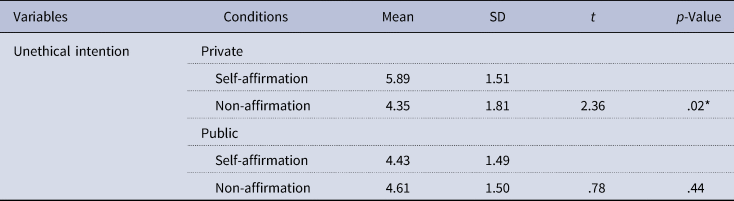
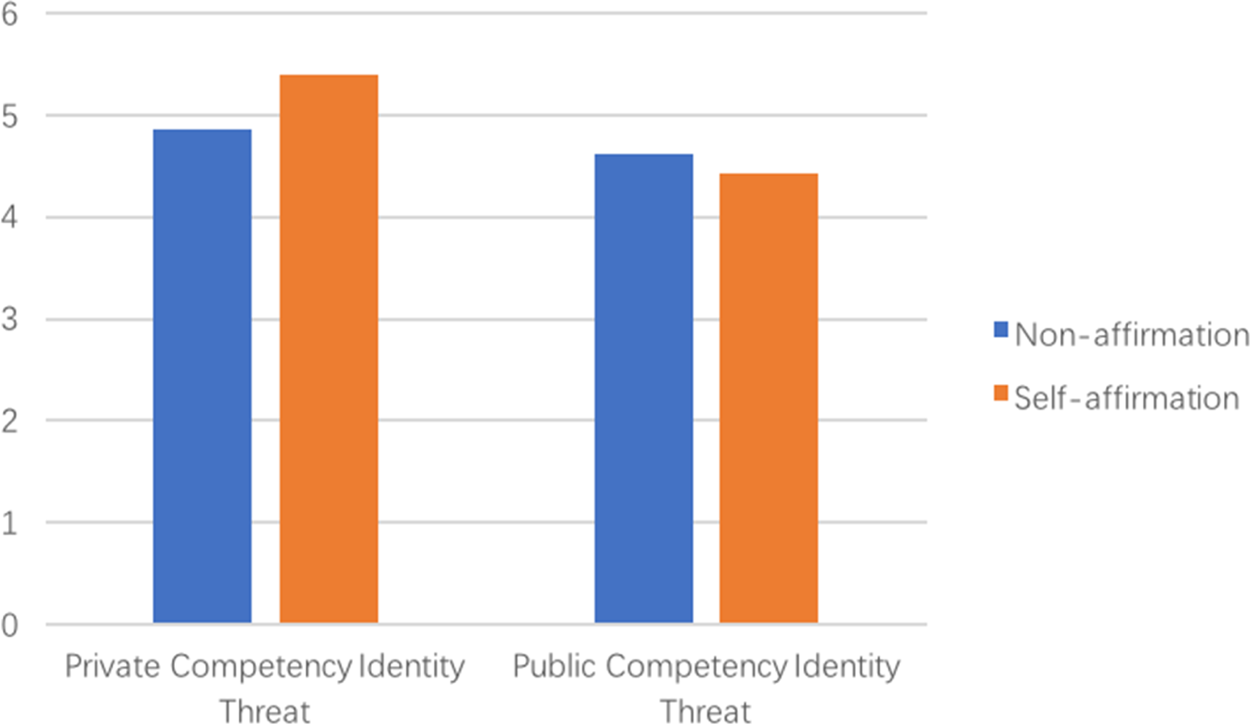
Hypotheses 1 and 2 predicted that identity threat would lead to more (less) unethical behavior when individuals' public (private) identity was threatened compared with the self-affirmation condition. The results showed that there was a significant difference in unethical behavior between the self-affirmation (M = 5.39, SD = 1.51) and non-affirmation conditions (M = 4.85, SD = 1.81; t = 2.36, p = .02) when private identity was threatened. Therefore, hypothesis 2 was supported. However, although the pattern was correct, the results did not reach a significant level when public identity was threatened (self-affirmation: M = 4.43, SD = 1.49; non-affirmation: M = 4.61, SD = 1.50; t = .78, p = .44; see Table 1 and Figure 1 for more details), participants who were under public identity threat did not exhibit less unethical behavior under the condition of affirmation, and hypothesis 1 was not supported.
Means and comparison tests for the variables assessed by condition (study 1)

Note: Private: private identity threat, Public: public identity threat.
*p ≤ .05.
The unethical intention in different conditions (Study 1)

Discussion
In this study, we found that participants with private identity threat tended to have lower unethical intentions than those without private identity threat (i.e., after self-affirmation). This finding gave us preliminary support for the relationship between identity threat and unethical behaviors. Moreover, we found a significant interactive effect of self-affirmation and private identity threat on unethical behavior intentions. However, this study may have some limitations. For example, single-item measurement of unethical intention may impede the reliability of actual effects. Therefore, to replicate the causal inferences of the interactive effect by examining the real unethical behavior in experimental settings and to identify the boundary conditions, we conducted the following laboratory experiment.
Study 2: Laboratory Experiment
Participants and design
To further demonstrate the causal effect of interaction between self-affirmation and identity threat on unethical behavior, we conducted this experiment in the laboratory. The experiment featured a 2 by 2 between-subject design with self-affirmation condition (i.e., affirmation and non-affirmation) and identity threat condition (i.e., public and private) manipulated by a between-subject design. Eighty-eight participants were recruited by one experiment recruitment system, with two of them ultimately excluded due to incomplete results. Thus, 86 participants' results were recorded, consisting of 38 males and 48 females with an average age of 22.17 (Mean age = 22.17 years; SD = 2.47). These participants were undergraduate or graduate students from almost 20 different schools in one major university in China. They were told that they would receive an average of 40 RMB (almost $6) for their participation and were randomly assigned to four conditions by one experiment system (i.e., Qualtrics). Our entire experiment was directed automatically by this system to avoid any personal disturbance.
Procedures
A cover story was provided on the computer screens to each participant that explained that the study sought to investigate humans' subjective memory (memories of personal experiences) and objective memory (memories of others' experiences). After signing the consent forms and being assured of the confidentiality of their responses, the participants were asked to take a deep breath and empty their minds and were then automatically and randomly assigned to one of four conditions by one computer system.
Following the instructions on the screen, half of the participants first completed the affirmation manipulation by ranking the values and characteristics according to personal importance (or recalled and wrote down the foods they had eaten and drunk in last 48 hr in the non-affirmation condition) following traditional methods (Cohen, Aronson, & Steele, Reference Cohen, Aronson and Steele2000). Then, they received the basic information about the main task and identity threat information on the screens (i.e., not successfully completing the task would mean they were a person who did not have high intelligence and would have problems in daily study) to threaten their competency identity and then told to write a story about campus life without awareness of our purpose. After that, they were told that their rewards would be based on their numbers of correctly answered items in the main task. They were asked to report their results in the main matrix task to obtain the monetary reward and completed some questions about their demographic information. The participants were also told that after they completed all the tasks, we would pay their fees based on their own reported results on the main task (3 RMB per item; i.e., almost $.4 per item). However, at the end of the experiments, we debriefed them on the aims of our experiment and actually paid them equally.
In our study, instead of directly giving participants negative feedback on an IQ test (Fein & Spencer, Reference Fein and Spencer1997; Koole et al., Reference Koole, Smeets, Van Knippenberg and Dijksterhuis1999), we chose to set an impossible goal as the identity threat as suggested by goal-setting theory (Locke & Latham, Reference Locke and Latham2002). We told the participants on the computer screen to complete the main task (i.e., the problem-solving matrix) and that ‘this task has a strong predictive power to measure your IQ level, which has been demonstrated to relate to your career success’. The basic standard was successfully completing 15 items within a limited time. While ‘not successfully completing the task means you are a person who does not have high intelligence and would have problems in daily study’ was used to activate identity threat. In both conditions, both halves of the participants were directed to complete a problem-solving matrix task (main task), which they had been told would measure their IQ level; the only difference was that in the public identity threat condition, one complementary procedure was added to announce the results to all the participants.
Manipulation of publicness of identity threat
In the private identity threat condition, to ensure a totally private environment that half of the participants were directed to write down their results on an answer sheet without any obvious mark to identify them. To provide a more confidential workspace, their screens were also covered by some cardboard on the sides to avoid any peeping behavior. After they completed the tasks, they sealed their results in some envelopes and returned them directly to us. In the public identity threat condition, that half of the participants were given unique paper labels with different shapes to mark their unique identities and told that their results (i.e., whether more or less than 15 items) would be announced by sticking their labels on different parts of a whiteboard in the front of the laboratory (i.e., more than 15 items or less than 15 items).
Measurement of unethical behavior
Participants' unethical behavior was measured by a traditional problem-solving matrix adapted from Wiltermuth (Reference Wiltermuth2011) and Kouchaki and Wareham (Reference Kouchaki and Wareham2015) except that we told the participants this task would be used to measure their IQ levels as noted above. After reading the identity threat, the participants had an opportunity for 1 min pretest practice. After the practice, they were presented with 20 matrices of 12 three-digit numbers (e.g., 3.18) on 20 pages (i.e., one matrix per page) and asked to indicate whether they had found the matching pair of numbers that could be summed to 10 within 15 s per matrix. Half of the matrices could be solved (i.e., contained two numbers summing to 10), while the other half could not (i.e., did not contain two numbers summing to 10, unbeknownst to the participants). We counted the number of items for which the participants indicated that they could find the solution but which could not actually be solved as the unethical behavior measurement.
Other variables
Prior studies have demonstrated self-affirmation affect people's attitude towards risky information assimilation (Cohen et al., Reference Cohen, Garcia, Apfel and Master2006). As risk preference represents an attitude orientation that anchors whether people would take high risks in order to receive more rewards. Individuals with high risk preference might hold more objective attitudes towards uncertainty and embrace more courage to deal with risky decision. Thus, individuals with high risk preference might be easy to assimilate more perspectives and thus become more easy to be self-affirmed. Therefore, we believe that risk preference can also act as one kind of affirming resources and accelerate the effects of self-affirmation on unethical behavior.
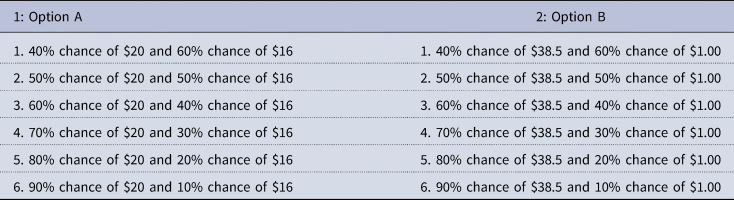
To test the influences of individuals' differences in their decisions, we also measured the participants' risk preference. After the participants completed all the experiment procedures, the computer system asked them to make six decisions about lottery outcomes to elicit their risk preference developed by Holt and Laury (Reference Holt and Laury2002). As shown in Table 2, each decision consisted of choosing either a relatively safe option, A, or a relatively risky option, B, and the possibilities of each lottery outcome were carefully manipulated so that the risky choice involved progressively higher expected earnings than the safe choices. The switching points of each participant were recorded and reversed as the participants' risk preference measurement. We also conducted ANOVA tests to ensure that this measurement of risk preference was not influenced by self-affirmation (F (1, 85) = .23, n.s.) and different kinds of identity threats (F (1, 85) = 1.31, n.s.).
Lottery choice questions for measuring risk preference (Study 2)

Results
Manipulation check
We first asked the participants whether they believed that their results would be confidential or publicized to check the manipulation of publicness of identity threat. All the participants passed this check. We used the same method to check the self-affirmation manipulation as in study 1. Half of the participants were told to write a story about their campus lives following the instruction, ‘Now, close your eyes and picture something in your campus lives, tell a story about it’ as a relaxing task immediately after the self-affirmation manipulation. Following the previous process, we used the number of positive affect-related words to ensure manipulations. As expected, half of the participants in the self-affirmation condition tended to have more positive affect (M = 4.23, SD = 2.75) than those in the non-affirmation condition (M = 2.93, SD = 2.18), (t (84) = − 2.43, p < .05).
Unethical behavior
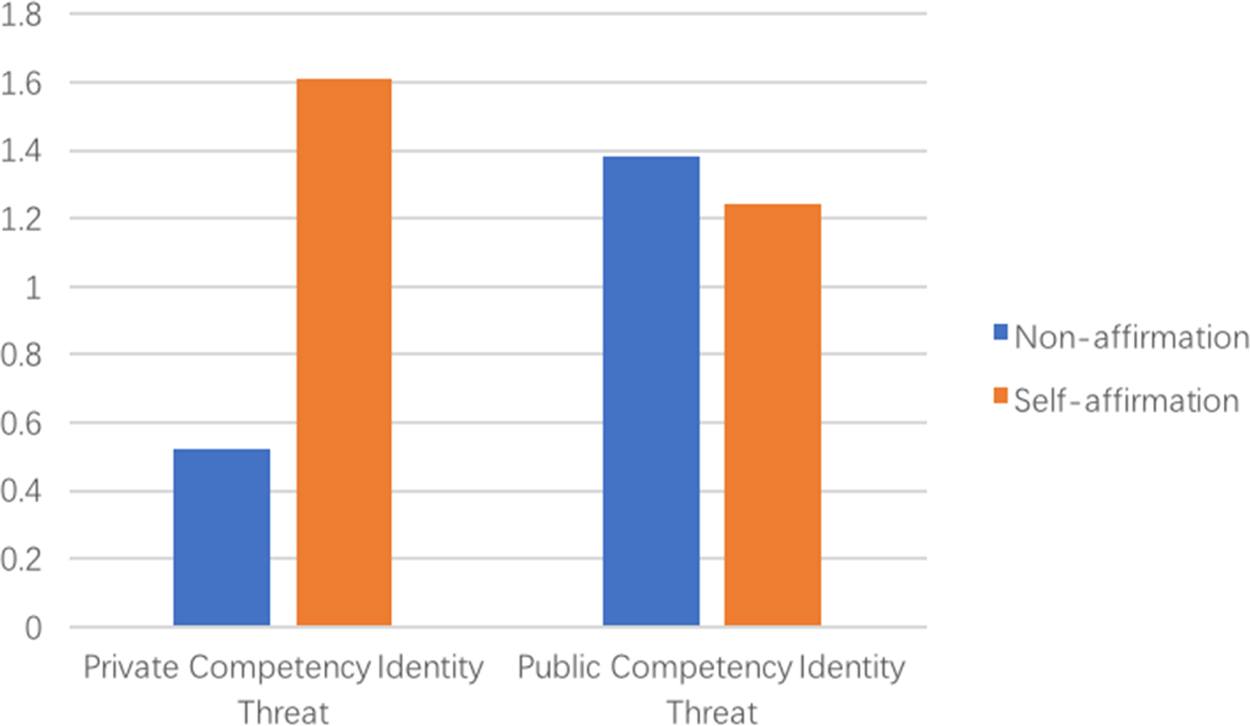
A 2 (self-affirmation or non-affirmation) by 2 (identity threat or identity threat) ANOVA revealed a significant interactive effect of self-affirmation and different kinds of identity threats (F (1, 82) = 5.12, p < .05). Therefore, hypothesis 3 was supported in this study. Hypothesis 2 predicted that participants under private identity threat would tend to exhibit more unethical behaviors under the self-affirmation condition. A pairwise t-test revealed significant differences between the two conditions (t (78) = 2.76, p < .01). Half of the participants tended to cheat under private identity threat (M = .52, SD = .81) compared with those in the self-affirmation condition (M = 1.61, SD = 2.25). Hypothesis 2 predicted that participants under public identity threat would tend to exhibit more unethical behavior than in the self-affirmation condition. However, although the pattern was correct, the result did not approach a significant level (public threat: M = 1.38, SD = 1.83; self-affirmation: M = .86, SD = 1.24; t (78) = 1.31, n.s.) (see Figure 2). Moreover, the post hoc test of analysis showed the difference between the public and private identity threat condition in the non-affirmation condition (t (40) = 1.86, p = .057), which also supported the restraining effect of private identity threat.
The unethical behavior in different conditions (Study 2)

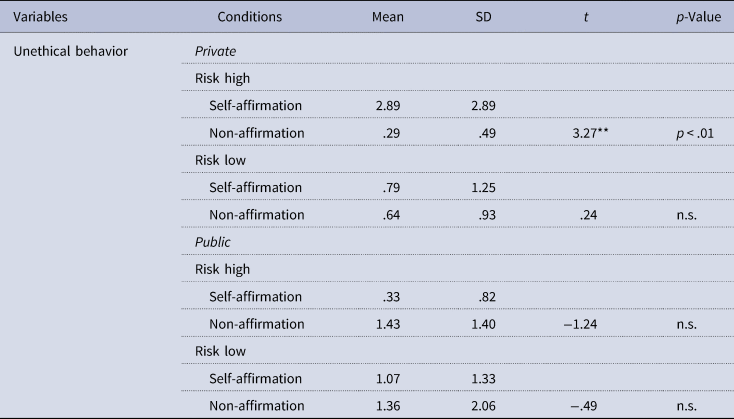
We conducted some complimentary analyses and found the moderating effect of individuals' risk preference. The 2 (self-affirmation or non-affirmation) by 2 (private identity threat or public identity threat) by 2 (high risk preference or low risk preference) ANOVA revealed the existence of a three-way interaction among self-affirmation, identity threat, and risk preference (F (3, 79) = 5.13, p < .01). In this three-way interaction, under the private identity threat condition, the participants' risk preference strengthened the effect of self-affirmation on unethical behavior. We categorized the risk preference as ‘1’ under the high risk preference condition and ‘0’ under the low risk preference condition at the benchmark of its mean value. In the private identity threat condition, the participants with high risk preference in the self-affirmation condition (M = 2.89, SD = 2.89) cheated significantly more than those in the non-affirmation condition (M = .29, SD = .49; t (78) = 3.27, p < .01). However, in the low risk preference condition, there was no significant difference between the self-affirmation condition (M = .79, SD = 1.25) and the non-affirmation condition after private identity threat (M = .64, SD = .93; t (78) = .24, n.s.). However, under the public identity threat condition, the effects of self-affirmation on unethical behavior were not significant in either the high (M = .33, SD = .82; M = 1.43, SD = 1.40; t (78) = − 1.24, n.s.) or the low risk preference condition (M = 1.07, SD = 1.33; M = 1.36, SD = 2.06; t (78) = − .49, n.s.) (see Table 3 and Figure 2).
Means and comparison tests for the variables assessed by condition (Study 2)

Note: Private: private identity threat, Public: public identity threat; Risk high: high risk preference, Risk low: low risk preference.
**p ≤ .01.
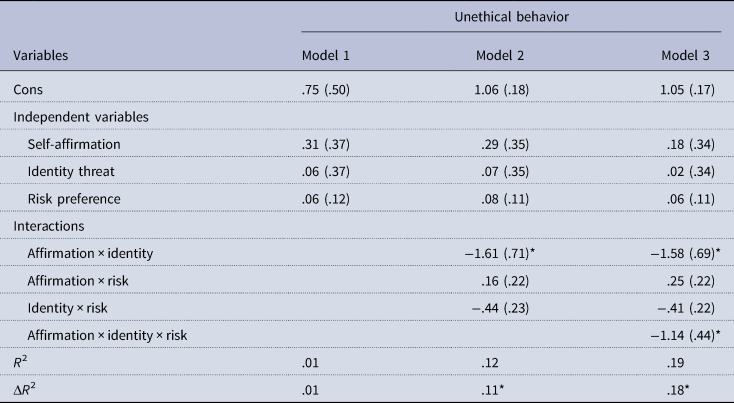
We also conducted hierarchical ordinary least-squares (OLS) regression analyses to test the three-way interaction. We followed traditional regression procedures recommended by Aiken and West (Reference Aiken and West1991), entering self-affirmation (coded as dummy variables), identity threat (coded as dummy variables), and risk preference (coded as continuance variable, centralized) in Model 2, their two-way interactions in Model 3, and their three-way interaction in Model 4. The results of our regression analyses are displayed in Table 4. The interaction between self-affirmation and publicness of identity threat significantly predicted unethical behavior (β = − 1.58, p < .05), which supported hypothesis 3, and the interaction among self-affirmation, identity threat, and risk preference (centralized) also approached a significant level (β = − 1.14, p < .05).
The results of the OLS model (Study 2)

Note: N = 86; self-affirmation = 1 for self-affirmation group, = 0 for non-affirmation groups; identity threat = 1 for public identity group, = 0 for identity groups; gender = 1 for female, = 0 for male.
*p ≤ .05, **p ≤ .01.
Discussion
In this study, we extended our study 1 and validated the contingencies of the relationships between identity threat and unethical behavior. We found a significant interactive effect of identity threat and self-affirmation on the participants' unethical behavior, while this effect was contingent on the publicness of the identity threat. We also demonstrated a three-way interaction of the participants' risk preference in facilitating the positive and negative relationships between identity threat and unethical behavior, which further verified the effect of individual differences.
General Discussion
In the current study, we articulate a different story by declaring identity threat a double-edged sword for unethical behavior based on the theory of identity threat and self-affirmation theory with two studies. The results of our study contribute to the literature on both identity threat and self-affirmation theory.
Theoretical contributions
First, the current study proposes and validates that identity threat acts as a double-edged sword that can both increase individuals' unethical behavior as defensive responses to public identity threat and reduce their unethical behavior when their threatened identity is inherently private. Our findings combine previous theoretical streams by arguing that although cheating can act as a deceptive strategy to buffer temporal threats to individuals' identity in others' eyes, increasing their own competency is the only way for them to maintain identity in their own eyes (Cohen & Sherman, Reference Cohen and Sherman2014; Leary & Baumeister, Reference Leary and Baumeister2000; Steele, Reference Steele1988). More theoretical evidence supporting our arguments can also be derived from research on the effects of other morally incompatible identity (Galperin, Bennett, & Aquino, Reference Galperin, Bennett and Aquino2011), while we provide empirical evidence to confirm this effect in experimental settings. Our study raises serious concerns about the actual effects of different kinds of identity threats and provides supplementary supporting evidence of individuals' value or goal system underlying a global identity system in an experimental design. Therefore, our findings provide a new perspective on identity threat theory by incorporating public and private aspects of individuals' identity systems (Aquino & Reed, Reference Aquino and Reed2002).
Second, the current study provides new insights into self-affirmation theory by suggesting that self-affirmation can also backfire by identifying negative influences of affirming other kinds of identities, which may not be in accordance with prior findings on the theory of self-affirmation (Steele, Reference Steele1988). Some previous studies find that affirming currently threatened identities other than alternative ones could actually enhance the escalation of commitment because attempts at self-affirmation at this time will magnify the perceived severity of the failures and strengthen individuals' motives to justify their previous bad decisions (Arndt & Greenberg, Reference Arndt and Greenberg1999; Aronson, Blanton, & Cooper, Reference Aronson, Blanton and Cooper1995; Sivanathan, Molden, Galinsky, & Ku, Reference Sivanathan, Molden, Galinsky and Ku2008). Our study suggests that even affirming positive traits, abilities, or values in task-irrelevant domains can backfire. We demonstrate that when encountering identity threat, individuals' unethical intent or actual unethical behavior is contingent on the type of publicness of such threat. Specifically, when the motive activated by the threatened identity is from the private sphere, self-affirmation tends to show its ‘dark side’ by eliminating the positive effect of that specific identity.
Third, our results illustrate that personal and situational factors additively influence individuals' affirmation processes and actual workplace behaviors. This finding of the moderating role of risk preference also contributes to self-affirmation theory. Our study identifies a critical individual difference other than self-esteem (Sivanathan et al., Reference Sivanathan, Molden, Galinsky and Ku2008) in self-affirmation processes. As previous studies propose that affirming global self-integrity broadens individuals' perspectives, one possible explanation regarding our results might be that individuals with high risk preference tend to have a broader field of vision, which makes them more easily affirmed. Risk preference represents an attitude orientation that anchors whether individuals will take high risks to receive more rewards (Sitkin & Pablo, Reference Sitkin and Pablo1992). Individuals with high risk preference hold more objective attitudes towards uncertainty and have more courage to make risky decisions. Thus, those with high risk preference may find it easier to assimilate more perspectives. Additionally, the current study may create an opportunity for future research to investigate the function of individuals' risk preference in self-affirmation processes in more research settings.
Practical implications
The current study also has some important practical implications. First, we raise an important concern for managers on the detrimental influences of identity threat. As the results show, threats to individuals' public identity may make individuals more likely to engage in unethical behavior to maintain a good impression, but if they are affirmed in task-irrelevant identities, their unethical behaviors will then decrease. In the workplace, managers can take advantage of this logic and try to pacify dissatisfied individuals in alternative places; this may help individuals calm down and reduce their fiercely defensive behaviors. However, for threats related to the private sphere of identity, in workplaces that exclude interpersonal comparisons, these threats actually help people bravely face the threats to some extent because these identity threats can only be defended by ethical attitudes and behaviors. Self-affirmation may not be a good choice because it may reduce the self-importance of being ethical in this condition. Therefore, we suggest managers use appropriate strategies to relieve individuals' defensive attitudes towards different kinds of identity threats, and self-affirmation will not always be a good choice for them.
We also highlight individuals' individual differences: risk preference as a critical factor that determines whether individuals are easily affirmed. We suggest that managers should assess the organizational environment to determine whether they should recruit individuals with high risk preference because high risk preference also has two sides in our study. That is, when individuals' main aim is to maintain good identity images, high risk preference leads them to efficiently separate themselves from meaningless comparisons. When their main aim is to prove their own competency, high risk preference may otherwise induce them to more easily disengage from their self-condemnation systems. Managers must clearly analyze the environment and identify potential identity threats that individuals may encounter from daily work in organizations. The characteristics of different identity threats determine whether managers can identify individuals' alternative strengths, values or beliefs to help them.
Limitations and future directions
Some limitations are inevitable in our research. First, the intermediate mechanisms should also be emphasized in future research. In fact, scholars have tried to investigate whether expectation, trivialization, positive mood, moral disengagement, internal or external attribution, and regulatory focus could function as potential mediators in the relationship between self-affirmation and unethical behavior based on established theory (Koole et al., Reference Koole, Smeets, Van Knippenberg and Dijksterhuis1999; Sherman & Cohen, Reference Sherman and Cohen2006). However, all the variables we measured appeared to decline in the current study. A recent study on self-affirmation suggests that individuals who are affirmed tend to broaden their construal towards the focal events and prevent daily adversity as threat (Sherman et al., Reference Sherman, Hartson, Binning, Purdie-Vaughns, Garcia, Taborsky-Barba and Cohen2013); we call for more research to investigate whether these psychological factors could help explain the mechanisms through which self-affirmation impacts their unethical behavior. Specifically, more publicness-relevant mediators should be considered. For example, impression management motives can be aroused when public identity is threatened, while self-enhancement motives will be activated when private identity is threatened. Thus, more publicness-relevant mediators may mediate the relationship between identity threat and some kinds of unethical behavior.
Second, Aquino and his colleagues propose that moral identity can function through different angles: moral internalization, which refers to the degree to which moral traits are central to individuals' self-concept, and symbolization, which is the degree to which moral traits are reflected in individuals' actions in the world (Aquino & Reed, Reference Aquino and Reed2002). As we used the announcement of the participants' experimental results as a threat to their public competent identity, this manipulation may also have aroused the participants' identity in their own eyes at the same time we aroused their public competent identity. According to our arguments, these two sources of identity threat should be clearly differentiated and manipulated. Future studies could focus on using purer manipulations to identify the different effects of these two identity threats.
Third, there is an alternative explanation for the effect of self-affirmation on individuals' unethical behavior. The moral licensing view (Klotz & Bolino, Reference Klotz and Bolino2013; Sachdeva, Iliev, & Medin, Reference Sachdeva, Iliev and Medin2009) refers to a theoretical perspective indicating that when people engage in morally praiseworthy behaviors, they grant themselves a moral license to behave immorally in the future. In our study, self-affirmation may make individuals feel positive about themselves and grant them a license to behave immorally after affirmation. This view may also explain why we do not find differences between the self-affirmation and non-affirmation conditions under public identity threat. That is, the moral licensing effect may neutralize the reducing effect of self-affirmation under the public condition.
Finally, since we conducted this study in China, cultural differences should be considered when testing hypotheses. For example, in China, the ‘losing face’ problem may also influence our results. Scholars have indicated that the Chinese face consists of a moral face, which refers to society's focus on the integrity of an individual's moral character (Zhang, Cao, & Grigoriou, Reference Zhang, Cao and Grigoriou2011). Therefore, future studies should integrate or at least control for ‘losing face’ when investigating impression management and unethical behavior.
Conclusion
The current study indicates that publicness of identity threat determines whether such threat will lead to more unethical behaviors. We posit this argument because not all kinds of identity threats are detrimental for individuals, especially when they are underlain with inherently moral motives. In conclusion, identity threat may serve as a double-edged sword that can both increase and reduce individuals' unethical behavior in the workplace. The ‘dark side’ of self-affirmation is also found in our study. When self-affirmation reduces the importance of maintaining a morally compatible identity, individuals can more easily rationalize and justify their unethical behavior.
Financial support
The authors acknowledge funding support from the National Natural Science Foundation of China (71232003 and 71573147).