Introduction
Members of the genus Lecanora, as currently recognized, are mainly characterized by their lecanorine apothecia and a crustose or rarely placodioid thallus. Sexual reproduction predominates but vegetative reproduction by soredia is also quite common. Sorediate European species usually have a crustose thallus; leprose (e.g. L. expallens, L. rouxii) and placodioid (only in saxicolous L. lisbonensis and L. lojkaeana) growth forms are rare. Soralia vary from small delimited ones (e.g. L. exspersa, L. impudens) to those covering almost the entire thallus (e.g. L. barkmaniana, L. thysanophora). It is difficult to identify many predominantly sterile species and thus chemotaxonomic methods, mainly spot tests or thin-layer chromatography, are necessary for their correct identification (e.g. Brodo et al. Reference Brodo, Owe-Larsson and Lumbsch1994; Malíček Reference Malíček2014; Zduńczyk & Kukwa Reference Zahlbruckner2014).
This study focuses on sorediate taxa occurring on tree bark or wood which contain atranorin and/or chloratranorin as a major secondary metabolite. Some sterile specimens cannot be unambiguously identified without DNA sequence data due to the large within-species variabilities and a limited number of phenotypic characters. In contrast, our sequence data of mtSSU and ITS loci did not distinguish some closely related species that we still regard as ‘good species’ with respect to their differences in anatomical, chemical and ecological characters.
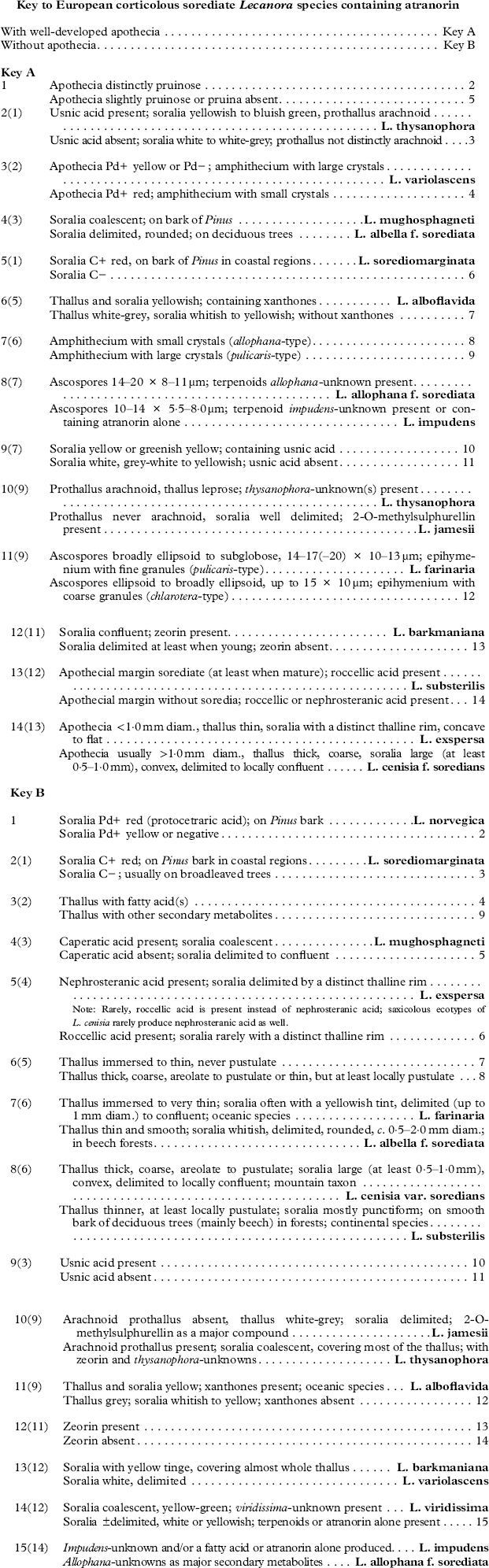
During our research on forest lichen diversity in Central Europe in recent years, several unidentified sorediate crusts have been collected, some of which could belong to new taxa of Lecanora or to new chemotypes (e.g. with gangaleoidin) of already known species. One crust collected at several localities, which was proved by DNA sequence data to be Lecanora, was distinctive and is described here as new. Five other taxa are treated in detail, the others are briefly commented upon. Identification keys (for specimens with apothecia and for sterile specimens) to all 16 species known from Europe are provided. Generally, this group of lichens is taxonomically very difficult, and detailed TLC and DNA analyses are recommended for correct identifications.
Material and Methods
This study is based on material collected by the authors and deposited either in private or public herbaria (FB: hb. F. Berger, JM: hb. J. Malíček, PRA). In addition, other specimens, including type material, were studied in B, BG, BM, BRA, E (collections of B. J. Coppins), GZU, H, L, M, PRA (collections of Z. Palice and J. Vondrák), PRA-V, S, SZU and UPS. Type material of Lecanora farinaria and L. inversa was examined only via JStor Global Plants.
Anatomical and chemical examination
Microscopic descriptions are based on hand-cut sections mounted in water. The solubility of epihymenial crystals was studied in 50% HNO3. The amphithecium and apothecial cortex were observed in KOH. Crystals and granules in apothecia were observed in polarized light (POL). For the terminology of anatomical characters, the work of Brodo (Reference Brodo1984) was followed. Thin-layer chromatography (TLC), with a few minor modifications, followed the methods of Orange et al. (Reference Orange, James and White2010). Lichen compounds were applied on a set of three glass plates and placed into A, B' and C solvents. The distance between starting and finishing lines was c. 100 mm. Two or three drops (according to the quantity of tested material) of acetone were added to each test tube. Fatty acids were detected by dipping each of these plates into water tanks. Chloratranorin was not distinguished from atranorin by TLC; their mutual presence is constant in all involved species but this is not repeated in species descriptions. Five samples extracted in methanol were analyzed by LC-MS (liquid chromatography and mass spectrometry), following the methods of Valný et al. (Reference Urbanavichus2016) with a few modifications: the analyses were performed under a linear gradient program (min/%B) 0/5, 1·5/5, 12·5/58 followed by a 1·5-min column clean-up (100% B) and 1·5 min equilibration (5% B). The total analysis time was 20 min.
DNA extraction, amplification and sequencing
Initially, simple NaOH extraction (Werner et al. Reference Vondrák, Malíček, Šoun and Pouska2002) was used for DNA isolations. This is recommended for quick isolations of non-problematic loci, for example nrITS and mtSSU regions in some richly fertile taxa (L. argentata, L. chlarotera) or very fresh material. Thereafter, Invisorb Spin Plant Mini Kit (Invitek) and CTAB protocol (Cubero et al. Reference Cubero, Crespo, Fatehi and Bridge1999) were used with better results. The fungal nuclear ITS region and mitochondrial SSU were amplified with the following primers: ITS1F (Gardes & Bruns Reference Gardes and Bruns1993) and ITS4 (White et al. Reference Werner, Ros and Guerra1990), mrSSU1, mrSSU2 and mrSSU3R (Zoller et al. Reference Zedda1999). We also tested nuclear IGS, Mcm7, LSU, SSU and protein-coding β-tubulin, RPB2 and TEF; these were used mainly in problematic sterile samples where no or only one-locus data were available. However, the amplification was unsuccessful in almost all cases.
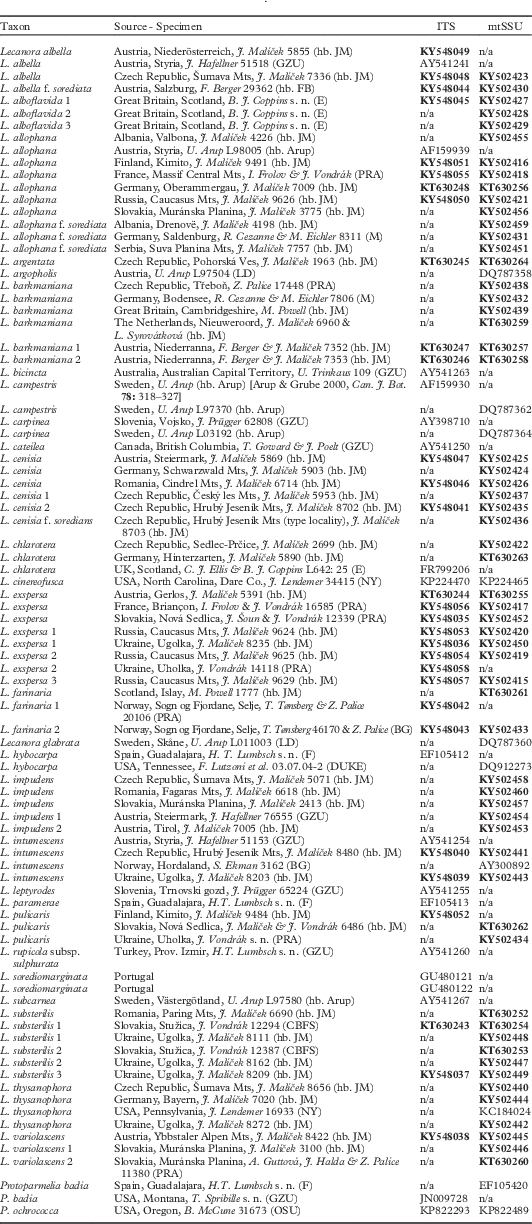
PCR reactions of nrITS and mtSSU were prepared for a 20 µl final volume containing 14 µl of double-distilled water, 4 µl MyTaq polymerase reaction buffer, 0·2 µl MyTaq DNA polymerase, 0·4 µl of each of the 25 mM primers and 1 µl of the sample. Amplifications of both loci consisted of an initial 1 min denaturation at 95 °C, followed by 35 cycles of 1 min at 95 °C, 1 min at 55–56 °C, 1 min at 72 °C, and a final extension of 7 min at 72 °C. The PCR products were quantified on a 0·8% agarose gel stained with ethidium bromide and cleaned with GenElute PCR Clean-Up Kit (Sigma), according to the manufacturer’s protocols, or with the sodium acetate/ethanol purification method. In total, 30 new nuclear ITS and 60 mtSSU sequences were generated (Table 1).
GenBank Accession numbers and voucher information for sequenced specimens used in this paper. Sequences in bold are newly produced

n/a = data not available
Unfortunately, we were unable to obtain sequences from five species due to the lack of fresh material (L. viridissima, epiphytic L. cenisia f. soredians) and difficulties with gene amplification (L. jamesii, L. mughosphagneti, L. norvegica). Acquiring sequences of many sterile species was very problematic and often had limited success. For example, the ITS region from L. impudens, L. thysanophora and L. allophana f. sorediata was unsuccessfully amplified in all attempts, despite employing various troubleshooting methods (touch-down PCR, nested PCR, tuning PCR settings, application of specific primers etc.). It was also necessary to use only a short mtSSU region (SSU2×SSU3R) of c. 400 BP in many cases because it had higher efficiency than a long one (SSU1×SSU3R) of c. 700 BP. Some species (L. allophana f. sorediata, L. farinaria) are represented only by one or two sequences due to a limited amount of fresh material and the amplification problems discussed above.
Alignment and phylogenetic analysis
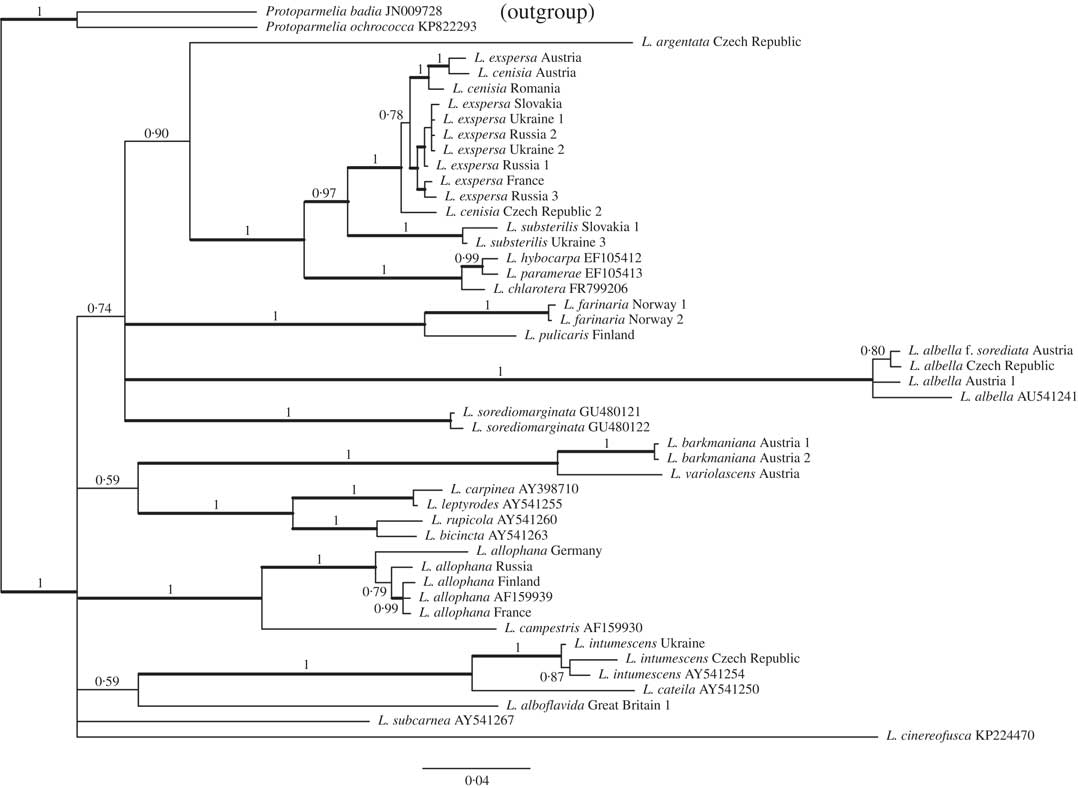
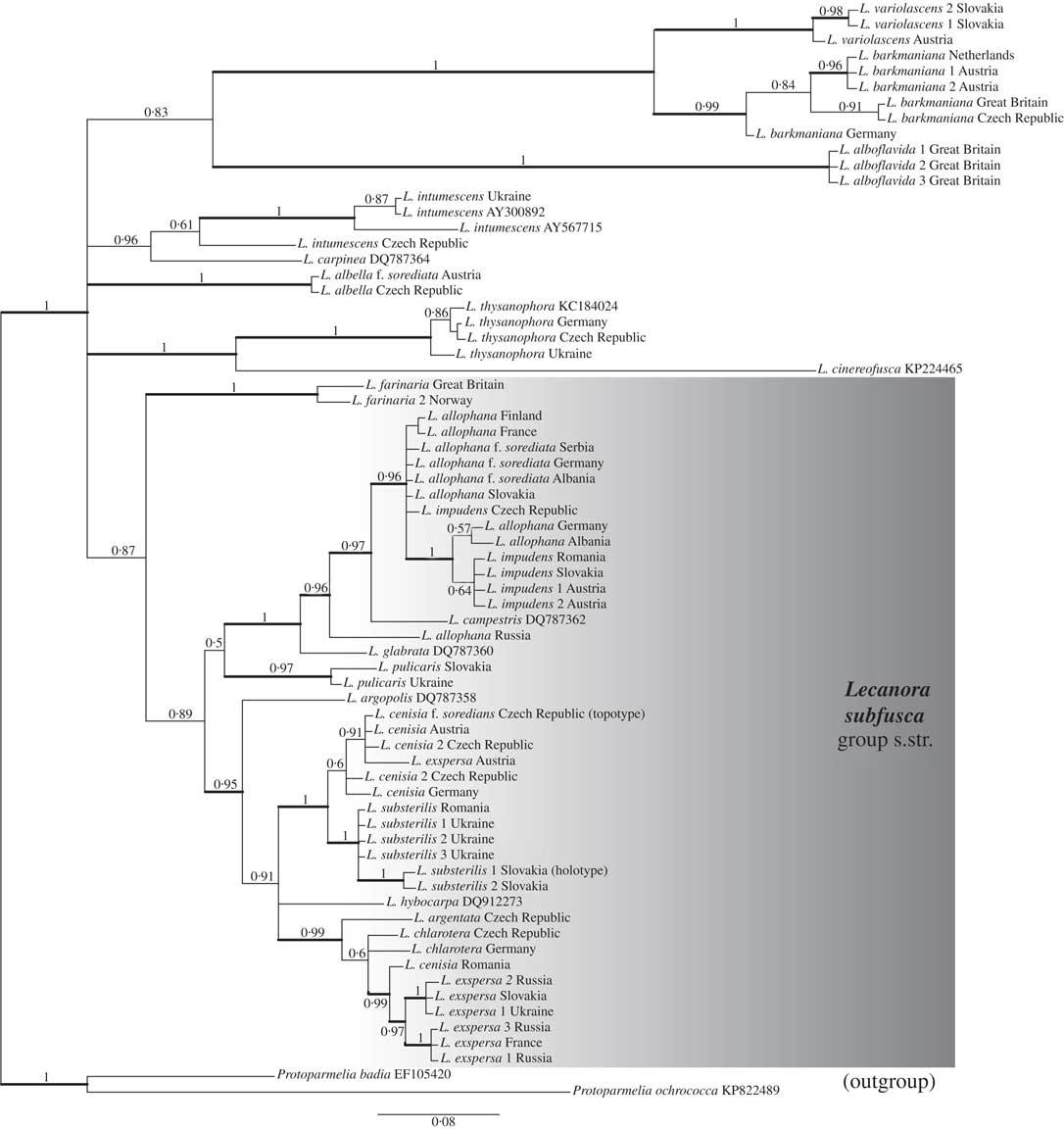
Sequences were edited in BioEdit 7.2.5 free software (Hall Reference Hall1999) and then aligned by the online application MAFFT version 7 (Katoh & Standley Reference Katoh and Standley2013) with L-INS-i method (Katoh et al. Reference Katoh, Kuma, Toh and Miyata2005). The alignments were manually revised. The final ITS alignment contained 613 positions and 48 sequences; the mtSSU alignment had 895 positions and 70 sequences. Gaps were coded in SeqState by simple coding (Simmons & Ochoterena Reference Simmons and Ochoterena2000). Molecular phylogenies were reconstructed by Bayesian inference as incorporated in MrBayes 3.1.2 (Huelsenbeck & Ronquist Reference Huelsenbeck and Ronquist2001; Ronquist & Huelsenbeck Reference Ronquist and Huelsenbeck2003). The Kimura 2-parameter model using a gamma shaped distribution and proportion of invariant sites (K2P+G+I) was suggested as the best DNA substitution model for ITS, and the Hasegawa-Kishino-Yano model using a gamma shaped distribution and proportion of invariant sites (HKY+G+I) for mtSSU. This was evaluated with the help of the program Modeltest (Posada & Crandall Reference Posada and Crandall1998). Each analysis was performed using a run with four MCMC chains. Trees were sampled after every 500th generation. Analyses were stopped when the average standard deviation of split frequencies between the simultaneous chains was <0·01. To eliminate trees sampled before reaching apparent stationarity, the first 25% of entries was discarded as burn-in and the rest were used to compute majority-rule consensus, where the relative occurrences of nodes are identified with Bayesian posterior probabilities (Figs 1 & 2). Final trees were modified in Adobe Illustrator CS3.
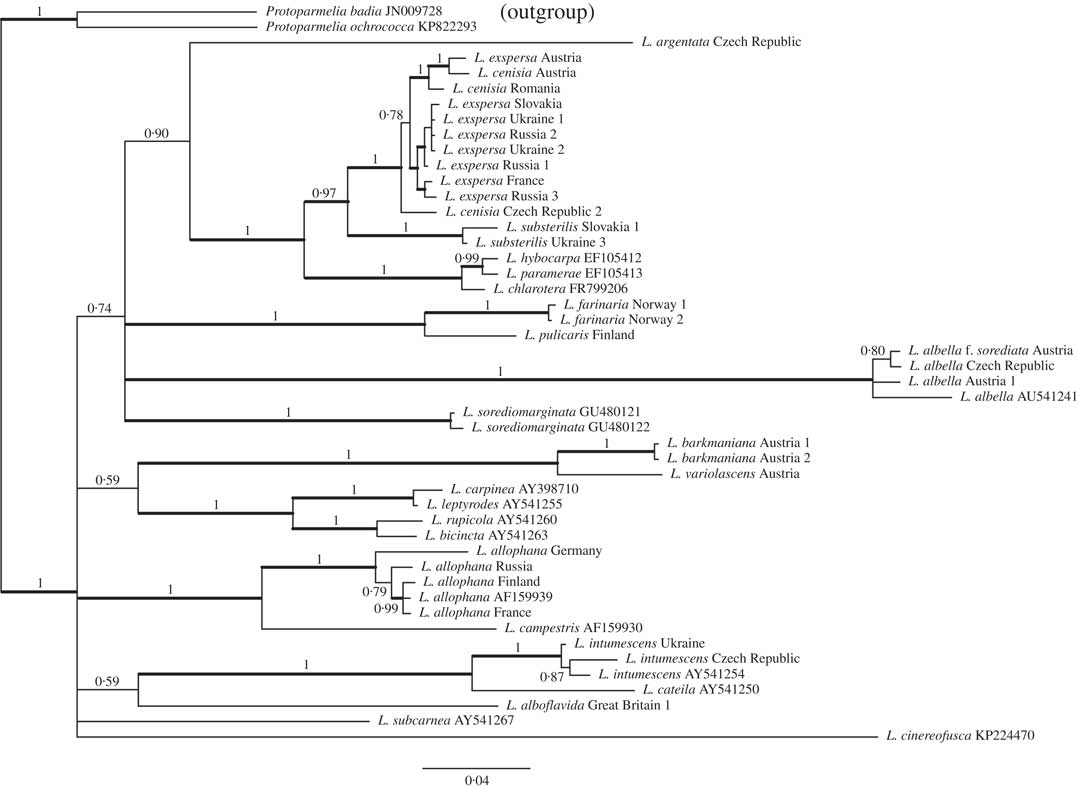
Bayesian phylogenetic reconstruction (75% majority-rule consensus) of the nrITS showing positions of sorediate epiphytic Lecanora specimens containing atranorin. Branches with >0·95 Bayesian posterior probability values are indicated by thicker lines.
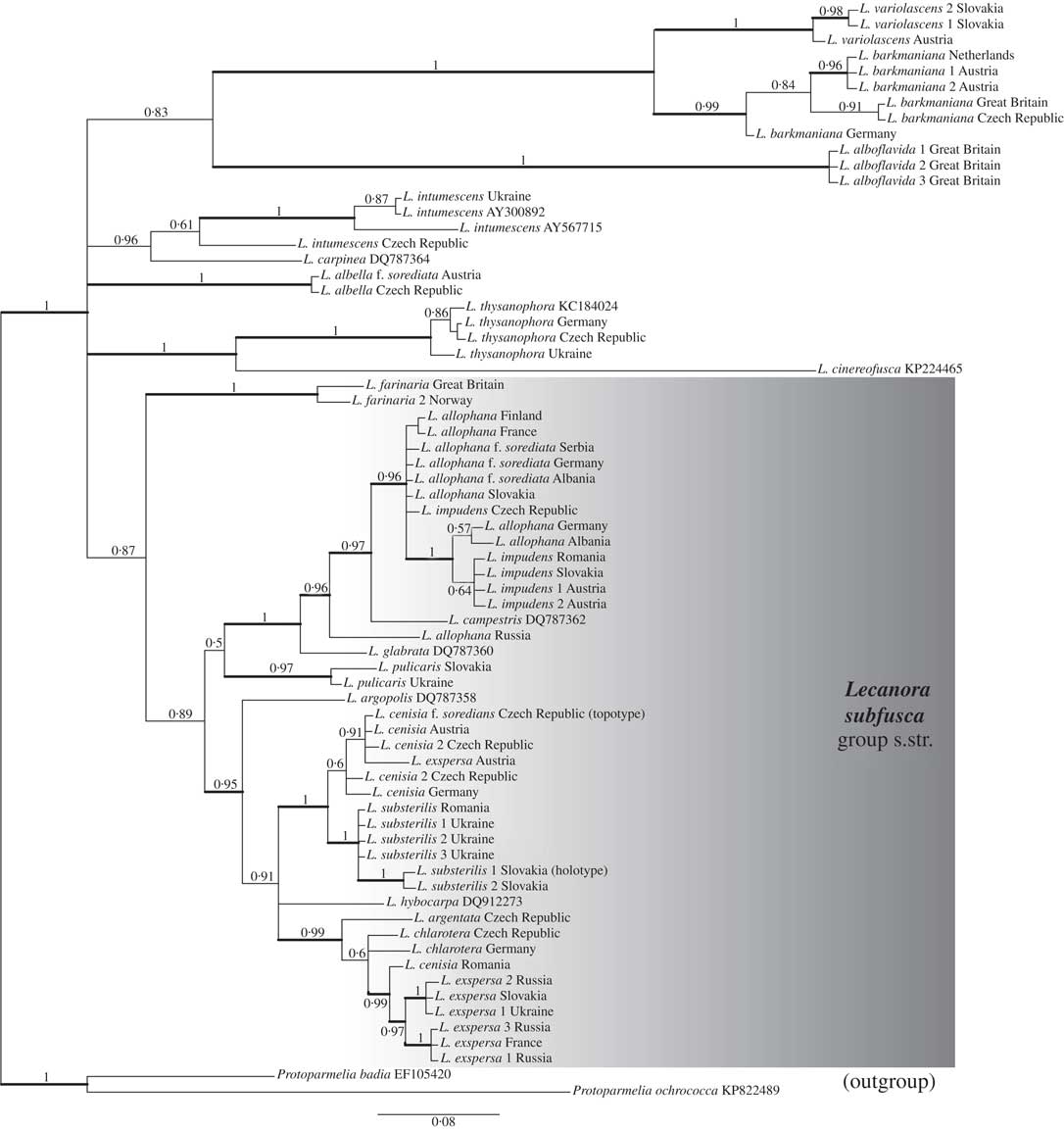
Bayesian phylogenetic reconstruction (75% majority-rule consensus) of the mitochondrial SSU showing positions of sorediate epiphytic Lecanora specimens containing atranorin. Branches with >0·95 Bayesian posterior probability values are indicated by thicker lines.
Results and Discussion
Phylogeny
Nuclear ITS and mitochondrial SSU trees are presented separately because of the gapped sequence dataset (see Table 1). As expected, the ITS region was more variable than the mtSSU. Almost all species were represented by highly supported clades but phylogeny at higher taxonomic levels remained unresolved in both loci.
According to ITS, members of the Lecanora subfusca group in its strict sense (Brodo Reference Brodo1984) were placed into four clades: 1) with small amphithecial crystals and terpenoids represented by L. allophana and L. campestris; 2) with large amphithecial crystals and fatty acids or gangaleoidin chemosyndrome; 3) the clade of L. farinaria and L. pulicaris; and 4) the clade of L. cinereofusca (Fig. 1).
MtSSU phylogeny indicated a monophyly of the L. subfusca group, except for an unrelated species, L. cinerefusca (Fig. 2). Species with small and large amphithecial crystals were again distinguished; consequently L. farinaria and L. pulicaris formed isolated clades. Due to a lower variability of this region, some closely related species were not separated from each other (e.g. L. cenisia and L. exspersa) although they differ markedly in many characters.
Species
Lecanora albella f. sorediata (Schaer.) H. Olivier
Expo. Syst. Descr. Lich. Ouest Fr. 1: 277 (1897)—Lecanora pallida f. sorediata Schaer., Enum. critic. lich. europ. (Bern): 78 (1850); type: not seen.
Lecanora albella is characterized by strongly pruinose apothecia and the presence of protocetraric acid in the apothecia giving a distinct Pd+ red reaction. The sorediate form is characterized by greenish, rounded, flat to convex, well-delimited soralia of c. 0·5–2·0 mm diam. and a smooth and thin thallus. Soralia and thallus contain roccellic acid. In the ITS and mtSSU phylogenetic reconstructions, sorediate and non-sorediate populations are closely related and collectively form supported clades distant from all other species included (Figs 1 & 2). The species prefers old-growth beech forests but it is occasionally found on other phorophytes and in other forest types.
Specimens examined. Austria: Salzburg: Obersulzbachtal, 47°11'41''N, 12°15'43''E, alt. 1300 m, Alnus, 2015, F. Berger 29362 (hb. Berger).
Lecanora alboflavida Taylor
Fl. Hibern. 2: 260 (1836); type: not seen.
Lecanora inversa Nyl., Flora, Regensburg 62: 361 (1879)—Ochrolechia inversa (Nyl.) J. R. Laundon, Lichenologist 2: 130 (1963); type: [Ireland], on furze [Ulex europaeus], Finnihy River, Co. Kerry, [Taylor], (BM975547—lectotype?).
The species is characterized by the thick, smooth to more often pustulate thallus and rounded soralia which tend to be confluent later. Apothecia are rare and ascospores unknown. Based on anastomosing paraphyses, Laundon (Reference Laundon1963) transferred the species into the genus Ochrolechia. It produces xanthones (arthothelin, thiophaninic acid and sometimes others). Lecanora alboflavida has an isolated position among Lecanora species included in both trees (Figs 1 & 2). It is a very distinct taxon among the other sorediate Lecanora species containing atranorin due to its yellowish thallus and soralia that are UV+ as well as C+ orange. The thallus colour reflects the xanthone concentration and may vary from grey to yellow. It can be misidentified as saxicolous Pertusaria flavicans, which lacks atranorin, and Lecidella subviridis, which has a very similar chemistry but a much thinner thallus with usually confluent and never rounded soralia.
Lecanora alboflavida is a poorly known and very rare oceanic species. It occurs on acidic bark of old trees, rarely on slate and sandstone rocks. Most of its localities are known from the British Isles. It has also been reported from Norway, France and Macaronesia (Edwards et al. Reference Edwards, Aptroot, Hawksworth and James2009) but the material has not been examined. Nevertheless, the Norwegian record is absent from the checklist of Fennoscandian lichens (http://130.238.83.220/santesson/home).
The species was described from transition rocks (Taylor Reference Taylor1836). According to Laundon (Reference Laundon1963), Taylor’s only saxicolous specimen (i.e. the type) is in fact L. epanora. Therefore, the correct name should be Lecanora inversa, which was described by Nylander (Reference Nylander1879) based on Taylor’s epiphytic material. However, we follow the concept of British authors (Edwards et al. Reference Edwards, Aptroot, Hawksworth and James2009) because we haven’t yet studied Taylor’s collections.
Specimens examined. Great Britain: Scotland: V. C. 73, Kirkudbrightshire: Glen Trool, Caldons Wood, 55°4'36–39''N, 4°30'40–51''E, alt. 80 m, Betula and Quercus, 2016, B. J. Coppins (E, dupl. hb. JM).—Ireland: North Kerry: Cahnicaun Wood, Killarney Lakes, Quercus, 1982, P. W. James (BM); Derrycunihy, woods above Galway’s Bridge, 1982, P. W. James (BM).
Lecanora allophana f. sorediata Vain.
Medd. Soc. Fauna Flora Fenn. 3: 103 (1878); type: not seen.
The sorediate morphotype of L. allophana produces delimited, white to yellowish soralia but apothecia are frequently present as well. The sorediate form frequently accompanies non-sorediate populations. The presence of terpenoids allophana-unknowns distinguishes this species from all other European corticolous Lecanora. For a detailed description of the taxon and its chemical substances, see Tønsberg (1992) and Malíček (Reference Malíček2014).
The taxon strongly resembles L. impudens, which nests within the L. allophana clade in the mtSSU phylogeny (Fig. 2); an amplification of nrITS for the sorediate form was unsuccessful. However, the taxa differ in secondary metabolites and ascospore size, and we have tentatively kept them at the species level.
Selected specimens examined. Austria: Tirol: Heiterwang, 47°27'18''N, 10°45'32''E, alt. 980 m, 2014, Fraxinus excelsior, J. Malíček 7005 & 7006 (hb. JM).—Albania: Korcë County: Drenovë National Park, Korča [Korcë], 40°35'02''N, 20°50'43''E, alt. 1400 m, Populus tremula, 2011, J. Malíček 4198 & F. Bouda (hb. JM).—Germany: Bayern: Allgäu, am Bannwaldsee nördl. Füssen, 800 m, Fraxinus excelsior, 1956, An. & Ad. Schröppel & J. Poelt (PRA-V 14603). Niederbayern: Burganlage oberhalb von Saldenburg, alt. 560 m, Esche, 2011, R. Cezanne & M. Eichler 8311 (M).—Macedonia: Galichica National Park: Stenje, Mt. Magaro, 40°56'46''N, 20°52'16''E, alt. 1150 m, old Quercus cerris, 2014, J. Malíček 7964 (hb. JM).—Serbia: Suva Planina Mts: Sopotnica, 43°10'00''N, 22°08'59''E, alt. 690 m, old Quercus cerris, 2014, J. Malíček 7757 (hb. JM).—Slovakia: Muránska planina National Park, Cigánka Reserve, 48°45'34·8''N, 20°03'37·8''E, alt. 920–925 m, Acer pseudoplatanus, 2010, J. Malíček 3081 & Z. Palice 13483 et al. (hb. JM, PRA).
Lecanora barkmaniana Aptroot & Herk
As L. barkmaneana in Lichenologist 31: 3 (1999) [see orthographic correction in Lichenologist 31: 553 (1999)]; type: Netherlands, Prov. Friesland, De Blesse, 7 km south of Wolvega, 6°05'E, 52°50'N, young wayside Quercus robur, at the base of the trunk, C. M. van Herk 1996 (B—holotype; L 0064338—isotype!).
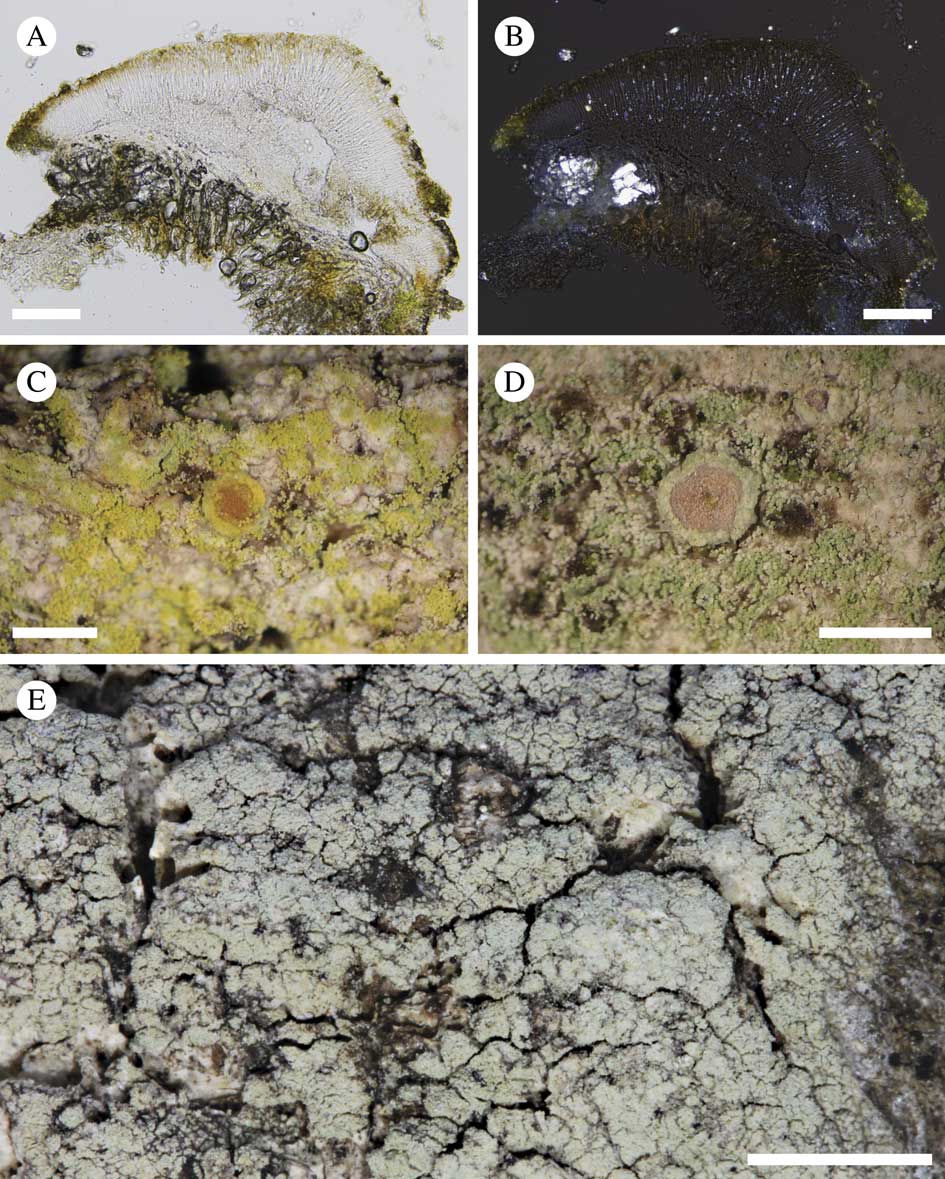
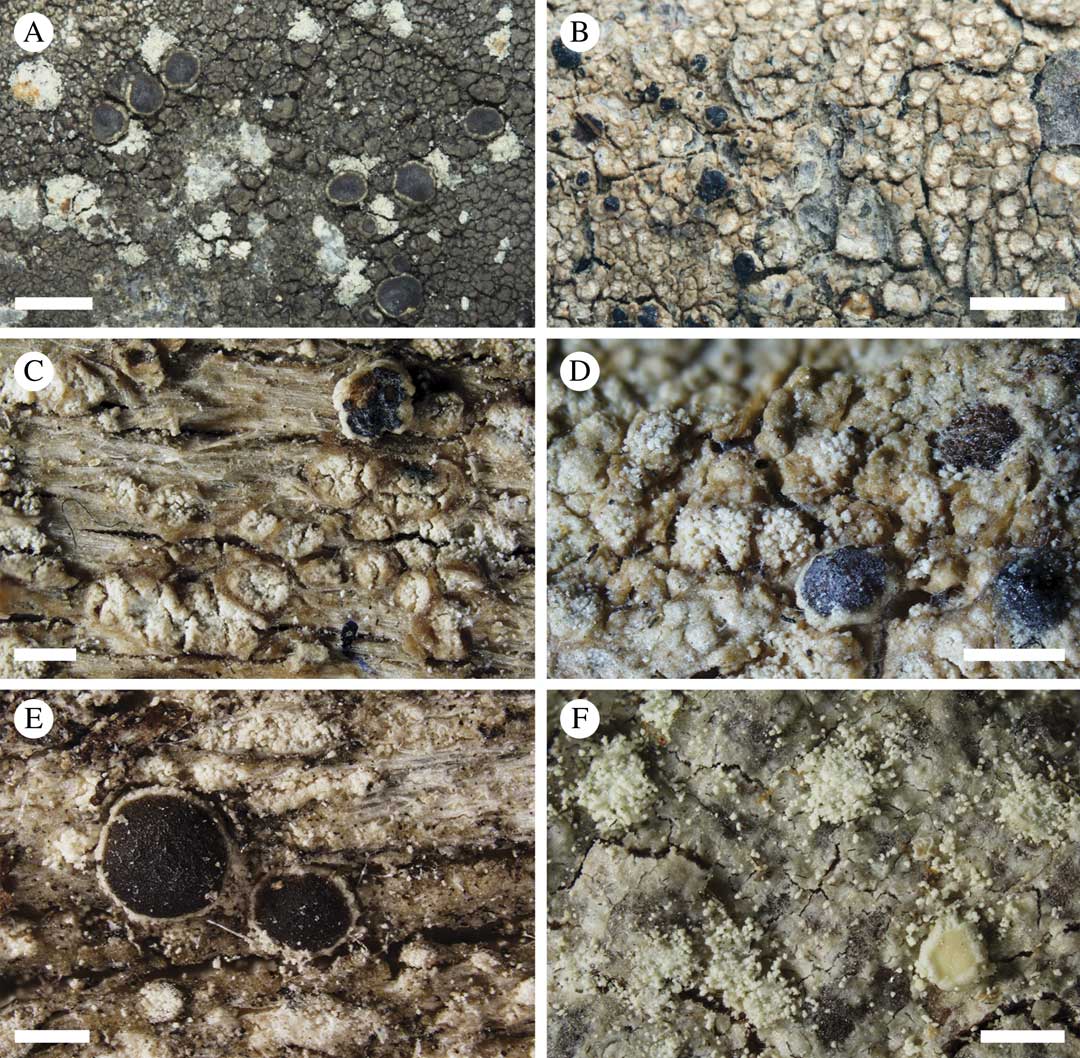
Habitus of Lecanora barkmaniana. A, apothecial section of the chemotype with pulvinic acid derivatives; B, the same in polarized light; C, apothecium with high concentration of pulvinic acid derivatives; D, Austrian collection without the yellow pigment; E, isotype of L. barkmaniana (L64338). Scales: A & B=100 μm; C & D=1 mm; E=1 cm. In colour online.
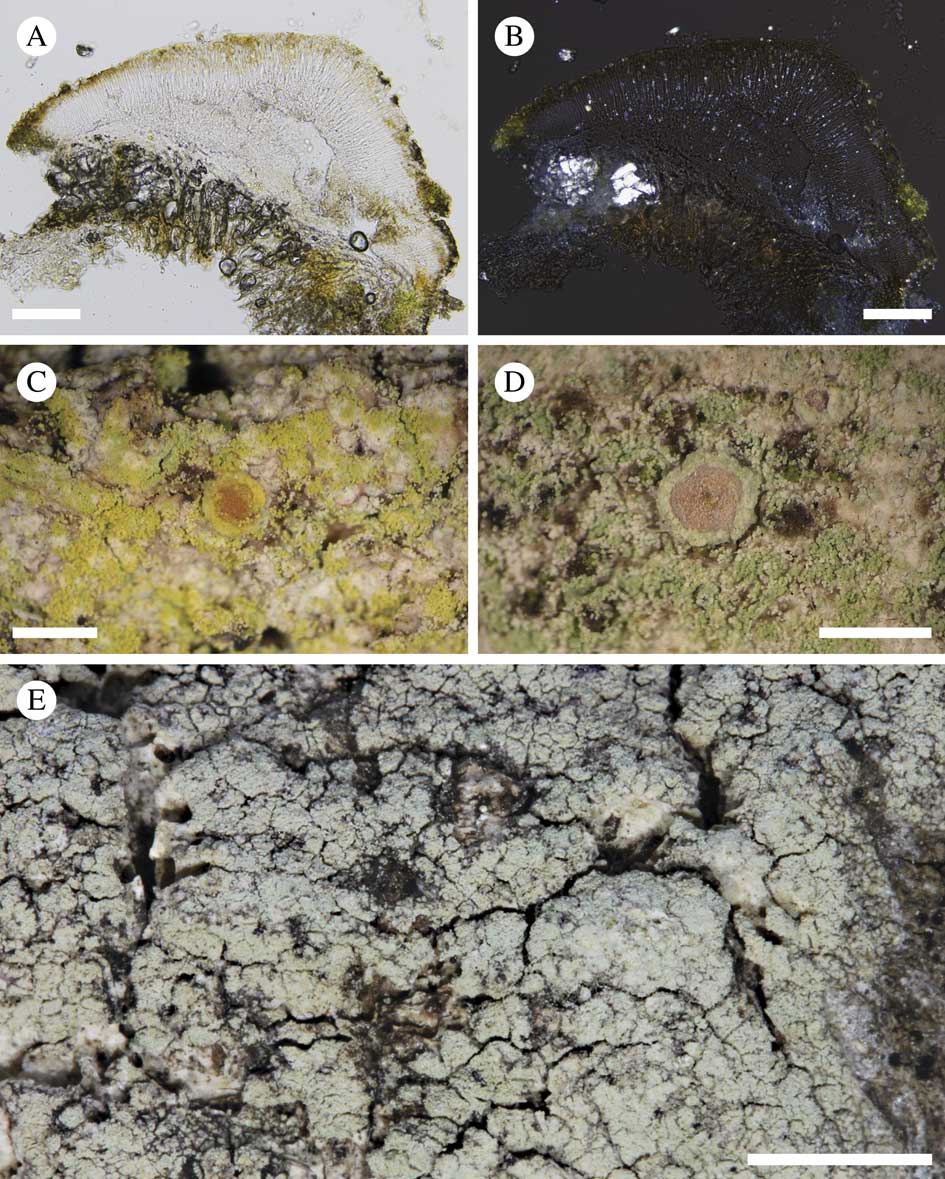
Thallus white to pale grey, matt, up to 8 cm diam. or exceptionally covering large areas, thin to rarely strongly verrucose or pustulose (up to 0·25 mm thick), pustules frequently fissured, filled by large calcium oxalate crystals (POL+); prothallus absent or indistinct, whitish grey, visible in some collections, especially from smooth bark; photobiont trebouxioud, cells globose to subglobose, 7–13 µm diam.; soralia more or less delimited when young, later confluent or forming a continuous leprose crust covering the whole thallus, but esorediate parts of the thallus remain visible at least in the marginal zone; soredia whitish grey with a yellow tinge, rarely greenish yellow to golden yellow, farinose, 25–35(–40) µm diam.
Apothecia rare, lecanorine, sessile, 0·5–0·9 mm diam.; margin slightly to strongly crenulate or flexuose, medium thick (c. 0·1 mm), grey to rarely yellow, often partly sorediate; discs yellow to pale brown, matt, usually with very small and scattered pruina-like granules.
Thalline exciple with numerous photobiont cells; amphithecium ±paraplectenchymatous, with large crystals, often forming clusters; cortex indistinct; hypothecium colourless, yellowish in K; hymenium colourless, 50–75 µm high, composed of unbranched paraphyses 1·5–2·0 µm thick, conglutinated, very slightly swollen at tips, K/I−; epihymenium with pale brownish granules (POL−), rarely with golden orange pigment and granules, granules at paraphyses tips, soluble or partly insoluble in K; asci Lecanora-type, 35–50×9–15 µm, 8-spored but usually fewer spores observed; ascospores simple, colourless, broadly ellipsoid to rarely subglobose, 12–15×8·5–10·0 µm.
Conidiomata unknown.
Chemistry. Atranorin, chloratranorin and zeorin as major substances (nine specimens including the isotype analyzed by TLC, two by LC). According to Aptroot & van Herk (Reference Aptroot and van Herk1999), atranorin was only a minor compound in their HPLC analysis; however, we detected comparable amounts of both substances. A new yellow chemotype with pulvinic acid complex is reported here from Austria (specimens marked by *). An unidentified yellow pigment (visible by TLC in solvents A, B' and C) is produced as a major compound, and a trace of calycin is visible in solvent C. Probably the pigment is closely related to pulvinic acid due to the presence of the two together in tested material of Candelariella species. This pulvinic acid derivative is characterized as a yellow spot (UV+ orange before heating) on TLC plates. In the B' solvent, the spot is below the level of pulvinic acid and in the same position as norstictic acid. The common chemotype of L. barkmaniana sometimes accompanies the yellow form in Austria. The pulvinic acid derivatives are often unevenly distributed on the thallus and apothecia: some parts are vivid lemon yellow, others have the normal tinge. Spot reactions of thallus and soralia: Pd− or Pd+ yellow (in the yellow chemotype), K+ yellow, C−, KC−, UV−.
Phylogeny. Based on ITS and mtSSU sequences, L. barkmaniana does not belong to the L. subfusca group in a narrow sense as suggested by Aptroot & van Herk (Reference Aptroot and van Herk1999), but forms an isolated clade with L. variolascens (Figs 1 & 2).
Ecology. In Western Europe, L. barkmaniana occurs mainly on wayside deciduous trees (e.g. Quercus robur), usually at eutrophicated sites (Aptroot & van Herk Reference Aptroot and van Herk1999). Central European localities are characterized by natural deciduous woodlands with, for example, Quercus robur, Alnus glutinosa and Fraxinus excelsior. The Austrian populations are concentrated mainly at the bottom of wind- and sun-protected river gorges; this area has c. 1000 mm of precipitation a year and an average annual temperature of c. 9 °C. These sites are interesting due to the occurrence of several species with suboceanic distributions (e.g. Coniocarpon cinnabarinum and Micarea coppinsii).
Distribution. The species has a subatlantic distribution, occurring mainly in Western Europe (Great Britain, Netherlands, Germany, France etc.). Scattered localities are reported here from Central Europe: Austria, the Czech Republic and Slovenia (see below). Surprisingly it does not occur in Scandinavia. A dubious record has been published from Korea (Kondratyuk et al. Reference Kondratyuk, Lökös, Tschabanenko, Haji-Moniri, Farkas, Wang, Oh and Hur2013). The yellow chemotype is known only from the Danube Valley and some of its tributaries in Upper Austria, very close to the north-western border with Germany in the Bayerischer Wald Foothills region.
Remarks. Despite resembling several other sorediate crusts (e.g. Lecanora compallens, Lecidella elaeochroma f. sorediata, L. subviridis), L. barkmaniana is well characterized by the grey-white thallus, ±continuously covered by yellowish confluent soralia, and its chemistry. The ascospore size of 7–12 × 3–4µm reported by Aptroot & van Herk (Reference Aptroot and van Herk1999) in its original description is probably based on immature or poorly developed ascospores. Our measurements of the well-developed, fertile material from Austria indicated larger dimensions. The yellow variety of L. barkmaniana is one of a small number of species in the genus producing pulvinic acid derivatives (see Lumbsch Reference Lumbsch1994; Morse & Ladd Reference Morse and Ladd2016). The morph with golden yellow soralia resembles Chrysothrix candelaris or Candelariella efflorescens agg.
Specimens examined. Austria: Upper Austria: Schärding, Waldkirchen, Kleiner Keßlbach, 290 m, Fraxinus, 2004, F. Berger *19451 (hb. Berger); ibid., 48°27'51''N, 13°47'20''E, 2014, J. Malíček *7352 & F. Berger (hb. JM); Rohrbach, Neustift, valley of the River Ranna, alt. 340 m, 48°29'28''N, 13°46'52''E, Alnus glutinosa, 2004, F. Berger *19437 (hb. Berger, BG); ibid.:, 48°28'46''N, 13°46'37''E, alt. 300 m, J. Malíček *7353 & F. Berger (hb. JM); Braunau, Salzachtal, Auwald W St. Radegund, 365 m, Alnus glutinosa, 2004, F. Berger *19718 (hb. Berger); Engelhartszell, Kronschlag, 48°28'42''N, 13°45'43''E, alt. 340 m, Juglans regia, 2014, J. Malíček 6981, 7350, 7351 & F. Berger (hb. JM).—Czech Republic: S Bohemia: Třeboň, nature reserve Stará řeka, alluvial oak forest, 48°59'00''N, 14°50'39''E, alt. 435 m, Quercus robur, 2014, Z. Palice 17448 (PRA).—Germany: Bayern: Bodensee, Weißenberg, alt. 530 m, Linde, R. Cezanne & M. Eichler 7806 (M).—Great Britain: England: V.C. 29, Cambridgeshire: Gamlingay Wood, Populus tremula, 2013, M. Powell (hb. JM).—The Netherlands: Drente: 7 km W of Diever, Vledder, Quercus robur, 1993, P. v.d. Boom 15075 (PRA-V); Hoogeveen, Nieuweroord, 52°43'28''N, 6°34'30''E, alt. 0–50 m, Quercus robur, 2014, J. Malíček 6960 & L. Syrovátková (hb. JM).—Slovenia: Dinaric Alps Mts: Postojna, 45°49'14''N, 14°14'46''E, alt. 460 m, Acer campestre, 2016, J. Malíček 9463 (hb. JM).
Lecanora cenisia f. soredians (Suza)Malíček comb. nov.
MycoBank No.: MB 822389
Lecanora cenisia var. soredians Suza, Sb. Klubu Přírodovĕdeckého v Brnĕ 11: 152 (1929); type: [Czech Republic], Moravia, Sudeti or., Jeseníky, in monte Vozka (Fuhrmannstein), ad saxa schistosa in fissis subumbrosis, 1370 m, 1928, J. Suza (PRM 639535!—holotype).
Lecanora caesiosora Poelt, Denkschr. Regensb. Bot. Ges. 26: 82 (1966); nom. nov. – Lecanora soralifera H. Magn., Bot. Notiser 1937: 135 (1937); type: Magnusson: Lich. sel. Scand. exs. 270b, Sweden, Västergötland: Partille, northwest of Tultered, on stone fence, open situation, 1936, A. H. Magnusson (UPS—holotype; B!, BRA!—isotypes).
(Fig. 4A)
A, holotype of Lecanora cenisia f. soredians (PRM); B & C, type collection of L. elisa (=L. exspersa) (H-NYL 27609 & M); D, type material of L. exspersa (M); E, habitus of L. farinaria (B); F, fertile specimen of L. jamesii (JM 9007). Scales: A & B=2 mm; C–F=0·5 mm. In colour online.
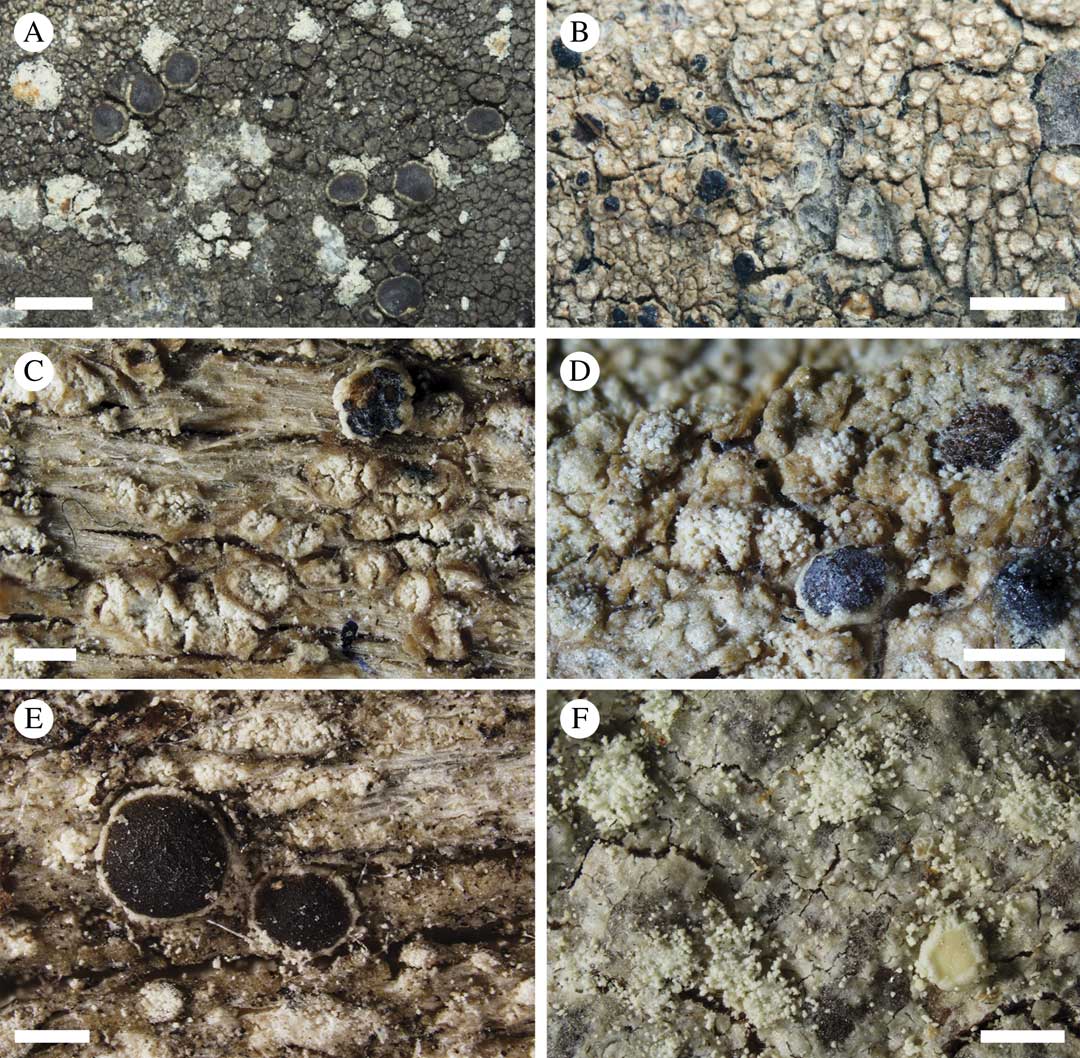
The sorediate form of L. cenisia is characterized by a thick verrucose thallus and large, flat to convex, rounded soralia. It produces roccellic acid, rarely replaced by nephrosteranic acid. For a detailed description see Brodo et al. (Reference Brodo, Owe-Larsson and Lumbsch1994) and Malíček (Reference Malíček2014). Lecanora cenisia is predominantly a saxicolous species occurring on exposed as well as sheltered siliceous rocks in montane areas. The sorediate form prefers overhanging rocks. Epiphytic growth is rare and most records are from twigs of Rhododendron in the subalpine zone (Hinteregger Reference Hinteregger1994), where it can be easily misidentified as L. exspersa.
In contrast to Brodo et al. (Reference Brodo, Owe-Larsson and Lumbsch1994) and Malíček (Reference Malíček2014), we prefer to regard L. caesiosora as a sorediate form of L. cenisia. Both taxa are morphologically and chemically identical, they also share ecological preferences (although L. caesiosora prefers vertical and overhanging rocks) and apothecial anatomy, and often grow together. Synonymization of L. caesiosora with L. cenisia is supported by the mtSSU data (Fig. 2); the sorediate form shares the same sequence as the typical L. cenisia and co-occurs at the type locality of f. soredians. Nevertheless, the taxonomy of L. caesiosora sensu Brodo et al. (Reference Brodo, Owe-Larsson and Lumbsch1994) still remains partially unclear because of its wide variation. The rare chemotype with nephrosteranic acid might potentially represent a saxicolous form of L. exspersa, but molecular data are not available.
Epiphytic specimens examined. Austria: Tirol: Ötztaler Alpen, S von Obergurgl, Gurgler-Heide, Gaisberglift, 1950 m, Rhododendron ferrugineum, 1986, E. Hinterreger (GZU).—Czech Republic: Šumava Mts: cirque of the Černé jezero lake, 49°10'35''N, 13°11'10''E, 1150 m, Sorbus aucuparia, 1995, Z. Palice 232 (PRA).
Lecanora exspersa Nyl.
Flora, Regensburg 58: 443 (1875); type: [Romania], ad ramulos abietum in regione “Aragyes” infra alpem Retyezát, com. Hunyad in Transsylvania, 1873, Lojka (H-NYL 27610!—holotype; M 207003!—isotype).
Lecanora raesaenenii Gyeln. [as ‘räsänenii’], Acta Faun. Fl. Univers., Ser. 2, Bot. 1 (no. 5–6): 10 (1933); nom. nov. for Lecanora coilocarpa var. sorediata Räsänen, Medd. Soc. Fauna Flora Fenn. 43: 118 (1917); type: [Finland] Ob. Simo. Pahnila, huoneen semalla, [on wood], 1913 & 1915, V. Räsänen (H!—lectotype).
Lecanora elisa Nyl., Flora, Regensburg 64: 178 (1881); type: [Romania], ad ramulos Pini cembrae in regione “Arágyes” infra alpem Retyezát, com. Hunyad in Transsylvania, 1874, Lojka (H-NYL 27609!—holotype; M 207005!—isotype).
Thallus whitish grey, thin, usually slightly pustulate to areolate-cracked, rarely ± smooth; prothallus absent or black when adjacent to other lichens; photobiont trebouxioid, cells globose, 7–12(–15) µm diam.; soralia whitish, distinctly paler than the esorediate part of the thallus, rarely yellowish (in populations from beech forests), flat or concave when young, 0·2–0·8 mm diam., rounded, delimited by a thalline rim that can be missing in large or old soralia, only occasionally confluent; soredia farinose, 20–50 µm diam.
Apothecia usually absent or poorly developed, sessile or immersed when young, up to 0·5 mm diam.; margin flexuose, uneven, later disappearing or discontinuous; discs brown to brownish black, sometimes slightly pruinose, flat to convex. Amphithecium with large crystals (pulicaris-type), but these are usually absent; cortex indistinct or if present up to 40 µm at base; hypothecium colourless; hymenium 40–100 µm high; epihymenium reddish brown to brown, granules usually sparse to rarely almost absent, coarse, at paraphyses tips (chlarotera-type), soluble in HNO3; asci and ascospores not developed in the material studied but according to Hinteregger (Reference Hinteregger1994), asci 8-spored and ascospores 7–11×4–6 um.
Pycnidia brown to brown-grey according to Hinteregger (Reference Hinteregger1994); conidia filiform, straight to curved, 15–25×1·0–1·2 µm.
Chemistry. Nephrosteranic acid as a major secondary compound; a trace amount of 1–2 unknown fatty acids (under nephrosteranic a.) found in 11 samples (n=32). In one collection (GZU/Poelt 11706), roccellic acid instead of nephrosteranic acid was detected. Hinteregger (Reference Hinteregger1994) reported roccellic acid from several specimens but, according to our data, nephrosteranic acid is the prevailing substance and roccellic acid is more typical for some similar species, such as L. cenisia f. soredians, L. farinaria and L. substerilis. The bark of Rhododendron, the most common substratum of this species, is rich in various terpenoids that form very distinct spots on TLC plates.
Etymology. The species was described by Nylander (Reference Nylander1875) as L. exspersa, but Zahlbruckner (Reference Wirth1928) treated it as L. expersa without any orthographical comments and most subsequent authors apparently followed his concept. We use Nylander’s original spelling which means ‘poured out’ (ex-spersum).
Ecology. It is quite common on Rhododendron ferrugineum, especially on old twigs and stems in the subalpine belt, up to 2500 m (Hinteregger Reference Hinteregger1994). It also occurs on the acidic bark of a range of other phorophytes (see the specimens examined) as well as hard coniferous wood and decorticated twigs. Some populations are reported here from old-growth beech forests, on trunks of beeches and a few other trees close to the tree line at elevations above 1150 m. Generally, L. exspersa prefers microhabitats directly influenced by a long snow lie, such as tree bases and low shrubs.
Distribution. To date, the species has been reported only from Eurasia, mainly the Alps, Finland (Santesson et al. Reference Santesson, Moberg, Nordin, Tønsberg and Vitikainen2004) and the boreal-Arctic zone of Russia (Urbanavichus Reference Tønsberg, Türk and Hofmann2010). Single records are from Romania (Nylander Reference Nylander1875), Montenegro (Vězda Reference Valný, Honsa, Kirdajová, Kameník and Anděrová2000) and the Bavarian Forest (Printzen et al. Reference Printzen, Halda, Palice and Tønsberg2002). It is reported here for the first time from the Czech Republic, France, Slovakia, Ukraine and the Caucasus. The previous record from Slovakia (Palice et al. Reference Palice, Guttová and Halda2006) is erroneous, being based on stunted specimens of L. pulicaris with partly eroding, ‘sorediate’ thalli. The Slovakian and Ukrainian localities are situated in old-growth forests of Stužica and Uholka-Shyrokyi Luh in the Carpathians.
Phylogeny. ITS and mtSSU phylogenies are not congruent in the relationships between L. cenisia, L. exspersa and some other species in the Lecanora subfusca group. In the ITS phylogeny, Lecanora exspersa is not distinguished from L. cenisia but they form a well-supported clade distinct from other taxa. In the mtSSU, a single sequence of L. exspersa from the Austrian Alps is in a clade with L. substerilis and most of the L. cenisia sequences, whereas other sequences of L. exspersa form a supported clade together with L. argentata, L. chlarotera and one L. cenisia specimen from Romania. We decided to maintain the ‘classical’ phenotypic delimitation of L. exspersa, although it does not correspond with mtSSU (and partly with ITS); this decision might be temporary but establishing any other taxonomic alternative needs stronger support.
Remarks. Lecanora exspersa growing on wood can easily be misidentified as Ochrolechia microstictoides or O. alboflavescens in the field, but both species differ chemically. Very similar morphotypes can be sometimes formed by L. farinaria, but the overall distribution and ecology of these species are different. The predominantly saxicolous L. cenisia f. soredians sometimes occurs on Rhododendron ferrugineum (Hinteregger Reference Hinteregger1994) but its thallus is thicker and verrucose, the soralia are large (up to 1 mm diam.), usually convex, delimited for a long time, and roccellic acid is produced as the major secondary compound. The beech forest populations occur together with L. substerilis which has greyish white soralia without a thalline rim and produces roccellic acid.
Selected specimens examined. Austria: Salzburg: Hohe Tauern, Krimml, 47°12'33''N, 12°10'21''E, alt. 1080 m, Alnus incana, 2012, J. Malíček 5417, 5551 (hb. JM); ibid., Gerlos, 47°10'57''N, 12°06'45''E, alt. 1740 m, Rhododendron ferrugineum, 2012, J. Malíček 5391 (hb. JM); ibid., Mt. Hoher Sonnblick, 47°03'41·2''N, 12°59'26·0''E, alt. 1875 m, Pinus mugo, 2014, F. Bouda, Z. Palice 18558 & O. Peksa (PRA).—Czech Republic: S. Bohemia: Šumava Mts, Nová Pec: glacial cirque of the lake Plešné jezero, alt. 1250 m, Acer pseudoplatanus, 48°46'27''N, 13°51'26·5''E, 2016, Z. Palice 22028 (PRA). Hrubý Jeseník Mts: Mt. Praděd, 50·07723°N, 17·25190°E, alt. 1190 m, Sorbus aucuparia, 2015, J. Vondrák 16550 (PRA).—France: Provence-Alpes-Côte d’Azur: Briançon, Montgenèvre, 44·929099°N, 6·719706°E, alt. 1840 m, Larix decidua, 2016, I. Frolov & J. Vondrák 16585 (PRA).—Montenegro: Montes Durmitor, silva virginea supra lacum ‘Zminje jezero’, loco Surdup dicto, alt. 1500–1700 m, 1984, A. Vězda (GZU).—Russia: Republic of Bashkortostan: Yuryuzan’, vill. Tyulyuk, alt. 1200–1300 m, 54°33'51''N, 58°50'37''E, wood of Picea obovata, 2011, J. Vondrák 13214 (PRA); Yuzhnouralskiy zapovednik, Katav-Ivanovsk, 54°30'47''N, 58°18'36''E, alt. 1100–1200 m, wood of Picea, 2011, J. Vondrák 13391 (PRA). Caucasus Mts: Caucasian Biosphere Reserve, primeval forests in the surroundings of Guzeripl, alt. 1460–1900 m, Abies nordmanniana, Betula sp., Fagus orientalis, 2016, J. Malíček, Z. Palice & J. Vondrák (many specimens in hb. JM, PRA).—Slovakia: Poloniny Mts: Nová Sedlica, Stužica, 49°5'24''N, 22°32'57''E, alt. 1150 m, Acer pseudoplatanus, 2014, J. Šoun & J. Vondrák 12339 (PRA).—Slovenia: Julian Alps: Triglav National Park, 46°26'32''N, 13°43'37''E, alt. 1800 m, Larix decidua, 2016, J. Malíček 9446 (hb. JM).—Ukraine: Zakarpattia Oblast: Velyka Uhol’ka, Mt. Menchul, 48°17'52''N, 23°39'59''E, alt. 1200 m, Fagus sylvatica, 2015, F. Berger, J. Malíček 8235, Z. Palice 19165, 19235 & J. Vondrák 14117, 14118 (hb. Berger, JM, PRA).
Lecanora farinaria Borrer
Suppl. Engl. Bot. 2: tab. 2727 (1834); type: England, Sussex, Hurstpierpoint, Danny sandfields, on wood, Borrer (BM—holotype & possible isotype 1089246!).
(Fig. 4E)
Thallus immersed to thin (up to 0·1 mm thick), grey-white, smooth; prothallus indistinct or black; photobiont trebouxioid, 6–11 µm diam.; soralia white, greenish or yellowish white, delimited to confluent, rounded to ellipsoid, 0·2–1·0 mm, sometimes covering the whole thallus surface (e.g. as in the holotype), flat to more rarely convex, often bordered by a thin thalline rim; soredia farinose, 20–50 µm diam.
Apothecia rare, sessile or with constricted bases, 0·4–1·0(–1·5) mm; margin sorediate, up to 0·1 mm thick, often becoming excluded, white, regular to more often flexuose; discs brown to black, matt, epruinose, flat to slightly convex. Amphithecium with large crystals (pulicaris-type) or crystals absent, with abundant algal cells; cortex absent; hypothecium colourless; hymenium 50–80(–100) µm; epihymenium pale brown to reddish brown, rarely with green pigment, K+ olive, HNO3+ brownish red to red, interspersed with fine granules (POL+) soluble in K, insoluble in N (pulicaris-type); paraphyses 1·5–2·0 µm, up to 3·0 µm at apices; asci 8-spored; ascospores broadly ellipsoid to subglobose, 14–18(–20) × (9–)10–13(–15) µm, thick-walled (1·0–1·5 µm).
Conidiomata unknown.
Chemistry. Roccellic acid (major) with traces of 1–2 additional fatty acids.
Ecology. Lecanora farinaria prefers humid forests at lower elevations, especially close to the coast. The most common substrata are Alnus incana, Sorbus aucuparia (Tønsberg 1992) and timber.
Distribution. Lecanora farinaria has been reported from many European countries, North America and Asia (see Kukwa & Kubiak Reference Kukwa and Kubiak2007) but some of these records could be based on misidentifications. It is an oceanic species known mainly from Great Britain (Edwards et al. Reference Edwards, Aptroot, Hawksworth and James2009) and Norway (Tønsberg 1992). It very probably occurs in other Western European and Scandinavian countries (material not seen). A record from Ukraine by Kondratyuk & Coppins (Reference Kondratyuk and Coppins1999) belongs to L. substerilis and the specimen from Sardinia by Zedda (Reference Zduńczyk and Kukwa2002) is L. impudens. In Central Europe, the species has been reported from humid parts of the Austrian Alps (Tønsberg et al. 2001) and Poland (Kukwa & Kubiak Reference Kukwa and Kubiak2007).
Phylogeny. The Bayesian analysis of the mtSSU region demonstrated a quite isolated position within the L. subfusca group (Fig. 2), but the ITS region placed the species together with L. pulicaris in an isolated clade (Fig. 1).
Remarks. Lecanora farinaria is a very variable species, especially in terms of the soralia and thallus. Tønsberg (1992) mentioned morphotypes with an areolate or tuberculate thallus containing calcium oxalate crystals. This is a fairly common feature in several other sorediate Lecanora species but probably very rare in L. farinaria. Sterile material can be easily confused with several similar taxa (L. exspersa, L. impudens, L. substerilis etc.) but its ecology and/or distribution differ. Apothecial anatomy is very similar to L. pulicaris, a closely related species according to the ITS phylogeny (Fig. 1).
Selected specimens examined. Austria: Hohe Tauern, Krimml, 47°12'44''N, 12°10'09''E, alt. 1050 m, Alnus incana, 2012, J. Malíček 5417 (hb. JM). Tirol: Brandenberg, Kaiserklamm, 47°33'N, 11°54'E, alt. 730–760 m, Salix, T. Tønsberg 24270 (BG).—Great Britain: Scotland: V.C. 96, East Inverness: Glen Affric, SW shore of Loch Beinn a Mhea, 57°15·99'N, W004°57·77', Vaccinium, alt. 235 m, 2004, Z. Palice 9831 (PRA). V.C. 102, South Ebudes: Island of Islay, on fence post, 2011, M. Powell 1777 (hb. JM).—Norway: Nordland: Vefsn, W of Lake Fustvatnet, alt. 40–60 m, Alnus incana, 1982, T. Tønsberg 7615a (GZU). Møre og Romsdal: Rauma, W of Innfjorden, 40 m, Corylus avellana, 1979, T. Tønsberg 3817 (GZU). Sogn og Fjordane: Selje, 62·0562°N, 5·3912°E, alt. 270–280 m, Sorbus aucuparia, 2015, T. Tønsberg 46170 & Z. Palice 20106 (BG, PRA).
Lecanora impudens Degel.
Svensk Bot. Tidskr. 38: 50 (1944); nom. nov. for Pertusaria farinacea H. Magn., Bot. Not. 1942: 15 (1942); type: Sweden, Södermanland, Botkyrka, Tullinge gård, on Ulmus in an avenue, 1938, A. H. Magnusson 16125 (UPS 65900!—holotype).
Lecanora maculata (Erichsen) Almb. [nom. illeg.], Bot. Not. 1952: 251 (1952); Pertusaria maculata Erichsen, Rabenh. Kryptog. Flora Deutsch. 5: 646 (1936).
Lecanora impudens is morphologically identical to L. allophana f. sorediata but they are separated by chemistry and ascospore size (up to 14 µm in L. impudens). Lecanora impudens produces an unknown fatty acid and the terpenoid impudens-unknown or atranorin alone. For a detailed description of the species and chemical substances, see Tønsberg (1992) and Malíček (Reference Malíček2014).
Lecanora impudens prefers trees with a higher bark pH (e.g. Fraxinus excelsior) in open landscape. It has a mostly continental distribution in Europe, being completely absent from Western Europe; however, it does occur in the more continental part of Norway (Tønsberg 1992). The record from Sardinia is phytogeographically interesting. Generally, it is not a very common lichen but it can be locally widespread, as in some regions of Scandinavia, the Alps and the Carpathians.
Some authors (e.g. Poelt & Vězda Reference Poelt and Vězda1981; Clauzade & Roux Reference Clauzade and Roux1985; Schreiner & Hafellner Reference Schreiner and Hafellner1992; Wirth Reference White, Bruns, Lee and Taylor1995) have regarded L. impudens and L. allophana f. sorediata as conspecific. Both taxa are very similar and share almost the same habitat; their status has not been resolved by mtSSU phylogeny (Fig. 2). We have separated them at the species level on the basis of their different chemistry and ascospore size.
Selected specimens examined. Austria: Steiermark: Grazer Bergland, Straßegg Sattel c. 8 km E von St. Jakob-Breitenau, 47°23'20''N, 15°31'50''E, 1180 m, Fraxinus, 1999, J. Hafellner 49623 (GZU).—Italy: [Sardinia:] Illorai, Monte Artu, alt. 900 m, old Quercus pubescens, 1996, L. Zedda (B).—Romania: Fagaras Mts: Sibiu, Mt. Moldoveanu, 45°34'22''N, 24°42'04''E, alt. 1380 m, Acer pseudoplatanus, 2013, J. Malíček 6618, F. Bouda & L. Syrovátková (hb. JM).—Russia: Orenburg Region: Maloe Churaevo, 51°40'09''N, 57°27'14''E, alt. 250–500 m, Ulmus laevis, 2011, J. Vondrák 13073, 13080 (PRA).—Slovakia: Strážovské vrchy: prope pg. Briestenné, 500 m, ad cort. Juglandis, 1976, I. Pišút (BRA).
Lecanora jamesii J. R. Laundon
Lichenologist 2: 122 (1963); type: UK, Pembroke, near Pontfaen, Afon Gwaun, V.C. 45, on rotting branches of Salix over stream, 350 ft., 1958, P. W. James (BM—holotype).
(Fig. 4F)
This species is well characterized by its yellow delimited soralia containing usnic acid and the production of 2-O-methylsulphurellin as a diagnostic substance. Apothecia are rare, containing large crystals in the amphithecium and with a granular, pale yellowish brown epihymenium (Laundon Reference Laundon1963). In Europe, the species is reported from oceanic parts of Western Europe and humid regions of the Austrian Alps (e.g. Brodo & Elix Reference Brodo and Elix1993; Tønsberg et al. 2001). For a detailed description, see Laundon (Reference Laundon1963) and Edwards et al. (Reference Edwards, Aptroot, Hawksworth and James2009).
Selected specimens examined. Austria: Wildnisgebiet Dürrenstein, Lunz am See, primeval beech-silver fir forest “Grosser Urwald”, 47°46'56''N, 15°05'02''E, alt. 1200 m, Fagus sylvatica, 2015, J. Malíček 8471, F. Berger, O. Breuss & R. Türk (hb. JM); ibid., See bei Oisklause, 47°46'33''N, 15°08'54''E, alt. 1010–1020 m, Holz von Picea abies, F. Berger, O. Breuss, J. Malíček & R. Türk 56240 (SZU).—Canada: British Columbia: Hyphocus Island, 48°55·808'N, 125°31·679'W, alt. 2–10 m, Alnus rubra, 2011, T. Tønsberg 41348 (BG).—France: Bretagne: Monts d’Arrée, St. Herbot, alt. 250 m, Salix atrocinerea, 1984, P. Clerc 6298 (S).—Great Britain: England: V.C. 3, South Devon: Slapton bei Start, Salix, 1971, J. Poelt 10545 (GZU). Scotland: V.C. 101, Lochgilphead, Kilmartin, 56°08'43''N, 5°32'04''W, alt. 50 m, Salix aurita, 2014, J. Malíček 9005, B. J. Coppins & J. Vondrák (hb. JM). V.C. 103, Argyllshire, Mull, Salen, Salix aurita, 1968, P. W. James (S – Vězda: Lich. Sel. Exs. 789).—USA: Washington: Olympic National Park, Ozette Lake, 48°07·2'N, 124°36·1'W, alt. 10 m, Salix, 1999, T. Tønsberg 28040 & C. Printzen (M).
Lecanora mughosphagneti Poelt & Vězda
Biblioth. Lichenol. 16: 364 (1981); type: [Germany], Bavaria, Allmannshauser Filz, Arnold in Lich. exs. 1832 (M!—holotype).
A thin, whitish to pale grey thallus and early coalescent soralia with fine, whitish soredia covering almost the whole thallus are typical for this species. In well-developed specimens, the thallus can be quite thick with a cotton-like or arachnoid prothallus. Whitish pruinose apothecia of the L. albella type are known only from the type material (Poelt & Vězda Reference Poelt and Vězda1981). The species produces caperatic and roccellic acids. Protocetraric acid was detected in apothecia only (Lumbsch et al. Reference Lumbsch, Plümper, Guderley and Feige1997). For a detailed description, see Poelt & Vězda (Reference Poelt and Vězda1981) and Lumbsch et al. (Reference Lumbsch, Plümper, Guderley and Feige1997).
To date, L. mughosphagneti has been recorded only from Germany, Austria (Lumbsch et al. Reference Lumbsch, Plümper, Guderley and Feige1997) and Switzerland (Bürgi-Meyer et al. Reference Bürgi-Meyer, Dietrich and Martig2014). It is reported here as new for the Czech Republic. The species grows mainly on trunks of Pinus spp. in boggy pine forests. It can be found at the same sites as the very similar L. norvegica which differs in the Pd+ red reaction of its soralia (protocetraric acid). A detailed study of both species will be published elsewhere (Z. Palice & T. Tønsberg, unpublished data).
Selected specimens examined. Czech Republic: Southern Bohemia: Šumava Mts, Smolná Pec: waterlogged spruce forest with Pinus rotundata, 48°51'03''N, 13°53'05''E, alt. 815 m, Pinus rotundata, 2010, J. Malíček 2736 & Z. Palice (hb. JM); Třeboň region, Suchdol nad Lužnicí, Červené blato, alt. 470 m, Pinus rotundata, 2010, J. Malíček 2953 (hb. JM).—Germany: Bayern: Föhrenrinden in der Pupplinger Au im Isarthale bei Wolfratshausen, 1893, Arnold (M – Lich. Monac. Exs. 297); Spirkenfilz zw. Bernried u. Bern. Filz, Spirke, 1955, J. Poelt (M); Spirkenfilz südlich Rohrmoos, Gemeinde Forst, Pinus uncinata, 1964, J. Poelt (M).
Lecanora norvegica Tønsberg
Sommerfeltia 14: 165 (1992); type: Norway, Oppland, Sel, Sjoa, UTM grid ref.: 32V, NP 2839, alt. 280–300 m, on Pinus sylvestris, 1990, T. Tønsberg 13145 (BG—holotype; E—isotype).
This species is very similar to L. mughosphagneti, from which it differs in its Pd+ red soralia due to the presence of protocetraric acid. Roccellic acid was detected as a minor compound. According to Tønsberg (1992), soralia are green to grey-green and discrete at first, but these characters are probably not reliable for a differentiation of these species. For a detailed description see Tønsberg (1992).
It has been reported from Norway (Tønsberg 1992), Sweden (Santesson et al. Reference Santesson, Moberg, Nordin, Tønsberg and Vitikainen2004), Switzerland (Dietrich & Scheidegger Reference Dietrich and Scheidegger1996), Estonia (Jüriado Reference Jüriado, Lõhmus and Saag2000), Lithuania (Motiejūnaitė et al. Reference Motiejūnaitė, Stončius, Dolnik, Tõrra and Uselienė2007) and European Russia (Stepanchikova et al. Reference Stepanchikova, Kukwa, Kuznetsova, Motiejūnaitė and Himelbrant2010). Lecanora norvegica is recorded here as new for the Czech Republic. The species prefers humid mire pine forests. Cliostomum leprosum, Loxospora elatina and Ochrolechia microstictoides are other sorediate species with a similar ecology; therefore TLC is necessary for correct identification.
Selected specimens examined. Czech Republic: Northern Moravia: Jeseníky Mts, Rejvíz, 50°13'13''N, 17°17'13''E, alt. 760 m, Pinus rotundata, 2012, J. Malíček 5131 & L. Syrovátková (hb. JM). Southern Bohemia: Novohradské hory Mts, Pohoří na Šumavě, Stodůlecký vrch, 48°35'09''N, 14°42'20''E, alt. 955 m, Pinus sylvestris, 2012, J. Malíček 5707, J. Kocourková, Z. Palice & J. Vondrák (hb. JM).—Norway: Oppland: Sel, Sjoa, 61°41’N, 9°33''E, alt. 300 m, Pinus sylvestris, 1992, T. Tønsberg 17746 (M).
Lecanora sorediomarginata S. A. Rodrigues, A. Terrón & Elix
Lichenologist 43: 102 (2011); type: Portugal, Beira Litoral, Figueira da Foz, Dunas de Quiaios, alt. 49 m, Pinus pinaster in a pine forest on sand dunes, 2006, S. A. Rodrigues (AVE-L—holotype; LEB-Lichenes 7581—isotype).
This recently described species (Rodrigues et al. Reference Rodrigues, Terrón-Alfonso, Elix, Pérez-Ortega, Tønsberg, Fernández-Salegui and Soares2011) is characterized by the endosubstratal or very thin thallus, coalescent soredia, sorediate apothecial margin and C+ red reaction due to the presence of 3,5-dichloro-2'-O-methylnorstenosporic acid as a major compound. Atranorin and chloratranorin are present only as minor substances. To date it has been reported only from the bark of pines in coastal regions of Portugal. Lecanora sorediomarginata is distinguished by its chemistry and specific ecology. For a detailed description see Rodrigues et al. (Reference Rodrigues, Terrón-Alfonso, Elix, Pérez-Ortega, Tønsberg, Fernández-Salegui and Soares2011).
Lecanora substerilis Malíček & Vondrák sp. nov.
MycoBank No.: MB 813677
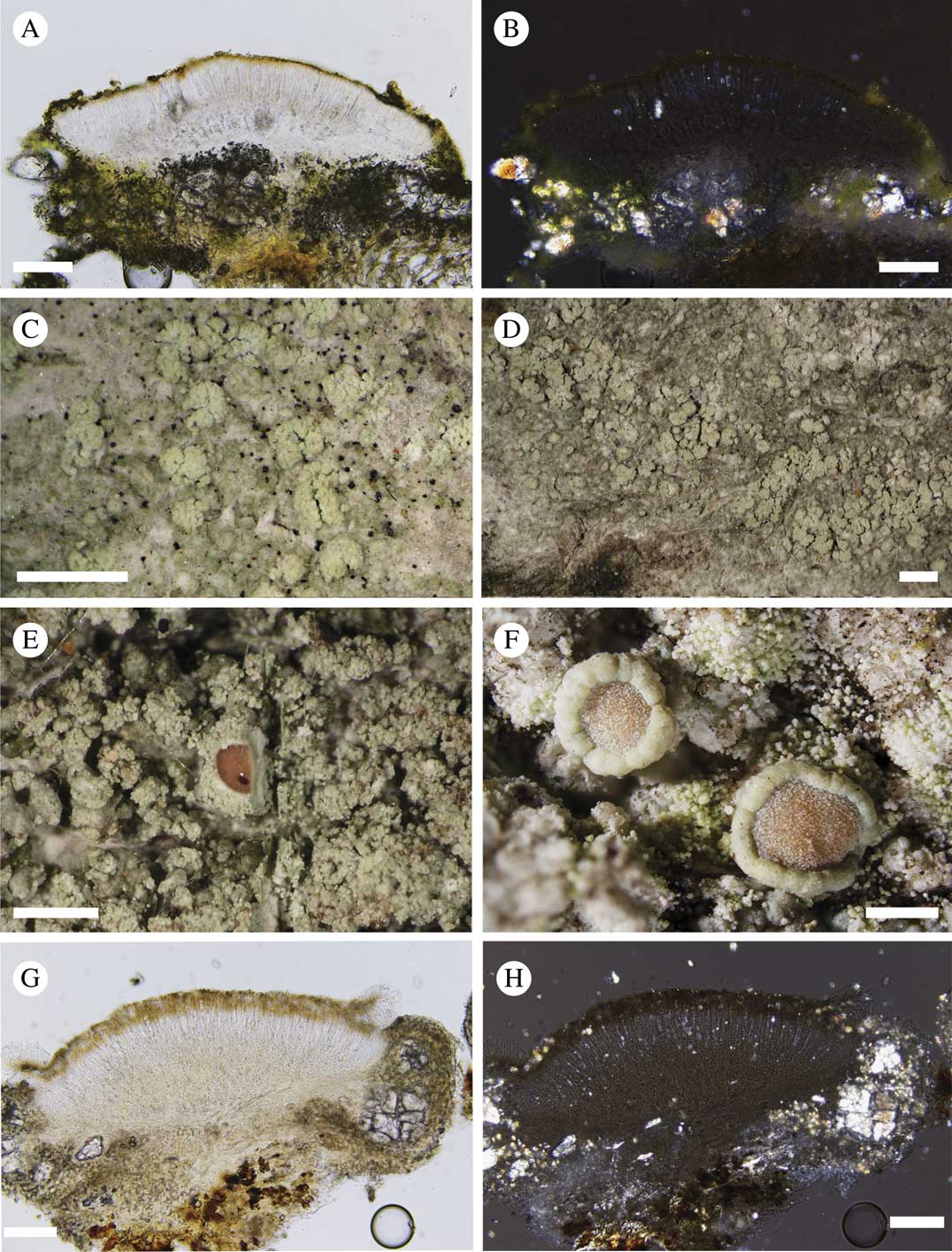
A member of the L. subfusca group in a strict sense, macroscopically similar to L. farinaria but the thallus often thick and verrucose; thalline apothecial margin sorediate; epihymenium with coarse granules at paraphyses tips; amphithecium with large crystals; roccellic acid alone or together with an unidentified fatty acid as major secondary metabolites; on bark of beeches in old-growth beech forests.
Type: Slovakia, Poloniny Mts, Nová Sedlica, protected area Stužica, in a valley, alt. 600–800 m, 49°04'24''N, 22°32'35''E, Fagus sylvatica, 2014, J. Šoun & J. Vondrák (PRA JV12294—holotype; 12303—isotype). Sequences of the holotype: KT630243 (ITS) and KT630254 (mtSSU).
A & B, apothecial sections of the holotype of Lecanora substerilis using brightfield and polarized light microscopy respectively; C & D, sorediate thallus of L. substerilis; E, apothecium of the holotype specimen (PRA JV12294); F, habitus of L. variolascens (JM 8422); G & H, apothecial sections of L. variolascens using brightfield and polarized light microscopy respectively. Scales: A, B, G & H=100 μm; C–E=1 mm; F=0·5 mm. In colour online.
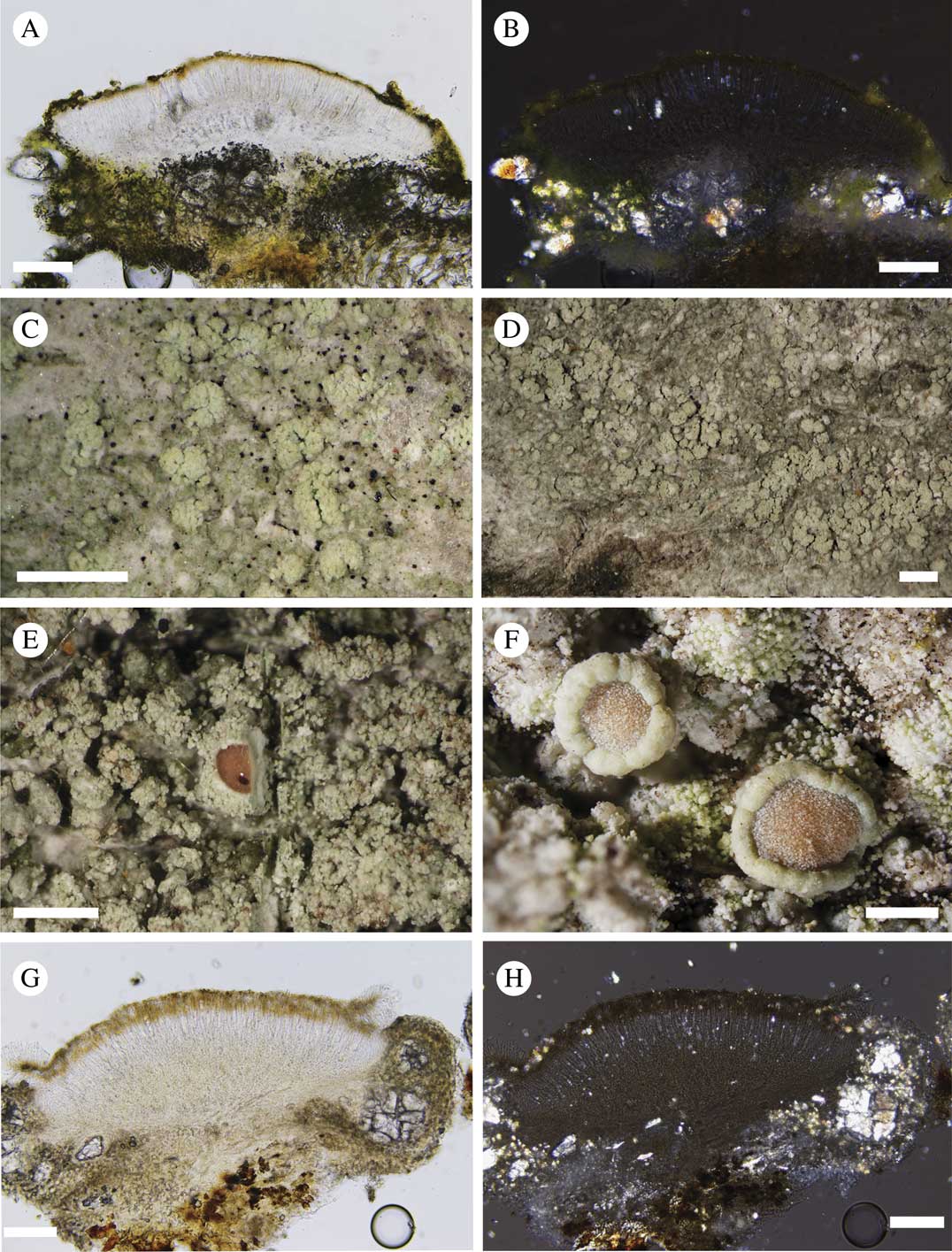
Thallus crustose, grey, matt, forming patches up to 5 cm diam., sterile specimens usually with a thin thallus up to 0·1 mm thick, in fertile material thallus well developed and strongly pustulose (>0·5 mm thick); pustules low and almost indistinct to strongly developed and globose to clavate with constricted bases, filled with large calcium oxalate crystals (POL+); prothallus indistinct or whitish grey; photobiont trebouxioid; soralia pale grey to grey-green, punctiform to rarely confluent, flat, 0·2–0·6 mm diam.; soredia farinose to granulose, simple or in consoredia, 25–75 µm diam., coarser in fertile collections.
Apothecia lecanorine, known only from the holotype, c. 1 mm diam., with a constricted base, probably arising from pustules; margin 0·2 mm thick, uneven and slightly pustulate when young, later sorediate; discs brown, matt, pruina absent. Amphithecium with abundant large crystals (pulicaris-type), filled with numerous trebouxioid photobiont cells (5–14 µm diam.) surrounded by 2·5–3·5 µm thick and branched hyphae, lower part without algal cells and crystals±paraplectenchymatous; cortex not observed; hypothecium colourless, prosoplectenchymatous; hymenium colourless, 60–80 µm high; paraphyses 1·5–2·0 µm thick, not or very slightly broadening at tips; epihymenium chlarotera-type, red-brown (K+ pale brown), with coarse, brown, irregular granules (POL+) abundant at paraphyses tips, 1–2(–5) µm diam., soluble in KOH; asci 8-spored, Lecanora-type, c. 45–55×12 µm; ascospores well developed, simple, colourless, broadly ellipsoid to subglobose, 10–14×7–11(–12) µm.
Conidiomata unknown.
Chemistry. Atranorin, roccellic acid alone or together with an unidentified fatty acid. In four of 12 specimens examined, traces of several terpenoids (probably from bark) detected by TLC. Soralia: K+ yellow, Pd−, C−, UV−.
Etymology. This species is mostly collected sterile; fertile material is very rare.
Phylogeny. Lecanora substerilis belongs to the L. subfusca group. In the nrITS phylogeny, it forms a supported clade that is well resolved from the closest outgroup including L. cenisia and L. exspersa (Fig. 1). It also forms a supported clade in the mtSSU that is in polytomy with the latter taxa.
Ecology and distribution. This new species is so far known only from Carpathian beech forests, especially from old-growth woodlands at elevations of 450–1235 m. It has been published from Stužica beech-silver fir forest in Slovakia as Lecanora cf. farinaria (Vondrák et al. Reference Vězda2015). It is fairly common on Fagus sylvatica in this reserve and one collection is also from Abies alba. The most frequently associated species are Lecanora argentata, Candelariella xanthostigma, Hypogymnia physodes, Lecanora pulicaris, Porina aenea and Scoliciosporum umbrinum. The second site from Slovakia is situated in the Muránska planina National Park. Lecanora substerilis is a common species in the Ukrainian virgin beech forest Uholka-Shyrokyi Luh where it is associated with, for example, Buellia griseovirens and Rinodina efflorescens. It is also known from a humid beech forest (1050 m a.s.l.) in the Paring Mountains (Muntii Parâng) in Romania and a mountain old-growth beech forest (1235 m a.s.l.) in the Beskydy Mountains in the Czech Republic.
Remarks. Lecanora substerilis strongly resembles the western L. farinaria but the latter differs in its smooth, immersed to thin thallus and the pulicaris-type of epihymenium (with fine granules). Sterile specimens are hardly distinguishable from, for example, L. allophana f. sorediata, L. impudens, L. exspersa, L. variolascens and L. cenisia f. soredians. These taxa are absent or very rare in beech forests. The first three species do not contain roccellic acid in the thallus. Lecanora exspersa usually occurs at higher elevations and its soralia have a distinct thalline rim; L. cenisia f. soredians has larger (at least 0·5–1·0 mm diam.) and convex soralia.
Additional specimens examined. Czech Republic: Moravskoslezské Beskydy Mts: Mt. Kněhyně, 49°29'41·9''N, 18°18'44·3''E, Fagus sylvatica, alt. 1235 m, 2016, J. Malíček & Z. Palice 21699 (PRA).—Romania: Paring Mts: Petrosani, 100 m E of Cabana Mija, 45°24'24''N, 23°30'22''E, 1050 m, Fagus sylvatica, 2013, J. Malíček 6690 & F. Bouda (hb. Malíček).—Slovakia: Bukovské vrchy Mts: Nová Sedlica, Stužica, S-facing slopes between Mt. Kamenná lúka (1201 m) and Mt. Kremenec (1221 m), 49°05'10''N, 22°33'09''E, 1050 m, Fagus sylvatica, 2013, J. Malíček 6541 & J. Vondrák (hb. JM); ibid., 800 m, 49°04'20''N, 22°32'06''E, Fagus sylvatica, 2014, J. Šoun & J. Vondrák (CBFS JV12387); ibid., in valley, 600–800 m, 49°04'24''N, 22°32'35''E, Abies alba, 2014, J. Šoun & J. Vondrák (CBFS JV12293). Muránska planina National Park: Čertova dolina protected area, 48°44'22''N, 19°52'00''E, alt. 950 m, Fagus sylvatica, 2012, J. Malíček 5269, A. Guttová & Z. Palice (hb. JM).—Ukraine: Zakarpattia Oblast Region: Khust, Velyka Uhol’ka, at many sites in the Uholka old-growth forest, 48°14–15'N, 23°39–41'E, alt. 460–820 m, Fagus sylvatica and Acer pseudoplatanus, 2015, F. Berger 29182, 29183, J. Malíček 8111, 8162, 8209, 8294, Z. Palice 19223, 19611 & J. Vondrák (hb. FB, JM, PRA).
Lecanora thysanophora R. C. Harris
Bryologist 103: 790 (2000); type: USA, New York, Clinton Co., Town of Mooers, trail to The Gulf Unique Area, 1·5 mi (2·4 km) NW of Cannon Corners Road (Co. Rd. 10) on Rock Road, 1 mi (1·6 km) N of Davison Road at Cannon Corners, 44°59'N, 73°46·5'W, conifer-red maple woods, 1996, Buck 30804 (NY—holotype).
Lecanora thysanophora differs from all species included in this paper by its continuously sorediate, yellow to bluish yellow thallus and the arachnoid prothallus which can be absent or poorly developed in young thalli. Apothecia are unknown in European populations. In addition to atranorin, it produces usnic acid, zeorin and specific terpenoid(s) of thysanophora-unknowns visible only as UV+ blue spots after sulphuric acid spraying and heating. It belongs to a more or less isolated lineage according to mtSSU (Fig. 2).
In Europe, the species is quite common in beech forests in some parts of the Alps and Carpathians, and scattered in some other mountains in Central Europe (e.g. Šumava/Bavarian Forest Mts). Surprisingly, it is widely distributed in northern Poland, commonly found also on Carpinus betulus and Quercus (Zduńczyk & Kukwa Reference Zahlbruckner2014), and in some surrounding countries (Golubkov & Kukwa Reference Golubkov and Kukwa2006; Motiejūnaitė et al. Reference Motiejūnaitė, Suija, Lõhmus, Kuznetsova, Tõrra, Prigodina-Lukošienė and Piterāns2006). For a detailed description see Harris et al. (Reference Harris, Brodo and Tønsberg2000). It can be confused with Haematomma ochroleucum which, however, contains porphyrilic acid (see Zduńczyk & Kukwa (Reference Zahlbruckner2014) for details). Both can occur on bark and rock but H. ochrolecum is mainly saxicolous and L. thysanophora is mainly corticolous.
Selected specimens examined. Austria: Tirol: Brandenberg, NW of Kaiserklamm, 47°32'48''N, 11°54'39''E, alt. 750 m, Salix elaeagnos, 2012, J. Malíček 5538 (hb. JM).—Czech Republic: Šumava Mts: Mt. Smrčina, 48°43'59''N, 13°56'17''E, alt. 1105 m, Fagus, 2015, J. Malíček 8656 & J. Vondrák (hb. JM).—Germany: Bayern: Oberammergau, Graswang, 47°33'44''N, 11°02'15''E, alt. 920 m, Fagus, 2014, J. Malíček 7020 (hb. JM).—Ukraine: Zakarpattia Oblast Province: Kvasovo, flood-plain forest Otok, 48°12'35''N, 22°46'08''E, alt. 120 m, Populus nigra, 2013, J. Malíček 6445 & J. Vondrák (hb. JM).
Lecanora variolascens Nyl.
Flora, Regensburg 64: 183 (1881); type: [Germany, Baden-Württemberg], Heidelberg, an Carp. et Sorbus rar., v. Zwackh 252 (H-NYL 27851!—holotype).
Lecanora bavarica Poelt, Ber. Bayer. Bot. Ges. 29: 68 (1952); type: [Germany], Oberbayern, Ldks. Starnberg u. Bernried, Obere Hochebene, Ulme an der Straße nach Unterzeismering, ziemlich am Grunde des Stammes, 1951, J. Poelt (M!—holotype).
Thallus quite variable, smooth to rough, often verrucose especially in the centre, greyish, thin to medium thick (up to 0·2 mm), filled by large calcium oxalate crystals; photobiont trebouxioid; soralia flat to slightly convex, concolorous with the thallus, at first delimited (0·3–1·0 mm diam.), later more or less confluent and rarely forming a sorediate crust covering the thallus; soredia farinose.
Apothecia frequently present, 0·5–1·0(–1·5) mm diam., sessile or rarely with constricted bases, plane; discs reddish brown to dark brown, medium to strongly whitish to bluish pruinose, rarely non-pruinose; margin smooth to coarse, matt, thick, partly flexuose, elevated, sometimes slightly crenulate. Epihymenium reddish brown, in K ±colourless to pale orange-brown, pigment more or less intensifying in HNO3, with coarse brown granules 3–5(–8) µm diam. on the surface of paraphyses tips, soluble in K, very slowly soluble in HNO3, POL−; amphithecium of pulicaris-type, with very large crystals of calcium oxalate (up to 100 µm diam.), soluble in HNO3; true cortex absent; hypothecium colourless to yellowish; hymenium 60–80 µm high; paraphyses (1·0–)1·5–2·0 µm thick, at tips slightly swollen (up to 3·0 µm); asci 8-spored; ascospores broadly ellipsoid, (9·0–)10·0–12·5 × 6–8(–9) µm.
Conidiomata unknown.
Chemistry. Atranorin, chloratranorin and zeorin detected by TLC and LC as major compounds. In two specimens (of 14 analyzed by TLC) including the holotype, a trace of an unknown colourless spot (C4, UV−) with a fatty character was recorded. Disc C−; soralia K+ yellow, Pd+ yellow, C−. Crystals of terpenoids are usually visible on old collections.
Phylogeny. The species is not closely related to the morphologically similar L. intumescens but it forms an isolated clade with L. barkmaniana (Figs. 1 & 2).
Ecology. Lecanora variolascens occurs on ±acidic bark (mainly of oaks and pines) but usually in slightly eutrophicated places, as noted by Lumbsch et al. (Reference Lumbsch, Plümper, Guderley and Feige1997). It is closely associated with Candelariella efflorescens agg., C. reflexa s. str., C. xanthostigma, Catillaria nigroclavata, Opegrapha rufescens, Phlyctis argena, Physcia adscendens, Physconia distorta and Lecidella albida. It prefers well-lit forests at medium elevations.
Distribution. The species is rare and known only from several European countries: Austria, France, Germany, Italy, Poland and Switzerland (Lumbsch et al. Reference Lumbsch, Plümper, Guderley and Feige1997; Nimis & Martellos Reference Nimis and Martellos2003; Roux Reference Roux2015). It is reported here as new for Slovakia.
Remarks. Lecanora variolascens is a distinctive species but it has been rarely reported. Many specimens have been found in herbaria by chance as unidentified or incorrectly identified specimens. This confusion might have arisen as a result of a vague and ambiguous description of the taxon by earlier authors. Apothecia of some morphotypes (e.g. the holotype) can resemble L. intumescens which differs mainly in the apothecial anatomy (e.g. tiny crystals in the amphithecium). Indeed, Nylander (Reference Nylander1881) and Brodo (Reference Brodo1984) suggested that this sorediate taxon is closely related to L. intumescens, if not conspecific. Lumbsch et al. (Reference Lumbsch, Plümper, Guderley and Feige1997) distinguished it from L. intumescens, included the Central European L. bavarica Poelt as its synonym, and provided a more detailed description. Unfortunately, the authors characterized L. variolascens as a species with psoromic acid and relatively small crystals in the amphithecium (nevertheless of the pulicaris-type according to the mentioned size). The Pd+ yellow reaction of the soralia, suggesting the presence of psoromic acid, could be caused by a high concentration of atranorin; no psoromic or 2'-O-demethylpsoromic acids were detected by TLC (n=14), liquid chromatography or mass spectrometry (n=3) in the material examined, which included two specimens studied by Lumbsch et al. (Reference Lumbsch, Plümper, Guderley and Feige1997).
The sorediate thallus strongly resembles L. impudens, L. allophana f. sorediata, L. farinaria and several Ochrolechia species. In such cases, TLC or spot reactions are necessary for certain identification. Lecanora variolascens is chemically identical to L. barkmaniana, which is usually sterile with yellowish soralia that soon become confluent. When apothecia are present, ascospores of L. barkmaniana are distinctly larger than in L. variolascens. Lecanora carneolutescens Nyl., regarded as endemic to south-western North America, shares chemical and anatomical characters with L. variolascens. It differs in its non-pruinose apothecia and larger ascospores, 12·5–16·0×8·5–10·5 µm (Ryan et al. Reference Ryan, Lumbsch, Messuti, Printzen, Sliwa and Nash2004).
Specimens examined. Austria: Steiermark: Kalvarienberg SW oberhalb vom Landeskrankenhaus Feldbach, Umgebung eines alten Lehmabbaus, 340 m, Malus domestica, 1993, B. Wieser 642 (GZU). Oberösterreich: Rading (nw. Windischgarsten), an Föhrenstämmen im Radinger Moor, 600 m, 1986, S. Wagner (GZU, dupl. ex SZU 10491); Haiden bei Ischl, 1867, H. Lojka (GZU). Lower Austria: Ybbstaler Alpen Mts, Langau, Maierhöfen, 47°51'36·9''N, 15°06'46·2''E, alt. 680 m, Pyrus communis, 2015, J. Malíček 8422 (hb. JM).—France: Aquitaine: Pyrénées Atlantiques, St. Engrâce, 47°46·83'N, 3°29·67'W, 600 m, Acacia, 1992, J. L. Spier 4898 (L).—Germany: Oberbayern: Starnberg, Moorsinger Schlucht, Quercus, 1952, A. Schreppel (GZU). Bayern: Allgäu, an Acer am Forggensee nördlich Füssen, 785 m, 1956, J. Poelt (B, S, Lich. Alp. 4).—Slovakia: Muránska planina plateau: Poludnica Nature Reserve, well-lit oak forest, 48°45·44'N, 20°01·72'E, alt. 660 m, Quercus, 2007, A. Guttová, J. Halda & Z. Palice 11380 (PRA, BG); ibid., c. 48°45'33''N, 20°02'01''E, alt. 700–750 m, Quercus petraea agg., 2010, J. Malíček 3100, A. Guttová & Z. Palice (hb. JM); ibid., 48°45'19''N, 20°01'46''E, alt. 565 m, 2014, A. Guttová, Z. Fačkovcová & Z. Palice 18379 (PRA); ibid., Šiance Nature Reserve, 48°45'55''N, 20°03'55''E, alt. 886 m, Quercus, 2012, A. Guttová & Z. Palice 17959 (PRA).
Lecanora viridissima A. Nordin, Sundin & G. Thor
Nordic Journal of Botany 15: 555 (1995); type: Sweden, Gotland, Lummelunda Parish, Ellstädaränget wooded meadow, c. 1 km NW Bunge and c. 1 km E of Lummelunda church, 57°46'N, 18°28'E, Quercus robur, 1990, A. Nordin, R. Sundin & G. Thor 1300 (S!—holotype).
This species is characterized by a yellow to green sorediate thallus forming small patches up to 1 cm; apothecia are unknown. This small lichen can be very easily overlooked in a mosaic with other species. It resembles, for example, young L. expallens. Based on herbarium material from S, it often occurs together with morphologically very similar Lecidella subviridis and Pyrrhospora quernea. Some specimens identified as Lecanora viridissima are indeed these taxa, including the holotype which is a mixture of Lecidella subviridis and L. viridissima. All these lichens differ chemically, so careful TLC/LC analysis is necessary for correct identifications. Lecanora viridissima produces, in addition to atranorin, an unknown substance in position B'5 and C5. This compound is recognized in TLC after charring as a yellow spot with a large pale halo and fatty character; it is pale yellow-green to brown in long-wave UV light (not observed in low concentrations). It is very probably related to 2-O-methylsulphurellin and some planaic acid derivatives due to the very characteristic spots on TLC plates. It differs from the 2-O-methylsulphurellin in the lower position on TLC plates and typical double yellow spot in solvent B'.
Lecanora viridissima is a poorly known species reported only from Gotland in Sweden. It occurs on the bark of Quercus robur and Fraxinus excelsior mainly in wooded meadows (Nordin et al. Reference Nordin, Sundin and Thor1995). Lecanora argentata and Phlyctis argena were the most common closely associated species in the material studied.
Selected specimens examined. Sweden: Gotland: Träkumla, Tjängdarve, 59°33'N, 18°19'E, Fraxinus, 1989, A. Nordin, R. Sundin & G. Thor 49 (S); Rone, Oggesänget, 57°12'N, 18°25'E, Quercus, 1990, A. Nordin, R. Sundin & G. Thor 1186 (S); Lojsta, 57°18'N, 18°23'E, Quercus, 1989, A. Nordin, R. Sundin & G. Thor 353 (S); Atlingbo, 57°28'N, 18°22'E, Fraxinus, 1989, A. Nordin, R. Sundin & G. Thor 207 (S); Hemse, 57°13'N, 18°22'E, Quercus, 1990, A. Nordin, R. Sundin & G. Thor 999 (S).
We are grateful to the curators of B, BG, BM, BRA, GZU, H, L, M, PRA, S, SZU and UPS for the loan of selected material. Mark R. D. Seaward provided useful criticism and kindly revised the manuscript. Brian J. Coppins, Mark Powell and Tor Tønsberg provided material for DNA studies. Zdeněk Kameník kindly helped with the methods of liquid chromatography and mass spectrometry. Two anonymous reviewers helped to improve the manuscript. The study was supported by grant nos. 647412 and 1074416 from the Charles University Grant Agency.