Introduction
Gastrointestinal nematodes are one of the principal sanitary problems of small ruminants in tropical and temperate regions throughout the world (Duarte et al., Reference Duarte, Matias, Bastos, Maia, Júnior and Soares2019; Sallé et al., Reference Sallé, Doyle, Cortet, Cabaret, Berriman, Holroyd and Cotton2019). The control of these nematodes relies almost exclusively on the administration of anthelmintics, such as benzimidazoles, macrocyclic lactones, imidazothiazoles, monepantel (amino-acetonitrile derivative) and derquantel (spiroindole). However, the continuous use of these drugs has promoted the selection of resistant and/or multiresistant nematode populations (Silva et al., Reference Silva, Bezerra, Feitosa and Vilela2018; Santos et al., Reference Santos, Vasconcelos, Frota, Freitas, Teixeira, Vieira and Monteiro2019; Nixon et al., Reference Nixon, Welz, Woods, Costa-Junior, Zamanian and Martin2020).
The control of gastrointestinal nematodes using plant essential oils and their bioactive compounds has been highlighted as a promising alternative (Camurça-Vasconcelos et al., Reference Camurça-Vasconcelos, Bevilaqua, Morais, Maciel, Costa, Macedo, Oliveira, Braga, Silva and Vieira2007; Katiki et al., Reference Katiki, Barbieri, Araujo, Veríssimo, Louvandini and Ferreira2017; Araújo-Filho et al., Reference Araújo-Filho, Ribeiro, André, Cavalcante, Guerra, Muniz, Macedo, Rondon, Bevilaqua and Oliveira2018; Macedo et al., Reference Macedo, Oliveira, André, Araújo Filho, Santos, Rondon, Ribeiro, Camurça-Vasconcelos, Oliveira, Paula and Bevilaqua2019). Carvacrol is a phenolic monoterpenoid found in the essential oils of oregano (Origanum vulgare), thyme (Thymus vulgaris) and other plants (Sharifi-Rad et al., Reference Sharifi-Rad, Varoni, Iriti, Martorell, Setzer, Contreras, Salehi, Soltani-Nejad, Rajabi, Tajbakhsh and Sharifi_Rad2018). This monoterpene has antiparasitic activity (Katiki et al., Reference Katiki, Barbieri, Araujo, Veríssimo, Louvandini and Ferreira2017; Novato et al., Reference Novato, Gomes, Zeringóta, Franco, Oliveira, Melo, Carvalho, Daemon and Monteiro2018). Carvacrol presents high toxicity, and acetylation is an alternative that can potentiate its biological activity and reduce toxicity. Carvacryl acetate (CVA) reduced motility and caused cuticle lesions in adult Haemonchus contortus and promotes a 65.9% reduction in egg count per gram of feces (epg) of sheep, but the efficacy does not reach the desired therapeutic level (Andre et al., Reference Andre, Ribeiro, Cavalcante, Santos, Macedo, Paula, Freitas, Maia, Melo and Bevilaqua2016). Nanoencapsulation has been proposed as an alternative to protect and promote the sustained release of bioactive compounds that show promising anthelmintic action since it can increase their bioavailability and potentiate their nematicidal action (Mesquita et al., Reference Mesquita, Silva Júnior, Panassol, Oliveira, Camurça-Vasconcelos, Paula and Bevilaqua2013; Ribeiro et al., Reference Ribeiro, Camurça-Vasconcelos, Santos, Macedo, Ribeiro, Oliveira, Paula and Bevilaqua2017; Katiki et al., Reference Katiki, Araujo, Ziegelmeyer, Gomes, Gutmanis, Rodrigues, Bueno, Veríssimo, Louvandini, Ferreira and Amarante2019; André et al., Reference Andre, Junior, Cavalcante, Ribeiro, Araújo-Filho, Cavalcanti, Morais, Oliveira, Bevilaqua and Abreu2020b). Biopolymers are used for the nanoencapsulation of bioactive compounds via polyelectrolyte complexation (Paula et al., Reference Magalhães, Neto, Sombra, Richter, Abreu, Feitosa, Paula, Goycoolea and Paula2016). Among the biopolymers, chitosan is a polysaccharide obtained by the deacetylation of chitin. Chitosan possesses a high density of positive charges due to the protonation of amino groups and presents properties such as nontoxicity, biocompatibility and biodegradability (Luo and Wang, Reference Luo and Wang2014). The positively charged amino groups of chitosan react with an anionic group of polysaccharides, such as chichá gum, leading to the formation of a polyelectrolyte complex (Paula et al., Reference Magalhães, Neto, Sombra, Richter, Abreu, Feitosa, Paula, Goycoolea and Paula2016). Chichá gum is extracted from Sterculia striata, a tree species belonging to the family Sterculiaceae that is widely found in the northeastern and central regions of Brazil (Mangas et al., Reference Mangas, Mello and Suarez2013). This polymer has been used as a possible polymer for drug nanoencapsulation (Magalhães et al., Reference Magalhães, Neto, Sombra, Richter, Abreu, Feitosa, Paula, Goycoolea and Paula2016; Sombra et al., Reference Sombra, Richter, Araújo, Ribeiro, Mendes, Fontenelle, Silva, Paula, Feitosa, Goycoolea and Paula2019). Thus, in a study evaluating the best reaction conditions for the nanoencapsulation of CVA with biopolymers, it was found that nanoencapsulation with chitosan/chichá gum in a polymeric bilayer presented controlled release and inhibited the motility of H. contortus adults in vitro. Thus, the use of a biopolymer, such as chichá gum, which has a greater number of carboxylic groups, can trigger greater polyethylene complexation and increase the efficiency of nanoencapsulation (André et al., Reference Andre, Junior, Cavalcante, Ribeiro, Araújo-Filho, Santos, Alves, Monteiro, Morais, Silva, Oliveira, Abreu and Bevilaqua2020a).
Thus, the aim of the current study was to evaluate the toxicity and anthelmintic activity of nanoencapsulated carvacryl acetate (nCVA) with chitosan/chichá gum against sheep gastrointestinal nematodes.
Materials and methods
Gas chromatography coupled to mass spectrometry (GC-MS)
Carvacrol acetylation was performed according to Andre et al. (Reference Andre, Ribeiro, Cavalcante, Santos, Macedo, Paula, Freitas, Maia, Melo and Bevilaqua2016). The chemical analysis of the CVA was performed with a Shimadzu QP-2010 Ultra instrument with the following conditions: column, Rtx-5 MS (Crossbond 5%, diphenyl/95% dimethyl polysiloxane) with 30 m × 0.25 mm × 0.25 μm df; carrier gas, He (24.2 mL min−1, in constant linear velocity mode); injector temperature of 250 °C, split mode (1:100) and detector temperature of 250 °C. The column temperature was programmed as follows: the column increased from 35 to 180 °C at 4 °C min−1 and then from 180 to 280 °C at 17 °C min−1 and was subsequently maintained at 280 °C for 10 min. The mass spectra were acquired with an electron impact of 70 eV. Compounds were identified by their relative retention times obtained by GC to those of known compounds and by comparison of their mass spectra with those present in the computer data bank (NIST) and published literature (Adams, Reference Adams2007).
Nanoencapsulation of CVA
The nanoparticles were produced from a polyelectrolytic complexation system (Andre et al., Reference Andre, Junior, Cavalcante, Ribeiro, Araújo-Filho, Santos, Alves, Monteiro, Morais, Silva, Oliveira, Abreu and Bevilaqua2020a). Chitosan (1%) (w/v) and Tween 80 were subjected to mechanical stirring; 300 μL of CVA was then added, and the solution was maintained in an ultrasonic bath (Ultra 800, Ciencor Scientific Ltd., São Paulo, Brazil) for 15 min. For formation of the prenucleus of the nanoparticles, 0.1% sodium tripolyphosphate P.A. (STP) (Dinâmica®, São Paulo, Brazil) was added dropwise at a chitosan:STP ratio of 50:1, and the solution was subjected to magnetic stirring for 30 min. Then, 1% chichá gum (w/v) (Dinâmica®, São Paulo, Brazil) was added to the solution at a chitosan:chichá gum ratio of 10:1, and the solution was subjected to magnetic stirring for another 30 min. For the production of particles in bilayers, the monolayer particles were suspended in 20 mL of distilled water and subjected to magnetic stirring. Chitosan (1%) was added dropwise and stirred continuously for an additional 30 min. Subsequently, 1% chichá gum (w/v) was added and stirred continuously for an additional 30 min. The solution was centrifuged at 4000 rpm for 20 min, the supernatant was removed, and the bilayer nanoparticles were subjected to the lyophilization process.
Encapsulation efficiency
The encapsulation efficiency (EE) of CVA was determined by absorption spectroscopy with a Genesys 10S UV-Vis (Thermo Scientific, Massachusetts, USA) at a wavelength of 271 nm. A solution of 10 mL of 95% ethanol with 10 mg of nanoparticles was stirred constantly for 48 h. Subsequently, 2 mL of the solution was filtered using a 0.25-μm syringe filter, and the concentration of CVA was determined according to the calibration curve using equation (1), with the absorbance (abs) and the CVA concentration (conc) in mg/mL:

Physicochemical characterization of nanoparticles
The nanoparticles were characterized by Fourier-transform infrared (FTIR) spectroscopy using a Nicolet iS5 spectrophotometer (Thermo Scientific). The samples were prepared as potassium bromide pellets (KBr) at a ratio of 1:20 (m/m) (sample:KBr). The particle size, surface charge at different pH values (3–8) and the point of zero charge were determined through zeta-potential measurements using a Nano ZetaSizer analyzer (Malvern 3600, Worcestershire, UK) with a laser wavelength of 632.8 nm and a fixed dispersion angle of 173 °.
Acute toxicity
Acute toxicity was assessed according to OECD-425/2008 (The ‘Up-and-Down’ method for acute toxicity testing) (OECD, 2008). Female Swiss mice (n = 11) weighing 25.1 ± 1.1 g were allowed to acclimatize to the laboratory conditions (luminosity: 12 h/12 h, light/dark; temperature: 22 ± 2 °C; relative humidity: 60%) for 7 days and were provided commercial feed (Labina®, Purina, São Paulo, Brazil) and water ad libitum. The animals were divided into two groups and received the following treatments orally: G1 (n = 8), nCVA at doses of 175, 440, 1110 and 2800 mg kg−1 and G2 (n = 3) and chitosan/chichá gum (negative control). The dose correction factor was 3.2-fold, and the dose was increased or decreased according to the survival and mortality of the animal. Each animal received a single dose and was evaluated for 48 h prior to selection of the dose to be administered to the next animal. An increase or reduction in the dose occurred according to the observation of the survival or mortality of the animals, respectively. The dosage was discontinued when five reversals occurred in six consecutive nCVA-treated animals. All decisions regarding the doses administered and the estimation of the 50% lethal dose (LD50) were performed using AOT425StatPgm software.
Fecal egg count reduction test (FECRT)
We used 40 sheep of both sexes ranging in age from 6 to 18 months, with an average weight of 30 kg, and subjected them via semi-extensive management with feeding on native pastures of the semiarid region of northeastern Brazil. The animals selected had over 500 epg, as determined using the McMaster technique with a 50-epg detection limit and sugar flotation (Coles et al., Reference Coles, Jackson, Pomroy, Prichard, Von Samson-Himmelstjerna, Silvestre, Taylor and Vercruysse2006). Sheep were divided into 4 groups (n = 10) according to the epg and randomly assigned to the following treatments: G1, 250 mg kg−1 CVA; G2, nCVA; G3, chitosan/chichá gum (negative control) and G4, 2.5 mg kg−1 monepantel (Zolvix®, Novartis, New Zealand) (positive control). The treatments were administered orally in a single dose. Fecal samples from each animal were collected on days 0, 8 and 16 posttreatment to determine the epg. According to Coles et al. (Reference Coles, Jackson, Pomroy, Prichard, Von Samson-Himmelstjerna, Silvestre, Taylor and Vercruysse2006), when more than one anthelmintic class is being evaluated, a longer period of 14 days should be used, justifying the evaluation of epg on days 8 and 16 posttreatment. Aliquots of 2 g of feces from each animal belonging to the same group were homogenized and divided into three coprocultures containing approximately 20 g each (Roberts and O'Sullivan, Reference Roberts and O'Sullivan1950), and larvae were identified according to Van Wyk and Mayhew (Reference Van Wyk and Mayhew2013).
Statistical analysis
The efficacy of the FECRT was calculated using the following formula: FECRT = 100 × (1 − [T2/T1][C1/C2]), in which the arithmetic fecal egg count means in controls (C) and treated (T) animals before (T1 and C1) and 8 or 16 days after (T2 and C2) deworming were compared (Dash et al., Reference Dash, Hall and Barger1988) and 95% confidence intervals (CIs) were estimated using BootStreat 1.0 software (Cabaret, Reference Cabaret and Quick2014). The epg values were log transformed (log 10[x + 1]), analysed by analysis of variance and compared using Tukey's test with GraphPad Prism® 7.0 software. The CI of the percentage of L3 recovered in coprocultures was calculated according to the following formula: $2\sqrt {pq} /n$ , where p is the total number of larvae of a nematode genus, q is the total number of the other genera of nematodes and n is the total number of nematodes identified.
Results
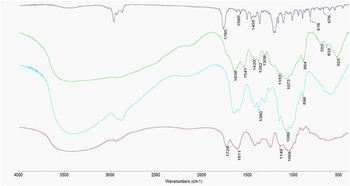
GC-MS analysis of the CVA indicated 99.3% CVA and 0.69% carvacrol. The EE and yield of nCVA were 72.8 and 57.5%, respectively. The FTIR spectra of CVA, chitosan, chichá gum and nCVA are shown in Fig. 1. CVA presented the following bands: 1590 cm−1 (C–H flexion), 1765 cm−1 (acetyl group) and 816 cm−1 (aromatic ring) (Andre et al., Reference Andre, Ribeiro, Cavalcante, Santos, Macedo, Paula, Freitas, Maia, Melo and Bevilaqua2016). The 1086 cm−1 (C–O–C stretch) and 890 cm−1 (pyranose ring) bands correspond to chitosan (Keawchaoon and Yoksan, Reference Keawchaoon and Yoksan2011). The bands at 1728 cm−1 indicate stretching and bending deformation out of plane due to the presence of acetyl groups in the chichá gum (Brito et al., Reference Brito, Silva, De Paula and Feitosa2004). CVA was not detected in the nCVA, possibly due to overlap with other bands of the biopolymer matrix.
FTIR spectra of CVA (), nCVA (), chitosan () and chichá gum ().

The average size of the nanoparticles was 764.5 ± 302.5 nm and had a unimodal distribution.
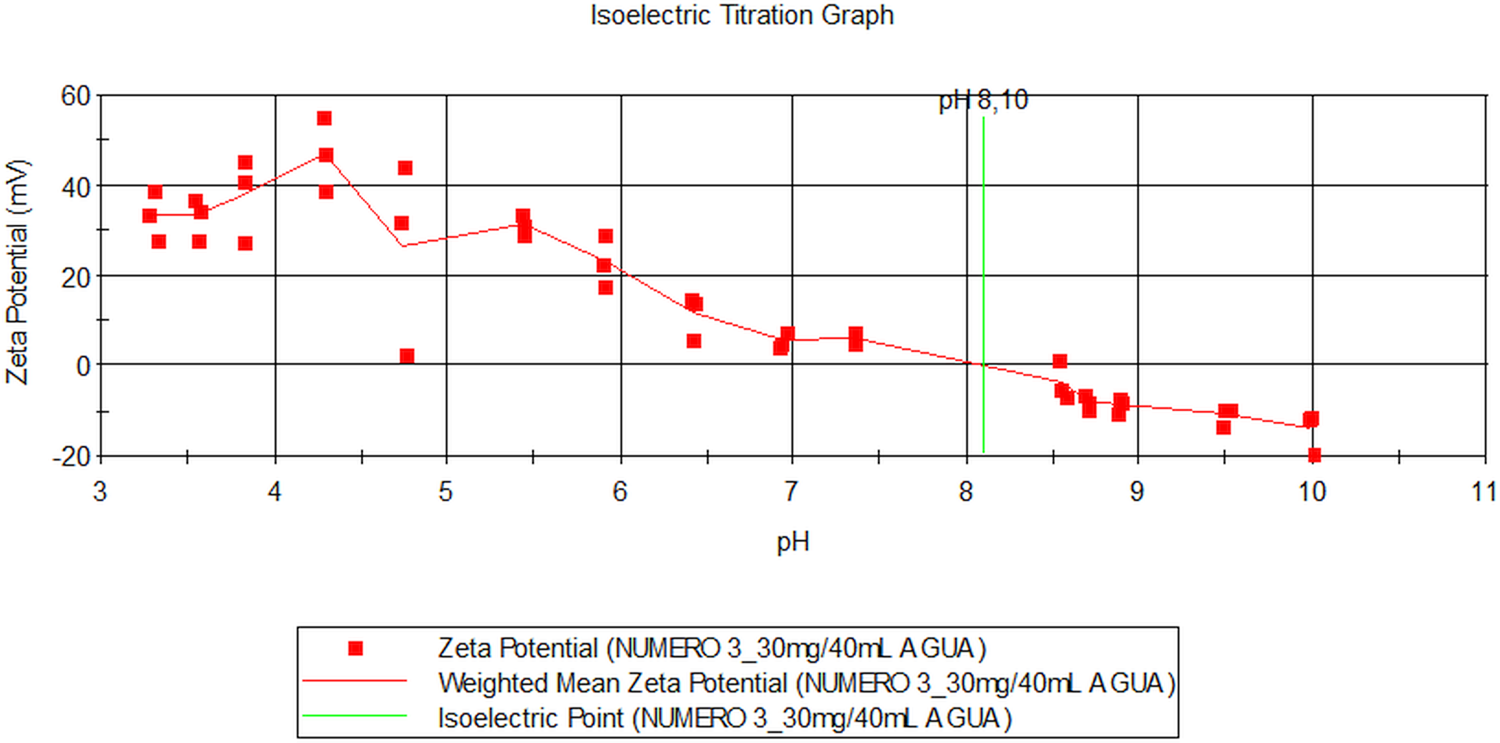
The nanoparticles showed a decrease in the zeta potential with an increase in pH. At pH 3.2, the zeta potential was +22.0 mV, and the point of zero charge was situated at approximately pH 6.9 (Fig. 2).
Zeta-potential variation with pH for nCVA. Zeta potential (■) and weighted mean zeta potential pH 8.1 ().

In the acute toxicity test, nCVA presented an LD50 value of 2609 mg kg−1. The encapsulating matrix showed no toxicity.
The FECRT results of CVA, nCVA and monepantel are expressed as the mean epg on days 0, 8 and 16 posttreatment (Table 1). CVA, nCVA and monepantel reduced the epg by 52.9, 71.5 and 98.7%, respectively, by 16 days posttreatment. The CVA and nCVA results were not significantly different (P > 0.05). However, nCVA was significantly different from the negative control (P < 0.05).
Fecal egg count reduction (FECR) and egg counts per gram of feces (epg ± standard deviation) of sheep treated with CVA, nCVA and monepantel.

Capital letters compare means in the rows and small letters compare means in the columns. Different letters indicate significantly different values (P < 0.05).
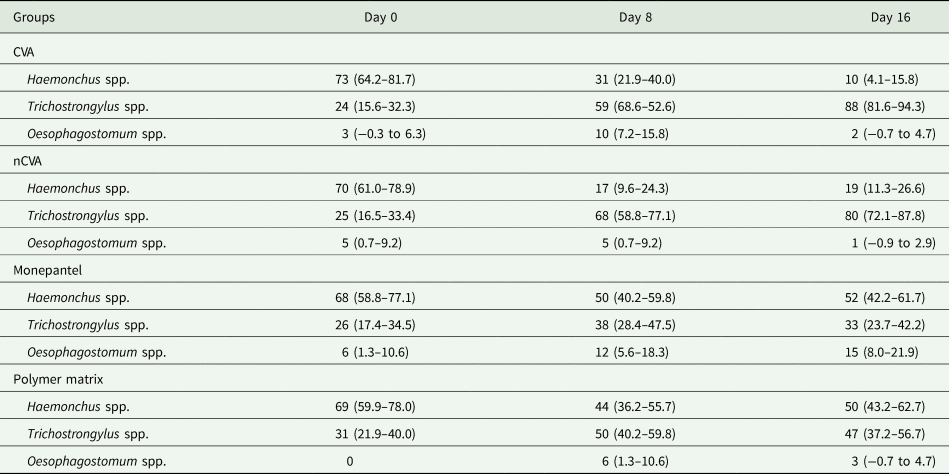
The prevalence of nematode genera in FECRT is presented in Table 2. After treatment, the frequency of Trichostrongylus spp. increased in relation to Haemonchus spp. in the CVA- and nCVA-treated groups.
Frequency (%) and 95% CI of third-stage larvae identified in coprocultures on days 0, 8 and 16 posttreatment treated with CVA, nCVA, monepantel and polymer matrix

Groups were treated with 250 mg kg−1 CVA or nCVA. The positive control group was treated with 2.5 mg kg−1 monepantel (Zolvix®), and the negative control group received polymer matrix.
Discussion
The evaluation of the zeta potential of nCVA at different pH values (3 and 8) showed that the nanoparticles were more stable at pH 3.2, where they had a zeta potential of +18.3 mV. The positive zeta potential of nCVA at acidic pH occurred due to the protonation of the amine groups of chitosan, increasing the positive charges on the surface of the nanoparticles. These positively charged nanoparticles can interact electrostatically with the negative charges of components present in the mucus that protect the mucosa of the stomach of monogastric animals, resulting in the mucoadhesion of nanoparticles (Ways et al., Reference Ways, Lau and Khutoryanskiy2018). The acidic pH of ovine abomasum may promote the protonation of chitosan, the adhesion of nanoparticles to the abomasal mucosa and a prolonged release of CVA. However, for nanoparticles that do not adhere to the abomasal mucosa and reach the small intestine where the pH is basic, deprotonation of the amine groups of chitosan occurs, and the carboxyl groups of gum chichá are ionized, which reduces the zeta potential of the nanoparticles to approach the isoelectric point, where charge neutralization occurs (Abreu et al., Reference Abreu, Bianchini, Forte and Kist2008); consequently, the nanoencapsulated biocomposite is rapidly released.
The LD50 of nCVA was 2609 mg kg−1, while the LD50 of CVA was 1544.5 mg kg−1, as obtained from the acute toxicity test in mice (Andre et al., Reference Andre, Ribeiro, Cavalcante, Santos, Macedo, Paula, Freitas, Maia, Melo and Bevilaqua2016). The nanoencapsulation of CVA reduced toxicity and increased the toxicology safety of this biocomposite. The reduction in toxicity of a nanoencapsulated essential oil was also verified by an evaluation of the acute toxicity of Eucalyptus staigeriana essential oil (LD50 = 1603.9 mg kg−1) and its nanoemulsion (LD50 = 3495.9 mg kg−1) (Ribeiro et al., Reference Ribeiro, Camurça-Vasconcelos, Macedo, Santos, Araújo-Filho, Ribeiro, Pereira, Viana, Paula and Bevilaqua2015). The reduction in toxicity may be associated with the sustained release of these biocomposites, which maintains their therapeutic effect and reduces the occurrence of plasma peaks that may trigger toxic effects on animal cells.
In the current study, a significant difference (P < 0.05) in the epg values was found between the nCVA-treated group and the negative control group; however, no significant difference (P > 0.05) in the epg values was detected between the CVA and nCVA groups. The similarity in the epg values between the treated and negative control groups was also verified when evaluating the effectiveness of the nanoencapsulated CVA with chitosan/gum arabic and the nanoemulsion of the essential oil of Eucalyptus citriodora (Ribeiro et al., Reference Ribeiro, Ribeiro, Camurça-Vasconcelos, Macedo, Santos, Paula, Aráujo-Filho, Magalhães and Bevilaqua2014; André et al., Reference Andre, Junior, Cavalcante, Ribeiro, Araújo-Filho, Santos, Alves, Monteiro, Morais, Silva, Oliveira, Abreu and Bevilaqua2020a). There was a reduction in the percentage of Haemonchus spp. L3 and a resulting increase in Trichostrongylus spp. L3 in posttreatment coprocultures. CVA activity against Haemonchus spp. was probably improved by the process of encapsulation with chitosan, which is a bioadhesive polymer used in drug delivery systems, by promoting sustained release at acidic pH, increasing the bioavailability of CVA and therefore potentiating anthelmintic efficacy on abomasal nematodes. Similar results were found when evaluating the anthelmintic activity of E. staigeriana essential oil nanoencapsulated with chitosan in the parasitic load of sheep infected with Haemonchus spp., Trichostrongylus spp. and Oesophagostomum spp., where only the parasitic burden of Haemonchus spp. has been reduced (Mesquita et al., Reference Mesquita, Silva Júnior, Panassol, Oliveira, Camurça-Vasconcelos, Paula and Bevilaqua2013). In addition, it has been shown that the efficacy varies according to the nematode species, particularly when these inhabit separate digestive organs (Hoste et al., Reference Hoste, Torres-Acosta, Alonso-Diaz, Brunet, Sandoval-Castro and Adote2008).
The nanoencapsulation system was effective, presenting a nanometric size, zeta potential and sustained release in acidic pH, in addition to reducing the toxicity of the biocomposite. Thus, studies evaluating the anthelmintic action of CVA in experimentally infected animals with gastrointestinal nematodes should be performed. In addition, the bioavailability of biocomposites must be performed to prove that there is a greater release of CVA in the abomasum and to thus justify a greater effectiveness on Haemonchus spp. in relation to Trichostrongylus spp.
Acknowledgements
We acknowledge the Universidade Estadual do Ceará (UECE) and Universidade Federal do Ceará (UFC) for providing the necessary infrastructure and carrying out the experiments.
Author contributions
FOMSA and CMLB: conceptualization. WPPA, JRPJ, GSC, WLCR and JVAF: performed experiments. WPPA, GSC, WLCR and JVAF: data analysis, supervision and project administration: FOMSA, LMBO, SMM, CMLB and WPPA: writing the manuscript. All the authors reviewed and approved the manuscript.
Financial support
This study was supported by Brazilian funding agencies Coordenação de Aperfeiçoamento de Pessoal de Nível Superior (CAPES) and Conselho Nacional de Desenvolvimento Científico e Tecnológico (CNPq). Dr Bevilaqua has received a researcher fellowship from CNPq (305911/2019-8) and Dr André has received a doctoral scholarship at CAPES (1582708).
Conflict of interest
The authors declare that they have no conflicts of interest.
Ethical standards
This study was approved by the Ethics Committee on the Use of Animals of the Universidade Estadual do Ceará (Protocol Number: 6511846/2016).