



Introduction
Tension pneumothorax (TPTX) is a fatal condition if left untreated. Reference Rojas, Wasserberger and Balasubramaniam1,Reference Fischer and Masel2 Treatment is needle decompression per Advanced Trauma Life Support (ATLS) guidelines. Reference Galvagno, Nahmias and Young3 A hemothorax or pneumothorax can be difficult to detect by physical exam alone, as the sensitivity of the auscultation is only 58% Reference Chen, Markmann, Kauder and Schwab4 and is less sensitive (9%) in a moving ambulance. Reference Brown, Gough, Bryan-Berg and Hunt5 Point-of-care ultrasound (POCUS) performed by physicians for TPTX detection is more accurate than supine chest radiography with sensitivity and specificity as high as 99%. Reference Ball, Kirkpatrick and Feliciano6-Reference Alrajab, Youssef, Akkus and Caldito8 Emergency Medical Services (EMS) personnel with minimal POCUS training can correctly diagnose TPTX from still and video ultrasound (US) images. Reference Szarpak, Mateo and Marchese9-Reference Bhat, Johnson, Pierog, Zaia, Williams and Gharahbaghian11 Lung US has been shown to positively impact treatment and transport decisions in the prehospital setting when performed by physicians in Europe. Reference Ketelaars, Hoogerwerf and Scheffer12 No study to date examines whether paramedics can use POCUS to correctly identify and treat TPTX in a simulation scenario.
The primary goal of this study was to determine if US use after brief POCUS training on cardiac and lung exams would result in more paramedics correctly identifying a TPTX during a simulation scenario. Tension pneumothorax was defined as pneumothorax associated with respiratory distress and hypotension consistent with the local prehospital protocol. Secondary outcomes included use of US during the scenario, time to TPTX diagnosis, correct treatment of TPTX, and time to treatment of TPTX.
Methods
Study Design
Randomized controlled, simulation-based trial of POCUS lung exam education on the ability of paramedics to correctly diagnose and treat a TPTX was performed. This study was approved by the Colorado Multiple Institutional Review Board (Aurora, Colorado USA; #19-2267). Written informed consent was obtained from all paramedics enrolled in the study.
Study Setting and Population
Paramedics from a metro fire-rescue department were enrolled during their regularly scheduled quarterly education, which occurred over three separate days during February 2020. The education occurs in the training facility that contains a simulation lab with several high-fidelity mannequins. This paramedic group has received a waiver from the state to teach POCUS to their paramedics. Paramedics were included on a voluntary basis on their pre-assigned education day. Paramedics were excluded if they had participated in previous POCUS education sessions held by the paramedic group. The paramedics were not compensated for their participation.
Study Protocol
After written consent was obtained, the paramedics completed a pre-survey which included age, years of experience, prior exposure to POCUS, and comfort with POCUS. Comfort questions were assessed with a visual analog scale with one being very uncomfortable and five being very comfortable.
Paramedics were randomized via an online randomizer. The US intervention group received a 30-minute cardiac and lung POCUS lecture, including the use of POCUS to diagnose TPTX, followed by hands-on lung and cardiac scanning on 10 volunteer subjects with a Butterfly iQ probe (Butterfly Network, Inc.; Guilford, Connecticut USA), a hand-held US probe which attaches to smart phones and tablets. The paramedics also completed one scan using SonoSim (SonoSim Inc.; Santa Monica, California USA). SonoSim provides an US probe which is used on anatomically specific locations (stickers) on a mannequin to detect pre-programmed pathological US images on a provided laptop screen. The control group did not receive any POCUS training.
Normal lung on POCUS shows sliding of the visceral on the parietal pleura, which cause an artifact of vertical lines called comet tails. Absence of sliding suggests pneumothorax in an appropriate clinical setting. The POCUS M-mode is the motion mode or time motion display which shows a single dimensional POCUS image over time rather than a two-dimensional image. The POCUS M-mode findings of a TPTX are repeated horizontal straight lines (TPTX “stratosphere sign”) as opposed to grainy in the normal lung with normal pleural movement (“sand on the beach sign”). Reference Dawson and Mallin13
Both groups participated in two simulation scenarios: an adult patient with a right unilateral TPTX and an adult patient with undifferentiated shock. The paramedics were unaware of the diagnoses prior to the scenario. Within each group, paramedics were randomized via an online randomizer for the order of the scenarios. Prior to each scenario, the paramedics were oriented to the METIman or iStan manikin (CAE Healthcare; Montreal, Canada), which simulate a 70kg adult male. These high-fidelity manikins have palpable pulses and auscultable breath and heart sounds. The manikins can exhibit color change with cyanosis and can make audible sounds such as stridor or wheezing. They can be intubated with confirmation of placement with end tidal CO2 and breath sounds and can be defibrillated. Clinically applicable SonoSim images for each case were available on a computer screen to the paramedic if the paramedic placed the US probe on the appropriate sticker on the manikin during the scenario.
Two simulation educators from the fire-rescue department administered the scenarios. The information provided to the paramedic was a 30-year-old male patient in extremis who was intubated by the fire department team prior with no information on the patient’s prior medical history. Appropriate tube placement was confirmed by video laryngoscopy. The paramedic assumed care after intubation as the fire department team needed to respond to a fire. In both scenarios, the patient continued to be hypoxemic with pulse oximetry 86%-88% and hypotensive with a blood pressure of 70/50 after the paramedic assumed care. During the scenarios, sirens were played at 65 decibels to mimic typical EMS conditions. Both groups had access to US via SonoSim during the scenarios. Each participant was given five minutes to complete each scenario. All scenarios were videotaped.
During each scenario, one of the simulation educators was present at the bedside and stated aloud the time as diagnoses were made and procedures performed by the paramedic, which were recorded by study investigator. Another study investigator independently verified the times of diagnoses and procedures post-scenario through videotape review. The independent rater also assessed if they correctly identified the TPTX, if US was used, time to correct diagnosis, treatment of TPTX, and time to treatment of TPTX.
After the scenarios, paramedics completed a post-survey. The post-survey included questions on comfort diagnosing and treating TPTX, their opinion on how best to learn POCUS, what POCUS exams they would like to learn, and if POCUS was within their scope of practice. Comfort questions were assessed with a visual analog scale with one being very uncomfortable and five being very comfortable.
Outcome Measures
The primary outcome measure was the percentage of paramedics who arrived at the correct diagnosis for the TPTX scenario. Secondary outcomes included use of US during the scenario, time to TPTX diagnosis, correct treatment of TPTX, and time to treatment of TPTX.
Data Analysis
Chi-square and Fisher’s exact tests were used to analyze categorical variables. Time to diagnosis and time to correct treatment were presented as medians with interquartile ranges (IQR) as their distributions were not normal and analyzed with the Mann-Whitney U test. McNemar’s test was used to compare categorical variables from the pre-course survey to the post-course survey. Comfort level was dichotomized for analysis. Based on prior literature, the clinical exam was estimated to be accurate to detect pneumothorax in 50% of the control group with an anticipated improvement to 85% with the addition of US to the physical exam in the intervention group. For the sample size calculations, alpha was set at 0.05 and power at 80%. Therefore, 27 subjects needed to be enrolled per group to detect this difference. To account for potential incomplete data, 30 subjects were enrolled per group. A P value of ≤.05 was considered statistically significant. Statistical analyses were performed with SPSS version 22 (IBM SPSS; Armonk, New York USA).
Results
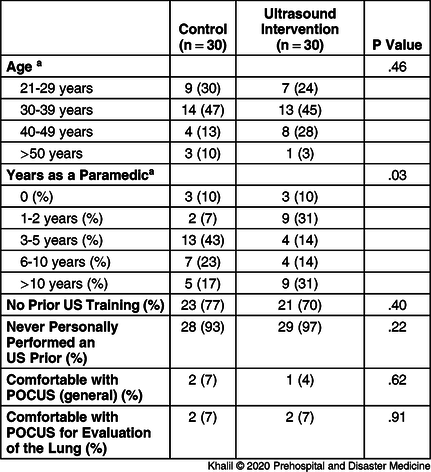
Thirty paramedics were randomized to the control group, and 30 paramedics were randomized to the US intervention group. None declined participation. There was no difference in age between the two groups (P = .46), but there were more paramedics randomized to the US intervention group who had been a paramedic only a few years (one-two years) or who had been a paramedic for greater than 10 years as compared to controls (P = .03). On the pre-survey, the majority of paramedics in each group reported they had not received any prior US training (P = .40) and had not personally performed a POCUS exam prior (P = .22). The majority of paramedics were also uncomfortable with POCUS, in general (P = .41), as well as with the POCUS lung exam (P = .25; Table 1).
Demographics, Pre-Survey Ultrasound Experience and Comfort Level

Abbreviation: POCUS, point-of-care ultrasound; US, ultrasound.
a One person in the intervention group did not answer both questions.
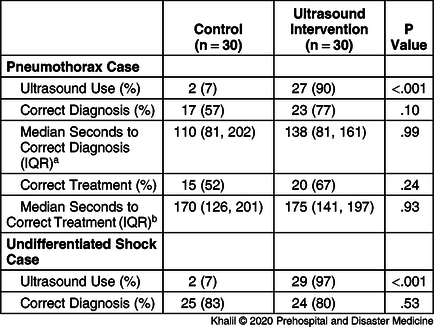
Ultrasound use was significantly higher in the US intervention group for both simulation cases (P <.001). A higher percentage of paramedics in the US intervention group arrived at the correct diagnosis (77%) for the TPTX case as compared to the control group (57%), but this difference was not statistically significant (P = .10). There was no difference in the correct diagnosis between the control and US intervention groups for the undifferentiated shock case (Table 2). For paramedics whose diagnosis was incorrect for the TPTX case, four paramedics in both the US intervention and control groups performed bilateral needle thoracostomies, and two paramedics in both the intervention and control groups performed needle thoracostomies on the left (incorrect) side of the chest. For paramedics whose diagnosis was incorrect for the undifferentiated shock case, two paramedics in the US intervention performed bilateral needle thoracostomies, one paramedic in the US invention group performed a right sided needle thoracostomy, and one paramedic in the control groups performed bilateral needle thoracostomies. The order of the simulation cases (ie, TPTX followed by undifferentiated shock or vice versa) did not change the percentages of correct diagnoses for either the TPTX case (control group, P = .71; US intervention group, P = 1.0) or the undifferentiated shock case (control group, P = .59; US intervention group, P = .17).
Simulation Results: Use of Ultrasound and Correct Diagnosis

a 17 in the control group, 23 in the intervention group.
b 15 in the control group, 20 in the intervention group.
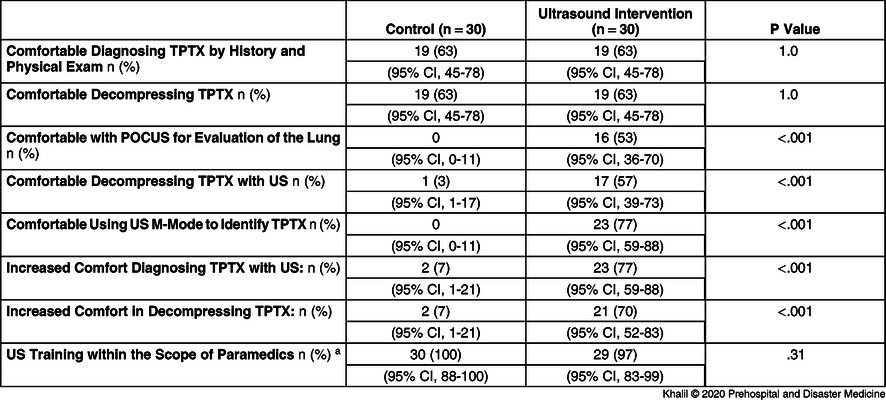
On the post-survey, there was no difference between the two groups in number of prior patients with TPTX (P = .49) with almost all paramedics caring for only zero to five patients with a TPTX (control: 100%; US intervention: 97%). There was also no difference in the number of times the paramedics had previously decompressed a TPTX (P = .60), with almost all paramedics having performed the procedure only zero-five times (control: 100%; US intervention: 97%). One paramedic in the US intervention groups reported caring for more than 10 patients with a TPTX and decompressing a TPTX in more than 10 patients. The majority of paramedics in each group felt comfortable diagnosing and decompressing a TPTX by history and physical exam alone. More paramedics in the US intervention group were comfortable with POCUS for evaluation of the lung, comfortable decompressing TPTX with US, and using the M-Mode to identify a TPTX on US (P <.001; Table 3). Paramedics in the US intervention group reported an increased comfort level with POCUS for evaluation of the lung between the pre-survey and the post-survey (P <.001). More paramedics in the US intervention group reported their comfort had increased in both diagnosing and decompressing a TPTX with US as compared to controls (P <.001; Table 3). When asked to state their preference for additional training, participants preferred hands-on sessions (58; 97%), review of US images with experts (48; 80%), classroom didactics (42; 70%), and web-based teaching (20; 33%). Paramedics’ preferences for future US education were extended focused assessment with sonography with trauma, or eFAST (13; 21%), US guided intravenous placement (13; 21%), advanced lung (10; 17%), advanced cardiac (9; 15%), and airway (6; 10%). All paramedics who responded to the question believed that POCUS was within their scope of practice (30/30 of controls; 29/30 US intervention with one participant from the US intervention group not answering the question; Table 3).
Post-Survey Results: Comfort Level with Diagnosing TPTX and Ultrasound Use

Abbreviation: POCUS, point-of-care ultrasound; TPTX, tension pneumothorax; US, ultrasound.
a One person in the intervention group did not answer.
Discussion
Paramedics were more likely to correctly diagnose a TPTX during a simulation scenario after a brief POCUS educational intervention on the lung exam, although this difference was not statistically different. Based on prior literature used in the sample size calculations, it was expected approximately 50% diagnostic accuracy based on physical exam alone and 85% with US. In this study, there was 57% accuracy with physical exam in the control group and improvement to 77% in the US intervention group. This difference did not reach statistical significance, which may have been achieved with a larger sample size.
Other factors that could have contributed to not achieving statistical significance were that the paramedics were still novices, having completed only 30 minutes of didactics and performed only 10 examinations on volunteers and one with SonoSim. Per guidelines set out by the American College of Emergency Physicians (ACEP; Irving, Texas USA), physicians need to have 16 hours of didactics and perform 25-50 examinations in each of the core applications. 14 When asked to state their preference for future training, 97% stated that they would prefer more hands-on sessions and 80% requested review of POCUS with experts. A common barrier to POCUS education for all types of providers is the availability of POCUS-trained experts in their field, which would likely be true for prehospital personnel. Training for paramedics may need to include novel approaches, including flipped classrooms where the student initially studies web-based learning modules followed by hands-on instruction with experts. Reference Soon, Toney, Stidham, Kendall and Roosevelt15 Paramedics would also likely require specific modules directed towards their specific clinical practice.
Another potential factor contributing to the lack of statistical significance was more paramedics were randomized to the US intervention group who had been a paramedic only a few years (one-two years) or who had been a paramedic for greater than 10 years as compared to controls, although there was no difference in age between the two groups. Younger paramedics may have been more uncomfortable with TPTX pathology and performing procedures while older paramedics may have been more comfortable relying on their physical exam rather than introducing a new technology-based modality for diagnosis.
Secondary outcomes demonstrated that paramedics were much more likely to use POCUS and reported increased comfort levels with US after the intervention. These paramedics were receptive to incorporating new techniques and technology into their clinical practice. This was also reflected when they reported that POCUS is within their scope practice. There was no difference in time to diagnosis or time to intervention between the two groups in the TPTX case. This likely reflects the additional time needed to prepare the US device and perform the scan. There were several incorrect needle thoracostomies performed. In both groups, four paramedics performed bilateral needle thoracostomies despite only a right-sided TPTX. Bilateral decompression can benefit critically ill trauma patients and is often indicated if there is diagnostic uncertainty. It would be expected that the number of incorrect thoracostomies would decrease with more experience and increased comfort with the use of POCUS.
The availability of small, portable, handheld US probes which connect to tablets and smart phones allows POCUS to be convenient and feasible in the prehospital setting. Recent technological advances have improved their image quality such that it is comparable to full-size devices. When compared to full-size machines, portable devices have shown similar image quality and interpretation agreement. Reference Rykkje, Carlsen and Nielsen16 Point-of-care US provides paramedics an additional tool to more definitively diagnose or exclude a life-threatening TPTX. Because of the unique challenges in the prehospital environment (eg, background noise including sirens), POCUS may be a practice-changing intervention when caring for these types of patients.
Limitations
This study has several limitations. In contrast to simulation, there are a variety of barriers to utilizing lung POCUS and making the correct diagnosis in actual practice. This scenario took place indoors in a well-controlled area with good lighting, which is often not the case in the prehospital environment. Additionally, obtaining sonographic windows using the SonoSim system on a manikin may be easier than doing so on a live patient using POCUS. Obtaining real-time images may be more challenging and could lead to fewer correct diagnoses and longer times to diagnosis than seen in this study, although the ability of prehospital providers to obtain adequate images and assess lung sliding has been demonstrated. Reference Lyon, Walton, Bhalla and Shiver17 Additional training and practice beyond the short educational intervention is likely to improve paramedics’ abilities in practice. A larger sample size would have increased the power to detect a difference.
Conclusion
Paramedics were more likely to correctly diagnose a TPTX during a simulation scenario after a brief POCUS educational intervention, although this difference was not statistically significant. Paramedics were also much more likely to use US after education and showed increased comfort levels with US after a brief educational intervention. This intervention was effective despite the paramedics being novices, as the majority had no prior US training and almost all paramedics had not personally performed an US prior. Paramedics believe that POCUS is within their scope of practice.
Acknowledgements
The authors would like to thank South Metro Fire Rescue (Centennial, Colorado USA) for their participation in this study, as well as for the service and hard work that they do to keep the community safe. They would also like to acknowledge SonoSim for allowing them to use their technology to simulate the pathology needed to make this study happen.
Conflicts of interest
The authors have no conflicts of interest to disclose.



Target article
Tension Pneumothorax in Prehospital Setting
Related commentaries (1)
Randomized Controlled Trial of Point-of-Care Ultrasound Education for the Recognition of Tension Pneumothorax by Paramedics in Prehospital Simulation